New Israeli bill banning Palestine flag in protests
Palestine Information Center – December 16, 2018
OCCUPIED JERUSALEM – Israel’s Ministerial Committee for Legislation is scheduled to discuss a new bill imposing a one-year prison sentence on individuals who raise Palestinian flags during demonstrations, according to Haaretz.
Drafted by MK Anat Berko, the bill stipulates that any gathering of at least of three people raising the flag of a state or an entity that is not friend with Israel or that prevents the raising of the flag of Israel will be considered illegal. Anyone who participates in a prohibited gathering would be subjected to up to a year in prison.
The bill defines the states that are not friends with Israel as the “states who do not recognize Israel as a Jewish and democratic state”.
Berko, in her justification, wrote that Israel is a democratic state which allows its citizens to protest against different issues; however, the new bill draws a red line between the legal protest and the protest where the flags of the countries that do not recognize Israel are raised.
Fanning the Flames of Dissent: The Ruling Class Is Having Trouble with Its Israel-Palestine Narrative
By Jason Hirthler | American Herald Tribune | December 15, 2018
Recently, the White House hosted two Hanukkah celebrations attended by the president, first lady, and vice president. One can imagine the general bonhomie as the Trumps rubbed elbows with fellow billionaire Sheldon Adelson and other luminaries of the ‘special relationship’. Trump was cheered for his provocative move of the American embassy from Tel Aviv to Jerusalem, something many observers call a sea change in U.S. foreign policy. Of course, almost every recent president has publicly stated that Jerusalem is Israel’s proper capital. Trump was simply the first president to actually follow through on the implications of that position.
In its coverage of the events, Trump was assailed by the Times of Israel for telling American Jews that Israel was “your country”, as if they were not American citizens. The paper noted that if Barack Obama had made such a rhetorical misstep, he would’ve been savaged by conservative media. As it was, Trump’s language was generally passed over in silence in the mainstream press. Despite that, the president and his coterie of Zionist comrades are likely becoming an ever more isolated pack of wolves on the American scene, their inflexible ideology and its brutal manifestations alienating them from popular opinion in the U.S.
The Scourge of Self-Deception
In his excellent book The Folly of Fools, evolutionary biologist Robert Trivers expounded his theory of deceit and self-deception among humans, including his concept of false historical narratives. A false historical narrative is essentially when a nation or tribe or people collectively believe a false version of their history. Trivers’ particular example? Israel. The author unpacks the country’s long-standing denial of Palestinian agency in its zealous Zionist pursuit of Greater Israel as a form of collective self-delusion. One that has had considerable influence in the United States where AIPAC wields outsized influence on Capitol Hill.
One wonders if false historical narratives are more likely to befall colonial settler nations. After all, the United States itself is beholden to any number of false historical narratives: the belief that America promotes and defends freedom around the world; the belief that it won World War Two; the lack of acknowledgement of the Native American genocide in its historical narrative; and that it has served as an impartial mediator in the Israeli-Palestinian conflict.
This latter belief has been lately exploded by several excellent books, among them Rashid Khalidi’s Brokers of Deceit. Thanks in large part to such works, the rise of social media, and the militancy and visibility of the Boycott, Divestment, and Sanctions (BDS) movement, the general tenor of debate in the United States, at least, has changed. This is deeply troubling for Tel Aviv and Washington, which have long depended on a tightly controlled, top-down narrative to control opinion on Palestinian issues, a storyline dutifully disseminated by sycophantic corporate media. But a false narrative cannot survive or thrive amid a digital space of unbridled debate, much of it agitated unmediated wrangling with a tendency to devolve into ad hominem attacks, but also plenty of powerful non-mainstream journalism bringing fresh perspectives to the topic.
Damming the Flood
Only heavy-handed censorship can hope to stem the tide of dissident voices from chopping the legs out from beneath the mainstream fairy tale of Israeli rectitude and Arab savagery. And that is, of course, precisely what is happening in the social space.
Facebook has purged some 400 pro-Palestinian voices from its platform for violating “community standards,” an ironic phrase given that real community standards would necessarily have to be created by the community, rather than its ‘owner’, presently being advised by the neoliberal, neocon Atlantic Council. Facebook labeled the banned commentary as “hate speech”, a term unsupported by the Supreme Court but happily flung about by the Israeli lobby–alongside the stalwart ‘anti-Semitism’–in efforts to shutter dissent. Twitter, too, has fallen in line with the pro-Israel position of both the government and its mainstream media lapdogs. It has shuttered attempts to out IDF commando unit soldiers who raided Gaza last month. The censorship aligns with Israeli military censors in Tel Aviv.
CNN wasted no time firing Marc Lamont Hill after a fairly normal speech at the United Nations during its commemoration of the International Day of Solidarity with the Palestinian People. Board members at Temple University, where he teaches, rumbled about punitive measures. The treatment of Hill falls in line with a long history of attacks on African-Americans who disagree with American foreign policy, from Paul Robeson during the McCarthy era, the many victims of the FBI’s COINTELPRO effort to destroy black solidarity movements. Even Andrew Young, serving as Jimmy Carter’s UN Ambassador, was forced to resign when he took the bold step of actually talking to the Palestinian Liberation Organization (PLO). An alliance of oppressed peoples across national borders is a true existential nightmare for imperialists, explaining in part why so many African-American leftists have been swift and energetically besieged by establishment agencies.
A Leaky Vessel
But it may be too little too late. Holes are being ripped in the Zionist false narrative, and it is leaking hard truths like a sieve. At last, Americans are beginning to recognize the cruelty of the Israeli occupation. For years the international community has angrily brandished UN resolutions against the occupation, about the right of return, and others declaring Zionism as a form of racism. To little avail. Some sixty resolutions have been widely ignored in the west. With this occupation more than any other conflict in the geopolitical arena, it is as if international law does not exist.
John Mearsheimer and Stephen Walt punctured a gaping hole in the side of stealthy Zionist influence with their landmark work The Israel Lobby and U.S. Foreign Policy. But the social media response to the brutal Israeli siege of Gaza in 2014 was likely the watershed moment. Progressives like Max Blumenthal assiduously documented the assault, while the glib Obama administration’s willingness to sell arms to Israel in the midst of its crushing attack struck many Americans as almost unconscionably blasé. So too the international response to the recently passed Basic Law, in which Israel is confirmed as a Jewish-ethnic state, with all mention of democracy stripped from the language. In one recent step by a major company, Airbnb recused itself from doing business in occupied territories, a move lauded by Palestinian supporters and naturally deplored by Zionists.
The perceptual gap between the views of the American populace and the Israeli citizenry appears to be widening. A recent polling result in Israel uncovered widespread racism targeting Arabs and Palestinians. Israelis were uncomfortable in large numbers to a variety of hypothetical interactions with Palestinians: if their children made friends with Palestinian children, if their neighbors were Palestinian, if people near them spoke in Arabic, and so on. Likewise, many said they’d be unlikely to rent to Palestinians and felt Israelis deserved job placement consideration over Arabs. As a comparison with a comparable European poll showed, Israeli discomfort with Arabs was more widespread than European discomfort with Jews, undermining the MSM discussion of rising anti-Semitism, a phenomenon that Foreign Policy argued was not tied to rising criticism of Israel.
A University of Maryland poll of Americans showed growing support for a one-state solution, as more observers have come to believe that rampant Israeli settlement-building in occupied territory have made a two-state solution completely unrealistic apart from some construction that posited a Palestinian state composed of tiny isolated cantons vigilantly policed by the IDF on the least arable land available (the rest having been annexed by entitled settlers).
A one-state solution is an anathema to Zionists. Israel has long harbored a fear of one day being outnumbered by Arabs in its own ‘homeland’. One hears the occasional trumpeting of a demographic ‘time bomb’ (and sometimes arguments that give lie to the concept). Israelis have cited the ‘security situation’ as an incentive to reproduce. In any event, settlements continue apace. It is instructive to note that inside Israel, there is vigorous debate on this issue: not about the validity of settlements, but the pace at which they are constructed.
Americans also increasingly support sanctions on Israel for its continued settlement activity. This undoubtedly partly owing to the aforementioned thaw in the commentary, particularly of the non-professional variety, but also perhaps has to do with the fact that Washington has leveled sanctions against so many perceived foes in recent years: Venezuela, Nicaragua, Russia, China, Syria, Iran, and on and on. Why, the public must wonder, is Israel left out of this seemingly indiscriminate use of economic leverage?
Zionists have mounted vigorous resistance to BDS, and have persuaded Congress to put forward the Israel Anti-Boycott Act, which would criminalize any kind of voluntary boycotting of Israel and its settlements. This last argument reflects the threadbare smear that pro-Israeli hawks like Alan Dershowitz and other informally appointed paladins of the cause have long used to defend criticism of Israel: that any criticism of Israel or Zionism is a de facto attack on Jews and therefore anti-Semitic. This attempt to conflate Israel with all Jewry is not unlike the facile use of the “hate speech” to encompass all varieties of criticism.
The Race to Narrative Hegemony
Yet dire reports surface almost daily, as Israel clamors to bar and ban and liquidate resistance. Among the recent stories that must have Israeli PR groups a furor: the expelling of Human Rights Watch officials from the country, the shooting of unarmed protestors during the ‘Great March of Return’ border protests, remorseless extrajudicial killings, the expansion of “admissions committees” to restrict Palestinian access to housing, the rationing of electricity and medicines to desperate Gazans, the forcible exile of Bedouins from historic villages. The list is interminable.
Perhaps for these reasons rather in spite of them, some 38 percent of Americans, including 37 percent of Jewish Americans polled, think Israel has too much influence in the American political system. Democrats in particular are increasingly favorable to actually neutral policies toward Israelis and Palestinians, not least because of Obama’s chilly relationship with Tel Aviv, and Benjamin Netanyahu’s undermining of the former president’s JCPOA with Iran.
It is critical to note the yawning abyss between the corporate state and corporate media positions on Israeli-Palestinian issues and those of the American public. While the MSM continues its pro-Israel stance, the ideological ground beneath it is shifting like sand, as Americans have engaged in online debates that have in some cases broadened their perspectives and in others deepened their partisanship. It is forever ironic that efforts to suppress a particular viewpoint tend to exacerbate it. As the mainstream become ever more strident in their response to heterodox opinions, the objections only grow louder. As one might expect, the historical narrative around Israel is now freighted with heretical objections, its propositions subject to relentless dissection in the digital sphere.
It is no surprise then, that Trump’s friends at those White House Hanukkah parties have grown shrill and heavy-handed in their attempts to shout down a rising chorus of resistance to the party line. The question is, can they push Washington and America’s social media giants hard enough to foreclose the numberless avenues of dissent fast enough to salvage what’s left of a tawdry argument for apartheid.
Are Academics Cowards?
The Grip of Grievance Studies and the Sunk Costs of Academic Pursuit
By James A. Lindsay | Areo Magazine | December 4, 2018
There is much that should be said about the ways in which the dominant Social Justice ideology has negative impacts upon the university, free expression, academic freedom and, especially, the sciences. Like all rigid ideologies, Social Justice is inimical to science—not because of what it claims or concludes but because of how it goes about reaching its conclusions. Social Justice, like all rigid ideologies, is only interested in science that supports its predetermined theoretical conclusions and holds all other science suspect.
Of course, the accusation that the sciences are susceptible to the forces of Social Justice and its endless politicking may come as some surprise to those in the sciences, because they are duly confident in their own rigor. They are right to realize that, even if the Social Justice educational reformers go too far or have a frightening amount of institutional control, they cannot really influence science directly because they don’t do science. The assumption held by many, which is plausible, is that scientists will keep doing science according to rigorous scientific methodologies and needn’t worry much about the influence of politics from the more ideological sectors of the academy—including the administration.
This attitude is both laudable and quaintly naive. It is likely to underestimate the degree to which the sciences, like all disciplines, are susceptible to the influences and whims of a dominant orthodoxy. We should note that this exact concern is also what we hear from proponents of Social Justice when they attempt to encroach upon science—it’s perhaps the chorus of the siren song of feminist studies of science and technology to insist that the sciences are already biased and that their activism is a necessary corrective. These criticisms of science insist that science is already prejudiced towards the ideological assumptions of white, Western men and therefore needs to be made more inclusive. This argument, however, goes against the core and essential nature of science, which is universality. Whatever is true about the world should be discoverable by the same methods, regardless of who or what does the experiment.
Another core part of the scientific process is skepticism. This means that science, as a process, is already geared to minimize and correct for potential biases and errors, be they ideological or otherwise. Input into ways to do this more efficiently are always welcome, but Social Justice approaches do not seek to further improve the objectivity of science. Instead, they aim to introduce opposing biases, which they see as effectively counteracting existing ones. Far from being a novel or useful insight, however, concerns about the lack of objectivity on the part of any given observer or theoretician aren’t lost on any serious scientist or philosopher of science and haven’t been in decades (and appropriating Thomas Kuhn’s work here doesn’t work on the Social Justice side).
For these reasons, scientists should be deeply concerned with the possibility that people with strongly ideological and political motives, many of which are ambivalent at best and hostile at worst to the core values of scientific inquiry, might establish themselves as the body of working scientists and arbiters of what science can and should be done and for what reasons. Rigorous epistemology and a certain willingness to let the cards fall where they may and to have one’s ideas proven wrong will suffice.
The thing is, it is extremely likely that a majority of working scientists, at least outside of the social sciences, are keenly aware of the ways in which Social Justice can corrupt science, its conflict with the core values of science and science education, and its potential costs and implications. Nevertheless, it appears that they are letting it happen. Why would they do this?
There’s no real mystery in this question. Most of the scientists who see the writing on the wall and wish they could do something about it will eagerly tell you precisely why they don’t speak and act against the creeping woke hegemony they know will eventually corrupt their disciplines, possibly for generations. They’re afraid. They’re afraid they’ll be fired. They’re afraid they’ll be blacklisted from jobs, tenure and research funding opportunities. They’re afraid they’ll become thorns in the sides of the administration, especially the Grand Wizards of their institutions’ Offices of Diversity and Inclusion, and targets of the newly minted campus inquisition Bias Response Teams, and never have another peaceful day to get real work done. They’re afraid they’ll be done like Tim Hunt was done.
Outside of the academy, this attitude often gets them branded cowards. In fact, the insistence that academics are cowardly, and that’s how we got into this mess in the first place, is one that seems to have a worrying level of support lately. It’s probably true that significant numbers of academics are cowards. In the main, however, it is only true in the sense in which a person is a coward for knowing that the first few to speak out in a revolt against any hegemonic regime are going to be its first martyrs. Speaking game theoretically, she who speaks out first should always be somebody else.
On those grounds, it’s probably not correct to say that academics are cowards. We hear exhortations that they should have the courage to risk their positions by speaking out because they have options. They have PhDs for God’s sake—surely they can get another job somewhere. This is a popular myth, but the opposite is nearer to the truth. Getting a PhD often locks a person into very few options other than to toe whatever line is needed to stay in academia. If we’re going to solve many of the institutional problems facing the academic working environment, not least the creep of Social Justice ideology into these institutions, the reality of the PhD job market is going to have to be taken into account.
To understand and find a workable path forward, we need to empathize.
Imagine yourself as a relatively new PhD. Chances are that you have spent anywhere between the last three and twelve years dedicated to higher education, and you have been following a path of increasing difficulty, paired with increasingly specific and narrow focus. By definition, supposing your committee and institution were up to the task and you’re not a rather extreme outlier, you should be for about eighteen months the world’s foremost authority on some exceptionally narrow topic within a subfield of whatever field you tell people that you got your doctorate in. You’re going to be competent in other aspects of that field, of course, but it’s important to remember that you’ve spent at least the last two or three years of your program (or the entire program, depending on the country where you studied) going right to the bottom of some fairly deep rabbit hole.
Why did you do this? Passion. Love. Interest. Enthusiasm. To pursue the simple dream of doing something you genuinely love doing.
It’s virtually impossible to push yourself through a PhD program unless you truly love the subject you’re studying and want to devote your working life to researching it and teaching it—which means getting an academic job. And earning a PhD isn’t exactly a picnic. (When I did my master’s degree, my reaction was that it was a bit surprising how easy it was to earn compared to my expectations going into the program. When I finished my Ph.D., the only thing I could say was, “they don’t give those away!”) In nearly every case, it takes a great deal of dedication, interest and passion to earn a PhD, to say nothing of luck and talent.
The phrase grad student is misleading. It seems to many kind of like Easy Street. But many PhD students and postdocs work obscene hours—often in excess of eighty hours a week—to keep up with their educational, research and job duties, especially if they want to do well enough to score a tenure-track job later. They usually get summers off from coursework so that they can work even harder on their research, so there’s no real break there. They also usually do this out of passion and grit because there’s hardly any money in graduate assistantship stipends in the wide majority of fields.
And don’t get this wrong. This isn’t a poor PhD candidate story: it’s a tale of investment. A PhD program isn’t just school (or college); it is just another kind of apprenticeship like that any master tradesperson has to go through, except that it takes about a decade of insanely hard work to get through the first stage of it. To earn a PhD requires an enormous investment of time, energy, talent and resources. And what do you get in return (besides your degree and a set of wizard’s robes, complete with a hooded cape and a goofy hat)? (Note: You have to buy the robes and hat, and they’re expensive. Further, you’ll never wear them again unless you go into academia professionally.)
Pause to consider this. Chances are, if you’re looking for academic jobs, especially in the sciences, you’re coming off a postdoc or two, so you’ve literally spent the last decade or more in training for the job you hope to get. You’ve made incredible sacrifices for it. You’ve invested more into getting past the first hurdle of a future career than almost anyone else. Just imagine training at double full time, paid less than minimum wage, for a decade for a job and then being able to think it’s worth risking the career you’re working for to make a political point, even a really important or necessary one.
It’s not easy to call that cowardice when you see what it’s really about.
But you got a PhD at the end of it, so you’ve got little to worry about now, right? Wrong. By the time you earn your PhD, you will have achieved a few things, all of which contribute to why your job prospects outside of the academy border upon the mythological.
One: you’ll be hyper-competent in something pretty narrow and specific, while being generally knowledgeable about the raft of information that supports that specific set of skills. This isn’t particularly great for you, unless you get to apply that specific focus or fall into something closely related. This isn’t really a problem within the academy because it’s where your passion for researching and teaching led you—and it’s the job you trained yourself for—but if you abandon academia, it is a big problem.
Two: you will become overqualified for the vast majority of positions in the working world. For a long time, I wasn’t able to understand how overqualification is a problem, but I do now. If you are overqualified, you aren’t just worth more than many employers might want to pay; you’re worth more for a specific and important reason that matters far more than your education. Employers know that overqualified employees aren’t likely to last a long time in their jobs. It’s altogether too likely that an overqualified employee will become bored with their current job or find one more fitting to their qualifications and leave. This is a real risk for an employer, especially one who may (or may not!) already be paying you a lot more for your time than they’d pay someone rightly qualified for the work. This limits your employment options to something for which you are genuinely qualified (mostly in academia), jobs that don’t care about high turnover rates or jobs obtained through nepotism.
Three: despite having proved your capacity to learn new things and get very, very good at them, you’re likely to be essentially useless at everything else. I know this is a tough pill to swallow for a lot of PhDs, but it’s exactly how they’re seen from the outside. Even making the jump from a coding-heavy science specialty to something like commercial data mining—which you probably have the skills to adjust to quickly—isn’t an easy sell.
The result of this is the following employability portfolio. Unless something pretty fortunate happens to you (or nepotism), you can either (a) get a job in your field, which will almost certainly be in academia for most PhDs; (b) attempt to build something on your own; or (c) work somewhere that has high enough employee turnover not to care about your overqualification, for example, as a stocker in a grocery store or a barista in a coffee shop. The myth here is that (b) is easy because you have a PhD. It is, in fact, by far the most difficult of the three options. And (c) is about two notches above throwing the hardest decade of your life in a dumpster and setting it on fire.
Essentially, shooting for that job in academia—which is probably your main ambition anyway—takes a ton of work but is worth competing for because building something successful on your own takes a lot of auxiliary skills, work, time and luck, and it’s still extremely high risk. Most people who try this path fail, and there’s nothing in staying in formal educational spheres until you’re almost thirty that increases your odds at making it in the real world.
Worse, you haven’t probably had the time or resources to lay any of the tracks to pull this off if you’ve been working in academia up until this point because those jobs are usually insanely busy, especially now. That also implies that you can’t really safety net yourself in an academic job while you start building something because working in academia (especially sub-tenure) will leave you with absolutely no time to build a goddamn thing.
Because there are so many people with PhDs now and so many more in the educational pipeline, the academic jobs you’re after (both for practical reasons and because, remember, it’s probably your dream) are insanely competitive—often against people who literally cannot understand why anyone wouldn’t want to work as hard as they can for every waking moment of their lives. Therefore, these extremely demanding jobs don’t come easily, and thus there’s a lot of justifiable fear of losing one. (The applications process for academic jobs is, itself, a fairly brutal full-time job—except it doesn’t pay a cent.) This is even without factoring in the insane investment that went into being qualified for them in the first place.
It’s grimmer than that, though. Because your skill set is likely to be highly specific in your research and limited to education outside of it, there’s pretty much nothing left for you in the overqualification gulf between these options and working the back room of a big box store. And you can’t safety net there, either.
The same forces also make for another type of hypercompetitive pressure on academic jobs—you go obsolete fast. Your skills are hyper-specific, and there’s an army of people coming up behind you, with similar hyper-specific skills, which are just that little bit more fresh. Remember how I mentioned that you’ll be the world’s expert in your dissertation topic for about eighteen months? Yeah, well, take that much time off, and you’re obsolete. There’s no bridge back, at least not to a tenure-track position at a research university. After that much time has passed out of active work in your field, it will be virtually impossible for you to convince anyone that you’re marketable against the glut of hungry candidates who haven’t stepped away for a minute.
So, if you’re going to go for that academic job, you’re going to have to chain yourself to it. Your alternatives are to abandon it entirely (along with your dreams and most of the point of your hard work up to that point) and either take the great risk of building something new, completely changing course in life (probably by taking up a trade), or working in the lowest sectors of the economy, just as you could have done without ever chasing your dreams first.
So take a minute to imagine working a double-full-time apprenticeship in something you’re passionate about and want to do more than anything else in your life, doing it for a decade, and then having to give that up to serve someone coffee because you had political opinions that bucked the institutional orthodoxy. Worse, tenure is (perceived to be) little protection against the considerable inroads made by the Social Justice ideology into the academic institution’s administrative ranks, so that the further one goes in an academic career, the more one has to lose by challenging it. To lose tenure is, in a best case scenario, to have to earn it again, and if PhDs don’t come easy, tenure is far worse. It’s a grim picture.
This set of options sucks so much ass that it’s perfectly reasonable—not cowardly in the least—for so many academics to choose chaining themselves to their careers to be able to keep doing the thing they loved enough to go to college for a decade to be able to do and teach. I mean, you could go back to teaching as an adjunct, but you’re quite literally better off bartending.
In short, we don’t see most academics risking their careers to speak out against the creep of Social Justice ideology or other institutional and administrative nightmares because the risks just aren’t worth the potential rewards in most cases. This isn’t cowardice. It’s a legitimate problem to be overcome.
The thing is, there won’t be change if a few faculty members speak up. On the contrary, by putting themselves in the firing line and being summarily executed, other academics are likely to be further deterred from speaking out. To make a difference will require a critical mass action. It will require honest communication between academics for them to realize how many of them there are who see the same problem and become emboldened enough to feel safe speaking up about the institutionalization of a Social Justice orthodoxy throughout the academy and beyond. What we need now is a way for academics to connect with each other, share their concerns, discuss ways in which they can support each other and then all speak out at once.
The question comes down to what working scientists and other academics who are concerned about Social Justice ideology can do about any of this. Here are a few suggestions. Do as much as you can feel safe doing. That may mean making anonymous posts on message boards, social media or elsewhere. It may mean signing your name to the same, if you think you can. It is probably helpful to feel out the situation with your colleagues and find out whom you can talk to or to seek out similar people online. The purpose of this is to realize that many other people are concerned that the educational reformers and Social Justice busybodies have gone too far. Recognize that what these groups are after is far more than the pleasant sounding diversity, inclusion and equity and look into what those terms really mean. You may find that a great deal of what they’re after is at direct odds with your core values, and this might rouse you to want to do more about it. Most importantly, realize that you’re not alone in this, and you probably have far more colleagues who agree with you than who do not.
Egypt bans yellow vests fearing copycat Gilets Jaunes protests
MEMO | December 11, 2018
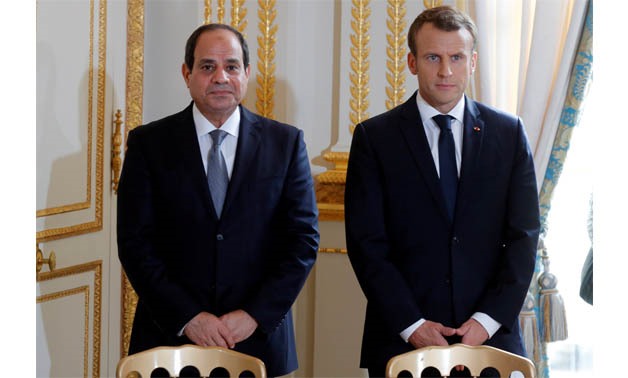
The Egyptian authorities have quietly clamped down on the sales of reflective yellow vests fearing that they could prompt copycat protests inspired by the Gilets Jaunes demonstrations taking place in France. The measure was taken as a precaution as Egypt approaches the seventh anniversary next month of the revolution that toppled the dictator Hosni Mubarak after a 30-year rule. Any form of public gatherings are banned.
According to testimonies from industrial equipment dealers in Cairo, retailers have been instructed not to sell yellow vests to walk-in buyers and to restrict business to wholesale deals with verified companies, but only after obtaining permission from the security forces.
“They seem not to want anyone to do what they are doing in France,” said one retailer. Another added that, “The police came here a few days back and told us to stop selling them. When we asked why, they said they were acting on instructions.” Both spoke to reporters on the condition of anonymity, for fear of reprisals from the authorities.
Security officials confirmed that the restrictions would remain in place until the end of January, but the Interior Ministry refused to comment on the issue. Over the past two years, hundreds of police officers and soldiers have been deployed across the country to quash any protests or commemorations of the revolution.
The yellow vests worn by French protesters have become a symbol of the wave of demonstrations against a rise in fuel taxes and the economic policies of French President Emmanuel Macron.
Egyptian media outlets have covered the Paris protests regularly, stressing the riots, looting and arson, in an attempt to support Egyptian President Abdel Fattah Al-Sisi’s frequent warnings that street action leads to chaos. In October, Al-Sisi even described the 2011 Egyptian revolution as “the wrong cure to the wrong diagnosis,” stating that the protests had achieved insufficient change due to a lack of understanding among the people of what the problems in the country were.
Egypt has witnessed a dramatic crackdown on freedom of speech since the military coup in 2013 that brought Al-Sisi, then a general, to power. The government has also increased regulatory legislation on the grounds of “national security”. The Muslim Brotherhood, which played an instrumental role in the revolution and was subsequently elected to govern, has since been banned and declared a terrorist group.
Amnesty International has described the situation in Egypt as the worst human rights crisis in the country in decades, with the state systematically using arbitrary arrests and enforced disappearances to silence any dissent and create an atmosphere of fear. Hundreds of journalists and human rights activists have also been arrested and held without trial.
The government in Cairo has criticised the findings of many NGOs and accused them of being deliberately “misleading” about human rights abuses in Egypt.
The Bowdlerized Bush Obituaries
Something is missing
By Philip Giraldi • Unz Review • December 11, 2018
When George H.W. Bush died on November 30th, America’s two self-proclaimed newspapers of record The Washington Post and The New York Times were both quick off the mark in publishing what appeared to be definitive obituaries of the former president and statesman that had clearly been prepared in advance. The obit by The Times and that by The Post differed little in substance but they had one curious omission, i.e. President G.H.W. Bush’s eighteen month confrontation with Israel and its powerful domestic lobby.
In 1991-1992 President Bush engaged in a series of sharp exchanges with Israel and its American lobby over the issue of $10 billion in loan guarantees to the Jewish state to pay for the resettlement of Russian Jews, who were beginning to arrive in both Israel and the West in large numbers. Bush correctly assumed that the loans would in fact also subsidize the expansions of illegal settlements on the West Bank and in Gaza, which the U.S. government opposed, so he said “no” to the loans. After a series of increasingly acrimonious exchanges back and forth, Bush, facing election, withdrew his objections and the loans were approved, but he was the only U.S. president since John F. Kennedy to confront the Israel Lobby in any serious way. Kennedy was, of course, assassinated and Bush was defeated for reelection.
Both G.H.W. Bush and many other observers of the campaign and election believed the loss to Bill Clinton in 1992 was at least in part attributable to the actions of Israel and its friends. The conflict between Bush and the Israeli government backed up by the Israel Lobby and a number of congressmen and media outlets began in the spring of 1991. By September, President Bush refused to approve the loan guarantees as he believed that withholding approval of the money would give the U.S. leverage in peace negotiations with the Arabs that were planned for the end of the year in Madrid. Bush felt that Israeli Prime Minister was not taking the U.S. seriously because he believed that he would get what was wanted from Congress in any event without stopping settlement construction or having to concede anything to the Palestinians. There was also a distinct possibility that the Israelis would not bother to participate in Madrid without some kind of possible financial inducement.
Bush fought hard against the Israeli government and the thousands of American Jews plus their organizations that mobilized against him. Thomas Dine, Executive Director of the American Israel Public Affairs Committee (AIPAC) declared that the day when Bush rejected the loan guarantees would prove to be “a day that lives in infamy for the American pro-Israeli community.” Sentiment against the president in the Jewish community was so intense that many prominent American Jews to this day consider any nostalgia towards the man or his presidency to be an expression of anti-Semitism.
Bush did not roll over. He famously called a press conference in which he said: “We’re up against very strong and effective, sometimes, groups that go up to the Hill. I heard today there were something like a thousand lobbyists on the Hill working the other side of the question. We’ve got one little guy down here doing it… The Constitution charges the president with the conduct of the nation’s foreign policy… There is an attempt by some in Congress to prevent the president from taking steps central to the nation’s security. But too much is at stake for domestic politics to take precedence over peace.”
In October Bush obtained a four-month delay in the loans, a defeat for the Israel Lobby, but the process dragged on into the following summer. On August 12, 1992, Bush, in trouble with his presidential campaign, finally approved the guarantees, which would enable the Israelis to borrow money at a low interest rate. Ironically, by June 1993, none of the borrowed money had been used and Israeli sources admitted that they have never needed the loans. The entire affair was actually a test of strength against the U.S. government, a competition that the Israelis and their friends had persevered in and won.
None of the tale of the Israeli loans appeared in either obituary. Nor was there any hint that Bush might have lost the election in part because pro-Israel forces worked actively against him. Voting tallies reveal a sharp shift in Jewish votes in swing districts to favor Clinton but the impact of Jewish money into the campaign as well as the anti-Bush media onslaught are inevitably more difficult to assess. The Times of Israel observed that “He made clear the cost of an American president waging a political fight against the vast coalition of pro-Israel lobbying groups. In doing so, he exposed the limits of what the world’s most powerful man can do…” George Herbert Walker Bush certainly believed that he was defeated by the Israeli government and its lobby, and he passed that judgment on to his son George W. who was careful not to anger the Israeli/Jewish constituency.
G.H.W. Bush was not the first American statesman to be on the receiving end of a bowdlerized obituary over the subject of Israel. In February 1995, former Senator William Fulbright was remembered by The Times without any reference to his views on the Middle East that had led to his failure to be reelected. As head of the Senate Foreign Relations Committee, Fulbright’s was a powerful voice that could not be ignored. He wrote: “So completely have many of our principal officeholders fallen under Israeli influence that they not only deny today the legitimacy of Palestinian national aspirations, but debate who more passionately opposes a Palestinian state. The lobby can just about tell the president what to do when it comes to Israel.”
In Fulbright’s case, the Lobby launched a media and personal vilification campaign against him when he came up for reelection in 1974. Late in the campaign, they came up with an opposition candidate Dale Bumpers whom they generously funded and Fulbright was defeated. His obituaries in the mainstream media would have the reader believe that none of that had actually happened.
Fulbright was followed a decade later by Senator Charles Percy of Illinois who was targeted by the Israeli Lobby because he had voted to approve the sale of AWACS planes to Saudi Arabia. His defeat was choreographed by the Israel Lobby and wealthy Jews and was henceforth called the “Percy Factor,” a warning to even the most established politicians never to trifle with Jewish power. Percy died in 2011 and he too received an obituary from The New York Times that ignored his involvement with the Middle East and the Israel Lobby.
The self-censorship by the media when the topic is Israel is remarkable, nowhere more evident than in the obituaries of leading politicians who had anything at all to do with the Middle East. George H.W. Bush, William Fulbright and Charles Percy all confronted the Israel Lobby because they were patriots aware of the terrible damage it was doing to the actual interests of the United States. In a sense, all three of them enjoyed some success but were eventually defeated by Israel and its friends within the American oligarchy. No other foreign policy lobby, indeed, no other lobby of any sort, has that kind of power in the United States. The obituary of G.H.W. Bush should serve as a warning, recalling a comment sometimes attributed to Voltaire: “To learn who rules over you, simply find out who you are not allowed to criticize.”
Philip M. Giraldi, Ph.D., is Executive Director of the Council for the National Interest, a 501(c)3 tax deductible educational foundation that seeks a more interests-based U.S. foreign policy in the Middle East. Website is www.councilforthenationalinterest.org, address is P.O. Box 2157, Purcellville VA 20134 and its email is inform@cnionline.org.
The EU and the warning signs of Fascism

Image source – here
By Kit Knightly | OffGuardian | December 10, 2018
Things are spiralling out of control in Europe, faster than many predicted. Outside of Brexit, there is strong anti-EU feeling in Hungary, Spain, Italy, Greece and France. The EU is in danger of crumbling, and people afraid of losing power are prone to extreme acts of dictatorial control.
How long before the EU truly becomes the authoritarian force that people from both ends of the political spectrum have always feared?
The EU Defence Force
Earlier this year, the EU voted to “punish” one of its own members, Hungary, for the internal policies of its elected government. To be clear about this – whatever you think of Viktor Orban, he was elected by the people of Hungary. He is their legally recognised democratic leader. Hungary voted for him – in contrast, Hungary did NOT vote for any of the 448 MEPs who supported the motion, posed by Dutch MEP Judith Sargentini, that:
The Hungarian people deserve better… They deserve freedom of speech, non-discrimination, tolerance, justice and equality, all of which are enshrined in the European treaties.”
Note that “democracy” is not included on that list. “Tolerance”, “justice” and “equality”, but not democracy. A Freudian slip, perhaps.
The European Parliament vote was, itself, a corrupt nonsense – one in which abstentions were disregarded so the 2/3rds majority could be reached. Forcing through a bill that, essentially, calls for a change of regime in Hungary via:
“appropriate measures to restore inclusive democracy, the rule of law and respect for fundamental rights in Hungary”
One suggested punishment – “The Nuclear Option” – is a loss of voting rights. Hungary would still be a member of the EU, would still have to pay into the EU, would still have to obey all EU laws and regulations, but would no longer have a say in what those laws were.
This would, notionally, be in defence of “inclusive democracy”.
How long before disapproval and punishment of certain leaders turns into outright removal? Can we really say that would never happen?
This month, Paris (and other French cities) have seen the massive Gilets Jaunes protests against the fuel tax, austerity and income inequality. The violent repression of these protests has received no criticism from either individual member states of the EU, or the EU itself. However, an armored vehicle painted with the EU’s insignia was seen on the streets of Paris.
Both Macron and Merkel have talked, recently, of the need for an EU Army – will these protests in France be used as an excuse to implement those plans?
Let’s assume the EU Army is brought about – let us supply the European Union with its coveted “defence force”. 250,000 hypothetical men, drawn from all the member states. What is their purpose? What is their function?
For example, would they have been deployed to Catalonia last year to “keep the peace”? Would an EU army have moved against a peaceful vote to “defend” the integrity of the Union?
Would a possible step in dealing with Viktor Orban’s government be to deploy the EU Defence Force to Budapest and remove the man who is a threat to “equality”? Would that count as “appropriate measures to restore inclusive democracy”?
If Brexit is ruled a “threat to human rights” (or some other collection of buzzwords), would the EU army be rolling armoured vehicles along the streets of London to protect us from ourselves?
There have been, and could be, many situations in the EU’s recent past where military intervention was only avoided because it literally wasn’t an option. An EU Army would make it an option, do we trust Brussels not to avail themselves of it?
Some argue that an EU Army would be a good thing because it would decrease Europe’s reliance on NATO, and remove US influence. I don’t believe that to be the case, and as evidence, I supply the fact that the Carnegie Endowment for International Peace, a well-known US-backed NGO, is very much in favour of the plan.
The EU’s Ministry of Truth
Of course, the increasing possibility of an EU consensus imposed by force is only one part of the threat.
Outside of physical repression – both by the EU (of national sovereignty), and by the state (of the individual right to protest) – there are warning signs of intellectual repression. A coming crackdown on freedom of expression and opinion.
There is a scary article on The Guardian today: Russia ‘paved way for Ukraine ship seizures with fake news drive’ . It’s not scary because of the headline – it’s scary because of the motivations behind it, and the implications for the future of Europe.
The meat of the article is an unsourced, unlinked, evidence-free claim of Russian malfeasance, and as such, Hitchens’ Razor applies.
The first half of the article is riddled with lies, omissions and mistakes. It’s the Guardian, you expect that. Disregard the babble about cholera and nuclear bombs. Disregard the factual errors – many though they are. In this instance, none of it matters.
All that matters is the second half – the proposed “solution” to the “problem” to which this article is a “reaction”. Namely, online disinformation. Specifically, “Russian” online disinformation.
Julian King, former UK ambassador to France and now EU security commissioner, wants tech companies to take steps to prevent the spread of “fake news”. It’s a war against dissent, with three fronts.
One – establish the “truth”:
Last week the European Commission announced it would set up a rapid alert system to help EU member states recognise disinformation campaigns
Essentially, there will be an EU mandated list of acceptable “news”, and anything which deviates from that in the slightest way will be branded “disinformation”. This will allow people to dismiss, rather than engage with, views that differ from their own.
Two – eliminate dissent:
King said social media platforms needed to identify and close down fake accounts that were spreading disinformation.
By “fake accounts”, they mean accounts which spread “disinformation”. Being a “bot” is not about whether or not you are a real person, it’s about whether or not you have the right opinions. As has been demonstrated, they either do not know or do not care who is real and who is not. Perfectly real people have been labelled Russian bots in the media, when they are proven to be neither Russian nor bots. Whether this is incompetence or corruption does not matter, the point is governments have shown they cannot be trusted on this issue.
Three – control the narrative:
We need to see greater clarity around algorithms, information on how they prioritise what content to display, for example. If you search for anything EU-related on Google, content from Russian propaganda outlets like RT or Sputnik is invariably in the first few results…. All of this should be subject to independent oversight and audit.
The Google algorithm is allowing news that either disagrees with the EU, or is directly critical of it, to be shown in their results. This is unacceptable. What the EU security commissioner wants is for Google to “fix” their system, to make sure news that deviates from the EU’s agenda does not show up in their results.
Now, if you think that sounds like censorship, don’t worry because [our emphasis]:
What we are not trying to do is to censor the internet. There is no suggestion that we – or anyone else – should become the arbiter of what content users should or shouldn’t be consuming online. This is about transparency, not censorship.
The EU wants Google to remove certain websites from their algorithm, but it’s about transparency, not censorship. So that’s OK.
Conclusion
To sum up:
- The European Union’s two major figureheads are both in favour of an EU army.
- The European Union’s flag is painted on armoured vehicles repressing anti-government protests in France.
- The European Union is putting aside £4.6 millio (5 million Euros) to “help people recognise disinformation”.
- The European Union wants to pressure social media companies into “shutting down” accounts that spread “fake news”.
- The European Union wants Google to alter their algorithm, to promote news that praises the EU and demote sites critical of it.
- The European Union wants us to understand that this is about “transparency” and is definitely NOT censorship.
Does this sound like an organization of which we want to be a part? Are we supposed to like the proposed multi-national EU “defense force” putting down anti-EU marches on the streets of Barcelona or Rome? To cheer on the idea that the EU Army could be sent into non-cooperative member-states to remove “dangerous” elected leaders because they are a threat to “equality”?
We won’t even be able to get to the truth of those matters, because the EU will be supplying lists of “fake news” social media accounts to Twitter and Facebook, who will dutifully shut them down. While Google alters and re-alters their algorithm to make sure any news covering EU repression of democracy is pushed so far down the results pages it may as well not exist.
The British press, pundits and talking heads are constantly referring to the “Brexit crisis”, but that’s just hysteria and fear mongering. Re-negotiating your position in a trade bloc is NOT a crisis. A crisis is what happens when an unelected, bureaucratic power structure suddenly senses its grip on power is slipping, and acts accordingly.
And a crisis could well be on the horizon. The signs are there, if you want to see them.
Kit Knightly is co-editor of OffGuardian. The Guardian banned him from commenting. Twice. He used to write for fun, but now he’s forced to out of a near-permanent sense of outrage.
Controlling the Israel Message: How to Manage the American Sheeple
By Philip Giraldi | American Herald Tribune | December 3, 2018
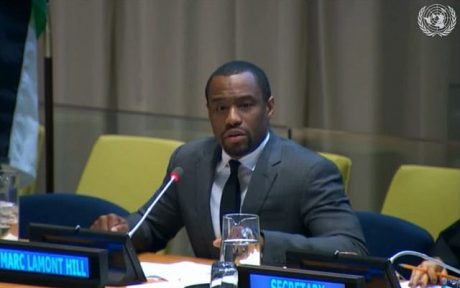
There has been another defenestration of a television-based political commentator for touching the only real electrified third rail remaining in reporting what passes for the news. Marc Lamont Hill, a Temple University professor of Media Studies and Urban Education, who is a regular political commentator on CNN, was fired for what he said in a speech at the International Day of Solidarity with the Palestinian People, which took place last Wednesday at the United Nations. Hill called for a “free Palestine from river to the sea,” which CNN considered grounds for terminating his contract.
As ever, the Israelis were quick to jump on the bandwagon with their New York Consul General Dani Dayan denouncing Hill as a “racist, a bigot, [and] an anti-Semite.” He noted that Hill is under contract both with Temple University and CNN, implying that he should be punished by being fired, and called the remarks “appalling.” To no avail, Hill responded “I support Palestinian freedom. I support Palestinian self-determination. I am deeply critical of Israeli policy and practice. I do not support anti-Semitism, killing Jewish people, or any of the other things attributed to my speech.”
Hill was fired by CNN within 24 hours. The message is clear. You can criticize Christianity, Muslims, white males, Donald Trump and the American government at will and you can even criticize blacks or sexual alphabet soups if you are clever in how you do it, but never, never go after Jews or Israel even indirectly if you want to keep your job. One recalls the fate of Rick Sanchez, a CNN anchor who was fired in September 2010 one day after he complained about how Jon Stewart and others in the Jewish mafia that runs the media treat Hispanics, saying “Yeah, very powerless people. He’s such a minority. I mean, you know, please. What—are you kidding? I’m telling you that everybody who runs CNN is a lot like Stewart, and a lot of people who run all the other networks are a lot like Stewart. And to imply that somehow they, the people in this country who are Jewish, are an oppressed minority?”
Sanchez was forced to publicly grovel for his “inartful” comments and even had to write a letter of apology to the monstrous Abe Foxman of the Anti-Defamation League (ADL). Far worse, he also had to endure two hours of counseling with “America’s rabbi” Shmuley Boteach. Sanchez subsequently drifted through low level jobs for a number of years, but he is now a news anchor with RT America.
Also in 2010, Octavia Nasr, a Lebanese-American journalist who had been CNN’s Senior Editor for Mideast Affairs for over 20 years was immediately fired after she tweeted “sad to hear of the passing” of Lebanese cleric Sayyed Mohammad Hussein Fadlalah. Fadlalah’s only crime was that he had been demonized by Israel and the neocons as a “spiritual mentor” of Hezbollah. Nasr’s only crime is that she granted the admittedly controversial dead man some respect.
To be sure, CNN is pro-Israeli in its reporting and, more important, in terms of choosing what not to report. Its lead political anchor is Wolf Blitzer, a former American Israeli Political Action Committee (AIPAC) employee, who speaks Hebrew and has lived in Israel. Like most major American mainstream media outlets, CNN has numerous Jewish employees working to select, edit and produce the news stories that actually air, well placed to manage what does finally go out to the public.
Reports critical of Israel or Jews are not welcome anywhere in the U.S. national media, which is why Israel gets away with slaughtering unarmed Gazans using army snipers. I note a recent bizarre though interesting story that appeared in the British media and was not picked up by the U.S. mainstream at all. The story detailed how the leadership of the European Jewish Congress is seeking the insertion of “warning messages” in both Christian and Muslim holy texts. In a document entitled “An End to Antisemitism,” which was released last week, it was recommended that “Translations of the New Testament, the Qur’an and other Christian or Muslim literatures need marginal glosses, and introductions that emphasize continuity with Jewish heritage of both Christianity and Islam and warn readers about antisemitic passages in them. While some efforts have been made in this direction in the case of Christianity, these efforts need to be extended and made consistent in both religions.” One wonders when the same body will be recommending that the nastier bits of the Torah and Talmud be “glossed” to deal with the numerous slaughters of conquered peoples as well as slurs on Jesus Christ and assertions that Jews have the right to treat non-Jews as no better than livestock?
Some in the media might argue that the same set of rules about not offending one’s religious beliefs would apply to all religions, not just to Judaism, but it is difficult to find evidence of any even handedness, particularly when Islam is being discussed by commentators who are completely ignorant of the tenets of the religion. Nor are there any apparent limits in making ridiculous statements on CNN if one is disparaging Arabs, most particularly if they are Palestinians. CNN paid commentator former Pennsylvania Senator Rick Santorum has claimed absurdly that Palestinians do not even exist, which many Israelis believe, without any admonishment. Consider the outrage if he were to say that Jewish Israelis do not exist, which may actually be much closer to the truth according to some geneticists.
And what about when a Jew is attacking Christians? Far from there being any consequences, there is a demonstrable double standard as Christian beliefs appear to be fair game in some circles. Dana Jacobson currently co-anchor for the weekend edition of CBS national morning news experienced an apparently alcohol driven meltdown at a sports roast that she was helping emcee in January 2008 when she was working for ESPN.
Belting down vodka and cursing “like a sailor,” Jacobson went after Catholics in particular and said “Fuck Notre Dame,” “Fuck touchdown Jesus” and “Fuck Jesus” a number of times before she was hauled off the stage. Her after-the-fact apology consisted of written concession that she had demonstrated a “poor lack of judgment.” And her punishment by ESPN also demonstrated a “lack of judgment” when the company spokesman Josh Krulewitz reported that “Her actions and comments were inappropriate and we’ve dealt with it.” Dealing with it apparently consisted of a one-week suspension.
Any company operating in the United States should be able to dismiss an employee for any reason or for no reason, but anything even mildly critical of Jewish collective behavior or Israel is severely punished immediately. Professor Marc Lamont Hill said nothing wrong. On the contrary, he said something badly needed and which should have been accepted by CNN if it were really a global communications network dedicated to the truth and, one might add, to justice. Instead it was more of the same old, same old. If you criticize Israel don’t let the door hit you in the ass as you leave the building.
To Rid the World of Antisemitism
By Gilad Atzmon | November 29, 2018
On Tuesday, CNN published a survey of anti-Semitism in Europe. The poll revealed that “more than a quarter of Europeans surveyed believe Jews have too much influence in business and finance. One in five say they have too much influence in media and politics. In some countries the numbers are often higher: 42% of Hungarians think Jews have too much influence in finance and business across the world.”
In my recent book, Being in Time, I argue that Jewish power is the power to silence opposition to Jewish Power. CNN’s poll supports my thesis. That some Jews enjoy significant influence in politics, culture and finance is not a matter of ‘opinion,’ it is an established fact as reports in the Jewish and mainstream media reveal on a daily basis. Jewish prominence in certain areas is a frequent boast of renowned Jews such as Alan Dershowitz. Yet only one of five Europeans is brave enough to admit that in the open.
CNN’s poll suggests that 80% of those who dwell in Europe are either lying, blind or, most likely, terrified of the truth. They have good reason to be scared. They have seen the onslaught of revenge from Jewish institutions against artists, writers, comedians, politicians, activists and academics including: Dieudonné M’bala M’bala, Richard Falk, Alison Weir, Norman Finkelstein, David Icke, Jeremy Corbyn and yours truly. Telling the truth about Israel, Zionism or expressing any form of criticism of Jewish politics subjects the teller to an immediate and colossal smear campaign. The CNN poll suggests that 80% of Europeans seem to have accepted the present tyrannical and authoritarian conditions. But this isn’t exactly a stable situation. It is only a question of time before the genie pops out of the bottle as has happened far too many times in the past.
By now it has become clear that the more Jewish institutions ‘fight’ anti-Semitism, the more the opposition is directed against Jewish politics and Israeli brutality. The same applies to the holocaust; the caravans of Jewish youngsters visiting Poland didn’t kill anti-Semitism nor did it revive the memory of the holocaust. In Poland, according to the CNN poll, “50% of people think that Jews use the Holocaust to advance their position.”
What can Jews do about anti-Semitism? Simple– look in the mirror– introspect.
If Jews want to be loved or simply just ignored, then:(1) maybe The European Jewish Congress should seriously consider the possible consequences of its ‘demand’ that “the Bible and the Koran use ‘trigger warnings’ to highlight anti-Semitic passages,” (2) The French Jewish organisations might want to reconsider their relentless campaign to decimate the artistic career of France’s most popular comedian, or (3) It might not be a great idea for Britain’s Jewish institutions to interfere with British national politics by smearing Britain’s number one anti racist.
If Jews want to rid the world of antisemitism, Jewish bodies should carefully self reflect and take responsibility for their own actions instead of blaming the Goyim…
Beware the Trumpenleft!
By C.J. Hopkins | Consent Factory | November 26, 2018
Unless you move in certain leftist circles, you may not have heard about one of the Russians’ most insidiously evil active measures, an active measure so insidiously evil that it could only have been dreamed up in Moscow, the current wellspring of insidious evil. Its official Russo-Nazi-sounding code name is still being decided on by leftist cryptographers, but most people know it as the “Trumpenleft.”
The Trumpenleft (or “Sputnik Left,” as it is also called by professional anti-Putin-Nazi intelligence analysts) is pretty much exactly what it sounds like. It is a gang of nefarious Putin-Nazi infiltrators posing as respectable leftists in order to disseminate Trumpian ideology and Putin-Nazi propaganda among an assortment of online leftist magazines that hardly anyone ever actually reads. The aim of these insidious Trumpenleft infiltrators is to sow confusion, chaos, and discord among actual, real, authentic leftists who are going about the serious business of calling Donald Trump a fascist on the Internet twenty-five times a day, verbally abusing Julian Assange, occasionally pulling down oppressive statues, and sharing videos of racist idiots acting like racist idiots in public.
The Trumpenleft is determined to sabotage (or momentarily disrupt) this revolutionary work, mostly by tricking these actual leftists into critically thinking about a host of issues that there is no good reason to critically think about … global capitalism, national sovereignty, immigration, identity politics, corporate censorship, and other issues that there is no conceivable reason to discuss, or debate, or even casually mention, unless you’re some kind of Russia-loving Nazi.
Angela Nagle’s recent piece in American Affairs is a perfect example. Nagle (who is certainly Trumpenleft) puts forth the fascistic proposition that mass migration won’t help the world’s poor, and she claims that it creates “a race to the bottom for workers” in wealthier, developed countries and “a brain drain” in poorer, less developed countries. After deploying a variety of Trumpenleft sophistry (i.e., fact-based analysis, logic, and so on), she goes so far as to openly suggest that “progressives should focus on addressing the systemic exploitation at the root of mass migration rather than retreating to a shallow moralism” … a shallow moralism that reifies the dominant neoliberal ideology that is causing mass migration in the first place.
This is the type of gobbledegook the Trumpenleft use to try to dupe real leftists into putting down their phones for a minute and actually thinking through political issues! Fortunately, no one is falling for it. As any bona fide leftist knows, there is no “mass migration problem.” The whole thing is simply a racist hoax concocted by Putin, Alex Jones, and other Trumpian disinformationists. The only thing real leftists need to know about immigration is that immigrants are good, and Trump, and walls, and borders are bad! All that other fancy gibberish about global capitalism, Milton Friedman, labor markets, and national sovereignty is nothing but fascist propaganda (which needs to be censored, or at least deplatformed, or demonetized, or otherwise suppressed).
But Angela Nagle is just one example. The Trumpenleft is legion, and growing. Its membership includes a handful of prominent (and rather less prominent) fake leftist figures: Glenn Greenwald, who many among the “Resistance” would like to see renditioned and indefinitely detained in some offshore Trumpenleft gulag somewhere; Matt Taibbi, who just published a treasonous article challenging the right of the US government to prosecute publishers as “enemy agents” for publishing material they don’t want published; Julian Assange, who is one such publisher, and who the US has scheduled for public crucifixion just as soon as they can get their hands on him; Aaron Maté of the Real News Network, a notorious Trump-Russia “collusion denialist“; Caitlin Johnstone, an Australian blogger and poet who the Red-Brown Putin-Nazi hunters at CounterPunch have become totally obsessed with; Diana Johnstone, who they also don’t like; and (full disclosure) your humble narrator.
Now, normally, the opinions of some political journalists and rather marginal political writers wouldn’t amount to a hill of beans in this crazy world, but there’s a war on, so there’s no room for neutrality. As I mentioned in my latest essay, over the course of the next two years, the global capitalist ruling classes need to make an example of Trump, and Assange, and anyone else who has had the gall to fuck with their global empire. Part of how they are going to do this is to further polarize the already extremely polarized ideological spectrum until everyone is forced onto one or the other side of a pro- or anti-Trump equation, or a pro- or anti-populist equation … or a pro- or anti-fascist equation.
As you probably noticed, The Guardian has just launched a special six-week “investigative series” exploring the whole “new populism” phenomenon (which began with a lot of scary photos of Steve Bannon next to the word “populism”). We are going to be hearing a lot about “populism” over the course of the next two years. We are going to be hearing how “populism” is actually not that different from fascism, or at the very least is inherently racist, and anti-Semitic, and xenophobic, and how, basically, anyone who criticizes neoliberal elites or the corporate media is Russia-loving, pro-Trump Nazi.
And this is where this “Trumpenleft” malarkey fits into the ruling classes’ broader campaign to eliminate any kind of critical thinking and force people to mindlessly root for their “team.” See, the problem with us “Trumpenleft” types is not that we support Donald Trump. For the record, none of us really do. Some of us think he is a dangerous demagogue. Others of us think he is a blithering idiot. None of us think he’s Fidel Castro, or that he cares one iota about the working classes, or about anyone other than Donald Trump.
No, the problem is not that we’re on the wrong team; the problem is that we are asking people to question the propaganda of the team that we’re supposed to be on, or at least to be rooting for. We are asking people to pay attention to how the global capitalist ruling establishment is going about quashing this “populist” insurgency (of which Brexit and Trump are manifestations, not causes) so they can get back to the business of relentlessly restructuring, privatizing, and debt-enslaving everything, as they’ve been doing since the end of the Cold War. We’re asking folks, not to join “the other team,” but to pay close attention to how they are being manipulated into believing that there are only two “teams,” and that they have to join one, and then mindlessly parrot whatever nonsense their team decides they need to disseminate in order to win a game that is merely a simulation they have conjured up (i.e., the ruling classes have conjured up) in order to inoculate themselves against an actual conflict they cannot win and so must prevent at all costs from ever beginning … which, they are doing a pretty good job of that so far.
In other words, the problem with us Trumpenlefters is, the prospect of defeating a fake Russian Hitler, and restoring neoliberal normality in the USA and the rest of the West, is just not all that terribly inspiring. So, rather than regurgitating the Russia hysteria and the fascism hysteria that is being produced by the global capitalist ruling establishment to gin up support for their counterinsurgency, we are continuing to focus on the capitalist ruling classes, which are actually still running things, globally, and will be running things long after Trump is gone (and the Imminent Threat of Global Fascist Takeover of Everything has disappeared, as the Imminent Threat of Nookular Terrorist Backpack Attack disappeared before it).
Or maybe all that is just a ruse, an attempt on my part to dupe you into going out and buying a MAGA hat and shouting racist abuse at Honduran kids, assuming you can find some in your vicinity. You never know with us Trumpenleft types. Probably the safest thing to do to protect yourself from our insidious treachery is to start your own personal Trumpenleft blacklist, and spread lies about us all over the Internet, or just report us to Twitter, or Facebook, or somebody, whoever you feel are the proper authorities. The main thing is to shut us up, or prophylactically delegitimize us, to keep us from infecting other leftists with our filthy, nonconformist ideas. The last thing we need at a time like this is a bunch of leftists thinking for themselves and questioning official leftist dogma. Who knows what that kind of behavior might lead to?
N.B. As far as I could gather from my research, the “Trumpenleft” label was coined by Paul Street, a regular columnist at Truthdig and CounterPunch and all-around professional leftist. Like the editors of The New York Times, Street understands the importance of sloppily Germanicizing terms you want to frighten people with, because there’s nothing quite as terrifying as Nazi morphology!
C. J. Hopkins is an award-winning American playwright, novelist and satirist based in Berlin. His plays are published by Bloomsbury Publishing (UK) and Broadway Play Publishing (USA). His debut novel, ZONE 23, is published by Snoggsworthy, Swaine & Cormorant. He can be reached at cjhopkins.com or consentfactory.org.
Amid warming ties with Chad, Israel eyes normal ties with Sudan, other Africa states: Report
Press TV – November 26, 2018
Amid warming relations with Chad, Israel is reportedly working to normalize relations with Sudan and other African states as the regime steps up its push to strengthen its foothold in the continent.
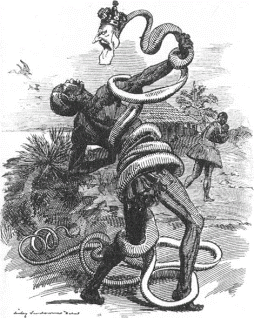 A senior Israeli official told Channel 10 TV channel that a visit on Sunday by Chadian President Idriss Deby to the occupied territories was laying the groundwork for normal ties between Tel Aviv and the Muslim-majority African states of Sudan, Mali and Niger.
The unnamed official also noted that Israel was seeking to shorten flight times from the occupied territories to Latin America through normalizing relations with African countries.
Deby became the first Chadian leader to visit Israel on Sunday, 46 years after the two sides severed ties.
After meeting Israeli Prime Minister Benjamin Netanyahu, the Chadian president pledged a new era of cooperation with “the prospect of reestablishing diplomatic relations.”
Israeli media cited sources in N’Djamena as saying that Deby’s visit was focused on “security,” and that the regime in Tel Aviv had already been supplying weapons and other military equipment to Chad.
Netanyahu, however, declined to comment on potential Israeli weapons sales to Chad.
During his visit, Deby said the future resumption of ties with Israel “does not make us ignore the Palestinian issue.”
The Palestinians, however, protested Deby’s trip to Israel.
Wasel Abu Youssef, a member of the Palestine Liberation Organization’s executive committee, voiced displeasure over the visit.
“All countries and institutions must boycott the extremist government of Israel and impose a siege on it because of its settlement activities, its occupation of Palestinian land,” Youssef was quoted as saying by Reuters.
Over the past two years, Netanyahu has traveled to several African states in a bid to end decades of hostility against the occupying entity and convince them to stop voting against the Israeli regime at the United Nations in favor of Palestinians.
According to Channel 10, Israeli is now in talks with Sudan in a bid to improve relations with the African state.
The Israeli push comes almost two years after Sudan joined Saudi Arabia and Bahrain in cutting relations with Iran.
At that time, Israeli daily Haaretz reported that Tel Aviv had urged the US and other countries to improve their relationship with Sudan in response.
In a 2016, Sudanese Foreign Minister Ibrahim Ghandour said Khartoum was open to the idea of normalizing ties with Israel in exchange for lifting US sanctions.
Israel is also said to be seeking to take advantage of the insurgency and Takfiri militancy gripping parts of Africa to sell advanced military equipment to conflict-ridden states in the continent.
Israel in contact with Persian Gulf Arab states
Meanwhile, reports have emerged recently of Israel’s attempts to make its secret ties with Persian Gulf Arab governments public and establish formal relations with them.
On Sunday, Israeli news sites reported that Tel Aviv is working to normalize ties with Bahrain, hours after Netanyahu hinted he would soon travel to unspecified Arab states.
Israeli Economy Minister Eli Cohen said on Monday he had been invited to attend a conference next year in Bahrain.
Netanyahu met with Oman’s Sultan Qaboos in Muscat last month, but the controversial visit was kept secret until after the Israeli premier returned to the occupied territories.
The visit to Muscat was the first by an Israeli prime minister since 1996.
On Sunday, Israel’s Hadashot television news reported that Netanyahu had secured reassurances from Oman that airlines flying to and from the occupied territories would be permitted to fly over the kingdom’s airspace.
Activists with a pro-Palestine boycott campaign against Israel said Monday that the meeting between Sultan Qaboos and Netanyahu may have breached a long-dormant Israeli boycott law.
“Since 1977, official records stopped mentioning the Law of Boycotting Israel, neither denying it nor confirming it,” an Omani activist with the Boycott, Divestment and Sanctions (BDS) movement told the Middle East Eye news portal.
“This happened when the country took a neutral policy in foreign affairs, including accepting normalizing ties with the Zionist entity,” the activist added.
Another activist said several prominent activists had been arrested shortly before the Israeli prime minister’s visit to Muscat for pro-Palestinian posts on social media, adding, however, that they were freed after disassociating themselves from BDS Oman.
“There is no clear legal path of how to implement the law. But even discussing this topic is a risky business, because there is no political free speech,” he said.
The activist also noted that BDS Oman had sent its “sincerest apologies” to the Palestinian people after a visit by “criminal” Netanyahu.
Featured Video

Dan Dicks with James Corbett on Solutions Watch
or go to
Aletho News Archives – Video-Images
From the Archives
$1.5bn up in smoke: US THAAD missile stockpile dries up defending Israel against Iran
By Ivan Kesic | Press TV | July 2, 2025
According to American media, defense news outlets, and independent analysts, the 12-day Israeli military aggression against Iran significantly depleted the US stockpile of THAAD (Terminal High Altitude Area Defense) interceptor missiles.
Citing official sources, American magazine Newsweek reported on Friday that the US transferred a substantial portion of its advanced missile defense capabilities to support the Israeli regime, an effort with questionable results and a critical impact on US strategic reserves.
THAAD, developed by Lockheed Martin arms manufacturing company, is a key component of Israel’s multi-layered air defense architecture. It is designed to intercept medium-range ballistic missiles, including those launched from Iran and Yemen.
The US-made system is capable of targeting short-, medium-, and intermediate-range ballistic missiles during their terminal phase, whether inside or outside Earth’s atmosphere.
THAAD uses a “hit-to-kill” method, relying on kinetic energy rather than explosive warheads to destroy incoming threats, intercepting at altitudes of up to 150 km and ranges between 150-200 km.
Operated exclusively by American personnel, the US military maintains eight THAAD batteries with an estimated 350–400 interceptors in total. The eighth battery was activated during the June 20 Israeli aggression against Iran and is capable of intercepting hypersonic missiles. … continue
Blog Roll
 Aletho News
- While Gaza dominates the UN, these are the people keeping it alive
- New Report: “Scholasticide and Genocide in Gaza: Assessment, Testimonies and Legal Analysis”
- ‘THAAD Delusion’: Iran war exposes US missile shield limits – The Atlantic
- Moscow issues warning to NATO over Russian exclave
- Yes, the Iran war has destroyed Trump’s presidency
- The fallacy of US delusions about Iran’s economic collapse
- Hezbollah denies Syria cell link, warns of Israeli plan to sow discord
- The legacy of US sanctions, war, and occupation in Iraq
- Iraqi resistance group rejects disarmament, vows to maintain support for Lebanon
- Sheikh al-Asadi warns of Iraqi government compliance with US demands
- If Americans Knew
- Mamdani releases plan to combat antisemitism and hate crimes in New York City
- Iran’s Revolutionary Guards Publish Letter to the American People
- DMFI launches $1 million ad campaign supporting Virginia’s Elaine Luria
- US Senate blocks resolution seeking report on Americans killed by Israel
- Israeli Attacks Kill Ten Palestinians in Gaza
- Massacre at Minab: The School That Became a Grave
- Israeli media: The IDF Shows It Doesn’t Turn a Blind Eye; It Actively Emboldens Settler Havoc
- As settlers ravage West Bank, Israeli forces kill 10 in Gaza – Daily Update
- New Report: “Scholasticide and Genocide in Gaza: Assessment, Testimonies and Legal Analysis”
- Ex-Biden officials are desperate for a Gaza scapegoat
- No Tricks Zone
- Green Energy Debacle: German Expert Professor Fritz Vahrenholt Warns Of Severe Economic And Social Consequences
- Two More Paleo Reconstructions Affirm Meters-Higher Sea Levels Across Ireland, Brazil 7000-6000 Years Ago
- New Study: Earth And Venus Surface Warmth Largely Explained By Convection And Lapse Rate, Not CO2 Or Radiation
- 2025 Nature Paper Claiming Worsening Global Drought Gets RETRACTED …Heavily Flawed
- New Study: ‘Global Drought Shows No Detectable Recent Acceleration Under Climate Warming’
- Economic Masterminds: German Socialists Suggest Taxing Productivity Gains Stemming From Using AI
- The South China Sea Has Not Been Cooperating With The Climate Change Narrative
- Energy Crisis: Germany Enters Heating Season With Historically Low Gas Reserve Fill Levels
- New Study: The Antarctic Ice Sheet Gained Mass From 2020-2024 Due To Staggering Snow And Ice Accumulation
- Study: Ocean Heating Rates From Thousands Of Years Ago ‘Dwarf’ Modern Ocean Heating Rates

