Facebook Turns Into Manipulative Tool of US Intelligence – Moscow
Sputnik – 20.09.2018
ST PETERSBURG – Facebook is transforming into a manipulative tool of the US intelligence services and a lever to influence the domestic policy of other states, Russian Foreign Ministry spokeswoman said.
“Facebook continues to follow the path of stricter censorship… [Facebook], which was presented and has established itself as a means of free communication and exchange of various kinds of content, is now being transformed into an instrument of US intelligence agencies to cleanse the information space of materials that are unwanted by Washington,” Russian Foreign Ministry spokeswoman Maria Zakharova told a briefing on Thursday.
As an example, she named the agreement between Facebook and the Atlantic Council stated to be aimed to help monitor attempts to spread “disinformation” in elections around the world.
She further called the process “a manipulation and a deception” stressing that “the fighters for free democratic elections and the purity of the information space themselves are engaged in interference in affairs of other states and in the dissemination of false information.”
In addition, she said that under the pretext of fighting fake news, Facebook planned to check the personal data of users, as well as audio and video materials.
After the 2016 US presidential election, Facebook said it would take a number of steps to improve transparency, including stricter rules for ad placement, fact-checking photos, videos and links, as well as adding technology to get rid of fake accounts and improve security.
The United States has accused Moscow of meddling in its 2016 presidential election, with Russian authorities denying the accusations as groundless.
Court orders psychiatric evaluation for Marine Le Pen, she slams it as ‘hallucination’
RT | September 20, 2018
French politician Marine Le Pen said a court ordered her to undergo psychiatric evaluation over a series of images she posted on Twitter showing Islamic State executions. She slammed the order as a “hallucination.”
The president of France’s National Rally (formerly Front National) has released an order saying it comes from the magistrates in Nanterre near Paris, calling on her to “undergo a psychiatric examination.”
“For denouncing the horrors of Daesh (Islamic State/IS, formerly ISIS) by tweets the “justice system” has referred [me] to a psychiatric assessment. How far will they go?!” she tweeted in response.
The 2017 presidential candidate denounced the order as “a hallucination,” saying: “This regime is really starting to scare [us].”
French major outlet BMFTV, which also broke the story, said that the procedure was in fact a “common” occurrence. The comment did not go down well with Le Pen though, who branded the claim “a lie.” Such an examination is required of “pedophiles or [those with] sexual deviance,” she argued.
In December of 2015, Le Pen tweeted three pictures of killings carried out by IS terrorists accompanied by the text “Daesh [Arabic term for ISIS] is THIS!” The tweets had been a response to journalist Jean-Jacques Bourdin, who compared Le Pen’s nationalist rhetoric to that of the Islamic terrorist group.
One of the pictures showed the body of James Foley, whom the extremists beheaded in August 2014. Back then his family said they had been “deeply disturbed by the unsolicited use of Jim for Le Pen’s political gain.”
Le Pen later deleted the images. Speaking to French media earlier this year she said that she is being charged for “having condemned the horrors of Daesh.”
If convicted, the politician faces a maximum punishment of a €75,000 fine and up to three years in prison.
A number of politicians have lambasted the judges’ decision towards Le Pen. According to National Assembly member Gilbert Collard, the order simply means “the psychiatrization of political opinion.”
Italian Deputy Prime Minister Matteo Salvini also took to Twitter to express support for the French politician. “A court orders a psychiatric assessment for Marine Le Pen. Words fail me! Solidarity with her and with the French who love freedom!” he wrote.
This is not the first time Marine Le Pen has locked horns with the authorities. In 2017, roughly two months before the presidential election, she was summoned by judges for alleged misuse of EU funds. The court said that Le Pen’s staff was fictitiously employed at the European Parliament as assistants. She denied the allegations.
This July, French judges blocked €2 million of subsidies to Le Pen’s party. Le Pen condemned the move as “a blow to democracy,” since withholding the funding would likely result in her party becoming defunct.
Free Press Advocates Alarmed by US Government’s “Terrifying” Secret Rules for Spying on Journalists
Jessica Corbett – CommonDreams – September 17, 2018
Journalists and free press advocates are responding with alarm to newly released documents revealing the U.S. government’s secret rules for using Foreign Intelligence Surveillance Act (FISA) court orders to spy on reporters, calling the revelations “important” and “terrifying.”

The documents – obtained and released by the Freedom of the Press Foundation and the Knight First Amendment Institute at Columbia University through an ongoing Freedom of Information Act (FOIA) lawsuit filed last November – confirm long held suspicions that federal officials can target journalists with FISA orders.
New documents – obtained by @knightcolumbia and @FreedomofPress – appear to confirm longstanding suspicion that government has relied on Foreign Intelligence Surveillance Act to monitor journalist communications. @2ramyakrishnanhttps://t.co/VFDjk9oJqq pic.twitter.com/ybnEeuNsby
— Knight 1st Amendment (@knightcolumbia) September 17, 2018
The two 2015 memos from former Attorney General Eric Holder to the Federal Bureau of Investigation (FBI) lay out procedures to ensure that the attorney general or deputy attorney general signs off on any FISA applications “targeting known media entities or known members of the media.”
These secret rules, as Cora Currier reported for The Intercept, “apply to media entities or journalists who are thought to be agents of a foreign government, or, in some cases, are of interest under the broader standard that they possess foreign intelligence information.”
“There’s a lack of clarity on the circumstances when the government might consider a journalist an agent of a foreign power,” Ramya Krishnan, a staff attorney with the Knight Institute told Currier.
“Think about WikiLeaks; the government has said they are an intelligence operation.”
Additionally, even if they aren’t personally targeted by FISA orders, Krishnan pointed out that “journalists merely by being contacted by a FISA target might be subject to monitoring – these guidelines, as far as we can tell, don’t contemplate that situation or add any additional protections.”
Freedom of the Press Foundation executive director Trevor Timm noted that while “the fact that these were kept secret during the Obama administration is cause for great concern,” President Donald Trump “has repeatedly stated his hatred for the media, and his Attorney General Jeff Sessions has already tripled the amount of leak investigations since the Obama era (when they were already at an all time high).”
“This is critically important information at a time when press freedom has been under threat from the government, and its role in our democracy has never been more important,” Timm added, calling on the DOJ to disclose how often journalists have been subjected to FISA court orders, and why the rules were kept secret until this suit.
“It makes me wonder, what other rules are out there, and how have these rules been applied?” Victoria Baranetsky, general counsel with the Center for Investigative Reporting, previously of Reporters Committee for the Freedom of the Press, told Currier. “The next step is figuring out how this has been used.”
The DOJ’s rules for obtaining a FISA court order to target a journalist, Timm explained, “are entirely separate from – and much less stringent—than the rules for obtaining subpoenas, court orders, and warrants against journalists” detailed in the DOJ’s “media guidelines,” which Holder “strengthened in 2015 after several scandals involving surveillance of journalists during the Obama era.”
However, Holder’s guidelines still concerned media advocates, Currier noted, “because they left room for the use of National Security Letters,” which “are administrative orders with which the FBI can obtain certain phone and financial records without a judge’s oversight.” Currier previously reported on the FBI’s 2013 rules for such orders, and concerns about them, in 2016.
You can read the DOJ’s rules for targeting journalists with FISA court orders here.
A Test of the Tropical 200-300 mb Warming Rate in Climate Models
By Ross McKitrick | Climate Etc. | September 17, 2018
I sat down to write a description of my new paper with John Christy, but when I looked up a reference via Google Scholar something odd cropped up that requires a brief digression.
Google Scholar insists on providing a list of “recommended” articles whenever I sign on to it. Most turn out to be unpublished or non-peer reviewed discussion papers. But at least they are typically current, so I was surprised to see the top rank given to “Consistency of Modelled and Observed Temperature Trends in the Tropical Troposphere,” a decade-old paper by Santer et al. Google was, however, referring to its reappearance as a chapter in a 2018 book called Climate Modelling: Philosophical and Conceptual Issues edited by Elizabeth Lloyd and Eric Winsberg, two US-based philosophers. Lloyd specifically describes herself as “a philosopher of climate science and evolutionary biology, as well as a scientist studying women’s sexuality” so readers should not expect specialized expertise in climate model evaluation, nor do the book’s editors exhibit any. Yet Google’s algorithm flagged it for me as the best thing out there and positioned two of its chapters as top leads in its “recommended” list.
Much of the first part of the book is an extended attack on a 2007 paper by David Douglass, John Christy, Benjamin Pearson and Fred Singer on the model/observational mismatch in the tropical troposphere. The editors add a diatribe against John Christy in particular for supposedly being impervious to empirical evidence, using flawed statistical methods and refusing to accept the validity of climate model representations of the warming of the tropical troposphere.
By way of contrast, and as an exemplar of research probity, they reproduce the decade-old Santer et al. paper and rely entirely on it for their case. If they are aware of any subsequent literature (which I doubt) they don’t mention it. They fail to mention:
- Santer bitterly fought releasing his data
- Despite having data up to 2007 he truncated his sample at 1999
- If he had used the same methodology on the full data set he’d have reached the opposite conclusion, supporting Douglass et al. rather than supposedly refuting them
- Steve McIntyre and I submitted a comment to the journal showing this. It was rejected, in part because the referee considered Santer’s statistical method invalid and didn’t want it perpetuated through further discussion
- We re-cast the article as a more detailed discussion of trend comparison methodology and published it in 2010 in Atmospheric Science Letters. We confirmed, among other things, that based on modern econometric testing methods the gap between models and observations in the tropical troposphere is statistically significant.
Stakes Rise in Browder-Gate – EU Threatens Cyprus with Article 7
By Tom Luango | September 15, 2018
It’s been quite a week for Article 7 of the Lisbon Treaty. First Hungary and now Cyprus. And all because of some guy named Bill Browder?
Despite numerous warnings and obstacles, Cyprus continues to assist Russia in investigating the finances of Bill Browder. This has resulted in letters of warning to Cypriot President Nicos Anastasiades as well as lawsuits by Browder citing the investigation violates his human rights.
Like everything else in this world, just ask Browder.
Last fall Browder and 17 MEP’s launched a two-pronged assault on Cyprus to end their assisting Russia’s investigation into Browder. Browder with the lawsuit. The MEP’s with a letter of warning.
The lawsuit has failed, however. The Nicosia District Court handed down a ruling recently which allowed for Browder to sue for damages to his reputation but not putting an injunction on the investigation.
More than a month ago the Nicosia District Court said that the cooperation with Russia in its politically motivated probe would violate the human rights of Bill Browder and his associate Ivan Cherkasov and the two would have good prospects in claiming damages from the government. Still, the court rejected Browder’s application for an order preventing Cypriot authorities from cooperating with Russia in its proceedings against him on the grounds that any damage would not be irreparable.
And this is where this gets interesting.
Because now in light of this ruling the stakes have been raised. Four of those original 17 MEP’s, many of whom are on the infamous “Soros List” as being in the pay of Open Society Foundation, sent a more serious letter of warning to Anastasaides threatening Cyprus with censure via Article 7 of the Lisbon Treaty for not upholding the European Union’s standards on human rights.
Now this is a dangerous escalation in service of an investigation into someone who, agree or not, Russia has a legitimate interest in pursuing. Dismissing all of Russia’s concerns about Browder as ‘politically motivated’ is pure grandstanding. It carries no weight of law and stinks of a far deeper and more serious corruption.
Because if Browder was as pure as the driven snow as he presents himself to the world then he would have no issue whatsoever in Cyprus opening up his books to Russia and put his question of guilt to rest once and for all.
The ruling from the court stated that Cypriot officials are not barred from helping Russia get to the bottom of Browder’s web of offshore accounts, all of which, according to Russian lawyer Natalya Veselnitskaya, run through Cyprus.
“He [Browder] is afraid of the Russian probe that has conclusive evidence of his financial crimes and proof that his theory of Magnitsky’s death is an absolute fake. That’s why Browder is ready to stage any provocation,” Veselnitskaya said. She went on to say that the investor’s decision to intervene was particularly “influenced by the fact that the entire network of offshore companies that make up his organized criminal group is located on the territory of Cyprus.”
The incident that Veselnitskaya was referring to took place in late October 2017. At that time, 17 members of the European Parliament appealed to Cypriot President Nikos Anastasiades in an open letter, in which they called on him to stop assisting Russia in its investigation against Browder.
Remember, Veselnitskaya was the woman who met with Donald Trump Jr. during the 2016 campaign. She was adamant she had information that was pertinent to them. The Mueller probe and the media tried to spin that meeting as her giving Trump access to Hillary Clinton’s e-mails.
But what she was really trying to give them was the low-down on Browder, the Magnitsky Act and the whole rotten, sordid history of him, Edmund Safra of Republic National Bank and the raping of Russia by them and others in the 1990’s.
And to show Trump that the Magnitsky Act was built on a lie and the sanctions against Russia should be lifted because of this.
Some of this I covered in an earlier article.
The Real Browder Story
And this is the whole point. Browder’s story is fiction.
Magnitsky was his accountant and not his lawyer, who knew all about his dealings and could convict Browder of a raft of crimes far greater than the ones Russia already has in absentia.
Putin had no interest in having Magnitsky executed or beaten to death in prison. If anyone had an incentive to keep Magnitsky alive it was Vladimir Putin. If anyone had incentive to have Magnitsky die in prison it was Browder. And so, the whole story that Browder has woven, the myth around himself is so insane that it bears repeating over and over.
Browder’s story is fiction.
Because when you stop and put all the pieces together you realize a number of things and none of them are good.
First, Browder was deeply enmeshed in the plot to frame Yeltsin for stealing $7 billion in IMF money which created the conditions for bringing Putin to power.
Second, he, Mihail Khordokovsky and others have systematically lobbied Congress and the European Parliament to peddle this false story of the brave freedom fighter Magnitsky against the evil Putin to get revenge, in Khordokovsky’s case, on Putin for deposing him from power in Russia and stealing back the wealth Khordokovsky stole during the Yelstin years, namely Yukos.
And for Browder it was the culmination of years of work to destroy Russia from within and stay one step ahead of the hangman’s noose. His 2015 book Red Notice is a work of near fiction as outlined by Alex Krainer in his book The Grand Deception: The Truth About Bill Browder, The Magnitsky Act and Anti-Russia Sanctions.
And the Magnitsky Act was the way everyone interested who can prove this could be silenced through sanctions.
But, it’s bigger than that.
This was policy.
The Magnitsky Act is a lynchpin of American and European foreign policy to destroy Russia and subjugate the world.
It was enacted alongside other legislation to take back control of the political narrative of the world; rein in free speech on the internet by tying any activity not approved of by The Davos Crowd to be subject to sanctions on the nebulous basis of ‘human rights violations.’
The Magnitsky Act has weaponized virtue-signaling and, in my mind it was intentionally done to open up another path to protect the most vile and venal people in the world to arrogate power to themselves without consequence.
Today we stand on the brink of an open hot war between the U.S. and Russia because of the lies which have been stacked on top of each other in service of this monstrous piece of legislation.
With each day it and its follow-up, last year’s Countering America’s Adversaries Through Sanctions Act (CAATSA), are used as immense hammers to bring untold misery to millions around the world.
People like Browder are nothing by petty thieves. It is obvious to me he started out as a willing pawn because he was young, hungry and vaguely psychopathic. The deeper he got in it the more erratic his behavior became.
Browder is being protected by powerful people in the U.S. and EU not because he’s so important but because exposing him exposes them.
This is why another country is being threatened with the stripping of what few rights sovereign nations have within the EU, Cyprus, over his books.
Poland stood up for Hungary the other day over ideological reasons. No one seems ready to stand up to the conspiracy surrounding Browder, Khordokovsky and the Magnitsky Act.
But, if someone in power finally does, it could change everything we think we know about geopolitics.
Twitter blocks real Iranians’ accounts, overlooks US ‘regime change’ propaganda: Zarif
Press TV – September 16, 2018
Iranian Foreign Minister Mohammad Javad Zarif says Twitter has blocked the accounts of “real Iranians” but overlooks the “regime change” propaganda spewing out of Washington.
Zarif made the remarks in a post on his official Twitter page on Sunday addressing Jack Patrick Dorsey, the co-founder and CEO of Twitter.
He said the accounts of real Iranians, including TV presenters and students, have been shuttered for allegedly being part of an “influence operation.”
“How about looking at actual bots in Tirana used to prop up ‘regime change’ propaganda spewed out of DC?” the top Iranian diplomat asked, alluding to the anti-Iran terrorist Mujahedin-e Khalq Organization (MKO), whose members are currently based in Albanian capital city.
Back in August, Google removed 39 YouTube channels linked to the Iranian state broadcaster. Google terminated those accounts, along with six blogs on its Blogger service and 13 Google+ accounts linked with Iran. The move came after Twitter and Facebook also blocked hundreds of accounts on suspicion of possible ties with Iran.
The MKO has a dark history of assassinations and bombings against the Iranian government and nation. It notoriously sided with former Iraqi dictator, Saddam Hussein, in his eight-year war against Iran in the 1980s.
The group has been behind most of the terrorist attacks, which have claimed the lives of nearly 17,000 Iranians since the victory of the Islamic Revolution in Iran in 1979.
Initially designated as a terrorist organization by Europe and the US, the group has established close links with Western political parties.
In recent years, several media reports have emerged about top political figures in the US and Europe receiving money from the MKO to speak favorably of the terrorist group.
In September 2016, the last remaining members of the terrorist group were relocated from Camp Liberty (Hurriya), a former US military base near the Iraqi capital Baghdad, to Albania.
Iraq had long urged MKO remnants to leave the country, but a complete eviction of the terrorists had been hampered as a result of the US and European countries’ support for the group.
When Social Networks Care About National Security

By Harry Bentham | OffGuardian | September 16, 2018
Controversies surrounding online fake news, having alarmed political activists in Britain and the US, are prompting social media companies to be more active in combating the alleged threat. For many people in opposition to the policies of US President Donald Trump and Britain’s exit from the EU, the internet is to blame for the situation because it illicitly influenced voters. As a result, increased policing of social networks to root out foreign spies and domestic dissidents seems necessary to them. One of the latest examples is Twitter’s permanent suspension of American conspiracy theorist entertainer Alex Jones.
The responsibility to police the social networks seems to have largely been placed, by pushy and concerned politicians, on the management of tech companies themselves. British MPs and US senators did this by summoning them to hearings and campaigning openly against the internet’s permissiveness on political content, making demands they should shut down dissident and foreign outlets because they have gone too far.
Although the most vocal of them are not actually in the incumbent government and therefore not responsible for national security responses, they are still lawmakers representing constituents and can threaten legislation to compel social media companies to change. Preferring instead to make the policing of social media posts look voluntary, they seem to have capably persuaded the management of the tech companies to enforce their views on national security.
Therefore, now, we are at an awkward point where transnational social networks must care about so-called national security – specifically the US’s national security, based on that country’s strange and self-obsessed drivel about being exceptional and better than others. What next?
Recently, we have seen police-like enforcement action against dissident users and outlets present on a variety of social media platforms and applications used by a probable majority of people in the UK and the US. This removal of controversial figures from online platforms is presented as not being censorship, but rather the enforcement of decent community guidelines by companies that have every right to withhold services. However, this argument is not very convincing. The political pressure has been immense. The results have not been targeted at bad social media behavior like spam and harassment, but against alternate political views on both the left and the right. If we look at the actions of the tech companies, they are not only encouraged by elements of the state but have made themselves into state-like actors by describing themselves as stopping foreign threats and extremism.
Brexit was the mistake of a misled public, perhaps. We are told so by influential media personalities – almost all of them – and the same narrative is presented when it comes to the election of Trump. We are encouraged to lean towards the same common solution to both of these mishaps, and it consists of mostly a crackdown online – especially on Twitter. We will be shutting down online accounts and channels belonging to the supporters of such causes as Trump and Brexit, after quickly and conveniently finding them guilty of being bots or possibly foreign. No attention is given to bad behavior as a whole.
For example, no enforcement action is used against pro-EU accounts or anti-Trump accounts, many of which self-identify as foreign or completely automated. Some even blatantly violate Twitter’s rules on inflated hashtag campaigns, doing things like using the hashtag #FBPE to get followers and retweets from pro-EU bots. Their own determination to trick users and violate the community guidelines is openly celebrated by them, so oblivious are these kinds of activists to their own hypocrisy.
So, in fact, what seems at first a principled argument against bad behavior is really a cliché so we can pretend there was some civilized reason for thuggishly silencing other points of view.
Much of the commentary by the Democratic Party, as with opponents of Brexit in the UK, focuses on national security and the need to silence or eliminate bad people and Russians. It is presented as war, using the language of military propaganda. Being in opposition, these democracy-loving people in the Democratic Party and other groups now presume it is the job of civil society – news networks like CNN and tech companies like Apple mainly – to not only take charge of national security themselves but also engage directly in censorship.
But censorship, the shutting down of opposing views and channels on grounds that they are treasonous, is not an exertion of soft power but hard power. It is a state-like activity, and the sole responsibility of states in all previous cases. By taking part in censorship without being part of the elected leadership of the state and the command structure it possesses to deal with national security threats, unelected elements in civil society are allowed to commit what would be a crime if they had been elected to do it. They engage in a coup-like activity, since, not being part of an elected government, they are nonetheless engaged in state-like activity and are trying to invasively police matters that only a heavily expanded state or dictatorship is ever expected to police.
What is presented above makes it justifiable to consider whether traditional models of state censorship would be more consistent with the rule of law and the importance of a democratic mandate than the current capricious enforcement by private companies. A party whose candidate failed to win power over the whole state, such as the Democrats, is not able to implement a program of state censorship at the moment they most want to. The reason this is the case is because of their very loss in the 2016 US election, which makes them not responsible for matters of national security and not tasked with securing the information space against threats, and yet they try. For them to seek routes around this failure, going to non-elected entities such as the tech companies in an attempt to dictate terms of censorship and actual national security policies via them, can be compared with a coup or a form of separatism. This is the creation of a second state, the seizure of infrastructure to interdict citizens. It is completely outside the bounds of normal political processes, which focus solely on democratic and valid elections as the only means of changing power.
Each point made in relation to the US Democrats here is equally true of influencers and leaders who seek to invalidate the results of the UK’s Brexit referendum, in large part because these are the same kind of civil society actors. In their attempts to portray the activity of the national government itself as treasonous and wrest control of the management of national security from the British government, entities with no democratic mandate are hopelessly creating a second state – one without elections – to take control over national security.
It is not political opposition but a second state because, for the first time ever, it wants not just persuasive soft power but hard power in the capability to suppress targets or eliminate their influence on command. Not only would this realization make these parties and their tech industry collaborators a state-like entity, but it could make such actors as the Democratic Party traitors at war with the electorate.
While this article doesn’t make such a claim, it is one Trump and his supporters have come close to making when the President accused unrelenting elements of the press of being “enemies of the people”, and could eventually create a national security crisis. The reason it would be a crisis is because both Trump and his critics will have a point. It is the role of activists and media to be adversarial, but if they are too aggressive and specifically driven to remove an elected head of state from power, their actions may be seen as the de facto overthrow of the republic to install themselves as political arbiters and impose a moral aristocracy.
Many leaders and followers in the political opposition in the US and UK are supportive of censorship, slithering around constitutional safeguards against state censorship. Whether in public hearings or behind closed doors, they have been going directly to tech companies and other parts of civil society to physically disrupt or silence speech they dislike. If they are such supporters of national security and censorship, and are really so concerned about traitors, they should not conspire. Rather, these people should approach the elected government with their concerns, to avoid being deemed traitors themselves.
They can achieve censorship by working to convince the elected government to change the law in relation to such practices and introduce programs of lawful censorship, as well as bodies to reliably and authoritatively identify traitors. This means national security can be pursued in a way at least consistent with electoral democracy, even if it erodes human rights further. Otherwise, we will continue to see electorally defeated parties and elements of civil society acting like terrorist hijackers determined to take power. They will be gaining state-like powers, harassing citizens who did not vote for them, carrying out targeted censorship, and enforcing their values over the corpse of the democratic state.
It should be concluded that none of the above is a desirable conversation to take part in and it is regrettable that it would need to be published. Ideally, neither state censorship nor corporate censorship should be tolerated. The internet should continue to be home to an anarchic culture at all costs, not a state-like one. However, as rhetoric becomes more warlike and paranoid and positions become irreconcilable, all spaces could become politically aligned and everyone’s freedom to communicate could catastrophically reduce. With constant political censorship, critical thinking will rewind a hundred years and the internet will talk like propaganda from 1914 when you try to search for the truth.
On the Censorship of Michael Hoffman’s Books by Amazon

The Saker • Unz Review • September 13, 2018
A couple of months ago I did an interview with one of the foremost scholars of rabbinical Judaism, Michael Hoffman. The occasion was the release of his latest book “The Occult Renaissance Church of Rome”. At the time I did not expect to have to ask for a follow-up interview with him, but when I learned that Amazon had censored his books (please see Hoffman’s own account of this here). Specifically, the ban is on three of his books. A complete ban (Kindle + printed book) on Judaism’s Strange Gods: Revised and Expanded, as well as The Great Holocaust Trial: Revised and Expanded, while his textbook, Judaism Discovered, has been removed from the Kindle. I felt that I had to talk to him again and he kindly agreed to reply to my questions. I submit to you the full text of our Q&A which I will follow-up with a short commentary.
* * *
The Saker: Please summarize what happened to your books and Amazon and tells us what specific explanations were given to you. Did Amazon ever offer you a “page and paragraph” list of “offending” passages? Do you have any means of knowing exactly what your book is being banned for?
Hoffman: Whether it is Facebook, Google or Amazon, the excuse most often cited for suppression is “content guidelines’ violation.” Amazon notified us on August 13 that two of our titles, which they have been selling for years and in thousands of copies, Judaism Discovered, our 1100 page textbook published in 2008, and Judaism’s Strange Gods: Revised and Expanded, published in 2010 — were being permanently removed after “review” by the Kindle Direct Publishing (KDP) unit of Amazon. A facsimile of the KDP notice can be viewed here:
In their e-mail they told us that “… we found that this content is in violation of content guidelines.” In studying their content guidelines one encounters a vague, generic statement about not permitting that which is “offensive.” There is no guidance as to what “offense” has suddenly arisen after these books were sold on Amazon for several years. Like the Red Queen in Wonderland who declared to Alice that, “A word is anything I say it is!” — that which “offends” is anything Amazon says it is. A third book, The Great Holocaust Trial: The Landmark Battle for the Right to Doubt the West’s Most Sacred Relic, was also forbidden.
Does Amazon have the chutzpah to publicly categorize these books as “hate speech” or some other alibi for censorship that could be contested? No, they do not. They leave authors and publishers twisting in the wind, making it more difficult to appeal the decision and report to the public on the tyranny. Although since they allow no appeal, it’s a moot point. Personally, I have no doubt concerning why my books were censored.
The Saker: What is, in your opinion, the true intent behind the ban on the sales of your book? What is Amazon’s interest in this?
Hoffman: I don’t believe Amazon has much interest in this. It is more likely that the Southern Poverty Law Center (SPLC) is the interested party. Last August 7 the New York Times online published a revealing piece by David French in which he wrote: “We live in a world where the Southern Poverty Law Center, a formerly respected civil-rights organization, abuses its past trust to label a host of mainstream organizations (including my former employer, the Alliance Defending Freedom) and individuals as ‘hate groups,… based sometimes on… outright misreadings and misrepresentations of an individual’s beliefs and views… Amazon recently booted Alliance Defending Freedom from its AmazonSmile charity program because of the center’s designation.”
At around the time in 2017 that the SPLC was trying to interfere with the business operations of people such as myself, by intimidating banks and credit card processors into refusing to process payments for books, Paypal notified us that due to the contents of our website (www.RevisionistHistory.org) we were an embarrassment to their brand and they were terminating our account. As long as Paypal was owned by libertarians, all was well and we had a high customer satisfaction rating for our integrity and dependability. The original Paypal mainly cared about whether you were a responsible seller. A politicized administration eventually took over Paypal and in 2017 we were terminated, very likely on the “advice” of the SPLC.
To return to Amazon, CEO Jeff Bezos founded it in 1994. It was very much a libertarian book operation from the start. From 1994 until a year or two ago, Amazon only refused to sell hard core pornography and books that constituted direct appeals to violence or law-breaking, which is how it should be. Every other type of book was sold, without censorship, which is one reason for Amazon’s early success and increasing market share. Then last year, after Mr. Bezos had reached the status of one of the world’s wealthiest persons, and Amazon’s total value was beginning to approach that of Apple and Google, Amazon staged a huge purge and eliminated more than a hundred World War II revisionist history books published by Germar Rudolf’s CODOH organization (books smeared as “Holocaust denial”). This year it was my turn. Next year it might be any author not part of the university press syndicates or the major houses. Such is the heedless power and immunity of Amazon.
It’s important to note that the thought police who removed three of my books were based in the digital division of Amazon, where the electronic Kindle books are marketed and managed. A Kindle permits anyone connected to the Amazon website to read approximately the first thirty pages of any Kindle book free of charge. Consequently, my Judaica scholarship was on display around the world and therefore it was much harder to lie about me and mischaracterize my Talmud and Kabbalah research under those circumstances.
We were also beginning to sell ever increasing numbers of these Kindle books to people in Asia, particularly India and Japan. It’s my hunch that Big Brother is not half so worried about printed books as the digital kind. Removing the three books from the Kindle was the primary objective.
To be banned by Amazon is not equivalent to being banned by any other private business. Most publishers will admit that Amazon has replaced Bowker Books in Print as the industry’s authoritative guide to what books in English have been printed in the past and what is in print now. Amazon is currently the reference source. For a book to be forbidden by Amazon renders it largely invisible. It is equivalent to burning the book. So this is not a matter of Amazon exercising the prerogative of private enterprise. Amazon is a monopoly. It has no rival. If your book doesn’t exist on Amazon, then for most people who are not research specialists, your book doesn’t exist. The consequences for the pursuit of knowledge are ominous.
There is a problem here for Amazon as well. The more Amazon excludes books that embody facts and ideas that constitute radical dissent, the more it becomes a narrow censor’s aperture rather than a reliable bridge to the entire range of the Republic of Letters.
Apologists for censorship of radicals and authentic conservatives often claim that no First Amendment rights are violated when Amazon bans books, therefore it is not a civil rights issue, merely an inconvenience of the capitalist system. In the 1950s however, when the privately-owned movie studios banned certain directors, actors and screen-writers judged to be Leftists or Communists, that action on the part of private enterprise was inscribed in the rolls of the culture wars as the infamous “Blacklist,” and we are still reading and weeping over it sixty-five years later. So it depends on whose ox is being gored.
My Judaica studies are free of “Jew hate,” as anyone who peruses the sections in both books titled “To the Judaic Reader” knows. There we state that the books are dedicated to pidyon shevyuim (redemption of the captive), i.e. rescuing those Judaic persons who are in bondage to the Talmud and the Kabbalah.
Our enemies easily turn to their advantage books containing hatred of “The Jews.” What they absolutely have no credible answer to is a critique predicated, as our books are, on a sincere foundation of true Christian love. Boundary-breaking scholarship united to compassionate concern for the welfare of Judaic people is almost unprecedented in this field. This approach makes my studies of Judaism among the most powerful and effective because they are free of the “hate speech” which is the pivot upon which turns the machinery of liberal-approved censorship. For that reason, making Judaism’s Strange Gods: Revised and Expanded, and Judaism Discovered available on the Kindle undercut decades of hatred and libel. Therefore those volumes had to be suppressed.
The Saker: Since this ban was put in place – what reactions have you heard? who has spoken in defense of your scholarship and right to be heard? has anybody taken your defense or spoken up for you?
Hoffman: Ron Unz allowed me to publish a note on the ban at unz.com and you, the Saker, have taken an interest. Our many friends, readers and subscribers have expressed outrage on Twitter and in e-mail. Meanwhile we have contacted everyone from a columnist for Taki’s website to the legacy media, to no discernible effect thus far. The Washington Post, which is owned by Mr. Bezos, has as its motto, “Democracy dies in darkness.” Yet it is in that very darkness where Amazon’s book-banning dwells, due to the apathy of the media and the American Library Association. To ban books by a vulnerable independent scholar is not exactly a daring move in this age where “hate speech” is anything that offends someone’s cherished myth. The definition is so loose it functions as an inquisitor’s sword.
On the positive side, we have seen an uptick in orders to our own online store for the printed books which Amazon has banned [https://truthfulhistory.blogspot.com/2016/02/judaica-books-and-resources.html]. There is no replacement for the banned Kindle editions, however.
The Saker: What do you believe could be done to resist this state of affairs? What can we all do to put a stop to this kind of censorship?
Hoffman: In general, the supporters of the lies of the Overlords wage spiritual and psychological warfare with far more dedication, commitment and self-sacrifice than the purported allies of God’s truth. The Cryptocracy’s defenders are 24/7 militants resolved to contend with their perceived foes with every ounce of their being. Whereas on the side of Christian conservative renewal, with honorable exceptions, I find mainly armchair warriors and folks so enormously distracted by the choices offered by the Internet’s deluge of words and images, that they are nearly paralyzed by the spectacle.
Compare the reception Judge Kavanaugh received in the Senate hearings with that of recent Supreme Court nominees Kagan and Ginsburg. The Republicans were too cowed to seriously confront those ladies. Maintaining decorum was the chief concern of the timid GOP at the time, while Kavanaugh faced a near riot in the visitor’s gallery and extremes of withering interrogation and contempt from defiant Democratic senators.
When CODOH’s books were banned we reported the case extensively online and in our printed newsletter. We contacted an executive with the American Library Association to elicit his response and express our outrage. We did what we could even though we have almost no relationship with CODOH. We would do the same for any person of good will who is denied the right to advance human learning with suppressed facts and ideas. This was formerly a truism in America, up until the rise of the punks of social media who seem to be more like a branch of Antifa than an intellectual class invested in discovery and enlightenment.
Advances in human knowledge are achieved on the basis that “error has rights,” for the reason that enshrined dogmas are often wrong and demonized dissidents are sometimes the bearers of rare discoveries. But the epigram of our time is “Error has no rights,” which was the doctrine of the fiery Inquisition, of the head-chopping French Revolution and of the Bolsheviks and Maoists. If error has no rights then neither does truth, in that what is denounced as hateful error by the mob is sometimes a destabilizing, necessary and even cosmic truth.
* * *
Reading Hoffman’s words I thought that what happened to him is so typical of the Orwellian world we live in where the what I call the “Skripal rules of evidence” (aka “highly likely”) have replaced even basic evidentiary notions, a world in which false flag attacks are announced weeks in advance, a world in which the Planetary Hegemon has declared urbi et orbi that nothing in the body of international law applies to the “indispensable nation” (or to the parasitic host feeding off it) and where “might makes right” has become the motto by which everybody lives. Of course, the censorship of a book cannot be compared to the initiation of a war of aggression (which is the “supreme international crime” under international law: this was the conclusion of the Nuremberg Trial on this topic: To initiate a war of aggression, therefore, is not only an international crime; it is the supreme international crime differing only from other war crimes in that it contains within itself the accumulated evil of the whole ). Still, there is something uniquely devious and evil about the censorship of Hoffman’s books by Amazon, several things in fact:
- What is attacked in not a person or even a group, but ideas, arguably the most precious attribute of mankind. This is therefore not only an attack on a human being, but an attack on the very notion of humanity as such
- While the method is different, the intention here is no different from the book burnings of the Nazis or the Papacy except that in these latter cases it was obvious who ordered the burning of putatively “degenerate” or “heretical” books. Thus the ideological motive of the Nazis and Papists was always clear whereas in the case of Hoffman this ideological motive is hidden (even if obvious with anybody with a modicum of intelligence).
- The ultimate hypocrisy lies in the fact that most so-called libertarians (from the Left to the Right) have nothing to say about this because this is not a case of censorship by government but the action of a corporation which has the “right” to do as it wishes, never mind that the result is still a clear de-facto infringement of Hoffman’s First Amendment rights and the freedom of academic scholarship.
- The US government and Congress, by allowing monopolistic corporations such as Amazon to have that kind of power are basically engaging in what I would call “censorship by proxy” which is to be expected from a deep state which now does almost everything by proxy in order to bypass fundamental US and international laws (“extraordinary renditions” anybody?).
- Unlike the government which does have to produce at least some evidence before it can censor an individual or organization, a US corporation does not even have to justify itself by a single word. This is viewed as a triumph of deregulation by mindless libertarians who would gladly surrender all their freedoms as long as it is not to the state. In the real world, of course, they still end up handing over their freedoms to the state, except that the state is hiding behind their beloved corporations.
It is also pretty obvious that those who might, at least in theory, have something to say about this kind of censorship by proxy remain silent because, at least according to them, Hoffman is an “anti-Semite” (which, having read many of his books, I can attest is a total falsehood; by way of evidence here are sample pages from his book:
Using hate speech accusations to suppress irrefutable facts, the troglodyte book-banning lobby pressured Amazon to suppress “Judaism’s Strange Gods: Revised and Expanded” containing documentation that advances human learning. Amazon complied, preferring censorship to knowledge. pic.twitter.com/YjHJxU9lAK
— Michael Hoffman (@HoffmanMichaelA) September 10, 2018
and thus he is undeserving of support. So-called “anti-Semites” are, along with the pedophiles, the “consensus villains” of the day (I explain that in detail here) but what the anti-anti-Semites fail to realize is that each time a “consensus villain” is deprived from his rights, this sets a precedent for everybody else. This is why Yehuda Bauer warned us when he wrote: “Thou shalt not be a victim, Thou shalt not be a perpetrator, And above all, Thou shalt not be a bystander”. To no avail, alas: we live in society of silent bystanders apparently! And when YouTube decides to silence all the Syrian state channels to better prepare for a false flag chemical attack, everybody looks away – “ain’t my problem”…
We all know that in Europe (and in Russia) you can be jailed and your books banned if a court finds them to be “revisionist” or “anti-Semitic” or “hateful” and the like. But at least in Europe (and in Russia), you get your day in court and you can defend yourself against accusations which the state has to prove. In Russia, just last week, a man accused of “rehabilitating National-Socialism” (for reprinting an article by another author!) was found non guilty by a majority of jurors (5 to 3) (the punishment he was facing was a fine and several years in jail). Thank God, in the “home of the brave” no such thing could happen, right?!
True, Hoffman does not risk jail (yet!). But in terms of crushing crimethink, I submit that the US system is much more effective because it allows the deep state to hide behind the veil of corporate malfeasance. There have been plenty of revolutions against a state, but I don’t know of any revolutions against the corporate dictatorship.
You tell me: which is worse, the absence of freedom or the illusion of freedom?
Personally, I find the latter much worse.
I never expected the corporate presstitutes to really care about our freedoms, ditto for the libertarians and the progressive Left. They are all too busy with their narrow ideological agenda. As for the US academic world, it has shown its true face when it allowed the persecution of Professor Norman Finkenstein. But I have to say that I am shocked by the fact that the blogosphere and the so-called “alternative media” has remained so silent in the face of such a blatant censorship by proxy by the deep state against one of the foremost US historians.
I urge all those reading these lines to speak up on Hoffman’s behalf and to support him by purchasing his superb and censored books. This is how every one of us can resist the Hegemon and his rule!
Facebook’s Atlantic Council censors are more interested in tanks than thinking
RT | September 13, 2018
Like all foreign policy and military think tanks, the Atlantic Council exists to manufacture consent for the goals of its paymasters. It hit the jackpot when the world’s largest social media network put it in charge of censorship.
While the ubiquitous presence of Atlantic Council lobbyists across the information space already imperilled fair discourse, Facebook’s May move empowered it to endanger freedom of expression. And founder Mark Zuckerberg’s reference to an information “arms race” in a Washington Post op-ed last weekend exposes the grim reality behind the move.
That said, the spin has been impressive. Headlines such as “US think tank’s tiny lab helps Facebook battle fake social media (Reuters )” and “Facebook partners with Atlantic Council to improve election security (The Hill )”.
But the truth is very different. The Atlantic Council is effectively NATO’s propaganda wing. And it’s funded by arms manufacturers, various branches of the US military, and Middle Eastern autocratic regimes, among others, as it promotes the alliance’s agenda – which was best described by its first secretary-general, Hastings Ismay, as “to keep the Russians out, the Americans in, and the Germans down.”
Let’s be clear. If people don’t believe in the “Russian threat,” NATO is essentially rendered useless. Promoting tensions with Europe’s largest country is an existential matter for The Atlantic Council. And now Facebook has effectively placed the lobby group in charge of political censorship on its platform. This presents chilling dangers to free speech and should worry anybody who believes in fairness and balance in the media. Especially after Zuckerberg admitted in the Washington Post piece how his company is being used by US authorities to control information and combat “foreign actors.” The tech boss also boasted that “we’ve worked with law enforcement to take down accounts in Russia.”
Roll of horror
Founded in 1961, with the mission of “encouraging the continuation of cooperation between North America and Europe that began after the Second World War,” the Atlantic Council slowly evolved from being a sort of forum for socialising to a pseudo-academic lobby group. While it professes to be a “think tank,” its lack of genuine debate and tolerance for dissent means in practice this description isn’t accurate in the classical sense of the term, as the Atlantic Council is clearly more interested in creating a market for tanks than thinking.
Funding comes from dozens of foreign governments and also individual vested interests. They include arms makers Lockheed Martin, Raytheon, and Boeing, plus wealthy private backers such as Ukraine’s Viktor Pinchuk and Saudi billionaire Bahaa Hariri. State institutions who plough in funds vary from the National Endowment for Democracy to the British Foreign Office and the US Army itself.
The money is mainly used to hire lobbyists, who are known as “fellows.” And some of them are occasionally outsourced to cutouts like the Digital Forensic Research Lab (DFRLab) – the department which works with Facebook.
Some of the Atlantic Council’s hires have significant media profiles. For instance, Dmitri Alperovitch (of DNC hack fame), Anders Aslund (a radical economist who has predicted Russia’s collapse twice, and been wrong both times), Michael Carpenter (Joe Biden’s, usually misinformed, Russia-baiting sidekick), Borzou Daragahi (Middle East correspondent of Buzzfeed ), Maxim Eristavi (a pro-American Ukrainian activist), Evelyn Farkas (a rabidly anti-Russian Obama adviser), and Michael Weiss (a CNN ‘Russia analyst’ who has never been to Russia and can’t speak Russian). The DFR Lab is comprised of 11, almost uniformly young, tech enthusiasts from the US and Eastern Europe and previously worked to support NATO narratives in Ukraine and Syria.
Some are long-time Atlantic Council bodies, and others are some fresh recruits. The main men are Eliot Higgins, the founder of Bellingcat, which specialises in media-friendly investigations of wars from the perspective which suits British and American interests, Aric Toler (a former private intelligence specialist who spent time in Russia on State Department-funded study programmes) and Ben Nimmo, a one-time NATO press officer.
Other censors include ex-Obama administration and NATO staff, with the managing editor, Graham Brookie, having previously worked at the US National Security Council. There is nobody listed as an employee who could be considered, in any way, neutral on Russia. This betrays the unit’s confidence in how the mainstream media won’t scrutinise them, as normally you’d expect at least one token dissenter.
Different times
In normal circumstances, Facebook’s engagement of the Atlantic Council to decide standards of permissible information would seem bizarre. But, in the current US climate, Zuckerberg’s motivations are quite obvious. Betrayed by the speed with which he engaged the pressure group shortly after his testimony to Congress on “election meddling” was widely derided by the establishment last Spring. And how better to avoid a repeat, and turn down the heat, than to engage the ultimate DC insider institution?
After all, an organisation that has helped to rehabilitate George W. Bush can probably rescue any reputation in the American capital.
Some of the stuff the Atlantic Council itself gets away with serves to show its power over the mainstream media. For instance, when Nimmo himself earlier this year ludicrously insisted grammar mistakes were “proof” that social media users critical of NATO were paid Kremlin trolls, and later when he smeared a British man by labelling him a Russian bot, the popular press didn’t bother to question whether he was a fit and proper person for Facebook to engage as a censor. Even after the victim appeared on Sky News to prove he was a real person. Thus, what should have been a warning of the dangers of DFR Lab was essentially ignored.
At the time, after Nimmo, instead of apologising, wrote “interesting to see the real face of Ian56789, rather than the David Gandy one, at last (referring to his Twitter avatar). Not a troll factory account. Rather, a pro-Kremlin troll(definition based on [sic] use of someone else’s picture, systematic use of Kremlin narratives, and repetitive abusive behaviour),”
WikiLeaks challenged the lobbyist. “You literally produced, with money from weapons companies and dictatorships, a fake news story that spread all over the world, defaming a very British retiree, who wants to reduce arms company profits, as a Kremlin bot,” its editors wrote. “So who’s the paid troll?”
Again, despite WikiLeaks’ prominence, no mainstream outlets connected the dots.
Higgins and Nimmo also focused on attempting to discredit the Twitter user ‘Partisan Girl’ (real name Maram Susli). Susli herself insisted an associate of Higgins had even written to her university accusing of her of plotting to make Sarin gas, and she provided evidence to back up her claims.
Susli was also insulted by Atlantic Council “fellow” Michael Weiss. After a group of pro-Syrian jihadist agitators accused her of having had cosmetic surgery, she responded with a photo of herself as a child to prove them wrong. Weiss interjected by asserting how the young Maram looked like a prostitute, writing “so, your parents raised you as a streetwalker? Honey, no wonder you are pro-Assad.”
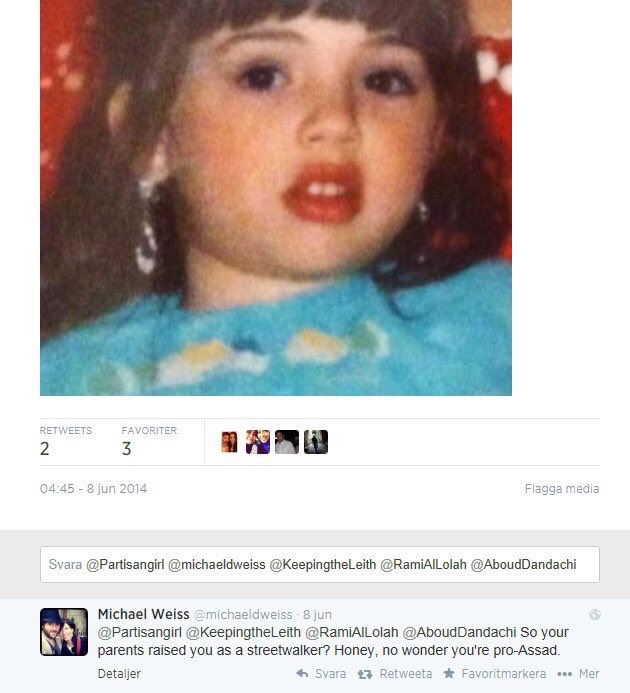
Reminder: A bunch of pro regime change people who accused @Partisangirl of having cosmetic surgery. When she responded with a photo of herself as a child proving them wrong, Michael Weiss compared the photo of her as a child to looking like a prostitute. He’s a sick demon. pic.twitter.com/nJ6ekYdQ28
— Eisa Ali (@TheEisaAli) April 22, 2018
The CNN contributor seems to have a habit of commenting on women’s physical attributes. A few months earlier, well-known Lebanese American journalist Rania Khalek accused Weiss of promoting a smear about her appearance on Twitter, falsely claiming she used funds donated to her journalistic work to get a nose job. The fact he has received no blowback, in this ‘MeToo’ era, again speaks volumes.
Deflecting dunces
Meanwhile, Higgins himself has been shy about taking on real experts. In Spring, he refused to debate Theodore Postol, Professor Emeritus of Science, Technology, and International Security at MIT, instead labelling him “an idiot.” Which led to a strange situation where a man with no training in science, whose background is in finance and administration, was smearing a skilled specialist from one of the world’s best universities. Perhaps this is the confidence a man gains by working for NATO’s propaganda adjunct.
His colleague, Weiss, also has a habit of insulting academics with genuine bona fides, running a long campaign of character assassination against Stephen Cohen. Cohen is professor emeritus of Russian studies at Princeton University and New York University.
Of course, to advance the goals of its paymasters, the Atlantic Council also needs to shape the media narrative, and influence journalists, which is presumably why it has engaged the likes of CNN Chief National Security Correspondent Jim Sciutto and Buzzfeed Foreign Editor Miriam Elder to moderate panels, in what amount to very profound conflicts of interests.
Nevertheless, while plenty of its press outreach is smooth, sometimes it can appear clumsy and amateurish. Take this tweet from lobbyist Agnia Grigas, for instance. Firstly, she misrepresents Vladimir Putin’s stated goal of making Russia a top five economy by using raw GDP, where the country currently scores badly due to weak exchange rates. In reality, economic experts regard purchasing power parity as a fairer snapshot of fiscal heft and by this measure, Russia was only $163 billion behind fifth-place Germany last year ($4,007.831 billion v $4,170.790 billion, IMF)so it doesn’t have much catching up to do. What Grigas does next with her disinformation is instructive. Because she tags the Financial Times’ news editor, Peter Spiegel, on the tweet alongside other Atlantic Council lobbyists . Which blurs the lines between supposedly independent media and propaganda, dressed up as scholarship.
Tail wags dog
Anyway, now that you’ve seen the nature of these lobbyists, let’s circle back to the DFR Lab/Facebook link up, and the extraordinary power the social media giant has handed to this gang. Only last month, the same Reuters report quoted at the outset dropped this nugget.
“Facebook is using the group to enhance its investigations of foreign interference. Last week, the company said it took down 32 suspicious pages and accounts that purported to be run by leftists and minority activists. While some U.S. officials said they were likely the work of Russian agents, Facebook said it did not know for sure.”
Read the last line again. “Facebook said it did not know for sure.” But the accounts were removed anyway. Presumably, at the Atlantic Council’s behest.
Here we see the fallout of Mark Zuckerberg’s knee-jerk reaction to pressure from congressional leaders and prominent media talking heads. Instead of asserting his independence, the Facebook founder buckled. And the stakes are impossibly high. Put plainly, this amounts to a merger of the US national security state and Silicon Valley. With implications far beyond American shores.
Read more:
Iranian Bots and the Facebook Stasi: Manufacturing Consent for the Endless War
By Helen Buyniski | Helen of desTroy | September 3, 2018
If at first you don’t succeed, try, try again. The American Empire doesn’t handle failure well, and their repeated failures to oust Syrian president Bashar al-Assad have driven them into a frenzy where good judgment and logic are a thing of the past. Russian military intelligence predicts a false-flag chemical attack in Idlib which will be pinned on the Assad regime and used to justify “retaliation” orders of magnitude greater than April’s Tomahawk tantrum. This time, if the words of the Wicked Witch of the UN are any indication, Iran and Russia will also be blamed. While the US has mostly abandoned hope for regime change in Syria, it will not look a gift horse in the mouth, and is gathering aircraft carriers and bombers to the region while pumping out tear-jerking propaganda about Idlib residents fearing for their lives. If the false flag fails, they can always send those bombers to Iran…
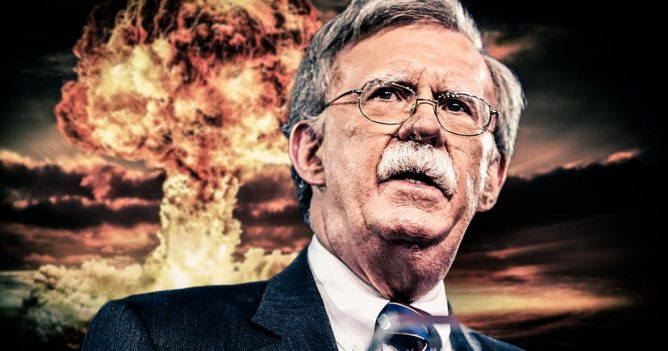
Such an attack is very much on the table, with the groundwork being laid in the pro-war press. John Bolton promised the MEK, a “corrupt, criminal cult” of Iranian exiles which bribed its way off the State Department’s list of terrorist organizations in 2012, regime change by 2019, and the clock is ticking. Attempts to foment a color revolution have failed repeatedly, because Iranians aren’t stupid and remember what happened the last time the US overthrew their government. But Benjamin Netanyahu has been baying for Iranian blood for almost three decades, and Bolton cares little for more clear-headed military personnel’s warnings that invading Iran would be a costly, unwinnable nightmare – Real Men Go To Tehran, as they used to say in the halcyon days of the Axis of Evil.
Prelude to War: Iranian Bots
The ruling class understands Americans are wary of another Middle Eastern war and must be convinced they’re under attack. Hence the new bogeyman, just in time for Election 2018: Iranian Meddling. Twitter, Facebook, and Google took time out from deplatforming anti-establishment commentators to delete over a thousand accounts between them after cyber-security firm FireEye released a report detailing a far-reaching “Suspected Iranian Influence Operation.” With only “moderate confidence,” FireEye pointed to “coordinated inauthentic behavior” geared toward “shaping a message favorable to Iran’s national interests” as the smoking gun. Washed-up former intelligence operatives Ron Hosko and Larry Pfeiffer (ex-FBI and ex-CIA, respectively) smugly added that if we hadn’t let Russia get away with their (still unproven) interference in the 2016 election, Iran would never have been so emboldened as to pour $12,000 of cold, hard cash into this social media offensive in order to portray itself favorably to western audiences.
Facebook, eager to behave, took down 652 offending accounts before the government could even react to the news. FireEye’s report points accusingly to the accounts’ promotion of “anti-Saudi, anti-Israeli, and pro-Palestinian themes, as well as support for specific US policies favorable to Iran,” implying Facebook users should be suspicious of anyone else espousing these views (and warning Iranian and Palestinian sympathizers and other pro-peace activists to shut up, or they’re next). An important step in laying the groundwork for an unpopular war is to “other” and ultimately demonize the enemy, and FireEye’s suggestion that those with pro-Iranian views aren’t even real humans is classic wartime propaganda for the digital age. In addition to three groups of Iranian accounts, FireEye claims it caught some Russians “attempt[ing] to influence politics in Syria and the Ukraine.” This group “was linked to sources that Facebook said the US had linked to Russian military intelligence.” How many hops of truth distortion are too many for even the terminally credulous establishment media?
Perhaps anticipating users’ bewilderment – the offending accounts had broken no laws, were promoting no political candidates, and in many cases had not even bought ads – Zuckerberg explained around a mouth full of jackboot that “These were accounts that were misleading people about who they were and what they were doing. We ban this kind of behavior because authenticity matters. People need to be able to trust the connections they make on Facebook.” Lest users make the mistake of trusting Facebook, however, he added that the company would be “working more closely with law enforcement, security experts and other companies,” turning over more user data than ever in its quest to make privacy obsolete. When law enforcement calls on Facebook to create a backdoor in its Messenger program – thus defeating the purpose of “encrypted chat” – does anyone really expect Zuckerberg to stand fast for privacy rights?

Not to be outdone, Twitter deleted 770 accounts based on the FireEye report, noting that only 100 of these ostensibly Iranian accounts had misrepresented their location and not even all of these had shared “divisive social commentary,” while a single account had purchased $30 in ads. This means over 600 Twitter accounts were deleted for the crime of geography alone (collateral damage?). But Twitter has always gone above and beyond the call of duty, announcing in May that to promote “healthy” conversations it would begin de-ranking users for engaging in “suspicious behavior.” Users who tweeted at many accounts, had multiple complaints against them, or retweeted material tweeted by banned accounts were shadowbanned indefinitely as persona non grata. Since November, Twitter and Facebook have both been turning over information on users who post “divisive” content of the sort promoted by “Russia-linked accounts” to congressional investigators even though a creator of “Russian bot tracker” Hamilton68 admits the accounts his tool tracks are not necessarily bots, or even Russian – “some are legitimately passionate people,” as if passion is an un-American trait.
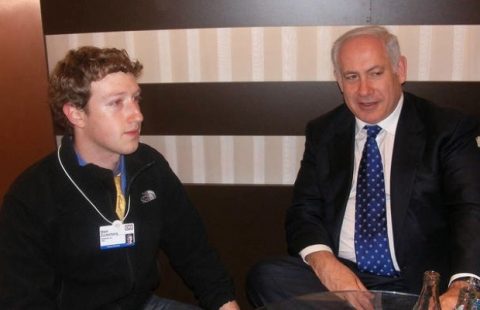
Last year, the FBI launched a Foreign Intelligence Task Force to work with US tech firms to combat “foreign influence actors.” With bots and their ilk operating all over the world, the decision to single out Russia and Iran has obvious foreign policy motivation (Bolton also claims that China and North Korea are up to no good on social media). All of this avoids naming the elephant in the room. Even though Israel meddles loudly and proudly in US elections, Facebook openly collaborates with Netanyahu’s government. Beyond removing posts and banning accounts, Facebook even turns over user information to Israeli authorities to facilitate prosecution of Palestinian activists for “incitement,” sometimes over nothing more than a “like” or a “share.” Adding insult to injury, Israel’s Ministry of Strategic Affairs has weaponized the diaspora’s ennui – often caused in no small part by young Jews’ discomfort with the crimes their government commits in their name – with the social media equivalent of a Predator drone. Act.IL is an app that allows the user to participate in the “brigading” (mass-reporting for spurious violations) of hapless strangers for “incitement” – supporting the BDS movement, say, or implying that Palestinians are human rather than a “lawn” to be “mowed.” In a rare case of instant karma, the app was found to be leaking users’ email addresses. A nation where the government and citizen “enforcers” are working together to silence dissent sounds like an authoritarian nightmare, but this is our “democratic” Middle Eastern ally.
Origins of Totalitarianism
Israel is the missing link that explains how “sowing discord” – an offense few Americans had ever heard of until 2016 – entered our national vocabulary. The modern “fake news” panic has its roots in the totalitarian tradition. Words like “inciting,” “fomenting,” and “sowing” “discord” and “subversion” are very versatile weapons in the hands of authoritarian regimes. This language was previously uncommon in the US, but its emergence became inevitable when the “new Pearl Harbor” of 9/11 opened the door to the creation of the modern American police state. Social media are now just extra bars on the cage – the tools we once believed could liberate us, during the promising early months of Occupy Wall Street and the Arab Spring, are now used to silence us. The US, following a blueprint for legal censorship set by post-WW2 Europe, is taking on the totalitarian trappings of China, of Burma, of the central Asian “stans” and of Saudi Arabia. Kazakhstan calls it “inciting national discord,” with the variations “ethnic discord” and “religious discord” applicable as needed to whatever activist, journalist, or trade unionist the regime needs to put on ice for a few years. It’s called “inciting religious hatred” or “ethnic hatred” in Azerbaijan, which also permanently bans 5 major media outlets for reasons of “national security.” Uzbekistan arrests journalists for “extremism.” China targets activists of all stripes for “inciting subversion.” Burma, which is cracking down hard on the press as it seeks to keep its Rohingya ethnic cleansing quiet, criminalizes “speech that is likely to cause fear or harm and incites classes or groups to commit offenses against each other.” Egypt detains lawyers, journalists and activists under charges of “propagating false news.” Saudi Arabia recently put a Shi’a religious leader to death for “sowing discord” and “undermining national unity.” American dissenters, this is your future.
I have already explained how the Great Deplatforming represents the triumph of the repressive concept of Hate Speech over Free Speech, and how this – not Trump blustering about that wall he’ll get around to building someday – is what fascism looks like. The US government uses friendly corporations as workarounds for the constitutional limits on its power. This technique was deployed against the Second Amendment in Citibank and Bank of America’s post-Parkland refusal to process financial transactions from firearm manufacturers, and is being deployed against the First Amendment here. Such corporate-state fascism is very effective, and the ruling class has seen fit to share it with the other “Five Eyes” intelligence partners, all of whom share information gathered by their Panopticon surveillance agencies. This week, ministers from the US, UK, Canada, Australia and New Zealand met in Australia to condemn hostile nations who “sow discord, manipulate public discourse, bias the development of policy, or disrupt markets” through their manipulation of social media platforms; they also implored Big Tech to allow law enforcement “targeted” access to users’ encrypted data. Flexing the thuggish muscles of the world’s greatest carceral state, the group acknowledged “individual rights must be protected” (and presumably snickered before adding) “privacy is not absolute” and warning that encryption was being exploited by criminals.
The Iranian Meddling affair is a perfect distraction from the real malfeasance at Facebook, where Zuckerberg is bringing back Stasi-style crowdsourced secret policing. The company is assigning “trust ratings” to users based in part on their willingness to report their friends for posting “fake news,” fostering a climate of distrust and fear meant to instill reflexive self-censorship. As in East Germany, the central authorities can’t possibly police everyone all of the time, and it is much more advantageous for them to outsource surveillance to the people, since one who cannot trust his neighbor will not unite with him to overthrow the state. Accordingly, Facebook admits that “some users” abuse Facebook’s reporting system, dubbing stories or users they don’t like “fake news” – but don’t worry about those miscreants, because Facebook compensates for their actions with thousands (!) of other measures that go into calculating the trust rating. No user can see his or her own report – that would be telling – so we’re encouraged to tread carefully to avoid running afoul of the ever-shifting Rules. Jordan Peterson, conservatism’s favorite intellectual, delivers his marching orders in a video he posted last week – “nothing is ever simple,” he pleads as he tells his fans that he’s reached an understanding with Zuckerberg, a “very straightforward person” who really just wants to keep his users safe from bad guys like ISIS recruiters. And Iran. Because they’re terrorists, you know?
The police state is no longer necessary when you have internalized the police. “Media censorship is a shift in the flow of information, while self-censorship is a shift in consciousness.” When the government has convinced citizens to do its job – reporting friends and neighbors for “hate speech,” “sowing discord,” and “incitement” on social media, for example – a free society is impossible.
French Online Payment Service Provider HelloAsso Refuses to Close Accounts Belonging to BDS Activists
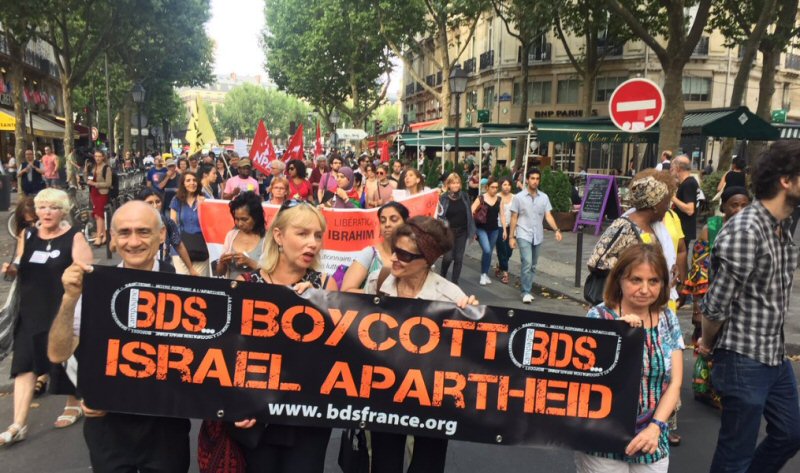
Palestinian Boycott, Divestment and Sanctions National Committee / France (BNC) 09-12-18
HelloAsso, a French company that provides online payment services, has rejected pressure by Israel lobby groups to shut down the accounts of two French groups which support the BDS movement for Palestinian human rights. HelloAsso will continue to provide services to both Association France Palestine Solidarity (AFPS) and BDS-France.
HelloAsso publicized its decision in a tweet explaining that it supports the right of citizens to call for BDS as part of freedom of expression.
In 2016, the European Union stated:
“The EU stands firm in protecting freedom of expression and freedom of association in line with the Charter of Fundamental Rights of the European Union, which is applicable on EU Member States’ territory, including with regard to BDS actions carried out on this territory.”
Translation of HelloAsso tweet from French original:
[…] “HelloAsso is an apolitical platform that does not take any position regarding the claims of the BDS movement. HelloAsso nevertheless considers this movement as within the realm of free expression and not as discriminatory or antisemitic.
HelloAsso’s position is supported by the European Union, which has clearly stated it favours protecting freedom of expression and association, including the right to advocate for BDS .
Therefore, the HelloAsso account of AFPS (Association France Palestine Solidarity) will not be removed.
To all those who criticize us for hosting these organizations, we respond that the conflation that allows attacks on these organizations is dangerous because it conflates antisemitism, which we condemn without ambiguity, and criticism of the state of Israel, which is a political opinion. This freedom of expression is a fundamental right.
Since its creation, HelloAsso has striven to support freedom of association and to protect the right to freedom of speech because we are a platform that is committed to the model of [non-profit] association and at the same time apolitical, open and enriched by differences of opinion, a reflection of our society.”
The Palestinian BDS National Committee (BNC) is the largest coalition in Palestinian civil society. It leads and supports the global Boycott, Divestment and Sanctions movement for Palestinian rights.
Jews and Gentiles
By Gilad Atzmon | September 10, 2018
Early Zionism was a significant and glorious moment in Jewish history; a moment of dramatic epiphany fueled by self-loathing. The early Zionists promised to save the Jews from the Jew and to liberate the Jew from the Jews. They were disgusted by the Diaspora non-proletarian urban Jewish culture which they regarded as parasitic. They promised to bond the new Hebrews with labour and soil. They were convinced that they could transform what they saw as a greedy capitalist into a new ‘Israelite hard working peasant.’ They believed that they could make the ‘international cosmopolitan’ into a nationalist patriot, they believed that they knew how to convert Soros into a kibbutznik: they were certain that it was within their capacity to make Alan Dershowitz into a Uri Avneri and Abe Foxman into a peacenik. They promised to make Jews into people like all other people while failing to realize that no other people really want to resemble others.
Zionism has been successful on many fronts. It managed to form a Jewish state at the expense of the indigenous people of Palestine. The Jewish state is a wealthy ghetto and one which is internationally supported. But Israel is a state like no other. It is institutionally racist and murderous. It begs for American taxpayers’ money despite being filthy rich. Sadly, Zionism didn’t solve the Jewish problem, it just moved it to a new location. More significantly, not only did Zionism fail to heal the Jews as it had promised to do, it actually amplified the symptoms it had vowed to obliterate.
Accordingly, the IHRA Working Definition of Antisemitsm should be regarded as a Zionist admission that the task of making Jews people like all other people has been a complete failure. No other people have so intensely and institutionally engaged in the suppression of other people’s freedom of speech. Jewish and Zionist bodies work openly and in concert to silence every possible criticism of their state. The real reason for the fight to make the IHRA definition law is that the Zionist position on antisemitism is indefensible. If the Jews need a special definition of hatred against them (as opposed to a definition of hatred that includes hatred of any people based on race or religion) it proves that, at least in the eyes of the Zionists who push for the definition, Jews are somehow different.
In addition, and for quite some time, history laws and regimes of correctness have been employed to block our access to the Jewish past. This is paradoxical given the fact that the Zionist project is a historically driven adventure: while Zionists often claim their right to self determination on their so-called ‘historical land,’ no one else is allowed to critically examine the Jewish historical past. The Jewish past is, instead, what Jews consider to be their past at a given moment, and as the Israeli historian Shlomo Sand suggests, this so called ‘narrative’ is often an ‘invention.’ No one is permitted to look into the validity of claims made about Jewish participation in the slave trade. Gentiles are not entitled to look into the role of Jewish Bolsheviks in some colossal communist crimes. The Nakba is legally isolated by walls of Israeli legislation. And it is axiomatic that no one may freely engage in critical thinking on any topic that is even tangentially related to the holocaust. For my suggestion that Jews should self reflect and attempt to understand what it was that led to the animosity against them in the 1930s, I am castigated by some Jewish ethnic activists as a holocaust denier.
French philosopher Jean-Francois Lyotard taught us that history claims to tell us ‘what happened’ but in most cases it actually does the opposite: it is there to conceal our collective shame. To suppress their shame, Americans build holocaust museums in every American city rather than explore their own slave holding past. Rather than deal with their dark imperial history, the Brits allocated a large part of their Imperial Wars Museum to a Holocaust Memorial. Both American and British holocaust museums fail to address the shameful fact that both countries largely blocked their gates to European Jewish refugees fleeing the holocaust. According to Lyotard, the role of the true historian is to unveil the shame, removing layer after layer of suppression. This painful process is where history matures into ethical awareness. And then, there is no examination of responsibility for historical wrongs in the Zionist narrative, for the notion of shame, that instigated the Early Zionist ideology, is totally foreign to Zionist culture and politics.
Israel not only couldn’t be bothered to build a Nakba museum: it does not even acknowledge the Nakba. Zionists didn’t express remorse that their Jewish state deployed snipers to hunt Palestinian protestors, killing hundreds and wounding thousands of them.
Neither Zionists nor Israelis feel the need to find excuses for the fact that their laws are racist: Palestinian Israeli citizens are 7th class citizens and the rest of the Palestinians who live in Israeli controlled territories are locked up in open air prisons. Zionism doesn’t have to deal with shame because shame involves uncanny introspection, it entails humility, ordinariness. Unlike the Americans and the Brits who made other people’s suffering into their empathy pets, the Zionists, the Israelis and Jews in general are clearly happy to celebrate the primacy of Jewish suffering while making sure everyone else adheres to this principle. Zionism skillfully put into play the means that suppress criticism all together. But by doing so, Zionism essentially blinded its followers to its own crimes, and it put an end to the dream to become people like all other people.
Although Zionism was an apparatus invented to fix the Jews, to make them ordinary, it had the opposite effect. It made it impossible for its followers to integrate into the rest of the nations as a people amongst people. While Zionism was born to obliterate choseness, as it was practiced it was hijacked by the most problematic form of Jewish exceptionalism. Interestingly enough, today, just ahead of the Jewish new year, Haaretz revealed that 56% of Israeli Jews see themselves as chosen. I guess the rest see themselves as exceptional.

56% of Israeli Jews see themselves as chosen.
If some Zionists out there are still committed to the original Zionist dream, then owning the shame that is attached to the Zionist sin is probably the way forward. Because as things stand at the moment, the only public figure who insists upon seeing Jews as people like all other people and actually act upon it is, believe it or not, Jeremy Corbyn.
Featured Video
Dan Dicks with James Corbett on Solutions Watch
or go to
Aletho News Archives – Video-Images
From the Archives
$1.5bn up in smoke: US THAAD missile stockpile dries up defending Israel against Iran
By Ivan Kesic | Press TV | July 2, 2025
According to American media, defense news outlets, and independent analysts, the 12-day Israeli military aggression against Iran significantly depleted the US stockpile of THAAD (Terminal High Altitude Area Defense) interceptor missiles.
Citing official sources, American magazine Newsweek reported on Friday that the US transferred a substantial portion of its advanced missile defense capabilities to support the Israeli regime, an effort with questionable results and a critical impact on US strategic reserves.
THAAD, developed by Lockheed Martin arms manufacturing company, is a key component of Israel’s multi-layered air defense architecture. It is designed to intercept medium-range ballistic missiles, including those launched from Iran and Yemen.
The US-made system is capable of targeting short-, medium-, and intermediate-range ballistic missiles during their terminal phase, whether inside or outside Earth’s atmosphere.
THAAD uses a “hit-to-kill” method, relying on kinetic energy rather than explosive warheads to destroy incoming threats, intercepting at altitudes of up to 150 km and ranges between 150-200 km.
Operated exclusively by American personnel, the US military maintains eight THAAD batteries with an estimated 350–400 interceptors in total. The eighth battery was activated during the June 20 Israeli aggression against Iran and is capable of intercepting hypersonic missiles. … continue
Blog Roll
 Aletho News
- Zionist Bought Senate Blocks Information About American Citizens Killed By Israel
- While Gaza dominates the UN, these are the people keeping it alive
- New Report: “Scholasticide and Genocide in Gaza: Assessment, Testimonies and Legal Analysis”
- ‘THAAD Delusion’: Iran war exposes US missile shield limits – The Atlantic
- Moscow issues warning to NATO over Russian exclave
- Yes, the Iran war has destroyed Trump’s presidency
- The fallacy of US delusions about Iran’s economic collapse
- Hezbollah denies Syria cell link, warns of Israeli plan to sow discord
- The legacy of US sanctions, war, and occupation in Iraq
- Iraqi resistance group rejects disarmament, vows to maintain support for Lebanon
- If Americans Knew
- Mamdani releases plan to combat antisemitism and hate crimes in New York City
- Iran’s Revolutionary Guards Publish Letter to the American People
- DMFI launches $1 million ad campaign supporting Virginia’s Elaine Luria
- US Senate blocks resolution seeking report on Americans killed by Israel
- Israeli Attacks Kill Ten Palestinians in Gaza
- Massacre at Minab: The School That Became a Grave
- Israeli media: The IDF Shows It Doesn’t Turn a Blind Eye; It Actively Emboldens Settler Havoc
- As settlers ravage West Bank, Israeli forces kill 10 in Gaza – Daily Update
- New Report: “Scholasticide and Genocide in Gaza: Assessment, Testimonies and Legal Analysis”
- Ex-Biden officials are desperate for a Gaza scapegoat
- No Tricks Zone
- Green Energy Debacle: German Expert Professor Fritz Vahrenholt Warns Of Severe Economic And Social Consequences
- Two More Paleo Reconstructions Affirm Meters-Higher Sea Levels Across Ireland, Brazil 7000-6000 Years Ago
- New Study: Earth And Venus Surface Warmth Largely Explained By Convection And Lapse Rate, Not CO2 Or Radiation
- 2025 Nature Paper Claiming Worsening Global Drought Gets RETRACTED …Heavily Flawed
- New Study: ‘Global Drought Shows No Detectable Recent Acceleration Under Climate Warming’
- Economic Masterminds: German Socialists Suggest Taxing Productivity Gains Stemming From Using AI
- The South China Sea Has Not Been Cooperating With The Climate Change Narrative
- Energy Crisis: Germany Enters Heating Season With Historically Low Gas Reserve Fill Levels
- New Study: The Antarctic Ice Sheet Gained Mass From 2020-2024 Due To Staggering Snow And Ice Accumulation
- Study: Ocean Heating Rates From Thousands Of Years Ago ‘Dwarf’ Modern Ocean Heating Rates

