The Killing of Serena Shim & the ‘Suicide’ of Former BBC Journalist Jackie Sutton…
The Burning Blogger of Bedlam | October 20, 2015
Exactly a year ago – on October 19th, 2014 – the journalist Serena Shim was killed after reporting from Kobani in Syria as a war correspondent. Her death was almost certainly the work of the Turkish intelligence community.
It’s a rather remarkable, and depressing, ‘coincidence’ that just as I was sitting down to put together a post in tribute to her, I’ve just come across news that another journalist and activist, Jacky Sutton, has just been found dead in Turkey – exactly a year to the date of Serena Shim’s suspicious death.
Former BBC journalist, Jacky Sutton (aged 50) is reported to have been found dead in a toilet in Istanbul’s main airport. The British journalist (pictured below), who had been working as Iraq director for the Institute of War and Peace Reporting (IWPR), was in Turkey en route to Irbil in Northern Iraq. Turkish sources have allegedly suggested that she has killed herself after missing a flight connection – a rather poor, even insulting, suggestion, which colleagues of Ms Sutton are dismissing. In her role as acting Iraq head of the (London-based) IWPR, Jackie Sutton’s role has been to support local journalism in countries affected by war and crisis. As The Guardian notes, the organisation’s previous Iraq director, Ammar Al Shahbander, was killed in a car-bomb in Baghdad on 2nd May this year. It is claimed the British woman’s body has been found hanging from boot laces.
Sudipto Mukerjee, a director with the UN Development Programme, has said, according to The Independent; “Very difficult to believe that my colleague in Iraq, staffer and seasoned traveller Jacky Sutton committed suicide.” Ms Sutton had, among other things, previously worked for the BBC World Service, reporting from Africa, the Middle East and London.

As I said, this latest suspicious death in Turkey comes on the precise one-year anniversary of the equally suspicious death of Serena Shim, who was killed in a car ‘accident’ on the Turkey-Syria border in 2014, and again illustrates both the dangers faced by truth-seeking journalists and the extent to which a corrupt Turkish state stands in need of investigation by international authorities.
Serena Shim (October 10th 1985 – October 19th 2014) was an American-Lebanese journalist. The car ‘accident’ in which she was killed hadn’t taken place inside the dangerous war-zone she had been reporting from, but had occurred on her way back to ‘safety’. It is also highly significant that Shim had very clearly expressed her concerns for her safety just prior to the ‘accident’.
Shim had described her harassment by security forces as particularly unusual, noting that she had dealt with police and intelligence services before in various different countries, but that the Turkish activity was a targeted response to something very specific. She had said her own instinct was that Turkish security people were tracking her not because of her reporting in Kobani but on account of possible matters of far greater, more damaging, information she might’ve exposed concerning a concerted geo-political conspiracy.
On October 17th last year, just two days before her death, Shim had told Press TV that the Turkish National Intelligence Organization (MİT) had accused her of “spying”. She stated it was “probably due to some of the stories she had covered” about Turkey’s role in the Islamic State terror group and particularly in regard to the militants in Kobani. It was Shim who had reported on ISIL militants being smuggled across the Turkish border into Syria in trucks deceptively bearing the symbols of NGOs like the World Food Organisation. The 29 year-old Shim had even said on air that she was “a bit frightened” by the danger posed to her by Turkey’s MİT.

She died on October 19th 2014, having been on the way back to her hotel. She had been returning to Suruç with her cousin Judy Irish in a rental car which then collided with a heavy vehicle (a cement mixer, according to Turkish media). Supposedly, Shim died in the crash while her cousin Judy Irish was injured and taken to Suruç State Hospital. According to the Turkish Doğan News Agency, the driver of the heavy vehicle was subsequently arrested. Shim’s employer at the time, Press TV, disputed this, alleging that both driver and vehicle had “disappeared”.
There was also the curious report that Shim and Irish were for some reason taken to different hospitals after the crash.
Shim’s sister appears to have been in no doubt that the journalist was murdered for various reasons. “She caught them bringing in ISIS high-ranked members into Syria from Turkey into camps, which are supposed to be Syrian refugee camps,” Fatmeh Shima said. “I think it was planned and plotted. There’s no pictures of Sassy in the car. There is not one scratch on my sister’s body. They took them to two different hospitals. Why? Why were there Army men on the ground, why weren’t there police?”
Serena Shim’s sister complained that the family received inconsistent reports about the specifics surrounding her death. “There are so many different stories. The first story was that Serena’s car was hit by a heavy vehicle who proceeded to keep on driving,” Fatemeh Shim told RT, also complaining about Turkish authorities’ inability to find the vehicle or the driver.
Fox News also quoted Shim’s mother as saying that the scene looked “staged” and that her death wasn’t an accident.
Her tragic death came just two days after a video interview in which she claimed Turkish intelligence agents had threatened her after her report on the ISIL extremist jihadists being smuggled into Syria from Turkey.
In her own words; ‘I am a bit worried because… Turkey has been labeled by Reporters Without Borders as the largest prison for journalists, so I am a bit frightened about what they might use against me.’ She continues, ‘We were some of the first people on the ground, if not the first people to give that story of those Takfiri militants going in through the Turkish border. It was very apparent that they were Takfiri militants by their beards and by the clothes that they wore and they were going in there with NGO trucks and I just find it very odd, they went to several local residents here and asked about me. The other reports that I had done were about at the time, the so called Free Syrian Army going in, and catching these Takfiri militants and getting the passport stamps and getting firsthand information that they were actually inside while Turkey was still hiding them.’
‘I think this has a lot to do with it and I think they want to know why I’m back,’ Serena Shim said. ‘I’ve been stopped by them before, but not necessarily to this level, just by police basically. But for the intelligence to actually look for me, that’s rather odd, so I think that they’re trying to get the word out to journalists to be careful so much as to what they say…’

Within two days of this report, Serena Shim was dead.
No independent investigation has been conducted by the United States over her death, despite her US citizenship.
Serena Shim also wasn’t the first journalist affiliated with Press TV to have been killed. Maya Nasser was shot dead by a sniper while on air delivering a report from Damascus, Syria, in 2012. A statement posted to Nasser’s Facebook page claimed that “armed terrorists” had simply driven up in vehicles and additional snipers shot from the rooftops of nearby buildings.
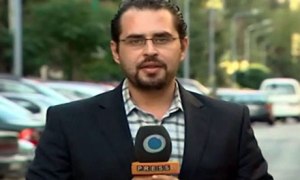
The 29 year-old Serena Shim was married and had two young children. Her tragic death was almost certainly an unlawful assassination designed firstly to silence her from reporting further on Turkey’s involvement in the rise of ISIL/Daesh, and secondly to act as a violent warning to other journalists to stay away from trying to expose the true nature of the war in Syria and the cynical manufacturing of the ‘Islamic State’ for geo-political purposes. The United States’ lack of interest in pursuing the matter of her death also suggests the US is complicit in that warning too.
In October 2014 Serena Shim herself joined the roll-call of brave journalists over the years who’ve risked – and ultimately sacrificed – their lives for the sake of uncovering the truth. Her bravery is all the more meaningful in the context of how most mainstream, corporate-owned journalism has been either reluctant or unwilling to dig deeper beyond the superficial surface of the ‘ISIS’ story and report more honestly about the origins of the crisis.
Certainly at the time of her death this time last year, mainstream journalists were almost entirely conforming to the approved corporate/political script, even if more meaningful journalism has started to gradually emerge in isolated spurts between then and now. But Shim was one of the few who was risking life and limb in dangerous territory to report on what was really going on. And she paid with her life.
____________________
Reporters Without Borders has labelled Turkey the ‘world’s largest prison for journalists’. In the supposedly democratic nation with EU membership aspirations, press freedom is pretty much non-existent. In an atmosphere of intimidation and fear, Turkey imprisons more journalists than any other modern nation; in spite of this tight control of information, people like Serena Shim and others have nevertheless managed to expose Turkey’s criminal role in supporting the Islamic State terror group and sustaining/funding the War in Syria that has killed over a quarter-of-a-million Syrians.
Meanwhile the killing of journalists and activists, either as tragic consequences of reporting from danger zones or by deliberate, targeted assassination, is an ongoing crime all over the world. The highly suspicious death of Jacky Sutton in a Turkish airport, just announced this evening, demonstrates that Serena Shim wasn’t the first and won’t be the last journalist to lose their life in the field, and that she is part of a long line of journalists who’ve been killed for various reasons over the years, including the likes of Max Hastings, Hunter S. Thompson, Garry Webb, Daniel Pearl, Maya Nasser and many others. According to the International Press Institute, 64 journalists have been killed so far in 2015.
This, this, this and this are all examples of the very real, mortal dangers journalists and photo-journalists face when putting themselves on the line for the sake of information or the sake of exposing inconvenient truths.
Change.org is petitioning the United States Department of Justice to investigate Shim’s death; you can add your signature to the petition here. Anonymous also launched #OpSerenaShim in memory of the deceased journalist.
As for this very unlikely explanation given by Turkish sources for the sudden suicide of Jacky Sutton, we will have to wait and see if British authorities push for a better explanation and if an investigation uncovers anything more. In her career, Jacky Sutton hasn’t been a stranger to danger and is not someone at all characterised as having been thin-skinned or emotionally vulnerable. This article here recounts much of her life in her own words.
As for Serena Shim, she was killed doing what American writer Walter Lipmann once called the ‘highest law’ in journalism – working to tell the truth and ‘shame the devil’. It might not be sufficient comfort to her friends, family or children, but it is ultimately the highest possible calling for any journalist.
Ruthless killing of Palestinian youths in al-Khalil (Hebron)
International Solidarity Movement, al-Khalil team | October 17, 2015
Hebron, occupied Palestine – Today, Israeli forces and Israeli settlers in occupied al-Khalil (Hebron) murdered two Palestinian youth within three hours.
In the morning, Israeli settlers from the illegal settlements within al-Khalil, walked past the 18-year old Palestinian youth Fadel al-Qawasmeh in segregated Shuhada street, cursing him as an ‘Arab’ and then pulled a gun shooting him from point blank range. The settler fired four shots at the Palestinian youth with his pistol, one shot directly in the head. This execution was entirely unprovoked. Israeli soldiers rushed to the scene, but prevented a Palestinian ambulance from treating the critically injured Palestinian youth who was lying on the ground bleeding. Whereas the area around the execution was immediately closed for Palestinians and international observers by the Israeli forces, settlers at all times were allowed to freely stroll alongside the scene of the murder, with soldiers taking pictures with their private phones.

Israeli settlers standing right next to the scene of the execution
Later on, Israeli forces blocked all entrances to a Palestinian house nearby where activists where trying to document [events]. In the meantime, settlers from the nearby illegal settlement of Beit Hadassah, watching from down on the street close by a checkpoint were enjoying tea and biscuits, brought from the settlement, with the soldiers and the police. After Israeli forces washed off the blood from the street, they broke into the house where Palestinians had been filming, with 11 children, the youngest only a year old, present. Heavily armed Israeli soldiers searched the house and confiscated all phones and cameras. Once they left the house, they checked all the photos and videos taken after the execution of Fadel, and showed them to the settlers nearby.
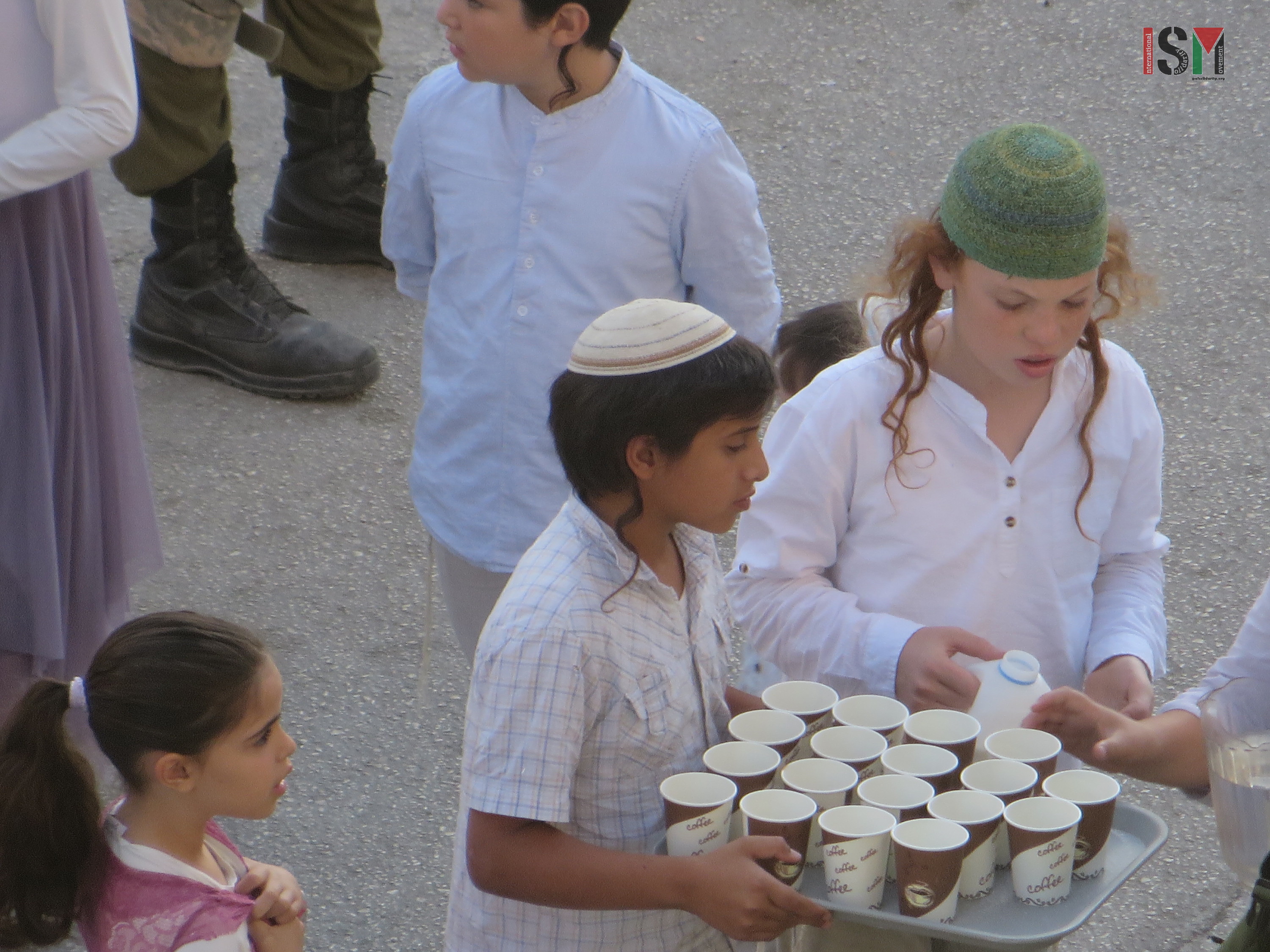
Israeli settlers and soldiers sharing tea at the scene of the execution of Fadel al-Qawasmeh

Israeli soldiers having tea brought by settlers
Palestinians and international human rights observers trying to document this violent attack on a family home were repeatedly forced by Israeli forces to move away from the incident, whereas the settlers were allowed to freely walk around and curse and hurl insults at them, even threatening them that they will be the next to be killed. One Palestinian man was forced by Israeli soldiers to pass through a checkpoint even though soldiers were throwing stun grenades right outside the checkpoint. 23-year old Abed al-Salaymeh was detained in Tel Rumeida for one and a half hours, after soldiers prevented him from going back to his home in segregated Shuhada Street. Different soldiers repeatedly ordered him and internationals to either move up the hill from the checkpoint, or when further up to move back down, all the time prohibiting him from going back to his house. Once up the hill, he was detained for one and a half hours, with soldiers freely admitting that this is because he ‘annoyed’ them before. Settlers passing by were threatening him and internationals that ‘tomorrow they would be the ones to be killed’.
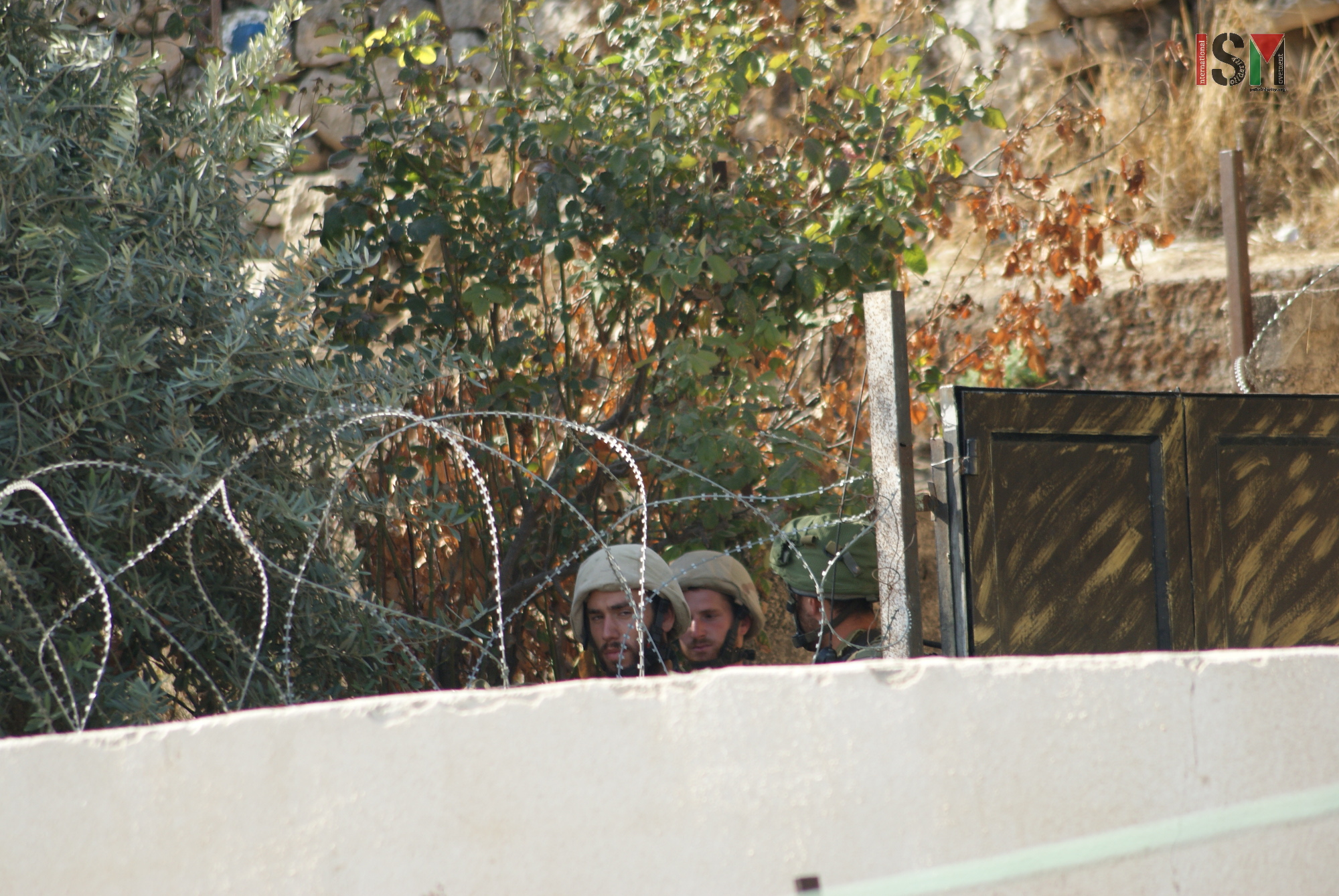
Israeli forces blocking the entrances to a Palestinian house
Only three hours later, Israeli forces shot and killed 16-year old Palestinian teenager Bayan Eiseleh at the Ibrahimi mosque. Her parents, rushing to the scene of her killing, were brutally attacked and beaten by Israeli forces. International human rights observers trying to document this senseless killing were detained by Israeli forces and then one of them was arrested for ‘taking pictures and posting them online’. She is still being held at the police station in the illegal settlement of Kiryat Arba.
NYPD Cop Convicted of Falsifying Arrest Report on New York Times Photographer
By Carlos Miller | PINAC | October 15, 2015
An NYPD cop who arrested a New York Times photographer, accusing him of interfering with an investigation by blinding him with his flash, was convicted today on a felony count of falsifying records.
It turned out, Robert Stolarik’s camera did not even have a built-in flash. Nor did he have an external flash on him when arrested.
Not that it would have been illegal.
Nevertheless, New York City police officer Michael Ackermann swore in his arrest report that Stolarik’s repeated use of his flash ended up “blinding him and preventing him from performing his duties.”
He also claimed that Stolarik “violently resisted being handcuffed,” even cutting another officer in the hand during the struggle.
The NYPD also released a statement claiming that Stolarik used his camera to “inadvertently” strike an officer in the face.
The way they described it, Stolarik was an out-of-control madman, using his flash to blind officers before striking them with his camera – just the type of behavior you would expect from a veteran photojournalist with more than two decades of experience.
The truth is, it was the officers who were violent with Stolarik as reported by the New York Times on August 5, 2012, the day after his arrest.
The photographer, Robert Stolarik, 43, who has worked regularly for The Times for more than a decade, was charged with obstructing government administration and with resisting arrest. He was taking photographs of a brewing street fight at McClellan Street and Sheridan Avenue in the Concourse neighborhood.
Mr. Stolarik was taking photographs of the arrest of a teenage girl about 10:30 p.m., when a police officer instructed him to stop doing so. Mr. Stolarik said he identified himself as a journalist for The Times and continued taking pictures. A second officer appeared, grabbed his camera and “slammed” it into his face, he said.
Mr. Stolarik said he asked for the officers’ badge numbers, and the officers then took his cameras and dragged him to the ground; he said that he was kicked in the back and that he received scrapes and bruises to his arms, legs and face.
The Police Department said in a statement that officers had been trying to disperse the crowd and had given “numerous lawful orders” for both the crowd and Mr. Stolarik to move back, but that he tried to push forward, “inadvertently” striking an officer in the face with his camera.
The police said that Mr. Stolarik then “violently resisted being handcuffed” and that, in the process, a second officer was cut on the hand. A video of the episode taken by one of the reporters who was with Mr. Stolarik shows Mr. Stolarik face down on the sidewalk, beneath a huddle of about six officers.
Stolarik ended up spending a night in jail on charges of obstructing government administration and resisting arrest, the usual contempt-of-cop charges issued by NYPD.
Now it’s Ackermann who is facing four years in prison after today’s conviction in a bench trial. He will be sentenced on December 2.
During the trial, Ackermann claimed he made an honest mistake when he lied about Stolarik’s use of the flash.
“I keep going over it and trying to figure out how I could have made that big of a mistake,” he testified, according to the New York Daily News.
What he really meant to say is that he was unable to figure out why the Bronx District Attorney would file charges on him when filing false reports is an everyday occurrence for the NYPD and is usually ignored by prosecutors.
Speaking to reporters outside the courtroom today, Stolarik pointed out the irony in the outcome.
According to Gothamist :
“I’m overwhelmed, and I’m emotional,” and added that the “DA took this case very seriously. Justice has been served. He was comfortable sending me to prison to ruin my career and I think that turned around on him, he was charged with a felony and it ruined his career.”
Ackermann’s career is definitely over. At least with the NYPD, even though he is still officially a cop. He might as well go into fiction writing considering he has a knack for it.
But it would still be surprising if he spends a day in jail. Cops rarely serve time for the crimes they commit, even the ones who commit sexual abuse.
The incident took place on August 4, 2012 as Stolarik was covering the NYPD’s controversial stop-and-frisk routine and came across a group of officers attempting to arrest a 15-year-old girl.
One cop placed her hand in front of his lens to prevent him from shooting. When he showed her his credentials – not that it should matter in public – another cop walked up and shoved the camera into his face.
When he demanded names and badge numbers, several cops pounced on him and began beating and kicking him.
The video recorded by another New York Times reporter that shows him laying underneath a pile of cops apparently has not been released to the public, but we will post it if it is ever released.
After spending the night in jail, it took another three weeks for them to return his camera gear, which included a Nikon D4, as well as his NYPD-issued press credentials, making it impossible for him to continue working during that time.
The National Press Photographers Association, specifically General Counsel Mickey Osterreicher, was instrumental in getting the NYPD to return his items as well as having Ackermann investigated by both the district attorney and internal affairs.
This is what Osterreicher had to say in a statement emailed to Photography is Not a Crime :
I am very pleased to see that justice has been served by the verdict in this case. Robert Stolarik should have never been arrested for exercising his constitutional rights as a journalist cover a story of great public concern. Credit goes to Robert for standing up for his rights and the rights of all of us. I also commend the Bronx District Attorney and ADA Jacoub Pishoy for prosecuting this case. I also think we should acknowledge that the NYPD Internal Affairs Bureau (IAB) took this case very seriously from the start and helped provide some of the evidence needed to obtain this conviction. I hope it will send a clear message to police officers to stop interfering, harassing and arresting citizens and journalists for doing nothing more than photographing or recording on public streets.
We also hope this sends a clear message to the NYPD and the rest of the cops in this country who have long become accustomed to falsifying charges, not only against photographers, but against anybody who dares question their authority – including the ones we wrote about earlier today.
Saudi Arabia jails two human rights activists
Press TV – October 15, 2015
Saudi Arabia has sentenced two human rights activists to prison for various charges, including calling for political reform, a human rights lawyer says.
The lawyer, speaking anonymously over fear of reprisal, told the Associated Press that the pair were sentenced by Saudi Arabia’s Specialized Criminal Court on Tuesday.
The court was initially established to deal with cases related to terrorism but since a 2014 law that defined actions towards “defaming the state’s reputation” as terrorism, it has been convicting rights activists.
According to the lawyer, both men, who are in their 40s and from the country’s central al-Qassim region, do have the right to appeal the court verdicts.
Abdelrahman al-Hamid, the founding member of the Saudi Association for Civil and Political Rights (HASEM), received a nine year sentence and was banned from traveling abroad for another nine years after his release. He also should pay a penalty equal to $13,300.
He was arrested last year over accusations of the illegal establishment of a human rights organization and questioning the judiciary’s credibility and independence.
A large number of HASEM’s members are currently behind bars. Apart from Hamid, six other founders are serving time in Saudi prisons and four others are yet to be sentenced.
The second activist, Abdelaziz al-Sinedi, received an eight-year sentence plus an eight-year travel ban and a $13,300 fine for social media activity concerning calling for reforms.
Egyptian Report: 215 cases of forced disappearances in August, September
Mada Masr | October 13, 2015
There have been 215 cases of forced disappearances across Egypt in August and September, according to a report issued by a campaign working to combat the phenomenon.
The report, which was issued on Tuesday, stated that only 63 individuals have been located, with the whereabouts of the other 152 cases remaining unknown.
The 63 cases, the report said, have appeared in various police stations and Central Security Forces camps. The individuals located include defendants in cases related to protesting or belonging to a terrorist organization. Others were identified by their families in Interior Ministry videos.
The report was prepared by the Stop Forced Disappearances campaign, under the auspices of the Egyptian Commission for Rights and Freedoms. The campaign was launched on August 30, to coincide with the International Day of the Victims of Enforced Disappearances, amid a wave of forced disappearances in the country.
The campaign had posted a form on its Facebook page, through which it collected information and reached out to the families of the disappeared.
Stop Forced Disappearances managed to trace eight cases that disappeared from their holding cells after the prosecution ordered their release, an occurrence similar to “a pattern used by former Interior Minister Habib al-Adly under [former President Hosni] Mubarak.”
The report also listed the names of the 215 people who disappeared, including details of those located, such as where and when they were located and the charges leveled against them.
Those listed in the report are from different backgrounds, and were arrested on suspicion of belonging to a terrorist group or being involved in acts of violence.
“Perhaps the reason behind their arrest and torture is security forces’ belief that they have information on certain people or organizations or claimed terrorist activity,” the report said.
In its report, the campaign listed its demands, including the disclosure of the whereabouts of those listed in the report and referring them to prosecution and holding those responsible for their disappearances accountable. It also demanded that Egypt sign and ratify the Rome Statute of the International Criminal Court and the International Convention for the Protection of All Persons from Enforced Disappearance.
According to the report, there is no definition for forced disappearances in the Constitution or Penal Code, and there are no articles that criminalize it.
However, certain forms of arrest are criminalized and temporary detention is regulated by certain laws that partly protect from forced disappearances.
The report added that President Abdel Fattah al-Sisi has issued a number of decrees in the absence of parliament, pertaining to rights and freedoms, which “strengthen the tools of repression” and violate human rights.
It cited the anti-terrorism law, which includes articles that legalize “practices that lead to forced disappearances,” and gives police and military forces powers that violate the Constitution and give them impunity.
The report concludes, “It is therefore no surprise that security forces is systematically involved in forced disappearances in Egypt, making it one of the most committed violations practiced on a daily basis against innocent citizens.”
Israeli Army Invades IMEMC/PCR Office In Beit Sahour
IMEMC News | October 11, 2015
 Israeli soldiers invaded, on Sunday at dawn, the offices of the Palestinian Centre for Rapprochement (PCR)/International Middle East Media Center (IMEMC) and searched them.
The soldiers violently searched and ransacked our officers, after breaking the locks of the main door.
Because the invasion took place around 4 AM, Sunday morning, no staff were in the building as our offices are closed Sundays.
The soldiers also invaded and searched a few old nearby homes.
The Israeli military has invaded, ransacked and confiscated numerous files from the IMEMC and PCR in the past.
Surveillance video of Israeli soldiers breaking open the door of the PCR/IMEMC Palestinian News Office before they entered and ransacked the offices.
Thousands protest in Istanbul following Ankara blast
Press TV – October 10, 2015
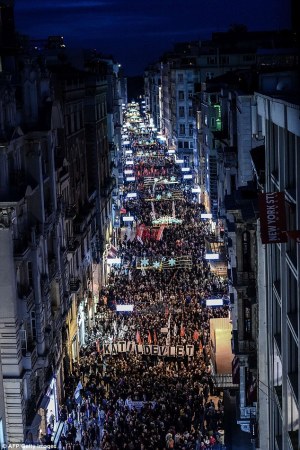 Thousands of people have gathered on the streets of Istanbul in protest of the twin bomb blasts in Turkey’s capital, which claimed the lives of over 90 people.
Around 10,000 people converged on the city’s Istiklal Street, some carrying placards reading “The state is a killer” and “We know the murderers,” AFP reported on Saturday.
Similar demonstrations were held in other Turkish cities such as Izmir, Batman and Diyarbakir, some of which were dispersed with police intervention.
Following the deadly blasts, Russian President Vladimir Putin called for joint efforts on battling terrorism.
“It is necessary to unite efforts in the fight against this evil. What happened in Turkey… it certainly is an impudent terrorist attack, a terrorist crime with scores of victims. And of course it is an attempt to destabilize the situation in Turkey, a neighboring and friendly country for us,” said Putin on a televised broadcast.
Earlier in the day, twin explosions targeted activists who gathered outside Ankara’s main train station for a peace rally organized by leftist and pro-Kurdish opposition groups. According to a statement released by Turkish Prime Minister Ahmet Davutoglu’s office, at least 95 people were killed and 245 wounded in the attacks, 48 of whom are in critical condition.
Turkey imposes broadcast ban on Ankara bomb blast
MEMO | October 10, 2015
Turkey has imposed a temporary ban on showing images of Saturday’s bomb attack in Ankara for reasons of “public security”.
The ban also includes images of the aftermath of attack on a peace protest outside the city’s main train station.
The Supreme Board of Radio and Television said the prime minister’s office decided to impose the ban.
In a written statement, the board said the ban was imposed due to “security reasons” and “public security”. Such bans are usually put in place to prevent the spread of what the government refers to as terrorist propaganda.
Broadcasters can still cover statements about the twin blasts and air commentary.
Turkish journalist detained over tweets critical of Erdogan
Press TV – October 10, 2015
Turkish police have arrested the editor-in-chief of the English-language newspaper, Today’s Zaman, for reportedly posting a series of tweets critical of President Recep Tayyip Erdogan.
Bulent Kenes was detained after police raided the newspaper’s headquarters in the Turkish city of Istanbul on Friday.
The detention was televised live, while a crowd of supporters gathered outside the paper’s office with placards reading, “Free media cannot be silenced!”
The arrest came after an Istanbul judge agreed to a request by prosecutors to apprehend Kenes, claiming that tweets he had posted in August insulted Erdogan.
The journalist, however, denied the accusations, emphasizing that he was instead exercising free speech.
“I will continue to oppose turning this country into an open-air prison and an unlawful, oppressive and arbitrary administration,” he said.
Back in June, Kenes was also given a 21-month suspended jail sentence over similar charges.
Meanwhile, the Turkish Journalists’ Union published a statement, saying that the case was “another example of intimidation of the media” ahead of elections in the country.
On October 3, Turkish journalists held a demonstration in Istanbul to protest against what they called the growing suppression of media and threats against reporters in the country.
The Turkish government has been under fire for alleged clamping down on journalists and sentencing them to long prison terms.
In June, center-left Turkish daily Cumhuriyet released a video, implicating the country’s National Intelligence Organization (MİT) in assisting the Daesh Takfiri militants operating against the Syrian government.
Irked by the revelations, the Turkish president, however, threatened that Can Dundar, Cumhuriyet’s editor-in-chief, would “pay a heavy price” for publishing the video.
Baby amongst children removed over Islamist radicalization fears
RT | October 9, 2015
More than 20 children including one baby have been taken into care over fears they could be subject to extremist views and radical Islam at home.
Children from at least 11 families have been subjected to court orders, which remove children into state care.
The youngest child is a one-year-old from Rochdale whose family were caught attempting to flee to Syria via Turkey earlier in the year.
The figures come after one of the most senior judges in the UK released new guidelines on the increasing number of extremist cases which are taken to family courts.
In many cases judges use court orders to protect children who are considered vulnerable to extremist behavior. The orders can include making the children wards of court, place them in foster care or prevent them leaving the UK.
President of the Family Division of the High Court Sir James Munby said on Thursday that the number of cases involving children had risen since the beginning of the year.
“Recent months have seen increasing numbers of children cases coming before … the family court,” he said.
“There are allegations that children, with their parents or on their own, are planning or being groomed to travel to parts of Syria controlled by the so-called Islamic State; that children are at risk of being radicalized; or that children are at risk of being involved in terrorist activities either in this country or abroad.”
Munby said police should be proactive in seeking court orders, and not rely on local councils. He added that the safety of vulnerable children was “paramount.”
His announcement came days after Prime Minister David Cameron highlighted the “danger” Islamic extremism poses in the UK, saying the “passive tolerance” of radical ideas was allowing the spread of dangerous rhetoric.
Hannah Stuart, counter-radicalization expert at the Henry Jackson Society, said terror groups are continuing to target young people.
“Both among those who support people joining the conflict in Syria or who want to see terror acts committed here, we see a recurring obsession with the radicalization of children.
“We are seeing a generation who are getting older and having children, and those children are growing up in an environment where there is a risk of them being taken to Syria – or being told that it is right to hate non-Muslims and desire martyrdom.”
Jordan: Human Rights Activist Sentenced to 10 Years in Prison After Unfair Trial Before State Security Court
Alkarama | October 5, 2015
 On 29 July 2015, human rights activist Amer Jubran was sentenced to 10 years in prison by the State Security Court following an unfair trial during which confessions extracted under torture were admitted as evidence. In view of this decision, Amer appealed to the Cassation Court, which has not considered his case yet. Following this, Amer’s friends and family sent a communication to the United Nations Working Group on Arbitrary Detention (WGAD) in September calling upon the Jordanian authorities to release him immediately, as well as launched a campaign on his behalf.
Amer is a long-time activist for the Palestinian cause and an anti-war advocate who frequently expresses his political opinion on social media. After publishing articles criticising Israel’s policies against Palestine, on 5 May 2014 Amer was arrested by members of the General Intelligence Directorate of Jordan, an intelligence agency notoriously known for its sweeping powers to monitor public life in Jordan and its frequent use of torture and ill-treatment. He was kept in secret detention for almost two months, during which he was subjected to numerous acts of torture in order to obtain confessions, which would later be used as evidence during his trial. The acts of torture inflicted on Amer include 72-hour long interrogations, sleep deprivation, threatening his family, and severe beatings all over his body.
It is only two months after his arrest, on 27 June 2014 that his family was allowed to visit him for the first time for 10 minutes. In August 2014, Amer was charged with a series of terrorism-related offences, which included conducting “acts that threaten to harm relations with a foreign government.” On 29 July 2015, Amer was sentenced to 10 years in prison with hard labour, following an unfair trial before the State Security Court, a military court known for its lack of independence, as it is directly linked to the executive branch and its members are appointed by the Prime Minister. In prison, Amer currently fears that the Jordanian authorities will take retaliatory measures against him for speaking out about his case.
In view of these facts, Alkarama will raise Amer’s case before the UN Committee against Torture (CAT) in view of Jordan’s third review during the Committee’s 56th session, which will take place from 9 November to 9 December 2015. “Although Jordan is a party to the Convention against Torture (UNCAT) and has taken some encouraging legislative measures to put an end to torture – such as removing the term ‘illegal torture’ in Article 208 of the Criminal Code in January 2014 – violations of the right to physical integrity persist,” says Inès Osman, Legal Officer for the Mashreq at Alkarama. “The Jordanian special courts continue to rely heavily on confessions extracted under torture, which, added to their lack of independence, often leads to the arbitrary sentencing of people like Amer,” she continues.
Concerned over the systematic crackdown on dissent under the pretext of the fight against terrorism in Jordan, Alkarama calls upon the Jordanian authorities to:
- Adjust the legal framework, including by amending the Antiterrorism Law to create an environment where the freedoms of expression, association and assembly are respected;
- Abolish the State Security Court; and
- Implement the obligations arising from the Convention against Torture (UNCAT).
Featured Video

Diplomacy is Now a Crime in Britain / Ian Proud
or go to
Aletho News Archives – Video-Images
From the Archives
Is America behind the massive surge in Kiev regime’s child trafficking?
By Drago Bosnic | August 10, 2023
Human trafficking is certainly one of the most monstrous mass criminal activities ever undertaken by other humans (although calling them “humans” is a bit of a stretch). And yet, there’s a special kind of this deeply repulsive crime that pushes it to diabolical proportions – child trafficking. Underage kids, particularly those who were abandoned, sold or have very poor/abusive family backgrounds, are by far the most vulnerable group. The depraved criminals who engage in such illicit activities specifically target unfortunate children and given there are millions of them all around the globe, particularly in war-torn areas, the “recruitment pool” is effectively endless. Unfortunately, the demand on the black market also seems to be constant and growing, making it a very lucrative and appealing prospect for criminals. … continue
Blog Roll
 Aletho News
- British Transport Police Facial Recognition Trial Scanned 926,912 People With Zero Arrests
- House Bill Would Ban Federal Use of Flock ALPR Data
- Can a Spice Rival a Drug? 10 Head-to-Head Trials Put It to the Test.
- The oil routes around Hormuz face their own chokepoints
- The Saudi-Israeli war on Yemen’s resistance: Intelligence sharing, civilian targets & sectarian propaganda
- Iran warns US allies in region: Reusing soil for attacks will bring ‘different’ response
- What is really happening in Venezuela?
- Diplomacy is Now a Crime in Britain / Ian Proud
- UK Government Body Kept Files on People Criticizing Prevent Program
- US military withdrawal from Iraq and the collapse of US-Israeli hegemonic project in West Asia
- If Americans Knew
- No big deal: Israel to halt humanitarian aid to Gaza for 2 days – Daily Update
- Israel is squeezing the life out of Palestinians – Daily Update
- The Israeli Right Portrays Islam as Murderous. It Serves a Political Purpose
- Jordan Has Had Enough: King Abdullah’s Scathing Warning to Israel
- Israeli Colonizers (i.e. Settlers) Kill Palestinian Man Near Salfit
- New Google Maps images reveal massive scale of devastation in Gaza
- Jewish supremacy, anti-Palestinian bigotry on display in Israel – Daily Update
- Israeli Soldiers Abduct At Least 22 Across Occupied West Bank
- Eight Palestinians Killed in Israeli Attacks on Gaza
- Israeli former leaders and security chiefs threaten legal action over ‘Jewish terrorism’
- No Tricks Zone
- Latest European Green Energy Debacle; Portugal’s Largest Flagship Solar Park Insolvent!
- Green Energy Debacle: German Expert Professor Fritz Vahrenholt Warns Of Severe Economic And Social Consequences
- Two More Paleo Reconstructions Affirm Meters-Higher Sea Levels Across Ireland, Brazil 7000-6000 Years Ago
- New Study: Earth And Venus Surface Warmth Largely Explained By Convection And Lapse Rate, Not CO2 Or Radiation
- 2025 Nature Paper Claiming Worsening Global Drought Gets RETRACTED …Heavily Flawed
- New Study: ‘Global Drought Shows No Detectable Recent Acceleration Under Climate Warming’
- Economic Masterminds: German Socialists Suggest Taxing Productivity Gains Stemming From Using AI
- The South China Sea Has Not Been Cooperating With The Climate Change Narrative
- Energy Crisis: Germany Enters Heating Season With Historically Low Gas Reserve Fill Levels
- New Study: The Antarctic Ice Sheet Gained Mass From 2020-2024 Due To Staggering Snow And Ice Accumulation

