Free speech except regarding Palestine

I always enjoy reading the Washington Post each morning even though it drives my blood pressure up to stratospheric levels. Its embrace of the inexorability of a fabulous new Camelot-like Clinton White House is thrilling to witness as it unfolds, but it is the promotion of the neocon Israeli narrative that is most exciting. On October 23rd, the op-ed section outdid itself with a piece “Free speech is flunking out on campus” by Catherine Rampell, who described the increasingly sorry state of first amendment rights on politically correct American university campuses. Blacks, LGBTers, women and victims of sexual assault were all identified as constituencies demanding “safe spaces” resulting in curtailment of free speech but somehow Israel and its supporters screaming anti-Semitism at every drop of the hat were left out in spite of the fact that Jews on campus have been both extremely and successfully active in taking political action to pressure universities whenever they claim to feel “threatened.”
The conflict between the Israelis and Palestinians has again reached a boiling point. Palestinian frustration over Israel’s fifty year occupation of the West Bank and its continued theft of Arab land and resources has produced an uprising of mostly young Palestinians that is being called in some circles a new intifada. The conflict is playing out with knives and bullets in Palestine and Israel but it is also being fought internationally in the media, through cultural and economic boycotts and, most pointedly, at many colleges and universities. Israeli Prime Minister Benjamin Netanyahu realizes that the pressure on Israel is, for the first time, serious and has not hesitated to lie outrageously about the slaughter of Jews in Europe during the Second World War. According to Netanyahu, the Palestinian Grand Mufti of Jerusalem gave the idea to Hitler, presumably justifying whatever the Israelis of today choose to do to suppress the current unrest.
Israel has inevitably responded brutally, producing a death toll of significantly more Palestinians than Israelis. Netanyahu has been referring to the protesters as terrorists and has issued new rules of engagement which permit soldiers to shoot stone throwers. Israeli plainclothes soldiers and police have been identified as infiltrating the protesters while pretending to be Palestinians, urging the young Arabs to hurl stones before pulling out concealed handguns to beat protesters, shoot them and make arrests.
In Gaza five teenagers were shot dead by Israeli soldiers for the crime of coming too close to the separation barrier, which government press releases described as the “frontier.” Killing teenagers in Gaza is a bit like shooting fish in a barrel as they are fenced in and have in reality no way to actually confront the Israeli border guards. On the day following the killing of the boys a mother and infant were killed in an Israeli airstrike. Within Israel an Eritrean was even mistakenly killed by Israeli police because he was reportedly acting oddly.
Because of a hostile media’s self-censorship buttressed by an unfriendly political class, here in the United States one of the few places in which the Palestinians can exercise something like free expression relating to their national aspirations is on college campuses. Israel and its powerful supporters understand that gap in their ability to control the narrative and are doing everything possible to shut down the option.
Friends of Israel, as ever, work from the same playbook orchestrated by the large donors who fund them. They claim that anti-Israel protests on campus to include even letters to the editor in college newspapers constitute a “threatening environment” for Jewish students. The argument is based on a fundamental falsehood, which is that criticism of the actions of a foreign government is equivalent to hatred for the dominant religion of that country, that religion is exactly the same as nationality. Applying that notion liberally would mean that criticism of any country where there is de facto or de jure a dominant state religion would be unacceptable speech. If applied liberally countries spanning the globe would be exempt from criticism, to include not only Israel but also Saudi Arabia and Iran.
But this is not about Christian or Muslim sensitivities. It is all about protection against insult for Jews and it relies on a perception of perpetual victimhood, which can be and is produced on demand to stifle any criticism that might be regarded by some as objectionable. Indeed, if calls for violence directed against Jews as a race or religion were occurring pleas for some form of mitigation might have some very slim cogency, but campus protest movements have very carefully and deliberately avoided falling into that trap. And it might also be pointed that on many campuses a considerable proportion of the dissenters are themselves Jews who are appalled by Israeli behavior.
Criticism of Israel does not just include complaining about the policies of that country’s government. It also has inevitably involved the so-called BDS movement, “boycott-divest-and sanction” which aims to make Israel pay an economic and social price for its behavior, similar to the pressure that was once directed against apartheid South Africa. This second narrative has been cleverly woven into the complaints about “harassment,” labeling any campus calls for BDS ipso facto anti-Semitic and “hurtful.” School authorities have generally been accommodating to claims made by Jewish groups that students are feeling “threatened,” obstructing and intimidating critics of Israel and denying tenure to faculty members who are seen as troublemakers. They have looked the other way as organizations like Canary Mission began exposing college students on its website who are reported to be “anti-Freedom, anti-American and anti-Semitic” with the deliberate intention of damaging their future employment prospects.
Between January 2014 and June 2015 there were more than 300 incidents on 65 college campuses in 24 states involving intimidation or prevention of protests against Israel. Students at Northeastern University distributing flyers at dorms were interrogated by campus police and had their group suspended by college authorities. Some were disciplined. And faculty members have also been on the receiving end, with Steven Salaita at the University of Illinois, denied a teaching position after he sent tweets complaining about Israel’s 2014 assault against Gaza which killed more than 500 children.
Richard Blum, a member of the University of California’s regents, has demanded that students who criticize Israel be suspended for expelled because they are “intolerant,” exhibiting anti-Semitic bigotry. Blum is the multimillionaire husband of California Senator Dianne Feinstein. Feinstein has also hinted that she could have the government look into possible violations occurring at federally funded institutions. The definition of bigotry being promoted by Blum and Feinstein conflates criticism of Israel with anti-Semitism and includes in its purview what are increasingly being referred to as “speech crimes.” The university regents are currently considering new language for their statement of policy against intolerance on campus but are under intense pressure from Jewish organizations that are lobbying them aggressively.
Many of the groups involved in the harassment of pro-Palestinian demonstrators are perhaps not surprisingly not indigenous to the colleges themselves. Stand With Us (SWU) and “Campus Maccabees” are national organizations well-funded by billionaire Sheldon Adelson and SWU has close ties to the Israeli government as does the lawfare center Shurat HaDin, which has filed lawsuits against Muslim and progressive groups on campus. Predictably, Congress and state legislatures have gotten into the act, seeking to pass laws that make it impossible for colleges and universities supported by taxpayer money to fund student groups that call for boycotts. The bills are drafted in terms of rejecting all selective boycotts but they are really all about Israel and everyone knows it. The fact that advocating voluntary boycotts is very much a part of one’s First Amendment rights appears to be irrelevant.
How to deal with it? The brouhaha is impossible to ignore as the advocates for Israel are relentlessly in one’s face even when the argument is being constructed in a restrained fashion and purposely framed so as not to offend Jews. It is consequently necessary to disarticulate being Israeli from being Jewish. Judaism is a religion and Israel is a foreign country. And it is important to recognize that legitimate direct criticism of Jewish groups for their involvement in pressuring universities should not itself be off limits. If the organizations self-identify as Jewish and they are attempting to restrict the discussion on Israel contrary to the First Amendment they become fair game. The First Amendment exists, after all, to permit free and open discussion of all issues and if some Jewish individuals and organizations are mobilizing to deny fundamental American rights on behalf of a foreign nation the rest of us have the responsibility to object forcibly and to make transparent just who is doing what to whom.
October 27, 2015
Posted by aletho |
Civil Liberties, Ethnic Cleansing, Racism, Zionism, Full Spectrum Dominance, Solidarity and Activism | Human rights, Israel, Palestine, United States, Washington Post, Zionism |
Leave a comment
As if Americans didn’t already have enough to worry about in regards to the recently resurrected Red Menace, we can now add the fear that those devious Russians are threatening to–horror of horrors–bring down the Internet.
As the New York Times‘ David Sanger and Eric Schmitt report, “Russian submarines and spy ships are aggressively operating near the vital undersea cables that carry almost all global Internet communications, raising concerns among some American military and intelligence officials that the Russians might be planning to attack those lines in times of conflict.”
As Navy spokesman Cmdr. William Marks adds, “It would be a concern to hear any country was tampering with communication cables.”
Indeed. Well, unless those tampering with international communication cables happen to be working on behalf of the “good guys” in the National Security Agency, or their equally good partners in Britain’s GCHQ. In that case, don’t consider it “tampering,” but rather something more akin to protecting the homeland from 21st century threats.
Of course whenever official Washington warns of a looming foreign cyber threat (China and Iran being the other favorite punching bags of the Times in this regard), it’s worth remembering that it was in fact the U.S., in partnership with Israel, that was the first state to actually launch a major offensive cyber attack on a sovereign nation. The attack being the Stuxnet virus set loose back in 2009 on Iran’s peaceful nuclear program. Such aggression was codified earlier this year when the Pentagon formally unveiled a cyber warfare doctrine sanctioning the use of preemptive strikes. But down the memory hole, it appears, with all that.
And so with all that out of mind, it’s back to Russia’s rising “aggression.” At least as the paper of record would have it.
As Sanger and Schmitt continue, “American concern over cable-cutting is just one aspect of Russia’s modernizing Navy that has drawn new scrutiny.”
Adm. Mark Ferguson, commander of American naval forces in Europe, speaking in Washington this month, said the proficiency and operational tempo of the Russian submarine force was increasing.
Citing public remarks by the Russian Navy chief, Adm. Viktor Chirkov, Admiral Ferguson said the intensity of Russian submarine patrols had risen by almost 50 percent over the last year. Russia has increased its operating tempo to levels not seen in over a decade. Russian Arctic bases and their $2.4 billion investment in the Black Sea Fleet expansion by 2020 demonstrate their commitment to develop their military infrastructure on the flanks, he said.
Left unmentioned by either Adm. Ferguson or the Times is the fact that the U.S. Navy’s fiscal year 2016 budget comes in at an astounding $161 billion. (For comparison, the entire Russian military’s FY 2016 budget is projected to come in just over $90 billion.) If scrutiny then is to be applied, one would think that the U.S. Navy’s budgetary windfall would offer plenty of fodder. For starters, it’s worth considering just how many food-insecure American children could be fed with $161 billion.
Capturing the essence of the official propaganda campaign seeking to depict Russia as some sort of dangerously revisionist power, Sanger and Schmitt go on in their piece to quote Adm. James Stavridis, NATO’s former top military commander and current dean of the Fletcher School of Law and Diplomacy. As Stavridis puts it, Russia’s supposed stepped up surveillance of undersea cables offers “yet another example of a highly assertive and aggressive regime seemingly reaching backwards for the tools of the Cold War, albeit with a high degree of technical improvement.”
Russia has indeed deployed its military forces in the last year to both Ukraine and Syria. (A fact Times readers are certainly well aware of.) But if that is a sign of a “highly assertive and aggressive regime,” what are we to make of a regime that in the past decade alone invaded and toppled governments in Afghanistan, Iraq, and Libya? What shall we call a regime that has bombed Afghanistan, Iraq, Somalia, Libya, Yemen, Syria, and Pakistan? What about a regime that unleashed a preemptive cyber attack on Iran? How about a regime with over 800 foreign military bases? Or one that exported nearly $50 billion in arms in the last year alone?
Global public opinion has of course already settled on what we are to call such a regime. According to a 2013 WIN/Gallop poll surveying the opinions of individuals from 65 nations around the world, it is the U.S. that constitutes “the greatest threat to peace in the world.” Russia didn’t register in the poll.
The recent historical record, then, reveals the latest Russian hit piece offered by the Times to be little more than Washington projection. The Russian Navy, all propaganda aside, hardly poses much of a noteworthy threat to the U.S. Navy, let alone global Internet communications. To find the greatest threat to global Internet communications we must once again heed global public opinion and come face to face with the menace within.
October 26, 2015
Posted by aletho |
Deception, Full Spectrum Dominance, Mainstream Media, Warmongering | David Sanger, Eric Schmitt, New York Times, Russia, United States |
Leave a comment

GAZA CITY – Palestinian journalists across the Gaza Strip, who work for different Palestinian, Arab and international news agencies, are reporting that Israeli troops have “deliberately targeted” media while covering clashes between young Palestinian men and Israeli forces near the border fence between the coastal enclave and Israel.
Palestine TV reporter Sali al-Sakni told Ma’an on Sunday she and her crew had deliberately stayed away from the center of clashes near al-Bureij refugee camp, but that they were still “showered with tear gas” while covering the clashes.
She added that dozens of other reporters and photojournalists “wearing helmets and flak-jackets with ‘PRESS’ marked clearly,” were also attacked with tear gas in the area. Al-Sakni said three tear gas canisters were fired directly at her crew.

Similarly, cameraman of Palestine Today news agency Dawood Abu al-Kas was hit with a rubber-coated bullet in the foot while covering clashes near the border opposite to the Israeli Kibbutz of Nahal Oz in the northeast Gaza Strip.
“I was trying to capture photos while standing near an ambulance more than 300 meters away from the border fence when I was shot,” al-Kas told Ma’an.
Al-Kas highlighted that he was wearing a flak-jacket marked “PRESS” during the incident.

Al-Kas said that having been shot would not deter his efforts to “expose the crimes Israeli occupation commits against the Palestinian people.”
The deputy speaker of the Union of Gaza Journalists, Tahsin al-Astal, said Israeli assaults against journalists are consistent with Israeli violations of Palestinian rights in general.
“The Israeli occupation carries out systematic assaults against journalists who work in the field to prevent them from telling the truth about the crimes the occupation forces are committing against the Palestinian people,” al-Astal said.
“These serious breaches are classified war crimes and violations to international treaties and conventions,” he said.
Al-Astal added that the Union of Gaza Journalists, “has updated the International Federation of Journalists of the terrorism against Palestinian journalists at the hands of Israeli occupation forces.”
The IFJ, he said, is expected to issue a press release condemning “Israeli crimes and breaches against our people.”
October 25, 2015
Posted by aletho |
Ethnic Cleansing, Racism, Zionism, Full Spectrum Dominance | Gaza, Human rights, Israel, Palestine, Zionism |
Leave a comment

A federal district court yesterday dismissed Wikimedia v. NSA, a lawsuit brought by the ACLU on behalf of a broad group of educational, legal, human rights, and media organizations whose communications are swept up by the NSA’s unprecedented Internet dragnet.
Our lawsuit concerns the NSA’s “upstream” surveillance, which involves the mass interception and searching of Americans’ international Internet communications. The court held that our clients lacked “standing” to bring suit, because they had not plausibly alleged that their communications were being monitored by the NSA. That’s just plain wrong.
The court’s opinion relies heavily on the Supreme Court’s decision in a previous ACLU lawsuit, Amnesty v. Clapper, a challenge to warrantless surveillance under the FISA Amendments Act of 2008. In February 2013, the Supreme Court dismissed that case on the grounds that the plaintiffs could not prove that they had communicated with the NSA’s targets.
But as we explained in court, our current challenge to the NSA’s warrantless spying is very different than the last one. Among other reasons, Clapper was decided prior to the Snowden revelations and extensive government disclosures about upstream surveillance. These revelations fundamentally changed the equation. Since Clapper, the public has learned that the NSA is not surveilling only its targets — it is instead surveilling virtually everyone, looking for information about those targets.
Some early takeaways from the district court’s opinion:
1.The court misunderstands how upstream surveillance is fundamentally different from and much more intrusive than the surveillance considered by the Supreme Court in Clapper.
Upstream surveillance is accomplished through the installation of devices directly on the Internet “backbone” — the network of high-capacity cables, switches, and routers across which Internet traffic travels. One particularly disturbing feature of upstream spying is known as “about” surveillance. Through this surveillance, the NSA is not simply plucking the communications to or from terrorists, spies, or other targets. Instead, it’s copying and searching through the contents of nearly everyone’s international communications, looking for information about its many targets. When the Supreme Court considered warrantless surveillance in Clapper, it was focused on whether the plaintiffs communicated with targets. At that time, the public had no idea that the NSA was essentially opening everyone’s international emails. Indeed, contrary to the district court’s understanding, “about” surveillance is in no way targeted:

2. The court ignores how Internet communications are structured — and why that requires the government to intercept at least some of our clients’ trillion-plus international communications.
Collectively, our clients engage in more than one trillion international Internet communications each year, with individuals in virtually every country on Earth. As we explained in our complaint, given the structure of the Internet, it is virtually impossible for the NSA to conduct upstream surveillance without intercepting at least some of plaintiffs’ communications. Yet the court dismissed these allegations, characterizing them as having “no basis in fact.”

3. Given how much is in the public record about upstream surveillance, our clients’ allegations are not “speculative” or “hypothetical.”
As the court acknowledged, at this early stage of the litigation, plaintiffs have to satisfy only a very low threshold: plausibility. Especially considering what’s publicly known about how upstream surveillance works, and the volume and distribution of our clients’ communications, their allegations are more than plausible.

4. The court’s opinion would insulate government surveillance from any legal challenge, except in cases where the government has already admitted its reliance on a particular program.
Although the court recognized that “no government surveillance program should be immunized from judicial scrutiny,” its analysis would do precisely that in the overwhelming majority of cases. If the court’s reasoning were correct, then the only people who could challenge NSA surveillance would be those told by the government they were spied on — a result at odds with well-established precedent and our system of checks and balances:
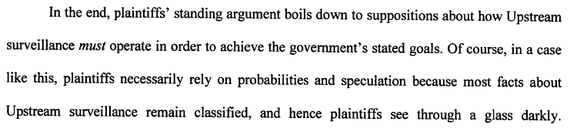
Our clients’ standing doesn’t depend on a supposition. There’s no question that the NSA is capturing and searching through their communications. That’s something the court — and everyone else — should find extremely disconcerting.
October 24, 2015
Posted by aletho |
Civil Liberties, Full Spectrum Dominance | Human rights, National security, NSA, Privacy, Surveillance, United States |
Leave a comment
Journalist Hossam al-Deen Seed was arrested in his home and taken to an unknown location on Thursday morning, the Arabic Network for Human Rights Information (ANHRI) reported.
He was still missing as of Thursday evening.
The charges against Seed are unknown, according to the ANHRI statement, which noted that he is a member of the Journalists Syndicate.
The Interior Ministry did not respond to Mada Masr’s calls for a comment on the incident.
Seed’s arrest comes the day after security forces raided the offices of the Mada Foundation for Media Development and arrested all staff members on the premises.
This raid represents “a dangerous escalation in the Egyptian authorities’ crackdown on freedom of expression and association,” Amnesty International argued in a statement released Wednesday.
Seed’s arrest also coincides with a National Council for Human Rights (NCHR) report on 15 cases of forced disappearances that was issued the day of the Mada Foundation raid, the privately owned newspaper Al-Masry Al-Youm reported.
Reports of journalists being arrested or forcibly disappeared by security forces have swelled since the military-led ouster of former President Mohamed Morsi in July 2013.
There are disagreements about the number of journalists currently detained or in prison, but estimates range from 60 to 70.
The freelance photographer Mahmoud Abou Zeid, commonly known as Shawkan, has been held in pre-trial detention for over two years, exceeding Egypt’s legal two-year limit.
Egypt ranked near the bottom of the 2015 Reporters Without Borders press freedoms index, coming in at 158 out of 180 countries.
At least 30 journalists were arbitrarily arrested in 2014 on charges of organizing or participating in protests, the report said. Reporters Without Borders claimed that President Abdel Fattah al-Sisi’s government is using its ongoing war on terror as a pretext to curb press freedoms and target media institutions affiliated with the banned Muslim Brotherhood.
The Egyptian Commission for Rights and Freedoms released a report in August stating that authorities violated journalists’ rights at least 658 times during the first year of Sisi’s presidency. The violations included preventing journalists from doing their jobs, verbal and physical assault, detention, arrests and imprisonment, damaging and confiscating equipment, banning press reports and filing lawsuits against journalists.
October 23, 2015
Posted by aletho |
Civil Liberties, Full Spectrum Dominance | Egypt, Human rights |
Leave a comment
The system for classifying intelligence and other national security documents is broken in major respects. Increasingly, it is also manipulated to punish perceived critics or to protect agency reputations and high officials, both from adverse publicity and in the courts. Hillary Clinton’s use of a private rather than State Department email service illustrates many of these issues. Her experience stands in stark contrast to treatment of national security whistleblowers, as illustrated in particular by variance in National Security Agency (NSA) communications intelligence policies.
–Culpability. Former Secretary of State Clinton clearly and knowingly mishandled classified information. As a U.S. senator, security clearances were required for her membership on the Senate Armed Services Committee from 2003 to 2009. Therefore, she knew the rules for handling classified information before she decided, at the outset when she became Secretary of State in early 2009, to use personal rather than secure email.
Hillary and Bill Clinton had suffered many political and public relations crises. She had already run for the presidency and likely would do so again. Rules for handling classified information were ignored, the effect being to hide records that could be used against her in a second presidential run.
It simply could never be argued plausibly that for four years, a person in the highest U.S. foreign policy slot had no classified or sensitive information in any business emails that she wrote or received – over 30,000 of them. This defies the definition of the job.
The State Department is a primary user and a significant generator of classified information that bears on the great majority of issues coming before the Secretary. The State Department is also a profligate designator of “Sensitive But Unclassified” information.
–Overclassification. It is widely admitted that the intelligence classification system suffers from systemic over-classification. President Barack Obama has acknowledged the problem, and one review group even stated that almost every item now labeled Confidential should be Unclassified. There is no penalty for playing it safe – or playing it political – by classifying at too high a level, but there are potentially severe repercussions for an individual who mistakenly classifies at too low a level, or who is known to mishandle or publicly reveal classified information.
It is most unlikely, however, that Hillary Clinton will fall victim to accusations that rely on improper overclassification. The State Department and White House, including President Obama himself, sought to protect her and to minimize the effects of her behavior.
The case is extremely high-profile, Democrats in Congress would attack any borderline classification, and a host of wellpaid lawyers would rise to her defense. Improperly classified items or those deemed Sensitive but Unclassified may be redacted from publicly released documents, but it is hard to imagine that Mrs. Clinton would be falsely accused of felonies.
Whistleblowers suffer a quite different fate. Intelligence agencies easily and repeatedly retaliate for the airing of their dirty laundry by accusing the whistleblower of improperly handling or revealing allegedly classified information. The Obama administration then prosecutes them under the Espionage Act, under which altruistic motivation is irrelevant and may not even be raised in court.
Former CIA official John Kiriakou revealed on television that post 9/11 torture was official U.S. policy, not just attributable to a few rogue agents. The CIA seethed, but the Justice Department would not prosecute. Unfortunately, Kiriakou erred in giving a reporter the business card of a man he thought had retired from CIA but was still an agent under cover. The agent’s name was not published, but CIA got its revenge when Kiriakou was indicted under the Intelligence Identities Protection Act of 1981. Left penniless with over $700,000 in legal bills even before trial, Kiriakou finally accepted a felony plea bargain and went to jail.
Thomas Drake and this author went through proper official channels in 20012002 to protest NSA’s surveillance of U.S. citizens. Along with colleagues Kirk Wiebe, William Binney and Edward Loomis, they also reported to the Defense Department Inspector General the waste of money on NSA modernization.
After domestic surveillance leaked to the New York Times four years later, the five became primary suspects, partly because the IG improperly offered their names to the FBI. All were raided, but no evidence was found because, as the reporter later stated publicly, he had not then met or communicated with any of the five.
Nonetheless, Drake was prosecuted under the Espionage Act for possessing five Unclassified NSA papers that NSA retroactively classified. He was threatened with 35 years in prison unless he pled guilty, but heroically resisted. Pretrial hearings proved all the information in the documents had been declassified by NSA. After a yearsold interview record was orally falsified, this author was asked to plead guilty to felony perjury, but also refused.
Section 1.7 of Executive Order 13526 governing classification stipulates that no information may be classified to conceal violations of law, inefficiency or administrative error; to prevent embarrassment; to restrain competition; or to prevent or delay release of information not requiring protection. This section is observed in the breach, as political considerations dictate.
For all the above proscribed reasons, unclassified parts of the NSA IG audit we requested are still withheld by NSA ten years after the audit was first published. Former NSA contractors Edward Snowden and John Kiriakou showed that illegal and unconstitutional activities were hidden from American citizens and others behind the veil of classification. For revealing material that never should have been classified in the first place, they are paying a very high price.
In Snowden’s case, many revelations about domestic surveillance still are treated as classified to keep them from U.S. voters, although every terrorist and every intelligence agency in the world has access to the documents and almost no ordinary person in any country of interest to the U.S. can function efficiently whilst avoiding NSA surveillance.
–Sensitive but Unclassified Material. Individual agencies claim an unsupervised right to withhold admittedly Unclassified information according to any criteria they see fit and for as long as they choose. In the Clinton email case, it is quite striking that not a word has been breathed about such Unclassified but Sensitive material. Her free pass in this respect is the envy of whistleblowers.
In our case, NSA initially refused to return any materials seized in the raids. When sued, NSA claimed that if a computer contained even one admittedly Unclassified document with material that had not been officially released by NSA, the Agency could retain and destroy the entire computer content. Courts eventually allowed NSA to keep such individual documents in their entirety and at their sole discretion, but required that others be copied and returned.
–With ordinary citizens or lower-level whistleblowers, Sensitive but Unclassified material is wielded as yet another weapon in the Executive’s arsenal of punishments. Even highlevel intelligence officials have had difficulty publishing their memoirs, partly because prepublication review agreements routinely allow an agency to withhold unclassified information.
Since the 1950s, most judges refuse to review allegedly classified or sensitive material even to determine that it does not fall under the commonsense prohibitions of Section 1.7 of the Executive Order on classification. The Executive Branch has also been famously successful in promulgating a “state secrets” doctrine to avoid or indefinitely delay court scrutiny of important civil liberties issues such as domestic surveillance. It is now known, however, that the original state secrets precedent wrongly invoked intelligence sources and methods to cover up Air Force culpability for a plane crash.
In the author’s case, even NSA’s grossly inconsistent classifications got a free pass. A document that was released to Kirk Wiebe as Unclassified was branded Top Secret Compartmented when found on the author’s computer. Confronted with this vast discrepancy, NSA alleged that it could neither confirm nor deny that the document had previously been released. It keeps no records of prior declassifications. Even in a related court case. Nor is it interested in an available system to compile and compare such records. But the judge let the classification stand.
Diane Roark retired in 2002 after 17 years on the professional staff of the House Permanent Select Committee on Intelligence and prior service on the National Security Council Staff, in the Office of the Secretary of Defense, and in the Intelligence section of the International division of the Department of Energy.
October 22, 2015
Posted by aletho |
Deception, Full Spectrum Dominance | Central Intelligence Agency, CIA, Hillary Clinton, John Kiriakou, National Security Agency, Obama, United States |
Leave a comment
After a delay, cybersecurity legislation dreaded by privacy advocates and relentlessly pursued by national security officials, known as CISA, will get a vote on the Senate floor “in a couple of days,” a top sponsoring senator anticipates.
The Cybersecurity Information Sharing Act of 2015, also known as CISA, is as polarizing as it is close to a vote. It finally hit the Senate floor for debate on Tuesday, with top sponsor Senator Richard Burr (R-North Carolina) highlighting its necessity because “actors around the world continue to attack US systems, and in many cases penetrate it.”
Under the bill, private companies would have increased liability protection with respect to collecting American’s personal data that could potentially be related to security threats. It would also make it easier for them to share such data with the government, including departments like the National Security Agency.
Prominent CISA opponent and privacy advocate, Senator Ron Wyden (D-Oregon), challenged Burr, who chairs the Select Committee on Intelligence, on one argument in particular.
“He said that the most important feature of the legislation is that it’s voluntary. The fact is, it is voluntary for companies. It will be mandatory for their customers,” Wyden said, “and the fact is the companies can participate without the knowledge and consent of their customers, and they are immune from customer oversight and lawsuits if they do so.”
In many cases, customers have been able to nudge companies from a pro to a con position on CISA. In one instance last month, the Business Software Alliance (BSA) sent a letter to legislators, in part calling for “cyber threat information sharing legislation” granting them immunity so that they could “more easily share that information voluntarily.” However, after Fight for the Future, an internet freedom advocacy group, set up YouBetrayedUs.org to criticize the organizations, the BSA changed its tune.
The BSA, which includes Apple, IBM, and Microsoft, now opposes CISA, as does the Computer and Communications Industry Association, which includes Google, Facebook, and Amazon. Reddit, Wikimedia, Twitter, and Yelp have also released anti-CISA statements.
“Leading security experts argue that CISA actually won’t do much, if anything, to prevent future large-scale data breaches such as the federal government has already suffered, but many worry it could make things worse, by creating incentives for private companies and the government to widely share huge amounts of Americans’ personally identifiable information that will itself then be vulnerable to sophisticated hacking attacks,” added the American Library Association in a press release.
The discussion on CISA comes after a stall in the Senate’s schedule before its August recess. Lawmakers agreed to delay a vote on the bill when it became clear that senators had many amendments to submit, some of which included so-called “riders,” or unrelated issues, such as Senator Rand Paul’s (R-Kentucky) amendments to audit the Federal Reserve and defund “sanctuary cities.” At least 22 amendments will be given a chance to be added to CISA before a final passage vote.
Burr optimistically told The Hill that “a couple of days” was all that was needed to get to a final vote on CISA. He may have overshot, however, because there could be a scrimmage over amendments despite his efforts. Burr, with support of other Senate leaders, has managed to combine eight amendments into a legislative package he shares with CISA co-sponsor Senator Dianne Feinstein (D-California), but the grouping includes only one of Wyden’s two amendments.
Wyden told reporters that the one he feels “most strongly about” hadn’t been included. It would have provided a review system for deleting private info before data gets passed on to the government. The Wyden amendment that was included in the bill only requires that people be notified when their data is inappropriately shared.
Although no vote has been scheduled yet, Senate Majority Leader Mitch McConnell (R-Kentucky) is trying to end debate by Thursday. Beyond CISA, the Senate has an ambitious to-do list. It will decide whether to extend government spending beyond September 30, address the Iran nuclear deal, and fund highways and transportation systems in a comprehensive bill.
October 22, 2015
Posted by aletho |
Civil Liberties, Full Spectrum Dominance | CISA, Human rights, Internet, National Security Agency, Privacy, Surveillance, United States |
Leave a comment
Just over two weeks after the University of Washington’s Center for Human Rights filed a lawsuit in federal court against the CIA for the intelligence agency’s refusal to release declassified documents, the office of the center’s director was broken into, with data and equipment stolen.
Sensitive documents, including personal details about ongoing investigations in El Salvador, pertaining to a lawsuit filed by the University of Washington against the the CIA were stolen from the office of Professor Angelina Godoy, University officials reported on Wednesday.
The robbery has been described by university officials as a “possible act of retaliation” by individuals interested in compromising the university’s case against the CIA due to circumstances that suggest this wasn’t just a common burglary.
“We are concerned because it is also possible this was an act of retaliation for our work. There are a few elements that make this an unusual incident,” the Center for Human Rights said in a statement.
Following the incident, Center for Human Rights Director Dr. Angelina Godoy reported that her desktop computer was stolen along with a hard drive containing about 90 percent of the information relating to the center’s research in El Salvador. However, according to the center, what was peculiar about the circumstances is that her office was the only one targeted and that the stolen hard drive has no real monetary value; what was valuable was the data on the drive.
“Lastly, the timing of this incident — in the wake of the recent publicity around our freedom of information lawsuit against the CIA regarding information on a suspected perpetrator of grave human rights violations in El Salvador — invites doubt as to potential motives,” added the press statement.
On Oct. 2 the center filed a lawsuit under the Freedom of Information Act alleging that the CIA is illegally withholding information on retired Salvadoran Army officer, Col. Sigifredo Ochoa, who is currently under criminal investigation for complicity in the 1981 Santa Cruz massacre in El Salvador.
The lawsuit hopes to support justice-seeking survivors of the U.S-backed counterinsurgency against left-wing rebels that left more than 75,000 people dead and over 30,000 disappeared between 1980 and 1992.
“Access to the documents … could facilitate justice proceedings in these and other cases of grave rights abuses,” the lawsuit claims.
October 22, 2015
Posted by aletho |
Civil Liberties, Deception, Full Spectrum Dominance | Central Intelligence Agency, CIA, El Salvador, Human rights, United States |
Leave a comment
A Turkish teenager has been arrested by police forces for allegedly “insulting” the country’s President Recep Tayyip Erdogan, reports say.
The Cihan News Agency said on Thursday that the teenager identified as U. E. was detained outside an Internet Café on Wednesday night.
The 15-year-old is expected to be brought before court later in the day, which will determine whether he will be charged or fined.
Details regarding the accusations brought against him have not been released.
It is illegal to insult the country’s president under Turkish law, and those found guilty of doing so are at risk of facing up to four years in prison. The law has led to the arrest and prosecution of a number of journalists, activists, intellectuals, students and even celebrities.
Last month, a 16-year-old Turkish youth was handed a suspended 11-month jail sentence for calling Erdogan a thief during a student protest last December.
Earlier, Bülent Keneş, the editor-in-chief of the Turkish English-language newspaper Today’s Zaman, was handed down a suspended jail term of 21 months by a court in the capital, Ankara, for insulting Erdogan in a message posted on Twitter.
Tolga Tanış, a US-based journalist, was also detained in June over suspicions that he insulted Erdogan in a book he had authored.
Rights groups and free speech advocates have criticized the government for suing people over expressing their opinions, describing it as a means of aggressive muzzling of dissent in Turkey.
Erdogan, a former premier who ascended to presidency last year, has faced growing popular dissatisfaction over what critics say is his growing autocratic manner.
October 22, 2015
Posted by aletho |
Civil Liberties, Full Spectrum Dominance | Human rights, Turkiye |
Leave a comment
Reprieve | October 21, 2015
The vast majority of people facing execution in Saudi Arabia were convicted for non-violent crimes including political protest and drugs offences, according to new research from the human rights organization Reprieve.
The report includes data gathered by Reprieve on 171 of the prisoners currently on death row in Saudi Arabia. It finds that 72 per cent of those prisoners whose alleged offences Reprieve has been able to determine were sentenced to death for non-violent crimes – including attendance at political protests and drug offences. Reprieve has also been able to establish that of 62 of the 224 prisoners estimated to have been executed in Saudi Arabia since January 2014, some 69 per cent had also been sentenced to death for non-violent offences.
Among those facing execution are prisoners who were sentenced to death as children, such as Ali Mohammed al-Nimr and Dawoud Hussain al-Marhoon. The two juveniles were arrested at 2012 protests, and were tortured into ‘confessions’ that were later used to convict them in the country’s secretive Specialized Criminal Court (SCC). Reprieve’s report also establishes that the use of torture to extract ‘confessions’ is widespread, with specific cases identified where prisoners have been beaten to the point of suffering broken bones and teeth.
The death sentences handed down to the two juveniles have provoked strong public concern from countries allied to Saudi Arabia such as the UK, the US and France. Yesterday, speaking to MPs both about Ali’s case and that of British citizen Karl Andree, British Foreign Secretary Philip Hammond said: “I do not expect Mr Andree to receive the lashings that he has been sentenced to, and I do not expect Mr al-Nimr to be executed.” However, Mr Hammond provided no details of any assurances received from the Saudi government.
Speaking to human rights organization Reprieve earlier today, Ali’s father Mohammed al-Nimr, said while he was glad politicians may have received some assurances from the Saudis, “the facts on the ground leave much fear and doubt”. He revealed that Ali was now being held “in the solitary cells reserved for those facing execution”, adding: “I tried to visit him yesterday but they prevented me.”
Commenting, Kate Higham, caseworker at Reprieve, said: “This report shows how Ali and Dawoud’s death sentences are just the tip of the iceberg. The Saudi government appears to be routinely sentencing people, including juveniles, to death for non-violent crimes such as attending protests. All too often, these sentences are handed down on the basis of ‘confessions’ extracted through torture, as in Ali and Dawoud’s cases. Ali and Dawoud are now being held in solitary confinement and could face imminent execution at any time. The UK and other close allies of Saudi Arabia must redouble their efforts to see the juveniles released to their families – they must also send a strong message to the Saudis that these widespread abuses are utterly unacceptable.”
October 21, 2015
Posted by aletho |
Civil Liberties, Full Spectrum Dominance, Subjugation - Torture | Human rights, Saudi Arabia |
Leave a comment
The recent Frankie Boyle article in the Guardian contained his usual mix of dark humour and on-point political satire. However, most people who follow the Syrian situation closely know his summary of the “civil war”, and assertion that “nobody likes Assad”, to be inaccurate.
Unfortunately efforts to point this out in the comments were met with the Guardian’s usual response to fact-based constructive criticism:

As you can see, Mr Purkayastha’s comment is civil, constructive, on topic and backed up with sources. And yet…

Seems like question the agenda doesn’t abide by their “community standards”. Thanks to Bill Purkayastha for bring this to your attention. If you have had similar experiences at the Guardian, or any MSM web-site, please let us know.
October 21, 2015
Posted by aletho |
Full Spectrum Dominance, Mainstream Media, Warmongering | Syria, The Guardian |
Leave a comment
Evidence Contradicts Presumed Motive for “Suicide”

Jacqueline Anne Sutton. Photo credit: Facebook
Family, friends and colleagues of veteran British journalist and activist Jacky Sutton (age 50) demand a full investigation into her mysterious hanging death at an airport in Istanbul Sunday morning. Many of them reject the notion that she could have committed suicide, as was initially reported by the Turkish media, citing Turkish authorities.
The official story was that Sutton had missed a connecting flight to Iraq, and was distraught because she could not afford to purchase a new ticket. She then supposedly went to a bathroom and hung herself with her shoelaces.
However, an Italian source reported that Sutton had €2,300 ($2,600) in her pocket when she died, much more than the short flight to Iraq would have cost.
Sutton recently took over as Iraq Chief of the Institute for War and Peace Reporting (IWPR) and had been on the way to Iraq from London. She was to replace Ammar Al Shahbander, who was killed in Baghdad by an Islamic State bomb in May.
While Turkish media unequivocally stated that her death was a suicide, those who knew Sutton were skeptical of that claim right away.
“The circumstances of her death are unclear, and we are trying to establish the facts,” IWPR said in a statement.
The group did not say outright that it ruled out suicide as a cause of death, but noted that “Jacky was returning to Iraq full of plans for innovative new work, including projects to counter violent extremism that threatens a country to which she was so committed.”
Others who knew Sutton did not mince words.
“What I’m sure about, the kind of person that Jacky was, it’s impossible she would have killed herself, impossible,” Mazin Elias, an Iraqi journalist who worked with Sutton, told MailOnline. “I’m really sad and sorry what happened, but if someone tells me ‘she killed herself,’ I tell him: ‘No, that’s wrong, someone killed Jacky’.”
Sutton’s brother Ian cited the “odd circumstances” of her death and friend and colleague Christian Bleuer tweeted that Sutton was the “Toughest woman u could meet. Turkish police say she committed suicide cuz she missed her flight?” Bleuer also wrote: “I’m not into conspiracies, but if the Turks say a security camera at Istanbul-Ataturk was ‘malfunctioning’ then Jacky Sutton was murdered.”
While it certainly would have been in Turkey’s interest to make this an open-and-shut suicide case, the evidence suggests that the initial story doesn’t hold water and a thorough investigation is warranted.
October 21, 2015
Posted by aletho |
Deception, Full Spectrum Dominance | Human rights, Turkiye |
Leave a comment