Unprovoked, Israeli Soldiers Attack AFP Journalists in West Bank
Sputnik – 26.09.2015
While covering a demonstration in the West Bank, two journalists with Agence France-Presse were attacked by Israeli soldiers, who then proceeded to destroy their equipment.
Andrea Bernardi and Abbas Momani were near the village of Beit Furik on Friday. On assignment for AFP, the two journalists were reporting on a protest that followed the funeral of a Palestinian man shot by Israeli security forces.
In covering the events, Bernardi and Momani were themselves attacked by Israeli soldiers.
“They had passed the first checkpoint of the border police with their press cards without problem,” AFP bureau chief Thomas Cox told the Guardian. “Andrea paused to check his camera setting and as he was doing so a soldier immediately arrived and told him to stop filming and pushed his camera.”
“He then took the camera and smashed it.”
Video of the incident shows the journalists walking away, only to be chased down by another soldier who destroys more of the pair’s equipment.
According to Cox, Bernardi later went back to recover his camera, and things escalated from there.
“At this point a soldier jumped on him and put a pistol on his face and attacked him.”
“It was crazy,” Bernardi told the Guardian. “When we arrived at the border police checkpoint we showed our documents. There was no problem. They were being nice.”
“We passed the first line of soldiers loading teargas. I heard screaming and a soldier started pushing and shouting ‘what the f*ck are you doing’ in English. I then [realized] he was loading this gun and I thought ‘what the…’ and we started walking back.”
Bernardi notes that if either he or Momani had been guilty of some crime that they would have been arrested, but that never happened.
“After we got back to the car I saw a piece of the camera and wanted to take a picture of it because I was worried they would accuse me of doing something wrong,” he said. “That’s when a soldier pointed a pistol in my face and pulled me down.”
AFP has announced its intention to file a formal complaint. … Full article
US Spies Await Terrorist Attack to Change Public’s Tune About Cyber Privacy
Sputnik – 26.09.2015
As the United States seeks backdoor encryption access, it faces strong pushback in the form of public opinion. But according to some intelligence officials, that perception could change if another terrorist attack were to occur on American soil.
Faced with a public outcry over privacy concerns and the tarnished reputation of American tech companies abroad, the Obama administration has found itself in a difficult spot. Many industry leaders are calling for the president to publicly disavow the idea of a law requiring tech companies to provide backdoor encryption access.
Intelligence officials, of course, are none-too-thrilled about such a move. Insistent on the notion that encryption access is vital for national security, many are eager for a law requiring companies like Apple to cooperate.
“Overall, the benefits to privacy, civil liberties and cybersecurity gained from encryption outweigh the broader risks that would have been created by weakening encryption,” reads the latest report from the US National Security Council.
But if public opinion remains a stubborn roadblock for such legislation, some officials have indicated that a terrorist attack could change the situation.
“… The legislative environment is very hostile today,” Robert S. Litt, a lawyer for the intelligence community, said in an email obtained by the Washington Post. “[But] it could turn in the event of a terrorist attack or criminal event where strong encryption can be shown to have hindered law enforcement.”
Litt isn’t the only one.
“People are still not persuaded this is a problem,” a senior official, speaking on condition of anonymity, told the Post. “People think we have not made the case. We do not have the perfect example where you have the dead child or a terrorist act to point to, and that’s what people seem to claim you have to have.”
While the US intelligence community seems to believe that a terrorist attack would prove the need for robust encryption, it’s already been proven that mass surveillance has done little to thwart such incidents. The National Security Agency’s data collection – unveiled by whistleblower Edward Snowden – was launched after the September 11 attacks, but failed to prevent future bombings, like that which occurred during the Boston Marathon in 2013.
A White House review panel formed two years ago recommended ending the domestic spying program after findings that the NSA’s bulk collection of telephone metadata had done nothing for national security.
Even if the Obama administration decides to publicly disavow encryption legislation, there’s no guarantee that the US government wouldn’t still carry forward with decryption plans. On Thursday, the Washington Post reported that the administration was looking into four distinct ways to force tech companies into compliance.
“We’re not promoting those as the way to go,” said another official, also speaking on condition of anonymity. “We’re just saying these are things that could be done.”
The West Suppresses Report on Ukraine’s Suppression of Journalists
OSCE Squelches Ukrainian Commission on Human Rights Speaker
By Eric Zuesse | Aletho News | September 23, 2015
At a 21 September 2015 meeting of the OSCE (Organization for Security and Cooperation in Europe), which is run by the Western powers and which is the leading organization concerning security and cooperation in Europe, a courageous speech against Ukraine’s imprisonment and killing of independent journalists was made by Alexey Tarasov, the Chairman of the All-Ukrainian Commission on Human Rights. Nearly halfway through the prepared text of his intended 6-minute summary description of the main cases, his speech was terminated by the Chairperson. It was cut off at 2:31 in this video:
https://www.youtube.com/watch?v=malosUt-9jc
However, in this video of it, the termination is at 2:38:
https://www.youtube.com/watch?t=161&v=RxeCM_EBZdE
Here, then, is the complete printed text, as it was posted at Fort Russ on September 22. I have additionally placed a mark at the point where Tarasov’s speech was cut short:
Dear colleagues,
Please allow me to welcome this meeting.
Probably everyone knows that today’s Ukraine is the most problematic European country in terms of human rights and fundamental freedoms.
Especially where it concerns the tragic situation with the freedom of speech and freedom of expression, the situation of access to information, limitation of journalists’ activity and the mass media in general.
According to information by the Institute of Mass Media, since the beginning of 2015 in Ukraine, there has been recorded 224 violations of the rights of journalists. According to the Institute’s reports, almost every day journalists in Ukraine are beaten or intimidated.
The worst thing is the continuation of journalists’ murders. For example, last year the talented journalist Oles’ Buzina was killed right near the entrance of his house. He was a consistent supporter of the Ukraine’s unity, at the same time fundamentally opposing to the war in the Donbass, which contradicted the official doctrine. The suspects of the murder of Buzina were arrested. They are under investigation. Human rights defenders are very concerned with the political pressure on the investigation and law enforcement agencies. They are afraid that the real killers will escape punishment.
In Kiev this year, journalists Sergei Sukhobok and Margarita Valenko, were killed in Cherkassy region – Vasily Sergienko.
In Ukraine there is political pressure on opposition media, harassment, illegal criminal searches and arrests of journalists became a reality. There are varied forms of violence against dissent in the Ukrainian media.
State officials are trying to illegally shut the license of the popular opposition 112 TV channel and of the metropolitan newspaper Vesti. There were a great number of provocations, criminal searches, etc. Ukrainian authorities are forcibly trying to substitute owners of the mass media. Employees of the Odessa opposition website “Timer” for “prevention” were summoned for questioning at the office of the Ukrainian security service (SBU). There were some searches in journalists’ houses.
Ukrainian authorities always have standard charges on “separatism” with following arrests for those media professionals who are disagree with the state policy. The Chief Editor of the Internet newspaper “Vzapravdu” Artem Buzila, for the last five months has been imprisoned in Odessa on such fabricated accusations.
The Editor of the newspaper “Rabochiy class”, Alexander Bondarchuk has been illegally jailed for the last six months in the Kiev prison. And I can continue this list. There are dozens of journalists who are jailed or are in the wanted list of the SBU for their opposition publications.
Also, I want to draw your attention to the problem with the freedom of expression and regulation of the rights of conscientious objectors (COs) in Ukraine. They are individuals who have claimed their right to refuse to take military service, who have special ideological and moral convictions. …
[CUT SHORT HERE BY CHAIRMAN]
… This is a normal practice for the European countries to protect rights of conscientious objectors, but not for the Ukraine. Nowadays the position of Ukrainian COs, who are not members of any religious organization, violates the law of the country. Authorities criminally prosecute even those journalists who are COs.
A striking confirmation of this problem is the prosecution of journalist Ruslan Kotsaba, who is CO. For his public conscientious objection, Ruslan Kotsaba has been jailed and his case has been considered for several months by the Ivano-Frankivsk City Court. The authorities consider the open position of the honest journalist as “obstruction of the lawful activities of the Armed Forces of Ukraine and other military formations during the special period.” Such behavior of the authorities is difficult to imagine in a normal democratic society. Now, according to the information of Ukrainian prosecutors thousands of COs have been prosecuted, and hundreds of them have been jailed. Therefore, in our country there is a total process of transformation of ideological Ukrainian COs into real prisoners of conscience.
In addition, there is another issue. Between Ukraine and the European Union the Association Agreement was signed, which was simultaneously ratified in September 16, 2014 by the European Parliament and the Parliament of Ukraine. According to the Agreement, particular attention is paid to the observation of human rights. Article II (two) states: “Respect for democratic principles, human rights and fundamental freedoms, as defined in particular in the Final Act of the Conference on Security and Cooperation in Europe (1975) and the Charter of Paris for a New Europe (1990) …”.
This Agreement has not yet entered into force, and the Parliament of Ukraine on May 21, 2015 has adopted a resolution “On the withdrawal from certain obligations, certain International Covenant on Civil and Political Rights and the Convention on the Protection of Human Rights and Fundamental Freedoms.” This resolution also violates Helsinki Final Act obligations. Ukrainian Deputies motivated their decision to adopt the resolution by the tragic events in Donbass.
By the way, our Ukrainian Human Rights Commission issued a report “Undeclared war at the center of Europe”. It concerns the observance of human rights during the so called «anti-terrorist operation» in Donbass by Ukraine’s state officials. You can see and have it near the conference hall.
So, the Ukrainian state instead of focusing on the implementation of international humanitarian law and the protection of civilians during the armed conflict in Donbass, has substituted these concepts and instead withdrew itself from the obligations of the state to respect international human rights, to protect them, and the exercising of rights of millions of inhabitants of Donetsk and Lugansk regions.
By the adoption of such a decision, the Ukrainian state has applied to a part of its citizens discriminatory measures based on their residence, and has restricted their human rights and fundamental freedoms, including their right to liberty and security, freedom of residence and movement, the right to fair trial and effective means of legal protection, social protection etc.
There is a question to the EU countries, who ratified the Association Agreement between Ukraine and the EU, the main elements of which are based on international and European standards of human rights without any exceptions:
Will these countries suspend the entry into force of the Association Agreement between Ukraine and the EU before the termination of the violations of human rights and fundamental freedoms of millions of citizens in Ukraine? Or will they want to support Ukraine’s position of double standards, and not to extend the requirements of this Agreement to particular regions of Donetsk and Lugansk?
We hope that the international community will stop the ignorance of massive and systematic violations of human rights and fundamental freedoms in Ukraine, first of all, in matters of freedom of speech and the rights of journalists, and will put pressure on the Ukrainian authorities in order to force them into complying with their international obligations in the field of human rights.
Investigative historian Eric Zuesse is the author, most recently, of They’re Not Even Close: The Democratic vs. Republican Economic Records, 1910-2010, and of CHRIST’S VENTRILOQUISTS: The Event that Created Christianity.
Millions of job seekers’ fingerprints will now be searched for criminal investigations, says FBI
PrivacySOS | September 21, 2015
For years the FBI has performed federal criminal background checks for employers and state governments, amassing tens of millions of biometric records on people accused of no crime. If you want to be a lawyer, teacher, or even bike messenger in many parts of the United States, you’ll need to submit your fingerprints to the FBI. Every single federal employee must submit their prints before employment. Until recently, the FBI claimed it would not search these civil prints when conducting criminal print matching; a wall between the civil and criminal fingerprint databases kept these distinct sets of information separate, the Bureau claimed. But in February 2015, that all changed—very quietly.
EFF‘s Jennifer Lynch:
The change, which the FBI revealed quietly in a February 2015 Privacy Impact Assessment (PIA), means that if you ever have your fingerprints taken for licensing or for a background check, they will most likely end up living indefinitely in the FBI’s [Next Generation Identification] database. They’ll be searched thousands of times a day by law enforcement agencies across the country—even if your prints didn’t match any criminal records when they were first submitted to the system.
This is the first time the FBI has allowed routine criminal searches of its civil fingerprint data. Although employers and certifying agencies have submitted prints to the FBI for decades, the FBI says it rarely retained these non-criminal prints. And even when it did retain prints in the past, they “were not readily accessible or searchable.” Now, not only will these prints—and the biographical data included with them—be available to any law enforcement agent who wants to look for them, they will be searched as a matter of course along with all prints collected for a clearly criminal purpose (like upon arrest or at time of booking).
This seems part of an ever-growing movement toward cataloguing information on everyone in America—and a movement that won’t end with fingerprints. With the launch of the face recognition component of NGI, employers and agencies will be able to submit a photograph along with prints as part of the standard background check. As we’ve noted before, one of FBI’s stated goals for NGI is to be able to track people as they move from one location to another. Having a robust database of face photos, built out using non-criminal records, will only make that goal even easier to achieve.
The FBI’s decision to start using civil prints in criminal investigations demonstrates that we should be very skeptical of all government efforts to collect and retain sensitive information about us. Today they say they won’t do X, Y, or Z with that information. But that can change very easily, and without many of the millions of people affected taking much notice.
Read more about the FBI’s plans to amass biometric information on all of us.
Who’s watching the watchdog?: Ofcom & the manufacture of consent
By Afshin Rattansi | RT | September 21, 2015
It will come as no surprise to anyone that a watchdog set up to hound mainstream UK broadcast media finds RT’s output difficult to deal with. Doubtless today’s Ofcom rulings will see other media outlets relishing RT being brought to heel.
But anyone who takes the trouble to look at the detail will see such outlets are on very flimsy ground.
Not only does Ofcom concede that RT has a mission to bring valuable diversity of perspective, the watchdog also makes clear that its musings on ‘Ukraine’s Refugees’ – one of the shows found to be in breach of the Code – are not the result of a complaint from any our many viewers. In fact, Ofcom took it upon itself to complain after “routine monitoring” of RT.
Personally, I am delighted that the program gave a voice to those caught in the violence that would otherwise have gone unheard and unmentioned by mainstream media, which has been steadfastly supporting the post-coup government in Kiev.
I’d also note that Ofcom’s attention is not always misdirected. Does anyone remember what they came out with before the incumbent, Sharon White, took the reins? A four-year inquiry by Ofcom, the results of which recently became public, uncovered nearly 50 breaches of statutory regulation by mainstream channels the BBC, CNN and CNBC. Thanks to Ofcom we know that these outlets had been screening politically-lobbied content without informing viewers.
As usual, there is a background to today’s stories that you may find goes unreported elsewhere.
Dodgy editorial procedures from the BBC, CNN and CNBC aren’t as good a story as RT being ‘guilty’. Mainstream transgressions are forgotten as soon as they are revealed. The Independent, which so brazenly referred to the BBC’s Code-breaching content as “propaganda” in a headline in mid-August, had already blissfully moved on when reporting on the Corporation’s plan to expand its foreign broadcasting barely a fortnight later.
Does anyone seriously think that big UK broadcasters adequately report on those opposing mainstream political opinion? That’s why so many BBC journalists were taken aback when UKIP and Jeremy Corbyn appeared on the scene.
The BBC wouldn’t even allow charities to ask for money to save those in Gaza because of pressure from those against the Palestinian side in the conflict that rages on in the Middle East. Alex Salmond, former leader of the Scottish National Party (SNP), told us on Saturday’s edition of RT’s Going Underground that he was appalled by the anti-independence bias of the BBC in the run-up to the Scottish Independence Referendum. He branded the BBC “a disgrace to public broadcasting.”
Needless to say, the mainstream Scotsman newspaper duly ran a report that he shouldn’t be criticizing the BBC on RT – as if RT, the internet’s favorite television news station, should be boycotted as part of a UK mainstream McCarthyite witch hunt against the channel.
Meanwhile Corbyn, who had just won Labour’s leadership in a landslide, was summarily branded by the UK press as the Kremlin’s “useful idiot” for criticizing Western interventionist policy on RT – in an interview in which he mentioned Russia not once.
And while we’re about it, why are the so-called liberal radio, print and internet media so keen to promote the highly-contentious adjudications of Ofcom against RT? They don’t call for the BBC to be shut down because it runs fraudulent competitions as part of Comic Relief, Sport Relief and Children in Need? Again, Ofcom did good work on this, investigating shady behavior. The regulator revealed “the BBC deceived its audience by faking winners of competitions and deliberately conducting competitions unfairly.”
License-Fee payers were duly ordered to stump up hundreds of thousands of pounds for BBC failures. Thanks to Ofcom, the whole thing ended up costing mainstream channels more than £11 million (now US$17 million) in 2008.
But when it comes to political controversies where the UK government is following US State Department policy, things are a little different. There are almost too many mainstream UK TV reports to choose from when it comes to proving the double standards of Ofcom over the politically-contentious issue of Ukraine. […]
You can see just how “impartial” their coverage of Ukraine is here and here.
The fact is that Ukraine was destabilized by the West – we know this because Victoria Nuland, assistant secretary of state for European and Eurasian Affairs at the State Department said so:
But that side of the story was absent from scores of mainstream broadcasts which it seems Ofcom decided not to watch or ‘monitor’.
Ukraine, though, is not the only tragedy we should be focusing on.
The Syrian refugee crisis was caused by destabilization of the Middle East by Western powers. Do you see reporters telling you that side of the story when they file reports on refugees? Could it be that without this context, mainstream journalists are, yet again, softening up public opinion for war? Today, establishment media is no longer reporting on WHY there are refugees – merely that there ARE refugees.
There is a terrible irony here as they skirt standards of impartiality. Broadcasters are, in effect, using the tragedy of dead children washing up on beaches to prepare the public to support a war that will lead to more dead children washing up on beaches.
If Britain and the US deploy their troops to depose President Assad of Syria it will be a part of a broader interventionist strategy. That’s why reporting needs to be accurate and more balanced on Syria and Ukraine – so that Americans and Brits can decide for themselves on the evidence whether military action is warranted. RT will show both sides of the argument, but – more importantly – give you the other side of the story, the one you’d be hard-pressed to get from the British or American MSM. Then you can make up your own mind.
One of the world’s greatest journalists, John Pilger, expressed his fear on RT’s Going Underground that the embrace of elites and media on the issue of Ukraine is pushing the world towards nuclear war.
It is a concern shared by the ‘Bulletin of Atomic Scientists’ which moved their Doomsday clock closer to midnight as Obama officials engineered the coup d’état in Ukraine.
What’s needed now is an urgent conference involving journalists, unions and NGOs to fight censorship in Britain. It must not involve compromised NGOs such as Index on Censorship, the Committee to Protect Journalists etc., who have proved time and time again to be one-sided about censorship. It should implore Ofcom to uphold the principle that news, in whatever form, must be reported with due accuracy and presented with due fairness to all positions, not just the ones belonging to the foreign policy establishment.
On a personal level, I almost empathize with Ofcom’s position. It is understandable that, fed on a constant diet of mainstream UK media, they might find it hard to digest RT. I hope, in time, they will join the hundreds of millions around the world who tune in to watch RT on TV, YouTube and online in appreciating journalism that gives a place to those who are, too often, robbed of a voice.
‘I’m a Trade Unionist, Not a Terrorist’: UK in Workers’ Union Spying Row
Sputnik – 22.09.2015
The British government, along with large multinational corporations, are trying to wash away the rights of workers and create a culture of fear among the country’s workforce through a series of systematic spying and blacklisting campaigns, a former blacklisted worker has told Sputnik.
As the government tries to usher through a new Trade Union Bill, described by critics as one of the most oppressive in the Western world, multinational corporations have been accused of taking part in extensive spying and intimidation tactics aimed at effectively locking vocal workers’ rights campaigners out of their professions.
The controversial bill has drawn the ire of trade unionists all over the country, with officials particularly angered by proposals which would require 50 percent of members to vote in favor of taking strike action for an event to be considered legal.
There are also fears that fines of up to £20,000 may be issued for unions whose members don’t wear identifying armbands during pickets.
Conservative business secretary Sajid Javid said the proposals would stop workers making “endless threats” at the expense of “hardworking people,” while union officials have seen it as an attack on trade unions and workers’ rights.
“The Tory government at the moment are trying to introduce the new Trade Union Bill, which even some Conservative MPs have said is the most restrictive legislation for trade unions in the whole of western Europe,” Dave Smith, former trade union representative and member of the Blacklist Support Group told Sputnik.
“The British government is never neutral when it comes to disputes between trade unions — it’s always on the side of big business.”
Some aspects of the Conservative’s bill even raised eyebrows with Tory MP David Davis saying some of the aspects resembled oppressive measures implemented by former Spanish dictator Francisco Franco.
“I agree with most of the Trade Union Bill. I think it’s very sensible… but there are bits of it which look OTT, like requiring pickets to give their names to the police force,” Davis told the Guardian.
“What is this? This isn’t Franco’s Britain, this is Queen Elizabeth II’s Britain.”
‘Spying and Blacklisting Still in Practice’
On top of the government proposals for trade unions, Dave Smith raised concerns over historical spying and intimidation tactics, which over the years has seen many trade union representatives placed on a blacklist, shared and used by multinational corporations to effectively lock some workers out of employment.
It was also revealed that undercover police units took part in spying and intelligence, gathering exercises on a number of unions and various members over the space of 40 years in order to identify leading figures in the movement and place them on employment blacklists.
While officially such practices are illegal, Dave Smith told Sputnik that he believes “there is no question about it whatsoever” that spying and blacklisting is still going on.
“They [large companies] were lying to everyone and lying to parliament for forty years, so why should we believe them now?”
Mr Smith, who is the co-author of the book, ‘Blacklisted: the Secret War between Big Business and Union Activists’, said he was first placed on a blacklist in the early nineties merely for campaigning over unpaid wage disputes and raising health and safety concerns in the construction industry.
“People got added to the list for doing fairly standard trade union activities — standing up for workers’ rights, standing up for unpaid wages, standing up for safety. That’s why I got on it,” Smith said.
“What they used to do, is as well as keeping files on you, every time you applied to work on a big building site, the big multinationals would check to see if your name was listed or not. And if you were on the black list you were just sacked or you weren’t offered a job.”
Despite being a qualified engineer, Smith said he was eventually forced to change professions to help pay his mortgage, because he couldn’t manage to find employment, even during the UK’s building boom of the late ’90s — early 2000s.
Blacklisting ‘Systematic’
He said the practice of placing some workers on an industry blacklist was endemic in Britain, and affected thousands of workers over the years — in some cases, ruining people’s lives.
“I’ve seen people whose blacklist files have got entries from the 1960s. This isn’t just one or two rogue managers having a quiet word with each other in a pub spreading a bit of gossip about you — this is systematic.”
“This is [a case of] directors of a multinational company keeping files on people and deliberately stopping people from getting work because of their trade union activities. I’m not a terrorist, I’m not a criminal — I’m a trade unionist. They’re deliberately stopping us because they don’t want trade union activists on their building sites.”
Mr Smith said that such practices, which he believes are to a degree still in operation today, created an environment of fear, where workers are now hesitant to stand up for their rights amid attacks from David Cameron’s Conservatives.
“The whole purpose was not only to victimize the activists but to discourage anyone else from standing up for their rights as well. It’s to scare everybody else and create that climate of fear.”
Facebook snoops on people just like NSA – Belgian watchdog to court
RT | September 21, 2015
Facebook is spying on people in “the very same way” that the US’s National Security Agency (NSA) does, said the Belgian data protection watchdog at a court hearing where the social network stands accused of violating the privacy of internet users.
“When it became known that the NSA was spying on people all around the world, everybody was upset. This actor [Facebook] is doing the very same thing, albeit in a different way,” said Frederic Debussere, a lawyer representing the Belgian privacy commission (BPC) at the Monday court hearing.
The Belgian watchdog has filed a lawsuit against the social network, accusing it of breaching EU law and violating the privacy rights of internet users. The BPC issued a report in March, arguing that Facebook tracked everyone, even users who had logged-out and people who don’t even have a Facebook account at all, via the use of cookies and the ‘like’ or ‘share’ buttons which can be found on more than 13 million websites worldwide.
This is possible, the report claimed, because the cookies are automatically installed on the computers of internet users each time they visit a page containing a Facebook plug-in, such as the ‘like’ button.
According to EU law, websites must ask for a user’s permission before installing any cookies. This is why Facebook’s policy is considered to in “violation of the European law” by the BPC.
The BPC is now threatening Facebook with a daily fine of €250,000 ($280,213).
“Don’t be intimidated by Facebook. They will argue our demands cannot be implemented in Belgium alone. Our demands can be perfectly implemented just in this country,” said Frederic Debussere, addressing the court.
Facebook has consistently denied all accusations and claimed that its practices are in compliance with EU law, accusing the BPC of presenting false reports.
“We will show the court how this technology protects people from spam, malware, and other attacks, that our practices are consistent with EU law and with those of the most popular Belgian websites,” a Facebook spokesperson said, as quoted by the Guardian.
Addressing questions about the company’s cookie policy, another Facebook representative, Paul Lefebvre, said that “they allow Facebook Ireland to identify bad faith attempts to gain access via the browser being used,” adding that if Belgium imposed a ban on this Facebook activity, the country “would become a cradle for cyber terrorism.”
Additionally, Facebook rejects the very idea it could be held accountable in Belgium as the company’s European headquarters are located in Dublin, Ireland, and its activities watched over by that country’s data protection authority.
The company does not rule out returning to talks with the BPC.
The case is now being closely watched by the rest of the EU’s 28 privacy watchdogs, including that of Holland, which has also started to question Facebook’s activities and privacy policy.
READ MORE:
Facebook ‘breaks EU laws’ tracking all visitors, even non-users – report
Fact: Facebook tracks non-users – says ‘fix already underway’
‘No respect for users, no precise answers:’ Facebook privacy policies slammed by Belgian watchdog
Chicago police spied on survivor of Chicago police shooting, Black political groups
PrivacySOS | September 20, 2015
Between November 2014 and January 2015, the Chicago Police Department monitored the First Amendment protected speech and political activity of dozens of groups and individuals, among them a victim of a Chicago police shooting, according to newly released documents.
Chicago based activist Freddy Martinez released the records after obtaining them through a public records request under the Illinois open government law. Among the groups monitored by CPD were:
Chicago Cop Watch, Let Us Breathe, Hands Up United, Occupy Chicago, We Charge Genocide, the Revolutionary Communist Party, Justice for Roshad, Black Youth Group, the Black is Back Coalition, the New Black Panther Party, and many others.
Among the individuals monitored were Corey Harris, who was shot by Chicago police, and anyone identifying as an activist or anarchist on social media.
The monitoring occurred during a period of intense agitation nationwide surrounding a Missouri grand jury’s finding that Officer Darren Wilson should not be tried for his killing of young Black Ferguson resident Mike Brown.
Freddy Martinez, the activist who obtained the records, told me:
“The resources of the government would be better served addressing the deep issues that BLM is highlighting. However the priority seem to be to criminalizing dissent and tracking activists through “fusion center” sharing of intelligence. It’s extremely important for groups to understand that this is the level of surveillance they will face when organizing against a racist police structure because we do have to organize.”
The document listing the protests, groups, and individuals monitored by the Chicago police during this time period is called a First Amendment Worksheet. Officers must fill out these forms when they intend to monitor protected speech or associational activities. The form disclosed to Martinez is an order to terminate the surveillance. Martinez told me that the initial authorization to conduct form was probably written outside the time period for which he requested records. It would be useful to see that document to understand exactly why the Chicago police, in its own mind, viewed these Black organizing initiatives with such apprehension and apparent fear.
Late last year, Chicago police used a controversial stingray device to track protesters’ cell phones. Earlier this year, records revealed that CPD officers were picking through the trash of opponents to the Chicago Olympic bid.
MI5 Paying British Muslims ‘Decent Money’ to Spy on Mosques
Sputnik – 21.09.2015
Britain’s intelligence agency is paying Muslims to spy on people living in their own community to try and avert terrorist attacks from homegrown Islamist extremists, the Guardian has revealed.
An anonymous source told the newspaper that MI5 is employing people across the UK in Muslim communities on temporary contracts to gather intelligence on specific targets attending the same mosque. The source also stated that they knew of one Muslim informant who had been paid £2,000 by the security services to spy on a specific mosque for six weeks.
“It’s been driven by the [intelligence] agencies, it’s a network of human resources across the country engaged to effectively spy on specific targets. It’s decent money.”
But MI5’s method of paying money to Muslims to spy on people in their own communities has come under criticism. Salman Farsi, spokesman for the UK’s largest mosque in East London suggested that the offer of money could corrupt the intelligence:
“If there’s money on the table, where’s the scrutiny or the oversight to ensure whether someone has not just come up with some fabricated information? Money can corrupt.”
Following the terror attack in London in 2007, the government spent millions on its ‘Prevent’ program to counter radicalization — but eight years later it has been accused of failing to prevent terrorism and radicalization, instead alienating Muslim communities in the UK further.
According to the Islamic Human Rights Commission: “The Prevent regime of attempting to stop young Muslims from being radicalized is not working and is simply alienating Muslims in Britain by serving as a cover for intelligence gathering on the community.”
But with around 650 young men, women and children who have fled the UK to join ISIL militants in Iraq and Syria and 3,000 radicalized terrorists being monitored by the MI5 — it appears that the British government’s approach to preventing terror isn’t working — and could be the reason behind this new push for for more powers.
The UK government and intelligence agency MI5, however, appear to agree on one thing — big Internet and social media companies should do more to help the authorities by reporting suspect users and sharing swathes of encrypted data with intelligence officers.
In what seems to be another round in the public relations exercise pushing for more support for the government’s Communications Data Bill or Snooper’s Charter, as it is also known, the head of the MI5 told British media that Internet and social media companies should inform the authorities if any users are a cause for concern.
“Some of the social media companies operate arrangements for their own purposes under their codes of practice which cause them to close accounts.”
Andrew Parker also wants the companies to pass on those account details to the intelligence agencies.
The Snooper’s Charter, would grant police and intelligence services more power to intercept and monitor almost every channel of terrorist communication online and offline. It could also force Internet companies to hand over users’ private data.
UK Home Secretary Theresa May is seeking support from Internet and telecoms companies for the controversial surveillance bill, whilst the head of MI5 publicly calls for more powers to monitor potential threats amid revelations his officers are paying Muslim informants ‘decent money’ to spy on their own mosques.
Native American 2nd grader kicked out of class for traditional Mohawk haircut
RT | September 21, 2015
It was a banner week for kicking children out of class. Along with Ahmed Mohamed and his homemade clock, a Native American student in Utah was told to lop off his Mohawk or leave school… until tribal leaders were forced to step in.
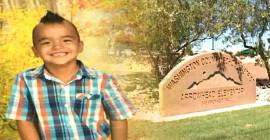 Jakobe ‘Kobe’ Sanden entered his second-grade classroom rocking a ‘hawk, not because it looked cool but because of his Native American roots. But the 7-year-old was kicked out of class because the “distracting” hairstyle was a potential violation of Arrowhead Elementary School’s dress code.
His mother, Teyawwna Sanden, was shocked when Susan Harrah, the principal of the Santa Clara school, called her to say she needed to pick up Kobe and get his hair cut.
“We had the students that weren’t used to it,” Harrah told KSTU. “They had called that out. So the teacher brought the student to my attention.”
The school’s online handbook stipulates only that “hair color should be within the spectrum of color that hair grows naturally.” The school district’s dress code goes further, stating: “Students have the responsibility to avoid grooming that causes a distraction or disruption, interrupting school decorum and adversely affecting the educational process.” It also notes that “Extremes in body piercings, hair styles and hair colors may be considered a distraction or disruption.”
Mrs. Sanden expressed her frustration with the school’s reaction on Facebook.
“So f’n irritated right now,” she wrote. “I get a call from the boys’ school and she said Kobe’s not allowed to have a Mohawk … that’s it’s school policy. WTH! Really? It’s hair!”
Kobe’s father, Gary Sanden, was traveling on business, but reached out to the Washington County School District’s superintendent of primary education.
“I was sympathetic to what they were saying ‒ that it was not conducive to learning,” he told the Washington Post. “But I couldn’t understand how it could be a distraction to the kids.”
The superintendent told Mr. Sanden to obtain letters from tribal leaders supporting the family’s claim that the hairstyle is part of their heritage.
“That’s like calling up the governor of our state,” he said. “But I called and got the letter. My wife did too.”
Mr. Sanden is a member of the Seneca Nation of Indians, which is based out of New York. Mrs. Sanden belongs to the Kaibab Band of Paiutes Indians.
“It is common for Seneca boys to wear a Mohawk because after years of discrimination and oppression, they are proud to share who they are,” Seneca Nation Tribal Councilor William Canella wrote. “It’s disappointing that your school does not view diversity in a positive manner, and it is our hope that Jakobe does not suffer from any discrimination by the school administration or faculty as a result of his hair cut.”
Canella told Native News Online that it was “ironic” that he had to step in to address such a situation at a school named Arrowhead. The Utah school is near several Indian reservations, including the Shivwits Band of Paiutes, which is less than 10 miles from the school, and the Kaibab Paiutes near the Utah-Arizona border.
Harrah told the Salt Lake Tribune that she felt the school had handled the hairstyle hubbub with aplomb, though she was surprised by the attention it received because “It took about a half hour of my time.”
“If there’s any kind of a hairstyle that is a distraction, then we have to tell the parents that we’ve got a problem,” she said. “There’s a protocol that we go through, and I felt like it was handled efficiently and that we respected their culture.”
 Mr. Sanden disagreed, however, noting that Kobe had to sit by himself in Harrah’s office for part of the day.
“That’s the sad part of the whole situation,” he told the Salt Lake Tribune. “To ostracize him like that ‒ that’s stuff from the ’50s.”
“It could have been handled 10 different ways,” he added.
Kobe’s removal from class happened less than three weeks after Malachi Wilson, a 5-year-old member of the Navajo Nation, was sent home on his first day of kindergarten at F.J. Young Elementary in Seminole, Texas because his long hair violated that district’s dress policy. The school required Malachi’s mother, April Wilson, to obtain documentation proving her son’s indigenous heritage, Indian Country Today reported.
In Louisiana last August, a Rastafarian teenager was suspended for three weeks from South Plaquemines High School for his dreadlocked hairstyle. The unnamed student claimed that not cutting his hair was a religious mandate, and his mother presented a letter from the 1st Church of Rastafar I explaining the religious significance of not cutting one’s dreadlocks. He eventually received an exemption from the school.
New Hampshire library to implement Tor above DHS objections—and how
PrivacySOS | September 16, 2015
A few weeks ago the Department of Homeland Security tried to intervene in a local library’s privacy program. Last night, the community roundly rejected those calls, explicitly choosing freedom over fear. Library board meetings don’t usually attract crowds, media, or protest. But something highly unusual—and extraordinarily encouraging—happened last night in a small town on the New Hampshire/Vermont border.
The drama unfolded in Lebanon, New Hampshire, where dozens of residents attended a library board meeting and spoke passionately about privacy and freedom before a gaggle of reporters and even some out of town activists. People in the room told me the energy was incredible. Some people cried. At the end of the meeting, the crowd that had gathered to passionately discuss issues at the heart of civic action and democracy erupted in cheers, elated at their collective success and lived commitment to the state motto: Live Free or Die.
The question before the public at the meeting last night was whether or not the Kilton Library in Lebanon should implement a Tor middle relay. Doing so would make the library a part of a global network of internet anonymity nodes offering users some measure of security and safety to people living under the terror of despotic regimes and abusive boyfriends alike. Weeks prior, the cops and the feds had managed to pull the plug on the project, a collaboration among the library, the Tor Project, and the Library Freedom Project.
But despite the Feds’ backroom fear mongering, the people of Lebanon, New Hampshire were not scared—and unlike DHS, which was mysteriously nowhere to be found last night, the people did their lobbying in full public view.
Nearly everyone who attended spoke in favor of the library’s plan to participate in Tor’s global internet freedom network. The only people who voiced opposition were the police chief and the town manager. But in the face of overwhelming community support, to include a local newspaper’s editors, even these few opponents were quick to temper their criticism of Tor, stressing that they would never tell the public it couldn’t do something like this if people want to.
People clearly want to. The room was so festive and pro-privacy that at the end of the meeting, the library board appeared unsure of what to do. It was so obvious that for a moment they just looked around. The people had spoken, and they weren’t scared, despite what DHS had told the local police, and what the local police had told the library. The library director stood up and proclaimed: the Tor node will return! The crowd cheered.
There were many remarkable moments during the public testimony. One woman, a library employee originally from Colombia, said that she wished a technology like Tor had existed in her country during a period of extreme repression in the early 2000s. It could have helped people, she said.
Library board chairman Francis Oscadal got philosophical, saying, “With any freedom there is risk. It came to me that I could vote in favor of the good … or I could vote against the bad. I’d rather vote for the good because there is value to this.” Please mark that quote and return to it; it’ll be endlessly relevant.
The Kilton Library and the community of Lebanon, New Hampshire have put the world on notice: privacy isn’t shameful and we don’t have to apologize for wanting to be free. We’d all do well to take heed, and gain some courage from their collective wisdom. Instead of fearing the bad in the world, and reacting based on those fears, we should vote for the good.
Featured Video

Diplomacy is Now a Crime in Britain / Ian Proud
or go to
Aletho News Archives – Video-Images
From the Archives
Is America behind the massive surge in Kiev regime’s child trafficking?
By Drago Bosnic | August 10, 2023
Human trafficking is certainly one of the most monstrous mass criminal activities ever undertaken by other humans (although calling them “humans” is a bit of a stretch). And yet, there’s a special kind of this deeply repulsive crime that pushes it to diabolical proportions – child trafficking. Underage kids, particularly those who were abandoned, sold or have very poor/abusive family backgrounds, are by far the most vulnerable group. The depraved criminals who engage in such illicit activities specifically target unfortunate children and given there are millions of them all around the globe, particularly in war-torn areas, the “recruitment pool” is effectively endless. Unfortunately, the demand on the black market also seems to be constant and growing, making it a very lucrative and appealing prospect for criminals. … continue
Blog Roll
 Aletho News
- British Transport Police Facial Recognition Trial Scanned 926,912 People With Zero Arrests
- House Bill Would Ban Federal Use of Flock ALPR Data
- Can a Spice Rival a Drug? 10 Head-to-Head Trials Put It to the Test.
- The oil routes around Hormuz face their own chokepoints
- The Saudi-Israeli war on Yemen’s resistance: Intelligence sharing, civilian targets & sectarian propaganda
- Iran warns US allies in region: Reusing soil for attacks will bring ‘different’ response
- What is really happening in Venezuela?
- Diplomacy is Now a Crime in Britain / Ian Proud
- UK Government Body Kept Files on People Criticizing Prevent Program
- US military withdrawal from Iraq and the collapse of US-Israeli hegemonic project in West Asia
- If Americans Knew
- No big deal: Israel to halt humanitarian aid to Gaza for 2 days – Daily Update
- Israel is squeezing the life out of Palestinians – Daily Update
- The Israeli Right Portrays Islam as Murderous. It Serves a Political Purpose
- Jordan Has Had Enough: King Abdullah’s Scathing Warning to Israel
- Israeli Colonizers (i.e. Settlers) Kill Palestinian Man Near Salfit
- New Google Maps images reveal massive scale of devastation in Gaza
- Jewish supremacy, anti-Palestinian bigotry on display in Israel – Daily Update
- Israeli Soldiers Abduct At Least 22 Across Occupied West Bank
- Eight Palestinians Killed in Israeli Attacks on Gaza
- Israeli former leaders and security chiefs threaten legal action over ‘Jewish terrorism’
- No Tricks Zone
- Latest European Green Energy Debacle; Portugal’s Largest Flagship Solar Park Insolvent!
- Green Energy Debacle: German Expert Professor Fritz Vahrenholt Warns Of Severe Economic And Social Consequences
- Two More Paleo Reconstructions Affirm Meters-Higher Sea Levels Across Ireland, Brazil 7000-6000 Years Ago
- New Study: Earth And Venus Surface Warmth Largely Explained By Convection And Lapse Rate, Not CO2 Or Radiation
- 2025 Nature Paper Claiming Worsening Global Drought Gets RETRACTED …Heavily Flawed
- New Study: ‘Global Drought Shows No Detectable Recent Acceleration Under Climate Warming’
- Economic Masterminds: German Socialists Suggest Taxing Productivity Gains Stemming From Using AI
- The South China Sea Has Not Been Cooperating With The Climate Change Narrative
- Energy Crisis: Germany Enters Heating Season With Historically Low Gas Reserve Fill Levels
- New Study: The Antarctic Ice Sheet Gained Mass From 2020-2024 Due To Staggering Snow And Ice Accumulation

