Surveillance watchdog calls for ‘democratic control’ of spies
RT | July 14, 2015
Civil liberties NGO Privacy International (PI) has criticized a report on state surveillance, calling for improved regulatory oversight rather than self-reporting by spy agencies.
The civil liberties NGO was commenting on a Royal United Service Institute (RUSI) report published on Monday.
Titled ‘A Democratic License to Operate’, the study was conducted by the foreign policy think-tank as part of Britain’s Independent Surveillance Review.
PI agreed with some of RUSI’s findings but insisted that government-backed mass surveillance remains a deep concern.
“The RUSI report, from start to end, emphasizes how technological change has rendered the current legal system governing surveillance obsolete,” PI deputy director Eric King told RT on Tuesday.
“Every day, the highly technical GCHQ finds new ways to eavesdrop, while our oversight tries to cope with technical blind spots,” he added.
Privacy International warned that the current system relies on GHCQ to self-report errors. It called for a “better resourced, more technically equipped oversight body” with the power to take “GCHQ to task.”
It also called for “root and branch reform” to bring snoops and the agencies they work for “under democratic control.”
This surveillance versus privacy rights debate has long infiltrated British politics, as campaigners continue to criticize government spy base GCHQ’s invasive snooping practices.
Despite contentious leaks by ex-NSA computer analyst and whistleblower Edward Snowden, RUSI’s report said there is “no evidence that the British government knowingly acts illegally in intercepting private communications.”
It argued further that there is no proof that the British state’s ability to collect data in bulk is used by snoops as a perpetual window into the private lives of UK residents.
RUSI’s study makes a series of recommendations on how state surveillance should be conducted in the future, saying that the current legal framework for intercepting communications is unclear.
The think tank adds this legal framework “has not kept pace with developments in communications technology, and does not serve either the government or members of the public satisfactorily.
The think tank is calling for “a new, comprehensive and clearer legal framework” to regulate state surveillance.
At a confidential intelligence conference held at Ditchley Park in Oxfordshire in June, the views of a number of high-ranking intelligence officials came to light.
Investigative journalist Duncan Campbell, who attended the conference, posted on his website, “Perhaps to many participants’ surprise, there was general agreement across broad divides of opinion that Snowden – love him or hate him – had changed the landscape.”
According to Campbell, a number of senior officials felt that shift “towards transparency, or at least ‘translucency’” was long overdue and utterly necessary.
‘Censorship’: UK freezes bank account of Russian news agency, gives no reason
RT | July 13, 2015
Barclay’s bank froze a Rossiya Segodnya news agency account without explaining its reasons. The news first came to light on Monday. The agency’s head Dmitry Kiselyov has called it “censorship.”
“To close the account of one of the world’s leading news agencies is censorship, the direct obstruction of journalists’ work,” Dmitry Kiselyov said. “What kind of press freedom and democracy can Britain claim to have if it prevents one of the world’s largest news agencies from working in the country?”
No formal notification of the move or justification for it was immediately provided. A source in the banking sector told the agency the Exchequer has put Dmitry Kiselyov on an anti-Russian sanctions list, which could have led to the news agency’s account being frozen.
Kiselyov is one of the people subjected to financial and travel sanctions in the EU. These restrictions have been imposed on a number of Russian officials in connection with Moscow’s stance over Ukraine crisis.
The sanctions list, which includes the head of Rossiya Segodnya news agency, was published on March 21. It characterizes Kiselyov as “central figure of the government propaganda supporting the deployment of Russian forces in Ukraine.”
Israeli Official Orders Barring of “Palestine 1948” TV
IMEMC & Agencies | July 10, 2015
Israeli Police spokeswomen Luba Samri said, Thursday, that Israeli Public Security Minister Gilad Erdan has signed an official order shutting down “Palestine 1948 TV,” and barring all of its activities in the country.
Erdan said “Israel will not allow anybody to harm its sovereignty, or to grant the Palestinian Authority any foothold in the country.”
He alleged that the TV station never obtained any proper authorization to operate in Israel, and said “Palestine 1948″ began broadcasting, a month ago, from Nazareth. The order is valid for six months.
Head of the Palestine Public Broadcasting Corporation, Minister Riyad al-Hasan, said the TV is broadcasting from the West Bank city of Ramallah, and that Israel has no authority, or right, to shut it down.”
Al-Hasan told the WAFA News Agency that the Israeli threats also targeted production companies and media outlets that have business or cooperation with the TV station.
Arab Member of Knesset of the Joint Arab List, Basel Ghattas, issued a press release denouncing Erdan’s decision, and considered it as a “desperate Israeli move to control Arab media outlets.”
“This is a dangerous, uncivil, decision based on stupidity; it is an attempt to control and dominate media outlets,” he added, “While Israel claims democracy, and while media and technology continue to advance, Israel still tries to silence us.”
Related, June 18, 2015: Netanyahu Orders New Palestinian TV Shut, P.A Plans to Appeal Decision
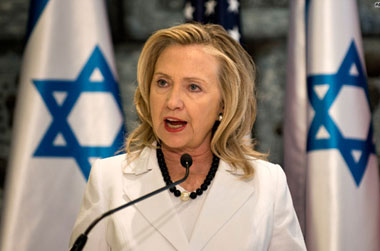
Hillary Clinton: Use Congress and Corporations to End Boycott Israel Movement
By Naji Dahi – ANTIMEDIA – July 9, 2015
According to a letter from Hillary Clinton to pro-Israel donor, Haim Saban, she wants to be the top pro-Israel candidate in the race for the Democratic presidential nomination. More specifically, Clinton pledges her opposition to the BDS (Boycott, Divest, Sanction) movement. According to McClatchy,
“I know you agree that we need to make countering BDS a priority… we can work together…to reverse this trend with information and advocacy, and fight back against further attempts to isolate and delegitimize Israel… from Congress and state legislatures to boardrooms and classrooms, we need to engage all people of good faith, regardless of their political persuasion or their views on policy specifics, in explaining why the BDS campaign is counterproductive to the pursuit of peace and harmful to Israelis and Palestinians alike.”
It is no secret that Hillary Clinton is the Wall Street-sponsored candidate in the Democratic primary race. Data from Open Secrets for the 1999-2016 election cycles shows that three of her top five contributors were Wall Street firms (Citigroup, Goldman Sachs, and J.P. Morgan Chase). It seems that Clinton now wants to become the undisputed pro-Israel candidate, as well.
In the United States presidential elections, all major party candidates are obliged to show their loyalty to the state of Israel. In return, wealthy pro-Israel donors fill their election campaign coffers with much needed cash. In 2008, for example, the top three candidates in both parties (Obama, Clinton, McCain) were also the top three recipients of donations from pro-Israel groups and individuals. In 2012, history repeated itself with Mitt Romney and Barack Obama, the top two recipients of campaign cash from pro-Israel individuals and groups. While it is too early to tell, it is highly likely that the top two candidates from the two major parties will also be the top two recipients of pro-Israel campaign contributions.
Haim Saban, a billionaire who made his fortune in the entertainment industry, is a long time Democrat and ally of Hillary Clinton. He will likely promote pro-Israel, anti-BDS discourse in the Democratic Party. Sheldon Adelson, also a billionaire, is a long-time Republican whose job is to enforce pro-Israel, anti-BDS discourse in the Republican Party. According to The Times of Israel,
“Adelson said his prime focus… was to reverse the inroads being made by what he called ‘the BDS (Boycott, Divestment and Sanctions) and company… the anti-Israel and anti-Semitic organizations [that] are making a lot of headway on the campuses in the United States.’ He said he would encourage Jewish groups to work to have boycott decisions taken by student campus groups reversed… Saban made clear that he intended to fight back against any business groups inclining to boycott Israel, and create a climate in which they were deterred from doing so.”
The success of the BDS movement is becoming an issue for Israel—so much so, that Saban and Adelson held a secret summit in Las Vegas last month to address the matter. The two billionaires invited 50 pro-Israel groups and pledged to fund their efforts to fight BDS on American college campuses with the hope of branding the movement anti-Semitic. According to Haaretz,
”…of millions of dollars were raised to combat campus campaigns to boycott, divest from and sanction Israel — or BDS, as the movement is known… both [Adelson and Saban] stressed their view that BDS — a form of nonviolent protest promoted by a diverse array of groups opposed to Israel’s policies toward the Palestinians — as simply a form of anti-Semitism.”
With Hillary Clinton officially on board and the two billionaires raising $20 million for the anti-BDS cause, American college campuses will be interesting centers of debate this fall.
NSA leaked Turkish officials false flag war talk: Report
Press TV – July 8, 2015
A 2014 Turkish Foreign Ministry session, which featured high-level Turkish officials discussing how Turkey could start a war with Syria, was reportedly recorded and leaked by the US National Security Agency (NSA).
German weekly magazine Focus attributed the leakage to the NSA, reporting on the security meeting among former Turkish Foreign Minister Ahmet Davutoğlu, National Intelligence Organization (MİT) head Hakan Fidan, Foreign Ministry Undersecretary Feridun Sinirlioğlu and Deputy Chief of General Staff Gen. Yaşar Güler.
President Recep Tayyip Erdogan, who was prime minister at the time, banned the video-sharing website YouTube after the leakage, which caught Fidan saying he would send four men from Syria to attack Turkey to “make up a cause of war.” Güler is heard saying in response, “What you’re going to do is a direct cause of war.”
Currently serving as Turkish prime minister, Davutoğlu said on July 3 that his country would not hesitate to launch a military intervention in Syria in case of what he referred to as a potential threat to Turkey’s “security.”
The Turkish newspaper Hürriyet Daily also reported last Sunday that the Turkish military had called on all troop commanders stationed along its border with Syria to be present at a meeting aimed at discussing a possible intervention in the crisis-hit country.
Erdogan has accused Syrian Kurds of trying to establish a state in Syria’s north, saying Ankara will leave no stone unturned to prevent such an establishment near its borders.
Ankara has long been engaged in a conflict with the Turkish Kurdistan Workers’ Party (PKK), which has been seeking an autonomous Kurdish region inside Turkey since the 1980s.
Turkey has also been one of the main supporters of the militancy against Syrian President Bashar al-Assad, with reports showing that Ankara actively trains and arms militants operating in Syria.
Florida Man Accused of ‘Terrorism’ Based On Book Collection
Counter Current News | July 2, 2015
Imagine being falsely accused of terrorism for nothing more than the books you have read. Well that’s exactly what has happened to a Florida man named Marcus Dwayne Robertson.
The U.S. government composed “snippets of information from various sources, out of context, to weave together a narrative of terrorist ideation,” according to a Florida judge.
That judge just ordered the release of Robertson, also known as “Abu Taubah,” an Orlando, Florida resident and Islamic scholar. Abu Taubah was accused of “supporting terrorism,” but the “evidence” against him amounted to nothing more than the books on his bookshelf.
Robertson, also known as “Abu Taubah,” was incarcerated from 2011. The charges he faced, however, were tax fraud and illegal gun possession. Not exactly “terrorism.”
But following his arrest and conviction stemming from these charges, prosecutors added what they termed “terrorism enhancement” to the sentence.
There seems to be no rationale for this other than ABu Taubah’s religious orientation… that and his book collection.
This sentencing guideline modification would have locked Robertson up for 20 years.
But the judge’s recent rejection of this bizarre, Orwellian sentencing “enhancement”, led to the Islamic scholar being released immediately.
Robertson’s sentence was argued as justifiable by prosecutors who said the contents of his Islamic book collection were sufficient “evidence” that he was connected to terrorism.
Approximately two dozen eBooks that Robertson downloaded were presented as “evidence” of his “terrorist connections.”
Prosecutors highlighted passage after controversial passage, as though this could serve as legitimate evidence that someone is a terrorist. They didn’t seem to understand that the contents of a book someone owns cannot be used as evidence against them.
A memorandum obtained by First Look was issued along with Judge Gregory A. Presnell decision. That memorandum strongly rejected the government’s argument that eBook passages could be used as “evidence” of “terrorism.”
“[T]here was no evidence produced that Robertson ever accessed these particular documents, much less that he took their extremism to heart,” Presnell argued.
He made it clear that even if the Islamic scholar admitted to having read the eBooks in question, this would not and could not be used as evidence of terrorism.
“The government has never disputed Robertson’s claim of being an Islamic scholar,” he added. “It is not at all remarkable for an Islamic scholar to study, among many, many others, the writings of Islamic extremists.”
He said that beyond this, the prosecutors did “not even come close to proving… Robertson’s relatively minor income tax fraud was intended to promote a federal crime of terrorism.”
The judge noted that he received “hundreds of emails” over the last few weeks that urged him to lock up the man for no reason other than because he was a Muslim. These emails amount to little more than racism and bigotry in most cases, and fear-mongering and ignorance in the rest.
“In America, everyone has a right to say and believe what they want, within the bounds of the law,” Presnell said before declaring that Robertson would have to be released immediately.
Robertson’s lawyer Daniel Broderson agreed that “at no point did the government ever have any actual evidence [Robertson] advocated terrorism, so they attempted to use his library of books as a backhanded way of branding him as a terrorist. He spent four years in prison, two years of it in isolation, over a prosecution that was both unfounded and that completely ran afoul of the first amendment.”
Speaking to The Intercept after he was released, Robertson said, “they’re trying to find an indirect way to sentence people with non-terrorism charges as though they’d committed terrorism offenses, without having to provide the preponderance of evidence that is normally required in such cases. You own a few books and some guy tells an informant you said something, and suddenly that is legal basis enough to sentence you to prison for decades.”
He added that he “lost all those years, in jail, in terrible conditions, away from my family. After all that, they couldn’t produce one single statement from me that supported terrorism.”
Protest commemorating one year anniversary of the killing of Mohammad Abu Khdeir met with military violence
International Solidarity Movement | July 3, 2015
Ramallah – On July 2, 2015, in honor of the first anniversary of the murder of Muhammad Abu Khdeir, Palestinian activists with international supporters blocked a settlers-only road leading to the illegal Adam settlement. Demonstrators cited this road as the road that the murderers took in their search for a Palestinian victim. Journalists, Palestinian and international activists, suffered from pepper spray burns and several were hospitalized.
“This is the first in a week of demonstrations for Muhammad Abu Khdeir. One of the murderers, Yosef Haim Ben-David, is from the Adam settlement. This is why the demonstration was held at this settlers-only entrance,” said Abdullah Abu Rahmah, the coordinator of Popular Committee Against the Wall and Settlements in Bil’in.
Demonstrators blocked the road to settler traffic in both directions until the Israeli Army and Border Police dispersed the non-violent demonstrators and journalists by pepper-spraying indiscriminately. Three Palestinian activists, four journalists, and two International ISM volunteers were pepper sprayed in the eyes and mouth by a masked Army officer. An ISM co-founder as well as journalists from Roya TV Channel, Reuters, and Palestine TV were severely pepper sprayed in the eyes requiring hospitalization.
The soldiers threw sound percussion grenades at demonstrators and chased people. In addition to the pepper spray, they shoved journalists and Palestinian activists to the ground.
After the soldiers and border police chased the demonstrators off the road and down a hill, they continued to throw percussion grenades even as the demonstrators stood at a distance waiting to find fellow demonstrators.
FBI Claims it Doesn’t Have to Share Records with Justice Dept. Inspector General
By Noel Brinkerhoff and Steve Straehley | AllGov | June 29, 2015
The Federal Bureau of Investigation (FBI) has continued to stonewall requests by the Department of Justice’s inspector general for records pertaining to multiple investigations by the internal watchdog.
The FBI has contended since 2010 that the IG’s office lacks the legal authority to see documents related to certain matters, including grand juries, Title III electronic surveillances and Fair Credit Reporting Act information.
FBI officials also claim they don’t have to share documents related to two investigations of alleged whistleblower retaliation, or those pertaining to an IG review of the FBI’s use of telephonic metadata collected under Section 215 of the Patriot Act, according to the Project on Government Oversight.
The IG said in a report “delaying or denying access to agency documents imperils an IG’s independence and impedes our ability to provide the effective and independent oversight that saves taxpayers money and improves the operations of the federal government.”
“Actions that limit, condition, or delay access have profoundly negative consequences for our work: they make us less effective, encourage other agencies to take similar actions in the future, and erode the morale of the dedicated professionals that make up our staffs,” the report stated.
And it might become even more difficult for the inspector general to get information from the FBI. The 2016 Justice Department budget proposal does not include the section that now forces the Bureau to cooperate with requests from the IG.
Inspector General Michael Horowitz said such a move “could lead the FBI to believe that its conduct has been sanctioned and could cause other department components to conclude that it is acceptable to ignore the Appropriations Act and clear requirements of the IG Act and raise legal objections to the OIG’s access to certain records necessary to perform our important oversight function.”
To Learn More:
Watchdog Barks for Access to FBI Records (by Michael Smallberg, Project on Government Oversight)
Justice Watchdog Continues to Clash with FBI Over Access to Documents (by Charles Clark, Government Executive )
180 Day Report to Congress on the Impact of Section 218 of the Department of Justice Appropriations Act for Fiscal Year 2015 (Department of Justice Inspector General) (pdf)
Justice Dept. Report Details Clashes between FBI and Organized Crime Drug Task Force (by Noel Brinkerhoff, AllGov )
Russia won’t go to OSCE parliamentary session in Helsinki – Duma speaker
RT | July 1, 2015
Sergey Naryshkin says the refusal to participate in the forthcoming OSCE session was meant as a protest against arbitrariness and violations of main principles of democracy and parliamentary politics.
The State Duma chairman announced the decision to skip the Helsinki session of the Organization for Security and Cooperation in Europe soon after the Finnish Foreign Ministry announced on Wednesday that it had turned down a request to temporarily waive the travel ban and allow Naryshkin and five more State Duma MPs to enter their country. In order to participate in the event that begins on Sunday.
Earlier, Naryshkin submitted a draft resolution to the Parliamentary Assembly of the OSCE denouncing the very practice of sanctions against parliamentarians. In this document he also stated that obstructing contacts between lawmakers from different nations was against the basic principles of democracy.
On Wednesday Naryshkin said that the whole of the Russian delegation would not participate in the OSCE session “in protest against arbitrariness, against violation of the principles of democracy.” He added that Russia still planned to take part in the next session of the OSCE’s Parliamentary Assembly that will take place in Ulan Bator, Mongolia.
Earlier in the day Vladimir Putin’s press secretary Dmitry Peskov called Finland’s decision to deny entry to the Duma speaker “outrageous and unacceptable,” especially considering the fact that the visit was within the framework of an international event. Peskov added that he expected the Russian Foreign Ministry to give a qualified appraisal of this step.
In March 2014, the USA and the EU introduced personal sanctions, such as visa bans and asset freezes, on a number of senior Russian officials and leading politicians whom they accused of being “key ideologists and architects” of the policy towards Ukraine. As the relations between the West and Russia continued to deteriorate, more names were added to the blacklists.
Russia replied with its own blacklist of about 200 people known for their anti-Russian positions and actions. The Russian Foreign Ministry did not initially disclose their names, but they were published by Finnish press earlier this year after Russia presented the list to European nations for the convenience of foreign officials who did not want to apply for visas if they were to be refused anyway.
The Russian Foreign Ministry expressed disappointment in this disclosure, calling it a threat to mutual trust.
Featured Video
Anthrax War – CBC The Passionate Eye
or go to
Aletho News Archives – Video-Images
Book Review
Shattered Dreams: The HPV Vaccine Exposed (2019)
By Christina England – 30 Q&As – Book Review & Summary
Lies are Unbekoming | September 4, 2026
… Gardasil received FDA fast-track approval in 2006, Cervarix followed in 2009, and Gardasil 9 was approved in December 2014 with more than double the aluminium adjuvant content of the original. The commercial context is specific. Merck was about to lose patent protection on Zocor and faced $18 billion in Vioxx injury claims from a cardiovascular drug the company had marketed while suppressing its own data showing a five-times increase in heart attacks. Analysts projected the global HPV vaccine market at $4 billion by 2011, contingent on government-funded national programs for teenage girls. The 1986 National Childhood Vaccine Injury Act had already granted manufacturers complete liability immunity. By 2013, Japan had withdrawn its HPV vaccine recommendation after cataloguing severe adverse reactions in hundreds of girls. No Western government followed. The establishment position across the UK, US, Australia, and most of Europe held, and still holds, that the vaccines are safe and effective, that reported injuries are coincidental, and that cervical cancer prevention justifies the program. The book was published into this position, not against a vacuum.
Shattered Dreams sits alongside Mary Holland’s The HPV Vaccine On Trial and Viera Scheibner’s foundational vaccination work as part of the documented record on what has been done to a generation of teenage girls under the banner of cancer prevention. The full summary unpacks three specific findings: that Merck used the aluminium adjuvant itself as the “placebo” control in 92.5% of trial subjects, making it structurally impossible to detect excess reactions from the adjuvant; that Dr. Sin Hang Lee found HPV DNA fragments bound to aluminium in every one of sixteen Gardasil samples tested, and in the blood and spleen of a New Zealand girl six months after her third dose; and that in every country with high vaccination coverage, including Australia, the UK, Norway, and Sweden, cervical cancer rates have stopped declining and started rising specifically in the vaccinated cohort. Martínez-Lavín’s 2017 calculation puts the number needed to seriously harm with Gardasil 9 at 140, and the number needed to vaccinate to prevent one case at 1,757. Thirteen young women are seriously harmed for every one who benefits. The vaccine was approved on the basis of trials that could not detect what the trials were supposed to detect, and it is still being given to twelve-year-olds today. … Read full review
Blog Roll
 Aletho News
- British Transport Police Facial Recognition Trial Scanned 926,912 People With Zero Arrests
- House Bill Would Ban Federal Use of Flock ALPR Data
- Can a Spice Rival a Drug? 10 Head-to-Head Trials Put It to the Test.
- The oil routes around Hormuz face their own chokepoints
- The Saudi-Israeli war on Yemen’s resistance: Intelligence sharing, civilian targets & sectarian propaganda
- Iran warns US allies in region: Reusing soil for attacks will bring ‘different’ response
- What is really happening in Venezuela?
- Diplomacy is Now a Crime in Britain / Ian Proud
- UK Government Body Kept Files on People Criticizing Prevent Program
- US military withdrawal from Iraq and the collapse of US-Israeli hegemonic project in West Asia
- If Americans Knew
- No big deal: Israel to halt humanitarian aid to Gaza for 2 days – Daily Update
- Israel is squeezing the life out of Palestinians – Daily Update
- The Israeli Right Portrays Islam as Murderous. It Serves a Political Purpose
- Jordan Has Had Enough: King Abdullah’s Scathing Warning to Israel
- Israeli Colonizers (i.e. Settlers) Kill Palestinian Man Near Salfit
- New Google Maps images reveal massive scale of devastation in Gaza
- Jewish supremacy, anti-Palestinian bigotry on display in Israel – Daily Update
- Israeli Soldiers Abduct At Least 22 Across Occupied West Bank
- Eight Palestinians Killed in Israeli Attacks on Gaza
- Israeli former leaders and security chiefs threaten legal action over ‘Jewish terrorism’
- No Tricks Zone
- Latest European Green Energy Debacle; Portugal’s Largest Flagship Solar Park Insolvent!
- Green Energy Debacle: German Expert Professor Fritz Vahrenholt Warns Of Severe Economic And Social Consequences
- Two More Paleo Reconstructions Affirm Meters-Higher Sea Levels Across Ireland, Brazil 7000-6000 Years Ago
- New Study: Earth And Venus Surface Warmth Largely Explained By Convection And Lapse Rate, Not CO2 Or Radiation
- 2025 Nature Paper Claiming Worsening Global Drought Gets RETRACTED …Heavily Flawed
- New Study: ‘Global Drought Shows No Detectable Recent Acceleration Under Climate Warming’
- Economic Masterminds: German Socialists Suggest Taxing Productivity Gains Stemming From Using AI
- The South China Sea Has Not Been Cooperating With The Climate Change Narrative
- Energy Crisis: Germany Enters Heating Season With Historically Low Gas Reserve Fill Levels
- New Study: The Antarctic Ice Sheet Gained Mass From 2020-2024 Due To Staggering Snow And Ice Accumulation

