Civil Liberty Violations Seen in NYPD Interrogations of Demonstrators
By Noel Brinkerhoff | AllGov | April 30, 2015
The New York City Police Department is back to doing something it was told by the courts decades ago to stop: interrogating demonstrators about their political behavior.
At least a dozen people protesting the decision not to prosecute the police who killed Eric Garner were detained by the NYPD. They later told The New York Times that they were questioned about their political associations and other matters related to their involvement in street protests.
The interrogations could have a chilling effect on Americans lawfully exercising their right to protest and may also put the department in violation of a 1985 consent decree that came out of a federal court case, Handschu v. Special Services Division (pdf), which was supposed to end investigations of political activity.
The recent NYPD actions aren’t the first time it has skirted the legalities of the Handschu settlement. In 2003, the department was rebuked after its Intelligence Division detectives collected information from antiwar protestors such as their school, their membership in organizations and their involvement in past protests.
The Times’ Colin Moynihan wrote that “some civil liberties lawyers say the recent questioning appeared to be substantially similar to the questioning in 2003,” with detectives focusing on political involvement, not criminal behavior.
“When the police investigate political affiliations and political activities, that poses a serious threat to First Amendment rights,” Christopher Dunn, the associate legal director of the New York Civil Liberties Union, told the Times. “The NYPD should stop this immediately.”
To Learn More:
Questioning of Garner Protesters in New York Renews Concerns about Police Practices (by Colin Moynihan, New York Times )
Chicago Police Accused of Running Secret Interrogation Center (by Noel Brinkerhoff, AllGov )
Supreme Court Rules a Suspect’s Silence during Police Interrogation Can be Used against Him (by Noel Brinkerhoff and Danny Biederman, AllGov )
Baltimore and the Human Right to Resistance: Rejecting the framework of the Oppressor
By Ajamu Baraka | Black Agenda Report | April 29, 2015
Anti-Black racism, always just beneath the surface of polite racial discourse in the U.S., has exploded in reaction to the resistance of black youth to another brutal murder by the agents of this racist, settler-colonialist state. With the resistance, the focus shifted from the brutal murder of Freddie Gray and the systematic state violence that historically has been deployed to control and contain the black population in the colonized urban zones of North America, to the forms of resistance by African Americans to the trauma of ongoing state violence.
The narrative being advanced by corporate media spokespeople gives the impression that the resistance has no rational basis. The impression being established is that this is just another manifestation of the irrationality of non-European people – in particular, Black people – and how they are prone to violence. This is the classic colonial projection employed by all white supremacist settler states, from the U.S., to South Africa and Israel.
The accompanying narrative is that any kind of resistance that does not fit the narrow definition of “non-violent” resistance is illegitimate violence and, therefore, counter-productive because – “violence doesn’t accomplish anything.” Not only does this position falsely equate resistance to oppression as being morally equivalent to the violence of the oppressor, it also attempts to erase the role of violence as being fundamental to the U.S. colonial project.
The history of colonial conquest saw the U.S. settler state shoot and murder its’ way across the land mass of what became the U.S. in the process of stealing indigenous land to expand the racist White republic from “sea to shining sea.” And the marginalization of the role of violence certainly does not reflect the values of the Obama administration that dutifully implements the bi-partisan dictates of the U.S. strategy of full spectrum dominance that privileges military power and oppressive violence to protect and advance U.S. global supremacy. The destruction of Libya; the re-invasion of Iraq; the civil war in Syria; Obama’s continued war in Afghanistan; the pathological assault by Israel on Palestinians in Gaza and the U.S. supported attack on Yemen by the Saudi dictatorship, are just a few of the horrific consequences of this criminal doctrine.
Race and oppressive violence has always been at the center of the racist colonial project that is the U.S. It is only when the oppressed resist — when we decide, like Malcolm X said, that we must fight for our human rights — that we are counseled to be like Dr. King, including by war mongers like Barack Obama. However, resistance to oppression is a right that the oppressed claim for themselves. It does not matter if it is sanctioned by the oppressor state, because that state has no legitimacy.
No rational person exalts violence and the loss of life. But violence is structured into the everyday institutional practices of all oppressive societies. It is the deliberate de-humanization of the person in order to turn them into a ‘thing’ — a process Dr. King called “thing-afication.” It is a necessary process for the oppressor in order to more effectively control and exploit. Resistance, informed by the conscious understanding of the equal humanity of all people, reverses this process of de-humanization. Struggle and resistance are the highest expressions of the collective demand for people-centered human rights – human rights defined and in the service of the people and not governments and middle-class lawyers.
That resistance may look chaotic at this point – spontaneous resistance almost always looks like that. But since the internal logic of neoliberal capital is incapable of resolving the contradiction that it created, expect more repression and more resistance that will eventually take a higher form of organization and permanence. In the meantime, we are watching to see who aligns with us or the racist state.
The contradictions of the colonial/capitalist system in its current expression of neoliberalism have obstructed the creation of decent, humane societies in which all people are valued and have democratic and human rights. What we are witnessing in the U.S. is a confirmation that neoliberal capitalism has created what Chris Hedges called “sacrificial zones” in which large numbers of black and Latino people have been confined and written off as disposable by the system. It is in those zones that we find the escalation of repressive violence by the militarized police forces. And it is in those zones where the people are deciding to fight back and take control of their communities and lives.
These are defining times for all those who give verbal support to anti-racist struggles and transformative politics. For many of our young white comrades, people of color and even some black ones who were too young to have lived through the last period of intensified struggle in the 1960s and ‘70s and have not understood the centrality of African American resistance to the historical social struggles in the U.S., it may be a little disconcerting to see the emergence of resistance that is not dependent on and validated by white folks or anyone else.”
The repression will continue, and so will the resistance. The fact that the resistance emerged in a so-called black city provides some complications, but those are rich and welcoming because they provide an opportunity to highlight one of the defining elements that will serve as a line of demarcation in the African American community – the issue of class. We are going to see a vicious ideological assault by the black middle class, probably led by their champion – Barack Obama – over the next few days. Yet the events over the last year are making it more difficult for these middle-class forces to distort and confuse the issue of their class collaboration with the white supremacist capitalist/colonialist patriarchy. The battle lines are being drawn; the only question that people must ask themselves is which side they’ll be on.
In politics as in war, advantage is not enough
By Greg Felton | April 28, 2015
Near the outset of the U.S. Civil War, President Abraham Lincoln made Maj.–Gen. George McClellan General-in-Chief of the Union Amy. McClellan was highly popular among his men and a great organizer who built the Army of the Potomac into a formidable force. Unfortunately for Lincoln, McClellan the meticulous organizer lacked the courage and judgment to be a field commander.
On April 5, 1862, Lincoln ordered McClellan to attack a Confederate force in Yorktown, Va. He had at his disposal 121,500 troops, 44 batteries of artillery and prodigious logistical support. The Confederate contingent in Yorktown, meanwhile, comprised something on the order of 10,000 men. The battle was a rout waiting to happen. It never did. McClellan told Lincoln the enemy was 100,000 strong and refused to attack. This delusion was partly due to Gen. John B. Magruder’s crafty parading of his Confederate soldiers in a circuit to give the illusion of greater numbers and his ordering of logs to be painted black to resemble cannons.
McClellan knew that intelligence estimates of Confederate strength were laughable exaggerations yet he acted as if they were true. Instead of attacking, he chose the do-nothing option of laying siege to Yorktown. In early May, Magruder and the Confederates slipped out to fight another day, leaving McClellan to enter an empty town. He declared victory. The last straw for Lincoln was McClellan’s repeated refusal to hasten after Gen. Robert E. Lee’s retreating army after the Battle of Antietam. On Nov. 5, 1862, Lincoln relieved him of command.
McClellan was an administrator who proved to be more of a coward than a commander, notwithstanding the Washington Post’s risible attempt to rehabilitate him. There may be a lesson here for a certain Canadian leader, one who finds himself at the head of a large force in the run up to a political war.
Two years ago this month, Justin Trudeau was anointed leader of the Liberal Party of Canada, a decision that gave hope to Canadians that somebody might finally put the brakes on Stephen Harper’s totalitarianism.
For one thing, Trudeau has a good pedigree. His father, Pierre Elliot Trudeau, was a respected if not wholly popular prime minister, though his reputation has much improved since his death. Trudeau’s Liberal predecessors, Stéphane Dion and Michael Ignatieff, were, respectively, too bland and too aloof to generate any deep support among the party faithful or offer a viable governing alternative. When you add good looks and youth (41), Justin Trudeau appears to be the ideal prime-minister-in-waiting, especially for young voters.
Opinion polls in the month following Trudeau’s election seemed to confirm that a reversion to Liberal rule was highly likely if not inevitable. In May 2013, voter support for the Liberals had more than doubled since the end of the 2011 election, whereas support for the Harperites had fallen by a third. Some of that Liberal growth even came at the expense of the centre-left New Democratic Party, which lost more than 20% support. Had an election been called at this time, the Liberals would have coasted to majority rule. What a difference two years makes.
By April this year, the Liberals had fallen from 38.6% to 27.6%, and Harper, of all people, was the major beneficiary! The NDP, contrary to expectation, not only did not benefit from Trudeau’s slip but lost ground, confirming that its leader, Thomas Mulcair, is not perceived as a serious rival to Trudeau.
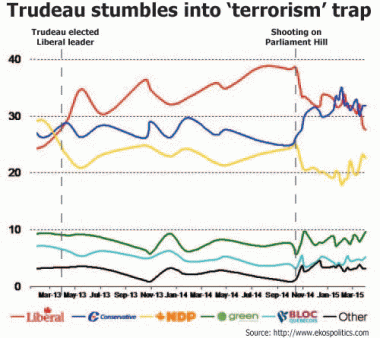 Like McClellan, Trudeau is highly popular. His victory came on the first ballot with 80% of the vote, and Liberal membership grew rapidly almost immediately. Trudeau’s popular appeal really took off in January 2014 and ballooned over the spring and summer.
Then, in mid-October, it all went south. The seminal event was the Oct. 22 shooting of Cpl. Nathan Cirillo, a ceremonial guard on duty on Parliament Hill. It was a bizarre incident, not only because it came out of nowhere, but it received conspicuously comprehensive video coverage. Some of this coverage even managed to catch no fewer than four police cars parked near the site on Parliament Hill with officers standing around as if… waiting for something to happen.
As readers already know, the shooting of Cpl. Cirillo gave Harper the excuse he needed to legislate police-state repression and a host of other unconstitutional measures in the name of “public safety.”
This police-state repression is manifested in Harper’s Protection of Canada from Terrorists Act (Bill C-44) and Security of Canada Information Sharing Act (“Secret Police Act,” Bill C-51) which authorize the state to conduct spying, harassment, arbitrary detention and intimidation and other unconstitutional measures. The main targets are not so much “terrorists” as anyone who criticizes the government, people like environmentalists and Muslim charities. These groups are already subject to malicious audits and have been intimidated into repressing their political activism.
Canada’s McClellan fails test of character
The shooting of Cpl. Cirillo gave Trudeau the perfect opportunity to seize the initiative from Mulcair and the NDP, who represent the Confederacy for analytical purposes: He could condemn the shooting and condemn the Harperites for their conspicuously contrived campaign to demonize the shooter, Michael Zehaf Bibeau, as a terrorist. Moreover, he could call attention to the totalitarian overtones of the shooting and its aftermath.
On the day of the shooting, Trudeau did deliver a speech, but it was stiff and peppered with “values” blathering reminiscent of George W. Bush’s post-Sept. 11 screed. Nevertheless, it had one redeeming virtue—he did not demonize Zehaf Bibeau: “Criminals cannot and will not dictate to us how we act as a nation, how we govern ourselves or how we treat each other. They cannot and will not dictate our values. And they do not get to decide how we use our shared public spaces.”
For his part, Mulcair also steered clear of the terrorism tar pit. On Oct. 29, he also used “criminal” to describe Zehaf Bibeau: “When you look at the history of the individual involved, you see a criminal act, of course. But… I think that we’re not in the presence of a terrorist act in the sense that we would understand it.”
At this point, Mulcair and Trudeau were on the same page regarding the shooting, but Trudeau had a big advantage. His Liberals are far and away richer and more populous than Mulcair’s NDP, and he can tap into overwhelming national hatred for Harper and his anti-terrorism totalitarianism to outmaneuver Mulcair. Since the Bill was announced, Harper’s terrorism smokescreen has lifted and opposition to state totalitarianism tripled in six weeks. Even key business leaders oppose it. All Trudeau had to do was channel this sentiment to become the people’s choice to restore Canada to parliamentary rule.
As expected, Harper and his minions jumped all over Mulcair for daring to be rational, but so did Trudeau! “The RCMP was clear, these were acts of terrorism, [so] these were acts of terrorism,” he said. Instead of lambasting Bill C-51 as unconstitutional and fascist, he tapped into his inner McClellan to adopt the do-nothing approach of proposing amendments that he knew full well would never pass. From a position of strength, Trudeau allowed himself to be outmaneuvered by both Harper and Mulcair thereby placing himself at odds with the electorate and his own party.
Trudeau’s abrupt about-face, and his attack on Mulcair for agreeing with him, makes no sense politically or morally. He does not allow for the possibility that the RCMP might lie, or that it might have abetted the shooting in some way. Currently, Parliament Hill has its own police force, which is loyal to Parliament; Harper wants it replaced by the RCMP, which is loyal to him. The RCMP has even admitted to being party to a smear campaign against former Liberal finance minister Ralph Goodale that helped Harper win his first election. Is it too much of a stretch to suggest that the RCMP came to Harper’s aid again? At any rate, Trudeau had no business taking the RCMP’s judgment on what is or is not “terrorism” at face value.
His uncritical acceptance of the RCMP’s version of events is also disturbing because it raises the possibility that he might have succumbed to political coercion. If so, one of the likely suspects is the Israel Lobby, which has the most to gain from the destruction of Canada’s civil liberties. This view gains credence from Trudeau’s knee-jerk condemnation of the Boycott Divestment and Sanctions campaign, which seeks to isolate Israel politically and economically because of the atrocities it commits in the Middle East. Trudeau claims (wrongly) that the BDS movement, like Israeli Apartheid Week, has no place on Canadian campuses, but this is just standard Lobby propaganda.
Since Trudeau wants to return the Liberals to power, he might have thought it less risky to acquiesce in attacks on Canadians’ constitutional rights than risk offending those who control vast amounts of campaign money and influence. After all, since Harper’s primary loyalty is to Israel, an attack on Harper’s secret-police bill might be construed as an attack on the Lobby. The problem with this scenario, though, is that it is utterly self-defeating—at least half the country and two thirds of Trudeau’s own MPs oppose Bill C-51. Why would Trudeau pick an unnecessary fight with his own party and the voting public unless he lacked the character and confidence to do the right thing?
In the end, Trudeau, like McClellan, succumbed to cowardice. Despite having a decisive advantage over his opponent and Harper set up like a clay pigeon, the expected rout never happened. Instead, Trudeau resorted to timid half-measures and abdicated the role of national saviour-in-waiting to Mulcair. Today, Mulcair and Green Party leader Elizabeth May are the only two national leaders willing to stand up to Harper to defend the Constitution and rule of law. In fact, Green Party support rose by more than 150% over this same period.
Short of a shock caucus revolt, which is distinctly unlikely in an election year, the Liberals are stuck with a McClellan at a time when they need a Ulysses S. Grant.
Facebook’s Internet.org, the Anti-Net Neutrality in Action
By Steve Straehley | AllGov | April 26, 2015
The idea sounds great—provide Internet access for the millions of people in developing areas that don’t have it. But in the process of putting that knowledge at the fingertips of that under-served community, Facebook founder Mark Zuckerberg’s Internet.org has drawn a bright line between the haves and have-nots.
Zuckerberg’s plan, developed with manufacturers such as Nokia, Ericsson, Qualcomm and Samsung, allows free access via mobile phones in developing areas only to certain parts of the Internet. Surprise—Facebook is one of the applications able to be reached by way of the Internet.org app. Wikipedia is also available as are weather and a few other sites. But if you want to go to a site not on the app, you must either pay a fee or you’re out of luck.
Latin American leaders, such as Colombian President Juan Manuel Santos, have applauded the Internet.org strategy, according to the Electronic Frontier Foundation (EFF). But others, including Carolina Botero, executive director of the Karisma Foundation in Bogotá, have reservations. Karisma supports the positive use of technology as it pertains to human rights. Botero said: “We have serious concerns that Internet.org is presented as a public policy strategy for universal access to the Internet. This initiative compromises everyone’s rights and blurs the government’s obligation to reduce the digital divide for its citizens for compromised access to certain applications. No matter how interesting they are, these services are associated with a commercial interest of a multinational which the state is directly supporting.”
Zuckerberg claims that because Internet.org doesn’t specifically block sites or charge sites more to run faster, the app conforms with net neutrality principles. But more businesses are starting to see it the other way and are opting out of the program, among them a group of Indian publishers.
“We support net neutrality because it creates a fair, level playing field for all companies—big and small—to produce the best service and offer it to consumers,” The Times Group, one of the publishers that withdrew from Internet.org, said in a statement. Other Indian companies to opt out of Internet.org are travel website Cleartrip and information site Newshunt. “What started off with providing a simple search service has us now concerned with influencing customer decision-making by forcing options on them, something that is against our core DNA,” Cleartrip said in a statement, according to The Wall Street Journal.
“The problem runs deeper than simply which sites to which poor users should have subsidized access,” wrote EFF’s David Boagado and Katitza Rodriguez. “It lies in the very concept that Facebook and its corporate partners, or governments, should be able to privilege one service or site above another. Despite the good intentions of Facebook and the handful of allied companies, Internet.org effectively leaves its users without a real Internet in the [Latin American] region.”
The result is “having access to only a sliver of what is supposed to be the worldwide web,” wrote Issie Lapowsky at Wired. “As we’ve said before, this creates ‘an Internet for poor people.’”
Zuckerberg’s response, basically, is that half a loaf is better than none. “Arguments about net neutrality shouldn’t be used to prevent the most disadvantaged people in society from gaining access or to deprive people of opportunity,” he wrote April 17 in a Facebook post. “Eliminating programs that bring more people online won’t increase social inclusion or close the digital divide. It will only deprive all of us of the ideas and contributions of the two thirds of the world who are not connected.”
To Learn More:
Does Internet.org Leave Latin Americans Without A Real Internet? (by David Bogado and Katitza Rodriguez, Electronic Frontier Foundation)
Mark Zuckerberg Can’t Have It Both Ways on Net Neutrality (by Issie Lapowsky, Wired )
Indian Companies Pull Out of Internet.org amid Battle over Net Neutrality (by Aditi Malhotra, Wall Street Journal )
Supreme Court Upholds Cyber Freedom in India (by Karan Singh, AllGov India )
Israel war on critics of Gaza crimes

Norwegian doctor Mads Frederick Gilbert (C) treats a Palestinian child wounded in an Israeli airstrike at al-Shifa hospital on July 17, 2014
By KEVIN BARRETT | Press TV | April 25, 2015
Partisans of Israel are not content merely to murder and maim Palestinian civilians. They also launch “weaponized words” against anyone who speaks out against their crimes . . . including the world’s most prestigious medical journals.
The Zionists’ latest verbal salvo has targeted The Lancet, the world’s best-known medical journal. Medical apologists for Israel’s July 2014 assault on Gaza have posted a letter claiming The Lancet’s July 22 2014 article on Israeli war crimes constitutes “stereotypical extremist hate propaganda.” It seems the Israel lobby’s medical division has declared war on The Lancet’s editor, Richard Horton, and its publisher, Reed Elsevier.
The Zionists, who have bought up the Western mainstream media and are currently targeting Muslims, Arabs, and Palestinians in the biggest wave of hate propaganda in history, are hardly qualified to issue such accusations.
The Zionist doctors’ letter accuses The Lancet of a long list of vague and portentously-worded alleged misdeeds. But it offers virtually no specifics whatsoever to back up its hyper-general accusations. The vacuous list of charges against The Lancet includes “ethical and scientific lapses” (such as?), “failure to apply the normal rigorous standards of honesty and transparency” (with no examples given), failure to “publish corrections, clarifications, retractions and apologies when needed” (without offering a single concrete example of anything the Lancet published that required any such correction).
The Zionist letter attacks The Lancet’s July 22 2014 article “An open letter for the people in Gaza.” The angry authors bombastically assert: “ ‘An open letter for the people in Gaza’ by Manduca et al contains false assertions, unverifiable dishonest ‘facts’, many of them libellous, and glaring omissions.”
But the Zionists cannot name a single false assertion. They are just blowing smoke, hoping that nobody is paying close attention.
The Lancet Ombudsman had already investigated “An open letter for the people in Gaza” and found no false statements. According to HandsOffTheLancet.com, the Ombudsman did cite a “’regrettable statement’ that, because only 5% of Israeli academics had supported an appeal to” Israel to end the “military operation in Gaza (Gur-Arieh 2014), the authors had been ‘tempted to conclude that … the rest of the Israeli academics [had been] complicit in the massacre and destruction of Gaza.’”
But what is regrettable about such a statement? Can there be any doubt that the vast majority of Israeli academics, indeed a virtual unanimity of Zionists in Occupied Palestine, were actively or passively complicit in the massacre, and the larger genocide? While it may be regrettable that the Zionists in Occupied Palestine are complicit in Tel Aviv’s war crimes, and its larger ongoing program of genocide, it is not the slightest bit regrettable that The Lancet writers have pointed out such a disturbing but indisputable fact. (Polls show that virtually all Zionists in Occupied Palestine support the Gaza massacres, including the so-called Cast Lead in 2008-2009 and Protective Edge last summer.)
The roughly 500 Zionist doctors who are fulminating against The Lancet ought to have their licenses to practice medicine revoked. Then they ought to be put on trial for complicity in genocide propaganda. They are a disgrace to the medical profession, like the Nazi doctors who were indirectly responsible for brutalizing helpless people in World War II Germany because they averted their gazes from the crimes of their countrymen.
Unlike the Nazi Doctors (and their mirror images, the Zionist Doctors), the authors of “An open letter for the people in Gaza” could not avert their gaze:
“The massacre in Gaza spares no one, and includes the disabled and sick in hospitals, children playing on the beach or on the roof top, with a large majority of non-combatants. Hospitals, clinics, ambulances, mosques, schools, and press buildings have all been attacked, with thousands of private homes bombed, clearly directing fire to target whole families killing them within their homes…”
The Zionist Doctors have not demonstrated a single factual error in the above words, nor in any other passage from “An open letter for the people in Gaza.”
The current assault on The Lancet is not the first Zionist war on a leading medical journal. In 2004, British Medical Journal (BMJ) published “Palestine: the assault on health and other war crimes.” According to the article:
“Two thirds of the 621 children (two thirds under 15 years) killed at checkpoints, in the street, on the way to school, in their homes, died from small arms fire, directed in over half of cases to the head, neck and chest – the sniper’s wound… Clearly, soldiers are routinely authorized to shoot to kill children in situations of minimal or no threat.”
The BMJ article was unprecedented. For first time in history, one of the world’s leading medical journals had documented the murder by sniper fire of more than 600 helpless Palestinian children – many of them “hunted for sport” as described by one horrified eyewitness, the journalist Chris Hedges, in his famous article “Gaza Diary.”
The Zionist reaction was swift. BMJ was castigated with the usual blustering Zionist rhetoric. But not a single factual mistake was found. As usual, the Zionists used vicious ad hominem attacks to obscure the hollowness of their arguments.
On December 9th, 1946, an American military tribunal charged twenty-three leading German physicians with crimes against humanity. Sixteen were convicted, and seven were executed.
Will the Zionist Doctors, whose complicity in genocide propaganda has been demonstrated by their attack on The Lancet, one day meet a similar fate?
Israel denies South African education minister entry to Palestine
Ma’an – April 24, 2015
BETHLEHEM – The South African minister of higher education said late Thursday that he had been denied entry to Palestine by Israeli authorities in revenge for political stances against Israeli policies.
“This is not only an act against him, but also an act against him as a member of the Cabinet, so by extension it’s an anti-government protest by Israel,” spokesperson KhayeNkwanyana told South African news website News24.
Minister Blade Nzimande was due to travel to the West Bank for a six-day working visit to discuss collaborations between the University of Johannesburg and Palestinian universities, a follow up to an agreement signed when Palestinian President Mahmoud Abbas visited South Africa last year.
The Ministry said, however, that the Israeli consulate refused to grant him a visa as a result of his political views in what is being labeled an “attack” on the South African government itself in the local press.
Nkwanyana said that the visa rejection was creating a “serious diplomatic problem,” noting that it effectively barred all South African officials from visiting both Palestine as well as Israel.
All travel in and out of the West Bank is controlled by Israel, meaning that Israeli military authorities hold ultimate control over any individual trying to reach the Palestinian territories.
“We must just boycott Israel,” the minister said in a statement to the press, adding that Israel was trying to “minimize the number of people who can actually see what is happening on the ground.”
He also said that he would urge South African institutions of higher education to cut their ties to Israeli institutions.
Palestinian Foreign Minister Riyad al-Malki condemned the move in a statement released on the official Palestinian news agency Wafa.
“Israel’s policies would not succeed in isolating the Palestinians,” he said.
“It will only embolden them into more struggle for ending Israeli occupation of Palestinian territories.”
South Africa is a vocal supporter of the Palestinian cause and numerous government officials have repeatedly compared the Israeli occupation and the systematic discrimination practiced against Palestinians to the racial apartheid policies practiced by the South African government against its black citizens until 1994.
Israeli authorities have repeatedly denied entry to officials from other countries and even from international bodies such as the United Nations that it feel have taken antagonistic political stances.
In January, the UN Special Rapporteur on violence against women, its causes, and consequences, Rashida Manjoo said she had been denied entry by Israel.
She said she had tried for months to get permission to enter in order to undertake a fact-finding mission, but had been refused entry.
In November, Israeli authorities banned the Colombian foreign minister from visiting the West Bank after discovering that she did not plan to meet with Israeli officials as well.
Professors for Israel try to shut down Lancet
By Jonathon Cook | The Blog from Nazareth | April 24, 2015
Academia is far from the bastion of free thinking and free speech it would like to claim for itself, as a newly confected “row” involving the leading medical journal The Lancet confirms.
Recently Southampton University in the UK caved in on hosting an important conference examining Israel and international law, following an intensive campaign of intimidation from Israeli apologists.
Now some 400 medical professors are blackmailing Reed Elsevier, publishers of The Lancet, by threatening to boycott its publications unless the company sacks editor Richard Horton – or as they duplicitously phrase it, “enforce appropriate ethical standards of editorship”.
By refusing to publish papers or peer review them, the professors, including five Nobel winners, hope Reed Elsevier will capitulate from fear that such a boycott might bring it to its knees.
Why target Horton? Because he has committed the cardinal sin of transforming what was once a sleepy academic publication into a journal dealing seriously with global health issues, including – and here’s the rub – reporting on the medical implications for Palestinians of Israel’s occupation, especially its attack on Gaza last summer.
According to the eminent professors, this is “stereotypical extremist hate propaganda” and “dishonest and malicious material that incites hatred and violence”.
What the professors would like is for The Lancet to follow the medical establishment’s traditional Three Wise Monkeys approach: they see, hear and speak no evil when it comes to Israel’s oppression of Palestinians, including its documented torture, even of children, in its prisons, overseen by Israeli doctors.
Much is at stake here. Very gradually, the space to have an honest and critical debate about Israel is opening up in places where once it was almost impossible, including in the media, in academia and even among the conservative medical community. Those committed to protecting Israel at all costs are desperate to shut down those spaces. It is important that we don’t let them succeed.
There are signs that the apologists’ hand is weakening. Note that Southampton University was so incapable of justifying its decision to shut down the conference on academic or ethical grounds, it was forced to lie and claim that, despite police assurances that they could cope with any protests, the conference could not go ahead because of “safety concerns”.
Therefore, we should support Horton and The Lancet and make sure Reed Elsevier understands that there is also a price to pay if it capitulates to the authoritarian professors. It is good to see that a rival set of medical academics has already written to Reed Elsevier in support of Horton and The Lancet here.
Mass Surveillance is Driven by the Private Sector
By Bill Blunden | CounterPunch | April 23, 2015
Yet another report has surfaced describing how tools created by the malware-industrial complex are being deployed by U.S. security services. While the coverage surrounding this story focuses primarily on federal agencies it’s important to step back for a moment and view the big picture. In particular, looking at who builds, operates, and profits from mass surveillance technology offers insight into the nature of the global panopticon.
A report published by Privacy International as well as an article posted by Vice Motherboard clearly show that both the DEA and the United States Army have long-standing relationships with Hacking Team, an Italian company that’s notorious for selling malware to any number of unsavory characters.
Federal records indicate that the DEA and Army purchased Hacking Team’s Remote Control System (RCS) package. RCS is a rootkit, a software backdoor with lots of bells and whistles. It’s a product that facilitates a covert foothold on infected machines so intruders can quietly make off with sensitive data. The aforementioned sensitive data includes encryption keys. In fact, Hacking Team has an RCS brochure that tells potential customers:
“What you need is a way to bypass encryption, collect relevant data out of any device, and keep monitoring your targets wherever they are, even outside your monitoring domain”
[Note: Readers interested in nitty-gritty details about RCS can check out the Manuals online.]
It’s public knowledge that other federal agencies like the FBI and the CIA have become adept at foiling encryption. Yet this kind of subversion doesn’t necessarily bother high tech luminaries like Bruce Schneier, who believe that spying is “perfectly reasonable” as long as it’s targeted. Ditto that for Ed Snowden. Schneier and Snowden maintain that covert ops, shrouded by layers of official secrecy, are somehow compatible with democracy just so long as they’re narrow in scope.
But here’s the catch: RCS is designed and marketed as a means for mass collection. It violates the targeted surveillance condition. Specifically, a Hacking Team RCS brochure proudly states:
“’Remote Control System’ can monitor from a few and up to hundreds of thousands of targets. The whole system can be managed by a single easy to use interface that simplifies day by day investigation activities.”
Does this sound like a product built for targeted collection?
So there you have it. Subverting encryption en masse compliments of Hacking Team. The fact that there’s an entire industry of companies just like this should give one pause as there are unsettling ramifications regarding the specter of totalitarian control.
Corporate America is Mass Surveillance
Throughout the Snowden affair there’s a theme that recurs. It appeared recently in a foreword written by Glenn Greenwald for Tom Engelhardt’s book Shadow Government:
“I really don’t think there’s any more important battle today than combating the surveillance state [my emphasis]. Ultimately, the thing that matters most is that the rights that we know we have as human beings are rights that we exercise.”
There’s a tendency to frame mass surveillance in terms of the state. As purely a result of government agencies like the CIA and NSA. The narrative preferred by the far right is one which focuses entirely on the government (the so-called “surveillance state”) as the sole culprit, completely ignoring the corporate factions that fundamentally shape political decision making.
American philosopher John Dewey once observed that “power today resides in control of the means of production, exchange, publicity, transportation and communication. Whoever owns them rules the life of the country,” even under the pretense of democratic structures[1].
There are some 1300 billionaires in the United States who can testify to this fact. As can anyone following the developments around the secretive Trans-Pacific Partnership.
Dewey’s observation provides a conceptual basis for understanding how business interests drive the global surveillance apparatus. Mass surveillance is a corporate endeavor because the people who inevitably drive decisions are the same ones who control the resources. For example, the backbone of the internet itself consists of infrastructure run by Tier 1 providers like Verizon and Level 3 Communications. These companies are in a perfect position to track users and that’s exactly what they do.
Furthermore when spying is conducted it’s usually executed, in one form or another, by business interests. Approximately 70 percent of the national intelligence budget end up being channeled to defense contractors. Never mind that the private sector’s surveillance machinery dwarfs the NSA’s as spying on users is an integral part of high tech’s business model. Internet companies like Google operate their services by selling user information to the data brokers. The data broker industry, for example, generates almost $200 billion a year in revenue. That’s well over twice the entire 2014 U.S. intelligence budget.
From a historical vantage point it’s imperative to realize that high tech companies are essentially the offspring of the defense industry. This holds true even today as companies like Google are heavily linked with the Pentagon. For decades (going back to the days of Crypto AG) the private sector has collaborated heavily with the NSA’s in its campaign of mass subversion: the drive to insert hidden back doors and weaken encryption protocols across the board. Companies have instituted “design changes” that make computers and network devices “exploitable.” It’s also been revealed that companies like Microsoft have secret agreements with U.S. security services to provide information on unpublished vulnerabilities in exchange for special benefits like access to classified intelligence.
In a nutshell: contrary to talking points that depict hi-tech companies as our saviors, they’re more often accomplices if not outright perpetrators of mass surveillance. And you can bet that CEOs will devote significant resources towards public relations campaigns aimed at obscuring this truth.
Denouement
A parting observation: the current emphasis on Constitutional freedom neglects the other pillar of the Constitution: equality. Concentrating intently on liberty while eschewing the complementary notion of equality leads to the sort of ugly practices that preceded the Civil War. In fact there are those who would argue that society is currently progressing towards something worse, a reality by the way that the financial elite are well aware of. When the public’s collective misery reaches a tipping point, and people begin to mobilize, the digital panopticon of the ruling class will be leveraged to preserve social control. They’ll do what they’ve always done, tirelessly work to maintain power and impose hierarchy.
Bill Blunden is a journalist whose current areas of inquiry include information security, anti-forensics, and institutional analysis. He is the author of several books, including “The Rootkit Arsenal” and “Behold a Pale Farce: Cyberwar, Threat Inflation, and the Malware-Industrial Complex.” Bill is the lead investigator at Below Gotham Labs.
Notes.
[1] The Later Works of John Dewey, 1925-1953, Volume 9: 1933-1934, Essays, Reviews, Miscellany, and A Common Faith, Southern Illinois University Press, 2008, page 76.
Egyptian National Security summons journalists following report on police violations
Mada Masr | April 21, 2015
The National Security Agency summoned the editor-in-chief of the privately owned newspaper Al-Masry Al-Youm and four of the newspaper’s journalists for investigations on Tuesday, following the publication of a controversial report documenting police violations.
Published last Sunday, “Police martyrs and sins: Holes in the uniform of the police” is a seven-page spread documenting recent police violations and individual cases against policemen. The report also highlights policemen who were killed in action, acknowledging their sacrifices.
The NSA summoned editor-in-chief Mahmoud Mosallam and journalists Yosry al-Badry, Mostafa Makhlouf, Hassan Ahmed Hussein and Ibrahim Qaraa for questioning pertaining to the report.
The investigation was postponed to April 26 at the request of Journalists Syndicate head Yehia Qallash to allow more time for the journalists in question to be notified and for syndicate members to attend the questioning, since the summons was only issued late on Monday, the state-owned Al-Ahram newspaper reported.
Ahmed Ragab, chief editor of Al-Masry Al-Youm’s news site, declined to comment on the case.
The Interior Ministry issued a statement on Sunday calling the report in question “unprofessional,” and asserting that it would take legal action against the newspaper. The ministry said that the paper wrote the report in retaliation against the referral of its journalist, Yosry al-Badry, and former editor-in-chief to prosecution last December.
Badry was referred to the prosecution at the behest of the National Security Agency over a story he published on a suicide bombing that targeted the Ministry of Interior in Daqahlia.
In a statement published on Monday, the Journalists Syndicate denounced what it called the Interior Ministry’s “attempts to intimidate colleagues,” decrying the ministry’s response to the report as a “restriction on the freedom of the press.”
The increase in complaints filed against journalists “opens the door for restricting freedoms, instead of closing it,” the syndicate said.
The statement added that the ministry should have investigated the violations in the report and provided answers to the public, instead of taking legal action against the journalists.
The syndicate will issue a memo to the general prosecutor, reiterating the legal guarantees pertaining to publishing cases, the statement concluded.
Gamal Eid, head of the Arabic Network for Human Rights Information, told Mada Masr that there isn’t enough information on the dynamics behind the recent conflicts between state institutions and media outlets, many of which were aligned with the state until recently. He speculates that two factors could be at play.
“The brutality of the Interior Ministry has really increased, meaning ignoring police violations is worse than under Mubarak,” he said. “It became an issue newspapers couldn’t ignore.” Another explanation is that state institutions are pitting newspapers against each other, Eid said.
“We know that the military, intelligence services, national security and all these institutions have their own men in certain newspapers, and each of them is more loyal to a certain publication. It’s possible that one institution agreed to attack another,” he claimed.
Last week, a journalist at the privately owned Al-Dostour newspaper was arrested on allegations that he had waged a campaign against the Ministry of Interior. The privately owned Al-Watan newspaper was forced to remove a report on tax evasion by state institutions from publication last month, and in October, Al-Masry Al-Youm was impelled to rescind an interview with a security agent.
Ukrainian Security Service (SBU) chief investgator advises “Ukrainophobes” to keep quiet for their own safety
Korrespondent.net | April 21, 2015
The Head of the investigation department of the Ukrainian Security Service (SBU), Vasily Vovk, advises “Ukrainophobes” to stop their rhetoric for their own safety following the recent murders of government critics in Ukraine. He said this on the ICTV television program Freedom of Speech on the evening of April 20.
“As the head of the Investigation Department, I believe that at present time, when there’s practically a war out there, the Ukrainophobes should either shut up or tone down their rhetoric to zero. No one should be taking a stand against Ukraine and Ukrainian-ness,”
Responding to a question about whether he has a scientific or legal definition of ‘Ukrainophobia’, Vovk said, “There’s none. But we do know what we’re talking about.”
As reported by Korrespondent.net, Oleg Kalashnikov, former member of the Party of Regions and member of the Verkhovna Rada, fifth convocation, was shot dead in Kiev on April 15. The journalist and writer, Oles Buzina, was gunned down in the capital near the entrance of his house on the afternoon of April 16.
President Petro Poroshenko has urged a prompt investigation of the murders of Kalashnikov and Buzina.
Translation to English by New Cold War.org.
Police Body Cameras and Police Surveillance: Eviscerating Privacy
By Ben Schreiner | Global Research | April 21, 2015
Using the recent spree of high profile police murders as the latest catalyst, calls to outfit all cops with some sort of body camera are once again reverberating nationally. But given the staggering amounts of personal data on the American people police agencies are already collecting, the proposals to lend the police one more surveillance device raises significant privacy concerns.
Speaking on the repercussions of the police murder of Walter Scott in North Charleston, South Carolina, former New York City Police Commissioner Ray Kelly, a former opponent of body cams, recently remarked, “I think it is a game-changer. What you’ll see is a movement now by many more police departments to go to cameras.”
Indeed, the city of North Charleston has already announced plans to equip its entire police force with body cameras. This comes on the heels of President Obama announcement last December that the federal government would purchase 50,000 body cams for state and local police agencies in response to the fatal police shooting of Michael Brown in Ferguson, Missouri.
For their proponents, body cameras promise to provide much needed accountability to the nation’s police agencies and their officers, who continue to gun down Americans at an alarming rate, while still mostly managing to allude prosecution. And as advocates note, limited study of such police cameras have already yielded seemingly promising results. In Rialto, California, for instance, a controlled study found a 60% decline in use of force by officers equipped with body cameras. Cops, to no surprise of anyone who has ever sought to film an on-duty officer, are all too cognizant of the power of recorded video (especially, we might add, when such video is in the hands of citizens).
But the anecdotal evidence championed by body camera backers aside, such police cams offer at best a flawed check on police abuse and brutality, and at worst portend a further bolstering of the already dystopian surveillance capabilities of law enforcement agencies.
The Limits of Police Body Cams
To begin with, as should be readily evident, police body cameras only work when officers turn them on. So in the case of the slaying of Walter Scott in South Carolina, even if Officer Michael Slager had been equipped with a body cam, there is no guarantee it would have captured his shooting of Scott; Slager could have simply turned it off. Indeed, a trial use of body cameras by Denver, Colorado police from June to December of 2014 saw less than half of all encounters involving the use of force actually recorded by camera equipped officers.
(And yet even when police brutality is captured on video and viewed publicly, accountability for officers is hardly guaranteed. The death of Eric Garner at the hands of New York City cops was, after all, captured on film, but no officers were charged in his death.)
For those police body cams that actually are recording, however, all data collected is often held and stored by the police themselves; that is, the very people the cameras are meant to hold to account. As the Washington Post reported, “Officials in more than a dozen states—as well as the District [of Columbia]—have proposed restricting access or completely withholding the [body cam] footage from the public.” D.C. Mayor Muriel Bowser, as the Post explains, has sought to keep the public from viewing police body cam videos by exempting all such videos from the Freedom of Information Act.
Simply put then, police not only control what body cameras record, but also increasingly what is done with the captured video.
It is also worth considering the fact that devices touted as a way to hold police accountable for their actions are configured not to watch and record the police, but rather to watch us from the perspective of the police. And as anyone who has come face-to-face with armored clad riot cops during a political protest will no doubt attest, the routine use of cameras trained on protesters by police brings no measure of accountability to the cops. Police cameras do nothing to stop warrior cops from unleashing their truncheons on peaceful protesters, nor do they do anything to hold them to account afterwards. In fact, the police deploy such cameras at rallies largely to aid the future prosecution of those they will arrest for the great criminal offense that is political dissent.
Snooping Cops
The far more troubling issue with championing police body cameras as some sort of progressive police reform, though, is that their deployment is part of a larger proliferation of mass surveillance capabilities now allowing domestic law enforcement agencies to sweep up a breathtaking amount of data on American citizens.
As the Wall Street Journal reported, the 560 body cameras currently employed by officers of the Oakland, California police department “results in about five to six terabytes of data every month—equivalent to about 1,250 to 1,500 high-definition movie downloads.” The data, the Journal continues, “is stored on a department server for two years at a minimum.”
Using the FBI’s Lockheed Martin designed Next Generation Identification system, cops everywhere equipped with body cameras will soon be able to tap into an FBI database containing over 50 million photos in order to utilize facial recognition technology when making routine traffic stops. It’s difficult to see how the use of body cameras to conduct such fishing expeditions would serve in any way to further police accountability.
The threat to personal privacy posed by police body cams is heightened further when considering the intimate places cops routinely go (e.g. inside one’s apartment or home) and the often compromised state of those visited by police. As the Los Angeles Times notes, “Video from dashboard cameras in police cars, a more widely used technology, has long been exploited for entertainment purposes. Internet users have posted dash-cam videos of arrests of naked women to YouTube, and TMZ sometimes obtains police videos of athletes and celebrities during minor or embarrassing traffic stops, turning officers into unwitting paparazzi.”
It doesn’t take much imagination to picture huckster entrepreneurs of the near future using any and all police body cam video released to the public (which will undoubtedly be skewed toward those videos portraying officers in a positive light) to piggyback on the already booming online mug shot industry currently dabbling in the lucrative trade of public humiliation and shame.
Body cameras or not, though, police agencies the nation over are already fixing to amass vast swaths of data on no less than our daily movements via the widespread deployment of things like automatic license plate readers (ALPRs), which snap pictures of car license plates in conjunction with date, time, and location.
According to a separate Journal report, the Justice Department is currently using ALPRs strategically placed on major highways, in combination with those routinely used by state and local law enforcement agencies, to maintain a national database to “track in real time the movement of vehicles around the U.S.” Many of the devices used to feed the database, the paper notes, “also record visual images of drivers and passengers, which are sometimes clear enough for investigators to confirm identities.”
Consider, also, the ability local police agencies already possess to scoop up our electronic communications via devices like “dirtboxes” and “stingrays” (which mimic cellular towers in order to trick all adjacent cell phones into sending their identifying information back to the devices for collection). This is to say nothing of the “haystack” of personal data the National Security Agency is actively compiling in its search for needles.
Such a rush by law enforcement to deploy all the latest surveillance technologies on the American people quite predictably leaves the collecting agencies awash in more data than could ever possibly be of use. In fact, such mass surveillance is quite lousy at its purported purpose of predicting and preventing crime or “terrorism.” As Julia Angwin writes in her book Dragnet Nation, “the flood of data can be overwhelming and confounding to those who are charged with sorting through it to find terrorists.” “But,” Angwin goes on to add, “ubiquitous, covert surveillance does appear to be very good at repression.”
Police Surveillance as Repression
What the “war on drugs” was for mass incarceration, the “war on terror” has clearly been to domestic surveillance. So not only are militarized police now sent parading through the streets in their repurposed military vehicles and equipment, they are also increasingly turning to military-styled mass surveillance methods to achieve the very same ends sought by occupying American forces abroad; that is, collective pacification.
As Darwin Bond-Graham and Ali Winston write in a 2014 LA Weekly article on the Los Angeles Police Department’s use of data-intensive “predictive policing”: the “LAPD’s mild-sounding ‘predictive policing’ technique, introduced by former Chief William Bratton [now chief of the NYPD] to anticipate where future crime would hit, is actually a sophisticated system developed not by cops but by the U.S. military, based on ‘insurgent’ activity in Iraq and civilian casualty patterns in Afghanistan.”
Bond-Graham and Winston add: “Records obtained by L.A. Weekly from the U.S. Army Research Office show that UCLA professors Jeff Brantingham and Andrea Bertozzi (anthropology and applied mathematics, respectively) in 2009 told the Army that their predictive techniques ‘will provide the Army with a plethora of new data-intensive predictive algorithms for dealing with insurgents and terrorists abroad.’ In a later update to the Army, after they had begun working with LAPD, they wrote, ‘Terrorist and insurgent activities have a distinct parallel to urban crime.'”
The world, lest we ever forget, is now a battlefield. But if the American dragnet abroad is, as Alfred McCoy writes, a means of cheaply “projecting power and keeping subordinate allies in line,” the domestic dragnet imposed by militarized cops is likewise as much about keeping domestic threats (activists, dissidents, the working class, and poor) in line as imperial rot takes hold within the “homeland” in the form of widening economic inequality and deepening social crisis.
And utilizing mass surveillance as a tool of repression indeed appears the intent of snooping police departments.
Pouring over documents released on the city of Boston’s now suspended ALPR program, ACLU attorney Catherine Crump found that “The Boston Police Department was targeting mostly low income, working class, and Black neighborhoods with their license plate reader program.” In one case, Crump discovered that “one motorcycle that was recorded stolen in the police department’s system had driven past one fixed plate reader 60 times.”
“This signals to me that our greatest fear is true,” Crump adds. “While police say, ‘We need this technology because it helps us find stolen cars and criminals,’ we have found they’re also using these tools to collect data about people who they have no reason to believe were involved in any criminal activity. In Boston, we found that police aren’t using these cameras to respond to hits, they’re sucking up all this data to use potentially down the road for intelligence.”
Are we to believe, then, that the mountains of data to be captured by police body cameras and stored for possibly years by police departments is to be used to hold cops to account? Or is such footage more likely to be kept in secret to further police control over potentially rebellious poor, minority, and working class citizens?
Who gains by entrusting killer cops with policing our privacy?
Slain Ukraine Politician Led the Picketing of US Embassy in Kiev a Day Before Killed
Russia Insider | April 20, 2015
A day before he was murdered on April 15th Oleg Kalashnikov had organized the protest at the US Embassy in Kiev on April 14th.
Oleg Tsarov, his collegue from the former Party of Regions and a fellow dissident Ukraine politician wrote on his Facebook:
I BLAME THE US FOR THE DEATH OF MY FRIEND
Another one of my friends, Oleg Kalashnikov, was killed. I’m very sorry. We were friends. I knew his family. Repeatedly I tried to convince him to leave Kiev. In response, he told me that if everyone leaves, then who will fight.
I constantly tell my friends, remaining in Ukraine, that the organization of protests is futile. This power does not argue with its opponents, it eliminates them. Many of my friends were arrested, some disappeared, others were killed.
Oleg was one of the organizers of the last protest at the U.S. Embassy: people gathered and stood in silence outside the Embassy. Oleg didn’t leave, did not give up. He died. He was killed.
The latest (April 14th) demonstration at the US Kiev Embassy:
Featured Video

Anthrax War – CBC The Passionate Eye
or go to
Aletho News Archives – Video-Images
Book Review
Shattered Dreams: The HPV Vaccine Exposed (2019)
By Christina England – 30 Q&As – Book Review & Summary
Lies are Unbekoming | September 4, 2026
… Gardasil received FDA fast-track approval in 2006, Cervarix followed in 2009, and Gardasil 9 was approved in December 2014 with more than double the aluminium adjuvant content of the original. The commercial context is specific. Merck was about to lose patent protection on Zocor and faced $18 billion in Vioxx injury claims from a cardiovascular drug the company had marketed while suppressing its own data showing a five-times increase in heart attacks. Analysts projected the global HPV vaccine market at $4 billion by 2011, contingent on government-funded national programs for teenage girls. The 1986 National Childhood Vaccine Injury Act had already granted manufacturers complete liability immunity. By 2013, Japan had withdrawn its HPV vaccine recommendation after cataloguing severe adverse reactions in hundreds of girls. No Western government followed. The establishment position across the UK, US, Australia, and most of Europe held, and still holds, that the vaccines are safe and effective, that reported injuries are coincidental, and that cervical cancer prevention justifies the program. The book was published into this position, not against a vacuum.
Shattered Dreams sits alongside Mary Holland’s The HPV Vaccine On Trial and Viera Scheibner’s foundational vaccination work as part of the documented record on what has been done to a generation of teenage girls under the banner of cancer prevention. The full summary unpacks three specific findings: that Merck used the aluminium adjuvant itself as the “placebo” control in 92.5% of trial subjects, making it structurally impossible to detect excess reactions from the adjuvant; that Dr. Sin Hang Lee found HPV DNA fragments bound to aluminium in every one of sixteen Gardasil samples tested, and in the blood and spleen of a New Zealand girl six months after her third dose; and that in every country with high vaccination coverage, including Australia, the UK, Norway, and Sweden, cervical cancer rates have stopped declining and started rising specifically in the vaccinated cohort. Martínez-Lavín’s 2017 calculation puts the number needed to seriously harm with Gardasil 9 at 140, and the number needed to vaccinate to prevent one case at 1,757. Thirteen young women are seriously harmed for every one who benefits. The vaccine was approved on the basis of trials that could not detect what the trials were supposed to detect, and it is still being given to twelve-year-olds today. … Read full review
Blog Roll
 Aletho News
- The Five-Year Fuel Crisis: Why the World Economy Is Paying for a War It Thinks Is Ending
- Trump’s Big Bluff on Iran
- Swiss scammed out of millions by Ukraine-linked call centers – media
- Germany facing potential ‘violent conflict’ with Russia – spy chief
- Ukraine’s EU neighbors reject new plea from Kiev – Politico
- British Transport Police Facial Recognition Trial Scanned 926,912 People With Zero Arrests
- House Bill Would Ban Federal Use of Flock ALPR Data
- Can a Spice Rival a Drug? 10 Head-to-Head Trials Put It to the Test.
- The oil routes around Hormuz face their own chokepoints
- The Saudi-Israeli war on Yemen’s resistance: Intelligence sharing, civilian targets & sectarian propaganda
- If Americans Knew
- New IDF Website Frames Slain Gaza Journalists as Terrorists
- Israeli media: After settlers beat him mercilessly, they stuffed dirt into his mouth
- Americans Are Paying the Price to Preserve Israel’s Nuclear Hegemony
- A U.S. Jewish Fund’s Ambitious Bid to Put a Settler Elite in Control of Israel’s Security
- As genocide drags on, “Zionism is racism” becomes official policy in one UK party – Daily Update
- Targeting the rescuers: Inside Israel’s war on paramedics in Lebanon
- No big deal: Israel to halt humanitarian aid to Gaza for 2 days – Daily Update
- Israel is squeezing the life out of Palestinians – Daily Update
- The Israeli Right Portrays Islam as Murderous. It Serves a Political Purpose
- Jordan Has Had Enough: King Abdullah’s Scathing Warning to Israel
- No Tricks Zone
- Latest European Green Energy Debacle; Portugal’s Largest Flagship Solar Park Insolvent!
- Green Energy Debacle: German Expert Professor Fritz Vahrenholt Warns Of Severe Economic And Social Consequences
- Two More Paleo Reconstructions Affirm Meters-Higher Sea Levels Across Ireland, Brazil 7000-6000 Years Ago
- New Study: Earth And Venus Surface Warmth Largely Explained By Convection And Lapse Rate, Not CO2 Or Radiation
- 2025 Nature Paper Claiming Worsening Global Drought Gets RETRACTED …Heavily Flawed
- New Study: ‘Global Drought Shows No Detectable Recent Acceleration Under Climate Warming’
- Economic Masterminds: German Socialists Suggest Taxing Productivity Gains Stemming From Using AI
- The South China Sea Has Not Been Cooperating With The Climate Change Narrative
- Energy Crisis: Germany Enters Heating Season With Historically Low Gas Reserve Fill Levels
- New Study: The Antarctic Ice Sheet Gained Mass From 2020-2024 Due To Staggering Snow And Ice Accumulation

