Israeli court brings 12 charges against MP Khalida Jerrar
Ma’an – 18/04/2015
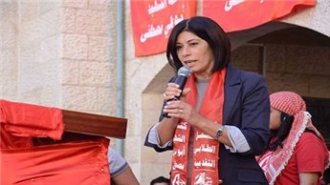
BETHLEHEM – An Israeli military court has brought 12 charges against Palestinian lawmaker Khalida Jerrar in connection to her membership of the Popular Front for the Liberation of Palestine, an international rights group said.
Having been detained and interrogated since Apr. 2, Jerrar was charged by the Israeli military prosecution on Wednesday, according to a report released Friday by Amnesty International.
Charges included membership of an illegal organization, participation in protests, and incitement to kidnap Israeli soldiers.
A review of the charges against her will take place on Apr. 29, the report said.
Jerrar’s defense team argued there was no basis to the incitement charge and that it was vindictive, according to Amnesty’s report.
The majority of Palestinian political organizations are considered illegal by Israel, including those that make up the PLO, and association with such parties is often used as grounds for imprisonment, according to prisoners’ rights group Addameer.
Jerrar was elected to the Palestinian Legislative Council in 2006 as a member of PFLP.
Jerrar was detained on Apr. 2 from her home in the Ramallah neighborhood of al-Bireh, and was afterwards held and interrogated at the Ofer detention center. She was later taken to Hasharon prison inside Israel.
An Israeli army spokeswoman told Ma’an that Jerrar had been detained for being the leader of a “terrorist organization,” and had encouraged “terror activities” in the previous few weeks.
The arrest also came after Jerrar refused a deportation order from Israeli authorities in August, demanding that she leave the Ramallah district for Jericho.
‘A symbol of resistance’
Jerrar has been targeted by Israeli authorities throughout her life, although Wednesday was the first time the lawmaker had been officially charged by Israeli military courts.
Palestinian factions have decried the arrest, with one PLO committee saying it was “an outrageous violation of her parliamentary immunity.”
Legislative Council lawmaker Jamil al-Majdalawi said: “Israel does not lose a chance to attempt to break the resistance’s will, the people’s resistance and their leadership symbols, and Khalida Jarrar is one of those symbols of resistance.”
In February, Jerrar joined the Palestinian committee in charge of conducting an International Criminal Court investigation into Israeli war crimes and crimes against humanity.
She is also vice-chair of prisoners’ rights group Addameer.
Until the charges against her on Wednesday, Jerrar had been held in Israeli prisons under administrative detention.
Palestinians held in administrative detention are often held without charge or trial for months and without access to the evidence that led to their detention, even though international law stipulates this tactic only be used in exceptional circumstances.
Israeli prisons currently hold 14 members of the PLC, eight of them in administrative detention
Hands Off The Lancet
WRITING GROUP:
Professor Graham Watt MD FRCGP FRSE FMedSci, Professor of General Practice, University of Glasgow, UK
Sir Iain Chalmers DSc FFPH FRCP Edin FRCP FMedSci, Coordinator, James Lind Initiative, Oxford, UK
Professor Rita Giacaman, PharmD, MPhil, Professor of Public Health, Birzeit University, occupied Palestinian territory
Professor Mads Gilbert MD PhD, Professor of Emergency Medicine, University of Tromsø, Norway
Professor John S Yudkin MD FRCP, Emeritus Professor of Medicine, University College London, UK
Introduction
On 31 March 2015, 396 professors and doctors, led by Professor Sir Mark Pepys, submitted a complaint to the Senior Management and Board of Reed Elsevier concerning “egregious editorial misconduct at The Lancet that is unacceptable in general and also gravely violates your own published Editorial Policies”.
The signatories include 5 Nobel laureates, 4 knights and a Lord. 193 (49%) of the signatories are from the US, 95 (24%) from Israel, 33 (8%) from the UK, 26 from France, 19 from Canada, 12 from Australia with smaller numbers from Belgium (3), Brazil (3), Italy (2), Denmark (2), Mexico (1), Panama (1), South Africa (1), Sweden (1) and Switzerland (1).
The complaint makes brief mention of The Lancet’s publication of the paper by Wakefield, linking MMR vaccine to autism, which was shown subsequently to be fraudulent, but is chiefly concerned with The Lancet Editor-in-Chief, Richard Horton, and his alleged “persistent and inappropriate misuse of The Lancet to mount a sustained political vendetta concerning the Israel-Palestinian conflict, to promote his own well known personal political agenda”.
The centre of the complaint concerns “An open letter for the people of Gaza” by Manduca and 23 others, which was published online by The Lancet on 22nd July and in hard copy on 2nd August 2014, 14 days into “Operation Protective Edge”, Israel’s 50 day attack on Gaza.
The complainants consider that this letter, and The Lancet’s handling of the controversy it aroused, breached both the Journal’s own policies and the Code of Conduct and Best Practice Guidelines for Journal Editors issues by the Committee on Publication Ethics (COPE).
The complaint ends by requiring “Reed Elsevier to behave ethically by retracting the Manduca letter, apologizing for its publication and ensuring that any further editorial malpractice at The Lancet is prevented”.
Chronology of events
8 July 2014
Israel began a major military assault on the Gaza Strip, the fourth in eight years. It lasted 50 days and was more devastating than previous offensives. 2,220 Gaza residents were killed, of whom at least 70% were civilians, including over 500 children. More than 17,000 residents were wounded and over 100,000 made homeless (UN OCHAopt, 2014). According to Israeli official accounts, 73 Israelis were killed: 67 soldiers and 6 civilians, including one child and one migrant worker. 469 Israeli soldiers and 255 civilians were wounded (Bachmann et al. 2014).
15-22 July 2014
A report cited by the Sunday Telegraph newspaper records that 125 children were killed during the week 15-22 July 2014, including 59 on 20th July.
22 July 2014
On the 14th day of Israel’s 50-day assault ‘An open letter for the people in Gaza’, co-authored by 24 signatories from Italy, the UK and Norway, was published by the medical journal The Lancet, initially online and subsequently in print (Manduca et al. 2014a). One of the signatories provided eyewitness accounts of the medical consequences for the civilian population, while working clinically at the largest trauma centre in Gaza during the first weeks of the assault. The letter was endorsed online by more than 20,000 signatories.
9 and 16 August 2014
The Lancet published 20 letters in hard copy editions, divided equally between authors criticising and supporting the Open Letter. Some correspondents declared that medicine “should not take sides” and that those who speak out against the consequences of war for civilians incited hate or introduced politics “where there is no place for it” (see, for example, Konikoff et al. 2014). Others described the letter as “anti-Jewish bigotry, pure and simple” (Marmor et al. 2014), although at least one of the authors of the ‘Open Letter’ was Jewish, and the word “Jewish” did not appear in the letter. Similar charges were made in the lay press, both within Israel and elsewhere (see Simons 2014, for example).
One of the letters published in response to the ‘Open Letter’ was co-authored by seven Jewish health professionals in South Africa (London et al. 2014). They suggested that “remaining neutral in the face of injustice is the hallmark of a lack of ethical engagement typical of docile populations under fascism”. They had witnessed and exposed some of the worst excesses of state brutality under apartheid, and had been harassed, victimised or detained for being anti-apartheid activists. They pointed out that they did not have the opportunity to air their views in their national medical journal, which suppressed public statements made by concerned health professionals and labelled such appeals for justice and human rights as ‘political’.
They expressed support for The Lancet’s decision to permit a discussion of the professional, ethical, and human rights implications of the conflict in Gaza, emphasizing that it is appropriate for health professionals to speak out on matters that are core to their professional values.
30 August 2014
After 20 responses to the ‘Open Letter’ had been published, its authors accepted The Lancet’s invitation to reply (Manduca et al. 2014b). They denied any financial conflicts of interests, as had been alleged, and listed the variety of experiences and affiliations that had led to their support for Palestinian society.
They noted that the allegations by the Ministry of Health in Gaza that gas had been used by the Israeli military would need to be tested by an independent Commission of Inquiry set up by the UN Human Rights Council. They ended by recalling the context in which they had written their letter: during the preceding two days one Palestinian child was being killed, on average, every two hours, and the UN had made clear how serious the situation had become:
“The huge loss of civilian life, alongside credible reports about civilians or civilian objects (including homes) which have been directly hit by Israeli shelling, in circumstances where there was no rocket fire or armed group activity in the close vicinity, raise concerns about the principles of distinction and proportionality under international law.” (OCHA oPt 2014)
22 September 2014
Some were dissatisfied with The Lancet’s handling of the Open Letter. Two medical academics at University College London registered complaints with The Lancet Ombudsman (Simons 2014). One of them, Professor Sir Mark Pepys, was quoted in The Telegraph as having written that “The failure of the Manduca et al. authors to disclose their extraordinary conflicts of interest… are the most serious, unprofessional and unethical errors…The transparent effort to conceal this vicious and substantially mendacious partisan political diatribe as an innocent humanitarian appeal has no place in any serious publication, let alone a professional medical journal, and would disgrace even the lowest of the gutter press.”
Pepys suggested that the behaviour of Dr Horton, editor of The Lancet, was “consistent with his longstanding and wholly inappropriate use of The Lancet as a vehicle for his own extreme political views, which had greatly detracted from the former high standing of the journal.” (quoted in Simons 2014).
The article in The Telegraph also alleged that two of the authors of the Open letter – one of them Chinese – have sympathies with the views of “an American white supremacist” (Simons, 2014), following the mistaken forwarding of emails, for which both individuals subsequently apologised.
When one of the authors of the ‘Open Letter’, the Norwegian doctor Mads Gilbert, who has worked clinically in Gaza during every Israeli assault on the Strip since 2006, was voted “Norwegian Name of the Year” in a national poll in December 2014, Pepys and eight other doctors wrote to the largest Norwegian newspaper, VG, to complain about his silence on the ‘loathsome hatred and racism’ of his co-authors. They asked for his national award to be reconsidered (Cohn et al. 2015).
17 October 2014
The Lancet Ombudsman published her report online on 17 October (Wedzicha, 2014). She said that she had received many emails and letters, some supporting and others opposing the position expressed in the ‘Open Letter’, and that some of them had been inappropriate in tone and of a personal nature. She stated that it was “entirely proper that medical journals and other media should seek to guide and reflect debate on matters relevant to health, including conflicts”.
She was not persuaded by calls for retraction of the ‘Open Letter’, “I do not believe that sufficient grounds for retraction have been established, and this would make other letters referring to the publication in question difficult to interpret”.
The Ombudsman went on to address allegations of bias among the authors of the ‘Open Letter’. “Given the shocking images and statistics reported from Gaza at the time, the use by Manduca and colleagues of emotive language, in description of the ‘massacre in Gaza’ for example, can be understood. Where the letter is less successful is in its portrayal of the armed element of the conflict on the Palestinian side. Given the authors’ close association with the region they will have been aware that several thousand potentially lethal rockets and mortars were fired from Gaza into Israel during the conflict, leading to loss of life.”
The authors were criticised for not having disclosed at the time of submission “any financial or other relationships that could be perceived to affect their work”, and she indicated that she would be asking the journal’s editors to put a policy in place as soon as possible to rectify this. The Ombudsman criticised the authors for not referencing in their original letter the source for their statement about the possible use of gas in Gaza.
The Ombudsman’s most serious criticism of the letter was the “regrettable statement” that, because only 5% of Israeli academics had supported an appeal to the Israeli government to stop the military operation in Gaza (Gur-Arieh 2014), the authors had been “tempted to conclude that…the rest of the Israeli academics [had been] complicit in the massacre and destruction of Gaza”.
“In summary”, the Ombudsman concluded, “the letter by Manduca and co-authors was published at a time of great tension, violence and loss of life. Given these circumstances the letter’s shortcomings can be understood, as a measure of balance has been achieved by the publication of further letters from both sides of the debate.”
3 November 2014
The Ombudsman’s decision to reject calls for the letter to be withdrawn from the public record was supported by Dr Richard Smith, former editor of the British Medical Journal, former chair of COPE and author of COPE’s Code of Conduct for Editors (Smith 2014): The Lancet letter was “passionate, overstated in parts, inflammatory to some, and one sided; and the authors failed to declare competing interests and two of them had acted in an objectionable but not illegal way. But none of these are grounds for retraction.”
He ended his commentary on an historical note:
“The Lancet was made the great journal it is by Thomas Wakley, the founder and first editor, publishing articles that were so inflammatory that his critics burnt his house down. That radical tradition has not always shone brightly in the nearly 200 years since, but Horton has restored it strongly, establishing the Lancet as a world leader in global health, speaking truth to power and giving a voice to those who are not heard (like the children of Gaza). It’s against that radical tradition and leadership that the Gaza open letter must be viewed. It should and has been disputed, but it shouldn’t be retracted.”
Contrasting views of journal editors
Editors have disagreed on whether political issues should be addressed in scientific journals.
For example, the American Diabetes Association issued a statement, signed by several editors of leading diabetes and endocrine journals, indicating that they “will refrain from publishing articles addressing political issues that are outside of either research funding or health care delivery” (American Diabetes Association 2014).
In response, a commentary signed by the current and two previous editors-in-chief of the European Journal of Public Health, one of whom has longstanding and very extensive collaborations with Israeli colleagues (McKee et al. 2015), voiced strong support for The Lancet, arguing that medical journals cannot ignore the political determinants of health, including those arising from conflicts. They noted, “It seems strange that it was the diabetes community that feels it necessary to take this decision,” noting how the global epidemic of diabetes, fuelled by forcing markets open to energy-dense food, reflects a policy identified primarily with Republicans rather than Democrats in the United States.
Following the Ombudsman’s Report
Soon after Israel’s 2014 assault, Physicians for Human Rights-Israel (PHR-Israel) assembled a medical fact-finding mission (FFM) of 8 international medical experts, unaffiliated with Israeli or Palestinian parties. Four had expertise in the fields of forensic medicine and pathology; four others were experts in emergency medicine, public health, paediatrics and paediatric intensive care, and health and human rights. The FFM made three visits to Gaza between 18 August and November, 2014.
The principal conclusion in the report of the FFM (Bachmann et al. 2014) is as follows: The attacks were characterised by heavy and unpredictable bombardments of civilian neighbourhoods in a manner that failed to discriminate between legitimate targets and protected populations and caused widespread destruction of homes and civilian property. Such indiscriminate attacks, by aircraft, drones, artillery, tanks and gunships, were unlikely to have been the result of decisions made by individual soldiers or commanders; they must have entailed approval from top-level decision-makers in the Israeli military and/or government.
The FFM (pp 98-99) listed many examples “suggestive of several serious violations of human rights and international humanitarian law”, including disproportionality, attacks on medical teams and facilities, and denial of means of escape. They also reported (pp 53-55) evidence which suggested the use of anti-personnel weapons and gas during the conflict.
These accusations have also been made in reports by Amnesty International (Amnesty, 2014), Human Rights Watch (Human Rights Watch, 2014), B’Tselem (B’Tselem – The Israeli Information Centre for Human Rights in the Occupied Territories, 2015) and the United Nations (OCHA, 2014, 2015).
The FFM called on the UN, the EU, the US and other international actors to take steps to ensure that the governments of Israel and Egypt permit and facilitate the entry of investigative teams into Gaza, including experts in international human rights law and arms experts, and noted (in January 2015) that this had still not been done, months after the offensive. Specifically, the UN Commission of Inquiry has been denied entry to Israel, the West Bank and Gaza (See: United Nations Independent Commission of Inquiry on the 2014 Gaza Conflict).
The FFM recommended further urgent and rigorous investigation into the impact of this war, as well as the previous armed conflicts, on public health, mental health and the broader social determinants of health in Gaza, adding that, in its assessment, the implacable effects of the on-going occupation itself would have to be taken into account.
There have been subsequent accusations by Amnesty International of war crimes committed by both sides of the conflict (BBC 2014; Linfield 2015).
Further calls for retraction of the Open Letter
Dissatisfied with the Ombudsman’s report, critics of the Open letter continued to call for it to be withdrawn and for The Lancet editor to apologise for publishing it. In a new development, the authors of the Open letter, and the journal, are being accused of being anti-Semitic. The current complaint to Reed Elsevier now refers to the Open Letter as “stereotypical extremist hate propaganda, under the selective and hypocritical disguise of medical concern”. On 24 February 2015, its lead author Professor Sir Mark Pepys wrote to 58 Israeli academics (Pepys, 2015):
The Lancet under the editorship of Richard Horton has published, for more than the past 10 years, many disgracefully dishonest and unacceptable articles about Israel. Horton has made no secret of the fact that these pieces express his own very strongly held personal views which he has published elsewhere in detail.
Last July, at the height of the Gaza war, The Lancet published a piece by Manduca and others which was at an unprecedentedly low level. It combines outright lies and slanted propaganda viciously attacking Israel with blood libels echoing those used for a thousand years to create anti-Semitic pogroms. It completely omitted the Hamas war crimes which initiated and sustained the conflict. There was no historical or political background. Crucially there was no mention of any conflict of interest among the authors despite the fact that Manduca and all the co-authors have long participated enthusiastically in not just anti-Israel but frankly Jew hating activities. All these individuals are close colleagues and collaborators of Horton.
Many of us have been trying as hard as we can since the Manduca publication to get it retracted, to get an apology for it and to convince Elsevier, the owners of The Lancet to both sanction Horton and to prevent any repetition of such shameful and unacceptable behaviour. So far there has been no satisfactory response. Indeed Horton continues to stand by the Manduca piece and refuses to accept that it is not factual and correct.
The goal of the attached protest to Elsevier document is to get the [‘Open letter’] retracted. I hope that all of you will sign it. Meanwhile colleagues at the Rambam Hospital have, as you know, invited Horton to Israel and shown him the reality of Israeli medicine, as opposed to the vicious anti-Semitic fantasy he has promoted. They have engaged in long discussions with him. Despite his refusal to either retract or apologise for his publications some colleagues are apparently convinced that Horton has reformed. Others, including Professor Peretz Lavie, the President of the Technion, who met with him for one and a half hours, were unconvinced by Horton’s presumed change of heart.
My view is that the Manduca piece was written by dedicated Jew haters, though some choose to mask this by being overtly passionate only about hating Israel. But they all agree that a Zionist/Jewish lobby or power group controls the world and its destiny and must be brought down. The Manduca piece would have made Goebbels proud and Streicher would have published it in Der Stürmer as happily as Horton published it in The Lancet…… anybody who was not a committed anti-Semite would firstly not have published (the Open letter), and secondly would have retracted instantly when the first author’s long track record of blatant anti-Semitism were exposed. In Horton’s case he already knew and liked her and her co-authors well, fully aware of all their vicious anti-Israel and frank, overtly anti-Semitic backgrounds.
Pepys’ text was distributed widely beyond the Israelis to whom the initial text had been sent, including, on 30 March, to over 150 academics with the subject line amended to:
‘DO NOT CITE The Lancet in your work – Their content includes fraudulent data’ (Lewis 2015).
As a result of this correspondence, 396 people have co-signed the complaint, including the statement “The collaboration of the academic community with Reed Elsevier and its journals is based on trust in their maintaining high ethical and scientific standards. None of us is under any obligation to submit and review material for publication in their journals or to serve on their editorial or advisory boards”.
The long history of pro-Israel suppression of medical freedom of expression
The heavy-handed escalation of the dispute and the use of ad personam charges of anti-Semitism to suppress freedom of expression in medical journals are not new.
In 1981, a short article in World Medicine informed medical readers who were considering attending the ‘medical olympics’ in Israel that the event was going to be held on the site of a massacre ordered by the then prime minister of Israel (Sabbagh 1981). The pro-Israel protest led eventually to the demise of the journal (O’Donnell 2009).
In 2001, pro-Israel objections to the historical background in an article on ‘The origins of Palestinians and their genetic relatedness with other Mediterranean populations’ published in Human Immunology (Arnaiz-Villena et al. 2001) led Elsevier to remove it from the public record.
In 2004, an article entitled ‘Poverty, stress and unmet needs: life with diabetes in the Gaza Strip’ (Tsapogas 2004) published in Diabetes Voice was expunged from the public record and the editor resigned, again because of charges of political bias.
In 2004, there was an outcry from pro-Israel doctors when the British Medical Journal published a personal view entitled ‘Palestine: the assault on health and other war crimes’ (Summerfield 2004). The editor received nearly a thousand emails, many of them personally abusive and alleging anti-Semitism (Sabbagh 2009).
In 2009, commenting on several British Medical Journal papers exposing and discussing these issues, a senior British Medical Journal editor concluded that authors, editors, publishers, advertisers, and shareholders should ignore orchestrated email campaigns (Delamothe 2009). Citing another editor he suggested that the best way to blunt the effectiveness of this type of bullying is to expose it to public scrutiny.
Conclusion
The “Open letter to the People of Gaza” was written in deep concern and outrage during a military assault on the Gaza Strip, killing large numbers of civilians, including women and children, on a daily basis. The world was shocked and appalled. The content and tone of the letter were controversial, as shown by subsequent correspondence in The Lancet, for and against.
The Lancet Ombudsman criticised aspects of the letter but neither she nor a former Chair of COPE considered that it should be withdrawn.
The involvement of 396 senior researchers in a mass effort to force Reed Elsevier to withdraw the letter is the latest in a series of heavy-handed interventions to stifle media coverage of the Israel-Palestine issue and should be resisted.
Richard Horton should be supported as an exceptional editor of The Lancet, in the best traditions of the Journal.
The “unfinished business” of Operation Protective Edge is not whether the “Open Letter to the People of Gaza” should be retracted, but in the light of reports by Physicians for Human Rights-Israel, Amnesty International, Human Rights Watch, the United Nations and others, to determine whether and by whom, from either side of the conflict, violations of international human rights and humanitarian law were committed.
Will the 396 signatories of the complaint to Reed Elsevier give their support to that objective?
~
References and Supporting Signatories available at source.
If you wish to communicate with the Writing Group please email HandsOffTheLancet@Gmail.Com
If you wish to add your name to this list of supporting signatories please use the form here
Personal details of murdered journalist & ex-MP found posted on Ukrainian ‘enemies of state’ database
RT | April 17, 2015

Flowers at Ukraine’s Embassy in Moscow after the murder of journalist Oles Buzina in Kiev. (RIA Novosti / Maxim Blinov)
The journalist and ex-MP who were gunned down in Kiev this week were on an ‘enemies of the state’ database – a social media website supported by the aide to Ukraine’s interior minister. The bloggers also have a Twitter account to share ‘successes.’
The volunteer-made website calling itself ‘Mirotvorec’ (Peacekeeper), posts very thorough and comprehensive information on anyone who happens to make the list – journalists, activists, MPs opposing the current Kiev authorities’ policies and rebels fighting against the government in the east. The posts include their addresses, social media account links, a substantial biography and any mentions in the Ukrainian press. There is also labeling involved e.g. “terrorist; supporter of federalization” and other tags.
The website indicates that politician Oleg Kalashnikov’s and journalist Oles Buzina’s details were published on the site no more than 48 hours before both were found dead.
The website has its own social media account, which frequently tweets cryptic messages of “successful missions.”
The website enjoys the support of at least one high-profile Ukrainian official: Anton Gerashchenko, an adviser to the interior minister and a member of the Ukrainian parliament. In one of his Facebook posts, he advised people to post updates to the website.
Praising the work of the website for helping him shoulder the heavy load of information on “terrorists” and “separatists,” Gerashchenko attacks the view that sharing extensive personal information is a breach of privacy.
“Not at all!” he says, citing Article 17 of the Ukrainian Constitution, which states, according to him, that “the defense of national sovereignty and territorial integrity of Ukraine, ensuring its economic and information security is one of the external functions of the state, and is the business of all the people of Ukraine… Everyone who reports a name to the website, or another [resource] is doing the right thing,” Gerashchenko writes.
Below is a video ofUkrainian Interior Minister ArsenAvakov physically assaulting Kalashnikov during a TV show.
The radical Ukraine Insurgent Army (UPA) organization claimed responsibility for Kalashnikov’s and Buzina’s murder. The statement was made in a letter to Ukrainian political analyst Vladimir Fesenko, who says he received it. The letter is presently being investigated by the Ukrainian police.
This week alone has seen at least four killings of opposition figures in Ukraine. It all started on April 13 with the slaying of journalist Sergey Sukhobok – followed by Kalashnikov two days later and Buzina, the day after that – on the 16th.
The latest murder happened last night when another journalist Olga Moroz – the editor-in-chief of the Neteshinskiy Vestnik, a Ukrainian paper. Moroz was found dead in her home, RBK Ukraine reported.
Her body showed signs of a violent death. Some possessions were missing from the apartment, according to police. Although her work is listed among the causes investigated, the police say there are no allegations relating to any complaints of pressure or threats of violence reported by the journalist.
Buzina’s murder has led to strong condemnation from the OSCE’s Representative on Freedom of the Media Dunja Mijatovic.
“This appalling act is yet another reminder about the dangers associated with journalism as a profession. This killing must be immediately and fully investigated by the competent authorities… My sincere condolences go out to Buzina’s family and colleagues.”
“I reiterate my call on the authorities to allocate all necessary resources to investigate all attacks on journalists,” she said. “There must be no impunity for the perpetrators and the masterminds behind any violence against members of the media.”
The official also commented on the murder of Sukhobok, who was co-founder of a number of online news portals and contributor to several more Ukrainian media outlets. An investigation is underway.
Mijatovic’s comments are the latest in a long string of international condemnation of the alarming rise of media murders.
In February, the European Union called for stricter observance of freedom of speech in the media by all sides in the Ukrainian conflict.
“We continue to condemn and call for an end to attacks on journalists notably in eastern Ukraine, including killings and abductions,” the statement read.
READ MORE:
2 Ukraine journalists killed in Kiev, Poroshenko suspects ‘provocation’
Series of ‘bizarre suicides’ & murders: Former Ukrainian MP shot dead in Kiev
Fast Track Bill Would Legitimize White House Secrecy and Clear the Way for Anti-User Trade Deals
By Jeremy Malcolm and Maira Sutton | EFF | April 16, 2015
Following months of protest, Congress has finally put forth bicameral Fast Track legislation today to rush trade agreements like the Trans-Pacific Partnership (TPP) and the Transatlantic Trade and Investment Partnership (TTIP) through Congress. Sens. Orrin Hatch and Ron Wyden, and Rep. Paul Ryan, respectively, introduced the bill titled the Bipartisan Congressional Trade Priorities and Accountability Act of 2015. With Fast Track, lawmakers will be shirking their constitutional authority over trade policy, letting the White House and the U.S. Trade Representative pass Internet rules in back room meetings with corporate industry groups. If this passes, lawmakers would only have a small window of time to conduct hearings over trade provisions and give a yea-or-nay vote on ratification of the agreement without any ability to amend it before they bind the United States to its terms.
The Fast Track bill contains some minor procedural improvements from the version of the bill introduced last year. However, these fixes will do little to nothing to address the threats of restrictive digital regulations on users rights in the TPP or TTIP. The biggest of these changes is language that would create a new position of Chief Transparency Officer that would supposedly have the authority to “consult with Congress on transparency policy, coordinate transparency in trade negotiations, engage and assist the public, and advise the United States Trade Representative on transparency policy.”
However, given the strict rules of confidentiality of existing, almost completed trade deals and those outlined in the Fast Track bill itself, we have no reason to believe that this officer would have much power to do anything meaningful to improve trade transparency, such as releasing the text of the agreement to the public prior to the completion of negotiations. As it stands, the text only has to be released to the public 60 days before it is signed, at which time the text is already locked down from any further amendments.
There is also a new “consultation and compliance” procedure, about which Public Citizen writes [pdf]:
The bill’s only new feature in this respect is a new “consultation and compliance” procedure that would only be usable after an agreement was already signed and entered into, at which point changes to the pact could be made only if all other negotiating parties agreed to reopen negotiations and then agreed to the changes (likely after extracting further concessions from the United States). That process would require approval by 60 Senators to take a pact off of Fast Track consideration, even though a simple majority “no” vote in the Senate would have the same effect on an agreement.
Thus, essentially the Fast Track bill does the same as it ever did—tying the hands of Congress so that it is unable to give meaningful input into the agreement during its drafting, or to thoroughly review the agreement once it is completed.
A main feature of the bill is its negotiation objectives, which set the parameters within which the President is authorized to negotiate the agreement. If Congress considers that the text ultimately deviates from these objectives, it can vote the agreement down. Some of these negotiation objectives have been added or changed since the previous Fast Track bill, but none of these provide any comfort to us on the troubling issues from the Intellectual Property, E-Commerce, and Investment chapters of the TPP. Indeed, some of the new text raise concerns. For example:
- Governments are to “refrain from implementing trade-related measures that impede digital trade in goods and services, restrict cross-border data flows, or require local storage or processing of data”. Data flows and the location of the processing of data aren’t solely or even primarily trade issues; they are human rights issues that can affect privacy, free expression and more. The discussion about whether laws that require local storage and processing of certain kinds of sensitive personal data are protective of user rights, for instance, cannot take place in the secret enclaves of a trade negotiation. The bill does allow for exceptions as required to further “legitimate policy objectives”, but only where these “are the least restrictive on trade” and “promote an open market environment”.
- Trade secrets collected by governments are to be protected against disclosure except in “exceptional circumstances to protect the public, or where such information is effectively protected against unfair competition”. But there are other cases in which there may be an important public interest in the disclosure of such trade secrets, such as where they reveal past misdeeds, or throw transparency onto the activities of corporations executing public functions.
But more troubling than what has been included in the negotiating objectives, is what has been excluded. There is literally nothing to require balance in copyright, such as the fair use right. On the contrary; if a country’s adoption of a fair use style right causes loss to a foreign investor, it could even be challenged as a breach of the agreement, under the investor-state dispute settlement (ISDS) provisions. Further, the “Intellectual Property” section of today’s bill is virtually identical to the version introduced in 2002, and what minor changes there are do not change the previous text’s evident antipathy for fair use. So while the new bill has added, as an objective, “to ensure that trade agreements foster innovation and promote access to medicines,” an unchanged objective is “providing strong enforcement of intellectual property rights.” What happens if those two objectives are in conflict? For example, in many industries, thin copyright and patent restrictions have proven to be more conducive to innovation than the thick, “strong” measures the bill requires. Some of our most innovative industries have been built on fair use and other exceptions to copyright—and that’s even more obvious now than it was in 2002. The unchanged language suggests the underlying assumption of the drafters is that more IP restrictions mean more innovation and access, and that’s an assumption that’s plainly false.
All in all, we do not see anything in this bill that would truly remedy the secretive, undemocratic process of trade agreements. Therefore, EFF stands alongside the huge coalition public interest groups, professors, lawmakers, and individuals who are opposed to Fast Track legislation that would legitimize the White House’s corporate-captured, backroom trade negotiations. The Fast Track bill will likely come to a vote by next week—and stopping it is one sure-fire way to block the passage of these secret, anti-user deals.
If you’re on Twitter, help us call on influential members of Congress to come out against this bill.


Additional Resources:
Read the text of the Bipartisan Congressional Trade Priorities and Accountability Act of 2015 here.
Read about all of our concerns with the TPP agreement:
- Anti-Circumvention of Digital Rights Management (DRM)
- Criminalization of Investigative Journalism, Security Research, and Whistleblowing
- ISP Liability: Internet Intermediaries as Copyright Cops
- Criminal Copyright Enforcement
- Expansion of Copyright Terms
- “Investor-State” Provisions Could Undermine User Protections in Copyright
- Restrictions on Fair Use
20 Palestinian journalists being held in Israeli jails
Ma’an – 17/04/2015
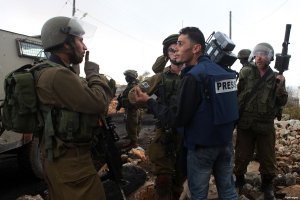
GAZA CITY – Israeli forces arrested a Palestinian journalist on Wednesday after raiding his home in Nablus, bringing the total number of journalists imprisoned by Israel to 20.
Amin Abdul Aziz Abu Wardeh, 48, is the general manager of the Asda news website, the Palestinian Center for Development and Media Freedoms said.
Abu Wardeh’s wife told MADA that Israeli forces raided their home at around 2 a.m. and interrogated Amin in a separate room for over an hour before arresting him.
They also seized three laptops and a cellphone.
Abu Wardeh had previously been held in administrative detention for nearly a year after being arrested in November 2011.
According to the Union of Palestinian Radios and Televisions there are now 20 Palestinian journalists being held in Israeli prisons, six of whom were detained in 2015 alone.
The longest serving journalist is reporter for the Sawt al-Haq wa al-Hurriya newspaper, Mahmoud Moussa Issa, who has been imprisoned since 1994.
Two Ukraine journalists killed in Kiev, Poroshenko suspects ‘provocation’
RT | April 16, 2015

Oles Buzina (Image from wikipedia.org)
Opposition journalist and writer Oles Buzina was assassinated near his house in Kiev. The police believe it could have been a contract killing. It follows hot on the heels of the vicious murder of another Ukrainian journalist, Sergey Sukhobok.
Oles Buzina, 45, oppositional journalist and former editor-in-chief of Segodnya newspaper, was killed in the yard of his house in the Ukrainian capital on Thursday, according to the counselor of the Minister of Internal Affairs.
MP Anton Gerashenko wrote on his Facebook page that unknown people shot at Buzina from a car with Latvian or Belarusian license plates, adding, “The killing of anti-Maidan eyewitnesses seems to be going on.”
Buzina, author of several controversial books, recently quit his newspaper job, explaining he had worked under heavy censorship, had no rights to influence human resources policy, or to “talk to the press or participate in talk shows.”
Ukraine’s President Petro Poroshenko called for law-enforcement agencies to investigate the cases of Buzina and Oleg Kalashnikov, a former MP and active anti-Maidan activist, who was killed in his flat in Kiev on Wednesday, “as soon as possible.” Poroshenko said these crimes were “a conscious provocation,” targeting “the destabilization of the political situation in Ukraine.”
Russian President Vladimir Putin expressed his condolences to the family and colleagues of the dead journalist. “It is not the first political assassination – we have seen a series of such killings in Ukraine,” Putin said at his annual Q&A session on Thursday.
Investigators are currently working at the site of the murder. The police believe it was a contract killing, RIA Novosti reported.
Following Buzina’s death, police “immediately” arrested two suspects, accused of killing another journalist Sergey Sukhobok. Sukhobok was shot and killed outside his house on Monday night, also in Kiev. “The court has decided on pre-trial restrictions,” said a statement on the Obcom website founded by Sukhobok.
Police are looking into several motives ranging from political activities to debts.
In February, the European Union called for stricter observance of freedom of speech in the media by all sides in the Ukrainian conflict.
“We continue to condemn and call for an end to attacks on journalists notably in eastern Ukraine, including killings and abductions,” the statement read.
Read more: Series of ‘bizarre suicides’ & murders: Former Ukrainian MP shot dead in Kiev
Series of ‘bizarre suicides’ & murders: Former Ukrainian MP shot dead in Kiev
RT | April 16, 2015
A former Ukrainian MP and active anti-Maidan activist, Oleg Kalashnikov, has been killed in his flat in Kiev. His killing is the latest in a series of odd deaths plaguing former government officials and ex-President Yanukovich’s party members.
The 52-year-old was found dead at his residence in Kiev on Wednesday evening. His death was “caused by a gunshot,” the Interior Ministry said in a statement announcing a police inquiry. Ukraine’s criminal investigation chief Vasily Paskal, took the investigation under personal control and promised to share motives and the preliminary results of the probe with reporters as soon as they become available.
The investigation is focused on five possible motives for the crime, according to Interior Minister’s senior adviser, Anton Gerashchenko.
So far the investigation considers the primary possible motive behind the killing to be Kalashnikov’s “political activity” linked with his “participation in the organization and financing” of counter-revolutionary events in Ukraine. Gerashchenko emphasized that Kalashnikov “had knowledge” of the anti-Maidan movement that resisted the coup last year and continues to challenge new authorities in Kiev.
“Without any doubt the deceased knew a lot about who and in what way financed anti-Maidan, which cost Yanukovich and his camarilla several million hryvnias per day. He takes these secrets with him to the grave,” Gerashchenko said, also listing some other leads on his Facebook page. Business debts, personal enmity, burglary attempt and “other versions of murder”are listed among other possible motives.
Ukrainian media reported that before the murder Kalashnikov received threats of physical violence for his political views, in particular for his drive to defend Ukrainians’ right to widely celebrate the 70th anniversary of WWII victory.
In a letter addressed to his friend before the murder, Kalashnikov allegedly wrote that an “open genocide on dissent, death threats and constant dirty insults” have become the “norm” following his open call to honor the memory of heroes and victims of the Great Patriotic War.
An acting Ukrainian MP and ex-spokesman for the extremist Right Sector group, Borislav Bereza, went further and alleged that Kalashnikov has been eliminated by his “former employers,” who were tying up loose ends, “scared” he could disclose details of their past activities. While part of the secret was “taken to the grave,” some information remained in “electronic form,” Bereza stated.
“A series of bizarre suicides of ex-regionals [Members of the Party of Regions], and now the murder of Kalashnikov, raises questions to law enforcement authorities. I hope that Ukrainian society will get the answers,” Bereza said.
Meanwhile, Oleg Tsarev, parliamentary speaker of the self-proclaimed Novorossiya, agreed that Kalashnikov’s murder is the latest link in a chain of mysterious deaths of former supporters of the Party of Regions.
“Of course, this is a political murder. In Ukraine, it is now extremely difficult to maintain your point of view, not to give up, and to publicly express it,” Tsarev told Lifenews. “Of course, this is a retaliatory murder of the sane.”
The murder is meant as a warning for all those who dare to oppose Kiev government, which can do anything against the opponents, Tsarev believes.
In the past few months, at least eight former Ukrainian government officials died mysterious deaths, with most treated as suicides.
On January 29, former chairman of Kharkov region government, Aleksey Kolesnik, was found hanged.
On February 24, former Party of Regions member Stanislav Melnik died of a gunshot with his death treated as suicide.
On February 25, several hours before his trial, the Mayor of Melitopol Sergey Valter was found hanged leaving no suicide note.
The next day, February 26, deputy chief of Melitopol police, Aleksandr Bordyuga, who reportedly acted as Valter’s lawyer, was found dead in his garage.
On February 26, a former MP and ex-chairman of Zaporozhye Regional State Administration was found dead with a gun wound to his neck. His death is being investigated as a suicide.
On February 28, former member of the Party of Regions, Mikhail Chechetov, jumped from the window of his 17th floor apartment in Kiev, leaving a suicide note.
On March 14, a 32-year-old prosecutor Sergey Melnichuk fell from a window of a 9th floor apartment in Odessa.
U.S. Citizen Sentenced to Life in Prison for Opposing Egyptian Government

Mohamed Soltan, on hunger strike, gets kiss from his father (photo: Twitter)
By Noel Brinkerhoff | AllGov | April 15, 2015
An American citizen could wind up spending the rest of his life in an Egyptian prison for protesting against the government two years ago.
Mohamed Soltan was arrested in 2013 during demonstrations in Cairo that arose after the military ousted President Mohamed Morsi of the Muslim Brotherhood.
The Egyptian-American was among more than 35 other defendants who received the same sentence. Still others, including Soltan’s father, Salah Soltan, were sentenced to death by the Egyptian court. Soltan’s family intends to appeal.
“The verdict is the latest in a long series of similarly harsh sentences handed down at mass trials of dozens or hundreds of defendants accused of participating in violent protests or riots in the aftermath of the military takeover, often based on only police testimony or cursory evidence,” according to The New York Times.
Soltan was working as a translator for journalists covering the protests and was shot in the arm during a demonstration on August 14, 2013. He was arrested at his home a few days later and has been jailed since, according to the Times. For the past year, he has been on a hunger strike to protest his arrest and detention.
Thousands of Egyptians are still in prison without being tried for opposing the military-backed government, which has been accused of vast human rights abuses.
The verdict also comes at a bad time for President Barack Obama who only last week authorized the release of hundreds of millions of dollars in military aid for Egypt despite the lack of democratic reforms on the part of officials in Cairo.
To Learn More:
American Among Nearly 40 Sentenced to Life in Prison for Egypt Protests (by David Kirkpatrick and Jared Malsin, New York Times )
Ohio State Alumnus Receives Life Sentence in an Egyptian Prison (by Rubina Kapi, The Lantern )
Mohamed Soltan, 36 Others Imprisoned for Life (by Aya Nader, Daily News Egypt)
The Life and Imprisonment of ‘Terrorist’ Mohamed Soltan (by Aya Nader, Daily News Egypt)
Obama Approves Weapons for Egyptian Tyrant (by Noel Brinkerhoff and Danny Biederman, AllGov )
6 Major Corporations that Profit from U.S. Aid to the Egyptian Military (by Noel Brinkerhoff and Danny Biederman, AllGov )
High Court backs university’s decision to ‘postpone’ Israel conference
MEMO | April 15, 2015
Organisers of a conference on Israel and international law have failed in their bid to overturn a decision by the University of Southampton to cancel the event, previously scheduled for this weekend.
On Tuesday, a High Court judge in London rejected the organisers’ application for a judicial review, with the university claiming that the conference had in fact merely been “postponed” due to “security concerns.”
Pro-Israel groups have been pressuring Southampton for months to stop the academic gathering. The legal challenge was launched earlier this month, following the university authorities’ decision to cancel the conference on the grounds of “risks to safety and public order.”
The news comes as a blow to organisers and their supporters, in what has been described by campaigners as an unprecedented attack on academic freedom in the UK.
In a statement released following the High Court decision, organisers expressed disappointment at the decision, but promised that the conference would ultimately take place.
We must continue to protest publicly against the university decision, and use the moral strength of our cause to ensure freedom of speech and academic debate – for our own sakes as well as for others.
In response to efforts by the Jewish Leadership Council, Board of Deputies of British Jews, and Zionist Federation to stop the conference, more than 900 academics, including dozens from Oxbridge, Russell Group universities and Ivy League schools, signed a statement of support.
The list of signatories included more than 30 researchers, lecturers and professors at Southampton itself, with senior officials referring unhappy staff to a “HR hotline.” In addition, more than 10,500 people have signed a public petition condemning the cancellation, and supporting free speech.
The backlash has already prompted a number of Israel advocates to publicly question the wisdom of campaigning for the cancellation of an academic conference. A piece in Ha’aretz described the affair as “a tactical and a moral defeat” for Israel’s defenders.
German court shuts down anti-Israel exhibition

This file photo shows a previous “Cologne Wailing Wall” exhibit displaying photographs of Palestinian children killed by Israel’s aggression
Press TV – April 12, 2015
A German court has shut down a long-standing anti-Israel exhibition in the western city of Cologne, accusing its organizer of anti-Semitism and glorification of violence.
The German municipal court said the permanent exhibit, which displayed numerous pictures of the Palestinian children who were killed and injured during the Israeli regime’s bloody offensive against Gaza last summer, violates a law designed to protect minors.
Walter Hermann, the organizer of the exhibit, has protested for years against Israel with his exhibit dubbed the “Cologne Wailing Wall.”
Hermann, 76, whose anti-Israel campaign is named “Peace Demonstration,” told the German Express newspaper that the wanted to draw public attention to Israeli policies against Palestinian people.
The court ruled that Hermann will face a fine of USD 635 and a possible second trial should he continue to display the pictures. The anti-Israel activist intends to appeal the ruling.
Earlier in 2010, the city partnerships of Cologne-Tel Aviv and Cologne-Bethlehem issued a joint statement condemning the anti-Israel exhibit.
According to the statement, “The anti-Semitic and anti-Israel presentation” of the Cologne Wailing Wall “feeds anti-Israel resentments.”
In its latest major act of military aggression against Gaza, the Israeli regime started airstrikes on the Palestinian territory in early July 2014 and later expanded its campaign with a ground invasion. The war ended in late August that year.
Nearly 2,200 Palestinians lost their lives and some 11,000 were injured in the assaults. Gaza Health officials say the victims included 578 children and nearly 260 women, adding that more than 3,100 children were injured in the offensive.
Moreover, the UN has said that up to 1,500 children were orphaned in the Israeli war.
Canada to send troops to Ukraine ‘in non-combat role’ – report
RT | April 11, 2015
Canadian government has decided to send troops to Ukraine in a non-combat role, CTV News reported, citing official sources. The troops could arrive in the country in the coming weeks or months, but the details of the mission are still being worked out.
The Canadian soldiers are likely to be sent for a training mission and could cooperate with American soldiers, the report said.
“While the government is still working out the details, sources told CTV News a training mission is one of the options on the table. Canada is likely to work closely with American allies who are already in the region,” CTV News reporter Mercedes Stephenson said.
The Conservative government has been leaning towards a more significant Canadian involvement in the Ukrainian crisis for the past few months.
In February, Canada updated the list of its sanctions against Russia with travel bans slapped on 37 Russian and Ukrainian individuals. It also applied economic sanctions against 17 Russian and Ukrainian companies, which included Russian oil giant Rosneft.
Russian Foreign Ministry spokesman Aleksandr Lukashevich labelled the new sanctions as an anti-Russian step that looks like “an awkward attempt to hinder the implementation of the conflict settlement agreements, reached in Minsk on February 12 with Russia’s active constructive role.”
In December, Canada signed an agreement to send its military police to Ukraine to “look into the possibilities of cooperation,” while it also looked to help the government in Kiev with security issues.
Meanwhile, Canada’s Toronto Symphony Orchestra (TSO) barred a Ukrainian-born pianist from playing in a scheduled program for expressing views on the situation in Ukraine via Twitter.
The orchestra dropped pianist Valentina Lisitsa who was due to play a concerto by Rachmaninoff. The hashtag #LetValentinaPlay surged in popularity on social media, and thousands of supporters spoke out for the artist, who was offered to be paid not to play.
Read more ‘Dangerous process’: Russia warns against US, NATO military instructors in Ukraine
Why the War on Drugs is So Bad For Privacy
By Jay Stanley | ACLU | April 8, 2015
In 2011, for the 50th anniversary of Richard Nixon’s declaration of America’s “War on Drugs,” I wrote a roundup of some of the ways in which the War on Drugs has eroded privacy. Yesterday’s news about the DEA’s enormous program to collect Americans’ call records is a hell of an addition to the list. But with the DEA story fresh in the headlines, it’s important to remember a key point about why the drug war has been so corrosive of privacy: drug use is a victimless crime.
Why does that make it so bad for privacy? Think about it: with an ordinary crime, you have a victim who goes running to the police to tell them about the wrongdoing that has taken place. They have been assaulted, or stolen from, or otherwise wronged, and are hopping mad, and look to the police for justice. If the crime is murder, then the victim’s loved ones will do the same. While police might engage in a certain amount of patrolling, for the most part reports of crime come to them.
But when there’s no victim, how are the police supposed to find out when the law has been broken? The only way for police to fight victimless crime is to proactively search out wrongdoing: insert themselves into people’s lives, monitor their behavior, search their cars, etc. The enforcement of drug laws thus relies disproportionately on surveillance, eavesdropping, and searches of private places and effects. This (and misguided judges) is the reason that the failed War on Drugs has generated so much bad law around privacy and the Fourth Amendment in particular.
It’s a simple point, and I’m hardly the first to make it, but it’s well worth keeping in mind, and it’s one reason that the ACLU generally opposes victimless crimes.
Featured Video
Anthrax War – CBC The Passionate Eye
or go to
Aletho News Archives – Video-Images
Book Review
Shattered Dreams: The HPV Vaccine Exposed (2019)
By Christina England – 30 Q&As – Book Review & Summary
Lies are Unbekoming | September 4, 2026
… Gardasil received FDA fast-track approval in 2006, Cervarix followed in 2009, and Gardasil 9 was approved in December 2014 with more than double the aluminium adjuvant content of the original. The commercial context is specific. Merck was about to lose patent protection on Zocor and faced $18 billion in Vioxx injury claims from a cardiovascular drug the company had marketed while suppressing its own data showing a five-times increase in heart attacks. Analysts projected the global HPV vaccine market at $4 billion by 2011, contingent on government-funded national programs for teenage girls. The 1986 National Childhood Vaccine Injury Act had already granted manufacturers complete liability immunity. By 2013, Japan had withdrawn its HPV vaccine recommendation after cataloguing severe adverse reactions in hundreds of girls. No Western government followed. The establishment position across the UK, US, Australia, and most of Europe held, and still holds, that the vaccines are safe and effective, that reported injuries are coincidental, and that cervical cancer prevention justifies the program. The book was published into this position, not against a vacuum.
Shattered Dreams sits alongside Mary Holland’s The HPV Vaccine On Trial and Viera Scheibner’s foundational vaccination work as part of the documented record on what has been done to a generation of teenage girls under the banner of cancer prevention. The full summary unpacks three specific findings: that Merck used the aluminium adjuvant itself as the “placebo” control in 92.5% of trial subjects, making it structurally impossible to detect excess reactions from the adjuvant; that Dr. Sin Hang Lee found HPV DNA fragments bound to aluminium in every one of sixteen Gardasil samples tested, and in the blood and spleen of a New Zealand girl six months after her third dose; and that in every country with high vaccination coverage, including Australia, the UK, Norway, and Sweden, cervical cancer rates have stopped declining and started rising specifically in the vaccinated cohort. Martínez-Lavín’s 2017 calculation puts the number needed to seriously harm with Gardasil 9 at 140, and the number needed to vaccinate to prevent one case at 1,757. Thirteen young women are seriously harmed for every one who benefits. The vaccine was approved on the basis of trials that could not detect what the trials were supposed to detect, and it is still being given to twelve-year-olds today. … Read full review
Blog Roll
 Aletho News
- The Five-Year Fuel Crisis: Why the World Economy Is Paying for a War It Thinks Is Ending
- Trump’s Big Bluff on Iran
- Swiss scammed out of millions by Ukraine-linked call centers – media
- Germany facing potential ‘violent conflict’ with Russia – spy chief
- Ukraine’s EU neighbors reject new plea from Kiev – Politico
- British Transport Police Facial Recognition Trial Scanned 926,912 People With Zero Arrests
- House Bill Would Ban Federal Use of Flock ALPR Data
- Can a Spice Rival a Drug? 10 Head-to-Head Trials Put It to the Test.
- The oil routes around Hormuz face their own chokepoints
- The Saudi-Israeli war on Yemen’s resistance: Intelligence sharing, civilian targets & sectarian propaganda
- If Americans Knew
- Four Palestinians Killed in Israeli Attacks in Gaza
- Two Palestinian youths killed and village razed as Israeli attacks on West Bank continue
- Two more Christian women innocent victims of Gaza raids
- Cruelty, Deprivation, Indignity: A Journalist’s 22 Months in Israeli Prison
- New IDF Website Frames Slain Gaza Journalists as Terrorists
- Israeli media: After settlers beat him mercilessly, they stuffed dirt into his mouth
- Americans Are Paying the Price to Preserve Israel’s Nuclear Hegemony
- A U.S. Jewish Fund’s Ambitious Bid to Put a Settler Elite in Control of Israel’s Security
- As genocide drags on, “Zionism is racism” becomes official policy in one UK party – Daily Update
- Targeting the rescuers: Inside Israel’s war on paramedics in Lebanon
- No Tricks Zone
- Latest European Green Energy Debacle; Portugal’s Largest Flagship Solar Park Insolvent!
- Green Energy Debacle: German Expert Professor Fritz Vahrenholt Warns Of Severe Economic And Social Consequences
- Two More Paleo Reconstructions Affirm Meters-Higher Sea Levels Across Ireland, Brazil 7000-6000 Years Ago
- New Study: Earth And Venus Surface Warmth Largely Explained By Convection And Lapse Rate, Not CO2 Or Radiation
- 2025 Nature Paper Claiming Worsening Global Drought Gets RETRACTED …Heavily Flawed
- New Study: ‘Global Drought Shows No Detectable Recent Acceleration Under Climate Warming’
- Economic Masterminds: German Socialists Suggest Taxing Productivity Gains Stemming From Using AI
- The South China Sea Has Not Been Cooperating With The Climate Change Narrative
- Energy Crisis: Germany Enters Heating Season With Historically Low Gas Reserve Fill Levels
- New Study: The Antarctic Ice Sheet Gained Mass From 2020-2024 Due To Staggering Snow And Ice Accumulation

