New Bill Would Have Teachers Diagnose Psychological Issues in Children and Report them to Police
By Jay Syrmopoulos | The Free Thought Project | March 24, 2015
Dallas, Texas – Texas State Representative Jason Villalba (R-Dallas) is once again in the spotlight after submitting yet another Orwellian proposal, H.B. 985.
Villalba first raised the ire of civil libertarians by proposing a bill, H.B. 2006, which would have eliminated the religious exemption for vaccination, essentially creating a forced government vaccination program without exception.
More recently, Villalba was thrust into the national spotlight when he proposed H.B. 2918, which would usurp citizens of the ability to hold law enforcement accountable for their actions. The bill would negate the people’s ability to create an accurate and impartial record of police interactions by restricting citizens from filming within 25 feet of an officer.
Now with H.B. 985, Villalba intends to give school officials the authority to force psychological screenings of students that teachers and staff diagnose as having mental health issues.
Once the process is set in motion by school officials, parents would be forced to take their child to a mental health professional within 30 days, under threat of suspension of the child from school.
“ …the requirement that the parent or guardian, before the expiration of the 30-day period, to avoid suspension of the student under this section, take the student to the nearest local mental health authority or a physician specializing in psychiatry to receive a mental health screening and a certificate of medical examination for mental illness, as described by Section 533.03522(c), Health and Safety Code, that contains the examining physician’s opinion that the student is not a danger to self or others.”
While under suspension the child would still receive an education, but they would be sent to an “alternative school.”
School administrators would be required under the law to provide the student’s name, address, and information regarding the complaint to the local mental health authorities and the police department upon verification of the complaint.
(i) A school counselor or a principal who receives notice
under. Subsection (b) about a student who subsequently is subject to
a notice of intent to suspend under Subsection (g) shall:
(1) provide the student’s name and address and
information concerning the conduct or statement that led to the
notice of intent to suspend to:
(A) the school district police department, if the
school counselor or principal is employed by a school district and
the district has a police department;
(B) the police department of the municipality in
which the school is located or, if the school is not in a
municipality, the sheriff of the county in which the school is
located; and
(C) the local mental health authority nearest the
school;
Teachers have enough on their academic plates without them being forced to become armchair psychologists in the classroom.
Also, it is highly inappropriate and dangerous for unqualified teachers to play the role of child psychiatrists. Unless they’ve had special training and are certified to diagnose the disorders, it can also be illegal.
We are already witnessing the damage caused by parents believing teachers who think that every child who acts out in their classroom has ADHD. It’s called The Ritalin Explosion.
The idea that students’ personal information would be submitted to mental health facilities and police departments for complaints initiated and investigated by only school officials also causes serious concern.
Is it really necessary to criminalize kids based upon a teacher’s unprofessional assessment of a kids mental health? And what about the student that is mentally healthy, but simply defiant?
Perhaps rather than attempting to legislate away this perceived problem by criminalizing “problem” children, there is a better way. Villalba would have been better served by using his position to help create a program to build sustainable bridges of communication between parents and administrators that assist in identifying and combating mental health problems in students.
Instead, like so many tyrants before him, Villalba tries to solve complex problems using the force of the state.
Florida Laws Target Online Video Anonymity: State-Based Site Blocking?
By Sherwin Siy | Public Knowledge | March 24, 2015
As EFF has noted, a troubling bill has been making its way through the Florida state legislature. The bill, with versions in both the state House and Senate, would require anyone “dealing in…the electronic dissemination of commercial recordings or audiovisual works” to post their “true and correct name, physical address, and email or telephone number” on their site.
The bill defines “commercial recording or audiovisual work” broadly—it’s basically any video meant to be seen by the public (whether for profit or not). The only thing it really excludes are short clips of exiting works or completely private videos. So it encompasses both a posting of my own complete home lip-synch video as well as my posting of a movie trailer or campaign ad.
Apparently, the plan is to make sure that no one can post online video that’s viewable in Florida without the world knowing just where to find you. The privacy and free speech implications of this are staggering—making it illegal to post anonymous video would chill a massive amount of valuable speech.
But what’s the purpose of this bill? Surely the state of Florida isn’t just interested in removing online anonymity, and specifically for video, is it? Is this an attempt like those in Idaho and Utah to prevent the spread of films showing animal abuse? An attempt, like the one in Texas, to go after people posting videos of police activity?
Maybe not, although the bill, on its face, would seem to cover all those cases and strip anonymity from the people posting such videos. But a closer look at the bill indicates something else at work. Failing to put your name on your site doesn’t seem to give the government the right to arrest or sue you; it gives the right to sue to the private party who “owns” or “licenses” the video. In other words, copyright holders and their business partners.
The para-copyright nature of the bill becomes clearer when looking at the staff legislative analysis of the bill, which specifically discusses copyright law, including federal preemption, the DMCA, and its enforcement. Despite it being classified as a “consumer protection” bill, it doesn’t discuss harms to consumers from anonymous videos.
So the Florida bills seem to represent another attempt to target alleged copyright infringers (note that a suit can be brought against someone merely “likely to” share a video) outside of the scope of federal law. And although the bill says that intermediaries like hosts and ISPs can’t be held liable for someone’s video-sharing under this new law, nothing in it says that they won’t be enjoined for the actual video-sharer’s actions. Given the long and growing trend of rightsholders seeking to enjoin non-liable parties in courts, it’s hard not to see this as moving in the same direction.
With a very similar law passed last year in Tennessee, the proposed Florida law seems to be part of a multi-state effort to find new ways of targeting intermediaries in an attempt to work around SOPA’s defeat. The fact that the state law tries to avoid being directly about copyright just means that other forms of speech get targeted, too. What happens when someone depicted in an unflattering campaign video starts claiming that they’re an “owner” via rights of publicity?
In other words, speech and privacy—fundamental values of our society—are merely collateral damage in the pursuit of site blocking—one particularly problematic technique only loosely connected to the values it is supposed to protect.
Bipartisan bill would repeal Patriot Act, cut down American surveillance
RT | March 25, 2015
The bipartisan Surveillance State Repeal Act, if passed, would repeal dragnet surveillance of Americans’ personal communications, overhaul the federal domestic surveillance program, and provide protections for whistleblowers.
House lawmakers Mark Pocan (D-Wis.) and Thomas Massie (R-Ky.) are co-sponsoring bill H.R.1466, which was introduced on Tuesday and would repeal the 2001 Patriot Act, limit powers of the FISA Amendments Act, and prohibit retaliation against federal national security whistleblowers, according to The Hill.
“The Patriot Act contains many provisions that violate the Fourth Amendment and have led to a dramatic expansion of our domestic surveillance state,” said Rep. Massie in a statement. “Our Founding Fathers fought and died to stop the kind of warrantless spying and searches that the Patriot Act and the FISA Amendments Act authorize. It is long past time to repeal the Patriot Act and reassert the constitutional rights of all Americans.”
Specifically, the bill would revoke all the powers of the Patriot Act, and instruct the Director of National Intelligence and the Attorney General to destroy any information collected under the FISA Amendments Act concerning any US person not under investigation.
It would repeal provisions of the FISA Amendments Act to ensure surveillance of email data only occurs with a valid warrant based on probable cause. The bill would also prohibit the government from mandating that manufacturers build mechanisms allowing the government to bypass encryption in order to conduct surveillance.
Additionally, the bill would protect a federal whistleblower’s efforts to expose mismanagement, waste, fraud, abuse, or criminal behavior. It would also make retaliation against anyone interfering with those efforts – such as threatening them with punishment or termination – illegal.
“Really, what we need are new whistleblower protections so that the next Edward Snowden doesn’t have to go to Russia or Hong Kong or whatever the case may be just for disclosing this,” Massie said.
There have been previous attempts to limit dragnet surveillance under the Patriot Act since former National Security Agency analyst Edward Snowden leaked information regarding the programs in 2013, but the Senate bill introduced in 2013 never reached the floor for a vote.
“The warrantless collection of millions of personal communications from innocent Americans is a direct violation of our constitutional right to privacy,” said Rep. Pocan in a statement.
“Revelations about the NSA’s programs reveal the extraordinary extent to which the program has invaded Americans’ privacy. I reject the notion that we must sacrifice liberty for security – we can live in a secure nation which also upholds a strong commitment to civil liberties. This legislation ends the NSA’s dragnet surveillance practices, while putting provisions in place to protect the privacy of American citizens through real and lasting change.”
Portions of the Patriot Act are due for renewal on June 1.
Cyber Armageddon is a Myth
By Bill Blunden | CounterPunch | March 23, 2015
Over the past several years mainstream news outlets have conveyed a litany of cyber doomsday scenarios on behalf of ostensibly credible public officials. Breathless intimations of the End Times. The stuff of Hollywood screenplays. However a recent statement by the U.S. intelligence community pours a bucket of cold water over all of this. Yes, Virginia, It turns out that all the talk of cyber Armageddon was a load of bunkum. An elaborate propaganda campaign which only serves as a pretext to sacrifice our civil liberties and channel an ocean of cash to the defense industry.
Looking back the parade of scare stories is hard to miss. For example, in late 2012 Secretary of Defense Leon Panetta warned of a “cyber-Pearl Harbor.” Former White House cybersecurity official Paul B. Kurtz likewise spoke of a threat which he referred to as a “cyber Katrina.” Former NSA director Mike McConnell claimed that a veritable Cyberwar was on and chided the public “are we going to wait for the cyber equivalent of the collapse of the World Trade Centers?” Yet another NSA director, Keith Alexander, described cyberattacks as constituting “the greatest transfer of wealth in history.” And finally, Vanity Fair magazine published a hyperbolic article entitled “A Declaration of Cyberwar” wherein the NSA’s Stuxnet attack against Iranian nuclear enrichment facilities was likened to a cyber “Hiroshima.”
Yet the 2015 Worldwide Threat Assessment of the U.S. intelligence community submitted recently to the Senate Armed Services Committee has explicitly conceded that the risk of “cyber Armageddon” is at best “remote.” In other words, it’s entirely safe to ignore the hyperbolic bluster of the Cult of Cyberwar. Despite what we’ve been told the Emperor is naked.
What society has witnessed is what’s known in the public relations business as threat inflation. It’s a messaging tool that’s grounded in human emotion. Faced with ominous prophecies by trusted public servants the average person seldom pauses to consider the likelihood of ulterior motives or perform a formal quantitative risk assessment. Most people tacitly cede to the speakers’ authority —given that most speakers are, or were, high-ranking officials— and accept their graphic worst-case scenarios at face value.
The American public saw threat inflation back in the 1950s when American leadership hyperventilated over the imaginary Missile Gap. We saw it once again before the invasion of Iraq when President Bush spoke of a nuclear “smoking gun that could come in the form of a mushroom cloud.” And after reading through the various cyber metaphors described earlier it’s hard not to recognize the fingerprints of threat inflation at work.
The goal of threat inflation is to stir up anxiety, to foment a profound sense of apprehension so that the public is receptive to marketing pitches emerging from the defense industry. Studies conducted by accredited research psychologists demonstrate that anxious people will choose to be safe rather than sorry. In the throes of an alleged crisis, anxious people aren’t necessarily particular about the solution as long as it’s presented as a remedial measure; they don’t care much about the ultimate cost or the civil liberties they relinquish. They’re willing to pay a steep price to feel safe again.
So it is that American intelligence services have raised a global panopticon and in doing so engaged in clandestine subversion programs that span entire sectors of the economy. Speaking to the public our leaders justify mass surveillance in terms of protecting the American public against terrorists. Speaking to each other intelligence officers disparage iPhone users as ‘zombies’ who pay for their own monitoring. This sharp contrast underscores an insight provided by whistleblower Ed Snowden in an open letter to Brazil. In particular Snowden stated that “These programs were never about terrorism: they’re about economic spying, social control, and diplomatic manipulation. They’re about power.”
This process, of capitalizing on deftly manufactured emotional responses, has been called securitization and it puts the economic and political imperatives of corporate interests before our own. An allegedly existential threat like cyber Armageddon can presumably justify any cost in the throes of a crisis mentality. This is exactly what powerful groups are betting on.
But just because there are several types of insurance doesn’t mean consumers should go out and buy all of them. Prudent buyers won’t pay any price to be safe, they purchase coverage strategically. There are prices that clear-headed people won’t pay. Something to remember when the term “national security” appears in public debate.
Bill Blunden is an independent investigator whose current areas of inquiry include information security, anti-forensics, and institutional analysis. He is the author of several books, including The Rootkit Arsenal , and Behold a Pale Farce: Cyberwar, Threat Inflation, and the Malware-Industrial Complex. Bill is the lead investigator at Below Gotham Labs.
Czechs told not to throw tomatoes, eggs at US military convoy
RT | March 23, 2015

US military convoy parades through Eastern Europe (Screenshot from Ruptly video)
Czech people were told not to throw tomatoes and eggs at a US military convoy rumbling through Eastern Europe, the local media said, citing the laws of the land. Those in love with egg & tomato hurling may get up to three years if convicted.
“Should anyone emerge with the intent to attack the convoy, with [items] such as tomatoes or eggs, it would qualify as disorderly conduct according to Czech legislation (up to 2 years without parole, in recidivist cases up to 3 years) or damage to property (sentences in the range of 6 months to 3 years).”
This statement was aired on Czech TV Nova and cited by the Russian Insider last week, ahead of the planned US military convoy.
Operation ‘Dragoon Ride’, a convoy of US military vehicles, mostly IAV Stryker APCs, started on Saturday. The convoy will make its way through Estonia, Lithuania, Poland, Latvia, the Czech Republic, with its final destination being Germany. It will cross the Czech Republic between March 29 and April 1 on its way to a base in the German city of Vilseck.
If skirmishes break out, offenders can expect to spend up to 3 years of prison. However, serious violence may incur 10-year sentences for the perpetrators.
“If (the incident) causes serious injuries, the attacker can receive a sentence of up to 10 years.”
Also if someone decides to sabotage the US operation, he or she would also face charges, said the Czech Army Press.
“Sabotage and/or attacks in the Republic, including attempts to undermine its defense capabilities are subject to imprisonment ranging from 8-12 years or forfeiture of property – § 310 par. 1 of the Criminal Code,” it said.
Earlier local media reported the government of the Czech Republic even instructed its own military to protect the US military convoy as it crosses the country over fears that numerous people protesting the move could stage “provocations.”
On Sunday Czech anti-war activists launched the ‘Tanks? No thanks!’ campaign to protest the procession of US Army hardware through the Eastern European country. They say it has been turned into a “provocative victory parade” near the Russian border.
“The last time that vehicles like this came to the Czech Republic, they were Soviet tanks coming to crush moves towards democracy in 1968. We don’t want such vehicles from foreign armies coming here ever again,” said Tana Bednarova from the ‘World without Wars and without Violence’ organization.
READ MORE: ‘Tanks? No thanks!’: Czechs unhappy about US military convoy crossing country
$1 Billion TSA Behavioral Screening Program Slammed as Ineffective “Junk Science”
AllGov | March 23, 2015
The Transportation Security Administration (TSA) has been accused of spending a billion dollars on a passenger-screening program that’s based on junk science.
The claim arose in a lawsuit (pdf) filed by the American Civil Liberties Union (ACLU), which has tried unsuccessfully to get the TSA to release documents on its SPOT (Screening Passengers by Observation Techniques) [pdf]) program through the Freedom of Information Act.
SPOT, whose techniques were first used in 2003 and formalized in 2007, uses “highly questionable” screening techniques, according to the ACLU complaint, while being “discriminatory, ineffective, pseudo-scientific, and wasteful of taxpayer money.” TSA has spent at least $1 billion on SPOT.
The Government Accountability Office (GAO) reported in 2010 that “TSA deployed SPOT nationwide before first determining whether there was a scientifically valid basis for using behavior detection and appearance indicators as a means for reliably identifying passengers as potential threats in airports,” according to the ACLU. And in 2013, GAO recommended that the agency spend less money on the program, which uses 3,000 “behavior detection officers” whose jobs is to identify terrorists before they board jetliners.
The ACLU contends SPOT uses racial profiling, even though TSA has a zero-tolerance policy for such singling out of people based on their ethnicity. The lawsuit says “passengers, as well as behavior detection officers themselves, have complained that this process results in subjecting people of Middle Eastern descent or appearance, African Americans, Hispanics, and other minorities to additional questioning and screening solely on the basis of their race.” Furthermore, “there is no known instance in which these techniques were responsible for apprehending someone who posed a security threat” after years of using SPOT.
To Learn More:
TSA Asked to Divulge Screening Techniques (by Adam Klasfeld, Courthouse News Service )
ACLU Sues TSA over Behavior Screening Program (by Bart Jansen, USA Today )
American Civil Liberties Union v. Transportation Security Administration (U.S. District Court, Southern New York) (pdf)
Request Under Freedom of Information Act/Expedited Processing Requested (American Civil Liberties Union) (pdf)
TSA Behavior Detection Technique Deemed Not Much Better than “Chance” (by Noel Brinkerhoff, AllGov )
Ukraine’s ‘Ministry of Truth’ Wants 15-Year Prison Terms for Journalists
Sputnik – 22.03.2015
Ukraine’s Minister of Information Policy announced that he seeks eight to 15 year prison terms for employees of Donetsk and Luhansk television stations.
Ukraine’s Minister of Information Policy, Yuri Stets, said in an interview to Radio Liberty that he wants people who work for local television in Donetsk and Luhansk to serve eight to 15 years in prison.
“I think that it’s effective enough for law enforcement to work there so that people who worked for the channels of the so-called LPR [Luhansk People’s Republic] and DPR [Donetsk People’s Republic] got the following sentences: eight to 15 years.”
In the same interview, Stets says that he has been able to convince Europeans that his ministry will not be a “Ministry of Censorship.” In addition, he announced that a new radio station aimed at Crimea will be launched sometime next week.
The Ministry of Information Policy remains the least-popular ministry in Ukraine according to opinion polls, and is often referred to as the “Ministry of Truth” for its contradictory aims, referencing George Orwell’s novel ‘1984.’ On Thursday, the ministry took control of a financial education television channel, intending to launch a new international broadcaster, Ukraine Tomorrow.
In February, the Ministry of Information Policy launched the “Ukrainian Information Army,” a project which intended to start arguments in comment sections of Russian news websites to shift public opinion. The project failed after warriors failed to convince Russians that Ukraine’s declining standard of living is the fault of Russia and personally Putin, and has since become a mailing list of links to share on social media.
French gov preparing to outlaw ‘conspiracy theories’

By Brandon Martinez | Non-Aligned Media | March 20, 2015
In addition to its new law against ‘condoning terrorism,’ the French regime also plans to outlaw ‘conspiracy theories’ and prevent French citizens from accessing websites deemed conspiratorial.
On Jan. 27 France’s President Francois Hollande told a Jewish-Zionist audience at a Holocaust Memorial ceremony:
“We need to act [against the dissemination of conspiracy theories] at the European level, and even internationally, so that a legal framework can be defined, and so that Internet platforms that manage social networks are held to account and that sanctions be imposed for failure to enforce [censorship].”
As a first step in the crackdown on theories not consonant with government propaganda and lies, the French regime banned five websites.
Non-Aligned Media holds that the Ottawa shooting, the Sydney Siege, the Charlie Hebdo attack and the recent assault in Copenhagen were all staged-managed PR events designed to validate a government crackdown on terrorism-skeptics.
The British, Australian and Canadian governments have all forwarded similar pleas to silence skeptics of war on terror mythology and the official interpretations of 9/11, 7/7 and other false flag events which bear Israeli and Western fingerprints.
Britain’s David Cameron in particular equated 9/11 and 7/7 skeptics with ISIS terrorists during a speech at the United Nations.
After the October 22 Ottawa shooting in Canada, Sun News, a neocon Fox News clone outlet, dubbed the phrase ‘terrorist truthers’ to describe anyone not sufficiently sheep-like.
Copyright 2015 Non-Aligned Media
The Collapse of French Intellectual Diversity
France Now an Obedient, Cowardly Nation
By ANDRE VLTCHEK | CounterPunch | March 20, 2015
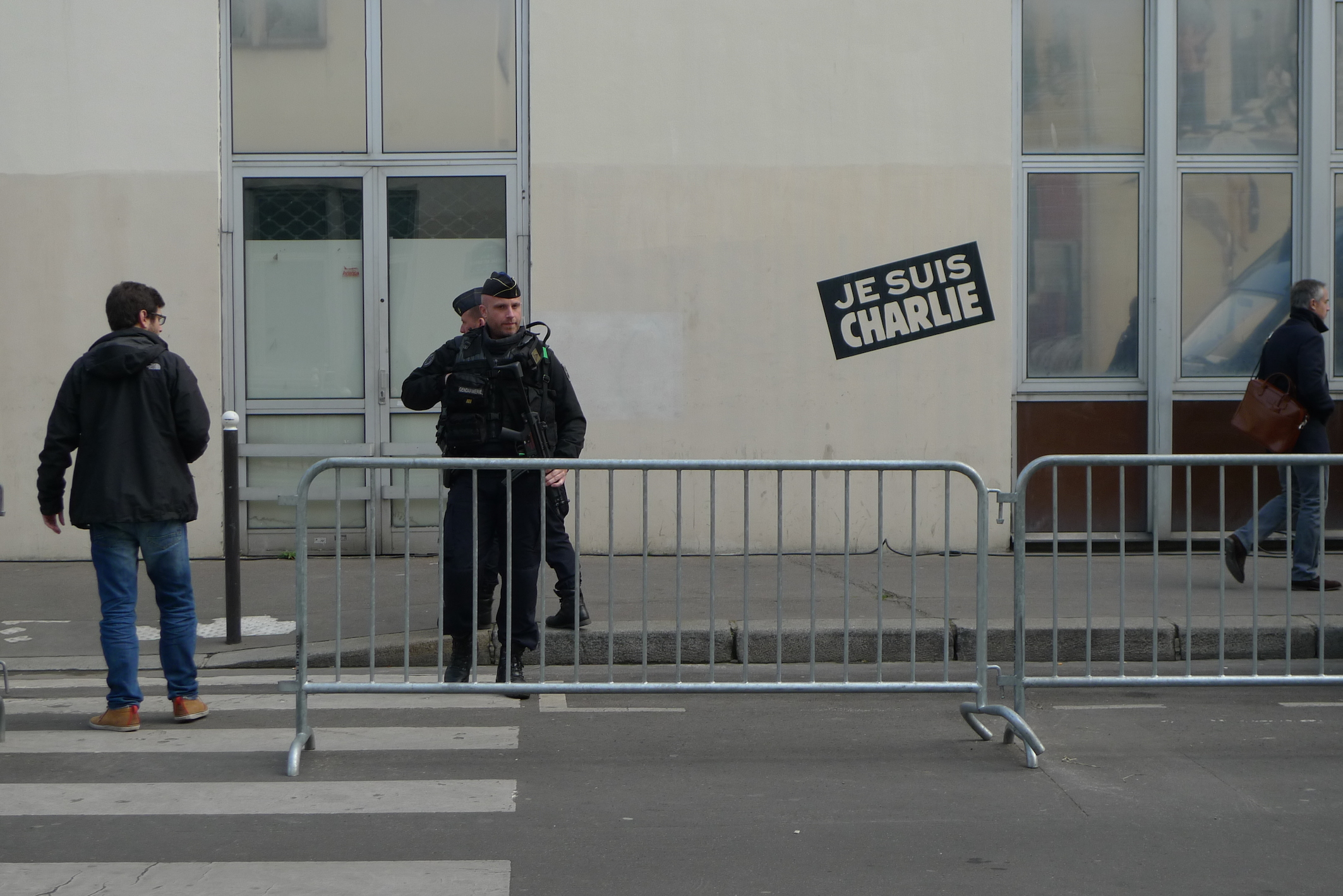
There are several machine gunners in front of the Charlie Hebdo building in Paris. These are cops, wearing bulletproof vests, carrying powerful weapons. They stare at occasional pedestrians in their special, revolting and highly intimidating way. Charlie Hedbo editors are well protected, some of them postmortem.
If you think that France is not as much a police state, as the UK or the US, think twice. Heavily armed military and police are visible at all train stations and many intersections, even at some narrow alleys. Internet providers are openly spying on their costumers. Mass media is self-censoring its reports. The regime’s propaganda is in “top gear”
But the people of France, at least the great majority of them, believe that they live in an ‘open and democratic society.’ If asked, they cannot prove it; they have no arguments. They are simply told that they are free, and so they believe it.
***
Employees of Charlie Hebdo go periodically out of the building for a smoke. I try to engage them in a conversation, but they reply in very short sentences only. They do their best to ignore me. Somehow, intuitively, they sense that I am not here to tell the official story.
I ask them why don’t they ever poke fun at the Western neo-colonialism, at the grotesque Western election system, or at the Western allies that are committing genocides all over the world: India, Israel, Indonesia, Rwanda, or Uganda? They impatiently dismiss me with their body language. Such thoughts are not encouraged, and most likely, they are not allowed. Even humorists and clowns in modern France know their place.
They soon let me know that I am asking too many questions. One of the employees simply looks, meaningfully, in the direction of armed cops. I get the message. I am not in the mood for a lengthy interrogation. I move on.
In the neighborhood, there are several sites carrying outpours of sympathy for the victims; 12 people who died during the January 2015 attack on the magazine. There are French flags and there are plastic white mice with Je Suis Charlie written on their bodies. One big poster proclaims: Je suis humain. Other banners read: “Islamic whores”, with red color correction, replacing Islamic with “terrorist” – Putain de terroristes.
There is plenty of graffiti written about freedom, all over the area. “Libre comme Charlie”, “Free like Charlie”!
A woman appears from the blue. She is very well dressed; she is elegant. She stands next to me for a few seconds. I realize that her body is shaking. She is crying.
“You’re a relative…?” I ask her, gently.
“No, no”, she replies. “We are all their relatives. We are all Charlie!”
She suddenly embraces me. I feel her wet face against my chest. I try to be sensitive. I hold her tight, this stranger – this unknown woman. Not because I want to, but because I feel that I have no other choice. Once I fulfill my civic obligation, I run away from the site.
***
Fifteen minutes walk from the Charlie Hebdo building, and there is the monumental National Picasso Museum, and dozens of art galleries. I make sure to visit at least 50 of them.
I want to know all about that freedom of expression that the French public is so righteously longing for and ‘defending’!
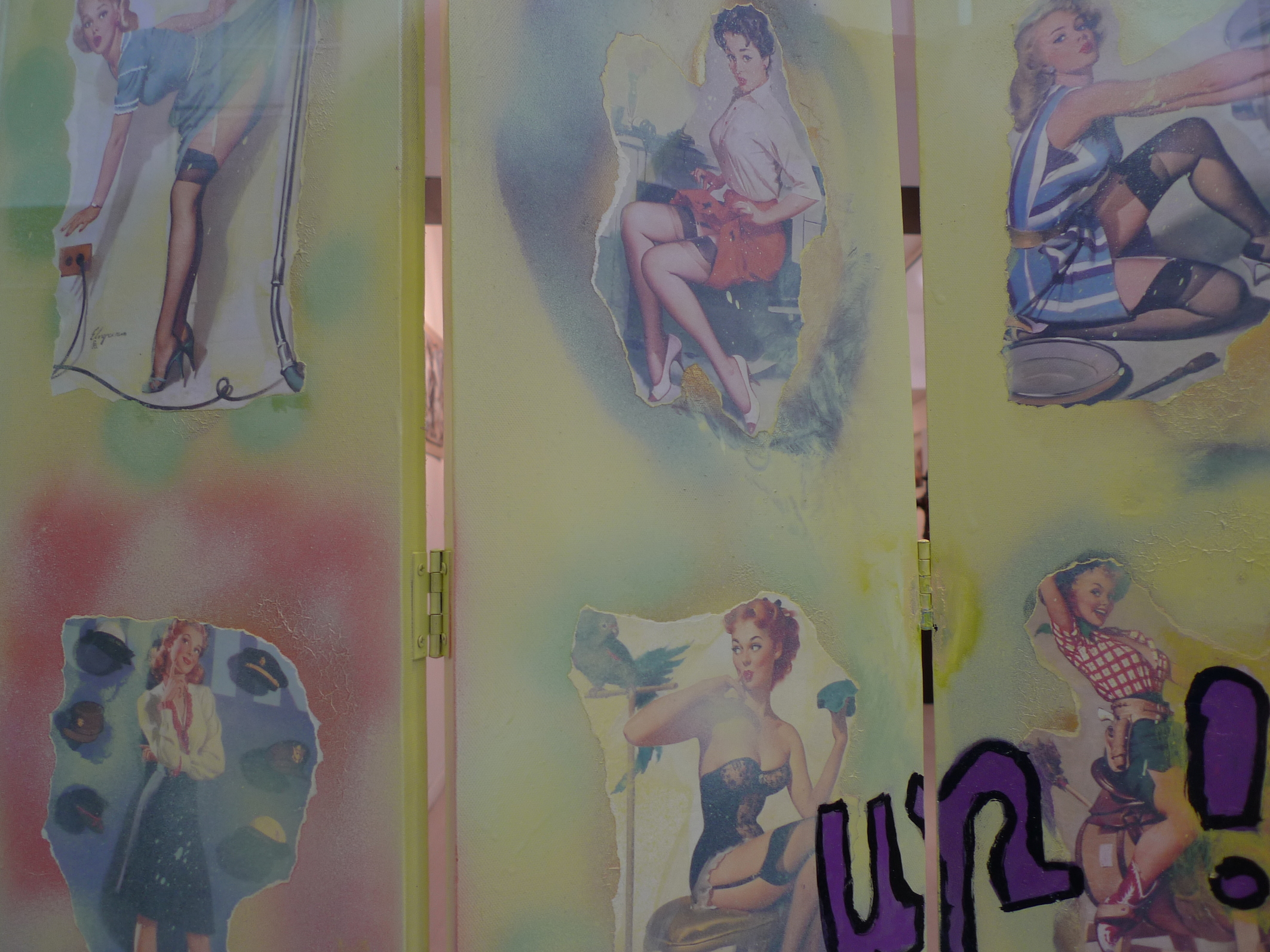
But what I see is endless pop. I see some broken window of a gallery and a sign: “You broke my art”. It is supposed to be an artwork itself.
Galleries exhibit endless lines and squares, all imaginable shapes and colors.
In several galleries, I observe abstract, Pollock-style ‘art’.
I ask owners of the galleries, whether they know about some exhibitions that are concentrating on the plight of tens of thousands of homeless people who are barely surviving the harsh Parisian winter. Are there painters and photographers exposing monstrous slums under the highway and railroad bridges? And what about French military and intelligence adventures in Africa, those that are ruining millions of human lives? Are there artists who are fighting against France becoming one of the leading centers of the Empire?
I am given outraged looks, or disgusted looks. Some looks are clearly alarmed. Gallery owners have no clue what am I talking about.
At the Picasso Museum, the mood is clearly that of ‘institutionalism’. Here, one would never guess that Pablo Picasso was a Communist, and deeply engaged painter and sculptor. One after another, groups of German tourists consisting mainly of senior citizens are passing through well-marked halls, accompanied by tour guides.
I don’t feel anything here. This museum is not inspiring me, it is castrating! The longer I stay here, the more I feel that my revolutionary zeal is evaporating.
I dash to the office and summon a junior curator.
I tell her all that I think about this museum and about those commercial galleries that are surrounding it.
“Those millions who were marching and writing messages around Charlie Hedbo… What do they mean by ‘freedom’? There seems to be nothing ‘free’ in France, anymore. Media is controlled, and art has just became some sort of brainless pop.”
She has nothing to say. “I don’t know”, she finally replied. “Painters are painting what people want to buy.”
“Is that so?” I asked.
I mention “798” in Beijing, where hundreds of galleries are deeply political.
“In oppressed societies, art tends to be more engaged”, she says.
I tell her what I think. I tell her that to me, and to many creative people I met in China, Beijing feels much more free, much less brainwashed or oppressed, than Paris. She looks at me in horror, then with that typical European sarcasm. She thinks I am provoking, trying to be funny. I cannot mean what I say. It is clear, isn’t it, that French artists are superior, that Western culture is the greatest. Who could doubt it?
I give her my card. She refuses to give me her name.
I leave in disgust, as I recently left in disgust the Peggy Guggenheim Collection in Venice.
At one point I walk into a cafe, to drink a cup of coffee and a glass of mineral water.
A man and his enormous dog walk in. Both park at the bar, standing. A dog puts its front paws on the bar table. They both have a beer: the man from a glass, his dog from a saucer. A few minutes later, they pay and leave.
I scribble into my notepad: “In France, dogs are free to take their beer in cafes.”
***
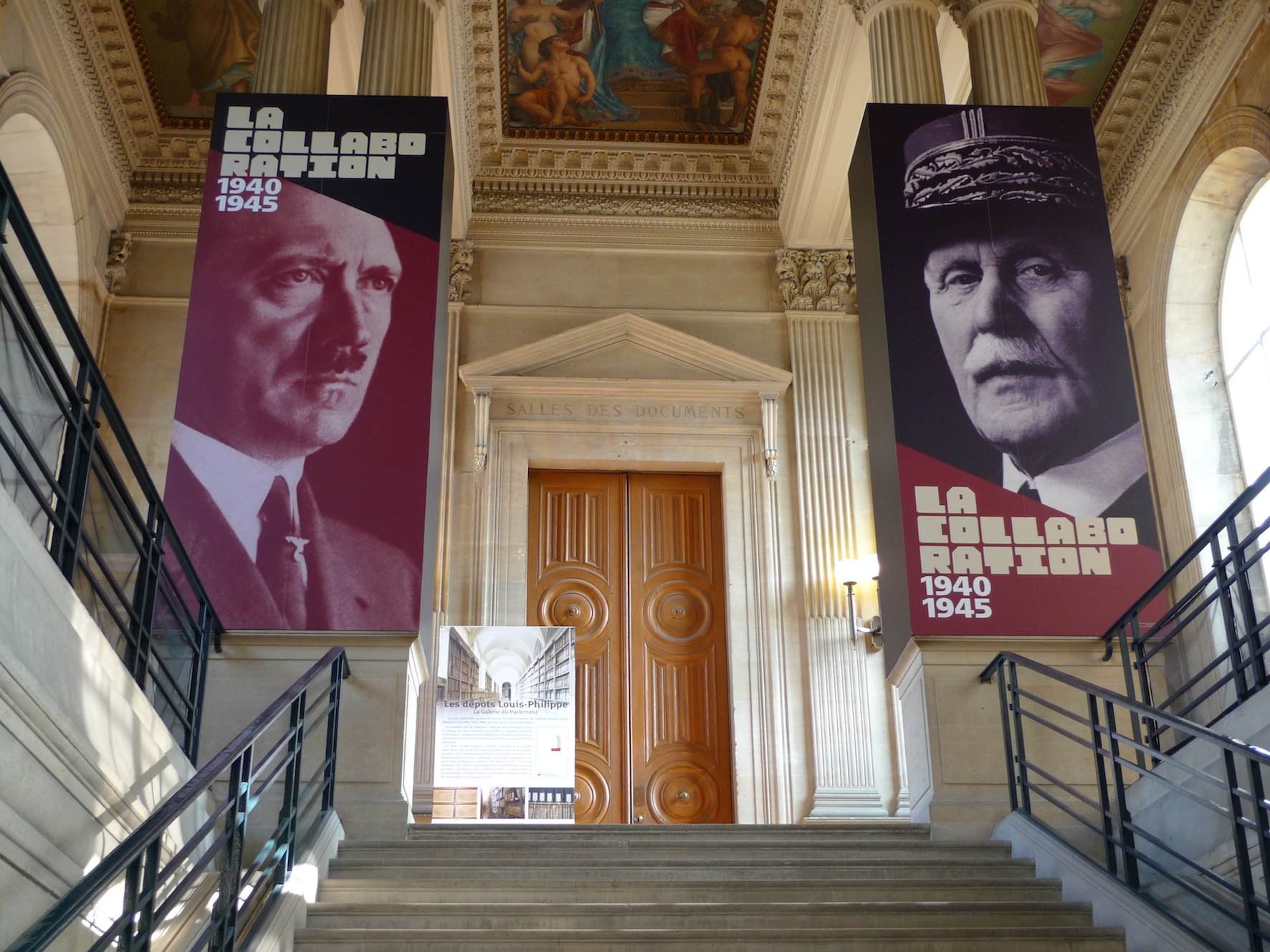
In the same neighborhood, I rediscover an enormous National Archive, a beautiful group of buildings with gardens and parks all around.
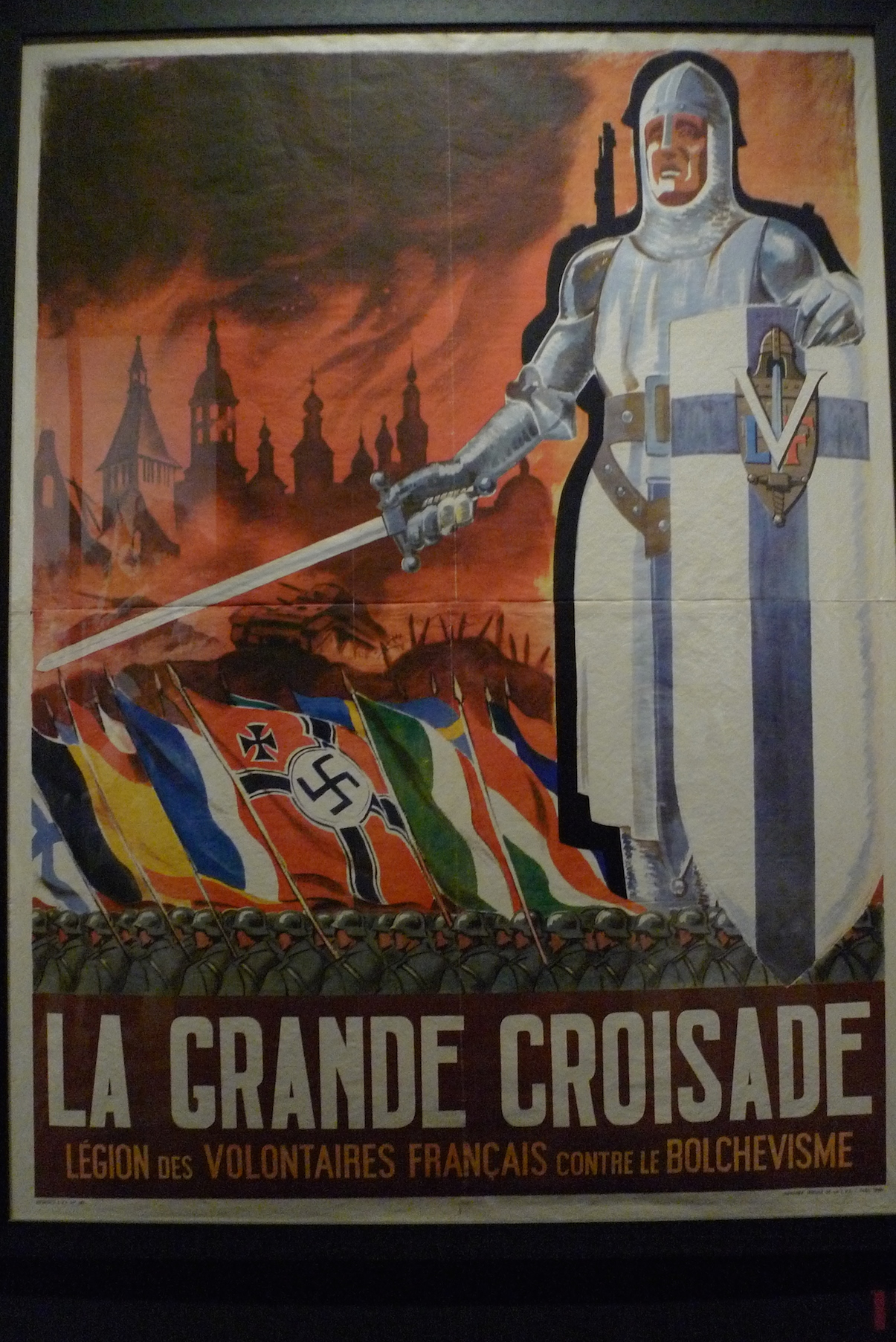
The place is holding a huge exhibition: on how France collaborated with the Nazi Germany during the WWII. The retrospect is grand and complete: with images and texts, with film showings.
For the first time in days, I am impressed. It all feels very familiar, intimately familiar!
***
At night I found myself in that enormous new Philharmonic, at the outskirts of Paris, near Porte de Pantin. I managed to smuggle myself to the invitation-only-opening of an enormous exhibition dedicated to French composer, conductor and writer – Pierre Boulez. That same Pierre Boulez who has been promoting, for ages, the idea of a public sector taking over French classic music scene!
Nobody protested at the exhibition, and I did not hear any jokes directed at Pierre Boulez. It was all brilliantly orchestrated. Great respect for the establishment cultural figure, for the cultural apparatchik!
I heard a technically brilliant concert of contemporary classical music, with new instruments being used.
But nowhere, in any of those tremendous spaces of the Philharmonic, did I hear any lament, any requiem, for the millions of people literally slaughtered by the Empire, of which France is now an inseparable part. No new symphonies or operas dedicated to the victims of Papua, Kashmir, Palestine, Libya, Mali, Somalia, the Democratic Republic of Congo, or Iraq.
My new friend, Francois Minaux, is writing an opera about the US carpet-bombing of the Plane of Jars, during the ‘Secret War’ conducted by the West against Laos. I am helping him with this enormous and noble project. But paradoxically (or logically?), Francoise is not living in France, but in the United States.
When I shared my thoughts with him, on Charlie Hebdo, and on freedom of expression in France, he summarized:
“It’s terrible. The art scene sucks. People are zombies. The mass reaction to the Charlie H attack is disgusting and depressing. ‘1984’ is happening but people are too blind to see it.”
A few hours later, I received an email in which Francoise reflected on his complex relationship with his native land, and its culture:
“Being French nowadays and being free to express yourself is impossible. Back in the early 2000’s, I could not accept the frame that culture would impose on its artists, and they could not accept my questioning and different approach to art making. They either spat on me or even worse, went mute. So, I left. You must travel outside of Europe and live and work outside, to feel the world.
I felt also that politically engaged works of art were not considered real art in Paris. There is this thing in France: any political engagement is seen either as propaganda or as advertisement. Back in the early 2000’s, we were supposed to make art for art’s sake. We were living under the glass dome of the conservatory. We were ‘protected by the government’.
They let us know that we should not talk about politics or religion in public. Maybe French secularism was a good idea but not to the present extent, when politics and religion became taboo. There is this climate of fear: our elders and teachers hardly discuss politics and religion. And so we didn’t know! Certain things are forbidden to be known in France.
Life in Paris became suffocating. Opinions were not expressed. We were not allowed to understand others. Live became boring: we had nothing substantial to talk about. And so we discussed greasy food and French wine. Economists describe the French economy as “austere”, but I would go further by saying that French behavior as well as French identity is austere. But the French people can’t see it because they now all think the same. They are trying so hard to stay French but they are forgetting, how the world has bled, so their French-ness could be preserved. Their culture was built from the blood flowing from the French colonies, and on the foundations of the modern-day French Empire.”
***
So where are those brave French minds now; people so many of us were admiring for their courage and integrity?
They were never ‘perfect’, and they erred, like all humans do, but they were often standing on the side of oppressed, they were calling for revolutions and some even for the end of colonialism. They were holding Western culture responsible for the horrors our planet has been facing for centuries.
Emile Zola and Victor Hugo, then later Sartre, Camus, Malraux, Beauvoir, Aragon…
What do we have now? Michel Houellebecq and his novels, full of insults against Islam, as well as of ‘tears of gratitude’ felt after each blowjob his characters get from their girlfriends.
The legacies of Houellebecq and Charlie are somehow similar. Is this the best France can do, these days? Is kicking what is on the ground, what was already destroyed by the West, what is humiliated and wrecked – called courage?
Are pink poodles on silver leashes, exhibited in local galleries, the essence of what is called the freedom of speech? Such stuff would pass any censorship board even in Indonesia, or Afghanistan! No need for the freedom of expression. It is cowardly and it is selfish – exactly what the Empire is promoting.
***
Christophe Joubert, a French documentary filmmaker, told me over a cup of coffee:
“First I was sad, when I heard about what happened to people at Charlie Hedbo. Then I got scared. Not of terrorism, but of the actions of the crowd. Everybody was indoctrinated: thinking the same way, acting the same way. Like Orwell and his 1984! More precisely, ‘the 8th day.”
“People in France know nothing about the world”, continues Christophe. “They believe what they are told by propagandist mass media”.
“I am not allowed to speak”, the Eritrean Ambassador to France, Hanna Simon, explained to me. “They invite me to some television show where they present a film criticizing my country. They speak openly, but when I try to respond, they shut me up.”
“I know nothing about what you are saying”, my good Asian friend replies, with sadness, after I tell him about the tremendous global rebellion taking place against the West, in Latin America, China, Russia, Africa… He is a highly educated man, working for the UNESCO. “You know, here we hear only one side; the official one.”
I am wondering whether, perhaps in 70 years from now, the National Archive will have another huge exhibition: one on France’s collaboration with neoliberalism, and on its direct involvement in building the global fascist regime controlled by the West.
But for now, as long as dogs can have a beer at the bar, fascism, imperialism and neoliberalism do not seem to matter.

Andre Vltchek is a philosopher, novelist, filmmaker and investigative journalist. He covered wars and conflicts in dozens of countries. His latest books are: “Exposing Lies Of The Empire” and “Fighting Against Western Imperialism”. Discussion with Noam Chomsky: On Western Terrorism. Point of No Return is his critically acclaimed political novel. Oceania – a book on Western imperialism in the South Pacific. His provocative book about Indonesia: “Indonesia – The Archipelago of Fear”. Andre is making films for teleSUR and Press TV. After living for many years in Latin America and Oceania, Vltchek presently resides and works in East Asia and the Middle East. He can be reached through his website or his Twitter.
France moves to legalize warrantless data surveillance
RT | March 19, 2015
In effort to boost its intelligence gathering, France is pushing for a law to allow authorities to spy on the digital and mobile communications of anyone linked to a “terrorist” enquiry without any judicial authorization.
The government presented the draft law to parliament on Thursday.
“Facing an increasing jihadist threat, we have to further enhance the effectiveness of the surveillance against terrorists,” Prime Minister Manuel Valls said at a news conference two months after 17 people died in a series of terrorist attacks in Paris.
“Today, one of the two people who arrived in Syria has been detected before his departure, so we have to … tighten the net of surveillance of radicalized and dangerous individuals.”
Valls said the text of the draft provided the intelligence services the means enough to fight terrorism, yet respecting individual freedoms – a view, not supported by many human rights organizations and lawyers.
The draft law would give the intelligence services the right to perform “security interceptions” of e-mails and phone conversations, to install radio beacons in a suspect’s cars, as well as microphones and cameras in their home. It could also be able to track what a suspect types on a computer keyboard with the use of special software, and also force internet service providers to hand over data to the security services.
However the prime minister underlined that the draft “is not a French-style Patriot Act,” referring to the anti-terrorism laws introduced in the US after the 9/11 tragedy in 2001 that strengthened security controls. The future law only legitimizes the actions, already common among the intelligence services, so Valls added that “There will be no more grey zone,” as cited by Reuters.
Human rights watchdogs and lawyers have slammed the project as “devastating” for individual freedom. The Paris Bar Association also expressed their disapproval over the “text made without any prior coordination with the judiciary.”
Nils Muiznieks, human rights commissioner of the Council of Europe, said on Thursday, “I am concerned about the strict security approach that characterizes the discussions and the text of the legislation aimed at intensifying the fight against terrorism.”
Amnesty International stated that it “is concerned that several of these measures may pave the way for violations of international and regional human rights standards that are binding on France, in particular those regarding the rights to freedom of expression and to private life.”
In January, following the attacks in Paris where 17 people were killed, Manuel Valls revealed plans to boost anti-terrorism strategies. The prime minister announced that France will employ 2,680 extra anti-terror operatives with a €425 million increase in funding.
French comedian sentenced for ‘defending terrorism’ in Facebook remark
By Brandon Martinez | Non-Aligned Media | March 18, 2015

The popular French comedian Dieudonne has been found guilty by a French court of ‘defending terrorism,’ making the comic one of dozens convicted of the Orwellian speech offence since the Charlie Hebdo shooting.
The charges stem from a Facebook comment Dieudonne made in the aftermath of the shooting, saying “I feel like I am Charlie Coulibaly,” a play on the ludicrous catch phrase “I am Charlie.”
Haaretz reports that the Paris court sentenced Dieudonne to a suspended sentence of two months in jail.
The French state has been criticized for its blatant double standards as it relates to free speech. Government ministers voiced support for Charlie Hebdo’s right to publish anti-Muslim cartoons, but concurrently issue orders for the arrest of people critical of Jews and Israel.
France’s President Manuel Valls is said to be under Jewish influence. Valls says he is “eternally linked” with Israel because his wife is Jewish.
Copyright 2015 Non-Aligned Media
Featured Video
Anthrax War – CBC The Passionate Eye
or go to
Aletho News Archives – Video-Images
Book Review
Shattered Dreams: The HPV Vaccine Exposed (2019)
By Christina England – 30 Q&As – Book Review & Summary
Lies are Unbekoming | September 4, 2026
… Gardasil received FDA fast-track approval in 2006, Cervarix followed in 2009, and Gardasil 9 was approved in December 2014 with more than double the aluminium adjuvant content of the original. The commercial context is specific. Merck was about to lose patent protection on Zocor and faced $18 billion in Vioxx injury claims from a cardiovascular drug the company had marketed while suppressing its own data showing a five-times increase in heart attacks. Analysts projected the global HPV vaccine market at $4 billion by 2011, contingent on government-funded national programs for teenage girls. The 1986 National Childhood Vaccine Injury Act had already granted manufacturers complete liability immunity. By 2013, Japan had withdrawn its HPV vaccine recommendation after cataloguing severe adverse reactions in hundreds of girls. No Western government followed. The establishment position across the UK, US, Australia, and most of Europe held, and still holds, that the vaccines are safe and effective, that reported injuries are coincidental, and that cervical cancer prevention justifies the program. The book was published into this position, not against a vacuum.
Shattered Dreams sits alongside Mary Holland’s The HPV Vaccine On Trial and Viera Scheibner’s foundational vaccination work as part of the documented record on what has been done to a generation of teenage girls under the banner of cancer prevention. The full summary unpacks three specific findings: that Merck used the aluminium adjuvant itself as the “placebo” control in 92.5% of trial subjects, making it structurally impossible to detect excess reactions from the adjuvant; that Dr. Sin Hang Lee found HPV DNA fragments bound to aluminium in every one of sixteen Gardasil samples tested, and in the blood and spleen of a New Zealand girl six months after her third dose; and that in every country with high vaccination coverage, including Australia, the UK, Norway, and Sweden, cervical cancer rates have stopped declining and started rising specifically in the vaccinated cohort. Martínez-Lavín’s 2017 calculation puts the number needed to seriously harm with Gardasil 9 at 140, and the number needed to vaccinate to prevent one case at 1,757. Thirteen young women are seriously harmed for every one who benefits. The vaccine was approved on the basis of trials that could not detect what the trials were supposed to detect, and it is still being given to twelve-year-olds today. … Read full review
Blog Roll
 Aletho News
- The Five-Year Fuel Crisis: Why the World Economy Is Paying for a War It Thinks Is Ending
- Trump’s Big Bluff on Iran
- Swiss scammed out of millions by Ukraine-linked call centers – media
- Germany facing potential ‘violent conflict’ with Russia – spy chief
- Ukraine’s EU neighbors reject new plea from Kiev – Politico
- British Transport Police Facial Recognition Trial Scanned 926,912 People With Zero Arrests
- House Bill Would Ban Federal Use of Flock ALPR Data
- Can a Spice Rival a Drug? 10 Head-to-Head Trials Put It to the Test.
- The oil routes around Hormuz face their own chokepoints
- The Saudi-Israeli war on Yemen’s resistance: Intelligence sharing, civilian targets & sectarian propaganda
- If Americans Knew
- Turkish Red Crescent helps elderly Gaza man walk again after Israel confiscates his prosthetic limb
- Four Palestinians Killed in Israeli Attacks in Gaza
- Two Palestinian youths killed and village razed as Israeli attacks on West Bank continue
- Two more Christian women innocent victims of Gaza raids
- Cruelty, Deprivation, Indignity: A Journalist’s 22 Months in Israeli Prison
- New IDF Website Frames Slain Gaza Journalists as Terrorists
- Israeli media: After settlers beat him mercilessly, they stuffed dirt into his mouth
- Americans Are Paying the Price to Preserve Israel’s Nuclear Hegemony
- A U.S. Jewish Fund’s Ambitious Bid to Put a Settler Elite in Control of Israel’s Security
- As genocide drags on, “Zionism is racism” becomes official policy in one UK party – Daily Update
- No Tricks Zone
- Latest European Green Energy Debacle; Portugal’s Largest Flagship Solar Park Insolvent!
- Green Energy Debacle: German Expert Professor Fritz Vahrenholt Warns Of Severe Economic And Social Consequences
- Two More Paleo Reconstructions Affirm Meters-Higher Sea Levels Across Ireland, Brazil 7000-6000 Years Ago
- New Study: Earth And Venus Surface Warmth Largely Explained By Convection And Lapse Rate, Not CO2 Or Radiation
- 2025 Nature Paper Claiming Worsening Global Drought Gets RETRACTED …Heavily Flawed
- New Study: ‘Global Drought Shows No Detectable Recent Acceleration Under Climate Warming’
- Economic Masterminds: German Socialists Suggest Taxing Productivity Gains Stemming From Using AI
- The South China Sea Has Not Been Cooperating With The Climate Change Narrative
- Energy Crisis: Germany Enters Heating Season With Historically Low Gas Reserve Fill Levels
- New Study: The Antarctic Ice Sheet Gained Mass From 2020-2024 Due To Staggering Snow And Ice Accumulation

