Obama to support Internet wiretapping program
RT | May 08, 2013
United States President Barack Obama is likely to endorse a Federal Bureau of Investigation effort that would ensure all Internet companies in the US provide a way for the government to conduct undetected, backdoor surveillance.
The FBI has been considering solutions to their so-called “Going Dark” problem as intricate methods of encryption and advances in technology have made it increasingly difficult for the federal government and law enforcement to gain access to online communications conducted in the shadows of the Web. Should the latest efforts of the FBI move forward, though, Internet companies that act as any conduit for correspondence of any kind would be heavily fined if they don’t include in their infrastructure a way for the government to eavesdrop on that dialogue in real time.
At a press conference in Washington, DC in March, FBI general counsel Andrew Weissmann said the Department of Justice was determined to have the means to wiretap any online communication by 2014 and called it “a huge priority for the FBI.” Further developments last month revealed that the FBI was considering a fine-based model under which Internet companies would be forced to comply or risk being penalized beyond repair.
On Tuesday, New York Times reporter Charlie Savage cited Obama administration officials as saying the president “is on the verge of backing” that very plan.
Savage explained that while companies would be allowed to operate without giving the government backdoor access, the fees would likely limit the number of entities willing to challenge the order. As RT reported last month, a company that doesn’t comply with the FBI’s orders would be fined $25,000 after 90 days. Additional penalties would then be tacked on every day an Internet service provider, website or other company fails to comply — with the price of the penalty doubling each day they don’t assist investigators.
“While the FBI’s original proposal would have required Internet communications services to each build in a wiretapping capacity, the revised one, which must now be reviewed by the White House, focuses on fining companies that do not comply with wiretap orders,” wrote Savage. “The difference, officials say, means that start-ups with a small number of users would have fewer worries about wiretapping issues unless the companies became popular enough to come to the Justice Department’s attention.”
Savage quoted a statement in his article from Weissmann in which the FBI attorney said, “This doesn’t create any new legal surveillance authority.” Instead, said Weissman, “None of the ‘going dark’ solutions would do anything except update the law given means of modern communications.”
“This always requires a court order,” he said.
Coincidently, that same issue has had major developments in its own right this week. On Wednesday morning, CNET reporter Declan McCullagh wrote that the Justice Department circulated memos in which they insisted that obtaining a search warrant isn’t necessary to eavesdrop on Internet communication of any sort.
“The US Department of Justice and the FBI believe they don’t need a search warrant to review Americans’ e-mails, Facebook chats, Twitter direct messages and other private files, internal documents reveal,” wrote McCullagh, citing a government documents obtained by the American Civil Liberties Union and provided to CNET.
According to McCullagh, those documents include very specific instructions from high-importance officials that demonstrate the Justice Department’s disinterest in applying established law when it comes to eavesdropping on Americans. While Weissmann made the argument that the FBI plan reportedly backed by the president won’t change what rules the DoJ operates by, the memos obtained by McCullagh paints the Obama White House as an administration unwilling to work with the already broad surveillance powers provided to it.
In one memo unearthed by the ACLU, McCullagh said the US attorney for Manhattan instructed his office that an easy-to-obtain legal paper that requires no judicial oversight is all that’s needed to obtain personal correspondence.
“[A] subpoena — a piece of paper signed by a prosecutor, not a judge — is sufficient to obtain nearly ‘all records from an ISP,’” McCullagh wrote.
In another instance, McCullagh said the US attorney in Houston, Texas obtained the “contents of stored communications” from another ISP without getting a judge to sign a warrant.
One current law that limits how and when authorities can obtain a suspect’s email pursuant to a criminal investigation, the Electronic Communication Privacy Act, provides that while a warrant is needed for relatively recent correspondence, a comparably easier to get administrative subpoena is all that’s required to get communication older than 180 days. Provisions of the ECPA have been largely unchanged since it was passed in the mid-1980s, but last month a Senate Judiciary Committee approved an amendment that would require a warrant in all instances.
In advocating for fewer restrictions when obtaining store communication, the FBI’s Wessmann said in April that another law, 1994’s Communications Assistance for Law Enforcement Act, needs to be expanded so investigators can leap over current hurdles that keep them from conducting real time wiretaps of online discussions.
“You do have laws that say you need to keep things for a certain amount of time, but in the cyber realm you can have companies that keep things for five minutes,” he said. “You can imagine totally legitimate reasons for that, but you can also imagine how enticing that ability is for people who are up to no good because the evidence comes and it goes.”
In the wake of the Boston Marathon bombing on April 15, renewed calls across the country have been made to make it easier for investigators to quickly conduct surveillance — in and off the Web. A recent poll found that roughly two-thirds of Americans favored more surveillance cameras in public places, and now the nation’s top law officials are asking for increased spy power not just on the streets but on the Web.
Earlier this month, Google Chairman Eric Schmidt said at a discussion in Washington, “When you come across an advocate for one thing — an advocate for security, and advocate for privacy — they’re often arguing from a position without understanding that it’s a two-edged sword.”
“For example, very strong encryption would allow you and I to have a very, very secure communication: If we were criminals, if we were dissidents, if we were martyrs or if we were just doing a little business,” he said. “If you could figure out a way to ban very strong encryption from evil people and only allow good people…then this would be easy,” he said.
Related articles
- Obama administration bypasses CISPA by secretly allowing Internet surveillance (alethonews.wordpress.com)
- Spy, or pay up: FBI-backed bill would fine US firms for refusing wiretaps (alethonews.wordpress.com)
- To Ease Internet Snooping, Feds Promise To Ignore Privacy Violations (reason.com)
Defend Assata, Defend Ourselves: The Black Is Black Coalition Rallies in Harlem
A Black Agenda Radio commentary by Glen Ford | May 8, 2013
In doubling the bounty on former Black Liberation Army member Assata Shakur’s head, the Obama administration is announcing that Black radicals are candidates for his Kill List. The message is as unmistakable and dramatic as the billboards that have been erected in Newark, New Jersey, and elsewhere screaming for the exiled freedom fighter’s blood.
One does not wind up on the FBI’s Most Wanted list based on the number of murders committed or millions of dollars stolen. The Most Wanted list is among the nation’s most political documents, in which individuals are meant to personify the scope and type of offenses that the U.S. government considers most in need of stamping out. The list is a kind of propaganda, a symbolic display of what the state considers dangerous behavior.
President Obama and Attorney General Eric Holder, the two Black men who are most responsible for making Assata Shakur the face of domestic terror in the United States, are fully conversant in the language of symbolism. They are publicly defining the Black liberation movement – or what’s left of it, or those who might attempt to revive it – as a priority domestic target for repression. Shakur, a 65-year old grandmother who has not left Cuba for the past 29 years, poses no physical danger to the American state. She represents a political threat, through her “ideology,” as brazenly stated by the FBI. The Bureau has marked Shakur for priority assassination on the basis of, in the FBI’s words, her “anti-U.S. government speeches espousing the Black Liberation Army message.” “Terrorism” is somehow inherent in the message of Black liberation. Advocacy of Black liberation, is the threat. The reward of $2 million is meant to silence Assata Shakur’s political speech, and remove her as a symbol of resistance to the U.S government.
For the National Security State, “terror” is a powerful word, with vast legal ramifications. The Obama administration is informing Americans and Cubans that Assata is as much fair game for assassination by drone as the late Anwar al-Awlaki. Barack Obama and Eric Holder are serving notice that those who share Assata’s ideology – as understood by the FBI – are subject to eradication as well, because it is an ideology of terror. And they are telling those who give “substantial support” to Assata that they are subject to detention by the U.S. military without trial or charge, for the duration of the war against “terror.”
The Black Is Back Coalition for Social Justice, Peace and Reparations will hold a demonstration on Thursday, May 9, from 5 to 7pm, in front of the Harlem State Office Building in New York City, to give substantial and unwavering support to the safety and freedom of Assata Shakur; Freedom for Sundiata Acoli and Sekou Odinga, Black Liberation Army members held in U.S. prisons; and Freedom for All Political Prisoners.
They tried to kill Assata in 1973, and their still trying. They tried to kill the Black liberation movement, but its not dead yet. Join the Black is Back Coalition and a host of other concerned organizations at the Harlem State Office Building, on 125th Street, at 5pm, on Thursday. Tell the real terrorists what you think about them, their austerity, their mass incarceration, and their wars.
Glen Ford can be contacted at GlenFord@BlackAgendaReport.com.
For more information, go to Black Is Back Coalition event Facebook page:
Expanding Security State
By affinis – Corrente – 05/06/2013
A few days ago, I noticed this piece at FDL: “’Homeland Security’ Spending Overtakes New Deal”
TomDispatch: this country has spent a jaw-dropping $791 billion on ‘homeland security’ since 9/11. To give you a sense of just how big that is, Washington spent an inflation-adjusted $500 billion on the entire New Deal.
Two indicators of the expanding security state that caught my attention in the last few days:
1. Glenn Greenwald: “Are all telephone calls recorded and accessible to the US government?”
2. A massive lockdown in the Madison WI area (where I live).
A fugitive, Paris Poe, whom the FBI wanted for parole violation and questioning in a murder investigation, was spotted at a hotel in a Madison, WI suburb. Poe had previously been imprisoned for armed robbery. A large area encompassing much of Vernona, Fitchburg, and part of Madison, WI was then essentially locked down and swarmed with SWAT teams in a day-long manhunt.
Reverse 911 calls were made to all landlines (about 30,000 homes) asking residents to lock their doors and remain inside. Police asked all the businesses in their area to close and lock their doors. All six schools in the area were placed on lockdown and surrounded by police. In Verona, no-one could enter or exit the schools. In some classrooms, children were told to crouch under their desks for hours. In some schools, children were herded into the gym. Children were prohibited from using the bathroom, since that would involve leaving their rooms, and were told to urinate in buckets. Parents could not pick up their children since entry or exit was prohibited. Once the lockdown was ended, parents were required to present ID to take their children home. During the escalating panic, it was stated that Poe was on the FBI’s most wanted list, but he was not.
Late in the day, Poe was arrested far outside the locked down area. He was apparently unarmed, faces no charges in WI, and will be transported back to IL. News stories here, here, here, here, here, here, here, and here.
Does anyone else see something wrong with this picture?
Automated License Plate Readers Threaten Our Privacy
By Jennifer Lynch and Peter Bibring | EFF | May 6, 2013
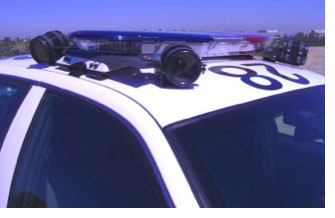 Law enforcement agencies are increasingly using sophisticated cameras, called “automated license plate readers” or ALPR, to scan and record the license plates of millions of cars across the country. These cameras, mounted on top of patrol cars and on city streets, can scan up to 1,800 license plate per minute, day or night, allowing one squad car to record more than 14,000 plates during the course of a single shift.
Photographing a single license plate one time on a public city street may not seem problematic, but when that data is put into a database, combined with other scans of that same plate on other city streets, and stored forever, it can become very revealing. Information about your location over time can show not only where you live and work, but your political and religious beliefs, your social and sexual habits, your visits to the doctor, and your associations with others. And, according to recent research reported in Nature, it’s possible to identify 95% of individuals with as few as four randomly selected geospatial datapoints (location + time), making location data the ultimate biometric identifier.
To better gauge the real threat to privacy posed by ALPR, EFF and the ACLU of Southern California asked LAPD and LASD for information on their systems, including their policies on retaining and sharing information and all the license plate data each department collected over the course of a single week in 2012. After both agencies refused to release most of the records we asked for, we sued. We hope to get access to this data, both to show just how much data the agencies are collecting and how revealing it can be.
ALPRs are often touted as an easy way to find stolen cars — the system checks a scanned plate against a database of stolen or wanted cars and can instantly identify a hit, allowing officers to set up a sting to recover the car and catch the thief. But even when there’s no match in the database and no reason to think a car is stolen or involved in a crime, police keep the data. According to the LA Weekly, LAPD and LASD together already have collected more than 160 million “data points” (license plates plus time, date, and exact location) in the greater LA area—that’s more than 20 hits for each of the more than 7 million vehicles registered in L.A. County. That’s a ton of data, but it’s not all — law enforcement officers also have access to private databases containing hundreds of millions of plates and their coordinates collected by “repo” men.
Law enforcement agencies claim that ALPR systems are no different from an officer recording license plate, time and location information by hand. They also argue the data doesn’t warrant any privacy protections because we drive our cars around in public. However, as five justices of the Supreme Court recognized last year in US v. Jones, a case involving GPS tracking, the ease of data collection and the low cost of data storage make technological surveillance solutions such as GPS or ALPR very different from techniques used in the past.
Police are open about their desire to record the movements of every car in case it might one day prove valuable. In 2008, LAPD Police Chief Charlie Beck (then the agency’s chief of detectives) told GovTech Magazine that ALPRs have “unlimited potential” as an investigative tool. “It’s always going to be great for the black-and-white to be driving down the street and find stolen cars rolling around . . . . But the real value comes from the long-term investigative uses of being able to track vehicles—where they’ve been and what they’ve been doing—and tie that to crimes that have occurred or that will occur.” But amassing data on the movements of law-abiding residents poses a real threat to privacy, while the benefit to public safety is speculative, at best.
In light of privacy concerns, states including Maine, New Jersey, and Virginia have limited the use of ALPRs, and New Hampshire has banned them outright. Even the International Association of Chiefs of Police has issued a report recognizing that “recording driving habits” could raise First Amendment concerns because cameras could record “vehicles parked at addiction-counseling meetings, doctors’ offices, health clinics, or even staging areas for political protests.”
But even if ALPRs are permitted, there are still common-sense limits that can allow the public safety benefits of ALPRs while preventing the wholesale tracking of every resident’s movements. Police can and should treat location information from ALPRs like other sensitive information — they should retain it no longer than necessary to determine if it might be relevant to a crime, and should get a warrant to keep it any longer. They should limit who can access it and who they can share it with. And they should put oversight in place to ensure these limits are followed.
Unfortunately, efforts to impose reasonable limits on ALPR tracking in California have failed so far. Last year, legislation that would have limited private and law enforcement retention of ALPR data to 60 days—a limit currently in effect for the California Highway Patrol — and restricted sharing between law enforcement and private companies failed after vigorous opposition from law enforcement. In California, law enforcement agencies remain free to set their own policies on the use and retention of ALPR data, or to have no policy at all.
Some have asked why we would seek public disclosure of the actual license plate data collected by the police—location-based data that we think is private. But we asked specifically for a narrow slice of data — just a week’s worth — to demonstrate how invasive the technology is. Having the data will allow us to see how frequently some plates have been scanned; where and when, specifically, the cops are scanning plates; and just how many plates can be collected in a large metropolitan area over the course of a single week. Actual data will reveal whether ALPRs are deployed primarily in particular areas of Los Angeles and whether some communities might therefore be much more heavily tracked than others. If this data is too private to give a week’s worth to the public to help inform us how the technology is being used, then isn’t it too private to let the police amass years’ worth of data without a warrant?
After the Boston Marathon bombings, many have argued that the government should take advantage of surveillance technology to collect more data rather than less. But we should not so readily give up the very freedoms that terrorists seek to destroy. We should recognize just how revealing ALPR data is and not be afraid to push our police and legislators for sensible limits to protect our basic right to privacy.
Documents
EFF and ACLU-SC’s legal Complaint
LA Sheriff’s Department ALPR Powerpoint Presentation
LA Sheriff’s Department – Automated License Plate Reader System Information
LAPD – Automated License Plate Reader User Guide
LA Sheriff’s Department – Field Operations Directive
Librarians, Archivists, the Transformation of Information and Palestine
By Ron Jacobs | Dissident Voice | May 5th, 2013
This June, a delegation of librarians, archivists, and other library workers will travel to Palestine. They will connect with our colleagues in library- and archive-related projects and institutions there, traveling as truth seekers and information skeptics, applying their experience in the form of skill shares and other types of joint work. Their hope is to shed light on Palestinian voices, refute various myths common in the West about Palestine, and bear witness to the destruction and appropriation of information. Furthermore, they will support efforts to preserve cultural heritage and archival materials (of all kinds) in Palestine. Upon their return, this delegation hopes to share the information and experience from their trip.
In all their travels, they have stated that they will respect the Palestinian civil society call for Boycott, Divestment, and Sanctions (BDS) against Israel and will not partner with any organization that violates this call.
Upon hearing of this venture, I emailed the organization with a few questions. What follows is my exchange with one of the group’s members, Vati Natarajan.
Ron Jacobs: What compelled/inspired you all to undertake this journey? Was there a specific report regarding the destruction of historical materials?
Vati Natarajan: We’re all librarians or archivists who have been involved with issues of knowledge production, circulation, access, and preservation across contexts and for many years. We’re also very much committed to the idea and practice of librarians and archivists as active members of justice movements, including Palestine. One of us has been organizing delegations to Palestine for many years now, and authored a study on the destruction of historic materials in Palestine. Given the austerity climate in the US and around the world, and the short shrift given to libraries, archives and other information commons, we felt that now would be a good time to head to Palestine to not only carry forward support for Palestine in the library and archive community, but to learn and share skills and knowledge on how to improve and expand the reach and effectiveness of these institutions for justice movements.
RJ: As a library worker, I share your belief in the power of knowledge. What do you see as the essential role knowledge plays in Palestine? Likewise, what about Israel?
VN: We are indeed absolutely committed to open access, and the free exchange and distribution of knowledge. Israeli settler-colonialism prioritizes short-circuiting this flow in any way they can, including destruction of schools, libraries, public spaces; confiscating books, newspapers, archives, and all sorts of written materials; denying entry or circumscribing the movement of scholars and students; imposing and censoring Palestinian speech, newspapers, and other works.
In this way, Israel aims to maintain and solidify the fragmentation of the Palestinian body politic, making it difficult for Palestinians to exchange knowledge with each other and with the outside world, and therefore strengthen their struggle for justice. Palestinians, however, remain some of the most highly educated people in the Arab world, and it is a testament to their will and ingenuity that knowledge and information is always prioritized, and remains central to the struggle. Of course, many libraries in Palestine face some of the same issues we face in the states, including reduced readership and budgets. We want to learn the ways Palestinians have attempted to craft accessible public commons — including community centres, libraries at schools, municipalities, and archives of all sorts all over the country. One need only visit the Prisoners Section of the Nablus Public Library, which holds books, writings, and other materials smuggled into Israel prisons and donated to the library by former prisoners, to understand the intense attachment of Palestinian society to knowledge. In this we feel we will be learning far more from our colleagues from Palestine than we could ever offer, and we’re excited by that exchange.
Of course, this settler-colonial project of blocking flows of knowledge impacts Israelis as well, many of whom have grown seemingly unaware and unwilling to learn about their neighbors, and their own complicity and responsibility in denying and destroying the heritage of the Palestinian people. We do hope to visit and meet with Israelis who have attempted to re-introduce knowledge erased and to confront the structures that have trapped both Palestinians and Israelis. We’re also keen to learn from Israelis working on other fronts in the fight against settler-colonialism, including organizing against anti-African and anti-Mizrahi racism, as well as participating in working class and social justice movements in Israel.
RJ: What is the nature of the library system (if there is one) in Palestine?
VN: There are several major university libraries in the West Bank and Gaza, including at Birzeit and Najah. There are public libraries in most of the major cities: Nablus, El-Bireh, Gaza. The Tamer Institute for Community Education, an organization that emerged during the First Intifada when schools and universities were forcibly shut down, some for years, is organizing a libraries network to connect them all together.
In numerous other spaces libraries are held, books accessed, archives organized and developed, and knowledge exchanged. So we’re hoping to visit national institutions like the Institute for Palestine Studies, the Qattan Foundation, as well as community centers and research centers in refugee camps, as well as Haifa, Lydd, Jerusalem, Nazareth, Hebron, Jaffa and elsewhere.
We hope to gain an understanding of how all these institutions communicate, what needs they have, what sorts of projects they’re currently working on, and what kinds of work they’re currently prioritizing. So the nature of library and archival systems is really something that we’re going there to learn about, rather than knowing about in any real detail beforehand.
If you would like to donate to the Librarians and Archivists Delegation to Palestine, please go to their website.
Israeli court sentences Palestinian journalist to 3 months imprisonment
Palestine Information Center – 03/05/2013

RAMALLAH — An Israeli court sentenced on Thursday the correspondent of Al-Aqsa TV Channel in the West Bank to three months imprisonment and ordered him to pay a fine.
Ahrar Center for Prisoners’ Studies and Human Rights said in a press statement that the Israeli court has sentenced journalist Tariq Abu Zaid to three months imprisonment and ordered him to pay 2000 shekel fine (550 U.S. dollars).
The Palestinian reporter was arrested without clear charges on March 8, 2013, while covering the anti-settlement weekly march in the town of Kafr Qaddum, near the city of Nablus.
Ahrar center added that the Israeli court had previously postponed the trial of captive Abu Zaid several times.
The human rights center condemned all violations against Palestinian journalists and demanded the international community to pressure the Israeli government to release the 12 journalists who have been detained while performing their legitimate professional activities.
Related article
Spy, or pay up: FBI-backed bill would fine US firms for refusing wiretaps
RT | April 29, 2013
A US government task force is drafting FBI-backed legislation that would penalize companies like Google and Facebook for refusing to comply with wiretap orders, media report.
In the new legislation being drafted by US law enforcement officials, refusal to cooperate with the FBI could cost a tech company tens of thousands of dollars in fines, the Washington Post quoted anonymous sources as saying.
The fined company would be given 90 days to comply with wiretap orders. If the organization is unable or unwilling to turn over the communications requested by the wiretap, the penalty sum would double every day.
“We don’t have the ability to go to court and say, ‘We need a court order to effectuate the intercept.’ Other countries have that. Most people assume that’s what you’re getting when you go to a court,” FBI general counsel Andrew Weissmann told the Washington Post.
If passed in Congress and signed by President Obama, the bill could become a provision of the 1968 Wiretap Act, which require companies to develop mechanisms for obtaining information requested by government investigators.
However, many companies maintain that their resistance to this and similar measures has nothing to do with an unwillingness to help investigators. Google began encrypting its email service following a major hacking attack in 2010; developing wiretap technology could make it and other companies vulnerable, creating “a way for someone to silently go in and activate a wiretap,” said Susan Landau, a former engineer at Sun Microsystems.
The proposed expansion of wiretaps into the digital frontier is the latest in a series of US government efforts to monitor online communications.
The recent Boston Marathon bombings were used by some members of Congress as a reason to push through the highly controversial Cyber Intelligence Sharing and Protect Act (CISPA), which was passed by the lower house. If CISPA is signed into law, telecommunication companies will be encouraged to share Internet data with the Departments of Homeland Security and Justice concerning national security purposes.
Tech companies, including giants like Facebook and Microsoft, have objected fiercely to the bill, citing customers’ privacy concerns. The bill is currently shelved in the Senate following President Obama’s threat to veto CISPA due to a lack of personal privacy provisions.
Earlier in April, the FBI requested an additional $41 million from the federal government for the recording and analysis of Internet communication.
The Electronic Privacy Information Center also recently obtained over 1,000 pages of documents proving that the Pentagon has secretly eavesdropped on Internet traffic for several years.
“Senior Obama administration officials have secretly authorized the interception of communications carried on portions of networks operated by AT&T and other Internet service providers, a practice that might otherwise be illegal under federal wiretapping laws,” CNET reporter Declan McCullagh wrote.
Related article
- Obama administration bypasses CISPA by secretly allowing Internet surveillance (alethonews.wordpress.com)
Obama Expands Wiretap Authority to Cover Finance, Healthcare and Other Industries
By Matt Bewig | AllGov | April 29, 2013
When one conspires to violate federal law, it helps to have a government agency or two as one’s co-conspirators when law enforcement comes poking around, as telecom giant AT&T and others learned recently when the Defense Department (DOD) and the Department of Homeland Security (DHS) successfully pressured the Justice Department (DOJ) to agree secretly not to prosecute blatantly illegal wiretaps conducted by AT&T and other Internet service providers at the request of the agencies.
Although some press reports have termed this an authorization of activity that would otherwise be illegal, this is a misnomer. The executive branch lacks the power to retroactively declare criminal conduct to be lawful, but it can choose to ignore it by waiving prosecution pursuant to “prosecutorial discretion.”
Although the secret DOJ prosecution waiver initially applied to a cyber-security pilot project—the DIB Cyber Pilot—that allowed the military to monitor defense contractors’ Internet links, the program has since been renamed Enhanced Cybersecurity Services and is being expanded by President Obama to allow the government to snoop on the private networks of all companies operating in “critical infrastructure sectors,” including energy, healthcare, and finance starting June 12.
“The Justice Department is helping private companies evade federal wiretap laws,” warned Marc Rotenberg, executive director of the Electronic Privacy Information Center, which obtained more than 1,000 pages of government documents relating to the issue via a Freedom of Information Act request. “Alarm bells should be going off.”
The wiretap law referenced by Rotenberg is the Wiretap Act, codified at 18 USC 2511, which makes it a crime for a network operator to intercept communications carried on its networks unless the monitoring is a “necessary incident” to providing the service or it occurs with a user’s “lawful consent.” Since neither of those exceptions applied, DOD and DHS pressed DOJ attorneys to agree not to prosecute what were clearly prosecutable offenses by issuing an unknown number of “2511 letters,” which are normally used by DOJ to tell a company that its conduct fit within one of the lawful exceptions to the Act.
The purported “retroactive authorization” is similar to the “retroactive immunity” given the telecoms by Congress for their participation in illegal wiretapping and eavesdropping between 2001 and 2006. Likewise, former DHS official Paul Rosenzweig compared the case of the “2511 letters” to the CIA asking the Justice Department for legal memos justifying torture a decade ago. “If you think of it poorly, it’s a CYA [“cover your ass] function,” Rosenzweig says. “If you think well of it, it’s an effort to secure advance authorization for an action that may not be clearly legal.” Or may be clearly illegal.
In any event, Obama’s own expansion by mid-June of the snooping “to all critical infrastructure sectors,” defined as companies providing services whose disruption would harm national economic security or “national public health or safety” will proceed.
Related articles
- Obama administration bypasses CISPA by secretly allowing Internet surveillance (alethonews.wordpress.com)
- To Ease Internet Snooping, Feds Promise To Ignore Privacy Violations (reason.com)
EFF Fights to Protect Electronic Reserves at College Libraries
By Corynne McSherry | EFF | April 25, 2013
When college professors want students to read a small part of a book, they put that book on reserve at the library, so everyone can get access to the bit of information they need without having to buy the entire expensive work. Advances in technology have made this even easier for students: librarians have created electronic reserves, allowing online access to a digital version of the excerpt. But the publishing world has come down hard on these electronic reserves in a lawsuit aimed at Georgia State University (GSU), insisting that libraries must pay fees for excerpts they make available digitally to students. In an amicus brief filed on behalf of several national library associations today, EFF argues that electronic reserves must be protected to serve the public interest and preserve librarians’ and students’ fair-use rights.
This case started back in 2008, when the Association of American Publishers (AAP) recruited three plaintiffs to sue GSU for copyright infringement in their electronic reserves. GSU promptly updated its procedures to conform to fair use guidelines the AAP itself had helped draft for other universities. But instead of declaring victory, the plaintiffs continued to pursue this case, even taking it up on appeal when their claims were rejected by a federal district court.
In the amicus brief filed today, EFF urges the appeals court to see what the district court saw: the vast majority of uses at issue were protected fair uses. Moreover, as a practical matter, the licensing market the publishers say they want to create for e-reserves will never emerge—not least because libraries can’t afford to participate in it. Even assuming that libraries could pay such fees, requiring this would thwart the purpose of copyright by undermining the overall market for scholarship. Given libraries’ stagnant or shrinking budgets, any new spending for licenses must be reallocated from existing expenditures, and the most likely source of reallocated funds is the budget for collections. An excerpt license requirement thus will harm the market for new scholarly works, as the works assigned for student reading are likely to be more established pieces written by well-known academics. Libraries’ total investment in scholarship will be the same but resources will be diverted away from new works to redundant payments for existing ones, in direct contradiction of copyright’s purpose of “promot[ing] progress.”
A win for the publishers here would be a Pyrrhic victory at best for them, and a significant loss for the public interest. We hope the appellate court agrees that copyright law does not require forcing libraries to make reading a handful of pages either extraordinarily expensive or inordinately difficult for college students.
Files
 georgiastateamicibriefconformed.pdf
Related articles
- EFF To Represent Bloggers Against Copyright Troll (eff.org)
- LCA Files Brief on Behalf of Georgia State (districtdispatch.org)
Featured Video

Houthis Don’t Have to Conquer Saudi Arabia to Make It Pay
or go to
Aletho News Archives – Video-Images
From the Archives
A Lesser “Grade” of Human
By Michael Hoffman | Revelation of the Method | January 3, 2024
Will the more than 100 Iranians killed by terrorist bombs today be mourned in the West as victims of terrorism? Certainly not. Allied doctrine has it that the killing of Israeli or American civilians is a crime of cosmic proportions, while shedding the blood of “enemy” women and children is perfectly acceptable; indeed commendable.
The West does not memorialize the hundreds of thousands of civilians bombed by the U.S. in Serbia, Iraq, Afghanistan and every major German city 1943-1945. America’s fire-bombing of the city of Tokyo by General Curtis LeMay in March 1945 was followed by Harry Truman’s atomic incineration of Hiroshima and Nagasaki in August of that year. Truman never had a moment of doubt or regret over the murder of more than a 100,000 Asian children, mothers and non-combatant boys and men. It was business as usual for the “noble” Allies during the “Good War.”
In the West human rights signifies passionate concern only for civilians designated as truly human: Israelis first, then Americans and British, followed by their satraps.
This inhumanity is the legacy of Talmudic ideology, beginning with tractate Sanhedrin 57a from 400 A.D., concerning liability for capital punishment: “If a Jew murders a gentile, he is exempt.”
This teaching of contempt was reiterated in the dogma of Chabad Lubavitch founder Rabbi Shneur Zalman in the 18th century. … continue
Blog Roll
 Aletho News
- Houthis Don’t Have to Conquer Saudi Arabia to Make It Pay
- MOE: Nearly 22,000 Students and Education Workers Killed
- Guterres in Islamabad: Genocide, cowardice, and the cage of Imran Khan
- Johnson, Marandi say Yemen holds upper hand over Saudi Arabia
- False flags won’t save aggressors, Iran FM spokesman says
- The Makkah Pact Enters Into Force: The End of American Dominance or Its New Form?
- NATO’s top generals gather in Kiev
- EU’s continuing expansion – greater threat to Russia
- US Senator Murphy says Pentagon denied him entry to US base in Qatar
- Israel expands “incitement” charge to target Palestinian education and memory
- If Americans Knew
- Three Years of Genocide: How America’s Israel-First Media Filtered Out the Truth
- Israeli war chief briefs ministers on potential war against Palestinian Authority
- New Report: Israel Killed nearly 21,000 Palestinian Students and Education Workers in Past Three Years
- Israel’s flailing chatbot army
- Five Palestinians Killed, Others Injured by Israeli Fire in Gaza
- Israel is rewriting the Palestinian curriculum in East Jerusalem to erase Palestinian identity
- Three years of genocide: Israel turned prisons into killing grounds and torture sites
- Three years of genocide. Words fail. Daily Update
- ‘I’d rather die than go back’: A Palestinian teen’s 10-month nightmare in Israeli jail
- How Jared Kushner’s firm’s investment in an Israeli company could be a major conflict of interest
- No Tricks Zone
- New Study: 50 Years Of The Most Aggressive ‘Net Zero’ Policies Can Only Affect The Global Climate By 0.03°C
- US September “Heat” Was No Record…Many Records Set Decades Ago
- Latest European Green Energy Debacle; Portugal’s Largest Flagship Solar Park Insolvent!
- Green Energy Debacle: German Expert Professor Fritz Vahrenholt Warns Of Severe Economic And Social Consequences
- Two More Paleo Reconstructions Affirm Meters-Higher Sea Levels Across Ireland, Brazil 7000-6000 Years Ago
- New Study: Earth And Venus Surface Warmth Largely Explained By Convection And Lapse Rate, Not CO2 Or Radiation
- 2025 Nature Paper Claiming Worsening Global Drought Gets RETRACTED …Heavily Flawed
- New Study: ‘Global Drought Shows No Detectable Recent Acceleration Under Climate Warming’
- Economic Masterminds: German Socialists Suggest Taxing Productivity Gains Stemming From Using AI
- The South China Sea Has Not Been Cooperating With The Climate Change Narrative

