Homeland Security’s Napolitano invokes 9/11 to push for CISPA 2.0
RT | January 25, 2013
In an attempt to scare the public with a looming cyber attack on US infrastructure, US Homeland Security Secretary Janet Napolitano is once again pushing Congress to pass legislation allowing the government to have greater control over the Internet.
Napolitano issued the warnings Thursday, claiming that inaction could result in a “cyber 9/11” attack that could knock out water, electricity and gas, causing destruction similar to that left behind by Hurricane Sandy.
Napolitano said that in order to prevent such an attack, Congress must pass legislation that gives the US government greater access to the Internet and cybersecurity information from the private sector. Such a bill, known as CISPA or Cyber Intelligence Sharing and Protection Act, was already introduced last year, but failed to pass in Congress due to concerns expressed by businesses and privacy advocates.
“We shouldn’t wait until there is a 9/11 in the cyber world. There are things we can and should be doing right now that, if not prevent, would mitigate the extent of the damage,” Napolitano said in a speech at the Wilson Center, a Washington, DC think tank.
Defense Secretary Leon Panetta has also been a strong advocate for increased governmental grip on the web and in October warned that the US is facing a possible “cyber-Pearl Harbor” by foreign hackers.
“A cyber attack perpetuated by nation states or violent extremist groups could be as destructive as the terrorist attack of 9/11,” he said during a speech. “Such a destructive cyber terrorist attack could paralyze the nation.”
Last September, Napolitano reiterated disappointment with Congress for failing to pass the cybersecurity legislation in August.
“Attacks are coming all the time,” she said in a speech at the Social Good Summit. “They are coming from different sources, they take different forms. But they are increasing in seriousness and sophistication.”
Despite Homeland Security’s constant warnings that hackers could shut down critical US infrastructure, the Cybersecurity Act of 2012 was shot down by the Senate in August, even though the Obama administration had pushed for the bill in numerous hearings and briefings.
Privacy advocates had expressed concern that the US government would be able to read Americans’ personal e-mails, online chat conversations, and other personal information that only private companies and servers might have access to. The head of the National Security Agency promised it wouldn’t abuse its power, but critics have remained skeptical.
A coalition of Democrats this year pledged to make this legislation a priority.
“Given all that relies on a safe and secure Internet, it is vital that we do what’s necessary to protect ourselves from hackers, cyber thieves, and terrorists,” said Sen. Tom Carper (D-Del.), the new chairman of the Homeland Security Committee.
The White House is also working on an executive order that would encourage companies to meet government cybersecurity standards.
Google Releases Transparency Report Showing US Surveillance Requests Up 33% in the Last Year
Two Out of Every Three US Demands to Google Come Without A Warrant
By Trevor Timm | Electronic Frontier Foundation | January 23, 2013
This morning, Google released their semi-annual transparency report, and once again, it revealed a troubling trend: Internet surveillance around the world continues to rise, with the United States leading the way in demands for user data.
Google received over 21,000 requests for data on over 33,000 users in the last six months from governments around the world, a 70% increase since Google started releasing numbers in 2010. The United States accounted for almost 40% the total requests (8,438) and the number of users (14,791). The total numbers in the US for 2012 amounted to a 33% increase from 2011. And while Google only complied with two-thirds of the total requests globally, they complied with 88% of the requests in the United States.
Admirably, Google expanded their transparency report this time around, providing more detailed information about what kind of requests they get from the US government—specifically the type of requests they get under the main email privacy law in the US, the Electronic Communications Privacy Act (ECPA).
EFF has long criticized ECPA for not providing email with the same warrant protection as the Fourth Amendment gives to physical letters and phone calls. The Justice Department believes that it doesn’t need a warrant for emails over 180 days. Google’s lawyers, to their credit, have criticized the law as well, saying just this week, “our view is that [ECPA] is out of compliance with the Fourth Amendment because the government can call for the production of your data without a search warrant.”
Related article
Former mayor put in administrative detention
Ma’an – 20/01/2013
 NABLUS – A former Palestinian mayor detained by Israeli forces this week will be held in administrative detention for six months, a prisoners group said Sunday.
Sheikh Jamal Tawil, who had held the mayoral post in al-Bireh, a neighborhood of Ramallah in the central West Bank, was detained on Tuesday.
The Solidarity Foundation for Human Rights said Ofer military court gave the former mayor six months in detention without charge.
Tawil was arrested by Israeli forces during the first intifada and held for several months under administrative detention at the time.
As of December, 178 Palestinians were being held without charge in Israeli jails, including seven elected members of the Palestinian parliament, according to prisoners rights group Addameer.
Related articles
- Prisoner Omar Barghouti: A Story of a Life Behind Bars (occupiedpalestine.wordpress.com)
- Detainees In Eshil Go On Hunger Strike (altahrir.wordpress.com)
Two Days Before MIT and Cambridge Cops Arrested Aaron Swartz, Secret Service Took Over the Investigation
EmptyWheel | January 13, 2013
The public story of Aaron Swartz’ now-tragic two year fight with the Federal government usually starts with his July 19, 2011 arrest.
But that’s not when he was first arrested for accessing a closet at MIT in which he had a netbook downloading huge quantities of scholarly journals. He was first arrested on January 6, 2011 by MIT and Cambrige, MA cops.
According to a suppression motion in his case, however two days before Aaron was arrested, the Secret Service took over the investigation.
On the morning of January 4, 2011, at approximately 8:00 am, MIT personnel located the netbook being used for the downloads and decided to leave it in place and institute a packet capture of the network traffic to and from the netbook.4 Timeline at 6. This was accomplished using the laptop of Dave Newman, MIT Senior Network Engineer, which was connected to the netbook and intercepted the communications coming to and from it. Id. Later that day, beginning at 11:00 am, the Secret Service assumed control of the investigation. [my emphasis]
In fact, in one of the most recent developments in discovery in Aaron’s case, the government belatedly turned over an email showing Secret Service agent Michael Pickett offering to take possession of the hardware seized from Aaron “anytime after it has been processed for prints or whenever you [Assistant US Attorney Stephen Heymann] feel it is appropriate.” Another newly disclosed document shows the Pickett accompanied the local cops as they moved the hardware they had seized from Aaron around.
According to the Secret Service, they get involved in investigations with:
- Significant economic or community impact
- Participation of organized criminal groups involving multiple districts or transnational organizations
- Use of schemes involving new technology
Downloading scholarly articles is none of those things.
A lot of people are justifiably furious with US Attorney Carmen Ortiz and AUSA Heymann’s conduct on this case.
But the involvement of the Secret Service just as it evolved from a local breaking and entry case into the excessive charges ultimately charged makes it clear that this was a nationally directed effort to take down Swartz.
MIT’s President Rafael Reif has expressed sadness about Aaron’s death and promised an investigation into the university’s treatment of Aaron. I want to know whether MIT–which is dependent on federal grants for much of its funding–brought in the Secret Service.
FBI Uses Portable Device to Track Cell Phone Users
By Matt Bewig | AllGov | January 14, 2013
Even on dry land, Americans should fear the stingray. Not the flat cartilaginous fishes related to sharks, but the secret government surveillance device that not only tracks suspected criminals but also intercepts the private information of law-abiding citizens who happen to be nearby. Now, because of a Freedom of Information Act (FOIA) request and lawsuit brought by the Electronic Privacy Information Center (EPIC) against the FBI, the government is slowly releasing thousands of relevant documents that are already raising alarms among privacy and civil liberties advocates.
The stingray came to public notice in 2011 when the FBI used a “cell-site simulator” to track down a suspect. This portable device, also called an “IMSI catcher” or a “stingray,” sends out a signal that fools nearby wireless phones into connecting with a fake network. It can then capture all sorts of personal data from all of those phones, including location data that can then be used to track a person’s movements in real time. A stingray can be handheld or mounted on a motor vehicle or an unmanned surveillance drone.
As the FBI has admitted to EPIC, because the stingray fools all nearby wireless phones into connecting with its bogus network and uploading private data to it, its use would constitute a “search and seizure” under the Fourth Amendment to the Constitution and thus require a warrant. However, because the FBI argues that wireless phone users have no reasonable expectation to privacy, the agency says it does not need a warrant. The Supreme Court has not yet ruled on the privacy of cell phone calls.
In addition to (probably) violating the constitution, the use of stingrays is also prohibited by federal law. Although heavily redacted, the files reluctantly released by the FBI reveal snippets of internal Justice Department discussions of how to justify use of the stingray as compliant with the provisions of the Communications Act that prohibit “interference” with communication signals like those of wireless phones.
These documents demonstrate, according to EPIC attorney Alan Butler, that “there are clearly concerns, even within the agency, that the use of Stingray technology might be inconsistent with current regulations. I don’t know how the DOJ justifies the use of Stingrays given the limitations of the Communications Act prohibition.”
Nor is it just the FBI. According to a recent report, local police are “quietly” using stingrays in Los Angeles, Miami, Fort Worth, and Gilbert, Arizona. And likely other places, as well.
Related articles
US justice system rife with intimidation: Dead activist’s family
Press TV – January 14, 2013
The US justice system is “rife with intimidation and prosecutorial overreach,” says the family of American activist Aaron Swartz, who was an outspoken critic of the US government and was recently found dead in his apartment.
“Aaron’s death is not simply a personal tragedy. It is the product of a criminal justice system rife with intimidation and prosecutorial overreach,” said Swartz’s family in a statement.
Since Friday, when the activist and computer prodigy was found dead in his New York apartment, internet activists have also blamed the US Attorney’s office.
Before his death, Swartz openly criticized the US and the Israeli regime for launching joint cyber attacks against Iran.
The blogger was also vocal in criticizing Obama’s “kill list,” a list of individuals who are suspected of terrorism by the US and are listed for targeted killing after final approval by the US president himself.
Swartz was also critical of the monopoly of information and believed that information should be available to everyone for the benefit of the society.
The US Attorney’s office in Massachusetts accused the 26-year-old of downloading millions of academic journal articles from the online service JSTOR by using Massachusetts Institute of Technology (MIT)’s computer network in 2010, to make such articles available to the public.
Even though, Swartz handed over his hard drives and the charges against him were dropped by the JSTOR, US Attorneys Carmen Ortiz and Steve Heymann, with the support of MIT, continued to pursue the activist’s prosecution.
According to the statement by the activist’s family, officials were demanding heavy penalties of more than 30 years in prison and up to USD 1.0 million in fines for Swartz, “to punish an alleged crime that had no victims.”
The activist’s death comes weeks before he was due in court.
A petition presented to the White House “for overreach in the case of Aaron Swartz” has been set up to remove US Attorney Ortiz and it has already gained almost 10,000 signatures.
Israeli Soldiers Attack, Evict, Bab Al-Shams, Arrest Dozens
By Saed Bannoura | IMEMC News | January 13, 2013
On Saturday at dawn thousands of Israeli soldiers and policemen attacked the Bab Al-Shams Palestinian village, installed east of in occupied East Jerusalem, and forcibly removed dozens of activists loading them into buses.
The soldiers dragged several activists onto the ground, attacked reporters and journalists and declared the area a closed military zone, several injuries were reported.
The Israeli decision to evacuate the village came, on Saturday, through a direct order issued by Israeli Prime Minister, Benjamin Netanyahu, and his right-wing fundamentalist cabinet.
Israeli daily, Haaretz, reported that by midnight Saturday, the order was signed by Osnat Mandel, head of the Israeli High Court division of the Justice Ministry, under the claim that “the people and the tents must be removed due to security considerations”.
The Israeli Police said that the eviction order, issued by the court, prohibits the army from removing the tents, but orders the removal of the people staying there.
Also, the so-called Israeli Civil Administration Office, run by the occupation in the West bank, claimed that the Palestinian tent village “was installed on state land”.
But four Bedouin families living in the area confirmed that they own the land, and even showed deeds proving ownership.
Dr. Mustafa Barghouthi, secretary-general of the Palestinian National Initiative, who was also at the Palestinian village, stated that hundreds of Israeli soldiers invaded the village after surrounding it, and attacked the nonviolent activists camped there, and started kidnapping them.
The soldiers violently attacked the residents, including journalists, elderly and women, and dragged several residents onto the ground.
The soldiers repeatedly interrupted the work of local reporters, flashing their lights onto the camera, and pushing the reporters away, and dragged dozens of activists into buses that were brought by the army to the area.
On Saturday evening, Israeli Prime Minister, Benjamin Netanyahu, ordered the army “to remove the Palestinians and their supporters from the Palestinian outpost” that was installed on privately-owned Palestinian lands to send a message to Israel and the entire world that this land is the land of Palestine, and the Palestinian people have the right to inhabit it.
The army installed dozens of roadblocks around the area to prevent Palestinian traffic and surrounded the Bab Al-Shams camp where around 200 activists installed around 20 tents declaring the Bab Al-Shams Palestinian village, in the area where Israel illegally declared it intends to build thousands of homes for Jewish settlers, east of occupied east Jerusalem.
The Israeli decision to build the illegal settlements in the occupied state of Palestine came after the Palestinians managed to obtain an observer state status at the UN – General Assembly.
The Israeli decision was met with international condemnation, but the settler-led government of Benjamin Netanyahu, approved the illegal settlement project.
The so-called E1 settlement project aims at linking the Maale Adumim illegal settlement, where 35,000 reside, with occupied East Jerusalem, thus illegally confiscating Palestinian lands and blocking geographical continuity in the occupied West Bank.
This illegal Israeli project would divide the West Bank into two parts, and would completely isolate it from occupied East Jerusalem, an issue that would prevent the establishment of a viable Palestinian state.
Abdullah Abu Rahma, a Palestinian nonviolent activist from the West Bank village on Bil’in, who was also detained when the army attacked and evicted Bab Al-Shams, stated that this village is on private Palestinian land, and that the Palestinians are not invading anybody’s property, as they are establishing a village in the land of Palestine.
“We tied our hands, chained ourselves with each other to prevent the soldiers from removing us”, Abu Rahma said, “The Soldiers violently attacked us, beat us, and injured at least 10”
He added that there will be more nonviolent activities, and that the struggle for Bab Al-Shams, the nonviolent struggle for the liberation of Palestine will continue as the Palestinians are practicing their internationally-guaranteed right.
It is worth mentioning that the Palestine TV was live streaming from Bab Al-Shams, and the army repeatedly tried to interrupt the stream, pushing the reporters, and using large flashlight, pointing them against the camera to disrupt the images.

Wounded Journalist Hafeth Ibrahim
Related articles
- Palestinians Establish a new Village, Bab Alshams, in Area E1 (alethonews.wordpress.com)
Why Latin America Will Not Bow to US Pressure over Iran
By Yusuf Fernandez | Al-Manar | January 11, 2013
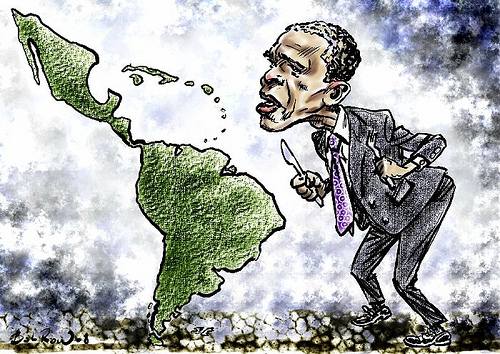
On December 28, US President Barack Obama enacted the so-called “Countering Iran in Western Hemisphere Act” which seeks to undermine Iran´s growing relations with Latin America, a region that has traditionally seen by the United States as its backyard and sphere of influence.
The Act, passed by congressmen earlier this year, requires the US Department of State to develop a strategy within 180 days to “address Iran´s growing hostile presence and activity” in Latin America. The Act points out that “Iran´s business and diplomatic ties are a threat to US national security”. It is seen, however, as another anti-Iranian move fabricated by the Zionist lobby in the US.
Shortly before, in July 2011, Robert F. Noriega – former Assistant Secretary of State for Western Hemisphere affairs, former US ambassador to the Organization of American States (OAS) and current Visiting Fellow at the American Enterprise Institute, one of the main neoconservatives -controlled entities in the US – said in a hearing before the House Subcommittee on Counterterrorism and Intelligence that Iran was carrying out “an offensive strategy” in Latin America.
The Iranian presence in the Latin America has also been harshly attacked by the pro-Israeli hawk Ileana Ros-Lehtinen, Foreign Affairs Committee Chairman and self-appointed bulwark against the alleged “Islamo-Boliviarian threat” to US security. She was co-star of a so-called “documentary” entitled “La amenaza iraní” (The Iranian Threat), in which she said, without blushing, that the US should attack Iran in order to “avert bomb explosions in various Latin American capitals”. The film was aired by Univision, a US broadcast network, which is owned by someone who has hosted galas in honour of the occupying Israeli army.
In 2009, another ridiculous “documentary” released by Univision involved the Venezuelan consul in Miami, Livia Acosta, in an absurd cyber-plot against the US allegedly promoted by “Iranian diplomats and Mexican computer hackers”. This was the pretext used for expelling her from the United States in a move that was widely seen as an American political revenge for Venezuela´s independent foreign policy.
Actually, the US Act rudely violates Latin American countries´ sovereignty and contains some stupid claims such as that the opening of Iranian embassies or cultural centers is to “spread terrorism”. Former Defense Secretary Leon Panetta also echoed those views by claiming, in a recent visit to Colombia, that Iranian attempts to expand its influence in South America amounted to expanding terrorism. Of course, no real evidence has ever been shown to support that laughable allegation.
“The paranoid nature of these estimations, and the scant evidence presented for them, are eerily reminiscent of the kind of broad-strokes, hawkish fear-mongering on display in the lead up to the war in Iraq. The testimony comes from a group bent on hyping security threats and, as Noriega admitted in the testimony, is not even in agreement with the State Department or intelligence agencies”, wrote John Glaser in a recent report.
The US accusations against Iran are also a way of targeting and casting suspicion on Latin American Muslims. In the Act, Washington speaks of “isolating Iran and its allies” and US officials accuse Iran or other pro-Iranian forces of “establishing mosques or Islamic centers throughout the region” in order to advance violent jihad “on our doorstep”.
US declining influence in Latin America
However, Latin American people know well that for over a hundred years it was the United States, and not another country, which wrought terror, war, poverty and repression throughout Latin America in the form of CIA-orchestrated military coups and support of paramilitary crimes, terrorism and dictatorial regimes. Military personnel found guilty of the worst violations of human rights in Latin American countries were trained in the notoriously famous School of Americans by US officers.
Actually, the Act is more evidence that US influence in Latin America is rapidly waning. Latin American countries have developed their own policies and set up independent blocks -ALBA, UNASUR and CELAC- while the Organization of American States, which includes the US and Canada, has been declining due to its submission to US policies on issues such as Cuba´s participation in its summits.
Iran has been seeking to increase its relations with Latin America in a bilateral way and in the framework of the Non-Aligned Movement and other international organizations. This has irritated Washington, which still seems to consider Latin American countries as vassals not having the right to pursue an independent foreign policy or seek its own friends and partners. Any agreement between Latin American states and Iran –or Russia and China- always arouses suspicion in the US.
Several Latin American countries have enhanced their diplomatic and trade ties with Iran in recent years, while their relations with the US have been downgraded amid popular demands for an end to dependence on Washington. Although the United States is still the largest economic partner of many Latin American countries, its economic and financial crisis has adversely affected them. This has led some nations, such as Mexico, to announce their intention to diversify their commercial partners in the next years.
As an international partner, the Islamic Republic is one of the best positioned to help Latin American countries develop their economies and their scientific and technological skills in many fields. The Iranian industry is highly developed. It has remarkable expertise in oil and gas exploitation and other sectors including health, defence, agriculture and space technology.
Iran has helped Venezuela build unmanned drone aircraft as part of their military cooperation. Referring to a Spanish media report that US prosecutors were investigating drone production in Venezuela, President Hugo Chavez said: “Of course we are doing it, and we have the right to. We are a free and independent country.”
In a televised speech to military officers at Venezuela´s Defense Ministry, Chavez said the aircraft only had a camera and was exclusively for defensive purposes. He said that Venezuela planned to soon begin exporting the unmanned drone. Moreover, Iran and Venezuela have mutual investments of about $ 5 billion in factories to make cement, satellites and tractors and the Iranians have helped the Latin American country build 14,000 houses.
Tehran has forged significant economic and political relations with the government of Evo Morales in Bolivia and with that of Rafael Correa in Ecuador. Iran´s links with Argentina, where Zionist circles have unsuccessfully tried to blame Iran for the AMIA attack in 1994, are also rapidly improving, as the government of President Cristina Fernandez is promoting a more conciliatory line towards Tehran.
Latin American countries, especially those that follow an independent foreign policy, trust Iran because they know that the Iranians cannot be pressured into betraying an agreement that disturbs the US or its allies. This is a main reason of Iran´s rising popularity in Latin America despite the propaganda of Zionist-owned media outlets and the US political and diplomatic actions.
HispanTV, the Spanish-language channel similar to the English-language Press TV channel, is also feared by the US establishment and Zionist circles because it is giving Latin American audiences accurate information about the Middle East and international developments that exposes the lies of Zionist-controlled agencies and media. The recent expulsion of Hispan TV from the Spanish-owned Hispasat channel is, in this sense, a desperate attempt to prevent the channel from reaching mass audiences. However, this move, as other similar ones in the past, is doomed to failure.
Therefore, Latin American nations won´t allow the US to dictate their foreign policy on the issue of their relations with Iran or any other country. In fact, Washington has already had a sign of this when it tried to pressure these countries to vote against Palestine’s bid to gain the status of a non-member state at the United Nations. Only one country, Panama, whose government has strong links with the Zionist entity and the local Zionist lobby voted against it.
Related articles
- US, Israel instill fears over Iran’s growing influence in Latin America (alethonews.wordpress.com)
- Ecuador to maintain foreign policy, ties with Iran: FM (alethonews.wordpress.com)
EU seeks more privacy pressure on Google, Facebook
RT | January 10, 2013
European Union lawmakers are hoping to pressure internet giants such as Facebook and Google, to boost personal security controls and limit the collection of data without users consent.
A German MEP has proposed modifications to the 1995 Data Protection Act, suggesting legislation that would limit corporations’ ability to use and sell data, such as browsing habits, especially when users are unaware of the practice.
“Users must be informed about what happens with their data,” said Jan Philipp Albrecht, a German Green Party MEP. “And they must be able to consciously agree to data processing – or reject it.”
EU justice commissioner Viviane Reding noted that she is “glad to see that the European Parliament rapporteurs are supporting the Commission’s aim to strengthen Europe’s data protection rules, which currently date back to 1995 – pre-Internet age.”
“A strong, clear and uniform legal framework will help unleashing the potential of the Digital Single Market and foster economic growth, innovation and job creation in Europe,” she added.
The report by the German MEP adds to a proposal for tougher data protection announced by the European Commission last January. The European Parliament, the European Commission and the bloc’s 27 nations say they will seek an agreement on the rules in the coming months.
Google and Facebook – who were among the first corporations to profit from user data – have been lobbying against any such moves in the European Union. The Internet goliaths have warned legislators that such laws may hamper innovation and harm business.
“We are concerned that some aspects of the report do not support a flourishing European digital single market and the reality of innovation on the Internet,” Erika Mann, head of EU policy for Facebook, said.
Meanwhile, the Industry Coalition for Data Protection, an ICT lobby group, stated that Albrecht had “missed an opportunity to reconcile effective privacy safeguards with rules protecting the conduct of business — both fundamental rights under the EU charter.”
The European Union frequently raises the issue of privacy controls, causing standoffs with major American corporations.
In September, in another standoff over privacy issues, Facebook was forced to remove its facial recognition software from the social network in Europe in order to comply with European data protection laws. This followed an investigation by the Office of the Data Protection Commissioner in Ireland.
Related articles
- Facebook, Google May Face More Data-Use Limits, EU Lawmaker Says (bloomberg.com)
- EU Seeks More Privacy Pressure On Google, Facebook (eurasiareview.com)
- Facebook and Google may be forced to ask permission to use personal data (guardian.co.uk)
Crashed US reconnaissance drone found in Philippine waters
Press TV – January 7, 2013
A US-made reconnaissance drone has been recovered in waters off Ticao Island of the Philippines, a navy official says.
Captain Rommel Jason Galang, a Philippine navy commander, said the drone was recovered on Monday, after it was found by fishermen floating near the island.
Galang also said the navy had deployed a ship with ordnance experts to the scene after the fishermen reported that the 3.65-meter object could have been a bomb.
“We will first study this drone but initially it appears to be a UAV used largely in reconnaissance,” he stated, adding that it was not clear why the BQM-74E drone had crashed.
The US embassy in Manila was informed of the discovery of the drone, which is expected to be turned over to US authorities.
The Philippines has seen a resurgence of US troops since late 2011, when the White House announced a turn in Washington’s foreign, economic and security policy toward the region.
Some 600 US soldiers have been stationed in the southern Philippines since 2002 to train local troops there.
Philippine President Benigno Aquino said last year that US drones were allowed to fly over the country for reconnaissance purposes.
Related articles
- US Drone Crashes Off Masbate Waters (rappler.com)
Featured Video

Houthis Don’t Have to Conquer Saudi Arabia to Make It Pay
or go to
Aletho News Archives – Video-Images
From the Archives
A Lesser “Grade” of Human
By Michael Hoffman | Revelation of the Method | January 3, 2024
Will the more than 100 Iranians killed by terrorist bombs today be mourned in the West as victims of terrorism? Certainly not. Allied doctrine has it that the killing of Israeli or American civilians is a crime of cosmic proportions, while shedding the blood of “enemy” women and children is perfectly acceptable; indeed commendable.
The West does not memorialize the hundreds of thousands of civilians bombed by the U.S. in Serbia, Iraq, Afghanistan and every major German city 1943-1945. America’s fire-bombing of the city of Tokyo by General Curtis LeMay in March 1945 was followed by Harry Truman’s atomic incineration of Hiroshima and Nagasaki in August of that year. Truman never had a moment of doubt or regret over the murder of more than a 100,000 Asian children, mothers and non-combatant boys and men. It was business as usual for the “noble” Allies during the “Good War.”
In the West human rights signifies passionate concern only for civilians designated as truly human: Israelis first, then Americans and British, followed by their satraps.
This inhumanity is the legacy of Talmudic ideology, beginning with tractate Sanhedrin 57a from 400 A.D., concerning liability for capital punishment: “If a Jew murders a gentile, he is exempt.”
This teaching of contempt was reiterated in the dogma of Chabad Lubavitch founder Rabbi Shneur Zalman in the 18th century. … continue
Blog Roll
 Aletho News
- Houthis Don’t Have to Conquer Saudi Arabia to Make It Pay
- MOE: Nearly 22,000 Students and Education Workers Killed
- Guterres in Islamabad: Genocide, cowardice, and the cage of Imran Khan
- Johnson, Marandi say Yemen holds upper hand over Saudi Arabia
- False flags won’t save aggressors, Iran FM spokesman says
- The Makkah Pact Enters Into Force: The End of American Dominance or Its New Form?
- NATO’s top generals gather in Kiev
- EU’s continuing expansion – greater threat to Russia
- US Senator Murphy says Pentagon denied him entry to US base in Qatar
- Israel expands “incitement” charge to target Palestinian education and memory
- If Americans Knew
- Three Years of Genocide: How America’s Israel-First Media Filtered Out the Truth
- Israeli war chief briefs ministers on potential war against Palestinian Authority
- New Report: Israel Killed nearly 21,000 Palestinian Students and Education Workers in Past Three Years
- Israel’s flailing chatbot army
- Five Palestinians Killed, Others Injured by Israeli Fire in Gaza
- Israel is rewriting the Palestinian curriculum in East Jerusalem to erase Palestinian identity
- Three years of genocide: Israel turned prisons into killing grounds and torture sites
- Three years of genocide. Words fail. Daily Update
- ‘I’d rather die than go back’: A Palestinian teen’s 10-month nightmare in Israeli jail
- How Jared Kushner’s firm’s investment in an Israeli company could be a major conflict of interest
- No Tricks Zone
- New Study: 50 Years Of The Most Aggressive ‘Net Zero’ Policies Can Only Affect The Global Climate By 0.03°C
- US September “Heat” Was No Record…Many Records Set Decades Ago
- Latest European Green Energy Debacle; Portugal’s Largest Flagship Solar Park Insolvent!
- Green Energy Debacle: German Expert Professor Fritz Vahrenholt Warns Of Severe Economic And Social Consequences
- Two More Paleo Reconstructions Affirm Meters-Higher Sea Levels Across Ireland, Brazil 7000-6000 Years Ago
- New Study: Earth And Venus Surface Warmth Largely Explained By Convection And Lapse Rate, Not CO2 Or Radiation
- 2025 Nature Paper Claiming Worsening Global Drought Gets RETRACTED …Heavily Flawed
- New Study: ‘Global Drought Shows No Detectable Recent Acceleration Under Climate Warming’
- Economic Masterminds: German Socialists Suggest Taxing Productivity Gains Stemming From Using AI
- The South China Sea Has Not Been Cooperating With The Climate Change Narrative

