Israeli Soldiers Attack, Evict, Bab Al-Shams, Arrest Dozens
By Saed Bannoura | IMEMC News | January 13, 2013
On Saturday at dawn thousands of Israeli soldiers and policemen attacked the Bab Al-Shams Palestinian village, installed east of in occupied East Jerusalem, and forcibly removed dozens of activists loading them into buses.
The soldiers dragged several activists onto the ground, attacked reporters and journalists and declared the area a closed military zone, several injuries were reported.
The Israeli decision to evacuate the village came, on Saturday, through a direct order issued by Israeli Prime Minister, Benjamin Netanyahu, and his right-wing fundamentalist cabinet.
Israeli daily, Haaretz, reported that by midnight Saturday, the order was signed by Osnat Mandel, head of the Israeli High Court division of the Justice Ministry, under the claim that “the people and the tents must be removed due to security considerations”.
The Israeli Police said that the eviction order, issued by the court, prohibits the army from removing the tents, but orders the removal of the people staying there.
Also, the so-called Israeli Civil Administration Office, run by the occupation in the West bank, claimed that the Palestinian tent village “was installed on state land”.
But four Bedouin families living in the area confirmed that they own the land, and even showed deeds proving ownership.
Dr. Mustafa Barghouthi, secretary-general of the Palestinian National Initiative, who was also at the Palestinian village, stated that hundreds of Israeli soldiers invaded the village after surrounding it, and attacked the nonviolent activists camped there, and started kidnapping them.
The soldiers violently attacked the residents, including journalists, elderly and women, and dragged several residents onto the ground.
The soldiers repeatedly interrupted the work of local reporters, flashing their lights onto the camera, and pushing the reporters away, and dragged dozens of activists into buses that were brought by the army to the area.
On Saturday evening, Israeli Prime Minister, Benjamin Netanyahu, ordered the army “to remove the Palestinians and their supporters from the Palestinian outpost” that was installed on privately-owned Palestinian lands to send a message to Israel and the entire world that this land is the land of Palestine, and the Palestinian people have the right to inhabit it.
The army installed dozens of roadblocks around the area to prevent Palestinian traffic and surrounded the Bab Al-Shams camp where around 200 activists installed around 20 tents declaring the Bab Al-Shams Palestinian village, in the area where Israel illegally declared it intends to build thousands of homes for Jewish settlers, east of occupied east Jerusalem.
The Israeli decision to build the illegal settlements in the occupied state of Palestine came after the Palestinians managed to obtain an observer state status at the UN – General Assembly.
The Israeli decision was met with international condemnation, but the settler-led government of Benjamin Netanyahu, approved the illegal settlement project.
The so-called E1 settlement project aims at linking the Maale Adumim illegal settlement, where 35,000 reside, with occupied East Jerusalem, thus illegally confiscating Palestinian lands and blocking geographical continuity in the occupied West Bank.
This illegal Israeli project would divide the West Bank into two parts, and would completely isolate it from occupied East Jerusalem, an issue that would prevent the establishment of a viable Palestinian state.
Abdullah Abu Rahma, a Palestinian nonviolent activist from the West Bank village on Bil’in, who was also detained when the army attacked and evicted Bab Al-Shams, stated that this village is on private Palestinian land, and that the Palestinians are not invading anybody’s property, as they are establishing a village in the land of Palestine.
“We tied our hands, chained ourselves with each other to prevent the soldiers from removing us”, Abu Rahma said, “The Soldiers violently attacked us, beat us, and injured at least 10”
He added that there will be more nonviolent activities, and that the struggle for Bab Al-Shams, the nonviolent struggle for the liberation of Palestine will continue as the Palestinians are practicing their internationally-guaranteed right.
It is worth mentioning that the Palestine TV was live streaming from Bab Al-Shams, and the army repeatedly tried to interrupt the stream, pushing the reporters, and using large flashlight, pointing them against the camera to disrupt the images.

Wounded Journalist Hafeth Ibrahim
Related articles
- Palestinians Establish a new Village, Bab Alshams, in Area E1 (alethonews.wordpress.com)
Why Latin America Will Not Bow to US Pressure over Iran
By Yusuf Fernandez | Al-Manar | January 11, 2013
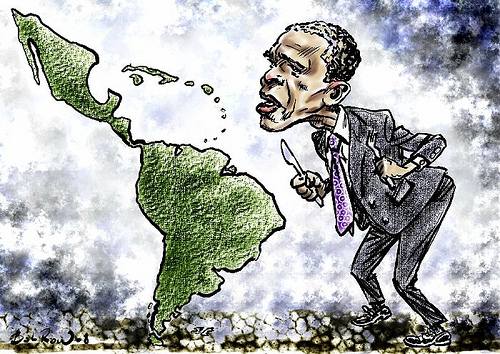
On December 28, US President Barack Obama enacted the so-called “Countering Iran in Western Hemisphere Act” which seeks to undermine Iran´s growing relations with Latin America, a region that has traditionally seen by the United States as its backyard and sphere of influence.
The Act, passed by congressmen earlier this year, requires the US Department of State to develop a strategy within 180 days to “address Iran´s growing hostile presence and activity” in Latin America. The Act points out that “Iran´s business and diplomatic ties are a threat to US national security”. It is seen, however, as another anti-Iranian move fabricated by the Zionist lobby in the US.
Shortly before, in July 2011, Robert F. Noriega – former Assistant Secretary of State for Western Hemisphere affairs, former US ambassador to the Organization of American States (OAS) and current Visiting Fellow at the American Enterprise Institute, one of the main neoconservatives -controlled entities in the US – said in a hearing before the House Subcommittee on Counterterrorism and Intelligence that Iran was carrying out “an offensive strategy” in Latin America.
The Iranian presence in the Latin America has also been harshly attacked by the pro-Israeli hawk Ileana Ros-Lehtinen, Foreign Affairs Committee Chairman and self-appointed bulwark against the alleged “Islamo-Boliviarian threat” to US security. She was co-star of a so-called “documentary” entitled “La amenaza iraní” (The Iranian Threat), in which she said, without blushing, that the US should attack Iran in order to “avert bomb explosions in various Latin American capitals”. The film was aired by Univision, a US broadcast network, which is owned by someone who has hosted galas in honour of the occupying Israeli army.
In 2009, another ridiculous “documentary” released by Univision involved the Venezuelan consul in Miami, Livia Acosta, in an absurd cyber-plot against the US allegedly promoted by “Iranian diplomats and Mexican computer hackers”. This was the pretext used for expelling her from the United States in a move that was widely seen as an American political revenge for Venezuela´s independent foreign policy.
Actually, the US Act rudely violates Latin American countries´ sovereignty and contains some stupid claims such as that the opening of Iranian embassies or cultural centers is to “spread terrorism”. Former Defense Secretary Leon Panetta also echoed those views by claiming, in a recent visit to Colombia, that Iranian attempts to expand its influence in South America amounted to expanding terrorism. Of course, no real evidence has ever been shown to support that laughable allegation.
“The paranoid nature of these estimations, and the scant evidence presented for them, are eerily reminiscent of the kind of broad-strokes, hawkish fear-mongering on display in the lead up to the war in Iraq. The testimony comes from a group bent on hyping security threats and, as Noriega admitted in the testimony, is not even in agreement with the State Department or intelligence agencies”, wrote John Glaser in a recent report.
The US accusations against Iran are also a way of targeting and casting suspicion on Latin American Muslims. In the Act, Washington speaks of “isolating Iran and its allies” and US officials accuse Iran or other pro-Iranian forces of “establishing mosques or Islamic centers throughout the region” in order to advance violent jihad “on our doorstep”.
US declining influence in Latin America
However, Latin American people know well that for over a hundred years it was the United States, and not another country, which wrought terror, war, poverty and repression throughout Latin America in the form of CIA-orchestrated military coups and support of paramilitary crimes, terrorism and dictatorial regimes. Military personnel found guilty of the worst violations of human rights in Latin American countries were trained in the notoriously famous School of Americans by US officers.
Actually, the Act is more evidence that US influence in Latin America is rapidly waning. Latin American countries have developed their own policies and set up independent blocks -ALBA, UNASUR and CELAC- while the Organization of American States, which includes the US and Canada, has been declining due to its submission to US policies on issues such as Cuba´s participation in its summits.
Iran has been seeking to increase its relations with Latin America in a bilateral way and in the framework of the Non-Aligned Movement and other international organizations. This has irritated Washington, which still seems to consider Latin American countries as vassals not having the right to pursue an independent foreign policy or seek its own friends and partners. Any agreement between Latin American states and Iran –or Russia and China- always arouses suspicion in the US.
Several Latin American countries have enhanced their diplomatic and trade ties with Iran in recent years, while their relations with the US have been downgraded amid popular demands for an end to dependence on Washington. Although the United States is still the largest economic partner of many Latin American countries, its economic and financial crisis has adversely affected them. This has led some nations, such as Mexico, to announce their intention to diversify their commercial partners in the next years.
As an international partner, the Islamic Republic is one of the best positioned to help Latin American countries develop their economies and their scientific and technological skills in many fields. The Iranian industry is highly developed. It has remarkable expertise in oil and gas exploitation and other sectors including health, defence, agriculture and space technology.
Iran has helped Venezuela build unmanned drone aircraft as part of their military cooperation. Referring to a Spanish media report that US prosecutors were investigating drone production in Venezuela, President Hugo Chavez said: “Of course we are doing it, and we have the right to. We are a free and independent country.”
In a televised speech to military officers at Venezuela´s Defense Ministry, Chavez said the aircraft only had a camera and was exclusively for defensive purposes. He said that Venezuela planned to soon begin exporting the unmanned drone. Moreover, Iran and Venezuela have mutual investments of about $ 5 billion in factories to make cement, satellites and tractors and the Iranians have helped the Latin American country build 14,000 houses.
Tehran has forged significant economic and political relations with the government of Evo Morales in Bolivia and with that of Rafael Correa in Ecuador. Iran´s links with Argentina, where Zionist circles have unsuccessfully tried to blame Iran for the AMIA attack in 1994, are also rapidly improving, as the government of President Cristina Fernandez is promoting a more conciliatory line towards Tehran.
Latin American countries, especially those that follow an independent foreign policy, trust Iran because they know that the Iranians cannot be pressured into betraying an agreement that disturbs the US or its allies. This is a main reason of Iran´s rising popularity in Latin America despite the propaganda of Zionist-owned media outlets and the US political and diplomatic actions.
HispanTV, the Spanish-language channel similar to the English-language Press TV channel, is also feared by the US establishment and Zionist circles because it is giving Latin American audiences accurate information about the Middle East and international developments that exposes the lies of Zionist-controlled agencies and media. The recent expulsion of Hispan TV from the Spanish-owned Hispasat channel is, in this sense, a desperate attempt to prevent the channel from reaching mass audiences. However, this move, as other similar ones in the past, is doomed to failure.
Therefore, Latin American nations won´t allow the US to dictate their foreign policy on the issue of their relations with Iran or any other country. In fact, Washington has already had a sign of this when it tried to pressure these countries to vote against Palestine’s bid to gain the status of a non-member state at the United Nations. Only one country, Panama, whose government has strong links with the Zionist entity and the local Zionist lobby voted against it.
Related articles
- US, Israel instill fears over Iran’s growing influence in Latin America (alethonews.wordpress.com)
- Ecuador to maintain foreign policy, ties with Iran: FM (alethonews.wordpress.com)
EU seeks more privacy pressure on Google, Facebook
RT | January 10, 2013
European Union lawmakers are hoping to pressure internet giants such as Facebook and Google, to boost personal security controls and limit the collection of data without users consent.
A German MEP has proposed modifications to the 1995 Data Protection Act, suggesting legislation that would limit corporations’ ability to use and sell data, such as browsing habits, especially when users are unaware of the practice.
“Users must be informed about what happens with their data,” said Jan Philipp Albrecht, a German Green Party MEP. “And they must be able to consciously agree to data processing – or reject it.”
EU justice commissioner Viviane Reding noted that she is “glad to see that the European Parliament rapporteurs are supporting the Commission’s aim to strengthen Europe’s data protection rules, which currently date back to 1995 – pre-Internet age.”
“A strong, clear and uniform legal framework will help unleashing the potential of the Digital Single Market and foster economic growth, innovation and job creation in Europe,” she added.
The report by the German MEP adds to a proposal for tougher data protection announced by the European Commission last January. The European Parliament, the European Commission and the bloc’s 27 nations say they will seek an agreement on the rules in the coming months.
Google and Facebook – who were among the first corporations to profit from user data – have been lobbying against any such moves in the European Union. The Internet goliaths have warned legislators that such laws may hamper innovation and harm business.
“We are concerned that some aspects of the report do not support a flourishing European digital single market and the reality of innovation on the Internet,” Erika Mann, head of EU policy for Facebook, said.
Meanwhile, the Industry Coalition for Data Protection, an ICT lobby group, stated that Albrecht had “missed an opportunity to reconcile effective privacy safeguards with rules protecting the conduct of business — both fundamental rights under the EU charter.”
The European Union frequently raises the issue of privacy controls, causing standoffs with major American corporations.
In September, in another standoff over privacy issues, Facebook was forced to remove its facial recognition software from the social network in Europe in order to comply with European data protection laws. This followed an investigation by the Office of the Data Protection Commissioner in Ireland.
Related articles
- Facebook, Google May Face More Data-Use Limits, EU Lawmaker Says (bloomberg.com)
- EU Seeks More Privacy Pressure On Google, Facebook (eurasiareview.com)
- Facebook and Google may be forced to ask permission to use personal data (guardian.co.uk)
Crashed US reconnaissance drone found in Philippine waters
Press TV – January 7, 2013
A US-made reconnaissance drone has been recovered in waters off Ticao Island of the Philippines, a navy official says.
Captain Rommel Jason Galang, a Philippine navy commander, said the drone was recovered on Monday, after it was found by fishermen floating near the island.
Galang also said the navy had deployed a ship with ordnance experts to the scene after the fishermen reported that the 3.65-meter object could have been a bomb.
“We will first study this drone but initially it appears to be a UAV used largely in reconnaissance,” he stated, adding that it was not clear why the BQM-74E drone had crashed.
The US embassy in Manila was informed of the discovery of the drone, which is expected to be turned over to US authorities.
The Philippines has seen a resurgence of US troops since late 2011, when the White House announced a turn in Washington’s foreign, economic and security policy toward the region.
Some 600 US soldiers have been stationed in the southern Philippines since 2002 to train local troops there.
Philippine President Benigno Aquino said last year that US drones were allowed to fly over the country for reconnaissance purposes.
Related articles
- US Drone Crashes Off Masbate Waters (rappler.com)
US renews war on Iranian media
PressTVGlobalNews | January 5, 2013
The United States has imposed fresh sanctions on Iranian media despite Washington’s claims of respecting free speech. Sanctions have all been applied under the umbrella of concern for Iran’s nuclear program becoming militarized. The CIA and IAEA have constantly reported that Iran is not developing nuclear weapons while mainstream American media have promoted that Iran has or is producing a nuclear bomb. Many observers though contend that the many sanctions on Iran are an act of war as part of Western colonialism and imperialism that also serves the Zionists of Israel.
To further discuss the issue, Press TV’s News Analysis has conducted an interview with Joe Iosbaker, Stop FBI Repression, from Chicago, Kevin Barrett, a founding member of the Muslim-Jewish-Christian Alliance, from Wisconsin, and Daniel Pipes, founder and director of the Middle East Forum, from Philadelphia.
Follow our Facebook on: https://www.facebook.com/presstvchannel
Follow our Twitter on: http://twitter.com/presstv
Follow our Tumblr on: http://presstvchannel.tumblr.com
Related articles
- US imposes fresh sanctions on Tehran, including ban on Iranian media (alethonews.wordpress.com)
US imposes fresh sanctions on Tehran, including ban on Iranian media
Press TV – January 4, 2013
The United States has imposed fresh sanctions on Iran that include bans on the country’s media despite Washington’s claims of protecting freedom of speech.
The new bans are included in the $633-billion military bill for 2013 which US President Barack Obama signed into law on Wednesday night.
The anti-Iran sanctions portion of the bill, among other economic features, blacklists the Islamic Republic of Iran Broadcasting (IRIB) and its president Ezzatollah Zarghami and will block all the IRIB assets and prevent others from doing business with it.
The sanction against IRIB is an attempt by the West to silence Iranian media. It is on top of another flagrant violation of freedom of speech by satellite providers Eutelsat SA and Intelsat SA which stopped the broadcast of several Iranian satellite channels in October.
In November, the Hong Kong-based Asia Satellite Telecommunications Co. Ltd. (AsiaSat) also took all Iranian channels off air in East Asia under pressure from the US.
In a similar move in December, Spain’s top satellite company Hispasat ordered its satellite provider Overon to take Iranian channels Press TV and Hispan TV off the air.
The restrictions on Iranian media are interpreted as an attempt to silence the truth-telling media.
This comes as US lawmakers say the fresh anti-Iran sanctions portion of the bill is part of measures aimed at pressuring Iran to halt its nuclear energy program.
The United States, Israel and some of their allies have repeatedly accused Iran of pursuing non-civilian objectives in its nuclear energy program.
Over the false allegation, Washington and the European Union have imposed illegal unilateral sanctions against the Islamic Republic.
Iran refutes the allegations and argues that as a signatory to the Non-Proliferation Treaty and a member of the International Atomic Energy Agency, it is entitled to develop and acquire nuclear technology for peaceful purposes.
Related articles
- US Senate to blacklist and block the assets of Iranian broadcaster IRIB (alethonews.wordpress.com)
Obama continues rendition despite extensive condemnation of tactic

Press TV – January 2, 2013
US President Barack Obama’s administration is continuing rendition, the practice of sending terrorism suspects to third countries for detention and interrogation without due process.
George Bush administration’s practice of rendition is continuing under the Obama administration despite widespread condemnation of the tactic in the years after the September 11, 2001 attacks, the Washington Post reported on Wednesday.
According to the US daily, it is unknown how many renditions have taken place during Obama’s first term due to the secrecy involved but his administration has not disavowed the practice.
In the latest example of Obama administration’s use of the tactic, a number of American interrogates visited three European men with Somali origins in a jail in the small African country of Djibouti. The detainees had been arrested on a vague pretext in August as they were passing through the African country.
US agents accused the three men of supporting Somalia’s al-Shabab group. The prisoners were secretly indicted by a federal grand jury in New York two months after their arrest. They were then clandestinely taken into custody by the FBI and flown to the United States to face trial.
The secret arrests and detentions became known on December 21, when the suspects appeared briefly in a Brooklyn courtroom.
The US government has revealed little about the circumstances of the arrests. The FBI and federal prosecutors for the Eastern District of New York have also not said where and why the defendants were detained.
Human rights advocates have condemned the Obama administration’s decision to continue rendition.
Obama, in his first presidential candidacy, had strongly suggested he might end the practice but the tactic is still continuing under his administration.
Related articles
2012 in Review: Blackout Protests Against Blacklist Bills
By Parker Higgins | EFF | January 1, 2013
Coming into 2012, the Internet community was looking down the barrel of very dangerous legislation that would have created legal structures to silence legitimate speech in the name of curbing online “piracy.” A House bill called the Stop Online Piracy Act (SOPA) and its Senate counterpart, the PROTECT IP Act (PIPA), had been debated, amended, and looked to be on the fast track for legislative approval.
That all changed on January 18. An historic “Blackout Day” protest, loosely coordinated by a coalition of public interest groups, startups, tech companies, and thousands of different websites, resulted in millions of emails and tens of thousands of calls to legislators. As sites across the web turned out their virtual lights at once, an important but otherwise arcane copyright bill became front-page news—and impossible for the content lobby and their favorite legislators to sneak past the public.
There were plenty of reasons to be concerned. After all, Congress has passed 15 laws aimed at stopping “piracy” over the last 30 years—an impressive record given the general absence of actual facts about the problem or the effectiveness of the proposed solutions. And even after an earlier protest, held in November 2011, resulted in nearly 90,000 calls to Congress in one day, SOPA’s author (and Judiciary Committee chair) Lamar Smith seemed intent on pushing the bill through, dismissing the complaints as not being “legitimate.”
But support for the bills began to crumble when met with the magnitude of the blackout protests. Over the course of January 18, people sent nearly a million emails to their legislators through the EFF’s action center alone, and many million more through other sites. Some of the most popular sites on the Internet, like Google, Reddit, and Wikipedia, were among over 100,000 pages dark in protest.
It worked. Angry supporters of the bill may have derided the grassroots action—MPAA chief Chris Dodd called it “dangerous” and a “gimmick,” while RIAA CEO Cary Sherman said it was based on “misinformation” and, strangely, a “misuse of power”—but legislators got the message, and began jumping ship from SOPA and PIPA almost immediately. Within a month, the bills were effectively dead.
The defeat of SOPA and PIPA marked an important victory in an ongoing struggle for copyright policy that’s based on actual facts and real evidence. The January 18 protests, too, served as a template for a new era of online activism. In 2012, we’ve already seen similar battles play out all over the world; in 2013, we’re sure to see even more.
Related articles
- U.S. Congress may not have stomach for another SOPA/PIPA fight (pcworld.com)
- Looking forward: The fight for Internet freedom (rappler.com)
2012 in Review: State Surveillance Around the Globe
By Katitza Rodriguez | EFF | December 31, 2012
All things considered, 2012 was a terrible year for online privacy against government surveillance. How bad was it? States around the world are demanding private data in ever-greater volumes—and getting it. They are recognizing the treasure troves of personal information created by modern communications technologies of all sorts, and pursuing ever easier, quicker, and more comprehensive access to our data. They are obtaining detailed logs of our entire lives online, and they are doing so under weaker legal standards than ever before. Several laws and proposals now afford many states warrantless snooping powers and nearly limitless data collection capabilities. These practices remain shrouded in secrecy, despite some private companies’ attempts to shine a light on the alarming measures states are taking around the world to obtain information about users.
To challenge the sweeping invasions into individuals’ personal lives, we’re calling on governments to ensure their surveillance policies and practices are consistent with international human rights standards. We’re also demanding that governments and companies become more transparent about their use of the Internet in state surveillance.
Signs of Growing International Surveillance in 2012
A new law in Brazil allows police and public prosecutors to demand user registration data from ISPs directly, via a simple request, with no court order, in criminal investigations involving money laundering. And, a new bill seeks to allow the Federal Police to demand registration data of Internet users in cases of crimes without the need of a court order nor judicial oversight.
Colombia adopted a new decree that compels ISPs to create backdoors that would make it easier for law enforcement to spy on Colombians. The law also forces ISPs and telecom providers to continuously collect and store for five years the location and subscriber information of millions of ordinary Colombian users.
Leaked documents revealed that the Mexican government shelled out $355 million to expand Mexican domestic surveillance equipment over the past year.
The Canadian government put proposed online surveillance legislation temporarily “on pause” following sustained public outrage generated by the bill. The bill introduces new police powers that would allow authorities easy access to Canadians’ online activities, including the power to force ISPs to hand over private customer data without a warrant.
The EU’s overarching data retention directive has become a dangerous model for other countries, despite the fact that several European Courts have declared several national data retention laws unconstitutional.
Romania went ahead with adopting a new data retention mandate law without any real evidence or debate over the right to privacy, despite the 2009 Constitutional Court ruling declaring the previous data retention law unconstitutional.
The German government is proposing a new law that would allow law enforcement and intelligence agencies to extensively identify Internet users, without any court order or reasonable suspicion of a crime. This year, more details were found on German State Trojan Program to spy on and monitor Skype, Gmail, Hotmail, Facebook and other online communications.
The UK government is considering a bill that would extend the police’s access to individuals’ email and social media traffic data. The UK ISPs will be compelled to gather the data and allow the UK police and security services to scrutinize it.
A Dutch proposal seeks to allow the police to break into foreign computers and search and delete data. If the location of a particular computer cannot be determined, the Dutch police would be able to break into it without ever contacting foreign authorities. Another Dutch proposal seeks to allow the police to force a suspect to decrypt information that is under investigation in a case of terrorism or sexual abuse of children.
In Russia, several new legal frameworks or proposed bills enable increased state surveillance of the Internet.
Australian law enforcement and intelligence agencies have continued to advance the false idea of the need for data retention mandates, mandatory backdoors for cloud computing services and the creation of a new crime for refusing to aid law enforcement in the decryption of communications.
A controversy arose in Lebanon over revelations that the country’s Internal Security Forces (ISF) demanded the content of all SMS text messages sent between September 13 and November 10 of this year, as well as usernames and passwords for services like Blackberry Messenger and Facebook.
The Rwandan Parliament is discussing a bill that will grant sanctions the police, army and intelligence services the power to listen to and read private communications in order to protect “public security”, the keyword often invoked to justify unnecessary human rights violations.
Pakistan adopted a Fair Trial Bill authorizing the state to intercept private communications to thwart acts of terrorism. No legal safeguards have been built in to prevent abuse of power and the word “terrorism” has been poorly defined (a word that’s often invoked to justify unnecessary human rights violations).
RIM announced that they had provided the Indian Government with a solution to intercept messages and emails exchanged via BlackBerry handsets. The encrypted communications will now be available to Indian intelligence agencies.
The Indian government approved the purchase of technological equipment to kickstart the National Intelligence Grid (NATGRID)—a project that seeks to link databases for ready access by intelligence agencies. The project is expected to facilitate “robust information sharing” by security and law enforcement agencies to combat terror threats.
Moving Forward
EFF’s international team and a coalition of civil society organizations around the world have drafted a set of principles that can be used by civil society, governments and industry to evaluate whether state surveillance laws and practices are consistent with human rights. In 2013, we will continue demanding that states adopt stronger legal protections if they want to track our cell phones, or see what web sites we’ve visited, or rummage through our Hotmail, or read our private messages on Facebook, or otherwise invade our electronic privacy. EFF will keep working collaboratively with advocates, lawyers, journalists, bloggers and security experts on the ground to fight overbroad surveillance laws. Our work will involve existing legislative initiatives, international fora, and other regional venues where we can have a meaningful impact on establishing stronger legal protections against government access to people’s electronic communications and data.
Related articles
- Colombia Adopts Mandatory Backdoor and Data Retention Mandates (informationliberation.com)
- Do we need the Snooper’s Charter to save lives? (pcpro.co.uk)
- ISP Walks Out of Piracy Talks: “We’re Not The Internet Police” (torrentfreak.com)
Honduras: Miguel Facusse is Tragically Misunderstood
By Dan Beeton | CEPR | December 21, 2012
The Los Angeles Times’ Tracy Wilkinson conducted a rare interview with Miguel Facussé Barjum, considered by many to be the most powerful man in Honduras, and also believed to be behind the killings of dozens of campesinos in the Aguan Valley, where Facussé has extensive land holdings. He has been the subject of much recent scrutiny, as Wilkinson notes, especially following the assassination of attorney Antonio Trejo Cabrera, who worked on behalf campesino organizations in the Aguan. Wilkinson describes some of the allegations and criticism leveled at Facussé from members of the U.S. Congress and human rights organizations:
In October, shortly before he lost reelection, U.S. Rep. Howard L. Berman (D-Valley Village) took the unusual step of singling out Facusse in a letter to Secretary of State Hillary Rodham Clinton. Berman demanded a major overhaul of U.S. policy toward Honduras, including suspension of aid to human rights abusers. He repeated Trejo’s accusation, calling for an investigation of Facussé.
“It is breathtaking that Facusse has been so untouchable,” said a House of Representatives staffer with knowledge of the issue, who spoke anonymously in keeping with Washington protocol.
The New York-based Center for Constitutional Rights, in filings with the International Criminal Court, alleges that Facusse may have committed “crimes against humanity” in the killings of Trejo and several peasant farmers.
As we have previously noted, Facussé has admitted the killings of some campesinos by his security forces. A 2011 human rights report from the FoodFirst Information and Action Network, the International Federation for Human Rights and other groups details a number of killings, kidnappings, torture, forced evictions, assaults, death threats and other human rights violations that victims, witnesses and others attribute to Facussé’s guards. In May this year, Reporters Without Borders declared Facussé to be a “predator” of press freedom. Facussé’s response has sometimes been to threaten to sue for defamation. As he explains in the LA Times article, “He said he considered suing Berman but was advised by friends that legal action would be a waste of time.”
Perhaps seeing the limits to suing for defamation when the allegations are supported by evidence, Facussé, it appears, wanted to sit down with Wilkinson in order to set the record straight. He explains that, while yes, his airplane was “was used to illegally carry the foreign minister out of the country against her will” during the 2009 coup d’etat; and yes, drug planes have used his property to traffic cocaine; and yes, he normally keeps a pistol on his desk; and yes, he “keeps files of photos of the various Honduran activists who are most vocal against him,” and yes, he was aware of the plans for the 2009 coup in advance – he’s misunderstood. One has to appreciate the tremendous pathos as Facussé laments, “My name is mud all over the world,” he said. “I’m the bad guy in the world.”
And
As for the allegations of involvement in the lawyer’s killing?
“I probably had reasons to kill him,” he said, “but I’m not a killer.”
Featured Video

Diplomacy is Now a Crime in Britain / Ian Proud
or go to
Aletho News Archives – Video-Images
From the Archives
Genetic baloney in thick slices
MAYBE COULD BE INC.
By Jon Rappoport | No More Fake News | July 8, 2021
Gene research companies tend to come and go. They start out banging and popping like fireworks in the sky, and then they fade out—selling themselves to larger outfits who’ve hired better liars…
Once upon a time, it sounded easy. Start with a disease, find the gene responsible for the disease, and correct the problem.
Then, researchers wondered, was disease the result of one gene or a group of genes acting together?
Either way, the proof would be in devising cures for diseases using gene therapy. “Not yet, but soon…”
And regardless, the major need was: money. Lots and lots of money.
This need required good PR people. “We have to pump up the idea that we’re on the edge of tremendous breakthroughs. We’re always on that edge…”
This hype also needed to obscure the fact that there wasn’t (and isn’t) ANY gene cure for ANY disease. … continue
Blog Roll
 Aletho News
- Diplomacy is Now a Crime in Britain / Ian Proud
- UK Government Body Kept Files on People Criticizing Prevent Program
- US military withdrawal from Iraq and the collapse of US-Israeli hegemonic project in West Asia
- What does Europe want – a war with Russia?
- She Followed the Actual Data on COVID Vaccines and Masks — Her Career Took a Huge Hit
- Florida AG Sues Pfizer, Bourla Over Deceptive Marketing of COVID Vaccines
- Von der Leyen gifts her spin doctor a job for life
- 10K More U.S. Troops Deploy as Trump Weighs New Iran Strikes /Suliaman Ahmed
- Iranian crew declared Dena training vessel ‘unarmed’ to US warship before deadly torpedo strike: Report
- Iran’s NPT debate moves beyond parliament
- If Americans Knew
- Israel is squeezing the life out of Palestinians – Daily Update
- The Israeli Right Portrays Islam as Murderous. It Serves a Political Purpose
- Jordan Has Had Enough: King Abdullah’s Scathing Warning to Israel
- Israeli Colonizers (i.e. Settlers) Kill Palestinian Man Near Salfit
- New Google Maps images reveal massive scale of devastation in Gaza
- Jewish supremacy, anti-Palestinian bigotry on display in Israel – Daily Update
- Israeli Soldiers Abduct At Least 22 Across Occupied West Bank
- Eight Palestinians Killed in Israeli Attacks on Gaza
- Israeli former leaders and security chiefs threaten legal action over ‘Jewish terrorism’
- Israel map in LA Times ad includes all land from the river to the sea
- No Tricks Zone
- Green Energy Debacle: German Expert Professor Fritz Vahrenholt Warns Of Severe Economic And Social Consequences
- Two More Paleo Reconstructions Affirm Meters-Higher Sea Levels Across Ireland, Brazil 7000-6000 Years Ago
- New Study: Earth And Venus Surface Warmth Largely Explained By Convection And Lapse Rate, Not CO2 Or Radiation
- 2025 Nature Paper Claiming Worsening Global Drought Gets RETRACTED …Heavily Flawed
- New Study: ‘Global Drought Shows No Detectable Recent Acceleration Under Climate Warming’
- Economic Masterminds: German Socialists Suggest Taxing Productivity Gains Stemming From Using AI
- The South China Sea Has Not Been Cooperating With The Climate Change Narrative
- Energy Crisis: Germany Enters Heating Season With Historically Low Gas Reserve Fill Levels
- New Study: The Antarctic Ice Sheet Gained Mass From 2020-2024 Due To Staggering Snow And Ice Accumulation
- Study: Ocean Heating Rates From Thousands Of Years Ago ‘Dwarf’ Modern Ocean Heating Rates

