Bahrain bans main opposition daily
Press TV – April 3, 2011
The Bahraini government has banned the publication of a leading independent newspaper due to its coverage of the popular revolution in the Persian Gulf littoral state.
Bahrain’s Information Affairs Commission suspended Al-Wasat daily, which has been critical of the government’s brutal crackdown on demonstrators in the country, BNA state news agency reported without giving further details.
The commission also ordered a case to be opened for further investigation by the Public Prosecution.
Masur al-Jamri, a former opposition activist during the uprising in the 1990s, is the editor-in-chief of the Bahraini newspaper.
Last week, Bahrain’s state television accused Al-Wasat of publishing “fabricated and false news” about the “security developments in Bahrain.”
The Bahraini police, backed by Saudi and UAE troops, have intensified the clampdown on anti-government protesters who demand a constitutional monarchy.
Rights groups and opposition parties say hundreds of people have been detained or have gone missing since the protests began in mid-February, with at least 25 people killed and 1,000 others wounded so far.
London set to limit right to protest
Press TV – March – 29, 2011
The British government has announced controversial plans to ban protestors from taking part in public gatherings following the weekend anti-cuts rallies, which were marred by violence.
Based on a proposal by Home Secretary Theresa May, the police may be given new powers to prevent so-called hooligans from attending rallies and marches while officers will also be authorized to force demonstrators, who do not want to be known, to remove their face-scarves and balaclavas.
The announcement has raised concerns among MPs who say no hasty decision should be made on the issue as the police may abuse the “stop and search” powers to target ordinary people rather than “known hooligans”.
May outlined her plans during an emergency Commons briefing on the violent incidents, which marred the Saturday rally organized by the Trades Union Congress.
May told the MPs that she is considering “banning orders” similar to those used against football hooligans for the demonstrators who police think may turn to violence.
She also said officers should force more protestors to remove their masks and balaclavas to help the police quickly identify participants in the rallies.
“Just as the police review their operational tactics, so the Home Office will review the powers available to the police. I have asked the police whether they need further powers to prevent violence before it occurs. I am willing to consider powers which would ban known hooligans from rallies and marches and I will look into the powers the police already have to force the removal of face-coverings and balaclavas,” May said.
While the Metropolitan Police earlier said it has charged 149 people out of more than 200 arrested during the Saturday rallies with various offenses, at least five people have lodged complaints with Scotland Yard about police violence against marchers.
The Met said on Monday that it has charged 138 people in connection with the sit-in at Fortnum & Mason luxury store for charges including aggravated trespass.
However, the UK Uncut, which organized the sit-in dismissed any claims that those participating in the Fortnum & Mason incident resorted to violence.
“This was not a protest by people wearing balaclavas and breaking things. It was a peaceful and mild-mannered gathering by people from all walks of life – teachers, hospital workers, charity workers,” said Tim Matthews, a spokesman for UK Uncut.
“People who took part now find themselves charged with a criminal offence simply for exercising their right to protest,” he added.
This comes as Tom Brake MP, co-chair of the Liberal Democrat parliamentary policy committee on home affairs, justice and equalities, warned the government against “a knee-jerk reaction” to what happened.
“Clearly there was a small minority who were out to cause trouble. We need to look in detail into whether the police have sufficient powers to tackle that, or whether they can be deployed differently to ensure such violent scenes don’t happen again,” Brake said.
Facebook removes third intifada page after Israeli calls
Palestine Information Center – 30/03/2011
NAZARETH — The Facebook administration has responded to calls to have a page calling for a third Intifada removed from the social website for good.
The page with a fan base exceeding 340,000 urged Palestinians to take to the streets to mark the anniversary of the Nakba on May 15.
The move came after Israeli minister Yuli Edelstein wrote to Facebook founder Mark Zuckerberg claiming that the page contained incitement against Jews and Israelis.
He said the page could help spark an ”armed rebellion” against Israel.
The page’s organizers had expressed fears that Facebook would shut down the page after the Free Palestine page, which had earned 216,000 fans, was closed without explanation.
They had threatened to boycott Facebook if it responded to the calls to close the page. They have contacted the administrators of popular Arab pages who had agreed to promote the third Intifada page.
They had also said the page’s closure would reveal Facebook’s true colors to the world, as it was the largest Palestinian site to date placed on the most important social website in the world.
The page used many innovative ideas to promote the third intifada. They included writing the set time for it on the currency and asking each of its fans to inform at least five friends of the due date.
False Symmetry: Teaching Holocaust in Gaza Schools

A set of historical ironies arises from this absurd report. (UNRWA)
By Seraj Assi | Palestine Chronicle | March 27, 2011
Spring has turned red in Gaza with a new Israeli massacre. Late Monday night Israeli combat planes pounded Northern Gaza and murdered two children and three adults whose only crime was playing football in front of their house. At the same day Haaretz published a report complaining that Hamas protests UN plans to teach Gazans about the Holocaust. It was also the very day that the Knesset in Israel approved the Nakaba Law, an absurd legislation that bans Palestinian citizens from commemorating the Nakba.
This is no mere coincidence. Nor is it the first time that Israel’s massacring of Palestinian children is followed by absurd demands to teach Jewish victimhood in Palestinian schools, while working to prevent its Palestinian citizens from commemorating their tragedy at the same time.
The uproar against the UN plan to teach the Holocaust in Gaza schools was spurred in February this year after a UN official told a Jordanian daily that UNRWA, the United Nations Relief and Works Agency for Palestine Refugees, would introduce the Holocaust history to Gaza students as part of its human rights curriculum for the next school year starting in September.
Haaretz also reported a series of statements by UN and Israeli officials accusing Palestinians of not fully understanding the tragedy that happened to the Jews, of divvying up facts, taking things out of context, and being reluctant to acknowledge Jewish suffering fearing it would diminish recognition of their own claims. The Israeli newspaper did not forget to remind Palestinians how the need to find a sanctuary for hundreds of thousands of Holocaust survivors contributed to the creation of Israel and that Palestinian recognition of the Holocaust is a necessary step toward peace.
A set of historical ironies arises from this absurd report. Most notable is that Israel’s billing of the Holocaust as a moral justification for the creation of Israel is historically refuted. Simply because it does not account for the fact that preparations for the creation of a Jewish State in Palestine had begun some half century before the Holocaust. Nor does it really tell us how many Holocaust survivors live in Israel today.
Yet this is not to suggest that we must accept this moral logic had there been a valid historical connection between the two events. For Palestinians are not responsible for the Holocaust and it is absurd to see their refusal to teach it to their children as complicity, especially when they are being ethnically cleansed by Israel’s air forces on a daily basis.
Yet what does remain valid here is that linking the Palestinian Nakba with the Holocaust is still vital to understanding how the latter has been always used to justify the former. The bulk of Gaza residents are themselves refugees whose dispossession was justified by Zionist misappropriation of the Holocaust tragedy.
Israel’s symmetry between the histories of the Holocaust and the Nakba is misleading for a simple reason. That is while the Holocaust is seen by Palestinians as part of European history and has nothing to do with Palestinian consciousness, the Nakba was generated by Israel and must be taught in its schools as part of its own history. Not to mention that for Palestinians the Nakba is an ongoing tragedy; that the refugee question is still unsettled and that Palestinians still live under occupation and ethnic suppression.
The question that persists is has Israel ever acknowledged Palestinian suffering and ongoing tragedy? The fact is that while countless books have been devoted in Israel and the West to denying Palestinian tragedy and distorting their history from Joan Peters’ notorious From Time Immemorial to this present day, there is no comparable Palestinian study on denying the Holocaust or challenging its scope.
I myself spent twelve years in an Arab school inside the so-called modern, democratic and liberal State of Israel and never heard of the word “Nakba.” The name Palestine itself has been banned in Arab schools for decades. We Palestinian students were never taught about the Islamic era in Palestine which lasted about thirteen centuries. Instead we were taught about Israel’s Independence Day, Zionist Peace Doves and Palestinian terrorism.
I vividly recall those moments when we were forced to stand still in memory of Israeli soldiers who had killed our own people. How else could we come to terms with the fact that many Palestinian Arabs in Israel continue to call Israel’s Independence Day the Independence Holiday?
Yes Palestinians are aware of the tragedy that befell the Jews. But they are also aware of the way it has been invested to justify their dispossession and displacement. They are aware of how by a strange change of fortune they became the victims of the victims; how the Zionist movement made the shift from victims to victimizers with terrifying ease; how Jewish suffering has been turned into political industry and discursive device for its colonial project in Palestine; how it has been used by Israel as political instrument and ideological weapon and seen as tantamount to the recognition of Jewish claims to the land.
To be sure, Palestinians do not refuse to teach or learn the Holocaust per se, but the Zionist perspective on the Holocaust. That is the way the tragic history of the Jews is being now turned into a modern version of civilizing mission in Gaza. Is there anything more absurd than besieging a people, ruining their life, slaughtering their children, destroying their schools and hospitals, and returning the next day to offer them lessons in multiculturalism?
Perhaps when Palestinians will have their full rights as a people, when they will live in freedom and justice and feel more secure in their homeland; they would be most happy to learn the history of the Holocaust, teach Jewish literature, and perhaps read Greek poetry.
– Seraj Assi is a PhD Student in Arabic and Islamic Studies at Georgetown University, Washington DC.
Iranian reporter forced out of France
Press TV – Mar 26, 2011
Iranian journalist Kamran Najafzadeh

An Iranian journalist has been forced to leave France due to restrictions imposed on him by the French government over his so-called “controversial” reports.
“After 18-month of journalistic activities, in a joint meeting of the French Interior and Foreign Ministry they came to the conclusion that ‘the IRIBNews reporter has crossed red lines and has stirred hatred in French public opinion,’” Kamran Najafzadeh said upon his arrival in Tehran on Saturday.
Commenting on restrictions imposed on him by the French administration, Najafzadeh said, “They told me you cannot go to the Elysee Palace… then they told me you are not allowed to go to the French parliament,” Fars News Agency reported.
“If I return to France, I will once again reports on the Louvre Museum and I will ask how they (the French) acquired these antiques? I will once again report on the Eurodif nuclear plant which 10 percent of its stocks belong to Iran and I will ask where Iran’s share is?”
Tehran holds a 10 percent stake in the Eurodif nuclear plant, which makes it entitled to some of the plant’s output. France’s largest provider of nuclear equipment and services AREVA, however, announced in 2009 that it had not delivered any enriched uranium to Iran.
Judge Cites Privacy Concerns in Rejecting Google Books Settlement
By Nicole Ozer | ACLU | March 23, 2011

What you read says a lot about what you think and believe. That’s why the ACLU, Electronic Frontier Foundation (EFF), and the Samuelson Clinic at the University of California, Berkeley, filed an objection to the proposed Google Book Search settlement on behalf of authors and readers concerned about inadequate privacy safeguards in the book service. Now a federal court has rejected that proposed settlement. In today’s court opinion, the judge wrote that “[t]he privacy concerns [with Google Book Search] are real.”
We urged the court to reject the proposed settlement unless Google took several important steps to protect user privacy:
- Promise to protect book records from disclosure by complying with demands for information only when those demands are embodied in a search warrant or civil court order and by informing users whose records are sought as soon as legally permissible.
- Limit tracking of users who choose to browse, read, and search books anonymously, including allowing users to use the service without registering or providing any personal information.
- Provide user control over reading and purchasing data, including the ability to maintain privacy settings for “bookcases” and to transfer a digital book to another user without a permanent record.
- Be transparent about the information that the service collects and maintains about users and when and why that information has been disclosed to any third party.
As we pointed out in Digital Books: A New Chapter for Reader Privacy, our recent issue paper, digital book services are growing in popularity. These services may collect detailed information about readers and the books they browse, the pages they read, and even the notes they write in the “margins.” The time is now to retain and strengthen reader privacy in the digital age and ensure that sensitive browsing and reading history does not improperly end up in the hands of the government or third parties.
To address this challenge, we are working with EFF to introduce landmark digital book privacy legislation in California. (Stay tuned!) But we need companies like Google to support these efforts — and to ensure that their digital book products protect reader privacy.
As the court noted today, Google has an opportunity to incorporate additional privacy protections into its Book Search product. Please let Google know that you demand strong reader privacy protections for the digital age by signing our petition today.
Learn more about privacy: Subscribe to our newsletter
Israeli occupation authority decides to change curriculum in Arab schools
Palestine Information Center – 18/03/2011

OCCUPIED JERUSALEM — Al-Maqdese for Society Development (MSD) oganization warned that the Israeli occupation authority (IOA) took significant steps ”to take control over Arab schools and supervise the educational curriculum” in occupied Jerusalem schools.
It said the move was aimed at “Judaizing and Israelizing” the holy city of Jerusalem.
The education department in Israel’s Jerusalem municipality has recently begun implementing a new decision stating that all schools that receive allowances from it must exclusively purchase books published by the municipality, MSD reported on Thursday.
It “means that the national Palestinian curriculum currently used will be cancelled and replaced with Israeli ones, which erases the Palestinian and Arab identity from the minds of students,” MSD said.
”The decision enables Israeli authorities to supervise programs and funding, control the activities and intervene in the affairs of Arab schools in east Jerusalem,” it added.
MSD said the decision would affect at least 60 percent of Arab schools in Jerusalem.
MSD receives donations from the European union, the UN and other European rights organizations.
Dept of Education opens investigation into anti-Semitism at UC Santa Cruz following events protesting the occupation
By Adam Horowitz | Mondoweiss | March 17, 2011
The Chronicle of Higher Education is reporting that the U.S. Education Department’s Office for Civil Rights will investigate charges of anti-Semitism at the University of California at Santa Cruz based on a complaint that the university ignored concerns that criticism of Israel was “creating a hostile climate for Jewish people on the campus.”
You can read a letter from the Dept. of Ed announcing the investigation here. The move is the first such investigation since the Department announced last October that they were expanding federal anti-bullying guidelines to include religious groups with “shared ethnic characteristics.” Previously, the relevant civil rights statute, Title VI, did not explicitly cover religion. This was a move applauded by Israel supporters, such as the Zionist Organization of America, who saw it as a way to criminalize activism critical of Israel on campus.
The lecturer who brought the complaint is Tammi Rossman-Benjamin, who teaches Hebrew at the school. You can read Rossman-Benjamin’s complaint to the Education Department here. Among the events she sites as examples of anti-Semitism on campus was a screening of the film Occupation 101 and another event called “Understanding Gaza.” This event featured speakers from Jewish Voice for Peace which she characterizes as “an extreme and disreputable fringe of American Jewry.” The Chronicle quotes her letter:
The anti-Israel discourse and behavior in classrooms and at departmentally and college-sponsored events at [Santa Cruz] is tantamount to institutional discrimination against Jewish students, which has resulted in their intellectual and emotional harassment and intimidation, and has adversely affected their educational experience at the university.
Reading over the complaint, it’s hard to believe that anyone took it very seriously. Rossman-Benjamin’s ulterior motive of silencing criticism of Israel is obvious, and she has even written openly about it. In a piece titled “Anti-Zionism and the Abuse of Academic Freedom” that she wrote for Dore Gold’s neocon thinktank the Jerusalem Center for Public Affairs, Rossman-Benjamin laments:
The foregoing analysis has amply demonstrated that anti-Zionist and anti-Semitic discourse has found academic legitimacy on at least one major university campus and is allowed to flourish because faculty and administrators are unwilling to address, or even acknowledge, these abuses of academic freedom.
To answer how this case has found support at the highest levels of government it helps to look at who is helping push it forward, and how the Department of Education’s new policy was created in the first place.
The case is being heavily supported by an organization called Institute for Jewish and Community Research (IJCR) a San Francisco-based organization which is “devoted to creating a safe, secure, and growing Jewish community.” A large part of that work is focused on documenting and exposing “anti-Israelism and anti-Semitism.” This project is headed up by Kenneth L. Marcus, who incidently served as the Education Department’s assistant secretary for civil rights from 2002 to 2004, and was the Staff Director at the United States Commission on Civil Rights during the Bush Administration. In fact, Marcus helped lay the groundwork for the new Dept of Education bullying policy with a 2004 policy letter that advocated for the change.
Although Marcus must have been responsible for a wide array of civil rights concerns during his time in government, it seems there is one issue close to his heart. Here is a list of his publications as listed on his wikipedia page:
- “The Second Mutation: Israel and Political Anti-Semitism”, inFocus Spring 2008 • Vol. II: No. 1
- “Anti-Zionism as Racism: Campus Anti-Semitism and the Civil Rights Act of 1964”, February 2007 issue of the William and Mary Bill of Rights Journal (pp. 837-891, published by the students of the William and Mary Law School)
- “The Resurgence of Anti-Semitism on American College Campuses”, Current Psychology, Vol. 26, Nos. 3 & 4, 2007
- “The Most Important Right We Think We Have But Don’t: Freedom from Religious Discrimination in Education”. Nevada Law Journal, Vol. 7, p. 171, 2006
- “Jurisprudence of the New Anti-Semitism”, Wake Forest Law Review, Vol. 44, 2009.
His IJCR also mentions his new book Jewish Identity and Civil Rights in America. Seems to be a bit of a one trick pony. Predictably, Marcus is celebrating the government’s decision and sees wide ranging ramification for the Rossman-Benjamin’s complaint. A IJCR press release quotes him as saying:
This case is extremely significant for four reasons. First, it is opened just as International Apartheid Week activities are being held around the world and illustrates the potential ramifications of extremist protest activities. Second, it follows right on the heels of a federal lawsuit alleging similar problems at the University of California Berkeley just a few days before and may illustrate a broad trend. Third, it is only the second major systemic anti-Semitism case that OCR has opened and may have important precedential value. Fourth, it is the first major case to follow OCR’s new campus anti-Semitism policy and may demonstrate whether OCR means what it says about its commitment to addressing hate and bias in federally funded higher education programs.
It’s hard to believe the complaint will be held up, but I also would never have thought it would go this far in the first place. Guess it helps to have friends in high places.
‘Corporate mafia grab Twitter, Facebook’
Press TV – March 13, 2011
The existing social networks on the internet can no longer be reliable platforms for organizing anti-government uprisings, because corporate cartels are beginning to own them, a political analyst says.
“You cannot rely on Facebook and Twitter …. [because] those avenues and weapons have already been corrupted by Goldman Sachs and JP Morgan,” David DeGraw from AmpedStatus.com told Press TV.
Goldman Sachs and JP Morgan are among the gigantic corporations, infamous for their corrupt records across the world.
Corrupt global cartels are beginning to seize the ownership of such networks on the internet to neutralize their “amazing” effects in organizing the ongoing anti-government uprisings across the world, he said.
“Goldman Sachs has just caught a deal with Facebook to be its major shareholder and JP Morgan is moving to be a shareholder of Twitter,” DeGraw mentioned.
This is while the popular uprisings against the dictatorial regimes are in fact uprisings against the current global economic system, in which the IMF gives such corrupt corporations a free rein over the regimes and economies in those countries, he added.
DeGraw argued, “We need platforms that cannot be gained and corrupted by Goldman Sachs and JP Morgan as Facebook and Twitter are being right now.”
In the past two months, anti-government revolts have been spreading across the Arab world. The popular uprisings have mostly been organized via internet social networks.
Last month in Tunisia, nationwide outrage at the government’s suppressive policies sparked a massive revolution that ended the 23-year rule of its despotic president, Zine El Abidine Ben Ali and forced him to flee to Saudi Arabia.
On February 11, a millions-strong nationwide revolution in Egypt, which started on January 25, ended the three-decade rule of US-backed dictator Hosni Mubarak.
Other anti-government uprisings have taken place in Libya, Bahrain, Yemen, Saudi Arabia, Algeria, Jordan and Oman, as more Arab countries are expected to stage similar popular revolts.
In Egypt, a New Guard
By Stephen Gowans | What’s Left | March 11, 2011
Field Marshal Mohamed Hussein Tantawi, known to Egyptians as “Mubarak’s poodle,” may be calling the shots in Cairo as head of the country’s military-led government, but the man who sits at his right hand side is the Pentagon’s poodle, and he’s likely to continue to play a key role in Egypt even after a civilian government succeeds the current military one.
Lt. General Sami Hafez Enan, “a favorite of the American military,” according to Elisabeth Bumiller’s piece in today’s New York Times, is second-in-command to Tantawi, the man reviled in Egypt for being a toady to the deposed president Hosni Mubarak.
Bumiller says Enan—who “remains in close contact with Pentagon officials by phone” and is “a crucial link for the United States”–is considered Tantawi’s likely successor as head of Egypt’s armed forces.
And since the military plays a dominant role in Egypt, Enan is likely to continue to exercise considerable influence, a point Bumiller agrees with. “No one disputes,” she observes, “that General Enan will play a central role in Egypt’s future government, more likely behind the scenes, where the country’s powerful and traditionally secretive armed forces are more comfortable.”
Washington showers $1.3 billion in military aid upon Egypt annually, which the Egyptian military uses to buy “American-made arms and equipment – typically F-16 fighter jets and M1A1 Abrams tanks.” None of the money ever leaves the United States. Instead, Enan and other senior Egyptian military officials present their wish list to the Pentagon, which then transfers US taxpayer dollars into the accounts of US arms merchants, who then deliver the goods.
It’s like an annual gift to General Dynamics. And Egypt. Courtesy of the US taxpayer.
Ever since Egypt agreed to become a prop of US imperialism in north Africa and western Asia—and to allow Israel to run roughshod over Arabs in Palestine and Lebanon–Washington has transferred $35 billion of US taxpayer money to the accounts of US arms manufacturers, on behalf of Egypt’s armed forces.
Bumiller reports that the reforms of General Enan and the military government “have so far been mostly cosmetic.”
Cosmetic is an apt description. Egypt’s revolution has amounted to little more that changing the faces of the state. Mubarak is out, because the people demanded it, and now so too is Mubarak’s old prime minister, also at the behest of the people. But Mubarakism—US domination of Egypt through a local military elite – remains.
This won’t change even if and when the current military government is succeeded by an elected, civilian, one.
What would happen if a future government decided to pursue policies at odds with US foreign policy preferences, especially in connection with Israel? Since a break with Washington on key foreign policy positions would likely disrupt the flow of equipment and training to the Egyptian armed forces, the probable outcome is that the government would lose the confidence of the military, and the military would take over to set Egypt back on the prescribed US foreign policy path. Knowing this, a civilian government is unlikely to step outside the boundaries its military’s benefactor is prepared to tolerate.
And just how independent of the White House and State Department will a future civilian government be? Already, officials in Washington are “discussing setting aside new funds to bolster the rise of secular political parties.” Sure, Egyptians are free to elect anyone they want, but modern elections are major marketing campaigns. Without strong financial backing, you haven’t a chance. How fitting, then, for the continuation of Mubarakism that Washington’s democracy promoters will be furnishing “acceptable” politicians and political parties with money, strategic advice, polling, and whatever other support they need to prevail over alternatives judged to be incompatible with “US interests”, but which, may, on the other hand, represent the interests of the mass of Egyptians.
Westerners would never tolerate foreign powers backing the West’s political parties, even if it was done in the name of promoting democracy. Strange that so many Westerners think it fine for their own governments to meddle in other countries’ elections –and fall for the deception that the imperialist practice of exerting influence abroad by buying foreign politicians is really a laudable exercise in democracy promotion. If foreign governments meddling in our elections means an outside power is trying to gain advantage at our expense, doesn’t Washington’s setting aside new funds to meddle in Egypt’s elections mean Washington is trying to gain advantage at Egyptians’ expense?
Or are Washington’s and the EU’s motives somehow purer? Given their records —both past and present—of backing Mubarak, other dictatorships, and absolute monarchies, to protect Western “interests,” this can hardly be true.
How then–with Egypt’s armed forces being a virtual extension of the Pentagon and Washington’s democracy promoters preparing to boost funding to pro-US political parties–are we to believe that the Egyptian rebellion will bring about anything more than a cosmetic face-lift of Mubarakism?
A real revolution requires more than replacing Mubarak with Tantawi, Tantawi with Enan, and Enan with a civilian government that needs to keep Enan–and the Pentagon officials he’s in close contact with–happy. A revolution is not a changing of the guard.
Press TV crew attacked in Bahrain
Press TV – March 11, 2011
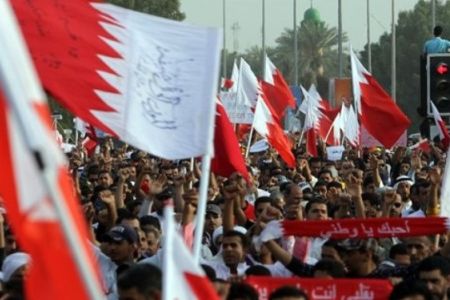
Forces loyal to the Bahraini regime have attacked a Press TV crew, filming anti-government demonstrations near the royal palace in the capital, Manama.
The assailants, who were armed with machetes and clubs, took the Press TV crew’s equipment.
“We were following an anti-government protest rally towards the royal palace that suddenly a group of about 300-400 pro-government thugs surrounded us,” Press TV’s correspondent in Manama Johnny Miller said.
Last week the Bahraini government blocked access to Press TV’s website from the country.
The violence came as tens of thousands of anti-government protesters are heading towards the royal palace, demanding political reforms.
Bahraini authorities had earlier warned against demonstrations near the palace, saying they would deal with the issue as a national security threat.
According to Press TV’s correspondent, since hundreds of pro-government forces have also gathered near the royal place more confrontations are expected.
Featured Video

Houthis Don’t Have to Conquer Saudi Arabia to Make It Pay
or go to
Aletho News Archives – Video-Images
From the Archives
Newly Released FBI Docs Shed Light on Apparent Mossad Foreknowledge of 9/11 Attacks
By Whitney Webb | MintPress News | May 17, 2019
NEW YORK — For nearly two decades, one of the most overlooked and little known arrests made in the aftermath of the September 11 attacks was that of the so-called “High Fivers,” or the “Dancing Israelis.” However, new information released by the FBI on May 7 has brought fresh scrutiny to the possibility that the “Dancing Israelis,” at least two of whom were known Mossad operatives, had prior knowledge of the attacks on the World Trade Center. … continue
Blog Roll
 Aletho News
- MEP blasts ‘Euro-Gestapo’ for lecturing Russia on democracy
- Syria May Send Troops to Saudi Arabia Amid War with Ansar Allah
- UK whines about losing billions to ‘Putin tax’
- Baghaei to Rubio: Distorted narratives cannot erase US record of broken commitments
- Houthis Don’t Have to Conquer Saudi Arabia to Make It Pay
- MOE: Nearly 22,000 Students and Education Workers Killed
- Guterres in Islamabad: Genocide, cowardice, and the cage of Imran Khan
- Johnson, Marandi say Yemen holds upper hand over Saudi Arabia
- False flags won’t save aggressors, Iran FM spokesman says
- The Makkah Pact Enters Into Force: The End of American Dominance or Its New Form?
- If Americans Knew
- Report claimed Mark Levin used by Israeli government to influence Trump
- Over 2,000 Gazans have died awaiting medical evacuation amid Israel’s continued siege
- How a U.S. Diplomat Suppressed and Altered Reports Critical of Israel
- 5 Palestinians Die from Israeli Strikes in Gaza as Relentless Attacks Continue
- Report: Ceasefire Slows Killing but Leaves Devastation Intact
- Country Music Singer Zach Bryan Breaks Attendance Record at Robert Kraft’s Gillette Stadium While Wearing ‘Free Palestine’ Shirt for Second Night in a Row
- Three years of death and devastation: Israel’s war on Gaza in pictures
- Why Hamas believed the status quo was more dangerous than its 7 October gamble
- Debunking Israel’s latest list of ‘terrorist’ journalists in Gaza
- In Gaza, focus is on survival, “every step is a struggle” – Daily Update
- No Tricks Zone
- New Study: 50 Years Of The Most Aggressive ‘Net Zero’ Policies Can Only Affect The Global Climate By 0.03°C
- US September “Heat” Was No Record…Many Records Set Decades Ago
- Latest European Green Energy Debacle; Portugal’s Largest Flagship Solar Park Insolvent!
- Green Energy Debacle: German Expert Professor Fritz Vahrenholt Warns Of Severe Economic And Social Consequences
- Two More Paleo Reconstructions Affirm Meters-Higher Sea Levels Across Ireland, Brazil 7000-6000 Years Ago
- New Study: Earth And Venus Surface Warmth Largely Explained By Convection And Lapse Rate, Not CO2 Or Radiation
- 2025 Nature Paper Claiming Worsening Global Drought Gets RETRACTED …Heavily Flawed
- New Study: ‘Global Drought Shows No Detectable Recent Acceleration Under Climate Warming’
- Economic Masterminds: German Socialists Suggest Taxing Productivity Gains Stemming From Using AI
- The South China Sea Has Not Been Cooperating With The Climate Change Narrative

