US Gov’t Attorneys: Providing Detailed Charges to Those on Terror Lists ‘Extremely Burdensome’
Activist Post | March 9, 2011
Defense lawyers for organizations on the U.S. government’s “terror list” are frustrated fighting the designation, and seizure of assets in many cases, because the government claims it is too tedious to give an explanation of the charges. “It would be extremely burdensome to give a list of charges,” said the government’s attorney, Douglas Letter, the Associated Press reported today:
Attorneys for the U.S. government told a federal appeals court Wednesday that informing each person and organization listed as a global terrorist of the reasons they are so designated would be too much work.
They made the argument in a case involving the government’s seizure of assets belonging to the U.S. chapter of Al Haramain Islamic Foundation Inc., a Saudi Arabia-based charity. The case is being heard by a three-judge panel of the 9th U.S. Circuit Court of Appeals.
Al Haramain attorney David Cole said outside court that representatives of Al Haramain were left in the dark after the organization was put on the global terrorist list. They continued to fight the designation without knowing what was driving it.
Cole said he and other attorneys could have provided a much more effective defense for the organization if they knew the reasons for the charges.
Organizations that are arbitrarily placed on the terror list who have their assets frozen are finding the burden of proof to be on them. Yet, they don’t even know what they are supposed to prove given the lack of detailed charges.
In a previous case, U.S. Judge, Gary Karr, ruled that freezing the assets of organizations suspected of terrorist ties has been done without due process by the Treasury Department. However, he also ruled that the “Treasury Department Office of Foreign Assets Control needed only a reasonable belief that the charity was a component of a larger organization that funds terrorism” to take action.
This erosion of due process and reversal of burden of proof, along with Obama’s recent Executive Order to detain suspected terrorists indefinitely, are troubling signs for the “Land of the Free.”
Blackmailing dissent: you’re either with Obama or you’re with the Tea Party
By Luciana Bohne | Intrepid Report | March 8, 2011
The Manichean heresy in early Christianity (Augustine had been a youthful adherent) divided the world into an earthly battleground of spiritual warfare between Satan and God, who shared power equally over the fate of humanity.
An example of late-Manichean thinking was typified by President Bush’s paranoically inane rallying call to choose between the terrorists and his governing clique in the aftermath of the massacre of civilians on 9/11, perpetrated by an ideological group spawned by the West’s secret services in the 1980s.
Because the United States has only two parties, both championing business interests, Manichaean thinking is second nature to the American electorate. You’re either with educated, enlightened humanitarian Democrats or you’re with the fascistic, racist Republicans, from the liberal point of view. Conversely, from the conservative point of view, you’re either with tradition, custom, and the tested way as a Republican or you’re with the bleeding-hearted, budget-wasting, morally lax, socialist Democrats.
This either/or proposition obviates the need for thought and makes voting a matter of choosing between good and evil. More sophisticated Americans resign themselves to voting for the lesser of two evils—which, in the end, is voting for evil. Thus, American elections have become an exercise in political neurosis. For example, in historically racially scarred America, the blackness of a presidential candidate was an irresistible lure to liberals, suffering from an irritable—and in their view—undeserved sense of guilt and shame. Conversely, the candidate’s blackness served to release the vilest resentments of misled know-nothings who gravitate to the more vermin-infested folds of the increasingly moldy conservative party, rabid with the success of a one-sided, bi-partisan, 30-year-long class war
It doesn’t take genius to figure out who benefits from Manichaeism in America—the business interests. They very cleverly support and fund now the Republican candidate, now the Democrat. Makes no difference to them whether a candidate is a Democrat or a Republican so long as he (or the much-awaited she) transfers the public wealth into private hands, depresses taxes on the wealthy, slashes social services, gives grotesque subsidies and handouts to banks and corporations, and carries out the seizure of markets, cheap labor, and resources abroad through domino-effect imperialist wars that transform America into the economic equivalent of whichever third-world country the elite are militarily devastating.
The promotion of Obama to the presidency of the United States by the financial aristocracy, let’s be honest, was a stroke of genius. Just as Clinton, a poor boy from Arkansas, was launched to wage war on the poor, so Obama, an eager and willing black American with the conveniently or inconveniently Muslim-sounding name, depending on one’s allegiance to identity politics, was installed to continue the imperial wars against the blackish populations of the world, while, of course, sustaining the pauperization of working Americans, black and white, at home, which Clinton, in the manner of Reagan, had done so much to secure.
Now you see why, in my liberal circles, thinking like mine sounds like the ravings of a tea-partier. If you have nothing to fall back on but a Manichean thinking equipment, where do you place a view that dissents from either the Republican or the Democrat cookie-cutter model of neatly dividing the lumpy, malformed dough of American politics into “us” and “them”? Where but against the wall? Garden-variety liberal Democrats I know have taken to calling themselves “progressives,” which leaves me no room from which to argue for ending the wars; demanding respect for international and national law in the matter of torture, rendition, and the closing down of Guantanamo; protesting against the extension of Bush’s tax law, giving breaks to the rich that devastate our communities; pointing out that there is a connection between the war on American workers and the wars abroad that consume masses of public wealth for the greed of the military-industrial-financial complex?
Divided they stand, Democrats and Republicans, united by forces they refuse to identify in the pursuit of self-destruction within the unfolding disaster that is America’s future. What can one do but resign oneself to being called names? It’s the only power either constituency has at present.
Egypt: A Virtual Smoking Gun?
By Maidhc Ó Cathail | The Passionate Attachment | March 4, 2011
On January 12, 2009, US Undersecretary for Public Diplomacy and Public Affairs James K. Glassman joined a group of Egyptian political bloggers from the Virtual Newsroom of the American University in Cairo.
Less than two months earlier, Glassman and Jared Cohen from the Secretary’s Policy Planning Staff had given an on-the-record briefing on the State Department’s alliance with ten partners in the private sector—including Facebook, Google, MTV, AT&T, Howcast, Access 360 Media—to form the Alliance for Youth Movements (AYM). During the briefing, Glassman singled out Egypt’s April 6 Youth Movement for special mention, saying that some of its members would be in attendance at the inaugural AYM youth summit in New York from December 3-5. Asked about “the risk of unleashing something here that is going to come back to bite you, especially with our allies,” Glassman replied:
We are very supportive of pro-democracy groups around the world. And sometimes, that puts us at odds with certain governments.
When pressed by the questioner, Glassman added:
Now, we have to work with those governments. And let me also just say, there’s a difference on an operational level between public—what we do in public diplomacy and what is often done in official diplomacy. We are communicating and engaging at the level of the public, not at the level of officials. So you know, it certainly is possible that some of these governments will not be all that happy that—at what we’re doing, but that’s what we do in public diplomacy.
Commenting on Cohen’s point that “these organizations online that are coming together are more of a new kind of civil society organization” that “eventually makes the transformation,” Glassman acknowledged that the US government has “been engaging with such civil society organizations in places like Egypt for a long time.”
As Al Jazeera revealed in a behind the scenes look at Egypt’s non-violent coup, the State Department-linked April 6 Youth Movement played a crucial role in making that “transformation,” by organizing and directing the protests that toppled America’s erstwhile ally Mubarak. The April 6 leaders also received training from the Belgrade-based Centre for Applied Nonviolent Action and Strategies (CANVAS), which works closely with the International Center for Nonviolent Conflict (ICNC). The ICNC was founded and funded entirely by Peter Ackerman, the junk bond “teflon guy,” who chaired Freedom House from September 2005 until January 2009. Freedom House is funded in part by the National Endowment for Democracy (NED), the US government-sponsored neoconservative-led regime change specialists.
On April 19, 2010, Ackerman attended an event entitled “Cyber-Dissidents and Political Change” sponsored by the George W. Bush Institute, which Glassman has headed since September 3, 2009. “Inspired by President and Mrs. Bush’s unwavering commitment to freedom for all people,” its website states, “The Bush Institute works to embolden dissidents and freedom advocates, creating a powerful network for moral support and education.” Among the cyber-dissidents in attendance at its Dallas event were Rodrigo Diamanti from Venezuela; Arash Kamangir, from Iran; Oleg Kozlovsky, from Russia; Ernesto Hernández Busto, from Cuba (who lives in Barcelona); Isaac Mao, from China; and Ahed Alhendi, from Syria. Clearly, some countries are seen as more deserving of Mr. and Mrs. Bush’s freedom advocacy than others.
In 2007, Glassman became Chairman of the Broadcasting Board of Governors (BBG), a US government agency that provides propaganda to non-American overseas audiences via the Voice of America, Radio Free Europe/Radio Liberty, the Middle East Broadcasting Networks (Alhurra TV and Radio Sawa), Radio Free Asia, and the Office of Cuba Broadcasting (Radio and TV Marti). Norman J. Pattiz, the “founding father” of Radio Sawa, which is increasingly popular in Egypt, sits on BBG’s board. Pattiz is also on the national board of the Israel Policy Forum, which is “committed to a strong and enduring U.S.-Israel relationship and to advancing the shared interests of the United States and the State of Israel.” Its Israeli Advisory Council is comprised of prominent figures from the Israeli military and intelligence establishment, mostly notably David Kimche, who was once described as “Israel’s Leading Spy and Would-Be Mossad Chief.” According to a Washington Report profile:
The “man with the suitcase,” as Kimche became known by colleagues in Israel, would appear in an African country a day or two before a major coup, and leave a week later after the new regime was firmly in control, often with the aid of Israeli security teams. (One of Israel’s protege allies in Africa whom Kimche helped to groom was none other than the continent’s most infamous ruler, Col. Idi Amin of Uganda.)
Prior to his involvement with “democracy promotion,” Glassman was a resident fellow at the neoconservative American Enterprise Institute, the propaganda mill that hatched the “global war on terror” primarily to advance the national interest of Israel. While there he founded The American, a magazine of ideas for business leaders, published by the AEI, and was its editor-in-chief from 2005 to 2007. Clearly, his neocon paymasters were not put off by his unenviable financial track record. In his 1999 book “Dow 36,000,” written shortly before the dot-com bubble burst, he predicted that the Dow Jones Industrial Average would rise to 36,000 within a few years. Commenting on the “hysteria” that fueled the deregulation-induced financial crisis nine years later, Ralph Nader singled out Glassman’s bestseller, joking that he would send it back to Glassman with one of the zeros missing.
As evidence of what a small neocon world we live in, Glassman’s co-author, Kevin A. Hassett, was an economic advisor to John McCain’s 2008 presidential campaign. Sen. McCain, who chairs NED’s Republican wing, the International Republican Institute, recently paid a visit to Tahrir Square with his inseparable travel buddy, Joe Lieberman, “the No. 1 pro-Israel advocate and leader in Congress.” Surveying the post-revolutionary scene, an “optimistic” Sen. Lieberman declared:
“This is a remarkable situation, and frankly, we should feel very good about the assistance we have given the Egyptian military over the years since the Camp David peace with Israel, because the Egyptian military really allowed this revolution in Egypt to be peaceful and let the people carry out their desires for political freedom and economic opportunity.”
Update: Jared Cohen’s buddy, Nicole Lapin, the daughter of a former Miss Israel, has been romantically linked to Twitter founder and CEO Jack Dorsey, whom Cohen contacted in June 2009 to help keep Iranian dissidents twittering.
Dershowitz rides shotgun for student attacking Palestinian scholar and his wife in California
By Philip Weiss on March 1, 2011
Bassam Frangieh is an Arabic scholar and translator who teaches at a California college, Claremont McKenna. I imagine that his life is framed by the Nakba; his family was extirpated from Jaffa in 1948; they owned orange groves; he was born in a refugee camp. In 2006, he had the nerve to attack Israel over the 2006 Lebanon invasion and describe Hizbullah as the national resistance.
Now he is being smeared as pro-terrorist by Charles Johnson, a journalist at Claremont McKenna, who published this attack in the National Review, citing the usual fragmentary statements about Hamas and Hezbollah. It includes this McCarthyite pirouette:
Frangieh’s radicalism is shared by his wife, Aleta Wenger. A former State Department official who worked on the Middle Eastern desk, Ms. Wenger is currently director of Claremont’s Center for Global Education and, as such, is the public face of the college overseas. Like her husband, she takes a conspiratorial view of Israel’s military, accusing it, without evidence, of bombing universities and hospitals.
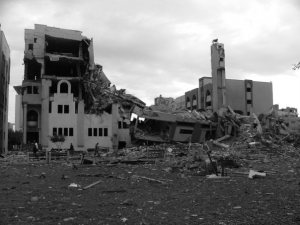 I’ve been to Gaza. I saw the ruins of the gene sequencing building at the Islamic University and of Al Quds Hospital. It is not clear to me who is pushing back, though apparently the Claremont administration is defending Frangieh on free speech grounds.
Johnson devoted a piece to Frangieh’s wife last month, too. And last night he stated in a letter to Claremont McKenna execs that he is getting help from Alan Dershowitz:
I should add that all of the material that I or The Claremont Independent published regarding Professor Bassam Frangieh has been reviewed by my counsel and by Professor Alan Dershowitz of Harvard Law School. The primary source material that I and The Claremont Independent published was translated by three different translators at considerable personal expense.
In the same piece Johnson says “nearly the entirety of the Government Department” at Claremont McKenna is on his side. I wonder how many of them know the history of the Israel-Palestine conflict and the role it is now playing in American politics…
Iraq: Security Forces Raid Press Freedom Group
Equipment, Documents Seized in 2 a.m. Break-In
HRW | February 26, 2011
(New York) – Iraqi authorities should immediately investigate a raid by security forces on the Journalistic Freedoms Observatory (JFO), a prominent Iraqi press freedom group, Human Rights Watch said today. Human Rights Watch also called on the government to ensure the speedy and safe return of all seized equipment and documents.
At about 2 a.m. on February 23, 2011, more than 20 armed men, some of them wearing brown military uniforms and red berets, and others wearing black military uniforms with skull-and-cross-bones insignia on their helmets, pulled up in Humvees outside the group’s office in Baghdad and broke in, a witness told Human Rights Watch. The security forces conducted a destructive search of the office that lasted more than an hour and seized the organization’s computers, external hard drives, cameras, cell phones, CDs, documents, and several flak jackets and helmets marked “Press,” the witness said.
“This raid on the Journalistic Freedoms Observatory shows the contempt of Iraqi authorities for groups that challenge the state’s human rights record,” said Joe Stork, deputy Middle East director at Human Rights Watch.
A spokesman for the Baghdad Operations Command confirmed to Human Rights Watch that the men were part of the Iraqi army but gave few other details.
Ziyad al-Ajili, the group’s executive director, told Human Rights Watch that the authorities “were obviously sending us a message to stop our work of supporting journalists…. This kind of governmental intimidation is precisely what we try to shed light on.” In Iraqi television interviews over the days leading up to the raid, al-Ajili voiced support for the right of Iraqis to protest peacefully and the media’s right to report on the protests.
Human Rights Watch visited the group’s office the morning after the raid and saw extensive damage, including broken furniture, destroyed equipment, kicked-in doors, and ripped-up posters and literature for the organization’s events, such as their annual “Press Courage Awards.” Framed photographs of journalists killed in Iraq since 2003 were strewn on the floor, covered in broken glass.
Human Rights Watch expressed concern that authorities would not return the computer hard drives and other electronic data storage devices seized from the group.
Al-Ajili said he fears that the authorities used the raid as a pretext to close the office, which serves as an informal gathering point for local journalists. In late January, the group held an awards ceremony in Baghdad, honoring investigative journalists who had uncovered corruption and other wrongdoing.
Although improvements in security since 2008 have reduced the assaults against media workers, journalists and press freedom advocates remain at risk in Iraq. On February 21, Human Rights Watch released a survey report, “At a Crossroads: Human Rights in Iraq Eight Years After the US-led Invasion,” which documents attacks against media and press restrictions. The report calls on the government to protect the rights of journalists and to amend its penal code and other laws that violate freedom of speech.
6 Threats to Free and Open Access to the Internet
Activist Post | February 23, 2011
Many of us believe the Internet to be open and free for us to explore all known information. Indeed, it is true that we currently can surf to any active website with our browser, and we can start a website or blog on any topic we wish to discuss. And it is quite a profound concept that everyone with a smart phone literally has all of the world’s knowledge in the palm of their hand.
Ben Franklin knew well the importance of free access to information when he founded the first public library in America to share knowledge with those without the means to their own books. Today, he surely would consider the Internet’s unprecedented access to information, and ability to communicate it instantly, as the ultimate level playing field of economic mobility and freedom.
However, this access is now under threat of authoritarian control. First, it is important to note that the gears of the Internet have always been controlled by central authorities, as Douglas Rushkoff recently wrote, “From its Domain Name Servers to its IP addresses, the Internet depends on highly centralized mechanisms to send our packets from one place to another.”
Therefore, the idea that our movements on the Web are even remotely private or untraceable is false. The central “authorities” who control the gears of the machine know exactly where you have been, while Google and the CIA have even developed ways of knowing where you’re going next as well. It’s very creepy to know that our every move is being tracked, traced, and databased, but it has been happening from day one on the Internet, and will likely continue to happen despite the violation of basic rights to our privacy.
Because Internet privacy has never been possible in the current web infrastructure, any proposed “privacy law” would just seem to pay lip service to the idea if it doesn’t address decentralizing the control grid. As Rushkoff pointed out, “I’m not trying to be a downer here, or knock the possibilities for networking. I just want to smash the fiction that the Internet is some sort of uncontrollable, decentralized free-for-all, so that we can get on with the business of creating something else that is.”
The focus here will be on the multitude of threats to our free access to the current Internet. As Ben Franklin understood, information should be free and open to all, not just the select few. Although the books in Franklin’s first library were indeed copyrighted material, they were freely shared. We should think of the Internet as a gigantic open-source public library. A place where information such as news, books, movies, and music should be free to view while we’re visiting the library.
Unfortunately, those who have control over the grid and influence over policymakers do not view the Internet in the same light. It appears that they view it as an economic and propaganda playground — the last one that they don’t fully control. Well, given the blight of proposed Internet control laws and web censorship tactics, it seems there is a calculated effort to control the free flow of information.
Below are 6 threats to our free and open access to the World Wide Web:
Legislation
The Protecting Cybersecurity as a National Asset Act, aka the “Internet Kill Switch” bill, has recently been reintroduced with a new Orwellian name, the Cybersecurity and Internet Freedom Act. This bill would give government the unchecked power to restrict access to the Internet if they declare a “national cyberemergency.” CNET recently reported:
But the revised wording (PDF) continues to alarm civil liberties groups and other critics of the bill, who say the language would allow the government to shut down portions of the Internet or restrict access to certain Web sites or types of content. Even former Egyptian President Hosni Mubarak didn’t actually “shut down” the Internet: at least at first, a trickle of connections continued.
The second piece of legislation that’s being reintroduced this year is the Combating Online Infringement and Counterfeits Act (COICA). This bill, clearly written by the mega-media entertainment cartel, would empower the U.S. Department of Justice to shut down, or block access to, websites found to be illegally sharing copyrighted material. It gives the government the authority to force Internet Service Providers to block access to websites from certain IP addresses, much like how the U.S. recently blocked the Al Jazeera feed during the Egyptian protests. COICA has also been referred to as the “Blacklist” bill because it allows the government to blacklist or seize any domain name suspected of infringement — even if located outside the United States.
DHS Seizures
Who needs there to be laws on the books when the Department of Homeland Security appears to already be above the law. DHS has been on a rampage of arbitrarily seizing websites without due process. In November 2010, they seized over 70 websites suspected of copyright infringement. Just before the Super Bowl, DHS seized another lot of domains for illegally share-streaming sporting events — some merely for linking to copyrighted material. Most recently, DHS erroneously seized 84,000 domains accused of being affiliated with child porn in some way which the DHS later admitted was done by accident.
Clearly, DHS has displayed its technical ability to censor the Internet by removing these websites. And although the domain seizures were technically accompanied by a court order, it seems that the DHS has partnered with large media outlets and sports entertainment to protect their profits. Finally, these court orders are a guilty-until-proven-innocent ruling which can irrevocably damage small businesses and the livelihoods of many people whose path to justice remains unclear.
Civil Lawsuits
Again who needs laws when you can be frivolously sued in civil court over copyright issues and bullied into settling the claim. Copyright infringement trolls like Righthaven are suing blogs and sites, and despite the only court ruling to date being a dismissal of charges due to Fair Use rights, they are still forcing many settlements. In fact, even Internet giant Drudge Report was forced to settle a civil suit involving a copyrighted image and link.
According to Steve Green, who’s been diligently covering these lawsuits for the Las Vegas Sun, claims they are a new type of legal enterprise:
Attorneys say the Righthaven lawsuits are unprecedented in recent memory because, in the past, newspapers dealt with online copyright infringement by simply asking infringing websites to remove the infringing material and to replace it with a link to the source newspaper. Most Righthaven defendants say they were sued without warning.
Not surprisingly, most of the cases are settled out of court. However, this tactic is a very effective intimidation tool against small websites who seek to share information. In some cases the costs and aggravation of combating the lawsuit can force the closure of these website defendants.
Net Neutrality
It would seem that net neutrality should fall under the legislative category. However, it is actually considered more of a “market based” regulation than actual law, yet the taxpayer still funds its enforcement through the FCC. Before identifying the reasoning behind and specific aspects of net neutrality rules, it’s worth noting that Internet futurist, Douglas Roshkoff, views the details as irrelevant because:
The moment the ‘net neutrality’ debate began was the moment the net neutrality debate was lost. For once the fate of a network — its fairness, its rule set, its capacity for social or economic reformation — is in the hands of policymakers and the corporations funding them — that network loses its power to effect change. (source)
The concept behind net neutrality is just what it says; to keep Internet access neutral for all users. But again, it is a very Orwellian term where true supporters of a free an open Internet can be tricked into supporting so-called neutrality rules. Blogger Timothy Karr wrote, “The rule is so riddled with loopholes that it’s become clear that this FCC chairman crafted it with the sole purpose of winning the endorsement of AT&T and cable lobbyists, and not defending the interests of the tens of millions of Internet users.”
What they are, in fact, are rules to allow service providers to charge tiered price levels depending on the amount of broadband used by individual web-surfers or websites. In other words, certain access will be discriminated against through reduced access speeds or additional fees. Besides limiting size of the surfer’s information wave, this tiered approach to the Internet will likely make it very difficult for smaller websites to compete with the big boys who can afford to pay ISPs for unadulterated access.
Technical Censorship
Google, Facebook, Youtube, Twitter and Wikipedia have become the most powerful information sharing tools the world has ever known. Combined, these five websites could literally rewrite history or shape the entire flow of current information if they chose to do so. Indeed, each of these virtual libraries has been repeatedly accused of censorship in many various forms; from blatant removal of content to manipulating the searchable strength of disapproved content.
Google, who seems so powerful that they may actually run the world, recently revealed that they are tweaking their search algorithm to weaken the search engine ranking of information aggregating websites referred to as “content farms.” It seems that Google seeks to reduce websites with little original content to the level of spammer status in their search results. What’s more, Google can wield the power of their Google Page Ranking for individual sites. Their constantly changing algorithm may actually penalize websites for search engine optimization, as with the recent case of JC Penney losing business due to Google penalizing them for SEO.
Taxes
If Congress or local governments elect to tax websites, the level playing field on the Internet is finished. In May 2010, the Federal Trade Commission proposed the “Drudge Tax” which would seek to tax news aggregators as if they are brick and mortar media companies. The FTC report also suggested that news aggregators be forced to pay copyright fees to link to mainstream news sources. And in perfect wealth distribution fashion the report also discusses the “possibility of offering tax exemptions to news organizations, establishing an AmeriCorps for reporters and creating a national fund for local news organizations.”
More recently, some states have proposed taxing online retailers such as Amazon, arguing that it’s not fair for local retailers who must pay taxes for selling the exact same items. In the past, Amazon has terminated its contracts with third-party affiliates in states who have adopted online tax laws. California Congressman, Dan Lungren, introduced the resolution Supporting the Preservation of Internet Entrepreneurs and Small Businesses aimed at preventing states from imposing these new taxes on online retailers.
What’s more, some states and even municipalities are beginning to impose a blogger fee referred to as a “privilege license” as a sort of business license for blogs. Philadelphia has forced bloggers to pay a $50/year, or $300 lifetime, fee for the privilege of expressing ideas online.
Conclusion
It seems clear that the powers-that-be are engaged in an all-out assault the free flow of information on the Internet. Blogs and websites must be prepared to combat the coming onslaught of news laws, regulations, and fees. For those who believe information should be free for all who pay for Internet access, we must fight to maintain this liberty. Stay tuned to the new blog Sites & Blogs for breaking Internet news and legal commentary about online copyright and privacy rights.
Omar Barghouti kept from entering the U.S. for BDS speaking tour
February 18, 2011
The following press release was just issued by the publisher of Omar Barghouti’s upcoming book:
Effectively canceling a planned speaking tour, the U.S. consulate in Jerusalem has inexplicably delayed the granting of a visa for Omar Barghouti, founding member of the Palestinian Civil Society Boycott, Divestment, Sanction (BDS) campaign, due to tour the United States this April for the release of his new book, Boycott, Divestment, Sanctions: The Global Struggle for Palestinian Rights.
Nobel Peace Laureate, Archbishop Desmond Tutu called the book “lucid and morally compelling… perfectly timed to make a major contribution to this urgently needed global campaign for justice, freedom and peace.” Former President of the UN General Assembly, Father Miguel d’’Escoto Brockmann called it “timely and responsibly written by a man who understands that creative nonviolence is the only way out of the dire situation in Palestine.””
In recent years, numerous foreign scholars and experts have been subject to visa delays and denials that have prohibited them from speaking and teaching in the U.S.—a process the American Civil Liberties Union describes as “Ideological Exclusion,” which they say violates Americans’ First Amendment right to hear constitutionally protected speech by denying foreign scholars, artists, politicians and others entry to the United States. Foreign nationals who have recently been denied visas include Fulbright scholar Marixa Lasso; Iraqi doctor Riyadh Lafta, who disputed the official Iraqi civilian death numbers in the respected British medical journal The Lancet; respected South African scholar and vocal Iraq War critic Dr. Adam Habib, and Oxford’s Tariq Ramadan, who have both recently received visas to speak in the United States after many years of delays and denials.
For the release of Boycott, Divestment, Sanctions, Barghouti has standing invitations for events in New York City, Harvard, Yale, Brown, Brandeis University, Washington DC, and Philadelphia. Barghouti studied, lived and worked in the United States for 11 years before permanently relocating to Jerusalem. He attended Columbia University, receiving both Bachelors and Masters degrees from the school. His U.S. born child, whom he needs a visa to visit, currently attends college in Indiana. Between 2005-2010, Barghouti visited the U.S. extensively without incident, on a 5 year visa, which only recently expired.
Barghouti’s publisher, Anthony Arnove of Haymarket Books, stated that “It’s essential authors be able to travel to promote their books and ideas, and as publishers we believe the free exchange of ideas is vital to a democratic culture. We find it frustrating that Omar’s visa is being delayed and potentially denied for political reasons and hope the Consulate will grant his visa immediately.”
Barghouti tour sponsors are calling on supporters to contact the U.S. Consulate in Jerusalem and the Department of State to ask them to fulfill the promise from the Obama Administration of “promoting the global marketplace of ideas” and grant Barghouti’s visa immediately.
U.S. Consulate:
Consul General Daniel Rubinstein
U.S. Consulate General, Jerusalem
18 Agron Road, Jerusalem 94190
Tel.: +972.2.622.7230, Fax: +972.2.625.9270
jerusalemvisa@state.gov
UsConGenJerusalem@state.govDepartment of State:
Visa Services
Public Inquiries Division
202-663-1225
usvisa@state.gov*
On Facebook: Join the group “Let Omar Barghouti Be Heard” and invite your friends
Obama Administration Says It Can Spy On Americans, But Can’t Tell You What Law Allows It
TechDirt | February 14, 2011
Remember how President Obama, while campaigning, promised to reject the questionable spying practices of the federal government of President Bush? Yeah, forget all that. Over the past two years, we’ve seen time and time again that he’s actually extended those abuses even further. The latest to come out is that the Justice Department is now claiming that the FBI has the right to get phone records on any call made from inside the US to an international number without any oversight. You may recall a few years back that there was a similar controversy, when it came out that the FBI would regularly just call up phone companies and ask for records — despite the fact that this violates certain laws designed to protect consumer privacy. Sometimes, they would just use post-it notes.
Apparently, a year ago, McClatchy newspapers put in a FOIA request, asking for the details of a particular Office of Legal Counsel (OLC) memo that was mentioned in the (previously released, but highly redacted) report that showed how frequently the FBI abused the law in this manner. The OLC took its sweet time responding, but finally responded, and in the cover letter admitted that the Obama administration believes it is perfectly legal for the FBI to route around the in-place oversight for getting access to such records and claimed that the law said so.
Which law says so? Oh, see, that they can’t say. Yes, the part of the letter that explains which law lets the FBI get these records without oversight was redacted.
It’s a secret law! And here I thought, in the US, if the government was going to base actions on a particular law, at the very least, they were supposed to tell you what law. Apparently, the Justice Department under the Obama administration does not believe that to be the case.
Basically, what this means is that the federal government believes that it’s free to request information without first getting court approval — and without telling the public what law says they’re allowed to get this information. That’s not what the laws on the books seem to say at all. But, of course, big telcos such as AT&T, who are so closely tied to the government, are going to roll over and give the government such info (or, perhaps, give them direct access to the info), even if it violates other laws. Why do you think President Obama voted to support giving telcos retroactive immunity on this issue, while he was running for President despite having earlier said he was against it? Now that he’s in power, he apparently is perfectly happy to let the FBI twist the clear intentions of the law to spy on Americans without oversight, and then to refuse to reveal what law he’s relying on to make such spying on Americans without oversight legal.
McClatchy quotes Michael German, a former FBI agent, who now works for the ACLU pointing out the obvious:
“It’s wrong that they’re withholding a legal rationale that has to do with the authorities of the FBI to collect information that affects the rights of American citizens here and abroad…. The law should never be secret. We should all understand what rules we’re operating under and particularly when it comes to an agency that has a long history of abuse in its collection activities.”
And so far, it doesn’t seem like most people care. About the only politician who really seems concerned about this is Senator Wyden, who says this level of secrecy “is a serious problem” and he’s “continuing to press the executive branch to disclose more information to the public about what their government thinks the law means.” Once again, kudos to Senator Wyden for being one of a very small number of politicians who seems to consistently be concerned about the rights of individuals. But it’s sad that the rest of our elected officials aren’t up in arms about this. The government shouldn’t be spying on Americans, and if it is, it should at least have to tell Americans what law it’s basing that decision on.
Israeli Students Cancel Speech by UN High Commissioner for Human Rights: “She is Anti-Semitic”
Alternative Information Center | 06 February 2011
Students at Israel’s Bar Ilan University cancelled a planned speech by UN High Commissioner for Human Rights, Ms. Navi Pillay, claiming that she is “anti-Semitic.”

Commissioner Pillay was invited by Bar Ilan University to speak at its Faculty of Law. University students affiliated with the right-wing “Forum for Eretz Israel” plastered the campus with posters against Pillay and sent a sharply worded letter of protest to the university’s administration.
“Ms. Pillay stands at the head of a commission…which is biased and tendentious in everything concerning the Israeli-Arab conflict,” the letter stated. “This commission explicitly promotes an anti-Jewish, anti-Israeli and anti-Zionist agenda, and a large number of her statements concerning Israel as like blood libels of the worst kind.”
Examples noted in the letter include Pillay’s statements that during Israel’s military attack on the Gaza Strip in December 2008-January 2009 (Operation Cast Lead), Israel bombed hospitals for no reason and in several cases, soldiers killed Palestinians in cold blood. According to Israel’s daily Israel Hayom, the letter also contends that a report issued by Pillay concerning these military attacks repeat contentions of the Goldstone Commission that Israel committed war crimes.
“Just as the university would not allow a Holocaust denier to speak, there is no room to provide a platform for an anti-Semitic personality such as her.”
Bar Ilan University failed to respond to questions in this matter.
‘Egypt eliminates witnesses to violence’
Press TV – February 3, 2011

Egyptian plain-clothes policemen arrest Mohamed Abdul Quddus, rapporteur of the civil Liberties Committee and member of the Press Syndicate Council, outside the journalists syndicate in downtown Cairo, Egypt, Wednesday, Jan. 26, 2011.
Supporters of Egyptian President Hosni Mubarak have attacked journalists in Cairo in an effort to disrupt the coverage of the violence used against anti-government protesters.
A Belgian reporter was arrested and beaten after he was accused of espionage in Cairo while al-Arabiya correspondent Ahmed Abdullah and journalists from the BBC, ABC News and CNN were attacked, CNN reported.
“The Egyptian government is employing a strategy of eliminating witnesses to their actions,” said Mohamed Abdel Dayem, Middle East and North Africa program coordinator for the Committee to Protect Journalists.
“The government has resorted to blanket censorship, intimidation, and today a series of deliberate attacks on journalists carried out by pro-government mobs,” he added.
Secretary General of Reporters Without Borders Jean-Francois Juillard has condemned the violence against media personnel and has called for an immediate reaction from the international community.
A number of European leaders have also called on Egypt to stop the violence against people and urged the government to take up political reforms without delay.
Medical sources have reported that three people were killed and more than 1,500 injured in clashes that broke out between protesters and plain-clothes policemen in Cairo on Wednesday.
Cairo’s Tahrir Square has turned into a battleground as protesters defy a nighttime curfew and pledge to remain on the streets until Mubarak steps down.
Featured Video

Houthis Don’t Have to Conquer Saudi Arabia to Make It Pay
or go to
Aletho News Archives – Video-Images
From the Archives
Newly Released FBI Docs Shed Light on Apparent Mossad Foreknowledge of 9/11 Attacks
By Whitney Webb | MintPress News | May 17, 2019
NEW YORK — For nearly two decades, one of the most overlooked and little known arrests made in the aftermath of the September 11 attacks was that of the so-called “High Fivers,” or the “Dancing Israelis.” However, new information released by the FBI on May 7 has brought fresh scrutiny to the possibility that the “Dancing Israelis,” at least two of whom were known Mossad operatives, had prior knowledge of the attacks on the World Trade Center. … continue
Blog Roll
 Aletho News
- MEP blasts ‘Euro-Gestapo’ for lecturing Russia on democracy
- Syria May Send Troops to Saudi Arabia Amid War with Ansar Allah
- UK whines about losing billions to ‘Putin tax’
- Baghaei to Rubio: Distorted narratives cannot erase US record of broken commitments
- Houthis Don’t Have to Conquer Saudi Arabia to Make It Pay
- MOE: Nearly 22,000 Students and Education Workers Killed
- Guterres in Islamabad: Genocide, cowardice, and the cage of Imran Khan
- Johnson, Marandi say Yemen holds upper hand over Saudi Arabia
- False flags won’t save aggressors, Iran FM spokesman says
- The Makkah Pact Enters Into Force: The End of American Dominance or Its New Form?
- If Americans Knew
- Report claimed Mark Levin used by Israeli government to influence Trump
- Over 2,000 Gazans have died awaiting medical evacuation amid Israel’s continued siege
- How a U.S. Diplomat Suppressed and Altered Reports Critical of Israel
- 5 Palestinians Die from Israeli Strikes in Gaza as Relentless Attacks Continue
- Report: Ceasefire Slows Killing but Leaves Devastation Intact
- Country Music Singer Zach Bryan Breaks Attendance Record at Robert Kraft’s Gillette Stadium While Wearing ‘Free Palestine’ Shirt for Second Night in a Row
- Three years of death and devastation: Israel’s war on Gaza in pictures
- Why Hamas believed the status quo was more dangerous than its 7 October gamble
- Debunking Israel’s latest list of ‘terrorist’ journalists in Gaza
- In Gaza, focus is on survival, “every step is a struggle” – Daily Update
- No Tricks Zone
- New Study: 50 Years Of The Most Aggressive ‘Net Zero’ Policies Can Only Affect The Global Climate By 0.03°C
- US September “Heat” Was No Record…Many Records Set Decades Ago
- Latest European Green Energy Debacle; Portugal’s Largest Flagship Solar Park Insolvent!
- Green Energy Debacle: German Expert Professor Fritz Vahrenholt Warns Of Severe Economic And Social Consequences
- Two More Paleo Reconstructions Affirm Meters-Higher Sea Levels Across Ireland, Brazil 7000-6000 Years Ago
- New Study: Earth And Venus Surface Warmth Largely Explained By Convection And Lapse Rate, Not CO2 Or Radiation
- 2025 Nature Paper Claiming Worsening Global Drought Gets RETRACTED …Heavily Flawed
- New Study: ‘Global Drought Shows No Detectable Recent Acceleration Under Climate Warming’
- Economic Masterminds: German Socialists Suggest Taxing Productivity Gains Stemming From Using AI
- The South China Sea Has Not Been Cooperating With The Climate Change Narrative

