AP, DPA, Reuters journalists targeted by Israeli forces
Ma’an – 17/07/2010
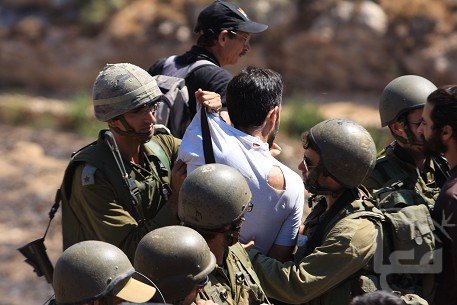
Hebron: Israeli forces fired percussion grenades directly at two journalists on Saturday, hitting them in the face and back during a Beit Ummar protest against continued land confiscations by a nearby Israeli settlement.
A third photojournalist was physically assaulted by armed Israeli personnel, and was taken to hospital for treatment by Red Crescent Paramedics.
Medics said Reuters photojournalist Abed Khweisa was treated checked for facial bone fractures after a sound bomb hit him in the cheek, while DPA photographer Abdul-Hafidh Hashlamoun was treated for bruises on his back after being struck by a second canister shot from a high-velocity launcher.
Hazim Badr, medics said, was beaten by soldiers and treated for bruises. All three said they were covering the protest when they were targeted.
One protester was reported injured, identified as 43-year-old Ahmad Khalil Abu Hashim, secretary-general of the local anti-land confiscation committee.
An Israeli military spokesman said soldiers were dispatched to the area when the protesters approached the perimeter fence surrounding the illegal Karmi Tzur settlement, and “responded with riot dispersal means when protesters began hurling rocks” at the soldiers.
Addressing a question about the targeting of members of the press, the spokesman said “anyone who chooses to be present at violent riots … does so at their own risk.”
In a swiftly-issued condemnation of the assault, the Palestinian Journalists Syndicate released a statement saying (PJS) a fourth journalist, Eyad Hamad with the AP, was detained “for few hours,” and said soldiers had damaged his camera.
The military spokesman confirmed that one “civilian who stood with the rioters” was taken in for questioning and released.
The society said it “condemns this attack and urges local, regional and international advocates of press freedom and human rights to pressure Israel to stop its attacks on Palestinian journalists.”
U.S. Government Considers Listing Turkish Charity As ‘Terrorists’
By Saed Bannoura – IMEMC News – July 15, 2010
The US State Department is considering whether to designate a Turkish charity as a ‘terrorist group’ after the organization sent a ship of medical and school supplies to the Gaza Strip in May.
The aid ship was attacked in international waters by the Israeli navy, and nine aid workers, including one US citizen, were killed.
The Foundation for Human Rights and Humanitarian Relief is a Muslim charity based in Turkey that funds humanitarian aid missions to troubled and impoverished places around the world.
Formed in 1992 with the goal of assisting Muslims in Bosnia, the charity has branched out to many places, including Lebanon, Pakistan, Sudan, Somalia and the Palestinian territories.
Although the Israeli-based Intelligence and Terrorism Information Center says the Turkish charity is quote “a radical Islamic organization with an anti-Western orientation,” the group has never been linked to any violent activities or groups.
When the aid ship was attacked by the Israeli navy in May, the U.S. Congress issued a statement declaring full support for the Israeli act of piracy, and the Obama administration did not criticize the attack.
Despite the fact that smuggled video footage shows passengers being killed execution-style by Israeli commandos, the U.S. government has continued its policy of unquestioning support of the Israeli attack.
The motive behind whistle-blower prosecutions
By Glenn Greenwald | July 15, 2010
One of the more flamboyant aspects of the Bradley Manning arrest was the claim that he had leaked to WikiLeaks 250,000 pages of “diplomatic cables.” Those were the documents which anonymous government officials pointed to when telling The Daily Beast‘s Philip Shenon that the leaks “could do serious damage to national security.” Most commentary on the Manning case has tacitly assumed that the leaking of “diplomatic cables” would jeopardize national security secrets. But a new BBC article today contains this quote from former UK intelligence analyst Crispin Black:
Diplomatic cables don’t usually contain huge secrets but they do contain the unvarnished truth so in a sense they can be even more embarrassing than secrets.
As usual, government concern over leaks is about avoiding embarrassment and other accountability; national security harm is but the fear-mongering excuse. Similarly, a new Washington Post article today details the Obama DOJ’s prosecution of NSA whistle blower Thomas Drake, whose disclosures resulted in no claimed national security harm, but rather, was evidence of “waste, mismanagement and a willingness to compromise Americans’ privacy without enhancing security” (leaked only after his use of the official channels resulted in nothing, as usual). As is true for virtually every whistle blower prosecution or threatened prosecution, there is no actual national security harm identified from that leak. Other than when a covert agent’s identity is blown (as happened to Valerie Plame), has anyone ever heard of any actual, concrete national security harm from any of the high-profile leak cases, whether it be the illegal NSA eavesdropping program, the network of CIA black sites, the release of the Apache helicopter attack video, or the corruption and privacy infringements revealed by Drake?
The Post today quotes Obama DOJ spokesman Matthew Miller’s justification for the administration’s escalated war on whistle blowers as follows: “We have consistently said that leaks and mishandling of classified information are matters that we take extremely seriously.” There’s no doubt that they take such acts “extremely seriously,” but what’s the reason for it? There’s been no identified harm to national security from any of these leaks.
What these leaks have actually accomplished is to “embarrass” the Government by revealing what the intelligence analyst quoted by the BBC calls “the unvarnished truth” about the illegal, corrupt, and embarrassing acts it undertakes. In all of these cases where the Obama DOJ is persecuting whistle blowers, they’re punishing the greatest sin there is — exposure of high-level government wrongdoing — not harm to national security. Amazingly, that was even the explicit rationale used by Obama when he and the Democratic Congress re-wrote FOIA to shield photographs of detainee abuse from court-ordered disclosure: these photos would reflect poorly on the U.S. government and therefore harm national security. And, of course, the administration’s repeated, Bush-replicating invocation of the “state secrets” privilege has been justified with vague appeals to National Security but actually motivated by a desire to shield government crimes of detention, surveillance and interrogation from disclosure and accountability.
Most of what the U.S. Government does of any significance — literally — occurs behind a vast wall of secrecy, completely unknown to the citizenry. While a small portion of that is legitimately classified, these whistle blower prosecutions and other disclosure controversies demonstrate that the vast majority of this secrecy is devoted to avoiding embarrassment and accountability. It has nothing to do with “national security” — one of the all-justifying terms (along with Terrorism) for what the Government does. Secrecy is the religion of the political class, and the prime enabler of its corruption. That’s why whistle blowers are among the most hated heretics. They’re one of the very few classes of people able to shed a small amount of light on what actually takes place.
The great irony is that there is a perfect inverse relationship between the secrecy powers of the Government (which rapidly increase) and the privacy rights of citizens (which erode just as rapidly). The citizenry meekly acquiesces to the notion that it must sacrifice more and more privacy to the Government in order to deter and expose criminality, corruption and other dangerous acts of private citizens, yet refuses to apply that same rationale to demand greater transparency from the Government itself. The Government (and its private corporate partners) know more and more about citizens, while citizens know less and less about the actions of the government-corporate axis which governs them.
The reason Iceland is poised to enact an unprecedentedly potent shield for whistle blowers and other leakers is that they realized that the oozing elite corruption that led to their financial collapse was caused by rampant secrecy. They realized that unauthorized leaks are the most effective check against the crimes of the powerful, which is precisely why such leaks in the U.S. are targeted with such a fury. What possible valid reason is there to keep classified that Apache attack video, or evidence of our civilian casualties in Afghanistan, or massive private contractor corruption at the NSA, or Bush crimes on torture and eavesdropping, or the lending programs of the Fed? The real criminals are not those who are leaking embarrassing information about corruption and wrongdoing — those whom the Obama DOJ is prosecuting with an unprecedented vengeance — but rather the political officials who are misusing powers of secrecy to hide information for which there is no legitimate secrecy basis.
US bars acclaimed Colombian journalist
By Gabriel Elizondo | Al-Jazeera | July 13th, 2010
Hollman Morris is known in Colombia for path-breaking journalism, but US wont let him into the country for a Harvard fellowship.
Hollman Morris is a Colombian journalist who has received dozens of international awards for his work uncovering atrocities and human rights abuses in the decade’s-long armed conflict in his country.
But the United States apparently views him as a terrorist. (More on this terrorist thing later).
For many years Morris, an independent television journalist, has risked his life trekking to remote (and dangerous) corners of Colombia to talk to victims of Colombia’s war. When there were allegations of the Colombia military or paramilitaries killing innocent people in a far away corner of the country, many journalists would report the story with a few press releases and phone calls from the comfort of Bogota. If it was reported at all. Not Morris. He would go to the source, often walking through the jungle for days to get to the location, speak to people, and find out what happened, and put it on television.
At its best, Morris’s work has led him to uncover evidence of atrocities potentially committed by actors of the state. At minimum, his reporting has often thrown doubt on official government positions few other journalists seem dare to challenge.
By all accounts, this has infuriated the outgoing president, Alvaro Uribe, who has publicly insinuated Morris is a terrorist sympathiser because of his interviews with the Farc guerilla group.
Morris and his family, including his young daughter, were victims of illegal spying by Colombia’s spy agency, the DAS (among a handful of other journalists, lawyers, judges, opposition politicians, and human rights activists). Human rights groups say it was a deliberate attempt to dig up any personal dirt they could find on him to squash his reporting. The scandal was so big, the agency was going to be dismantled, but as of yet it has not.
Regarding the Farc, it’s true Morris has interviewed Farc commanders over the years. But so have countless other journalists from Colombia and abroad. If Colombia threw in jail every reporter who has had contact with the Farc, the jails would be full overnight.
But Morris’s critics – and there are many in Colombia – largely fail to recognise only a small portion of his stories deal with the Farc; most of his pieces have a razor sharp focus on human rights, giving a true and authentic platform for those otherwise with no outlet to tell their story.
It is true that because Morris aggressively pursues stories on the ‘front lines’ of conflict, he often finds himself in sticky situations. Like last year when he recorded brief interviews with several Farc hostages moments before they were granted freedom, a move that was criticised by some in Colombia as Morris allowing himself to be used by the Farc to promote a propaganda agenda. In journalism theory class, maybe so. But when in the jungles of Colombia caught in between a firefight between rebels and the Army (as Morris has been on several occasions) perhaps things are not as clear at the time.
And unlike many other journalists, Morris isn’t afraid to give his personal viewpoints on President Uribe (especially after the government spying scandal against him), thrusting himself into the realm of activist-journalists, according to his critics.
But he and his brother, Juan Pablo – who is the executive producer at their Bogota-based Morris Productions – are recognised as respected, top shelf journalists by many people. They have done documentaries for Discovery Channel, European channels, and for many years had an independent programme on Colombian public TV called Contravia, partially funded by a grant from the European Union.
I first met Hollman and Juan Pablo almost eight years ago. We have since crossed paths in Peru, Honduras, Washington DC, and several times in Colombia. They have both worked for Al Jazeera on numerous occasions on a freelance basis, and specifically helped me on stories.
But the crowning recognition of Morris’s journalistic aptitude was being awarded a prestigious Nieman Fellowship at Harvard, where he was going to join an elite group of other journalist’s from around the world in this years class, and step back from his day-to-day reporting to study human rights issues that could enhance his theoretical understanding of the issues he reports on back at home.
But right as Hollman was making final preparations to head off to Harvard, brushing up on his English, the US government branded him with another label: “Terrorist”. As the Associated Press pointed out, his visa to study in the United States was denied, as US officials told him he was ineligible on grounds of a ‘terrorist activities’ section of the US Patriot Act.
Of course, US Embassy officials in Bogota won’t comment on individual cases.
So the speculation from human rights groups interviewed in a recent Washington Post article about the case, is that the Uribe administration – Washington’s closest friend in Latin America this decade under the George W Bush administration – orchestrated the visa rejection because of Morris’s reporting that questioned Uribe’s policies. Now some are pinning it on the Obama Administration.
I won’t pretend to know what the truth is on why the visa was denied and what role – if any – the Uribe administration played. It is no secret Morris’s reports over the years have annoyed Uribe to no end, and thus Uribe has tagged him a conspirator with terrorists, regardless of the fact he has never been charged with any such a crime. Groups such as Human Rights Watch protested Uribe’s comments.
The larger question is: What exactly is the objection from the US government to having an internationally recognised Colombian journalist do a Harvard-sponsored fellowship? What exactly is the evidence of his terrorist activities, or how exactly is he in violation of the Patriot Act?
Maybe ironically, the same US Embassy in Bogota that rejected his study visa to Harvard, singled him out in a 1997 human right report as having to flee the country because of death threats from illegal armed actors (scroll down to the section titled “Freedom of Speech and Press” in the link above).
The Committee to Protect Journalists has sent a letter to Secretary of State Hillary Clinton asking her department to reconsider Morris’s case.
For their part, the Nieman Foundation appears to stand behind Morris, but that is a small consequence because without a visa there is no chance to take part in the fellowship.
One of the comments by a reader identified as “vaalex” in the Washington Post article about the case said this: “His (Morris’s) work is too important to interrupt by wasting time at Harvard. The State Dept. decision is a blessing in disguise.”
A backhanded compliment to Morris, I guess, but still probably little consolation.
Because after Morris was accepted to Harvard, at first glance, one would think the US State Department would have opened the door and patted him on the shoulder with congratulations. Instead, the State Department slammed the door and slapped him across the face and branded him with the terrorist label.
The spot-and-shoot game, remote-controlled killing
By JONATHAN COOK – July 13, 2010
It is called Spot and Shoot. Operators sit in front of a TV monitor from which they can control the action with a PlayStation-style joystick.
The aim: to kill terrorists.
Played by: young women serving in the Israeli army.
Spot and Shoot, as it is called by the Israeli military, may look like a video game but the figures on the screen are real people — Palestinians in Gaza — who can be killed with the press of a button on the joystick.
The female soldiers, located far away in an operations room, are responsible for aiming and firing remote-controlled machine-guns mounted on watch-towers every few hundred metres along an electronic fence that surrounds Gaza.
The system is one of the latest “remote killing” devices developed by Israel’s Rafael armaments company, the former weapons research division of the Israeli army and now a separate governmental firm.
According to Giora Katz, Rafael’s vice-president, remote-controlled military hardware such as Spot and Shoot is the face of the future. He expects that within a decade at least a third of the machines used by the Israeli army to control land, air and sea will be unmanned.
The demand for such devices, the Israeli army admits, has been partly fuelled by a combination of declining recruitment levels and a population less ready to risk death in combat.
Oren Berebbi, head of its technology branch, recently told an American newspaper: “We’re trying to get to unmanned vehicles everywhere on the battlefield … We can do more and more missions without putting a soldier at risk.”
Rapid progress with the technology has raised alarm at the United Nations. Philip Alston, its special rapporteur on extrajudicial executions, warned last month of the danger that a “PlayStation mentality to killing” could quickly emerge.
According to analysts, however, Israel is unlikely to turn its back on hardware that it has been at the forefront of developing – using the occupied Palestinian territories, and especially Gaza, as testing laboratories.
Remotely controlled weapons systems are in high demand from repressive regimes and the burgeoning homeland security industries around the globe.
“These systems are still in the early stages of development but there is a large and growing market for them,” said Shlomo Brom, a retired general and defence analyst at the Institute of National Security Studies at Tel Aviv University.
The Spot and Shoot system — officially known as Sentry Tech — has mostly attracted attention in Israel because it is operated by 19- and 20-year-old female soldiers, making it the Israeli army’s only weapons system operated exclusively by women.
Female soldiers are preferred to operate remote killing devices because of a shortage of male recruits to Israel’s combat units. Young women can carry out missions without breaking the social taboo of risking their lives, said Mr Brom.
The women are supposed to identify anyone suspicious approaching the fence around Gaza and, if authorised by an officer, execute them using their joysticks.
The Israeli army, which plans to introduce the technology along Israel’s other confrontation lines, refuses to say how many Palestinians have been killed by the remotely controlled machine-guns in Gaza. According to the Israeli media, however, it is believed to be several dozen.
The system was phased-in two years ago for surveillance, but operators were only able to open fire with it more recently. The army admitted using Sentry Tech in December to kill at least two Palestinians several hundred metres inside the fence.
The Haaretz newspaper, which was given rare access to a Sentry Tech control room, quoted one soldier, Bar Keren, 20, saying: “It’s very alluring to be the one to do this. But not everyone wants this job. It’s no simple matter to take up a joystick like that of a Sony PlayStation and kill, but ultimately it’s for defence.”
Audio sensors on the towers mean that the women hear the shot as it kills the target. No woman, Haaretz reported, had failed the task of shooting what the army calls an “incriminated” Palestinian.
The Israeli military, which enforces a so-called “buffer zone” — an unmarked no-man’s land — inside the fence that reaches as deep as 300 metres into the tiny enclave, has been widely criticised for opening fire on civilians entering the closed zone.
In separate incidents in April, a 21-year-old Palestinian demonstrator was shot dead and a Maltese solidarity activist wounded when they took part in protests to plant a Palestinian flag in the buffer zone. The Maltese woman, Bianca Zammit, was videoing as she was hit.
It is unclear whether Spot and Shoot has been used against such demonstrations.
The Israeli army claims Sentry Tech is “revolutionary”. And that will make its marketing potential all the greater as other armies seek out innovations in “remote killing” technology.
Rafael is reported to be developing a version of Sentry Tech that will fire long-range guided missiles.
Another piece of hardware recently developed for the Israeli army is the Guardium, an armoured robot-car that can patrol territory at up to 80km per hour, navigate through cities, launch “ambushes” and shoot at targets. It now patrols the Israeli borders with Gaza and Lebanon.
Its Israeli developers, G-Nius, have called it the world’s first “robot soldier”. It looks like a first-generation version of the imaginary “robot-armour” worn by soldiers in the popular recent sci-fi movie Avatar.
Rafael has produced the first unmanned naval patrol boat, the “Protector”, which has been sold to Singapore’s navy and is being heavily marked in the US. A Rafael official, Patrick Bar-Avi, told the Israeli business daily Globes: “Navies worldwide are only now beginning to examine the possible uses of such vehicles, and the possibilities are endless.”
But Israel is most known for its role in developing “unmanned aerial vehicles” – or drones, as they have come to be known. Originally intended for spying, and first used by Israel over south Lebanon in the early 1980s, today they are increasingly being used for extrajudicial executions from thousands of feet in the sky.
In February Israel officially unveiled the 14 metre-long Heron TP drone, the largest ever. Capable of flying from Israel to Iran and carrying more than a ton of weapons, the Heron was tested by Israel in Gaza during Operation Cast Lead in winter 2008, when some 1,400 Palestinians were killed.
More than 40 countries now operate drones, many of them made in Israel, although so far only the Israeli and US armies have deployed them as remote-controlled killing machines. Israeli drones are being widely used in Afghanistan.
Smaller drones have been sold to the German, Australian, Spanish, French, Russian, Indian and Canadian armies. Brazil is expected to use the drone to provide security for the 2014 World Cup championship, and the Panamanian and Salvadoran governments want them too, ostensibly to run counter-drug operations.
Despite its diplomatic crisis with Ankara, Israel was reported last month to have completed a deal selling a fleet of 10 Herons to the Turkish army for $185 million.
Jonathan Cook is a writer and journalist based in Nazareth, Israel. His latest books are “Israel and the Clash of Civilisations: Iraq, Iran and the Plan to Remake the Middle East” (Pluto Press) and “Disappearing Palestine: Israel’s Experiments in Human Despair” (Zed Books). His website is www.jkcook.net.
Witch-hunt Begins in Israeli Schools and Colleges
By Jonathan Cook – Nazareth – July 12, 2010
Hundreds of Israeli college professors have signed a petition accusing the education minister of endangering academic freedoms after he threatened to “punish” any lecturer or institution that supports a boycott of Israel.
The backlash against Gideon Saar, a member of the prime minister Benjamin Netanyahu’s Likud party, comes after a series of moves suggesting he is trying to stamp a more stridently right-wing agenda on the Israeli education system.
The education minister has outraged the 540 professors who signed the petition by his open backing of a nationalist youth movement, Im Tirtzu, which demands that teachers be required to prove their commitment to right-wing Zionism.
Two of Mr Saar’s predecessors, Yossi Sarid and Yuli Tamir, are among those who signed the petition, which calls on the minister to “come to your senses … before it’s too late to save higher education in Israel”.
Mr Saar’s campaign to “re-Zionise” the education system, including introducing a new right-wing Jewish studies syllabus and bringing soldiers into classrooms, has heightened concerns that he is stoking an atmosphere increasingly hostile to left-wing academics and human-rights activists.
Neve Gordon, a politics professor at Ben Gurion University in Beersheva who called for an academic boycott of Israel last year, has reported receiving death threats, as has a school teacher who refused to participate in Mr Saar’s flagship programme to encourage high-school recruitment to the Israeli military.
Daniel Gutwein, a professor of Jewish history at Haifa University, said: “A serious red flag is raised when the education minister joins in the de-legitimisation of the academic establishment. This is a method to castrate and abolish Israeli academia.”
Mr Saar’s sympathies for Im Tirtzu were first revealed earlier this year when he addressed one of its conferences, telling delegates the organisation would be “blessed” for its “hugely vital” work.
The youth movement emerged in 2006 among students demanding that the government rather than ordinary soldiers be held to account for what was seen as Israel’s failure to crush Hizbollah during that year’s attack on Lebanon. It has rapidly evolved into a potent right-wing pressure group.
Its biggest success to date has been a campaign last year against Israeli human rights groups that assisted a United Nations inquiry led by Judge Richard Goldstone in investigating war crimes committed during Israel’s assault on Gaza in 2008. The human rights organisations are now facing possible government legislation to restrict their activities.
Im Tirtzu’s latest campaign, against what it calls “the reign of left-wing terror” in the education system, was backed by Mr Saar during a parliamentary debate last month. He told MPs he took very seriously a report by the movement claiming that anti-Zionist professors have taken over university politics departments and are silencing right-wing colleagues and students.
Mr Saar also warned that calls for boycotts against Israel were “impossible to accept” and that he was talking to higher education officials about taking “action” this summer, hinting that he would cut funds for the professors involved and their institutions.
Yossi Ben Artzi, the rector of Haifa University and the most senior university official to criticise Mr Saar, warned him against “monitoring and denouncing” academics. He added that the Im Tirtzu report “smells of McCarthyism”.
The universities are already disturbed by a bill submitted by 25 MPs last month that would make it a criminal offence for Israelis to “initiate, encourage, or aid” a boycott against Israel and require them to pay compensation to those harmed by it.
The bill is likely to be treated sympathetically by the government, which is worried about the growing momentum of boycott drives both internationally and in the occupied West Bank. Mr Netanyahu has called the emergence of a boycott movement inside Israel a “national scandal”.
Prof Gordon, who wrote a commentary in the Los Angeles Times a year ago supporting a boycott, said Im Tirtzu had contributed to a growing “atmosphere of violence” in the country and on campuses.
Hundreds of students at his university have staged demonstrations demanding his dismissal. He was also recently sent a letter from someone signing himself “Im Tirtzu” calling the professor a “traitor” and warning: “I will reach Ben Gurion [University] to kill you.”
Prof Gordon said: “I have tenure and Im Tirtzu cannot easily get me fired. But they are trying to become the ‘guards at the gate’ to make sure other academics do not follow in my path.”
Only three Israeli academics have so far openly endorsed a boycott, he added, with many others fearful that they will be punished if they do so. But Im Tirtzu and its supporters were using the issue as a pretext for cracking down on academics critical of rightwing policy. He called Israel an increasingly “proto-fascist” state.
Prof Gordon cited the recent case of Assaf Oren, a statistics lecturer and peace activist who had been told he was the leading candidate for a post in Ben Gurion’s industrial engineering department until right-wing groups launched a campaign against him.
In a further sign of what Prof Gordon and others have labelled a McCarthyite climate, MPs in the parliamentary education committee — which has come to closely reflect Mr Saar’s views — summoned for questioning two head teachers of prestigious schools after they criticised official policies.
One, Ram Cohen, has condemned Israel’s occupation of the Palestinians, while the other, Zeev Dagani, has spoken against the programme to send army officers into classrooms to encourage pupils to enlist.
Mr Dagani was the only head teacher in the 270 selected schools to reject the programme, saying he opposed “the blurring of boundaries when officers come and teach the teachers how to educate”. He subsequently received a flood of death threats.
The education ministry has announced a new core curriculum subject of Jewish studies in schools that concentrates on nationalist and religious themes and is likely to be taught by private rightwing and settler organisations.
Avi Sagi, a philosopher at Bar Ilan University in Tel Aviv, warned in the liberal Haaretz newspaper that the syllabus offered “an opening for dangerous indoctrination”.
A modern history curriculum published this month has been similarly criticised for leaving out study of the Oslo peace process and Palestinian politics.
Also in the sights of education officials are hundreds of Arab nursery schools, many of them established by the Islamic Movement. Zevulun Orlev, head of the education committee, has accused the schools of “poisoning the minds” of Arab children in Israel.
Mr Saar appointed a special committee last month to inspect the schools and shut them down if they were found to be teaching “anti-Israel” material.
Arab MPs have called the claims “ridiculous”, pointing out that the schools were set up after the education ministry failed to build nursery schools in Arab communities.
– Jonathan Cook is a writer and journalist based in Nazareth, Israel. His latest books are “Israel and the Clash of Civilisations: Iraq, Iran and the Plan to Remake the Middle East” (Pluto Press) and “Disappearing Palestine: Israel’s Experiments in Human Despair” (Zed Books). His website is www.jkcook.net.
Ireland seeks to block Israel’s access to data on EU citizens
By Ora Coren | Haaretz | July 11, 2010
Ireland is seeking to stop a European Union initiative that would enable Israel to receive sensitive information about European citizens, due to concerns about the use that Israel would make of this information, the Irish minister for justice said over the weekend.
In what may be another blow to Israel’s international status, Dermott Ahern said that since Israel allegedly used forged Irish passports to carry out the hit on Hamas official Mohammed al-Mabhouh in Dubai, Israel should not be allowed access to this data. Israel has not admitted to a role in the assassination.
Under a plan put forward at the beginning of the year, the European organizations for protecting individuals’ privacy agreed that Israeli companies and European companies should be able to exchange information about customers.
For example, this would mean that an Israeli customer of a local cell phone company, say, Pelephone, would be able to use his phone to connect to the Internet, say, in Italy, and the Italian telecom would be able to receive his personal data from Pelephone and charge his account accordingly. The same would be true for people with European cell phones in Israel who wanted to use Israeli networks.
In addition, multinational corporations would be able to entrust Israeli companies to secure their databases, and the data could be stored on servers in Israel. Plus, information about employees could be passed freely between European and Israeli branches of the same company.
In agreeing to grant this access, the EU authorities decided that Israel had proper information protection systems in place.
However, the plan still needs to be ratified by the government of each individual EU member country before it can take force.
Beyond easing companies’ operations, the plan is also intended to make it easier for the authorities to catch cases of money laundering.
Currently, passing data between Israel and Europe is dependent on explicit contracts, which fund many a lawyer’s income. The initiative would do away with one of the last remaining trade barriers with Europe.
10 Ways We Are Being Tracked, Traced, and Databased
Activist Post | July 10, 2010
- GPS — Global positioning chips are now appearing in everything from U.S. passports, cell phones, to cars. More common uses include tracking employees, and for all forms of private investigation. Apple recently announced they are collecting the precise location of iPhone users via GPS for public viewing in addition to spying on users in other ways.
- Internet — Internet browsers are recording your every move forming detailed cookies on your activities. The NSA has been exposed as having cookies on their site that don’t expire until 2035. Major search engines know where you surfed last summer, and online purchases are databased, supposedly for advertising and customer service uses. IP addresses are collected and even made public. Controversial websites can be flagged internally by government sites, as well as re-routing all traffic to block sites the government wants to censor. It has now been fully admitted that social networks provide NO privacy to users while technologies advance for real-time social network monitoring is already being used. The Cybersecurity Act attempts to legalize the collection and exploitation of your personal information. Apple’s iPhone also has browsing data recorded and stored. All of this despite the overwhelming opposition to cybersurveillance by citizens.
- RFID — Forget your credit cards which are meticulously tracked, or the membership cards for things so insignificant as movie rentals which require your SSN. Everyone has Costco, CVS, grocery-chain cards, and a wallet or purse full of many more. RFID “proximity cards” take tracking to a new level in uses ranging from loyalty cards, student ID, physical access, and computer network access. Latest developments include an RFID powder developed by Hitachi, for which the multitude of uses are endless — perhaps including tracking hard currency so we can’t even keep cash undetected. (Also see microchips below).
- Traffic cameras — License plate recognition has been used to remotely automate duties of the traffic police in the United States, but have been proven to have dual use in England such as to mark activists under the Terrorism Act. Perhaps the most common use will be to raise money and shore up budget deficits via traffic violations, but uses may descend to such “Big Brother” tactics as monitors telling pedestrians not to litter as talking cameras already do in the UK.
- Computer cameras and microphones — The fact that laptops — contributed by taxpayers — spied on public school children (at home) is outrageous. Years ago Google began officially to use computer “audio fingerprinting” for advertising uses. They have admitted to working with the NSA, the premier surveillance network in the world. Private communications companies already have been exposed routing communications to the NSA. Now, keyword tools — typed and spoken — link to the global security matrix.
- Public sound surveillance — This technology has come a long way from only being able to detect gunshots in public areas, to now listening in to whispers for dangerous “keywords.” This technology has been launched in Europe to “monitor conversations” to detect “verbal aggression” in public places. Sound Intelligence is the manufacturer of technology to analyze speech, and their website touts how it can easily be integrated into other systems.
- Biometrics — The most popular biometric authentication scheme employed for the last few years has been Iris Recognition. The main applications are entry control, ATMs and Government programs. Recently, network companies and governments have utilized biometric authentication including fingerprint analysis, iris recognition, voice recognition, or combinations of these for use in National identification cards.
- DNA — Blood from babies has been taken for all people under the age of 38. In England, DNA was sent to secret databases from routine heel prick tests. Several reports have revealed covert Pentagon databases of DNA for “terrorists” and now DNA from all American citizens is databased. Digital DNA is now being used as well to combat hackers.
- Microchips — Microsoft’s HealthVault and VeriMed partnership is to create RFID implantable microchips. Microchips for tracking our precious pets is becoming commonplace and serves to condition us to accept putting them in our children in the future. The FDA has already approved this technology for humans and is marketing it as a medical miracle, again for our safety.
- Facial recognition — Anonymity in public is over. Admittedly used at Obama’s campaign events, sporting events, and most recently at the G8/G20 protests in Canada. This technology is also harvesting data from Facebook images and surely will be tied into the street “traffic” cameras.
COUNCILS USE BUGS IN LAMPPOSTS TO EAVESDROP ON YOU
By Anil Dawar | Express | July 5, 2010
HIGH-powered spy microphones on street lampposts are being used by snooping council officials to listen in on private conversations.
A network of new “intelligent” listening devices which can monitor discussions has been deployed on Britain’s streets for the first time.
The so-called Sigard system has been tested in London, Manchester, Birmingham, Glasgow and Coventry. The microphones, connected to CCTV cameras, can recognise aggressive “trigger” words and sounds, then automatically direct cameras to zoom in on the speakers.
Manufacturers denied the system is used to record conversations. It analyses sound patterns to pick out angry or distressed voices. But the makers would not pledge that in the future Sigard would not be used to record whole sections of speech.
Privacy campaigners condemned the surveillance system, attacking it as another erosion of personal freedom.
News of the use of Sigard comes to light just days after around 200 cameras with number plate recognition software in Birmingham were mothballed when it emerged that they were being targeted at the city’s Asian districts.
Corinna Ferguson, a lawyer for human rights group Liberty, criticised Sigard. She said:
“Britain has been far too complacent about the growth of CCTV without any proper public debate or legal safeguards. With cameras linked to microphones and number-plate databases, everyone can be treated as a suspect.
“The Birmingham fiasco demonstrates the destructive power of snooping on whole communities who could otherwise be pulling together to fight crime and terrorism.”
Dylan Sharpe, from campaigners Big Brother Watch, said:
“There can be no justification for giving councils or the police the capability to listen in on private conversations. There is enormous potential for abuse, or a misheard word, causing unnecessary harm with this sort of intrusive and overbearing surveillance.”
The Dutch inventors of the Sigard technology say the system is designed to help combat violent or anti-social behaviour by detecting threatening language. Alerts can then be sent to police allowing them to stop minor problems flaring up into full-scale violence.
The microphones can listen in on conversations up to 100 yards away. The cameras then record both sound and images.
Manufacturers say Sigard can distinguish between distress calls, threatening behaviour and general shouting. The system filters out background noise and focuses on suspect sounds.
Sigard systems are used widely in Holland, where 12 cities have fitted the microphones. They are also in use on buses and trains.
In Coventry, the CV One partnership, funded by the city council, tested Sigard for six months by installing seven in the city’s nightclub district. No-one from the organisation would comment on the trial’s success.
The new Government is reviewing the use of CCTV as it honours a pledge to defend civil liberties.
Octavia Nasr’s firing and what the liberal media allows
By Glenn Greenwald | July 8, 2010
CNN yesterday ended the 20-year career of Octavia Nasr, its Atlanta-based Senior Middle East News Editor, because of a now-deleted tweet she wrote on Sunday upon learning of the death of one of the Shiite world’s most beloved religious figures: “Sad to hear of the passing of Sayyed Mohammed Hussein Fadlallah . . . . One of Hezbollah’s giants I respect a lot.” That message spawned an intense fit of protest from Far Right outlets, Thought Crime enforcers, and other neocon precincts, and CNN quickly (and characteristically) capitulated to that pressure by firing her. The network — which has employed a former AIPAC official, Wolf Blitzer, as its primary news anchor for the last 15 years — justified its actions by claiming that Nasr’s “credibility” had been “compromised.” Within this episode lies several important lessons about media “objectivity” and how the scope of permissible views is enforced.
First, consider which viewpoints cause someone to be fired from The Liberal Media. Last month, Helen Thomas’ 60-year career as a journalist ended when she expressed the exact view about Jews which numerous public figures have expressed (with no consequence or even controversy) about Palestinians. Just weeks ago, The Washington Post accepted the “resignation” of Dave Weigel because of scorn he heaped on right-wing figures such as Matt Drudge and Rush Limbaugh. CNN’s Chief News Executive, Eason Jordan, was previously forced to resign after he provoked a right-wing fit of fury over comments he made about the numerous — and obviously disturbing — incidents where the U.S. military had injured or killed journalists in war zones. NBC fired Peter Arnett for criticizing the U.S. war plan on Iraqi television, which prompted accusations of Treason from the Right. MSNBC demoted and then fired its rising star Ashleigh Banfield after she criticized American media war coverage for adhering to the Fox model of glorifying U.S. wars; the same network fired its top-rated host, Phil Donahue, due to its fear of being perceived as anti-war; and its former reporter, Jessica Yellin, confessed that journalists were “under enormous pressure from corporate executives” to present the news in a pro-war and pro-Bush manner.
What each of these firing offenses have in common is that they angered and offended the neocon Right. Isn’t that a strange dynamic for the supposedly Liberal Media: the only viewpoint-based firings of journalists are ones where the journalist breaches neoconservative orthodoxy? Have there ever been any viewpoint-based firings of establishment journalists by The Liberal Media because of comments which offended liberals? None that I can recall. I foolishly thought that when George Bush’s own Press Secretary mocked the American media for being “too deferential” to the Bush administration, that would at least put a dent in that most fictitious American myth: The Liberal Media. But it didn’t; nothing does, not even the endless spate of journalist firings for deviating from right-wing dogma.
Beyond journalism, speech codes concerning the Middle East are painfully biased and one-sided. Chas Freeman was barred from a government position — despite a long and accomplished record of public service — due to AIPAC-led anger over comments deemed insufficiently devoted to Israel. Juan Cole was denied a tenured position at Yale after a vicious neocon campaign based on his allegedly anti-Israel remarks, and Norman Finklestein suffered the same fate, despite a unanimous committee recommendation for tenure, after an Alan-Dershowitz-led demonization campaign based on his blasphemous scholarship about Israel. Does anyone ever suffer career-impeding injuries of this type — the way Nasr and Thomas also just have — for expressing anti-Muslim or anti-Arab views? No. The speech prohibitions and thought crimes on the Middle East all run in one direction: to enforce “pro-Israel” orthodoxies. Does this long list of examples leave room for doubt about that fact?
* * * * *
Then there’s the Nasr case itself. Look at how our discourse is completely distorted and dumbed-down by the same stunted, cartoonish neocon orthodoxies that have also destroyed our foreign policy. In our standard political discussions, the simplistic and false notion — obviously accepted by CNN — drives the discussion: Fadlallah is an Evil Hezbollah Terrorist!!, and Nasr probably is as well given the “respect” she expressed for him during his death. Thus: CNN got caught employing an Israel-hating Terrorist-lover, and once she revealed herself, she had to be fired immediately!!!! That really is the primitive level of agitprop churned out by neocon polemicists and then dutifully ingested and embraced by CNN.
The reality, though, is completely different. Fadlallah was a revered figure to a large chunk of the world, and was quite mainstream even in parts of the West. As the AP put it today, Fadlallah was “one of Shiite Islam’s highest and most revered religious authorities with a following that stretched beyond Lebanon’s borders to Iraq, the Gulf and as far away as central Asia.” Ironically, he was the religious guide for Iraq’s Dawa Party: the party of our close ally, Iraqi Prime Minister Nouri al-Maliki, who took the very unusual step of leaving Iraq to attend Fadlallah’s funeral. As ThinkProgress’ Matt Duss put it:
So here’s the neocon logic: When a reporter acknowledges the passing of a revered, if controversial figure in a way that doesn’t sufficiently convey what a completely evil terrorist neocons think that figure was — that’s unacceptable. But when the United States spends nearly a trillion dollars, loses over 4,000 of its own troops and over 100,000 Iraqis to establish a new government largely dominated by that same “terrorist’s” avowed acolytes — that’s victory.
Writing in Foreign Policy — not exactly a radical, Terrorist-loving outlet — David Kenner described how even moderate, U.S.-friendly officials such as Lebanese Prime Minister Saad Hariri praised Fadlallah as “a voice of moderation and an advocate of unity,” and Kenner documents that even Fadlallah’s alleged ties to Hezbollah are dubious at best.
Most striking, the British Ambassador to Lebanon, Frances Guy, heaped praise on Fadlallah far more gushing than anything Nasr said. In a piece she entitled “The Passing of Decent Men,” Ambassador Guy wrote that he was one of the people whom she enjoyed meeting most and with whom she was most impressed; that he was “a true man of religion, leaving an impact on everyone he meets, no matter what their faith”; that “Lebanon is a lesser place the day after his absence”; and that “the world needs more men like him willing to reach out across faiths.”
And Nasr herself wrote a moving explanation after the controversy over her tweet erupted, explaining that the respect she expressed for Fadlallah had nothing to do with some of his uglier views about the justifiability of civilian attacks on Israel or Holocaust disparagement, but was rather driven by his important and virtuous call for greater rights and respect for Muslim women, his desire for greater religious tolerance in Muslim nations, and the fact that he “spread what many considered a more moderate voice of Shia Islam than what was coming out of Iran.” She recounted the respect he showed her when she interviewed him 20 years ago. And she explained that “it was his commitment to Hezbollah’s original mission — resisting Israel’s occupation of Lebanon — that made him popular and respected among many Lebanese, not just people of his own sect.” By all accounts, Fadlallah became particularly radicalized in his hostility toward the U.S. when the Reagan administration — working in concert with Saudi Arabia — attempted to assassinate him with a car bomb in Beirut, missed, and slaughtered 80 innocent civilians instead.
In other words, like many people involved in protracted and religiously-motivated violent conflicts, Fadlallah was a profoundly complex figure, with some legitimate grievances, some entrenched hatreds and ugly viewpoints, and a substantial capacity for good. Nasr was expressing a very mild and restrained form of sadness and respect for someone who had just died: sentiments shared in much stronger form by hundreds of millions of people in the Muslim and even Western world. The sentiment she expressed, while infuriating neocons, is widespread and completely unnotable for large parts of the world.
What makes Nasr’s summary firing even more astonishing is that Nasr herself was an unremarkable journalist who rarely if ever provoked controversy, had no history of anti-Israel or pro-Terrorist sentiments, and blended perfectly into the American corporate media woodwork. Indeed, Middle East expert and neocon critic Nir Rosen ironically noted yesterday that — as almost happened to Michael Steele — “Octavia Nasr got fired for the one smart thing she ever said.”
This was a banal and very cautious establishment journalist who survived and advanced at Time Warner, Inc. for 20 years by adhering to all the prevailing codes.
But no matter: as we’ve seen repeatedly, in American media and political culture, Middle East orthodoxies are the most sacred and inviolable. Thus, her 2o-year loyal service is brushed to the side because of a 140-character blip of blasphemy. As the Palestinian-American journalist Ali Abunimah put it: she “wasn’t particularly groundbreaking. That’s the point. EVEN someone usually so cautious cannot survive.” He added: “More than ever, [CNN, NPR, The New York Times] are purveyors of official, accepted opinion. Their job is to police what/who we can hear.” That’s what Nicholas Kristof meant when, writing today from Jerusalem, he observed that Israel “tolerates a far greater range of opinions than America”: it’s even more acceptable to utter blasphemy about Israel in Israel than it is in the U.S., as Octavia Nasr was but the latest to discover.
* * * * *
With the Nasr firing, here we find yet again exposed the central lie of American establishment journalism: that opinion-free “objectivity” is possible, required, and the governing rule. The exact opposite is true: very strong opinions are not only permitted but required. They just have to be the right opinions: the official, approved ones. Just look at the things that are allowed. The Washington Post lavished editorial praise on the brutal, right-wing tyrant Augusto Pinochet, and that caused no controversy. AP’s Washington Bureau Chief Ron Fournier got caught sending secret, supportive emails to Karl Rove, and nothing happened. Benjamin Netanyahu formally celebrates the Terrorist bombing of the King David Hotel that killed 91 civilians and nobody is stigmatized for supporting him. Erick Erickson sent around the most rancid and arguably racist tweets, only to thereafter be hired as a CNN contributor. And as Jonathan Schwarz wrote of the Nasr firing:
William Barr is on the board of directors of Time Warner, the parent company of CNN. Barr was a senior adviser in the Reagan administration, which attempted to assassinate Fadlallah, missing him and killing more than eighty bystanders.
Having someone who was part of the slaughter of 80 civilians in Lebanon on your Board is fine. And having a former AIPAC official with an obvious bias toward Israel (just watch Blitzer in this 5-minute clip if you have doubts about that) is perfectly consistent with a news network’s “credibility.” But expressing sadness over the death of an Islamic cleric beloved by much of the Muslim world is not. Whatever is driving that, it has nothing to do with “objectivity.”
All of this would be so much more tolerable if CNN would simply admit that it permits its journalists to hold and express some controversial opinions (ones in accord with official U.S. policy and orthodox viewpoints) but prohibits others (ones which the neocon Right dislikes). Instead, we are subjected to this patently false pretense of opinion-free objectivity.
The reality is that “pro-Israel” is not considered a viewpoint at all; it’s considered “objective.” That’s why there’s no expression of it too extreme to result in the sort of punishment which Nasr just suffered (preceded by so many others before her). Conversely, while Hezbollah is seen by much of the world as an important defense against Israeli aggression in Lebanon, the U.S. Government has declared it a Terrorist organization, and therefore “independent” U.S. media outlets such as CNN dutifully follow along by firing anyone who expresses any positive feelings about anyone who, in turn, has any connection to that group. That’s how tenuous and distant the thought crime can be and still end someone’s career. It’s true that much of the world sees some of Hezbollah’s actions as Terrorism; much of the world sees Israel’s that way as well. CNN requires the former view while prohibiting the latter. As usual, our brave journalistic outlets not only acquiesce to these suffocating and extremely subjective restrictions on what our political discourse allows; they lead the way in enforcing them.
Europe approves US mass data grab
By John Oates • The Register • 29th June 2010
Europe has signed a deal to hand over all bank transaction data to the US in order to help the ongoing war on terrorism.
The SWIFT agreement was signed yesterday in Brussels by Spanish minister for home affairs Alfredo Pérez Rubalcaba and the US embassy’s economic economic officer to the EU, Michael Dodman.
Rubalcaba welcomed the “excellent agreement”, which he said had been reached after discussions with the European Parliament.
The treaty must now be approved by the European Parliament. Assuming it does pass it will be in force for five years.
IT gives the US Treasury access to bank transactions although there is now some filtering at the European end. The agreement will be overseen by Europol.
The Swift agreement was first approved in the wake of the 9/11 attacks. It lapsed in February after the European Parliament rejected an earlier draft.
The European Data Protection Supervisor remains unimpressed and has questioned the need for bulk transfers of data and the time such data is kept without being investigated by US authorities. The EDPS has also called for better oversight of the process.
Most of the world’s bank transactions are transmitted by the Society for Worldwide Interbank Financial Telecommunication (SWIFT), based in Belgium.
Jerusalem lawmaker detained; expulsion expected
Ma’an – 30/06/2010
Jerusalem resident and elected Palestinian official Mohammad Abu Tier was detained by Israeli police on Wednesday, and reportedly taken to the Russian Compound for questioning.
Former Minister of Jerusalem Affairs for the Palestinian Authority Khalid Abu Arafa confirmed the arrest, which he said was carried out near the official’s Sur Baher home, in a neighborhood of East Jerusalem.
According to a report in Israel’s daily Haaretz newspaper, police representatives will submit a request to Israeli courts on Thursday, requesting that the official remain in police custody.
Abu Arafah said that the move was in preparation for the execution of deportation orders okayed by and Israeli court last week. The orders would see Abu Tier stripped of his Jerusalem residency card and prohibited from accessing the city.
The former minister called the detention of an elected official “beyond the red line,” and said it demonstrated Israel’s willingness to expel all Palestinian leaders from the city, starting with Abu Tier, and the three other officials – including himself – who were elected in the 2006 Palestinian vote with Hamas.
An Israeli police source said Abu Tier was not part of a deal made by Palestinian Authority officials from Ramallah. President Mahmoud Abbas met with the four lawmakers on Friday, and following the meeting sources within the PA said a deal had been struck to ensure the lawmakers were not expelled from their native Jerusalem.
A second police source said Abu Tier would go before the Jerusalem court and be deported to the West Bank or Gaza.
Earlier reports said the four men would have to renounce their affiliation with the Hamas movement if they hoped to remain in Jerusalem.
Deportation orders had been handed down in 2006 when the four were elected, but were only handed out within the past months, following the activation of Israel’s military orders 1649 and 1650, which expanded the definition of infiltrator to any individuate living in an Israeli-controlled area without express permission by unidentified Israeli bodies.
Other PLC members targeted in the expulsion include Mohammed Totach and Ahmed Atoun. All four were given until July to leave Jerusalem.
Featured Video

When Israel Is Mighty
or go to
Aletho News Archives – Video-Images
From the Archives
US murdering 1 million Iraqis is democracy, Iran giving yogurt to Iraq is “domination”
By Ali Salaam | American Herald Tribune | July 31, 2017
The New York Times, owned by the Zionist Jewish supremacist Ochs-Sulzberger family, has no problem with Iraqi suffering as long as Iran is not the one behind it.
The Iraq War was a genocide of the Iraqi people by Zionist supremacists in the Bush administration. Over 1 million innocent people were killed based on a lie. American soldiers died in an Israeli war and now an average of 22 soldiers commit suicide every day because their consciences cannot cope with the fact they committed crimes in an illegal war that served no purpose other than to benefit Israel, not America.
Benjamin Netanyahu, Prime Minister of the Zionist regime, once said “We are benefiting from one thing, and that is the attack on the Twin Towers and Pentagon, and the American struggle in Iraq.”
Paul Wolfowitz had his sights on Iraq since his time in the first Bush administration. Former Israeli official and Bush administration official Richard Perle had his eyes on Iraq since at least his authorship of the Clean Break white paper. The Zionist regime had their eyes on Iraq since the 1980s when strategist Oded Yinon wrote his white paper in support of dividing the Arab-Muslim world along ethnic and sectarian lines. The global Zionist lobby has had their eyes on Iraq since Theodor Herzl stated that Eretz Israel’s true borders go from the Nile River in Egypt to the Euphrates River in Iraq. … continue
Blog Roll
 Aletho News
- MEP blasts ‘Euro-Gestapo’ for lecturing Russia on democracy
- Syria May Send Troops to Saudi Arabia Amid War with Ansar Allah
- UK whines about losing billions to ‘Putin tax’
- Baghaei to Rubio: Distorted narratives cannot erase US record of broken commitments
- Houthis Don’t Have to Conquer Saudi Arabia to Make It Pay
- MOE: Nearly 22,000 Students and Education Workers Killed
- Guterres in Islamabad: Genocide, cowardice, and the cage of Imran Khan
- Johnson, Marandi say Yemen holds upper hand over Saudi Arabia
- False flags won’t save aggressors, Iran FM spokesman says
- The Makkah Pact Enters Into Force: The End of American Dominance or Its New Form?
- If Americans Knew
- Suppressing Palestinian resistance: US charity under fire for AI monitoring of Gaza classrooms
- Thousands Are Held in Israeli Torture Camps. This Is What Happens Inside
- Israel puts Gaza’s sick, injured, newborn in peril – Daily Update
- Report claimed Mark Levin used by Israeli government to influence Trump
- Over 2,000 Gazans have died awaiting medical evacuation amid Israel’s continued siege
- How a U.S. Diplomat Suppressed and Altered Reports Critical of Israel
- 5 Palestinians Die from Israeli Strikes in Gaza as Relentless Attacks Continue
- Report: Ceasefire Slows Killing but Leaves Devastation Intact
- Country Music Singer Zach Bryan Breaks Attendance Record at Robert Kraft’s Gillette Stadium While Wearing ‘Free Palestine’ Shirt for Second Night in a Row
- Three years of death and devastation: Israel’s war on Gaza in pictures
- No Tricks Zone
- New Study: 50 Years Of The Most Aggressive ‘Net Zero’ Policies Can Only Affect The Global Climate By 0.03°C
- US September “Heat” Was No Record…Many Records Set Decades Ago
- Latest European Green Energy Debacle; Portugal’s Largest Flagship Solar Park Insolvent!
- Green Energy Debacle: German Expert Professor Fritz Vahrenholt Warns Of Severe Economic And Social Consequences
- Two More Paleo Reconstructions Affirm Meters-Higher Sea Levels Across Ireland, Brazil 7000-6000 Years Ago
- New Study: Earth And Venus Surface Warmth Largely Explained By Convection And Lapse Rate, Not CO2 Or Radiation
- 2025 Nature Paper Claiming Worsening Global Drought Gets RETRACTED …Heavily Flawed
- New Study: ‘Global Drought Shows No Detectable Recent Acceleration Under Climate Warming’
- Economic Masterminds: German Socialists Suggest Taxing Productivity Gains Stemming From Using AI
- The South China Sea Has Not Been Cooperating With The Climate Change Narrative

