British intel sought to silence West’s top Russia academic, leaks reveal
UK intelligence operatives groomed British politicians to silence skeptical academics
By Kit Klarenberg | The Grayzone | April 1, 2025
Leaked emails reviewed by The Grayzone reveal a high-level British intelligence plot to smear and silence British political scientists such as Richard Sakwa, who is widely regarded as one of the English-speaking world’s foremost authorities on Russia.
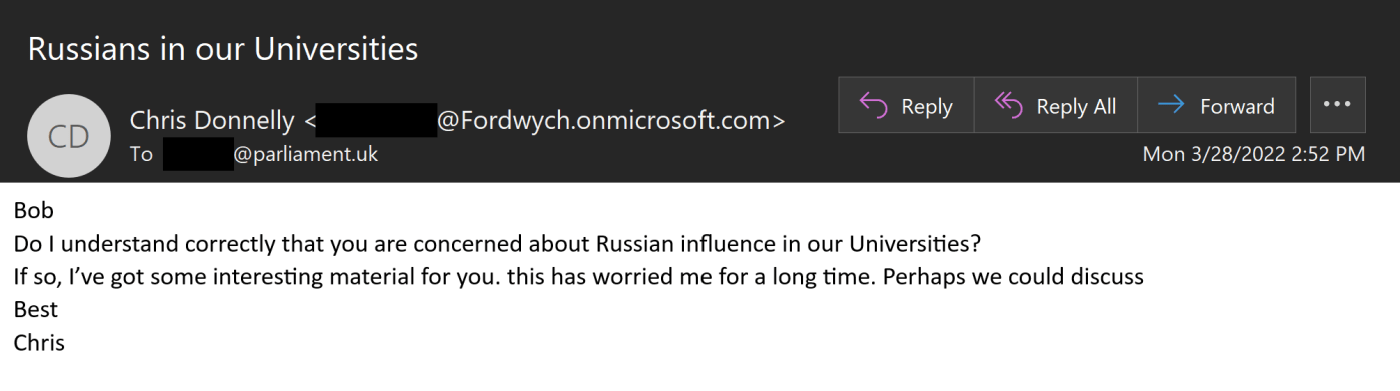
In a March 2022 email entitled “Russians in our Universities,” British military intelligence officer and former senior NATO advisor Chris Donnelly accused Sakwa of being a Russian “fellow traveller” who’d been “gradually breaking cover,” insisting the professor was “far too well-informed about Russian strategy to be called just ‘a useful idiot.’” Another email reveals Donnelly fantasizing about publicly exposing Sakwa for being “funded by Russian entities” – a claim the professor strenuously denies.
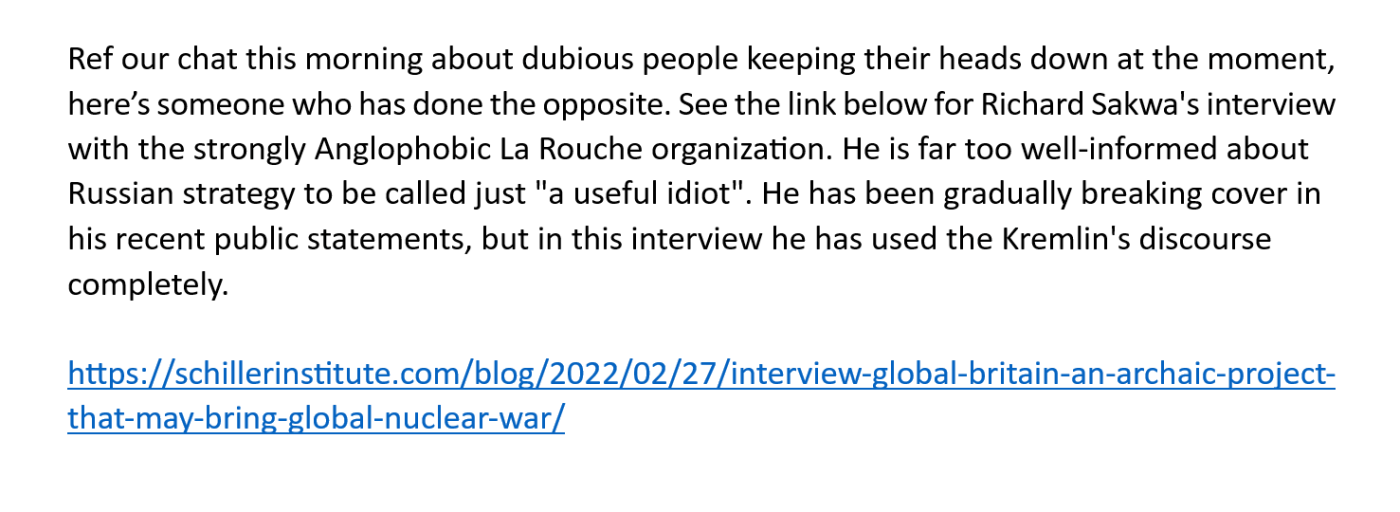
Donnelly fired off the emails just two weeks after the UK’s then-Education Secretary Nadhim Zahawi pledged that the British government was “already on the case and is contacting [their] universities,” after being asked whether the UK government would intervene directly to stop anti-war academics from “acting as useful idiots for President Putin’s atrocities in Ukraine.”
The Grayzone has revealed Donnelly as a key figure behind a secret British military and spying cell dubbed Project Alchemy, which was created in early 2022 to keep Ukraine fighting “at all costs.” A core component of that effort was to silence journalistic voices and media outlets – including this one – deemed a threat to London’s control of the proxy war’s narrative.
The newly-exposed messages show that Donnelly was conducting similar operations in the academic world as well. Though Professor Sakwa has long challenged dominant Western narratives on Putin’s Russia, criticizing both NATO’s rampant expansionism and its refusal to include Moscow in the European security structure following the Soviet Union’s 1991 collapse, he was effectively disappeared from mainstream debates on the conflict since the Ukraine proxy war erupted.
The leaked emails strongly suggest the direct intervention of Donnelly, a known British intelligence asset, may have been responsible for marginalizing Sakwa. Messages show Donnelly contacted influential UK lawmakers to stamp out the “influence” of Sakwa, whom he called his “number one” target, while calling for the blacklisting of other academics who might expose inconvenient truths about the conflict in Ukraine.
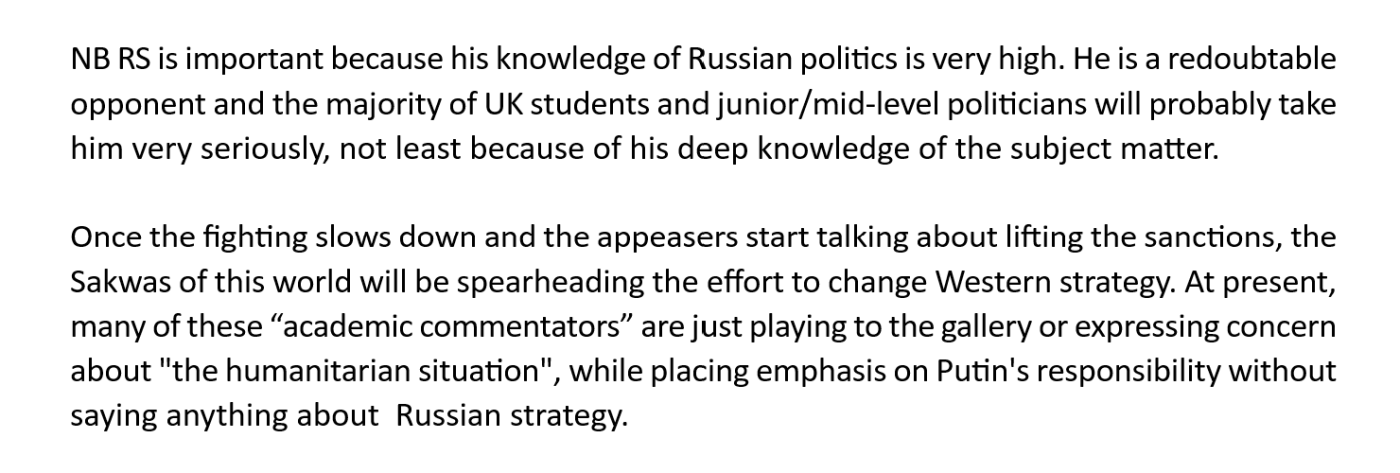
Donnelly’s determination to silence the professor apparently extended beyond the duration of the conflict. In private, he fretted that once “fighting slows down” in Ukraine, “appeasers” would “start talking about lifting the sanctions,” and “the Sakwas of this world will be spearheading the effort to change Western strategy.” In other words, even when the war ended in failure for Kiev and its proxy backers, Connelly and his associates would remain determined to prevent any public reconsideration of the West’s relationship with Russia.
Sakwa “a redoubtable opponent” who’s taken “very seriously”
While recently smeared as a Kremlin apologist and “disinformation” peddler in certain quarters, Sakwa’s works have historically elicited glowing mainstream reviews. Even after the Ukraine proxy war erupted, the Council on Foreign Relations’ Foreign Affairs journal positively appraised the professor’s recent books dissecting the Russiagate fraud, and the origins of the Ukraine conflict. Clearly, it was Sakwa’s credibility and formidable body of knowledge that made him a target of British intelligence following the outbreak of war in Ukraine.
In emails exchanged with James Sherr, a career think tank staffer who once headed the Russia and Eurasia program at the British government-linked think tank Chatham House, Donnelly expressed discomfort about the prospect of Sakwa’s ideas reaching impressionable Western audiences. Sakwa’s “knowledge of Russian politics is very high,” Donnelly warned Sherr, making him “a redoubtable opponent” whom the “majority” of British students and “junior/mid-level politicians” would likely take “very seriously.”
Sherr responded that he had “no doubt” Sakwa was “on the Kremlin payroll,” but insisted the academic criticized NATO expansion “not [for] money,” but “out of hatred of the United States.” If there was “hard evidence” that Sakwa was “funded by Russian entities, then this should be made known,” Sherr added, but even if footage existed of Vladimir Putin personally “writing [Sakwa] a cheque over dinner… the University of Kent will continue to employ him, and he will continue to be adored by those who adore him.”
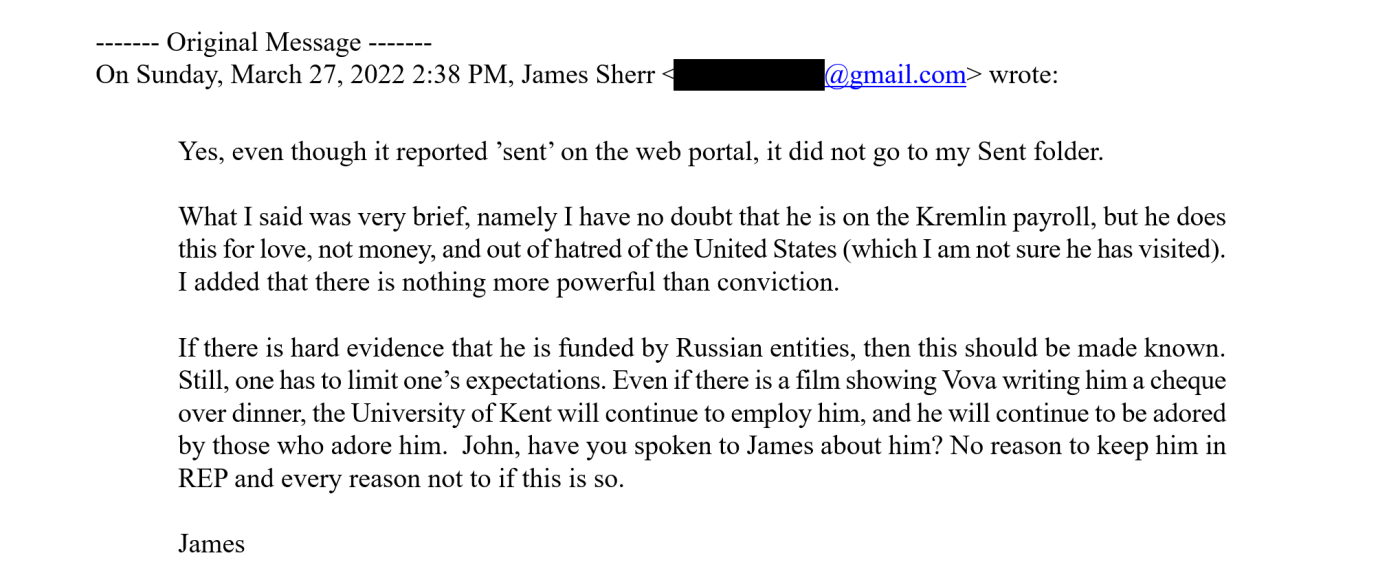
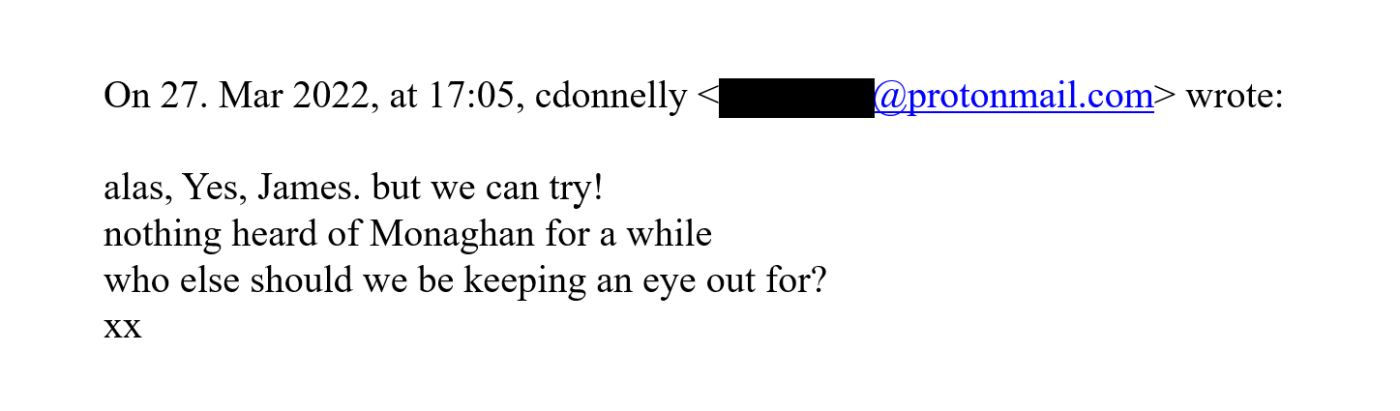
Donnelly agreed with his friend’s false assessment, but was evidently undeterred from pursuing Sakwa, telling Sherr, “we can try!” He added that Andrew Monaghan, another academic who had long warned of the perils of military confrontation with Russia, hadn’t been heard from “for a while,” and asked Sherr: “who else should we be keeping an eye out for?” A day later, Donnelly posed the same question to his longtime associate Victor Madeira, an academic closely connected to former MI6 chief Richard Dearlove.
This followed another email by Donnelly to Conservative MP Bob Seely, a hawkish military veteran and then-member of parliament’s foreign affairs committee. Donnelly asked Seely whether he was “concerned about Russian influence in our Universities,” because “if so, I’ve got some interesting material for you.” Forwarding the unsolicited email to Madeira, Donnelly boasted, “l may have an opportunity to get this addressed,” and bragged that he would soon be discussing the subject with the then-chair of British Parliament’s education select committee.
“cells in the British governmental apparatus… which subvert the fundamental principles of British democracy”
In comments to The Grayzone, Sakwa said Donnelly’s actions were “extremely disturbing,” and suggested the emails indicate “there are cells in the British governmental apparatus who are working in ways which subvert the fundamental principles of British democracy, tolerance of divergent political views, and the encouragement of open debate and dialogue.”
The professor argues that “by traducing scholars and civic activists,” Donnelly and his collaborators “precisely undermine the values which they are ostensibly trying to defend,” and “practice guilt by association.”
“The assumption [that] questioning official policy on a particular issue must be motivated by mercenary concerns, in this case being in the pay of Moscow, is a dreadful manifestation of the McCarthyism we had hoped we put behind us with the end of the Cold War,” Sakwa adds.
“In fact, it demonstrates [that] Cold War II is potentially more dangerous than the first, with the attempt to blacken the reputation of critical voices, and thus assumedly weaken their public impact. This is not only morally and politically wrong in itself, but also damages the possibility of coherent, informed and dispassionate analysis, and thus weakens the coherence of intelligent policy-making in its entirety.”
When Sakwa retired from his university position in August 2022, he was unaware that British intelligence operatives had waged a plot to silence him for over a year. Now, however, the professor wonders whether an incident that occurred two months prior may have been related. That June, the Canterbury anti-war movement organized an event at which Sakwa was the guest speaker. “To our astonishment, about 20 Ukrainians and associates picketed the meeting, with banners condemning me and the organizers,” he told The Grayzone.
Rather than being turned away, the protesters were invited in – “minus placards,” Sakwa noted. However, “they then proceeded to try to disrupt the meeting,” until the event chair warned them “that if their anti-democratic behavior continued, they would be asked to leave.” Following the warning, the event continued in peace. Sakwa said “most” attendees felt his address “struck the appropriate balance between sympathy for the plight of the Ukrainian people, and political analysis of the situation.”
The incident likely would have ended there, but counter-demonstrators seized on leaflets calling for an official inquiry into the ever-mysterious Bucha incident which were distributed by another attendee. Ukrainian officials and their British backers charge that Russian forces carried out a massacre of innocent civilians in the city of Bucha, but have blocked attempts at UN investigation, and refused to release names of purported victims.
While Sakwa believes calls for such a probe to be “not unreasonable”, he said he had nothing to do with the leaflets’ production, and was unaware of their contents at the time. He only learned of their existence when one of the Ukrainian activists who disrupted the event accused him of condoning “conspiracy theories,” leading the University of Kent to open an internal inquiry.
“To the University of Kent’s credit, they dismissed any potential charge of misconduct, and defended the principle of freedom of speech. The institution lived up to its reputation for collegiality and the robust defence of academic freedom,” Sakwa says. “However, the initial charge was clearly malicious and malevolent, and demonstrates the danger of ‘Ukraine syndrome’ damaging the quality of civic life in England.”
Today, “Ukraine syndrome” remains alive and well in Britain as Prime Minister Keir Starmer proudly declares his desire to deploy troops and aircraft to Kiev to participate in hostilities despite UK military chiefs warning that London lacks the men and materiel to even consider such a mission. A depressing official review of the British Army has prompted the head of the Financial Times’ editorial board to conclude “their forces would struggle to fight a European war lasting more than a few weeks.”
While Richard Sakwa and other genuine regional experts warned over many years that transforming Ukraine into an anti-Russian bastion would lead to disaster for all involved, Western leaders turned instead to the paranoid pronouncements of spies like Chris Donnelly for guidance on how to respond to Moscow’s forcefully stated opposition to Ukraine joining NATO. And before the belligerent plans of Donnelly and his cadre could be discredited, they made certain that no one would be left to call them out.
Judge Dismisses Defamation Lawsuit Against NewsGuard
By Cindy Harper | Reclaim The Net | March 27, 2025
A federal judge has thrown out a $13.6 million defamation lawsuit brought by Consortium News against the media ratings firm NewsGuard, delivering a blow to the independent outlet’s fight against what it views as reputational sabotage masked as media accountability. The suit, filed in 2023, centered on NewsGuard’s characterization of Consortium’s journalism, particularly its coverage of Russia’s war on Ukraine, as misleading and unreliable.
We obtained a copy of the ruling for you here.
NewsGuard, a for-profit company that partners with government agencies and private firms, and “misinformation,” had assigned Consortium News a failing trust score of 47.5 out of 100.
It accused the outlet of falling short in three categories: avoiding falsehoods, reporting responsibly, and issuing timely corrections. A “proceed with caution” warning label — first red, later changed to blue — was attached to the site, branding it as a publication that “generally fails to maintain basic standards of accuracy and accountability.”
Consortium News responded with a forceful legal challenge, arguing that the flag was defamatory and that the firm’s sweeping judgments were based on a cursory review of just five opinion pieces out of more than 20,000 articles and videos published on its platform. The complaint accused NewsGuard of misrepresenting its entire body of work.
On Wednesday, US District Judge Katherine Failla granted NewsGuard’s motion to dismiss the suit, ruling that Consortium News had failed to show the kind of “actual malice” required to sustain a defamation claim. In her opinion, Failla wrote that the plaintiffs didn’t offer concrete allegations that NewsGuard knowingly made false statements.
“Indeed, far from alleging that NewsGuard knew its statements to be false, Consortium News effectively concedes the truth of the ‘anti-U.S. perspective’ label, and acknowledges that ‘reasonable people’ could differ as to the truth or falsity of its reporting, undercutting any suggestion that NewsGuard knew its criticisms to be false and published those criticisms despite knowing them to be false,” Failla wrote.
NewsGuard, which has secured contracts with the US government and other institutional clients, argued in court that its evaluations are protected expressions of opinion and that its partnership with federal agencies does not convert it into a government actor. In its defense, it called its scoring framework “inherently subjective.”
Welcome to Britain, Where Critical WhatsApp Messages Are a Police Matter

By Cam Wakefield | Reclaim The Net | March 30, 2025
You’d think that in Britain, the worst thing that could happen to you after sending a few critical WhatsApp messages would be a passive-aggressive reply or, at most, a snooty whisper campaign. What you probably wouldn’t expect is to have six police officers show up on your doorstep like they’re hunting down a cartel. But that’s precisely what happened to Maxie Allen and Rosalind Levine — two parents whose great offense was asking some mildly inconvenient questions about how their daughter’s school planned to replace its retiring principal.
This is not an episode of Black Mirror. This is Borehamwood, Hertfordshire, 2025. And the parents in question—Maxie Allen, a Times Radio producer, and Rosalind Levine, 46, a mother of two—had the gall to inquire, via WhatsApp no less, whether Cowley Hill Primary School was being entirely above board in appointing a new principal.
What happened next should make everyone in Britain pause and consider just how overreaching their government has become. Because in the time it takes to send a meme about the school’s bake sale, you too could be staring down the barrel of a “malicious communications” charge.
The trouble started in May, shortly after the school’s principal retired. Instead of the usual round of polite emails, clumsy PowerPoints, and dreary Q&A sessions, there was… silence. Maxie Allen, who had once served as a school governor—so presumably knows his way around a budget meeting—asked the unthinkable: when was the recruitment process going to be opened up?
A fair question, right? Not in Borehamwood, apparently. The school responded not with answers, but with a sort of preemptive nuclear strike. Jackie Spriggs, the chair of governors, issued a public warning about “inflammatory and defamatory” social media posts and hinted at disciplinary action for those who dared to cause “disharmony.” One imagines this word being uttered in the tone of a Bond villain stroking a white cat.
For the crime of “casting aspersions,” Allen and Levine were promptly banned from the school premises. That meant no parents’ evening, no Christmas concert, no chance to speak face-to-face about the specific needs of their daughter Sascha, who—just to add to the bleakness of it all—has epilepsy and is registered disabled.
So what do you do when the school shuts its doors in your face? You send emails. Lots of them. You try to get answers. And if that fails, you might—just might—vent a little on WhatsApp.
But apparently, that was enough to earn the label of harassers. Not in the figurative, overly sensitive, “Karen’s upset again” sense. No, this was the actual, legal, possibly-prison kind of harassment.
Then came January 29. Rosalind was at home sorting toys for charity—presumably a heinous act in today’s climate—when she opened the door to what can only be described as a low-budget reboot of Line of Duty. Six officers. Two cars. A van. All to arrest two middle-aged parents whose biggest vice appears to be stubborn curiosity.
“I saw six police officers standing there,” she said. “My first thought was that Sascha was dead.”
Instead, it was the prelude to an 11-hour ordeal in a police cell. Eleven hours. That’s enough time to commit actual crimes, be tried, be sentenced, and still get home in time for MasterChef.
Allen called the experience “dystopian,” and, for once, the word isn’t hyperbole. “It was just unfathomable to me that things had escalated to this degree,” he said. “We’d never used abusive or threatening language, even in private.”
Worse still, they were never even told which communications were being investigated. It’s like being detained by police for “vibes.”
One of the many delightful ironies here is that the school accused them of causing a “nuisance on school property,” despite the fact that neither of them had set foot on said property in six months.
Now, in the school’s defense—such as it is—they claim they went to the police because the sheer volume of correspondence and social media posts had become “upsetting.” Which raises an important question: when did being “upsetting” become a police matter?
What we’re witnessing is not a breakdown in communication, but a full-blown bureaucratic tantrum. Instead of engaging with concerned parents, Cowley Hill’s leadership took the nuclear option: drag them out in cuffs and let the police deal with it.
Hertfordshire Constabulary, apparently mistaking Borehamwood for Basra, decided this was a perfectly normal use of resources. “The number of officers was necessary,” said a spokesman, “to secure electronic devices and care for children at the address.”
Right. Nothing says “childcare” like watching your mom get led away in handcuffs while your toddler hides in the corner, traumatized.
After five weeks—five weeks of real police time, in a country where burglaries are basically a form of inheritance transfer—the whole thing was quietly dropped. Insufficient evidence. No charges. Not even a slap on the wrist.
So here we are. A story about a couple who dared to question how a public school was run, and ended up locked in a cell, banned from the school play, and smeared with criminal accusations for trying to advocate for their disabled child.
This is Britain in 2025. A place where public institutions behave like paranoid cults and the police are deployed like private security firms for anyone with a bruised ego. All while the rest of the population is left wondering how many other WhatsApp groups are one message away from a dawn raid.
Because if this is what happens when you ask a few inconvenient questions, what’s next? Fingerprinting people for liking the wrong Facebook post? Tactical units sent in for sarcastic TripAdvisor reviews?
It’s a warning. Ask the wrong question, speak out of turn, and you too may get a visit from half the local police force.
Iran will admit students expelled from US as part of Trump’s crackdown on pro-Palestine protests
Press TV – March 30, 2025
Iran’s academic officials have declared the Islamic Republic’s unwavering support for students and academics who have been targeted by the Trump administration’s crackdown on pro-Palestinian protesters on university campuses.
Officials from Iran’s academic institutions said in a joint statement on Sunday that the country’s universities “take pride in extending their support” to students protesting “the crimes of the Zionist regime” in the US.
“The acts of global arrogance in suppressing justice-seeking students and expelling them from American universities after their peaceful protests against the atrocities committed by the Zionist regime against the oppressed people of Palestine have further unveiled the true nature of those who claim to advocate for human rights,” the statement read.
Iran’s universities, it said, are ready to accept students who are being expelled by US immigration officials for showing sympathy for the Palestinian cause.
Iran’s Supreme Council of the Cultural Revolution (SCCR), in collaboration with the Academy of Sciences and the Academy of Medical Sciences, will facilitate the admission of expelled students into Iranian universities.
President Donald Trump has begun following through on a threat to deport all non-citizen university activists with ties to the pro-Palestine protests, which rocked the US last spring, with students staging daily protests in college campuses across the country for weeks.
The crackdown intensified since US immigration agents arrested Mahmoud Kahlil, a graduate of Columbia University, on March 8. Kahlil, who is being held in an immigration detention center in Louisiana, faces deportation for his role in pro-Palestinian campus protests.
Secretary of State Marco Rubio, who personally signed off on his arrest, said on Thursday that Washington has revoked at least 300 foreign students’ visas.
“Maybe more than 300 at this point,” he said. “We do it every day, every time I find one of these lunatics.”
Trump officials have accused these students of being “adversarial to the foreign policy and national security interests” of the US.
Anti-genocide activists exposed by pro-Israel groups using facial recognition tech
The Cradle | March 30, 2025
Foreign activists who took part in widespread campus protests against US support for the Israeli genocide of Palestinians in Gaza are being exposed by pro-Israel groups using facial recognition technology and tip lines, according to an investigation by AP.
Zionist organization Betar US has reportedly submitted a list of identified protesters to US federal officials. The list was compiled with the help of Eliyahu Hawila, a New York-based software engineer who built a facial recognition tool called NesherAI designed to identify masked protesters.
“It’s a very concerning practice,” said Abed Ayoub, National Executive Director of the American-Arab Anti-Discrimination Committee. “Essentially, the administration is outsourcing surveillance.”
Since the return of US President Donald Trump to power, the Immigration and Customs Enforcement (ICE) agency and the Department of Homeland Security (DHS) have detained or deported at least nine foreign university students for their activism in support of Palestine and against the US-Israeli genocide.
“Now they’re using tools of the state to actually go after people,” a Columbia graduate student from South Asia who has been active in protests told AP. “We suddenly feel like we’re being forced to think about our survival.”
“It might be more than 300 at this point. We do it every day. Every time I find one of these lunatics, I take away their visa,” State Secretary Marco Rubio said earlier this week when asked about the ongoing crackdown on pro-Palestinian students and academics.
“Please tell everyone you know who is at a university to file complaints about foreign students and faculty who support Hamas,” Elizabeth Rand, president of a group called Mothers Against Campus Antisemitism, said in a 21 January post to more than 60,000 followers on Facebook. It included a link to an ICE tip line.
In early February, messages from a chat group frequented by Israelis living in New York were published online. “Do you know students at Columbia or any other university who are here on a study visa and participated in demonstrations against Israel?” one message said in Hebrew. “If so, now is our time!” the message adds, accompanied by a link to the ICE hotline.
Earlier this week, Axios reported that the White House is threatening to block certain colleges from having any foreign students if it decides too many are involved in protests against Israel’s genocide in Gaza.
ECHR Finds Ukraine Responsible for Odessa Massacre
By Kit Klarenberg | March 30, 2025
On March 13th, a bombshell judgment by the European Court of Human Rights found the Ukrainian government guilty of grave human rights breaches over the May 2nd 2014 Odessa massacre, in which dozens of Russian-speaking anti-Maidan activists were forced into the city’s Trade Unions House and burned alive by violent ultranationalist thugs. The explosive findings unambiguously uncover a concerted conspiracy by Ukrainian authorities to facilitate and exacerbate the grotesque killing, then insulate its perpetrators, and officials and state agencies which helped it happen, from justice.
In all, 42 people were killed and hundreds injured as a result of the blaze, a bloody bookend to the so-called “Maidan revolution” that saw Ukraine’s democratically-elected president Viktor Yanukovych deposed in a Western-orchestrated coup months earlier. Ever since Ukrainian officials and legacy media outlets have consistently framed the deaths as a tragic accident, with some figures even blaming anti-Maidan protesters themselves for starting the blaze. That notion is comprehensively incinerated by the verdict, which was delivered by a team of seven European judges, including a Ukrainian.
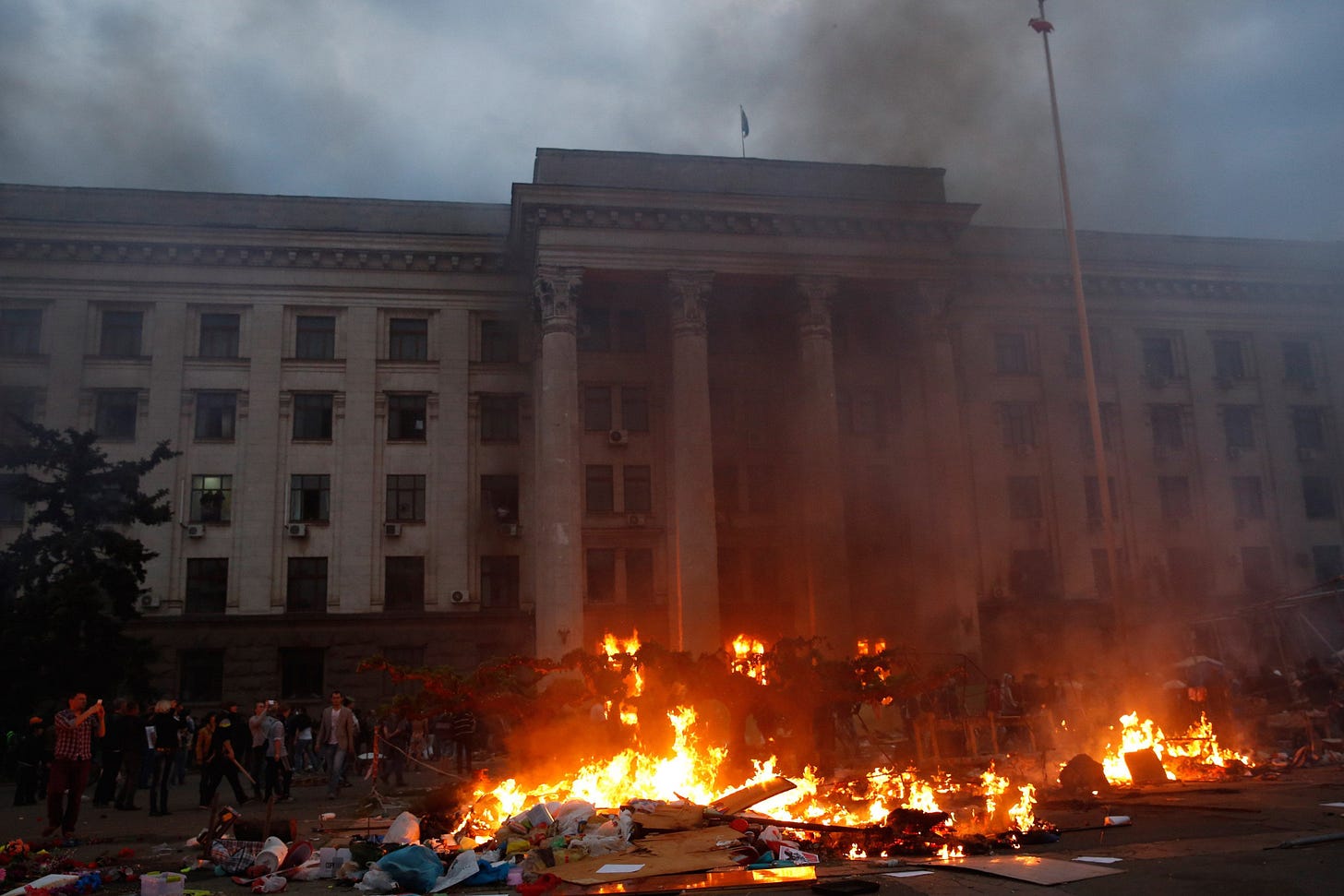
The May 2nd 2014 Odessa massacre
“Relevant authorities’ failure to do everything that could reasonably be expected of them to prevent the violence in Odessa… to stop that violence after its outbreak, to ensure timely rescue measures for people trapped in the fire, and to institute and conduct an effective investigation into the events” means Kiev was found guilty of egregious European Convention on Human Rights breaches. Moreover, numerous incendiary passages make clear industrial scale “negligence” by officials on the day, and ever after, “went beyond an error of judgment or carelessness.”
For example, the ECHR found deployment of fire engines to the site was “deliberately delayed for 40 minutes” – the local fire station being just one kilometer away – and police stood by passively as the building and its occupants burned, refusing to “help evacuate people… promptly and safely.” Moreover, Ukrainian authorities made “no efforts whatsoever” or “any meaningful attempt” to prevent or disrupt the skirmishes between pro- and anti-Maidan activists that prefaced the deadly inferno, despite knowing in advance such clashes were impending on the day.
While stopping short of charging that Ukrainian authorities actively wished for the anti-Maidan activists trapped in the burning building to die, this conclusion is ineluctable based on the ECHR’s findings. So too the apparent immunity from prosecution for implicated officials and ultranationalist perpetrators, and Kiev’s failure to act on “extensive photographic and video evidence” indicating precisely who was responsible for “firing shots during the clashes,” setting the building ablaze, and “assaulting the fire victims” who managed to escape.
The case was brought by 25 people who lost family members in the Neo-Nazi arson attack and clashes that preceded it, and three who survived the fire “with various injuries”. The ECHR has demanded Ukraine pay them just 15,000 euros each in damages. In an even greater affront to justice, the damning ruling stops short of exposing the full reality of the Odessa slaughter, indicting the Western-supported Neo-Nazi elements responsible, and their intimate ties to the February 2014 Maidan Square false flag sniper massacre.
‘Explicit Order’
Once the Maidan protests commenced in Ukraine in November 2013, tensions began steadily brewing between Odessa’s sizable Russian-speaking population and Ukrainian nationalists within and without the city. As the ECHR ruling notes, “while violent incidents had overall remained rare… the situation was volatile and implied a constant risk of escalation.” In March 2014, anti-Maidan activists set up a tent camp in Kulykove Pole Square, and began calling for a referendum on the establishment of an “Odessa Autonomous Republic”.
The next month, supporters of Odesa Chornomorets and Kharkiv Metalist football clubs announced a rally “For a United Ukraine” on May 2, before a scheduled match. Shortly thereafter, the ECHR records “anti-Maidan posts began to appear on social media describing the event as a Nazi march and calling for people to prevent it.” While branded Russian “disinformation” in the ruling, hooligans associated with both clubs had overt Neo-Nazi sympathies and associations, and well-established reputations for violence. They later formed the notorious Azov Battalion.
Fearing their tent encampment would be attacked, anti-Maidan activists resolved to disrupt the “pro-unity march” before it reached them. The ECHR reveals Ukraine’s security services and cybercrime unit had substantive intelligence indicating “violence, clashes and disorder” were certain on the day. Yet, authorities “ignored the available intelligence and the relevant warning signs”, and undertook no actions or “proper measures” to “stamp out any provocation”, such as implementing “enhanced security in the relevant areas.”
So it was on the afternoon of May 2nd 2014, “as soon as the march began,” anti-Maidan activists confronted the demonstrators, and violent clashes erupted. At roughly 17:45, in the precise manner of the Maidan Square sniper false flag massacre three months earlier, multiple anti-Maidan activists were fatally shot “by someone standing on a nearby balcony”, using “a hunting gun.” Subsequently, “pro-unity protesters… gained the upper hand in the clashes,” and charged towards Kulykove Pole square.
Anti-Maidan activists duly “took refuge” in Trade Unions House, a five-storey building overlooking the square, while their ultranationalist adversaries “started setting fire to the tents.” Gunfire and Molotov cocktails were “reportedly” exchanged by both sides, and before long, the building was ablaze. “Numerous calls” were made to the local fire brigade, including by police, “to no avail.” Mysteriously, its chief had “instructed his staff not to send any fire engines to Kulykove Pole without his explicit order,” so none were dispatched.
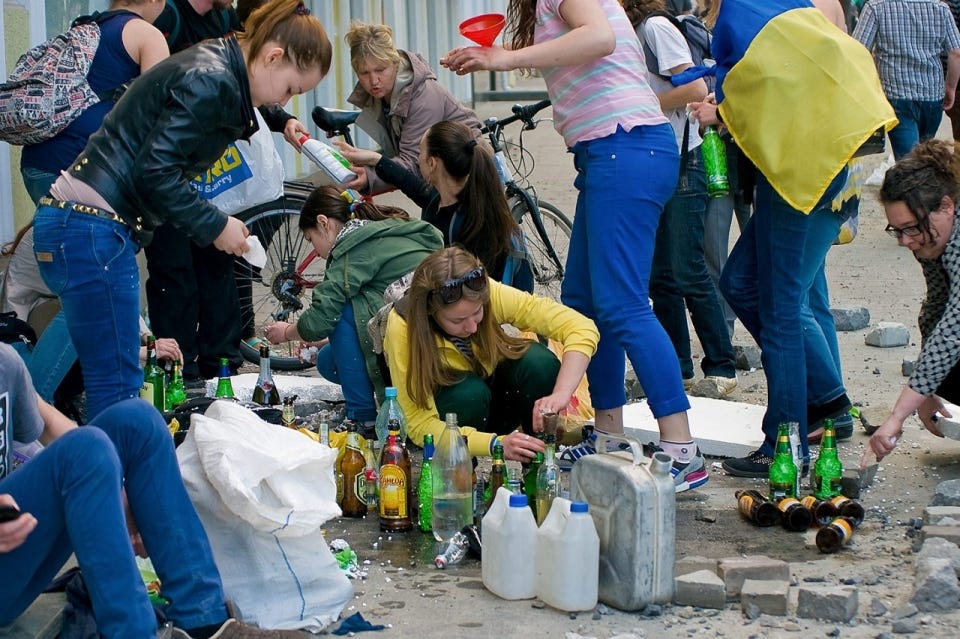
Wives and girlfriends of Neo-Nazis prepare Molotov cocktails for the attack
Several people trapped in the building tried to escape by jumping from its upper windows – some survived, but others died. “Video footage shows pro-unity protesters attacking people who had jumped or had fallen,” the ECHR notes. It was not until 20:30 that firefighters finally entered the building and extinguished the blaze. Police then arrested 63 surviving activists “still inside the building or on the roof.” They were released two days later, after a several hundred-strong group of anti-Maidan protesters “stormed the local police station where they were being held.”
‘Serious Defects’
The litany of security failures and industrial scale negligence by authorities on the day was greatly aggravated by “local prosecutors, law enforcement, and military officers” not being “contactable for a large part or all of time [sic],” as they were coincidentally attending a meeting with Ukraine’s Deputy Prosecutor General. The ECHR “found the attitude and passivity of those officials inexplicable,” apparently unwilling to consider the obvious possibility they purposefully made themselves incommunicado to ensure maximum mayhem and bloodshed, while insulating themselves from legal repercussions.
Still, the ECHR ruled “relevant” Ukrainian authorities “had not done everything they reasonably could to prevent the violence” or “what could reasonably be expected of them to save people’s lives,” therefore finding Kiev committed “violations of the substantive aspect of Article 2” of the European Convention on Human Rights. The Court also concluded authorities “failed to institute and conduct an effective investigation into the events in Odessa” – “a violation of the procedural aspect of Article 2”.
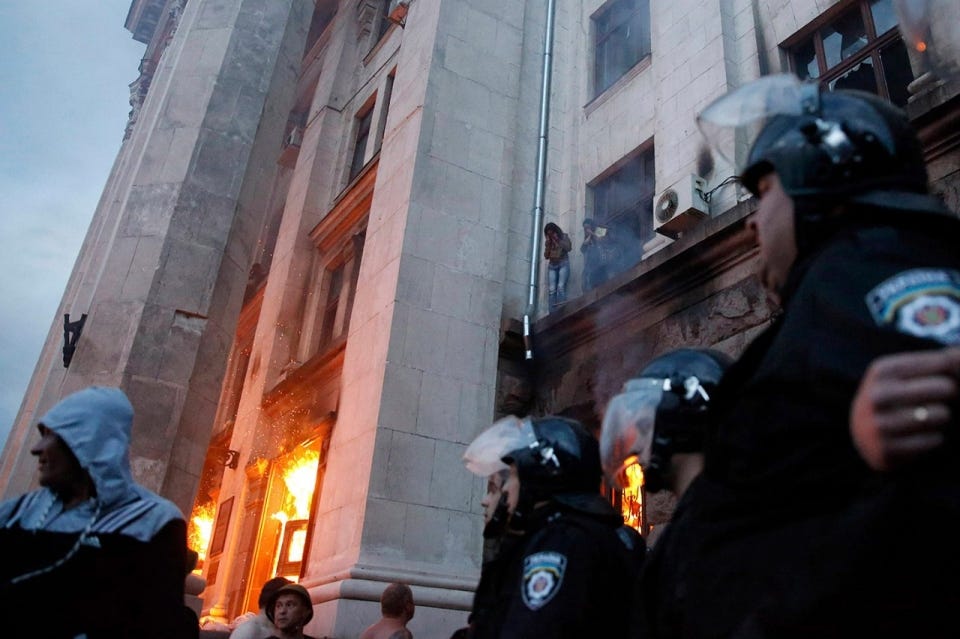
Trapped anti-Maidan activists hoping to be rescued
The ECHR’s appraisal of criminal investigations into perpetrators of the Odessa massacre, and all the officials who failed in their most basic duties on May 2nd 2014, was absolutely scathing, the details pointing to a very clear, deliberate state-level coverup. For example, no effort was made to seal off “affected areas of the city centre” in the event’s aftermath. Instead, “the first thing” authorities did “was to send cleaning and maintenance services to those areas,” meaning invaluable evidence was almost inevitably eradicated.
Accordingly, when on-site inspections were finally carried out two weeks later, the probes “produced no meaningful results.” Trade Unions House likewise “remained freely accessible to the public for 17 days after the events,” giving malicious actors plentiful time to manipulate, remove, or plant incriminating evidence at the site. Meanwhile, “many of the suspects absconded.” Several criminal investigations into perpetrators were opened, only to go nowhere, left to expire under Ukraine’s statute of limitations. Other cases that reached trial “remained pending for years”, before being dropped.
This was despite “extensive photographic and video evidence regarding both the clashes in the city centre and the fire,” from which culprits’ identities could be easily discerned. The ECHR had no confidence Ukrainian authorities “made genuine efforts to identify all the perpetrators,” and several forensic reports weren’t released for many years. Elsewhere, the Court noted a criminal investigation of an individual suspected of having shot at anti-Maidan activists was inexplicably discontinued on four separate occasions, on identical grounds.
The ECHR also noted “serious defects” in investigations of officials, “and their role in the events.” Primarily, this took the form of “prohibitive delays” and “significant periods of unexplained inactivity and stagnation” in opening cases. For instance, “although it had never been disputed that the fire service regional head had been responsible for the delayed deployment of fire engines to Kulykove Pole,” no probe into his flagrantly criminal dereliction of duty was launched until almost two years after the massacre.
Similarly, Odessa’s regional police chief not only failed to implement any “contingency plan in the event of mass disorder” according to protocol, but internal documents attesting that security measures had in fact been undertaken were found to have been forged. However, he only became subject to criminal investigation “almost a year later.” Following pre-trial investigation, his case remained pending “for about eight years,” after which he was released from criminal liability, “on the grounds that the charges against him had become time-barred.”
‘Burn Everything’
Wholly unconsidered by the ECHR was the prospect that, far from a freak twist of fate produced by two effectively warring factions clashing in Odessa, the lethal incineration of anti-Maidan activists in May 2014 was an intentional and premeditated act of mass murder, conceived and directed by Kiev’s US-installed far-right government. This interpretation is amply reinforced by testimonies from a Ukrainian parliamentary commission, instituted in the massacre’s immediate aftermath.
The commission found Ukrainian national and regional officials explicitly planned to use far-right activists drawn from the fascist Maidan Self-Defence to violently suppress Odessa’s would-be separatists, and disperse all those camped by Trade Unions House. Moreover, Maidan Self-Defence chief Andriy Parubiy and 500 of his armed and dangerous members were dispatched to the city from Kiev on the eve of the massacre. From 1998 – 2004, Parubiy served as founder and leader of Neo-Nazi paramilitary faction Patriot of Ukraine.
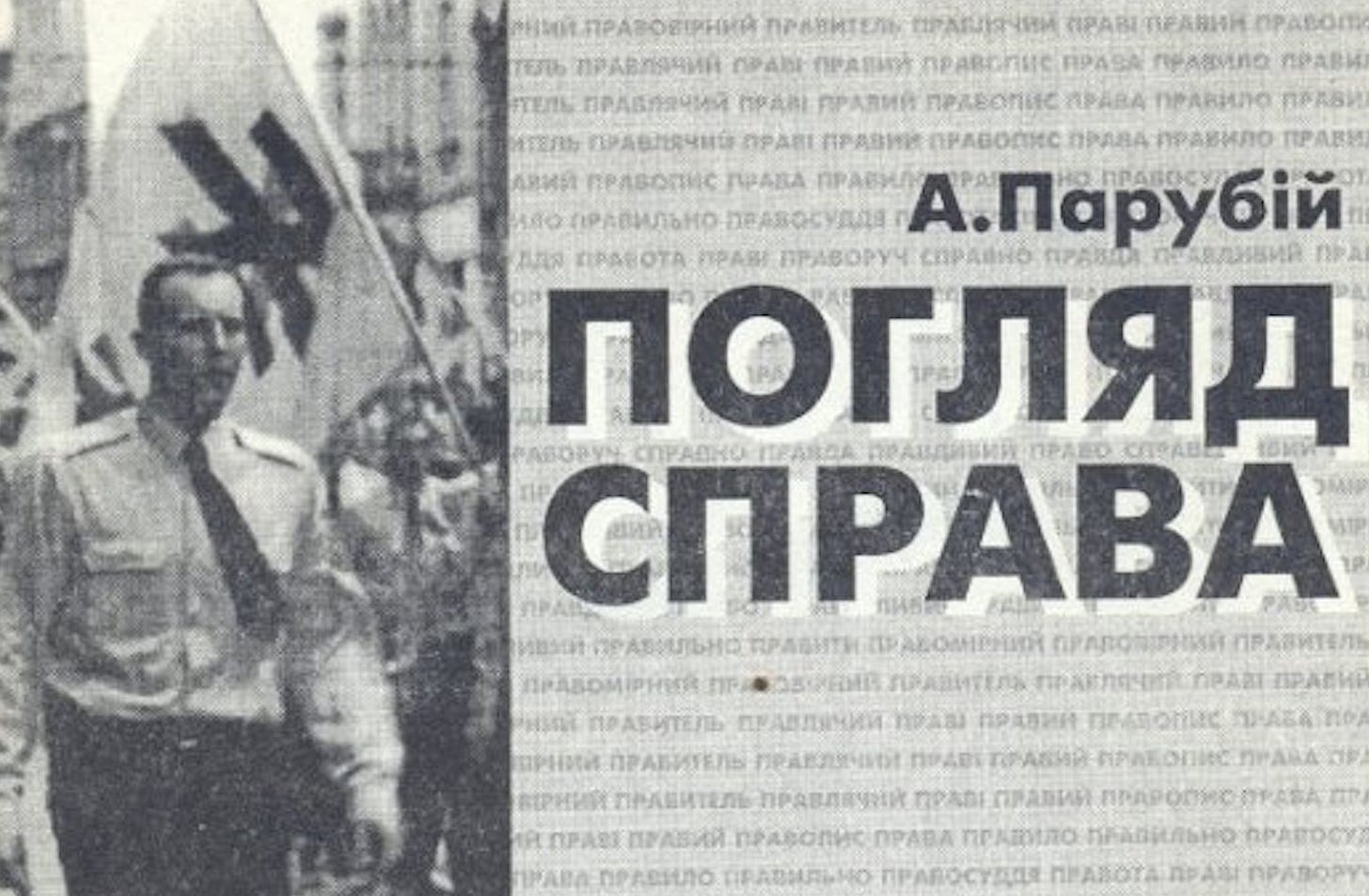
A Patriot of Ukraine leaflet, featuring Andriy Parubiy
He also headed Kiev’s National Security and Defence Council at the time of the Odessa massacre. Ukraine’s State Bureau of Investigations immediately began scrutinising Parubiy’s role in the May 2014 events after he was replaced as lead parliamentary speaker, following the country’s 2019 general election. This probe has seemingly come to nothing since. Nonetheless, a year prior a Georgian militant told Israeli documentarians that he engaged in “provocations” in the Odessa massacre under Parubiy’s command, who told him to attack anti-Maidan activists and “burn everything.”
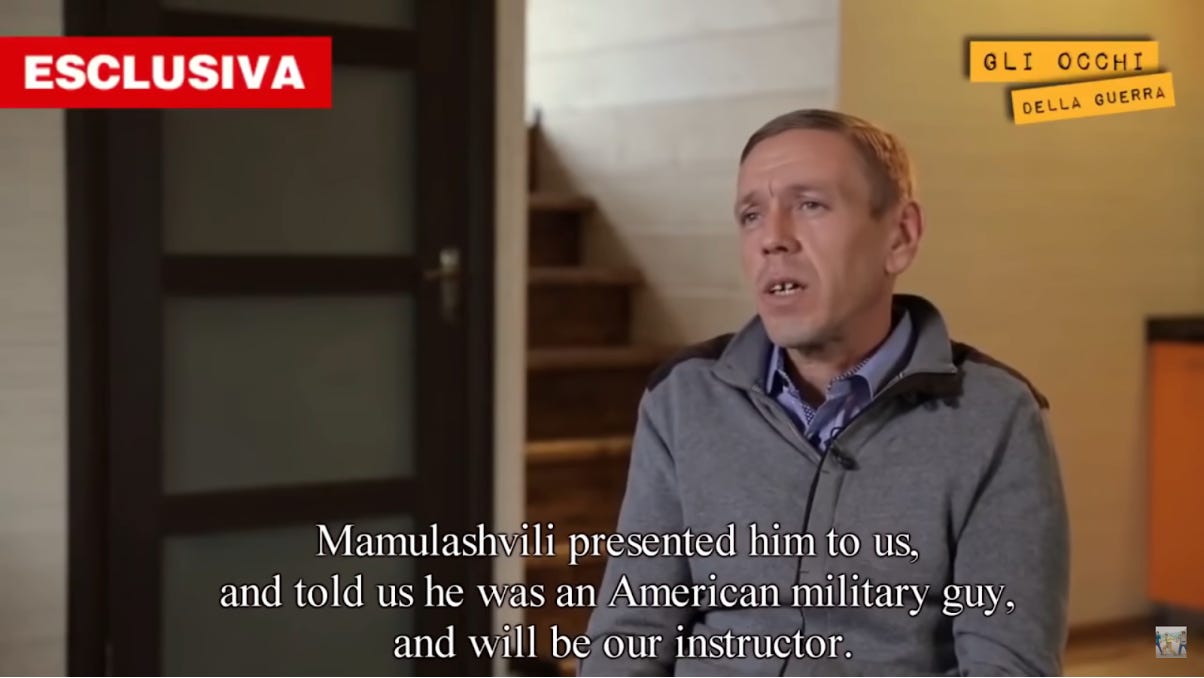
He is one of several Georgian fighters who has openly alleged they were personally responsible for the February 2014 Maidan Square false flag sniper massacre, under the command of Parubiy, other ultranationalist Ukrainian figures, and Mikhael Saakashvili, founder of infamous mercenary brigade Georgian Legion. That slaughter brought about the end of Viktor Yanukovych’s government, and sent Ukraine hurtling towards war with Russia. The Odessa massacre was another key chapter in that morbid saga – and the West’s foremost human rights court has now firmly laid responsibility for the horror at Kiev’s feet.
New German government wants to ban ‘lies’
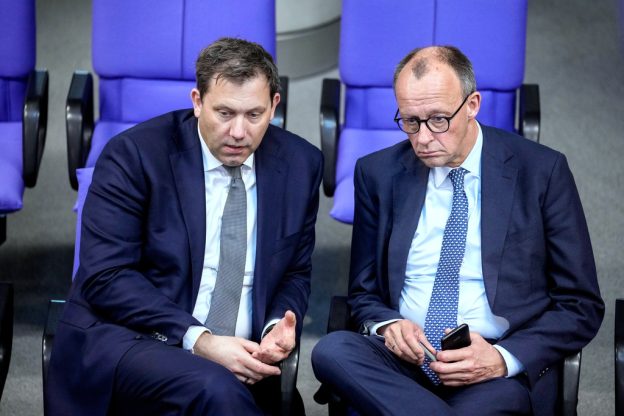
Remix News | March 28, 2025
The new German government coalition, which is likely to be the Christian Democrats (CDU) and the Social Democrats (SPD) is looking to ban “lies,” according to a working paper that emerged from the group “culture and media” between the two parties.
Bild newspaper received a copy of the working paper, which outlines the goal of combating “fake” news on social media, including restrictions on it.
The paper from the CDU and SPD indicates that “disinformation and fake news” threaten democracy.
In fact, the paper argues that freedom of expression does not apply in such circumstances.
Bild contacted a number of constitutional lawyers, and they are highly skeptical of the law.
“Lies are only prohibited if they are punishable, for example in the case of sedition. Otherwise, you can lie,” said Volker Boehme-Neßler, a professor at the University of Oldenburg.
Even determining a lie is a legal complexity.
“It is not an easy question of what a factual claim and what an expression of opinion is. Most courts interpret freedom of expression very broadly,” he added.
He also took aim at a specific part of the working paper, which addresses “hate and agitation.”
He said, “‘hate and agitation’ — these are ‘no legal terms.” He added, “Basically, the spread of hatred in Germany is protected by freedom of expression. An assertion like ‘I hate all politicians,’ does not yet constitute a criminal offense.”
Another law professor from the University of Augsburg, Josef Franz Lindner, said that the “deliberate spreading of false facts is not punishable, not illegal.”
He said that if the new government moves forward with a law against “fake news,” it would represent a grave threat to freedom of speech.
He said he can only warn against a “fake news” offense being created, saying “Ultimately, it would expose any controversial statement to the risk of criminal prosecution.”
It is also worth noting that Friedrich Merz himself, who is likely to be Germany’s next chancellor, openly lied when he said that his party would [not] support an end to the debt brake. Almost immediately after the election, he said the debt brake would be lifted, and that Germany would take on historic amounts of debt.
Lawyer Joachim Steinhöfel, who has a broad range of clients related to internet censorship, says the CDU and SPD’s goal with the new paper is to “intimidate the unpopular social media” content producers. He said that such censorship already lacks a “constitutional basis.”
From JFK to Donald Trump: How the USA Became Wedded to Zionist Israel
By Rick Sterling | Global Research | March 28, 2025
There are many contrasts between the 35th president, John F. Kennedy, and the 45th and 47th president, Donald J. Trump. One extreme example is regarding U.S. policy toward Israel.
JFK and Israel/Palestine
Unknown to many people today, JFK supported Palestinian rights and sought a sustainable peace in the region.
In 1960, when JFK was campaigning to be president, he spoke at the convention of the Zionists of America. In his speech, Kennedy was complimentary about Israel but frankly said,
“I cannot believe that Israel has any real desire to remain indefinitely a garrison state surrounded by fear and hate.”
That warning, issued when Israel had only existed for 12 years, was ignored. Israel continued to act in an aggressive zionist fashion.
Kennedy did not just issue warnings. To the chagrin of the Israelis, JFK established friendly relations with Egypt’s President Nasser. The Kennedy administration provided loans and aid to Egypt.
The JFK administration supported UN resolution 194 which called for the right of return for Palestinian refugees driven out of their homeland. Although Israel committed to abide by UN resolutions when it was admitted to the United Nations in 1949, the Israelis reneged on this commitment and were hostile to the resolution. The day before JFK was assassinated, the New York Times reported (p 19), “Israel Dissents as U.N. Group Backs U.S. on Arab Refugees” and “U.S. Stand Angers Israel.” The second item begins, “Premier Levi Eshkol expressed extreme distaste today for the United States’ position in the Palestinian-refugee debate.”
John Kennedy’s brother Robert was Attorney General and headed the Department of Justice. For two years, up until the end of 1963, the DOJ made increasingly strict demands that the American Zionist Council (AZC) register as agents of a foreign country. In response, the AZC stalled, delayed, and created the American Israel Public Affairs Committee (AIPAC).
The most intense disagreement between Tel Aviv and Washington was regarding the nuclear site under construction at Dimona. JFK was intent on stopping the expansion of countries which possessed nuclear weapons. Although IsraeliPrime Minister Ben-Gurion said the nuclear site was for peaceful purposes, JFK insisted that the US needed to inspect and confirm this. The inspection deadline was December 1963.
In each of these four areas of contention, US policy changed dramatically after JFK was assassinated and Lyndon Johnson became president. Dimona was never properly inspected, and LBJ did not object to Israeli acquisition of nuclear weapons. The demand that the American Zionist Council register as an agent of a foreign country was dropped. Over time, the US withdrew their support of UN resolution 194, and LBJ was hostile to Nasser and ended US loans and support. Details of this process are described in this article and this book.
Israel Policy Since JFK and Today
With few exceptions, US policy has been subservient to Israel’s wants ever since JFK. An extreme low point was the treachery of President Johnson in covering up the Israeli attack on the USS Liberty during the June 1967 “Six Day War”. News about the Israeli killing and injuring of over 200 US sailors was suppressed for decades.

Damaged USS Liberty on 9 June 1967, one day after attack (Public Domain)
Now we are in a new extreme low point. In his first presidency, Trump flouted international law and longstanding US policy by moving the US Embassy from Tel Aviv to Jerusalem. The significant move was driven by mega donor Sheldon Adelson who wanted it announced on Trump’s first day in office. Another prime concern of Adelson was to torpedo the Joint Comprehensive Plan of Action (JCPOA) with Iran. Trump responded as expected and withdrew the US from the agreement, effectively killing it.
Now President Trump’s administration is trampling on the right to free speech and aggressively suppressing critics of Israel. This repression on behalf of Israel was taking place under Biden but has escalated dramatically. Authorities have imprisoned a perfectly legal resident, Mahmoud Khalil. They have forced Columbia University to punish students without just cause and to impose obvious restrictions and prohibitions on speech and opinion. Why did they do this? It appears to follow the wishes of megadonor Miriam Adelson. She is president and chief funder of the Maccabee Task Force, which has campaigned on these issues for months.
As reported at Responsible Statecraft,
“Adelson’s support for the administration’s campaign to stifle criticism of Israel on college campuses isn’t a new focus but her alignment with the levers of state powers to implement her vision are unprecedented. In fact, tax documents reveal that she is directly overseeing a social media campaign targeting Khalil and Columbia University.”
In addition to suppressing free speech and punishing critics of Israel, the Trump administration has bombed and attacked an independent country (Yemen) in the service of Israel. They are doing this despite the fact that Yemen did NOT threaten U.S. ships in the region. The Houthi government only threatened Israeli ships after Israel unilaterally broke the ceasefire and prevented food and other necessary humanitarian aid getting into Gaza. Israel, with U.S. support, is blatantly defying the International Court of Justice which ordered Israel to “maintain open the Rafah crossing for unhindered provision at scale of urgently needed basic services and humanitarian assistance” and “immediately halt its military offensive, and any other action in the Rafah Governorate, which may inflict on the Palestinian group in Gaza conditions of life that could bring about its physical destruction in whole or in part.” Israel is in violation of this order and the US is complicit by providing most of the weapons.
President Trump, who campaigned and won election on the pledge to STOP needless wars, has started a new war with Yemen which is of no benefit to the US but serves the interests of Netanyahu’s Israel. Will he authorize attacks on Iran, in further subservience to Bibi?
Corruption of the Political Process
When Jewish donors to JFK’s 1960 campaign suggested they should determine his Mideast policy, JFK was shocked and definitively said NO. As reported by Seymour Hersh in “The Samson Option”, Kennedy talked with a friend who described what happened: “As an American citizen he (JFK) was outraged to have a zionist group come to him and say, ‘We know your campaign is in trouble. We’re willing to pay your bills if you’ll let us have control of your Middle East policy.” At that time, JFK vowed to change the US electoral system to prevent this corruption if he got elected. As president, he tried, but faced big hurdles and did not succeed.
Ever since JFK’s death, pro-Israel forces have had undue influence on U.S. policy. If the International Court of Justice decides that Israel is committing genocide, as seems likely, the U.S. will be the primary collaborator in the war crimes. The US is increasingly alone in supporting the zionist state as it practices apartheid within Israel, theft of land in the West Bank, and massacres in Gaza including attacks on hospitals, schools, and UN facilities. Fourteen countries now support South Africa’s charges of genocide against Israel.
Under Democratic President Joe Biden, U.S. policy to Israel was unwaveringly obsequious. Despite 70% of Democratic Party voters wanting the U.S. to get a ceasefire in Gaza, the Biden/Blinken team refused to do this. The Democratic Party leaders’ zionist ideology combined with zionist financial influence superseded their party members’ wishes. Netanyahu ignored Biden’s “red lines” with impunity.
Republican President Trump has taken this to a new level. His zionist donors determine his Israel policy. To protect Israel, Trump issued an executive order which weaponizes antisemitism. Universities are being compelled to implement a new definition of antisemitism which conflates criticism of Israel with ethnic discrimination. Trump’s campaign to “Make America Great Again” has evolved into “Miriam Adelson Gets All”.
It is a remarkable descent from the days when JFK did what was best for the U.S. as well as being best for Palestinians and non-zionist Jews.
Rick Sterling is an independent journalist based in the San Francisco Bay Area. He can be reached at rsterling1@gmail.com.
Some New Tales from the Darkside
Beatings and arrests continue both in the US and the Middle East
By Philip Giraldi • Unz Review • March 27, 2025
The news cycle over the past week has been dominated by reports and analysis of the Signal group chat involving top national security officials discussing aspects of the recent air strikes which have been directed against the Houthis in Yemen. There are four basic issues that are being examined by both the media and by elected and appointed government officials. First is the apparent ignorance of ordering the strike at all since the panel appeared not to know very much about the target or why the US was escalating the conflict. Second, was the possibly accidental inclusion in the list of participants of a journalist who is closely connected to Zionist Israel, having voluntarily served in the Israeli Army as a prison guard, where he may have tortured Palestinians, and who plausibly is a dual national US-Israeli citizen. Third is the security of the Signal technology itself, which was reportedly initially created to permit such sharing of confidential views online for criminal purposes, but which might be vulnerable to penetration by any professional foreign intelligence service including those of Russia, China, the United Kingdom and, of course, Israel, which would have had a serious interest in what Washington was intending to do in Yemen. Fourth, is the question whether Donald Trump knew about the meeting and approved what was being discussed.
My own experience of secure communications enabling meetings goes back nearly fifty years when nearly every national security-linked facility, including Embassies and military bases, had a so called “bubble” which was enclosed and electronically sealed to prevent outside penetration to learn what was being discussed and by whom. Since that time, there have been huge advances in protecting communications but friends who are still in the intelligence community insist that what is being protected can be made vulnerable by the cyber agencies that exist in various competitive countries that spend billions of dollars to do just that.
The participants in the Signal meeting are now scrambling to make their case that they did nothing wrong, and Defense Secretary Pete Hegseth in particular is arguing that the discussion was not classified even though the issue related to sensitive intelligence regarding the United States plans for escalating a war against a country with which it was not technically at war. The deniers are certainly wrong in making that case, either that or they were incapable of understanding what was on the table. The presence of Jeffrey Goldberg of The Atlantic magazine is more difficult to comprehend as he is no friend of the Trump Administration, but it is now being argued that it was either done absentmindedly by Michael Waltz, the national security director who chaired the meeting, or it was caused by a fit of confusion due to the fact that the “Goldberg” who was supposed to be invited was someone else. In any event, Jeffrey Goldberg first surfaced the story of the Signal meeting and then followed up with a full transcript. Was it all some kind of clever ploy to push Trump into making the decision to go full throttle and attack Iran? It would not be above Netanyahu to arrange something that convoluted and flat out evil and we shall see about Iran soon enough, but certainly Goldberg could only have been there due to manipulation of a situation in which he was pursuing a pro-Israel agenda. Waltz is taking credit for the snafu at the moment but that position might change as he comes under more pressure to resign.
In any event, the Signal story will no doubt be discussed and both embellished and dismissed during the next few days, but one thing it does demonstrate is the relative lack of knowledge that comes across as incompetency on the part of the Trump national security team. And the role of Trump himself will also be hotly debated as he has personally been playing a key role in foreign policy decision making, though so far he is only speaking up to support the work of his subordinates.
Actually there are couple of other stories that surfaced last week that I much prefer. First is the ongoing battle to silence, imprison and actually deport anyone who is critical of Israel or of Jewish group behavior. This has been job number one for the Israel Lobby, which has been eminently successful under both the Joe Biden and Donald Trump administrations, so much so that the sentiment that Israel controls America has been growing among the US public to such an extent that it surfaces regularly.
The Justice Department has reportedly acted on President Trump’s Executive Order on Additional Measures to Combat Anti-Semitism, through the formation of a multi-agency Task Force to Combat Anti-Semitism. The Task Force’s first priority will be to root out anti-Semitic harassment in schools and on college campuses. It is currently on the prowl, visiting four cities (Chicago, New York, Los Angeles and Boston) where it will investigate ten elite universities. It has been suggested that Israeli investigators might well be part of the teams that will actually go into the classrooms, dormitories and administrative buildings on campus, all done without search warrants or probable cause. And the universities have basically surrendered over the issue of freedom of speech, guaranteed by the First Amendment to the Constitution of the United States and regarded by many as the “right” that is most vital if the people are to enjoy fundamental liberties.
A recent arrest of a foreign student took place in Somerville Massachusetts on Tuesday March 25th when Turkish graduate student Rumeysa Ozturk was on her way to meet friends at an Iftar dinner to break their Ramadan fast, but she never made it. Instead, the 30-year-old was arrested and physically restrained by six armed plainclothes immigration officers near her apartment, close to Tufts University’s campus where she was a PhD student. Surveillance cameras show how one officer wearing a hat and hoodie grabbed her arms, causing her to shriek in fear while another confiscated her cell phone. The officers reportedly only showed their badges after Ozturk was restrained with her hands cuffed behind her back. According to the University, she was enrolled in a doctorate program at Tufts University on a valid F-1 visa, which allows international students to pursue full time academic studies, in which she was in good standing. A Department of Homeland Security (DHS) spokesman issued a statement on Wednesday claiming that Ozturk “engaged in activities in support of Hamas, that relishes the killing of Americans” but didn’t specify what those alleged activities were. In fact, friends report that Ozturk has not even been active in pro-Palestinian demonstrations. The DHS spokesman never the less pressed on and explained “A visa is a privilege not a right. Glorifying and supporting terrorists who kill Americans is grounds for visa issuance to be terminated. This is commonsense security.” Nevertheless, no actual charges have been filed against Ozturk but the State Department has indicated that her visa has been terminated and she has been transferred to the Central Louisiana Immigration and Customs Enforcement (ICE) Processing Center in Basile, where other students are also being held.
It is believed that Ozturk’s actual “crime” consisted of having cowritten a March 2024 op-ed in the school’s newspaper where she criticized Tufts’ response to the pro-Palestinian movement, calling for the school to “acknowledge the Palestinian genocide” and also urging divestment of any holdings in Israeli companies and government. Ozturk was to a certain extent a victim of vigilante justice. Her photo and details appear on a website called Canary Mission, run by a Jewish extremist group that says it is dedicated to documenting individuals and organizations “that promote hatred of the USA, Israel and Jews on North American college campuses and beyond.” Tufts University officials said the school had no prior knowledge of the arrest and did not cooperate with it. Several professors, speaking off the record, were shocked and described how many on campus are fearing what comes next.
One final tale comes from a place formerly known as Palestine, where armed Israeli settlers descended upon the Palestinian village of Susiya in the Masafer Yatta region of the occupied West Bank and assaulted Hamdan Ballal. Ballal is the co-director of the film “No Other Land” which recently has been in the news since it won an Oscar in Hollywood for best documentary. As is always the case when Jews assault Arabs, Israeli soldiers were present at the scene and stood by as Ballal was attacked and beaten along with other local residents, only to then detain him and two other Palestinians overnight in a military base, where they endured further abuse from the “Most Moral Army in the World” before being released.
Of course, President Trump did not register a complaint at the treatment of Ballal. What happened to the Palestinian was not just a random encounter. As co-director of a film that documents the ethnic cleansing of Palestinians and the violent expansion of Israeli settlements in his region, he has used his platform to speak directly and unapologetically about Israeli apartheid and theft. Friends of Israel clearly see that as a threat and they have succeeded in blocking the showing of the documentary in the US, where it has been unable to obtain a distributor. Targeting Ballal is part of a broader strategy by the Israeli government and groups like the settlers of silencing Palestinian cultural figures and truth-tellers, especially those who succeed in establishing prominent narratives worldwide. The underlying message is that if even an award-winning filmmaker isn’t immune to state violence, then Palestinians should rightly walk in fear or get out. The sad part is that international media, which should have recognized something was wrong when Palestinians without global awards and credentials — students, farmers, mothers, teachers — have been arrested and beaten and tortured by Israeli forces every day, ignored their plight. Their stories do not make headlines. Their names are rarely known. In death, all they become is a number, like the tens of thousands who are buried under rubble in Gaza and who will never be commemorated.
Philip M. Giraldi, Ph.D., is Executive Director of the Council for the National Interest, a 501(c)3 tax deductible educational foundation (Federal ID Number #52-1739023) that seeks a more interests-based U.S. foreign policy in the Middle East. Website is councilforthenationalinterest.org, address is P.O. Box 2157, Purcellville VA 20134 and its email is inform@cnionline.org.
The First Amendment Protects Mahmoud Khalil
By Gary Chartier | The Libertarian Institute | March 26, 2025
One of Donald Trump’s first official actions as president was to sign an executive order designed to protect freedom of expression against government pressure. Soon after, Vice President J.D. Vance issued a vigorous challenge at the Munich Security Conference to speech restrictions in Europe. After years of government assaults on freedom of expression, people who cared about First Amendment values were cautiously optimistic.
Then came the administration’s attempted deportation of Mahmoud Khalil.
Khalil, a permanent legal resident of the United States who is married to an American citizen and who is soon to be a father, was detained by the government after he participated in protests focused on the plight of people in Gaza.
In a court filing supporting the decision to deport him, the administration maintained that his “presence or activities in the United States would have serious adverse foreign policy consequences for the United States.”
Obviously, this can’t mean that he was physically impeding the formulation or implementation of foreign policy. He threatened, if he did, to bring about “serious adverse foreign policy consequences for the United States” because what he did had the potential to change people’s minds. He was targeted because of the anticipated impact of his actual (and potential) expressive activity.
Secretary of State Marco Rubio offered a similar rationale for Khalil’s deportation. “And if you tell us, when you apply for a visa, ‘I’m coming to the U.S. to participate in pro-Hamas events,’ that runs counter to the foreign policy interest of the United States of America,” according to the Secretary. “If you had told us that you were going to do that, we never would have given you the visa.” (He makes a separate point about Khalil’s involvement in disruptive activities on the Columbia University campus, which I’ll bracket here.)
Rubio’s claim about “the foreign policy interest of the United States” makes sense only if, again, the worry is that the kind of protest in which Khalil was involved risked contributing to changes in policy, or at least signaled Khalil’s personal opposition to the that policy. (Rubio conveniently equates current U.S. foreign policy with “the foreign policy interest of the United States.” But let that slide.)
Khalil has been targeted because of core First Amendment activity: speech and assembly.
Rubio and other defenders of the administration’s position might argue for the legitimacy of Khalil’s deportation by arguing that, as a non-citizen, he’s not protected by the First Amendment. But the Constitution’s language makes no reference to citizens. And there are good reasons for treating it as applicable to Khalil.
The Bill of Rights appears to be intended to apply across the board to those affected by the actions of the U.S. government. Does anyone seriously think that the government could deny non-citizens the protection of the Seventh Amendment right to trial by jury in civil cases, or claim that the Eighth Amendment’s prohibition of excessive bail is inapplicable to non-citizens? Unless the Constitution explicitly limits a given safeguard to citizens, we should read it as protecting everyone the government can impact.
And permanent residents, like Khalil, seem especially worthy of constitutional protection. After all, they are not tourists or brief visitors. They have established substantial ties to the United States and have demonstrated that they are good neighbors. They are often on the road to citizenship.
Whatever we judge to be the primary focus of the First Amendment, singling our people for sanctions because of what they say is deeply problematic. When the government targets the nonviolent expression of particular ideas, on anyone’s part, it sends the message that those ideas are disfavored and that others expressing them can expect to be penalized. Deporting Khalil because of the potential impact of his expressive acts exerts a chilling effect on the expression of officially disapproved ideas about the Middle East—by citizens as well as non-citizens.
The content-focused rationale the government has offered for Khalil’s deportation is a rationale it could invoke to attack citizens for what they say, too. A U.S. citizen who writes an op-ed criticizing some aspect of current foreign policy and whose action the government believes could influence others to avoid supporting its position could be penalized in multiple ways. Citizens (probably) can’t be deported for political dissent. However, if the rationale the government has offered here is upheld, they could be denied other discretionary benefits.
The First Amendment should also be read as protecting Khalil from deportation for the content of his speech because it doesn’t primarily or exclusively serve the interests of speakers. At least as important is the protection it offers to listeners.
Restricting listeners’ access to information undermines democracy and the free formation of public opinion. The more people have the chance to encounter varied voices, the more they have the chance to weigh arguments, evaluate insights, and assess factual claims for themselves. A government that can filter what people hear can artificially insulate its policies against critical push-back and keep them from being altered in light of relevant facts and norms. (Consider, for instance, how frequently governments that rush to war try to censor not only stories about specific military actions or espionage techniques but also arguments for peace.)
There’s no Middle East exception to the First Amendment. The administration can underscore its commitment to freedom of expression by not acting as if there were. The Constitution weighs strongly against deporting Khalil on the basis of what he’s said. Freeing him will benefit not only him and his family but also all Americans.
Ukrainian MP claims Zelensky tried to kill him

Artyom Dmitruk © Social Media
RT | March 23, 2025
Artyom Dmitruk, a fugitive member of the Verkhovna Rada, has claimed that Vladimir Zelensky directed the Security Service of Ukraine (SBU) to kidnap and kill him. He said that SBU agents detained and severely beat him during an incident in the Black Sea port city of Odessa in 2022.
Dmitruk was elected to parliament as part of Zelensky’s Servant of the People party in 2019. He was expelled from the party two years later and continued serving as an independent MP.
He fled the country in August 2024, claiming that the authorities had plotted to “liquidate” him.
The Prosecutor General’s Office has since placed Dmitruk on a wanted list on suspicion that he assaulted a police officer and attempted to steal his gun.
In a video posted to X on Friday, Dmitruk detailed his accusations against Zelensky and his chief of staff, Andrey Yermak, as well as sharing photos of his injuries.
“I was brutally beaten, tortured in basements, and nearly killed on Zelensky’s orders for my opposition activities,” the self-exiled politician wrote in an accompanying post. He insisted that the government targeted him because of his “political activities.”
Dmitruk claimed that in 2022, Viktor Dorovsky, the head of the SBU office in Odessa, threatened him over the phone. “We’re going to kill you. We’ll cut your head off,” Dorovsky said, according to Dmitruk.
The politician said that a group of SBU agents abducted him on March 4, 2022 as he was delivering aid to a military checkpoint. According to Dmitruk, the agents put a bag over his head and handcuffed him. “They beat me severely with rifle butts, feet, and hands. I lost consciousness.”
Dmitruk claimed that he was taken to a basement where he was “tortured” and had his nose broken. He said the agents wanted to force him into making incriminating statements. They drove him to several locations, including a regional SBU office, where the threats and beatings continued, he added.
He went on to say that the agents threatened him with a gun and made him promise on camera that he would stop criticizing Zelensky, Yermak, and the government. According to Dmitruk, the agents eventually dropped him off at a parking lot.
“The order to commit these crimes against me was given personally by Volodymyr Zelenskyy, Andriy Yermak, and the head of the Odessa SBU Viktor Dorovsky,” Dmitruk wrote on X, using the Ukrainian spelling of the names.
“There are thousands of stories like mine. There are people who have been sitting in the basements of the SBU for more than two years,” he said.
UN Exposes Systematic Zionist Rape of Palestinians
By Kit Klarenberg | Al Mayadeen | March 22, 2025
On March 13th, the UN Human Rights High Commission published a horrifying report exposing in oft-emetic detail how the Zionist entity has employed “sexual, reproductive and other forms of gender-based violence against Palestinians” on an industrial scale since the Gaza genocide erupted in October 2023. The UN concludes these hideous acts are a central component of Israel’s “broader effort to undermine [Palestinians’] right to self-determination,” their systematic nature pointing unambiguously to endorsement by Tel Aviv’s military and political leaders.
The report records, “sexual and gender-based violence is by no means a new element of the Israeli occupation.” However, in the wake of October 7th, there has been a “sharp increase in sexual violence against Palestinian women and men”, both by Zionist Occupation Forces (ZoF) and settlers. The UN encountered no obstacles collecting voluminous highly incriminating evidence of this vile abuse. In addition to a welter of victim and witness testimony, perpetrators often voyeuristically captured themselves and their confederates openly committing these crimes on camera.
Frequently, these abhorrent images were pridefully posted on the culprits’ personal social media accounts. Such actions amply attest to the culture of total impunity in which ZOF soldiers literally rape and pillage. “Despite the abundance of witness and digital evidence of Israeli soldiers committing crimes in Gaza,” the UN found “there have been no meaningful efforts by Israel to hold the perpetrators accountable.” Requests submitted to Tel Aviv for clarity on investigations into sexual violence committed by Occupation Forces have been ignored:
“The Commission has not seen any evidence that Israeli authorities have taken any effective measures to prevent or stop acts of sexual violence or to identify and punish perpetrators.”
By contrast, the UN documented multiple statements by Zionist entity officials actively supporting ZOF militants accused of sex crimes, and “legitimizing rape and other forms of sexual violence” against Palestinians, particularly detainees. That Israel’s rulers advocate sexually-charged attacks on Palestinians is further reinforced by a deliberate ZOF strike on a women’s rights centre in Gaza, in mid-November 2023. The UN noted the broadside’s “clear gendered dimension,” with soldiers daubing deeply offensive, sexist insults directed at Palestinian women on the building’s inner walls in Hebrew.
Outside, ZOF tanks precisely blitzed the building’s fifth floor, which provided shelter for women and families. That area was “completely destroyed”, but the rest of the building “remained intact”. Mercifully, the site and its surrounding area had been evacuated well in advance of the attack, meaning no one was harmed. The Commission “did not find any military justification” for the ZOF’s targeting of the centre. Yet, from the Zionist entity’s perspective, it undoubtedly served a very specific military purpose.
Collectively, the Commission’s conclusions point ineluctably to the fact that sexuality and gender are now key, dedicated battlegrounds in Israel’s unending erasure of the Palestinians, while sexual abuse, rape, and resultant physical and psychological trauma are entrenched, well-honed weapons in the Zionist entity’s Mephistophelian military arsenal. Gravely, given Tel Aviv’s tendency to export its tools and methods of repression and mass murder abroad, the implications of this grotesque evolution in modern warfare could be global.
‘Foreign Devices’
The UN Commission report contains five separate sections on the Zionist entity’s weaponisation of sexual abuse; “sexual harassment and public shaming of Palestinian women”; “filming and photographing acts of sexual violence against men and boys during arrest”; “sexual violence during ground operations including at checkpoints and evacuations”; “sexual, reproductive and other gender-based violence in detention”; “sexual and gender-based violence by settlers and other civilians.” Each is rife with repulsive descriptions, and stomach-churning attestations.
While ranking circles of hell is a tawdry task, the section detailing sexual violence directed towards male and female Palestinian detainees is most vital to examine. The sheer scale of abuses documented, and consistency of accounts provided by victims imprisoned in over 10 separate Israeli military detention facilities, means it cannot be plausibly argued this savagery is aberrational, or attributable to ‘rogue’ ZOF militants or units. It can only be deliberate, determined policy, signed off and directed at the highest levels.
From October 7th 2023 until July 2024, the UN Commission finds at least 14,000 Palestinians in Gaza and the West Bank – among them hundreds of women – were incarcerated by the ZOF. Many were not informed of the reasons for their imprisonment. In case after case, “sexual violence was used as a means of punishment and intimidation from the moment of arrest and throughout [their] detention, including during interrogations and searches”:
“Acts of sexual violence… appear to have been motivated by extreme hatred towards the Palestinian people and a desire to dehumanize and punish them… Forced nudity, with the aim of degrading and humiliating victims in front of both soldiers and other detainees, was frequently used… Male detainees reported ZOF personnel had beaten, kicked, pulled or squeezed their genitals, often while they were naked… In some cases, objects such as metal detectors and batons were used to brutalise them while they were naked.”
The Commission documented widespread rape and sexual assault of male detainees, “including the use of an electrical probe to cause burns to the anus, and the insertion of objects, such as fingers, sticks, broomsticks and vegetables, into the anus and rectum.” One victim was suspended from the ceiling so only his toes touched a chair below, and beaten with tools for hours. During the abuse, a “metal stick” was inserted into his penis roughly 20 times until he began bleeding, before fainting.
The Commission has determined that detainees were routinely subjected to sexual abuse and harassment, and that threats of sexual assault and rape were directed at detainees or their female family members. The Commission received information about detainees being forced to undress and lie on top of each other while subjected to verbal abuse and forced to curse their mothers. They were beaten if they did not comply.
Female detainees were also subjected to sexual harassment, assault, rape, and threats to their lives. One was told by a ZOF soldier he would kill her and burn her children, asking: “How do you want us to rape you? One by one or all together?” Another was threatened with sexual assault in front of her husband, before soldiers spat in her face and beat her until she fainted. Several Palestinian women suffered the heinous indignity of “foreign devices” being inserted into their vaginas or rectums.
Female detainees moreover endured “repeated, prolonged and invasive strip searches, both before and after interrogations.” One Palestinian woman was strip searched in her cell every three hours during her four-day detention, “even though she was menstruating.” Women were regularly forced to remove all their clothes, including veils, in front of male and female ZOF soldiers. Beatings and harassment, while being bombarded with foul insults and sexual slurs, such as “bitch” and “whore”, were also commonplace.
‘Terrible Injustice’
In July 2024, 10 ZOF soldiers were arrested after subjecting a male Palestinian detainee to such vicious sexual violence, he required urgent surgery. The Commission finds this was by no means an isolated incident since October 7th, but it remains the only instance to date of a victim’s tormentors facing repercussions for their unconscionable abuse. Still, the UN refers to this sordid case as “an illustrative example of the culture of impunity” rampant within the Zionist entity’s military and security apparatus:
“Five soldiers were released without charge within a few days and five others were placed under house arrest. In September 2024, a military court eased the conditions of their house arrest, removing the requirement for them to be accompanied by a supervisor during their night-time house arrest and allowing them to submit requests for release during the holidays.”
A since-published indictment records how the five accused soldiers burst into the man’s cell at Sde Teiman detention facility, beat him with batons and tasered him in the head, before forcibly inserting a baton into his mouth, all while intimidating him with a dog. He was also stabbed in the rectum with a sharp object. The attack left the Palestinian with several fractured ribs, a punctured lung, and other life-threatening injuries.
Unmentioned in the report, the initial arrest of the 10 ZOF soldiers responsible for this gruesome barbarity elicited outrage among Israeli citizens, leading to mass protests demanding their release. Nonetheless, the Commission did record how several high-ranking Zionist entity officials expressed outrage at the soldiers’ arrests. Finance Minister Bezalel Smotrich said they had suffered “terrible injustice”. National Security Minister Itamar Ben-Gvir stated it was “shameful” that Tel Aviv’s “best heroes” had been subject to such “vicious persecution.”
The Western media remained deathly silent on this open championing of rape as an instrument of terror. The UN Commission’s disturbing findings have likewise fallen on mainstream deaf ears. As ever, news outlets, and the Zionist entity’s Western puppet masters, are complicit by their silence – and it is precisely this silence that encourages and safeguards the ZOF’s culture of impunity. As a result, we can expect the “sharp increase in sexual violence against Palestinian women and men” to only increase in future.
Featured Video
Houthis Keep Advancing as the Red Sea Crisis Deepens
or go to
Aletho News Archives – Video-Images
From the Archives
Clash of Civilization, Iran Part II
By Jamal Kanj – Intifada-Palestine.com – January 14, 2011
Israel’s survival kit is: perpetuate conflict, insecurity to rationalize collective hate and finally playing victim.
Devoid of conflict, Israel implodes internally; without hate, Zionism loses its justification; and playing eternal victim to continue blackmailing the West. Absence of this holy trinity, Israel ceases to exist. … continue
Blog Roll
 Aletho News
- Macgregor: We Haven’t Seen the Worst of the Iran War Yet
- ‘We are not like everyone else’ laws that bind other nations do not apply to Israel, says Likud lawmaker
- Report: Saudi Arabia seeks allies’ assistance as missiles deplete amid war on Yemen
- Fuel Crisis Deepens: Pakistan Warns Tanker Attack in Red Sea Would Be an ‘Act of War’
- ‘Bucha massacre’ a false flag orchestrated by UK – Moscow
- China Rejects Outside Pressure on Trade Ties After New US Russia Sanctions Bill
- Houthis Keep Advancing as the Red Sea Crisis Deepens
- Iran spent $1 million to wipe out $30 billion in data center plans, and take down Amazon in the ME
- Zionist billionaire pressure to silence Macklemore sparks exodus from Ed Sheeran tour
- House Votes to End Iran War for Third Time
- If Americans Knew
- Biden’s Genocide Accomplices Targeted by New Accountability Campaign
- AIPAC’s Network Has Already Spent $67.2 Million to Shape the Midterm Elections
- Jewish Supremacist Manufacturing a Civilizational Threat to License Bigotry
- US bans Palestinian president from speaking at the UN
- Israeli Forces Detain Journalist Alaa al-Rimawi amid Widespread West Bank Raids
- Even a pro-Israel Congress member has put a hold on 40,000 one-ton bombs to Israel
- As Gaza crumbles, Israel preps new ground invasion – Daily Update
- ‘We are not like everyone else’ laws that bind other nations do not apply to Israel, says Likud lawmaker
- Trump’s govt makes ‘treasonous’ claim of weapons shortages
- Palestinian-American Journalist Naqaa Hamed Imprisoned by Israeli Forces After Settlers Targeted Her
- No Tricks Zone
- New Study: ‘Global Drought Shows No Detectable Recent Acceleration Under Climate Warming’
- Economic Masterminds: German Socialists Suggest Taxing Productivity Gains Stemming From Using AI
- The South China Sea Has Not Been Cooperating With The Climate Change Narrative
- Energy Crisis: Germany Enters Heating Season With Historically Low Gas Reserve Fill Levels
- New Study: The Antarctic Ice Sheet Gained Mass From 2020-2024 Due To Staggering Snow And Ice Accumulation
- Study: Ocean Heating Rates From Thousands Of Years Ago ‘Dwarf’ Modern Ocean Heating Rates
- Climate Extremists Target, Attack Large-Scale Power Grid Infrastructure In Germany!
- New Study: Antarctic Ice Melt Has Contributed Less Than 1 Centimeter To Sea Level Rise In The Last 30 Years
- Fear Of Debate: Alarmist German Climate Scientist Calls On Mainstream Media To Discredit Skeptic Voices
- End-Of-August Arctic Sea Ice Extent Hasn’t Fallen In 20 Years, Official Data Show!
 Aletho News