Israel’s New Travel Ban
By Alison Weir | Dissident Voice | March 20, 2017
Dear Israeli Government:
You’ve recently banned foreigners who support boycotts against Israel or Israeli settlements from being allowed to enter Israel – even Jewish foreigners, a first for the self-proclaimed Jewish state After all, your “Law of Return” has allowed (and encouraged) Jewish foreigners to freely immigrate to Israel, even as multitudes of Palestinians have been banned from returning to their homes.
People throughout the Western world have objected in outrage to your new law, particularly Jewish Westerners who have family and connections in Israel from whom they’ll be cut off in retaliation for their political positions.
Critics, even some who oppose boycotting Israel and who have had no problem with excluding Palestinians, have called out the law for diverse reasons: its quashing of free debate and political expression, its anti-democratic nature, how it will affect them and others personally.
I support these objections.
But I’m not trying to visit Israel.
I want to go to Bethlehem and Nablus, Ramallah and Hebron, Jenin and Tulkarem. I hope to return to Khan Yunis, Rafah, Gaza City, and numerous other towns and villages in the West Bank and Gaza.
In other words, I want to go to Palestine – a country recognized by 136 countries around the world. But your law, astoundingly, prevents me from visiting that country. You control entry and exit to the places I want to visit, even though they’re not part of your territory, or included in your exclusive democracy.
When I was born, Palestine referred to the whole of the land that your founders then ethnically cleansed and renamed. Now, it officially refers to a few segments of land, surrounded and trapped.
Unlike the residents of every other country on earth, Palestinians are not free to travel to and from their own country unless a foreign country gives them permission – a normally universal right that you routinely deny: to young and old, Muslims and Christians, professors and paupers, men and women.
Visitors are similarly obstructed. You decide whether they can get in, and whether they can get out.
When I try to visit Bethlehem, for example, I must face your armed soldiers manning the Kafkaesque, towering concrete wall you have erected on Palestinian land. These gun-toting youngsters will decree whether or not I and others – including Palestinian descendants of Bethlehem’s ancient shepherds – can pass through.
In other words, Israel is essentially imprisoning over 4 million men, women, and children (with some help from Egypt, its proxy to the south). Israeli jailers, euphemistically “border guards,” determine who may even visit this incarcerated population, and what supplies may reach them.
Over the years I’ve seen you prevent numerous individuals and groups, many bringing medicines and life-saving supplies, from visiting this captive population. You’ve blocked sons from visiting dying mothers, suffering children from receiving critical medical care, malnourished toddlers from receiving help.
It is a profound shame upon the world that this cruel and unconscionable condition has been permitted to persist year after year. There should have been massive and irresistible objections long before your recent legislation.
I remember when the United States opposed the Iron Curtain. Today, the U.S. gives the perpetrator of this current captivity $10 million per day.
Israel already denied me entry once 15 years ago, locking me up for 28 hours in a detention cell in Ben Gurion Airport before expelling me. I remember Israeli officials telling me I was not “allowed into Israel.” They didn’t even supply a reason.
Next time, they may say it’s because I endorse BDS, which I wholeheartedly do.
But I’m not trying to go to Israel. I want to go to Palestine.
– Alison Weir
Alison Weir is executive director of If Americans Knew. She can be reached at: contact@ifamericansknew.org.
NDP Leadership Debate Fails to Mention Canadian Foreign Policy
By Yves Engler | Dissident Voice | March 18, 2017
Is the NDP establishment scared to have party members discuss Canada’s international posture?
At the party’s first leadership debate last weekend there wasn’t a single foreign policy question despite a host of contentious recent party positions on international affairs.
Certainly at a time when the mainstream media is giving prominence to militarist voices, many members would be keen to hear the four candidates’ positions on military spending. The party’s 2015 platform said an NDP government would “meet our military commitments by maintaining Department of National Defence budget allocations.” In addition to backing Stephen Harper’s budget allocations, the NDP aggressively promoted the National Shipbuilding Procurement Strategy, a $40 billion effort to expand the combat fleet over three decades (over its lifespan the cost is expected to top $100 billion). Defence critic Jack Harris bemoaned “Conservative delays” undermining “our navy from getting wanted equipment” and the platform said the NDP would “carry forward the National Shipbuilding Procurement Strategy to ensure Canada has the ships we need” even if this naval build-up strengthens Canadian officials’ capacity to bully weaker countries.
It would also be good to know the candidates’ views on the Trudeau government repeatedly isolating Canada from world opinion regarding Palestinian rights. In November, for instance, Canada joined the US, Israel, Marshall Islands, Nauru, Federated States of Micronesia and Palau in opposing UN motions titled “Israeli settlements in the Occupied Palestinian Territory, including East Jerusalem, and the occupied Syrian Golan” and “persons displaced as a result of the June 1967 and subsequent hostilities.” One hundred and fifty-six countries voted in favour of the motions, but the NDP stayed silent on the UN votes.
During the 2015 federal election the NDP responded to Conservative party pressure by ousting as many as eight individuals from running or contesting nominations because they defended Palestinian rights on social media. In the most high profile incident, Morgan Wheeldon was dismissed as the party’s candidate in a Nova Scotia riding because he accused Israel of committing war crimes in Gaza, when it killed 2,200 mostly civilians in the summer of 2014. Do leadership candidates plan to continue purging critics of Israel?
The grassroots would also be interested to know the candidates’ views on Ottawa ramping up its military presence on Russia’s doorstep. The NDP backed the 2014 coup in Kiev, war in eastern Ukraine and NATO military buildup in Eastern Europe. During a 2015 election debate party leader Tom Mulcair called for stronger sanctions against Russian officials and last summer NDP defence critic Randall Garrison expressed support for Canada leading a NATO battle group to Latvia as part of ratcheting up tensions with Russia. Alongside ongoing deployments in Poland and Ukraine, 450 Canadian troops will soon be deployed to Latvia while the US, Britain and Germany head missions in Poland, Lithuania and Estonia.
Are the candidates troubled by the protracted civil war in Libya that grew out of NATO’s bombing? In 2011 the NDP supported two House of Commons votes endorsing the bombing of Libya, which was justified based on exaggerations and outright lies about the Gaddafi regime’s human rights violations (see my The Ugly Canadian: Stephen Harper’s Foreign Policy for details). Additionally, the NATO forces explicitly contravened the UN resolutions sanctioning a no-fly zone by dispatching troops and expanding the bombing far beyond protecting civilians, while Ottawa directly defied the two Libya-related UN resolutions by selling drones to the rebels.
It would also be good to hear the candidates speak out against diplomatic efforts to promote mining interests abroad or Ottawa signing Foreign Investment Promotion and Protection Agreements (FIPAs) to protect mineral corporations in Africa.
But party insiders likely don’t want to discuss foreign policy because there is a substantial gap between members’ views on the issues and what the dominant media considers acceptable. The party’s grassroots would be open to reducing the $20 billion (plus) military budget and withdrawing from NATO. A good number would also be concerned about stoking tension with Russia and a new poll confirms that NDP members — and most Canadians — are critical of Israel and open to the Palestinian civil society’s call to boycott that country.
Fundamentally, party insiders do not want to rock the foreign policy status quo boat. The media backlash that would result from adopting progressive foreign policy positions terrifies the NDP establishment. Even debating the subjects mentioned above would drop the party’s stock in the eyes of the dominant media.
But maybe that’s a good thing. Maybe being perceived as outside the mainstream political consensus — fresh ideas and promoters of open debate — is exactly what the NDP needs.
If a leadership campaign is not a time for a rigorous foreign policy debate, when is?
Yves Engler is the author of A Propaganda System: How Canada’s Government, Corporations, Media and Academia Sell War and Canada in Africa: 300 years of aid and exploitation.
Netanyahu levels possible threat at Putin; Moscow summons Israeli ambassador
By Adam Garrie | The Duran | March 18, 2017
Israeli Prime Minsiter Benjamin Netanyahu has emerged after an illegal Israeli air strike on Syrian troops in Palmyra. In his statement, he predictably disregarded international law, but he also made what can only be described as a thinly veiled threat against Russia.
The Israeli leader claimed he was targeting Syrian allied Hezbollah fighters but in reality, it is almost certain the strike hit Syrian Arab Army regulars.
He went on to say,
Just who could ‘everyone’ imply. Could the Israeli leader be threatening Russia?
It seems that he is.
Russia has been a consistent ally of the Syrian Arab Republic in her war against terrorism. Israel, which has been an enemy of Syria since the 1940s, is deeply desirous for regime change in one of the few Arab states left, which still pursues an independent foreign policy, one which is openly pro-Palestine.
As a result of Netanyahu’s provocative remarks, Moscow summoned the Israeli Ambassador to Russia to clarify the remarks. Russia is in a unique position as a power that is an ally of Syria, a traditional friend of Palestine, but also a power that Israel listens to and does not want to overtly upset.
Indeed, Netanyahu was in Moscow just over a week ago. If Israel thinks it is in a position to provoke Russia and threaten Russia into changing its established policy in Syria, they really ought to think again.
One must remain hopeful that the Israeli Ambassador got a stern warning from Russia, something along the lines of, ‘stay out of Syria and stay out of our business in Syria as a legal partner of Damascus’.
Israel says will continue hitting Hezbollah in Syria
Press TV – March 18, 2017
Israeli Prime Minister Benjamin Netanyahu has said in brazen remarks that his regime will continue to conduct military attacks against Hezbollah targets inside Syria, a day after Tel Aviv had to admit airstrikes inside Syrian territory.
Israeli warplanes intruded Syrian airspace on Friday, striking several targets near the ancient city of Palmyra in the central part of the Arab country. The Syrian government said it had fired anti-aircraft missiles at the intruding Israeli jets. It said one warplane had been shot down and another damaged.
Israeli Prime Minister Benjamin Netanyahu spoke about the incursion on Saturday, claiming that the strikes targeted weapons shipments to Hezbollah.
“When we identify attempts to transfer advanced weapons to Hezbollah and we have intelligence and it is operationally feasible, we act to prevent it,” he alleged. “That’s how it was yesterday and that’s how we shall continue to act.”
Hezbollah defended Lebanon against Israeli wars in 2000 and 2006. It has helped both prevent and contain the spillover into Lebanon of a terrorist campaign going on in Syria. The resistance movement has also been aiding the Syrian government in its own battle against extremist militants inside Syria.
The Syrian army has called the latest Israeli airstrikes “a desperate attempt” to help the Takfiri terrorist group of Daesh.
Israel, on the other hand, has been contributing to the terrorist campaign in Syria with the strikes against Hezbollah and the Syrian military and by offering medial treatment for the anti-Damascus militants in the Israeli-occupied Syrian territory of Golan Heights.
Last September, an Israeli lawmaker said Tel Aviv was directly aiding the terrorist group formerly known as al-Nusra Front in the Golan Heights.
In a message posted on his Facebook page and quoted by the daily Haaretz, Knesset member Akram Hasoon said Jabhat Fateh al-Sham, as the group is currently known, was bombing the Druze village of Khadr in non-occupied Golan with Israeli Minister for Military Affairs Avigdor Lieberman’s support and protection.
The Israeli regime every now and then hits targets inside Syrian territory in strikes that typically go unclaimed. While Netanyahu admitted for the first time in April 2016 that Israel had attacked dozens of convoys transporting weapons for Hezbollah in Syria, the Tel Aviv regime refuses to claim individual attacks.
It was forced to admit the Friday airstrikes, though, because its jets had been attacked by the Syrian military in that incursion.
Aiming for a state on the resistance front
Speaking to Press TV, Richard Becker, an expert with the ANSWER Coalition anti-war group, and London-based journalist and political commentator Richard Millet offered their takes on the Israeli attacks in Syria.
Millet claimed that the air raids had been “an act of self-defense” stopping Hezbollah from using those weapons against Israel. He also alleged that the strikes were “against… the takeover of Syria by Iran.”
Becker, however, said that Tel Aviv sought “to destroy Syria,” which has served as “a frontline state against the practices and policies of Israel, [i.e.] suppressing the Palestinian people and waging war on the Arab people and other people throughout the region.”
“Israel has long wanted to bring about regime change in Syria; and, if they can break up the Syrian state, that’s… seen by them [as being] in their interest,” he said.
US Citizens to Join Protests of US Nuclear Weapons Deployed in Germany

Blockaders cover the Front Gate at the Luftwaffe’s Buchel Air Base in Germany, which deploys and trains to use up to 20 U.S. B61 hydrogen bombs on Germany Tornado jet fighter
By John Laforge | CounterPunch | March 17, 2017
On March 26, nuclear disarmament activists in Germany will launch a 20-week-long series of nonviolent protests at the Luftwaffe’s Büchel Air Base, Germany, demanding the withdrawal of 20 U.S. nuclear weapons still deployed there. The actions will continue through August 9, the anniversary of the US atomic bombing of Nagasaki, Japan in 1945.
For the first time in the 20-year-long campaign to rid Büchel of the U.S. bombs, a delegation of U.S. peace activists will take part. During the campaign’s “international week” July 12 to 18, disarmament workers from Wisconsin, California, Washington, DC, Virginia, Minnesota, New Mexico and Maryland will join the coalition of 50 German peace and justice groups converging on the base. Activists from The Netherlands, France and Belgium also plan to join the international gathering.
The U.S. citizens are particularly shocked that the U.S. government is pursuing production of a totally new H-bomb intended to replace the 20 so-called “B61” gravity bombs now at Büchel, and the 160 others that are deployed in a total of five NATO countries.
Under a NATO scheme called “nuclear sharing,” Germany, Italy, Belgium, Turkey, and The Netherlands still deploy the U.S. B61s, and these governments all claim the deployment does not violate the Non-Proliferation Treaty (NPT). Articles I and II of the treaty prohibit nuclear weapons from being transferred to, or accepted from, other countries.
“The world wants nuclear disarmament,” said US delegate Bonnie Urfer, a long-time peace activist and former staffer with the nuclear watchdog group Nukewatch, in Wisconsin. “To waste billions of dollars replacing the B61s when they should be eliminated is criminal — like sentencing innocent people to death — considering how many millions need immediate famine relief, emergency shelter, and safe drinking water,” Urfer said.
Although the B61’s planned replacement is actually a completely new bomb — the B61-12 — the Pentagon calls the program “modernization” — in order to skirt the NPT’s prohibitions. However, it’s being touted as the first ever “smart” nuclear bomb, made to be guided by satellites, making it completely unprecedented. New nuclear weapons are unlawful under the NPT, and even President Barak Obama’s 2010 Nuclear Posture Review required that “upgrades” to the Pentagon’s current H-bombs must not have “new capabilities.” Overall cost of the new bomb, which is not yet in production, is estimated to be up to $12 billion.
Historic German Resolution to Evict US H-bombs
The March 26 start date of “Twenty Weeks for Twenty Bombs” is doubly significant for Germans and others eager to see the bombs retired. First, on March 26, 2010, massive public support pushed Germany’s parliament, the Bundestag, to vote overwhelmingly — across all parties — to have the government remove the U.S. weapons from German territory.
Second, beginning March 27 in New York, the United Nations General Assembly will launch formal negotiations for a treaty banning nuclear weapons. The UNGA will convene two sessions — March 27 to 31, and June 15 to July 7 — to produce a legally binding “convention” banning any possession or use of the bomb, in accordance with Article 6 of the NPT. (Similar treaty bans already forbid poison and gas weapons, land mines, cluster bombs, and biological weapons.) Individual governments can later ratify or reject the treaty. Several nuclear-armed states including the US government worked unsuccessfully to derail the negotiations; and Germany’s current government under Angela Merkel has said it will boycott the negotiations in spite of broad public support for nuclear disarmament.
“We want Germany to be nuclear weapons free,” said Marion Küpker, a disarmament campaigner and organizer with DFG-VK, an affiliate of War Resisters International and Germany’s oldest peace organization, this year celebrating its 125th anniversary. “The government must abide by the 2010 resolution, throw out the B61s, and not replace them with new ones,” Küpker said.
A huge majority in Germany supports both the UN treaty ban and the removal of US nuclear weapons. A staggering 93 percent want nuclear weapons banned, according to a poll commissioned by the German chapter of the International Physicians for the Prevention of Nuclear War published in March last year. Some 85 percent agreed that the US weapons should be withdrawn from the country, and 88 percent said they oppose US plans to replace current bombs with the new B61-12.
U.S. and NATO officials claim that “deterrence” makes the B61 important in Europe. But as Xanthe Hall reports for the International Campaign to Abolish Nuclear Weapons, “Nuclear deterrence is the archetypal security dilemma. You have to keep threatening to use nuclear weapons to make it work. And the more you threaten, the more likely it is that they will be used.”
For more information and to sign a “Declaration of Solidarity.”
Additional information about the B61 and NATO’s “nuclear sharing” at CounterPunch:
“Wild Turkey with H-Bombs: Failed Coup Brings Calls for Denuclearization,” July 28, 2016.
“Undeterred: Amid Terror Attacks in Europe, US H-bombs Still Deployed There,” June 17, 2016.
“Nuclear Weapons Proliferation: Made in the USA,” May 27, 2015.
“US Defies Conference on Nuclear Weapons Effects & Abolition,” Dec. 15, 2014.
“German ‘Bomb Sharing’ Confronted with Defiant ‘Instruments of Disarmament”, Aug. 9, 2013.
John LaForge is a Co-director of Nukewatch, a peace and environmental justice group in Wisconsin, and edits its newsletter.
Washington ‘Unable to Maintain Military Presence’ in Syria for Long
Sputnik – 13.03.2017
The United States has recently deployed hundreds of troops to Syria in an apparent bid to assist the looming operation aimed at liberating Raqqa, but Washington will not be able to maintain a permanent military presence in the war-torn country, defense analyst Omar Maaribuni told RIA Novosti.
“Speaking about prospects, I don’t think that Turkey or the United States will be able to maintain their dominance [in northern Syria]. This is due to many factors. The main reason is the resistance which could emerge if American and Turkish forces refuse to withdraw from the region after the war is over,” he said.
In Maaribuni’s opinion, the other reason has to do with Washington’s plans to create a Kurdish canton spanning from the city of Afrin to the Mediterranean. The analyst said that it is impossible to carry out such a project in Syria due to demography and ethnic distribution, which prevent the Kurds from creating a “stable and self-contained” autonomous region on the border with Turkey.
“I think that America’s military presence near Manbij and other cities is temporary. The United States will have to withdraw sooner or later since there are no grounds for them to be there,” the analyst said. “Washington is trying to claim some of the achievement [in the fight against terrorism] as its own at the moment and improve its standing following a series of setbacks that the US has suffered.”
The Obama administration pledged to refrain from sending American boots on the ground in Syria, but later reversed its decision once it became apparent that the US-led coalition was struggling to destroy Daesh. The US has deployed hundreds of special operations troops to the war-torn country to ostensibly train and assist its local allies in their counterterrorism campaigns.
Maaribuni further commented on multilateral efforts aimed at liberating Raqqa, the so-called capital of Daesh’s caliphate. The US-backed Syrian Democratic Forces (SDF) are the primary force engaged in the operation aimed at pushing the militants out of the city, but the analyst suggested that the Syrian Arab Army (SAA) could also make a move towards the brutal group’s key stronghold.
“If the SAA moves towards the city of al-Thawrah after the military operation in Maskanah is over, Damascus-led forces will be able to secure three of its air bases, namely Kuweires, Kashish and al-Thawrah. They will need them for air cover largely provided by attack helicopters. These tactics have been used in the eastern Aleppo province and around Palmyra,” he explained.
Maaribuni suggested that the SAA “could find itself on the verge of the battle for Raqqa” if it has enough aerial support and uses artillery wisely.
Why Trump’s Syria ‘Surge’ Will Fail
By Ron Paul | March 13, 2017
Last week President Trump significantly escalated the US military presence in Syria, sending some 400 Marines to the ISIS-controlled Raqqa, and several dozen Army Rangers to the contested area around Manbij. According to press reports he will also station some 2,500 more US troops in Kuwait to be used as he wishes in Iraq and Syria.
Not only is it illegal under international law to send troops into another country without permission, it is also against US law for President Trump to take the country to war without a declaration. But not only is Trump’s first big war illegal: it is doomed to failure because it makes no sense.
President Trump says the purpose of the escalation is to defeat ISIS in Raqqa, its headquarters in Syria. However the Syrian Army with its allies Russia and Iran are already close to defeating ISIS in Syria. Why must the US military be sent in when the Syrian army is already winning? Does Trump wish to occupy eastern Syria and put a Washington-backed rebel government in charge? Has anyone told President Trump what that would to cost in dollars and lives – including American lives? How would this US-backed rebel government respond to the approach of a Syrian army backed up by the Russian military?
Is Trump planning on handing eastern Syria over to the Kurds, who have been doing much of the fighting in the area? How does he think NATO-ally Turkey would take a de facto Kurdistan carved out of Syria with its eyes on Kurdish-inhabited southern Turkey?
And besides, by what rights would Washington carve up Syria or any other country?
Or is Trump going to give up on the US policy of “regime change” and hand conquered eastern Syria back to Assad? If that is the case, why waste American lives and money if the Syrians and their allies are already doing the job? Candidate Trump even said he was perfectly happy with Russia and Syria getting rid of ISIS. If US policy is shifting toward accepting an Assad victory, it could be achieved by ending arms supplies to the rebels and getting out of the way.
It does not appear that President Trump or his advisors have thought through what happens next if the US military takes possession of Raqqa, Syria. What is the endgame? Maybe the neocons told him it would be a “cakewalk” as they promised before the 2003 Iraq invasion.
Part of the problem is that President Trump’s advisors believe the myth that the US “surge” in Iraq and Afghanistan was a great success and repeating it would bring the victory that eluded Obama with his reliance of drones and proxy military forces. A big show of US military force on the ground – like the 100,000 sent to Afghanistan by Obama in 2009 – is what is needed in Syria, these experts argue. Rarely is it asked that if the surge worked so well why are Afghanistan and Iraq still a disaster?
President Trump’s escalation in Syria is doomed to failure. He is being drawn into a quagmire by the neocons that will destroy scores of lives, cost us a fortune, and may well ruin his presidency. He must de-escalate immediately before it is too late.
Copyright © 2017 by RonPaul Institute.
Assad: No one invited US to Manbij, all foreign troops in Syria without permission are ‘invaders’
RT | March 11, 2017
Any foreign forces, including those from the US, that enter Syria without invitation are invaders, Syrian President Bashar Assad told Chinese media in an interview, noting that no one had given the US troops currently in Manbij permission to be there.
“Any foreign troops coming to Syria without our invitation or consultation or permission, they are invaders, whether they are American, Turkish, or any other one,” Assad told Chinese PHOENIX TV, as cited by the Syrian state-run SANA news agency.
When a journalist asked the Syrian president if Damascus had “opened doors” for American troops in Aleppo province’s city of Manbij, Assad said “No, we didn’t.”
“What are they [foreign troops] going to do? To fight ISIS [Islamic State, formerly ISIL]? The Americans lost nearly every war. They lost in Iraq, they had to withdraw at the end. Even in Somalia, let alone Vietnam in the past and Afghanistan.”
According to Assad, the US “didn’t succeed anywhere they sent troops, they only create a mess; they are very good in creating problems and destroying, but they are very bad in finding solutions.”
The Pentagon confirmed earlier in March that US troops had been sent to Manbij to prevent conflict between US-backed Kurdish forces and rebels backed by Turkey.
Without foreign intervention, the Syrian war “will take a few months” to bring to an end, Assad noted.
“The complexity of this war is the foreign intervention. This is the problem,” he said.
Syria’s president stressed that government troops are now very close to Raqqa, Islamic State’s stronghold some 100 kilometers from Manbij.
American troops were first spotted in the town earlier in March. Reports emerged at the time claiming that a deal had been struck for the US-backed Syrian Democratic Forces (SDF) to hand over some 20 villages in a zone between Manbij and Al-Bab, which had been recently taken by Turkish-backed forces, to the Syrian government.
“They [Syrian forces] are certainly aware of where we [US] are, and we are aware of where they are. There is no intention between the two of there being any conflict against any party other than ISIS,” Pentagon spokesman Captain Jeff Davis told reporters.
On Thursday, the US-led coalition confirmed that around 400 American marines and army rangers had arrived in Syria to establish an outpost to support an operation to take the city of Raqqa. The new contingent adds to the 500 US troops already in Syria. US Air Force Colonel John Dorrian, the coalition’s spokesman, says the new soldiers have been deployed to expedite the defeat of the terrorists in Raqqa.
Mass rally held in Sana’a against Saudi onslaught on Yemen
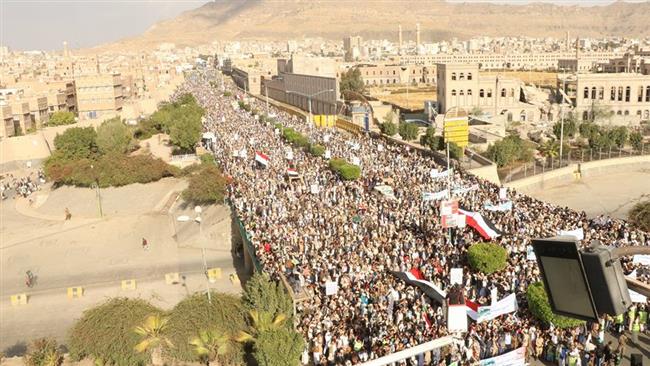
People take part in a demonstration in the Yemeni capital city of Sana’a on March 3, 2017 to denounce the Saudi military campaign against their country
Press TV – March 3, 2017
Tens of thousands of people have taken to the streets in the Yemeni capital city of Sana’a to express outrage over Saudi Arabia’s deadly military campaign against the impoverished Arab country.
The protesters converged in the Old City of Sana’a following Friday prayers, carrying Yemeni flags and banners in condemnation of the Saudi aggression.
Participants in the demonstration, under the motto “Tough against Disbelievers”, also held up pictures of civilians injured in the deadly Saudi airstrikes, calling on the United Nations to fulfill its responsibilities and stop the Riyadh regime’s atrocious military offensive.
They also warned the Saudi leadership that the continued attacks on the people in Yemen will only strengthen the steadfastness of the nation.
Protesters also accused the United States of being complicit in the Saudi crimes against the Yemeni nation by providing the Al Saud regime with various munitions.
Saudi Arabia has been engaged in a deadly campaign against Yemen since March 2015 in an attempt to reinstall the former president, Abd Rabbuh Mansur Hadi, who is a close Riyadh ally.
The airstrikes have taken a heavy toll on the impoverished country’s facilities and infrastructure, destroying many hospitals, schools, and factories.
The United Nations humanitarian coordinator for Yemen, Jamie McGoldrick, says the Saudi campaign has claimed the lives of 10,000 Yemenis and left 40,000 others wounded.
McGoldrick told reporters in Sana’a earlier this year that the figure was based on casualty counts given by health facilities and that the actual number might be higher.
On February 23, Yemen’s Legal Center for Rights and Development, an independent monitoring group, put the civilian death toll in the war-torn Arab country at 12,041.
The fatalities, it said, comprise 2,568 children and 1,870 women.
Pentagon conducts 20 airstrikes in Yemen, first since botched raid
Press TV – March 3, 2017
The Pentagon has carried out its first major military operation in Yemen since a botched raid in January that killed women and children as well as an American commando.
US forces conducted more than 20 airstrikes involving a mix of manned and unmanned aircraft early on Thursday, the Pentagon said.
Navy Captain Jeff Davis said the airstrikes targeted al-Qaeda in the Arabian Peninsula in three south-central provinces of Abyan, Shabwah and al-Bayda.
“The strikes will degrade the AQAP’s ability to coordinate external terror attacks and limit their ability to use territory seized from the legitimate government of Yemen as a safe space for terror plotting,” the Pentagon spokesman said.
The US military did not share a casualty estimate, but local officials said at least nine suspected al-Qaeda militants were killed.
Davis said the operation was coordinated with resigned president, Abd Rabbuh Mansur Hadi, a strong ally of Saudi Arabia that has been engaged in its own military campaign against Yemen.
Troops engage al-Qaeda on the ground
Military helicopters and drones launched a flurry of fresh airstrikes in Shabwah province early on Friday, witnesses said, according to Reuters.
The raids targeted the residence of Sa’ad Atef, an al-Qaeda leader, as well as other suspected militant positions in the area.
The unidentified aircraft, believed to be American, also deployed troops to the al-Saeed area of the southern province, who engaged suspected al-Qaeda militants on the ground for nearly half an hour.
The military operations came more than a month since a January 29 raid, the first of its kind authorized by President Donald Trump, in al-Bayda which residents said left as many as 25 civilians dead.
An ongoing investigation by the US Central Command has also determined that civilians, including possibly children, lost their lives during the botched raid.
The White House hailed the operation as a success, but critics said it was a failure since it resulted in the death of civilians and 36-year-old Navy SEAL Ryan Owens.
Three other Americans were also wounded in the Navy SEAL Team Six mission and a military aircraft worth $75 million was destroyed after it crash-landed at the raid site.
Trump blames generals for botched raid
President Trump has tried to distance himself from the raid by emphasizing that the operation had been in the works long before he took office. “This was a mission that was started before I got here,” he said in an interview with Fox News this week.
“This was something that, you know, they wanted to do. They came to see me and they explained what they wanted to do, the generals, who are very respected,” the president said. “And they lost Ryan.”
During his address to a joint session of Congress on Tuesday, Trump paid tribute to the fallen SEAL, and insisted that the operation yielded valuable intelligence that would “lead to many more victories in the future.”
Some US officials, however, have disputed that claim, saying the raid gathered little, if any, workable intelligence.
The United States conducts drone strikes in Yemen and several countries. Washington claims the airstrikes target members of al-Qaeda and other militants, but according to local officials and witnesses, civilians have been the victims of the attacks in many cases.
Al-Qaeda in Yemen has grown in weapons and number since the start of the Saudi military campaign in March 2015, which was launched to bring back Hadi to power and undermine the Houthi Ansarullah movement.
Featured Video

The Truth About the Trump Shootings with Ken Silva
or go to
Aletho News Archives – Video-Images
From the Archives
The Geopolitics behind the War in Yemen (I)
By Mahdi Darius NAZEMROAYA | Strategic Culture Foundation | 30.03.2015
The United States and the Kingdom of Saudi Arabia became very uneasy when the Yemenese or Yemenite movement of the Houthi or Ansarallah (meaning the supporters of God in Arabic) gained control of Yemen’s capital, Sanaa/Sana, in September 2014. The US-supported Yemenite President Abd-Rabbuh Manṣour Al-Hadi was humiliatingly forced to share power with the Houthis and the coalition of northern Yemenese tribes that had helped them enter Sana. Al-Hadi declared that negotiations for a Yemeni national unity government would take place and his allies the US and Saudi Arabia tried to use a new national dialogue and mediated talks to co-opt and pacify the Houthis.
The truth has been turned on its head about the war in Yemen. The war and ousting of President Abd-Rabbuh Manṣour Al-Hadi in Yemen are not the results of «Houthi coup» in Yemen. It is the opposite. Al-Hadi was ousted, because with Saudi and US support he tried to backtrack on the power sharing agreements he had made and return Yemen to authoritarian rule. The ousting of President Al-Hadi by the Houthis and their political allies was an unexpected reaction to the takeover Al-Hadi was planning with Washington and the House of Saudi. … continue
Blog Roll
 Aletho News
- Imran Khan’s entire immediate family detained in Pakistan ahead of mass protest demanding his release
- EU nation detains former presidential frontrunner
- Leaked: Britain’s Sham Conviction Of Hashim Thaci
- Seyed M. Marandi: U.S. Strike Imminent – Toward Total War in the Middle East
- Russia Voted Under Fire. Washington Is Loading the Tankers.
- 12 Things Your Oncologist Was Trained Not to Tell You
- Anthrax Attacks Paved Way for COVID-Era ‘Junk Drugs and Vaccines’
- How Real Is the Impact of Western Sanctions on Israel?
- France, You Are Guilty: How Paris Turned Western Sahara into the Maghreb’s Powder Keg
- 2025 Nature Paper Claiming Worsening Global Drought Gets RETRACTED …Heavily Flawed
- If Americans Knew
- An error has occurred; the feed is probably down. Try again later.
- No Tricks Zone
- 2025 Nature Paper Claiming Worsening Global Drought Gets RETRACTED …Heavily Flawed
- New Study: ‘Global Drought Shows No Detectable Recent Acceleration Under Climate Warming’
- Economic Masterminds: German Socialists Suggest Taxing Productivity Gains Stemming From Using AI
- The South China Sea Has Not Been Cooperating With The Climate Change Narrative
- Energy Crisis: Germany Enters Heating Season With Historically Low Gas Reserve Fill Levels
- New Study: The Antarctic Ice Sheet Gained Mass From 2020-2024 Due To Staggering Snow And Ice Accumulation
- Study: Ocean Heating Rates From Thousands Of Years Ago ‘Dwarf’ Modern Ocean Heating Rates
- Climate Extremists Target, Attack Large-Scale Power Grid Infrastructure In Germany!
- New Study: Antarctic Ice Melt Has Contributed Less Than 1 Centimeter To Sea Level Rise In The Last 30 Years
- Fear Of Debate: Alarmist German Climate Scientist Calls On Mainstream Media To Discredit Skeptic Voices
 Aletho News