Russia warns US against ‘direct aggression’
Press TV – October 1, 2016
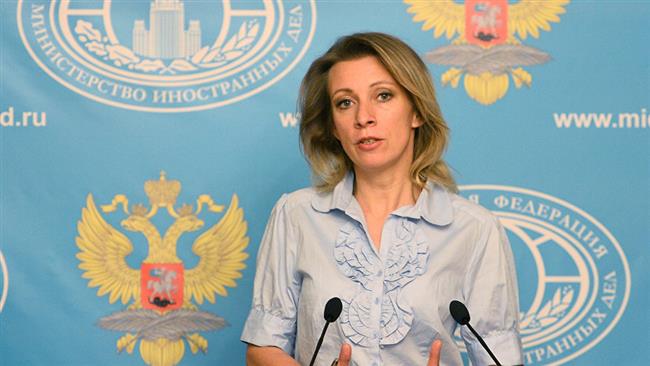
Russia has warned that any “direct aggression” by the US against the Syrian government or army would lead to “frightening, tectonic shifts” in the Middle East.
The warning by Russian Foreign Ministry spokeswoman Maria Zakharova on Saturday came after US officials said Washington had begun considering tougher responses to an ongoing Syrian assault on Aleppo, including military options.
Russia has been supporting the Syrian government in its push to take back Aleppo from Takfiri terrorists.
The US is backing what it calls “moderate” militants fighting to topple Syrian President Bashar al-Assad besides carrying out airstrikes against what it calls Daesh targets.
However, with Syrian advances on Aleppo gaining momentum, US officials have hinted at direct attacks on Syrian troops.
US aircraft recently bombed Syrian army positions in Dayr al-Zawr, killing 83 soldiers. The airstrike, which helped Daesh briefly overrun government positions in the area, was characterized by Washington as unintentional but Syria rejected the allegation.
“How could they (Daesh) know that the Americans are going to attack that position in order to gather their militants to attack right away and to capture it one hour after the strike?” Assad asked during an interview with the Associated Press.
Last week, the Middle East Eye news portal cited a source close to militants as saying that the US was resolved to prevent the fall of Aleppo.
The US State Department has warned it was considering the suspension of “bilateral engagement” in Syria unless Russia took “immediate steps to end the assault on Aleppo.”
A US-Russian brokered ceasefire recently fell apart after the American airstrike on Syrian troops.
Afghanistan: UN mission condemns killing of at least 15 civilians in airstrike
UN News Centre | September 29, 2016
The United Nations mission in Afghanistan has condemned the killing of at least 15 civilian men and the injuring of at least 13 others, including at least one boy, in an airstrike targeting the Islamic State of Iraq and the Levant (ISIL/Da’esh) conducted yesterday in the country’s eastern district of Achin.
In a press statement, the UN Assistance Mission (UNAMA) reiterated the need for all parties to the conflict to adhere to their obligations under international humanitarian law.
“UNAMA calls on the Government and international military forces to launch a prompt, independent, impartial, transparent, and effective investigation into this incident,” the mission said.
In the early morning of 28 September, an international military forces unmanned aerial vehicle conducted an airstrike, reportedly targeting members of ISIL/Da’esh, which struck a civilian home, killing the 15 civilians, according to UNAMA.
The civilians had gathered in a village to celebrate the return of a tribal elder from the Hajj pilgrimage to Mecca and were reportedly sleeping in a guesthouse of the elder when the airstrike occurred. Civilian victims of the strike included students and a teacher, as well as members of families considered to be pro-Government. Government sources report that ISIL/Da’esh personnel also died in the attack, UNAMA said.
The mission highlighted that in a press release issued yesterday, United States Force-Afghanistan acknowledged conducting the airstrike, but refrained from elaborating further, indicating that they “are still reviewing all materials related to the strike.”
UNAMA also expressed condolences to the families of those killed in the incident and wished a speedy recovery to the injured.
Afghanistan has been in protracted conflict for almost 35 years, which, in addition to being prone to recurrent natural disasters, has seriously hampered poverty reduction and development, strained the fabric of society and depleted the country’s coping mechanisms.
Turkey might continue Syria incursion for years
Press TV – September 30, 2016
A senior Turkish official says Ankara’s military incursion into Syria could last for years if necessary.
Turkish troops entered the Syrian territory in a sudden incursion which resulted in the occupation of Jarablus after Daesh left the city without resistance earlier this month.
Turkey has indicated that its eyes were now set on the Syrian city of Raqqah which is controlled by Daesh.
The senior Turkish official said on Friday a planned US offensive to retake Raqqah using Kurdish militia fighters would trigger an ethnic conflict there.
He said driving out Daesh from the Syrian city of al-Bab is also among the targets of Turkey’s incursion into northern Syria.
On Sunday, Foreign Minister Mevlut Cavusoglu said Turkey was planning to send troops deeper into Syrian territory to establish what it calls a safe zone.
Damascus has condemned the incursion, denouncing it as a “flagrant breach” of its sovereignty.
Syria’s envoy to the UN Bashar Ja’afari said last week Turkey, along with the US and Israel, have moved from a proxy war to a “personal” one on the Arab state.
Turkey and Israel will mutually name ambassadors within 10 days as part of the normalization of ties, the Turkish official said.
‘If Germany is Really Independent, It Must Close Ramstein’
Sputnik – 30.09.2016
Wolfgang Jung, a retired German teacher from Kaiserslautern, Germany, has done everything to try to get the government to close Ramstein Airbase.
In April, he filed a lawsuit in a federal court, saying that the deadly drone strikes using the base were a violation of international law.
His case has been dismissed, but he hasn’t lost hope.
Interviewed by Sputnik Deutschland, the spritely 88-year-old explained that his case, filed in April at the Federal Administrative Court in Leipzig, had been dismissed, because his claim supposedly ‘did not concern him personally’.
“I filed a lawsuit against the use of the Ramstein Airbase, which violates international law and the German constitution,” the retired teacher said. He added that over the course of four years, Ramstein has become central to the US drone war in Afghanistan.
“My case was dismissed. It was not even considered. I was simply denied the right to bring my suit,” Jung noted, explaining that he was told that he “personally was not affected by the military drones,” and therefore “cannot sue.”
Frustrated by the result, the retiree-turned-activist suggested that “according to the logic of the court, German citizens do not have the right to file a lawsuit against actions that are illegal under international law originating from US military bases on German territory.”
Russia says US inviting terrorists to attack its cities
Press TV – September 29, 2016
Russia has denounced US projection of possible attacks on Russian cities by terrorists fighting in Syria, saying the statement amounts to an invitation to terrorism.
Russian Deputy Foreign Minister Sergei Ryabkov was outraged on Thursday after US State Department spokesman John Kirby said terrorists in Syria could launch attacks “against Russian interests, perhaps even Russian cities.”
“We cannot interpret this as anything else apart from the current US administration’s de facto support for terrorism,” Ryabkov was quoted as saying.
“These thinly disguised invitations to use terrorism as a weapon against Russia show the political depths the current US administration has stooped to in its approach to the Middle East and specifically to Syria.”
Russia has been supporting the Syrian government in its push to take back Aleppo from Takfiri terrorists. The US also carries out airstrikes as well as operations on the ground through its special forces against what it calls Daesh targets.
However, with Syrian advances on Aleppo gaining momentum, US officials said on Wednesday that Washington had begun considering tougher responses to the assault on Aleppo, including military options.
Syrian army advances were interrupted first when the US brokered a ceasefire agreement with the Russians. The truce collapsed after US aircraft bombed Syrian army positions in Dayr al-Zawr, killing 82 soldiers.
The airstrike, which helped Daesh briefly overrun government positions in the area, was characterized by Washington as unintentional but Syria rejected the allegation.
“How could they (Daesh) know that the Americans are going to attack that position in order to gather their militants to attack right away and to capture it one hour after the strike?” Assad asked during an interview with the Associated Press last week.
Supply of new weapons
On Wednesday, a militant commander said foreign states have given extremists surface-to-surface Grad rockets of a type not previously supplied to them in response to the Aleppo offensive.
The Grad rockets with a range of 22 km and 40 km have been supplied in “excellent quantities” and will be used on battlefronts in Aleppo, Hama and the coastal region, militant commander Colonel Fares al-Bayoush told Reuters.
While Grad missiles have previously been supplied to militants, Bayoush said it was the first time this particular type had been delivered. Militants had previous stocks of the rocket captured from army stores, he added.
The Reuters news agency this week reported anonymous US officials as saying that the Obama administration was considering allowing Qatar and Saudi Arabia to arm militants with man-portable missiles.
The Middle East Eye news portal cited a source close to militants as saying that the US was resolved to prevent the fall of Aleppo and was preparing to allow its Persian Gulf allies to flood the city with shoulder-fired, anti-aircraft missiles.
“The US confirmed the green light to begin sending them to rebels through supply routes still open through Jordan and Turkey,” the source said.
“The US won’t let Aleppo fall. We can expect to see Syrian helicopters falling from the sky within weeks.”
On Wednesday, the US State Department warned it was considering the suspension of “bilateral engagement” in Syria “unless Russia takes immediate steps to end the assault on Aleppo and restore the cessation of hostilities.”
Ryabkov said Moscow saw no alternative to the original US-Russia plan to try to get a ceasefire in Syria and that Washington should focus on implementing it.
He said a seven-day ceasefire plan proposed by the United States was unacceptable however and that Moscow was proposing a 48-hour “humanitarian pause” in Aleppo instead.
Support for Fateh al-Sham Front
Meanwhile, Russia’s Foreign Ministry spokeswoman Maria Zakharova said Thursday US failure to separate “moderate” militants from terrorists is blocking the entire package of agreements.
Under the agreement, the US had undertaken to segregate the militants under its support from Takfiri groups such as the al-Qaeda-linked Fatah al-Sham Front but it has dragged its foot on the plan.
On Wednesday, Russian Foreign Minister Sergei Lavrov told US Secretary of State John Kerry during a phone conversation that Fateh al-Sham Front had been receiving foreign support and American weapons.
In an earlier interview with German-language daily Kölner Stadt-Anzeiger, a Fateh al-Sham commander identified only as Abu al-Ezz confirmed that the US is supporting the terror group, saying, “The Americans are on our side.”
In his conversation with Kerry, “Lavrov drew attention to the fact that a number of anti-government units which Washington calls moderate… were instead merging with Jabhat Fateh al-Sham,” the Russian Foreign Ministry said.
Earlier this year, the US blocked a Russian move in the United Nations to blacklist Ahrar al-Sham militants as a terrorist group.
Moscow says US failed to separate rebels from terrorists in response to US ultimatum over Syria
RT | September 28, 2016
The US holds Russia responsible for the violence in Aleppo and is threatening to break off all cooperation with Moscow in Syria, the State Department said. Russia is asking the US to live up to its obligation to separate US-backed opposition from terrorists.
In a phone conversation with the Russian Foreign Minister Sergey Lavrov on Wednesday morning, the US Secretary of State John Kerry “expressed grave concern” over the “attacks on hospitals, the water supply network, and other civilian infrastructure in Aleppo” by the Russian and Syrian forces, State Department spokesman John Kirby said.
“The Secretary made clear the United States and its partners hold Russia responsible for this situation, including the use of incendiary and bunker buster bombs in an urban environment, a drastic escalation that puts civilians at great risk,” Kirby added.
The Russian foreign minister pointed out that a number of anti-government groups described by Washington as “moderates” refused to follow the ceasefire arranged by Russia and the US on September 9, instead choosing to side with Jabhat Al-Nusra and attack the Syrian Army alongside this Al-Qaeda branch.
Washington is preparing to suspend the “bilateral engagement” on Syria with Moscow, including the establishment of the Joint Implementation Center, unless Russia immediately halts the attack on Aleppo and restores the ceasefire, Kerry told Lavrov.
The US promised long ago to separate the rebels from terrorists and it needs to live up to that obligation, Lavrov told Kerry, bringing up the recent interview of an Al-Nusra commander about how the group is receiving outside support – including American weapons – as well as the statement of a Syrian opposition leader Riyad Hijab that he did not consider Al-Nusra terrorists.
Kerry’s belief that Russia was responsible for the ceasefire’s collapse is “absolutely mistaken” author and journalist Abdel Bari Atwan told RT.
It was Washington that did not follow through on to the deal, failing to separate what it called moderate opposition from terrorist groups, he said.
“I’m really scared about this ultimatum, because it seems like the US administration is going to escalate the [situation] in Aleppo,” Atwan told RT. “Things are really moving into a really dangerous zone here.”
Wealthy Gulf states may arm Syrian rebels to ‘get the Russians to back off’ – US officials
RT | September 27, 2016
With the Syria ceasefire in tatters, there is a growing possibility that wealthy Gulf states might arm Syrian rebels, looking to shield themselves from Syrian and Russian warplanes, with shoulder-fired anti-aircraft missiles, according to a report.
One US official, speaking on condition of anonymity, told Reuters that Washington has kept high numbers of man-portable air defense systems (MANPADS), considered to be a threat to low-flying aircraft, out of Syria by uniting Western and Arab allies behind sending training and infantry weapons to moderate opposition groups while the US conducted talks with Russia.
Fed up with dancing to Washington’s tune, Gulf allies or Turkey may sooner or later silently agree to wealthy individuals supplying MANPADS to opposition groups in Syria, another US official said.
“The Saudis have always thought that the way to get the Russians to back off is what worked in Afghanistan 30 years ago – negating their air power by giving MANPADS to the Mujahideen,” an unnamed US official told Reuters.
“So far, we’ve been able to convince them that the risks of that are much higher today because we’re not dealing with a Soviet Union in retreat, but a Russian leader who’s bent on rebuilding Russian power and less likely to flinch,” the official added, referring to Russian President Vladimir Putin.
Asked if Washington planned to do “anything other than pursue a diplomatic solution” to halt the violence in Syria, State Department spokesman Mark Toner said anyone pouring more weapons into the conflict will only add more fuel to the fire.
“I think that those who may be deluded into thinking there’s a military solution also have to realize, and we’ve alluded to this before, that there are those – and not the United States – but there are those who back various groups and opposition groups within Syria who also may seek to arm them. And again, what you have as a result is just an escalation in what is already horrific fighting. As I said, things could go from bad to much worse,” Toner said.
Another administration official, who spoke on condition of anonymity to Reuters, noted, however: “The opposition has a right to defend itself and they will not be left defenseless in the face of this indiscriminate bombardment.”
The official stated that some other US “allies and partners” have been also involved in the US-Russia talks on the conflict in Syria.
“We don’t believe they will take lightly to the kind of outrages we’ve seen in the last 72 hours,” the administration official said, noting that he would not comment on “the specific capability that might be brought into the fight.”
On Monday, the German newspaper Kölner Stadt-Anzeiger published an interview with an Al-Nusra commander in Syria, identified as “Abu Al-Ezz,” who said that US allies were providing Al-Nusra with tanks and artillery.
“The Americans are on our side,” Al-Ezz reportedly said, adding that Al-Nusra has allegedly been receiving funding from Saudi Arabia, Qatar and Kuwait, and has obtained tanks and artillery from Libya via Turkey. The group especially appreciated the US-supplied TOW anti-tank missiles, he alleged.
While admitting that its allies in the region may be arming Al-Nusra militants, the US government has categorically denied that it is providing any aid to them.
“That’s complete poppycock. Whatever he’s saying, no.
“We would never provide Nusra with any kind of assistance at all,” State Department spokesman Toner told reporters on Monday.
Asked why the US has been unable to persuade the “moderate opposition” in Syria to separate itself from Al-Nusra, Toner replied that it was the rebels’ responsibility, and that they would need a seven-day ceasefire to do so.
Tensions escalated after US-led coalition jets bombed Syrian government forces’ positions near the eastern city of Deir ez-Zor, killing 62 troops on September 17. The incident dealt a serious blow to the Syrian ceasefire deal, which Moscow and Washington agreed to earlier this month, with the Syrian Army General Command saying the airstrike “paved the way” for Islamic State (IS, formerly ISIS/ISIL) militants.
The bombing was stopped only after the Russian military contacted the US side several times, saying that they were attacking the wrong targets.
Washington acknowledged the airstrike against the Syrian troops and even apologized for the mistake.
The speaker of the People’s Council of Syria said on Monday that Damascus has a recording of conversations between the American military and Islamic State terrorists ahead of the US-led coalition airstrike that hit Syrian troops near Deir ez-Zor.
“The Syrian Army intercepted the communications between the Americans and Daesh [Arabic pejorative for Islamic State] ahead of the attack on Deir ez-Zor,” Hadiya Khalaf Abbas said, as cited by Sputnik Arabic.
During his speech at the UN General Assembly over the weekend, Syrian Foreign Minister Walid Muallem also stated that the bombing of Syrian troops by the US-led coalition was a deliberate attack, not a mistake as Washington claims.
On September 19, a humanitarian convoy consisting of 31 trucks was attacked while heading to Aleppo. According to the Red Cross, 20 civilians and one aid worker died as a result. Initial reports by the organization claimed the convoy had been targeted by an airstrike. The US State Department was quick to blame Damascus and Moscow for the attack which led the UN to suspend aid deliveries to Syria. The day after the attack, the UN backtracked on its earlier claims that the convoy was hit by military planes.
The Russian Defense Ministry stated that Russian and Syrian warplanes did not launch airstrikes on the aid convoy that was attacked en route to Aleppo. The ministry added that only militants who control the area had information regarding the location of the convoy.
Read more:
‘Americans are on our side’: Al-Nusra commander says US arming jihadists via 3rd countries
Clinton meets Netanyahu, rejects UN solution for Palestine
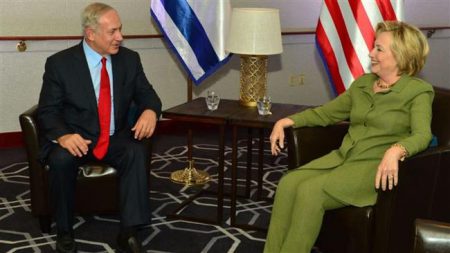
Israeli Prime Minister Benjamin Netanyahu (L) and US Democratic presidential nominee Hillary Clinton meet in New York, September 25, 2016.
Press TV – September 26, 2016
US Democratic presidential nominee Hillary Clinton has told Israel’s Prime Minister Benjamin Netanyahu that she opposes a UN-brokered solution to the Israeli-Palestinian conflict, pledging to fight efforts to “delegitimize” the Tel Aviv regime.
The former US secretary of state and Netanyahu met at a hotel in Manhattan, New York, on Sunday evening, hours after the Israeli PM’s meeting with Clinton’s Republican rival, Donald Trump.
During the meeting, Clinton endorsed the two-state solution for the ongoing conflict in Palestine, but also expressed “her opposition to any attempt by outside parties to impose a solution,” including the UN Security Council, her campaign said in a statement.
Clinton doubled down on “her commitment to countering attempts to delegitimize Israel, including through the BDS (Boycott, Divestment and Sanctions) movement,” the statement further read.
The BDS movement was initiated in 2005 by over 170 Palestinian organizations that were pushing for “various forms of boycott against Israel until it meets its obligations under international law.”
Since then, thousands of volunteers worldwide have joined the BDS to help promote the Palestinian cause.
The former first lady also backed Washington’s military support for Tel Aviv, saying that a “strong and secure Israel” was vital to the US.
Washington has been providing the Israeli regime with $3.1 billion annually since 2007, under a 10-year agreement with the administration of former president George W. Bush. The figure was recently raised to $3.8 billion for the next decade.
Earlier in the day, Netanyahu went to the Trump Tower in New York City to meet with the billionaire businessman.
During the 90-minute meeting, Trump promised Netanyahu that he will “recognize Jerusalem as the undivided capital of the state of Israel,” the candidate’s campaign said in a statement.
He described East Jerusalem al-Quds, occupied by Israel since 1967, as “the eternal capital of the Jewish people.”
Like Clinton, Trump backed America’s military support for Israel, hailing it as an “excellent investment for America.”
Netanyahu, who was being accompanied by Israeli ambassador to Washington Ron Dermer during the meetings, thanked both candidates for their “friendship and support for Israel.”
The Hillary Clinton Presidency has Already Begun as Lame Ducks Promote Her War
By Diana Johnstone | CounterPunch | September 26, 2016
If the British Empire was built on the playing fields of Eton, United States world hegemony gets its training in Hollywood studios and advertising agencies. Selling your product, or yourself, by looking sincere is a cultivated American art. Current top U.S. leaders are expert practitioners.
In the space of a few days, Samantha Power, John Kerry, and Barack Obama all turned in war-winning performances.
Three Deadly U.S. Blows to Hopes of Peace In Syria
Last August 8, on that serious think tank the Charlie Rose show, former acting CIA director Michael Morell said that U.S. policy in Syria should be to make Iran and Russia “pay a price”. Russians and Iranians should be killed “covertly, so you don’t tell the world about it”, he said. Morell proposed that U.S. forces begin bombing Syrian government installations, in order to “scare Assad”. Probably angling for a good job next year, he is on record supporting Hillary Clinton as a “highly qualified commander in chief” and a “strong proponent of a more aggressive approach” in Syria.
Act I – An Act of War
Then, on Saturday, September 17, the U.S. Air Force did exactly what that CIA insider had called for. In sustained air strikes, four U.S. jets bombed a key Syrian Army position that had been defending the town of Deir ez-Zor from ISIS/Daech fighters. More than sixty Syrian soldiers were killed and over a hundred wounded. Daesh forces immediately took advantage of the strikes to overrun the government position. In effect, the U.S. Air Force acted as air cover for the Islamic fanatics U.S. to advance against the legitimate army of Syria.
This was not only a violation of the cease-fire painstakingly worked out by Russian foreign minister Sergei Lavrov and U.S. Secretary of State John Kerry. It was an open military aggression by the United States on the territory of a sovereign state.
The Russians immediately called an emergency session of the United Nations Security Council to respond to this deadly violation of the truce supposedly intended to facilitate peace negotiations and humanitarian aid. When Russian ambassador Vitaly Churkin took the floor to speak, his American counterpart, Samantha Power, draped in her long red mane, walked out to give a press conference that clearly illustrated the difference between Russian and U.S. diplomacy.
Churkin, like Lavrov a few days later, cited facts and analysed the situation rationally. Samantha Power put on a show of evasion and insults.
Why all the fuss? was her opening theme. After all, we halted the attack when we were informed that “it was possible we might be hitting Syrian regime personnel and vehicles”, she stated, adding that “if” we did so, “that was not our intention”. That should settle the question; who could believe that the United States might deliberately attack the regime their politicians have been saying “must go”?
The best defense is offensive, and Power can be most offensive:
“Even by Russia’s standards, tonight’s stunt – replete with moralism and grandstanding is uniquely cynical and hypocritical”, she declared.
Samantha Power, that conniving arriviste whose carefully constructed career has been built on moralism, grandstanding, cynicism and hypocrisy, had all the nerve in the world to turn these epithets against the prime target of her own habitual moralism, grandstanding, cynicism and hypocrisy.
If the air strikes hadn’t been enough to destroy Russian confidence in dealing with the United States, Samantha Power’s contemptuous reaction was sure to do the trick.
Act II – Change the Subject
Next ploy: change the subject. Our little accidental bombing is nothing, Power implied, compared to the alleged fact that “since 2011 the Assad regime has intentionally been striking civilian targets with horrifying, predictable regularity”. Here is the core of the Samantha Power fraud, containing two elements:
1/ While good-hearted bumbling America occasionally kills a few people by accident, the others do it all the time and above all intentionally.
2/ Killing civilians is what war is all about. War is not about battles between armed forces for control of territory. It is not about geopolitical power struggles. It is about “civilian victims”.
At the close of her stunt, grandstanding and scoring cheap points, Samantha Power exhorted Russia “to stop the cheap point scoring and the grandstanding and the stunts and focus on what matters, which is implementation of something we negotiated in good faith with them.” Good faith? They are supposed to believe we negotiated “in good faith” an agreement which we just flagrantly destroyed?
Lo and behold, only two days after the U.S. bombing of Deie ez-Zor, the subject was definitively changed when an international humanitarian aid convoy was attacked on its way to Aleppo. Twenty aid workers were killed and the aid mission was halted. Without waiting for any evidence, the unanimous cry went up from Washington that “the Russians did it!”
In the U.N. Security Council this time, John Kerry took the stage. Again, the critical point was the contrast between what we certainly did and what they allegedly did. Yes, we committed “a terrible accident”. But what they (allegedly) did was worse.
“I got to tell you, people running around with guns on the ground, from the air, is a very different thing from trucks in a convoy with big UN markings all over them,” Kerry declared. He was implying that the difference was between an understandable accident, whose victims were “running around with guns”, and an attack on civilians. Yes, but in war, attacking soldiers is the whole point. It can make a difference in the outcome. Hitting an aid convoy is “collateral damage”, as the U.S. calls it when the bombs are American. By bombing Deir ez-Zor, the United States was taking part in a war in which Syria is fighting for its life.
It cannot be ruled out that Syrian forces attacked the aid convoy because the truce was already broken at Deir ez-Zor and they believed it concealed weapons being transported to Daesh. Such things happen. Or the attack could have been carried out by rebels as an act of propaganda, a “false flag”, designed precisely to be used to accuse the adversary. Such things also happen.
It has already been established by careful research that the notorious Al Ghouta chemical weapons attack, attributed to Assad, was almost certainly carried out by rebels precisely in order to incite the United States to cross the “red line” set by President Obama and bomb Damascus. The War Party which by now controls the Pentagon, much of the State Department, most of Congress, as well as leading media and think tanks, has been castigating Obama ever since for not having seized that opportunity to wage a full-scale “regime change” war against Syria. The critics have never forgiven Obama for accepting the Russian proposal to use the occasion to rid Syria of its chemical arsenal, instead of overthrowing the Syrian government.
But in recent weeks, as the Hillary Clinton campaign grows more frantic, Obama himself has joined the War Party.
Act III – Wallow in Sentimentality
On September 20, President Obama used a Leaders Summit on Refugees to portray the Syrian episode in what increasingly appears to be World War III as a sentimental children’s story. Obama read the letter from 6-year-old Alex, who lives in Scarsdale, New York, expressing his wish to adopt Omran Daqneesh, the bewildered 5-year-old boy with a mop of dusty hair whose photo sitting in an orange ambulance seat was iconized across the world. The letter, provided to mass media by the White House, with its childish writing but nearly perfect spelling, was full of touching details about butterfly collections and shared toys. Obama read the letter, as people reached for Kleenexes all over the country, and then commented:
“Those are the words of a six-year-old boy – a young child you has not learned to be cynical, or suspicious, or fearful of other people because of where they come from, how they look, or how they pray. We should all be more like Alex. Imagine what the world would look like if we were.”
The little boys are very cute, very sweet. Fortunately, Omran Daneesh’s parents are alive, so there is no need to adopt him. Many other children are dead, notably in Yemen, killed by Washington’s ally Saudi Arabia with arms provided by the United States. Too late to adopt them.
“We should all be more like Alex”, Obama tells his good people. Imagine indeed, if all Americans were as innocent and naïve as six-year-old children. And indeed, that seems to be the goal of government propaganda.
This propagandistic heartstring tugging is aimed at distracting from U.S. involvement in a long-term joint criminal enterprise to overthrow a government that indeed did not discriminate against people because of “how they pray”, and replace it by fanatics who are ready to behead people because of “how they pray”.
An infantilized public will believe that “geopolitics” and “national sovereignty” are just big words that don’t mean anything. An infantilized public will believe that when the United States goes to war, it is all about protecting little children from their bad, mean dictators, whose only aspiration is to “bomb their own people”. They will believe that the world out there is Little Red Riding Hood, threatened by the Big Bad Wolf, and that there really is a Santa Claus.
It will never occur to an infantilized public that the war to destroy Syria has been planned for years – even though someone like General Wesley Clark revealed this years ago. Or that it is carried out to eliminate Israel’s enemies, keep Arabs busy killing each other, and incidentally help Saudi Arabia spread its Wahhabite fanaticism. No, that will never occur to them.
They won’t even notice that the Obama administration has now effectively given up any effort to justify the Nobel Peace Prize so foolishly bestowed on the apprentice president, and is now engaged in a scenario designed to prepare for Hillary’s next successful regime change war in Syria.
And it won’t occur to them that the photo of the little boy in the orange seat was quite deliberately iconized by Western media as part of the campaign promoting the Islamic rebel-connected “White Helmets” for the future Nobel Peace Prize.
Another subtle step in demonizing the “Assad regime” before Hillary takes over to administer the planned coup de grace. The future chuckler-in-chief is looking forward to seeing another head fall. This is called “smart power”.
 Diana Johnstone is the author of Fools’ Crusade: Yugoslavia, NATO, and Western Delusions. Her new book is Queen of Chaos: the Misadventures of Hillary Clinton. She can be reached at diana.johnstone@wanadoo.fr
Israel calls on Norwegian theater to help remove fake BDS clip

© nationaltheatret beklager / YouTube
RT | September 26, 2016
Tel Aviv has urged the National Theatre of Norway to deny links to and remove a video in which a fake theater official called for a boycott of Israel and its HaBima Theater. The Norwegian theater denied its part but stopped short of criticizing the clip.
While the theater apparently had no role in producing the video, the Israeli Foreign Ministry demanded that it should “clearly and immediately repudiate” the clip, as well as take “necessary measures to have the video removed from every site.”
It went on to compare the video to “the works of the Reich Minister of Propaganda, Joseph Goebbels, or the Nazi filmmaker Leni Riefenstahl,” adding that it is “actively pursuing the matter with all involved parties.”
In response, the National Theater of Norway wrote in a statement published on its website that it was in no way part of making the video, and does not engage in boycotts.
“The article and video are not made by The National Theater of Norway – and do not represent The National Theater of Norway’s attitude – they are an expression of artistic freedom. The National Theater of Norway still has greater faith in collaboration with artists across national borders and from regimes we are critical to, than boycotts and silence,” it wrote.
Although the six-minute video claims to be from the National Theater of Norway, it was actually created by a group of actors from the art project “Monsters of Reality,” which is part of the 2016 International Ibsen Festival.
In the video, a person claiming to be a spokesperson for the theater lashes out against Israel and its occupation of Palestinian territories. She apologizes on behalf of the playhouse, for collaborating with Israel’s HaBima Theater between 2013 and 2015.
“This is a great day for the National Theater of Norway. It is the day when we publicly apologize for our shameful collaboration with HaBima, the national theater of Israel…” the spokesperson says.
She goes on to state that when the theatre agreed to collaborate with Israel, it did not know “what a powerful role HaBima and other Israeli art institutions play in normalizing the Israeli occupation,” calling Israeli art a “tool” for building an image of “a humanistic nation” instead of an “apartheid state.”
She claims the two theatres were collaborating as Israel “executed its horrific bombing over the Gaza strip,” and that the Norwegian one was unaware of HaBima’s alleged role because it did not do “one single piece of research…we didn’t bother to find out.”
“Five-hundred Palestinian children lost their lives while HaBima was busy entertaining Israeli soldiers,” she says.
In conclusion, the woman posing as spokesperson makes three promises on behalf of the theatre. The first is that it will fully support the Palestinian call for boycott, divestment, and sanctions (BDS) of Israel, and cancel its membership with the “politically irresponsible” European Theatre Union.
Next, the spokesperson claims the theatre will dedicate all means of production to “work with the situation in the Middle East” from 2017 to 2019. She even promises that the facility’s director will give 50 percent of her salary to Palestinian theatre in the West Bank and Gaza.
The Boycott, Divestment, Sanctions (BDS) movement works to “end international support for Israel’s oppression of Palestinians and pressure Israel to comply with international law,” according to the Palestinian BDS National Committee’s website.
READ MORE:
‘FIFA Tarnishing Football by Allowing Games on Stolen Land’
Al-Manar | September 26, 2016
Human Rights Watch (HRW) accused world football’s governing body FIFA of “tarnishing the beautiful game” by allowing “games on stolen land”.
In a report published on Sunday, HRW said that FIFA was legitimizing the building of Israeli settlements in the West Bank—considered illegal under international law—and was sponsoring business activity that supports the settlements.
The New York-based body urged FIFA to force six Israeli football clubs based in settlements in the West Bank to relocate from occupied territories or be banned from competitions recognized by football’s governing body.
The six clubs in question are located in the West Bank and play in the lower Israeli leagues—Beitar Givat Ze’ev, Beitar Ironi Ariel, Ironi Yehuda, Beitar Ironi Maale Adumim and Hapoel Bik’at Hayarden.
The report follows an online petition that has gained more than 150,000 signatures, calling for FIFA official Tokyo Sexwale—who is heading up FIFA’s investigation into the issue—to ban settlement clubs from FIFA-recognized competitions.
More than 60 members of the European Parliament (MEPs) also sent an open letter to FIFA President Gianni Infantino earlier in September, calling for the settlement clubs to be relocated or excluded from the Israeli Football Association (IFA).
FIFA’s rulebook states that football clubs that are a member of one football association may not play on the territory of another football association without the other association’s permission. The Palestinian Football Association has been recognized by FIFA since 1998.
“By holding games on stolen land, FIFA is tarnishing the beautiful game of football,” said Sari Bashi, ‘Israel’ and Palestine country director at HRW.
President Trump would ‘recognize Jerusalem’ as Israeli capital
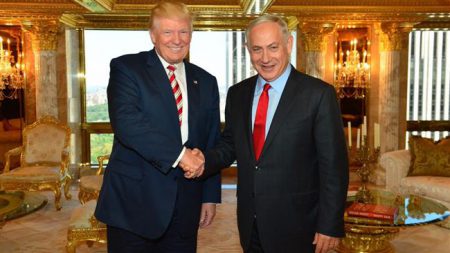
Israeli Prime Minister Benjamin Netanyahu (R) and Republican nominee Donald Trump during a meeting in New York on September 25, 2016. (photo via @IsraeliPM)
Press TV – September 25, 2016
Republican nominee Donald Trump promises Israeli Prime Minister Benjamin Netanyahu to “recognize Jerusalem as the undivided capital of the state of Israel” if he emerges victor in the US 2016 presidential election.
The meeting at the Trump Tower in Manhattan, New York, on Sunday took nearly 90 minutes as Trump’s son-in-law and a close adviser, Jared Kushner, was on hand for the meeting along with Israeli ambassador to the US Ron Dermer.
“A Trump administration would finally accept the long-standing Congressional mandate to recognize Jerusalem as the undivided capital of the state of Israel,” the Trump campaign said in a press release.
The two talked about “the special relationship between America and Israel and the unbreakable bond between the two countries.”
Trump asserted that the US military aid to Israeli missile system is “an excellent investment for America,” further calling Tel Aviv a “vital partner” in the war against “Islamic terrorism,” from which the Israelis have “suffered far too long.”
On the agenda at the meeting was also the nuclear deal between Iran and the world powers, including the United States.
Trump described East Jerusalem al-Quds, occupied by Israel since 1967, as “the eternal capital of the Jewish people.”
Trump’s statement was devoid of any reference to Israel’s heavy-handed crackdown in Palestine or even the so-called two –state solution, pursued in the foreign policy of the administration of President Barack Obama.
“The meeting concluded with both leaders promising the highest level of mutual support and cooperation should Mr. Trump have the honor and privilege of being elected president of the United States,” concluded the statement.
East Jerusalem al-Quds was occupied in 1967 and Israel later annexed it heedless of international condemnations.
The Palestinian Authority, which administers the occupied West Bank, views the city as the capital of its future state. Palestinians have also resisted numerous Israeli plans for exerting full control over the territory.
Featured Video

The Truth About the Trump Shootings with Ken Silva
or go to
Aletho News Archives – Video-Images
From the Archives
The Geopolitics behind the War in Yemen (I)
By Mahdi Darius NAZEMROAYA | Strategic Culture Foundation | 30.03.2015
The United States and the Kingdom of Saudi Arabia became very uneasy when the Yemenese or Yemenite movement of the Houthi or Ansarallah (meaning the supporters of God in Arabic) gained control of Yemen’s capital, Sanaa/Sana, in September 2014. The US-supported Yemenite President Abd-Rabbuh Manṣour Al-Hadi was humiliatingly forced to share power with the Houthis and the coalition of northern Yemenese tribes that had helped them enter Sana. Al-Hadi declared that negotiations for a Yemeni national unity government would take place and his allies the US and Saudi Arabia tried to use a new national dialogue and mediated talks to co-opt and pacify the Houthis.
The truth has been turned on its head about the war in Yemen. The war and ousting of President Abd-Rabbuh Manṣour Al-Hadi in Yemen are not the results of «Houthi coup» in Yemen. It is the opposite. Al-Hadi was ousted, because with Saudi and US support he tried to backtrack on the power sharing agreements he had made and return Yemen to authoritarian rule. The ousting of President Al-Hadi by the Houthis and their political allies was an unexpected reaction to the takeover Al-Hadi was planning with Washington and the House of Saudi. … continue
Blog Roll
 Aletho News
- Pakistan-Iran talks secure LNG shipment to Islamabad through Hormuz
- Black Sea grain crisis puts global wheat supplies under pressure
- IRGC air defenses destroy another US MQ-1 drone over Strait of Hormuz
- Imran Khan’s entire immediate family detained in Pakistan ahead of mass protest demanding his release
- EU nation detains former presidential frontrunner
- Leaked: Britain’s Sham Conviction Of Hashim Thaci
- Seyed M. Marandi: U.S. Strike Imminent – Toward Total War in the Middle East
- Russia Voted Under Fire. Washington Is Loading the Tankers.
- 12 Things Your Oncologist Was Trained Not to Tell You
- Anthrax Attacks Paved Way for COVID-Era ‘Junk Drugs and Vaccines’
- If Americans Knew
- Huckabee aide solicited cash gifts from Israelis
- This isn’t sci-fi, AI is already killing people
- ‘The Most Brutal Thing’: Investigation Reveals Execution of Elderly Woman in Rafah
- Inside Israel’s ‘soft’ ethnic cleansing plan for Gaza through the eyes of its victims
- New online database tracks pro-Israel political donations in the United States
- Israeli president pardons soldier convicted for killing wounded Palestinian
- Singer Ed Sheeran says his ‘heart broken’ by Gaza devastation, addresses Macklemore controversy
- Israel Has Imprisoned Female Journalist Bushra Al-Tawil Without Trial Or Charge In Solitary Confinement For Past Month
- Israel poised to teach West Bank a lesson after one Israeli killed – Daily Update
- Salah Sarsour’s Legal Team Says DHS Has Not Met Its Burden to Prove He Is Deportable
- No Tricks Zone
- 2025 Nature Paper Claiming Worsening Global Drought Gets RETRACTED …Heavily Flawed
- New Study: ‘Global Drought Shows No Detectable Recent Acceleration Under Climate Warming’
- Economic Masterminds: German Socialists Suggest Taxing Productivity Gains Stemming From Using AI
- The South China Sea Has Not Been Cooperating With The Climate Change Narrative
- Energy Crisis: Germany Enters Heating Season With Historically Low Gas Reserve Fill Levels
- New Study: The Antarctic Ice Sheet Gained Mass From 2020-2024 Due To Staggering Snow And Ice Accumulation
- Study: Ocean Heating Rates From Thousands Of Years Ago ‘Dwarf’ Modern Ocean Heating Rates
- Climate Extremists Target, Attack Large-Scale Power Grid Infrastructure In Germany!
- New Study: Antarctic Ice Melt Has Contributed Less Than 1 Centimeter To Sea Level Rise In The Last 30 Years
- Fear Of Debate: Alarmist German Climate Scientist Calls On Mainstream Media To Discredit Skeptic Voices
 Aletho News