Syria Solidarity Movement Statement on the US Attack against the Syrian Army at Deir ez-Zour
By Syria Solidarity Movement | September 19, 2016
The Syria Solidarity Movement unequivocally condemns and denounces the vicious US bombing attack on the Syrian army defending Deir ez-Zour, and we wish to make the following observations.
- The attack killed at least 62 Syrian soldiers and wounded more than 100. This is larger than the number of casualties inflicted in any US bombing on any terrorist target in Syria since the US announced its “war on ISIS”.
- The bombing inflicted no known casualties on ISIS, which the US says was its intended target.
- The US has produced no evidence that it notified its Russian counterparts, as required by agreement. In fact, joint action against ISIS was not expected for another two days. This leads to suspicions that the US attack was intended to preempt the provisions of the agreement.
- Syrian soldiers report seeing reconnaissance drones the previous day.
- ISIS fighters were poised to begin fighting the Syrian army units as soon as the US bombing raids ended. How did they know what constituted the end of the bombing?
- Although the Russian military presence in Syria is legal because it came at the invitation of the sovereign Syrian state, the US presence is illegal and was never approved, either by the Syrian government or by the United Nations. All US military actions in Syria therefore constitute an illegal invasion of Syrian territory, and must end now.
We find the US explanation of “unintended” targets, and especially the belligerent performance of Ambassador Samantha Power at the United Nations Security Council, to be false, disingenuous and counterproductive. The only credible explanation is that the US attack on Deir ez-Zour was intentional. The US has never seriously tried to fight ISIS other than to defend Kurdish fighters, with rare and largely ineffectual attacks against ISIS fighters in their strongholds, and none during the ISIS campaign against Palmyra, when they were very vulnerable by air.
We believe that the US intention is to dismember the sovereign Syrian state, and that the Syrian army base at Deir ez-Zour constitutes an obstacle to this plan, and is therefore a US target. In accordance with this plan, the US does not mind if ISIS continues to occupy a large portion of the Syrian Euphrates valley, and, in fact, prefers to maintain ISIS as a destructive force that weakens Syria and is available as a proxy fighting force for other US regional designs, in partnership with their Israeli allies.
We are doubtful that the US intends to honor its agreement with Russia, and implicitly with Syria. US strategists are seeking to weaken and threaten Russia and not to form cooperative and mutually beneficial agreements. Accordingly, the only option may unfortunately be to make the cost to the US too high to be acceptable, and thereby to force a change in its priorities.
There is another and more constructive alternative, as follows.
- The US should immediately issue a formal apology to the government of Syria and offer restitution for damages, both to the Syrian government and to the families of the dead and wounded.
- The US should withdraw completely from all Syrian territory and end its support for all fighting forces there.
- The US should enforce its end user agreements on the use of its arms supplied to Saudi Arabia, Turkey, Qatar and other countries, to prevent their use in non-defensive roles outside their territories, and in particular to prevent supplying them to subversive forces in Syria.
- The US should use its influence in international banking and commerce to prevent the transfer of funds to terrorist forces in Syria and to prevent illegal trafficking by terrorists of oil and other Syrian assets from terrorist-held territory.
- The US should try to develop a new and cooperative relationship with Russia, and to stop threatening Russia through its subversive actions in Syria, Ukraine and other places, including the stationing of bases and troops in countries on Russia’s borders. The US should end its commercial and financial sanctions against Russia and Syria.
- The US needs to take action to end the internal bickering within its own government. International diplomacy is impossible when agreements negotiated by diplomats are undermined by other governmental agencies. Secretary of Defense Ash Carter and other US government figures should be fired for insubordination and replaced with figures that allow the administration to speak with a single voice and so that negotiated agreements can be assured of implementation.
The Syria Solidarity Movement advocates respect for and compliance with all international law, prosecution of international outlaws, an end to attempts to strengthen one country by destroying others, the use of diplomacy to settle international disputes, and the development of peaceful and constructive relationships among all nations. We hold these goals to be of the utmost priority at the present moment because, given the level of escalation to which the USA has pushed a confrontation with Russia (and China) over Syria, Ukraine, and the South China Sea, the threat to world peace has never been higher since 1939.
Syria Solidarity Movement was founded in 2013 to counter misinformation about Syria and to promote peace, reconciliation and justice.
BDS ‘new face of terrorism’ – Israeli minister
RT | September 19, 2016
Israeli Justice Minister Ayelet Shaked called the Boycott Divestment and Sanctions (BDS) movement “the new face of terrorism” in New York on Sunday.
Speaking at the Jewish National Fund (JNF) in New York, Shaked said, “The BDS is illegitimate. I define it thus: BDS is another branch of terrorism in the modern age.”
The BDS movement is a global campaign to end Israel’s occupation of Palestinian land through the boycott of Israeli goods and services, the divestment of funds and, in theory, sanctions.
Shaked claimed that the aim of the BDS movement was to “to wipe Israel off the map.”
As the decade-long movement gains momentum, Israel has pushed back against it with increasing determination.
“Sometimes the BDS movement’s funding sources are identical to those funding the terrorist organisations,” Shaked told the New York crowd. “This is the new face of terrorism.”
Shaked, a conservative member of Israel’s government who does not believe in a two-state solution to the Israel-Palestine conflict, has made controversial statements in the past.
In, 2014 she was accused of inciting genocide with a Facebook post which quoted a Jewish settler, “They are all enemy combatants, and their blood shall be on all their heads. Now this also includes the mothers of the martyrs, who send them to hell with flowers and kisses. They should follow their sons, nothing would be more just. They should go, as should the physical homes in which they raised the snakes. Otherwise, more little snakes will be raised there.”
Shaked reminded the crowd about 9/11, and said that the terrorism which has taken place in Jerusalem, New York, Paris, Tel Aviv, London, Brussels, Istanbul “is the same terrorism.”
The minister went on to tell the crowd that Israel and the rest of the world are all “fighting against extreme Islamic terrorism.”
The justice minister expressed concern that young Jewish people are “confused and are led astray” by BDS, claiming that they are being tricked by “terrorists from radical Islam.”
She congratulated states in the US that have adopted legislation against BDS and expressed hope that others would follow suit and make BDS illegal.
US airstrikes on Syrian airbase intentional, says aide to Assad
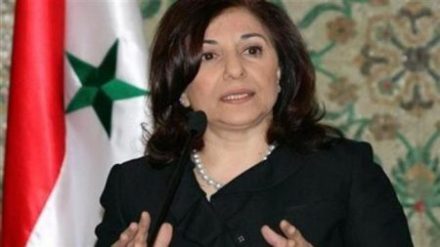
Buthaina Shaaban, a senior adviser to Syrian President Bashar al-Assad
Press TV – September 18, 2016
A senior adviser to Syria’s President Bashar al-Assad has accused US-led coalition forces of carrying out “intentional” airstrikes against a Syrian military airbase in Dayr al-Zawr province, where 90 soldiers were killed.
Buthaina Shaaban said in an interview with AFP on Sunday, “None of the facts on the ground show that what happened was a mistake or a coincidence.”
The Syrian official also blamed Washington and its allies for colluding with the Takfiri Daesh terrorist group in the region.
“Everything was calculated and Daesh knew about it … Even Russia reached the terrifying conclusion that the United States is colluding with Daesh,” Shaaban stated, adding, “When Daesh advanced, the raids stopped.”
The coalition aircraft, purportedly fighting Daesh in Syria, bombed the airbase on Saturday. At least a hundred soldiers were also injured.
Two F-16 and two A-10 jets entered the Syrian airspace from Iraq to conduct the attacks.
The US military says it halted the raids after Russian officials said the targets were Syrian government forces and not Daesh terrorists.
Elsewhere in her remarks, Shaaban said since the US-led intervention began in Syria in 2014, “We have been saying that this is not against Daesh, that they are not striking Daesh.”
The so-called coalition has been conducting the airstrikes in Syria without any authorization from Damascus or a UN mandate.
Many have criticized the ineffectiveness of the raids.
Washington and some of its regional allies have supported Takfiri groups fighting against Syria’s government.
The Syrian Foreign Ministry has called on the UN Security Council to condemn the attacks and to make the US respect Syria’s sovereignty.
US airstrikes jeopardize ceasefire
Shaaban said such attacks could endanger a US-Russia brokered ceasefire deal meant to end hostilities in the conflict-ridden Arab country.
She added that Damascus believed the Saturday raids may signal divisions within the US administration on deepening cooperation between Washington and Moscow under the truce deal.
“What is worrying is its (the strikes’) effect on the US-Russia agreement. I believe that some elements in the United States do not want this deal,” Shaaban said, adding, “There is a side that agrees with the Russians and another side that rejects the agreement. This makes it seem to us that the White House wants this agreement while the Pentagon rejects it.”
However, Shaaban said Damascus was committed to the existing truce. “We are committed to the truce. The truce is continuing until its expiration. Maybe it will be extended, maybe there will be another agreement.”
On September 9, Russia and the United States agreed on a milestone deal on the crisis in Syria after marathon talks in the Swiss city of Geneva.
The deal, which went into effect on September 12 and was initially agreed to last seven days, calls for increased humanitarian aid for those trapped inside the embattled northwestern city of Aleppo.
Under the terms of the ceasefire agreement, Russian and US fighter jets would launch joint airstrikes against Daesh.
Timing & other aspects of US strike on Syrian army suggest intentional provocation – Churkin
RT | September 18, 2016
The US’ sudden attempt to “help” the Syrian army fighting ISIS in the eastern city of Deir ez-Zor, which resulted in a strike that killed and injured dozens of soldiers, does not look like an honest mistake, Russia’s UN envoy told journalists at the UNSC meeting.
“It is highly suspicious that the United States chose to conduct this particular air strike at this time,” Russia’s ambassador Vitaly Churkin said.
Churkin questioned why the US suddenly chose to “help” the Syrian army defend Deir ez-Zor after all these years, recalling how American forces just observed terrorists’ movements and did “nothing when ISIS advanced on Palmyra.”
“It was quite significant and not accidental that it happened just two days before the Russian-American arrangements were supposed to come into full force,” Churkin added.
Vitaly Churkin spoke to journalists after briefly leaving the closed-door UN Security Council meeting, which was convened by Moscow to give Washington a chance to offer an explanation for the actions of its military.
However, instead of discussing the issue, US ambassador Samantha Power immediately left the room to address the press and accuse Russia of hypocrisy.
The US envoy to the UN spent some 30 seconds expressing “regret” over the unfortunate coalition airstrike that resulted in the loss of the lives of Syrian soldiers, and insisting that even if the ongoing investigation proves the US military is indeed to blame, it had never been their “intention” to strike Syrian military.
After that, Power spent the next 15 minutes slamming Moscow’s “uniquely hypocritical and cynical” attempt to make Washington explain itself at an urgent UNSC meeting.
“Why are we having this meeting tonight? It is a diversion from what is happening on the ground. If you don’t like what is happening on the ground then you distract. It is a magician’s trick… we encourage the Russian Federation to have emergency meetings with the Assad regime and deliver them to this deal,” said Samantha Power.
“What Russia is alleging tonight is that somehow the United States is undermining the fighting against ISIL. The Russian spokesperson even said that the United States might be complicit in this attack … this is not a game,” she added, before going into details of how Assad government is to blame for the dire situation in Syria.
US-led coalition aircraft strike Syrian army positions, kill 62 soldiers – military
RT | September 17, 2016
US-led coalition jets have bombed Syrian government forces’ positions near the eastern city of Deir ez-Zor, killing 62 troops and “paving the way” for Islamic State militants, the Syrian Army General Command told the state television.
According to Syria’s official SANA news agency, the bombing took place on al-Tharda Mountain in the region of Deir ez-Zor and caused casualties and destruction on the ground.
Sixty-two Syrian soldiers were killed and over 100 injured in the airstrike by the US-led coalition, Russia’s Defense Ministry spokesman, Major-General Igor Konashenkov, said, citing information received from the Syrian General Command.
“We are aware of the reports and checking with Centcom and CJTF (Combined Joint Task Force),” the Pentagon told RT.
The Russian Defense Ministry said on Saturday that the aircraft which carried out the bombings had entered Syrian airspace from the territory of Iraq.
Four strikes against Syrian positions was performed by two F-16 jet fighters and two A-10 support aircraft, it added.
“If the airstrike was caused by the wrong coordinates of targets than it’s a direct consequence of the stubborn unwillingness of the American side to coordinate with Russia in its actions against terrorist groups in Syria,” Konashenkov stressed.
The Defense Ministry also confirmed a report by SANA that an Islamic State offensive began right after Syrian Army positions were hit from the air.
“Immediately after the airstrike by coalition planes, Islamic State militants launched their offensive. Fierce fighting with the terrorists is currently underway in the area of the airport where for a long a time humanitarian aid for civilians was parachuted,” Konashenkov said.
The Syrian General Command has called the bombing a “serious and blatant aggression” against Syrian forces, and said it was “conclusive evidence” that the US and its allies support IS militants.
Earlier on Saturday, Russia accused the US of being reluctant to take measures to force rebels under its control to fall in line with the terms of the Syrian ceasefire.
Numerous Russian appeals to the American side remain unanswered, which “raises doubts over the US’s ability to influence opposition groups under their control and their willingness to further ensure the implementation of the Geneva agreements,” senior Russian General Staff official, Viktor Poznikhir, said.
Poznikhir also said that the truce is being used by the militants to regroup, resupply and prepare an offensive against government troops.
Last week, Moscow and Washington agreed to influence the Syrian government and the so-called moderate rebel forces respectively in order to establish a ceasefire in the country.
Since then, Russia has repeatedly complained that the US is failing to keep its part of the bargain. The US, on its part, has blamed Russia for not pressuring Damascus enough to facilitate humanitarian access to Syria.
US & US-controlled forces haven’t fulfilled any Syria ceasefire deal obligations – Russian Army
RT |September 17, 2016
The US is still reluctant to take measures to force rebels under its control to implement the Syrian ceasefire, Russia’s Defense Ministry said, adding that if things do not change, Washington will be the sole side responsible for the failure of the truce.
“After five days of the ceasefire, it has to be noted that only the Russian and Syrian sides have been fully implementing their commitments. On its own initiative, Russia prolonged the cessation of hostilities for 48 hours, and yesterday it was extended for another 72 hours,” senior Russian General Staff official, Viktor Poznikhir, said at a briefing in Moscow.
But, according to Poznikhir, it is very different on the American side as “the US and the so-called moderate groups under their control didn’t fulfill a single commitment undertaken in the framework of the Geneva arrangements.”
The Russian official pointed out that “the main priority of the Russian-American agreements of September was the division of territories controlled by IS (Islamic State, formerly ISIS/ISIL), Jabhat al-Nusra, and the areas controlled by the ‘moderate opposition,’ as well the separation of the ‘moderate opposition’ from Jabhat al-Nusra.”
Such a division is essential for the implementation of the ceasefire in Syria because “without it, the hands of the government forces are tied. They can’t fight the terrorists without knowing which of them joined the truce and who didn’t,” he explained.
Numerous Russian appeals to the American side remain unanswered, which “raises doubts over the US’s ability to influence opposition groups under their control and their willingness to further ensure the implementation of the Geneva agreements.
“Russia is making every possible effort to hold off government troops from the use of force in return [to opposition attacks]. If the US does not implement the necessary measures to fulfill their obligations under the September 9 agreements, the responsibility for the failure of the ceasefire will be solely America’s,” Poznikhir said.
The inaction of the American side has already led to a worsening of the situation in Syria, the General Staff official stressed.
“Tensions are rising in Syria, especially in the provinces of Aleppo and Hama, where opposition groups are using the cessation of hostilities to regroup forces, refill their stocks of ammunition and weapons and are preparing an offensive in order to capture new territories,” he said.
“In the past 24 hours, the number of attacks has increased drastically. The positions of government troops, the people’s militia, and civilians were fired at on 55 occasions,” Poznikhir added.
Last week, Russia’s Foreign Minister, Sergey Lavrov, and US Secretary of State, John Kerry, agreed to influence the Syrian government and the so-called moderate rebel forces respectively in order to establish a ceasefire in the country.
Since then, Russia has repeatedly complained that the US is failing to keep its part of the bargain. While the US, on its part, blamed Russia for not pressuring Damascus enough to facilitate humanitarian access to Syria.
Lavrov talked to Kerry on the phone Saturday, urging Washington to start influencing the opposition in Syria in order to expand humanitarian access in the country, the Russian Foreign Ministry said.
The FM also called on the American side to actively participate in monitoring the Syrian ceasefire instead of merely accusing Syrian government forces of violations.
“Due to Washington’s continuing claims of ceasefire violations by the Syrian government forces, the Russian Foreign Minister urged them to go beyond accusations and to ensure the US military’s full-fledged participation in the ceasefire control mechanism created as far back as February and March and to take action against violations,” the ministry said in a statement.
Lavrov also stressed that “as result of Russia’s efforts, the issues of putting on track cooperation between the Syrian authorities and the United Nations in the area of broader humanitarian access are being solved, though not without difficulty.”
He may have insulted Obama, but Duterte held up a long-hidden looking glass to the US
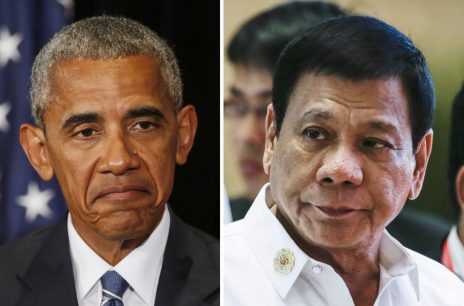
Insulting Barack Obama made the headlines, but Rodrigo Duterte’s remarks referred to a long and dark history of US interference in the Philippines.
Narendra Shresthma, Mast Irham/EPA
By Adele Webb | The Conversation | September 8, 2016
Philippine President Rodrigo Duterte has taken his “bad manners” – having gained global notoriety with his election campaign insults earlier this year – to a new level.
At a press conference at Davao International Airport on Monday, on his way to meet US President Barack Obama and other leaders attending the ASEAN summit, Duterte muttered a few short words in tagalog at the end of a lengthy and irritated reply to a local journalist. With those words, he again made international headlines.
What did Rodrigo Duterte call Barack Obama?
If that were all there was to it, we could rightly roll our eyes and move on. After all, Duterte’s language is vulgar; his slander of people and groups is liable to incite violence; and his determination to kill drug pushers (to fight “crime with crime”) an abuse of power. He should not be defended for any of this.
But as someone who has spent a long time studying US-Philippine relations, I think there’s something more for us to see here. And if we want to judge the Philippine president (and, by default, the nation for electing him) from high moral ground, I think we have a responsibility to pay attention to it.
Restoring an invisible history
Who is he to question me about human rights and extrajudicial killings?
So asked Duterte on Monday. It’s actually a very good question, and one long overdue from a Philippine president. The extent to which the violence of US relations with the Philippines has been made invisible by a history written predominantly by Americans themselves cannot be overstated.
It began with a three-year war (1899-1902) that most Americans have never heard of. The war overthrew a newly independent Philippine republic and cost between 250,000 and a million Filipino lives – only to be called “a great misunderstanding” by American colonial writers.
After all, the US had chosen the Philippines to be its great Asian “showcase of democracy”. The invasion was a benevolent act. Hence the complete erasure of acts of American violence from the Philippine national story.
 The 20th Kansas Volunteers march through Caloocan after the battle of February 10, 1899, early in the war that toppled the first Philippine republic. G.W. Peters/Internet Archive

You don’t need to be a conspiracy theorist to smell something rotten. Since the 1950s Philippine writers, academics, journalists and so on have been trying to reframe the historical narrative to point out this fact: to be invaded by a military power, told you don’t possess the character or capability for self-government, and then controlled by another nation for four decades, to the occupier’s lucrative commercial benefit, was not to be the recipient of a benevolent act.
Even at the time the war was taking place, one of America’s best-loved authors was writing just as much. Mark Twain was prolific in writing about the paradox of the “democratising mission” to the Philippines.
Penned in 1901, but still stunningly poignant, is this extract from his essay, To the Person Sitting in Darkness:
The Person Sitting in Darkness is almost sure to say: ‘There is something curious about this – curious and unaccountable. There must be two Americas: one that sets the captive free, and one that takes a once-captive’s new freedom away from him, and picks a quarrel with him with nothing to found it on; then kills him to get his land.’
In America, these remain Twain’s least-known works.
Before his (now regretted) distasteful remark, Duterte had much to say in response to the question about being confronted over human rights in an upcoming meeting with Obama. He was responding to murmurs from critics that, if he wouldn’t listen to anyone else about the extrajudicial killings in the Philippines, just wait until he meets the US president.
No-one seems to have listened to or cared much about the other six minutes of Duterte’s reply. So let me tell you something about it. It was a reclaiming of the historical narrative of Philippine-US relations, a holding up to the US of the hidden “looking glass” Mark Twain had written about 100 years earlier.
 The Macabebe Scouts were a native Filipino force of the US Army during the Spanish–American War. The Ardvaark/Wikipedia Commons
An assertion of independence
Calling out the hidden insinuations, as Duterte did, that the US continues to have authority over the politics of the Philippines, is bold and brazen, but reasonable. Consider his statement:
I am a president of a sovereign state. And we have long ceased to be a colony. I do not have any master but the Filipino people.
These words are less evidence of his demagoguery or an intention to personally disparage Obama than a reference to history, and are more accurately read as such.
After the second world war, colonies of any sort, even the so-called “democratic” US one in the Philippines, were on the nose. But this didn’t stop Washington officialdom from continuing to claim the right of access to the Philippines’ political and economic realms.
When the US finally granted the Philippines its (second) independence in 1946, it required the new republic to amend its constitution so a bill could be passed that, as well as legislating preferential trade conditions for the US, would grant American citizens equal rights with Filipinos to Philippine natural resources. It was the beginning of a new phase: neocolonialism.
It was not just a matter of political interference and the power to make or break Philippine presidents with endorsement and strategic financial support. In a visceral sense, the nation was always being watched and judged by its democratic “teacher”.
 School Begins: Uncle Sam lectures his class in Civilisation (the pupils are labelled Philippines, Hawaii, Puerto Rico and Cuba). Puck Magazine 1899
Asked about being confronted with human rights concerns by Obama, Duterte said:
You must be kidding. Who is he to confront me? America has one too many to answer for the misdeeds in this country … As a matter of fact, we inherited this problem from the United States. Why? Because they invaded this country and made us their subjugated people … Can I explain the extrajudicial killing? Can they explain the 600,000 Moro massacred in this island [Mindanao]? Do you want to see the pictures? Maybe you ask him. And make it public.
I’m reminded of a comment by Alicia Garza, a founder of the Black Lives Matter movement ignited by police killings of black Americans. Speaking in Sydney last weekend at the Festival of Dangerous Ideas, she related how, when civil rights protests get uncomfortably heated, she is often asked: “Why are they so angry?” She paused. Then softly giggled, giving the audience time for the ludicrousness of the question to sink in.
Why is the Philippines president so angry about the prospect of the US president confronting him about human rights abuses? History. As Duterte said himself on Monday, violent acts of the past don’t stay in the past. They get passed on from generation to generation, especially when the injustice goes unacknowledged and unaddressed.
It is difficult to stomach Duterte’s style. It certainly is difficult to look past the serious issues raised by his administration’s “war on drugs”. We should condemn his misuse of power.
But if we condemn the president for his recent remarks because we claim to be concerned about the rights of Filipinos while showing no interest in acknowledging the past crimes and injustices against the Philippines, we fall into our own sort of hypocrisy.
Let’s be honest, if Duterte didn’t curse and swear and offend our sensibilities, would we be paying so much attention to the Philippines? For once, I heard a Philippine president holding the US to account for all its doublespeak and hypocrisy in US-Philippine relations. And I couldn’t help but appreciate that.
Adele Webb, PhD Researcher, Department of Government and International Relations / Sydney Democracy Network, University of Sydney
Disclosure statement
Adele Webb does not work for, consult, own shares in or receive funding from any company or organization that would benefit from this article, and has disclosed no relevant affiliations beyond the academic appointment above.
Women’s Boat to Gaza sets sail to try to break Israeli blockade

IMEMC News – September 15, 2016
Two boats with all-women crews set sail Wednesday for the Gaza Strip from Barcelona, Spain. They are planning to travel across the Mediterranean and break the Israeli blockade on Gaza by delivering much-needed medical supplies to the people of Gaza.
The participants in the siege-breaking boat hail from fifteen different countries and include members of Parliament and other dignitaries.
From Barcelona, the boats will travel to France, and one other port before heading to Gaza. This is just the latest of a series of boats that have tried to break the blockade on Gaza since Israel imposed the air, sea and land blockade in 2006.
The mayor of Barcelona, Ada Colau, arrived at the port on Wednesday along with hundreds of supporters, to offer her support for the mission of the Women’s Boat to Gaza trip.
The two boats have been named the “Amal”, which means ‘hope’ in Arabic, and “Zaytouna”, which means ‘olive’ in Arabic.
The list of passengers includes Tunisian MP Latifa Habashi; Malin Björk, a Member of European Parliament from Sweden; Ann Wright, a retired U.S. Army Colonel and former U.S. diplomat who resigned in 2003 in opposition to the invasion of Iraq; and Dr. Fauziah Modh Hasan, a Malaysian physician who has participated in many humanitarian missions with the Malaysian Medical Relief Society.
The Chairman of the Popular Committee to Support Gaza, Essam Youssef, said in a statement that the Women’s Boat to Gaza is “a humanitarian cry in the face of an illegitimate siege imposed on an innocent people that has been calling for years on the international community for help.”
He added, “Palestine will remain the axis of struggle not just in the Middle East but also in the world. Achieving justice for Palestine is the key to stability in the region and the world.”
Wednesday’s launch of the Women’s Boat to Gaza came just as the U.S. Congress authorized an unprecedented $38.5 billion aid package to Israel, despite acknowledging in the same session that Israeli settlement expansion in the West Bank has violated all signed agreements and international law.
Corruption and waste in Afghanistan: Role of US government exposed in new report
RT |September 14, 2016
A new report examining widespread corruption and waste in Afghanistan found that the practice blossomed following the US invasion in 2001. The problem was fed by its slowness to recognize the problem and exacerbated by the injection of tens of billions dollars into the economy with very little oversight.
“Corruption in Conflict: Lessons from the U.S. Experience in Afghanistan” examined how from 2001 to 2014 the US government, through the Department of Defense, State, Treasury and Justice and the US Agency for International Development (USAID) understood the risks of corruption in Afghanistan, how the US evolved its understanding, and the effectiveness of that response.
SIGAR was created by Congress to provide independent and objective oversight of Afghan reconstruction projects and activities.
The report released on Wednesday had five main findings: 1) corruption undermined the US mission in Afghanistan by fueling grievances against the Afghan government and channeling material support to the Taliban; 2) the injection of tens of billions of dollars into the Afghan economy was governed by flawed oversight and contracting practices and “partnering with malign powerbrokers”; 3) the US was slow to recognize the problem; 4) when it did recognize the depth of corruption “security and political goals” trumped anti-corruption efforts; 5) in areas where it was successful it was only “in the absence of sustained Afghan and US political commitment.”
The report defined corruption as “the abuse of entrusted authority for private gain,” and placed in the context of Afghanistan’s kinship-based society where the gains from corruption often benefited not just an individual but a family, clan, tribe or ethnic group.
Corruption is the system of governance
According to SIGAR about $113.1 billion has been appropriated for Afghanistan relief and reconstruction since 2002. The funds were used by the Afghan National Security Forces to promote good governance, conduct development assistance, and engage in counter-narcotics and anti-corruption efforts.
In a 2010 US Embassy Kabul report on a meeting with senior US officials and the Afghan National Security Adviser, Dr. Rangin Dadfar Spanta said “corruption is not just a problem for the system of governance in Afghanistan; it is the system of governance.”
The report referred to a 2015 UK research that showed there was weak separation of the private and public spheres which resulted in widespread private appropriation of public resources, vertical- and identity-based relationships had primacy over horizontal, i.e. citizen-to-citizen relationships, and politics was centered around a centralization of power and patron-client relations replicated throughout society.
Opportunities for corruption expanded after 2001 as the amount of money in the economy grew from millions to billions of dollars with the Department of Defense budget at time equivalent to the entire Afghan economy and sometimes quadruple the amount.
“Many of the funds were licit, arriving via civilian and military contracts. At their peak in fiscal year 2012, DOD contract obligations for services in Afghanistan including transportation, construction, base support, translation/interpretation, an private security total approximately $19 billion, just under the Afghanistan’s 2012 gross domestic product of $20,5 billion,” stated the report. “From 2007 to 2014 those contract obligation totaled more than 89 billion.”
Billions worth scandals
During the years of the Obama administration, Afghanistan was rocked by two corruption scandals: The Salehi arrest and the Kabul Bank losing $1 billion.
Salehi was involved in the New Ansari Money Exchange, a money transfer firm that moved money into and out of Afghanistan. The exchange was suspected of moving billions of dollars out of Afghanistan for Afghan government officials, drug traffickers and insurgents. US law enforcement and intelligence investigators estimated that as much as $2.78 billion was taken out of Afghanistan between 2007 and 2010.
“A wiretap recorded an aide to Karzai, Mohammad Zia Salehi, soliciting a bribe in exchange for obstructing the investigation into New Ansari. Reportedly, after US officials played some of the wiretaps for an adviser to Karzai, the adviser approved Salehi’s arrest,” stated the report.
Salehi was arrested in July 2010, but was released within hours on the orders of President Karzai and the case was dropped. The New York Times reported Salehi had once worked for notorious warlord Rashid Dostum and was also “being paid by the CIA.”
“If true, this would suggest a US intelligence agency was paying an individual as an intelligence asset even as US law enforcement agencies were building a major corruption case against him,” stated the report.
The other corruption scandal involved the Kabul Bank, which was used among other things to pay the salaries of the Afghan military and police, was found in 2010 to have lost nearly $1 billion of US taxpayer’s funded foreign assistance to Afghanistan. The bank’s deposits had seemingly vanished into Dubai and off-shore locations and unknown offshore bank accounts and tax havens, through Ponzi schemes, fraudulent loans, mass looting and insider loans to fake and bogus companies by less than 12 people who were apparently linked to President Karzai.
Lack of oversight and slow response
Against this the DOD and USAID vetted contractors and implemented contracting guidance to reduce opportunities for corruption and while they were somewhat successful, “they were not unified by an overarching strategy or backed by sustained, high-level US political commitment,” stated the report.
During this time, from mid-2011 to March 2012, the US also sought to explore political reconciliation with the Taliban and to do so the US had to preserve a working relationship with President Karzai to ensure an Afghan government buy-in.
“The US government showed a lack of political commitment. When it became clear the Afghan government was not willing to undertake true reform – because it involved taking action against people connected to the highest levels of political power – the US government failed to use all of its available tools to incentivize steps towards resolution,” stated the report.
Another weakness in tackling corruption was the high turnover of US civilian and military staff “meant US institutional memory was weak and efforts were not always informed by previous experience.”
“One Afghan anticorruption expert noted that US agencies often hosted workshops and training that lasted only a few days, with limited follow-up. He suggested that a more fruitful approach might have been to establish a standing institute to train auditors, attorneys, investigative police and others for year, rather than days,” stated the report.
SIGAR’s report quoted Ryan Crocker, who re-opened the US Embassy in Kabul soon after the September 11, 2001 attacks and served again as ambassador in 2011-2012 as saying that “the ultimate point of failure for our efforts wasn’t an insurgency. It was the weight of endemic corruption.”
The report comes with recommendations for addressing corruption risks to US strategic objectives for future missions. It recommended that Congress pass legislation to make clear “that anticorruption is a national security priority in a contingency operation” and required strategies, benchmarks and “annual reporting on implementation.” It also recommended that Congress consider sanctions and the DOD, State and USAID should establish a joint vetting unit to better vet contractors and subcontractors in the field.
The recommendations for the executive branch level are that interagency task force should formulate policy and lead strategy on anticorruption during an operation and the intelligence community should analyze links between host government officials, corruption, criminality, trafficking and terrorism and provide regular updates.
“In Afghanistan today, corruption remains an enormous challenge to security, political stability, and development,” SIGAR said.
Italy ‘No Longer Sovereign State, It is on NATO’s, US’ Tight Military Leash’
Sputnik – 14.09.2016
Italy has been packed full of NATO and US military bases across the country, which serve as testing grounds for the US and the alliance; Sputnik Italy talked to Fulvio Grimaldi, Italian journalist, war correspondent and documentarian on the everyday damage these military facilities cause to the country.
“We fell victim to the self-restrictions contrary to our own interests. Europe is tormenting itself,” Grimaldi told Sputnik while commenting on the issue.
“It is in the interests of the US that Italy has imposed sanctions on Russia which have harmed Moscow less than Italian farmers and the country’s industry, which have subsequently found themselves in grave economic conditions,” he noted.
The journalist further acknowledged that his home country has been forcefully militarized. There are around 90 US bases in the country, let alone a lot more NATO bases on its territory, which are at the US disposal.
“We are a country overflowing with military bases, and this is a serious burden for our economy to the detriment of construction, maintenance of medical facilities, schools and land improvement,” the journalist said. These military facilities also put Italy at risk of becoming a potential target for those countries who will decide one day to stand up to NATO aggression.
The correspondent cites as an example the American Mobile User Objective System (MUOS), a modern satellite communications system located in Sicily, the largest Mediterranean island, which is capable of reaching out to Africa and the Middle East.
“It is a huge social and industrial burden for the island,” he said.
Another example is the US military facility on another large Italian island in the Mediterranean Sea, Sardinia, which serves as a testing range for the newly released weaponry which pollutes the environment and threatens the health of local residents.
The economic damage is also substantial. NATO military operations around the globe cost the Italian defense ministry 55 million euro ($61.7mln) per day. If you take into account the expenses of other related ministries, the daily cost rises to 80 million ($89.7mln).
“This is the contribution of the country which has no interest in the military operation in any country of the world, because it is facing no threats,” Grimaldi said.
The US military and political control over the Italian territory comes as the aftermath of the Second World War which deprived Italy of its sovereignty. “I see no reasons for optimism in such a situation.
What I actually see is the acknowledgment of similar subordination in other countries of the EU, and this aggressive strategy of NATO is leading us towards an epic failure,” the journalist said.
However he added that he is certain that one day the authorities will finally come to their senses and change their stance towards the alliance.
Featured Video

The Truth About the Trump Shootings with Ken Silva
or go to
Aletho News Archives – Video-Images
From the Archives
The Geopolitics behind the War in Yemen (I)
By Mahdi Darius NAZEMROAYA | Strategic Culture Foundation | 30.03.2015
The United States and the Kingdom of Saudi Arabia became very uneasy when the Yemenese or Yemenite movement of the Houthi or Ansarallah (meaning the supporters of God in Arabic) gained control of Yemen’s capital, Sanaa/Sana, in September 2014. The US-supported Yemenite President Abd-Rabbuh Manṣour Al-Hadi was humiliatingly forced to share power with the Houthis and the coalition of northern Yemenese tribes that had helped them enter Sana. Al-Hadi declared that negotiations for a Yemeni national unity government would take place and his allies the US and Saudi Arabia tried to use a new national dialogue and mediated talks to co-opt and pacify the Houthis.
The truth has been turned on its head about the war in Yemen. The war and ousting of President Abd-Rabbuh Manṣour Al-Hadi in Yemen are not the results of «Houthi coup» in Yemen. It is the opposite. Al-Hadi was ousted, because with Saudi and US support he tried to backtrack on the power sharing agreements he had made and return Yemen to authoritarian rule. The ousting of President Al-Hadi by the Houthis and their political allies was an unexpected reaction to the takeover Al-Hadi was planning with Washington and the House of Saudi. … continue
Blog Roll
 Aletho News
- Pakistan-Iran talks secure LNG shipment to Islamabad through Hormuz
- Black Sea grain crisis puts global wheat supplies under pressure
- IRGC air defenses destroy another US MQ-1 drone over Strait of Hormuz
- Imran Khan’s entire immediate family detained in Pakistan ahead of mass protest demanding his release
- EU nation detains former presidential frontrunner
- Leaked: Britain’s Sham Conviction Of Hashim Thaci
- Seyed M. Marandi: U.S. Strike Imminent – Toward Total War in the Middle East
- Russia Voted Under Fire. Washington Is Loading the Tankers.
- 12 Things Your Oncologist Was Trained Not to Tell You
- Anthrax Attacks Paved Way for COVID-Era ‘Junk Drugs and Vaccines’
- If Americans Knew
- Trump’s militarization of Washington DC as he pursues Israel’s war against Iran
- Why Israel Fears This Searing New Documentary
- Huckabee aide solicited cash gifts from Israelis
- This isn’t sci-fi, AI is already killing people
- ‘The Most Brutal Thing’: Investigation Reveals Execution of Elderly Woman in Rafah
- Inside Israel’s ‘soft’ ethnic cleansing plan for Gaza through the eyes of its victims
- New online database tracks pro-Israel political donations in the United States
- Israeli president pardons soldier convicted for killing wounded Palestinian
- Singer Ed Sheeran says his ‘heart broken’ by Gaza devastation, addresses Macklemore controversy
- Israel Has Imprisoned Female Journalist Bushra Al-Tawil Without Trial Or Charge In Solitary Confinement For Past Month
- No Tricks Zone
- 2025 Nature Paper Claiming Worsening Global Drought Gets RETRACTED …Heavily Flawed
- New Study: ‘Global Drought Shows No Detectable Recent Acceleration Under Climate Warming’
- Economic Masterminds: German Socialists Suggest Taxing Productivity Gains Stemming From Using AI
- The South China Sea Has Not Been Cooperating With The Climate Change Narrative
- Energy Crisis: Germany Enters Heating Season With Historically Low Gas Reserve Fill Levels
- New Study: The Antarctic Ice Sheet Gained Mass From 2020-2024 Due To Staggering Snow And Ice Accumulation
- Study: Ocean Heating Rates From Thousands Of Years Ago ‘Dwarf’ Modern Ocean Heating Rates
- Climate Extremists Target, Attack Large-Scale Power Grid Infrastructure In Germany!
- New Study: Antarctic Ice Melt Has Contributed Less Than 1 Centimeter To Sea Level Rise In The Last 30 Years
- Fear Of Debate: Alarmist German Climate Scientist Calls On Mainstream Media To Discredit Skeptic Voices
 Aletho News