US military to expand Europe presence over Russia
Press TV – November 9, 2015
US military officials have proposed plans to expand the American presence in Europe in a bid to counter Russia in the event of a crisis, a new report says.
Addressing the Reagan National Defense Forum over the weekend, senior US military leaders said the Pentagon needs to send more forces to Europe on a rotating basis, allowing the presence of multiple US brigades in the continent at any given time, the Wall Street Journal reported Sunday.
General Philip Breedlove, the supreme allied commander of the North Atlantic Treaty Organization (NATO), said he wants more forces committed to Europe in a rotational manner. He said the final decisions on the proposal will be made “in the next couple of months.”
It was also declared in the forum that the US is stepping up its military drills in various European countries, preparing to counter potential Russian interference with troop transfers, should a war break out between the two sides.
General Mark Milley, the chief of staff of the US Army, said the Army is adapting its training to make sure that the US military is able to face threats posed by Russian forces.
The American troops are preparing to counter hybrid war, a blend of regular and irregular forces with propaganda and unconventional tactics to spark confusion, Milley noted.
The defense leaders slammed Russian President Vladimir Putin’s “military aggression and threats” and warned that Washington must not allow Moscow to cooperate with the West in Syria.
They said Putin’s military support for Syrian President Bashar al-Assad against Daesh Takfiri terrorists is in fact a distraction designed to take away attention from the conflict in Ukraine.
Breedlove warned that cooperating with Russia on Syria means the West has accepted Moscow’s annexation of Crimea and support for pro-Russia forces in Ukraine’s Donbas region.
Ties between Moscow and Washington hit a new low after US-backed forces ousted Ukraine’s former president Viktor Yanukovych in February 2014.
US Defense Secretary Ashton Carter issued a warning against what he called the Russian “aggression” at the same forum, saying Saturday that Moscow seems “intent to play spoiler” by “throwing gasoline” on the fire of Syria. He then went on to criticize Russia’s “nuclear saber-rattling.”
Carter said NATO is in need of a “new playbook” to deter Russia.
The US has vowed to develop military training bases in six countries on or near Russian borders, including Latvia, Estonia and Lithuania, as well as Poland, Bulgaria and Romania.
It was announced last week that the US is poised to deploy 4,000 more troops in its European military bases.
The American military is pushing to include the new plan’s necessary funding in a budget request which will be sent to the US Capitol Hill early next year.
Russian officials say there is little difference between rotational forces and a permanent military buildup. They also say that the US and NATO are the true aggressors in Europe.
Henoko Takes on U.S. Imperialism
By Maya Evans | Dissident Voice | November 7, 2015
OKINAWA, JAPAN — Around one hundred and fifty Japanese protesters gathered to stop construction trucks from entering the U.S. base Camp Schwab, after the Ministry of Land over-ruled the local Governors’ decision to revoke permission for construction plans, criticizing the “mainland-centric” Japanese Government of compromising the environmental, health and safety interests of the Islanders.
Riot police poured out of buses at six a.m., out-numbering protesters four to one, with road sitters systematically picked off in less than an hour to make way for construction vehicles.
All the mayors and government representatives of Okinawa have objected to the construction of the new coastal base, which will landfill one hundred and sixty acres of Oura Bay, for a two hundred and five hectare construction plan which will be part of a military runway.
Marine biologists describe Oura Bay as a critical habitat for the endangered dugong (a species of manatee), which feeds in the area, as well as sea turtles and unique large coral communities.
The bay is particularly special for its extreme rich ecosystem which has developed due to six inland rivers converging into the bay, making the sea levels deep, and ideal from various types of porites coral and dependent creatures.
Camp Schwab is just one of 32 U.S. bases which occupy 17% of the Island, using various areas for military exercises from jungle training to Osprey helicopter training exercises. There are on average 50 Osprey take off and landings every day, many next to housing and built up residential areas, causing disruption to everyday life with extreme noise levels, heat and diesel smell from the engines.
Two days ago there were six arrests outside the base, as well as ‘Kayactivists’ in the sea trying to disrupt the construction. A formidable line of tethered red buoys mark out the area consigned for construction, running from the land to a group of offshore rocks, Nagashima and Hirashima, described by local shamans as the place where dragons (the source of wisdom) originated.
Protesters also have a number of speed boats which take to the waters around the cordoned area; the response of the coast guard is to use the tactic of trying to board these boats after ramming them off course.
 The overwhelming feeling of the local people is that the Government on the mainland is willing to sacrifice the wishes of Okinawans in order to pursue its military defense measures against China. Bound by Article 9, Japan has not had an army since world war two, though moves by the Government suggest a desire to scrap the Article and embark on a ‘special relationship’ with the U.S., who is already securing control of the area with over 200 bases, and thus tightening the Asia pivot with control over land and sea trade routes, particularly those routes used by China.
Meanwhile, Japan is footing 75% of the bill for accommodating the U.S., with each soldier costing the Japanese Government 200 million yen per year, that’s $4.4 billion a year for the 53,082 U.S. soldiers currently in Japan, with around half (26,460) based in Okinawa. The new base at Henoko is also expected to cost the Japanese Government a tidy sum with the current price tag calculated to be at least 5 trillion yen.
Okinawa suffered devastating losses during the Second World War, with a quarter of the population killed within the 3-month-long Battle of Okinawa which claimed 200,000 lives in total. Hilltops are said to have changed shape due to the sheer bombardment of ammunition.
Local activist Hiroshi Ashitomi has been protesting at Camp Schwab since the expansion was announced 11 years ago, he said: “We want an island of peace and the ability to make our own decisions, if this doesn’t happen then maybe we might need to start talking about independence.”
Maya Evans coordinates Voices for Creative Nonviolence UK.
Victoria Nuland’s Capitol Hill Comedy of Errors
By Daniel McAdams | Ron Paul Institute | November 7, 2015
Wednesday’s hearing in the House Foreign Affairs Committee was a comedy of errors, starting with the loaded title: “US Policy After Russia’s Escalation in Syria.” The hearing featured two Assistant Secretaries of State as witnesses, Victoria “cookies” Nuland, in charge of European and Eurasian Affairs, and Anne Patterson with Near Eastern Affairs duty at State.
Starting with the title, yes, “escalation.” Apparently four years of active US regime change policy in Syria is not “escalation.” Four years violating Syria’s sovereignty with a CIA covert war on its soil is not “escalation.” Billions spent training “moderate” rebels who rush to join al-Qaeda at first opportunity is not “escalation.” A year of US bombing sorties over Syria in violation of US law and international law is not “escalation.” Failed “regime change” policy in Syria producing millions of refugees is not “escalation.” And now, a presidential decision to place the US military into a country that has neither attacked nor threatened the US is not “escalation.”
No, a Russian entry in the conflict in response to a request from the legal and sovereign Syrian government, which in a month has crippled jihadists from al-Nusra to ISIS, is considered by the US to be “escalation.” Doing effectively in a month what the US has claimed to be doing for a year is considered “escalation.” We recall President George W. Bush’s famous, “you’re either with us or you are against us.” But with Nuland, Russia is against us even when it is with us…
Why? Because in addition to attacks on ISIS east of the zone controlled by the Syrian government, the Russians have also done damage to US-backed (and al-Qaeda affiliated) rebels north of Syrian government controlled territory leading to Syria’s second city, Aleppo, and then on to the Turkish border — an area that might otherwise be known as the jihadist superhighway.
Russia taking out ISIS and the other extremist groups in Syria — including those backed by the US — is not tolerable to Nuland, a member of the neocon Kagan family. For Nuland and the Kagans, war is great for business. Her husband Robert Kagan is at Brookings, from where he regularly writes in the Washington Post that we need to increase military spending. His wife steers US policy toward her husband’s goals. Brother-in-law and sister-in-law Fred and Kimberly are at neocon American Enterprise Institute and Institute for the Study of War, respectively, where they do their part for the family business: pushing hate and war across the globe.
In her testimony before the House Foreign Affairs Committee this week, Nuland did a remarkable turnaround. With the Russian entry into the fight against jihadists in Syria, Nuland suddenly became concerned with refugees, “collateral damage,” economic cost of intervention, human suffering, and more. Not a word about these for the past year as US bombs flew. No, she is only concerned with these things if they come about as a result of Russian airstrikes.
While polls show solid support even among American citizens for Russian attacks on Islamic extremists, Victoria Nuland told Congress this week that:
Russia is paying a steep price to its reputation in the fight against terror.
Such an assertion doesn’t pass the laugh test.
Victoria Nuland does offer Russia some hope for redemption, however. Russia could choose the path of “positive cooperation,” Nuland told the House Foreign Affairs Committee, but it would require that Russia:
… urgently work with us, our Allies and UN envoy Steffan De Mistura to turn the statement of principles that Secretary Kerry, FM Lavrov, and 17 other ministers and institutions released in Vienna last Friday into a true ceasefire, and a parallel 3 political transition process that hastens the day that Asad’s bloody tenure comes to an end.
In other words, after four years of failed active US regime change policy Russia can finally be constructive in the process if it signs on to the very same policy that has failed for four years. Russia can be constructive if it adopts the US view that it has the right to decide who gets to rule foreign countries. Russia can win by adopting the losing US policy.
Is it any wonder US diplomacy has become a laughingstock?
ICC prosecutor must rethink Gaza flotilla probe: Judges
Press TV – November 7, 2015
Judges at the International Criminal Court (ICC) say the court’s prosecutor must reconsider an earlier decision not to open a probe into an Israeli attack on a Gaza-bound aid flotilla back in 2010.
Following a few months of deliberations, judges at the appeals chamber ruled on Friday that prosecutor Fatou Bensouda must rethink her decision against the Gaza flotilla probe.
Judges at The Hague-based court had initially asked Bensouda to reconsider her decision in July, saying she made “material errors in her determination of the gravity” of the case.
The latest decision could force Bensouda to open a full investigation into the case.
Last year, Bensouda declined a request by the Indian Ocean island nation of Comoros to investigate the attack on the Turkish Mavi Marmara ship that was sailing under a Comoros flag. She ruled the case was not serious enough to merit an ICC probe.
The prosecutor said publicly available information provides “a reasonable basis” to believe that the Israeli forces committed war crimes during the attack in international waters back in 2010, but the case does not fall under their jurisdiction for an official probe.
However, lawyers representing Comoros had sought a review of Bensouda’s original rejection, insisting that “the interests of justice and fairness, which are the core of the ICC’s mandate, strongly militate in favor of the prosecutor reconsidering her decision.”
On May 31, 2010, Israeli commandos attacked the Freedom Flotilla in international waters in the Mediterranean Sea, killing nine Turkish citizens, including a teenager with dual Turkish-US citizenship, and injuring about 50 other people who were part of the team on the six-ship convoy. Another injured activist died in May 2014 after having been in a coma for four years.
The flotilla was attempting to break the Israeli naval blockade of the Gaza Strip, carrying aid to Palestinians in the enclave.
Gaza has been blockaded since June 2007, a situation that has caused a decline in the standard of living, unprecedented levels of unemployment, and unrelenting poverty.
The attack sparked international outcry and plunged relations between Tel Aviv and Ankara to an all-time low at the time.
Israeli MK: ‘Label products of countries that back boycott’
MEMO | November 6, 2015
Israeil Knesset Deputy Speaker Miki Zohar yesterday proposed a bill that requires Israeli retailers to mark products that are manufactured in countries which boycott settlement goods, local media reported.
Israels Hayom newspaper reported that Zohar’s “A label for a label” initiative comes in response to the European campaign to label Israeli produce manufactured in illegal Israeli settlements in the occupied West Bank, East Jerusalem and the Golan Heights.
According to the bill, failure to comply would result in a six month prison term and a fine of up to 14,000 Israeli shekels ($3,500).
The newspaper reported that Member of the Knesset Michael Oren of the Kulanu party said: “The EU decision to label Israeli products is anti-Semitic. There are dozens of border disputes and occupations in the world but the EU decided to single out Israel. They are not labelling products from China, India or Turkey – only Israel.”
“The Israeli consumers need to know that when they buy European products, they are supporting the EU’s anti-Semitic policies,” Oren added, calling on the government to prioritise trade with the United States as well as Asian and African countries who do not support the boycott.
The European Union is expected to start labelling products manufactured in Israeli settlements on Wednesday.
Americans oppose Obama’s plans for fighting ISIL: Poll
Press TV – November 5, 2015
Most Americans disapprove of US President Barack Obama’s approach in fighting the Daesh (ISIL) terrorist group, a new poll has found.
More than 6 in 10 people in the US reject Obama’s handling of the threat posed by the ISIL in Syria and Iraq, an Associated Press-GfK poll released on Thursday finds.
Support for his approach has dropped since Washington formed a military coalition against ISIL in late 2014. Last year, Americans were approximately even, but disapproval has risen 8 percent since January.
This is while two-thirds of the people surveyed in the poll described the threat posed by Daesh as a “very or extremely important issue.”
The poll also found that only 40 percent of Americans still approve of the president’s management of foreign policy.
Obama announced last week that 50 US special operations troops will head to northern Syria, marking the first time the US is openly sending forces into that war-torn country.
‘Afghanistan, a historic failure’
Concerns about Obama’s strategy overseas become more apparent when it comes to Afghanistan, where he has dropped his plan to pull US forces by the end of 2016. The new plan means that when he leaves office, the US will have at least 5,500 troops in Afghanistan.
The poll found that 71 percent of Americans believe history will judge the Afghanistan war as more of a failure than a success.
Roughly a third of Americans said they approve of Obama’s revamped plan in the country, while one-third opposed it.
‘No armed combatants, no fighting’: MSF issues Afghan hospital bombing report
RT | November 5, 2015
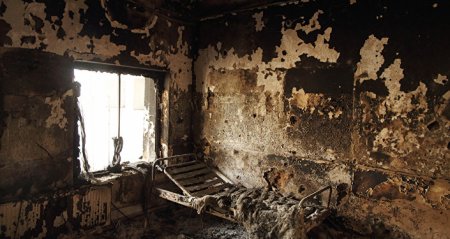
A Médecins Sans Frontières investigation into the Afghan hospital bombing by US forces has found that there were no armed combatants or weapons within the compound, and no fighting in the direct vicinity of the hospital at the time of the airstrikes.
In its report released on Thursday, Médecins Sans Frontières (MSF/Doctors Without Borders) addressed the “relentless and brutal aerial attack by US forces” which took place in Kunduz on October 3 and killed at least 30 people, including MSF staff.
“The MSF rules in the hospital were implemented and respected, including the ‘no weapon’ policy and MSF was in full control of the hospital at the time of the airstrikes,” the organization stated.
The document also said there were “no armed combatants within the hospital compound and there was no fighting from or in the direct vicinity” of the trauma center at the time of the strikes.
The hospital was “fully functioning” at the time of the airstrikes, with 105 patients admitted and surgeries taking place, according to the findings of the investigation.
In addition, MSF said the “agreement to respect the neutrality of our medical facility based on the applicable sections of International Humanitarian Law was fully in place and agreed with all parties to the conflict prior to the attack.”
Despite that neutrality, the hospital was still the target of a US airstrike, leading MSF to ask how such an attack was allowed to happen.
“The question remains as to whether our hospital lost its protected status in the eyes of the military forces engaged in this attack – and if so, why,” MSF said in its statement.
Presenting the report, MSF general director Christopher Stokes said: “From what we are seeing now, this action is illegal in the laws of war. There are still many unanswered questions, including who took the final decision, who gave the targeting instructions for the hospital.”
The MSF statement described the tragic situation at the hospital.
“Patients burned in their beds, medical staff were decapitated and lost limbs, and others were shot by the circling AC-130 gunship while fleeing the burning building. At least 30 MSF staff and patients were killed,” it states.
MSF says its demand is simple: “A functioning hospital caring for patients, such as the one in Kunduz, cannot simply lose its protection and be attacked; wounded combatants are patients and must be free from attack and treated without discrimination; medical staff should never be punished or attacked for providing treatment to wounded combatants.”
Following the aerial attack, the Pentagon initially attempted to shift responsibility onto Afghan security forces, claiming they had requested the airstrikes.
However, the commander of the US and NATO forces in Afghanistan, Gen. John Campbell, later admitted the attack was a “US decision made within the US chain of command.” He went on to say that Washington would “never intentionally target a protected medical facility.”
Read more:
US tank enters MSF hospital in Afghanistan’s Kunduz, ‘destroys potential evidence’ – reports
War in Syria? Where Is Speaker Ryan?
By Pat Buchanan • Unz Review • November 3, 2015
“The United States is being sucked into a new Middle East war,” says The New York Times. And the Times has it exactly right.
Despite repeated pledges not to put “boots on the ground” in Syria, President Obama is inserting 50 U.S. special ops troops into that country, with more to follow.
U.S. A-10 “warthog” attack planes have been moved into Incirlik Air Base in Turkey, close to Syria.
Hillary Clinton, who has called for arming Syrian rebels to bring down Bashar Assad, is urging Obama to establish a no-fly zone inside Syria.
Citing Clinton and Gen. David Petraeus, John McCain is calling for a no-fly zone and a safe zone in Syria, to be policed by U.S. air power.
“How many men, women and children,” McCain asks, “are we willing to watch being slaughtered by the Russians and Bashar al-Assad?”
Yet, if we put U.S. forces onto sovereign Syrian territory, against the will and resistance of that government, that is an act of war.
Would we tolerate Mexican troops in Texas to protect their citizens inside our country? Would we, in the Cold War, have tolerated Russians in Cuba telling us they were establishing a no-fly zone for all U.S. warplanes over the Florida Strait and Florida Keys?
Obama has begun an escalation into Syria’s civil war, and not only against ISIS and the al-Nusra Front, but against Syria’s armed forces.
Mission creep has begun. The tripwire is being put down. Yet, who authorized Obama to take us into this war? The Russians and Iranians are in Syria at the invitation of the government. But Obama has no authorization from Congress to put combat troops into Syria.
Neither the al-Nusra Front nor ISIS has an air force. Against whom, then, is this Clinton-McCain no fly-zone directed, if not Syrian and Russian warplanes and helicopters?
Is America really prepared to order the shooting down of Russian warplanes and the killing of Russian pilots operating inside Syria with the approval of the Syrian government?
In deepening America’s involvement and risking a clash with Syrian, Russian and Iranian forces, Obama is contemptuously ignoring a Congress that has never authorized the use of military force against the Damascus regime.
Congress’ meek acquiescence in being stripped of its war powers is astonishing. Weren’t these the Republicans who were going to Washington to “stand up to Obama”?
Coming after Congress voted for “fast track,” i.e., to surrender its constitutional right to amend trade treaties, the capitulations of 2015 rank as milestones in the long decline into irrelevance of the U.S. Congress. Yet in the Constitution, Congress is still the first branch of the U.S. government.
Has anyone thought through to where this U.S. intervention can lead?
This weekend, the Justice and Development Party, or AKP, of President Recep Tayyip Erdogan regained full control of the parliament in a “khaki election” it called after renewing its war on the Kurdish PKK in southeastern Turkey and northern Iraq.
Erdogan regards the PKK as a terror group. As do we. But Erdogan also considers Syria’s Kurdish fighters, the YPG, to be terrorists. And Ankara has warned that if the YPG occupies more territory along the Syrian-Turkish border, west of the Euphrates, Turkey will attack.
Why should this concern us?
Not only do we not regard the YPG as terrorists, they are the fighting allies we assisted in the recapture of Kobani. And the U.S. hopes Syria’s Kurds will serve as the spear point of the campaign to retake Raqqa, the ISIS capital in Syria, which is only a few dozen miles south of YPG lines.
Should the YPG help to defeat ISIS and become the dominant power in northern Syria, the more dangerous they will appear to Erdogan, and the more problems that will create between the Turkish president and his NATO ally, the United States.
Not only does a Congressional debate on an authorization to use military force appear constitutionally mandated before we intervene in Syria, but the debate itself on an AUMF might induce a measure of caution before we plunge into yet another Middle East quagmire.
When Saddam fell, we got civil war, ISIS in Anbar, and a fractured and failed state with hundreds dying every week.
And, as of today, no one knows with certitude who rises if Assad falls.
The leading candidates are Jabhat al-Nusra, the front for an al-Qaida that brought down the twin towers[sic], and the butchers of ISIS, who captured another town on the Damascus road this weekend.
Monday, The Wall Street Journal wrote that Erdogan’s regrettable victory is “a reminder of what happens when America’s refusal to act to stop chaos in places like Syria frightens allies into making unpalatable choices.”
Now there’s an argument for America’s plunging into Syria: Send our troops to fight and die in multisided civil war that has cost 250,000 lives, so Turks will feel reassured enough they won’t vote for “strongmen” like Erdogan.
America needs an America First movement.
The Syrian Democratic Forces: Just an Invention by Washington to Save Face?
Sputnik – 03.11.2015
As America’s previous strategies for dealing with the Syrian crisis fell into disarray, the Pentagon scrambled to gather a ragtag band of militia groups under the banner of the Syrian Democratic Forces. But the new alliance is barely holding together, and may in fact have been dreamed up as an excuse to continue pumping weapons into the region.
Mere days after the Obama administration announced it was ending its controversial plan to train and equip so-called “moderate” Syrian rebels, a new player arrived on the scene.
“The sensitive state our country Syria is going through and rapid developments on the military and political front… require that there be a united national military force for all Syrians, joining Kurds, Arabs, Syriacs and other groups,” read a statement released by the newly formed Syrian Democratic Forces (SDF) last month.
The alliance consists of the Kurdish YPG militia, an Assyrian Christian group, and a number of various Arab groups collectively known as the Syrian Arab Coalition.
And according to a senior US military official speaking to the New York Times, the Syrian Arab Coalition was “an American invention.”
Washington’s new Syria strategy involves supporting this nebulous ground alliance in a fight against the self-proclaimed Islamic State terrorist group – in addition to sending between 30 and 50 US Special Forces as “advisers.”
But according to the government officials, the Syrian Arab Coalition consists of only 5,000 fighters. These are spread across various groups without any real central leadership, and approximately 20% of those forces said they had no interest in staging an offensive against IS.
If the SDF is to display any effectiveness, it will be from the 40,000-strong Kurdish militia – a fact which doesn’t exactly sit well with America’s Turkish allies. But by creating the Syrian Arab Coalition, the United States can indirectly arm the Kurds while maintaining plausible deniability.
“The YPG is a very effective fighting force, and it can do a lot. But these Arab groups are weak and just a fig leaf for the YPG,” Barak Barfi, of the New America Foundation, told the Times.
“There is no deep-rooted alliance between these groups; this is a shifting tactical alliance.”
The Syrian Arab Coalition is all but nonexistent, but even the broader SDF is in tatters. Despite the Pentagon’s dumping of 50 tons of ammunition into Syria last month, the alliance is in desperate need of heavy weapons, radios, infrastructure, leadership, and, yes, ammunition.
Visiting the frontlines in Syria, Ben Hubbard of the New York Times reported on just how ill-equipped the alliance is. Fighters wear old, worn-out boots and ragged fatigues. Security checkpoints are manned by teenagers armed with aging rifles. The only unifying factor at this time appears to be a yellow flag meant to represent the SDF, though it has no command posts to fly over.
“This is the state of our fighters: trying to fight ISIS with simple means,” one commander said, using an alternative acronym for the Islamic State.
The SDF is also in dire need of leadership. While the group is meant to be led by a six-person military council, that council currently consists of a single individual, who largely serves as little more than a spokesman.
Creating an illusory group to justify military actions in Syria isn’t exactly a new strategy for the Obama administration. When the US-led coalition first began airstrikes in Syria, Pentagon officials said they were targeting an al-Qaeda affiliate known as Khorasan.
“There are serious questions about whether the Khorasan Group even exists in any meaningful way or identifiable manner,” Glenn Greenwald and Murtaza Hussain wrote for the Intercept.
“What happened here is all-too-familiar. The Obama administration needed propagandistic and legal rationale for bombing yet another predominantly Muslim country.”
With the SDF, the administration can similarly deny arming Kurdish militias, and pretend it has an actual strategy in the region.
Syria peace talks a small step, but leans forward
By M K Bhadrakumar | Indian Punchline | November 2, 2015
When diplomats from seventeen countries sit down together for the first time in a particular format and after “a frank and constructive discussion” for over seven hours and manage to find common ground to issue a joint statement spelling out in nine points their “mutual understanding”, although “substantial differences remain”, regarding an acute regional conflict, that is commendable effort – especially, when it is about “the grave situation in Syria and how to bring about an end to the violence as soon as possible”.
Indeed, the joint statement issued in Vienna in the evening of Friday, October 30 is notable for both bringing together a common ground between the participants as well as for giving a sense of direction and a pledge that the ministers who attended the talks will reconvene within two weeks “to continue these discussions” and in the meanwhile “working to narrow remaining areas of disagreement, and build on areas of agreement”.
The salience of the joint statement lies in its neatly sidestepping the contentious issue of the future of President Bashar Al-Assad and instead focus on the peace process in search of a settlement and the fight against terrorism. The UN Secretary-General Ban Ki-Moon couldn’t have put it better when he said afterward, “The future of Syria or the future of all these peace talks and Syrian-led negotiations should not be held up by an issue of a future of one man. Basically, I believe it is up to Syrian people, who have to decide the future of President Assad.”
The highlights of the joint statement are: a) the unity, independence, territorial integrity and secular character of Syria are “fundamental”; b) the rights of all Syrians must be protected; c) the peace process will be under the UN auspices; d) the political process will comprise the representatives of the Syrian government and the opposition; e) it will be Syrian-led and Syrian-owned, and the “Syrian people will decide the future of Syria”; f) the political process will lead to “credible, inclusive, non-sectarian governance”, followed by a new constitution and elections under UN supervision in which “all Syrians, including the diaspora” will be eligible to participate”. In the meanwhile, modalities of a ceasefire will be explored, which will, however, exclude the Islamic State and other extremist groups. A follow-up meeting is expected next week.
It does not need much ingenuity to figure out that the stance of Russia and Iran has been vindicated to a very great extent. How could this have happened? The short answer is that the United States has begun distancing itself from the position of its so-called ‘allies’ in Syria – Saudi Arabia, in particular. The body language at the Vienna talks suggests an overarching US-Russia amity. The US Secretary of State John Kerry and Russian Foreign Minister Sergey Lavrov sat side by side and frequently consulted each other. The friendly atmosphere was evident also during their joint press conference after the talks in Vienna.
The unspoken question is how in an “inclusive” political process where the people of the country are to be the final decision-makers regarding the future of their country — and where even the Syrian diaspora can participate — how on earth one single individual by name Assad can be made the solitary exception because Saudi Arabia doesn’t like his face (for whatever reason)? The Saudi insistence that Assad should be removed through a political settlement or by force has become untenable. What Saudi Arabia seeks is a political order in Syria that is imposed top-down, whereas, the joint statement takes the contrarian position that it is the Syrian people who will choose their next leadership – not any foreign power.
During the Kerry-Lavrov press conference, it transpired that Moscow has proposed more cooperation with Washington for a coordinated fight against the Islamic State. Kerry said he would seek President Barack Obama’s approval for the Russian proposal. Meanwhile, it is to be noted that Russia has only perfunctorily disagreed with President Barack Obama’s decision to deploy around four dozen military advisers to Syria. (Iran’s reaction, too, is notably low-key.) Of course, Obama’s detractors in the US have gone to town to vilify him by claiming he has gone back on his word that he will not put ‘boots on the ground’ in Syria. But it stands to reason that this is not a ‘mission creep’, as made out to be by Obama’s critics.
Of course, there is a dichotomy in the Obama administration’s overall approach on Syria following the Russian military intervention. Clearly, Obama is figuring out his way forward and is unsure of the downstream repercussions of the Russian military operations. The tantalizing question is whether the US isn’t, after all, edging closer to the original Russian proposal for a concerted effort to fight the IS? Indeed, if a nation-wide ceasefire takes hold in Syria between the government and the ‘moderate’ opposition concurrent with the political process (which is what has been envisaged in the joint statement), it opens the door to a Russian-American coordinated military effort against the IS. Obama cannot be oblivious of that. The text of the joint statement is here.
US and Israel’s Insulting Solution to Restore Calm in Palestine
By Stephen Lendman | The Peoples Voice | November 1st, 2015
During his Senate years, no congressional member was more one-sidedly pro-Israeli than John Kerry. It shows in his current capacity, blaming Palestinian victims for Netanyahu’s high crimes.
It’s hard believing his latest scheme, concocted in cahoots with Israeli officials, their absurd way to restore calm in East Jerusalem – supposedly to show Israel won’t change its holy site status, a smokescreen showing nothing.
The proposed idea calls for installing round-the-clock security cameras on what Arabs call al-Haram al-Sarif, the Noble Sanctuary – what Jews call the Temple Mount. Longtime Israeli collaborator Mahmoud Abbas approved. So did Jordanian King Abdullah, both part of the problem, not the solution.
Israel will maintain full control over recorded footage, revealing or concealing whatever it wishes – easily able to produce fake footage to show what it wants, claiming it’s legitimate.
This scheme fools no one. Over the weekend, Kerry sounded buffoon-like, saying: “I am pleased that Prime Minister Netanyahu has reaffirmed Israel’s commitment to upholding the unchanged status quo of the Temple Mount/Haram al-Sharif, both in word and in practice.”
He absurdly called installing cameras “a game-changer in discouraging anybody from disturbing the sanctity of this holy site. Netanyahu “reaffirmed” nothing, not now, earlier or ahead. Kerry’s remarks were willful deception.
Netanyahu and Abbas “expressed their strong commitment to ending violence and restoring calm as soon as possible,” he added – code language for wanting Palestinians to continue agreeing to be treated like dogs, leaving the deplorable status quo unchanged, victimizing an entire population, letting Israel continue stomping on it at its discretion.
PA Prime Minister Riyad al-Maliki blasted the camera-installing scheme, saying: “We are falling into the same trap once again. Netanyahu cannot be trusted. Who will monitor the screens of these cameras?”
“Who will record the movements of those worshipers wishing to enter? How will these cameras be employed, and will the recordings later be used to arrest young men and worshipers under the pretext of incitement?”
Hamas spokesman Fawzi Barhoum said “(t)his is a despicable attempt by Netanyahu, with American collusion, to entrench the Zionist control of Al-Aqsa Mosque by granting the occupation the right to authorize and prohibit Muslims to pray at Al-Aqsa Mosque.”
He called Kerry’s statement “pathetic” – an attempt “to beautify the Zionist Judaizing project and rescue Netanyahu from the crisis he is in as a result of his racist, extremist policy.”
Maliki failed to explain the issue for Palestinians goes way beyond assuring the sanctity of Islam’s third holiest site. Longstanding occupation harshness is the root cause of justifiable popular anger – led by a new generation of youths, wanting fundamental freedoms everyone deserves.
The only way to stop daily violence and persecution in Palestine is by ending occupation and effectively challenging US imperial lawlessness.
Washington arms and funds Israel’s killing machine. Without its support, real change is possible. With it, longstanding state terrorism persists, Palestinians blamed for Israeli high crimes, on their own with no outside help against a ruthless occupier.
Kerry, Netanyahu, Abbas, and Abdullah changed the subject, ignored the fundamental issue vital to address equitably to change the destructive dynamic on the ground.
Courageous, justifiable Palestinian resistance won’t end until long abused people are free from repressive occupation.
The only solution is revolutionary change, justice for a long-suffering population too intolerable to accept any longer.
Stephen Lendman lives in Chicago and can be reached at lendmanstephen@sbcglobal.net.
His new book as editor and contributor is titled “Flashpoint in Ukraine: How the US Drive for Hegemony Risks World War III”.
Featured Video
Seyed M. Marandi: Toward Total War in the Middle East
or go to
Aletho News Archives – Video-Images
From the Archives
The Geopolitics behind the War in Yemen (I)
By Mahdi Darius NAZEMROAYA | Strategic Culture Foundation | 30.03.2015
The United States and the Kingdom of Saudi Arabia became very uneasy when the Yemenese or Yemenite movement of the Houthi or Ansarallah (meaning the supporters of God in Arabic) gained control of Yemen’s capital, Sanaa/Sana, in September 2014. The US-supported Yemenite President Abd-Rabbuh Manṣour Al-Hadi was humiliatingly forced to share power with the Houthis and the coalition of northern Yemenese tribes that had helped them enter Sana. Al-Hadi declared that negotiations for a Yemeni national unity government would take place and his allies the US and Saudi Arabia tried to use a new national dialogue and mediated talks to co-opt and pacify the Houthis.
The truth has been turned on its head about the war in Yemen. The war and ousting of President Abd-Rabbuh Manṣour Al-Hadi in Yemen are not the results of «Houthi coup» in Yemen. It is the opposite. Al-Hadi was ousted, because with Saudi and US support he tried to backtrack on the power sharing agreements he had made and return Yemen to authoritarian rule. The ousting of President Al-Hadi by the Houthis and their political allies was an unexpected reaction to the takeover Al-Hadi was planning with Washington and the House of Saudi. … continue
Blog Roll
 Aletho News
- Finland’s Stubb tells European leaders to calm down
- Defeating Russia on battlefield impossible – Fico
- Finland’s Gender Clinic Reversal
- Massachusetts Wants Mental Health Visits, Why Does Government Use ‘Health’ to Enter Our Homes & Families?
- US lawmaker admits American people footing bill for Trump’s failed aggression against Iran
- Pfizer Gave $500,000 to Groups That Lobbied to End Religious Exemption in Massachusetts
- HE SAVED LIVES. NOW HE FACES PRISON.
- Israeli lobby seeks to bind US fate to ‘Israel’: Araghchi
- Pakistan-Iran talks secure LNG shipment to Islamabad through Hormuz
- Black Sea grain crisis puts global wheat supplies under pressure
- If Americans Knew
- Gaza desperately needs tents, wheelchairs, fuel… and everything else (Israel blocks it all) – Daily Update
- Israeli Attacks in Gaza Kill at Least Seven Palestinians Over Three Days, including Woman and Child
- Trump’s militarization of Washington DC as he pursues Israel’s war against Iran
- Why Israel Fears This Searing New Documentary
- Huckabee aide solicited cash gifts from Israelis
- This isn’t sci-fi, AI is already killing people
- ‘The Most Brutal Thing’: Investigation Reveals Execution of Elderly Woman in Rafah
- Inside Israel’s ‘soft’ ethnic cleansing plan for Gaza through the eyes of its victims
- New online database tracks pro-Israel political donations in the United States
- Israeli president pardons soldier convicted for killing wounded Palestinian
- No Tricks Zone
- 2025 Nature Paper Claiming Worsening Global Drought Gets RETRACTED …Heavily Flawed
- New Study: ‘Global Drought Shows No Detectable Recent Acceleration Under Climate Warming’
- Economic Masterminds: German Socialists Suggest Taxing Productivity Gains Stemming From Using AI
- The South China Sea Has Not Been Cooperating With The Climate Change Narrative
- Energy Crisis: Germany Enters Heating Season With Historically Low Gas Reserve Fill Levels
- New Study: The Antarctic Ice Sheet Gained Mass From 2020-2024 Due To Staggering Snow And Ice Accumulation
- Study: Ocean Heating Rates From Thousands Of Years Ago ‘Dwarf’ Modern Ocean Heating Rates
- Climate Extremists Target, Attack Large-Scale Power Grid Infrastructure In Germany!
- New Study: Antarctic Ice Melt Has Contributed Less Than 1 Centimeter To Sea Level Rise In The Last 30 Years
- Fear Of Debate: Alarmist German Climate Scientist Calls On Mainstream Media To Discredit Skeptic Voices
 Aletho News