Honduras: Lawyer for Aguán and “Model Cities” Struggles Is Murdered
Weekly News Update on the Americas | September 23, 2012
Activist Honduran attorney Antonio Trejo Cabrera was killed by unknown assailants the evening of Sept. 22 in Tegucigalpa’s América neighborhood near the Toncontín International Airport. Trejo, who was also a Protestant minister, received a call on his telephone while he was in a church attending a wedding; he stepped outside and was gunned down. He died an hour later in a teaching hospital. Trejo was active in two major political conflicts: a long-standing dispute over land in the Lower Aguán Valley in northern Honduras and a new struggle over the Special Development Regions (RED, also known as “Model Cities”), a neoliberal project for creating several privatized semi-autonomous zones near ports.
Trejo was the attorney for the Authentic Claimant Movement of Aguán Campesinos (MARCA), one of the main campesino collectives involved in the Aguán disputes; he was arrested along with 24 MARCA members at a demonstration outside the Supreme Court of Justice (CSJ) building in Tegucigalpa on Aug. 21 [see Update #1142]. Annie Bird, co-director of the Toronto-based solidarity organization Rights Action, wrote after Trejo’s death that his “dedicated efforts had regained legal ownership of four farms owned by [wealthy landowners] Miguel Facussé, René Morales and Reinaldo Canales…. Now MARCA will have a hard time continuing to defend their land from the judicial hitmen.” In a statement on Sept. 23, another campesino collective, the Unified Campesino Movement of the Aguán (MUCA), charged that Facussé, Morales and Canales were responsible for Trejo’s murder. (El Heraldo (Tegucigalpa) 9/23/12; Rights Action email 9/23/12; Notimex 9/23/12 via Univision)
Trejo was also one of several attorneys who filed a complaint with the Public Ministry charging the legislative deputies who voted in favor of the “model cities” project with “the crime of treason to the nation and abuse of authority.” A number of legal challenges have been filed against the project on the grounds that it cedes national sovereignty to private and foreign groups; the main investors appear to be Canadian and US firms [see Update #1144], although some deputies suggested that one US investor, Michael Strong, might be fronting for some Honduran business interests. The Public Ministry itself has found the project unconstitutional, according to Danelia Ferrera, the director of prosecutors at the ministry, although she said any legal action would be on hold until the CSJ makes a ruling. (El Heraldo 9/15/12, 9/19/12)
Opposition to the “model cities” isn’t limited to court challenges. A number of organizations have joined together in a National Campaign Against the Model Cities, which has called for “the most aggressive actions by all the organized sectors and by the citizenry in general, going beyond mere public pronouncements.” The campaign called for a demonstration on Sept. 19 outside the CSJ. (Adital (Brazil) 9/17/12)
Public school teachers included the “model cities” among the issues they protested with a one-day strike on Sept. 21 that shut down classes for two million students; the teachers also protested a change in the schedule for their pay day, which had previously been on the 20th of each month, and the cost of fuel. In Tegucigalpa the teachers gathered at 8 am outside the Francisco Morazán National Pedagogic University (UPNFM) and then spread out to different parts of the capital. One group of strikers blocked traffic on the Centroamérica Boulevard near the National Institute of Teachers’ Social Security (Inprema), which handles teachers’ pensions. In northern Honduras a number of teachers and students blocked Puerto Cortés, the country’s most important port, bringing economic activity to a halt. (A conservative parents’ group responded to the strike by calling for teachers to be subject to drug testing.) (El Heraldo 9/22/12)
Members of the Garífuna ethnic group have combined opposition to the “model cities” project with their continuing struggle to regain land they claim along the northern coast. One of the supposedly “uninhabited” regions being considered for the first “model city” is the area near Puerto Castilla in Colón department, territory that the Garífuna say their ancestors began settling in the early 19th century, more than a decade before 1821, when Honduras became an independent country. On Aug. 26 some 200 Garífuna families occupied the Vallecito area on the coast, with support from a leading Garífuna organization, the Honduran Black Fraternal Organization (OFRANEH); apparently this was intended as a preemptive move to establish the Garífuna claim to the area.
The coastal region is near the Aguán Valley, the site of the land dispute between landowners and campesinos, and the Garífuna settlers say they have been harassed by paramilitaries who may be linked either to drug traffickers or to Aguán landowner and cooking oil magnate Miguel Facussé. (Desinformemos 9/17/12 via Lista Informativa Nicaragua y Más; Upside Down World 9/18/12)
Related articles
- Lawyer Representing Peasant Land Rights Cases Murdered in Honduras (hispanicallyspeakingnews.com)
Libya attack a “catastrophic intelligence loss” for US
Al Akhbar | September 24, 2012
The attack that killed the US ambassador to Libya dealt a huge blow to US intelligence operations because CIA agents and contractors were among the Americans evacuated afterward, the New York Times reported late Sunday.
The CIA’s intelligence targets in unstable Libya included an Islamist militia that some have blamed for the September 11 attack in the eastern city of Benghazi and suspected members of al-Qaeda’s North African affiliate, the paper said.
More than two dozen Americans were rushed out of Libya after the attack that killed ambassador Chris Stevens, three other Americans and 10 Libyan security officers.
They included about a dozen CIA operatives and contractors monitoring a variety of armed groups in the city, the paper reported.
“It is a catastrophic intelligence loss,” it quoted an American official who has served in Libya as saying. “We got our eyes poked out.”
However, the paper quoted another official as saying the United States was still collecting information via other techniques such as informants, intercepting mobile phone conversations and use of satellite images.
“The United States isn’t close to being blind in Benghazi and eastern Libya,” the second official said.
The paper also said that contrary to initial accounts, a consulate annex that was also attacked was never meant to be a “safe house” for the CIA.
Last week Secretary of State Hillary Clinton announced an official review of security at the US mission in Libya.
President Barack Obama’s administration initially said it believed extremists had not really planned the attack in Libya but simply taken advantage of a spontaneous protest over an anti-Islamic trailer to mix in and attack.
The White House for the first time Thursday described the assault as a “terrorist attack” and said it could have links to al-Qaeda.
But a Republican lawmaker, Mike Rogers, chairman of the House Intelligence Committee, cast doubt Sunday over whether the protests even happened.
(AFP, Al-Akhbar)
Related articles
- Libya lawmaker says Benghazi attack planned (alethonews.wordpress.com)
Is the Afghan Surge Really Over?
By Peter Hart – FAIR – 09/21/2012
Misleading media reports today are announcing the end of the U.S. troop surge in Afghanistan.

And the Washington Post:

There are many more along the same lines.
It’s important to understand that the troop reductions are only part of the total troop surge that happened under Obama.
As FAIR noted last year (Media Advisory, 6/23/11) there were two major increases in the number of U.S. troops in 2009:
When Obama took office in 2009, the U.S. had about 34,000 troops in Afghanistan. Obama has initiated two major troop increases in Afghanistan: about 20,000 additional troops were announced in February 2009, followed by the December 2009 announcement that an another 33,000 would be deployed as well; other smaller increases have brought the total to 100,000.
The surge that is “ending” today refers to the 33,000 that were sent in December. But the troops that were sent in the earlier Obama surge are still there. As the USA Today article notes, there are still 68,000 U.S. troops in Afghanistan, roughly double the number that were in the country when Obama took office.
These headlines might give the impression that the Afghan War is winding down. Based on the troop levels alone, that would be highly misleading.
Settlers destroy 18 olive trees Burin
September 11, 2012 | International Solidarity Movement, West Bank
Eighteen Palestinian-owned olive trees were destroyed by settlers in the village of Burin, near Nablus, when settlers attacked the Palestinian land Tuesday 4 September 2012. Burin, located in the northern West Bank, comes under frequent attack from the settlements of Yitzhar and Bracha that encircle the village.
Under the cover of dark, settlers from Yitzhar entered the olive grove of the Nasser Qadous family and began cutting the branches from his trees. This is not the first attack on his land. Two years ago the settlers burned his land, which consists of 5 dunums. The following morning Nasser Qadous arrived in the olive grove and found all his olive trees destroyed. After one hour the Israeli army, police, and The District Coordination Office (DCO) arrived at his land. They spoke with Nasser but he says that they have taken no action to find those responsible.
Background:
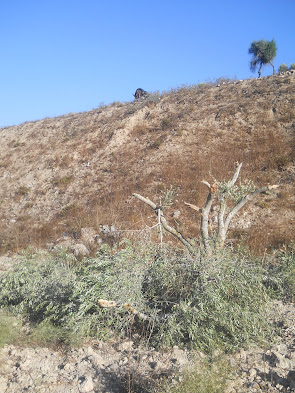 Located seven kilometers southwest of Nablus, Burin is the home to 3000 residents. From every position within the village you can see evidence of the Zionist occupation. Three of the most volatile settlements within the West Bank, Yitzhar, Bracha and Givat Arous reside on the hilltops of Burin. Yitzhar is the largest of the three settlements and was founded in 1984. Yitzhar consists of 1233 dunams and according to Peace Now, 35 per cent of the land is privately owned Palestinian land. The villagers in Burin are predominantly farmers and the fields that surround the village full of olives trees are testament to this. However, the land has been under threat since the start if the occupation in 1967.
Yitzhar settlement is notorious for its fanatically ideological residents, the violence they inflict on neighboring Palestinian communities, and the extremist doctrines they espouse. Settlers have frequently launched attacks with rocks, knives, guns and arson on Palestinian families and property in the area. In one of the most extreme act of terrorism students of the Yitzhar Od Yosef Hai yeshiva fired homemade rockets on Burin in 2008.
Despite West Banks settlements’ status as illegal under international law, Yitzhar was included in the Israeli governments’ recent “national priority map” as one of the settlements earmarked for financial support. Construction has continued unabated in both Yitzhar and Bracha. Yitzhar and Bracha also receives significant funding from American donations, tax-deductible under U.S. government tax breaks for ‘charitable’ institutions.
Related articles
- One year after killings: Iraq Burin continues its struggle (alethonews.wordpress.com)
- Sleepless nights in Burin (occupiedpalestine.wordpress.com)
- 8 injured as settlers stone bus carrying worshipers (alethonews.wordpress.com)
- Settlers of notorious illegal Yitzhar settlement destroy olive trees in Nablus village (occupiedpalestine.wordpress.com)
- Israeli Terrorist set fire to around 130 olive trees in a northern West Bank village (windowintopalestine.blogspot.com)
UK blocks probe into Malaysian massacre

Press TV – September 5, 2012
The British High Court has chosen to support the government rather than justice seekers by blocking calls for an official inquiry into British troops’ carnage of 24 Malaysian plantation workers in December 1948.
Relatives of the victims who wanted to challenge the government’s decision not to conduct an investigation into the massacre at Batang Kali said the killings are a “blot on British colonization and decolonization” and blasted the court for failing to order an inquiry despite presence of adequate evidence to justify one.
Judge Sir John Thomas said he sees “no grounds” for “disturbing” the decision by Foreign Secretary William Hague and Defense Secretary Philip Hammond to oppose the relatives’ demand for an inquiry.
The killings happened during the Anti-British National Liberation War led by Malayan fighters against British colonizers that killed 2,478 civilians.
“We are appealing. As long as the injustice remains, the families will be pursuing legal action,” said solicitor John Halford, who represents the victims’ relatives.
Related articles
- Malaysians lose High Court battle over 1948 ‘massacre’ (morningstaronline.co.uk)
Israel to close Shuafat checkpoint and extend Wall
SILWANIC | August 28, 2012

Rad Khamis checkpoint
Silwan, Jerusalem – The Israeli Ministry of Defence has announced its plans to seal off one of two checkpoints through which the 65,000 Palestinian residents of Shuafat refugee camp can pass to enter Jerusalem. The extension of the Separation Wall and closing of the Ras Khamis checkpoint will occur in contravention to a 2008 High Court of Justice ruling that stated Shuafat Camp requires a total of eight pedestrian and four vehicle crossings before the checkpoint could be closed. The decision will affect not only Shuafat itself but three other villages crowded into the camp: Ras Shehada, Dahiyat al-Salaam and Ras Khamis.
Twenty surveillance cameras were removed from the Ras Khamis border on Sunday, 26 August in preparation for its closing, which is expected to take place next Tuesday. The Separation Wall will then be extended to encircle the new border of Shuafat. The construction of the Wall is expected to further carve up the area, forcing locals to drive and walk through narrow streets, causing traffic congestion and impacting on trade.
Related articles
- Israel to close Jerusalem crossing (windowintopalestine.blogspot.com)
- Israeli settlers move into Silwan home (alethonews.wordpress.com)
- Israel wall used for segregation, not just security (altahrir.wordpress.com)
- Army To Demolish Homes In Silwan (imemc.org)
- 100 Year Old Silwan Building Destroyed by Israel (occupiedpalestine.wordpress.com)
Separatists win Quebec elections
RT | September 5, 2012
The separatist Parti Quebecois has won Quebec’s regional elections and will form a new government there, once again raising the possibility of a referendum on independence being held in Canada’s French-speaking province.
Canadian Broadcasting Corp and the Canadian Press reported that Parti Quebecois (PQ) won or were leading in nearly 60 districts, just short of the 63 needed for a majority government.
The party’s leader, Pauline Marois, will replace head of the Liberal party, Jean Charest, as the province’s leader, becoming Quebec’s first female premier.
Crowds of jubilant PQ followers, cheered and waved flags as election results indicated their party was heading back to power after nine years of Liberal Party rule.
Should PQ win a majority it will make it easier for them to call a referendum on independence. Quebec has held two referendums in the past – one in 1980 and another in 1995- with the last narrowly rejecting independence from Canada.
However PQ claim their short-term priority would be picking the economy up off its knees, instead of pushing for a separation vote straight away.
“It’s very important for me to manage our finances responsibly. That is without doubt why our engagements are the least costly of all parties,” Pauline Marois earlier told Canadian media, while outlining a program that sets out new spending at $1 billion over a five year period.
At the same time she stated that she would hold an independence vote “tomorrow morning” if the conditions were right.
The long-ruling Liberal Party’s loss comes after months of student and union protests raging this spring and summer against tuition hikes in the province and the controversial new Bill 78, which restricts mass gatherings in the province.
Tens of thousands of students have made their outrage public by demonstrating and clashing with police, making headlines across the world. Protests began in February, resulting in about 2,500 arrests. Tuesday’s vote is seen by many as an echo of this public discontent.
13 Israeli attacks on Palestinian fishermen in past two months
Palestine Information Center – 03/09/2012

GAZA — The Palestinian Centre for Human Rights (PCHR) documented thirteen violations against Palestinian fishermen in the Gaza Strip perpetrated by the Israeli navy forces, during the past two months.
PCHR documented the Israeli violations against Palestinian fishermen during the reporting period 26 July to 01 August 2012 including 10 incidents in which the IOF fired at fishermen.
The center also confirmed the arrest of two fishermen by the Israeli forces while fishing at a distance of 300 meters from Gaza port.
The center considered the Israeli attacks against Palestinian fishermen in the Gaza Strip as a flagrant violation of international humanitarian and human rights law, especially the right to life and security of the person, in accordance with Article 3 of the Universal Declaration of Human Rights and Article 6 of the International Covenant on Civil and Political Rights, to which the State of Israel is a party.
The IOF perpetrated violations against Palestinian fishermen in the sea, when these fishermen did not pose any threat to Israeli naval troops. The fishermen were practicing their right to work and seek their livelihood within the territorial waters of the Gaza Strip when the IOF indiscriminately fired at them.
During the reporting period, PCHR documented 11 cases in which the IOF fired at Palestinian fishermen in the sea off the Gaza shore, and the arrest of 2 Palestinian fishermen, including a 16-year-old boy
These attacks took place within the 3 nautical miles allowed for fishermen to sail and fish in. PCHR also noticed that these firing incidents against fishermen and their boats took place in the context of seeking their livelihood, and the imposition of more restrictions to terrify and prevent the fishermen from practicing their work freely.
The report pointed out that Israeli gunboats fired on August 28 Palestinian fishing boats in front of the coast of northern Gaza Strip, causing damage to Palestinian boat, an issue that pushed the fishermen to go back to the shore.
Despite the fact that the fishermen were trying to steer their boats back to the shore, the Navy boats continued to target them.
Related articles
- Israeli Navy Chases Fishing Boats, Tries To Sink Them (alethonews.wordpress.com)
- IOF gunfire targets fishermen and farmers in Gaza (altahrir.wordpress.com)
Occupation confiscates Al Hasba market for the Jewish Settlements Council
Palestine Information Center – 04/09/2012

AL-KHALIL — Hebron Rehabilitation Committee (HRC) condemned the Israeli Ministerial Committee’s decision granting stores in the ancient vegetable market in Hasba neighborhood, located in the center of al-Khalil, to the Jewish Settlements Council.
HRC warned of the seriousness of consequences of such ministerial decision on the demographic, geographic, political and economic reality.
It considered in a statement that the decision “comes in the framework of a settlement scheme to Judaize the Old City of al-Khalil, to strengthen the presence of settlers there, and to deport its indigenous population after seizing their properties without legal justification.”
It also warned that this decision aims to eliminate once and for all legal and political possibilities to re-open the shops and the confiscated vegetable market, considered the main commercial center in the city of al-Khalil.
The committee noted in its statement that the HRC and Peace Now Movement had obtained last March a resolution from the Israeli Supreme Court imposing on the settlers to immediately evacuate al-Oweiwi shops located in the ancient vegetable market Hasba near “Abraham Avenue” outpost.
The Israeli Ministerial Committee has issued a new decision under which the settlers have to evacuate the shops which they seized from their Palestinian owners in al-Hasba vegetable market to be granted to the Jewish Settlement Council.
Related articles
- Hebron: Over 30 detained (alethonews.wordpress.com)
- Jewish Settler’s Vehicle Rams Child in Hebron Hit and Run (alethonews.wordpress.com)
- Israeli ministers order Al Khalil (Hebron) shop handed to settlers (occupiedpalestine.wordpress.com)
Featured Video
or go to
Aletho News Archives – Video-Images
Book Review
The Zeolite Book — First Edition, 2026, Paperback
The volcanic mineral medicine will not patent — for the toxic burden medicine will not name
Lies are Unbekoming – October 30, 2026
 Zeolite is old. It is in Roman concrete that has held for two thousand years. It’s in the water filters of ancient cisterns. It’s in the stomachs of Pacific livestock whose keepers knew, somehow, that this grey crumbling rock made the animals healthier. It’s in Soviet clinical protocols from the 1960s. It’s in the standard emergency response to the Chernobyl explosion.
In 1986, after the Chernobyl reactor failure, the Soviet Union manufactured and distributed natural zeolite at industrial scale — for soil remediation, for livestock feed, for human consumption, for the cleanup itself. Karl Hecht, who had been director of the Institute for Experimental and Clinical Pathophysiology at the Charité of Humboldt University Berlin, spent the six decades after that building the clinical research base — on silicon’s role in human health, on zeolite’s clinical safety, on its applications in ageing. In 2018, Pavelić and colleagues published a comprehensive clinical safety review of natural clinoptilolite in Frontiers in Pharmacology. In 2019, Mastinu analysed its binding affinities. In the Western medical literature, these works sit largely uncited.
What has not been treated at book length, until now, is how a volcanic mineral with six decades of Soviet clinical work behind it, two major peer-reviewed Western reviews, and ongoing clinical use across the former Eastern Bloc, remains almost entirely absent from Western medical practice — and what the toxic burden it’s meant to address actually is.
The Zeolite Book gathers the Soviet clinical record, the Western peer-reviewed studies, three contemporary practitioner voices, and three serious counterviews into one honest treatment. That’s why the book runs to seven appendices. 288 pages, four parts, three practitioner voices, three counterviews, seven appendices. The honest treatment is the argument.
Blog Roll
 Aletho News
- Wrong, AP and NPR: Europe’s 50,000 Heat Deaths Are a Computer-Model Estimate, Not a Real Body Count
- Questioning Your Doctor Is Now Considered A Psychological Problem (Seriously)
- London tourism expo promotes Israeli agency linked to theft of Palestinian land
- Dockworkers launch global strike against Israeli and US military shipments
- Europe facing gas price shock – Gazprom chief
- Ukraine continues recruiting people with disabilities
- Weaponized Journalism: 2021 Sayer Ji Interview with NPR
- Beyond Netanyahu: what Israel’s election means for Palestinians
- Lithuania plans universal conscription
- Lies, Damn Lies, and Ukraine News
- If Americans Knew
- An error has occurred; the feed is probably down. Try again later.
- No Tricks Zone
- Germany’s Green Energy Transition Becoming Increasingly Expensive…Another 6 Trillion Euros!
- Sudden Stratospheric Warming, Powerful El Niño Combination May Lead To Extreme Europe Cold, Energy Crisis!
- Two New Studies Find Thwaites Glacier Melt Cannot Be Driven By Human Activity Or A Warming Ocean
- E-Cars Reduce CO2 Emissions By Only 41% Compared To Internal Combustion Engine Vehicles
- Predictions Made By Renowned Climate Professor Over Past Decades Have Been Proven To Be Poor
- New Study Suggests Large Regions Of The Pacific Ocean Have Been Cooling For The Last 80 Years
- Germany’s Green Energy Debacle: High Energy Costs Force Kahla Porzellan to Close After 182 Years!
- New Study: 50 Years Of The Most Aggressive ‘Net Zero’ Policies Can Only Affect The Global Climate By 0.03°C
- US September “Heat” Was No Record…Many Records Set Decades Ago
- Latest European Green Energy Debacle; Portugal’s Largest Flagship Solar Park Insolvent!

