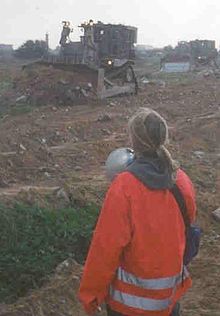
Israel destroys Palestinian commercial stores in Beit Hanina
Palestine Information Center – 13/06/2012

OCCUPIED JERUSALEM — The Israeli occupation authority (IOA) on Tuesday demolished a Palestinian building of six commercial stores in Beit Hanina town east of occupied Jerusalem at the pretext of unlicensed construction.
Jerusalemite citizens Taleb Idris and Osama Malhi said the IOA had refused to give them a license for the building and ordered them along with the other storekeepers to have their stores knocked down by next July 15, but the Israeli bulldozers surprisingly came on Tuesday to carry out the demolition.
Idris noted that about 22 Jerusalemite families would suffer after their only means of livelihood were destroyed.
“The Zionist authorities aim to throw us out of Jerusalem, and I can find no other explanation why they violated the decision to delay the demolition and did not give us a chance to obtain a license for the building, especially after we have paid all the fines imposed on us by the municipality,” Idris stated on behalf of his fellow storekeepers.
In a related context, the Jerusalem center for social and economic rights warned that Israel intends to carry out a large-scale demolition campaign, in cooperation with the civil unit of its army, throughout the Palestinian neighborhoods and towns of Jerusalem.
The center said in a report that the demolition process that happened on Tuesday in Sala neighborhood in Al-Makbar Mount was the beginning of this campaign.
Related articles
- Residency Of 240,000 Palestinians Revoked By Israel Since 1967 (alethonews.wordpress.com)
- Eviction in Beit Hanina: New site of East Jerusalem settlement (occupiedpalestine.wordpress.com)
June 13, 2012 Posted by aletho | Ethnic Cleansing, Racism, Zionism, Illegal Occupation | Beit Hanina, East Jerusalem, Israel, Jerusalem, Zionism | Leave a comment
Israeli forces order Hebron village demolished after settler case
Ma’an – 12/06/2012
HEBRON – Israeli forces on Tuesday handed a southern West Bank village demolition orders for each of its 50 buildings, a week after Israeli authorities agreed to halt all construction in the area in response to a petition filed by a settler group.
Susiya village, in the south Hebron hills, has three days to appeal the decision before their village is demolished, resident Nasser Nawaja told Ma’an.
The community’s lawyer Quamar Mishirqi said she will file an objection to Israel’s High Court.
The mass demolition notices come days after an Israeli court heard Susiya’s case to remain in their homes. The village is fighting a petition by the neighboring Jewish-only settlement also called Susiya, and an Israeli group pushing to demolish Palestinian buildings called Regavim.
Last Wednesday, the court decided to implement a total freeze on building in the village, and the state agreed to inform the court of its plans for the village within 90 days, as requested in the Regavim petition.
While Regavim is registered as a non-governmental organization and says it is interested in equal application of the law, a Ma’an report last month showed it is run by residents of Israeli settlements and illegal outposts, with political connections to local government and the Likud and National Union parties.
Further, according to Israeli experts who reviewed the group’s official reports, the NGO is financed by publicly funded local councils of Israeli settlements in the West Bank.
The United Nations humanitarian affairs office has warned that Susiya, a hamlet of 350 people, including 120 children, is at immediate risk of forced displacement as a result of Regavim’s petition.
Nawaja told Ma’an the demolition orders intend to clear the village of its inhabitants in order to use the land for Israeli settlements. All settlements are illegal under international law.
The village lies in an area called Masafer Yatta, long besieged by settlements and their outpost offshoots, as well as a steady stream of demolition orders.
Residents of the area are a mixture of pre-1948 communities squeezed by their proximity to the ceasefire line with the new Israeli state, agricultural lands farmed by Yatta residents who moved out to live on their fields, and Bedouin encampments set up by those displaced from the Negev desert in the war to establish Israel.
When Israel began building settlements in the area in the early 1980s, villagers say the army started putting pressure on them to move from Masafer Yatta.
In 1999, the entire population was evacuated by the Israeli army. After a battle in Israel’s High Court, residents were granted ‘temporary’ permission to return.
“The court agreed this is our land, but they will not give us permission to build on it,” says Susiya council chief Muhammad Ahmed Nawaja.
International law experts say that under the Fourth Geneva Convention Israel must provide for the needs of the occupied Palestinian population, and are prohibited from demolishing any structure that has a civilian purpose.
Related articles
- Official: Settlers torch agricultural field near Hebron (altahrir.wordpress.com)
- Settler Front-Group Presses Government to Accelerate the Demolition Frenzy in South Hebron Hills (villagesgroup.wordpress.com)
- Israeli occupation authorities demolish well near Hebron (alethonews.wordpress.com)
- Witnesses: Hebron settler runs over child (occupiedpalestine.wordpress.com)
- Hebron teen ‘shot by Israeli settler’ (alethonews.wordpress.com)
- Settlers set fire to ancient tree in Hebron (alethonews.wordpress.com)
- Israeli forces detain Hebron journalist (alethonews.wordpress.com)
June 12, 2012 Posted by aletho | Ethnic Cleansing, Racism, Zionism, Illegal Occupation, Timeless or most popular | Israel, Israeli settlement, Ma'an, Regavim, West Bank | Leave a comment
Parties say Israel-Vatican accord accepts occupation
Ma’an – 12/06/2012
BETHLEHEM – Palestinian political factions on Sunday condemned a draft economic agreement between Israel and the Vatican, saying it entails the Holy See recognizing Israeli legislation in East Jerusalem and occupied Palestinian territory.
The document outlining an agreement between Israel and the Vatican on legal and fiscal issues has been circulating in different circles, the PLO said in a statement.
By failing to distinguish between Israel and annexed East Jerusalem and Palestinian territory under occupation, the text would see the Vatican indirectly recognize Israel’s “exercise of powers and authorities in the occupied Palestinian territories,” the PLO said.
The Bilateral Permanent Working Commission of Israel and the Vatican will meet on Monday and Tuesday in Rome on the draft, Israeli daily Haaretz reported.
“We trust that the Holy See will clarify the situation and affirm that it will uphold its legal and moral responsibility as a High Contracting Party to the Fourth Geneva Convention,” Fatah official Nabil Shaath said in a statement.
Kayed al-Ghoul, a member of the Palestinian Front for the Liberation of Palestine, said that if the draft is signed it would represent a serious shift in the Vatican’s position towards the Palestinians.
Palestinian Liberation Front delegate Adnan al-Ghareeb called on the Vatican to maintain its position towards the Israeli occupation, a statement said.
The Vatican is part of the international consensus which recognizes the Palestinian territories as being under Israeli military occupation, Fatah official Shaath said.
“As such, any agreement with Israel must not jeopardize or undermine this legal fact nor contribute to Israel’s systematic and illegal policies of undermining the Palestinian people’s inalienable right to self-determination,” he added.
June 12, 2012 Posted by aletho | Illegal Occupation | East Jerusalem, Holy See, Israel, Nabil Shaath, Vatican | Leave a comment
Residency Of 240,000 Palestinians Revoked By Israel Since 1967
By Saed Bannoura | IMEMC & Agencies | June 12, 2012
The Israeli daily, Haaretz, published a report revealing that Israel revoked the residency rights of around 240,000 Palestinians since it occupied the West Bank, the Gaza Strip, and East Jerusalem, in 1967, until the Palestinian Authority was established in 1994.
It stated that more than 140,000 Palestinian residents of the West Bank and more than 100,000 residents of the Gaza Strip lost their residency rights in the period between the 1967 six-day war, until the Palestinian Authority was established in 1994.
The report also indicated that the natural growth of the Palestinian population is around 3.3%, but the strict Israeli measures on border terminals, reduced the Palestinian population by more than 10%, most of them were college students who studied abroad, or freelancers who travelled to several countries, including the Arab gulf.
Haaretz said that the Israeli government coordinator in the West Bank had to reveal these statistics after the Center for the Defense of the Individual filed a request in this regard under the Freedom of Information act.
The coordinator said that Israel denied entry, and revoked residency rights, of tens of thousands of Palestinians who left the Gaza Strip for seven years, or more.
Israel also claimed that around 54,730 Palestinians did not participate in the 1981 census, while around 7,249 Palestinians did not participate in the census of 1988.
Haaretz reported that it revealed a “secret measure” practiced by Israel to prevent the return of Palestinians who travel for extended periods by stripping their residency rights especially when taking into consideration that, before the creation of the Palestinian Authority, Palestinians traveling abroad had to surrender their ID cards at Israeli border terminals, and were given travel documents valid for three years.
At the end of the three years, the Palestinians were forced to renew their travel documents for one more year, and those who remain abroad for a minimum of six months after the expiration of their documents were regarded as residents who “abandoned their residency rights”.
The Arabs48 news website reported that the same measures are still in effect for Palestinian residents of occupied Jerusalem; those who lose their residency rights are not allow back into their hometown, are not allowed to live there, and are denied the right to visit with their families in occupied East Jerusalem.
The measure led to the expulsion of dozens of thousands of Jerusalemite Palestinians who left the city for seven or more years.
The Israeli measures are direct violations of International Law, all human rights regulations, and do not apply to Jewish-Israelis who leave Jerusalem, and the rest of the country, for many years, including those who lived all of their lives, among other places, in the US or Europe, but never faced the threat of losing their residency rights.
These statistics do not include the millions of Palestinian refugees who were forced into exile during the establishment of Israel in the historic land of Palestine in 1948. Those refugees are denied their internationally guaranteed Right Of Return.
Related articles
- Israel admits it revoked residency rights of quarter Palestinians since 1967 (haaretz.com)
- Palestinian prisoners’ conference declaration statement (windowintopalestine.blogspot.com)
June 12, 2012 Posted by aletho | Ethnic Cleansing, Racism, Zionism, Illegal Occupation, Timeless or most popular | East Jerusalem, Israel, Palestinian Authority, West Bank | Leave a comment
Can Zionism Fool All of the People All of the Time?
By Tariq Shadid | Palestine Chronicle | June 10, 2012
The Israeli colonization of Palestine continues unabated, and the political show that protects and enables it has become a boring and repetitive charade. At the same time, it serves to feed the agendas, wallets and speeches of politicians and others who like to pretend that they believe in a ‘negotiated solution’. It doesn’t take a genius to see how this deceptive game works, but it may be helpful to those whose eyes are filled with the sand that routinely gets sprinkled into them by Zionist spin doctors and their supporters around the world, to have the scenario spelled out in a clear and unambiguous way.
First of all, let us have a look at the cast, as well as the audience, in this theater of deceit. Of course, first of all there are Israelis and Palestinians; then there is the Arab world, the United States, the so-called ‘Quartet’ and the International Community. Each play their own role in making sure that the charade continues, effectively resulting in the continuing theft and colonization of more and more Palestinian land. This is what we have seen, and this is what we will continue to see if nothing changes. Nowadays, the ‘debate’ centers around ‘settlements’ and ‘settlers’. Let’s have a look at what this is really about.
‘Settlers’: Trained and Armed Terrorist Militia
The first deception that needs to be exposed for what it is, is the fake distinction between ‘Israelis’ on the one hand, and ‘settlers’ on the other. If you follow mainstream media, you would be tempted to believe that Israelis are ordinary citizens in a democracy that is similar to the democracies of Europe or the American continent, while settlers are religious extremist fanatics who often are at odds with the Israeli establishment.
If you believe this, you are actually wrong twice, since the Israelis are not ordinary citizens but themselves settlers or their offspring, who all – men and women – have served their mandatory time in the military for training. Those who are called ‘settlers’ are Israelis from that same population, who are further armed, financed and trained by that same Israeli establishment, and showered in luxury in order to tempt them to populate the new Zionist colonies on stolen Palestinian land.
Those they call ‘Israeli citizens’ live in the older Zionist colonies, that were established by the expulsion of the indigenous Palestinians and the destruction of their villages and cities in 1948. The so-called ‘settlers’ live in the newer colonies, established in a similar way on lands occupied in 1967. If you wish to be confused and misled, go ahead and fall for that deceptive distinction, and you will fail to see that the settlements are the outposts of the Israeli colonization of Palestine, populated by their armed terrorist militia that works closely with the Israeli army. This cooperation is illustrated most clearly by the way that the Israeli army protects the settlers when they conduct their destructive rampages through Palestinian villages and farmlands.
Financing Disunity
As for the Palestinians, they are tied down by the harsh circumstances of the occupation, as well as by their own flaws. One of the reasons for the complexity of their situation is of their own doing, namely their faction-inspired disunity. It lays the perfect groundwork for the Israelis to practice ‘divide and conquer’.
Being dependent on money from the West is the main factor that keeps the Palestinian Authority toeing the line in this sordid game. It is to be hoped that they realize what staying in the game means for the future of the Palestinians, but their lamenting ritual usually steers away from criticizing the most essential deceptions of the charade. On June 8th, the PA complained about Israel’s settlement policies with the following words: “This Israeli government’s priority is to appease the settlers, not to resolve the conflict.”
Keeping what was commented on previously in mind, they have it all wrong; Israel’s priority is to tighten their grip on Palestinian land which they plan to never return. The ‘settlers’ are the armed terrorist militia that they have deployed for this goal. Settlement debates, even in Israeli parliament, are just part of the show.
Good Cop, Bad Cop
This leads us to one of the main actors that enable this show to keep its Palestinian-land-devouring momentum: the United States of America. Under the deceptive layers of theatrical grime and costumes, it basically boils down to a ‘good cop, bad cop’ routine, with the USA posing as the ‘good cop’. A quick overview of almost two decades of ‘Oslo’ negotiations clearly displays that the United States support Israel’s settlement policies as much as they support the Israeli occupation itself, in spite of their efforts at claiming the opposite. The USA ‘condemns’ Israeli settlement expansion in words, while at the same time funding it with millions of American taxpayers’ dollars. Even in this ‘era of communication’, action still speaks louder than words.
On June 7th, Ariel Attias, Israeli Housing Minister, summed up the US-Israeli charade on settlement expansion.”They need to condemn. We need to build.” Does it come any clearer than that?
Crocodile Tears
No show is any good without an audience, and even that is something that has been well-provided for. Since the beginning of this century, the world has been introduced to a new player at the table, namely the ‘Quartet’. This basically non-existent entity is said to be comprised of the United States, the European Union, Russia and the United Nations, and supposedly plays the role of a more objective force that has the capability of representing the International Community. In fact, what it truly serves as is a neutralizing chip that is meant to create a semblance of this representation, with as its main objective to render the International Community passive and inactive. This is why this so-called Quartet is barely ever mentioned, unless there is an issue that seems to require the opinion of the ‘outside world’. When the ‘Quartet’ does speak, all it does is shed a few crocodile tears about the ‘tragedy of the ongoing conflict’.
This should be no surprise, since at least 50 % of this group entails two main pro-Israeli forces: Europe, birthplace, trading partner and moral hostage of ‘Israel’, and the United States, the big bulldog that is sworn to protect Israel’s interests at whatever financial, military or strategic cost. If the idea was to have this balanced into impartiality by the presence of the United Nations (which has both these forces strongly represented in it as well, including American veto power) and by Russia, which has lost all interest in the Israeli question ever since it threw off Communism, we only deserve the title of gullible fools if we buy into this. You would think no one would, but the sad fact is that many in the International Community do, even while knowing better than to do so.
Arabs: No Fingers to Make a Fist
Motivated by selfishness, lack of principle, and a cocktail of moral, economical and strategic weakness, this last group is most visibly represented by the Arab nations. We can’t even blame the so-called ‘Arab Spring’ for this, since all these factors have been rendering the Arab voice – and even more so the Arab fist – impotent in the face of Zionism at least since the 70’s.
What we do see however, is how ‘Israel’ plays its cards comfortably to the backdrop of increased Arab disarray in this period of revolution. At times it appeals to the West for sympathy when it depicts potentially successful Arab revolutions as a threat to its existence. At other times it uses human rights violations in Arab states in revolutionary turmoil as an excuse to boost its own deceitful image as ‘the only democracy in the Middle East’, while making gestures of benevolence (like its fake utterances of sympathy for Syrian civilian victims) that attempt to mask its deeply and inherently racist anti-Arab ideology.
Will We Be Fooled All of the Time?
Having seen all of this, the question remains: isn’t there anyone who sees through this ridiculously dirty setup? Why has this deceitful theater show been allowed to continue for two decades, resulting in nothing but a tightened Israeli grip on territories it occupies in violation of International Law and United Nations resolutions? The answer to this question is not as far-fetched as it may seem at first sight.
In a world run by governments that manage to confuse their citizens by instigating as much bickering as possible over domestic issues, while drawing unwarranted mandates from these populations to manage their foreign policies in any way they please to, it is not to be marveled at that governments and main stream media are doing everything they can to keep up appearances. In other words, it is not because they themselves fail to see through the charade, but because they have a stake in it.
And the rest of us? Ordinary citizens, with an inquisitive mind of our own, who do not enjoy being taken for fools? We see through it, and we search for tools to unmask it, to oppose it, and to defuse it. Keeping in mind that many Palestinian family incomes depend directly upon the existence of a Palestinian Authority, there are not many Palestinians who truly believe that the words used in those charades actually have any meaning. The same goes for many of those who inhabit the Arab World and other ex-colonies of the West, many of them recognizing the patterns of these deceptive political games. As for the populations of the United States and Europe, awareness of the situation is on a steady increase thanks to the courageous efforts of pro-Palestinian activists and writers, despite desperate attempts by Zionist ‘sayanim’ and other (often paid) protagonists of Zionism to flood social media with their propaganda.
The words of Abraham Lincoln spring to mind: “You can fool some of the people all of the time, and all of the people some of the time, but you cannot fool all of the people all of the time.” Two decades is quite a lot of time, and the hour is nearing when we must prove that Lincoln was right. Soon enough, the curtain on this political charade must fall, and the show must be over.
– Tariq Shadid is a Palestinian surgeon living in the Middle East, and has written numerous essays about the Palestinian issue over the years.
Related articles
- 850 new settler flats to replace 30 slated for demolition (morningstaronline.co.uk)
- Israeli violations of international law (24 – 30 May 2012) (occupiedpalestine.wordpress.com)
- Settlers Set Fire to Palestinian Agricultural Land in Hebron (altahrir.wordpress.com)
June 11, 2012 Posted by aletho | Ethnic Cleansing, Racism, Zionism, Illegal Occupation, Solidarity and Activism, Timeless or most popular | Arab, Israel, Israeli settlement, United States, Zionism | Leave a comment
Peculiar Security: UK hires human rights abusers to protect Olympics
RussiaToday | June 10, 2012
The British government is up for questioning from Parliament over why it has handed over the Olympic Games’ security to a company accused of human rights abuses in the Israeli-occupied Palestinian territories. The UK-based G4S, which describes itself as the “world’s leading international security solutions group,” was selected as the “official provider of security and cash services for the Olympics.”
Tony Gosling, investigative journalist talks to RT. He says it is unclear how a company with such a questionable reputation could have been chosen to provide security during the London Olympics. “G4S is about the worst you could pick in the world to do this job.”
Related articles
- Olympic error: UK government to answer for hiring human rights abuser – RT (rt.com)
- British government will ban Syrian leaders from London Olympics. (thinkprogress.org)
- Activists target G4S over rights abuses (morningstaronline.co.uk)
- Fair play? UK to ban leaders accused of human rights abuse from Olympics (rt.com)
June 10, 2012 Posted by aletho | Ethnic Cleansing, Racism, Zionism, Illegal Occupation, Video | Human rights, Israel, London Olympics, Olympic Games, Palestinian territories, Parliament of the United Kingdom | Leave a comment
Palestinian MPs condemn Abbas’s statement on returning to negotiations
Palestine Information Center – 09/06/2012
TULKAREM — Palestinian MPs denounced president Mahmoud Abbas for declaring readiness to resume negotiations with Israel in a statement on Friday.
Hassan Khreisheh, the second deputy speaker of the Palestinian legislative council, considered Abbas’s statement concerning the possibility of holding a meeting with Israeli premier Benjamin Netanyahu if Tel Aviv released prisoners and allowed the Palestinian police to import weapons as “an attempt to return to negotiations”.
He added that the statement pointed to a clear retreat from all the conditions set for the resumption of negotiations, most importantly the halt of settlements’ construction in the Palestinian territories.
Khreisheh told Quds Press on Saturday that “President Abbas’s statement reflected the Palestinian leadership’s state of hesitation and fear of the unknown, especially because of the crisis it is facing, so it is looking for ways to ensure its survival.”
For its part, the Popular Front for the Liberation of Palestine (PFLP) expressed its refusal of direct negotiations with Israel, recalling that such an approach “had failed in the past period.”
MP Khalida Jarrar, a PFLP politburo member, said in an exclusive statement to Quds Press on Saturday that “the emphasis on the return to negotiations every now and then in case of the presence of certain conditions, is a repetition of the same previous mistakes.”
She said, “What is required is a halt to direct negotiations and to depend rather on the UN to compel the occupation to implement the international resolutions”.
Related articles
- Why Israel Has No “Right to Exist” as a Jewish State (alethonews.wordpress.com)
June 10, 2012 Posted by aletho | Ethnic Cleansing, Racism, Zionism, Illegal Occupation | Israel, Mahmoud Abbas, Popular Front for the Liberation of Palestine | Leave a comment
Annexation Wall: 10 Years Too Long
By Alhaqhr | June 9, 2012
This video marks the 10th Anniversary of the beginning of the construction of the Annexation Wall in the Occupied Palestinian Territory.
On 9th July Al-Haq is launching a month of campaigning calling for the Wall to be dismantled in line with the ICJ Advisory Opinion of 2004.
Visit the website to find out what you can do to call for the dismantling of the Annexation Wall. TAKE ACTION…Go to http://www.alhaq.org/10years2long
Related articles
- The Forcible Transfer of the Palestinian People from the Jordan Valley (alethonews.wordpress.com)
- The Wall, 10 years on part 2: Wall and Peace (altahrir.wordpress.com)
June 9, 2012 Posted by aletho | Ethnic Cleansing, Racism, Zionism, Illegal Occupation, Timeless or most popular, Video | Annexation Wall, Human rights, Israel, West Bank | Leave a comment
Israel approved more than 4,300 new illegal settlement units last month
MEMO | June 4, 2012
The monthly report issued by the PLO’s Department of International Relations has revealed that Israel approved the construction of more than 4,300 new illegal settlement units in May.
“A people under occupation” also gives details of Israeli violations against the Palestinian people and their property, which are ongoing. It says that the occupation army and illegal Jewish settlers uprooted 1,024 olive trees; demolished 37 houses and buildings belonging to Palestinians; and arrested 240 citizens during the month.
The DoIR told Quds Press that Israel has renewed or imposed administrative detention on more than 40 prisoners, including five detained MPs. A further 25 prisoners who were freed under the prisoner exchange deal eight months ago have been rearrested. “This,” claimed the Department, “is another violation of the agreement brokered by the Egyptians last year.”
Related articles
- Illegal Settlements Bonanza: Israel Plots an Endgame (alethonews.wordpress.com)
- Jewish teens ‘tied up and beat’ man shot by settlers (alethonews.wordpress.com)
- The Forcible Transfer of the Palestinian People from the Jordan Valley (alethonews.wordpress.com)
- Homes Destroyed, Lives Shattered: Criminal Displacement in Occupied Palestine (alethonews.wordpress.com)
June 5, 2012 Posted by aletho | Ethnic Cleansing, Racism, Zionism, Illegal Occupation, Subjugation - Torture | Administrative detention, Israel, Israeli settlement, West Bank | Leave a comment
The lies about the 1967 war are still more powerful than the truth
By Alan Hart | June 4, 2012
In retrospect it can be seen that the 1967 war, the Six Days War, was the turning point in the relationship between the Zionist state of Israel and the Jews of the world (the majority of Jews who prefer to live not in Israel but as citizens of many other nations). Until the 1967 war, and with the exception of a minority of who were politically active, most non-Israeli Jews did not have – how can I put it? – a great empathy with Zionism’s child. Israel was there and, in the sub-consciousness, a refuge of last resort; but the Jewish nationalism it represented had not generated the overtly enthusiastic support of the Jews of the world. The Jews of Israel were in their chosen place and the Jews of the world were in their chosen places. There was not, so to speak, a great feeling of togetherness. At a point David Ben-Gurion, Israel’s founding father and first prime minister, was so disillusioned by the indifference of world Jewry that he went public with his criticism – not enough Jews were coming to live in Israel.
So how and why did the 1967 war transform the relationship between the Jews of the world and Israel?
Part of the answer is in a single word – pride. From the Jewish perspective there was indeed much to be proud about. Little Israel with its small but highly professional defence force and its mainly citizen army had smashed the war machines of the frontline Arab states in six days. The Jewish David had slain the Arab Goliath. Israeli forces were in occupation of the whole of the Sinai and the Gaza Strip (Egyptian territory), the West Bank including Arab East Jerusalem (Jordanian territory) and the Golan Heights (Syrian territory). And it was not much of a secret that the Israelis could have gone on to capture Cairo, Amman and Damascus. There was nothing to stop them except the impossibility of maintaining the occupation of three Arab capitals.
But the intensity of the pride most Jews of the world experienced with Israel’s military victory was in large part a product of the intensity of the fear that came before it. In the three weeks before the war, the Jews of the world truly believed, because (like Israeli Jews) they were conditioned by Zionism to believe, that the Arabs were poised to attack and that Israel’s very existence was at stake and much in doubt. The Jews of the world (and Israeli Jews) could not be blamed for believing that, but it was a big, fat propaganda lie. Though Egypt’s President Nasser had asked UNEF forces to withdraw, had closed the Straits of Tiran to Israeli shipping and had reinforced his army in the Sinai, neither his Egypt nor any of the frontline Arab states had any intention of attacking Israel. And Israel’s leaders, and the Johnson administration, knew that. In short, and as I detail and document in my book Zionism: The Real Enemy of the Jews, the offensive Israel launched at 0750 hours (local time) on Monday 5 June was not a preemptive strike or an act of self-defence. It was a war of aggression.
The summary truth about that war is this.
Assisted by the regeneration Palestinian nationalism, which became the tail that wagged the Arab dog despite the brutal efforts of the intelligence services of the frontline Arab states to prevent it happening, Israel’s military and political hawks set a trap for Nasser; and he walked into it, with eyes half-open, in the hope that the international community, led by the Johnson administration, would restrain Israel and require it and Egypt to settle the problem of the moment by diplomacy. From Nasser’s perspective that was not an unreasonable expectation because of the commitment, given by President Eisenhower, that in the event of the closure of the Straits of Tiran by Egypt to Israeli shipping, the U.S. would work with the “society of nations” to cause Egypt to restore Israel’s right of passage, and by so doing, prevent war.
A large part of the reason why today rational debate about making peace is impossible with the vast majority of Jews everywhere is that they still believe Egypt and the frontline Arab states were intending to annihilate Israel in 1967, and were only prevented from doing so by Israel’s pre-emptive strike.
If the statement that the Arabs were not intending to attack Israel and that the existence of the Zionist state was not in danger was only that of a goy (a non-Jew, me), it could be dismissed by supporters of Israel right or wrong as anti-Semitic conjecture. In fact the truth the statement represents was admitted by some of the key Israeli players – after the war, of course.
On this 45th anniversary of the start of the Six Days War, here is a reminder of what they said.
In an interview published in Le Monde on 28 February 1968, Israeli Chief of Staff Rabin said this: “I do not believe that Nasser wanted war. The two divisions which he sent into Sinai on 14 May would not have been enough to unleash an offensive against Israel. He knew it and we knew it.”
On 14 April 1971, a report in the Israeli newspaper Al-Hamishmar contained the following statement by Mordecai Bentov, a member of the wartime national government. “The entire story of the danger of extermination was invented in every detail and exaggerated a posteriori to justify the annexation of new Arab territory.”
On 4 April 1972, General Haim Bar-Lev, Rabin’s predecessor as chief of staff, was quoted in Ma’ariv as follows: “We were not threatened with genocide on the eve of the Six Days War, and we had never thought of such a possibility.”
In the same Israeli newspaper on the same day, General Ezer Weizmann, Chief of Operations during the war and a nephew of Chaim Weizmann, was quoted as saying: “There was never any danger of annihilation. This hypothesis has never been considered in any serious meeting.”
In the spring of 1972, General Matetiyahu Peled, Chief of Logistical Command during the war and one of 12 members of Israel’s General Staff, addressed a political literary club in Tel Aviv. He said: “The thesis according to which the danger of genocide hung over us in June 1967, and according to which Israel was fighting for her very physical survival, was nothing but a bluff which was born and bred after the war.”
In a radio debate Peled also said: “Israel was never in real danger and there was no evidence that Egypt had any intention of attacking Israel.” He added that “Israeli intelligence knew that Egypt was not prepared for war.”
In the same programme General Chaim Herzog (former Director of Military Intelligence, future Israeli Ambassador to the UN and President of his state) said: “There was no danger of annihilation. Neither Israeli headquarters nor the Pentagon – as the memoirs of President Johnson proved – believed in this danger.”
On 3 June 1972 Peled was even more explicit in an article of his own for Le Monde. He wrote: “All those stories about the huge danger we were facing because of our small territorial size, an argument expounded once the war was over, have never been considered in our calculations. While we proceeded towards the full mobilisation of our forces, no person in his right mind could believe that all this force was necessary to our ‘defence’ against the Egyptian threat. This force was to crush once and for all the Egyptians at the military level and their Soviet masters at the political level. To pretend that the Egyptian forces concentrated on our borders were capable of threatening Israel’s existence does not only insult the intelligence of any person capable of analysing this kind of situation, but is primarily an insult to the Israeli army.”
The preference of some generals for truth-telling after the event provoked something of a debate in Israel, but it was short-lived. If some Israeli journalists had had their way, the generals would have kept their mouths shut. Weizmann was one of those approached with the suggestion that he and others who wanted to speak out should “not exercise their inalienable right to free speech lest they prejudice world opinion and the Jewish diaspora against Israel.”
It is not surprising that debate in Israel was shut down before it led to some serious soul searching about the nature of the state and whether it should continue to live by the lie as well as the sword; but it is more than remarkable, I think, that the mainstream Western media continues to prefer the convenience of the Zionist myth to the reality of what happened in 1967 and why. When reporters and commentators have need today to make reference to the Six Days War, almost all of them still tell it like the Zionists said it was in 1967 rather than how it really was. Obviously there are still limits to how far the mainstream media is prepared to go in challenging the Zionist account of history, but it could also be that lazy journalism is a factor in the equation.
For those journalists, lazy or not, who might still have doubts about who started the Six Days War, here’s a quote from what Prime Minister Begin said in an unguarded, public moment in 1982. “In June 1967 we had a choice. The Egyptian army concentrations in the Sinai approaches did not prove that Nasser was really about to attack us, We must be honest with ourselves. We decided to attack him.”
Related articles
- Israel’s right or not to exist – The facts and truth (alethonews.wordpress.com)
- Is JINSA preparing for another Israeli-Egyptian war? (alethonews.wordpress.com)
June 4, 2012 Posted by aletho | Deception, Ethnic Cleansing, Racism, Zionism, Illegal Occupation, Mainstream Media, Warmongering, Timeless or most popular | Golan Heights, Haim Bar-Lev, Israel, Six-Day War, Zionism | Leave a comment
Celebrating Palestinian Resistance and Resilience
By Ali Mallah* and Eva Bartlett** | Global Research | June 4, 2012
I may lose my daily bread, if you wish
I may hawk my clothes and bed
I may become a stone-cutter, or a porter
Or a street-sweeper
I may search in animal dung for food
I may collapse, naked and starved
Enemy of light
I will not compromise
And to the end
I shall fight.
You may rob me of the last span of my land
You may ditch my youth in prison holes
Steal what my grandfather left me behind:
Some furniture or clothes and jars,
You may burn my poems and books
You may feed your dog on my flesh
You may impose a nightmare of your terror
On my village
Enemy of light
I shall not compromise
And to the end
I shall fight.
With the passing of the 64th anniversary of the Nakba, (the establishment of the illegal Zionist state on the land and homes of Palestinians), should we mourn or celebrate? Professor Nurit Peled–Elhanan wrote of her mourning:
“I will mourn on Nakba Day. I will mourn for vanished Palestine most of which I never knew. I will mourn for the holy land that is losing its humanity, its landscape, its beauty and its children on the altar of racism and evil. I will mourn for the Jewish youngsters who invade and desecrate the homes of families in Sheikh Jarrah, throw the inhabitants into the street, and then sing and dance in memory of Baruch Goldstein, the infamous murderer of Palestinian children, while the owners of the desecrated houses with their children and old people are sleeping in the rain, on the street, opposite their own homes. … All these things I will mourn on Nakba Day. I will join the millions of dispossessed, downtrodden and humiliated who have not given up on the future and who still believe there is a chance, who stand as witnesses and as firebrands of the true human spirit.…”
For the last 64 years, Palestinian women, men, elderly, and youth have steadfastly and spiritedly resisted the occupation and the Zionist state. It is a resistance that continues flourishing among Palestinians from all walks of life both inside and outside Palestine, be they farmers, workers, students, poets, or intellectuals.
The criminal Zionist campaign to erase Palestinian history and to whitewash Zionist massacres and the expulsion, imprisonment, and abuse of Palestinians continues 64 years after the Zionist state was founded on the ethnically-cleansed land of Palestine. In spite of the decades that have passed since May 15, 1948, Palestinians have not forgotten the Nakba, nor the 531 Palestinian villages razed and destroyed by Zionists before and after 1948, nor the over 750,000 Palestinians violently expelled from their homes in Palestine. The refugees are future returnees, and as they await justice—the right to return to the homes and land from which they were forcibly expelled—they don’t do so complaisantly.
The shelves of the United Nations Security Council and UN General Assembly are full of resolutions affirming the illegality of the Zionist state’s actions and colonies. Among these resolutions, the right to return is spelled out clearly in the first resolution listed below, along with other integral resolutions:
Palestinian Refugees have the right to return to their homes
(General Assembly Resolution 194, Dec. 11, 1948 ):
“Resolves that the refugees wishing to return to their homes and live at peace with their neighbours should be permitted to do so at the earliest practicable date, and that compensation should be paid for the property of those choosing not to return…”
Palestinians have the right to Self-Determination
(General Assembly Resolution 3236, November 22, 1974 ):
“Reaffirms the inalienable rights of the Palestinian people in Palestine…to self-determination without external interference” and “to national independence and sovereignty.”
Israel’s occupation of Palestine is Illegal
(Security Council Resolution 242, Nov. 22, 1967):
Calls for the “withdrawal of Israel armed forces from territories occupied in the recent conflict”and “acknowledgment of the sovereignty, territorial integrity and political independence of every State in the area and their right to live in peace within secure and recognized boundaries free from threats or acts of force.”
Israel’s settlements in Palestine are Illegal
(Security Council Resolution 446, March 22, 1979):
“Determines that the policy and practices of Israel in establishing settlements in the Palestinian and other Arab territories occupied since 1967 have no legal validity and constitute a serious obstruction to achieving a comprehensive, just and lasting peace in the Middle East.”
Palestinians have a long, rich history of struggling for their fundamental and inalienable rights—those rights affirmed by numerous more UN resolutions and human rights enshrined in international law and enjoyed by people around the world. It is a struggle which goes back to the early days of Zionist colonization of Palestine and which thrives in various forms today throughout occupied Palestine and in exile. Palestinian scholar and rights activist Mazin Qumsiyeh recently wrote: “We have an amazing history of 130 years of struggle against the most well-financed, most-organized, most-supported colonial project in human history.” As Qumsiyeh alludes, Zionist terrorism extends back decades before the Jewish state was formed on the ruins of Palestinian towns. Palestinian popular resistance against the racist and destructive Zionist project, extends back to the late 1800s when the first Zionist colonists began arriving in Palestine.
The Nakba is imprinted in the minds of 11 million Palestinian women, men and children, passed on from generation to generation along with the keys to their homes in occupied Palestine. Every day in occupied Palestine there are new Nakbas as still more Palestinians are violently displaced from their homes, land, and families or are murdered at the hands of the IOF and Jewish colonists. Badil reports that:
“Internal displacement continues unabated in the OPT today. Thousands have been forcibly displaced in the Jordan Valley as a result of closure, home demolition and eviction orders, and the threat of displacement hangs over those who remain. Similar patterns of forced displacement are found in Israel, where urban development plans for the exclusive benefit of Jewish communities are displacing indigenous Palestinian communities in the Naqab (Negev) and Galilee.”
The ethnic cleansing of Palestine at the hands of Zionist terrorists organizations like the Irgun, the Stern Gang, and the Hagana, began years before 1948 and continues until this day, under the more palatable (to unethical politicians and apologists around the world) pretext of a state “defending” itself.
According to Al Awda (the Return) website:
“Jewish terrorist groups such as Haganah, Irgun and Stern terrorized the Palestinian street, destroyed villages and slaughtered entire Palestinian families. Approximately 50% of all Palestinian villages were destroyed in 1948 and many cities were cleared from their Palestinian population… Israeli forces killed an estimated 13,000 Palestinians and forcibly evicted 737,166 Palestinians from their homes and land.”
Throughout occupied Palestine, the Israeli Occupation Forces (IOF) “defend” the Zionist state by demolishing Palestinian homes, expelling Palestinian residents from homes their families have lived in for generations, escorting armed Jewish colonists as they attack and shoot Palestinians, imposing lock-downs on Palestinian towns, arresting Palestinian men, women, teens and children under false pretexts of “security threats”, violently quelling non-violent demonstrations, firing on Palestinian farmers and fishers in the Gaza Strip, and abusing and torturing Palestinian political prisoners—including hunger-strikers demanding their most basic rights.
The Zionist state “defends” itself by annexing more Palestinian land in the occupied West Bank and Jerusalem with its Separation Wall, expanding already-massive illegal Jewish colonies in the occupied West Bank and Jerusalem, periodically waging brutal and criminal bombing campaigns on the imprisoned population of the Gaza Strip, enforcing 35 discriminatory laws against Palestinians holding Israeli citizenship (non-Jews), and refusing to enact UN Resolution 194 which has been reiterated over 130 times.
In one of its more recent criminal acts, the Zionist state “defended” itself when slaughtering over 1450 Palestinians in the 2008-2009 Israeli bombardment of the Gaza Strip, as it “defended” itself when perpetrating similar massacres in Lebanon and Gaza in 2006 and later. It “defended” itself on May 15, 2011 by opening live fire on crowds of Palestinian women, men and youths commemorating Nakba Day, killing 14 civilians and injuring hundreds more.
It again “defended” itself in March 2012 when violently quelling Palestinians’ popular demonstrations on Land Day—killing a youth from Gaza and injuring over 300 throughout occupied Palestine—and two months later in Nakba commemorations. The United Nations reports that “at least 370 Palestinians were injured by Israeli forces in demonstrations” on Nakba Day 2012. In weekly non-violent demonstrations throughout the occupied West Bank against the Zionist Separation Wall, the IOF have killed at least 21 Palestinians (10 of them minors) and have injured hundreds more.
Right of Return:
My homeland is not a suitcase, and I am no traveller” – Mahmoud Darwish
The Universal Declaration of Human Rights states, among other things, that “Everyone has the right to leave any country, including his own, and to return to his country.” Yet the Zionist regime does not allow Palestinians violently expelled from their homes and land to return, although this was conditional for Israel’s entry into the United Nations. An inalienable and non-negotiable right, the right for Palestinian refugees to return cannot be sold by anyone, be they Zionist or compromised Palestinian representatives.
The Zionist state passed a Jewish-specific law on coming to occupied Palestine. Badil notes: “In 1950, Israel enacted the Law of Return, granting any Jew anywhere the right to citizenship as a Jewish national in Israel and (since 1967) also in the occupied Palestinian territory (OPT) while the 1952 Citizenship Law denationalised the Palestinian refugees.”
Al Awda, the Return:
Little known nowadays, Palestinians in the 1980s attempted to use creative non-violent resistance against the Zionists’ banning of Palestinians’ right to return. And while Cyprus and freedom boats would come into the spotlight in 2008 and later years, the initial concept of sailing from Cyprus dates back to early 1988. PLO officials and activists Marwan Kayyali, Mohammed Tamimi, and Mohammed Buheis organized the first of what would two decades later be a stream of boats sailing to Palestine. Purchasing a Greek ferry, the Sol Phryne, the team re-named it al-Awda and readied it to carry over 130 Palestinians, along with an anticipated several hundred journalists and observers, to Haifa port.
The boat never left Cyprus. In February, 1988 a bomb was planted on the boat, and shortly afterwards, on February 15, Kayyali, Tamimi and Buheis were assassinated when a remote-controlled bomb was detonated in their car. All fingers pointed to “Israel”—which had publicly stated that the boat would never be allowed near Haifa—and its Mossad (Secret Services). Yet, as with uncountable assassinations by “Israeli” agents, “Israel” got away with murder.
The Intifada:
In 1976, the Zionist state announced plans to expropriate still more Palestinian land—thousands of acres—for “security and settlement purposes.” On March 30, Palestinian citizens of 1948 Palestine (pre-”Israel”) responded by holding a general strike, and organized marches throughout occupied Palestine. Not surprisingly, the IOF was heavy-handed in their quashing of the demonstrations and killed six Palestinians in the process, injuring hundreds more. Land Day, as it came to be known, is commemorated yearly, with ever more reasons annually to protest continuing Zionist land-grabs.
The First Intifada (uprising) broke out throughout occupied Palestine in December 1987, lasting until 1993, with popular demonstrations, strikes, civil disobedience and other manifestations of unified non-violent resistance to the Zionist occupation. The IOF killed over 1,000 Palestinians during the years of the Intifada and employed a criminal bone-breaking campaign on Palestinian protesters and other civilians.
On September 28, 2000, when war criminal Ariel Sharon—accompanied by 1,000 troops and paramilitary police, and scores of Jewish colonists—entered the al-Haram al-Sharif complex, one of Islam’s holiest sites and in which Al Aqsa Mosque is housed, hundreds of Palestinians revolted, starting off the Second Intifada. Like the First Intifada, the collective uprising against the Zionist occupation spread throughout occupied Palestine. It lasted until 2005, with Palestinians subjected to more Zionist crimes and brutality, including massive IOF invasions into Palestinian towns and cities and the bulldozing of thousands of homes throughout occupied Palestine. Well over 5,500 Palestinians were killed in the Second Intifada. Yet, Palestinians’ uprising has not stopped as the Zionist occupation continues.
In August 2008, after planning and mobilizing for two years, the Free Gaza movement completed what Marwan Kayyali and others had been trying to do before they were assassinated: Free Gaza sailed two rickety fishing boats filled with international solidarity activists, journalists, and Palestinians from Cyprus to Gaza, Palestine. Four more successful missions carried Free Gaza activists, including Palestinians, to and from the Gaza Strip. On the next three attempts, Israeli gunboats rammed a Free Gaza boat three times, nearly sinking it, and forcibly boarded the other two Free Gaza boats, abducting and deporting all on board.
New initiatives sprang forth from Free Gaza’s example, including boats from Malaysia, Libya, Canada, Ireland, Turkey, and a boat of Jewish activists. All of these were prevented by the IOF from reaching Gaza, Palestine. In another brazen display of ruthlessness, Israeli commandos assassinated nine Turkish civilians participating in the Freedom Flotilla in May 2010. Air-dropped onto the Turkish Mavi Marmara, the Israeli commandos descended firing machine guns and proceeded to hunt down passengers, shooting many “point-blank assassination style,” as Kevin Neish, a Canadian participant, described.
The return movement inspired by Kayyali has not been limited to sea travel. Since early 2009, land convoys from Africa, Europe, and around the world have proceeded to Gaza via the Egyptian Rafah crossing, bringing supplies of humanitarian aid vitally needed in Gaza, but more importantly challenging the illegal Israeli-enforced complete closure of Gaza’s borders to people, goods and exports.
Palestinians, later supported by international activists, expanded the growing BDS (Boycotts, Divestment and Sanctions) campaign of 2005, the Gaza Freedom March, the Global March to Jerusalem, and organized the Welcome to Palestine campaign which saw people from around the world fly to Tel Aviv with the intent of visiting Palestine. Zionist security prevented the vast majority from entering Palestine, going as far as to send “no-fly” lists to airports around the world.
Final Comments:
For the last 64 years, Zionists in Palestine have been killing Palestinians, destroying homes, uprooting ancient olive trees, burning, poisoning, and destroying farm land, stealing water, imprisoning Palestinian men and women, girls and boys, and breaking their bones. They have been strangling the 1.7 million Palestinians in Gaza, denying them rights to employment, agriculture, fishing, clean water, electricity, travel, education, and adequate medical care.
The massacres, from Deir Yassin to Gaza, are permanent witness to the Zionists’ crimes. However, the Palestinian spirits will never be broken and, with every new Palestinian infant born inside occupied Palestine or in the diaspora, the spirit of resistance is passed along to each new generation. Palestinian youths memorize the poetry of Mahmoud Darwish, Samih Al Qassem and many others as they memorize the names of every Palestinian town, hill and valley. They will return.
Enemy of light
The signs of joy and the tidings
Shouts of happiness and anthems
Are there at the port
And at the horizon
A sail is defying the wind and the deep seas
Overcoming all the challenges
It is the return of Ulysses
From the lost sees
It is the return of the sun
And the return of the ousted
And for their sake
I swear
I shall not compromise
And to the end
I shall fight!
*Ali Mallah is a member of the National Steering Committee of Canadian Peace Alliance, is on the coordinating committee of the Toronto Coalition Against the War and the Board of Directors of Alternatives Canada and the Centre for Social Justice. Ali serves on the International Central Committee of Global March to Jerusalem, and was deeply involved in the previous Gaza Freedom March Initiative, was a founding member of Canadian Boat to Gaza, the Coalition Against Israeli Apartheid, and the Muslim Unity Group. He is a former Vice-President of the Canadian Arab Federation and is a CUPE activist.
**Eva Bartlett is a Canadian activist and freelance journalist who has spent collectively three years in the occupied West Bank and Gaza Strip volunteering with the International Solidarity Movement (ISM). In November 2008, Eva sailed with Free Gaza the Gaza Strip where until June 2010 she joined the ISM in accompanying fishermen on the sea and farmers in the border regions. During the 2008-2009 Israeli massacre of Gaza, Eva and other ISM members accompanied Palestinian medics in their ambulances, documenting the victims of Israel’s massacre, including Palestinian medics and rescuers. She writes for IPS news, the Dominion, and various independent media, as well as maintaining her blog, In Gaza.
see also:
A strategy of liberation requires emancipation
The Right to Return, a Basic Right Still Denied
A Review of the Ethnic Cleansing of Palestine by Ilan Pappe
More UN Resolutions on Israel, 195-1992:
Res 106: condemns Israel for Gaza raid
Res 111: condemns Israel for raid on Syria that killed fifty-six people.
Res 127: recommends Israel suspend its no-man’s zone’ in Jerusalem.
Res 162: urges Israel to comply with UN decisions.
Res 171: determines flagrant violations by Israel in its attack on Syria.
Res 228: censures Israel for its attack on Samu in the West Bank, then under Jordanian control.
Res 237: urges Israel to allow return of new 1967 Palestinian refugees.
Res 248: condemns Israel for its massive attack on Karameh in Jordan.
Res 250: calls on Israel to refrain from holding military parade in Jerusalem.
Res 251: deeply deplores Israeli military parade in Jerusalem in defiance of Resolution 250.
Res 252: declares invalid Israel’s acts to unify Jerusalem as Jewish capital.
Res 256: condemns Israeli raids on Jordan as flagrant violation.
Res 259: deplores Israel’s refusal to accept UN mission to probe occupation.
Res 262: condemns Israel for attack on Beirut airport.
Res 265: condemns Israel for air attacks for Salt in Jordan.
Res 267: censures Israel for administrative acts to change the status of Jerusalem.
Res 270: condemns Israel for air attacks on villages in southern Lebanon.
Res 271: condemns Israel’s failure to obey UN resolutions on Jerusalem.
Res 279: demands withdrawal of Israeli forces from Lebanon.
Res 280: condemns Israeli’s attacks against Lebanon.
Res 285: demands immediate Israeli withdrawal from Lebanon.
Res 298: deplores Israel’s changing of the status of Jerusalem.
Res 313: demands that Israel stop attacks against Lebanon.
Res 316: condemns Israel for repeated attacks on Lebanon.
Res 317: deplores Israel’s refusal to release.
Res 332: condemns Israel’s repeated attacks against Lebanon.
Res 337: condemns Israel for violating Lebanon’s sovereignty.
Res 347: condemns Israeli attacks on Lebanon.
Res 425: calls on Israel to withdraw its forces from Lebanon.
Res 427: calls on Israel to complete its withdrawal from Lebanon.
Res 444: deplores Israel’s lack of cooperation with UN peacekeeping forces.
Res 446: determines that Israeli settlements are a serious obstruction to peace and calls on Israel to abide by the Fourth Geneva Convention
Res 450: calls on Israel to stop attacking Lebanon.
Res 452: calls on Israel to cease building settlements in occupied territories.
Res 465: deplores Israel’s settlements and asks all member states not to assist its settlements program.
Res 467: strongly deplores Israel’s military intervention in Lebanon.
Res 468: calls on Israel to rescind illegal expulsions of two Palestinian mayors and a judge and to facilitate their return.
Res 469: strongly deplores Israel’s failure to observe the council’s order not to deport Palestinians.
Res 471: expresses deep concern at Israel’s failure to abide by the Fourth Geneva Convention.
Res 476: reiterates that Israel’s claim to Jerusalem are null and void.
Res 478: censures (Israel) in the strongest terms for its claim to Jerusalem in its Basic Law.
Res 484: declares it imperative that Israel re-admit two deported Palestinian mayors.
Res 487: strongly condemns Israel for its attack on Iraq’s nuclear facility.
Res 497: decides that Israel’s annexation of Syria’s Golan Heights is null and void and demands that Israel rescinds its decision forthwith.
Res 498: calls on Israel to withdraw from Lebanon.
Res 501: calls on Israel to stop attacks against Lebanon and withdraw its troops.
Res 509: demands that Israel withdraw its forces forthwith and unconditionally from Lebanon.
Res 515: demands that Israel lift its siege of Beirut and allow food supplies to be brought in.
Res 517: censures Israel for failing to obey UN resolutions and demands that Israel withdraw its forces from Lebanon.
Res 518: demands that Israel cooperate fully with UN forces in Lebanon.
Res 520: condemns Israel’s attack into West Beirut.
Res 573: condemns Israel vigorously for bombing Tunisia in attack on PLO headquarters.
Res 587: takes note of previous calls on Israel to withdraw its forces from Lebanon and urges all parties to withdraw.
Res 592: strongly deplores the killing of Palestinian students at Bir Zeit University by Israeli troops.
Res 605: strongly deplores Israel’s policies and practices denying the human rights of Palestinians.
Res 607: calls on Israel not to deport Palestinians and strongly requests it to abide by the Fourth Geneva Convention.
Res 608: deeply regrets that Israel has defied the United Nations and deported Palestinian civilians.
Res 636: deeply regrets Israeli deportation of Palestinian civilians.
Res 641: deplores Israel’s continuing deportation of Palestinians.
Res 672: condemns Israel for violence against Palestinians at the Haram Al-Sharif/Temple Mount.
Res 673: deplores Israel’s refusal to cooperate with the United Nations.
Res 681: deplores Israel’s resumption of the deportation of Palestinians.
Res 694: deplores Israel’s deportation of Palestinians and calls on it to ensure their safe and immediate return.
Res 726: strongly condemns Israel’s deportation of Palestinians.
Res 799: strongly condemns Israel’s deportation of 413 Palestinians and calls for their immediate return.
Related articles
- Israel’s right or not to exist – The facts and truth (alethonews.wordpress.com)
- Top 10 Facts You Probably Didn’t Know About the #Nakba (alethonews.wordpress.com)
- The Palestinians Must Just Be (alethonews.wordpress.com)
- Countering the Israel Lobby’s Dominance (alethonews.wordpress.com)
- Dire Nakba memories live by the day (alethonews.wordpress.com)
June 4, 2012 Posted by aletho | Ethnic Cleansing, Racism, Zionism, Illegal Occupation, Solidarity and Activism, Timeless or most popular | Israel, Nakba, Palestine, Zionism | Leave a comment
Living Land: Population Transfer and the Mewat Pretext in the Naqab
By Salman Abu Sitta | Badil Resource Center | Spring-Summer 2012

Al-Araqib village in the Naqab (© Photo: Rich Wiles/BADIL, 2011)
Father: This land was Arab land before you were born. The fields and villages were theirs. But you do not see many of them now. There are only flourishing Jewish colonies where they used to be… because a great miracle happened to us…
Daughter: How can one take land which belongs to someone else, cultivating that land and living off it?
Father: There is nothing difficult about that. All you need is force. Once you have power you can.
Daughter: But is there no law? Are there no courts in Israel?
Father: Of course there are. But they only held up matters very briefly. The Arabs did go to our courts and asked for their land back from those who stole it. And the judges decided that yes, the Arabs are the legal owners of the fields they have tilled for generations.
Daughter: Well then, if that is the decision of the judges… we are a law-abiding nation.
Father: No, my dear, it is not quite like that. If the law decides against the thief, and the thief is very powerful, then he makes another law supporting his view.
–The father was Maariv founder and first editor, Dr. Israel Carlebach. This exchange was published in Ma’ariv, 25th December 1953.
Since December 1947, the Zionist movement has carried out the largest, planned and comprehensive ethnic cleansing operation in modern history: the ongoing Nakba. Between that month and April of 1949, 675 Palestinian towns and villages were totally depopulated. Their inhabitants are still homeless and are refugees to this day. Israel was declared on 78 percent of the Mandate territory of Palestine, 93 percent of which is Palestinian-owned land.2 In the southern half of Mandate Palestine, the Naqab (Negev), Jewish possession did not exceed 60,000 dunams; amounting to less than 0.5 percent of the 12,577,000 dunams of the Beer Sheba district. This negligible Jewish presence was augmented by force through the military occupation of the district in 1948 (the town of Beer Sheba was occupied on October 21, 1948), massacres and forced displacement of the indigenous population leading to the almost complete ethnic cleansing of the district. The majority of the more than 100,000 native Palestinians of the district were expelled to the Gaza Strip, Al Khalil (Hebron) district, Jordan, and the Sinai.
After declaring its independence, Israel applied martial law to those Palestinians who had not been displaced beyond the borders of the new state. In the Beer Sheba district, it took the drastic measure of rounding up all those Palestinians who remained, 12 percent of the original population of the district, and concentrated them in a reserve to the north and north east of the town of Beer Sheba. This area, known as the siyag (“fenced off area”), makes up 7 percent of the district. In 1952, Israel confiscated a further 1,225,000 dunams of the land owned by the internally displaced southern Palestinians who had become its citizens; reclassifying them as Present Absentees. Then in 1965, it passed the Planning and Construction Law which rendered around forty of the Palestinian villages in the siyag (as well as a further dozen villages in the Galilee) unrecognized, meaning they were not to receive any government services (such as water, electricity, education, roads, waste collection and healthcare) and that all construction in these areas became illegal.
Beginning in 1968, Israel planned seven townships—the so-called “recognized villages” of Rahat, Tel Sheva, Kessifa, Ar’ara, Shegib, Hura, Laqiya—on a total land area of 57,778 dunams. The combined purpose and effect of the recognized and unrecognized communities is to confiscate what remains of Palestinian land in the Naqab, and concentrate the Palestinian population in residential dormitories to provide cheap labor for Jewish industries while detaching them from their land and depriving them of their pastoral and agricultural livelihoods. By 2002, about 50 percent of the 130,000 Palestinians in the district had been concentrated in the planned townships, while the other half had managed to resist displacement and remain in the squalid conditions of the unrecognized villages.
Various aspects of displacement and land confiscation in the Naqab—including such practices as the terrorism perpetrated by the “Green Patrols;” ongoing house, school and clinic demolitions; the environmental and health impact of industrial zones and the dumping of toxic wastes; and the aerial spraying of poisonous pesticides on Palestinian crops and communities—have been discussed elsewhere.3 What I examine in what follows is one particular aspect of the Naqab’s ongoing Nakba: Israel’s use of the Ottoman “mewat” classification of land as legal justification for the ongoing confiscation of Palestinian land in the Naqab.
The Mewat Pretext
Israel considers itself a successor state. If this assumption refers to its military conquest outside the limits of the Partition Plan, then the inadmissibility of conquest and the Fourth Geneva Convention safeguard the sanctity of the property of the subjugated people. International law stipulates that, upon extending a new sovereignty on a territory, people and land go together, both stay protected. Expelling people and confiscating their land is not permissible. On the other hand, if this assumption refers to the UN Partition Plan resolution No. 181, which was the basis of Israel’s declaration of independence in 1948, this resolution clearly stipulates that Arabs in the Jewish-majority state (and vice versa) shall enjoy full civil and political rights, including ownership, without discrimination on any grounds and of course without expulsion.
As such, Israeli authorities had to find ways of inventing legal justifications for the confiscation of Palestinian lands. In the Naqab, the main justification has been that Palestinians did not have rights to their land under the regime’s that preceded Israel, and the title to these lands should thus revert to the state. The Head of the Land Title Settlement Unit in the Southern District, Havatzeler Yahel, gave a summary of the standard Israeli position in this regard when he boldly stated that “neither the Ottoman Empire nor the British Mandate recognized the ownership of nomadic Bedouin over land in the Negev… Israeli Law… is based on earlier Ottoman and British Legislation.”4 The Goldberg Report follows the same contention, based as it is on the claims that the Ottomans never recognized the Bedouin ownership in Beer Sheba and that the Palestinian population of the Naqab are “nomads.”5 In examining the legal arguments surrounding these claims, we find that the main Israeli justification is that the lands of the Naqab were classified as mewat lands under Ottoman law, and that this classification continued under the British Mandate.
According to Ottoman Law, mewat land is that which is dead, uncultivated, or vacant. Article 103 of the 1858 Ottoman Land Code specifies mewat land as (1) vacant (2) grazing land not possessed by anybody (3) not assigned ab antiquo to the use of inhabitants and (4) land where no human voice can be heard from the edge of habitation, a distance estimated to be 1.5 miles (2.85 km). The latter is a distance travelled on a horse in about 40 minutes, in wilderness where no human being lives ordinarily. The text of Article 103 reads as follows:
The empty (Khali) places, such as rocky or stony areas, or lands where cultivable soil is scarce or grazing land not held by anyone with tapu or not assigned ab antiquo to the use of towns and villages or far from towns and villages such that a clear loud cry would not be heard from the edge of cultivation, is mewat land. Any one in need of a tract from this land can, free of charge, break up or dig a place with permission and make it a field on condition that its raqaba belongs to Beit el Mal. All the applicable legal rules of other agricultural areas will then apply to this land fully. But if the person who had permission to dig [and cultivate] a place did not do so for 3 years without a good reason, the place is given to someone else. If someone digs one of these lands without permission and made it into a field, he will be charged bedl mithl (equivalent price) and the land will be allocated to him and he will be granted title deed (tapu).6
It is clear that the objective of the Ottoman law was to encourage cultivation for the good of the community and not to restrict it. In 1969, the Israeli Knesset passed a law stating that “all mewat land is state land,” and that long-time possession does not confer ownership rights.7 By claiming that Naqab lands were classified as mewat and then passing legislation transferring mewat lands to state control, Israel seemingly got around the international legal protection of Palestinians and their properties in the Naqab. The main problem, as I show in the next section, is that at no point in the centuries of Ottoman rule, or the decades of British occupation, were the lands of the Naqab ever classified as mewat. On the contrary, Palestinians’ ownership of these lands was recognized in both the Ottoman and Mandate periods.
Ottoman Period
Ownership of land in Islam rests ultimately with the umma (Islamic nation), as God’s trustee. The Ottomans adopted and developed the same Islamic principle into a refined set of state laws. In the words of Halil Inalcik, an authority on Ottoman history, “the underlying argument always was that such lands belonged to God, or to the imam as His trustee, who represented the Islamic community, it was his duty to see that such lands were administered in the way that would best serve the interests of the community and Islamic state.”8 The principle was applied in a two-tier system: (1) rakaba, ownership rested with the Caliph, imam, Sultan or state, (2) tasarruf, manfa’a, usufruct. While the first was always held by the state, the second was granted to a member(s) of the community, ra’iya, in a manner close to independent ownership in that the land in question may be inherited. Over 90 percent of arable land in the Ottoman empire, was considered state land (miri). The rest had been removed from this domain by a special dispensation from the Sultan. The underlying aim was to put all land for the use of the community as cultivators of the land and a source of income tax for the general benefit of the umma. Accordingly, foreigners were not allowed to own land. Late in the nineteenth century, under intense European pressure, the Ottoman laws restricting the sale of land to non-Muslims were relaxed. But these sales were insignificant.
For over fourteen centuries, the land was cultivated under Islamic rules, and Beer Sheba land was no exception. It was cultivated where possible according to rainfall and taxes were paid. There was no question that such land was not mewat. We have one of the earliest Ottoman documents to prove this. The Dafteri Mufassel of 1596, one of the earliest Ottoman Tax Registers, gives information on sites in the Beer Sheba Sub-District which grew wheat, barley and summer crops (e.g. maize, melon) and paid taxes accordingly. Remarkably, the names of these sites remained the same until the 1948 ethnic cleansing of Palestine.
At no time, whether before the promulgation of the Ottoman Land Code of 1858 or after, did the Turks challenge the land ownership of Palestinians in Beer Sheba. Three hundred years after the Dafteri Mufassel, at about the end of the nineteenth century, we have further confirmation that the Turkish authorities recognized the land ownership in Beer Sheba. On May 4, 1891, upon orders from the Ministry of Interior in Istanbul, the Gaza District Council (which the British split into two sub-districts: Gaza and Beer Sheba for the same region: Bilad Gazzeh) decided to “register these lands in the Gaza District of Jerusalem Mutassarefiyat and cultivated by ‘urban (tribes) at the Land Registry (tapu) since absence of this registration may cause conflict and inter-fighting.”9
The council sent a five-member committee of notables together with official surveyors “to delimit and record the lands of each tribe. The officials sent by the Mutassarefiyat delineated 5 million dunams out of lands exceeding 10 million dunams [of the District] among its ancient holders with the approval of the Special Military Committee. Then the approval of the sheikhs was obtained.” The Turkish document goes on to state that three survey officers were needed to plot demarcation points on a “proper basis.”10
The boundaries of individual ownership of the land in most of Palestine, including Beer Sheba, was known and acknowledged by Custom Law (al-‘urf wa al-‘ada). In other words, it is an observed legal practice and the relevant actors consider it to be law. On this basis tracts of land were bought, sold, inherited and taxes paid for. The town site of Beer Sheba itself was “purchased”, not confiscated, from al-Mohamadiyeen, Azazema, in 1900. If the land was mewat or state land, this would not be needed. A proof of this may be found in two documents registered at the Shari’a Court in Jerusalem, in the period 1906-1910. The first of these two documents deals with appointing a power of attorney to carry out the transaction of the ownership of a tract of land in Abu Sdeir “whose borders are known, requiring no description or delimitation as well-known to all,”11 and the second in Khirbet Muleih “judged by District Council to be the property of Sheikh Ismail.”12 These locations are deep into Beer Sheba district and roughly correspond to sites in the 1596 Tax Register.
Thus it may be concluded that during the Ottoman period (1517 – 1917), land ownership in Beer Sheba was recognized, its boundaries were defined through customary law; land was purchased and sold by individual owners; and citizens paid taxes. There is no evidence whatsoever that land in the Beer Sheba district was at any point classified as mewat.
The Period of the British Mandate
Arab scholars have written about Palestinian clans since the tenth century, and particularly through the description of Dar al Haj al-Masri and al-Shami. European accounts of Naqab lands and tribes began with the Napoleon Description de l’Egypte, and continued through the writings of European missionaries, travelers and spies such as W. M. Thompson, Edward Hull, Victor Guérin, Alois Musil, Max von Oppenheim, T.E. Lawrence, C. Leonard Woolley and Britain’s Royal Geographic Society.13 Each of these records, taken on its own, would be sufficient to dispel the Zionist mythologies that have been used to justify the confiscation of Beer Sheba land on the pretext that this land had no owners and that it was barren. Taken together, the Zionist myth of a “land without a people” appears for what it is: a pure forgery and outright mendacity.
Beer Sheba Sub-District, as delineated by the Mandate government of Palestine, is the largest district of Palestine, at 12,577,000 dunams, or 62 percent of Israel today. Apart from grazing, its southern half is rich in minerals and archeological sites dating back to the fourth century A.D, while the northern half is fertile and was the home of 95 percent of the district’s population who used to live and cultivate their land, with only 5 percent living on grazing. The total population of Beer Sheba district was about 100,000 in 1948. Israeli population estimates are considerably lower because they erroneously use the 1931 census figures, which do not correct for underestimation of females or absence of figures for some tribes.
The British Mandate government listed 77 official clans (ashiras) grouped into seven major tribes, in addition to Beer Sheba town and about a dozen settlements around police stations. As illustrated earlier, the land ownership has always been held by Custom Law, on which basis individual plots were sold, inherited, mortgaged, rented, divided or taxes paid. This customary ownership of land was recognized by the British government in the person of Colonial Secretary Winston Churchill, and Herbert Samuel, the first High Commissioner of Palestine.14 In March 1921, Churchill met with leading Beer Sheba sheikhs, Sheikh Hussein Abu Sitta and Sheikh Freih Abu Middain, and assured them that their land ownership and Custom Law are respected.15 Indeed, Article 45 of the Palestine Order in Council confirmed that legal jurisdiction in Beer Sheba district would be governed by tribal custom. The government waived the Land Registry fees to facilitate the acquisition of title deeds, but the clans did not take up the offer as they saw no need for confirming land ownership on paper. Their response was “with this (pointing to their swords), we register”, meaning they could defend their land against aggressors.
During the British military administration (1917-1920), the Zionists took steps for the eventual takeover of territory in Palestine. Chaim Weizmann headed the newly formed Zionist Commission for Palestine and appointed Herbert Samuel, the Jewish future High Commissioner for Palestine, as the head of its Advisory Committee.16 Weizmann urged the British to close Land Registry books to prevent rise in land prices and called for the formation of a Land Commission to examine land status in Palestine. The most urgent task was to possess as much land as possible, particularly ‘state land, waste land’, ‘abandoned’ and uncultivated land, whose definition was left to interpretation.17 When Samuel took his post as High Commissioner of Palestine under the Mandate, his bias was clearly in favor of Zionist interests. During his tenure (1920-1925) he issued dozens of ordinances changing or modifying land laws in order to enable Zionist acquisition of land. As a prelude he engineered the formation of the Land Commission to evaluate available land for Jewish settlement.
Contrary to general practice in which country surveys begin with topographical maps, there was great rush to produce cadastral maps. A survey department was hastily established using the services of highly experienced British colonial officials, particularly from Egypt. The aim, as Weizmann demanded, was to undertake “legal examination of the validity of all land title deeds in Palestine.”18 Thus, the extent and ownership of private land, if proven beyond doubt, would be determined. All else would be subject to interpretation as ‘state or waste land’, open for Jewish settlement.
The Zionist pressure on the British Mandate to start immediately land survey pertaining to ownership of land, rather than the basic topographical mapping, caused confusion and delayed the surveying project for almost eight years. The necessary ordinance (“the Land Settlement Ordinance”) was finally promulgated in 1928 using the Australian Torrens system. The British started applying this system, and by the end of 1946, the initial triangulation was completed for Palestine from Khalasa in the south to el Khalisa in the north. The emphasis was always on the coastal plain and water resources and, in particular, on areas with Jewish land ownership or interest.
The British, however, left Palestine in a hurry in May 1948 leaving the armed Zionists to deal with the defenseless Palestinians. As such, the map of completed Land Settlement (of title), up to 1947, which covered only 20% of Palestine (5,243,042 dunams as of 30 April 1947) corresponds very closely to the area in Palestine proposed to be the northern part of a Jewish state under the Partition Plan of 1947. In this area lies the Jewish-held land during the Mandate, which was about 5% of Palestine. During the Mandate, the British saw no urgent need to complete Land Settlement in the Galilee, West Bank and Naqab because it was predominantly Arab. After 1948, Israel used this accidental fact to show that no title existed for Arab owners in these areas. Thus, Israeli legislation created new criteria for settlement of title to deny Arab ownership and confiscate land, and were particularly applied to Palestinian properties in Beer Sheba.
When Britain decided to abandon its obligations in Palestine after WWII, without completing the Land Settlement, the British Mandate, by way of compensation, undertook an aerial survey in 1945-1946. Over 5000 aerial photos were taken mostly at a scale of 1:15,000, yet again with emphasis on the coastal areas with Jewish concentration, and less emphasis on the West Bank, Jordan River and Beer Sheba district. The populated northern half of Beer Sheba district was covered by this aerial survey. The photographs show intensive and close cultivation everywhere, which belies the Israeli myth that it was barren. This is further proof that cultivation and land ownership have been maintained and recognized, at least since 1596.
Further proof can be found in British policies and practices regarding mewat land under the Mandate. Herbert Samuel and his legal secretary Norman Bentwich, known for their Zionist sympathies, reformulated Art 103 of the Ottoman Land Code that was intended to revive mewat land (as described above), to do the opposite by punishing those carrying out such cultivation. Instead of recognizing the title (tapu) of a person who cultivated mewat and paid its value (Bedl Misl) to the state, Bentwich’s Mewat Land Ordinance of 1921 provides that a person who breaks up mewat without authorization has no legal right to title over the land and is also committing a wrongful act and would be treated as a trespasser. In spite of this Ordinance, a more lenient view was later taken by the British administration, and the practice during the Mandate was to make tapu grants on payment of Bedl Misl to persons who could show cultivation and revival of mewat lands even if they had no authorization to do so.19 The practice of not enforcing this Ordinance, was confirmed by the last official report by the Government of Palestine, prepared for the Anglo-American Committee of Enquiry in 1947, which stated that “it is frequently difficult to assume that there was in the past no grant, and consequently it is not safe to assume that all the empty lands south of Beersheba or east of Hebron, for instance, are mewat… [indeed] it is possible that there may be private claims to over 2000 square kilometers which are cultivated from time to time. The remainder may be considered to be either mewat or empty miri.20
The British retracted some of their Zionist policies and instituted in 1940 a law restricting the alienation of Arab land to Jews. Zionist attempts to avoid the application of the 1940 Transfer Regulations by fraud or deceit had been rebuffed by the Mandate authorities. For example, much of land claimed by Zionists in Beer Sheba was not legally registered. The fortnightly reports of the Beer Sheba District Commissioners to the High Commissioner in Jerusalem, forwarded to London, are replete with examples of such fraud and illegal land dealings, particularly in the 1940s. A case in point is this excerpt from the Gaza Fortnightly Report No. 161, of 1-15 October 1945 from District Commissioner (Gaza) to Chief Secretary, Jerusalem:
para 209: Protests have been raised at attempted ploughing by Jews of land in Asluj to which they have an extremely doubtful title. I am hearing a case under the Land Dispute (Possession) Ordinance, pending a decision by the Land Court. There are large areas in Beer Sheba sub-district which the Jews claim to have bought before the date of the Land Transfer Regulations but which are not registered in the Land Registry.21
In order not to be exposed, the Jews submitted to the following court session an undertaking to the District Commissioner not to plough the land in question. Otherwise the Court would have clearly ruled against them. The land was never registered in the Land Registry. Yet it appeared as ‘Jewish’ in maps prepared by the Jewish National Fund’s Yosef Weitz, and settler colonies were built on it after 1948.
The British Mandate never considered lands in Beer Sheba district as State Land or State Domain. Indeed, maps showing State Land (Domain) in Palestine in 1947, just before the end of the Mandate clearly do not include the land of Beer Sheba. To conclude, the British did not even enforce their own 1921 mewat ordinance created by Herbert Samuel. More importantly, like the Ottoman authorities before them, the British Mandate authorities recognized Palestinians’ individual and customary ownership in Beer Sheba. They did not consider this land to be mewat or State land.
The Absurdity of the Mewat Pretext
In two excellent papers, Ronen Shamir and Sandy Kedar have analyzed the anomalies of the Israeli claim that Beer Sheba land is mewat.22 They have summarized the Israeli courts’ arguments for a mewat classification of Beer Sheba lands as follows:
1. The voice criterion is not acceptable. What was needed is a “modern” or “objective” criterion.
2. The distance to mewat land should be greater than 1.5 miles (2.5 km). The distance is the criterion.
3. The distance is to be measured from a town or village.
4. Cultivated (miri) tract of land is not an acceptable point of measurement, as a town or village would be.
5. Similarly, a movable abode such as tents is not an acceptable reference, even if this cluster of tents includes a school or cemetery.
6. Also unacceptable is an inhabited area with amenities, houses and some cultivation around a government centre such as police or railway station.
7. Also unacceptable are measurements from an isolated house at the edge of a village.
8. An Arab tribe abode should prove existence before 1858, otherwise all cultivated land after 1858 will be classified mewat (the case of Arab Suead).
9. To prove that an area is not mewat, cultivation must cover at least 50% of the land.
10. Tax records are not proof of ownership.
11. RAF aerial photography (1945) is acceptable if it shows more than 50% cultivation, as certified by the government expert, provided that the holder possessed and cultivated the land for 20 years. That is, if land was cultivated in 1945 as shown on aerial photos, it should be held and cultivated till 1965. (All Palestinian lands were confiscated according to Land Acquisition (Validation of Acts and Compensation) law, 1953. This makes this condition impossible to fulfill.)
12. The onus of proof of ownership lies with the holder – that is, he has no ownership rights unless he proves the opposite. His long history before the arrival of the Jewish immigrants does not count.
In short, the Israeli judiciary has made it absolutely impossible for Palestinians to argue that their land is not mewat land, thereby “legalizing” the state confiscation of these lands. Of course, Israeli law is the law of the conqueror, a tool to deprive the vanquished of their rights. Thus, mirroring the conversation between father and daughter quoted at the beginning of this essay, not only does the Israeli legal system offer no redress for Palestinians, it has been one of the primary means through which Zionist injustices have been committed.
The failure of the Zionist cultivation policies
The often-touted slogan, stated in Israel’s declaration of independence, that Israel made the desert bloom, has met with abject failure. With very limited means and capital, depending on rain only, Palestinians before 1948 were able to cultivate anywhere between 2 to 5 million dunams. Israelis, with their massive capital wealth, have only been able to irrigate around 880,000 dunams. Their agricultural produce hardly competes with the produce of the limited agricultural land in Gaza with its salty water.
Another indicator of this failure was the dismal performance of the so-called “development towns.” Jews from Arab countries, who were brought in on the assumption that they were used to hot arid climate, failed to flourish in the Naqab. The Ashkenazi Kibbutzim have fared no better. There are no new recruits, their population is aged, the remnants of the 1948 conquest. Although Jewish settlements of the Beer Sheba district consume about half of the irrigation water, the value of their produce is negligible.
Jewish immigrants have tended to congregate near urban centers. Only 73,000 of the Jewish Israelis in the Beer Sheba district have moved in to the rural Kibbutzim and Moshavim in the vast area of 12,000 sq. km. That is 10 percent of Palestinian population of Beer Sheba had they not been ethnically cleansed in 1948. The remaining 800,000 Jewish Israelis in the district live in three cities and a number of dysfunctional “development towns.” Of those, over 200,000 are recent Russian immigrants and twice as many are Arab Jews lower down on the socio-economic ladder.
On the other side of this, the Palestinians from Beer Sheba number about three quarters of a million. About 15 percent of them have managed to remain in Israel and the rest are refugees. Most of these refugees are in the occupied and blockaded Gaza Strip, crammed at a density of 5000 persons/sq. km while those who dispossessed them roam their land at a density of 6 Jewish Israelis/sq. km. Those Palestinians who managed to remain have fared little better, they are denied the right to their property, their houses are continually demolished, their crops destroyed, and their villages remain unrecognized. Israeli practices have led to the confiscation of most of their lands, leaving them in very poor economic, social and educational conditions. For example, the largest Palestinian town in Beer Sheba, Rahat, is the poorest in Israel. In terms of education, the percentage of those students who complete secondary education is 10 percent, compared to 47 percent for Jewish students and, significantly, 44 percent for Palestinian refugees students. In other words, Palestinian refugees facing severe economic and political hardships, achieve levels of education comparable to Jewish students, while Palestinian citizens of ‘democratic Israel’ fare far worse.
Postscript
I have shown above that the main legal pretext for Israel’s continuing confiscation of Palestinian land in the Naqab, and the displacement of those Palestinians who have remained upon it, is based on a series of fictions and lies. This legal pretext is nothing more than a flimsy veil for an outright colonial policy of land theft. A reminder of how this policy has continued came on Sunday March 18, 2012. On that day, a Beer Sheba court rejected the case of the Uqbi family for the ownership of their land in the Naqab village of Araqib on which the family has lived for hundreds of years. The Israeli court accepted the testimony of an Israeli government “expert;” a professor of Polish ancestry who does not know Arabic and who testified, contrary to research that he himself had published earlier, that the Palestinians of Araqib were merely shepherds who came from Saudi Arabia with their sheep and then left. By claiming that Palestine is a land without people and that Palestinians do not exist, and by actually expelling Palestinians and confiscating their land, Israel converted this myth into a constant war crime.
Endnotes:
1. This article is based on a much more comprehensive report submitted to the International Fact Finding Mission Initiated by the Regional Council of Unrecognized Villages by the author on behalf of the Palestine Land Society. The report is titled “The Denied Inheritance: Palestinian Land Ownership in Beer Sheba,” and can be downloaded from: http://www.plands.org/store/pdf/BS%20Cte%20Paper.pdf.
2. Salman Abu Sitta, The Atlas of Palestine 1917- 1966, London: Palestine Land Society, 2010.
3. See for example, By All Means Possible: A Report on the Destruction by the State of Crops of Bedouin Citizens in the Naqab by Aerial Spraying with Chemicals. Nazareth: Arab Association of Human Rights, July 2004, website: http://www.arabhra.org/NaqabReport_English.pdf; Off the Map: Land and Housing Rights Violations in Israel’s Unrecognized Bedouin Villages, Human Rights Watch March 2008, Vol. 20, No. 5 (E); Alexandre (Sandy) Kedar, “The Legal Transformation of Ethnic Geography: Israel; Law and the Palestinian Landholder 1948, 1967,” International Law and Politics, Vol. 33, pp. 923-1000; Ronen Shamir, “Suspended in Space: Bedouins under the Law of Israel,” Law and Society Review, Vol. 30, Number 2 (1996), pp. 231-257; Sabri Jiryis, The Arabs in Israel, New York and London: Monthly Review Press, 1976; David Kretzmer, The Legal Status of the Arabs in Israel, Jerusalem: The Institute of Israeli – Arab Studies, 2002 (in Arabic); Hazem Jamjoum, “Al-Naqab: The Ongoing Displacement of Palestine’s Southern Bedouin,” al-Majdal, Issue 39-40, Winter 2009, pp.27-31.
4. Havatzelet Yahel, “Land Disputes Between the Negev Bedouin and Israel,” Israel Studies, Vol. II, No. 2, 2006, pp. 1-21
5. The Recommendation of the Goldberg Commission, Jerusalem, Dec. 2008 (Arabic Translation).
6. From the original Turkish and Arabic: Ottoman Land Law, Beirut: Jesuit Fathers Press, 1873.
7. Land Law, 5729-1969; see also Badil and COHRE, Ruling Palestine: A History of the Legally Sanctioned Jewish-Israeli Seizure of Land and Housing in Palestine, Bethlehem & Geneva: Badil & COHRE, 2005, pp. 46-52.
8. Halil Inalcik with Donald Quataert (ed.), An Economic and Social History of the Ottoman Empire 1300-1914. Cambridge: Cambridge University Press, 1994, p. 104.
9. Turkish Document on the Registration of Beer Sheba Land to its Holders, IMMS. 122/5229 dated 4 May 1891.
10. Ibid.
11. PGR 121-078
12. PGR 116 – 078
13. See: W. M. Thompson, The Land and the Book. London: Thomas Nelson, 1911, p. 556; Edward Hull, Mount Seir; Sinai and Western Palestine. London: Richard Bentley and Son, 1885, p. 139; Victor Guérin, Description de la Palestine. 7 Volumes. Amsterdam: Oriental Press, 1969. See Vol. II, pp. 178-290; Alois Musil, Arabia Petraea. 3 Volumes. Vienna: Kaiserliche Akademie der Wissenschaften, 1908. Max von Oppenheim, Die Beduinen. Zurich: Georg Olms Verlag, 1983; T.E. Lawrence and C. Leonard Woolley, Wilderness of Zin, London: Stacey International, 2003; The Survey of Western Palestine, 1882-1888, 10 vols. and maps, London: PEF and The Royal Geographical Society, reprinted by Archive Editions with PEF, 1998.
14. Public Records Office CO 733/2/21698/folio 77, 29 March 1921; McDonnell, Law Reports of Palestine, 1920-1923, p. 458.
15. Taped interview with Sheikh Abu Sitta, July 1969, Amman
16. Don Gavish, A Survey of Palestine under the British Mandate, 1920-1948, Oxford: Routledge–Curzon, 2005, p. 33
17. Ibid.
18 Ibid.
19. F.M Goadby and Moses Dukhan, The Land Law of Palestine, Tel Aviv, Palestine, 1935, p. 64.
20. Survey of Palestine, Vol. I, Chapter VIII, para 77, 82, pp. 256-257
21. Political Diaries of the Arab World – Palestine and Jordan, 1945-1946, Vol. 8, Archive Editions, Reading, UK, 2001, p. 228.
22. See: Kedar, “The Legal Transformation of Ethnic Geography: Israel; Law and the Palestinian Landholder 1948, 1967” and Shamir, “Suspended in Space: Bedouins under the Law of Israel.”
Related articles
- Israel’s right or not to exist – The facts and truth (alethonews.wordpress.com)
- Rawabi: Israeli Model for “Neo-Palestinian” City (alethonews.wordpress.com)
- Top 10 Facts You Probably Didn’t Know About the #Nakba (alethonews.wordpress.com)
- Symbols of Nakba, Visions of Return: Al Majdal Special Issue on the Nakba and Resistance (jadaliyya.com)
June 2, 2012 Posted by aletho | Ethnic Cleansing, Racism, Zionism, Illegal Occupation, Timeless or most popular | Beersheba, Fourth Geneva Convention, Israel, Naqab | Leave a comment
Featured Video
Iran War Confusion & Mixed Messaging /Lt Col Daniel Davis
or go to
Aletho News Archives – Video-Images
From the Archives
Anti-science
The infinite list
The Naked Emperor’s Newsletter | October 12, 2022
Almost three years ago science entered a new dark age.
Jay Bhattacharya, a professor of medicine at Stanford University and co-author of the Great Barrington Declaration, seems to agree. He has been compiling a list of the examples of anti-science we have unfortunately become used to.
I have listed his thoughts so far but the list is continually expanding... continue
Blog Roll
-
Join 2,458 other subscribers
Visits Since December 2009
- 7,495,879 hits
Looking for something?
Archives
Calendar
Categories
Aletho News Civil Liberties Corruption Deception Economics Environmentalism Ethnic Cleansing, Racism, Zionism Fake News False Flag Terrorism Full Spectrum Dominance Illegal Occupation Mainstream Media, Warmongering Malthusian Ideology, Phony Scarcity Militarism Progressive Hypocrite Russophobia Science and Pseudo-Science Solidarity and Activism Subjugation - Torture Supremacism, Social Darwinism Timeless or most popular Video War Crimes Wars for IsraelTags
9/11 Afghanistan Africa al-Qaeda Australia BBC Benjamin Netanyahu Brazil Canada CDC Central Intelligence Agency China CIA CNN Covid-19 COVID-19 Vaccine Donald Trump Egypt European Union Facebook FBI FDA France Gaza Germany Google Hamas Hebron Hezbollah Hillary Clinton Human rights Hungary India Iran Iraq ISIS Israel Israeli settlement Japan Jerusalem Joe Biden Korea Latin America Lebanon Libya Middle East National Security Agency NATO New York Times North Korea NSA Obama Pakistan Palestine Poland Qatar Russia Sanctions against Iran Saudi Arabia Syria The Guardian Turkey Twitter UAE UK Ukraine United Nations United States USA Venezuela Washington Post West Bank WHO Yemen Zionism
Aletho News- Iran War Confusion & Mixed Messaging /Lt Col Daniel Davis
- Israel threatens Gaza flotilla activists with death after abduction
- Met refuses to probe British nationals accused of war crimes in Gaza
- Hezbollah denies activity in Syria amid persistent and false claims
- Melkite bishops concerned over Israeli demolitions in South Lebanon
- Israel’s Obliteration Ecocide from Gaza to Lebanon and Beyond
- UAE deports tens of thousands of Pakistanis, seizes their savings amid war on Iran: Report
- Wheels Down in Tbilisi: Was a Routine U.S. Military Stopover a Deliberate Signal to Iran?
- Trump’s second strike on Iran would be suicidal. But that’s not the reason why he won’t go ahead with it
- Palantir touts record expansion and ‘battlefield’ AI value
If Americans Knew- An All-American Retort to Israel’s Invasion of Lebanon
- How Dr. Adam Hamawy’s experience as a surgeon in Gaza inspired him to run for Congress
- Under Trump, Green Card Seekers Face New Scrutiny for Views on Israel
- With World Distracted by War, Extremist Settlers Intensify Attacks in West Bank
- Israel’s brutality toward Gaza flotilla activists – 3 articles
- “Spitting and humiliation are daily. People are afraid to walk in Jerusalem with Christian symbols.”
- How the US-Israel Relationship Weakens America and Harms the World
- 1 in 5 amputees in Gaza is a child, UN warns amid prosthetic care crisis
- 6,000 Gazans lack prosthetic and/or rehabilitation care – Daily Update
- As in Gaza, Israel is targeting rescue workers in South Lebanon, killing more than 100 since March
No Tricks Zone- New Study: Declining Trends In 1980-2023 Tropical Cyclone Frequency, Accumulated Energy
- 46 IPCC Scientists Break Rank, Publicly Challenge Long-Standing Dogmatic Climate Claims
- Another Study Links Warming To Cloud Forcing, Shortwave Radiation, Natural Atmospheric Circulation
- Wind Energy Is Toxic, Hazardous To Human Health, Scientific Review Shows
- Oversupply Of Volatile Solar Energy Leads To Record NEGATIVE Prices!
- New Study: Extreme Heat Records, Heatwaves, Extreme Cold Records Declining Across US Since 1899
- It’s The Cold, Stupid! Cold 20 Times More Lethal Than Heat, Multiple Studies Show
- European Institute For Climate And Energy: “Climate Debate is Seldom About Science”
- New Study: The Climate May Be 5 Times More Sensitive To Solar Forcing Than Commonly Assumed
- EV Industry Reached $70 Billion In Losses In 2024 Due To Delusional Green Ideologies
Contact:
atheonews (at) gmail.com
Disclaimer
This site is provided as a research and reference tool. Although we make every reasonable effort to ensure that the information and data provided at this site are useful, accurate, and current, we cannot guarantee that the information and data provided here will be error-free. By using this site, you assume all responsibility for and risk arising from your use of and reliance upon the contents of this site.
This site and the information available through it do not, and are not intended to constitute legal advice. Should you require legal advice, you should consult your own attorney.
Nothing within this site or linked to by this site constitutes investment advice or medical advice.
Materials accessible from or added to this site by third parties, such as comments posted, are strictly the responsibility of the third party who added such materials or made them accessible and we neither endorse nor undertake to control, monitor, edit or assume responsibility for any such third-party material.
The posting of stories, commentaries, reports, documents and links (embedded or otherwise) on this site does not in any way, shape or form, implied or otherwise, necessarily express or suggest endorsement or support of any of such posted material or parts therein.
The word “alleged” is deemed to occur before the word “fraud.” Since the rule of law still applies. To peasants, at least.
Fair Use
This site contains copyrighted material the use of which has not always been specifically authorized by the copyright owner. We are making such material available in our efforts to advance understanding of environmental, political, human rights, economic, democracy, scientific, and social justice issues, etc. We believe this constitutes a ‘fair use’ of any such copyrighted material as provided for in section 107 of the US Copyright Law. In accordance with Title 17 U.S.C. Section 107, the material on this site is distributed without profit to those who have expressed a prior interest in receiving the included information for research and educational purposes. For more info go to: http://www.law.cornell.edu/uscode/17/107.shtml. If you wish to use copyrighted material from this site for purposes of your own that go beyond ‘fair use’, you must obtain permission from the copyright owner.
DMCA Contact
This is information for anyone that wishes to challenge our “fair use” of copyrighted material.
If you are a legal copyright holder or a designated agent for such and you believe that content residing on or accessible through our website infringes a copyright and falls outside the boundaries of “Fair Use”, please send a notice of infringement by contacting atheonews@gmail.com.
We will respond and take necessary action immediately.
If notice is given of an alleged copyright violation we will act expeditiously to remove or disable access to the material(s) in question.
All 3rd party material posted on this website is copyright the respective owners / authors. Aletho News makes no claim of copyright on such material.