Israel hosts British MPs to buy support
Press TV – December 18, 2011
A new investigative report has found that Israel pays for trips by the UK lawmakers to the occupied Palestinian territories in a desperate attempt to buy their support.
The report released by political activist David Cronin shows that lawmakers including Chloe Smith, Aidan Burley, James Morris and Neil Parish, who are also the members of the so-called Conservative Friends of Israel (CFI) in the British political establishment, have visited occupied Palestine during summer this year, from 29 May to 3 June, a trip whose costs were partly paid by the Israeli foreign ministry.
The members of the lower house of the parliament (MPs) cited themselves in separate declarations based on Freedom of Information requests that the cost of their visit has amounted to £1,548 each.
They said that the Israeli foreign ministry has paid £574 of the amount and the remaining £974 was paid by the pro-Israeli lobby group (CFI).
The striking fact was that the visit coincided with the UK government changing its law on universal jurisdiction in favor of Israeli authorities, said Cronin.
The law enables a country to prosecute other countries’ officials or other entities’ authorities on charges of grave human rights violations irrespective of where they may have happened.
In 2009, Tzipi Livni, the then foreign minister of the Zionist regime, had to cancel a pre-planned trip to London, because some peace activists had sought an arrest warrant for her on charges of committing war crimes during the Zionist army’s murderous invasion of the Gaza Strip.
The Conservative Friends of Israel, which organized the MPs’ trip, has been working diligently to have the universal jurisdiction law watered down in favor of the Israeli authority.
According to the CFI’s website, the organised trips featured tours of production facilities run by the weapons manufacturing company Elbit.
Elbit designs and manufactures the Hermes drones that the Zionist army used to attack Palestinian civilians during its invasion of Gaza. The company also supplies the British army with the same drone aircrafts deployed in the war in Afghanistan.
Amnesty International has reported that engines used in Elbit’s drones have been fitted by a plant belonging to the company near England’s second largest city, Birmingham.
More than 80 percent of the Conservative members of the British parliament are actually member to the extremist pro-Israeli lobby group, the Conservative Friends of Israel.
Israel to build 1,028 new illegal settler units
Press TV – December 18, 2011
Israel has unveiled tenders for the construction of 1,028 new illegal settlement units in East al-Quds (Jerusalem) and the occupied West Bank.
The new settlement buildings include 500 units in the Har Homa neighborhood of East al-Quds, 348 in the Beitar Ilit settlement near Bethlehem, and 180 in the Givat Ze’ev settlement in the West Bank.
Israeli officials said the settlement units were being marketed “as a follow-up to the Palestinian UN membership bid in September.”
Acting Palestinian Authority chief Mahmoud Abbas submitted an “application of the state of Palestine for admission to membership in the United Nations” to UN Secretary General Ban Ki-moon on September 23.
The tenders are part of a 6,000-unit package that is scheduled to be constructed across Israel and the West Bank.
Israel has repeatedly been criticized by the international community for illegal settlement activities on the occupied Palestinian land.
On December 12, Israel approved the construction of 40 settlement units and a farm in two new settler communities in the West Bank.
In November, Israel decided to speed up the building process of the settlement units in response to the UNESCO vote.
Between October 2010 and July 2011, the construction of 2,598 new illegal housing units started in all areas in the West Bank.
Chicago Rally to Thank Obama for Supposedly Ending War in Iraq Turns Up 30 Speakers and 10 Audience Members
By David Swanson – December 17, 2011
Obama promised to make ending the war in Iraq his first act in office. Then he did what he could to avoid ending it. Forced by Bush and Maliki and the Iraqis to remove troops, he’s keeping troops nearby and filling bases with mercenaries, while expanding ground and drone wars around the region and claiming the power to make war anywhere he likes, including having already done so in Libya. Nonetheless a hearty band of Obama-Right-Or-Wrongers planned a rally in Chicago to praise the president for . . . well, for something or other.
The rally was sponsored by Marilyn Katz and Carl Davidson and “Chicagoans Against War in Iraq,” and was promoted as a big national event. I heard about the planning here in Virginia. Among the 30 speakers were the president of the Cook County Board Toni Preckwinkle, Alderman Joe Moore, and Tom Hayden. But an email report I’ve just been forwarded says the audience was “5-10,” and “Dozens and dozens of prepared placards that said ‘yes we can’ were in a box, untouched.”
Meanwhile, “In opposition, holding placards, were some 15 or more from March 19th Anti-War Coalition, Occupy Chicago, Iraq Veterans Against the War, Albany Park, North Park, Mayfair Neighbors for Peace and Justice, and others. The placards included slogans “The U.S. War on Iraq is NOT Over” “Obama Does Mot Deserve Praise,” “Obama is Continuing Illegal & Unjust Wars,” “Obama Is Threatening Iran and Syria,” “Free Bradley Manning,” “No War on Iran,” “Orambo,” “There Is Nothing to Celebrate” and others. Hundreds of leaflets from the March 19th Anti-War Coalition entitled “The Government is NOT bringing all U.S. troops home or ending its wars against Iraq, Afghanistan, Libya, or its threats against Iran and Syria and elsewhere” were distributed to passersby as well as those at the rally.”
Lebanon files complaint against Israel
Press TV – December 17, 2011
The Lebanese foreign ministry has filed a formal complaint with the United Nations over Israel’s espionage activities in the country, Press TV reports.
Beirut called the Israeli activities a blatant violation of its sovereignty and of UN resolution 1701, which brokered a ceasefire in the war of aggression Israel launched against Lebanon in 2006 and calls on Tel Aviv to respect Beirut’s sovereignty and territorial integrity..
In addition, Israeli activities were described as “a threat to international peace and security” in the complaint, a Press TV correspondent reported on Saturday.
The complaint was filed after Lebanon discovered Israeli spy devices in its southern towns of Deir Kifa and Sirfa earlier in the month.
On December 2, Lebanon’s resistance movement of Hezbollah announced that it had uncovered an attempt by Tel Aviv to infiltrate its telecommunication network.
The Lebanese government, Hezbollah, and UNIFIL have repeatedly cited Israel’s surveillance flights over Lebanon as clear violations of UN Security Council Resolution 1701 and the country’s sovereignty.
Hezbollah has on a number of occasions uncovered Israeli espionage devices in southern Lebanon.
Activists file lawsuit against Minnesota State Board of Investment over Israel bonds
By Nora Barrows-Friedman – The Electronic Intifada – 12/16/2011
Activists with the Minnesota Break the Bonds Campaign (MN BBC) have officially filed a lawsuit against the State Board of Investments (SBI), demanding that Minnesota divest from Israel’s illegal military occupation activities in Palestine.
This lawsuit was filed despite Governor Mark Dayton’s recent rejection of MN BBC’s demand that the SBI divest from Israel bonds, the campaign stated in a press release sent by email to The Electronic Intifada. The statement continued:
On November 29, 2011, MN BBC, along with 26 other co-plaintiffs, including Palestinian residents of the besieged village of Bil’in in the Occupied Palestinian Territories and Jewish-Israeli members of the Israeli human rights advocacy group Boycott From Within, served a lawsuit against the SBI demanding that it cancel its Israel Bonds investments. The suit was not formally filed in court at that time in order to permit the SBI an opportunity to resolve MN BBC’s divestment demand without the necessity of court action.
The lawsuit claims that the Board’s investments in Israel Bonds are unlawful according to Minnesota and international law because they help fund Israel’s universally condemned illegal settlement activities in the Occupied Palestinian Territories.
Following Governor Dayton’s rejection of the divestment demand, the Executive Committee of the National Lawyers Guild (NLG), headquartered in New York, advised all four members of the SBI Board, including Governor Dayton, that the Board was aiding and abetting Israel’s violation of international law, which also violates Minnesota law. The NLG correspondence to each of the four Board members, which was delivered to them on December 13, 2011, is posted at the MN BBC website at http://mn.breakthebonds.org/?p=1597.
In deciding to proceed with the lawsuit, the plaintiffs also considered the murder by Israeli soldiers last Friday of Mustafa Tamimi, a Palestinian resident of Nebi Saleh, one of a growing number of West Bank villages besieged by Israeli settlers. Tamimi was shot point-blank in the face with a high velocity tear gas grenade. Israel buys a portion of its military equipment with the aid of Israel Bonds. MN Break the Bonds Campaign believes that Minnesota should not be investing our state’s money in such atrocities.
The full text (in PDF format) of the MN BBC’s lawsuit can be read by clicking here.
A summary of complaint reads:
Plaintiffs demand that the SBI divest from Israel Bonds on the basis that monies invested in Israel Bonds are pooled in Israel’s general treasury without restriction on use and that the SBI knows that these pooled funds augment funds that are then used and have been used by Israel to fund activities that violate customary international law. The SBI has refused to divest, in violation of its statutory obligation to act prudently. An actual controversy and dispute of a justiciable nature has therefore arisen between the plaintiffs and defendant.
Activists with MN BBC have been working tirelessly to pressure state lawmakers to divest from Israel bonds. They have initiated public letter-writing campaigns to the Minnesota SBI over the past year, in an effort to flood the capitol building with demands that Minnesota divest from Israel, as well as meetings with SBI representatives in person. Back in March, MN BBC activists met with SBI officials, but said that the state was “unresponsive” to the demands to divest from Israel.
The Electronic Intifada will follow this important lawsuit and provide updates. For more information on the Minnesota Break the Bonds Campaign, visit their website at http://mn.breakthebonds.org/.
US soldier rapes teenage Korean girl
Press TV – December 13, 2011
 File photo shows South Koreans protest against US troops stationed in the country.
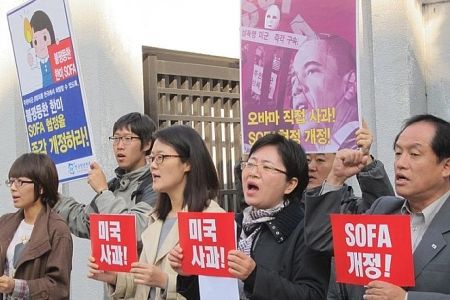
South Korean prosecutors say an American soldier has been charged with raping a South Korean teenager at her residence in the capital Seoul.
Pvt. Kevin Robinson was accused of raping the 18-year-old girl in her rented room in Mapo in the early hours of the morning on September 17, Yonhap news agency reported.
The 21-year-old private allegedly broke into the girl’s room while she was sleeping and sexually assaulted her before leaving with her laptop computer.
US 8th Army spokesman Col. Andrew Mutter said the suspect was transferred to the custody of South Korean authorities.
The soldier has reportedly denied the charges, but prosecutors said they have secured DNA evidence of the rape.
Last month, another soldier was convicted and sentenced to 10 years in prison for brutally raping a 17-year-old South Korean girl.
About 28,000 US troops are stationed in South Korea. Crimes committed by US troops based in the South are a sensitive subject.
Several major anti-US demonstrations have been held in the country to protest the presence of American troops in South Korea.
Israeli Settlers Break Into Military Zone By Jordanian Border
By Saed Bannoura | IMEMC News | December 13, 2011
Extremist right-wing Israeli settlers broke into a closed-off military zone in between the West Bank and the Jordanian border, at the site thought to be where Jesus was baptized.
On Monday, right-wing Israeli protesters barricaded themselves in buildings at the site of the baptism of Jesus at the Jordan River, which is a holy site for Christians around the world.
They hung banners with photos of the right-wing Jewish leader Ze’ev Jabotinsky, who called for the “Jewish state to expand beyond the Jordan River into the state of Jordan and all the way to Iraq.”
The protesters say they are sending a message to the Jordanian government to stay out of Israeli affairs. This is a reference to the statement made by Jordan’s King Abdullah Monday that he hoped Israel would choose not to demolish a bridge in Jerusalem.
The bridge in question is an historic structure that leads to the al-Aqsa mosque, which is the third holiest site in the world for Muslims. Israeli authorities closed the bridge on Friday, sparking outrage among Muslims around the world.
The attack occurred at the Jordan River, on a closed military zone separating the West Bank and the Jordanian border, and both Jordanian Authorities and the Israeli Army have stated that the Israelis did not cross the border, but were approximately only a few hundred metres away.
Those protesters in question were from a group known as the ‘Hilltop Youth’, numbered around thirty, and were quickly removed from the area by the Israeli army and police.
In a separate incident, around fifty Settlers invaded the Efraim Regional Brigades military barracks near Qalqilia, setting several fires, throwing molotov cocktails and stones, which led to damage to buildings and vehicles.
Over a hundred settlers also attacked the Brigade Commanders car, and threw stones at passing Palestinian cars, on the main road near the settlement of Ramat Gilad.
The string of attacks comes as tension mounts over the impending dismantlement of numerous illegal outposts within the West Bank by the Israeli authorities.
Israeli SodaStream: Maybe Green, Definitely Not Clean
By Theresa Wolfwood | Palestine Chronicle | December 10, 2011
It seems like a great idea – to buy a counter top device that converts tap water into sparkling fizzy water. Add a line of 100 flavours of sweet syrups; in the words of the sales clerk I spoke to, ‘it’s a fun thing.’
SodaStream (sometimes marketed as Soda Club) is sold around the world including in my city, often by big chain stores like Costco, Kmart and Amazon (USA); Sears, The Bay, and Home Outfitters (Canada); Tesco, Asda and Argos (UK); Migros (a large coop network in Switzerland); Carrefour (France & other countries); Edeka, Adler, and Karstadt, (in Germany where it is distributed by Brita, the international water filter company. Brita products are sold in Israel by SodaStream.)
The world’s largest producer of home carbonation systems, sold in 41 countries, SodaStream claims to be environmentally friendly because it uses its own reusable bottles, saving the production and transport of millions of disposable plastic containers and saving money and time for consumers. As some of the syrups use natural products, while others use sugar and artificial sweeteners, it is promoted also as “healthy” in natural food, eco-friendly, green and biological shops.
It sounds too good to be true – and so it is.
These products are labelled “Made in Israel”, the company claims to have factories elsewhere including China. An examination of the corporate annual report reveals that only some parts are made in China. (SodaStream International Ltd.; Annual report,” 30 June 2011).
SodaStream is owned by Soda-Club, an Israeli company founded in 1991 by Peter Wiseburgh and publicly traded on NASDAQ as SodaStream International under the symbol SODA with 2009 revenues of USA$ 142,842,000.
However, the products are not made in Israel at all.
SodaStream is manufactured in Mishor Adumin, (also known as Mishor Edomin) one of 171 illegal settlements within Palestine. Mishor Adumin is about 20 kilometres east of Jerusalem in a strategic area of illegal settlements designed to cut off Palestinians’ right of free movement between the northern and southern areas of the West Bank. Syrups are produced in another settlement, Ashkelon. (The device uses disposable carbon dioxide cartridges which are made in Germany and other countries.)
“These products are fraudulently labelled as “Made in Israel”, but are in fact produced in illegal settlements under the conditions of the military occupation in the West Bank, outside the internationally-recognized borders of Israel.” http://www.bdsmovement.net/2011
Environmentally-friendly? Think of the Palestinian residents and farmers of Mishor Adumin whose homes, fields, orchards and forests were destroyed to create this industrial settlement and the neighbouring residential settlement of Ma’aleh Adumim which today ranks third in population of all Israeli settlements in the West Bank. Over 1.5 million trees have been destroyed in Palestine by the occupiers as they insinuate their homes and factories into Palestinian land. More than 300,000 Palestinians are homeless as a result of home demolitions in Palestine.
The environmental destruction continues. When I was in Palestine I witnessed fields, orchards and homes being bulldozed and leveled, preparing for the continuation of the wall and the construction of an Israeli-only super highway linking all the settlements around Jerusalem, including Ma’aleh Adumim and Mishor Adumin.
So how can SodaStream be green?
There is nothing clean about the production of this ‘fun’ product, either. Many of the workers in SodaStream factory are Palestinians, desperate for any kind of job. Independent research has revealed that workers are poorly paid, sometimes below the minimum wage, are threatened with job loss (in any Israeli-owned facility) if they complain about bad working condition, job insecurity or low wages. They are the occupied subjects of military rule, lacking legal rights, including the right to organize. (For more details, see here)
SodaStream has also been accused of fraud. The European Union grants certain tax benefits to Israeli goods imported into Europe, but that does not include goods produced in occupied territories. In 2010 the European Court of Justice ruled that its products manufactured in Israeli-occupied territories were not subject to the preferential import duty treatment as goods manufactured within Israel. In Germany shipments of these products have been stopped by customs because they are not labelled truthfully.
Resolutions #242 & #338 of the UN Security Council include statements that prohibit permanent settlement of occupied lands for domestic or commercial purposes; Israel continues to rob Palestine of land, resources and access. Article 49 of the Fourth Geneva Convention of 1949 also states that, “The Occupying Power shall not deport or transfer parts of its own civilian population into the territory it occupies.”
The Boycott, Divestment and Sanctions Movement, founded by 180 civil organizations in Palestine, has spread around the world. Solidarity groups everywhere are chalking up successes in consumer products and institutional investments, including national pension plans. (See: BDS: BOYCOTT, DIVESTMENT, SANCTIONS: The Global Struggle for Palestinian Rights. 2011. Haymarket Books, USA by Omar Barghouti)
Meanwhile SodaStream claims with much publicity to have sold one million of its devices in socially-responsible Sweden. But in July, 2011 the Coop (Cooperative Stores Network) announced it would stop selling SodaStream products because they are made in occupied territory and their sale was in conflict with Coop’s own ethical standard as well as Global Compact, the UN ethical guidelines for businesses. In Belgium as well as other European countries BDS campaigners actively protest against the sale of SodaStream.
USA and Canada both have a Free Trade Agreement with Israel. That means, as in the European Union, certain taxes are not levied on partners. By allowing SodaStream to sell its fraudulently labelled “Made in Israel” products, illegally produced under military occupation, as free trade products, the company receives financial concessions under Free Trade agreements.
Boycotts are powerful tools for our international campaigns for human rights. Ahava Cosmetic Products are also made in an illegal settlement, Mitzpe Shalem, near the Dead Sea; they are no longer sold in major outlets in Canada and USA after boycott actions. As law respecting citizens we have a responsibility to stop the illegal sale of another luxury product with dubious health or environmental benefits, made under conditions that violate the human rights of workers and all Palestinians.
Boycott SodaStream!
– Theresa Wolfwood is a writer and activist in Victoria, BC, Canada. She visited Palestine in 2010 and Belgium in 2011.
UN Renews Demand that Israel Comply with Resolutions Related to Occupied Golan
SANA | December 10, 2011
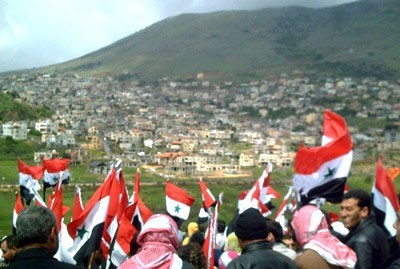
NEW YORK – The UN renewed its demand that Israeli authorities comply with international legitimacy resolutions, particularly the Security Council Resolution No. 497 for 1981 which considers Israel’s decision to impose its laws, jurisdiction and administration on the occupied Syrian Golan as null and void and without international legal effect.
The UN demand came on Saturday during the adoption of a draft resolution entitled ‘the Occupied Syrian Golan’ by the UN General Assembly.
The resolution demanded that Israel immediately rescind its decision to annex the Golan, considering all the legislative and administrative measures and procedures which Israel took and will take to change the character of the occupied Golan as null and void and a flagrant violation of the international law and the Geneva Convention related to the Protection of Civilians in time of war without any legal effect.
Israel is also demanded to stop imposing the Israeli nationality and the Israeli ID cards on the Syrian citizens in the occupied Golan and to halt its suppressive measures taken against the Syrian people in the Golan.
The resolution denounced the Israeli violations of the Geneva Convention relative to the Protection of Civilian Persons in Time of War, renewing call upon the UN member states not to recognize any of the measures and procedures inconsistent with the international law Israel has taken in the occupied Golan.
163 countries voted in favor of the resolution, while only Israel voted against it and the US, Canada and 9 other countries abstained.
The UN General Assembly’s ‘Fourth Committee’, the Special Political and Decolonization Committee, had adopted the resolution in November and submitted it to the General Assembly for vote.
UN General Assembly Passes Nine Resolutions On Israel-Palestine
By Saed Bannoura | IMEMC News | December 10, 2011
On Friday, the United Nations General Assembly passed nine resolutions related to Palestine as part of a set of 24 resolutions and two texts related to human rights and decolonization.
The resolutions were passed by the General Assembly after the recommendation of the Special Political and Decolonization Committee. Several of the resolutions were passed almost unanimously, with only Israel voting against them.
Among these were a resolution that called for an accelerated return of displaced persons who became refugees in 1967, and called on donor countries to assist the United Nations Relief and Works Agency for Palestinian Refugees (UNRWA) in meeting the needs of the Palestinian refugees. This resolution was passed by a vote of 160 in favor to 1 opposed (Israel), with 9 abstentions.
Another resolution urged Israel to reimburse UNRWA for all transit charges incurred and other financial losses sustained as a result of delays and restrictions on movement and access, and to cease obstructing the movement and access of the staff, vehicles and supplies of the Agency. That resolution passed with a vote of 163 in favour to 7 against (Israel, Canada, Federated States of Micronesia, Marshall Islands, Nauru, Palau, United States), with 2 abstentions (Cameroon, Vanuatu).
Of the other Israel-Palestine related resolutions passed by the United Nations General Assembly on Friday, five were part of the report from the Special Committee to Investigate Israeli Practices Affecting the Human Rights of the Palestinian People and Other Arabs of the Occupied Territories, and related to Israel’s practices and obligations as an Occupying Power under the Fourth Geneva Convention.
One of these resolutions demanded that Israel accept the de jure (by law) applicability of the Convention in the Occupied Palestinian Territory, including East Jerusalem, and other Arab territories occupied by Israel since 1967, and that it comply scrupulously with the provisions of the Convention. The text was approved by a recorded vote of 162 in favour to 7 against (Israel, Canada, Federated States of Micronesia, Marshall Islands, Nauru, Palau, United States), with 3 abstentions (Cameroon, Côte d’Ivoire, Vanuatu).
In another of the five resolutions originating from the special committee, the Assembly, bearing in mind the “extremely detrimental” impact of Israeli settlement policies, decisions and activities on efforts to resume and advance the peace process, reiterated its demand for the immediate and complete cessation of all Israeli settlement activities in all of the Occupied Palestinian Territory, including East Jerusalem, and in the occupied Syrian Golan.
It was adopted by a recorded vote of 162 in favour to 7 against (Canada, Federated States of Micronesia, Israel, Marshall islands, Nauru, Palau, United States), with 4 abstentions (Cameroon, Côte d’Ivoire, Panama, Vanuatu).
Since the recommendation that Palestine be split in half to create a Jewish state in 1947, the United Nations has passed hundreds of resolutions on the issue of Israel-Palestine, all of which have been voted against by the Israeli UN delegate. These resolutions have repeatedly called on Israel to adhere to its obligations under international law and the Fourth Geneva Convention. But the UN General Assembly has no enforcement capability to ensure that its resolutions are carried out.
The Palestinian Authority attempted in September to achieve recognition as a state at the United Nations, to be able to participate in proceedings at the General Assembly, but that petition was not approved by the United Nations Security Council.
UN Committee Demands Israel Stops House Demolitions Forthwith
Israeli Committee Against House Demolitions | December 6th, 2011

The UN Committee on Economic, Social and Cultural Rights, published its concluding observations earlier this week, calling Israel to stop forthwith house demolitions, forced eviction and residency revocation in the Occupied Palestinian Territory and East Jerusalem. After considering the state report by Israel on compliance with the International Covenant on Economic, Social and Cultural Rights, and the ICAHD parallel report (found here…) the Committee recommended Israel reviews and reforms its policies, to align with recommendations made by ICAHD and partner human rights and peace organizations.
ICAHD Co-Director Itay Epshtain addressed the Committee and highlighted the propagated ethnic displacement of Palestinians in the Occupied Territory and within Israel proper, and turned the Committee members’ attention to politically driven displacement trends in East Jerusalem, Jerusalem periphery and the Jordan Valley. To listen to the statement, press here…
The Committee was also presented with findings of the recent ICAHD publication ‘No Home, No Homeland: A New Normative Framework for Examining the Practice of Administrative Home Demolitions in East Jerusalem’ (found here…) in a side event held by ICAHD in conjunction with Al-Haq, Adalah, and Be’tselem.
The Committee adopted the following concluding observations:
The Committee is concerned about the revocation of residency permits of Palestinians living in East Jerusalem, which results in the loss, among other things, of their right to social security, including access to social services (art.9). The Committee calls upon the State party to put a stop to the revocation of residency permits of Palestinians living in East Jerusalem. The Committee urges the State party not to hinder the enjoyment of their right to social security, including access to social services.
The Committee is deeply concerned about home demolitions and forced evictions in the West Bank, in particular Area C, as well as in East Jerusalem, by Israeli authorities, military personnel and settlers (art.11). The Committee urges the State party to stop forthwith home demolitions as reprisals and ensure that evictions in Area C are in conformity with the duty (a) to explore all possible alternatives prior to evictions; (b) to consult with the affected persons; and (c) to provide effective remedies to those affected by forced evictions carried out by the State party’s military. The Committee recommends that the State party ensure that the development of special outline plans and closed military zones are preceded by consultations with affected Palestinian communities. The Committee also recommends that the State party review and reform its housing policy and the issuance of construction permits in East Jerusalem, in order to prevent demolitions and forced evictions and ensure the legality of construction in those areas.
The Committee is concerned that Palestinians living in the OPT do not have access to sufficient and safe drinking water and adequate sanitation. It is also concerned about the continuing destruction of the water infrastructure in Gaza and in the West Bank, including in the Jordan Valley, under military and settler operations since 1967. (art.11). The Committee urges the State party to take measures to ensure the availability of sufficient and safe drinking water and adequate sanitation for Palestinians living in the OPT, including through the facilitation of the entry of necessary materials to rebuild the water and sanitation systems in Gaza. The Committee urges the State party to take urgent steps to facilitate the restoration of the water infrastructure of the West Bank including in the Jordan Valley, affected by the destruction of the local civilians’ wells, roof water tanks, and other water and irrigation facilities under military and settler operations since 1967.
The Committee on Economic, Social and Cultural Rights concluding observations in their entirety can be found here…
At the time of the release of the Committee’s observations, Israel continued demolishing homes in East Jerusalem and Area C of the West Bank in defiance of international law. Yesterday (December 5th) a house and an animal pen were demolished in Wadi Asoul (Silwan, East Jerusalem), two homes were demolished in Beit Hanina, and this morning three homes were demolished in Al Khalayleh (Area C, West Bank).
Settler “professor” top attraction at EU-Israel science show
By David Cronin – The Electronic Intifada – 12/06/2011
A weapons inventor representing an illegal Israeli settlement will participate in an EU-sponsored conference on scientific research later this week.
Yitzhak Ben-Israel, a retired major-general, is among the speakers listed on the programme for Thursday’s event on “technology terrorism” in Brussels. He is a member of the board of trustees in Ariel University, which is located on occupied land in the West Bank. His resumé also states that he has headed the research divisions of both the Israeli military and its Ministry of Defense.
Although Israel is an active participant in the EU’s science programme, the Union says that firms and universities based in the settlements are not eligible for the programme’s research grants. So I asked the European Commission if it had any difficulties with Ben-Israel’s role in this week’s event, considering his links to Ariel. “To the best of our knowledge, Mr Ben-Israel does not have any direct role in the [‘technology terrorism’] project, apart from being a speaker at the workshop,” Carlo Corazza, a Commission spokesman, replied.
That lame response cannot be allowed to conceal how the EU is ingratiating itself with Israel’s military and political elite. Ben-Israel is regarded as an important strategist on “defense” issues and has received several awards for his work. He has been credited with developing a “C4 system” (to help commanders manage a range of operations) for the Israeli military, as well as Nautilus, a laser system designed to counteract the crude rockets that Hamas and other resistance groups have fired from Gaza and that Hezbollah have fired from Lebanon. Furthermore, he has served on the board of directors for Israel Aerospace Industries, a maker of warplanes used to slaughter Gaza civilians during Operation Cast Lead in 2008 and 2009. And I almost forgot to add that he has been a member of the Knesset, Israel’s parliament, for Kadima, the party set up by that mass murderer Ariel Sharon.
Selective focus on violence
Thursday’s event marks the culmination of a €1 million ($1.3 million) project called FESTOS (Foresight of Evolving Security Threats Posed by Emerging Technologies). While most of the money for FESTOS comes from the EU taxpayer, the project is being coordinated by Yair Sharan from Tel Aviv University.
In a newsletter published in February, Sharan said the aim of the project is to assess how “terrorists” are availing of technology and to recommend what policy measures should be taken in response. “New technological horizons are opened to individuals and groups who are ready to abuse technology to accomplish their evil purposes,” he wrote.
It is probably superfluous to add that the project is highly selective. It only examines violence perpetrated in response to oppression and not the routine violence of oppressor states like Israel.
Corazzo tried to justify the project by saying that “FESTOS is not about developing weapons.” He added that developing weapons is not allowed by the EU’s scientific research activities as they belong to a “civilian programme.”
Don’t be fooled by that assurance. No matter what EU officials say, the Union is helping to nurture a “security” industry in Israel that is inseparable from that country’s military and its crimes against humanity.
Last week The Financial Times published a feature about Israel’s technology prowess. It was a piece of thinly-veiled propaganda by the paper’s correspondent Tobias Buck, yet it nonetheless underscored how many of the big shots in Israel’s technology sector were trained in Unit 8200, an electronic espionage division of the Israeli military.
Israel is taking part in 800 EU research projects at the moment, with a total value of €4.3 billion. As a European taxpayer, I don’t recall ever being asked for permission to fund a war machine that is an affront to everything I believe in.
Featured Video

EUROPE FEARS RUSSIA’S NEXT MOVE / Ian Proud
or go to
Aletho News Archives – Video-Images
New Book
New Book: No Autoimmunity The Body Doesn’t Attack Itself
Lies are Unbekoming | September 24, 2026
 The label for Humira, once the best-selling drug in the world, lists its risks in plain print. One of them, in the label’s own words, is new “autoimmune” disease.
A drug prescribed for a condition labelled autoimmune carries a warning that it can cause a condition labelled autoimmune. That contradiction sits in every box, on a folded paper almost nobody reads.
My new book starts there.
No Autoimmunity: The Body Doesn’t Attack Itself
For seventy years, “your body is attacking itself, and we don’t know why” has ended the conversation for people diagnosed with multiple sclerosis, lupus, rheumatoid arthritis, Hashimoto’s, Type 1 diabetes, Crohn’s and psoriasis. More than eighty conditions now carry the autoimmune label. The diagnosis comes with a prescription for life. It almost never comes with a question about cause.
This book asks the question and answers it from the framework’s own records: its drug labels, its journals, its regulatory filings, and its own experiments. … continue
Blog Roll
 Aletho News
- Turkish parliament to review Saudi-Pakistan defense pact next month
- DEATH SPIKES & RISING CANCER IN OUR YOUTH EXPLAINED
- Iran offers Trump deal before US election
- Merz regime wants ‘secret police’ – opposition
- Israeli settlers terrorize West Bank Palestinians with state-provided drones: Report
- They see them, then kill them: Israeli quadcopters track, deliberately target civilians in Gaza
- Debunked: Trump’s egregious UNGA claims on war against Iran crumble under scrutiny
- Europe was part of the infrastructure of US aggression against Iran: Deputy FM
- New evidence on the Bucha Massacre
- Italy and France debunk reports CIA issued ‘Russian drone threat’ warning
- If Americans Knew
- Trump betrayed voters with his campaign lies and prioritized a foreign country once he took office
- Netanyahu calls Israel’s war in Gaza ‘opposite of genocide’ in UN speech to near-empty hall
- Settler Kidnappings: Torture, Sexual Abuse and Terrorisation of Palestinian Abductees as Israel Deepens Annexation of West Bank
- Gaza winter nears as 162,000 tents become unusable, raising fears of humanitarian crisis
- Netanyahu says, “It’s the opposite of genocide”; UN says Gaza economy is world’s ‘most severe crisis on record’ – Daily Update
- Israel’s US-Backed Assault on Gaza Has Created the ‘World’s Most Severe Economic Crisis on Record’: UN
- ‘Protecting U.S. Citizens’… From Israel
- ‘This is where I live now, the back of a truck’: a day in the life of a grandmother in Gaza
- In UN Speech, Iran’s President Displays Pictures of Children Killed by US, Brings Attention to Israel’s Nuclear Arsenal
- Israel displaces hundreds of Palestinians amid wave of demolitions in West Bank
- No Tricks Zone
- New Study: Earth And Venus Surface Warmth Largely Explained By Convection And Lapse Rate, Not CO2 Or Radiation
- 2025 Nature Paper Claiming Worsening Global Drought Gets RETRACTED …Heavily Flawed
- New Study: ‘Global Drought Shows No Detectable Recent Acceleration Under Climate Warming’
- Economic Masterminds: German Socialists Suggest Taxing Productivity Gains Stemming From Using AI
- The South China Sea Has Not Been Cooperating With The Climate Change Narrative
- Energy Crisis: Germany Enters Heating Season With Historically Low Gas Reserve Fill Levels
- New Study: The Antarctic Ice Sheet Gained Mass From 2020-2024 Due To Staggering Snow And Ice Accumulation
- Study: Ocean Heating Rates From Thousands Of Years Ago ‘Dwarf’ Modern Ocean Heating Rates
- Climate Extremists Target, Attack Large-Scale Power Grid Infrastructure In Germany!
- New Study: Antarctic Ice Melt Has Contributed Less Than 1 Centimeter To Sea Level Rise In The Last 30 Years

