Charges against Gazan engineer show strip is still occupied
Dirar Abu Sisi was kidnapped by Israeli agents in Ukraine. He is charged with developing rockets, missiles and mortar shells for Hamas
Yossi Gurvitz | +972 | April 5 2011
Israel has kidnapped, apparently with the Ukrainian authorities turning a blind eye, a Gazan engineer named Dirar Abu Sisi. He was detained for several weeks under the usual schtick of a double gag order: one gag order preventing making public the fact that he is held, another denying the public the right to know there is a gag order. This buys the GSS (Internal Security Service) precious torture time, and allows him to present the prisoner to the press after he has confessed, which is as it likes it. Yesterday, the veil of secrecy was lifted as Abu Sisi was indicted, confessions and all. His lawyers say they have been tortured out of him, which is a reasonable claim.
The GSS claims Abu Sisi provided Hamas with weapons technology and developed rockets, missiles and mortar shells for it. Which is where it all turns to farce. Abu Sisi, who is not an Israeli citizen, is charged with violations of Israeli law, which has no standing either in the Gaza Strip or in Ukraine, where he was kidnapped. Specifically (Hebrew), the charges are: Membership in a terror organization (residing outside the borders of Israel), contact with a foreign agent (again, this law is invalid in Gaza), conspiracy to commit crimes (likewise), an attempted murder (likewise), and manufacturing of arms.
The last charge is particularly twisted. As far as the Israeli authorities are concerned, the manufacture of any weapon – including the anti-tank rockets Abu Sisi allegedly developed – is a felony. In the hugely asymmetrical armed struggle between the Israelis and the Palestinians, a Palestinian who produces weapons is ipso facto a criminal.
Once again, Israel plays at its favorite double game: When it wants to, the struggle with the Palestinians is a war, which allows it to use the laws of war; when the mood fits her, it is crime suppression. Enemy fighters are never considered to be soldiers, when they are caught; they are always criminals. They don’t get the protections enjoyed by soldiers, even if all they did was resist the Israeli army, but are tried as common criminals. So, on the one hand Israel holds the West Bank under “wartime powers”; on the other hand, anyone objecting to this military occupation is a felon = according to Israeli law, which has no validity in the territories.
The injustice in Abu Sisi’s case is particularly striking: Israel, after all, keeps claiming she does not control the Gaza Strip any longer. And yet, it dares to try a Gazan according to Israeli law, something it did not do when it occupied the place (then, Palestinians were subject to military law). Abu Sisi’s kidnapping highlights the fact that the Israeli occupation in the Strip did not end; it was just mutated.
The kidnapping also sheds an unusually ironic light on one of Israel’s regular claims: That courts in other countries are disbarred from extending their jurisdiction to visiting IDF gunmen. Israel itself, of course, thinks it has precisely this right, and that it extends not just to visitors but to people it brought over by force.
These contradictions are simply not seen by most Israelis. They consider Israel to be the eternal victim, and hence as a country to whom normal rules do not apply. Later, they are puzzled – if they stop at that station at all, before arriving at their final destination of whiny victimhood – when the rest of the world considers Israel to be the neighbourhood bully.
Israel targets international activists in Bil’in raid
Ma’an – 04/04/2011
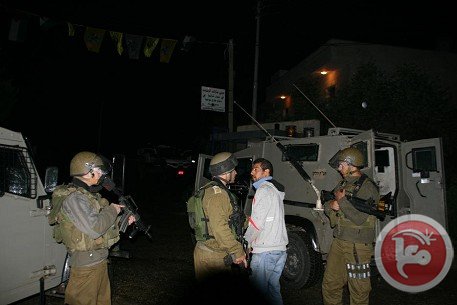
RAMALLAH — Israeli forces entered the central West Bank village of Bil’in on Monday morning, searching homes and harassing residents, reportedly in search of international solidarity activists who often remain in the area to document rights violations.
A spokesperson for the local popular committee said the raid began at 1:30 a.m. and lasted approximately an hour. The official said the homes of village residents Ali Birnat and Khamis Abu Rahma were targeted and searched.
Local committee members attempting to document the raid were prevented from accessing the scene of the searches.
An Israeli military spokeswoman did not immediately return calls seeking comment.
A statement from the Popular Struggle Coordination Committee said Abu Rahma was questioned about who was residing in his house, noting soldiers were “interested in internationals, although they could not find any,” noting that soldiers and police searched Abu Rahma’s home and garden, including the garbage and inside cars located nearby.
Groups of solidarity activists have for the past year stayed frequently in the village, which hosts the longest running weekly protest against Israel’s separation wall.
The prominent popular committee in the village has organized a yearly conference on popular non-violent resistance, and gained international support for its initiatives.
Since the early years of the protests, international solidarity activists have joined the demonstrations in an effort to mitigate the use of violence against the villagers. The use of high-velocity tear-gas canisters have caused death and injury to residents, and solidarity activists say an international presence witnessing and documenting the action often reduces the use of force.
Once activists left the village at the close of the protests, particularly during 2009 and 2010, Israeli forces would enter and detain teens they said were throwing stones at the soldiers, and later targeted protest leaders for detentions.
Activists began staying overnight in the village to document the night raids they said were being used to intimidate villagers, who have also launched court actions against the confiscation of land by Israel’s separation wall.
Sixty percent of the village lands now stand on the far side of the wall, and are largely inaccessible but for a gate that opens periodically allowing farmers to tend crops, without the use of heavy machinery or equipment.
‘US Boat to Gaza’ organizers respond to Netanyahu charges against flotilla
By Jane Hirschmann and Richard Levy | Mondoweiss | April 2, 2011
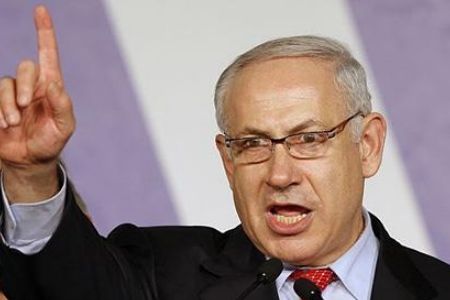
Israeli Prime Minister Benjamin Netanyahu recently met with UN Secretary-General Ban Ki-moon to ask for UN assistance to stop the planned flotilla scheduled to break the Gaza blockade in late May, 2011.
He argued to the UN Secretary General that the flotilla is a conglomerate of “extreme Islamists that are interested only in provocation” and hell bent on the destruction of Israel. Nothing could be further from the truth. We, who are actively engaged in the U.S. Boat to Gaza, named The Audacity of Hope, are appalled by this flagrant misrepresentation, so typical of right-wing Israeli propaganda. […]
The U.S. flagged ship –and all the ships in the Flotilla– that sails to Gaza in May – will sail in peace and with a single nonviolent message—“The people of Gaza are entitled to the same life, liberty and pursuit of happiness that are the right of every human being.”
Ban Ki-moon should remind Benjamin Netanyahu that Israel’s occupation of the West Bank, siege of Gaza, expansion of settlements, destruction of homes, usurpation of water and air rights, walls of confinement , brutal military presence, and daily sniper attacks on innocent civilians constitute the paramount violence and terrorism in the Mideast, conduct that we all abhor. The 2nd International Freedom Flotilla comprised of 22 countries and many boats, heading toward Gaza, including The Audacity of Hope, is not the problem. Israel’s conduct in Palestine is the problem and should be condemned by the UN, the U.S. and all people who care about freedom and justice.
Jane Hirschmann and Richard Levy are volunteers with the US Boat To Gaza.
HEBRON: Settlers attack Palestinian home in Beqa’a Valley
CPTnet | 1 April 2011
On Monday 14 March, fifteen settlers from Harsina Settlement attacked the Jaber home in the Beqa’a Valley, adjacent to Hebron. At the initial attack during the day, the Israeli military stopped the settlers, but they returned at 6:30 p.m. and stoned the house for one hour with no interference by the military.
The Jaber home sits below the settlement of Givat Ha Harsina and houses several families—seventeen people in all, with twelve children. This family has lost most of its land to the Harsina settlement over the years, land for which it has deeds dating back to the time of the Ottoman Empire.
Surrounding homes in the Beqa’a Valley have likewise suffered tremendous pressure from the settlers and Israeli military. Within the last year alone, the Israeli military destroyed thirteen water cisterns in the valley, cut irrigation pipes to the grape vineyards, occupied a home during increased settler activity, allowed the building of at least four more houses in Harsina Settlement during the so called “Settlement Freeze,” and permitted visiting settlers to plant 1000 trees on Palestinian land in this valley.
One of the Jaber brothers who lives across the road from Givat Ha Harsina—now living in his third home after the military destroyed his first two homes—said he was so worried that he wondered whether he should move his family to one of his cousins’ homes for safety. He told CPTers he cannot fall asleep until 1:30 or 2:30 a.m. at night.
For photo coverage of previous acts of destruction in the Beqa’a see http://cpt.org/index.php?q=gallery&g2_itemId=20652
Israeli forces erect more army checkpoints in Nablus
Ma’an – 02/04/2011
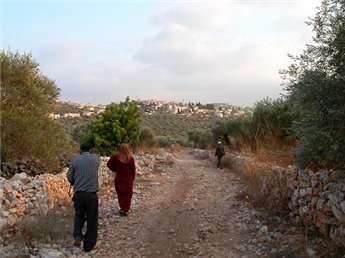
NABLUS — Israeli forces on Saturday erected several military checkpoints on the road to Wadi Qana south of Nablus in the northern West Bank, denying local farmers access to their fields in the area.
Meanwhile, 13 busloads of Israeli settlers from the nearby Alfe Menashe and Qarne Shomron settlements were escorted to the Wadi Qana valley by heavy police and military forces.
The mayor of Deir Istiya, Nathmi Salman, said he was denied access to Wadi Qana at gun point and was told the area was a “closed military zone.”
He said that Palestinian farmers had gathered in a building near Wadi Qana and an Israeli military jeep was stationed there preventing them from leaving.
An Israeli military spokesman said he was not aware of any unusual activity in the area.
Wadi Qana provides the main source of income for many Palestinian farmers, but they have been denied access to their fields by Israeli forces several times before. Meanwhile, extremist settlers frequently attack shepherds and uproot fields in the area.
In 2010, Israeli forces demolished an agricultural project funded by the Palestinian Authority’s Ministry of Finance in Wadi Qana.
Israel lays Gaza-like siege on West Bank village
Nora Barrows-Friedman, The Electronic Intifada, 31 March 2011

An Israeli army watchtower and locked metal gate block the main entrance to Beit Ommar, 29 March 2011. (Nora Barrows-Friedman)
Since 24 March, Israeli forces have sealed the southern occupied West Bank village of Beit Ommar for an indefinite amount of time as soldiers continue to arrest young Palestinian residents and hold them in Israeli detention centers.
In a move akin to the four-year-long economic blockade against the occupied Gaza Strip, Israeli soldiers have closed the six entrances to the village of 17,000 inhabitants and have imposed a widespread prohibition policy against all major imports and exports from the village — including gasoline, produce, raw industrial materials and basic supplies. Ambulances have also been prevented from entering or exiting the village.
The closures and arrests followed a brazen attack by an Israeli settler on a funeral procession on 21 March.
The settler stopped his car on Route 60 (the highway linking Jerusalem with Hebron-area settlements) as the crowd of mourners moved towards the village cemetery, and started firing indiscriminately with live ammunition, injuring two Palestinian men, the Beit Ommar-based Palestine Solidarity Project (PSP) reported.
“The settler who shot the two men was not arrested,” PSP stated (“Two Palestinians Injured as Settler Opens Fire on Funeral Procession in Beit Ommar,” 21 March 2011).
“Israeli forces arrived on the scene and used sound bombs and tear gas to disperse the gathered crowd as medical teams evacuated the wounded,” the report added.
The attack came amidst a widespread spate of settler violence against Palestinians throughout the occupied West Bank including East Jerusalem.
Settler attacks have continued this week. The Palestine News Network reported that Israeli settlers attacked Palestinians in Ramallah, Jenin and Hebron on 30 and 31 March (“Daily Roundup: Settler Attacks in Ramallah, Jenin; Three-year-old Hit by Settler Car; Four Arrested,” 31 March 2011).
Following the settler attack against the funeral procession, Israeli forces closed the main entrance to Beit Ommar, as special forces invaded the village and shot tear gas and rubber-coated steel bullets before arresting three Palestinian residents, PSP reported on 25 March (“Three Beit Ommar Residents Arrested As Israeli Forces Close Village Streets“).
The next day, all six entrances to the village were shut, and continue to remain closed. Beit Ommar residents and international solidarity activists engaged in protests against the closures and collective punishment on 26 March.
On the evening of 27 March, fifteen young Palestinians were arrested and remain in detention at the military base in nearby Gush Etzion settlement. Of those fifteen, seven are under 18 years old. [[The military gave no reason for their arrests and detentions, PSP stated.]]
Hours later, PSP reported, Israeli soldiers “fired tear gas and rubber bullets at villagers attempting to pass the road blocks on foot to board the taxis and buses waiting below. The soldiers refused to let anyone exit Beit Ommar until after their departure roughly an hour and a half later” (“15 Beit Ommar Residents Arrested as Closures, Army Harassment, Continue,” 28 March 2011).
Yousef Abu Maria, coordinator of the Center for Freedom and Justice in Beit Ommar (CFJ), told The Electronic Intifada that the indefinite closures imposed on the village have already created an economic crisis for Beit Ommar’s 17,000 residents during the last week.
“The industrial factories in Beit Ommar are effectively closed,” Abu Maria said. “There haven’t been any imported raw materials from the outside. And the gas station will close soon, because there isn’t enough gas. Essential products are hard to obtain right now in the village.”
Ahmed Oudeh of the PSP and the CFJ told The Electronic Intifada that farmers in the village who depend on exporting their produce to nearby cities and towns are facing a dire financial situation if the closure remains in place. Additionally, pregnant women and people needing medical attention are not able to reach the hospital, as the policy affects ambulance access to and from the village.
The Electronic Intifada witnessed a Palestinian Red Crescent Society ambulance being turned away at the front gate of Beit Ommar, forced by Israeli soldiers to find a rural route out of the village. Oudeh said that it could take up to an hour and a half to get back to the hospital in Hebron.
It is against international law — as outlined in the Fourth Geneva Convention — for the Israeli military to prevent ambulances from accessing or transporting persons needing medical attention.
Abu Maria further explained that schoolteachers working in the village are having difficulties getting to and from Beit Ommar, since the roads are sealed and public buses and taxis are being turned away by the soldiers at the gates.
“Laborers who work in Hebron or nearby in Saffa village are also being directly affected,” Abu Maria added. “They can’t drive their cars out of the village or back inside, and many don’t have enough money to pay for taxi services to and from work. [These policies are] a collective punishment for the people in Beit Ommar.”
Meanwhile, a new section of the Efrat settlement colony on the other side of Route 60 is being built, according to a new map issued by the Israeli military and obtained by the CFJ. Beit Ommar is surrounded by several illegal settlements, parts of the Gush Etzion settlement bloc in the southern West Bank.
Abu Maria said that the Israeli military is planning to erect a fence around the village, and will move the main entrance gate deeper inside Beit Ommar to protect settlers on the road. But the main purpose of the current closures and the fence is to “take more land and expand the settlements,” he said.
Beit Ommar resident Naama Hassan Sleibi, 65, told The Electronic Intifada that she and her husband have been farmers their whole lives but continue to lose their land as the nearby Karmei Tsur settlement expands. “We have empty land with no produce,” she said. “[The expansion of the settlements] is a huge loss for farmers.”
For years, Beit Ommar’s residents have been engaged in unwavering actions of civil disobedience against the encroaching settlements and land confiscation policies. Abu Maria explained that part of Israel’s intention to impose the closures and control movement of the villagers is to break the steadfast resistance inside Beit Ommar.
“In [the nearby village of] Saffa, next to the Bat Ayn settlement, we are planting olive trees,” he said. “The Israeli military said we can’t plant there, but we’re going to keep doing it anyway. They won’t succeed in stopping us.”
As the closures continue to paralyze people’s lives across a broad spectrum, Sleibi said that she’s most worried most about the youth of Beit Ommar. “[The Israeli soldiers] come and arrest young people all the time,” she said.
Sleibi needed to go to the hospital in Hebron several days ago for routine medical needs but was turned back by Israeli soldiers. “We can’t do anything,” she said. “The settler attacked the funeral, but the people of Beit Ommar pay the price.”
Homes destroyed by Israeli Army in Amnyir, South Hebron Hills
29 March 2011 | Christian Peacemaker Teams
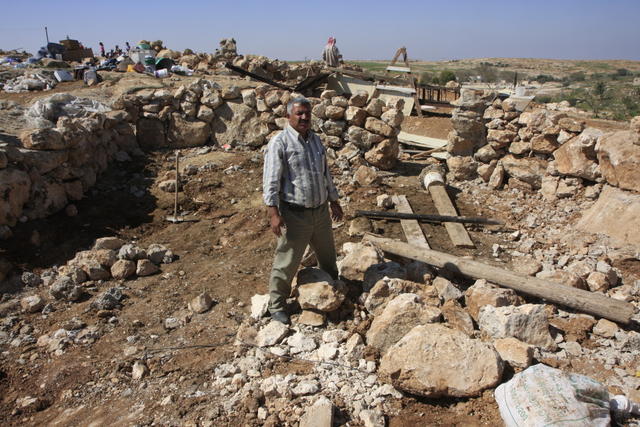
At 7:00 am on the morning of March 29th 2011 the Israeli military demolished the village of Amniyr , destroying seven tent dwellings and confiscating the remains. This is the second time in just over a month that the Israeli army has demolished the village. After the last demolition, villagers built new tent dwellings a few days later with the help of the Israeli human rights group Ta’ayush and the International Red Cross.
Five residents were transported to the hospital with injuries incurred when soldiers forcibly removed residents from their homes. One resident was injured by a blow to his had by the butt of a gun, and four required treatment for inhalation of teargas used by the soldiers.
Israel does not deny that the demolished homes are on private land owned by the village’s Palestinian residents. Israel simply prohibits the residents from constructing any dwellings, cisterns, or structures of any kind, essentially making it “illegal” for these villagers to live on their land.
Immediately after the demolitions were finished, villagers began to reconstruct what they could of the rubble. As residents started gathering stones from a demolished sheep pen, the sounds of an Israeli bulldozer could be heard across the valley as it continued to excavate new construction for the illegal Israeli settlement of Susiya.
Additional photos are available here.
Israel destroys ancient wells near Bethlehem
Ma’an – 27/03/2011
BETHLEHEM — Israeli authorities destroyed ancient water wells and natural reservoirs used by Bedouins southeast of Bethlehem, Palestinian officials said.
A 3,000-cubic-meter well owned by Ali Madghan Rashayida and a 225-cubic meter reservoir belonging to Majid Rashayida were demolished last week, in a move Palestinian Authority officials said was illegal and “an obvious assault by the Israeli occupation.”
International and local human rights groups had been working with PA officials to help the Rashayida Bedouins rehabilitate the area, and use natural caves to collect water for domestic use and for their sheep.
Bringing water tankers to the area had been very costly, and beyond the means of the community.
By demolishing the structures, Israeli authorities deprived the community of the right to file a legal appeal, officials added, noting that the time limit given in the demolition warrants had not yet passed.
Residents of Arab Ar-Rashayida were handed demolition orders for the tents and wells in their enclave of the village during the week of 13 March.
Ali Auda, the head of the family, said if the orders were carried out in full, the family — 50 members in all — would have nowhere else to go.
“It is the farce of the twenty-first century, imagine, an occupying state telling Palestinians they are violating their own land.”
The partial demolition of the community will have an equally devastating effect, officials said, explaining that the Bedouin would not have sufficient water for themselves or their livestock, and would be at high risk during summer months in the desert area.
The UN has noted a sharp increase in Israel’s demolitions of Palestinian structures in the West Bank in 2011.
“Although the Israeli authorities maintain that these demolitions are carried out due to the lack of Israeli-issued permits, the highly restrictive and often discriminatory nature of the planning regime implemented by the same authorities rarely grants Palestinians such permits in Area C, leaving them with no choice but to build ‘illegally,’ or to leave the area,” the agency said February in its monthly report.
“It is difficult to understand the reasoning behind the destruction of basic rain water collection systems, some of them very old, which serve marginalised rural and herder Palestinian communities where water is already scarce and where drought is an ever-present threat,” said Maxwell Gaylard, who heads OCHA in the Palestinian territories.
Gaylard noted that the demolitions were illegal under international law, which prohibits an occupying power from destroying property belonging to individuals or communities except when absolutely required by military operations.
Following Israel’s confiscation of nine water tankers from a community in Khirbet Tana, in Nablus, on March 7, Gaylard said, “if the authorities ultimately responsible for these demolitions could see the devastating impact on vulnerable Palestinian communities, they might reflect upon the inhumanity of their actions.”
Two civilians wounded in new Israeli air raids on Gaza
Palestine Information Center – 24/03/2011
GAZA — Two Palestinian civilians have been wounded Thursday morning during Israeli aerial attacks north of the Gaza Strip.
For its part, Salahuddin Brigades, the armed wing of the popular resistance committees, said one of its fighters miraculously survived an air raid.
Local sources told the Palestinian information center (PIC) that Israeli warplanes launched two raids this morning on a group of civilians east of Beit Lahia district, north of Gaza, which led to the injury of one citizen.
Another civilian was transferred to hospital after a similar raid on an area near Al-Khazndar station in Beit Lahia.
Salahuddin Brigades claimed responsibility for firing three homemade rockets on Karmiya settlement, south of Ashkelon city and one mortar shell on the Israeli military post Abu Safiya.
The firing of rockets and mortar shells at Israeli settlements and military posts near Gaza comes in retaliation to Israel’s military escalation against the Strip.
~
One settler killed and 39 others injured in an explosion in Jerusalem
Palestine Information Center – 23/03/2011
OCCUPIED JERUSALEM — One Israeli settler was killed and 39 others were injured as a result of the explosion that took place on Wednesday evening at a bus station in occupied Jerusalem, according to Israeli occupation sources.
Israeli occupation medical sources said that about half of those injured are in moderate condition.
Yedioth Ahranoth said that the Israeli occupation suspects that the explosion was as a result of a bomb placed in a rubbish bin and detonated by remote control and suspect that Palestinians were behind it.
~
Israeli occupation says retaliatory rocket attacks from Gaza injured settlers
Palestine Information Center – 23/03/2011
OCCUPIED JERUSALEM — The Israel occupation state admitted on Wednesday that 26 Israeli settlers were wounded when two grad rockets landed in the vicinity of Beersheba city in the early morning hours.
The Hebrew radio said the injured settlers were transferred to Soroka hospital for medical treatment.
It described the injuries of three of them as moderate and the others as slight, and noted that all of them are in a state of panic.
Al-Quds Brigades, the armed wing of Islamic Jihad, declared its responsibility for firing two grad rockets at Beersheba in response to the assassination of four of its resistance fighters, and the massacre of children and civilians in Shuja’ia neighborhood.
~
Israeli occupation killed 10 Palestinians and wounded 43 since Sunday
Palestine Information Center – 23/03/2011
GAZA — Israeli occupation forces launched more than 17 airstrikes and fired more than sixty artillery missiles between Sunday 20 March to Wednesday 23 March killing ten Palestinians and wounded 43 others.
Palestinian medical sources in Gaza confirmed these figure and added that the number of martyrs is likely to rise as a number of those wounded are in critical condition.
Adham Abu Selmeyyah, spokesman for the emergency services said in a statement on Wednesday evening that the number of martyrs reached 10, five of them children and the number of wounded is 43 people, 15 of them are children and six of them are women.
He further said that more than sixty bombs were fired and 17 airstrikes were carried out against 30 civilian targets in the Gaza Strip.
Israeli forces detain journalist in Awarta
Ma’an – 22/03/2011

RAMALLAH — Sources at Voice of Palestine Radio told Ma’an that the station’s director of programming was detained by Israeli forces in the village of Awarta, after the village was locked down under a military curfew.
Kamal Sharab’s home was searched during a raid, and soldiers detained him and two of his sons – Fadi, 17, and Ra’fat, 16.
Earlier in the week, Sharab’s brother was also detained, in a round up that saw 40 men and youth from Awarta taken by Israeli forces.
The sources told Ma’an that Israeli forces detained Kamal’s brother a few days ago.
The Palestinian Journalist Syndicate condemned the detention of journalists and called for his immediate release.
Israeli forces re-entered Awarta at sunrise Tuesday, announcing via loudspeaker that the community was under curfew the for a second time this month.
The village had been under a military curfew from March 12-16 as Israeli police, military and intelligence forces searched the area for evidence relating to the murder of five settlers in the adjacent illegal settlement Itamar.
An as yet unknown attacker or attackers stabbed five members of the Fogel family, including two children and a baby. Israeli leaders immediately blamed Palestinian militant groups, and put a total gag order on the investigation for the Israeli press.
A military spokeswoman confirmed that there was a curfew in place, but said she could not disclose how long it would remain on the village. She said the search was in relation on the ongoing investigation into the Itamar murders, and that troops were trying not to disrupt normal life in the village.
Head of the Awarta village council Qays Awwad told Ma’an that a large number of Israeli forces entered the town and set up checkpoints at all of its entrances.
Villagers were told they were prohibited to leave their homes and enter the streets.
“So far, we have not been informed about the motive behind the incursion,” the Awwad said.
The last closure of the village prevented patients in need of medical treatment from getting to hospital. Villagers reported that at least two children suffered bites from sniffer dogs. Teenagers sustained broken bones after attempting to stave off an attack by settlers who marched into the village and threw rocks and bottles at homes.
Although militant groups in the West Bank have denied involvement in the murders, accusations by Israeli officials sparked a string of settler attacks against Palestinian civilians.
On Monday, one settler in the southern West Bank opened fire on a funeral procession in Beit Ummar, injuring one man critically and hospitalizing a second with a gunshot wound to the thigh.
Further south, a settler from the Ma’on outpost stabbed a Palestinian man on a donkey en route to a local clinic for treatment.
Two Palestinians were stabbed earlier in the week as they went to work in the industrial area of the Shilo settlement.
Dozens of acts of vandalism and harassment have also been reported.
‘Isolated Saleh under pressure to quit’
Interview with Zayd al-Isa, a Middle East expert in London
Press TV – March 22, 2011
Democratic protesters in Yemen now seem to be gaining the advantage against a dictator that is losing political and military support. Press TV talks with Zayd al-Isa, a Middle East expert in London on the latest developments in Yemen and about where President Saleh can turn for additional support.
Press TV: How do you see the situation in Yemen? We have Yemeni ambassadors in Europe, the Arab League, the UN and in China all stepping down and calling for the resignation of President Ali Abdullah Saleh. This presumably would leave him more isolated. How much do you think this would pressure Saleh to step down?
Zayd al-Isa: Saleh is becoming increasingly isolated, beleaguered and embattled. Support is waning away from him and he is under unprecedented pressure. The massacre that his forces have perpetrated has piled on the pressure for him to resign and step down. People have hardened their rhetoric ad toughened their language against him. They want him to be ousted and not only that, but to stand trial for crimes committed against unarmed peaceful civilians.
This has followed the massacre by Saudi forces on the people of Bahrain and we can say that Saleh too is following the green light given by the US. Saudi Arabia considers Yemen to be its backyard garden – both Yemen and Bahrain. Americans have given them a license to kill in those two countries.
Saleh’s policy of shooting to kill the protesters has backfired and we are witnessing the backlash from the tribe’s people, which is highly significant because Yemen is a tribal nation. These tribes are now standing against him and most importantly we now see the army, high ranking Generals, pull the rug from under his feet turning against him.
Without warning some of the army’s troops have been ordered on the ground, tanks included, to come to the defense of the innocent people of Yemen.
We have seen support come from the defense minister who has pledged his loyalty and called Saleh a constitutional president. This is all a critical and highly dangerous development that may show divisions within the high ranks of the military, which is something different to what occurred in Egypt, which was stable and united. We also saw a different situation in Tunisia where the army stood firmly against Ben Ali and remained as a stable unit.
The situation in Yemen has deteriorated further with Saleh becoming isolated amid an unprecedented number of diplomats defecting. This highlights the beginning of a new phase where the protesters are gaining the upper hand and the movement is gathering momentum.
This is to the contrary of what Saleh had expected. Protesters have flouted the imposed curfew and numbers have substantially escalated, spreading to all parts of Yemen. Saleh is now in a terrible position and I believe he now has to step down. France has said that the fall of Saleh has become unavoidable. We haven’t heard such noises coming from the US as Saleh is again considered one of the key allies of the US.
I think Saleh depends on three important pillars: the support of the tribes, the support of the US and aid that is allocated to military; and finally the backing and support of the Saudi regime. Saleh has been a loyal and obedient defender of the Saudi Monarchy.
Press TV: Regarding the three pillars of Saleh’s ability to stay in power that you mentioned, President Saleh’s own tribe has called upon him to step down.
Zayd al-Isa: That’s right and support of that tribe is absolutely crucial. Using a policy of divide and conquer he heavily relied on this tribe in the earlier war against the Houthis, which was backed by Saudi Arabia. That tribal support now is waning.
The aid from the US goes to Saleh’s military in order to fight al-Qaeda, which we know the Saudi regime has been a major factor in the supporting and the flourishing of al-Qaeda. Al Qaeda has flourished during those dictatorships and the oppression forced on the people of those countries, in Yemen, and of course in Saudi Arabia, which is the mother of all dictatorships.
Press TV: Let’s talk about the support of Saudi Arabia for Saleh – Do you think there will be Saudi troops deployed to Yemen as they were deployed to Bahrain?
Zayd al-Isa: I wouldn’t call it a deployment of forces. What you have in Bahrain is a clear cut occupation; an outright invasion of a sovereign country.
Yemen though is a huge massive country with a very difficult terrain. And we’ve seen Saudi Arabia actually try to invade Yemen before to impose its own will on the Houthis and to actually commit genocide against them; committing crimes against humanity and ethnic cleansing against them. They used their superior military ground forces and supremacy in the air – advanced equipment supplied to them by the US.
They picked on the Houthis, a simple militia and now we see them once again taking on a tiny country (Bahrain) which is ruled by a ruthless dictator the so-called king of Bahrain who is no king (by definition). He was never elected and has subjected his people to intolerable discrimination. He has tried to change the makeup of the country by luring thousands of mercenaries giving them citizenship if they commit crimes against his own people.
Saudi now has its trigger happy forces inside Bahrain to quash the revolutionary forces of democracy also and with utter silence from the US. The US has condemned the situation in Bahrain, but has not lifted a finger to help prevent the occupation of Bahrain. We can see through this discussion that what they have done in Bahrain they cannot duplicate in Yemen.
Press TV: We have reports that Houthi fighters are now in control of Yemen’s Northern provinces. This raises a question of – What are the chances of Yemen falling into a civil war?
Zayd al-Isa: The situation is incredibly volatile and there are so many tribes. And what makes it even more dangerous is the division (potential) between the army generals and this could lead to civil war unless the army sits down and unites, that is, a united front against Saleh. He has the loyalty of the Defense Minister, but I do believe that Saleh is running out of allies and supporters; he is relying now on the backing and support of Saudi Arabia. That’s why he has sent his foreign minister to Saudi Arabia to get whole hearted support and the king of Saudi Arabia has emphatically supported the dictators in the region. He gave shelter to Ben Ali to live in his country and he tried to influence Egypt into allowing Mubarak to remain in power and oversee a transition. They have been the bastion of dictatorship.
Israeli occupation authority decides to change curriculum in Arab schools
Palestine Information Center – 18/03/2011

OCCUPIED JERUSALEM — Al-Maqdese for Society Development (MSD) oganization warned that the Israeli occupation authority (IOA) took significant steps ”to take control over Arab schools and supervise the educational curriculum” in occupied Jerusalem schools.
It said the move was aimed at “Judaizing and Israelizing” the holy city of Jerusalem.
The education department in Israel’s Jerusalem municipality has recently begun implementing a new decision stating that all schools that receive allowances from it must exclusively purchase books published by the municipality, MSD reported on Thursday.
It “means that the national Palestinian curriculum currently used will be cancelled and replaced with Israeli ones, which erases the Palestinian and Arab identity from the minds of students,” MSD said.
”The decision enables Israeli authorities to supervise programs and funding, control the activities and intervene in the affairs of Arab schools in east Jerusalem,” it added.
MSD said the decision would affect at least 60 percent of Arab schools in Jerusalem.
MSD receives donations from the European union, the UN and other European rights organizations.
Featured Video

AIDS Inc. by Gary Null (2007)
or go to
Aletho News Archives – Video-Images
From the Archives
Clash of Civilization, Iran Part II
By Jamal Kanj – Intifada-Palestine.com – January 14, 2011
Israel’s survival kit is: perpetuate conflict, insecurity to rationalize collective hate and finally playing victim.
Devoid of conflict, Israel implodes internally; without hate, Zionism loses its justification; and playing eternal victim to continue blackmailing the West. Absence of this holy trinity, Israel ceases to exist.
From its inception, the house of Zion has mastered exploiting adversarial powers to advance Israel’s cause. For instance, their influence over the Democratic Party in the US began with President Truman’s bid for 2nd term election in 1948.
Responding to strong opposition from Secretary of State General George Marshall and Department experts urging against recognition of Israel, President Truman replied: “I’m sorry gentlemen but I have to answer to hundreds of thousands [Jewish voters] who are anxious for the success of Zionism. I do not have hundreds of thousands of [voting] Arabs among my constituents”
Zionists influence over liberal American politics was matched with the doctrinal school of Conservative theoreticians aligning the Republican Party’s platform with Israel’s objectives. The Neoconservative Zionists, coined Zioncons, invented the “Clash of Civilization” concept to fight Israel’s wars. … continue
Blog Roll
 Aletho News
- Merck Virologists Admitted to Falsely Certifying Vaccine Efficacy
- Mandatory Folic Acid for every man, woman & child
- Pro-Palestine protesters arrested outside UK’s ruling Labour Conference in Liverpool
- Mauritius denies landing permit to flight from Israel, forcing cancellation: Tour operator
- Israeli finance minister calls for genocidal war on West Bank, annexation of south Lebanon
- 12 Things Your Psychiatrist Was Trained Not to Tell You
- From Unipolar Universalism to Multipolar Civilizational Distinctiveness
- RSF military group defects, joins Sudanese army: State media
- Ireland goalkeeper refuses to play ‘Israel’ as squad weighs boycott
- China pushes back against US on Cuba, Iran
- If Americans Knew
- Israel forces Gazans to live in constant peril – Daily Update
- Deconstructing Netanyahu’s pants-on-fire UN rant – Daily Update
- Trump betrayed voters with his campaign lies and prioritized a foreign country once he took office
- Netanyahu calls Israel’s war in Gaza ‘opposite of genocide’ in UN speech to near-empty hall
- Settler Kidnappings: Torture, Sexual Abuse and Terrorisation of Palestinian Abductees as Israel Deepens Annexation of West Bank
- Gaza winter nears as 162,000 tents become unusable, raising fears of humanitarian crisis
- Netanyahu says, “It’s the opposite of genocide”; UN says Gaza economy is world’s ‘most severe crisis on record’ – Daily Update
- Israel’s US-Backed Assault on Gaza Has Created the ‘World’s Most Severe Economic Crisis on Record’: UN
- ‘Protecting U.S. Citizens’… From Israel
- ‘This is where I live now, the back of a truck’: a day in the life of a grandmother in Gaza
- No Tricks Zone
- New Study: Earth And Venus Surface Warmth Largely Explained By Convection And Lapse Rate, Not CO2 Or Radiation
- 2025 Nature Paper Claiming Worsening Global Drought Gets RETRACTED …Heavily Flawed
- New Study: ‘Global Drought Shows No Detectable Recent Acceleration Under Climate Warming’
- Economic Masterminds: German Socialists Suggest Taxing Productivity Gains Stemming From Using AI
- The South China Sea Has Not Been Cooperating With The Climate Change Narrative
- Energy Crisis: Germany Enters Heating Season With Historically Low Gas Reserve Fill Levels
- New Study: The Antarctic Ice Sheet Gained Mass From 2020-2024 Due To Staggering Snow And Ice Accumulation
- Study: Ocean Heating Rates From Thousands Of Years Ago ‘Dwarf’ Modern Ocean Heating Rates
- Climate Extremists Target, Attack Large-Scale Power Grid Infrastructure In Germany!
- New Study: Antarctic Ice Melt Has Contributed Less Than 1 Centimeter To Sea Level Rise In The Last 30 Years

