Israel’s War Against the Dead
Mamilla Cemetery and the Simon Wiesenthal Center
By LAWRENCE SWAIM | CounterPunch | November 19, 2010
In June, 2005, the Simon Wiesenthal Center of Los Angeles began construction in Jerusalem of an ambitious new facility. This project was variously referred to by Rabbi Marvin Hier, the founder and “dean” of the SWC, as the “Center for Human Dignity,” the “Center for Human Dignity—Jerusalem” and most pretentiously, the “Center for Human Dignity—Museum of Tolerance.” (Ground-breaking on the construction site had occurred in 2004, giving Arnold Schwarzenegger an opportunity to fly to Israel for one of his many photo ops with Rabbi Heir.) This sprawling structure was to be built on a parking lot that was supposedly adjacent to a historic Muslim ceremony; but which actually turned out to be directly on top of a part of it.
The cemetery, called the Mamilla Cemetary (Ma’Man Allah in Arabic), was an extremely old Muslim burial ground that was once the most important in Palestine, and in the Middle East generally. The Center for Constitutional Rights in New York, in a petition to the UN and other international organizations to stop construction of the Wiesenthal Museum, wrote as follows: “The Mamilla Cemetery is an ancient Muslim burial ground and holy site believed to date back to the 7th century, when companions of the Prophet Muhammad were reputedly buried there. Numerous saints of the Sufi faith and thousands of other officials, scholar, notables and Jerusalemite families have been buried in the cemetery over the last 1000 years. The Muslim Supreme Council declared the cemetery a historical site in 1927, and the British Mandate authorities pronounced it an antiquities site in 1944. It was an active burial ground until 1948.”
“After the new State of Israel seized the western part of Jerusalem in 1948, the cemetery fell under Israeli control, and like other Islamic endowment properties, or waqf, Mamilla Cemetery was taken over by the Custodian for Absentee Property. Since then, Muslim authorities have not been allowed to maintain the cemetery.” At that time, in 1948, the Israeli Religious Affairs Ministry itself acknowledged Mamilla “to be one of the most prominent Muslim cemeteries, where seventy thousand Muslim warriors of [Saladin’s] armies are interred along with many Muslim scholars.” It added: “Israel will always know to protect and respect this site.”
But that is not what happened.
In the early 1980s, Muslims became aware that the cemetery was being encroached on and human remains were being disinterred, and protested to the United Nations Education, Scientific and Cultural Organization (UNESCO). In 1984 Israel responded to that protest by stating flatly that “no project exists for the de-consecration of the site and that on the contrary the site and its tombs are to be safeguarded.” In fact even as Israel said this, however, it was engaged in parceling off pieces of the cemetery for various kinds of private developments, even as they assured UNESCO that they were protecting it.
Sadly, Palestinians had no legal instrument by which they could stop this. Although Mamilla cemetery in on a list of “Special Antiquities Sites,” it is not protected as a religious site. All of the cemeteries in Israel that are protected as religious sites are Jewish. (The Israeli government designates 137 holy sites that receive such protection, but all are Jewish, a fact that the US State Department’s International Religious Freedom Report of 2009 protested against.) Furthermore successive governments have sought to obliterate reminders of Palestinian culture in Jerusalem; successive governments parceled out sections of Mamilla for buildings, then for the construction of the parking lot mentioned above—and in 1992, the site was transferred to the Jerusalem municipality. At one point the government built a park over a part of the cemetery, which they named Independence Park, a reference to the founding of Israel in 1948 (and a clear attempt to provoke and humiliate Palestinians).
This is completely unlike the treatment meted out to Jewish cemeteries. On the Mount of the Olives, for example, the Jewish cemetery has been lavishly refurbished and even expanded, and finally transformed into a “heritage site.” On the other hand, Israel’s Muslim cemeteries have been allowed to fade into disuse, and are even destroyed when the government thinks it can get away with it. The 900-year-old Hittin mosque built by Saladin in the Galilee region has been deliberately fenced off and allowed to go to ruin. According to Bethlehem-based journalist Jonathan Cook, some mosques are used by rural Jewish communities as animal sheds. “And yet more,” he writes, “have been converted into discos, bars or nightclubs, including the Dahir al-Umar mosque—now the Dona Rosa restaurant—in the former Palestinian village of Ayn Hawd.”
Meron Benvenisti, a former Deputy Mayor of Jerusalem who wrote Sacred Landscape: Buried History of the Holy Land Since 1948, has been vocal in pointing out that Muslim groups, contrary to what the Simon Wiesenthal camp is saying, pleaded over the years to be allowed to officially refurbish and keep up their sacred sites and cemeteries, but were never allowed to do so. Many important Islamic sites, he has written, have been “turned into dumps, parking lots, roads and construction sites.”
The Israeli government has recently added Ibrahimi and Bilal Bin Abi Rabah Mosques to the Jewish heritage list, which means they are not protected as religious sites. This means that the Israeli government could easily sell off, close or develop the sites, just as it has the Mamilla site, which is also on the heritage list but not protected as a religious site.
On a tour of East Jerusalem in late summer 2010, activist and author Phillip Weiss wrote on his website Mondoweiss:
Maybe the most pitiable sight I saw yesterday, inside the West Bank but close to the north Jerusalem colonies of Ramot and Ramat Shlomo, [was] the hilltop tomb of the prophet Samuel, which is worshiped by Jews and Muslims. The tomb is both a mosque with a minaret and a Jewish place of worship. Well when we visited, busloads of Jewish schoolchildren were arriving and Israeli soldiers were in the tomb davening and Hasidic boys were descending, too.
But next door it was a different story:
The door is chained, pigeons fly into the outer rooms, the Palestinian who runs a store there told us that the authorities had shut down the minaret. There are no Palestinian worshipers.
Weiss points out that this is an Israeli National Park in the West Bank, which is supposedly Palestinian land and supposedly—if there were actually ever to be a two-state solution—the future site of a Palestinian state. But being under the authority of the Israeli army, the Jewish site is protected as a religious site, whereas the Muslim worship facility next to the tomb of the prophet Samuel has been closed down. It is hard not to conclude that the closing and degradation of Muslim religious sites is a deliberate and coordinated policy of the Israeli government to humiliate Palestinian Muslims, an extension of the slow ethnic cleansing currently underway in the occupied territories. The message seems to be, “If you don’t like what we’re doing to Muslim holy sites, why don’t you leave?”
The Simon Wiesenthal Center similarly claims that Mamilla deserves no protection as a religious site, citing the fact that in 1964 the government set up a Muslim trust and that the head of that council “deconsecrated” Mamilla—and supposedly declared it no longer sacred ground, thus opening it up to partial development. But the person in question was apparently a government plant brought in to give political cover to those anxious to make money by developing the cemetery. (The bogus 1964 proclamation was aggressively overturned—or ruled “void”—by the Shari’a Court of Appeals in Israel, which found the sanctity of cemeteries to be “eternal” in Islam.) Certainly one person—especially one who in 1964 had been given no authority by Muslims to represent them—cannot speak for the many families whose ancestors are buried in Mamilla. Although some tombstones appeared to have been replaced in recent years, individual attempts at upkeep haven’t been as successful as organized efforts by a Muslim trust would be.
In Death in Jerusalem, Noga Tarnopolsky writes of her friend Sari Nusseibeh, a philosopher and university president, who located the tomb of two illustrious ancestors in the Mamilla cemetery: “Nusseibeh then contacted a friend working at the Ministry for Religious Affairs and requested permission to place a plaque on the crypt. ‘I thought it was important to commemorate this, and to tell people that in the case of a family like mine, we are not claiming roots here in the abstract or national sense, but in the familial sense, which is a much closer thing,’ he said.”
“Nusseibeh secured permission and affixed a stone plaque explaining that the tomb belonged to Islam’s Kabrkabiyyan period and contained the remains of one Prince Iddaghji and a certain Judge Nusseibeh. The next day it was removed by municipal workers, who claimed sole jurisdiction over the entire park.” This was despite the permission he had supposedly gotten from the Ministry for Religious Affairs. This could stand as a paradigm interaction of Israel and its Palestinian citizens. One can jump through all the hoops, do all the paperwork required, but if you are Palestinian you can be ignored and shut down at any moment, simply because you do not have the right religion. And your attorney will be able to do nothing for you, because in Israel the legal system is completely skewed against Palestinians.
Thus the location for SWC’s “Museum of Tolerance” had already been contested ground for some time before 2004, and in the opinion of most Palestinians a prime example of Israel’s swaggering and increasingly aggressive religious intolerance. Even the design for the new structure—by the internationally-known architect Frank Gehry—seems to have pleased nobody. (Gehry claims that it represents a bowl of fruit, a strange idea that got little traction in Jerusalem.)[i] Meron Benvenisti complained about its “geometric forms that can’t be any more dissonant to the environment in which it is planned to put this alien object.” Noga Tarnopolsky characterized its design as “the image of a supernatural edifice resembling nothing so much as a crab in the process of hatching a sapphire spider with huge, glassy eyes. It is neither beautiful nor ugly; it is striking and odd.” The management of the Vad Yashem Holocaust memorial were unhappy about the competition in Holocaust tourism (there’s a great comic novel in there somewhere), and the people of Jerusalem, perhaps wary of busloads of ecstatic tourists from southern California, were generally mystified by Heir’s grandiose ideas.
The “Museum of Tolerance” was built on a parking lot that was supposed to be adjacent to Mamilla cemetery. In reality it was built over part of it. This fact became painfully clear to the Wiesenthal Center as workmen began to encounter human remains. (Laying electrical cables and sewer lines probably resulted in digging deeper than had been required for building the parking lot.) At first the presence of human remains was kept secret by the SWC, but it couldn’t have surprised many people in Jerusalem, since they knew that the government had been parceling off the cemetery for some time. What the government had chosen to ignore was how resentful of this Palestinians had become over the years, especially those families with ancestors buried in Mamilla.
Reports vary, but the Wiesenthal Center workers apparently encountered remains of about two hundred people; and a decision was supposedly made to take the remains to another Muslim cemetery and re-inter them there. (What really happened can’t be confirmed because the Wiesenthal Center won’t reveal where they were taken.) The centuries-old remains have been the main sticking point for Hier and the SWC, the seriousness of which can be inferred from their insistence that they “respectfully” re-interred the bones. (If that is true, why won’t they allow journalists to take photos of their final resting place?) If the Wiesenthal Center is simply building something on a parking lot, why were they engaged in digging up human remains? And if the claims of local Muslim families were all lies, why was the Wiesenthal Center, by its own admission, re-interring those same human remains in another Muslim cemetery?
In fact, Hier and the Wiesenthal Center had known for a very long time that they were building their “Center for Human Dignity—Museum of Tolerance.” on top of an historic Muslim cemetery. During the building of the original parking lot back in the 1960, hundreds of graves were disinterred, which caused anguished protests by Muslims; the same thing happened in 1984, when they appealed to UNESCO. Furthermore, as early as 1993 the municipal authorities offered the SWC the parking lot for the building of the project. Both Teddy Kollek and Ehud Olmert had encouraged the Simon Wiesenthal Center to build the current or similar projects at precisely this site, and they above all were in a position to know that the parking lot had been built over part of Mamilla Cemetery. Therefore Kollek, Ehud Olmert and Rabbi Hier knew exactly what lay under the parking lot. In fact, the case can be made that Hier wanted to build on a Muslim cemetery, especially given his apocalyptic ideas about the inevitability of religious war between Muslims and Jews. What could be better for fund-raising than a nice little religious war, with the frenetic Hier leading his faithful troops into the fray?
In 2005, Gideon Suleimani, a Palestinian archeologist, personally warned representatives of the SWC that the area was an antiquities site; at Seleimani’s request, the Israeli Antiquities Authority (IAA) dug test trenches, and it was revealed that hundreds of graves—as many as four layers of graves—were located under the parking lot. One has the sense that Suleimani thought that he could get the Wiesenthal Center to back off if only he could appeal to their common humanity. If so, he didn’t know the group he was dealing with—the SWC continued, in spite of being so advised; and when reports surfaced of their digging up remains and carrying them away surreptitiously in boxes, several Palestinian families in the area decided to act.
The Israeli Antiquities Authority (IAA) then moved to investigate further. Suleimani, who was the Chief Excavator on the project, found that there were “at least 2000 graves,” on at least four levels, with exhumed remains dating back to the 12th century, and the lowest level dating back to the 11th century. But, as Suleimann later testified in an Affidavit, people from the Simon Wiesenthal Center began to put pressure on the IAA, as did interested politicians who were invested in getting the construction done. For their part the IAA, according to Suleimani, tried to get him to stop his excavating and to alter his report. Suleimani also said that “representatives of the SWC started coming by on a daily basis, pressing for the excavation to progress quickly, to prevent the Muslims from stopping the project,” not to mention entrepreneurs whose connection to the site was unclear, but who were now threatening to sue the Israeli Antiquities Authority.
In 2006 a lawsuit was filed that resulted in a court order that temporarily stopped construction. But the pressures were growing on the government. The Israeli Antiquities Authority decided, while defending against the lawsuit, to suppress the evidence their Chief Excavator Gideon Suleimani had uncovered. The High Court of Israel never found out that there were around 2,000 graves under the parking lot, going down four levels, the lowest level of graves dating back to the 11th century. They did not find out about it because the IAA suppressed the evidence that Seluimani collected, and that the IAA had asked him to collect. In an equally cynical move, the IAA apparently lied (according to affidavits by Suleimani) about his finding that only about ten percent of the excavations had been done, instead claiming that ninety percent was done.
What caused these criminal misrepresentations to the High Court, the first of which was suppression of evidence, and the second of which was perjury? For one thing, the Simon Wiesenthal Center had arranged to pay the workers doing the excavation, perhaps a violation of the law, but one that gave the SWC greater leverage over facts on the ground. Secondly, there is some evidence that the “Museum of Tolerance” was part of a larger deal which may not have been strictly legitimate (since it may have involved patronage from politicians). Thirdly, why did the IAA falsify the report they had initiated, and what did they receive in return from the Simon Wiesenthal Center? This critical piece of information can’t be determined until the principals to the controversy can be examined under oath. But given the value of the land involved it is hard to believe that they acted alone, or that they decided to suppress evidence on their own volition.
The High Court allowed construction to continue in October, 2008. Efforts were made to appeal this, since the Israel Antiquities Authority had repressed the only evidence that really counts in this case, which was testimony (and evidence) of the Chief Excavator assigned by the IAA itself, Gideon Suleimani. Despite the suppression of everything he had to say and all the evidence he had obtained, the court refused to open the case again, and insisted that construction must proceed. Exhumation of human remains resumed, and there was nothing that could be done about it. This constituted the exhaustion of appeals within the Israeli system of justice, and made the later appeal to the United Nations inevitable.
Contrary to what the IAA had told the High Court, ninety percent of the area intended for the Wiesenthal Center project still had to be dug up. The Israeli Antiquities Authority claimed that the disinterring of human remains occurring after October, 2008, involved manual removal after documentation so that the remains could be re-interred, but both the Simon Wiesenthal Center and the IAA have engaged in extreme secrecy, and it is impossible to say exactly what they did with the remains. (Needless to say, they refused to consult with appropriate Muslim authorities.) It was reported by the Palestinian News Network that during one week in 2009, some 300 Muslim graves were opened up, and the remains dumped into a mass grave. It is impossible to confirm this, but one can imagine how such reports affect the Palestinians that read them. The apparent collusion of the IAA and the Simon Wiesenthal group, and the extreme secrecy with which they operated—not to mention Rabbi Hier’s violent rhetorical attacks on any who oppose their projects as terrorists, anti-Semites, and “Islamists”—have for the time being removed hope for resolution using any of the instruments of Israeli civil society.
Therefore on 10 February 2010, in New York, Jerusalem, Geneva and Los Angeles, a petition was filed with several United Nations agencies to stop desecration of Mamilla Cemetary by Israeli authorities and the Simon Wiesenthal Center. (Press conferences were held in Geneva, Jersalem and Los Angeles.) The UN agencies to whom this was appealed were the UN Special Rapporteurs on Freedom of Religion and Belief and on Contemporary Forms of Racism; the Independent Expert on Culture; the High Commissioner for Human Rights; and the Director General of UNESCO, the agency that was involved in investigations of previous desecrations of Mamilla Cemetary in 1984. The Petition was filed on behalf of some 60 Palestinians from 15 Jerusalem families whose ancestors, going back to the 12th century, are buried in the cemetery. The filing was done by the Center for Constitutional Rights located in New York, which has made information about the campaign to save Mamilla available at www.mamillacampaign.org.
The press release accompanying the filing said as follows:
“This will be the first known time Palestinian individuals have taken collective action against Israel to bring such an issue before a UN forum and comes after all remedies in Israel were exhausted. The families, NGOs, and attorneys argue the desecration of the cemetery violates international conventions protecting cultural heritage, the manifestation of religious beliefs, and the right to family.” Maria LaHood, a Senior Attorney as CCR, added: “Left with no recourse in Israel, families of people buried in Mamilla cemetery have come together to petition the United Nations to safeguard their international human rights to be free from discrimination, to manifest religious beliefs, and to have their cultural heritage protected. We call on the international community to denounce this shameful desecration of a historic Muslim cemetery in Jerusalem.”
The Center for Constitutional Rights was found in 1966 by lawyers involved in the civil rights movement in the US, and is “committed to the creative use of law as a positive force for social change.” In the international arena, the CCR sees itself as “dedicated to advancing and protecting the rights guaranteed by the United States Constitution and the Universal Declaration of Human Rights.” Predictably, the Simon Wiesenthal Center sees the Petition filed by the Center for Constitutional Rights as a scheme to overthrown the authority of the Jewish state, in the same way that the Goldstone Report is seen by them as an unfair use of international law to attack and destroy Israel.
In 2009, in the New York Sun and the Jewish press, the Simon Wiesenthal Center presented “evidence” (in the form of a story from the Palestine Post of 1945) that the Supreme Muslim Council of Jerusalem was planning a business center on the site of the Mamilla Cemetary in 1945. The Palestine Post (precursor to the Jerusalem Post) was violently Labor-Zionist in its politics, and in 1945 was not the best source for anything going on within the Palestinian community, nor the best advocate for its interests. Furthermore, the nominal head of the Muslim Council at that time was the notorious Mohammad Amin al-Husayni, who although out of the country in 1945 was still the Grand Mufti of Jerusalem; and who, besides being one of the worst anti-Semites of the 20th century, was also an enthusiastic propagandist for Hitler and the Nazis. Furthermore, the entire Muslim Council in Jerusalem at that time was rife with cronyism, corruption, and the infighting of various Jerusalem families.
Although it is somewhat dangerous to generalize, it could be said that Al-Husayni and Jerusalem’s Muslim Council in 1945 represented a snapshot of exactly what a great many secular Arab nationalists (not to mention the later Islamic Revival throughout Muslim-majority countries) aimed to get rid of—not merely cronyism, greed and class oppression but also, in the case of Al-Husaybi, European-style fascism and anti-Semitism. The fact that neither Arab nationalism nor the Islamic Revival was entirely successful in doing so does not change the fact that Al-Husayni and the Muslim Council of 1945 engaged in behavior that the best Arab thinkers were irrevocably opposed to. It was for precisely this reason that the Palestinian Liberation Organization was careful to sideline al-Husayni and to downplay his influence in the years before his death in 1974.
In any case, neither al-Husayni nor the Muslim Council of 1945 are authoritative guides to the important cultural and political decisions that face Israel/Palestine in 2010, if for no other reason than that both Palestinian and Jewish communities today are entirely different than they were in 1945, as are their leaders. Sadly but not unsurprisingly, that is difficult for Rabbi Hier and the Simon Wiesenthal Center to accept. For them, there are only “the Palestinians,” much as Christians once referred to that mysterious entity known as “the Jews,” who were supposedly the enemy of Christendom; in the same way, Hier sees all Palestinians as enemies of Israeli Jews.
But Hier’s rhetoric is the self-delusion of the bully, who projects his own bad conscience onto his weaker victim. In reality, there is no they in those organizations and individuals who seek to defend Mamilla Cemetary, but Muslims, Christians and Jews of many different temperaments and affiliations who share an interest in preserving one of the most important and compelling religious sites of the Middle East. But Mamilla Cemetery is also a dispute in which a dominant group of people have the power to hurt and humiliate another and weaker group of people, whose religious sites furthermore receive no protection from the government. And the most dangerous thing in the world is unlimited executive power over aggrieved but powerless people, with the impunity to hurt them and get away with it.
* * *
The Simon Wiesenthal Center is an extreme rightwing Jewish organization, tinged by neo-fascism and with many of the characteristics of a hate organization. It is based almost completely on a vulgarized, pervasive form of religious nationalism. Its vision for Israel is consistent with the neo-fascist Jabotinsky tendency within Zionism that was modeled on Italian fascism, and it also promotes the Likudnik doctrine that Judaism itself has no practical or demographic existence separate from Israel. The SWC supports the neo-con belief in permanent war in the Middle East, and it engages in the vigorous dissemination of religious bigotry against Muslims in the US. It portrays anti-Semitism as worse than it is, partly for fund-raising purposes and partly to establish an imagined victim status. It similarly uses the Holocaust both to discourage criticism of Israel and to justify Israel’s own violence, aggressively insisting that every criticism of Israel is really aimed at destroying the Jewish people. Above all, the SWC is a dangerous cultural force that seeks religious war as the standard for religious authenticity.
What kind of people make up the “400,000 member-families” the SWC claims as supporters in southern California and the US? If the SWC does indeed have that many families that contribute annually, that makes it very much a mass organization, which means that it must be taken seriously. One has the sense that Hier’s followers are primarily lower (and middle) middle-class people, perhaps small businesspersons and conservative professionals who reject Judaism’s traditional concern for social justice, whose level of cultural literacy is not particularly high, and who are attracted to the us-against-them aggression of religious nationalism. The frenetic and frequently duplicitous advocacy emanating from the Simon Wiesenthal Center has a pronounced middlebrow flavor—that is, it is pretentious, self-congratulatory and sometimes unintentionally funny. (Last year an e-mailed Passover invitation to SWC members billed Rabbis Marvin Hier and Abraham Cooper as “featured Scholars-in-Residence at the Arizona Biltmore Hotel and Spa.”) Above all, the “member-families” of the Simon Wiesenthal Center are incessantly indoctrinated with the idea that Israel—and the Center itself—never make mistakes and are never at fault, because criticisms of them are invariably the work of anti-Semites.
The Wiesenthal Center’s exaggerations and fabrications regarding anti-Semitism and anti-Israeli attitudes are well-known. The SWC claimed that the 2002 World Social Forum in Mumbai was ‘hi-jacked by anti-Israel and anti-American forces.’ This was completely untrue, as Jewish peace activist Cecilie Surasky, who was in attendance, later testified. (The SWC also claimed in the Jerusalem Post to be ‘the only Jewish NGO’ at Mumbai, whereas in reality there were several, including Jewish Voice for Peace, with which Surasky is affiliated.) The Wiesenthal Center also engaged off a strenuous campaign to portray Hugo Chavez as an anti-Semite, which they attempted to do by strategically doctoring a quote by Chavez. This interventionist attitude shouldn’t surprise us—the Wiesenthal Center once presented Jeanne Kilpatrick, a US diplomatic defender of the murderous Pinochet regime in Chile, with its Humanitarian of the Year Award. (They also honored such noted humanitarians as Ronald Reagan, Margaret Thatcher and Robert Murdoch.)
The Wiesenthal Center also has the unenviable distinction of involvement in one of the worst journalistic blunders of modern times. In the late spring of 2006, Douglas Kelly, editor of the National Post, a Canadian newspaper, became aware of an item in a column by Iranian exile Amir Taheri, indicating that the Iranian Parliament might require Jews to wear yellow stars. A Post editor contacted the Simon Wiesenthal Center, thinking it was a legitimate human rights agency. Both Rabbi Marvin Hier and Rabbi Abraham Cooper of the SWC excitedly insisted to anybody that would listen, both verbally and in an email to the Post, that the tale was “absolutely true.” The Post went ahead with the story on Page One, but Taheri was a neo-con plant, and the story was a fabrication.
Within days, Post editor Kelly was obliged to make a long and detailed apology to his readers. He referred directly to the Post’s contact with both Cooper and Hier at the Wiesenthal Center, mentioning pointedly that they had both, on separate occasions, confirmed the story. The implication of having been consciously betrayed by the Wiesenthal Center was quite clear. For Hier and Cooper, however, it was a big victory—they’d been able to place a great piece of propaganda on Page One of a large daily newspaper, while managing to make the connection between Nazis and Iranians, a staple theme of the SWC.
The Wiesenthal Center is silent on the rise of fascism in Israel in 2010, probably because the Center’s own tactics are borrowed from classical fascism, such as their tireless dissemination of religious bigotry. Their more overt activity in this area involves their promotion and showing of the violently anti-Muslim film The Third Jihad, which was a project of the Clarion Fund, a shadowy rightwing Zionist operation that produced Obsession: Radical Islam’s War with the West. According to recent investigative reporting by Pam Martens appearing in Counterpunch, the Clarion Fund’s main financial supporters—Donor Capital Fund and Donors Trust—are managed by people who have a long association with Charles G. Koch, billionaire donor to the Tea Party.
The Simon Wiesenthal Center also cooperated with Aish HaTorah, a extremist rightwing Jewish group that Atlantic Magazine’s pro-Israel pundit Jeffrey Goldberg has referred to as “just about the most fundamentalist movement in Judaism today,”[ii] a group that has strong ties to the racist settlers in Israel’s occupied territories. Before the election of 2008, the Clarion Fund functioned as a loosely-constituted front group in America for Aish HaTorah, whose operatives had produced a film in 2003 alleging Palestinian incitement against Israel and Jews. Then, in the heady post-9/11 atmosphere, the Clarion Fund went ahead to produce Obsession, and then The Third Jihad, both wildly inflammatory propaganda films that were supposedly about a minority of “radical” Muslims, but which made fantastic allegations about mainstream Muslims organizations in the US such as the Council on American Islamic Relations (CAIR), alleging them to be part of a hostile international plot to infiltrate and take over America.
In the spring of 2009, the Clarion Fund released The Third Jihad, with the Simon Wiesenthal Center in Los Angeles enthusiastically opting to sponsor its West Coast premiere on May 17th, 2009, thereby making it a major event in their spring calendar. The Wiesenthal premiere was co-sponsored by the American Freedom Alliance, an unsavory far-right group that was unabashedly Islamophobic and pro-torture (books by John Yoo and Marc Thiessen were on sale at their website). The Washington D.C. opening of The Third Jihad, which occurred at the same time as the SWC event in Los Angeles, was co-sponsored by the International Free Press Society, another unsavory rightwing group, this one authentically neo-fascist. Two months before the Washington Premiere, the IFPS had been involved in publicizing and promoting Geert Wilders, the well-known Dutch neo-fascist with links to several far-right parties in Europe.
The climax of The Third Jihad was a supposed Federal Bureau of Investigation discovery of a subversive document—a “Grand Jihad Manifesto”—outlining a Muslim plot to take over America. Why the FBI wasn’t out making arrests, if the plot violated any laws, was left unanswered. The document was depicted as being so sensitive it couldn’t be released to the general public, perhaps because it would demoralize the nation. (Or perhaps, on the other hand, it really doesn’t exist.) “The 15-page document outlines goals and strategies for the infiltration and domination of America from within,” The Third Jihad insists. “Among the strategies discussed is the establishment of ‘moderate’ groups, mosques and Islamic centers across North America in an effort to strategically position Islam so that it might weaken western culture and promote the implementation of Sharia Law.” (The resemblance of the alleged secret “Grand Jihad Manifesto” to the “Protocols of the Elders of Zion” was not lost on Jewish progressives.)
The Wiesenthal Center’s cooperation with Aish HaTorah, the group behind the Clarion Fund, is problematical for other reasons. Experts on cults suggest that Aish HaTorah has either become a cult or developed profoundly cult-like behavior. Some information about these concerns—including the first-person account of a Jewish mother whose son was indoctrinated—appears on the website of the Ross A. Rick Institute, which monitors cult behavior. Ross writes that cult-like Orthodox Jewish groups like “Aish HaTorah and Ohr Somayach have generated serious and repeated complaints from Jewish families, including Orthodox Jewish families….Aish/Ohr has repeatedly been accused of ‘brainwashing’ American Jewish tourists in Israel. These are typically young people that started out on vacation and were instead sucked into Aish/Ohr. These recruits then often gave up school, work, previously set goals and relationships to study at times for years with Aish/Ohr and stayed in Israel.”
Ross continues: “Recruiting was often done at the Western Wall and began with a simple invitation to a dinner or ‘Shabbat.’ Families should be aware of all this before sending their kids to Israel for any programs or vacations….Some of the most hateful and nasty emails I have ever received from any group mentioned on the Ross Institute database have been from Aish and Ohr participants, which have denounced other Jews (e.g. Reform and Conservative) and have expressed often extreme, bigoted and even violent sentiments.” Like many cults, Aish HaTorah uses various excerpts from holy books to rationalize coercive or violent behavior by leaders.
At present Aish HaTorah is also little more than an extension of the worldwide Israeli propaganda effort. People associated with Aish Hatorah devised the Hasbara Fellowships, which invite (or lure) young people to Israel, indoctrinate them, and send them back to fight “the enemies of Israel.” Honest Reporting, which claims to be the world’s largest pro-Israel media organization, is also a product of Aish HaTorah—its claimed 150,000 members worldwide that report on journalism they believe to be “anti-Israel.” Aish HaTorah is also known to partner with a national US Jewish fraternity to run a three-week tour of Israel trip for their undergraduate members, who then receive “education” from the group. Aish HaTorah runs a plethora of groups and seminars that purport to teach “core values” of Judaism, but which actually teach a fanatical, apocalyptic version of rightwing religious Zionism. For its leaders, the final goal of life is the death or defeat of Palestinians and Arabs. In some interviews, Aish HaTorah participants have made statements that suggest that they believe that it is God’s will that the Al Aqsa Mosque in Jerusalem be destroyed—an eventuality that would, of course, spark a major religious conflagration.
It is this background of incessant Islamophobia and extremely aggressive religious nationalism that must be kept in mind when considering the Wiesenthal Center’s motivation for building the “Center for Human Dignity—Museum of Tolerance.” Rabbi Hier and the SWC knew very well about the bodies buried under the parking lot at Mamilla Cemetery in Jerusalem. They had reportedly contemplated buying the site since at least 1993; they have been repeatedly warned that the site was built over a historic Muslim cemetery; and they have repeatedly refused suggestions of both Muslims and Jews to build somewhere else. Leaders of the Simon Wiesenthal Center cannot say that they did not know the potential for conflict in their choice. At its core the conflict over Mamilla Cemetery is, besides its potential for sparking religious conflict, one more attempt by rightwing Zionists to redefine Judaism as a religion that can somehow redeem the Holocaust by hurting and humiliating Palestinians.
Words like “Tolerance” and “Dignity” from the liberal and social-democratic past of European Jewry are gleefully flaunted by the SWC, but are used in the same way that Stalinists used words such as “democratic“ or “liberation,” to disguise the real nature of Stalinism. There is nothing “ironic” about the use of such words, as many liberal and religious-liberty groups believe, because this use of language it is a ploy, a part of SWC strategy; it serves the main function of deliberate Orwellian language, which is to communicate contempt for logic and to distract with its absurdity. Finally, it is an expression of raw illegitimate power, saying in effect to the Palestinians: “We control everything, even language. If we say that black is white, we will force you to accept it, because we have the power to humiliate and kill you.” Finally, like most extremist rightwing movements, people in the leadership of the Wiesenthal Center will lie and misrepresent things anytime they think they can get away with it.
The Mamilla Cemetery site was chosen for a reason. The Simon Wiesenthal Center’s real objective in building the “Center for Human Dignity—Museum of Tolerance” in Jerusalem is almost surely to ignite religious conflict, and ultimately religious war in the region. It is this pathological aggression that makes the Simon Wiesenthal Center, and its fundamentalist allies like Aish HaTorah, so dangerous. The fight over Mamilla Cemetery is a dispute in which Rabbi Hier, the very incarnation of the charismatic but morally corrupt religious fanatic, seeks to invent a new Judaism that, like medieval Christianity, defines itself by its ability to wound and torment the underdog. As American neo-conservatives made clear in their famous letter to Netanyahu in 1996, the American empire they seek depends on a state of permanent war in the Middle East. By all appearances, the Simon Wiesenthal Center aspires to be a pivotal part of this approaching religious war.
Lawrence Swaim is executive director of the Interfaith Freedom Foundation.
Notes.
[i] Gehry latter pulled out of the project. In November, 2010, Jewish Voice for Peace announced that Gehry had joined a group of theatre professionals and people in the arts that were boycotting the Ariel performance center in the West Bank.
[ii] Ben Harris, “Rabbi Noah Wienberg, Founder of Aish HaTorah, Dies,” Jewish Telegraphic Agency, 6 Feb. 2009.
(This article is based on a column written for InFocus News, the national Muslim newspaper.)
Israel ‘to raze 88 Palestinian homes’
Press TV – 19 November 2010
Israel has ordered demolition of around 88 Palestinian homes in the East al-Quds (Jerusalem) neighborhood of Silwan, Palestinian officials say.
Israeli Attorney Yehuda Weinstein ordered the destruction in al-Bustan area under the pretext that they were illegally built, said Ahmed al-Rowaidhi, the chief of al-Quds Unit at the Palestinian presidency.
“Israeli will evict 1,500 Palestinians from al-Bustan to make room for a tourist center in the area,” Rowaidhi said.
The Palestinian official further added that Weinstein’s order may affect 20,000 homes in East al-Quds.
He also warned that Israel will displace around 100,000 Palestinians from East al-Quds if it implements its demolition threats.
Israel occupied al-Quds in the 1967 war — a move not recognized by the international community and the United Nations.
Meanwhile, Israel reportedly plans to sell 3,000 new settler units in al-Quds next year after Tel Aviv approved the construction of 1,300 units in East al-Quds.
‘I am strong. We resist’: An interview in the village of Jeb al Theeb
By The volunteers of the Harvesting Peace Project | Mondoweiss | November 18, 2010
Sitting in one of the houses of Jeb al Theeb, a small village south of Bethlehem, a Palestinian woman describes the living conditions. She is a teacher but in the darkness it is difficult to determine her age. Her home, just as the entire village, is without electricity. The only light that arrives comes from the mega-illumination of the adjacent settlements of El David, Nokdim, and Sde bar.
Can you tell us more about life here in the village?
Jeb al Theeb is a simple Palestinian village inhabited by 150 people, most of whom are young. We don’t have many older people here. The village lacks all types of basic infrastructure and the only roads are unsuitable for cars, forcing the people to travel on foot. There is no school, the children must walk a long way to the nearest one, even in winter with the rains. We no longer have access to our land, shepherds cannot graze their sheep in the pastures and children cannot play in the fields. We have no electricity and therefore cannot use computers or television. The children are unable to study after school, and, as you can see, at 5pm it is already dark. Studying by candlelight creates problems with their eyesight.

A settler and the village of Jeb al Theeb in the background

We’re staying in a house nearby and we have electricity, as do other homes in the area. Why don’t you have it here?
The houses a little further away from the settlements are supplied with electricity simply because they do not represent a direct threat. Our village, on the other hand, is located right next to the Israeli settlements, whose strategy is clearly to deny us electricity as well as other basic necessities.
In addition to electricity, what other basic necessities are you denied?
They often shut off the water and also damage the pipes, which creates many difficulties for us. Water is already scarce here, then we are forced to ration what little we have stored in tanks.
Who do you call when there are problems with the water?
We are located in Area C, so we have no choice but to call the Israelis. They come but they do nothing, nothing ever changes. We have no faith in the Israeli authorities.
In recent months there has been much talk of construction and expansion of the settlements. Are you allowed to build?
Absolutely not. In addition to not being allowed to build or even complete work already begun, houses are demolished by the Israeli authorities. My brother’s house was destroyed.
The other day we saw a settler in a pickup truck enter the village. Do they come here often?
It is as if they live here. They do what they want, when they want.
Do they come to intimidate you? To scare you? To provoke you?
They come for all these reasons. Just the other day, as I walked to work early in the morning, I saw a settler turn a hundred of his goats on the olive trees belonging to a man near the village. The day before, that same man had defended his right to access his lands. The goats damaged both the trees and the olives.

Abu Yassir, a villager in Jeb al Theeb who was attacked by a settler.

We’ve noticed that the settlers are armed. Do they ever attack people in the village?
Unfortunately, yes. One of the most serious cases was that of this elderly man beside me who was beaten with a stick and hit with stones for nothing more than attempting to graze his sheep on his land. As you can see, he suffered a deep wound to the head. He received no immediate treatment due to the isolation of the village. It was only later that he was taken to the hospital in Ramallah where he underwent surgery. Fortunately, he recovered fully.
Was the settler who attacked him prosecuted?
We called the Israeli authorities. They came and wrote a report of the incident, but they did not take any action. It is clear that there is collaboration between the settlers and the Israeli forces.
When was it that your village began to have problems?
More or less 15 years ago when they started to build settlements. As a child I remember playing in the fields, there were flowers in the spring.
How exactly were you informed that you could no longer access your land?
They came to us presenting an official government document, according to which, from that moment on, we were not allowed to enter our lands. The same document gave the settlers the right to shoot anyone who tried. They communicated this to us in person.
Who brought you the document? The IDF soldiers?
No.
The Israeli civil authorities?
No, it was the settlers themselves. As you know, they receive orders from above. The government also provides them with a series of incentives that help them economically. They have sheep, tractors, horses and camels, they have everything.
Now that you can no longer access your land, what is its current status?
I think the settlers go there to take our olives. They certainly take their sheep there to graze, and they eat the leaves and the olives off the trees.
What is that large metal building we see a few hundred meters from here?
It is a plant producing fertilizer that was built two years ago. As you may have noticed it also produces a horrible smell not to mention the fumes coming from its smokestacks. We shut the windows and doors to our houses but the smoke still gets in. Furthermore, it is dealing with chemical substances that cause serious health problems, especially for our children.
Do you think is was located here on purpose?
Maybe. One thing is certain, they don’t not care about us. They just want us to leave and will be happy when we do so.
And have people left the village?
As you can see, there are many houses that have been abandoned by their owners who were tired of the continual harassment and hardships they endured. Life here is impossible. How can it be that in the 21st century we are forced to live without electricity? We don’t have internet, we cannot send email, children cannot watch cartoons on TV.
But I’m not leaving. I could certainly have a more comfortable life elsewhere, but this is where my family is, this is my land. I remain also to keep hope alive.
I am strong. We resist.
Interview by the volunteers of the Harvesting Peace Project
Harvesting Peace is an Italian civilian peace intervention project in Palestine to support the olive harvest and the work of Popular Struggle Coordination Committee (www.popularstruggle.org). The project is promoted by Service Civil International – Italy, Association for Peace and Un Ponte Per. Volunteers provide international accompaniment for four weeks in the village of Jeb al Theeb near Bethlehem, under threat from the nearby illegal settlements and settlers.
http://raccogliendolapace.wordpress.com/
13 activists detained during volunteer work
Ma’an – 18/11/2010
 Israeli soldiers scuffle with human rights activists on the outskirts of the West Bank
village of Beit Ummar near Hebron on July 18, 2009 [MaanImages/Mamoun Wazwaz]
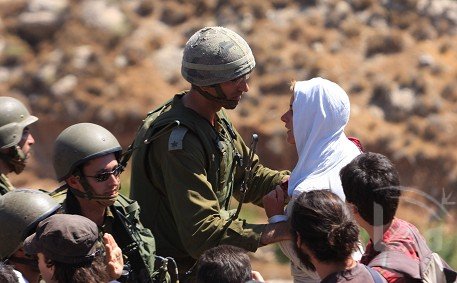
HEBRON — Thirteen activists from a group of 30 were detained by Israeli forces Thursday afternoon while aiding local farmers whose land is set for confiscation by an adjacent settlement, locals from the village of Saffa reported.
Early Thursday morning officials said the activists were escorted to lands belonging to Sheik Mohammad Aady, reportedly slated for annexation the Bat Ayin settlement.
A statement by event organizers said that after half an hour of work, soldiers surrounded the group of volunteers and detained several, including seven Israeli activists.
An Israeli military spokeswoman confirmed the arrests, but said she could not comment on the reasons for the detentions.
Protesting the Hebron Fund, I remember a long afternoon at a segregated swimming hole
By Seán O’Neill | Mondoweiss | November 18, 2010

(Protesters in New York. Photo: Vanissa W. Chan)
Hebron Fund held its annual fundraiser in New York Tuesday night. A report from O’Neill, a former member of Christian Peacemaker Teams in the South Hebron Hills, who attended the protest:
I was just leaving Hebron’s Old City one day in August 2009 when a friend of mine, Hamzi, invited me to go swimming.
He and a few other guys were going for a dip in Abraham’s Well, an ancient spring located in Tel Rumeida, essentially the only neighborhood in the West Bank city where Palestinians and Israeli settlers physically encounter one another on a daily basis.
Whereas in the Old City a complex system of barricades, roadblocks, and checkpoints keeps Palestinians caged in and under the settlement pockets, in Tel Rumeida there is some level of mutual access, albeit unequal and under the watchful eye of Israeli soldiers.
It was a hot, sticky day, and the thought of taking a dip in the cool undeground waters of Abraham’s Well sounded superb. After a long circuitous route, unable to cross Shuhada St., Hebron’s main thoroughfare banned from use by Palestinians, we reached an olive grove just above the well. In our enthusiasm, we didn’t notice the four Israeli soldiers sitting above it until they came running, screaming at us, rifles aimed in our direction. Hamzi explained that we were just on our way down to swim. The soldiers replied that there were a couple Jewish girls there swimming, so we’d have to wait. We began to sit down in the shade of the olive tree next to the soldiers when a soldier began yelling again, shooing us with his free hand, indicating that we were too close.
“He acts like were dogs,” Hamzi muttered to himself as we moved back a few trees.
Occasionally we would crane our necks over the terraced rocks to see if the girls were leaving yet. Noticing this, the soldier berated us again, instructing us to face the other direction, so as not to offend the young women, who by now, done swimming, were having a picnic next to the well. Hamzi and the others stared for a moment, absorbing this latest humiliation, before turning away, powerless. We sat there for about an hour in the midday heat, sweating profusely, debating whether it was worth the wait. Finally one of us, sneaking a look, noticed the girls leaving. We jumped up happily and asked the soldiers if we could now swim.
“No,” one said. “There’s someone else coming.” Indeed, two young Jewish boys had now approached the well and began to disrobe.
“But we’ve been here over an hour,” Hamzi protested. “It’s a hot day. If we have to wait for every Jew in Hebron to swim we’ll never get a turn.”
“Maybe not,” the soldier said, matter-of-factly.
And so we left, hot and irritated. There wasn’t a physical attack or a home bulldozed. No one was arrested or tear gassed. Just another of the thousand daily humiliations that is apartheid Hebron. That was the last day I was in Hebron, and the last time I saw Hamzi, although I didn’t realize it at the time. Shortly thereafter I flew home for a visit and returning a month later discovered I had been banned from re-entry.
Tuesday night in New York was windy, cold and dark, a far cry from that blistering day in August. Strange in a way to think that the men and women in suits and gowns at Chelsea Piers making their way to a dinner cruise on the Hudson River had any connection at all to that conflicted place thousands of miles away. Hamzi and some 160,000 Palestinians in Hebron settled down to bed after celebrating another Eid al Adha in the grip of a suffocating occupation.
Here in New York husbands and wives and their families parked their cars and walked breezily past the indoor soccer fields to a feast of their own, making tax-exempt donations to bankroll Hamzi’s oppression. Tuesday night was the annual dinner of the Hebron Fund, founded in 1979 to raise money for the Hebron settlements. According to the Washington Post, the Hebron Fund and similar organizations have donated $33.4 million since 2004 to the settlement enterprise. Settlements, keep in mind, are illegal according to international law.
This year’s dinner, held on a boat, was styled as the Hebron Aid Flotilla, a perverse celebration of the murder of nine human rights activists by Israeli commandos on the flotilla to Gaza this past May.
The event, however, did not go unnoticed. A couple hundred people gathered at the piers’ entrance in not one, but two protests. On the one hand was a coalition of Palestinian, Jewish, and anti-occupation groups such as Students for Justice in Palestine, Jewish Voice for Peace, Veterans for Peace, Women in Black, Code Pink, and Adalah NY, among others. They stood in a mostly silent vigil with signs reading “End the Siege of Hebron”, “Remove the Settlers”, and “Free Gaza”.
On the other, about 40 feet away, was a protest staged by J Street U, the college branch of the advocacy group which styles itself as pro-Israel, pro-peace. They held Israeli flags and lamented the settlements as an obstacle to a two-state solution. A participant in the J Street protest, Moriel Rothman said of the two protests, “I think that we’re working in parallel. Ultimately we probably want similar things but have different tactics in how to get there.”
An attendee of the fundraiser, who chose to remain anonymous, brushed the protests off, saying, “If you look at the amount of energy that goes into protesting Jewish misconduct, it is disproportionate. The world holds Jews to a higher standard.” He added, referring to the Jewish protesters, “They are introspective. You very seldom see that amongst the Palestinians.”
My first thought at seeing the two different protests was one of dismay. Had the ideology of separation reared its ugly head even here, among the dissenters? On second thought however, in a context in which meaningful dissent has been muffled for so long, a bit of pluralism may not be bad. The groups didn’t agree on tactics, or symbols, or what a solution to the conflict will look like. However, if there is an emerging consensus that the Hebron settlements, at least, are beyond the pale, that on a hot summer day Palestinian residents shouldn’t have to navigate around Jew-only roads to find that the well is closed to Arabs, that just might be progress.
British Defense Chief: 30 to 40 Years of Afghanistan Occupation Ahead
The New American | November 17, 2010
The foreign policy bait-and-switch continues. First, President Barack Obama declared the end of combat in Iraq, withdrawing some U.S. troops but leaving many others behind, possibly for decades, and redefining their role as “advise and assist” — whereupon they continued engaging in combat. Now, with Obama having publicly stated his intent to begin withdrawing troops from Afghanistan next July, both Defense Secretary Robert Gates and Gen. David Petraeus are arguing for a long-term, if not permanent, U.S. presence in Afghanistan.
On top of that, British Defense Chief Gen. Sir David Richards, echoing their sentiments, has stated that “Nato now needs to plan for a 30 or 40 year role to help the Afghan armed forces hold their country against the militants,” according to the Daily Mail, though he “stuck to the government’s plans to withdraw combat troops by 2014 but made clear that thousands of troops will be needed long after that date.”
In an interview on November 14, Richards said, “Everyone is clear that we will have to remains [sic] a lot longer than” four to five years. “The plans,” he added, “are now in place to do that” and will be made “rather clearer” at the upcoming NATO summit in Lisbon.
Richards correctly argued that the Taliban and al-Qaeda cannot be defeated militarily and that victory cannot be declared by “marching into another nation’s capital,” as in conventional warfare. These organizations, after all, are loosely organized and have no command center that can be neutralized. However, he contended, victory over Islamic terrorism in the traditional sense “is unnecessary and would never be achieved. But we can [sic] contain it to the point that our lives and our children’s lives are led securely? I think we can.”
The problem is that Richards, along with most other members of the government and media elite, believes that continued intervention in Afghanistan by foreign countries is the best way to go about containing terrorism. Therefore, in his opinion, U.S. and British forces must remain in Afghanistan for “generations,” albeit under the rubric of assistance rather than combat. Richards, writes the Mail, “said that there would need to be more support for the military from political, diplomatic and international aid efforts if the effort is to succeed.” (He did allow for the possibility of negotiating with some Taliban members, an option that the Obama administration has opposed.)
The idea that Islamic terrorism is, in large measure, a response to foreign intervention in Muslim countries seems never to have crossed Richards’ mind; but then such thoughts are anathema to a political establishment with an enormously inflated opinion of its own benevolence and effectiveness. Rare indeed is the politician or pundit who suggests that his own government ought to maintain “peace, commerce, and honest friendship with all nations; entangling alliances with none,” as Thomas Jefferson counseled. When one does make such a suggestion, he can expect to be shouted down with charges of “isolationism.”
Thus, both British and American officials, regardless of political affiliation, are playing along with the charade of ending combat while continuing to station troops in volatile regions and of stamping out terrorism by prolonging the conditions that incite it. In Britain, Prime Minster David Cameron of the Conservative Party “has recently moderated [his] stance” toward withdrawing troops from Afghanistan next year in response to Richards’ and Petraeus’ assertions that “it may be 2012 before there can be any significant draw down of frontline forces,” says the Mail. Likewise, the paper reported that the Labor Party’s shadow defense secretary, Jim Murphy, “said Gen Richards was ‘right’ that there was no purely military solution and said there would be ‘no white flag surrender moment.’ He added: ‘It will be for the long haul.’ ”
On this side of the Atlantic, Obama himself “is going to make a public announcement of the US government’s official abandonment of the July 2011 date and the new 2014 ‘target’ for the war effort’s transition to Afghan control,” according to Antiwar.com’s Jason Ditz, who adds that “Obama will be vowing an ‘enduring presence’ in Afghanistan beyond the 2014 date.”
It appears, then, that Afghanistan (and Iraq) will be occupied by foreign troops for years to come, costing American and British taxpayers a hefty sum and increasing, rather than decreasing, the chances of terrorism against those same taxpayers. There was no al-Qaeda in Iraq prior to the U.S. invasion; and just this summer CIA Director Leon Panetta estimated there were no more than 100 al-Qaeda militants in all of Afghanistan. At the same time, NATO is spending an estimated $50 million for every Taliban member it kills in that same country. Surely there are better uses for this increasingly scarce money, such as in paying down both governments’ astronomical debts. Bringing the troops home, cutting the defense budget down to what is needed strictly to defend our actual territory, and eliminating foreign aid and other intervention will do far more for our pocketbooks and our security than another 40 years’ worth of futile — and, from the American perspective, unconstitutional — intervention.
Israeli troops raid and loot house, commercial property of businessman
Palestine Information Center – 15/11/2010

TULKAREM — A large number of Israeli troops raided at dawn Monday the house of an imprisoned noted businessman called Ali Al-Dudu as well as his furniture showroom and stores in Tulkarem city and looted some contents of the house, all the merchandise and three of his vehicles.
Local sources said that a large number of troops aboard more than 30 military vehicles, bulldozers and big cargo trucks stormed Tulkarem at two o’clock this morning and confiscated lots of furniture from his home and everything stored in the showroom and its warehouses.
The invading Israeli troops also confiscated two cars and one truck owned by the businessman before withdrawing from the city with everything they stole. The things seized during this raid are worth millions of shekels.
The Israeli occupation forces (IOF) kidnapped the businessman last June only two days after they detained his daughter Yasmine, a student at Birzeit university, and his son Ziya’a. Both of his children were interrogated in Jalama prison.
Security forces from the Palestinian authority kidnapped his son Ziya’a immediately after his release from Israeli jails and interrogated him, in full coordination with the Israeli side, about his father’s business activities and alleged financial ties with Hamas Movement.
In a separate incident, the IOF kidnapped on the same day at dawn 11 Palestinian citizens from different West Bank areas only one day before Eid Al-Adha vacation, according to Yedioth Ahronoth newspaper.
Local sources said the detainees were kidnapped during raids on homes in the cities of Jenin, Nablus, Bethlehem and Al-Khalil.
Israeli Army Isolates the Village of Nabi Saleh to Prevent Commemorative Folk Festival
By Mays Al-Azza – IMEMC & Agencies – November 12, 2010
After the Fatah movement called the Palestinian people in Ramallah for a folk festival to commemorate late president Yasser Arafat, as a new step in escalating the popular resistance, the Israeli army imposed an intensive blockade upon the village of an-Nabi Saleh, northwest of Ramallah.
Israeli army personnel also erected military barriers to separate the villages of Beit Ramba and Kufr Aein, northwest Ramallah, and tightened measures and obstructed the passage of the vehicles through the Israeli checkpoint, Attara.
Muhammad Tamemi, an official in the media office in Popular Committee Against the Wall and Settlement Construction, stated that Israeli army personnel imposed a blockade upon the village and obstructed the passage of vehicles preventing international peace activists and journalists from entering the village. He pointed out that these measures had been carried out after the Israeli army entered the village at dawn threatening the villagers with harsh measures if the festival went ahead.
He added that Israeli army personnel closed all the entrances of the village and intensified the presence of the soldiers there in order to prevent the residents of the nearby villages from participating in the festival which is scheduled to be held at mid-day.
The Popular committee Against the Wall and Settlement Construction has called the Palestinians to go by foot to participate in the festival and face all the Israeli measures.
Major Dutch pension fund divests from occupation
Adri Nieuwhof and Guus Hoelen, The Electronic Intifada, 12 November 2010
The major Dutch pension fund Pensioenfonds Zorg en Welzijn (PFZW), which has investments totaling 97 billion euros, has informed The Electronic Intifada that it has divested from almost all the Israeli companies in its portfolio.
PGGM, the manager of the major Dutch pension fund PFZW, has adopted a new guideline for socially responsible investment in companies which operate in conflict zones.
In addition, PFZM has also entered into discussions with Motorola, Veolia and Alstom to raise its concerns about human rights issues. All three companies have actively supported and profited from Israel’s occupation of the West Bank (including East Jerusalem) and the Gaza Strip.
Over the past few years, activists in the Netherlands have questioned the two largest pension funds PFZW and ABP about their holdings in companies profiting from the Israeli occupation of Palestine. In September 2009, the Norwegian State Pension Fund decided that it would no longer invest in companies that directly contribute to violations of international humanitarian law. By February 2010, ABP, the largest Dutch pension fund, informed The Electronic Intifada it had also divested from the Israeli company Elbit Systems. At the same time, PFZW confirmed that it held shares in Elbit Systems worth 1.6 million euros.
However, the pension fund was reevaluating its investments in Israeli companies. At the time, PFZW held shares in thirteen Israeli companies, including four banks, several telecommunication companies, construction companies and Elbit Systems. In November 2009, PGGM informed The Electronic Intifada that the fund would approach divestment decisions on “Bank Hapoalim, Bank Leumi and other [Israeli] companies” in a structural manner. This was based on a “new policy on how to deal with investments in companies in the Israeli-Palestinian conflict.” That month, PGGM announced that PFZW was divesting from Africa-Israel for “technical reasons.” Owned by Lev Leviev, Africa-Israel has been involved in the building of illegal settlements in the occupied West Bank.
On 8 November, PGGM spokeswoman Diana Abrahams confirmed in a telephone conversation PFZW’s divestment from almost all Israeli companies. Abrahams could give no further details and referred to PFZW’s 2010 annual report, which will be published next year.
During this period, PGGM has also contributed to the development of guidelines for the United Nations Global Compact. The Global Compact is a strategic policy initiative for businesses that are committed to sustainability and responsible business practices which started in 2000. The initiative is endorsed by chief executives and seeks to align their operations and strategies with ten universally-accepted principles in the areas of human rights, labor, environment and anti-corruption. Last year PGGM was involved in developing a guideline for business operations in combat zones.
The decision by the Dutch pension funds to divest from Israeli companies is yet another indicator for the success of the international boycott, divestment and sanctions campaign. It is likely only a matter of time before these funds and others divest from the international corporations which profit from Israel’s occupation.
Adri Nieuwhof is a consultant and human rights advocate based in Switzerland.
Guus Hoelen, secretary of Werkgroep Keerpunt, involved in divestment campaigns in the Netherlands.
Jerusalem attorney discloses Israeli plan for full destruction of city
Palestine Information Center – 10/11/2010

OCCUPIED JERUSALEM– The Israeli government is “planning to completely destroy the city of Jerusalem and a erect a new Jerusalem with a Zionist vision amid a plan it prepared which it calls the Jerusalem 2020 plan,” Jerusalem attorney Ahmed Al-Ruwaidi said in a statement he released Wednesday.
The Jerusalem unit head said the wide-ranging plan envisions new settlements in the city and a complete transformation of Jerusalem’s Old City.
The Old City walls will dwindle down to a trace on the full parameters of biblical parks, bridges, and synagogues in an area covering the Silwan, Sheikh Jarah, Wadi Al-Jawz, and Al-Sawanah districts of the city, he added.
The plan alleges that Jerusalem is “the capital and spiritual center of Israel and the Jewish people and a world city which attracts the souls of millions of believers across the globe.”
Ruwaidi went on to say: “All of the settlement projects in Jerusalem during the past three years, some of which have been practically implemented, fall under the [plan’s] framework, including a decision to erect a thousand new settlement units in Jebel Abu Ghunaim aimed at completing the isolation of the city with a wall of settlements.”
“Israel announced previously it will build 50,000 new units in the city. The implementation of 20,000 of those units has been initiated practically under projects that have been approved from time to time for political objectives linked to political and international action.”
20,000 Palestinian housing units have been threatened with demolition.
Under the plan, Arab Jerusalem will make up 71,000 dunums of the eastern and western sides of the city’s total 126,000 dunum land area.
Ruwaidi added that planning projects for new settlement units, conferences held in Jerusalem, excavation projects in the holy city’s area, and revocation of Palestinian residencies that have recently appeared in the media are part of a decided Israeli program that the Israeli government and other parties have been working to materialize.
Ruwaidi met Wednesday with a legal team from the UK accompanied by political and cultural extensions from the British Consulate in Jerusalem. The delegation is currently developing a report about the situation in the city.
The Palestinian attorney presented a comprehensive report to the UK delegation relating to the city and the distress of its citizens, and the need to put the Fourth Geneva Convention of 1949 and The Hague Convention of 1907 into action and to recognize Israel as an occupying force in Jerusalem that has no right to change the city’s landmarks.
He called for legal, political, and economic support for Palestinians in the holy city.
Israeli occupation forces detain eldest son of MP
Palestine Information Center – 10/11/2010

AL-KHALIL — Israeli occupation forces (IOF) broke into the house of MP Samira Al-Halaika and took away her eldest son Anas in a pre dawn raid on Wednesday, the MP said in a press release.
She said that an IOF unit in four military vehicles and a white civilian car stormed the Qafan Khamis suburb east of Al-Shuyukh town in Al-Khalil district at 0300 am Wednesday and kidnapped her son Anas, 24.
She said that the soldiers locked up all her family members in one room and summoned her along with her husband and told them that they will take away their son Anas.
The lawmaker noted that her son was supposed to meet an Israeli intelligence official on Wednesday in Eztion on Wednesday morning.
Halaika held the Israeli occupation authority (IOA) fully responsible for any repercussions that might befall her son, who was released from the jails of security militias loyal to de facto Palestinian president Mahmoud Abbas on 5/9/2010 after 45 days in solitary confinement, which had a very bad physiological impact on him due to the continued isolation and cruel treatment.
She appealed to all human rights groups to intervene and demand an end to the suffering of her family due to the practices of the IOA and Abbas’s militias.
The IOF had previously detained Anas in October 2005 and released him in November 2006 before Abbas’s militias repeatedly summoned him before holding him in custody on 16/9/2009 for one month and apprehended him again on 21/7/2010 before his release on 5/9/2010.
Anas is studying journalism in Al-Khalil University.
Israeli police interfere in repairs at Aqsa Mosque, detain three of its guards
Palestine Information Center – 10/11/2010

OCCUPIED JERUSALEM — The Israeli police detained three Palestinian guards of the Aqsa Mosque after they prevented a group of settlers from making what they called repairs in the Islamic Khatuniya School at the Aqsa Mosque.
The police also summoned for interrogation engineers of the Palestinian ministry of religious affairs who are members of the Mosque’s renovation committee.
The settlers resumed their work after Israeli policemen escorted them back to the School. The police deliberately intervene in renovation works at the Aqsa Mosque and still prevent the Palestinian ministry of religious affairs and its entitled Islamic institutions from carrying out repairs at the Aqsa Mosque’s premises including this School.
Al-Khatuniya School is located behind Al-Aqsa Mosque’s mihrab and there are a door and stairs leading to it behind this mihrab. It is part and extension of the old Aqsa Mosque and includes other sections and an Islamic library.
Sheikh Abdelazim Salhab, the head of the Islamic endowment council, condemned this Israeli act as an attack on the Aqsa Mosque and a violation of the jurisdiction of the ministry of religious affairs and its institutions, the only parties authorized to restore the Islamic holy sites in the occupied Palestinian territories.
Featured Video

AIDS Inc. by Gary Null (2007)
or go to
Aletho News Archives – Video-Images
From the Archives
Clash of Civilization, Iran Part II
By Jamal Kanj – Intifada-Palestine.com – January 14, 2011
Israel’s survival kit is: perpetuate conflict, insecurity to rationalize collective hate and finally playing victim.
Devoid of conflict, Israel implodes internally; without hate, Zionism loses its justification; and playing eternal victim to continue blackmailing the West. Absence of this holy trinity, Israel ceases to exist.
From its inception, the house of Zion has mastered exploiting adversarial powers to advance Israel’s cause. For instance, their influence over the Democratic Party in the US began with President Truman’s bid for 2nd term election in 1948.
Responding to strong opposition from Secretary of State General George Marshall and Department experts urging against recognition of Israel, President Truman replied: “I’m sorry gentlemen but I have to answer to hundreds of thousands [Jewish voters] who are anxious for the success of Zionism. I do not have hundreds of thousands of [voting] Arabs among my constituents”
Zionists influence over liberal American politics was matched with the doctrinal school of Conservative theoreticians aligning the Republican Party’s platform with Israel’s objectives. The Neoconservative Zionists, coined Zioncons, invented the “Clash of Civilization” concept to fight Israel’s wars. … continue
Blog Roll
 Aletho News
- Merck Virologists Admitted to Falsely Certifying Vaccine Efficacy
- Mandatory Folic Acid for every man, woman & child
- Pro-Palestine protesters arrested outside UK’s ruling Labour Conference in Liverpool
- Mauritius denies landing permit to flight from Israel, forcing cancellation: Tour operator
- Israeli finance minister calls for genocidal war on West Bank, annexation of south Lebanon
- 12 Things Your Psychiatrist Was Trained Not to Tell You
- From Unipolar Universalism to Multipolar Civilizational Distinctiveness
- RSF military group defects, joins Sudanese army: State media
- Ireland goalkeeper refuses to play ‘Israel’ as squad weighs boycott
- China pushes back against US on Cuba, Iran
- If Americans Knew
- Israel forces Gazans to live in constant peril – Daily Update
- Deconstructing Netanyahu’s pants-on-fire UN rant – Daily Update
- Trump betrayed voters with his campaign lies and prioritized a foreign country once he took office
- Netanyahu calls Israel’s war in Gaza ‘opposite of genocide’ in UN speech to near-empty hall
- Settler Kidnappings: Torture, Sexual Abuse and Terrorisation of Palestinian Abductees as Israel Deepens Annexation of West Bank
- Gaza winter nears as 162,000 tents become unusable, raising fears of humanitarian crisis
- Netanyahu says, “It’s the opposite of genocide”; UN says Gaza economy is world’s ‘most severe crisis on record’ – Daily Update
- Israel’s US-Backed Assault on Gaza Has Created the ‘World’s Most Severe Economic Crisis on Record’: UN
- ‘Protecting U.S. Citizens’… From Israel
- ‘This is where I live now, the back of a truck’: a day in the life of a grandmother in Gaza
- No Tricks Zone
- New Study: Earth And Venus Surface Warmth Largely Explained By Convection And Lapse Rate, Not CO2 Or Radiation
- 2025 Nature Paper Claiming Worsening Global Drought Gets RETRACTED …Heavily Flawed
- New Study: ‘Global Drought Shows No Detectable Recent Acceleration Under Climate Warming’
- Economic Masterminds: German Socialists Suggest Taxing Productivity Gains Stemming From Using AI
- The South China Sea Has Not Been Cooperating With The Climate Change Narrative
- Energy Crisis: Germany Enters Heating Season With Historically Low Gas Reserve Fill Levels
- New Study: The Antarctic Ice Sheet Gained Mass From 2020-2024 Due To Staggering Snow And Ice Accumulation
- Study: Ocean Heating Rates From Thousands Of Years Ago ‘Dwarf’ Modern Ocean Heating Rates
- Climate Extremists Target, Attack Large-Scale Power Grid Infrastructure In Germany!
- New Study: Antarctic Ice Melt Has Contributed Less Than 1 Centimeter To Sea Level Rise In The Last 30 Years

