By Hook and By Crook: Israel’s Settlement Policy in the West Bank
B’Tselem | July 2010
Some half a million Israelis are now living over the Green Line: more than 300,000 in 121 settlements and about one hundred outposts, which control 42 percent of the land area of the West Bank, and the rest in twelve neighborhoods that Israel established on land it annexed to the Jerusalem Municipality. The report analyzes the means employed by Israel to gain control of land for building the settlements. In preparing the report, B’Tselem relied on official state data and documents, among them Attorney Talia Sasson’s report on the outposts, the database produced by Brigadier General Baruch Spiegel, reports of the state comptroller, and maps of the Civil Administration.
The settlement enterprise has been characterized, since its inception, by an instrumental, cynical, and even criminal approach to international law, local legislation, Israeli military orders, and Israeli law, which has enabled the continuous pilfering of land from Palestinians in the West Bank.
The principal means Israel used for this purpose was declaration of “state land,” a mechanism that resulted in the seizure of more than 900,000 dunams of land (sixteen percent of the West Bank), with most of the declarations being made in 1979-1992. The interpretation that the State Attorney’s Office gave to the concept “state land” in the Ottoman Land Law contradicted explicit statutory provisions and judgments of the Mandatory Supreme Court. Without this distorted interpretation, Israel would not have been able to allocate such extensive areas of land for the settlements.
In addition, the settlements seized control of private Palestinian land. By cross-checking data of the Civil Administration, the settlements’ jurisdictional area, and aerial photos of the settlements taken in 2009, B’Tselem found that 21 percent of the built-up area of the settlements is land that Israel recognizes as private property, owned by Palestinians.
To encourage Israelis to move to the settlements, Israel created a mechanism for providing benefits and incentives to settlements and settlers, regardless of their economic condition, which often was financially secure. Most of the settlements in the West Bank hold the status of National Priority Area A, which entitles them to a number of benefits: in housing, by enabling settlers to purchase quality, inexpensive apartments, with an automatic grant of a subsidized mortgage; wide-ranging benefits in education, such as free education from age three, extended school days, free transportation to schools, and higher teachers’ salaries; for industry and agriculture, by grants and subsidies, and indemnification for the taxes imposed on their produce by the European Union; in taxation, by imposing taxes significantly lower than in communities inside the Green Line, and by providing larger balancing grants to the settlements, to aid in covering deficits.
Establishment of the settlements violates international humanitarian law. Israel has ignored the relevant rules of law, adopting its own interpretation, which is not accepted by almost all leading jurists around the world and by the international community.
The settlement enterprise has caused continuing, cumulative infringement of the Palestinians’ human rights, as follows:
- the right of property, by seizing control of extensive stretches of West Bank land in favor of the settlements;
- the right to equality and due process, by establishing separate legal systems, in which the person’s rights are based on his national origin, the settlers being subject to Israel’s legal system, which is based on human rights and democratic values, while the Palestinians are subject to the military legal system, which systematically deprives them of their rights;
- the right to an adequate standard of living, since the settlements were intentionally established in a way that prevents urban development of Palestinian communities, and Israel’s control of the water sources prevents the development of Palestinian agriculture;
- the right to freedom of movement, by means of the checkpoints and other obstructions on Palestinian movement in the West Bank, which are intended to protect the settlements and the settler’s traffic arteries;
- the right to self-determination, by severing Palestinian territorial contiguity and creating dozens of enclaves that prevent the establishment of an independent and viable Palestinian state.
The cloak of legality that Israel has sought to give to the settlement enterprise is aimed at covering the ongoing theft of West Bank land, thereby removing the basic values of legality and justice from Israel’s system of law enforcement in the West Bank. The report exposes the system Israel has adopted as a tool to advance political objectives, enabling the systematic infringement of the Palestinians’ human rights.
The extensive geographic-spatial changes that Israel has made in the landscape of the West Bank undermine the negotiations that Israel has conducted for eighteen years with the Palestinians and breach its international obligations. The settlement enterprise, being based on discrimination against the Palestinians living in the West Bank, also weakens the pillars of the State of Israel as a democratic country and diminishes its status among the nations of the world.
World tired of us: Israeli minister
Press TV – July 1, 2010

Israeli Minister of Trade, Industry and Labor, Binyamin Ben-Elezier
Israeli Minister of Trade, Industry and Labor, Binyamin Ben-Eliezer, says the world is tired of Israel and that Israel, rather than the Gaza Strip, is actually blockaded.
“We’re not the ones maintaining a blockade. We’re blockaded, utterly isolated. We’re in a situation where the world is tired of us,” the Jewish Daily quoted Ben-Elezier as saying in an interview in the Yediot Ahronot Friday supplement.
“They’re tired of hearing our explanations, of showing empathy for our troubles, even if they’re real troubles. (The world is) Tired of understanding us. This business just isn’t working anymore. After 43 years, nobody wants to hear any more explanations about why this occupation is continuing and how we have nobody to talk to.” Elezier continued.
Born in 1936 in Basra in southern Iraq, Binyamin “Fuad” Ben-Eliezer is the senior leader of the Labor Party’s hawkish wing, a tough-as-nails ex-general and currently the party’s grand old man.
Israel convicts grassroots activist to two years’ imprisonment
Amy Darwish, The Electronic Intifada, 1 July 2010
 |
| Adeeb Abu Rahme during a protest against the wall in Bilin. (Hamde Abu Rahme) |
On 30 June grassroots activist Adeeb Abu Rahmah was sentenced by Israel to two years imprisonment at a military court hearing at the Ofer Military Complex in the occupied West Bank. Abu Rahmah already spent 11 months behind bars and his arrest and detention is part of Israel’s repressive efforts to criminalize the grassroots popular resistance to the Israeli occupation.
Adeeb Abu Rahmah is known for his vibrant presence at the occupied West Bank village of Bilin’s weekly demonstrations against Israel’s wall and for his commitment to popular nonviolent resistance. A founding member of the Bilin Popular Committee Against the Wall and Settlements, Abu Rahmah was arrested at a nonviolent demonstration on 10 July 2009 and later indicted by the military prosecution on grounds of “incitement,” “activity against public order,” and “being present in a closed military zone.”
Abu Rahmah has repeatedly affirmed his commitment to nonviolent resistance. He has also denied all charges, aside from acknowledging his participation in the weekly demonstrations. Although his release was initially ordered on 16 July 2009, the prosecution later appealed the decision and Abu Rahmah was remanded into custody for the duration of his legal proceedings.
Many contend that Israel’s investigation of Abu Rahmeh was flawed from the very beginning, and the Israeli military court system is notorious for its lack of respect for international standards of fair trial and detention. A 5 March 2010 Human Rights Watch report particularly highlighted many due process concerns where investigations regarding Palestinian anti-wall demonstrators are concerned, citing charges based on “questionable evidence and allegedly coerced confessions.”
According to Iyad Burnat, Head of the Bilin Popular Committee, the Israeli military in Abu Rahmah’s case “relied on the forced confessions of four Bilin youth — one 14, one 15 and two 16 years of age — to convict Adeeb for having told them to throw stones.”
Burnat added: “This problem is not confined to Bilin and has also emerged in other villages.”
Attorney Gaby Lasky, who is representing Abu Rahmah, noted that the testimony from the minors in question was provided under considerable duress. “They were arrested at 3:30am, they were handcuffed and blindfolded,” she said. “They were then interrogated at 2pm the next day, without having eaten or having had a chance to use the washroom.”
Israeli military authorities claim that they questioned the youths to determine who threw the stones, and the youths identified Abu Rahmah as having done so.
“Yet, several times, the demonstrators had thrown leaflets and other innocuous objects at the soldiers. We are arguing that the police investigation was so lacking that they didn’t even ask the youth what Adeeb had specifically said,” Lasky explained.
Lasky also noted that the youth were questioned by an interrogator who was not a specialist in questioning children, and the interrogation was carried out without the presence of a lawyer or the children’s parents. Human Rights Watch states that such practices directly contravene provisions under Israeli Military Orders that allow detainees to contact lawyers and grant child detainees the right to have a parent present during their interrogations.
The credibility of the investigation was also challenged when Lasky learned that a special army unit was filming the demonstrations and that the footage was being submitted as evidence against Abu Rahmah. When Lasky subsequently attempted to get ahold of the footage, however, she was told that all the cassettes had been erased.
“Under different circumstances, this might have been enough to acquit him,” Lasky said. “There have been many problems with the investigation and we had hoped that the court would take this into consideration.”
Ultimately, Abu Rahmah’s trial may portend broader implications where the popular resistance is concerned. “Adeeb’s indictment and conviction raise much bigger questions,” Lasky explained. “The trial is really against the demonstrations as a whole.” Indeed, Abu Rahmah’s indictment may signal an escalation in the use of legal strategies as a means of quelling the popular resistance.
For the past five years, the people of Bilin have waged an ongoing struggle against the construction of Israel’s wall, which has annexed large portions of their agricultural lands and threatens the economy of the village. Since the first bulldozers began to uproot olive trees in February 2005, the villagers have staged weekly demonstrations every Friday. Joining villages such as Budrus, Jayyus, Nilin and al-Masara, their creative tactics have captured the imaginations of many people around the world and inspired other Palestinian communities across the West Bank to take up the struggle.
Villagers in Bilin have also launched a precedent-setting legal challenge alongside its popular campaign. On 22 June 2009, court proceedings unfolded in the Quebec Superior Court, where the village filed their lawsuit against Green Mount and Green Park International, two Quebec-based companies involved in the construction of condos and the expansion of settlements at the village’s expense. Citing the Fourth Article of the Geneva Convention and the Canadian Law on Crimes Against Humanity and War Crimes, the complaint accuses both companies of complicity in war crimes.
Coinciding with the legal challenge, three members of the Bilin Popular Committee Against the Wall and Settlements also visited 11 Canadian cities for a nation-wide speaking tour.
While the case was later rejected by the Quebec Superior Court in the fall of 2009, the village later appealed the decision at the Quebec Court of Appeals. During hearings that unfolded earlier this month, judges fielded arguments from the village’s legal team regarding the “justiceability” of the village’s claim. Lawyers for the village maintain that the Fourth Geneva Convention is not incorporated into Israeli law, thereby precluding the possibility that the case can be heard in the Israeli high court. At present, the Canadian court has taken the case under advisement and a decision is anticipated in the months to come.
While Bilin’s three-pronged strategy of direct action, court cases and international solidarity have kept it in the headlines, the Israeli military continues to repress it. Indeed, Abu Rahmah’s conviction represents the most recent development in a broader campaign to quell the popular struggle.
In a recent report, prisoner rights group Addameer and the Stop the Wall campaign have noted that violence has been systematically used by Israeli forces to suppress the popular resistance. It is estimated that more than 1,566 Palestinians have been injured and 16 have been killed between 2005 and 2009. In Bilin alone, approximately 1,300 protestors have been wounded during weekly demonstrations over the past five years. Israel’s directed policy of misusing dispersement tactics also claimed the life of Bilin’s Bassem Abu Rahmah, who was killed on 17 April 2009, when he was shot in the chest with a tear gas canister.
The Israeli military has also instituted a policy of targeted arrests and detention. According to Sahar Francis, director of Addameer, “this policy is very much part of a broader campaign of repression against any form of activism.” The use of detentions and arrests has also escalated considerably in recent years. “Within the past one or two years, it has increased considerably as momentum in the campaign against the wall builds.”
Since 2002, Addameer and Stop the Wall have documented the arrests of 176 Palestinian grassroots activists in five villages, namely Bilin, Nilin, al-Masara, Jayyus and Budrus. According to Bilin’s internal village statistics, 85 residents have been arrested since June 2009, many during the Israeli military’s frequent night raids into the village The recent wave of political arrests has targeted key community activists; five of those arrested are active with the Bilin Popular Committee Against the Wall and Settlements, and all were charged with “incitement.”
Defined as “any act of attempting, whether verbally or otherwise, to influence public opinion in the Area in a way that may disturb the public peace or public order” under Article 7(a) of Military Order 101, the use of incitement as a blanket charge is controversial.
Attorney Lasky explained that “Until recently, people had not been charged with this particular offense for a very long time and it is now being interpreted very broadly.” In a recent press release, Amnesty International also cautioned that “the broad scope of Israeli military orders mean that Abu Rahmah could be imprisoned solely for legitimately exercising his right to freedom of expression in opposing Israeli policies in the West Bank.”
From Sahar Francis’ perspective, the use of vague language and nebulous parameters is no coincidence. “The first thing we should remember is that all forms of activism are deemed illegal,” she explained. “Participating in demonstrations, holding forums — all these things are considered to be incitement. You find very vague language and definitions so broad that any action can fit inside. This was written into the Military Orders in 1967 to permit them to adapt to evolving forms of resistance.”
Abu Rahmah’s case could also have far-reaching implications for other anti-wall activists currently awaiting trial. As Amnesty International explained, he could be “the first activist against the fence/wall to be brought to a full evidential trial in a case of this kind.” Abu Rahmah’s conviction could potentially set troubling new precedents for further criminalizing the popular resistance.
Abu Rahmah’s sentence has also come as a tremendous shock and disappointment to his family, and his ongoing imprisonment continues to weigh heavily upon them. Left without a financial provider, the family of ten has struggled to make ends meet for the past 11 months.
“I am a medical student at Abu Dis University, while my sister is also studying management at al-Quds Open University,” daughter Rajaa Abu Rahmah explained. “We also have to cover the costs of books and tuition, in addition to meeting basic needs. It has been really hard to get by.”
In addition to financial pressures, Abu Rahmah’s absence has also exacted a heavy emotional toll on the family. “This is the first time my father has been away from us, even for a short period of time,” stated Rajaa. “We feel angry all the time, for no reason. It has been a sad, lonely time for us all.”
Despite the challenges faced during his absence, the Abu Rahmah family remains steadfast. “We are not alone,” Rajaa said. “Many villages also have prisoners and people who have suffered injuries. It has been difficult, but we have to come out of this stronger.”
As the Abu Rahmah family has been resilient, so too has the popular struggle. The weekly demonstrations have continued unabated and resistance remains ongoing, even in the face of intense repression and legal persecution.
“Certain people may be more cautious in their participation,” Francis explained. “Still, the resistance is continuing and even expanding to new villages, such as Nabi Saleh. They are not succeeding in breaking the will of the people.”
Iyad Burnat said that the latest round of repression leaves the movement even more determined to sustain the popular struggle. “Israel will not break us on their anvil — they will only make us stronger with their repression and hammer blows.”
Burnat added, “After five years of struggle in the village, one murder and many disabling injuries we still strive with the words of Terence McSwiney — the Irish nationalist who fought the British occupation of Ireland and died on hunger strike in protest — in mind: ‘it is not those who can inflict the most, but those that can endure the most who will prevail.'”
Amy Darwish is a writer and community organizer active in the Tadamon! network in Montreal.
Methodists launch boycott over West Bank
By Jerome Taylor | The Independent | 30 June 2010
The Methodist Church today voted to boycott all products from Israeli settlements in Palestinian territories becoming the first major Christian denomination in Britain to officially adopt such a policy.
The decision was made at the church’s Conference in Portsmouth, an annual gathering which decides Methodist policy. The official stance of the church, the fourth largest Christian denomination in Britain, will be to boycott any products made on Jewish settlements on the West Bank. Lay Methodists will also be encouraged to follow the church’s lead.
The move will inevitably put Methodists on a collision course with Britain’s Jewish community. The Board of Deputies of British Jews had already expressed concern over a 50-page report which had been compiled by a Methodist committee and sent to all its churches before the conference explaining why a boycott was justified.
In December, Defra introduced new advice on labelling, recommending that packaging of products imported from the West Bank should distinguish between Palestinian areas and Israeli settlements.
Christine Elliott, Secretary for External Relationships, said, “This decision has not been taken lightly, but after months of research, careful consideration and finally, today’s debate at the Conference. The goal of the boycott is to put an end to the existing injustice. It reflects the challenge that settlements present to a lasting peace in the region.
Ben White, a Methodist supporter if the boycott, said: “This is a clear show of support from Jews and Christians who understand that a real peace for both peoples requires justice. It stands in stark contrast to the disingenuous threat that listening to the call of Christian Palestinians and upholding international law and human rights will damage ‘inter-faith relations’ – on the contrary, inter-faith dialogue is not facilitated by ignoring serious questions about injustice.”
Jerusalem lawmaker detained; expulsion expected
Ma’an – 30/06/2010
Jerusalem resident and elected Palestinian official Mohammad Abu Tier was detained by Israeli police on Wednesday, and reportedly taken to the Russian Compound for questioning.
Former Minister of Jerusalem Affairs for the Palestinian Authority Khalid Abu Arafa confirmed the arrest, which he said was carried out near the official’s Sur Baher home, in a neighborhood of East Jerusalem.
According to a report in Israel’s daily Haaretz newspaper, police representatives will submit a request to Israeli courts on Thursday, requesting that the official remain in police custody.
Abu Arafah said that the move was in preparation for the execution of deportation orders okayed by and Israeli court last week. The orders would see Abu Tier stripped of his Jerusalem residency card and prohibited from accessing the city.
The former minister called the detention of an elected official “beyond the red line,” and said it demonstrated Israel’s willingness to expel all Palestinian leaders from the city, starting with Abu Tier, and the three other officials – including himself – who were elected in the 2006 Palestinian vote with Hamas.
An Israeli police source said Abu Tier was not part of a deal made by Palestinian Authority officials from Ramallah. President Mahmoud Abbas met with the four lawmakers on Friday, and following the meeting sources within the PA said a deal had been struck to ensure the lawmakers were not expelled from their native Jerusalem.
A second police source said Abu Tier would go before the Jerusalem court and be deported to the West Bank or Gaza.
Earlier reports said the four men would have to renounce their affiliation with the Hamas movement if they hoped to remain in Jerusalem.
Deportation orders had been handed down in 2006 when the four were elected, but were only handed out within the past months, following the activation of Israel’s military orders 1649 and 1650, which expanded the definition of infiltrator to any individuate living in an Israeli-controlled area without express permission by unidentified Israeli bodies.
Other PLC members targeted in the expulsion include Mohammed Totach and Ahmed Atoun. All four were given until July to leave Jerusalem.
Jerusalem Politicians Face Expulsion
By Jonathan Cook in Nazareth – June 29, 2010
Israeli human-rights groups and Mahmoud Abbas, the president of the Palestinian Authority, have condemned a decision by Israel to expel four Palestinian politicians from East Jerusalem by the end of this week.
The Israeli government revoked their residency rights in Jerusalem a few weeks ago, after claiming they were “in breach of trust” for belonging to a “foreign parliament”, a reference to the Palestinian Legislative Council.
All four men belong to Hamas and were arrested a few months after taking part in the Palestinian national elections in January 2006. They remained in jail until recently as “bargaining chips” for the release of an Israeli soldier, Gilad Shalit, who is being held captive by Hamas.
Observers say Israel’s move reflects its anger at Hamas’s growing hold on the political sympathies of Jerusalem’s 260,000 Palestinians and is designed to further entrench a physical separation Israel has been imposing on East Jerusalem and the adjacent West Bank.
Israel has not said where the three MPs and a former cabinet minister will be expelled to. The loss of residency effectively leaves the politicians stateless, in breach of international law, according to human-rights lawyers.
Hassan Jabareen, the director of the Adalah legal centre for the Arab minority in Israel, said a “very dangerous precedent” was being set. “It is the first time Palestinians in East Jerusalem have had their residency revoked for being ‘disloyal’ and this could be used to expel many other residents whose politics Israel does not like.
“This is a draconian measure characteristic of dark and totalitarian regimes,” he said.
The January 2006 vote for the Palestinian Legislative Council, in which Hamas won a majority of seats against its Fatah rivals, was the first time the Islamic party had participated in a national election.
Jerusalem politicians were allowed to stand only after the international community insisted that Israel honour the terms of the Oslo accords.
Unlike the occupied Palestinian territories of the West Bank and Gaza, East Jerusalem was annexed to Israel following the 1967 war and its Palestinian inhabitants were given the status of “permanent residents”. Israel has violated international law by building large settlements throughout East Jerusalem that are now home to 200,000 Jews.
After the 2006 vote, the government of Ehud Olmert responded to Hamas’s success in East Jerusalem by initiating procedures to revoke the residency of three MPs – Mohammed Abu Tir, Ahmed Attoun and Mohammed Totah – and Khaled Abu Arafeh, who Hamas appointed as the PA’s minister for Jerusalem affairs.
Before the revocations could take effect, however, Israel arrested the men, as well as dozens of other Hamas legislators, in retaliation for Sgt Shalit’s capture four years ago.
Since their release, all four politicians have had their Israeli identity cards confiscated and been told they must leave the city within a month.
Mr Abu Tir, 60, was supposed to leave on June 19, but has so far evaded expulsion. “I will not willingly leave the place my family has lived for 500 years,” he said last week.
The deadline for the other three expires on Saturday.
Unusually, the plight of the Hamas politicians has won the support of Mr Abbas, who also heads Fatah and has been seeking to overturn Hamas’s rule in Gaza.
Calling the expulsions one of “the biggest obstacles yet on the path to peace”, Mr Abbas has vowed to put pressure on the US to reverse Israel’s decision.
During a meeting with three of the men last week, he said: “We cannot stand idly by while people are expelled from their homeland, which we consider a crime.” Mr Abbas is reported to fear that Israel is hoping to establish a new precedent for expelling thousands of Palestinians from the city.
Hatem Abdel Kader, Fatah’s minister for Jerusalem affairs, was warned this month by the Shin Bet, Israel’s secret police, that he would have his residency revoked if he continued his political activities in the city.
Yigal Palmor, a spokesman for the Israeli foreign ministry, said Israel was issuing “a very clear warning to Hamas and all those who promote terror” that they would face a “backlash”.
Lawyers for the four Hamas politicians petitioned the Israeli Supreme Court this month for an injunction on the expulsions until a hearing can be held on the men’s residency rights. Last week, however, the court declined to stop what it called “deportations”, saying it would issue a ruling at a later date.
Mr Jabareen, whose Adalah organisation is advising the politicians, said he was “astonished” by the court’s position, and that in all previous expulsion cases an injunction had been issued before the expulsion took place.
He added: “Under international law, an occupying power cannot demand loyalty from the the people it occupies. Palestinians in East Jerusalem are ‘protected persons’ in law and cannot be expelled.”
Israel has based its decision on the Entry into Israel Law of 1952, which governs the naturalisation process for non-Jews. It allows the interior minister to revoke citizenship and residency in some cases.
“The purpose of this law is to oversee the entry into Israel of foreigners,” said Mr Jabareen. “The Palestinians of East Jerusalem did not enter Israel; Israel entered East Jerusalem by occupying it in 1967.”
The revocations of the politicians’ residency comes in the wake of a rapid rise in the number of Palestinians who have been stripped of Jerusalem residency on other grounds, usually because Israel claims the city is no longer the “centre of their life” and typically because a resident has studied or worked abroad.
In 2008, more than 4,500 Palestinians lost their Jerusalem residency, interior ministry figures show. The number has been steadily rising since 1995, when 91 Palestinians were stripped of their rights. According to Israel, a total of 13,000 Palestinians have had their residency revoked since 1967.
The loss of residency is seen by the Palestinians as part of a wider Israeli strategy to weaken their hold on East Jerusalem and its holy sites.
Israel has built sections of its separation wall through Palestinian neighbourhoods of Jerusalem, cutting off some 60,000 residents from their city.
It has also shut down all Palestinian political institutions in Jerusalem associated with the Palestinian national movements, and banned events – including a literature festival last year – that it claims are financed with PA money.
Last week police forced the closure of Hamas’ political office near the Old City. Yuval Diskin, the head of the Shin Bet, had earlier accused Hamas of trying to buy property in Jerusalem.
In early 2006, shortly before they were arrested, Mr Abu Tir and Mr Abu Arafeh were revealed to have established a diplomatic channel with several prominent Israeli rabbis to negotiate Sgt Shalit’s release and the terms of a possible peace deal. The talks were effectively foiled by their arrests.
In a related move, Israeli officials have also been threatening to revoke the citizenship of Palestinian leaders inside Israel, including Haneen Zoubi, the Israeli MP who was onboard last month’s aid flottilla to Gaza that Israeli commandos attacked, killing nine passengers.
– Jonathan Cook is a writer and journalist based in Nazareth, Israel. His latest books are “Israel and the Clash of Civilisations: Iraq, Iran and the Plan to Remake the Middle East” (Pluto Press) and “Disappearing Palestine: Israel’s Experiments in Human Despair” (Zed Books). His website is www.jkcook.net.
Israeli Occupation Authority still banning entry of 3,500 commodities into Gaza
Palestine Information Center – 28/06/2010
GAZA: MP Jamal Al-Khudari, the head of the popular committee against the siege, has said that the Israeli occupation authority (IOA) was still barring the entry of 3500 commodities into the Gaza Strip.
He said in a report published on Sunday that the IOA allowed only 10% of goods that were previously banned from entering Gaza, describing the IOA talk about easing the siege as mere propaganda and means to deceive the world and is contrary to what is happening on the ground.
The lawmaker noted that in the first week the IOA opened two commercial crossings out of four, which were all completely closed, then it opened one crossing for a couple of days while the fourth was only partially opened.
There is no real end to the siege without opening all commercial crossings on permanent basis, allowing influx of all types of goods, opening a safe passage between Gaza and the West Bank, and finally allowing a sea route between Gaza and the outside world under European supervision, Khudari elaborated.
He championed continued pressure on the IOA to achieve those goals, asking the UN Secretary General and UNRWA to continue pressuring the IOA until the siege is totally lifted.
Meanwhile, a delegation of Lebanese doctors arrived in the Gaza Strip on Sunday in a show of solidarity with the besieged people of Gaza.
The crossings and borders authority said in a statement that the 8 Lebanese doctors would remain in Gaza till next Thursday and might operate on a number of patients.
10 Jordan Valley families given 24 hours to leave homes
Ma’an – 28/06/2010
Bethlehem – Ten families in the Jordan Valley were handed home demolition orders on Sunday and given 24 hours to evacuate their lands.
Most of the homes to be demolished belong to the Daraghmah and Al-Makahmreh families, who say they have documents proving their ownership of the land filed with Israel’s Land Registry.
The families said they had been issued demolition orders before, however this was the first time they had been given a 24-hour notice.
A spokesman from the Israeli Civil Administration office said the orders were given because the homes are in a “fire zone”, putting the residents “at risk.”
The homes slated for demolition are in Al-Farsieyah in the Tubas municipality, all in “Area C”, under zoning regulations established under the Oslo Accords, putting them under Israeli civil and military control.
Several villages in Tubas have been targeted by home demolition orders in recent days. Six families in the villages of Al-Hadidiya and Khirbet Humsa were given 10 days to evacuate their land on 21 June, a move which would see 50 Palestinians homeless and without their livelihoods.
So far this year, 125 Palestinians have been displaced by home demolitions in “Area C”, which encompasses 60 percent of the West Bank and is under full Israeli military and administrative control, according to UN reports.
Palestinians can only build within boundaries specified by the Israeli Civil Administration, the UN Office for the Coordination of Humanitarian Affairs has noted, an area that constitutes less than one percent of “Area C”, and much of this is already built up.
Effectively, “in almost the entirety of the Jordan Valley, Palestinian construction is prohibited,” a UN office reported in December 2009.
In a recent report, Amnesty International’s deputy director, Philip Luther, remarked that “Demolition and eviction orders do not just destroy people’s homes. They also take away their possessions and their hopes for a secure future,”
Last year, at least 600 Palestinians, half of them children, were made homeless by home demolition orders, the report said.
Building Settlements at Sheikh Jarrah Begins
Al Manar | June 28, 2010
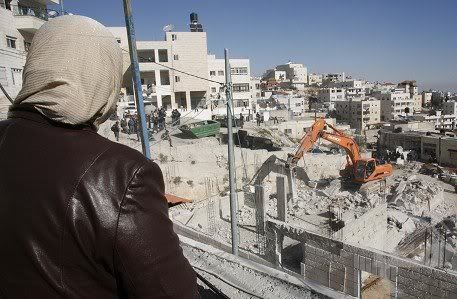
Building settlements in the occupied east Jerusalem neighborhood of Sheikh Jarrah began Sunday, just a few days before Israeli Prime Minister Benjamin Netanyahu was scheduled to meet with the US president.
The controversial construction plans, set at the site of the Shepherd Hotel, surfaced on the eve of Netanyahu’s previous meeting with Barack Obama three months ago, embarrassing the Israeli government.
Channel 10 reported Sunday that bulldozers had already arrived at the site, intended for 20 new Israeli homes.
Netanyahu has much to account for during his meeting with Obama, with occupied Jerusalem Mayor Nir Barkat’s controversial so-called ‘King’s Garden’ plan in Silwan. The plan orders the razing of 22 Palestinian homes.
A number of officials, including Israeli Defense Minister Ehud Barak, have claimed the Sheikh Jarrah and Silwan construction plans were purposefully promoted at sensitive times by extreme rightists hoping to embarrass the Israeli prime minister.
Peace Now said in a statement, “The mayor of Jerusalem and his partners in the right wing continue to decide the facts on the ground and harm Israel’s political status. Netanyahu must order Barkat to stop the construction in Sheikh Jarrah immediately.”
Jerusalem master plan: Expansion of Jewish enclaves across the city
The Jerusalem District Planning and Building Committee is set to approve a master plan that calls for the expansion of Jewish neighborhoods in East Jerusalem.
By Nir Hasson and Akiva Eldar | Haaretz | June 28, 2010
The Jerusalem District Planning and Building Committee is set to approve an unprecedented master plan that calls for the expansion of Jewish neighborhoods in East Jerusalem, a move largely based on construction on privately owned Arab property.
The committee’s proposal would codify the municipality’s planning policy for the entire city. In essence, Jerusalem would uniformly apply its zoning and construction procedures to both halves of the city.
Before giving the go-ahead, the committee will give objectors to the plan 60 days to submit their reservations. This is the decisive stage in the planning process, because only rarely are plans altered.
Once the 60-day period expires, the plan’s approval is a fait accompli. Such a development would probably invite a hail of criticism from the Palestinians, Arab countries and the international community.
The United States has recently communicated its expectation that Prime Minister Benjamin Netanyahu will prevent any change in the city’s status quo pending the conclusion of final-status talks with the Palestinian Authority. Netanyahu is scheduled to meet with U.S. President Barack Obama in Washington early next month.
For over a decade, dozens of architects have worked to draw up the latest Jerusalem master plan, meant to replace the one in effect since 1959, eight years before the Six-Day War. While the plan did not attract opposition from the international community and leftist organizations, political developments over the last year – including the spat with the United States over the Ramat Shlomo building project – are likely to touch off renewed diplomatic tensions.
According to a document prepared by Ir Amim, an NGO that “seeks to render Jerusalem a more viable and equitable city,” the master plan vastly underestimates the construction needs of the Arab population in the city. While the plan calls for 13,500 new residential units in East Jerusalem for Palestinians, updated demographic studies indicate that this amount barely represents half the minimum needs for the Arab population by 2030.
Ir Amim officials also said that while the plan allows for Palestinian construction in the north and south of the capital, it barely provides for an expansion of Arab construction projects in the center of the city, particularly in the area next to the holy basin.
The group added that the plan creates a spate of bureaucratic obstacles for Palestinians who wish to build in the city. Ir Amim warns that the plan is likely to be perceived as an Israeli provocation because most of the Jewish building projects are designated for areas east of the Green Line.
In October 2008, the district committee opted to promote a master plan submitted by Moshe Cohen, formerly the chief Jerusalem planner at the Interior Ministry. Right-wing political parties in Jerusalem protested to Interior Minister Eli Yishai over the plan’s intention to add significantly larger residential areas for the benefit of the Arab population at the expense of green areas.
Jerusalem Mayor Nir Barkat instructed his subordinates to alter the plan in line with his policy of thickening the Jewish presence around the holy basin and the eastern half of the city.
Despite the National Planning and Building Committee’s decision to designate the City of David – which sits in the heart of the East Jerusalem neighborhood of Silwan – as “a national park,” the new master plan allows for the construction of residential units in the area.
The Ir David Foundation, a nonprofit group that seeks to increase Jewish settlement in the City of David and whose heads are close associates of the mayor, has in recent years bought houses near the Old City in an effort to “Judaize” the area.
Last week, the Jerusalem municipality’s planning and building committee approved a controversial plan for the Silwan neighborhood that calls for razing 22 Palestinian homes built without permits and constructing a tourism center in their place. Barkat said the illegal construction in the area is preventing the municipality from building a tourism center, which would include restaurants and boutique hotels.
Earlier this year planning officials received an internal memo circulated by Cohen, who was later dismissed as head of the master plan staff. Cohen wrote that the plans for the City of David are an example “of the district committee’s ambitious intention to satisfy contradictory positions.” He warned that this would not pass legal muster.
Cohen objected to the city’s decision to convert 2,500 dunams that were listed as “open areas” into residential neighborhoods.
A Jerusalem municipality spokesman said in response: “Indeed, the plan will be brought for a discussion before the district committee.” A spokesman from Yishai’s office said: “Professional deliberations are taking place in an effort to approve the plan.”
June deadliest month yet for NATO in Afghanistan, 310 killed
DPA | June 27, 2010
Kabul – Two NATO soldiers were killed in an attack in eastern Afghanistan on Sunday, while the British Defence Ministry said a British soldier had died of wounds he sustained in an attack earlier this month.
The NATO-led International Security Assistance Force (ISAF) said in a statement that two foreign soldiers had died following a small- arms attack in the eastern region. It did not reveal the nationalities of the deceased.
Most of the NATO troops in the eastern provinces are from the United States, while small units of French and Polish military forces are also based in the restive region.
The British soldier died of wounds he had sustained during a blast in the Nahre Saraj district of the southern province of Helmand on June 10, the Defence Ministry said. The soldier died in hospital in Birmingham, the ministry said in a statement posted at its website.
Meanwhile, the Canadian Defence Ministry said two of the six soldiers killed in separate attacks in Afghanistan on Saturday were Canadians. In a statement the ministry said a female Canadian soldier and her male comrade were killed in the Panjwayi district of the southern province of Kandahar when their vehicle was struck by a roadside bomb.
At least 310 international soldiers have been killed in Afghanistan in June, the deadliest month for NATO troops in the country since the ouster of the Taliban regime in late 2001.
Both Taliban and NATO-led troops are preparing for major battles this summer, when the total number of foreign troops is set to peak at 150,000 from the more than 130,000 currently based in the country.
IOF soldiers abduct daughter of businessman, serve demolition notice
Palestine Information Center – 26/06/2010
 File Photo – IOF Home Invasion

TULKAREM — Israeli occupation forces (IOF) have stormed the home of Palestinian businessman Ali Al-Dadu in Tulkarem city and kidnapped his daughter Yasmin after confiscating a number of personal computers in the house.
Local sources said that the IOF troops broke into the house before dawn Friday and thoroughly searched it, wreaking havoc in the process.
The IOF soldiers had detained Dia, Yasmin’s brother, a couple of days ago at the Karame crossing on returning from Jordan into the West Bank.
Dadu’s shop was burnt at the hands of Fatah elements after Hamas took over control of the Gaza Strip more than three years ago and his losses were estimated at millions of dollars. The businessman and his sons were repeatedly detained by Fatah militias and the IOF soldiers since then.
Hebrew press had reported that the IOF soldiers rounded up six Palestinians on Friday in northern and southern areas of the West Bank including two brothers in Qabatia, Jenin district.
Meanwhile, IOF troops delivered a demolition notice to a citizen in the northern Jordan Valley on Friday following a series of similar demolition notifications in the area.
Local sources told the PIC that the IOF soldiers handed Ahmed Nawaja’a a written order not to live or be present in the area of his residence and asked him to evacuate his home within 24 hours.
Featured Video

New positive ivermectin evidence
or go to
Aletho News Archives – Video-Images
From the Archives
Fanatical Followers of the Covid Regime: A Jim Jones-Style Cult?
By Professor Roger Watson and Dr. Niall McCrae | The Daily Sceptic | November 15, 2021
As scholars at leading British universities over recent decades, we witnessed the replacement of critical thinking and debate by narrative: facts are discrimination and scientific method is imperialism; truth, instead, is derived from ‘progressive’ values. This educational trend may be a major contributory factor to the ease in which society has been inculcated to the Covid ‘new normal’ of masking, testing, and repeated doses of vaccines for a disease of similar risk to severe influenza.
One doesn’t need much critical reasoning to observe the flawed logic of some vaccination enthusiasts, such as people who respond to experiencing any side effects, however debilitating, by saying “at least I know it’s working”, or, after contracting the disease despite their promised inoculation (over 90% effective, according to initial drug company claims), “I’d have been worse off without the jab.” … continue
Blog Roll
 Aletho News
- The Rise And… Rise Of ‘Color Revolutions’
- The Coming GOP Bloodbath?
- Arctic Scare Stories Melt Away
- Wrong, Euronews: Climate Change Has Not Created a Food, Energy, and Economic “Meta-Crisis”
- New positive ivermectin evidence
- Met Office Caught Fabricating Daily Temperature Record Claims
- Merck Virologists Admitted to Falsely Certifying Vaccine Efficacy
- Mandatory Folic Acid for every man, woman & child
- Pro-Palestine protesters arrested outside UK’s ruling Labour Conference in Liverpool
- Mauritius denies landing permit to flight from Israel, forcing cancellation: Tour operator
- If Americans Knew
- CNN Chief Int’l Correspondent Clarissa Ward on Journalists in Gaza
- Democratic Party Consultants Surround Troy Jackson with Pro-Israel Donors
- Christian Leader Responds To Netanyahu’s Claims Regarding Palestinian Christians
- In Gaza, ‘Whoever Survives the Bombing Won’t Survive the Rubble’
- Israel kills more Palestinians, amid push to resettle Gaza – Daily Update
- Israel forces Gazans to live in constant peril – Daily Update
- Deconstructing Netanyahu’s pants-on-fire UN rant – Daily Update
- Trump betrayed voters with his campaign lies and prioritized a foreign country once he took office
- Netanyahu calls Israel’s war in Gaza ‘opposite of genocide’ in UN speech to near-empty hall
- Settler Kidnappings: Torture, Sexual Abuse and Terrorisation of Palestinian Abductees as Israel Deepens Annexation of West Bank
- No Tricks Zone
- New Study: Earth And Venus Surface Warmth Largely Explained By Convection And Lapse Rate, Not CO2 Or Radiation
- 2025 Nature Paper Claiming Worsening Global Drought Gets RETRACTED …Heavily Flawed
- New Study: ‘Global Drought Shows No Detectable Recent Acceleration Under Climate Warming’
- Economic Masterminds: German Socialists Suggest Taxing Productivity Gains Stemming From Using AI
- The South China Sea Has Not Been Cooperating With The Climate Change Narrative
- Energy Crisis: Germany Enters Heating Season With Historically Low Gas Reserve Fill Levels
- New Study: The Antarctic Ice Sheet Gained Mass From 2020-2024 Due To Staggering Snow And Ice Accumulation
- Study: Ocean Heating Rates From Thousands Of Years Ago ‘Dwarf’ Modern Ocean Heating Rates
- Climate Extremists Target, Attack Large-Scale Power Grid Infrastructure In Germany!
- New Study: Antarctic Ice Melt Has Contributed Less Than 1 Centimeter To Sea Level Rise In The Last 30 Years

