Is Europe Planning Seal of Approval for Israeli Settlers?
Israel in OECD: Israel Set to Join Club of Richest Nations
By Jonathan Cook| March 8, 2010
An exclusive club of the world’s most developed countries is poised to admit Israel as a member even though, a confidential internal document indicates, doing so will amount to endorsing Israel’s illegal occupation of Palestinian and Syrian territories.
Israel has been told that its accession to the Organization for Economic Cooperation and Development (OECD) is all but assured when the 30 member states meet in May.
But a draft OECD report concedes that Israel has breached one of the organization’s key requirements on providing accurate and transparent data on its economic activity.
The information supplied by Israel, the report notes, includes not only the economic activity of its citizens inside its recognized borders but also Jewish settlers who live in the occupied territories of East Jerusalem, the West Bank, and the Golan in violation of international law.
Israel’s accession to the OECD on such terms threatens to severely embarrass many of the organization’s member states, especially those in the European Union that are publicly committed to avoiding collusion with the occupation.
The OECD report proposes that these legal difficulties may be circumvented by asking Israel to produce new statistics within a year of its accession excluding the settler population — even though, an OECD official has admitted, Israel would have the power to veto such a demand after it becomes a member.
“The OECD seems to be so determined to get Israel through its door that it is prepared to cover up the crimes of the occupation,” said Shir Hever, a Jerusalem-based economist.
Israel has been lobbying for nearly 20 years to be admitted to the OECD, founded in 1961 for wealthy industrialized democracies to meet and coordinate economic and social policies. It includes the United States and most of Europe.
“The financial privileges are relatively modest, but there is great prestige to being accepted,” Mr. Hever said. “Israel has worked so hard to gain admission because it believes accession will confer international legitimacy on its occupation.”
Several countries with a lower development level than Israel have already been accepted, including Turkey, Mexico, and the Czech Republic.
Israel’s past rejections, it is widely assumed, were because many states were uncomfortable about admitting Israel while it was occupying the Palestinian territories of East Jerusalem, Gaza, and the West Bank and the Syrian-owned Golan Heights.
However, Israel was formally invited to begin discussions about membership in 2007 after intense lobbying by Stanley Fischer, the governor of the Bank of Israel. Membership is expected to bring financial stability to Israel’s economy, attract investment, and reduce the country’s risk premium.
The OECD’s secretary general, Angel Gurria, visited in January, after a review of Israel’s economy, and suggested that admission this year was a certainty.
However, a leaked draft report by the OECD’s committee on statistics, produced last month after the review, shows there are major problems with the data presented by Israel.
According to its rules, the OECD takes account of economic activity outside a candidate state’s recognized borders in very limited circumstances, such as remittances from migrant workers.
But given that this status does not apply to the illegal settlers living in the occupied territories, the OECD committee argues that either the settlers be excluded from the data or everyone living in the territories — including Palestinians — should be factored in.
“Israel has been caught out because it has always refused, even in its own internal data, to differentiate between Israel and the occupied territories,” Mr. Hever said. Both East Jerusalem and the Golan have been annexed by Israel in violation of international law.
  |
“The OECD is treating Israel as though it has seven million citizens when, in reality, it has 11 million subjects, of whom four million are Palestinians living under occupation,” Mr. Hever said. “If they were included in the figures submitted to the OECD, Israel would have to be refused accession because of the enormous disparities in wealth.”
Meron Benvenisti, a former deputy mayor of Jerusalem, noted recently that there was a 20:1 ratio in the difference in gross domestic product per capita between an Israeli and a Palestinian living in Gaza.
But rather than conclude that Israel has failed to meet the organization’s entry criteria, the committee proposes a workaround: Israel can be accepted to the organization and given a year to submit new data excluding the settlers.
Tim Davis, an OECD official with the statistics committee in Paris, said he could not comment on the report because its contents were confidential but agreed that there was nothing to stop Israel reneging on such a commitment in the future. “In a case like that, nothing could be done in practice. We work on the basis of co-operation, not pressure.”
Israel is reported to have failed other entry conditions, including on corruption and copyright violations.
The OECD has required member states to crack down on corrupt practices since it approved a convention against bribery in 1997. Israel, however, was ranked in 32nd place in a major index on corruption last year, with much of it relating to the country’s $6 billion arms industry.
European and US defense firms have threatened to derail Israel’s OECD bid if it does not clean up its act.
Israel is also believed to be violating intellectual property rights, again in breach of OECD rules. US and Swiss firms have accused Israel of failing to regulate the international marketing of drugs produced by its largest pharmaceuticals company, Teva.
Israel’s bid for OECD membership has been opposed by the leaders of its Arab minority, one-fifth of the population. Last month the Higher Follow-Up Committee, the minority’s main political body, petitioned the OECD to reject Israel.
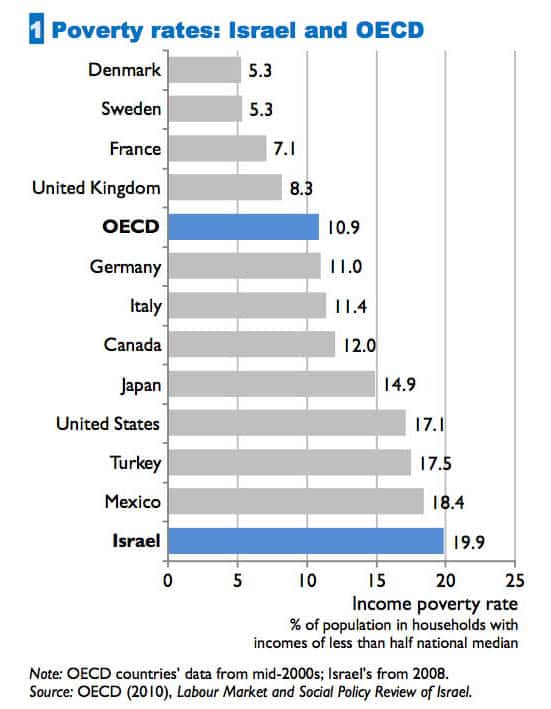
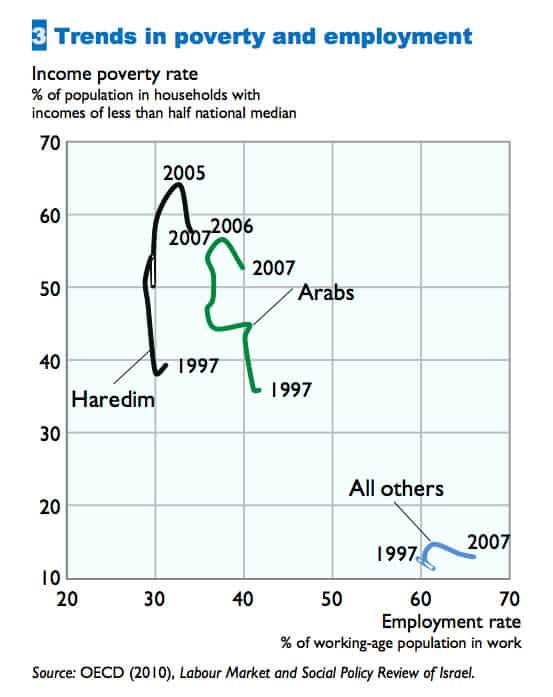
It has pointed out that half of Israel’s Arab citizens are living below the poverty line, a rate three times higher than among Israeli Jews, and that on average Arab citizens earn salaries that are one-third less than Jews. Mohammed Zeidan, head of the committee, blamed the disparities in wealth on what he called Israel’s “racist and discriminatory polices.”
Another OECD report, published in January, showed that, even on the basis of Israel’s figures excluding the Palestinians, Israel would still have the widest social gaps of any member state if it were accepted.
Jonathan Cook is a writer and journalist based in Nazareth, Israel.
Twilight zone / Unanswered questions
By Gideon Levy | Haaretz | March 4, 2010
Musa Abu Hashhash could not hold back his tears. We have worked with this devoted field worker from B’Tselem, the Israeli Information Center for Human Rights in the Occupied Territories, for years. Never before had we seen him cry. But this week he broke down and wept after a visit to the widow of Fayez Faraj, his aged, broken-hearted mother, and his 10 distraught orphans, aged 2 to 18.
Fayez Faraj was the last person who might have been expected to attack Israel Defense Forces soldiers. He had a permit to enter and sleep over in Israel, which few Palestinians are given – and then only after a thorough security check. He had worked for 15 years for Kriza, a footwear company in Tel Aviv, crafting soles for the women’s shoes. Aged 41, he spoke Hebrew fluently, hung out in Tel Aviv, had Israeli friends, was well-off economically and lived in a relatively spacious stone home.
No one in Hebron believes that Faraj attacked the soldiers. One of his Tel Aviv employers, who asked to remain anonymous, also refuses to believe it. A., the Israeli, spoke to Faraj by phone three hours before he was killed, an ordinary business conversation.
“I don’t believe he went to stab a soldier,” A. told Haaretz this week. “I have worked with him for 15 years. I know he was a good guy. Someone who loved life. He wasn’t embittered. I can’t understand how he got into a situation where soldiers killed him. It’s a kind of fate, a screwed-up fate. It’s true that he was slightly depressed lately, because he was in a financial crisis, but the whole story is puzzling, very puzzling.”
A. is not the only one who’s puzzled. It’s strange that the soldiers fired no fewer than seven bullets into Fayez from short range, three into his leg, three into his stomach and one into his left hand, in three volleys; that they went on shooting him after he lay on the ground, blood streaming from his leg, in which a major artery was hit; and that they pulled him – still alive – out of a Palestinian ambulance, and transferred him into an army Jeep and then into an Israeli Magen David Adom ambulance. And above all, there is the question of whether Faraj attacked the soldiers with a knife, as the IDF claims, or whether we should believe the testimony of a young woman who watched the incident from the roof of her house and says the soldiers took the knife from their Jeep in order to incriminate Faraj.
These are all serious, unsettling questions. A Military Police investigation is under way.
The Israeli media barely reported the killing of a Palestinian civilian by IDF soldiers in the heart of Hebron exactly three weeks ago today. A dead Palestinian is a non-story. This week we visited the meager home of his brother Samir, a policeman in the Palestinian Authority, a few dozen meters from the family workshop and from the site of the killing. There we heard about Fayez’s last day and about the circumstances of his death.
At about 12:30 P.M. that Friday, Fayez visited his brother and asked Samir to help out in the workshop. Samir said he was expecting guests and would come to work after they left. Fayez went on to their mother’s home, had lunch there and hurried to the workshop at the corner of the street below Samir’s house.
At about 4 P.M., Samir heard gunshots from the street and rushed down to see what had happened. He encountered a group of soldiers who threatened him with their rifles and ordered him to move off. He tried to approach from a different lane, but again soldiers stopped him. In the meantime, he heard that a wounded man was lying on the road, bleeding.
Samir phoned Tarek Watan, whose barbershop is opposite the scene of the incident, and learned that the wounded man was his brother Fayez. Watan told Samir that the soldiers were continuing to shoot Fayez every time he tried to lift his head. In the meantime, more IDF troops rushed to the scene in Jeeps and fired tear-gas and stun grenades to disperse the crowd that had gathered. Samir shouted to the soldiers that he wanted to see his brother, but to no avail.
A few minutes later, a Palestinian Red Crescent ambulance arrived and Samir saw Fayez being placed in it, still alive. As the ambulance started to pull away, soldiers ordered the driver to stop. The Palestinian paramedic Eid Abu Munshar stated in his testimony to two B’Tselem field workers who arrived on the scene, that the soldiers entered the ambulance and pulled the IV from Fayez’s arm. He said Fayez was suffering from a massive loss of blood and time was critical.
Aliya Hospital lies a few hundred meters from the scene of the incident, and the paramedic wanted to rush Fayez there. But an IDF officer who arrived at the scene ordered him taken out of the ambulance, the paramedic said. The dying Fayez, with seven bullets in his body, was transferred to an IDF jeep and then placed in an intensive care ambulance of Magen David Adom. According to Palestinian testimony, the ambulance waited there for half an hour. At 5:25 P.M., the Red Crescent received a call from the District Coordination and Liaison Office: Fayez had died in the ambulance; they should send a vehicle to pick up the body at the checkpoint at the northern entrance to Hebron.
What actually happened on the street corner between Tarek’s barbershop and Fayez’s footwear workshop? According to the testimonies compiled by Samir and B’Tselem field workers, the following sequence of events emerges: While Fayez was walking from his mother’s house to the workshop, he ran into a group of men celebrating the engagement ceremony of a neighborhood girl. He stopped to congratulate them just as a group of six soldiers walked by. (The IDF sometimes enters the neighborhood, even though it is in area H1, which is supposedly under Palestinian control.) About half an hour earlier, some people had thrown stones at these soldiers in a different neighborhood, and local residents testified that they seemed tense. The soldiers were coming up one of the lanes and people warned Fayez about them. But Fayez, who was considered a proud man who also spoke Hebrew and interacted with Israelis, replied, “So what if there are soldiers?”
One witness reported that shouts were suddenly heard from up the lane. He saw one of the soldiers slip and fall, apparently because of the steepness of the street. Immediately afterward he saw the soldier get up and shoot Fayez in the leg. Maybe Fayez attacked him, or maybe the soldier thought Fayez had attacked him. He heard Fayez curse the soldiers after being wounded and saw him get up. The soldiers then shot him again. People who had gathered on the street shouted to Fayez not to move, because the soldiers might shoot him again – and they indeed shot him a third time, according to the testimonies.
After Fayez was taken away, Samir asked an officer what had happened. The officer, known as “Captain Moshe,” said his brother had tried to stab one of the soldiers, and showed him a knife. Samir told the officer that this made no sense – if Fayez had wanted to stab an Israeli he could have done so in Tel Aviv. Moreover, he had not taken a knife from the house. The officer told Samir that Fayez was in serious condition and had been taken to Hadassah Medical Center in Jerusalem.
Shortly afterward, an officer who identified himself as “Captain Rafi,” possibly from the Military Police investigations unit, arrived, and asked Samir about his brother’s mental state. Samir told him that “Fayez’s intelligence is bigger than both of ours” and that he had never had mental problems. Together, they questioned the eyewitnesses at the site, all of whom said they had seen no knife in Fayez’s hand. A young woman of 19, Bian Julani, who was on the roof of her home when the incident occurred, told Samir – and, he says, also Captain Rafi – that she saw the soldiers shoot Fayez three times. She also claimed that she saw a soldier wearing gloves take a knife out of the army jeep.
In the meantime, the soldiers confiscated the camera of Abu Hashhash, who arrived on the scene, and returned it to him with all the photos deleted. “As a police officer,” says Samir, “I can tell you that in any event, six soldiers could have subdued Fayez without killing him. It was murder in cold blood.”
Soldiers tore down the posters hung in Fayez’s memory on walls at the scene of the incident. At the entrance to his home, located in another part of the city, a large parrot whistles – Fayez bought it in Tel Aviv. Ten children wander about the house, and their grandmother, Maisar, bursts into tears. “Will someone with 10 children go with a knife?” she asks, and the question echoes through the room. Ibtisam, the widow, is due to give birth any day now. She is carrying a boy. His name will be Fayez, of course.
No comment from the IDF Spokesman was received by press time.
Israeli forces raid Al-Aqsa compound
Ma’an – 05/03/2010
Jerusalem – Dozens of Palestinians were injured as Israeli forces entered East Jerusalem’s Al-Aqsa Mosque compound following the weekly Friday prayers, firing tear gas, rubber-coated bullets and stun grenades.
At least 15 Israeli police officers were also injured by rocks thrown by Palestinians, Israeli news reports said. Some 200 police officers appeared on the scene, clashing with worshipers in the Haram Ash-Sharif, or noble sanctuary, which houses the mosque.
Forces were seen striking Palestinians with batons, injuring a number of elderly worshipers, and closed off gates into the Old City even before clashes erupted, preventing some worshipers from reaching the site.
The number of injuries amount to more than 60, among them a woman who sustained injuries after being shot with a bullet in the eye, while others sustained injuries to the feet, chest and hands when attacked with rubber-coated bullets.
Israeli forces were also seen preventing crews of Palestine Red Crescent medics from reaching and treating those who were injured.
Clashes erupted between Palestinian teenagers and Israeli forces at several gates leading into the Old City, most prominently at the Mughrabi Gate leading to the mosque, as well as the Huta Gate and the yard of the mosque compound itself.
The compound is the third holiest site in Islam, believed to be the location where the Prophet Muhammad ascended to heaven and returned. The site is the holiest for Jews, who believe it to be the site of the Second Temple, destroyed by the Romans in 70 AD, and is referred to by Jews and Israelis as the Temple Mount.
The compound is a frequent site of clashes, as tensions run high in the Old City over Israeli excavations and rumors of settlers amassing at the site. Seven Palestinians were detained as clashes erupted last Sunday, with Israeli forces storming the site with discord reported throughout the Old City of occupied East Jerusalem.
Israeli police spokesman Mickey Rosenfeld said at the time that “tourists entered the Temple Mount and were attacked by 20 masked Palestinians, throwing stones. Police immediately responded to disperse them.”
Rosenfeld said police did not enter the Al-Aqsa Mosque, but surrounded the compound. He added that “1,000 tourist visits continue” in the area.
Over 200 Israeli soldiers and police surrounded the mosque, using loudspeakers calling on worshipers to evacuate the site, Ma’an’s correspondent said. Palestinians responded by using the loudspeakers in the mosque, used to call Muslims to prayer, to urge Palestinians to head to the city.
At the beginning of the week, extremist groups called on sympathizers to gather at the Buraq square, known to Israelis as the Wailing Wall, and march on the Al-Aqsa compound. Palestinians spent the night in the mosque to prevent their entry, it was reported.
In response, national and religious leaders in Jerusalem and in Israel urged Palestinians to prevent the anticipated take-over by amassing at the mosque to prevent the entry of extremists.
Disturbances at the mosque are a central reason for the escalation of tensions between the two sides, the Palestinian Centre for Human Rights (PCHR) said Monday in a public condemnation of a prior breach of the holy compound.
While Israeli reports of the incident placed blame for Sunday’s clashes squarely on Palestinians, PCHR investigations affirmed eyewitness accounts and local news coverage contending that hundreds of Israeli settlers and their supporters, escorted by Israeli security forces, had entered the mosque compound, sparking clashes.
PCHR condmened the breach in the “strongest possible terms,” and further slammed the “use of excessive force” by Israeli forces against Palestinian civilians who had gathered inside the mosque or attempted to prevent “the provocative entry of settlers into the mosque.”
In its condemnation, the organization noted heightened concerns over Israeli control of traditionally Palestinian holy sites, following the declaration by Israeli Prime Minister Benjamin Netanyahu the previous Sunday, of sites within the West Bank as “Israeli heritage” locations. The move sparked fears that Israeli forces would further limit Palestinian access to the landmarks.
“PCHR strongly condemns all disruptive measures taken by [Israeli forces] in East Jerusalem … [and] calls upon the international community to immediately intervene to force Israel, the occupying power, to stop such measures.”
Oops, Our Bad!
By Jeff Huber | March 02, 2010
Among the worst Orwellian deceptions being exposed by the Pentagon’s Marjah offensive is the ludicrous notion that we’re fighting a war in Afghanistan in order to protect Afghan civilians. The recent U.S. Special Forces air strike in the Marjah area that killed 27 or more civilians, including four women and a child, is a prime example of a cognitive disconnect that has been endemic in U.S. military operations throughout our misnamed war on terrorism.
The Feb. 21 air strike occurred in an area under Dutch control. The Dutch are durn-burnit het up about that, because the day before, the Dutch government collapsed over an initiative to extend the deployment of the country’s 2,000 troops in Afghanistan. (We could learn something from the Dutch on how to throw a peace movement, couldn’t we?)
A Dutch Defense Ministry spokesmodel, who talked to the press at the Hague on what the New York Times described as “customary anonymity,” said it wasn’t any Dutch boy who called in that air strike. The Dutch Defense Dude wouldn’t say who did call in the air strike, and unidentified NATO officials didn’t say who ordered the strike in either. Sadly, it’s just possible that nobody knows who called in the air strike. If that’s the case, though, the operations types running the show over there are bigger screw-ups than I thought they were, and I already thought they were colossal screw-ups.
The NATO officials did, however, release a statement that said, “After the joint ground force arrived at the scene and found women and children, they transported the wounded to medical treatment facilities.” It’s a good thing the NATO guys made sure everybody knows they took care of the civilians they wounded; otherwise, the Afghans might have gotten mad about all the civilians they killed.
Gen. Stanley McChrystal, head hatter of the Marjah madness, expressed his “sorrow and regret” over the civilian deaths to Afghan President Hamid Karzai. This happened moments after McChrystal won two out of three falls from a crocodile in a crying contest. Dead civilians? Oops, my bad.
McChrystal’s been wearing a bleeding-heart mask ever since his confirmation hearing in June 2009 when he fed the Senate Armed Services Committee that line of coke about how “the measure of effectiveness will not be enemy killed. It will be the number of Afghans shielded from violence.” McChrystal then turned around and, in his first major action as commander in Afghanistan, launched an offensive in Kandahar province designed to kill the enemy.
The Pentagon (i.e., Gen. David Petraeus and his minions) sold McChrystal to the Senate as a counterinsurgency expert. McChrystal was and is nothing of the kind. From 2003 to 2008, he commanded the Joint Special Operations Command, the super secret outfit that reported directly to Dick Cheney and that specialized in targeting, tracking, and assassinating suspected terrorists in Iraq, Pakistan, and Afghanistan.
You can bet a shiny new Missouri quarter that for the five years Stan the Man and his Howling Commandos were running amok in the west end of Asia they whacked a whole lot of mommies and babies more or less by mistake. McChrystal has more blood on his hands than Lady Macbeth. His apology to Karzai for the recent collateral deaths, like his confirmation hearing statement about protecting Afghan civilians, was a talking point crafted for him by the likes of Rear Adm. Gregory “Word” Smith, a career bull-feather merchant who is now McChrystal’s propaganda czar.
Smith no doubt had a lot to do with fabricating the “tactical directive” McChrystal promulgated in June 2009 that ordered a “new operational standard” to “minimize the use of deadly force” as a measure to protect Afghan civilians. Smith briefed the press that not only would McChrystal cut back the air strikes, but ground troops would refrain from “firing on structures where insurgents may have taken refuge among civilians” unless, of course, “Western or allied troops are in imminent danger.”
The assertion made by Smith and other war merchants that we can separate the “enemy from the people” in a scenario like the one we have in Afghanistan is hallucinatory. The Taliban and other militant groups in Afghanistan didn’t invade the country. There may or may not be foreign fighters in theater looking for an opportunity to sock it to Uncle Sam’s infidels, but this insurgency, like pretty much all insurgencies, is a home-based enterprise. What’s more, just about everybody in Afghanistan and Pakistan is related to somebody who totes a gun for the guerillas, so separating the “civilians” from the insurgents would involve splitting genetic material. As one Pentagon planner has aptly noted, “It’s harder to separate the enemy from the people when they are the people.”
Hence, when you bump against insurgents, you bulldoze civilians, and if the insurgents are fighting you, you are bound by the U.S. Standing Rules of Engagement that command you to defend yourself and your unit. And if you’re in danger, which you are the moment you’re in a firefight you can’t withdraw from, you call in an air strike to bail you out of it.
So the June 2009 order to limit air strikes didn’t limit air strikes at all. In fact, at the time the directive was issued, one of McChrystal’s advisers said the order didn’t mean the use of air power would be reduced. It just meant, as the Los Angeles Times related, that the “emphasis” would be on “protecting civilians rather than killing insurgents.”
What kind of air strike emphasizes protecting civilians? The kind that drops leaflets that say “Have a Nice Day” in Pashto? And if the emphasis of an air strike isn’t to kill insurgents, why call it in to begin with?
McChrystal has now issued a new directive that will, as the Boston Globe puts it, “limit night raids on civilians.” What in the wide world of sports are they conducting night raids on civilians for? McChrystal says, “We didn’t understand what a cultural line it was” to burst into civilian Muslims’ homes. We’ve been busting into Muslims’ homes for nearly a decade now to disastrous results. How could McChrystal or anyone not understand what a cultural line it is to cross? How could anyone not understand what a line it is to cross in any culture? Does McChrystal think maybe the Jews in Berlin liked it when the Gestapo kicked their doors in? Will Americans like it when Chinese bill collectors come for their high-definition TVs and bargain barn furniture?
Like the directive on air strikes, the directive on night raids is classified so we can’t see what it actually says, but Lt. Col. Todd Breasseale, a NATO spokesmodel, tells us it “does not limit the ability of troops to operate.” It’s just that the emphasis of raiding civilian’s homes will now be to protect the civilians who live in them, not to kill insurgents.
It’s entirely possible that the personality disorders with life-support systems that run our military truly believe the lies they tell us, but that doesn’t excuse them. It merely makes them pathological liars, along with the other malignant things they are.
Palestinians slam City of David as East Jerusalem parking lot caves in
By Nir Hasson – Haaretz – 01/03/2010
A section of an East Jerusalem mosque parking lot collapsed on Monday, in what local Palestinian residents are saying is proof that archeological digs in the area are putting residents’ homes at risk.
The 4-meter deep pit was created near a mosque in the East Jerusalem neighborhood of Silwan, in a parking lot serving worshipers, located near a local kindergarten.
Two months ago, the Supreme Court rejected a petition against the dig directed by Elad, the nonprofit organization that runs the City of David in East Jerusalem and, submitted by Palestinian residents, saying the archeological digs did not jeopardize Silwan houses or local roads.
The City of David is one of the most popular tourist attractions in Israel, and Elad is in charge not only of operating the site, but also of conducting archaeological digs there.
Its leftist critics charge that it exploits archaeology in order to Judaize the neighborhood and embitter the lives of its Palestinian residents.
Elad counters that local Palestinians have also benefited from the City of David’s success as a tourist site.
Russell Tribunal aims to hold the international community to account
Frank Barat, The Electronic Intifada, 1 March 2010
Today, the first session of the Russell Tribunal on Palestine (RTP) will be held in Barcelona. The RTP is a peoples’ tribunal focusing not on Israel’s obligations under international humanitarian law (IHL) such as the Fourth Geneva Convention, but on the obligations of the international community of signatory states which sustain and enable Israel’s continuous violations of international law.
Israel has violated more than 60 UN resolutions and countless legal and diplomatic calls to abide by international law in relation to the expansion of illegal settlements, denial of the right of return and the continuing occupation of the West Bank, including East Jerusalem, the Gaza Strip and the Syrian Golan Heights. Dozens of reports, investigations and inquiries have produced evidence of alleged Israeli war crimes and crimes against humanity, including massacres, collective punishment, home demolitions and extrajudicial killings on a cyclical scale over the past 62 years.
In 2004, the International Court of Justice (ICJ) issued an advisory opinion finding Israel’s wall in the West Bank illegal and contrary to international law. The opinion was the key tenet of a 54-page document covering illegal settlements, the appropriation of natural resources and Israel’s violation of the Fourth Geneva Convention over the past 40 years, and reminded that IHL signatory states had an obligation “not to recognize the illegal situation resulting from the construction of the wall and not to render aid or assistance in maintaining the situation created by such construction” and “to ensure compliance by Israel with international humanitarian law as embodied in that Convention.”
The ruling sparked hopes in the Palestinian community and international solidarity movements that finally, not only had Israeli violations been legally judged but that the responsibilities of the states which enable Israeli impunity to continue would be put to the test. Six years and 500 kilometers of wall on, the continued construction of the wall casts a shadow over international law.
Or does it?
The RTP is an independent initiative which intends to generate a public literacy in international law and the possibilities for the rule of law if respected to dismantle and disempower the reproduction of the occupation as a military, cultural and economic movement.
Israel is an international entity, kept afloat not just financially and politically by international state partners and supporters, but “legally” by the continued legitimization of illegal acts and “facts on the ground” by these states. Israel’s most important market is not economic or military — it is the market of legitimacy, the permission it receives to normalize crimes against humanity to its own citizens and the international community. This can only happen with the complicity of non-IHL compliant states. The RTP is a way of publicly pointing the finger at these states and mobilizing public opinion towards holding them accountable for the ongoing human rights violations in Palestine.
The RTP is composed of four sessions. The first in Barcelona from 1-3 March, focuses on establishing whether the European Union as an entity has fulfilled its obligations under international law. At the end of 2010, a London session will scrutinize the complicity of corporations in normalizing and perpetuating Israel’s violations of international law as well as labor rights in Palestine/Israel. In mid-2011, a session in South Africa will examine the applicability of the crime of apartheid in the context of Israel. The final session will be held in the United States in late 2011 and will analyze the role of the US within the United Nations and decision-making processes on issues of violating international law.
The RTP is not a talking shop. For too long Israel has been the focus of international campaigning as if it alone is responsible for the oppression of the Palestinian people, and as if it has been acting alone. The RTP is about making the links between the crimes committed on the ground in Palestine and their international sponsors. If we want to popularize the notion of “normalization” of the occupation as a key obstacle to a just peace, then understanding how this “normalization” operates on an international legal level in the corridors of Washington, Brussels and London, as well as Tel Aviv, is a vital part of challenging it.
As Israeli think tanks and lobby groups bemoan the rise of “delegitimization” of Israel on a popular level within Europe, the actual, pragmatic delegitimization of Israeli criminal policies is still unrealized and unimplemented by countries that have not just the means but the obligations to do this. The RTP contributes to the growing movement for boycott, divestment and sanctions by popularizing the facts behind the arguments for why states have a responsibility to implement sanctions against Israel, and for companies to withdraw from illegal projects and for the public to boycott Israeli institutions, goods and the normalization of apartheid.
The Geneva Conventions were created and agreed upon by the countries of the world in 1949, under popular pressure, as the legal means to ensure that crimes against humanity committed around the world during the Second World War would never happen again. The principles and tenets of these laws are being violated by Israel continuously. These laws stem from liberation struggles and sacrifices of movements in the past, and are on our side, the side of the people. We can use these laws as guides to build the conditions for genuine justice and universal human rights, and a world based on solidarity and equality.
Frank Barat is coordinator of the Russell Tribunal on Palestine (http://www.russelltribunalonpalestine.com). A live streaming of the session can be viewed here: http://www.bcnsolidaria.tv/tv/ and a list of jury members as well as experts and witnesses participating in the tribunal is available for download (PDF)
39 army raids, 28 arrests: Just another day in the West Bank
Amira Hass | Haaretz | March 1, 2010
“The year 2009 was the quietest for Israelis from the security point of view and the most violent for the Palestinians from the point of view of attacks by settlers in the West Bank.” Just as he was saying this – as an example of one of the absurdities that characterize the political situation – Palestinian Agriculture Minister Ismail Daiq received a phone call from the Jenin district to inform him that five artesian wells in the village of Daan had been destroyed that morning. One person was shot and wounded in the abdomen when he tried to lift the pump to save it from damage. This was not an attack by settlers but a raid by the army.
And that wasn’t the only routine event on Wednesday, February 24. The negotiations affairs department of the Palestine Liberation Organization collects information daily from all the districts of the occupied territories (Gaza and the West Bank, as well as Jerusalem) and publishes it in a daily situation report by the Palestinian Monitoring Group. For the sake of convenience, the report categorizes the events and then provides details for each district.
That Wednesday, a total of 212 occupation-related incidents were recorded. Examples include: four physical assaults (which took place in the West Bank, and included civilians being beaten in Nablus and Jerusalem); one injury (a civilian hurt in a clash in Daan); eight military shooting attacks (two of which took place in Gaza, two were in the midst of raids, and one came from a military outpost; 39 army raids (one in Gaza); 28 arrests; and 12 detentions at checkpoints and in residential areas. The items on the checklist include home demolition (none that day), the leveling of agricultural land (one, in Gaza), and construction of the separation wall (at 22 locations).
The report also includes categories for property destruction (seven cases, including the destruction of wells and crops); checkpoint closure (eight cases at five checkpoints, including instances of impeded access); mobile (“flying”) checkpoints (23); permanent closure of village access roads (seven); closure of main roads (40, (including four in Bethlehem and 14 in Hebron, and the village of Jaba east of Ramallah); closure of main crossing points (four, including the permanent blockade of Gaza); disruptions at school (three cases, including the throwing of two tear gas canisters); violence on the part of settlers (one, in Sheikh Jarrah); demonstrations (one, in Hebron). The checklist also includes Palestinian attacks (none on that day).
The philosophy behind the situation report is clear. An “event” is not just a fatality, assault, shooting or demolition. It is something that entails permanent damage, and stems from the policy of imposing closures, building the wall and maintaining the blockade of the Gaza Strip. But even without these occupation-related items, the vast majority of the incidents are not made known to the vast majority of Israelis.
No statistics can express the emotional and social distress that accompanies every event and non-event, such as the incarceration of 1.5 million people inside the Gaza Strip or the fact that tens of thousands still have not been able to reconstruct homes that were damaged during the Israel Defense Forces offensive in the winter of 2008-2009. Even without asking, it is possible to know that the reason for the destruction of the wells in the Jenin district is that they were dug “without a permit.” But the sovereign that destroys is also the one that controls the water resources and decides on an unequal division of water between Palestinians and Israelis. The statistics do not include the practical difficulties that stem from this discrimination or the permanent insult it creates.
In 2009, Israel destroyed 225 Palestinian homes in the West Bank and uprooted 515 Palestinians from their homes, the United Nations Office for the Coordination of Humanitarian Affairs reported. Thousands more in Area C and in Jerusalem live in constant fear that their homes will be destroyed and they will be uprooted from their places of residence.
How does one count fear? Like the fear that was felt in the homes of some 700 minors the IDF arrested in 2009. The Palestinian branch of Defence for Children International represented 218 of these minors. Forty were released, 28 on bail and 12 without conditions. Seven minors were kept in administrative detention – that is, they were detained without a trial. A total of 192 were brought to trial, of whom 23 were aged 12 or 13, and 46 were 14 or 15. The majority – 123 minors – were aged 16 or 17.
Sentences of less than six months were imposed on 121 of those arrested – 63 percent – while 31 of them received sentences of between six months and a year, and 32 were sentenced to between one and three years. Eight of the minors were jailed for more than three years.
The majority (117) were sentenced for throwing stones, 33 for possessing and throwing Molotov cocktails, 11 for being members of a banned organization, eight for conspiring to kill, seven for possessing and hiding explosives, and 16 for possessing and manufacturing weapons.
For the moment, let us not discuss the arrests and trials of the military system, which is said to be a way of maintaining law and order but actually maintains the occupation. Let us put aside, for now, the fact that in military tribunals it is often advisable to admit to offenses the defendant did not commit, since the detention time while the proceedings are underway might end up being longer than the actual sentence for the alleged offense.
But how is it possible to quantify the personal and collective rage expressed by the stones being thrown and created by Israel’s military tribunal system?
Any news item we report that deals with Israeli rule over the Palestinians is misleading. It creates the impression that whatever has been reported is all that has happened on the Palestinian side and that otherwise everything is normal, or even flourishing. Any news item that is published in Israeli papers is a sign of what is missing, what no one wants to know.
Israel effectively pressuring Palestinian Bedouin community to leave the Jordan Valley
B’TSELEM | February 2010
Al-Hadidiyeh – The Jordan Valley is classified as Area C and is, therefore, under complete Israeli control. Israel has imposed harsh restrictions on building and movement there that apply to Palestinians alone, effectively pushing them to leave area.
The Civil Administration does not allow Palestinians to build in Bedouin areas in the valley and systematically demolishes the temporary structures in which they live and raise their flocks. The army limits the movement of Palestinians between the valley and the rest of the West Bank, allowing only Palestinians registered as residents of the valley to enter it in private vehicles. Palestinians from elsewhere in the West Bank are allowed to enter only on foot or by public transportation. The separation of the Jordan Valley from the rest of the West Bank severely infringes the human rights of many Palestinians.
The Bedouin community of al-Hadidiyeh is situated in the north of the Jordan Valley. The settlements Ro’i and Beka’ot were built east of it, partially on its farmland. ‘Abd a-Rahim Bsharat, 60, who has lived in the community his whole life, estimates that there are ten families, a total of 91 persons, now living in it, in three small clusters. The residents, like those of many other small Bedouin communities in the Jordan Valley, gain their livelihood by raising sheep and goats and by working their land.
In the census taken by Israel in 1967, the authorities registered all persons living in the area as residents of the nearby towns of Tammun and Tubas. Therefore, there is no official information on the number of residents who lived in al-Hadidiyeh at the time. Bsharat estimates that before 1967, there were about 2,500 residents, some of whom fled to Jordan after the war.
Since the mid-1970s, Israel has pressured the residents to abandon their land, along with establishing settlements in the area. Bsharat describes how the army fined shepherds who grazed their flocks on land near the settlements, and how, in some instances, soldiers fired at the flocks, killing several sheep and confiscating animals. In recent months, B’Tselem has documented several cases in which residents of al-Hadidiyeh claimed that the security coordinators of Ro’i and Beka’ot assaulted or harassed them while they were grazing their flocks, in an attempt to distance them from the settlements. The testimonies paint a worrisome picture of army and police support for the security coordinators’ harassment of the shepherds.
Three years ago, the Israeli High Court of Justice ordered that the residents of al-Hadidiyeh be removed from their homes, accepting the position of the Civil Administration that the residents were living on land classified as “agricultural” in plans drafted by the British Mandate in the 1940s. The High Court also accepted the state’s position that their living on the site posed a security threat because of its proximity to the Ro’i settlement.
In recent years, the Civil Administration demolished the shacks of the Bsharat family and others in the community four times. Currently, the Civil Administration threatens to demolish all the shacks in the community yet again.
Click here to enlarge map

Map: the small community of al-Hadidiyeh and the settlements built near it.
The harsh restrictions Israel places on movement of Palestinians in the Jordan Valley make life very difficult for the residents of al-Hadidiyeh. In addition to the general restrictions, the army has blocked access from the community to the Alon Road (Route 578), by placing a dirt pile on a connecting dirt road that crosses fields cultivated by Ro’i settlers. To reach the Alon Road, residents of al-Hadidiyeh must cross through part of the Ro’i settlement itself, and when the gate to the settlement is closed, they have to travel a much longer route, which runs between Ro’i and Beka’ot.
Residents of al-Hadidiyeh receive all their services from the towns of Tammun and Tubas, which are situated in Area A. The shortest way to the two towns is along a dirt road leading to Tammun, a trip that takes 15 minutes. The army placed a gate on the road that it opens only twice a week, at set times in the morning and afternoon. Only persons registered with the army as residents of the area, including residents of al-Hadidiyeh, are allowed to pass. At other times, the residents must drive to the Hamra checkpoint, about 30 minutes’ travel south of al-Hadidiyeh, and from there north to Tammun or Tubas, a trip that takes another 30 minutes.
Persons requiring medical treatment also have to use this route. The army does not allow Palestinian ambulances to cross the Hamra checkpoint to go to Palestinian communities in the Jordan Valley, even in emergency cases. The ambulances have to wait at the checkpoint for the patient to be brought to them.
The community has no school, and to get to their schools in Tammun, the children from al-Hadidiyeh have to travel the long way via the Hamra checkpoint. To enable them to attend school regularly, many of the children spend weekday nights with relatives in Tammun.
The residents of al-Hadidiyeh also have trouble marketing their produce throughout the West Bank since it is hard for West Bank merchants to reach al-Hadidiyeh and nearby communities.
Al-Hadidiyeh is not hooked up to the power grid and does not have running water. The nearby settlements, on the other hand, are hooked up to the Israeli power grid and are supplied water by the Beka’ot 1 Pumping Station, which was built by the Israel’s water company, Mekorot. Although the pumping station is adjacent to their land, residents of al-Hadidiyeh have no choice but to buy water from private contractors, who come to the area every few days and charge up to 200 shekels for 10 cubic meters of water, four times the price Mekorot charges in Israel and in the settlements.
Israeli troops storm and encircle Aqsa Mosque
|
 |
|
OCCUPIED JERUSALEM — The Israeli occupation forces (IOF) on Sunday stormed the courtyards of the Aqsa Mosque and cordoned off its premises where dozens of Palestinian worshipers are still maintaining a vigil and refusing to leave for fear of attacks by Israeli extremists. Eyewitnesses said that more than 200 Israeli policemen have encircled the Aqsa Mosque since the early morning hours and demanded the worshipers come out, while the Palestinians inside the mosque used the amplifiers of the Mosque to urge fellow citizens to head to the Old City of occupied Jerusalem to defend it against Israeli violations. Many unruly Israeli settlers were allowed by policemen to walk around in the Mosque courtyards. 12 Palestinian citizens including an elderly woman outside reportedly suffered tear gas suffocation as they were trying to reach the Aqsa Mosque. Meanwhile, the neighborhoods of the Old City of Jerusalem saw clashes between young Palestinian men and Israeli troops. Numbers of protesters were reportedly rounded up. Other Palestinian citizens living in the neighborhoods near the gates of the Aqsa Mosque complained that the IOF troops stormed and ransacked their homes, and used the roofs to observe the movement of people. For his part, Hamas spokesman Yousuf Farahat on Sunday appealed to all Muslim scholars and leaders to urgently move to defend Jerusalem and the Aqsa Mosque against Israeli crimes. In a press release, Farahat noted that the feeble official Arab stand is the umbrella under which the Israeli occupation is working and setting schemes to Judaize the whole city of Jerusalem. In a related context, the Israeli occupation authority (IOA) announced the launch of a 30-month project to fully change the Arab landmarks and sites in the holy city. Al-Jazeera website said that Israel claims that this project is intended for developing the infrastructure of the city, but in fact it is aimed to obliterate its Arab identity and turn it into a Jewish religious area. For its part, the Israeli Maariv newspaper warned that the winds of war are blowing from the north and castigated the Israeli premier for his failure to control the angry protests against his decision to seize the Ibrahimi Mosque in Al-Khalil city. It opined that if there had been negotiations with Syria, the Iranian president would not have visited Damascus and the danger of war would have subsided. ###
|

US soldiers kill Iraqi tribal chief’s son
Dawn Media | February 27, 2010
AQUBA: US soldiers killed an Iraqi tribal chief’s son and wounded his wife in what the Americans on Saturday called a tragic accident, although local accounts of the incident differed.
US troops were travelling through the district of Kanaan, northeast of Baghdad, late on Thursday when Zhaheri tribe chief Thaher Zaihud al-Zhaheri’s son, Ahmed, walked outside the family’s front door and was shot dead, the tribal leader said.
Further gunfire wounded Zhaheri’s wife in the leg.
According to the US military, American soldiers were conducting a reconnaissance patrol ahead of a combined operation with Iraqi security forces when the “tragic accident” occurred.
“Villagers responded to what they thought were intruders and began firing in the darkness, which caused other residents to come out of their homes and also fire their rifles,” a statement said.
“Thinking they were under attack, the US soldiers returned fire to protect themselves. Regrettably, as a result of this gunfire exchange, a young man was killed and a woman was wounded.”
The statement said an investigation had been launched.
According to Zhaheri, however, there was no shooting prior to the family hearing a noise near their home and they thought there might be thieves in their village, Saisabanah.
“Ahmed went outside and when he opened the door and walked outside, the Americans shot and killed him,” he told AFP.
“They continued shooting at our house and one bullet hit my wife’s leg.” Zhaheri’s account of the incident was repeated by an Iraqi military officer in Diyala’s provincial security operations centre.
Saisabanah is a village of around 10 houses, and families there are known to have fought US forces since the 2003 invasion.
Zhaheri’s wife Sabiha Nahath Saud, 56, was in stable condition, according to Ahmed Alwan, a doctor at the main hospital in Baquba, Diyala’s provincial capital.
Israel approves 600 more homes in occupied East Jerusalem
Ma’an – 26/02/2010
Bethlehem – Israel’s district planning commission approved the construction of 600 new settlement homes in occupied East Jerusalem, Israeli media reported on Friday.
The homes are tipped for construction near the illegal Pisgat Ze’ev settlement and the Palestinian neighborhood of Shu’fat, the Israeli daily Haaretz reported.
The number was scaled back to 600 from the original 1,100 when it was revealed that much of the land was owned privately by Palestinians, according to the daily.
Meanwhile, two homes in the adjacent Palestinian neighborhood of Beit Hanina were slated for demolition, while eight families in Silwan were handed orders announcing their homes were to be demolished, as Israeli municipality workers entered the area accompanied by military guards on Wednesday.
Settlement construction in East Jerusalem is deemed illegal under international law, as Israel’s sovereignty over the eastern part of city, occupied in 1967, is not internationally recognized. Further settlement expansion in the city has sparked international condemnation, as Palestinians throughout the occupied part of the city are served with court ordered home evictions, despite Israeli courts lacking jurisdiction in the area.
The World Court has ruled that all the settlements Israel has built in occupied territory are illegal.
EU court strikes blow against Israeli settlers
By Andrew Rettman | EU Observer | February 25, 2010
The EU court in Luxembourg has ruled that Israel cannot pass off products made by its settlers on occupied Palestinian land as its own in order to get customs perks.
The verdict on Thursday (25 February) came in the case of German soft drinks firm Brita, which buys syrups from Israeli company Soda-Club in Mishor Adumin in the occupied West Bank.
Israeli customs authorities had put forward documents saying that the goods were made in Israel and fell under the customs rules of the EU-Israel Association Agreement.
But the court ruling said Soda-Club should have obtained papers from the Palestinian Authority instead if it wanted any customs breaks.
“Products obtained in locations which have been placed under Israeli administration since 1967 do not qualify for the preferential treatment provided for under that [EU-Israel] agreement,” the court explained in a statement, referring to the 1967 Six-Day War.
The ruling sets an EU-wide precedent for Israeli imports to the union, worth €8.8 billion last year.
It is unlikely to have a big financial impact, however. The European Commission says that exports from settlements currently account for just 0.87 percent of the trade volume and are in many cases labeled as such, meaning they pay full EU customs duties.
But the judgment has political weight in the context of long-standing EU complaints that Israeli support for settlers is damaging the Middle East peace process.
Featured Video

New positive ivermectin evidence
or go to
Aletho News Archives – Video-Images
From the Archives
Fanatical Followers of the Covid Regime: A Jim Jones-Style Cult?
By Professor Roger Watson and Dr. Niall McCrae | The Daily Sceptic | November 15, 2021
As scholars at leading British universities over recent decades, we witnessed the replacement of critical thinking and debate by narrative: facts are discrimination and scientific method is imperialism; truth, instead, is derived from ‘progressive’ values. This educational trend may be a major contributory factor to the ease in which society has been inculcated to the Covid ‘new normal’ of masking, testing, and repeated doses of vaccines for a disease of similar risk to severe influenza.
One doesn’t need much critical reasoning to observe the flawed logic of some vaccination enthusiasts, such as people who respond to experiencing any side effects, however debilitating, by saying “at least I know it’s working”, or, after contracting the disease despite their promised inoculation (over 90% effective, according to initial drug company claims), “I’d have been worse off without the jab.” … continue
Blog Roll
 Aletho News
- EU Council Advances Chat Control 2.0 Scanning Proposal
- Ex-Greek MEP files complaint against Israeli spyware firm over alleged Pegasus surveillance
- Troubling ideas throughout the Torah, Talmud, Mishneh Torah and Tanya
- ‘Grave, alarming’: Iran mission on Trump’s UNGA ‘annihilation’ threats
- Najaf airport to reopen to Iranian flights within 24 hours: Ambassador
- From ‘How Will This End For Iran’ to ‘When America Walks Away’: A tale of two Economist covers
- Tehran blasts ‘baseless’ speculation linking Iran to alleged bomb plot at UK air base
- The Rise And… Rise Of ‘Color Revolutions’
- The Coming GOP Bloodbath?
- Arctic Scare Stories Melt Away
- If Americans Knew
- Netanyahu Asked UAE Leader to Deny Report on Oct. 7 Warning in Secret Visit, Sources Say
- CNN Chief Int’l Correspondent Clarissa Ward on Journalists in Gaza
- Democratic Party Consultants Surround Troy Jackson with Pro-Israel Donors
- Christian Leader Responds To Netanyahu’s Claims Regarding Palestinian Christians
- In Gaza, ‘Whoever Survives the Bombing Won’t Survive the Rubble’
- Israel kills more Palestinians, amid push to resettle Gaza – Daily Update
- Israel forces Gazans to live in constant peril – Daily Update
- Deconstructing Netanyahu’s pants-on-fire UN rant – Daily Update
- Trump betrayed voters with his campaign lies and prioritized a foreign country once he took office
- Netanyahu calls Israel’s war in Gaza ‘opposite of genocide’ in UN speech to near-empty hall
- No Tricks Zone
- New Study: Earth And Venus Surface Warmth Largely Explained By Convection And Lapse Rate, Not CO2 Or Radiation
- 2025 Nature Paper Claiming Worsening Global Drought Gets RETRACTED …Heavily Flawed
- New Study: ‘Global Drought Shows No Detectable Recent Acceleration Under Climate Warming’
- Economic Masterminds: German Socialists Suggest Taxing Productivity Gains Stemming From Using AI
- The South China Sea Has Not Been Cooperating With The Climate Change Narrative
- Energy Crisis: Germany Enters Heating Season With Historically Low Gas Reserve Fill Levels
- New Study: The Antarctic Ice Sheet Gained Mass From 2020-2024 Due To Staggering Snow And Ice Accumulation
- Study: Ocean Heating Rates From Thousands Of Years Ago ‘Dwarf’ Modern Ocean Heating Rates
- Climate Extremists Target, Attack Large-Scale Power Grid Infrastructure In Germany!
- New Study: Antarctic Ice Melt Has Contributed Less Than 1 Centimeter To Sea Level Rise In The Last 30 Years

