UN envoy: Heritage sites not in Israel
Ma’an – 22/02/2010
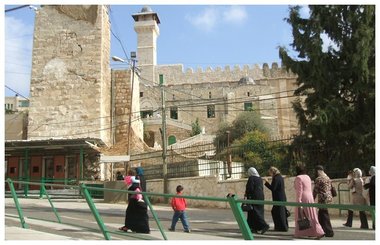
Bethlehem – Robert Serry, the UN envoy for Middle East peace, expressed concern on Monday over Israel’s announcement regarding holy sites in Hebron and Bethlehem and the heightened tensions that have resulted.
“These sites are in occupied Palestinian territory and are of historical and religious significance not only to Judaism but also to Islam, and to Christianity as well,” Serry said in a statement.
“I urge Israel not to take any steps on the ground which undermine trust or could prejudice negotiations, the resumption of which should be the highest shared priority of all who seek peace. I also call for restraint and calm,” he said.
“As I underscored in my visit to Hebron last week, I would like to see more positive steps by Israel to enable Palestinian development and state-building in the area and throughout the West Bank, reflecting a genuine commitment to the two State solution,” he added.
Israeli Brig-General likens IOF to worms
Urbicide by worming: the zionist entity’s cutting edge in military strategy.
_______
Scattered in death as in life
By Nadia Hijab, The Electronic Intifada, 22 February 2010
 |
| The Mamilla cemetery in Jerusalem, 1854. (Wikipedia) |
I carried a handful of ashes from my father’s cremates into the Occupied Palestinian Territories a few years ago, hoping to take them to his hometown, Nablus. At the border, the only available taxi was driven by an Israeli Moroccan Jew. Delighted I was an Arab, he immediately plunged into conversation and pointed out various landmarks along the way to Jerusalem.
“That road,” he said at one point, “leads to Nablus,” indicating the tarmac cutting through the rocky soil as we drove through a desolate area. I asked him to stop the car. Israel often kept Nablus under curfew for weeks on end and I didn’t know if I’d be able to get there during my short trip. On the road to Nablus, I laid the ashes and paid my respects. Back in the car, the puzzled driver wondered what I had been doing. When I told him he asked hesitantly, “Don’t you have rites like ours, including visiting loved ones’ graves?”
I stared at the back of his neck, as brown as my own, as I sought a response. We do have similar rites. It is rare for a Muslim to seek cremation, as in our father’s case, part of the enforced modernity of exile. In fact, at no time is the loss of Palestine more piercing than at a loved one’s passing, reinforcing the realization that, Muslim or Christian, Palestinians are as scattered across the globe in death as in life. But how could one explain 100 years of history in a cab ride? “Yes, but you’ve made it impossible for us to practice ours.”
So it is with special poignancy that I have followed the latest twist in the battle over Jerusalem’s Mamilla Cemetery, a Muslim cemetery known in Arabic as Maman Allah, where the US-based Simon Wiesenthal Center intends to build a Museum of Tolerance, a project stalled by legal and other protests since it began in 2004.
Mamilla is estimated to be over 800 years old and was in continuous use until 1948 when the Western part of Jerusalem was conquered as Israel was created. In the latest Palestinian challenge, representatives of 60 of the oldest and most prominent Jerusalemite families have petitioned several bodies at the United Nations to uphold the international legal obligation to halt the project.
The battle over Mamilla encapsulates many aspects of Israel’s approach to Palestinian rights since the conflict began, and it is worth considering five here.
First, the use of legal garb to shroud illegal acts. In this case, for example, Israel’s high court ruled in favor of the museum project in 2008. However, it turned out that the Israeli Antiquities Authority had withheld its own Chief Excavator’s conclusion that the site should not be approved for construction. Calling the Authority’s conduct an “archeological crime” the Chief Excavator noted, among other things, at least four unexcavated layers of Muslim graves dating back to the 11th century. However, the court has refused to reopen the case.
Second, the overreach. The move on Mamilla spotlights not just Israel’s occupation of Arab East Jerusalem in 1967, but also its original takeover of West Jerusalem. The international community still does not accept Israeli sovereignty over West Jerusalem because the basis for the establishment of the Israeli state — the 1947 United Nations partition plan — provides for a corpus separatum for Jerusalem, as the European Community reminded Israel in 1999.
Third, the ongoing creation of facts on the ground to erase evidence of the indigenous inhabitants. As former Israeli leader Moshe Dayan told Technion University students back in 1969, “There is not one place built in this country that did not have a former Arab population.”
Fourth, the Orwellian use of language to mean the direct opposite of what is intended: for example “tolerance” for “discrimination.” Indeed, the plans for the Museum of Tolerance are replete with irony. At one point, it was suggested that a horizontal barrier be built to separate the museum and the graves to show “respect” — a horizontal separation of the dead comparable to Israel’s vertical separation barriers in the West Bank and Gaza.
Fifth, the delegitimization — not of Israel, which is a secure member state of the UN — but of the Zionist ideology that resulted in Israel’s creation. These actions remind the world that one people was displaced by another. The project architect, the renowned Frank Gehry, has since withdrawn his plans. Further international attention to the Mamilla case can only add to the growing global campaign to boycott Israel until it upholds international law.
Mamilla is not just about family history but also a nation’s history, as Dyala Husseini-Dajani — who comes from one long-established Jerusalem families and married into another — told a journalist while at the cemetery to say a prayer to her forebears. She added, “One day I want to be buried here. And I want my grandchildren to come and say this prayer for me.” As I read those words, I wished the Moroccan Jewish taxi driver would read them too.
Nadia Hijab is an independent analyst and a senior fellow at the Institute for Palestine Studies.
Latest collapse in Jerusalem blamed on Israeli excavations
Ma’an – 22/02/2010

Jerusalem – A street collapse near the entrance of the Bab Khan Az-Zeit market in the Old City of Jerusalem occurred on Sunday, as a result of Israeli excavations in the area, witnesses reported.
“A two by one meter deep hole was left following the collapse,” Ma’an’s Jerusalem correspondent said.
The latest collapse is reportedly related to ongoing Israeli archeological digs around the Al-Aqsa Mosque compound, which have caused a series of cave-ins around the Old City and in East Jerusalem neighborhoods.
The cave-in follows Israeli Prime Minister Benjamin Netanyahu’s decision to include two sites in the occupied Palestinian territories on an Israeli heritage list, The Ibrahimi Mosque in Hebron and Rachel’s Tomb in Bethlehem.
In January, the Al-Aqsa Foundation for Endowment and Heritage reported a street collapse on the main road in the area of Silwan in occupied East Jerusalem, causing a hole in similar dimensions to the most recent cave-in.
According to the foundation, the collapse was related to ongoing excavations by Israeli authorities in the vicinity, apparently on tunnels extending underneath the neighborhood about 700 meters from the mosque compound. Authorities recently removed quantities of dirt and rocks from under Silwan to undisclosed locations, the statement said.
A second collapse was further reported in Silwan in January, by the Wadi Hilwah Information Centre, south of the Al-Aqsa Mosque compound which creating a 12 meter square hole in the middle of Wadi Hilwah street.
Jawad Siam, head of the information centre, said that the latest collapse in Wadi Hilwah took place over a 10 meter deep tunnel and is was few meters from the previous cave-in in January.
A child was injured and a vehicle fell ithrough the site, Siam said, adding that the local Al-Ein mosque, where Israeli excavation has intensified, was flooded as rainwater seeped into the collapsed site.
The Al-Quds Centre for Economic and Social rights said that this incident follows a number of similar collapses in Silwan recently, pointing out that last year, a collapse occurred in a girls’ school, injuring 17 students.
Clashes reported in Hebron over Israeli heritage decision
Ma’an – 22/02/2010
Hebron – Confrontations between Palestinians and Israeli forces were reported in Hebron on Monday, as public figures declare a general strike across the city, amidst growing anger at the Israeli cabinet’s decision to include two religious sites in the occupied West Bank, including Hebron’s Ibrahimi Mosque.
Protesters in the southern part of the city set tires alight, while in the city center, an Israeli military outpost at the entrance of Ash-Shuhada’ street, closed off to Palestinians, was pelted with stones. According to locals, Israeli soldiers used stun grenades against demonstrators.
An Israeli military spokeswoman said that about 100 Palestinians were rioting in the area, “hurling rocks in a violent and illegal riot.” One soldier was lightly injured as a result, she said.
Confrontations reportedly erupted near the Tariq Ibn Ziad school, between students and Israeli soldiers in the southern part of the city.
Students left schools early and rallied across the city calling for an intervention in the “Judaization of the Ibrahimi Mosque.”
Public figures react
In Yatta, south of Hebron, a strike was also called for. Governor of the city, Zahran Abu Qbeita denounced the Israeli decision to include both the Ibrahimi Mosque and Rachel’s Tomb in Bethlehem on the Israeli heritage list, saying it violates Palestinians’ right to access holy sites and impedes efforts to restart the peace process.
The Mufti of Palestine Sheikh Muhammad Hussein said “the occupation has devoted all of its efforts to steal Islamic holy sites in Jerusalem, Hebron, and Palestinian cities to change their Arab and Islamic character to prove the country is Jewish.”
Minister of Waqf and Religious Affairs Mahmoud Habbash said the decision was an attack against Muslims across the world, humanity and civilization as a whole, and reiterated that it would have a negative impact on peace talks.
“This is an attempt to seize Palestinian cultural and religious symbols and use them to serve the Zionist scheme on Palestinian lands, aimed at obstructing the efforts of the Palestinian leadership and the international community to end the occupation and achieve peace in the region,” Habbash said.
In Hebron, Fatah further called for a general strike and condemned the action as an attempt to steal Palestinian heritage and culture. “This is a new crime in the occupation’s lexicon,” a party statement said, which called on Arab nations to break their silence.
The Israeli heritage site list
Following a cabinet meeting on Sunday, Israeli Prime Minister Benjamin Netanyahu announced that two religious sites in the occupied West Bank would be among 150 Israeli heritage sites considered for renovation within his “Plan to Rehabilitate and Strengthen Israel’s National Heritage Infrastructures.”
The upgrade affects Hebron’s Ibrahimi Mosque, known to Israelis as the Cave of the Patriachs, and Rachel’s Tomb in Bethlehem.
Renovation projects are tipped to cost 400 million Israeli shekels (approximately 110 million US dollars).
‘An act of aggression against cultural and religious rights’
Palestinian Authority officials immediately condemned the initiative.
“This announcement is an act of aggression against the cultural and religious rights of the Palestinian people,” said Dr Hamdan Taha, director of the PA Tourism Ministry’s antiquities department, in a telephone interview.
“Instead of making use of heritage to promote peace, it is being used as a means to promote war,” Taha said, maintaining that the proposal’s timing could not be discounted: “This is clearly intended to obstruct the peace process.”
Also noting that the shrines in question are holy to many faiths, Taha insisted that Netanyahu’s plan to designate them as Israeli heritage sites “reflects an artificial history that solely serves Israel’s settlement policy.”
Dutch troops to pull out of Afghanistan by the end of year after coalition falls
Dutch troops will almost certainly be withdrawn from Afghanistan this year following the collapse of the coalition government in The Hague.
The Telegraph | February 20, 2010
The government fell because of a dispute between its main partners over how long its soldiers should stay in the war.
A withdrawal, expected to begin in August and be completed by December, would come as a major blow to Nato efforts to battle the Taliban and reassure Afghans that the West will stay and protect them.
For several years thousands of Dutch troops have been based in Uruzgan Province, to the north of Helmand where British soldiers are engaged in deadly fighting against insurgents.
A withdrawal of 2000 Dutch soldiers – whose operation has won the respect of Nato commanders – could put more pressure on overstretched British soldiers in southern Afghanistan, who may be called on to plug the gap which would be left by a Dutch withdrawal.
Dutch Prime Minister Jan Peter Balkenende, leader of the centre-right Christian Democrats, announced on Saturday that the coalition government he has led for nearly three years could not continue. Mr Balkenende had wanted to extend the deployment of Dutch troops beyond an August deadline, but the Labour Party, his junior partner in the coalition, was opposed.
Dutch troops had already extended their stay after originally planning to withdraw in 2008. Their deployment has long been controversial with an electorate more at ease with peacekeeping operations than fighting a war. Twenty-one Dutch soldiers have died in Afghanistan. The province where they are based, Uruzgan, is a mountainous area of the south where Taliban support is strong.
If the Dutch do withdraw, as seems almost certain now, they would be the first of the ten major Nato contributing nations to pull out of Afghanistan – handing a major propaganda victory to the Taliban, which believes it simply has to wait for western powers to tire of the costly war.
The coalition collapse came after more than 15 hours of talks that lasted until early on Saturday, and acrimonious exchanges throughout the week. Months of political turmoil could lie ahead for the Netherlands. Elections are likely later this year, and the big winner could be the controversial Right-winger Geert Wilders.
Opinion polls predict that his anti-immigration Freedom Party could become the second-largest or even largest party, making him the likely power broker in Dutch politics.
Dutch cabinet collapses in dispute over Afghanistan
Dutch forces have been in Uruzgan since 2006
BBC | February 20, 2010
The Dutch government has collapsed over disagreements within the governing coalition on extending troop deployments in Afghanistan.
After marathon talks, Christian Democratic Prime Minister Jan Peter Balkenende announced that the Labour Party was quitting the government.
Mr Balkenende has been considering a Nato request for Dutch forces to stay in Afghanistan beyond 2010. But Labour, the second-largest coalition party, has opposed the move.
Just under 2,000 Dutch service personnel have been serving in the southern Afghan province of Uruzgan since 2006, with 21 killed. Their deployment has already been extended once.
The troops should have returned home in 2008, but they stayed on because no other Nato nation offered replacements. The commitment is now due to end in August 2010.
The Dutch parliament voted in October 2009 that it must definitely stop by then, although the government has yet to endorse that vote.
The finance minister and leader of the Labour Party, Wouter Bos, demanded an immediate ruling from Mr Balkenende.
The collapse of the government was announced after a 16-hour cabinet meeting. The prime minister said there was no common ground between the parties.
“Where there is no trust, it is difficult to work together. There is no good path to allow this cabinet to go further,” he said.
The launch in 2001 of Nato’s International Security Assistance Force (Isaf) for Afghanistan was the organisation’s first and largest ground operation outside Europe.
Secretary-General Anders Fogh Rasmussen said six months ago when he began his job that his priority was the war in Afghanistan.
As of June 2009, Isaf had more than 61,000 personnel from 42 different countries including the US, Canada, European countries, Australia, Jordan and New Zealand.
The US provides the bulk of foreign forces in Afghanistan, and President Barack Obama has announced an extra 30,000 American troops for Afghanistan.
The Pentagon has said the next 18 months could prove crucial for the international mission in Afghanistan, after more than eight years of efforts to stabilise the country.
Afghanistan remains a deadly place for foreign forces. Suicide attacks on Afghan civilians and roadside bomb strikes on international troops are common, with the Taliban strongly resurgent in many areas of the country.
A History Lesson for Obama
By Henry Norr | February 17, 2010
With President Obama’s Middle East peace plans so completely — and humiliatingly — shipwrecked on the rocks of Israeli intransigence, it’s time for him to consider a new approach, at least if he’s serious about his announced objectives. In the spirit of bipartisanship that he’s so dedicated to, I suggest he look to the way Dwight D. Eisenhower handled a similar predicament a half-century ago.

First, a quick review of the goals Obama staked out last year and how much progress his efforts have produced. In his speech in Cairo last June, he noted that the Palestinian people have “for more than 60 years … endured the pain of dislocation” and “the daily humiliations — large and small — that come with occupation.”
“Let there be no doubt,” he proclaimed, “the situation for the Palestinian people is intolerable. And America will not turn our backs on the legitimate Palestinian aspiration for dignity, opportunity, and a state of their own.” Israel, he went on, “must live up to its obligation to ensure that Palestinians can live and work and develop their society.”
Specifically, on the key issue of Israeli colonization of East Jerusalem and the West Bank, he reaffirmed the policy Washington has subscribed to, at least on paper, since 1967: “The United States does not accept the legitimacy of continued Israeli settlements. This construction violates previous agreements and undermines efforts to achieve peace. It is time for these settlements to stop.”
As to the devastated Gaza Strip, Obama said little in Cairo, observing only that “the continuing humanitarian crisis in Gaza does not serve Israel’s security.” But shortly afterwards the Israeli newspaper Haaretz reported that his administration had delivered a diplomatic note to the Israeli government protesting its blockade of the 1.5 million Gazans and demanding that Israel open the border crossings to allow in desperately needed food, medical equipment, and reconstruction materials.
Now, thirteen months after Obama took office, and almost nine months since his Cairo speech, how do things look? No one can seriously claim that the Palestinians are any closer to “dignity, opportunity, and a state of their own.” The only discernible changes are that Israel has stepped up repression of grassroots, non-violent anti-occupation activists and accelerated its campaign to “Judaize” East Jerusalem.
With regard to settlements, Israeli Prime Minister Netanyahu promised a 10-month “freeze” on new construction, but his commitment was riddled with loopholes, and in practice, as both Israeli and Palestinian media and human-rights organizations have documented, settlement expansion continues unabated. In the words of the prominent Israeli pundit Akiva Eldar, “Only an idiot would say Israel has frozen settlement activity.”
Netanyahu himself is no idiot: Last month, after Obama’s special envoy George Mitchell once again left the region in failure, the prime minister celebrated by planting trees in several settlements, and just to make sure no one could misunderstand the symbolism, he spelled out his intent: to “send a clear message that we are here. We will stay here. We are planning and we are building.” The major settlements, he declared, are an “indisputable part of Israel forever.”
Meanwhile, conditions in Gaza have scarcely changed. Just this week, Secretary of State Hillary Rodham told a conference in Qatar that “We have pushed the Israelis to end the — to increase the trickle to a flood of goods into Gaza,” but the UN reports that deliveries of goods to Gaza actually declined last month and now amount to only 17 percent of the monthly average before Israel launched its full-scale siege in 2007 — a whole lot closer to a trickle than a flood.
When Secretary Clinton was grilled about the contradiction in Qatar, her only response was as vague as it was pathetic: “I hope that we are going to see some progress. … there are so many countries standing ready to help the people of Gaza rebuild. And we just want the chance to be able to do that.”
President Obama sounds equally helpless. “This is just really hard,” he told Time magazine reporter Joe Klein a few weeks ago. “This is as intractable a problem as you get. … And I think that we overestimated our ability to persuade” both the Israelis and the Palestinian Authority.
He promised, of course, to keep working on the issue, but if — as he’s shown over the past year — he’s unwilling to stand up to Netanyahu even over core American objectives, what reason is there to think he’ll have any more success in the coming year?
That’s where Ike comes in. 53 years ago this week, he too was facing a defiant Israeli government.* A few months earlier, in late October 1956, while he himself was in the home stretch of his re-election campaign, and the world was preoccupied with the bloody Hungarian revolution against Soviet rule, the Israelis colluded with Britain and France to launch a surprise attack on Nasser’s Egypt, apparently without so much as a word to Washington. Israeli forces quickly seized the Gaza Strip (previously under Egyptian control) and Egypt’s Sinai Peninsula, while the British and the French took over the Suez Canal.
Miffed at not being consulted, and embarrassed by such a blatant display of old-fashioned imperialism — instead of the neocolonial tactics of economic coercion and CIA manipulation the U.S. preferred — Eisenhower and his Secretary of State, John Foster Dulles, forthrightly condemned the attack. At the United Nations, where Britain and France held veto power in the Security Council, the U.S. joined the Soviet bloc — even as Soviet tanks rolled through Hungary — as well as emerging third-world governments in taking the matter to the General Assembly and approving resolution after resolution calling for a ceasefire, then withdrawal of the aggressors.
Within days the British and French gave in and began pulling out their troops. A few weeks later Israel grudgingly agreed to withdraw from the Sinai. But Israeli Prime Minister David Ben Gurion adamantly refused to give up the Gaza Strip as well as an area along the Gulf of Aqaba, despite personal pleas from Eisenhower and a sixth UN resolution calling for withdrawal. Israel’s parliament, the Knesset, formally proclaimed the country’s intent to keep Gaza.
Meanwhile, in the U.S., Israel mobilized its lobby — already a formidable political force, if not quite as dominant as it is today — to pressure the administration to back off on its demands. Senate majority leader Lyndon Johnson, with support from his Republican counterpart, William Knowland, led the campaign, with support from such luminaries as Eleanor Roosevelt, Harry Truman, and Time Inc. publisher Henry Luce. Noting the “terrific control the Jews have over the news media and the barrage the Jews have built up on congressmen,” Dulles complained that “The Israeli Embassy is practically dictating to the Congress through influential Jewish people in the country.”
“I am aware how almost impossible it is in this country to carry out a foreign policy not approved by the Jews,” he told Luce, but “I am going to have one. That does not mean I am anti-Jewish, but I believe in what George Washington said in his Farewell Address that an emotional attachment to another country should not interfere.”
Eisenhower agreed. On Feb. 11, 1957, he sent another message to Ben Gurion, offering to guarantee Israeli access to the Gulf of Aqaba but demanding “prompt and unconditional withdrawal” from Gaza. Ben Gurion again refused, replying that “there is no basis for the restoration of the status quo ante in Gaza.”
At that point, instead of an Obama-style cave-in, Ike decided to take the gloves off. On Feb. 20 he sent another cable to Ben Gurion threatening to support a UN call for sanctions against Israel and warning that such sanctions could apply not only to U.S. government aid to Israel (then modest) but also to Israel’s lifeline at the time, tax-deductible private donations and the purchase of Israel’s bonds. That same evening the president went on national television specifically to address the dispute with Israel. “We are now,” he told the American people, “faced with a fateful moment as the result of the failure of Israel to withdraw its forces behind the Armistice lines, as contemplated by the United Nations Resolutions on this subject.”
“I would, I feel, be untrue to the standards of the high office to which you have chosen me, if I were to lend the influence of the United States to the proposition that a nation which invades another should be permitted to exact conditions for withdrawal,” he continued. “I believe that in the interests of peace the United Nations has no choice but to exert pressure upon Israel to comply with the withdrawal resolutions.”
Ben Gurion’s initial response was continued defiance, but with no indication that Eisenhower would back down, and the General Assembly about to vote for sanctions, he had no choice but to capitulate. On March 1 Israel’s foreign minister, Golda Meir, announced that her government would withdraw from Gaza after all, and by March 16 the pull-out was complete. On the way out, the Israelis systematically destroyed all surface roads, railway tracks, and telephone lines in the area, as well as several villages. But at least the occupation of the Gaza Strip came to an end — until the Israelis came storming back 10 years later.
Granted, there was hypocrisy aplenty in Eisenhower’s stand, considering his own administration’s activities in Iran, Guatemala, and elsewhere. (In mid-1958 he even sent the Marines into Lebanon.) And of course the Middle East today is very different from in 1956-57.
Still, there’s a lesson in the events of 53 years ago that remains relevant today: on the rare occasions when U.S. leaders have the guts to stand up to the bluster of the Israelis and their supporters at home, to insist on respect for international law, to take their case to the American people and the world, and to back up their demands with the threat of economic sanctions, even the most recalcitrant Israeli government has to give in.
If Obama would only learn that lesson, he might yet be able to achieve the goals he set out last June in Cairo.
*This account of the events of 1956-57 is based mainly on the Eisenhower papers posted by the American Presidency Project at the University of California at Santa Barbara <www.presidency.ucsb.edu>; the archives of the New York Times; Patrick Tyler’s A World of Trouble: The White House and the Middle East – from the Cold War to the War on Terror (2009); and two books by Donald Neff, Warriors at Suez: Eisenhower Takes America into the Middle East in 1956 (1988) and Fallen Pillars: U.S. Policy towards Palestine and Israel since 1945 (1995).
– Henry Norr is a retired journalist. He was fired by the San Francisco Chronicle in 2003 after participating in the International Solidarity Movement in the Gaza Strip, then getting arrested in San Francisco protesting the war on Iraq. He welcomes comments at henry@norr.com.
Settler sewage flowing into West Bank village
Ma’an –19/02/2010
Qalqiliya – Sewage from a treatment plant in the Israeli settlement of Sha’are Tiqwa has been flowing into a high school in the northern West Bank village of Azzun Atma since the early morning, local authorities said late on Wednesday.
The Azzun Atma Municipality said that some students simply stayed away from school because of the stench emanating from the wastewater that pooled in the schoolyard.
The municipality said it informed the Palestinian civil coordination office in order to pass a message to Israeli authorities. Officials from the International Committee of the Red Cross came to the village from nearby Qalqiliya and documented the sewage flow, the municipality added.
Jews-Only Homes for Ajami
By Jonathan Cook in Jaffa | Palestine Chronicle | February 16, 2010

Over the past few days graffiti scrawled on walls around the mixed Jewish and Arab town of Jaffa in central Israel exclaims: “Settlers, keep out” and “Jaffa is not Hebron”.
Although Jaffa is only a stone’s throw from the bustling coastal metropolis of Tel Aviv, Arab residents say their neighbourhood has become the unlikely battleground for an attempted takeover by extremist Jews more familiar from West Bank settlements.
Small numbers of nationalist religious Jews, distinctive for wearing knitted skullcaps, have begun moving into Jaffa’s deprived main Arab district, Ajami, over recent months.
Tensions have been simmering since a special seminary was established last year in the heart of Ajami for young Jewish men who combine study of the Bible with serving in the Israeli army. Many such seminaries, known as “hesder yeshivas”, are located in the occupied territories and have earnt a reputation for turning out extremists.
Last week Ajami’s residents were dealt a further blow when an Israeli court approved the sale of one of the district’s few remaining building plots to B’Emuna (Hebrew for “with faith”), a construction company that specialises in building subsidised homes for religious families, many of them in West Bank settlements.
The Association of Civil Rights in Israel, the country’s largest human rights law
centre, which petitioned the courts on the Arab residents’ behalf, called the company’s policy “racist”.
B’Emuna, which is expected to complete 20 apartments in the next few months, is applying for approval for a further 180, as well as a second seminary and a synagogue.
“We have no problem living peacefully with Jewish neighbours,” said Omar Siksik, an Arab councillor representing Jaffa in Tel Aviv’s municipality. “But these Jews are coming here as settlers.
“Like in Hebron, their policy is to weaken us as a population and eventually push us out of our homes,” he said, referring to a West Bank city where an enclave of a few dozen settlers has severely disrupted life for tens of thousands of Palestinians.
Jaffa’s fortunes have changed dramatically since early last century when it was the commercial hub of Palestine, famously exporting its orange crop around the world. During Israel’s founding in 1948, most of the town’s Palestinians were expelled or forced to flee, with the few remaining inhabitants confined to Ajami.
Today, Jaffa’s 18,000 Arab inhabitants are outnumbered two to one by Jews, after waves of immigrants were settled in empty homes during the 1950s.
Arab residents have long complained of being neglected by a municipality controlled from Tel Aviv. Ajami’s crumbling homes, ramshackle infrastructure and crime-ridden streets were on show in this year’s much-feted eponymous movie, nominated for an Oscar as best foreign-language film.
But the latest arrivals in Ajami are causing considerable anxiety, even from officials in Tel Aviv. Gilad Peleg, head of the Jaffa Development Authority, said he was “deeply concerned” at the trend of extremist organisations arriving “to shake up the local community”.
Nasmi Jabali, 56, lives in a modest single-storey home close to the olive grove where the new apartments will be built. “We’ve seen on TV how these settlers behave in the occupied territories, and don’t want them living next to us,” she said. “They’ll come here with the same attitudes.”
But despite widespread opposition, the Tel Aviv District Court last week rejected a petition from 27 residents who argued that the Israel Lands Authority had discriminated against them by awarding the land to B’Emuna, even though its policy is to build apartments only for Jews.
Yehuda Zefet, the judge, accused the residents of “bad faith” in arguing for equality when they wanted the interests of the local Arab community to take precedence over the interests of Jews.
Mr Siksik said the judge had failed to take into account the historical injustice
perpetrated on Ajami’s population. “For six decades the authorities have not built one new house for the Arab population, and in fact they have demolished many Arab homes, while building social housing for Jews.”
Fadi Shabita, a member of the local Popular Committee for the Defence of Jaffa’s Lands, said the plots in Ajami being sold by the government originally belonged to Palestinian families, some of whom were still in the district but had been forced to rent their properties from the state.
“The land was forcibly nationalised many years ago and the local owners were
dispossessed,” he said. “Now the same land is being privatised, but Ajami’s residents are being ignored in the development plans.
“For the settlers, the lesson of the disengagement [from Gaza in 2005] was that they need to begin a dialogue with Jews inside Israel to persuade them that a settlement in the West Bank is no less legitimate than one in Jaffa.”
B’Emuna told Israel National News, a settler website, that it was developing Jewish-only homes in several of the half dozen “mixed cities” in Israel to stem the flow of Jewish residents leaving because of poverty and falling property values caused by the presence of an Arab population.
B’Emuna has said it is looking to buy more land in Jaffa.
A short distance from the olive grove that is about to be developed is the Jewish
seminary established last year. An Israeli flag is draped from the front of the building and stars of David adorn the gate at its entrance.
The manager, Ariel Elimelech, who was overseeing two dozen young men on Sunday as they pored over the Torah, said he commuted daily to Ajami from his home in Eli, an illegal settlement deep in the West Bank south of the Palestinian city of Nablus.
Mr Elimelech said he favoured coexistence in Jaffa but added that the seminary’s goal was to strengthen Jewish identity in the area. “We don’t call this place Ajami; it’s known as Givat Aliyah,” he said, using a Hebrew name that refers to the immigration of Jews to Israel.
He said the students performed a vital service by visiting schools to help in the
education of Jewish children before performing 18 months of military service.
Kemal Agbaria, who chairs the Ajami neighbourhood council, said residents would launch an appeal to the Supreme Court and were planning large-scale demonstrations to draw attention to their plight.
– Jonathan Cook is a writer and journalist based in Nazareth, Israel. His latest books are “Israel and the Clash of Civilisations: Iraq, Iran and the Plan to Remake the Middle East” (Pluto Press) and “Disappearing Palestine: Israel’s Experiments in Human Despair” (Zed Books). His website is www.jkcook.net.
US-Led Invasion ‘Bogged Down’ in Marjah
By Jason Ditz, February 15, 2010
US forces continue to press forward in the Marjah region of Afghanistan’s Helmand Province, put are said to be struggling mightily with home-made bombs and sniper fire, and were able to advance only 500 yards yesterday.
Despite the pretense that the battle is going “according to plans,” the promises of a quick victory with overwhelming force in Marjah has turned out to be overly optimistic, with some officials now saying the offensive could take upwards of a month.
Still, the optimism isn’t entirely lost, and some US commanders remain convinced, to quote Colonel Scott Hartsell, that “pretty soon, they are going to run out of gas.”
The US has been pledging the invasion for over a month, aimed at installing a Karzai appointee as governor of Marjah. The troops began the invasion on Friday, with Taliban forces pledging to “wait out” the raid.
Civilian Killings by US Cast Pall on NATO’s Marjah Offensive
By Jason Ditz | February 14, 2010
The Battle of Marjah was supposed to be the centerpiece of the Obama escalation, showcasing NATO’s firepower against the farming community while emphasizing strategic changes designed to limit civilian casualties.
This has failed on both fronts, with troops encountering heavy resistance and making slow progress in occupying the town, and even more importantly an embarrassingly high profile mishap involving US forces.
According to NATO, the US was attempting to use its High Mobility Artillery Rocket System (HiMARS) to attack some nearby insurgents. The rockets fired from the HiMARS “missed” their targets, and instead hit a crowded home 300 meters away, killing at least 12 Afghan civilians.
Officials were quick to apologize, and the HiMARS has been temporarily barred from service, but after US forces papered the region with leaflets urging civilians to “stay put” during the invasion, the killings have once again drawn uncomfortable attention to the inaccuracy of war inside a town.
Despite the killings and the fighting, officials insist that the invasion is “going to plan.” Those paying attention over the past month however will recall repeated predictions of a quick victory with little battle, and the reality has been anything but.
Featured Video

New positive ivermectin evidence
or go to
Aletho News Archives – Video-Images
From the Archives
Fanatical Followers of the Covid Regime: A Jim Jones-Style Cult?
By Professor Roger Watson and Dr. Niall McCrae | The Daily Sceptic | November 15, 2021
As scholars at leading British universities over recent decades, we witnessed the replacement of critical thinking and debate by narrative: facts are discrimination and scientific method is imperialism; truth, instead, is derived from ‘progressive’ values. This educational trend may be a major contributory factor to the ease in which society has been inculcated to the Covid ‘new normal’ of masking, testing, and repeated doses of vaccines for a disease of similar risk to severe influenza.
One doesn’t need much critical reasoning to observe the flawed logic of some vaccination enthusiasts, such as people who respond to experiencing any side effects, however debilitating, by saying “at least I know it’s working”, or, after contracting the disease despite their promised inoculation (over 90% effective, according to initial drug company claims), “I’d have been worse off without the jab.” … continue
Blog Roll
 Aletho News
- EU Council Advances Chat Control 2.0 Scanning Proposal
- Ex-Greek MEP files complaint against Israeli spyware firm over alleged Pegasus surveillance
- Troubling ideas throughout the Torah, Talmud, Mishneh Torah and Tanya
- ‘Grave, alarming’: Iran mission on Trump’s UNGA ‘annihilation’ threats
- Najaf airport to reopen to Iranian flights within 24 hours: Ambassador
- From ‘How Will This End For Iran’ to ‘When America Walks Away’: A tale of two Economist covers
- Tehran blasts ‘baseless’ speculation linking Iran to alleged bomb plot at UK air base
- The Rise And… Rise Of ‘Color Revolutions’
- The Coming GOP Bloodbath?
- Arctic Scare Stories Melt Away
- If Americans Knew
- Netanyahu Asked UAE Leader to Deny Report on Oct. 7 Warning in Secret Visit, Sources Say
- CNN Chief Int’l Correspondent Clarissa Ward on Journalists in Gaza
- Democratic Party Consultants Surround Troy Jackson with Pro-Israel Donors
- Christian Leader Responds To Netanyahu’s Claims Regarding Palestinian Christians
- In Gaza, ‘Whoever Survives the Bombing Won’t Survive the Rubble’
- Israel kills more Palestinians, amid push to resettle Gaza – Daily Update
- Israel forces Gazans to live in constant peril – Daily Update
- Deconstructing Netanyahu’s pants-on-fire UN rant – Daily Update
- Trump betrayed voters with his campaign lies and prioritized a foreign country once he took office
- Netanyahu calls Israel’s war in Gaza ‘opposite of genocide’ in UN speech to near-empty hall
- No Tricks Zone
- New Study: Earth And Venus Surface Warmth Largely Explained By Convection And Lapse Rate, Not CO2 Or Radiation
- 2025 Nature Paper Claiming Worsening Global Drought Gets RETRACTED …Heavily Flawed
- New Study: ‘Global Drought Shows No Detectable Recent Acceleration Under Climate Warming’
- Economic Masterminds: German Socialists Suggest Taxing Productivity Gains Stemming From Using AI
- The South China Sea Has Not Been Cooperating With The Climate Change Narrative
- Energy Crisis: Germany Enters Heating Season With Historically Low Gas Reserve Fill Levels
- New Study: The Antarctic Ice Sheet Gained Mass From 2020-2024 Due To Staggering Snow And Ice Accumulation
- Study: Ocean Heating Rates From Thousands Of Years Ago ‘Dwarf’ Modern Ocean Heating Rates
- Climate Extremists Target, Attack Large-Scale Power Grid Infrastructure In Germany!
- New Study: Antarctic Ice Melt Has Contributed Less Than 1 Centimeter To Sea Level Rise In The Last 30 Years


