‘LA Times’ gives Wiesenthal Center a platform to spin falsehoods about Muslim cemetery in Jerusalem
By Philip Weiss | February 13, 2010
Yesterday, and somewhat shockingly, the Los Angeles Times published an opinion piece by Rabbi Martin Hier of the Simon Wiesenthal Center (SWC) defending the desecration of the Mamilla Cemetery in Jerusalem so that the SWC can build its “Center for Human Dignity– Museum of Tolerance” there. I say shockingly because the piece contained so many falsehoods. I excerpt Hier below. Then I will point out the stretchers. Rabbi Hier:
The museum is not being built on what can rightfully be called the Mamilla Cemetery, but on a three-acre site in the heart of West Jerusalem that, for more than half a century, served as the city’s municipal car park. Each day, hundreds of people of all faiths parked in the three-level underground structure without any protest from Muslim religious or academic leaders or interest groups. Additionally, telephone and electrical cables and sewer lines were laid deep below ground in the early 1960s, again without any protest.
As the [Israeli] Supreme Court noted in its ruling, “for almost 50 years the compound has not been a part of the cemetery, both in the normative sense and in the practical sense, and it was used for various public purposes.” It also noted: “During all those years no one raised any claim, on even one occasion, that the planning procedures violated the sanctity of the site, or that they were contrary to the law as a result of the historical and religious uniqueness of the site. . . . For decades this area was not regarded as a cemetery by the general public or by the Muslim community. . . . No one denied this position.”
Now let us go to this week’s petition to international human-rights bodies by a coalition of groups trying to preserve the Mamilla cemetery. In that petition, you will read the following facts:
There has never been any doubt about the centrality of the 33-acre Mamilla cemetery to Muslim practice in Jerusalem. Throughout the 1800s, Ottoman rulers “fastidiously” recognized the boundaries of the cemetery by surrounding it with a wall and roads. As for the Brits who followed, in 1938 and 1944, they officially recognized cemetery as an “Islamic endowment” and an “antiquities site.”
In 1948 the Israelis took over West Jerusalem. And from the beginning of Israeli rule, Muslim authorities appealed to Israel to protect the cemetery. In 1948 the Israeli Relgious Affairs Ministry said the cemetery “is considered to be one fo the most prominent Muslim cemeteries,” with remains going back to the great general of the Crusades, Salah-ah-Din. “Israel will always know to protect and respect this site.”
For a few years the Israelis kept their word. And then the encroachments began. The petitioners write: “Israel has gradually expropriated and destroyed most of the cemetery.” It began by building an “Independence Park” over half the cemetery in the 1960s. Then in 1964, it built that parking lot Hier refers to, over about three acres of the cemetery. Then it built an underground parking garage and ran cables and other infrastructure through the site.
Palestinians have never been silent about the desecration. On at least one occasion they petitioned UNESCO to stop it.
In recent years, the Israeli Antiquities Authority awarded the 3-acre parking lot site to the Simon Wiesenthal Center to build its Tolerance hall on, and an archaeologist was sent in to see what was going on. The report of this “Chief Excavator” was emphatic: There are thousands of graves under this parking lot that date to the 12th century. They have already been disturbed by construction. Some of these bodies have been removed. The construction zone is shrouded in secrecy.
If just one of those bodies were Jewish, the petitioners demonstrate, construction would stop in a nanosecond.
The archaelogist, Gideon Suleimani, was pressured to conclude his work in a perfunctory manner. But he said that the project was an “archeological crime” and “We’re talking about tens of thousands of skeletons under the ground there, and not just a few dozen.”
Suleimani’s report was suppressed by the Israeli government when it went to the Supreme Court to get the opinion that Hier quotes so approvingly above. That is why the Mamilla petitioners, who include Muslim and Jewish groups, are going to the UN High Commissioner for Human Rights, the UN special rapporteur on religious freedom, the UN special rapporteur on racism, and UNESCO.
As Rashid Khalidi, whose own ancestors are buried in Mamilla, has said: We have exhausted all recourse inside Israel against this “grotesque” project.
The desecration of Mamilla is all about the dangers of occupation. It is about the fact that Jerusalem was deemed to be an international space under the 1947 UN Partition plan– “a corpus separatum”–but its independence has never been respected by the Israelis.
Finally, consider this: Over the last 40 years under its “Protection of Holy Sites Law,” the Israeli Government has recognized 137 designated holy sites. ALL OF THEM ARE JEWISH. The U.S. State Department has protested this discrimination. “Non-Jewish holy sites do not enjoy legal protection under it because the government does not recognize them as official holy sites,” the State Department’s International Religious Freedom Report of 2009 stated.
Will this outrage pass? Will the LA Times give equal space to the petitioners to point out Hier’s falsehoods? Will the American Jewish community redeem itself from its blind support for a government that discriminates against an ethnic minority? To be continued…
Update, and my bad: The LA Times did run a piece by Saree Makdisi opposing the Museum of Tolerance (without countering the falsehoods in Hier’s account).
Israeli soldiers kill Palestinian in cold blood in Al-Khalil
PIC | 13-02-2010
Al-KHALIL — Israeli occupation forces (IOF) killed a Palestinian citizen from Al-Khalil city, south of the West Bank, in cold blood Friday evening, alleging that he tried to stab one of their soldiers.
Medical sources told the Palestinian information center (PIC) that Fayez Faraj, 41, was shot dead without warning by Israeli soldiers during his presence in the Shalala street in the city, noting that there were no clashes in the area.
The sources added that the IOF troops kidnapped the citizen despite the fact that he was seriously bleeding and took him to an unknown destination before declaring his death.
In a related context, the Palestinian center for human rights said in its weekly report that Israeli violations of international and humanitarian law escalated in the West Bank and the Gaza Strip during the week extending from 4 to 10 February 2010.
The report pointed out that during the week, the IOF troops wounded seven Palestinian civilians including two cameramen and a child in the village of Burin, south of Nablus, and in Sha’fat refugee camp in occupied Jerusalem.
In the Gaza Strip, IOF troops launched a series of aerial, naval and land attacks on civilian targets in Gaza. They also detained four fishermen for several hours, confiscated two fishing boats and bombarded Gaza international airport.
During the reporting period, IOF troops carried out at least 22 military incursions into West Bank areas and kidnapped 32 Palestinian civilians, including seven children, one woman, and two international human rights activists. They also detained 60 others in Sha’fat refugee camp.
On 10 February 2010, following the identification of a Palestinian who allegedly stabbed an Israeli soldier near Za’tara checkpoint, south of Nablus, IOF troops stormed Al-Kheljan village, southwest of Jenin, raiding and ransacking a number of houses, including the home belonging to the family of this Palestinian, Mahmoud al-Khatib.
They ordered the family to vacate the house in order to demolish it and withdrew from the village at night after kidnapping six Palestinian civilians, including Al-Khatib’s four brothers.
The report also talked about settlement activities and Israeli settlers’ continued attacks on Palestinian civilians and property as well as the severe restrictions imposed on the movement of Palestinian civilians throughout the West Bank including east Jerusalem and the tight blockade on Gaza.
US forces kill ‘eight bystanders’ in Iraq
Press TV – February 13, 2010
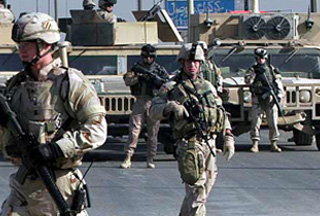 US forces have shot eight Iraqi people, most of them ‘innocent bystanders,’ in a raid in a village southeast of Baghdad, Iraqi provincial officials say.
Iraqi provincial council officials described the US raid as slaughter and demanded financial compensation for the relatives of the victims.
Maysan province governor Mohammed Shia al-Sudany told state-run television that eight people were killed, one wounded and 12 arrested in the village 75 km (46 miles) north of the provincial capital of Amara.
“What happened this morning was a massacre in every sense of the word. Eight people were killed. Most of them were innocent,” Reuters quoted Sudany as saying.
The US military, however, said the raid was against suspected members of what it called a terrorist Iran-backed group.
“The joint security team was fired upon by individuals dispersed in multiple residential buildings … members of the security team returned fire, killing individuals assessed to be enemy combatants,” the US military said in a statement on Friday.
“While the number of casualties has not yet been confirmed, initial reports indicate five individuals were killed,” the statement added.
This is while Iraqi officials have called on US troops to release all those arrested during the raid and to apologize for the attack.
Israeli occupation troops kidnap 150 Palestinians in two days
PIC | 12-02-2010

GAZA – The PA ministry of prisoners and ex-prisoners affairs in Gaza said on Thursday that the Israeli occupation authorities kidnapped 150 Palestinian citizens over the past two days, most of them from Jerusalem city.
According to Reyadh Al-Ashkar, the information officer in the ministry, the IOA rounded up nearly 100 Palestinian youths in the refugee camp of Shafat, north of the occupied city of Jerusalem during a military incursion described as the most violent in recent years.
Another 15 Palestinian civilians of one family, including children, were also kidnapped by the IOF troops after they swept into the northern borders of the Gaza Strip near the town of Beit Lahia. The whereabouts of the kidnapped Gazans is still unknown.
In the West Bank, the IOF troops kidnapped 38 Palestinian citizens, including at least 15 minors, over the past couple of days.
Meanwhile, the Israeli Salem military court extended the administrative detention of Palestinian female captive Sanabil Nabegh Brek, 19, for the 40th time successively. The Palestinian lady was kidnapped since September, 2008.
The court also extended the detention of Muntaha Al-Taweel, 45, wife of Al-Beireh mayor Jamal Al-Taweel, who was kidnapped from her house three days ago. Al-Taweel is a mother of five children, at least two of them need special care.
In this regard, the ministry appealed to international human rights and legal institutions to immediately intervene to protect the unarmed Palestinian civilians, and to pressure the IOA to halt the heinous practices against them.
The IOA is holding nearly 12,000 Palestinian citizens captives in its jails, many of them spent more than 20 years in jail so far. The issue of prisoners is considered one of the most crucial issues for the Palestinian people.
Israeli forces demolish wells, sheds near Hebron
Ma’an | 11-02-2010
Hebron – Israeli bulldozers demolished five water wells and three small storerooms, confiscated electric generators and water pumps in Idhna, a town west of Hebron.
Abdullah Al-Asoud, whose irrigation systems were destroyed in the demolition raid, said the area affected was in agricultural lands near the separation wall.
The farmer noted that the other residents whose wells were affected, had filed petitions with the Israeli court challenging the demolition notices. Since the suits were in progress, Al-Asoud said, farmers were surprised to see demolition crews Thursday morning.
Al-Asoud noted that while the wells and irrigation systems were ripped up, fields planted with crops were destroyed.
The mayor of Idhna, Jamal At-Tamzi, said that the municipality will work in cooperation with the Palestinian Authority to reconstruct the agricultural projects and the wells in the area. He called the demolitions part of a continued attempt to displace farmers and discourage them from working and producing on Palestinian lands.
The affected farmers. At-Tamzi said, relied on the produce from the lands for their livelihoods and now have nothing with which to support their wives and children.
The Netanyahu-Fayyad “economic peace” one year on
By Ziyaad Lunat, The Electronic Intifada, 10 February 2010
Israeli Prime Minister Benjamin Netanyahu was elected on a platform of “economic peace” with Palestinians in the West Bank. He contended that developing the Palestinian economy, by providing Palestinians with jobs and a better living standard, would render the “problems” between Israelis and Palestinians “more accessible for solutions.”
Salam Fayyad, the appointed Palestinian Authority (PA) prime minister in Ramallah and a former International Monetary Fund official, was quick to follow with his own complementary plan last August. His policies recently earned praise from Israeli President Shimon Peres who called Fayyad a Palestinian “Ben Gurionist,” in reference to Israel’s founding prime minister. Economic peace won broad backing from the UN, European leaders as well as the administration of US President Barack Obama — representatives of which form the self-appointed “Quartet” that dictates terms for the “peace process.
Tony Blair, the Quartet envoy for the Middle East peace process, characterized Fayyad as “absolutely first class — professional, courageous, intelligent.” Blair did not hold back praise for Netanyahu either, calling him a “peacemaker.”
A consensus has developed among the political elite, and even among Arab states, that improving Palestinians’ quality of life, even if under military occupation, is the long sought solution for Palestinian misfortunes. Netanyahu assigned Deputy Prime Minister Silvan Shalom to lead the economic peace task force and coordinate with both Blair and the PA.
The Netanyahu-Fayyad plan has been a magnet for foreign capital. The US Congress approved last July a deposit of $200 million into the PA treasury, under Fayyad’s direct control. In September donor countries pledged on the sidelines of the General Assembly $400 million to the PA by the end of 2009. Last month, the European Union transferred 21 million Euros to “help the Palestinian Authority pay the January salaries and pensions of 80,551 Palestinian public service providers and pensioners.”
This “West Bank First” policy of economic development replaced Bush’s failed policy of democracy promotion. In 2006, Palestinians in the West Bank and Gaza Strip elected Hamas but Israel and its western allies boycotted the movement because it did not conform to the demands of the Quartet, much of them at odds with international law.
The Quartet switched strategies towards finding “moderate” partners that can implement their vision of “peace.” One such person is PA President Mahmoud Abbas, whose term in office expired for the second time last month (after being questionably extended for an additional year in early 2009).
Western donors also hand-picked Salam Fayyad for the post of prime minister despite his Third Way party obtaining less than three percent of the popular vote in the 2006 legislative elections. His exclusive control of the Palestinian coffers give him immense power to implement policies to his own credit as speculation — and in some PA circles fear — grows that he is being groomed by the West to replace Abbas.
“Economic peace,” coupled with the “West Bank First” policy of economic development serves too as warning to Palestinians. They either conform to a political program approved by Israel and Western donors or risk sharing the dire fate of Gaza, under a crippling siege since June 2007. Hamas, under intense pressure, is gradually softening its positions, with cautious overtures to Israel and the West with the hope of inclusion in the process and perhaps a slice of the monetary rewards.
The results of the first year of Netanyahu’s economic peace are visible. While there has been no progress on the political front, security and economic cooperation with the PA has never been better. The American-trained security forces have kept a tight grip over West Bank towns squashing dissent and keeping “order.” When the Israeli army invades during the night, Palestinian security forces swiftly retreat. Intelligence sharing has enabled joint campaigns of arrest against members of the resistance.
The Guardian newspaper reported that Palestinians security forces have been working closely with the CIA to torture Palestinian dissenters. When Palestinians killed a settler last December, Abbas’ forces worked “overtime” to find the culprits arresting hundreds in the process. A PA spokesperson described the security situation up to the attack as “nearly perfect,” in reference to the diligent job of Palestinian security forces in preventing attacks against Israelis but ignoring the daily attacks Palestinians are subjected to at the hands of the Israeli military and settlers. Abbas’ clampdown didn’t prevent an Israeli death-squad from invading Nablus and killing in cold blood three Palestinians as an act of revenge.
Israel deems the PA a trusted partner for its diligent efforts to provide security for Israelis including settlers actively engaged in colonizing the West Bank. This perception motivated Netanyahu to order the dismantlement of a few dozen roadblocks and the lifting of strategic checkpoints to ease movement between Palestinian cities. Over 578 “closure obstacles” remain in place inside the West Bank. According to the UN, “while some of these measures have contributed to the easing of movement, they exact a price from Palestinians in terms of land loss, disruption of traditional routes, and deepening fragmentation of West Bank territory.” These “goodwill gestures” help give the impression of improvements nonetheless.
Other policies targeting the 17 percent of the West Bank controlled by the PA, otherwise designated as Area A under the 1993 Oslo accords, include the opening of a shopping center in Jenin and a cinema in Nablus. Netanyahu plans 25 other economic initiatives in the West Bank including more shopping centers, a light industrial zone in the Bethlehem area, a major industrial zone in the Jenin area and an agricultural processing and export zone in Jericho. Each ribbon cutting ceremony Fayyad attends reinforces the normalcy discourse propagated by the PA and Fatah-affiliated media that contrast it to the destruction and despair of Israeli-blockaded, Hamas-controlled Gaza.
There are fears these projects are attracting foreign speculators. “My message is very clear: there is an economic prize before us, there is a double dividend for you as companies” said British Prime Minister Gordon Brown to a conference of investors in Bethlehem. One such “prize” is the creation of a Palestinian equity market. The Palestine Investment Fund (PIF), the body leading such effort, expects to deliver an annual return of 15 percent. PIF plans to use cash deposits in local banks as well as money from investors to encourage growth in consumer spending. “Our banks have cash deposits of $7 billion, and they are saying there are not enough opportunities to invest,” said Mohammad Mustafa, the Fund’s chief executive and a former World Bank official.
Real Estate is the main target for foreign corporate investment. Rawabi, the first Palestinian planned city, is Fayyad’s flagship project. The Washington Post reported that Rawabi “is specifically designed for upwardly mobile families of a sort that in the United States might gravitate to places such as Reston, VA. The developments are also relying on another American import, the home mortgage, including creation of a Fannie Mae-style institution for the West Bank.” USAID, a branch of the American government, is funneling funds through nongovernmental organizations (NGOs) for the promotion of a mortgage culture in Palestine to support these initiatives from bottom-up. One such example is CHF International, a corporate-led development NGO, which is organizing community level focus groups and technical training as part of their “homebuyer education” program.
A year on, the cost of the Netanyahu-Fayyad plan is becoming clear. Low-income Palestinian families and small business are being encouraged to borrow to fuel a high-risk economy. Israel has proven time again that it won’t hesitate to strike a blow against Palestinian infrastructure should they dissent from the current consensus in its favor. Families are risking their possessions as collateral for their debts. Corporations responsible for the global financial collapse are applying their failed models in Palestine. Abraaj Capital, a Dubai-based investment fund that recently sparked fears for debt default, announced a $50 million private equity fund dedicated to “raising standards of living,” mirroring the predatory behavior that led to the collapse of the sub-prime mortgage system in the US.
Investors, Palestinian and internationals, are leading in the efforts for normalization of economic relations with Israel in violation of the boycott, divestment and sanctions (BDS) call of Palestinian civil society. There is concern about the growing power that the emerging Palestinian capitalist class can yield over the political process as the personal stakes rise as their economic relationships with Israel intensify. Abbas is said to have yielded to pressure from economic interests when he forfeited UN discussion of the Goldstone report last October causing popular outrage.
The economic peace model comes with a dose of cultural imperialism. Palestinians do not have basic freedoms but they are being told that they can enjoy the mundane and superfluous in cinemas and shopping centers. This is more vividly seen in wall-encircled Ramallah, the seat of the PA government. High-end clubs are appearing to cater for the western-oriented elite. These spaces draw invisible barriers of class and social status that the majority of people cannot relate to or simply cannot afford. This sort of social stratification inevitably leads to the creation of an individualist and self-interested culture and to contentment for the status quo. The availability of disposable income has even encouraged the presence of Russian chains of prostitution in the city. Fahmi Shabaneh, former head of the PA’s Anti-Corruption Department, was forced to quit from his position last year after uncovering a sex scandal involving one of Abbas’ top aides in Ramallah. As expected, the PA denies the accusations. Shabaneh said that “Abbas has surrounded himself with many of the thieves and officials who were involved in theft of public funds and who became icons of financial corruption.”
There is also a division being fostered between the urban and the rural populations. The Palestinians living in the 60 percent of the West Bank officially controlled by Israel, also known as Area C, are continuously dispossessed of their land and gradually being pushed to PA-controlled enclaves. The almost exclusive focus of Fayyad’s plan on the service sector, while ignoring the farming community, will inadvertently lead to acceleration of desertification of the rural areas as the young are pulled to new jobs in the city. The Bantustanization process is accelerating with the construction of Israel’s apartheid wall. The rural population, represented by the popular committees, is now leading resistance against Israel’s encroachment. They have been left without effective political representation, finding themselves in the front line of Israel’s annexationist policies. These two dichotomous realities, the urban and the rural, have left certain sectors of the population in urban centers like Ramallah to be completely oblivious to these struggles only a few miles away.
Hamas’ election in 2006 showed how vital is the Palestinian Authority’s dependence on foreign donors. It also showed how easily donors can turn off the money tap and cause the near destruction of the Palestinian social fabric as in Gaza. The plan that is being forged in the West Bank is fostering such dependence even more, raising the costs for sustaining the Palestinian struggle for liberation. Should the masses awaken from the current delusion, many of the rich elites would not hesitate to turn against their brethren to protect their status and power. Adding to the current political and territorial separation affecting Palestinians, the emerging economic stratification is yet another challenge in the way of Palestinian unity and liberation.
Ziyaad Lunat is an activist for Palestine.
Israel to raze 200 Palestinian homes in Jerusalem
By Jonathan Cook – Jerusalem – February 9, 2010
Jerusalem’s mayor threatened last week to demolish 200 homes in Palestinian neighbourhoods of the city in an act even he conceded would probably bring long-simmering tensions over housing in East Jerusalem to a boil.
His uncompromising stance is the latest stage in a protracted legal battle over a single building towering above the jumble of modest homes of Silwan, a deprived and overcrowded Palestinian community lying just outside the Old City walls, in the shadow of the silver-topped al Aqsa mosque.
Beit Yehonatan, or Jonathan’s House, is distinctive not only for its height – at seven storeys, it is at least three floors taller than its neighbours – but also for the Israeli flag draped from the roof to the street.
The settlement outpost, named for Jonathan Pollard, serving a life sentence in the US for spying on Israel’s behalf in the 1980s, has been home to eight Jewish families since 2004, when it was built without a licence by an extremist settler organisation known as Ateret Cohanim.
Beit Yehonatan is one of dozens of settler-occupied homes springing up in Palestinian areas of East Jerusalem, most of them takeovers of Palestinian homes.
Critics say the intent of these “outposts”, together with the large settlements of East Jerusalem built by the state and home to nearly 200,000 Jews, is to foil any peace agreement that might one day offer the Palestinians a meaningful state with Jerusalem as its capital.
But exceptionally for the settlers, who are used to a mix of overt and covert assistance from officials, the inhabitants of Beit Yehonatan are at risk of being evicted from their home, two years after an “urgent” enforcement order was issued by the Israeli Supreme Court.
Last week Nir Barkat, Jerusalem’s mayor, finally agreed “under protest” to seal Beit Yehonatan amid mounting pressure from an array of legal officials. Mr Barkat had been fighting strenuously against implementing the court order, aided by senior members of the parliament, the police, and even Benjamin Netanyahu, the Israeli prime minister, who opposed his own attorney general’s advice by declaring Beit Yehonatan’s future “a purely municipal matter”.
But the mayor has not simply capitulated. He warned that Beit Yehonatan would be evacuated only on condition that more than 200 demolition orders on Palestinian homes, most of them in Silwan, were carried out at the same time. He argued that he had to avoid any impression that the law was being enforced in a “discriminatory” manner against Jews.
Jeff Halper, head of the Israeli Committee Against House Demolitions, said Mr Barkat’s idea of fairness was “ridiculous”.
“In the past 15 years there have been more than a thousand Palestinian homes demolished in East Jerusalem versus absolutely no settler homes,” he said. “In fact, no settlers have ever lost their home in East Jerusalem.”
In making his announcement, Mr Barkat admitted that the 200 demolitions would trigger “a strong possibility for conflict”. Palestinians in East Jerusalem are already seething over decades of planning restrictions that have forced many of them to build or extend homes illegally because it is all but impossible to get permits from the Israeli authorities.
Mr Halper said the municipality had classified 22,000 Palestinian homes in East Jerusalem as illegal, even as it also assessed a shortage of 25,000 homes for the city’s 250,000-strong Palestinian population.
The homes targeted for demolition include Palestinian houses around Beit Yehonatan that violate planning restrictions that allow families to build only two floors; despite the restriction, many houses have four storeys and owners pay fines.
In addition, the city council wants to demolish 88 homes in a small area called Bustan that the municipality claims is in danger of flooding.
Zeinab Jaber lives next to Beit Yehonatan in the home she was born in 61 years ago. The building was declared illegal 20 years ago, after it was extended to four storeys to accommodate her growing family. Today she and her six grown-up sons pay monthly fines of more than $1,000 (Dh 3,672) in the hope of warding off destruction.
Her son Amjad, 32, married with two young sons, said he did not dare miss a payment. “It’s simple: if you don’t pay, you’ll end up in prison.”
“What is there for the settlers here?” Mrs Jaber asked. “They are only here because they want to take this place from us. They won’t be happy till we leave.”
On the opposite slope across the valley from Beit Yehonatan, Mohammed Jalajil, 48, said he did not doubt that the municipality would demolish the 200 homes. He, his wife and five children have been crammed into a room in a relative’s apartment since their own house was demolished seven years ago.
Mr Jalajil, 48, said: “It was only months after they took our house from us that I saw the settlers building theirs nearby. My lawyer tells me that, even though my house is gone, I won’t have paid off my fines for another 10 years.”
If Mr Barkat follows through with his threat, the demolitions will prompt a rebuke from the international community. Last month, France and the United States joined the UN in denouncing more than 100 demolitions in East Jerusalem over the past three months.
The mayor’s decision, warned Meir Margalit, a Jerusalem city councillor, was comparable to the “price tag” policy of the settlers in the West Bank, who have attacked Palestinian villages in retaliation against official attempts to dismantle a few of the settlement outposts dotting Palestinian territory.
“But the difference here is that the price tag is being levied not by the settlers themselves but by the municipality and the government on their behalf,” he said.
Yesterday the municipality was due to issue a seven-day evacuation notice to the inhabitants of Beit Yehonatan, but the operation was cancelled at the last minute when police refused to co-operate.
Frictions have been growing in Silwan for several years over the activities of another settler organisation, Elad, which, with official backing, has been building an archaeological park known as the City of David in the midst of the Palestinian neighbourhood. As Palestinians have been pushed out, at least 80 Jewish families have moved into homes nearby.
As Elad entrenches itself in Silwan, Beit Yehonatan has proved more difficult to secure. “Usually the settlers present a façade of legality to what they do,” Mr Halper said. “The problem here is that they built in an overtly illegal manner, without a permit and way over the building height restrictions.”
Mr Barkat’s resistance to evicting Beit Yehonatan’s inhabitants was highlighted last month when he tried to stave off legal pressure by proposing a new planning policy to legalise unlicensed buildings in Silwan. The mayor proposed that the rules limiting homes to two storeys be revised to four.
The reform would have applied to Beit Yehonatan first, sealing its top three storeys but allowing the Jewish families to inhabit the rest of the building.
Although Mr Barkat promised that illegal Palestinian buildings would also be saved, Ir Amim, an Israeli human rights groups, dismissed the mayor’s claim.
The overwhelming majority of Palestinian homes would fail to qualify because land registry documents are missing for the area and a range of requirements on car parking, access roads and sewerage connections are “impossible” to meet, Orly Noy, a spokeswoman, wrote in the Haaretz newspaper last month.
She added that Palestinian areas of East Jerusalem lacked 70km of sewage pipes and that not a single new road had been paved in their neighbourhoods since Israel’s occupation in 1967.
A planning map of East Jerusalem drawn up recently by the Jerusalem municipality came to light last month, as Mr Barkat was promising to legalise buildings, showing that more than 300 homes – most of them in Silwan – were facing imminent demolition.
Jonathan Cook is a writer and journalist based in Nazareth, Israel. His latest books are “Israel and the Clash of Civilisations: Iraq, Iran and the Plan to Remake the Middle East” (Pluto Press) and “Disappearing Palestine: Israel’s Experiments in Human Despair” (Zed Books). His website is www.jkcook.net.
Unrest continues in Shu’fat; overnight raids, youth detained
 09/02/2010
Jerusalem – Ma’an – Confrontations erupted between school children and border guards at the Shu’fat military checkpoint on Tuesday, leading to the detention of a 15-year-old and the injury of a soldier, witnesses said.
The clash followed a series of overnight raids where border guards handed out dozens of notices for residents to turn themselves in for questioning at Israeli intelligence compounds in Jerusalem. The raids came directly on the heels of an arrest campaign targeting dozens of Palestinian residents of the camp.
The teen detained in the most recent clashes was identified as Ahmad Jamil Abu Hamda, who was on his way to school when the clashes erupted.
Locals said soldiers used tear gas to disburse the crowds.
The secretary of Fatah in the camp, Khader Ad-Dibs, said that raids continued until 5am, and that more than a hundred soldiers guarded the entrances of the camp.
Ad-Dibs noted that some of the men and women detained Monday had already been transfered to the military court where their sentences were extended, and others who were released said they had been severely beaten.
Ethnic Cleansing Escalation in Jerusalem
Aletho News | February 8, 2010
Israeli occupation forces manning a military checkpoint at the Shu’fat refugee camp in Jerusalem set off protests Saturday due to the humiliating conditions inflicted on Palestinians on a daily basis. The residents, whom were displaced from their homes across Jerusalem, have been denied access to the city by the apartheid wall as well as various military checkpoints.
There have also been recent protests against home demolitions in the area. Palestine Information Center reports:
In the city’s Sheikh Jarrah suburb, an armed Israeli settler wearing military uniform pointed his rifle at Palestinian lady Refqa Al-Kurd, 85, in a bid to frighten her and force her out of what is remained of her house after the settlers occupied most of it.
- Refqa Al-Kurd, aged 85, after assault
The incident prompted clashes between the Palestinian neighbors, who rushed for the help of the elderly woman, and the settlers.
Another Israeli settler in the same suburb dropped a big stone at Palestinian teenager Murad Ateyyah, 14, prompting angry Palestinian citizens to intervene and clash with the settlers before the Israeli occupation police arrived and broke up the clashes.
Palestinian Jerusalemites asserted that attacks by Israeli settlers against them increased rapidly with the aim to force them out of the city.

Tensions were raised further by army raids on private residences in the Anata camp early on Monday. Packs of soldiers ransacked homes at daybreak in surrounding villages abducting residents for torture interrogations. House to house searches without search warrants resulted in the seizure of one homemade rifle.
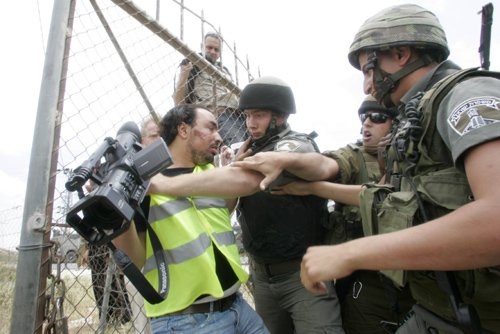
File photo
Ma’an reports that over 60 Palestinians were seized in the raids. Young Palestinians confronted the intruding forces by throwing stones. Journalists that attempted to record the clashes were fired upon with tear gas, rubber-coated bullets and stun grenades. Eyewitnesses also report the use of live ammunition. Several journalists were injured.
Occupation forces then attacked the local clinic and detained the doctors working there, preventing them from attending to the injured. The camp is now under military control, curfew has been imposed.
Israeli forces detain wife of mayor in Ramallah
 08/02/2010
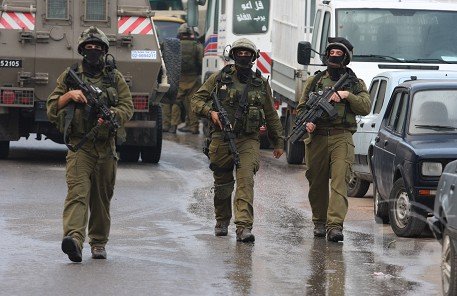
Jerusalem – Ma’an – Israeli forces detained Muntaha Tawil, wife of Al-Bireh Mayor Jamal Tawil, on Monday, after searching their home in Ramallah.
“Heavily armed soldiers and large numbers of military vehicles raided the mayor’s home on Monday early morning breaking the doors and damaging the house’ interior before they detained Muntaha Tawil, the mayor’s wife,” an Al-Birreh Municipal Council statement said.
Mayor Tawil said his wife’s detention would not hinder his ability to provide his constituents with the services they need, adding that Israel often attempts to exert pressure on mayors of Palestinian villages through detentions, forced home searches and summons orders.
Tawil is the mother of four and her husband has been detained several time by Israeli forces. Mayor Tawil previously served 13 years in an Israeli prison.
An Israeli military spokesman said that Muntaha Tawil was detained overnight by Israeli forces operating in Ramallah because of her involvement in activities “in the Hamas terrorist organization.”
###
Editor’s note:
Muntaha Tawil is one of the most active women working in the prisoners’ solidarity movement.
Taliban say ready for Nato’s major surge in Helmand
The International | February 06, 2010
PESHAWAR: The Afghan Taliban have said that they have made preparations for a long battle in the southwestern Helmand province.
“Taliban are not afraid of the planned major offensive by foreign forces in Helmand. We are happy that foreigners would come out of their bases and our fighters would attack them,” Mulla Sharfuddin, Taliban commander in Helmand, told the Afghan Islamic Press (AIP) by phone from an undisclosed location.
“Taliban are well aware of the enemies’ plan and they have already made preparations,” he claimed. Asked what kind of weapons the Taliban would use in the expected fighting, the Taliban commander said: “We have made all arrangements and divided the area under different commanders.
“We would use mines, heavy weapons and different military tactics in the fighting.” He said the people of Helmand were standing by the Taliban and foreign forces would not be able to force the Taliban out of the province.
He termed the foreign forces’ announcement of launching a major offensive in Helmand as a propaganda tactic and reminded that the foreigners had also mounted major attacks in the past but failed.
He maintained that the Taliban were very strong in the area and would defeat their enemy again. Asked whether Arab, Uzbek and other foreign fighters were present in the ranks of the Taliban, the commander insisted that all the fighters were Afghans.
He urged the Afghan police and soldiers to stop fighting against the Taliban. “I urge the Afghan National Army and the police not to fight against the Taliban. They should take part in Jihad along with the Taliban against the infidels. The foreigners have invaded Afghanistan and it is their duty to wage Jihad.”
About involvement in drug trade, Sharfuddin said the Taliban were not involved in poppy cultivation and drug trafficking. “The Taliban had banned drug cultivation during their rule,” he claimed. The commander said that most of the areas of Helmand, including Baghran, Baghni, Washer, Deshu, Brahmcha and Marja, were in the control of Taliban.
Israel to adjust wall’s route in Bil’in
February 6, 2010
Ramallah – Ma’an – Attorney of Bil’in local council, Michael Sfard, said on Saturday that Israeli authorities informed him of the new route of the separation wall, adjusted according to a decision by the Israeli Supreme Court of Justice in 2007.
“We were not convinced that it was vital for security reasons to maintain the existing route that passes through a topographically low area of Bil’in land and that there was no fitting security substitute to the construction of the barrier in order to protect the residents of Modi’in Illit,” Justice Supreme Court President Dorit Beinisch wrote in her decision.
Once the adjusted route is implemented, residents of Bil’in are expected to restore almost half of their 2,300 donums confiscated during the construction of the wall’s original route.
However, as the portion of the wall already built will be removed, farmers will expect significant damage to their olive groves located in the area.
The local Popular Committee Against the Separation Wall in Bil’in said the decision to alter the wall’s route came too late, and would not change the fact that the wall in unacceptable, wherever it is, members said.
Member of the committee Muhammad Al-Khateib, who was recently released from Israeli custody on bail, said Israel had not respected the Supreme Court decision, nor did Israel respect international resolutions condemning the wall.
He added that hundreds of people have been injured or detained during peace protests against the wall, which have been brutally suppressed, he said. Last year, Basim Abu Raham was killed at one of the rallies.
Nonetheless, Al-Khateib said, the adjustment to the wall’s route is an accomplishment achieved by the village, pointing out that Israeli authorities had failed to stop international and Israeli solidarity groups from supporting Palestinians, adding that the popular campaign against the wall succeeded in retrieving part of the village’s land confiscated by Israel through the wall’s construction.
Featured Video

New positive ivermectin evidence
or go to
Aletho News Archives – Video-Images
From the Archives
Fanatical Followers of the Covid Regime: A Jim Jones-Style Cult?
By Professor Roger Watson and Dr. Niall McCrae | The Daily Sceptic | November 15, 2021
As scholars at leading British universities over recent decades, we witnessed the replacement of critical thinking and debate by narrative: facts are discrimination and scientific method is imperialism; truth, instead, is derived from ‘progressive’ values. This educational trend may be a major contributory factor to the ease in which society has been inculcated to the Covid ‘new normal’ of masking, testing, and repeated doses of vaccines for a disease of similar risk to severe influenza.
One doesn’t need much critical reasoning to observe the flawed logic of some vaccination enthusiasts, such as people who respond to experiencing any side effects, however debilitating, by saying “at least I know it’s working”, or, after contracting the disease despite their promised inoculation (over 90% effective, according to initial drug company claims), “I’d have been worse off without the jab.” … continue
Blog Roll
 Aletho News
- EU Council Advances Chat Control 2.0 Scanning Proposal
- Ex-Greek MEP files complaint against Israeli spyware firm over alleged Pegasus surveillance
- Troubling ideas throughout the Torah, Talmud, Mishneh Torah and Tanya
- ‘Grave, alarming’: Iran mission on Trump’s UNGA ‘annihilation’ threats
- Najaf airport to reopen to Iranian flights within 24 hours: Ambassador
- From ‘How Will This End For Iran’ to ‘When America Walks Away’: A tale of two Economist covers
- Tehran blasts ‘baseless’ speculation linking Iran to alleged bomb plot at UK air base
- The Rise And… Rise Of ‘Color Revolutions’
- The Coming GOP Bloodbath?
- Arctic Scare Stories Melt Away
- If Americans Knew
- Netanyahu Asked UAE Leader to Deny Report on Oct. 7 Warning in Secret Visit, Sources Say
- CNN Chief Int’l Correspondent Clarissa Ward on Journalists in Gaza
- Democratic Party Consultants Surround Troy Jackson with Pro-Israel Donors
- Christian Leader Responds To Netanyahu’s Claims Regarding Palestinian Christians
- In Gaza, ‘Whoever Survives the Bombing Won’t Survive the Rubble’
- Israel kills more Palestinians, amid push to resettle Gaza – Daily Update
- Israel forces Gazans to live in constant peril – Daily Update
- Deconstructing Netanyahu’s pants-on-fire UN rant – Daily Update
- Trump betrayed voters with his campaign lies and prioritized a foreign country once he took office
- Netanyahu calls Israel’s war in Gaza ‘opposite of genocide’ in UN speech to near-empty hall
- No Tricks Zone
- New Study: Earth And Venus Surface Warmth Largely Explained By Convection And Lapse Rate, Not CO2 Or Radiation
- 2025 Nature Paper Claiming Worsening Global Drought Gets RETRACTED …Heavily Flawed
- New Study: ‘Global Drought Shows No Detectable Recent Acceleration Under Climate Warming’
- Economic Masterminds: German Socialists Suggest Taxing Productivity Gains Stemming From Using AI
- The South China Sea Has Not Been Cooperating With The Climate Change Narrative
- Energy Crisis: Germany Enters Heating Season With Historically Low Gas Reserve Fill Levels
- New Study: The Antarctic Ice Sheet Gained Mass From 2020-2024 Due To Staggering Snow And Ice Accumulation
- Study: Ocean Heating Rates From Thousands Of Years Ago ‘Dwarf’ Modern Ocean Heating Rates
- Climate Extremists Target, Attack Large-Scale Power Grid Infrastructure In Germany!
- New Study: Antarctic Ice Melt Has Contributed Less Than 1 Centimeter To Sea Level Rise In The Last 30 Years

