Raze Illegal Buildings – Unless They Are Jewish
Jerrold Kessel and Pierre Klochendler
SILWAN, Occupied East Jerusalem, Feb 3 (IPS) – Backed by armed security men, the municipal inspectors race their jeeps through the narrow alleyways and up a hillside crowded with buildings.
Some of the homes are well-faced with stone; the naked concrete of others gives off something of a temporary air.
One block of flats stands out for its unusual seven-storey height in an area of the city where two or three storied buildings are the norm. And then there is the giant, blue-and-white Israeli national flag draped demonstratively over the front of the building, from the roof down to the ground.
This is the so-called ‘Beit Yehonatan’, the House of Yehonatan, where religious Jews have put down a nationalist marker in the heart of this Palestinian neighbourhood, part of a major effort to change the face of Arab East Jerusalem that has been under Israeli occupation since 1967.
The inspectors’ mission is to deliver demolition orders to owners of illegally-built homes, almost all of them Palestinians.
Beit Yehonatan is also exceptional in this respect. In July 2008, the Israeli Supreme Court ordered that it too was built “illegally” by the settlers and should be evacuated and sealed off.
When, for the umpteenth time, the inspectors arrive at the settlers’ building they find it shuttered. They are unable to gain access. It is not clear whether anybody is at home. Shrugging their shoulders the inspectors move on to deliver demolition orders on more accessible targets – Palestinian families.
Anyway, they know that there are powerful forces determined to ensure that this display of equal application of the law to Jews and Arabs remains precisely that – a demonstration.
The seven-story structure was built in Silwan by the religious nationalist association Ateret Cohanim in 2004 without the necessary permits. Several Jewish families from Ateret Cohanim – a lynchpin group in the Jewish colonisation endeavour in East Jerusalem – are known to live there.
Last week, Jerusalem’s Israeli mayor Nir Barkat launched a new legal maneuver in a bid to stave off implementation of the High Court order that the settlers be evacuated.
This, despite the fact that the municipality’s own legal advisor, Yosi Havilio, ruled that the court order issued two years ago be implemented immediately. Havilio said that the Mayor’s last-ditch attempt to bypass the court by appealing for an additional ruling from “an external legal authority” was “unacceptable”.
Faced by international opprobrium over the repeated cases of settlers moving more and more into Palestinian neighbourhoods, the government of Benjamin Netanyahu says blandly “it is a purely municipal matter”.
That has enabled the mayor to stand his ground. In a letter to Israel’s State Prosecutor Moshe Lador, Barkat insisted that he has police backing too. “The police believe there is serious concern that the day after Beit Yehonatan would be sealed off it would be invaded by Jews and/or Arabs and that could create an unnecessary point of friction,” he warned.
The mayor is also trying to push an alternative gambit to having the “illegal building” closed down. He is proposing to issue a new municipal by-law specifically for Silwan which will allow the construction of buildings there up to four stories high.
The motive is clear: Such a by-law would “whitewash” many of the illegal buildings in the area, including Beit Yehonatan.
Given the mayor’s record, however, this seems unlikely to ease the plight of the Palestinians of East Jerusalem whose homes are regularly pulled down on the grounds that they have not acquired the necessary building permits.
In other parts of East Jerusalem the mayor has indeed approved construction tenders for new Jewish building projects; he has yet, though, to extend such tenders to Palestinian applicants in spite of repeated pledges to do so on the grounds that all residents of Jerusalem, Jews and Arabs alike, be treated “equally” in respect of building applications. In the nearby Palestinian neighbourhood of Sheikh Jarrah, Israeli and international demonstrators have been gathering weekly to protest the eviction of Palestinian families and their replacement by Jewish settlers.
At last Friday’s protest, a leftwing member of the Israeli parliament, Ilan Gilon, poured cold water on the settler claim of ownership over the houses they take over on the grounds that they rely on property titles held by Jews from early in the 20th century.
“If settlers can prove ownership of 28 buildings, Palestinians can prove ownership of 28,000,” he said.
“There are times when one cannot afford to sit quietly by,” the internationally-renowned Israeli novelist, David Grossman, told the gathering. “The settlers and the Right – with tremendous help from the government, the Israeli legal system and important business interests – continue to abuse Palestinian rights in a thousand ways.
“They are complicating the situation to such an extent as to make any peace agreement impossible. Basically, they are destroying our future – of Israelis and Palestinians alike,” Grossman warned.
Copyright © 2010 IPS-Inter Press Service. All rights reserved.
American detained for `interfering` with Israeli military
03/02/2010
Ramallah – Ma’an – A 27-year-old American woman was detained along with two Palestinians by Israeli forces during a night raid in the village of Bil’in on Wednesday.
All three were taken to the border police station, an organizer said. An Israeli military spokesman confirmed the detentions.
Forces broke into the home of Abed Al-Fattah Burnat, 27, then surrounded the home of Ashraf Abu Rahma. International and Palestinian activists were alerted of the raid and went to the location to film the event.
Witnesses said the home was declared a closed military zone by army officials, who demanded reporters and activists stay 50 meters away from the door. Organizers said the group moved 50 meters back, but soldiers continued to harass photojournalist and B’Tselem volunteer Hamdi Abu Rahameh, 22.
The Israeli military said Rahameh is a Palestinian citizen of Israel, and said he was detained for failing to move back from the home after soldiers declared it a closed area.
As soldiers detained the young man, an American activist known locally as “Stormy” attempted to intervene.
The military said the American woman “interfered” in the work of the Israeli army and attempted to “prevent Israeli soldiers from carrying out their duty.” They also said the actions of the woman caused rioting in the area. They confirmed her arrest and transfer to the Israeli police.
US Consulate officials said they were looking into the incident.
Another Palestinian resident of Bil’in, Ashraf Abu Ramhe, was later detained near the village mosque. Upon his detention, Israeli soldiers handcuffed and blindfolded him, ushering him into a car with a gun pointed at his head, Popular Committee organizers said.
The army also confirmed the arrest of Ramhe.
International peace activists have been staying overnight in the village of Bil’in since the Israeli army began night raids into the village, initially following each Friday’s demonstration against the separation wall being constructed on village lands.
Night raids became more regular during the fall of 2009, and now occur almost nightly, villagers say. Activists and photojournalists work to document the raids and treatment of Palestinians at the hands of Israeli forces.
In January, a Czech woman working on solidarity projects with Palestinians via the International Solidarity Movement was detained from her home in Ramallah during a night raid and deported the following day.
Night raid in Nablus
In addition to the raids of Bil’in and Ni’lin, sources reported Israeli forces operating in Nablus, where they detained one man, identified as 22-year-old Shurahbil Awwad.
The young man was taken from his home in the Al-Makhfiyeh area in the west of Nablus before sunrise.
Redeeming land from kibbutz to outpost
By Carmelle Wolfson
“Organic eggs labeled ‘Harduf’ are coming from a Jewish settlement in the West Bank,” I exclaim to my aunt over the phone to the kibbutz that allegedly harvested the eggs. “There is no way,” she says, astonished. Eventually she comes to believe the validity of this claim. “We all buy them,” she admits, adding that it’s what they sell at the kibbutz grocery. “I don’t think people in Harduf know.”
The Harduf organic food company is managed by one kibbutz member, but owned by Israeli food giant Tnuva. According to Haaretz and Israeli peace group Gush Shalom, Tnuva buys the organic eggs from illegal outpost Gva’ot Olam near the West Bank Palestinian village Yanoun.
The anthroposophic community of Harduf, while distinguishing itself from the kibbutz movement, comes from the kibbutz tradition – a Socialist Zionist agricultural commune built on Avodah Ivrit (exclusively Jewish labour). Kibbutzim, once regarded as utopian communes, in recent years have moved towards private ownership, graded wages and hierarchical governing bodies, while farming is being replaced by production plants and industrial companies.
The kibbutz was instrumental in defining territory for the Jewish state of Israel. Yitzhak Tabenkin, a spiritual leader of the Kibbutz Movement, described the movement as, “a builder of communal settlements whose aim is to colonize the country in order to establish a territory for the Jewish people.”
Most kibbutzim were strategically situated on the peripheries. Before and during the 1948 war kibbutzniks fought in the Haganah military underground to hold their settlements and later went on to establish the “Israeli Defense Forces”. Kibbutzniks also formed a major part of Israel’s military elite up until the past decade.
“They were the pioneers of this colonization, even though ideologically at least some of them objected the colonization and that way of expelling the Palestinians,” points out Eitan Bronstein from Zochrot, an Israeli organization that educates citizens about the Nakba (Arabic for catastrophe, referring to the ethnic cleansing of 750,000 Palestinians by Israel in 1948). In many cases they settled Palestinian houses and cultivated and picked the fruits of Palestinians’ fields. “The new practice of the Zionists was that after buying land, they did what they call redeeming the land. It means that after buying that land only Jews can live off that land,” explains Bronstein.
By the late 1970s the political climate shifted to the right as the government liberalized the Israeli economy. The history of the kibbutz’s rise and fall is commonly understood as stemming from massive organizational debts and the dismantling of the Jewish labour economy, in turn shifting people’s relation to communal values. This led towards an industrial economy and eventual privatization.
But a central factor in this transformation often left unmentioned is that after the 1967 war the value of the kibbutz as a frontline force had become obsolete. The then burgeoning settler movement soon came to replace the kibbutz as a central colonizing body. Occupying Palestinian land and cultivating it to be inhabited by exclusively Jewish communities, the strategies of settlers are not much different than early kibbutzniks.
Some Jewish settlements positioning themselves deep inside the West Bank and far beyond the Green Line have even called themselves kibbutzim. Recently, an outpost was erected under the name “Kibbutz Givat Menachem”, pointing out that both kibbutzim and illegal settlement outposts in the West Bank were established on Palestinian land and should not be treated differentially. The “kibbutz” was evacuated in November.
The so-called “Hilltop Youth,” young devoutly religious settlers committed to the idea of an ethnically exclusive socialist commune of God (a socialism derived from Jewish rather than Marxist scripture) are restoring the Socialist Zionist tradition. Setting up caravans as illegal outposts in the West Bank, farming the land, and using violence to deter Palestinians from reclaiming their fields, The Hilltop Youth are the new frontier, renewing the custom of Avodah Ivrit lost to the free market economy. From these outposts, Jewish settlements in the West Bank can grow.
Movement leader Avri Ran is the founder of the Gva’ot Olam illegal outpost farm, where Harduf gets their eggs. Organic vegetables, fruit and dairy are cultivated by an exclusively Jewish workforce and then sold at most natural food stores in Israel. Ran, an IDF reserves captain, is a kibbutznik himself who grew up on Kibbutz Nir Chen according to IsraelNationalNews.com. The kibbutz is in the Negev desert less than 30 km northeast of the Gaza Strip.
I asked a relative in Kibbutz Hatzor (about 40 km south of Tel Aviv) what he thinks about the comparison of settlers to kibbutzniks. Hatzor is a Hashomer Hatzair kibbutz, one of the most leftist and secular youth movements amongst the kibbutzim (originally affiliated with the International Revolutionary Marxist Centre and now associated with the Zionist social democratic party Meretz). “The prevailing attitude among ‘our’ kibbutz movement,” he says, framing it in the context of Israel’s internal religious and secular divide, “Is that there’s a distinct difference between the absolute need for a State, and the steps that were taken to realize that need, and the approach that says that the land is God-given and thus there’s only one legitimate claim.”
The Arab-Jewish border in the 1947 UN partition plan ran right through Hatzor fields, as my uncle himself has told me. Before Hatzor existed Palestinians lived in the area, but after Israel’s declaration a battle between Israeli and Egyptian forces in the South resulted in the Palestinians being pushed south into Gaza. Now, not a single Palestinian can be seen on the kibbutz.
On Hashomer Hatzair Kibbutz Lehavot Haviva – just west of Israel’s Green Line with the West Bank, kibbutz members aided the army in expelling and preventing the return of the Palestinian residents from Khirbet Al Jalama after the ‘48 war. These actions, which included blowing up the remaining Palestinian homes, were carried out despite an Israeli court decision to allow the Palestinians to return to their homes.
The irony of this Israeli political division is that the Hilltop Youth, who have gained international notoriety for being on the vanguard of Palestinian dispossession and racism, generally live in open fields on hilltops inside their own caravans. While the movement considered the source of Israel’s moral consciousness wiped out Palestinian villages and forcefully ejected Palestinians from their homes.
Blair’s Monstrous Consistency
 By Daniel Larison
The American Conservative
January 30th, 2010
But the failure to achieve a second, explicit, U.N. resolution was a political problem, not a legal obstacle. Few of the anti-war movement care to recall that the Kosovan War was, if anything, predicated upon a flimsier legal case than the Iraqi intervention. ~Alex Massie
One of the reasons why I keep revisiting the illegality and immorality of the intervention in Kosovo long after most people have forgotten about it is precisely because so many opponents of the Iraq war don’t want to acknowledge that Kosovo was every bit as unjustifiable and wrong as Iraq was. By endorsing the war in Kosovo even now, as Obama did again in Oslo, many opponents of the Iraq war have opened themselves up to the attack that Iraq hawks were using from the beginning. If someone pointed out that invading Iraq would violate international law and not have U.N. sanction, the hawks would throw the precedent of Kosovo in his face. Unless he was a principled progressive or antiwar conservative, the opponent of the invasion was always at a loss to respond. If invading Iraq was based on phony or exaggerated intelligence about WMDs, Kosovo was based on lies about preventing genocide and protecting human rights. Unless you are among the fairly small percentage that opposed both, the odds are that you are outraged over invading Iraq in inverse proportion to how outraged you were over bombing Serbia.
Inexplicably, Kosovo is remembered across much of the spectrum, especially the center-left, as a great success, despite having been disastrous for the very people it was supposed to help and despite being based on lies every bit as blatant and outrageous as the invasion of Iraq. As it hapened, Blair was Prime Minister during Britain’s participation in both wars of aggression. As far back as 1999, he has been the chief proponent of liberal interventionism aimed at subverting the normal protections of international law afforded to sovereign states, and he continues to be an outspoken advocate for killing foreigners for their own benefit. What is disheartening about all this is not just that Blair will never be held to account for his responsibility for the war in Iraq, but that he has never had to answer for or defend his decision to support an unprovoked, unnecessary war of aggression against Serbia.
Even though the air war led to the expulsions of Albanians from Kosovo it was meant to prevent, and even though the “negotiations” at Rambouillet involved delivering an intolerable ultimatum designed to start a war, this criminal operation continues to enjoy support or indifference from most Westerners. There were no allied casualties, and the war was brief, so there was little time for the publics in NATO nations to grow weary and disgusted with their criminal leaders. The war was over relatively quickly, so the media lost interest in the false atrocity stories that the Clinton administration used in its war propaganda, and the previous decade of constant anti-Serb coverage made the public receptive to whatever lies the administration wanted to tell.
What I can say about Blair is that he has been quite consistent. State sovereignty and international [law] did not matter to him in 1999, and they didn’t matter to him later in 2002-03. Given his remarks at the Chilcot inquiry about Iran, I am quite sure that he would have no difficulty supporting and even joining in an illegal attack on Iran were he still a minister in the British government. This makes him one of the most unabashed, unapologetic advocates of aggressive war alive today, and I’m not sure that this requires much courage when there have been and continue to be absolutely no consequences, legal or otherwise, for his actions.
US softens stance on Japan base
Press TV – February 1, 2010
Washington strikes a softer tone on its controversial military base in Japan, saying is ready to negotiate the relocation of the US forces on Okinawa Island.
US Assistant Secretary of Defense Wallace Gregson said the White House was not after an “American-imposed” solution to the months-long dispute with Tokyo.
“Our plan is based on our alliance relationships, and if we have to go back to negotiating, we’ll go back to negotiating,” Gregson said in a Tokyo speech on Monday.
“And it’s not negotiating like the United States and the Soviet Union in the old days of the Cold War. This is less negotiation than it is collaboration and mutual effort,” said the retired Marine general.
Locals on the island of Okinawa have long been demanding that the US Marine Corps air base close, citing aircraft noise, pollution, the risk of accidents and crimes committed by American troops.
Under a 2006 agreement between Tokyo and Washington, the US Marine Corps Futenma Air Station is to be moved from an urban area to a less populated coastal region within the southern prefecture of the island by 2014.
But Japan’s new center-left government has launched a review of the deal, with Prime Minister Yukio Hatoyama now also seeking a pull-out of American forces from the island or even out of Japan altogether.
Last month, US Secretary of State Hillary Clinton urged Japan to “move on” with the original plan, indicating moving the base within Okinawa was “the way forward”.
But Gregson said Washington could wait until Tokyo reconsidered the relocation deal signed under Japan’s previous conservative governments.
“We certainly understand the need for the new government to reexamine that, we are patient on that.”
The 2006 deal is part of a wider plan to rearrange the presence of some 47,000 US troops currently stationed in Japan.
Bethlehemite lives in cave to save land from confiscation
31/01/2010
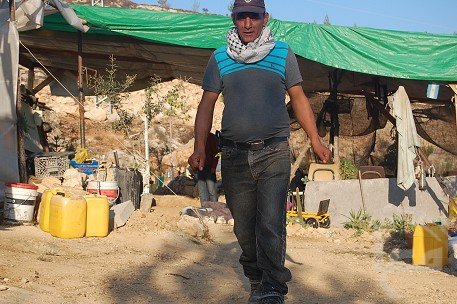
Bethlehem – Ma’an – Abdul-Fattah Abed Rabbo has lived in a cave adjacent to his agricultural land for the last ten years, in the village of Walaja, west of Bethlehem, to protect his land from being annexed by nearby Israeli settlements.
The Popular Committee for Resisting Settlements and the Separation Wall visited Abed Rabbo in his cave to offer their support to him and all Palestinians faced with land confiscation.
Coordinator for the committee, Awad Abu Swayy, described Abed Rabbo as an example to be followed, pointing out that he refused significant financial offers made by Israeli settlement agencies wanting to buy his land.
Abu Swayy said that the popular committee would try to erect a sit-in tent near the cave to host international solidarity activists and a tin roofed gallery which will be connected to the nearest water network.
The committee will also organize regular visits by international activists and Palestinian Authority officials, Abu Swayy said.
In December, coordinator of the popular committee in Nablus, Arafat Abu Ras, visited Abed Rabbo along with international human rights activists and journalists.
Abbas: We don’t want guarantees
31/01/2010
Bethlehem – Ma’an – President Mahmoud Abbas told reporters in London on Friday that his government was not interested in US guarantees and denied reports that Arab ministers exerted pressure on him in Washington to resume negotiations with Israel.
“The US continued to contact us and the Israelis, and they intended to give what they call ‘guarantees,’ but we said frankly that we didn’t want guarantees,” Abbas added.
Abbas said US President Barack Obama proposed a freeze to settlement construction, yet failed to convince Israel to halt settlement activity completely. Obama’s suggestion, he said, was a moratorium which is unacceptable, being only a partial standstill for 10 months, excluding Jerusalem and parts of the West Bank.
The PA, according to Abbas, gave suggestions on how to restart negotiations with Israel. The first suggestion necessitated a decisive moratorium for a given period, including East Jerusalem, the West Bank, and all Palestinian territories. Additionally, Israel must recognize the 1967 borders, he said. The second suggestion was to discuss all issues, including final status issues, which was undertaken with the former Israeli government, but nothing followed such talks, Abbas added.
Abbas also highlighted that the US suggested “proximity talks” but “we, the Palestinian side, didn’t give an official reply, which will be given in 10 days after consulting with Arab and ally countries,” he said.
Meanwhile, Abbas added, Obama gave Israeli Prime Minister Benjamin Netanyahu five steps to be taken in order to rebuild trust with the Palestinians. Firstly, all military incursions into the West Bank must be brought to halt, as they can no longer be justified while security measures are imposed solely by the PA. Secondly, all military checkpoints erected during the second Intifada must be dismantled, as there is neither an uprising nor security chaos, he said.
The third step includes the release of Palestinian prisoners. Abbas highlighted that Hamas is currently negotiating the release of one Israeli [occupation soldier] prisoner for potentially hundreds of Palestinian detainees, while the PA transfers all Israeli citizens illegally in the West Bank back to Israeli military officials.
Israel must allow the transfer of construction material into the Gaza Strip for reconstruction, and finally, Israel is to redefine the Palestinian areas A, B and C in order to allow Palestinians to move freely.
Obama’s Conspicuous Failure
January 30, 2010

Conspicuous failure
From rich sounding promises, Obama’s Israel-Palestine policy appears reduced to simply managing, not resolving, the conflict, writes Khalid Amayreh in the West Bank
The conspicuous failure of the latest visit to the region by US envoy to the Middle East George Mitchell raises questions as to the Obama administration’s ability — or even willingness — to pressure Israel to end its occupation of Palestinian lands. Prior to his arrival, Mitchell was widely thought to be carrying “serious ideas” that would help resume stalled peace talks between Israel and the Palestinians.
However, after meetings with both Palestinian and Israeli leaders, it became clear that the American envoy was near completely empty handed, and that he was succumbing to Israeli intransigence. Seeking to obscure his surrender to Israeli whims, Mitchell tried to cajole the increasingly vulnerable Palestinian leadership to resume the moribund peace process without receiving any guarantees that renewed talks would go anywhere.
Mitchell pressed the Palestinian Authority (PA) and Israel to start “low level talks” which he suggested might help leaders tackle the hard issues. However, in making such suggestions, Mitchell seemed to have forgotten that his proposal had been tried numerous times before but to no avail, mainly due to Israel’s refusal to give up the spoils of the 1967 war.
Mitchell also offered the PA leadership what one Palestinian official termed “secondary inducements” to return to the negotiating table with Israel, including enhancing Palestinian mobility in the West Bank and allowing PA police to operate in additional localities. But Mitchell refused to commit himself to pressure Israel to freeze settlement expansion and reportedly tried to circumvent the issue, saying that the sides would discuss the issue in bilateral negotiations.
Mitchell also suggested that the sides initiate “indirect talks”. The Israelis described the proposal as “interesting” while the PA called it “totally pointless”.
As Mitchell arrived in Israel, Prime Minister Binyamin Netanyahu issued a plethora of provocative and uncompromising — even pugnacious — statements, suggesting that Israel will never agree to the establishment of a truly viable Palestinian state. Marking a Jewish holiday at the settlement of Gush Etzion north of Hebron, Netanyahu declared that, “we are here to stay” and “this [settlement] is Jerusalem’s southern gate while Maali Adumim is Jerusalem’s eastern gate.”
Earlier, he stated that, “in the context of any peace arrangement, Israel would completely surround any Palestinian entity from all sides,” adding that Israel would have to maintain a “presence” in “Judea and Samaria” (the biblical names of the West Bank).
Maintaining a broad smile throughout his visit, Mitchell didn’t try to challenge Netanyahu and instead kept repeating old platitudes about the continued commitment of the Obama administration to Palestinian-Israeli peace. However, it was obvious that at least some of Mitchell’s Arab interlocutors were exasperated, having seen the Obama administration waste precious time while Israel steals more Arab land.
One Palestinian official in Ramallah remarked: “Every new visit by Mitchell makes the prospect of resolving the conflict more elusive.” The official, who spoke on condition of anonymity, complained bitterly that all that Mitchell wanted was to force the PA to absorb Israeli provocations.
The growing defiance displayed by Netanyahu finds encouragement in what is widely seen here as Netanyahu’s “victory” over Obama in the apparent tug-of-war between them over a settlement expansion freeze. Obama had been demanding that Israel freeze all settlement expansion in the West Bank, including Arab East Jerusalem. However, Netanyahu refused to budge. Eventually, it was Obama who really budged, allowing Netanyahu to emerge victorious.
To be sure, Netanyahu made a half-hearted decision to freeze some settlement building for 10 months. However, that freeze was disingenuous to a large extent, given continued building in numerous locations, as revealed by Israeli peace groups such as the Peace Now movement. On Tuesday, 26 January, the veteran Israeli journalist Akiva Eldar argued that, “only an idiot would say Israel has frozen settlements.”
Recently, Netanyahu has also been encouraged by Obama’s lost Democratic majority in Congress, which the Israeli premier hopes will make it impossible for the US administration to take decisions Israel doesn’t like. Moreover, Obama’s own admission that he had underestimated the hardship of making peace in the Middle East seems to militate in Netanyahu’s favour, as he is interpreting this as a vindication of his policy of “playing it tough”, not only with the Palestinians but also with the Americans.
In a recent interview with Time magazine, Obama admitted that his attempts to break the deadlock in Palestinian-Israeli negotiations by pressuring the Israeli government to end the construction of Jewish colonies have failed. The US president said he raised expectations of a breakthrough too high because he underestimated the obstacles involved.
“This is just really hard. This is as intractable a problem as you get. If we had anticipated some of these political problems on both sides earlier, we might not have raised expectations as high.”
Upset by the belated realisation that Mitchell’s main goal is to “keep the process going”, the Palestinian leadership of PA President Mahmoud Abbas is finding itself at a loss as to what to do in light of Obama’s failure. Reacting to Netanyahu’s remarks about Israel’s intention to annex large chunks of the West Bank, Palestinian officials countered: “This is an unacceptable act that destroys all the efforts being exerted by Senator Mitchell in order to bring the parties back to the negotiating table.”
Nabil Abu Rudeina, an aide to Abbas, added that the PA was still insistent that the resumption of the peace process would have to be preceded by a comprehensive settlement freeze. However, in order to avoid being accused of stonewalling and impeding peace, the PA is demanding that the US steps in and declare the endgame of the process, in which case the suspension of settlement expansion would no longer be a Palestinian pre-condition.
Regardless, only political novices think that a US declaration of the “endgame” would overcome the huge conceptual gap between the two sides, and Israel’s dominant influence over US politics and policies. Hence, most observers believe the Obama administration will merely continue to “manage” the conflict, not resolve it. The Obama administration might also seek a more “malleable” Palestinian leadership — one not answerable to the Palestinian masses, or even Fatah.
Such a scenario would undoubtedly generate a lot of frustration, anger and tension in occupied Palestine and throughout much of the Middle East, and might trigger a new wave of violence against US interests here and beyond. Moreover, the collapse of the peace process, even if kept alive by artificial means, would seriously undermine the credibility and survival of pro-US regimes in the region while bolstering the appeal of resistance groups such as Hamas and Hizbullah.
Village children gassed while taking refuge from military
International Solidarity Movement | 29 January 2010
Over 20 village residents – including 14 children – were targeted by Israeli soldiers in a volley of tear gas and rubber coated bullets as they took refuge in the Tamimi family house in An Nabi Salih. The residents were not part of the weekly demonstration and children from surrounding houses had gathered there for safety. One boy was hit in the stomach with a gas canister. Five people, children and elderly women, were taken away in ambulances and treated for injuries including tear gas asphyxiation.
Earlier, near 12:30PM, Israeli soldiers blocked the non-violent demonstration as they attempted to reach a spring recently taken by settlers from the near-by Jewish-only Hallamish settlement. Demonstrators slowly advanced a few meters and sat down. Israeli and international activists joined in solidarity. This tactic was repeated many times until soldiers began firing tear gas canisters directly at the demonstrators. As soldiers surrounded the village, shooting tear gas from three sides, a water cannon shooting foul smelling waste-water was deployed.
Just after the water cannon emptied its tanks, the Tamimi house was fired on.
As tear gas canisters and rubber-coated bullets flew through windows of the house, Red Crescent and activist volunteers responded to the attack, helping women and children outside to safety. In all, nine women, one man and 14 children were caught inside during the attack.
The same house was targeted one week ago when tear gas and sound grenades broke through the windows. Seven people were gassed but no injuries were serious. As the women and children exited the house, soldiers told them to go back in. They refused due to large amounts of tear gas lingering inside and the soldiers hit them. One woman was arrested.
This brutal repression of a non-violent demonstration and targeting innocent bystanders comes as the Israeli government attempts to squash the popular resistance through illegitimate arrests and disproportionate force.
According to one An Nabi Salih resident, the demonstration’s goal was to reach a spring taken by Israeli settlers, but the over all motivation for ongoing demonstrations is to stop the constant advance of the Hallamish settlement onto Palestinian land. Residents say that since 1977 the settlement has taken half of the village’s farm-land, burning or cutting down trees tended by the village for generations.
Approximately six weeks ago, a group of Halamish settlers took over the spring located in privately owned Palestinian land in between the village and the settlement. Since then, and despite the fact that ownership of the land undisputed, the army began preventing Palestinians from accessing the area.
Bilin grassroots leader Mohammed Khatib arrested in late-night raid
Press release, Popular Struggle Coordination Committee, 28 January 2010
The following edited press release was issued today by the Popular Struggle Coordination Committee:
 |
Mohammed Khatib (Tadamon!) |
BILIN, occupied West Bank – At 1:45am today, Mohammed Khatib, his wife Lamia and their four young children were woken up by Israeli soldiers storming their home, which was surrounded by a large military force. Once inside the house, the soldiers arrested Khatib, conducted a quick search and left the house.
Roughly half an hour after leaving the house, five military jeeps surrounded the house again, and six soldiers forced their way into the house, where Khatib’s children sat in terror. The forces conducted another very thorough search of the premises, without showing a search warrant. During the search, Khatib’s phone and many documents were seized, including papers from Bilin’s legal procedures in the Israel high court.
The soldiers exited an hour and a half later, leaving a note saying that documents suspected as “incitement materials” were seized. International activists who tried to enter the house to be with the family during the search were aggressively denied entry.
Mohammed Khatib was previously arrested during the ongoing wave of arrests and repression on 3 August 2009 with charges of incitement and stone throwing. After two weeks of detention, a military judge ruled that evidence against him was falsified and ordered his release, after it was proven that Khatib was abroad at the time the army alleged he was photographed throwing stones during a demonstration.
Khatib’s arrest today is the most severe escalation in a recent wave of repression again the Palestinian popular struggle and its leadership. Khatib is the 35th resident of Bilin to be arrested on suspicions related to anti-wall protest since 23 June 2009.
The recent wave of arrests is largely an assault on the members of the Popular Committees — the leadership of the popular struggle — who are then charged with incitement when arrested. The charge of incitement, defined under Israeli military law as “an attempt, whether verbally or otherwise, to influence public opinion in the area in a way that may disturb the public peace or public order,” is a cynical attempt to punish grassroots organizing with a hefty charge and lengthy imprisonment. Such indictments are part of the army’s strategy of using legal persecution as a means to quash the popular movement.
Similar raids have also been conducted in the village of al-Maasara, south of Bethlehem, and in the village of Nilin — where 110 residents have been arrested over the last year and half — as well as in the cities of Nablus, Ramallah and East Jerusalem.
Among those arrested in the recent campaign are three members of the Nilin Popular Committee, Said Yakin of the Palestinian National Committee Against the Wall, and five members of the Bilin Popular Committee — all suspected of incitement.
Prominent grassroots activists Jamal Juma’ (East Jerusalem) and Mohammed Othman (Jayyous) of the Stop the Wall nongovernmental organization, involved in anti-wall and boycott, divestment and sanctions campaigning, have recently been released from detention after being incarcerated for long periods based on secret evidence and with no charges brought against them.
Testimony: New Israeli intelligence officer harasses Nablus residents
28/01/2010
Nablus – Ma’an – Stripped almost naked in the January cold, Issam Mismar, 42, a father of five, was introduced to an Israeli soldier claiming to be the new intelligence chief in Nablus district.
“I’m the officer Oren, a new officer in the area, I came to personally get to know you. How are you and how are your kids?” Mismar remembered the man, holding a computer and sitting in a military jeep, telling him.
The incident began, according to Mismar, at 5:20am Thursday morning, when Israeli soldiers entered his restaurant in Aybal Mountain on the the northern hill line of Nablus, and told him he was prohibited from going to the local mosque for morning prayers.
After some time had passed, Mismar said he decided to walk to the mosque for a belated prayer. He joined nine other locals on the way.
The ten men were stopped by Israeli forces on the road. “They made us take off our clothes, and then go meet the Israeli intelligence officer who carried a computer and was sitting in a military jeep,” Mismar recalled.
Then the officer, who identified himself as Oren, asked Mismar, half naked, about his kids, about the mosque and who prayed at it, how many people there were and what the situation was there in general. Mismar said he asked questions for 5-10 minutes before he was allowed to go.
As he was dismissed, Mismar said he asked the officer if this was a new policy, if he had to get to know the people naked.
Yasser Alawneh, with the Independent Commission for Human Rights (ICHR) said the practice of making civilians strip “is a clear and flagrant violation of the Fourth Geneva Convention, which explicitly states that the occupying power should uphold the dignity and rights of all the citizens that are under its control.”
An Israeli military spokesman said he was unaware of an event matching this description occurring in the area.
80% of Germans against troop surge in Afghanistan
 Press TV – January 27, 2010
A recent survey by the Independent Polling Institute Forsa indicates that four out of five Germans disagree with Berlin having a stronger military role in Afghanistan.
Forsa indicated even among supporters of Chancellor Angela Merkel’s conservative Christian Union, 77 percent said they objected to adding soldiers to the 4,300-strong force currently in the war-ravaged country.
The survey says 32 percent of Germans are calling for an immediate withdrawal from Afghanistan. Despite these reports, Merkel pledged on Tuesday to send another 500 troops to Afghanistan.
“So that rebuilding can take place, and so that the training of security forces can occur, it is necessary that the (Afghan) population is protected from the Taliban,” the chancellor argued. “Without peace there is no reconstruction, but without reconstruction there will be no peace either,” Merkel was quoted by German broadcaster Deutsche Welle as saying.
She noted that German army personnel would also focus on accelerating the training of Afghan security forces. However, a 2009 fatal German-ordered airstrike in the province of Konduz sparked a debate over whether training was the sole purpose of the country’s presence.
Featured Video

New positive ivermectin evidence
or go to
Aletho News Archives – Video-Images
From the Archives
Fanatical Followers of the Covid Regime: A Jim Jones-Style Cult?
By Professor Roger Watson and Dr. Niall McCrae | The Daily Sceptic | November 15, 2021
As scholars at leading British universities over recent decades, we witnessed the replacement of critical thinking and debate by narrative: facts are discrimination and scientific method is imperialism; truth, instead, is derived from ‘progressive’ values. This educational trend may be a major contributory factor to the ease in which society has been inculcated to the Covid ‘new normal’ of masking, testing, and repeated doses of vaccines for a disease of similar risk to severe influenza.
One doesn’t need much critical reasoning to observe the flawed logic of some vaccination enthusiasts, such as people who respond to experiencing any side effects, however debilitating, by saying “at least I know it’s working”, or, after contracting the disease despite their promised inoculation (over 90% effective, according to initial drug company claims), “I’d have been worse off without the jab.” … continue
Blog Roll
 Aletho News
- EU Council Advances Chat Control 2.0 Scanning Proposal
- Ex-Greek MEP files complaint against Israeli spyware firm over alleged Pegasus surveillance
- Troubling ideas throughout the Torah, Talmud, Mishneh Torah and Tanya
- ‘Grave, alarming’: Iran mission on Trump’s UNGA ‘annihilation’ threats
- Najaf airport to reopen to Iranian flights within 24 hours: Ambassador
- From ‘How Will This End For Iran’ to ‘When America Walks Away’: A tale of two Economist covers
- Tehran blasts ‘baseless’ speculation linking Iran to alleged bomb plot at UK air base
- The Rise And… Rise Of ‘Color Revolutions’
- The Coming GOP Bloodbath?
- Arctic Scare Stories Melt Away
- If Americans Knew
- Netanyahu Asked UAE Leader to Deny Report on Oct. 7 Warning in Secret Visit, Sources Say
- CNN Chief Int’l Correspondent Clarissa Ward on Journalists in Gaza
- Democratic Party Consultants Surround Troy Jackson with Pro-Israel Donors
- Christian Leader Responds To Netanyahu’s Claims Regarding Palestinian Christians
- In Gaza, ‘Whoever Survives the Bombing Won’t Survive the Rubble’
- Israel kills more Palestinians, amid push to resettle Gaza – Daily Update
- Israel forces Gazans to live in constant peril – Daily Update
- Deconstructing Netanyahu’s pants-on-fire UN rant – Daily Update
- Trump betrayed voters with his campaign lies and prioritized a foreign country once he took office
- Netanyahu calls Israel’s war in Gaza ‘opposite of genocide’ in UN speech to near-empty hall
- No Tricks Zone
- New Study: Earth And Venus Surface Warmth Largely Explained By Convection And Lapse Rate, Not CO2 Or Radiation
- 2025 Nature Paper Claiming Worsening Global Drought Gets RETRACTED …Heavily Flawed
- New Study: ‘Global Drought Shows No Detectable Recent Acceleration Under Climate Warming’
- Economic Masterminds: German Socialists Suggest Taxing Productivity Gains Stemming From Using AI
- The South China Sea Has Not Been Cooperating With The Climate Change Narrative
- Energy Crisis: Germany Enters Heating Season With Historically Low Gas Reserve Fill Levels
- New Study: The Antarctic Ice Sheet Gained Mass From 2020-2024 Due To Staggering Snow And Ice Accumulation
- Study: Ocean Heating Rates From Thousands Of Years Ago ‘Dwarf’ Modern Ocean Heating Rates
- Climate Extremists Target, Attack Large-Scale Power Grid Infrastructure In Germany!
- New Study: Antarctic Ice Melt Has Contributed Less Than 1 Centimeter To Sea Level Rise In The Last 30 Years

