How surrendering Palestinian rights became the language of “peace”
Joseph Massad, The Electronic Intifada, 27 January 2010
 |
One of the ways the prejudiced Oslo “process” has survived is through the creation of a Palestinian Authority upon which tens of thousands depend for their livelihood. (WissamNassar/MaanImages) |
The 1993 Oslo agreement did not only usher in a new era of Palestinian-Israeli relations but has had a much more lasting effect in transforming the very language through which these relations have been governed internationally and the way the Palestinian leadership viewed them. Not only was the Palestinian vocabulary of liberation, end of colonialism, resistance, fighting racism, ending Israeli violence and theft of the land, independence, the right of return, justice and international law supplanted by new terms like negotiations, agreements, compromise, pragmatism, security assurances, moderation and recognition, all of which had been part of Israel’s vocabulary before Oslo and remain so, but also Oslo instituted itself as the language of peace that ipso facto delegitimizes any attempt to resist it as one that supports war, and dismisses all opponents of its surrender of Palestinian rights as opponents of peace. Making the language of surrender of rights the language of peace has also been part of Israel’s strategy before and after Oslo, and is also the language of US imperial power, in which Arabs and Muslims were instructed by US President Barack Obama in his speech in Cairo last June.
Thus the transformation that Oslo brought about was not only a transformation of language as such, but also of the Palestinian language and perspective through which the nature of Palestinian-Israeli relations were viewed by the Palestinian leadership, and that institutionalized instead the Israeli perspective and Israel’s vocabulary as neutral and objective. What Oslo aimed to do, therefore, was change the very goal of Palestinian politics from national independence from Israeli colonialism and occupation to one where Palestinians become fully dependent for their political and national survival on Israel and its sponsors in the interest of peace and security for their occupiers.
The key transformative formula of the Oslo agreement enshrined in the Declaration of Principles of 13 September 1993 is “Land for Peace.” This detrimental formula to internationally-recognized Palestinian rights remains the guiding and delimiting approach of all subsequent agreements — and disagreements — between the Palestinian Authority (PA) and successive Israeli governments. This formula alone prejudices the entire process by presupposing that Israel has “land” which it would be willing to give to the “Arabs,” and that the “Arabs” — seen as responsible for the state of war with Israel — can grant Israel the peace for which it has longed for decades. Placing the responsibility of the Arab-Israeli wars on the “Arabs” is a standard view that is never questioned in the Western media or by Western governments. The Palestine Liberation Organization (PLO) concession, however, has finally ensured that official Palestinians and other official Arabs, too, will not question it.
Despite its surface appearance as a political compromise, this formula is in fact a reflection of the racial views characterizing (European Jewish) Israelis and Palestinian and other Arabs. Whereas the Israelis are asked and are ostensibly (presented as) willing to negotiate about property, the recognized (Western) bourgeois right par excellence, Palestinians and other Arabs are asked to give up violence — or more precisely “their” violent means — as illegitimate and attributable only to uncivilized barbarians. The fact that Palestinians have already given up their rightful claim to 77 percent of Palestine and were negotiating about their future sovereignty over a mere 23 percent of their homeland did not qualify for a formula of “land for land” on which to base the “peace process.” In fact, the objective formula for any negotiations would be a “land for peace” formula whereby it is Palestinians who are giving up their rights to their historic homeland in exchange for an end to Israeli oppression of — and colonial violence against — their people.
The PLO, Israel and the Western media hailed the Oslo agreement as “mutual recognition.” This, however, contradicts the actual words uttered by both parties, and the projected actions based on these words. Whereas the PLO (which wrote the first letter) recognized “the right of the state of Israel to exist in peace and security,” the Israeli government, “in response” to Yasser Arafat’s letter, “has decided to recognize the PLO as the representative of the Palestinian people and commence negotiations with the PLO within the Middle East peace process.” But this is not mutual recognition, as the Israelis did not recognize the Palestinian people’s right to exist in a state of their own in peace and security as the PLO had done vis-a-vis Israel. Had the PLO only recognized the Rabin government as the representative of the Israeli people, without necessarily granting any “right” to the Israeli state to exist in peace and security, then the PLO’s recognition would have been on a par with Israel’s. The actual agreement, therefore, did not amount to mutual recognition; rather, it amounted to the legitimation of the Jewish state by the very people against whom its racist colonial policies have been — and continue to be — practiced, with the Israelis committing to nothing substantively new. Granting the PLO recognition as the representative of the Palestinians (something the majority of the world — except the US — had recognized since the mid-1970s) committed Israel to no concessions to the Palestinian people. It committed Israel only to a scenario whereby since the Israeli government was inclined to speak to “representatives” of the Palestinians, it would talk to the PLO, as it now recognized that party as their representative, whereas before it did not. This is precisely why successive Israeli governments and leaders have vacillated on whether they would grant the Palestinians the right to establish an independent state and always refer back to Oslo and subsequent agreements in which they made no such pledge.
Having exacted a precious recognition of their legitimacy from their victims, the Israelis moved forward through the mechanism of the Oslo peace process to divide the Palestinians into different groupings, the majority of whom would be expelled outside the peace process. By transforming the PLO, which represented all Palestinians in the Diaspora and in Israel and the occupied territories, including East Jerusalem, into the Palestinian Authority (PA) which could only hope to represent Palestinians of the West Bank and Gaza, constituting one third of the Palestinian people, the Oslo agreements engineered a major demographic reduction of the Palestinian people, dividing them by a factor of three while bringing about a major demographic expansion of the Jewish population of Israel, multiplying their number by a factor of three.
The insidious part of this process is how the PA, conscious of this transformation, continues to speak of the “Palestinian people,” which had been reduced through the Oslo accords to those West Bank and Gaza Palestinians it now claims to represent. Diaspora Palestinians are simply referred to, in accordance with US and Israeli parlance, as “refugees,” and Israeli Palestinians are referred to by Israeli diktat as “Israeli Arabs.” In doing so, not only has the scope of the Palestinian leadership and its representative status of the whole Palestinian people been substantially reduced, but the Palestinian people themselves were diminished demographically by the PA’s appropriation of the designation “Palestinian people” to refer to a mere third of Palestinians.
In the meantime, the Oslo process which produced phantom agreements like the Geneva accords, among others, has pushed forward the Israeli claim that Palestinians must recognize Israel’s right to exist not only in peace and security but also as a Jewish state, meaning a state that is racist by law and discriminates by law and governance against non-Jewish citizens, and one that encompasses not only its Jewish citizens but Jews everywhere. This is something that has been pushed by the Clinton, Bush, and more recently the Obama administrations. Indeed Obama does not miss an opportunity to reiterate his administration’s commitment to force the Palestinians to recognize Israel’s right to be a “Jewish state.”
While Israel has no legitimacy and is not recognized by any international body as a “representative” of Jews worldwide, but rather as the state of the Israeli people, who are citizens of it, the PLO and the PA are called upon to recognize Israel’s jurisdiction over world Jewry. As such, the internationally recognized status of the PLO as the representative of the Palestinian people has been reduced to one third of Palestinians since Oslo, while the representative status of the Israeli government has been expanded threefold as recognized by the PA’s unofficial representatives in Geneva. Israeli Prime Minister Benjamin Netanyahu is insistent that no progress will take place in the so-called peace process unless the Palestinians officially recognize Israel’s right to be a racist Jewish state. President Obama has also called on all Arabs to ratify this recognition officially. This has been done despite the fact that the majority of Jews living outside Israel are not Israeli citizens and that no bodies representing them ever endowed the Israeli state with representative powers on their behalf.
Dividing and reducing the Palestinian people demographically has gone hand in hand with the territorial reduction of Palestine, or the parts of it that Israel is willing to negotiate over after redeploying its colonial occupation army around. Aside from the removal of the illegally expanded, occupied and colonized East Jerusalem (now expanded to many times its original size at the expense of West Bank lands) from the territories over which Israel would negotiate its redeployment, the West Bank itself has been subdivided into cantons that exclude Jewish colonial settlements and Jewish-only highways connecting them, as well as imposed nature reserves, military bases and closed areas. But this is not all.
Israel also built the apartheid wall inside Palestinian land, effectively removing another 10 percent of the West Bank from the negotiating table and its army redeployment. Another of the more important measures that the Israeli and Palestinian architects of the Oslo agreement took in order to guarantee the structural survival of the Oslo “peace process” was the creation of structures, institutions and classes that would be directly connected to it, and that can survive the collapse of the Oslo agreement itself while preserving the “process” that the agreement generated. This guarantee was enshrined in law and upheld by international funding predicated on the continuation of the “Oslo process,” as long as the latter continued to serve Israeli and US interests as well as the interests of the corrupt Palestinian elite that acquiesced in it.
The five main classes that the architects of Oslo created to ensure that the “process” survives are: a political class, divided between those elected to serve the Oslo process, whether to the Legislative Council or the executive branch (essentially the position of president of the PA), and those who are appointed to serve those who are elected, whether in the ministries, or in the presidential office; a policing class, numbering in the tens of thousands, whose function is to defend the Oslo process against all Palestinians who try to undermine it. It is divided into a number of security and intelligence bodies competing with one another, all vying to prove that they are most adept at neutralizing any threat to the Oslo process. Under Arafat’s authority, members of this class inaugurated their services by shooting and killing 14 Palestinians they deemed enemies of the “process” in Gaza in 1994 — an achievement that earned them the initial respect of the Americans and the Israelis who insisted that the policing class should use more repression to be most effective. Their performance last summer in Jenin of killing Hamas members and unaffiliated bystanders to impress President Obama who asked the Palestinian leadership to keep their security part of the deal is the most recent example of this function.
Also: a bureaucratic class attached to the political class and the policing class and that constitutes an administrative body of tens of thousands who execute the orders of those elected and appointed to serve the “process;” a nongovernmental organization (NGO) class: another bureaucratic and technical class whose finances fully depend on their serving the Oslo process and ensuring its success through planning and services; and, a business class composed of expatriate Palestinian businessmen as well as local businessmen — including especially members of the political, policing and bureaucratic classes — whose income is derived from financial investment in the Oslo process and from profit-making deals that the PA can make possible. While the NGO class mostly does not receive money from the PA, being the beneficiary of foreign governmental and nongovernmental financial largesse that is structurally connected to the Oslo process, the political policing, and bureaucratic classes receive all their legitimate and illegitimate income from the PA directly.
By linking the livelihoods of hundreds of thousands of Palestinians to the Oslo process, the architects had given them a crucial stake in its survivability, even and especially if it failed to produce any political results. For the Palestinian elite that took charge of the PA, the main task all along was to ensure that the Oslo process continues and that the elite remain in control of all the institutions that guarantee the survival of the “process.” What the elite did not anticipate was that they could lose control to Hamas, a public opponent of the Oslo process that in accordance with expectations had boycotted the 1994 gerrymandered and Fatah-controlled elections. The 2006 elections, which Fatah was confident it would win, constituted an earthquake that could destroy all these structural guarantees and with them the “process” they were designed to protect. Hence the panic of the Americans who engineered the coup with the aid of Israel and PA security under Muhammad Dahlan to topple the Hamas government, which included kidnapping its members of parliament, government ministers and politicians and holding them hostage in Israeli jails, and finally staging a violent takeover of Gaza that backfired. All attempts since the American failed coup in Gaza have focused on perpetuating the peace process through maintenance of its structures under PA control and away from the democratically-elected Hamas.
Indeed, the destruction of Palestinian democracy was a necessary price to pay, insisted Israel and the Americans, pushed forward by the military efforts of Lieutenant General Keith Dayton. This situation became possible because of the funding strategy of the US, Israel and Arab oil-producing states towards the Palestinian struggle. The story of the Palestinian national movement can only be told through the ways and means that different Arab and non-Arab governments have tried to control it. While the PLO was established and controlled principally by the regime of Gamal Abdel-Nasser, the 1967 defeat weakened that arrangement leading to the revolutionary guerrillas takeover of the organization in 1969. With Fatah and the leftist Palestinian guerrillas at the helm, the revolutionary potential of the PLO constituted such a threat that it precipitated an all-out war in Jordan in 1970, a situation that powerful and repressive Arab regimes did not want to see repeated. It is in this context that Arab oil money (from Saudi Arabia, Kuwait, Libya, the United Arab Emirates and Iraq) began to pour into the coffers of the PLO, primarily to ensure that it would not encourage revolutionary change in Arab countries and that insofar as it did not compromise Arab regime interests its weapons should only be directed towards Israel. The Lebanese civil war and the PLO role in it in the second half of the 1970s remained a problem but, as far as they were concerned, it was a problem that Arab regimes were able to contain.
With the onset of the 1980s and the military defeat of the PLO in 1982 in Beirut, Arab funding for the PLO was no longer conditioned on its not turning its weapons against them only, but that the organization would also no longer target Israel. The various attempts at agreements between the PLO and King Hussein in the mid-1980s were part of that plan. With continued Israeli and US refusal to deal with the PLO no matter how much its policy and ideology had changed, the situation remained frozen until the first Palestinian uprising in 1987 gave the PLO the bargaining opportunity to lay down its weapons against Israel. The formalization of this transformation took place in Algiers in 1988 and later at the Madrid peace conference in 1991.
As oil funding dried up after the Gulf War of 1990-91, the PLO needed new funders. Enter the United States and its allies whose terms did not only include the Oslo agreement but also that the newly created and Fatah-controlled PA be indeed armed but that its weapons should have a new target: the Palestinian people themselves. The PA obliged and continued to receive its funding until the second intifada when, contra their raison d’etre, some of its security forces did engage the Israelis in gunfire when the Israelis attacked Palestinians. Funding was intermittently stopped, Arafat was placed under house arrest and the Israelis reinvaded. A resumption of steady funding continued after Arafat’s death conditional upon Mahmoud Abbas’s “seriousness” in pointing Palestinian guns at the Palestinians themselves, which he and the PA’s thuggish security apparatuses have done. However, they have not been as effective as the US and Israel had wished, which is why US General Keith Dayton is assuming full control of the military situation on the ground in order to “assist” the Palestinians to deliver their peace part of the bargain to Israel.
Note that throughout the last 16 years, Israeli leaders have consistently said, in line with the formula of land for peace, that they want and seek peace with the Palestinians, but not the establishment of a Palestinian state, nor in order to ensure the Palestinians’ right to self-determination. Indeed, not only has Israel multiplied the number of settlements and more than doubled the Jewish colonial settler population of the West Bank and East Jerusalem, chipping away at more of the land that was said to be under negotiations, it has done so while consistently exacting more Palestinian concessions to ensure Israeli “security” in order for the Palestinians to give Israel the “peace” on which the formula of “land for peace” is based. The Americans and the Europeans have also insisted that the Palestinians must give Israel peace before it can decide which lands to give them back and under whichever arrangement it finds most ensuring of this “peace.” Therefore, what land for peace — despite or because of its definitional prejudice against the Palestinian people — has brought about is a perpetual deferment of the return of land with insistent demands of advance payments on the peace the Palestinians must deliver. While the redeployment around Gaza and laying siege to its population, starving and bombarding them, is marketed as Israel’s compromising by returning land, the reality remains that the Gaza Strip has been transformed from a prison policed by the Israelis into a concentration camp guarded and surrounded by them from the outside with infiltration inside as the need arises, as it did last winter.
Ultimately then, what the Oslo agreement and the process it generated have achieved is a foreclosure of any real or imagined future independence of the Palestinian leadership, or even national independence for one third of the Palestinians in the West Bank and Gaza who are, at any rate, the only Palestinians that the Oslo agreement claims to want to help achieve it. By mortgaging the Palestinian leadership to US and Israeli sponsorship, by creating and maintaining administrative, legal and financial structures that will ensure this dependence, Oslo has been what it was designed to be from the start: the mechanism of ending the Palestinian quest to end Israeli colonialism and occupation, and the legitimation of Israel’s racist nature by the very people over whom it exercises its colonial and racist dominion. Anyone who questions these strictures can be fought with the ideological weapon of pragmatism.
Opposing Oslo makes one a utopian extremist and rejectionist, while participating in its structure makes one a pragmatist moderate person working for peace. The most effective ideological weapon that Oslo has deployed since 1993 is precisely that anyone who opposes its full surrender of Palestinian national rights is a proponent of war and an opponent of peace. In short, the goal of the Oslo process, which has been reached with much success, is not the establishment of Palestinian independence from Israel’s illegal occupation, but rather to end Palestinian independence as a future goal and as a current reality. Seen from this angle, Oslo continues to be a resounding success.
“Israel” plans to repatriate ‘lost Jewish tribe’ in India
By Jonathan Cook | January 27, 2010
Nazareth // The Israeli government is reported to have quietly approved the fast-track immigration of 7,000 members of a supposedly “lost Jewish” tribe, known as the Bnei Menashe, currently living in a remote area of India.
Under the plan, the “lost Jews” would be brought to Israel over the next two years by right-wing and religious organisations who, critics are concerned, will seek to place them in West Bank settlements in a bid to foil Israel’s partial agreement to a temporary freeze of settlement growth.
A previous attempt to bring the Bnei Menashe to Israel was halted in 2003 by Avraham Poraz, the interior minister at the time, after it became clear that most of the 1,500 who had arrived were being sent to extremist settlements, including in the Gaza Strip and next to Hebron, the large Palestinian city in the West Bank.
Dror Etkes, who monitors settlement growth for Yesh Din, an Israeli human rights group, said there were strong grounds for suspecting that some of the new Bnei Menashe would end up in the settlements, too.
“There is a mutual interest being exploited here,” he said. “The Bnei Menashe get help to make aliyah [immigration] while the settlements get lots of new arrivals to bolster their numbers, including in settlements close to Palestinian areas where most Israelis would not want to venture.”
The government’s decision, leaked this month to Ynet, Israel’s biggest news website, was made possible by a ruling in 2005 by Shlomo Amar, one of Israel’s two chief rabbis, that the Bnei Menashe are one of 10 lost Jewish tribes, supposedly exiled from the Middle East 2,700 years ago.
He ordered a team of rabbis to go to north-east India to begin preparing Bnei Menashe who identified themselves as Jews for conversion to the strictest stream of Judaism, Orthodoxy, so they would qualify to immigrate to Israel under the Law of Return.
The Bnei Menashe belong to an ethnic group called the Shinlung, who number more than one million and live mainly in the states of Manipur and Mizoram, close to the border with Myanmar. They were converted from animism to Christianity by British missionaries a century ago, but a small number claim to have kept an ancient connection to Judaism.
DNA samples taken from the Bnei Menashe have failed so far to establish any common ancestry to Jews.
The immigration of the Bnei Menashe following Mr Amar’s ruling was quickly halted after the foreign minstry expressed concerns that it was causing a diplomatic falling out with India, which has laws against missionary activity.
Ophir Pines-Paz, the interior minister in 2005, who opposed what he called the “clandestine” arrival of the Bnei Menashe, said in an interview last week: “I was against a policy that sends [Jewish] immigrants to the settlements. I hope that could not be the case today with a settlement freeze in place. I want to believe that is the case.”
However, the Bnei Menashe have won two powerful right-wing sponsors: Shavei Israel, led by Michael Freund, a former assistant to Benjamin Netanyahu, the Israeli prime minister; and a religious group known as the International Fellowship of Christians and Jews, which draws on wide support from evangelical Christians in the United States.
Mr Freund began lobbying for the immigration of the Bnei Menashe to Israel while he was an adviser to Mr Netanyahu during his previous premiership, in the late 1990s. Mr Freund is believed to have used his connections in the current government to push the group’s case again.
Arik Puder, a spokesman for Shavei Israel, refused to comment, saying the organisation had decided to keep “a low profile” on the decision to bring the Bnei Menashe to Israel. It is believed that Shavei Israel is concerned that the government may come under pressure to reverse its decision if there is too much public scrutiny.
According to Ynet, Israel is planning to avoid diplomatic complications with India by sending groups of Bnei Menashe to Nepal for a fast-track conversion.
The brand of Judaism the Bnei Menashe have been exposed to during their “Jewish education” in special camps in India was indicated by Rabbi Eliyahu Avichail, who has worked closely with the tribe since the early 1980s. He said he believed in the biblical prophecy of a coming apocalypse – one shared by “End of Days” evangelical Christians – in which “all the world is against Israel” in a battle to be decided in Jerusalem.
“I believe we are very close to the time when the Messiah will arrive and we must prepare by making sure that all the Jews are in the Land of Israel. There are more than six million among the lost tribes and they must be brought to Israel as a matter of urgency.”
Shimon Gangte, 33, who was helped by Mr Avichail to come to Israel 13 years ago, is among 500 Bnei Menashe living in Kiryat Arba, an extremist settlement whose armed inhabitants regularly clash with Palestinians in neighbouring Hebron. He said: “It is important that the 10 tribes are brought here because the time of the Messiah is near.”
Mr Gangte added that the Bnei Menashe were attracted to the West Bank because life was cheaper in the settlements than in Israel and the settlers “give us help finding housing, jobs and schools for our children”.
Mr Etkes of Yesh Din said “past experience” fed suspicions that the Bnei Menashe would be encouraged to settle deep in the West Bank, adding that the so-called settlement freeze, insisted on by the United States as a prelude to renewed peace talks, was having little effect on the ground.
“There is no freeze because it is being violated all the time. The settlers had lots of time to prepare for the freeze and spent the four to five months before it in a frenzy of construction activity.”
Shavei Israel lobbies for other groups of Jews to be brought to Israel, including communities in Spain, Portugal, Italy, South America, Russia, Poland and China.
Israeli peace groups were outraged in 2002 when Shavei Israel placed a group of 100 Peruvian immigrants, whose ancestors converted to Judaism 50 years ago, in the Gush Etzion settlement bloc in the West Bank.
Danish pension funds divest from Israeli companies
27/01/2010
Bethlehem – Ma’an – Two Danish pension funds announced on Tuesday their decision to divest from two Israeli companies implicated in the construction of Israel’s illegal wall and settlements inside the West Bank, a statement issued by the Stop the Wall Campaign said.
Danske Bank, the biggest financial group in Denmark, has excluded Elbit Systems and Africa Israel from its investment portfolio because of their involvement in providing equipment for the wall and in settlement construction.
Thomas H. Kjaergaard, responsible for socially responsible investment in the Danish Bank Group commented: “We handle clients’ interests, and we do not want to put customers’ money in companies that violate international standards.”
PKA Ltd., one of the largest funds administrating workers’ pension funds in Denmark, announced it would no longer consider investments in Elbit Systems, and US companies Megal Security Systems and Detection Systems.” All three are supplying equipment for the Wall. PKA has sold shares in Elbit worth almost one million dollars,” Stop the Wall wrote.
“The ICJ [International Court of Justice, the Hague] stated that the barrier only serves military purposes and violates Palestinian human rights. Therefore we have looked at whether companies produce custom-designed products to the wall and thus has a particular involvement in repressive activities. We cannot rule out the inclusion of other companies in our blacklist for their role in this area,” said Michael Nellemann, investment director of PKA, in the statement.
My family’s ongoing Nakba story
Mohammad Alsaafin writing from Doha, Qatar, Live from Palestine, 26 January 2010
 |
Israel restricts the freedom of movement of Palestinians through the imposition of an ID system. (Anne Paq/ActiveStills.org) |
One of the most traumatic effects wrought upon Palestinian society by the 1948 Nakba, or the dispossession of historic Palestine, is the physical separation it forced upon Palestinians, between those in the diaspora and the refugees, between those living in the Palestinian territories occupied in 1967 and those who became citizens of Israel. Yet this process is ongoing to this very day, and targets even individual families, like mine. This is our story.
My dad was born in the Gaza Strip in 1962, the son of refugees, and left to the United Kingdom along with his wife and first son (myself) in 1990 to pursue his PhD at the University of Bradford. By 2004, I had a brother and two sisters, and our entire family moved back to Palestine, this time to the town of Ramallah in the occupied West Bank. My father was working as a foreign journalist licensed by the Israeli Government Press Office and we were living in our country on yearly renewable Israeli work visas.
In 2005, I was turned back by Israeli border agents at the Sheikh Hussein Bridge as I attempted to cross into Jordan to visit my aunt. The agents told me that since I was born in the Gaza Strip in 1988 I had been issued a Gaza ID by the Israeli occupation authority and was therefore not allowed to legally reside in the West Bank. Additionally, I was informed that from then on, Israel would not recognize my British passport. I was able to return to Ramallah that day, but for the next four years I risked daily arrest by Israeli troops on the way to Birzeit University, where I was studying, and for a year after that while I was working in Ramallah. This summer, I left the West Bank to find work abroad, and was told by the Israelis that I would not be allowed to return home.
Despite this reprehensible situation, the rest of the family was thankfully spared such hardship. My dad continued working relatively unhindered as he moved across what is now Israel, the occupied West Bank and Gaza, and my mother and siblings enjoyed freedom of movement across the West Bank and inside Israel. This all changed very suddenly last August when, on a routine trip to Gaza where my dad had several assignments and where he wanted to visit his ailing father, he was detained by Israeli security at the Erez checkpoint, and was harassed, stripped of his press credentials and told — as I was four years earlier — that his British passport was worthless in Israel. He was also informed that he too had an Israeli-issued Gaza ID and thus would be treated as a Gazan, deprived of the most basic freedom of choice and movement and barred from ever returning to his wife and children in Ramallah. He was sent into Gaza, where he appealed to Israeli rights organizations, and as a British citizen to the British consulate and to former Prime Minister Tony Blair, now the Quartet’s Middle East envoy, for the right to leave Gaza and see his wife and children, if only for a day. The Israeli organizations were unable to help, the consulate was unable to circumvent a wall of Israeli bureaucracy, and Tony Blair chose to ignore our letter calling for assistance. In order to save his job, my dad had to give up hope of being allowed back into the West Bank, and left Gaza through Egypt in December.
At the time that my dad was stripped of his press credentials and work visa, my mother and siblings back in Ramallah were forced to accept their own Israeli-issued ID cards. Incredibly, my mother was given a Gaza ID despite being born abroad, raised in the West Bank and still owning a copy of her original West Bank ID! She now lives in constant fear of arrest and deportation by Israeli troops; if she were to leave the West Bank she would also be banned from returning to our family and home in Ramallah.
Meanwhile my brother and sister, who were both born in the UK and are now university students, have bizarrely been issued with West Bank ID cards, even though their parents and older brother were given Gaza IDs.
As a result of all of this, our family has been torn apart. My father is finally out of Gaza, but he is unable to see his children unless they travel abroad to meet him. My mother is in the West Bank, afraid to even leave Ramallah and risk being detained and deported at an Israeli army checkpoint. She is unable to leave the West Bank while my father and I are unable to enter. We don’t know how long it will be before we can see each other again — the Israeli authorities have said that they will not change my mother’s ID.
Israel has treated my family like criminals for being Palestinians. We have been punished, displaced and deprived from each other’s company. Our extended family was torn from its land in 1948 and expelled to refugee camps. In the 1990s, Israel’s policy of closure solidified our separation, particularly from my father’s side in Gaza. Now Israel’s racist and draconian demographic policies have separated my parents, my siblings and myself, just like they separate Jerusalemites who wish to marry other Palestinians from the West Bank, or Palestinian citizens of Israel who are legally barred from marrying Palestinians from the West Bank and Gaza.
This is one of the many faces of the ongoing Nakba today, and I urge more individuals and families who have suffered like this to speak out. The world must realize the true nature of Israeli apartheid, and the cruel separation of families is one more reason why Israel must be boycotted.
Mohammad Alsaafin is from the Palestinian village of Fallujah, ethnically cleansed by Israeli forces in 1949. He was born in the Khan Younis refugee camp and lived in the UK and US, before moving back to Palestine to study at Birzeit University.
Israeli settlers invade At-Tuwani village
Israeli soldiers enter Palestinian homes, attack Palestinians, and throw tear gas
Christian Peacemaker Team
26 January 2010
AT-TUWANI – On Tuesday, 26 January 2010 approximately fifteen Israeli settlers from the Israeli settlement of Ma’on and the Israeli outpost of Havat Ma’on attacked Palestinians in the village of At-Tuwani. The settlers were accompanied by Israeli soldiers in three army jeeps and the settlement security agent of Ma’on. Villagers from At-Tuwani arrived, protesting the settlers coming into their village. An Israeli soldier punched a Palestinian villager, who was hospitalized for his injuries. Immediately thereafter, Israeli settlers began throwing stones at the Palestinian villagers while soldiers fired three canisters of tear gas at Palestinians.
Afterwards, the settlers drove to the entrance of At-Tuwani, and began throwing stones at passers-by on the road.
The day’s incident began at 9:20 am when three army jeeps and a pickup truck with an Israeli settler from Havat Ma’on and the settlement security guard from Ma’on drove into At-Tuwani. The settler walked throughout the village, entering Palestinian homes, accompanied by the soldiers and settlement security guard, and then remained in the village and made phone calls until other settlers arrived.
For more information, contact:
Christian Peacemaker Teams 054 253 1323
Peace Talks Further Damaged as PM Claims Settlement Blocs ‘Part of Jerusalem’
By Jason Ditz | January 24, 2010
 Seemingly already damaged beyond repair, the prospect for peace talks took another hit today when Israeli Prime Minister Benjamin Netanyahu declared portions of the occupied West Bank “eternally” part of Israel.
Attending a tree-planting ceremony in one of the settlements, Netanyahu proclaimed that “we are planting here, we will stay here, we will build here, this place will be an inseparable part of the state of Israel for eternity.” He added that the settlements were part of “sovereign Jerusalem.”
The settlements are built on land occupied by the Israeli military in 1967 and are not recognized as part of the nation. They lie near East Jerusalem, which was also occupied and is not generally recognized as part of Israel either, though Netanyahu insists that this too will remain part of the Israeli state.
The Palestinian Authority slammed the comments, saying they further undermined efforts by visiting US envoy George Mitchell to resume peace talks. Those talks already took a major hit last week when Prime Minister Netanyahu demanded that any hypothetical future Palestinian state allow an eternal Israeli military occupation and grant Israel practical control over its border with Jordan.
Though President Obama has seemingly given up on the peace process, declaring last week that it “is just really hard,” Mitchell insisted that the US remained committed to a “viable” Palestinian state. Those promises of commitment are worth less and less as the rhetoric continues to worsen, and it seems the chances of an improved diplomatic situation are remote, at best.
Settlers Attack Nablus Village, Two Youth Wounded By Soldiers
 January 24, 2010 – By Saed Bannoura – IMEMC & Agencies
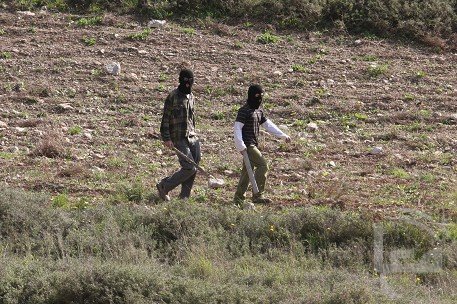
Palestinian medical sources reported on Saturday evening that two Palestinian youths were wounded by Israeli military fire as the soldiers opened fire at local residents who were defending themselves after being attacked by fundamentalist settlers near Nablus. The settlers attacked local villagers of Iraq-Burin village, south of Nablus, in the northern part of the West Bank.
Sources at the Palestinian Red crescent Society reported that Ahmad Isam Al Faqeeh, 16, was wounded by a rubber-coated bullet in his thigh, and was moved to the Rafidia Hospital. His condition was described as light-to-moderate. Resident Nasr Daoud Daqlous, 18, was lightly wounded and received treatment by medics at the scene.
The clashes started when dozens of fundamentalist settlers of the Yitzhar illegal settlement attacked the village and its residents.
Ghassan Douglas, in Charge of Settlements File in the northern part of the West Bank, stated that after the settlers attacked the residents, Israeli soldiers arrived at the scene and opened fire at the Palestinians instead removing the settlers who initiated the confrontation.
Iraq-Burin is a small village of nearly 1000 residents in addition to some 600 residents living abroad, especially in Jordan and Kuwait. It has 125 homes and the families living there are originally from Burin village.
NATO to Curb Night Raids After More Afghan Civilians Killed
By Jason Ditz | January 21, 2010
NATO commanders say that they will be issuing new rules to severely curb the number of nighttime raids they conduct in Afghanistan, after the latest civilian killings sparked more protests in the Ghazni Province.
NATO spokesman Rear Admiral Gregory Smith says the new rules will address “the issue that’s probably the most socially irritating thing we do and that is entering people’s homes at night.”
Locals likely find the shooting more irritating than the entering, however. People from a tiny Ghazni village marched on the provincial capital today, dragging the bodies of four people slain in the latest raid. Two of the bodies were an 11 year old and a 15 year old.
The official story from NATO is, as usual, starkly different. They insist that the four people killed, including the 15 year old, were all insurgents. No mention was made of an 11 year old but they insisted that “during the operation, 11 women and 24 children were protected.”
Family members of the slain note that not only were they not “insurgents,” they didn’t even own a gun and not a single round of ammunition was found in their home, labeled by NATO as a “training compound.” NATO’s statement is also likely significantly undermined by the very public effort to change the rules, something one would assume they would not do if, as the report claimed, everything went so swimmingly in the overnight raid.
David Brooks seeks to reframe Zionism
By Scott McConnell | January 18, 2010
When David Brooks puts forth a definition of Zionism, it merits our attention. Brooks is talented and sometimes incisive, but his main gift may be his acute sense of where Commentary leaves off and the ideological mainstream begins. There he parks, on the often shifting line between the two: kind of a neocon but not, understand, the frothing kind. It’s a slot he shares with The Atlantic’s Jeffrey Goldberg, sometimes described here as the most important Jewish journalist in America, and given the current configuration of power and opinion, a central one.
So in a seeming aside to his column praising Jewish over-representation in the world of intellect (should pro-Iraq-war media figures be quantified as well?) Brooks writes:
“Israel’s technological success is the fruition of the Zionist dream. The country was not founded so stray settlers could sit among thousands of angry Palestinians in Hebron. It was founded so Jews would have a safe place to come together and create things for the world.”
Perhaps also sensing that Americans need a refresher course in the purpose of Zionism, Jeffrey Goldberg immediately reproduced the above paragraph on his blog, appreciating that Brooks “frames Zionism in a completely different way than the news pages do” and “writes smartly about the competition between tribal and worldly Zionism”.
There is a tale in these carefully crafted sentences. David Brooks’s settlers are “stray”—as if some overly enthusiastic campers missed their trail, only to put down their rucksacks in Hebron—and not, as is actually the case, a well-financed salient backed by the American tax code, the Israeli government, and overseen by the IDF. (I’m reminded of the time, many years ago, when Leon Wieseltier explained to my wife that the Israeli army ended up on the outskirts of Beirut because they had misread their maps and got lost.)
Note too the passivity Brooks attributes to them. They don’t occupy, or build, or settle, or agitate. They “sit” –surrounded by “angry Palestinians.”
One wonders whether David Brooks, after five hundred or so NY Times columns, has considered what would happen if he devoted just one to depicting the actual situation in Hebron. Not the stray settlers who “sit” –but the settlers who throw stones at Palestinian children on their way to school, throw garbage and feces at the Palestinian markets, who scrawl “gas the Arabs” on Palestinian homes, cut apart olive trees belonging to the remaining Palestinians–all under the watchful protection of the Israeli army. Hebron is probably the closest thing to pure apartheid that exists anywhere in the world right now: Arab residents are barred from even walking on certain sidewalks in the old city. Many Israelis surely find it distasteful, but not enough to use their democracy to stop the army from protecting the settlers, not enough to terminate the state funds which build the settler roads and maintain infrastructure. Most Americans are oblivious; it’s not as if their mainstream media report from Hebron. So if David Brooks wrote a column about Hebron, it would multiply public awareness of what goes on there many times, and might be a huge step towards rectifying the situation.
But he doesn’t and probably never will. He is pleased to let us know that he finds the settlers a little bit infra dig, and that when Americans think of Israel they should think of software geniuses. It’s a skilled performance, but one almost prefers the forthrightness of the neocons who make no pretense of desiring a just settlement with the Palestinians, asserting instead that we should support Israel more than we do any other country in the world because it “shares our values.”
I Am Going Back to Gaza: Interview with Ewa Jasiewicz
 |
Ewa Jasiewicz: It’s an honour and a privilege to participate in this struggle. |
By Frank Barat
A year ago, Israel launched ‘Operation Cast lead’ in Gaza. It started on 27th of December 2008 and finished on 18th of January 2009. Those 22 days were the most brutal and violent the Palestinians had seen since 1967. More than 1400 Palestinians died including more than 400 children. More than 5000 Palestinians suffered serious injuries. 13 Israelis died. Ewa Jasiewicz was one of a handful “internationals” on the ground. A year later, she remembers and shares her reflections with me.
Frank Barat: You were in Gaza a year ago during “Operation Cast Lead”. Why and how did you and other activists get to the Gaza Strip?
Ewa Jasiewicz: Myself and several solidarity activists from Lebanon, Spain, Canada, Australia, Italy, UK, Ireland and Greece managed to get into Gaza aboard the Free Gaza Movement’s Dignity boat. FGM (1) has sailed five successful missions to Gaza between August-December 2008 bringing in human rights workers to build political solidarity activism, to break the isolation of ghettoized communities and directly confront Israel’s illegal and brutally collectively punishing siege.
FGM’s missions are political – we know Palestine is not a charity case, and that the solutions to 60-year policy of ethnic cleansing, apartheid and militarised ghettoization are not extra bags of flour, medicine, new tents and millions in aid, but, political will and direct action – currently un-forthcoming from governments around the world, so our actions are about directly applying international law from the grassroots up because it isn’t being respected and is being violated, daily, from the top-down – the siege of Gaza and occupation of Palestine is international, the states supporting it either with their silence or direct complicity in economically supporting Israel are co-occupiers and collaborators in war crimes against the Palestinian people along with Israel.
FB: You had already spent some time in the West Bank during various Israeli operations (more particularly in Jenin). What were the main differences between the 2 places and what did you expect to see in Gaza? Did you expect the attack?
EJ: I didn’t expect the attack – but people in Gaza and the Hamas authority did expect an attack because the ceasefire had expired and Israel was sabre-rattling, threatening to eliminate, as always but with greater intensity and focus, resistance leaders – military and political – and their supporters. There was an increase in UAVs (unmanned aerial vehicles – drones) flying 24-7. I had experience of smaller operations in the West Bank in Jenin and Nablus following Operation Defensive Shield in 2002. Operation Defensive Shield had been massive, hundreds of Palestinians were killed, the heart of Jenin refugee camp was bulldozed and dozens of civilians massacred in the process. By the time I came, all the ruins and trauma were still very fresh but the worst of the destruction and killing had subsided.
The smaller invasions were carried out under curfew, involving hundreds of troops, carrying out house to house searches, and mass arrests with every man aged between 15-50 rounded up, interrogated and beaten – a typical operation, with groups of children throwing anything they can at tanks and APCs in the street – and often getting shot at for doing it. There would be sporadic resistance at night from fighters, but many of the most experienced had been killed at that point. Troops would carry out collectively punishing home demolitions using bulldozers or explosives and civilians would be used as human shields. What was different at that time in the West Bank was that a lot of the PA’s infrastructure and military infrastructure of the resistance – fighters and leaders – had been destroyed during Defensive Shield by F16s. Israel was executing its cyclical strategy of having decimated the leaders of the armed and political resistance of major political factions, moving on to target the social infrastructure – community leaders, social activists, as continuing to arrest relatives of The Wanted and trying to bait out and kill the younger, more inexperienced fighters.
Because of the tunnels, fighters in Gaza have had access to more sophisticated and threatening weaponry than their West Bank counterparts, so Israeli aggression has been more intense in Gaza and heavily reliant on aerial bombardment. Since the withdrawal of the colonists and military bases, this has increased.
In the WB activists could be much more mobile and confront and dialogue with soldiers. In Gaza 2009 that was impossible. I only once saw soldiers – a special forces soldier trained his gun and apparently shot at our ambulance. In the West Bank we were often between tanks and APCs and following and observing soldiers close-up. If you got close to soldiers in Gaza they’d kill you – is what everyone kept telling us.
FB: What had you planned to do there? Did your plans changed once “Operation Cast Lead” started?
EJ: I’d planned, as had other activists, to work with Palestinian partners – civil society groups, unions, farmers and fisherman, local campaigns for the right to education and to end the siege. My role was going to be to co-ordinate and guide visiting delegations coming aboard Free Gaza’s boats along with Caoimhe Butterly. Once OCL (Operation Cast Lead) started, it became immediately clear that we needed to do as foreign activists was to fulfil our role of witnessing and reporting, mitigating the risk to those most likely to attacked – which during invasions are the medical services. The IOF (Israel Occupation Forces) killed 16 rescuers in 22 days and injured dozens more. By volunteering with medics we (a) attempted to deter attacks on them by informing the media and our embassies that we would be accompanying all services – 13 of the medics killed were from the Civil Defence services. We did no differentiate between ‘independent’ and ‘government’ services, all must be protected under international law. Also, we didn’t just sit in the ambulances, we physically carried the injured and dead and tried to assist where possible (b) we could remain mobile – ambulances were the only vehicles moving around 24-hours, we needed to be able to document and report on the attacks as fully as possible (c) in our mobility and proximity to the front line we could witness the effects of the bombardment on civilians in their homes, and take testimonies from families and Palestinian human rights workers inside hospitals.
FB: Could you describe a day in Gaza during “Operation Cast lead”.
EJ: The constant sneer of surveillance drones, repetitive bombing and crashing sounds, some close some further away, muted panic, empty streets, rubble everywhere, ambulance sirens wailing endlessly, screaming relatives coupled with the groans of the bloodied and dust-covered crushed and injured, medics praying, and smoking, heart-beating perpetual ratcheted-up adrenaline, a constant readiness for the next strike and yearning for it to all end, endless stream of bodies and blood-soaked stretchers, cyclical dread, pierced with fresh-surges of shock and horror, un-absorbed, and a deep fear of the night and whether we would make it through and whether each ambulance run might be the last. None of the fear paralysed us but nevertheless it was present. But we all early on accepted we could die, and took on the risks because it was worth it, the Palestinian people are worth it. We wanted to save lives and I know I let go of my attachment to mine, inspired and encouraged by the bravery of those around me, and their willingness to make the ultimate sacrifice for the sake of others.
FB: What was the feeling of the population on the ground? How were they surviving and responding?
EJ: Everybody was terrified but defiant. The feeling on the ground was that anything could happen, all red lines had been crossed, not just with this operation, we have to remember that Cast Lead was only an intensification and a drastic one at that, of an existing policy of massacre and deliberate targeting of civilians and civilian infrastructure, but in Jabalia, many of us were expecting another Sabra and Shatilla, with all witnesses banned from seeing the worst and with media being attacked, and tanks moving in closer and close, we felt that the atrocities already happening signified more could come and on a much wider scale.
FB: What was the most useful thing you think international volunteers were able to achieve and contribute? What did the Gazans think of your presence there?
EJ: The community was glad we were there and kept telling us, ‘please report what you see, we cant even believe this is happening to us, let the world know, its your duty to speak out about what your witness’ – and that’s what we did, through TV and Radio interviews, our own written reports, some of us wrote books too (Vittorio Arrigoni ‘Gaza, Stay Human’ (Italy) (2), Sharyn Lock ‘Gaza Beneath the Bombs’ (UK) (3), myself ‘Gaza: a ghetto unbroken’ (Poland) (4), and some of us made films, Fida Qeshta and Jenny Linnel – documentaries on the phosphoric bombardment of Khoza and Alberto Arce and Mohammad Rujailah (To Shoot an Elephant) (5). I think we contributed to the testimony of the Palestinian community – that white phosphorous was being used, that civilians were deliberately being targeted, that hospitals, schools, emergency services were being targeted. And that counter-acted Israel’s propaganda. Also, I know for a fact that we lifted the spirits of the medics we worked with, they felt they had a witness with them in case of their death, and a possible small bit of protection against Israeli attack. Everybody needs a witness when they’re going through hell – wherever and whatever that hell is – it’s a form of solidarity, of verification, that the unbelievable really is happening to you. Also, we were urging people on the outside to step up their protests and direct actions and advocacy for BDS (Boycott Divestment and Sanctions) (6) – getting that narrative out was important too, peoples eyes were opened by OCL and many people wanted to get involved and deepen their activism.
FB: Could you recount one event that truly shocked you during this period?
EJ: There were so so many. Probably the bombing of a house by F16 just a few feet away from four of our ambulances. I was in the passenger seat with my hand on the door, my friend and driver told me just wait, wait a little, and suddenly there was this enormous explosion – everything went bright fire orange and rubble and debris showered our ambulance. One of our drivers was injured and needed to be carried out on a stretcher. Our exit route was blocked by rubble, a family was screaming and gathering their belongings and getting out, we were stumbling with our casualty and surveillance drones were thundering above, and we feared a repeat strike, more casualties, and losing four ambulances when every single one was vital. We cheated death that night. The Israelis saw us and our solo-movement in the streets of Jabalia, and bombed a house less than 10 feet away from us – this is a criminal reckless use of force. Another was the bombing of the Beit Lahiya Elementary School with white phosphorous. We arrived in our ambulances after evacuating dozens of residents suffering from phosphoric inhalation and after the school had taken a direct hit. I was masked up but the stench and smoke was still penetrating, and when we got there a second round exploded above us, I was frozen to the spot and could see these burning blobs raining down next to me, I had to be screamed at to to move and shelter. The refugees in the school were screaming and crying under a flimsy metal shelter in the school yard. The third floor of the school was on fire. We brought Bilal Ashkar aged 7 – just this limp boy – into our ambulance. He’d been hit by the phosphorous shell and thrown down the stairs of the school by the force of the explosion. He was dead on arrival.
FB: A ceasefire was declared on 18th January. Did things change much after this? What did Gaza feel like and look like after the ceasefire?
EJ: The IOF flew F16s over people returning to pick up the pieces of their shattered lives in Ezbit Abid Rabo, drones continued to sneer above us every night. There was this hollow humiliation and un-digested horror, and loss, such a profound sense of dislocation and loss, of lives, of the loved, homes, whole communities, streets, mosques, shops, gone. People literally felt physically lost in their own neighbourhoods. It was like another Nakba (1948 Palestinian Catastrophe). People felt mocked by the international community, ‘Homme yidhak aleina’ was what we frequently heard, ‘they’re laughing at us, the whole world doesn’t care, they’re mocking us’. It felt like a tsunami had hit.
FB: Many reports coming from UN bodies, aid agencies and Human Rights organisations came out very quickly in months following “Operation Cast Lead”. Most of them agreed on the fact that War Crimes and possible Crimes against Humanity had been committed during the Israeli attack. You’re not an expert, but did you ever witness actions that for you were crimes of this magnitude?
EJ: Absolutely. The targeting of civilians and civilian areas, the reckless and wanton destruction of property, the disproportionate and indiscriminate use of force, seen with the bombing of the Beit Lahiya School, Samouni family massacre, the F16 bombardment of the Hamdan children in Beit Hanoun, the utter disregard for our ambulances, the blocking of access to the injured resulting in hundreds of deaths, the extra judicial killing of Sayed Al Seyam and Nazar Rayan and scores of their family members. We picked up some many shredded men (and some some women too) axed by heavy-duty bombs released by surveillance drones – these can carry a 150kg payload and are sophisticated enough to detect the colour of a person’s hair. According to Al Mezan, proportionally, most people in OCL were killed by UAV’s followed by F16s.
FB: A year later (27-12-09), people marched in hundreds of cities around the world to “commemorate” those horrific events. What do you think of those demonstrations, rallies…? What type of effect do they have on Gazans? Are they useful at all in your opinion?
EJ: The rallies are a focus point, we do need collective mourning, remembrance and action in our streets, but its also important to target companies violating international law and which are key in perpetuating Israeli apartheid which we must always remember is not limited to Gaza – the west bank is 15 times larger than Gaza and is full of mini Gaza’s – Bantustans surrounded by the apartheid wall. Companies like Veolia, Alstom, Caterpillar, Elbit Systems, CRT Holdings, Carmel-Agrexco could be charged with aiding and abetting war crimes of ethnic cleansing and illegal colony-building. The call for Boycott, Divestment and Sanctions from Palestinian civil society in 2005 needs to be responded to and supported – actively, daily. We are all complicit in the reproduction and reinforcement of the occupation – it is an international occupation, it is an international issue, and international solidarity for Palestinian human rights can create the conditions for a local solution.
FB: A few weeks ago, 16 aid agencies issued a report saying that the international community had “failed Gaza” (7). On the ground things not only have not changed at all for ordinary Gazans but have gotten worse. Keeping this in mind, what do you think is the role of popular resistance or citizen activism?
EJ: Yes, the international community facilitates and pays for Israel’s occupation, and pathologises and de-develops Palestine in the process. Ordinary citizens have a responsibility not to fund or politically support the bomb and build industry which hides a relentless project of ethnic cleansing and colonialism of Palestine, but to build a critical mass of political pressure by all means available – through BDS and direct action – to bring about sanctions against Israel and to enforce international law by targeting the companies that violate it with respect to Palestinian human rights, and to expose Israel in the same way South African Apartheid was exposed and eventually brought to an end.
FB: What, in your opinion, is most urgently needed in Gaza? What can people do to help and change the “Status quo”?
EJ: Palestinians in Gaza should answer that, but what many say, is that what Gaza needs is the rest of Palestine, people living in camps in Jordan, Lebanon, Syria and the West Bank want to be reunited with their families and homes. The inalienable and legal right of return for Gaza’s and all Palestinian refugees needs to be enacted. The Israeli tactic of divide and torture, of chopping up the Palestinian community, is a long-term tactic designed to break down the strongest weapon against ethnic cleansing that Palestinians possess – memory, community, family – as long as you have a people who remember their homes and lands, and know each other, refer to one another as cousin, uncle, sister and brother, and can ask, ‘Min dar mean’? From which home/family are you?’ then the struggle can never be alienated or abstracted. Palestinians in Gaza need to have the means to speak and act for themselves and not be spoken for, and to have access to the rest of the world – twinning relationships and projects between schools, mosques, universities, hospitals, youth groups, initiatives – these are all means to break the isolation inside and build a more intimate and motivated solidarity movement on the outside. Aid is not the answer. Solidarity is.
FB: Will you ever go back?
EJ: I am going back! I only meant to leave for a month, I deeply miss Gaza. It became like a home to me, I miss my friends and ‘family’ there. Like so many activists that go to Palestine, what we witness never leaves us. We learn from and are humbled by the people that we work with, and it’s an honour and a privilege to participate in this struggle.
[Ewa Jasiewicz is a human rights activist, union organiser and journalist. She has spent years working in occupied Palestine and Iraq with oil workers, refugees, paramedics and community groups. She is a co-ordinator for The Free Gaza Movement and part of the editorial collective of Le Monde Diplomatqiue Polish Edition. Her book ‘Gaza: Getto Nieujarzmione (Gaza – a Ghetto Unbroken) will be published in Poland by Ksiazka i Prasa in March. UK publisher T.B.C.]
– Frank Barat is a human right activist living in the UK. He contributed this article to PalestineChronicle.com.
Notes:
(1): See www.freegaza.org
(2): See Kubepublishing.org.
(3): www.plutobooks.com/display.asp?K=9780745330242
(4): Soon to be published
(5): www.toshootanelephant.com/
(6): www.bdsmovement.net/
(7): www.amnesty.org.uk/uploads/documents/doc_20012.pdf
Ma’an journalist enters week 2 in detention
Ma’an | 19 January 2010
As journalist Jared Malsin wrapped up one week in detention today, a Tel Aviv district judge indicated there were grounds for appealing an expulsion order issued last Tuesday.
District Judge Kobi Vardi sought further clarification of the explanation offered by the Israeli Attorney General’s Office that Malsin was denied entry for “refusing to cooperate” during an eight-hour interrogation at Tel Aviv’s Ben Gurion International Airport.
On Monday, Ma’an lawyer Castro Daoud filed additional information in response to allegations by the Attorney General’s Office, and insisted that Malsin be brought out of the airport to attend a hearing on the matter. Daoud argued that Malsin has a right to a full defense and, at the least, to be present at his own hearing.
The attorney general had requested that no hearing be scheduled, saying Malsin’s presence in court would complicate efforts by the Ministry of the Interior to deport the journalist, since moving him off airport property requires a change in visa status.
Daoud further contested the attorney general’s explanation, arguing the listed reasons for denial of entry do not constitute valid legal justifications, and that they certainly do not trump the unprecedented violation of press freedom that would accompany Malsin’s deportation.
According to court documents filed on Thursday evening, signed by an Israeli interrogator, Malsin was denied entry for “refusing to cooperate” and for violating visa terms.
Disturbingly, the documents also reveal that interrogators had gathered online research into the journalist’s writing history, which transcripts indicate included news stories “criticizing the State of Israel,” among other allegations he authored articles “inside the [Palestinian] territories.”
See the following for more information:
On the reaction of international press associations:
http://www.maannews.net/eng/ViewDetails.aspx?ID=254583
On Jared’s fight to overturn the deportation order:
http://www.maannews.net/eng/ViewDetails.aspx?ID=254021
On the timeline of Jared’s detention and questioning:
http://www.maannews.net/eng/ViewDetails.aspx?ID=254589
For further inquiries, please contact:
George Hale (English)
+972(0)52.785-4907
Raed Othman (Arabic)
+972(0)59.925-8705
Nasser Lahham (Hebrew)
+972(0)59.925-8704
For the most updated version of this news release, click here:
http://www.maannews.net/eng/ViewDetails.aspx?ID=253864
Israeli army crosses into Lebanon/Four Israeli jets seen over Lebanon
Xinhua | January 18, 2010
An Israeli army unit on Sunday crossed the borders with Lebanon in the direction of the occupied part of al-Ghajar village, Lebanon’s state-run National News Agency (NNA) reported.
“An intense Israeli build-up of forces during the past 24 hours has been observed along the eastern sector of the Blue Line, with mobile and fixed patrols,” said NNA.
It added that “Israeli tank emplacements were spotted amid intense overflights by helicopter gunships and warplanes.”
“Earlier, an Israeli mechanized infantry unit comprised of two Hummers crossed the UN-designated Blue Line for 300 meters in the direction of the occupied part of al-Ghajar village,” said NNA.
On the Lebanese side, UN Interim Force in Lebanon (UNIFIL) and Lebanese army personnel intensified patrolling activities.
The Blue Line, which is the line for Israeli withdrawal from south Lebanon in 2000, now serves as the borderline of the two countries and runs through the middle of the al-Ghajar village.
Lebanon accuses Israel of intruding its airspace on a daily basis, saying it is a violation of UN Security Council Resolution 1701. The resolution put an end to the 2006 war between Israel and Lebanese Shiite armed group Hezbollah, and mandates peacekeepers to monitor the armistice along the border.
Also:

BEIRUT, Jan 17 (KUNA) — Four Israeli fighter jets were seen flying over Lebanese airspace in violation of the Lebanese sovereignty and UN resolution 1701, a Lebanese statement said on Sunday.
The fighters were seen over a town south of Lebanon located close to the border with Israel, according to a statement by the Lebanese armed forces. The jets made a circular movement over several towns before heading back over the sea.
The statement added that Israeli fighters have been witnessed over Lebanese territory on a virtually daily basis for a few weeks lately, and this is considered a breach of the UN Security Council resolution 1701.
The UN Interim Forces in Lebanon (UNIFIL) have voiced concern over the matter on a number of occasions, criticizing the Israeli breaches on Lebanese sovereignty, and sending letters of complaint to the UN and Israeli army command.
Featured Video

New positive ivermectin evidence
or go to
Aletho News Archives – Video-Images
From the Archives
Fanatical Followers of the Covid Regime: A Jim Jones-Style Cult?
By Professor Roger Watson and Dr. Niall McCrae | The Daily Sceptic | November 15, 2021
As scholars at leading British universities over recent decades, we witnessed the replacement of critical thinking and debate by narrative: facts are discrimination and scientific method is imperialism; truth, instead, is derived from ‘progressive’ values. This educational trend may be a major contributory factor to the ease in which society has been inculcated to the Covid ‘new normal’ of masking, testing, and repeated doses of vaccines for a disease of similar risk to severe influenza.
One doesn’t need much critical reasoning to observe the flawed logic of some vaccination enthusiasts, such as people who respond to experiencing any side effects, however debilitating, by saying “at least I know it’s working”, or, after contracting the disease despite their promised inoculation (over 90% effective, according to initial drug company claims), “I’d have been worse off without the jab.” … continue
Blog Roll
 Aletho News
- EU Council Advances Chat Control 2.0 Scanning Proposal
- Ex-Greek MEP files complaint against Israeli spyware firm over alleged Pegasus surveillance
- Troubling ideas throughout the Torah, Talmud, Mishneh Torah and Tanya
- ‘Grave, alarming’: Iran mission on Trump’s UNGA ‘annihilation’ threats
- Najaf airport to reopen to Iranian flights within 24 hours: Ambassador
- From ‘How Will This End For Iran’ to ‘When America Walks Away’: A tale of two Economist covers
- Tehran blasts ‘baseless’ speculation linking Iran to alleged bomb plot at UK air base
- The Rise And… Rise Of ‘Color Revolutions’
- The Coming GOP Bloodbath?
- Arctic Scare Stories Melt Away
- If Americans Knew
- Netanyahu Asked UAE Leader to Deny Report on Oct. 7 Warning in Secret Visit, Sources Say
- CNN Chief Int’l Correspondent Clarissa Ward on Journalists in Gaza
- Democratic Party Consultants Surround Troy Jackson with Pro-Israel Donors
- Christian Leader Responds To Netanyahu’s Claims Regarding Palestinian Christians
- In Gaza, ‘Whoever Survives the Bombing Won’t Survive the Rubble’
- Israel kills more Palestinians, amid push to resettle Gaza – Daily Update
- Israel forces Gazans to live in constant peril – Daily Update
- Deconstructing Netanyahu’s pants-on-fire UN rant – Daily Update
- Trump betrayed voters with his campaign lies and prioritized a foreign country once he took office
- Netanyahu calls Israel’s war in Gaza ‘opposite of genocide’ in UN speech to near-empty hall
- No Tricks Zone
- New Study: Earth And Venus Surface Warmth Largely Explained By Convection And Lapse Rate, Not CO2 Or Radiation
- 2025 Nature Paper Claiming Worsening Global Drought Gets RETRACTED …Heavily Flawed
- New Study: ‘Global Drought Shows No Detectable Recent Acceleration Under Climate Warming’
- Economic Masterminds: German Socialists Suggest Taxing Productivity Gains Stemming From Using AI
- The South China Sea Has Not Been Cooperating With The Climate Change Narrative
- Energy Crisis: Germany Enters Heating Season With Historically Low Gas Reserve Fill Levels
- New Study: The Antarctic Ice Sheet Gained Mass From 2020-2024 Due To Staggering Snow And Ice Accumulation
- Study: Ocean Heating Rates From Thousands Of Years Ago ‘Dwarf’ Modern Ocean Heating Rates
- Climate Extremists Target, Attack Large-Scale Power Grid Infrastructure In Germany!
- New Study: Antarctic Ice Melt Has Contributed Less Than 1 Centimeter To Sea Level Rise In The Last 30 Years

