War Drums Beating Louder Under Biden Hardliners
By Stephen Lendman | March 9, 2021
On all things war related, Trump mainly focused on waging it all-out by other means on Iran, China, and other nations free from US control.
Early in his tenure, the rape and destruction of Raqqa, Syria and Mosul, Iraq were major exceptions.
For the most part, he was relatively quiet on the hot war front, notably launching no new ones during his time in office.
Biden and warmongers surrounding him are cut from a different cloth.
As US senator and vice president, Biden supported one preemptive US war after another on invented enemies — nonbelligerent states threatening no one.
Will the pattern repeat with him in the White House?
Is it just a matter of time before hardliners running his geopolitical agenda invent pretexts to escalate ongoing US wars and/or launch one or more new ones?
If past is prologue, greater US warmaking is highly likely.
In the Middle East, plans to escalate war in Syria may exist or are being prepared.
The same goes for neighboring Iraq. Its parliamentarians and ordinary people want their country back, US occupation ended once and for all.
Not if undemocratic Dems have their way. US forces came to Iraq to stay.
As in Syria, Afghanistan and elsewhere, permanent US occupation is planned — enforced through the barrel of a gun.
According to US war secretary Lloyd Austin on Sunday:
“We’ll strike, if that’s what we think we need to do, at a time and place of our own choosing. We demand the right to protect our troops (sic).”
In late February, hardliners in charge of Biden’s geopolitical agenda OK’d aggression against targets along the Iraqi/Syria border.
Is more of the same planned against both countries?
Is direct US confrontation with Iran coming ahead?
Are conflicts planned in Central Asia, North Africa and/or the Indo/Pacific?
According to Tom Dispatch in late January:
“Biden inherit(ed) (US) global war—and burgeoning new Cold War —spanning four continents and a military mired in active operations in dozens of countries, combat in some 14 of them, and bombing in at least seven.”
“That sort of scope has been standard fare for American presidents for almost two decades.”
What’s likely since Biden replaced Trump?
Will he escalate US wars of terror, not on it?
As senator and vice president, Biden cheerled US preemptive wars.
He’ll “surely escalate American adventurism abroad,” Tom Dispatch (TD) believes.
He’s been interventionist throughout his public life. He’ll likely at least maintain status quo belligerence.
TD: “Whether the issues are war, race, crime, or economics, Uncle Joe has made a career of bending with the prevailing political winds and it’s unlikely this old dog can truly learn any new tricks.”
He “filled his foreign policy squad with Obama-Clinton retreads, a number of whom were architects of—if not the initial Iraq and Afghan debacles.”
They followed with “disasters in Libya, Syria, West Africa, Yemen, and the Afghan surge of 2009.”
“Biden (put) former arsonists in charge of the forever-war fire brigade.”
At the same time, press agent media will likely “help (him)… make war more invisible… to Americans.”
History one day won’t likely “judge Biden the war president kindly.”
Since the run-up to WW I, Dems have been more belligerent than Republicans — Bush I, II, and Dick Cheney major exceptions.
So was Jack Kennedy going the other way, transforming himself from a warrior to peacemaker, one among other reasons why he was assassinated.
Jimmy Carter earlier said: During his time in office, “(w)e never dropped a bomb. We never fired a bullet.”
Dem presidents after his tenure were warriors, not peacemakers — notably Biden as senator, vice president, and now figurehead president, a disturbing record since the early 1970s.
Is escalated warmaking on his watch coming? His history of supporting wars on invented enemies and interventionist geopolitical team suggest more of the same ahead.
Terror-bombing targets along the Iraqi/Syrian border in late February perhaps was prelude for follow-up aggression.
Since taking office, increased numbers of Pentagon forces, heavy weapons, munitions and equipment were sent to Kurdish-controlled eastern Syria where most of the country’s oil is located.
Iran accused the Biden regime of reviving ISIS in Iran and Syria, Iranian Supreme National Security Council secretary Ali Shamkhani saying:
Recent US belligerence “strengthens and expands the activities of the terrorist Daesh (ISIS) in the region,” adding:
“The (late Feb.) attack on anti-terrorist resistance forces is the beginning of a new round of (US) organized terrorism.”
He vowed firm resistance to “confront the US plan to revive terrorism in the region.”
US aggression time and again signals more of the same coming — unjustifiably justified by invented pretexts. No legitimate ones exist.
The Pentagon reportedly deployed six long-range B-52 bombers to Diego Garcia.
It’s a location from which US airstrikes can hit targets in the Middle East and Indo/Pacific.
According to military.com, the US is “add(ing) roughly 10,000 personnel to… the Middle East.”
Southfront reported that Syrian forces are “prepar(ing) a decisive push on the Turkish-occupied areas” in the country’s north, adding:
“(S)oon-to-be-rebranded Hay’at Tahrir Al-Sham (HTS) terrorists are attempting to merge with the Turkish-backed National Front for Liberation (NFL).”
“This proposed military council is clearly meant to provide a legitimate cover for the rebranded terrorist activities of HTS and other al-Qaeda factions in Greater Idlib.”
According to Deputy Head of the Russian Coordination Center in Syria, Adm. Alexander Karpov:
“There has been information on that Jabhat al-Nusra terrorists are getting ready to stage a new provocation in the de-escalation zone in Idleb which includes staging a false flag chemical attack.”
Russia’s Defense Ministry reported that labs in Idlib run by European trained experts are preparing CWs for use by jihadists to stage false flag attacks to be blamed on Damascus.
If one or more incidents occur, Syria will surely be wrongfully blamed for what it had nothing to do with — like many times before.
Will Biden hardliners use false flag CW incident(s) as a pretext for escalated aggression?
Separately, Southfront said (US armed and trained) Ukrainian forces escalated artillery strikes on Donbass.
“(C)lashes between pro-Kiev forces and (freedom-fighting) DPR/LPR self-defense units” followed, adding:
“(L)ocal sources report that the scale of violations by pro-Kiev forces are unprecedented for the recent months…”
Kiev “is deploying additional units of heavy weapons and military equipment to the contact line… confirmed by OSCE reports.”
All of the above are worrisome signs of what Biden hardliners may be planning — escalated aggression by US forces, their jihadist proxies and US installed regime in Kiev.
Biden, Afghanistan and Forever Wars
By Binoy Kampmark | OffGuardian | March 9, 2021
The papers are full of suggestions on what US President Joe Biden should do about his country’s seemingly perennial involvement in Afghanistan.
None are particularly useful, in that they ignore the central premise that a nation state long mauled, molested and savaged should finally be left alone. Nonsense, say the media and political cognoscenti.
The Guardian claims that he is “trapped and has no good choices”. The Wall Street Journal opines that he is being “tested in Afghanistan” with his opposition to “forever wars”. The Washington Post more sensibly suggests that Biden take the loss and “add it to George W. Bush’s record.”
The Afghanistan imbroglio for US planners raises the usual problems. Liberals and Conservatives find themselves pillow fighting over similar issues, neither wishing to entirely leave the field. The imperium demands the same song sheet from choristers, whether they deliver it from the right side of the choir or the left.
The imperial feeling is that the tribes of a country most can barely name should be somehow kept within an orbit of security. To not do so would imperil allies, the US, and encourage a storm of danger that might cyclonically move towards other pockets of the globe.
It never occurs to the many dullard commentators that invading countries such as Afghanistan to begin with (throw Iraq into the mix) was itself an upending issue worthy of criminal prosecution, encouraged counter-insurgencies, theocratic aspirants and, for want of a better term, terrorist opportunists.
The long threaded argument made by the limpet committers has been consistent despite the disasters. Drum up the chaos scenario. Treat it as rebarbative. One example is to strain, drain and draw from reports such as that supplied by the World Bank.
Conflict is ongoing, and 2019 was the sixth year in a row when civilian casualties in Afghanistan exceeded 10,000. The displacement crisis persists, driven by intensified government and Taliban operations in the context of political negotiations.”
The report in question goes on to note the increase in IDPs (369,700 in 2018 to 462,803 in 2019) with “505,000 [additional] refugees returned to Afghanistan, mainly from Iran, during 2019.”
Then come remarks such as those from David von Drehle in the Washington Post. His commentary sits well with Austrian observations about Bosnia-Herzegovina during the latter part of the 19th century.
Nearly 20 years into the US effort to modernize and liberalize that notoriously difficult land, Taliban forces once more control the countryside, and they appear to be poised for a final spring offensive against the parts of the Afghan cities that remain under government control.”
The savages, in short, refuse to heel.
Von Drehle, to his credit, at least suggests that the US take leave of the place, admitting that Washington was unreservedly ignorant about the country. He quotes the words of retired L. General Douglas Lute: “We were devoid of a fundamental understanding of Afghanistan.” Tellingly, the general admitted that, “We didn’t know what we were doing.”
Fears exist as to how the May 2021 deadline for withdrawing all US military forces looms. Anthony H. Cordesman is very much teasing his imperial masters in Washington as to what is best. “Writing off the Afghan government will probably mean some form of Taliban victory.”
This is hardly shocking, but Cordesman prepares the terrain for the hawks.
This will create increased risks in terms of extremism and terrorism, but it is far from clear that these risks will not be higher than the risks of supporting a failed Afghan government indefinitely into the future and failing to use the same resources in other countries to support partners that are more effective.”
This is the usual gilded rubbish that justifies the gold from a US taxpayer. But will it continue to stick?
A few clues can be gathered on future directions, though they remain floated suggestions rather than positions of merit. The Biden administration’s Interim National Security Strategic Guidance waffles and speaks mightily about democracy (how refreshing it would be for him to refer to republicanism) which, in a document on national security, always suggests overstretch and overreach.
“They are those who argue that, given all the challenges we face, autocracy is the best way forward.” But he also inserts Trumpian lingo. “The United States should not, and will not, engage in ‘forever wars’ that have cost thousands of lives and trillions of dollars.”
Afghanistan comes in for special mention, and again, the language of the Trump administration is dragged out for repetition.
We will work to responsibly end America’s longest war in Afghanistan while ensuring that Afghanistan does not again become a safe haven for terrorists.”
Not much else besides, and certainly no express mention of grasping the nettle and cutting losses. And there is that troubling use of the word “responsibly”.
The default position remains the use of force, which the US “will never hesitate to” resort to “when required to defend our vital national interests. We will ensure our armed forces are equipped to deter our adversaries, defend our people, interests, and allies, and defeat the threats that emerge.” Again, the stretch is vast and imprecise.
Given that position, the withdrawal of the remaining 2,500 US troops in the country is bound to become a matter of delay, prevarication and consternation. Quiet American imperialism, at least a dusted down version of it, will stubbornly continue in its sheer, embarrassing futility. The imperial footprint will be merely recast, if in a smaller form.
Dr. Binoy Kampmark was a Commonwealth Scholar at Selwyn College, Cambridge. He lectures at RMIT University, Melbourne. Email: bkampmark@gmail.com
Iraqi resistance groups announce confrontation with US occupiers until liberation

Press TV – March 5, 2021
Iraqi resistance groups have announced a new phase of resistance against US forces in the country, vowing “confrontation with occupiers until the liberation of Iraq.”
“The resistance sees confrontation as the only option that guarantees the freedom, dignity of this country after exhausting all the means that others have bet on with the occupation,” the coordinating body for the Iraqi resistance factions said in a statement on Thursday, according to the Iraqi media.
“We are facing a new page from the pages of the resistance, in which the weapons of the resistance will reach all the occupation forces and its bases in any part of the homeland,” they said.
Hailing the recent attacks against the “occupation forces”, the statement added that “the resistance has the legal and national right and popular support for all of that, but will not target diplomatic missions.”
“The Iraqi resistance is an Iraqi decision, and its choice is the choice of the Iraqi people, and it will continue circumstances and sacrifices until Iraq is liberated from the filth of the occupation,” it said.
The statement came a day after 10 Grad rockets struck the Ain al-Assad air base hosting American forces in the western Iraqi province of Anbar. The incident led to the death of two American contractors and injured as many as six people. It also resulted in material damage to both parts of the outpost.
An informed security source told Press TV that eight of the projectiles struck the “American part” of the base, while two hit the section that is assigned to the US-led coalition.
The raid was conducted days after the US military targeted the positions of the Popular Mobilization Units (PMU), known as Hashd al-Sha’abi, on the Iraqi-Syrian border, where they were engaged in fighting the remnants of the Daesh terrorist group.
Elsewhere in the Thursday statement, the Iraqi resistance termed as “traitorous” any party that stands as an obstacle against the path of resistance and its constant choice in confronting and expelling the occupier.
“It is the right of the resistance, rather its duty, not to pay attention to such bodies, but rather to prevent it by all means from hindering its strikes against the occupation,” they said.
Forbes magazine reported on Wednesday that the United States will likely deploy the Avenger air defense system in Syria and Iraq to support US forces in the face of the growing drone threat.
US military bases and diplomatic missions in Iraq have been repeatedly targeted in recent months as anti-US sentiments run high in the Arab country since the US assassination of Iran’s legendary anti-terror commander General Qassem Soleimani and his Iraqi trenchmate Abu Mahdi al-Muhandis, deputy head of the PMU, last year.
The two anti-terror commanders were targeted along with their companions in a drone strike authorized by former US president Donald Trump near Baghdad International Airport on January 3, 2020.
The Wednesday attack against the US-led occupation forces targeted the same air base that Iran openly attacked on January 8, 2020 as part of its retaliation for the Soleimani assassination, which also prompted the Iraqi lawmakers to push for the expulsion of the US-led foreign forces from their country.
Biden becomes the sixth successive President to bomb Iraqis: how far could this latest round of escalation go?
By Aram Mirzaei for The Saker | March 4, 2021
Another president, another act of aggression. For the past few decades, it’s almost like a mandatory rite of passage for US presidents to bomb Muslim countries. I don’t think many of us are surprised to see that current US President Joe Biden turned out to be no different to his predecessors, when Washington once more bombed Iraqis last week.
Continuing the same policy of terrorism and humiliation from the Trump era, Washington felt the need to show strength against the Resistance forces on the Syrian-Iraqi border area. What angers me most, is not just the terrorist act of killing people who are fighting US occupation and US backed terrorism, but the fact that Washington cannot and will not recognize that there is a growing local resistance to Zionist hegemony, instead resorting to degrading and humiliating legitimate resistance groups such as Hashd al-Sha’abi of Iraq (PMU) or the Houthis of Yemen by labelling them “Iranian backed proxies”.
Everything and everyone that oppose Washington and Zionist hegemony in West Asia are “Iranian backed”. Whether it is a Houthi attack on a Saudi airport, a Taliban attack on a NATO convoy or a suspiciously random rocket attack on a US base in Iraq, it is always Iran’s fault and somehow the Islamic Republic must be held responsible for these attacks. Both Washington and the Zionist entity keep attacking Resistance forces in the very area where ISIS remnants have been re-emergent for the past months, claiming their right to self defense. Self defense?! America is more than 10,000 kilometres away. US troops are occupying Syrian and Iraqi territory and Washington claims the right to self defense? This narrative has been drilled into the minds of so many people in the West that nobody even reacts when one of the Obama gang’s old crude liars, Pentagon Press Secretary John Kirby was telling the press that Washington acted to “de-escalate” the situation when it bombed Resistance forces on the Syrian-Iraqi border.
What Kirby really meant by “de-escalation” was that he believes that Washington sent Iran and its allies a “clear message”, that messing with Washington is unwise. The sad part is that he and the other psychopaths in Washington actually believe that the so called “message” will in any way deter the Resistance forces in West Asia. It is pretty clear what the US is doing with these random attacks on the Resistance forces. Washington knows the realities on the ground and acts in response to them. In Syria, it has become clear for Washington that Damascus won’t fall, that dream came down crashing when Russia entered the war in 2015. So, Washington is acting to deny Syria and her allies their well deserved victory through the occupation and looting of eastern Syria. Washington will act for as long as it takes to starve the Syrian people into submission.
In Iraq, Washington, being well aware that the Iraqi parliament has voted to expel US forces from Iraq, is desperately seeking new reasons to prolong their occupation. Be it through the magical re-emergence of Daesh terrorists in Western Iraq or through suspicious Katyusha rocket attacks on US interests in Baghdad’s green zone, which are then blamed on the Iraqi Resistance forces without any kind of evidence presented, Washington is seeking to undermine the Iraqi parliament’s decision.
In Iraq, Washington has a foothold in Baghdad not seen in Syria’s Damascus. It is through this foothold that Washington wields influence over many Iraqi politicians and thus has the ability to cause great internal disunity and animosity among Iraqis themselves.
Washington has both great influence over the Kurds in northern Iraq and over the Prime Minister’s office. PM Al-Kadhimi is known to be a close associate of Washington’s and is suspected to be cooperating with the US to prolong their stay in Iraq. During his tenure, tensions between Baghdad and the PMU have run high as government forces have made random raids on the PMU headquarters, arresting some members even. Yet even more dangerous is the escalating tension between Washington and the PMU. On Wednesday March 3rd, a new rocket attack on the Ain Al-Assad military base was reported. This is the same military base that was struck by the IRGC last year in retaliation for Washington’s murder of martyrs Soleimani and Al-Muhandis. Previously the PMU had vowed revenge for Washington’s attack last week, which makes it rather obvious that Washington will blame the PMU for this recent strike.
With this latest round of escalation, one wonders what will happen next? Of course I’m just speculating but I see some real dangers with tensions running this high. I believe that Washington could very well seek to push Iraq into a new civil war in a bid to eradicate the Hashd al-Sha’abi. Many of the groups within the PMU have threatened to wage war on US forces if Washington refuses to withdraw. Unfortunately, this threat by the PMU can easily be exploited by the US, giving Washington a casus belli, as they intensify their “defensive” airstrikes while claiming to support Baghdad’s campaign to bring “stability” to Iraq. Such an endeavour could risk dragging several regional countries into the conflict as the Islamic Republic could be forced to intervene on behalf of the Iraqi Resistance forces. It is clear that Washington cannot and will not attack Iran directly, such an adventure would be too risky for the crazies in the White House and Pentagon. However, fighting “Iranian backed” forces and rolling back Iranian influence could serve to both solidify the continued US occupation of Iraq in the short term, and prevent the Resistance forces from achieving complete victory, in the mid-to-long term. In order to manufacture consent, Washington must portray their actions as both “defensive” and in service of “stability and peace”. Having others fight Washington’s wars for them is a speciality for the Empire. This is why I believe the most likely scenario to be one where Washington attempts to pit Baghdad against the PMU, then sweep in to “help” Baghdad “preserve stability”. This strategy has been used in different ways before by the Obama regime when it unleashed the Daesh terrorist group in Iraq, then claimed to fight the same terrorists it had armed and trained, in a bid to continue their occupation of Iraq and pressure pro-Iran PM Nouri Al-Maliki to resign. Obama then did the same thing in Syria with the support of Kurdish militants in a bid to pressure Damascus into concessions. Trump continued on the same path but went even further when his administration began using phony attacks on “US interests” in Iraq as a pretext for direct confrontation with the PMU, a path that ultimately led to the murder of Martyrs Soleimani and Al-Muhandis. The then-secretary of State Mike Pompeo claimed that Washington had acted to “stabilize” Iraq with the murder of these “terrorists” who were “hated among Iraqis”.
Iraq is key to the Resistance Axis and cannot fall into enemy hands. It is however also the most vulnerable of the countries where the Resistance forces are active, as not only does Washington have great influence over Baghdad, but also over the Kurdish autonomous region in the north.
Supporting Kurdish independence is another way that Washington could seek to attack the Resistance Axis. This can be seen in Syria as well where the Kurdish militants are acting as excellent proxy troops for Washington, occupying about a third of the country and helping US forces in the looting of Syrian oil. Kurdish parties also have excellent ties to the Zionist entity in Tel Aviv, as Zionist chieftain Netanyahu has on several occasions been a vocal supporter of Kurdish independence, often likening the Kurdish people’s cause with the Zionist one. The reactionary Kurdish parties, who are too ignorant and too greedy to understand and realize that they are being used as cannon fodder to further US imperial ambitions, will be more than happy to wage war on Syria and Iraq with US support behind them.
It’s been almost 10 years since the war in Syria began, and 18 years since the war in Iraq began, and still there seems to be no peace in sight for any of the Arab countries. Biden has been in office in less than two months, but in my opinion, the next four years seem to be rather clear in terms of Washington’s policies towards the West Asia region- the long wars will continue and more blood is to be expected. Bush bombed Iraq, [Clinton bombed Iraq, Bush Jr bombed Iraq,] Obama bombed Iraq, Trump bombed Iraq, and now Biden bombs Iraq. For our people, it never matters who or what occupies the White House, the bombings and wars will continue. Iraq has a rather young population, more than 60 percent of the population is under 25 years of age. This means that most Iraqis have known nothing else except the US imposed wars on their homeland. It is a tragedy and a shameful moment in human history where most people in the totally “advanced, civilized, democratic, morally superior” West don’t care about what their despicable governments are doing in Iraq or Syria, because they are stupid Muslim terrorists anyway. This is why Iraq cannot and should not rely on Western public opinion. Resistance is the only way, and the US Empire must be kicked out with force in order for Iraqis to finally have some peace.
Territorial dispute growing between Guyana and Venezuela
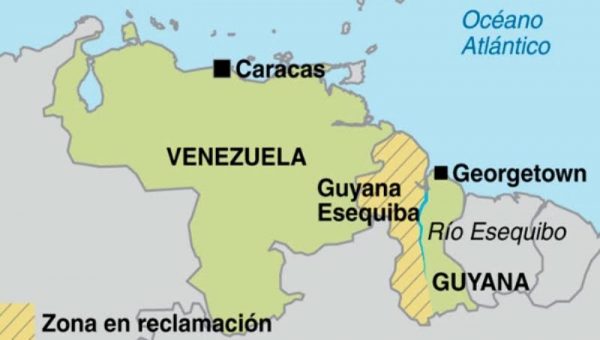
By Lucas Leiroz | March 4, 2021
An old territorial dispute in South America is reaching its most tense point in decades. The territory known as Essequibo has been mutually claimed by Guyana and Venezuela since the 19th century when Guyana still belonged to the United Kingdom. In 1897, the Venezuelan and British authorities agreed to submit their dispute to an arbitrary international court in Paris, which ruled that the land belonged to the UK. For decades, the arbitration decision was accepted by Caracas, but in 1948 Venezuelan authorities revealed some irregularities in the trial, which were documented in old government files. As a result, the decision was considered null, and years later, in 1963, Venezuela formally submitted its territorial claim to the United Nations, and the dispute remains unresolved till today, when the interests of foreign oil companies threaten to increase the tensions.
As a region rich in oil, Essequibo has recently entered the map of the large multinationals in this sector, especially the American Exxon Mobil. More than that, the economic sanctions imposed on Venezuela and the political alignment of Guyana with Washington contribute to create an even more controversial scenario. Guyana has the support of the large private oil sector and the American government, while Venezuela remains alone. Last year, the case was filed with the International Court of Justice, but Venezuela did not accept it and remained out of the trial.
However, in a sentence on December 18, 2020, the Court proclaimed its competence to intervene in the dispute, despite Venezuela’s position. It is necessary to highlight that, regardless of any decision taken by the Court over who really has sovereignty in Essequibo, this sentence must be considered null, since the absence of Venezuelan consent prevents the execution of the sentence. The need for consent is one of the most elementary principles of international law and the very fact that the Court declares itself competent already leads us to question whether its judges are really impartial – clearly, the norms of international law are being violated in favor of Guyana.
Guyana has publicly admitted that its expenses for the court case in The Hague were paid by Exxon Mobil. Although the American oil company has been operating in Guyana for decades, its interest has been greatly increased with the recent discoveries of oil reserves and investors are willing to do anything to ensure the exploration of local natural resources. Currently, Exxon Mobil is interested in expanding its facilities over an area of more than 26,000 square kilometers, which not only crosses the disputed territory in Essequibo, but also violates Venezuelan undisputed national territory.
With this scenario of clear attack on Venezuelan national sovereignty and possible collaboration of the International Court with one of the parties, Venezuela is at a disadvantage mainly due to its diplomatic weakness. Venezuela, at this point, lacks sufficient influence to cause the Court to review its decision or judge the case in a really partial way. For that, only strong international alliances can help Caracas. The large nations that are not aligned with Washington and have so far cooperated strongly with Venezuela, Russia and China, might be provoked by the Venezuelan government to incite international pressure in this regard. Only these two countries can mediate a parallel agreement that may be established between Caracas and The Hague in order to choose between two paths: either Venezuela agrees to submit to trial on the condition that there is a partial judgment and without the influence of private companies, or the Court declines jurisdiction. As the first scenario is unlikely and difficult to monitor, the most viable route would be for The Hague to abdicate any form of judgment.
It is important to mention that, in the absence of international judgment, what is in force in Essequibo is the Geneva Agreement of 1966, which did not decide on sovereignty in the region, but, in search of a peaceful solution, defined what activities would be allowed or prohibited in Essequibo. Oil exploration by foreign companies is not allowed, so, in principle, Guyana is violating the agreement and its activities could only become lawful if there was a decision by the International Court on the matter, allowing exploration. As Venezuela does not submit to the Court, the trial is impossible and, therefore, exploration remains prohibited and Guyana is committing an international offense.
However, more worrying than that is the fact that the American military is working in Essequibo, carrying out tests with the aim of intimidating Venezuela and pressuring Caracas to renounce its demands. There are American military ships in Essequibo “protecting” Exxon Mobil facilities and provoking Caracas. In addition, considering that the American company wants to publicly explore areas within Venezuelan territory, what will become of the American presence? If Caracas does not allow the activities of Exxon Mobil, it is the Venezuelan right to control or even destroy the facilities in its territory. And what would be the American reaction to that – considering Biden’s aggressive interventionist policy?
It is for these reasons that, more than ever, countries of greater international relevance must mediate the issue in order to maintain the status of illegality to the Exxon Mobil’s activities. With international pressure, it is possible that the American company will retreat or that at least the American military in the region will leave and with that we would have a reduction in tensions.
Still, it is possible that with international mediation a mutual exploration agreement will be reached that allows both countries to enjoy the local wealth, without, however, allowing companies that violate the Geneva Agreement to operate.
Lucas Leiroz is a research fellow in international law at the Federal University of Rio de Janeiro.
US Foreign Policy: War Is Peace
By Stephen Lendman | March 1, 2021
A permanent state of war on invented enemies is longstanding US policy.
It’s been this way throughout most of the post-WW II period.
Terror-bombing Syria last Thursday was one of many examples — escalating US aggression against the nation and people by Biden.
The Syrian Arab Republic threatens no one. President Assad is supported by most Syrians.
Yet Obama/Biden launched preemptive war on the country in March 2011.
US forces illegally occupy northern and southern areas.
The Pentagon and CIA use ISIS and likeminded jihadists as proxy forces to advance US imperial aims in Syria and elsewhere.
Washington under both right wings of its war party intends permanent occupation of the country.
Sergey Lavrov noted the diabolical scheme, saying:
Washington is “making the decision to never leave Syria, even to the point of destroying this country” — more than already he should have added.
Lavrov also stressed the US forces occupy “Syrian territory illegally, in violation of all norms of international law, including Security Council Resolutions on reconciliation in the Syrian Arab Republic.”
“They continue to play the separatism card.”
“They continue to block, using their levers of pressure on other states, any supply even of humanitarian aid, not to mention equipment and materials necessary to restoring the economy in the territories controlled by the government, and in every way possible force their allies to invest in territories outside Damascus’s control.”
“At the same time, they illegally exploit Syria’s hydrocarbon resources” by stealing them.
Longstanding US plans call for partitioning Syria and other regional countries for easier control.
According to former Global Policy Forum director James Paul, partitioning Syria “is the Israeli solution,” adding:
The Jewish state’s “overarching goal is to weaken every Arab state by bringing religion and ethnicity into the equation.”
The plan for Syria is partitioning it into Kurdish, Alawite and Sunni states.
Balkanization of Middle East countries is also longstanding US policy.
Regional expert Mahdi Nazemroaya earlier explained that “(r)egime change and balkanization in Syria is very closely tied to the objective of dismantling the ‘resistance bloc’ formed by Iran, Syria, Hezbollah, the Palestinians, and various Iraqi groups opposed to the US and Israel.”
US/NATO/Israeli regional aggression aims to achieve this objective — what failed so far and won’t likely fare better ahead, but continues anyway.
In cahoots with Israeli interests, Obama/Biden launched preemptive war on Syria in 2011.
For hardliners in both countries, the road to Tehran runs through Damascus.
Control over the Syrian Arab Republic is seen as a way to weaken and isolate Iran and Lebanon’s Hezbollah.
According to Algerian academic Abdelkrim Dekhakhena, Bush/Cheney’s 2003 aggression against Iraq “metamorphosed into an apocalypse that swept the core nations of the region.”
“Chaos and destruction” followed with no end of it in prospect.
Washington’s notion of democracy building is suppressing its emergence everywhere and eliminating it wherever it exists.
Endless US Middle East wars created instability and human misery.
US regional aggression is aided by ISIS and other terrorist groups — created by the CIA to advance Washington’s control over regional countries, their resources and populations.
According to Biden’s doublespeak through his press secretary Psaki — paid to lie for her boss — he OK’d escalated US aggression in Syria to “protect Americans (sic),” adding:
Further aggression will aim to “deescalate tensions.”
The above doublespeak mumbo jumbo defines Washington’s war is peace policy.
Endless US wars by hot and/or other means have nothing to do with democracy building, pursuing peace, or protecting Americans.
They have everything to do with advancing Washington’s diabolical imperial agenda that prioritizes unchallenged global dominance.
Psaki also defied reality by claiming that preemptive terror-bombing of Syria on Thursday underwent a “thorough legal process (sic).”
There’s nothing remotely legal about naked aggression in Syria or anywhere else.
A decade of US war against the Syrian Arab Republic and its long-suffering people perhaps will continue in perpetuity.
The same diabolical agenda continues in Afghanistan, Yemen, and Libya, along with war by other means against numerous invented US enemies — notably China, Russia and Iran.
Washington’s rage to dominate other countries by brute force defines what the scourge of imperialism is all about.
There’s no end of it in prospect.
Biden’s longstanding support for wars on invented enemies suggests further escalation of hostilities on his watch.
Confrontation by belligerence and other means will likely be prioritized over pursuing peace and cooperative relations with other countries.
It’s the diabolical American way — addicted to warmaking, abhorring peace and stability.
US seizes UN aid allocated for Rukban refugees, distributes it among terrorists: Russia, Syria
Press TV – March 1, 2021
Syrian and Russian officials have warned that the United States is exploiting the deteriorating humanitarian situation at the Rukban refugee camp to seize UN aid consignments and distribute it among allied Takfiri militants after it turned the camp, located close to Syria’s border with Jordan, into a center for training terrorists.
“As usual, the United States hopes to acquire the aid in order to support terrorist groups operating under its command in the vicinity of al-Rukban camp. The camp has indeed become a seedbed for training extremist terrorists,” the Russian and Syrian Joint Coordination Committees on Repatriation of Syrian Refugees said in a joint statement.
The statement further noted that the US continues to impede all efforts aimed at the closure of the camp, prevents return of its residents to areas liberated from the grips of Takfiri terrorists and does not allow the life there to return to normal.
The joint committees then reiterated the Damascus government’s readiness to receive all Rukban camp residents, who are taken hostage by the US and its terrorist mercenaries, ensure their security, and provide them with decent living conditions.
This is not the first time that aid cargos delivered by the UN and the Syrian Arab Red Crescent to al-Rukban are seized by Us forces or US-backed militants.
Russia and Syria have on numerous occasions also criticized the US for blocking aid deliveries to the refugee camp.
The Rukban camp, described by Russian and Syrian authorities as the “death camp,” is reportedly home to some 25,000 internally-displaced Syrians, mostly women and children.
Just a handful of humanitarian aid convoys have reached the camp in recent years.
In a joint statement on March 28 last year, the interagency coordination headquarters of Russia and Syria, attributed the humanitarian crisis in Rukban refugee camp to the illegal occupation of the area by American forces.
“We believe that the American side’s reluctance to exert influence on their [allied] militants in order to ensure unhindered departure of people from the camp and safe activities of humanitarian representatives in the At-Tanf zone is a clear evidence of its intention,” the statement noted at the time.
The camp lies within a 55-kilometer zone occupied by the US around its military base in the Syrian town of At-Tanf.
The headquarters stated that the US military is using Rukban as an “assembly line for training extremists.”
US military forces smuggle wheat crops from Syria’s Hasakah into Iraq
Meanwhile, a convoy of dozens of US trucks has left Syria’s northeastern province of Hasakah for the neighboring Iraq carrying tens of tons of grain.
Syria’s official news agency SANA, citing local sources in Rmelan town, reported that a convoy of 45 military vehicles loaded with wheat and barley crops departed Kharab al-Jir military base in the countryside of al-Malikiya town, and headed towards Iraqi territories after having passed through al-Walid border crossing.
This is who they are: Biden’s Syria strike is a stark reminder it’s American Empire that’s back
By Nebojsa Malic | RT | February 27, 2021
Only someone who hasn’t been paying attention could have been surprised by the US airstrike on Syria, now that an establishment committed to a globalist Empire rather than a constitutional republic is back in charge in Washington.
Democrats love proclaiming one can’t “turn back the clock,” usually to argue against even attempting to undo whatever domestic policies they’ve rammed through when in power. Yet everything about the Joe Biden administration has been about just that: erasing the past four years of Donald Trump and picking up where Barack Obama left off.
Trump also bombed Syria, mind you – launching cruise missiles on two occasions, spurred by spurious reports of “chemical attacks” – as well as the “Iranian-backed militias” in Iraq. Just over a year ago, he ordered the drone assassination of Iranian General Qassem Soleimani outside the Baghdad airport.
However, he was denounced at the time by congressional Democrats, Biden himself, and his now-spokeswoman Jen Psaki, as well as nearly all US media outlets – the same ones now praising Biden’s bombardment. It’s literally different when they do it, the narrative goes.
That may seem baffling. After all, the American Empire isn’t a partisan thing. The Obamas, Bidens and Clintons have eagerly been on board as much as the Bushes and the Cheneys. That is, until Trump came along and mocked the “endless wars,” spoke of “America first” and rejected the pompous platitudes used to sell overseas imperialism to the rapidly declining American heartland.
For that ‘crime’ he was denounced and rejected by the US establishment, which has repeatedly demonstrated it doesn’t give a damn for the little guy in “flyover country” but prefers the globalist agendas of coastal elites and the military-industrial complex.
One can’t blame Americans for not remembering that the only time Congress overrode Trump’s veto was to keep troops overseas forever, when the media they rely on for their opinions, feelings and values hardly bothered to mention that bit. Make no mistake, though, endless foreign wars is what Biden meant when he said last week that “America is back” and promised a crusade on behalf of “democracy,” whatever that may be.
Also back is the manufacturing of consent. When Trump bombed someone, he just tweeted about it. The “new” administration acts just like the ones of yore, first leaking the talking points to the media. Instead of Trump’s “cowboy” language, Biden’s people use carefully selected propaganda terms, such as “defensive precision strike” and “proportionate military response” that “aims to de-escalate” the situation. The media dutifully follow along, stenographers all.
This kind of smoke-and-mirrors perception management is how war has become normalized for Americans. Trump’s rejection of it – whatever his motivation – is one of the reasons he was so hated by the establishment. Biden was sold to the American people as a return to normal – and for the establishment, this is precisely what “normal” looks like.
This normalization of behavior that ought to be illegal, immoral and unacceptable is, frankly, quietly horrifying. Almost no one seems to care that the US has no legal right to be in Syria, or bomb Syria, or even keep troops in Iraq anymore.
Legal concerns? How quaint. The US bombing whomever, whenever and wherever has become the “dog bites man” of the old journalism joke – that’s not news, editors would say, come to me when “man bites dog.”
Instead, we have otherwise serious people dispassionately describing the strike as “solid persuasion” and noting – correctly – that it “probably doesn’t matter” who gets attacked.
There is another disturbing dimension to the “Obama restoration” the US establishment is so bent on effecting. It was the Obama-Biden administration that backed “moderate rebels” – many of whom turned out to be Al-Qaeda affiliates – in Syria in hopes of regime change in Damascus, kicking off a war there almost ten years ago.
Trump focused instead on defeating Islamic State (IS, formerly ISIS) terrorists, letting the same people who lied to him about troop numbers deceive him about abandoning (but not really) the regime change agenda.
If someone with a solid predictive record who claims to have sources within the Biden-Harris administration is to be believed, they want Syrian President Bashar Assad “gone by any means necessary and have no concern for the consequences.”
After all, those consequences are almost always borne by the foreigners that get bombed and the ‘flyover’ Americans who end up in the military – including the very same “underprivileged communities” the Democrats claim to be so concerned about – and not the powerful.
This obviously leaves those Americans who hoped for $2,000 stimulus checks, universal healthcare or higher minimum wage – those who believed the “that’s not who we are” Obama-era hype about empathy and decency – holding the empty bag and scratching their heads.
Which is why perception managers will no doubt feed them another manufactured outrage as a distraction, any moment now. Because that is who they are. Always have been.
Nebojsa Malic is a Serbian-American journalist, blogger and translator, who wrote a regular column for Antiwar.com from 2000 to 2015, and is now senior writer at RT. Follow him on Telegram @TheNebulator
US Bombs Syria And Ridiculously Claims Self Defense
By Caitlin Johnstone | February 26, 2021
On orders of [proclaimed] President Biden, the United States has launched an airstrike on a facility in Syria. As of this writing the exact number of killed and injured is unknown, with early reports claiming “a handful” of people were killed.
Rather than doing anything remotely resembling journalism, the western mass media have opted instead to uncritically repeat what they’ve been told about the airstrike by US officials, which is the same as just publishing Pentagon press releases.
Here’s this from The Washington Post:
The Biden administration conducted an airstrike against alleged Iranian-linked fighters in Syria on Thursday, signaling its intent to push back against violence believed to be sponsored by Tehran.
Pentagon spokesman John Kirby said the attack, the first action ordered by the Biden administration to push back against alleged Iranian-linked violence in Iraq and Syria, on a border control point in eastern Syria was “authorized in response to recent attacks against American and coalition personnel in Iraq, and to ongoing threats.”
He said the facilities were used by Iranian-linked militias including Kaitib Hezbollah and Kaitib Sayyid al-Shuhada.
The operation follows the latest serious attack on U.S. locations in Iraq that American officials have attributed to Iranian-linked groups operating in Iraq and Syria. Earlier this month, a rocket attack in northern Iraq killed a contractor working with the U.S. military and injured a U.S. service member there.
So we are being told that the United States launched an airstrike on Syria, a nation it invaded and is illegally occupying, because of attacks on “US locations” in Iraq, another nation the US invaded and is illegally occupying. This attack is justified on the basis that the Iraqi fighters were “Iranian-linked”, a claim that is both entirely without evidence and irrelevant to the justification of deadly military force. And this is somehow being framed in mainstream news publications as a defensive operation.
This is Defense Department stenography. The US military is an invading force in both Syria and Iraq; it is impossible for its actions in either of those countries to be defensive. It is always necessarily the aggressor. It’s the people trying to eject them who are acting defensively. The deaths of US troops and contractors in those countries can only be blamed on the powerful people who sent them there.
The US is just taking it as a given that it has de facto jurisdiction over the nations of Syria, Iraq, and Iran, and that any attempt to interfere in its authority in the region is an unprovoked attack which must be defended against. This is completely backwards and illegitimate. Only through the most perversely warped American supremacist reality tunnels can it look valid to dictate the affairs of sovereign nations on the other side of the planet and respond with violence if anyone in those nations tries to eject them.
It’s illegitimate for the US to be in the Middle East at all. It’s illegitimate for the US to claim to be acting defensively in nations it invaded. It’s illegitimate for the US to act like Iranian-backed fighters aren’t allowed to be in Syria, where they are fighting alongside the Syrian government against ISIS and other extremist militias with the permission of Damascus. It is illegitimate for the US to claim the fighters attacking US personnel in Iraq are controlled by Iran when Iraqis have every reason to want the US out of their country themselves.
Even the official narrative reveals itself as illegitimate from within its own worldview. CNN reports that the site of the airstrike “was not specifically tied to the rocket attacks” in Iraq, and a Reuters/AP report says “Biden administration officials condemned the February 15 rocket attack near the city of Irbil in Iraq’s semi-autonomous Kurdish-run region, but as recently as this week officials indicated they had not determined for certain who carried it out.”
This is all so very typical of the American supremacist worldview that is being aggressively shoved down our throats by all western mainstream news media. The US can bomb who it likes, whenever it likes, and when it does it is only ever doing so in self defense, because the entire planet is the property of Washington, DC. It can seize control of entire clusters of nations, and if any of those nations resist in any way they are invading America’s sovereignty.
It’s like if you broke into your neighbor’s house to rob him, killed him when he tried to stop you, and then claimed self defense because you consider his home your property. Only in the American exceptionalist alternate universe is this considered normal and acceptable.
This sort of nonsense is why it’s so important to prioritize opposition to western imperialism. World warmongering and domination is the front upon which all the most egregious evils inflicted by the powerful take place, and it plays such a crucial role in upholding the power structures we are up against. Without endless war, the oligarchic empire which is the cause of so much of our suffering cannot function, and must give way to something else. If you’re looking to throw sand in the gears of the machine, anti-imperialism is your most efficacious path toward that end, and should therefore be your priority.
In America especially it is important to oppose war and imperialism, because an entire empire depends on keeping the locals too poor and propagandized to force their nation’s resources to go to their own wellbeing. As long as the United States functions as the hub of a globe-spanning power structure, all the progressive agendas that are being sought by what passes for the US left these days will be denied them. Opposing warmongering must come first.
Standing against imperialism and American supremacism cuts directly to the heart of our difficulties in this world, which is why so much energy goes into keeping us focused on identity politics and vapid energy sucks which inconvenience the powerful in no way whatsoever. If you want to out-wrestle a crocodile, you must bind shut its mouth. If you want to take down a globe-spanning empire, you must take out its weapons. Opposing warmongering and killing public trust in the propaganda used to justify it is the best way to do this.
Biden Bombs Syria: A New World Record?
By Daniel McAdams | Ron Paul Institute | February 25, 2021
According to breaking news reports, including by Reuters, [proclaimed] President Biden has ordered and the Pentagon has carried out military airstrikes on Syria, attacking a structure inside the country that the US government claims houses “Iranian-backed” militia.
US missiles struck tonight near the Syrian town of Al-Bukamal, on the Iraqi border. The strike is said to be in retaliation for recent rocket attacks against US facilities in Iraq. After another rocket attack earlier this month, the US State Department pointed the finger at Iran and threatened a US military response.
The Iraqi parliament voted in January, 2020, to expel US troops from the country after then-President Trump ordered the assassination of Iranian General Qasem Soleimani. The US government ignored the vote of the democratically-elected Iraqi parliament, however Trump later announced his decision to pull US troops out of Iraq.
President Biden wasted no time in reversing Trump’s disengagement strategy for the Middle East. After just over a month in office, President Biden is re-igniting the failed US intervention launched in 2014 against Syria under the Obama Administration.
Within 24 hours of Biden being inaugurated commander-in-chief, US military convoys began pouring into northern Syria. His Administration, from Secretary of State Tony Blinken on down, enthusiastically supported the US “regime change” policy for Syria under President Obama – a policy that only benefitted al-Qaeda and its affiliates in the region.
Earlier this month it was reported that the US was building a new military base in Syria, near the Iraq and Turkey borders. New military bases carry with them new missions, so there is plenty of reason to believe that Biden plans to return the US to the “Assad must go” policy of his former boss.
Biden coming out of the gate with bombs blazing should be of little surprise to those who have watched his early foreign policy appointments. For example, he tapped noted neocon and aggressive interventionist Dana Stroul to head his Middle East Desk at the Pentagon and no doubt this airstrike at least indirectly reflects her influence and that of many others like her who have taken up positions in the Biden Administration.
Stroul hails from the AIPAC-founded “think tank,” the Washington Institute for Near East Policy (WINEP), where, as former CIA official Phil Giradi writes, “she has been the Shelly and Michael Kassen Fellow in the Institute’s Beth and David Geduld Program on Arab Politics.” She is an extreme Iran hawk and has advocated and worked for regime change in Syria and US retention of large areas of Syrian territory.
So within a month of assuming office, President Biden looks to be on the cusp of launching a new Middle East war.
Featured Video

Deception – Submarines against Olof Palme
or go to
Aletho News Archives – Video-Images
From the Archives
Woolsey Fire started at Santa Susana Field Lab — where “radioactive materials released were never accurately measured”
By John Laforge | CounterPunch | November 30, 2018
In my Nov. 16 column, I reported on potential radiation risks posed by California’s Woolsey wildfire having burned over parts or all of the Santa Susana Field Laboratory—south of Simi Valley, Calif., 30 miles outside Los Angeles—site of at least four partial or total nuclear reactor meltdowns.
The field laboratory operated 10 experimental reactors and conducted rocket engine tests. In his 2014 book Atomic Accidents, researcher James Mahaffey writes, “The cores in four experimental reactors on site … melted.” Reactor core melts always result in the release of large amounts of radioactive gases and particles. Clean up of the deeply contaminated site has not been conducted in spite of a 2010 agreement.
Los Angeles’s KABC-7 TV reported Nov. 13 that the Santa Susana lab site “appears to be the origin of the Woolsey Fire” which has torched over 96,000 acres. Southern Calif. Public Radio said, “According to Cal Fire, the Woolsey Fire started on the afternoon of Thursday, Nov. 8 … on the Santa Susana site.” … continue
Blog Roll
 Aletho News
- Dr. Abu-Sitta: Beirut ‘felt like a day in Shifa Hospital’
- Iran Has Won the War, It Will Be Up to the US to Secure the Peace: Mohammad Marandi
- Iran condemns assassination threats against Iranian negotiators amid US talks
- Brussels cannot say where its own pipeline inspectors are as Hungary’s oil lifeline remains shut
- Israel’s Iran War: Myth and Reality
- Between war and industrial breakdown: The US-Israeli attrition crisis
- Pressure builds on Iran to ‘drop’ Lebanon ceasefire demand as Islamabad talks hang in balance
- In another clash report, US denies agreement to release Iran’s assets
- What is fueling unrest across the EU?
- Why no power can undermine Iran’s eternal dominance over the Strait of Hormuz
- If Americans Knew
- Pro-Israel ‘Thinktanks’ and Individuals who Influence U.S. Foreign Policy
- Mearsheimer reveals how Israel dictates US policies on Iran, Gaza – video
- After killing 350+, Israel still has a “score to settle” with Lebanon before ceasefire – Daily Update
- Military aid to Israel emerges as the latest political litmus test for Democrats
- The only Palestinian children’s rights organization closes following years-long Israeli campaign against it
- ‘I Can’t Forget the Smell’: Lebanese Reel After Israel Kills Over 300 in Single Day
- DNC Shoots Down Resolutions Calling Out AIPAC and Limiting Arms to Israel
- TCN: Is Israel Blackmailing President Trump?
- Israel killed at least 303 Lebanese yesterday – who were they? Daily Update
- Amnesty: Urgent – Protect Lebanese civilians from brutal escalation in Israeli attacks
- No Tricks Zone
- German Expert: Heat Dome Led To Record Temps In Western USA…Warmer In 1934, 1936
- New Study: No Linear Warming Or Glacier Retreat Along Northern Antarctic Peninsula Since 1980s
- An Inconvenient Tree: Uncovered In Alps… Europe Much Warmer Than Today 6000 Years Ago
- New Study Reports A 60% Slowdown In Greenland’s Ice Loss Rate In The Last Decade
- Low Intensity Tornado Wrecks Major Solar Farm, Creating A Potential Toxic Dump
- New Study Finds Warming Saves Lives…Cold Temperatures 12 Times More Deadly Than Excess Heat
- German Science Blog Accuses PIK Climate Institute Of Hallucinating Climate Tipping Points
- Devastating Assessment Of Comirnaty Vaccine By Former Senior Pfizer Europe Toxicologist
- New Study: CO2 Is ‘Effectively Negligible’ As An Explanatory Climate Change Factor Since 2000
- Former Pfizer Toxicologist Dr. Helmut Sterz Tells Bundestag Hearing Pfizer Vaccine Should Have Never Been Approved
 Aletho News