Chinese diplomats have published a list of US military adventures in recent decades, arguing that Washington was the “real threat” to the world, as the EU, the US, the UK, NATO, and the UN chief have all accused Moscow of an “unprovoked” attack on Ukraine.
The Chinese embassy in Russia on Saturday reposted an image originally shared by China’s Foreign Ministry spokesperson Lijian Zhao earlier this week showcasing the United States’ “Democracy World Tour.” Listing many of the incidents where the US had either bombed or invaded other countries since the end of the Second World War, the image noted that these nations represented “roughly one-third of the people on earth.”
“Never forget who’s the real threat to the world,” Zhao captioned the photo. The embassy added the same caption to its post, but in Russian.
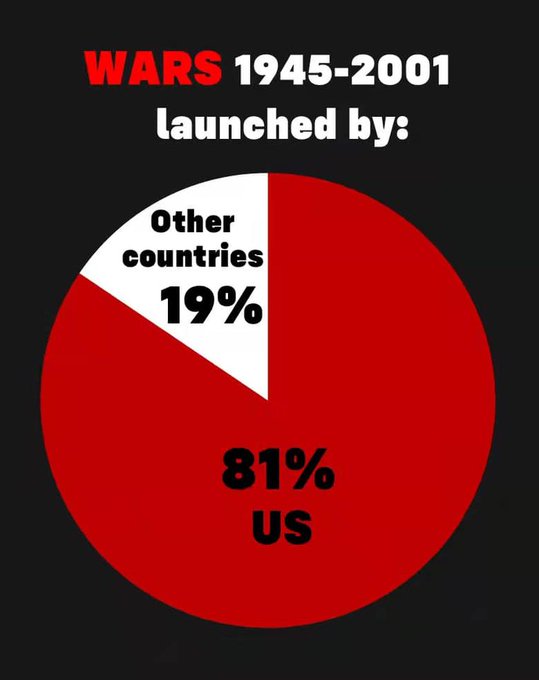
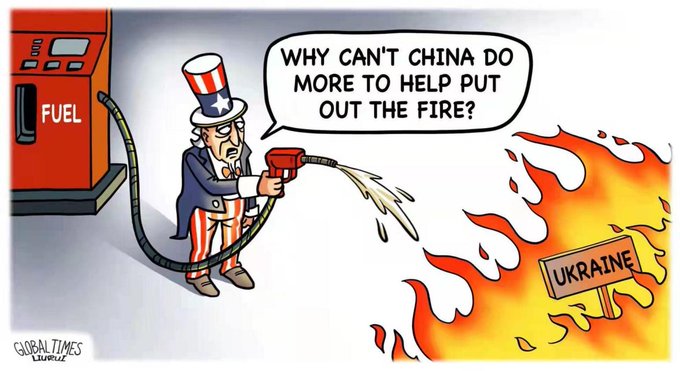
The embassy went on to point out that 81% of wars between 1945 and 2001 were launched by the US, accusing Washington of “pouring oil” on the conflict in Ukraine.
On Saturday, Zhao took yet another swipe at Washington with an image listing “bomb attacks, sabotage, attempted regime change” by Washington. The diplomat accompanied the post with a hashtag #NeverForget.
China was one of the three nations that abstained from the voting on a United Nations resolution condemning Russia’s “aggression” against Ukraine after it was vetoed by Russia. The resolution demanded the immediate withdrawal of troops engaged in the Kremlin’s “special military operation” in Ukraine. Bloomberg reported on Saturday that at least two of China’s largest state-controlled banks limited financing to purchase raw materials from Russia, reportedly out of concern about US sanctions.
Senior Hamas official Hisham Qasem has condemned Australia’s intention to designate his Movement as a terror group as “a reflection of blatant bias in favor of the Israeli aggression against the Palestinian people.”
In press remarks to Quds Press, Qasem said that “the Israeli occupation regime sees every opponent as a terrorist party, although it practices organized state terrorism day and night against the Palestinian people at home and abroad.”
“Hamas has never been hostile to any country of the world and only resisted the occupation inside the occupied Palestinian territory, which makes any terror designation by Australia ‘a step against logical reasoning’ and ‘without foundation.’ It is rather complete adoption of the occupation’s aggressive narrative,” the Hamas official underlined.
“The Australian step against the Movement will not change its conviction about upholding its path of resisting the occupation until it achieves its final goal of liberation and return,” he said, stressing that Hamas would never deviate from this path.
Flouting the fact that Hamas is a national liberation movement that resists an occupying power in accordance with international laws and resolutions, the Australian government has declared its intent to add the Hamas Movement to its list of terror groups.
Australia had previously listed the armed wing of Hamas, al-Qassam Brigades, as a terror group in 2003, but the new designation, which will come into effect in April, will blacklist the Movement in its entirety.
An historical review has found that the Dutch military “used extreme violence” condoned by the government during the Indonesian struggle for independence in the 1940s, the panel of experts involved in the research said on Thursday.
The Dutch state and military’s behavior throughout the 1945-49 war as Indonesians fought for independence from the colonial power was laid out in a major review that has been conducted over the past few years. Carried out by a panel of academics and experts, the review was funded by the Dutch government in 2017.
Releasing a summary of the findings, the panel said it found that the Dutch military had behaved in a manner that was rooted in a “colonial mentality,” and noted: “It is evident that at every level, the Dutch unquestioningly applied different standards to… colonial ‘subjects’.”
“Dutch armed forces used extreme violence on a frequent and structural basis, in the form of extrajudicial executions, ill-treatment and torture, detention under inhumane conditions,” it stated.
Among the review’s summary findings, the military was accused of “torching” buildings and whole villages, as well as conducting “mass arrests and mass internment” and “disproportionate air raids and artillery shelling.”
The Dutch government had not previously conducted a full assessment of its country’s actions; in 1969 the then-government found that its forces had as a whole behaved correctly in Indonesia – something the new review said was an untenable position to hold.
The Netherlands agreed in 2020 to provide €5,000 ($5,600) in compensation to the descendants of Indonesians who were killed during the independence war, following a 2013 deal with some of the widows of the military’s victims.
Also in 2020, King Willem-Alexander of the Netherlands offered an apology for the Dutch military’s “excessive violence” during the conflict. “In line with earlier statements by my government, I would like to express my regret and apologize for excessive violence on the part of the Dutch in those years,” the monarch said at the time.
“The past cannot be erased, and will have to be acknowledged by each generation in turn.”
Dutch Prime Minister Mark Rutte’s government is set to respond to the review later on Thursday.
The U.S. national-security establishment and its acolytes in the mainstream press are celebrating the U.S. military’s murder in Syria of Islamic State leader Abu Ibrahim Hashimi Qurayshi. Mind you, they don’t call it murder. They call it a “targeted killing” of a “bad guy” or a “terrorist.” But murder it is because the U.S. military has no legitimate authority to kill anyone in the Middle East (or anywhere else), whether it be people it labels “bad guys,” “terrorists,” “communists,” “opponents,” “rivals,” “adversaries,” or “enemies.”
Let’s take a look at the Bill of Rights, specifically the Fifth Amendment. Yes, I know that the national-security establishment and its supporters in the federal judiciary hold that the Bill of Rights doesn’t apply to the military, the CIA, and the NSA. But a close reading of the amendment reveals that there is no exception carved out for the national-security branch of the government. By its express terms, the restrictions in the Fifth Amendment apply to everyone in the federal government, not just to some people within the federal government.
The Fifth Amendment states in part: “No person shall be deprived of life without due process of law.”
Notice something important about that language: It doesn’t say “No American shall be deprived of life without due process of law.” It says “No person shall be deprived of life without due process of law.” That means it encompasses citizens of other countries.
Notice something else important: It doesn’t say “No person within the United States shall be deprived of life without due process of law.” It says “No person shall be deprived of life without due process of law.”
That’s what the Pentagon just did to Qurayshi. In a raid on a safe house in Syria, the Pentagon just deprived him of life without due process of law.
The Pentagon is pointing out that Qurayshi actually killed himself and his family with a bomb once the raid commenced. That doesn’t mean, of course, that the Pentagon isn’t responsible for killing him. The raid is the proximate cause of Qurayshi’s death as well as the deaths of other people who were with him, including women and children. That is, if the raid had not taken place, Qurayshi and those other people would still be alive.
In fact, the Pentagon is also responsible for the deaths of the women and children that were killed by Qurayshi’s suicide bomb. The Pentagon was well aware of the possibility that he could decide to blow himself up rather than be taken captive and carted away to Gitmo for torture and perpetual incarceration. That awareness did not stop them from conducting the raid anyway. The deaths of those women and children was a risk that the Pentagon felt was worth taking.
What is due process of law? It means notice and a trial. The Bill of Rights expressly prohibits the federal government from killing anyone without first giving him notice of criminal charges and a trial in federal district court. The notice comes in the form of a criminal indictment issued by a federal grand jury. At the trial, federal prosecutors are required to prove to a jury (or a judge) beyond a reasonable doubt that the accused is guilty of the offense for which they wish to kill him.
At the risk of belaboring the obvious, the Pentagon did not provide notice and a trial to Qurayshi before they raided that safe house and brought about his death and the deaths of more than a dozen other people. Perhaps the reason for that is that U.S. officials felt that they couldn’t prove that Qurayshi had committed a criminal offense against the United States.
National-security officials and their supporters implicitly claim that their “war on terrorism” trumps the Fifth Amendment. Really? Where does it say that in the Fifth Amendment? I certainly don’t see a “war on terrorism” exception in that amendment.
Indeed, what business do the Pentagon and the CIA have sitting in Syria and killing people? The last time I checked, Congress had not declared war on Syria. Moreover, the Syrian government has never invited the U.S. government to situate its troops and agents within the country. That makes the Pentagon and the CIA illegal interlopers in a foreign land, where they are killing whoever they want with impunity.
We also mustn’t forget that it is the Pentagon and the CIA that are responsible for the rise of ISIS in the first place, owing to their illegal and unconstitutional war of aggression against Iraq.
What is a “war of aggression”? It is a type of war that was declared a war crime at the Nuremberg War Crimes Tribunal. That was the tribunal that put accused Nazi war criminals on trial. The tribunal, which included U.S. officials, convicted German officials of attacking other nations. That’s what they called waging a “war of aggression.”
That’s what U.S. officials did with Iraq. It is undisputed that Iraq never attacked the United States. When the U.S. government attacked this impoverished third-world country, it was waging a “war on aggression.” Moreover, the fact that the Pentagon and the CIA did not secure the constitutionally required congressional declaration of war before committing this Nuremberg-type crime only makes the situation more egregious.
After U.S. officials installed a puppet regime with their war of aggression on Iraq, ISIS formed with the aim of ousting that U.S.-installed puppet regime. In fact, many of the ISIS members had been officials in the Saddam Hussein regime that was violently ousted from power by the U.S. invasion and occupation of the country. (It’s worth noting that Saddam was a partner and ally of the Pentagon and the CIA during the 1980s, when he was killing Iranians in his own war of aggression against Iran.)
Thus, if the U.S. government had never waged an illegal and unconstitutional war of aggression against Iraq, there never would have been an ISIS, which means that the man they just murdered — Abu Ibrahim Hashimi Qurayshi — would not have been the leader of ISIS, which means that he and his family would not be dead today.
Of course, Qurayshi will quickly be replaced, just like drug lords are quickly replaced after they are killed or captured by drug-war agents. ISIS will retaliate for Qurayshi’s killing, and the “war on terrorism” will continue, just as the drug war continues, which means ever-increasing budgets, power, and influence for the national-security establishment. The “war on terrorism” is a better racket than the “war on drugs” and perhaps even better than the old Cold War racket of the “war on communism.”
The UAE is directly benefitting from Illegal Israeli settlements and is in violation of international law according to recently signed bilateral trade agreements between Abu Dhabi and the occupation state, Hugh Lovatt, Senior Policy Fellow at the European Council on Foreign Relations, has pointed out in a series of tweets.
Lovatt has worked to advance the concept of EU Differentiation, which includes a variety of measures taken by the European bloc and its member states to exclude settlement-linked entities and activities from bilateral relations with Israel.
The EU has never recognised the legality of Israeli settlements in the occupied territories (including those in East Jerusalem and the Syrian Golan Heights that have been formally annexed by Israel). This means that the EU has an obligation to practically implement its non-recognition policy by fully and effectively implementing its own legislation against Israel’s incorporation of settlement entities and activities into its external relations with the EU.
In 2016, Lovatt worked to have this measure enshrined within UN Security Council Resolution 2334. It passed in a 14–0 vote, with the US notably abstaining. The Resolution states that Israel’s settlement activity constitutes a “flagrant violation” of international law and has “no legal validity”. It demands that Israel stop such activity and fulfil its obligations as an occupying power under the Fourth Geneva Convention.
Lovatt claims that recently released details of bilateral agreements between the UAE and Israel show that that the Gulf State is in violation of Resolution 2334 and the principal of differentiation which all UN member states are expected to abide by.
“Has the UAE respected international law and its obligations to differentiate between Israel and the settlements as per UNSCR 2334?” asked Lovatt in his tweet. “The answer: No.”
Big moment for 🇮🇱🇦🇪 and the settlements. The Israel-UAE agreement on the promotion and protection of investments is finally public. Has the UAE respected international law and its obligations to differentiate between Israel and the settlements as per UNSCR 2334? The answer: No pic.twitter.com/pTufBPd5t9
Lovatt explained that “to comply with UN Security Council Resolution 2334, every bilateral agreement signed with Israel should contain a ‘differentiation’ clause defining the territorial scope of its application to Israel’s pre-June 1967 borders. This is not the case in this UAE-Israel agreement”. He shared a screen shot of a clause from the bilateral agreement indicating that no such territorial distinction was made.
The definition of territory applied in the agreement includes all the land that is under “Israel’s jurisdiction”, which Lovatt explained include Israeli settlements on occupied Palestinian territory.
Notably Japan’s trade agreement with Israel includes a definition of “Israeli territory” which upholds the differentiation principal and, therefore, does not fall foul of Resolution 2334, Lovatt said. The absence of this distinction in the bilateral agreement between Abu Dhabi and Tel Aviv means that the UAE is “directly” befitting from illegal settlements through its normalisation with Israel.
Lovatt admits that the UAE may have a different interpretation of the agreement than he does, in which case “it would be incumbent on the UAE government to clarify the agreement’s territorial applicability as soon as possible,” he added.
Smedley Butler was one of the most decorated Marines in U.S. history, and by the end of his life he was also one of the most outspoken critics of the U.S. imperialism that he had spent most of his life enforcing. That contradiction between Butler the antiwar critic and Butler the builder of empire is at the heart of an important new book by Jonathan Katz, Gangsters of Capitalism: Smedley Butler, the Marines, and the Making and Breaking of America’s Empire. Katz’s book is an essential reminder of what the U.S. did during those decades and of the lasting effects that those interventions had on the countries where Butler went.
Butler took part in America’s so-called “small wars” in Asia, the Caribbean, and Central America in the early twentieth century. Like those wars, his military career has mostly been forgotten by the American public. That career was defined by aggressive military interventions on behalf of corporate interests, and by the end he was disgusted by it. As the author of War Is a Racket, Butler has been an inspiration to many antiwar and anti-imperialist Americans over the years, but he was also one of the military officers responsible for implementing destructive American colonialist designs at the expense of other nations. Twice awarded the Medal of Honor, he never believed he had done anything to deserve it, and the massacre that he took part in at Fort Rivière in Haiti haunted him.
In his later life, Butler came to see much of his career as a disreputable series of actions in the service of wealthy American interests, and he called himself a “racketeer for capitalism.” The racket he denounced was one that benefited a very few at the expense of the many. That core problem with our foreign policy that Butler identified almost ninety years ago is still very much with us. The U.S. still wages unnecessary wars based on flimsy pretexts against countries that cannot possibly threaten us, and today it also enables other wars with its weapons sales. The military budget grows every year despite the extraordinary physical security that the United States enjoys, and the hunt for new monsters to slay is unending. The racket is bigger and more destructive than ever.
Katz has produced a superb book in which he traces Butler’s steps from his first deployment to Cuba through his last mission in China. Through extensive use of Butler’s correspondence with his family, Katz is able to reconstruct to a remarkable degree what Butler thought about his various missions. Occasionally, there are flashes of anger at policies he was ordered to carry out that anticipate his later antiwar arguments. Appalled by the losses suffered during the invasion of Veracruz in 1914, he applauded his father’s belated vote in Congress against the mission. Katz writes, “The trauma fed Butler’s misgivings about the immorality and pointlessness of war.”
To read Butler’s story is to be reminded of our country’s long and ugly history of dominating many of our weaker neighbors. As Katz shows throughout the book, these countries are still living with the effects of those policies a century later. Katz traveled extensively to visit all the places where Butler served to learn more about his experiences and to document the legacy of the interventions in which Butler participated, and he bears witness to the lasting damage that U.S. policies have done. While most Americans know little or nothing about these interventions, many people in the affected countries still remember what U.S. forces did when they were there.
Butler is most loathed in Haiti, where he is viewed simply as “the Devil” and mechan (evil), because of his role in forcibly dissolving Haiti’s National Assembly to push through a new constitution, his reintroduction of a cruel system of forced labor, and the counterinsurgency campaign he waged against Haitian resistance to American rule. The Gendarmerie that Butler created became the national army and went on to interfere in and dominate Haitian politics for much of the rest of the century.
The outrages that the U.S. committed in its wars in the Philippines and Haiti, among other places, still affect how the U.S. is perceived today. The police and military institutions that the occupying U.S. authorities created in several countries became the apparatus of oppression used by later dictators, some of whom, like the Dominican Republic’s Trujillo, had been trained by the U.S. and became U.S. client rulers. During his brief time as the head of Philadelphia’s police force, Butler used the tactics he had employed against insurgents in other countries to fight “bandits” at home in an early example of the militarization of the police and the abuses that came with it.
The period of U.S. foreign policy between the start of the war with Spain and WWII is often wrongly described as “isolationist,” but no one can look at these decades of frequent, violent intervention in the affairs of other nations in the early twentieth century and still believe that. The U.S. took sides in Mexico’s civil war, it invaded other countries on the slightest pretext that a foreign rival might be gaining influence, and it militarily occupied some of them for years or decades. Like colonial empires the world over, the U.S. dominated weaker nations because it could and because its political leaders saw some economic advantage to be exploited.
While these interventions benefited private interests and were done on their behalf, they did nothing to make the United States more secure and were never really intended to. As Butler concluded in his later years, America’s colonial possessions in the Pacific only exposed the country to the dangers of a new, much larger war. “Sooner or later, if we hold onto them, America will be jerked into a damn war before we know what it’s all about,” Butler told a reporter in 1933. That was why he became an early supporter of independence for the Philippines as part of his broader antiwar advocacy. Butler did not live to see that prediction come true, but he was proven right eight years later.
Today there are still some neo-imperialists that look back on the “small wars” Butler fought as a model for how the U.S. should police the globe. Butler would be among the first to reject that idea out of hand. If his experience teaches us anything, it is that wars for empire cause tremendous harm to both the people being dominated and to the people sent to fight in those wars. Gangsters of Capitalism is an excellent account of Butler’s career, and it is also an outstanding history of the development of overseas American imperialism. The wars that Butler fought in anticipated and paved the way for the later militarization of U.S. foreign policy, and they serve as cautionary tales of the long-term harm that military intervention usually does to the nations that experience it. In order to find a way to stop the endless wars for good, we need to remember and learn from the brutal history of America’s empire-building.
Denmark must “immediately withdraw” some 90 troops it deployed to Mali last week “without [the government’s] consent and in violation of the protocols” allowing European nations to intervene in that African country, the government in Bamako said on Monday.
Some 91 Danes from the Jaeger Corps special forces arrived in Mali on January 18, as part of Task Force Takuba, a French-led counter-terrorism mission in the West African country. According to the Danish defense ministry, their job will be to reinforce the border with Niger and Burkina Faso, train Malian Armed Forces, and provide medical services to the peacekeepers.
While the government of Mali is grateful to “all its partners involved in the fight against terrorism,” it stressed “the need to obtain the prior agreement of the Malian authorities” before sending any troops to the country, says the communique signed by Colonel Abdoulaye Maiga, spokesman for the Ministry of Administration and Decentralization.
Announcing the deployment of the force last week, the government in Copenhagen said it had been scheduled in April 2021, as France sought to withdraw some of its troops from Mali.
Their objective was “to stabilize Mali and parts of the border triangle between Mali, Niger and Burkina Faso, and to ensure that civilians are protected from terrorist groups,” the Danish military said.
The Jaegers are also experienced in “training and educating” local militaries, a job they have previously performed in Afghanistan and Iraq. They were sent shortly after Sweden withdrew its contingent from Mali. The French-led operation also involves forces from Belgium, Czechia, Estonia, Hungary, Italy, the Netherlands, Portugal and Sweden.
Task Force Takuba has operated in Mali since March 2020, when Paris decided to wrap up the previous Operation Barkhane. France has maintained a military presence in its former West African colony since 2013, to help the government in Bamako deal with a Tuareg rebellion in the northwest of the country and subsequent terrorist insurgency loyal to Islamic State (IS, formerly ISIS).
Relations between Bamako and Paris have grown chilly since the latest military takeover in Mali in 2021, and France has since closed three of its military bases there, in Kidal, Tessalit, and Timbuktu.
A senior Yemeni official vows that the country will keep up its counteroffensives until its complete liberation from the scourge of a United States-backed and Saudi-led invasion and siege.
Mohammed al-Bukhaiti, a member of the Yemeni popular resistance Houthi Ansarullah movement’s Political Bureau, made the remarks on Sunday in an exclusive interview with Iran’s al-Alam Arabic-language television network.
Saudi Arabia and several of its allies have been attacking Yemen, the Arab world’s poorest nation, since March 2015 in an unsuccessful bid to change its ruling structure in favor of its former Riyadh-aligned regime.
The war, and an ensuing siege that the aggressors have been employing, has killed hundreds of thousands of Yemenis and turned the entire Yemen into the scene of the world’s worst humanitarian crisis.
The Yemeni forces that feature the Yemeni army and its allied fighters from the Popular Committees have, however, vowed not to lay down their arms until the expulsion of all foreign forces.
“Yemen’s operations against the countries of the [invading] coalition will continue at the domestic and overseas levels until the coalition stops its attacks and ends the blockade,” al-Bukhaiti said.
Invaders’ systematic denial
The invading countries are trying to deflect the international public opinion from their atrocities through a number of methods, he noted.
“They first deny any responsibility for their crimes, but later admit their involvement only to say they are going to investigate the atrocities,” said the official.
Al-Bukhaiti, meanwhile, rebuffed the invaders’ claims that they are attacking the impoverished country to retaliate for the Yemeni forces’ operations.
He said the aggressors took Yemen under heavy bombardment throughout the first three years of the war, during which the country did not have the deterrent power that it is using now to return the Saudi-led offensives.
“The invaders used to commit such crimes from the very first day of the invasion for three [consecutive] years,” long before Yemen became able to retaliate the aggression with ballistic missiles and drones, the Ansarullah official said.
He also hailed that the counterattacks had managed to force the invaders to reduce the number of their military assaults.
‘US, Zionists support aggressors’
“Those who support the invading countries, including Saudi Arabia and the UAE [in their crimes against the Yemeni people], are the United States and the Israeli regime, which are bereft of all human values,” al-Bukhaiti said.
The atrocities are being perpetrated to force Yemen to surrender and devolve into a vassal state, he added.
“But we tell them that these atrocities will have the opposite result” because they would prompt more Yemeni soldiers to join the battlefront against the aggressors, the official concluded.
“One lesson of recent history is that once Russians are in your house, it’s sometimes very difficult to get them to leave.”
The level of hubris-laced ignorance it would take an ostensibly intelligent, well-informed individual to make such a statement, in public, in an official capacity, goes beyond political parody.
And yet, there was the American Secretary of State, Tony Blinken, uttering those words at the tail end of a press statement where he questioned the legitimacy of Russia’s dispatch of military forces to Kazakhstan. The Russian actions took place in the wake of widespread violence that prompted the Kazakh President to request help from the Collective Security Treaty Organization (CSTO), which Russia leads.
It should be noted that Russia was invited to send troops to Kazakhstan. Russia was also invited to send troops to Syria. As Blinken was speaking, the US had between 900 and 1,200 troops inside Syria, none of whom were there at the request of the Syrian government. Likewise, the US continues to maintain a force of some 2,500 troops in Iraq, even though the Iraqi parliament has called for their withdrawal for more than a year.
When it comes to understanding what an “unwanted houseguest” looks and acts like, Tony Blinken need only look in the mirror for the perfect illustration.
The US is scrambling to seize the moral high ground when it comes to the issue of military intervention, seeking to exploit the 2008 Russian-Georgian War, the 2014 reabsorption of Crimea, and the 2015 military intervention in Syria to illustrate its position.
While the issue of Russo-Georgian relations is a difficult one, dating to before the dissolution of the Soviet Union, it is an undisputed fact – indeed, one backed up by the European Union’s inquiry into the incident – that the 2008 conflict was triggered by a Georgian military incursion into South Ossetia, including an unprovoked attack on Russian peacekeeping forces stationed there. Subsequent Russian actions are attributable to Georgian aggression.
Likewise, Russia’s actions vis-à-vis Crimea and the Donbass region, where Moscow supports ethnically Russian separatists, all derive from the so-called ‘Maidan Revolution’, a US and EU-backed insurrection that overthrew Viktor Yanukovich, the duly elected president of Ukraine, and replaced him with a more Washington-friendly government.
And, lastly, the Russian intervention in Syria came at the request of the legitimate government in Damascus, which was under siege from foreign-funded and trained terrorists and insurrectionists. Russia’s actions were decisive, helping shift the military balance in favor of the Syrian government, and leading to the defeat of most of the anti-government fighters. The irony behind the Russian intervention is that it exposed the hypocrisy of the US, in so far as several of the terrorist groups Russia helped defeat were not only affiliates of Al-Qaeda but were also being funded by the US and its allies.
The US presence in Iraq and Syria, however, is the direct consequence of the illegal US-led invasion and occupation of Iraq in 2003. Between the US and Russia, only one nation has violated international law when it comes to disregarding the sovereignty of others – and it is not Russia.
Tony Blinken did not limit his Russo-phobic commentary simply to the issue of unwanted houseguests. When asked during an interview on a Sunday morning talk show on January 9 whether he agreed that Russian President Vladimir Putin was seeking to restore the Soviet Union, Blinken answered: “I think that’s right… I think that’s one of President Putin’s objectives, and it is to re-exert a sphere of influence over countries that previously were part of the Soviet Union,” something that, Blinken added, was “unacceptable.”
First and foremost, as Russia has been making clear during its ongoing European security framework discussions with the US, NATO, and the OSCE this week, the issue of what is or isn’t acceptable when it comes to defining the scope and scale of Russian national security and related spheres of interest, is not something Moscow is willing to subordinate to Washington or its allies. Rather, it is a matter for Russia alone to decide.
It is the US, not Russia, which is seeking to continuously breathe life into the Cold War relic that is the NATO alliance. The history of broken American promises when it comes to the issue of NATO expansion – “not one inch east” has a different meaning in Brussels than anywhere else, it seems.
The ostensibly “defensive” NATO alliance has been, since the end of the Cold War, used for almost exclusively offensive military action, much of which has taken place outside the geographic boundaries defined by the treaty. Whether it be intervention in the former Yugoslavia, the dismemberment of Serbia, intervention in Libya, supporting the US invasions of Iraq and Afghanistan, or sustaining the illegal presence of US forces in Syria, NATO has made itself an unwanted houseguest across the globe.
Truth be told, if it were not for NATO actively seeking to attract both Georgia and Ukraine to its roster, the events of 2008 and 2014 might have unfolded completely differently.
Tony Blinken’s comments about the suitability of Russia as a houseguest are as fact-free as any made by senior international statesmen in modern times. The reality is the US is the unwanted houseguest, habitually overstaying its welcome, sowing chaos, death, and destruction in its path.
Using this analogy, Russia could be seen as the emergency clean-up crew tasked with trying to clean up the mess that accrues in the wake of America’s foreign policy tornado. Tony Blinken and his boss, President Joe Biden, seem to have difficulty focusing on the real consequences of their words and deeds, as their gaze is constantly fixed on an artificial horizon that only they can see.
Unfortunately for Washington, the rest of the world knows the truth, and who is to blame for what. Blinken can continue uttering nonsense about Russia but, from such ignorance, does not sound policy come. This should be a lesson for any nation, especially those in Europe, who are looking to the US for sound guidance and leadership when it comes to solving the world’s problems.
Any pretext or none at all unjustifiably justifies Israeli aggression against blockaded/defenseless Gazans.
At its discretion, the apartheid state bombs, shells, invades, and otherwise immiserates long-suffering Strip residents.
Despite Israeli state terror repeating with disturbing regularity, the world community yawns and ignores its worst crimes of war and against humanity against Palestinians for the “crime” of not being Jewish.
NGO Gisha supports enforcement of the rule of law and free movement of Palestinians — especially illegally blockaded Gazans, explaining the following:
Since Israel illegally occupied the West Bank and Gaza with intent to steal and develop Palestinian land for exclusive Jewish use, its ruling regimes instituted “a complex system of rules (and) restrictions” in flagrant breach of international law.
Fundamental rights of Palestinians — especially Gazans — are consistently and repeatedly violated.
Israeli regimes deny them “the right to life, the right to access medical care, the right to education, the right to livelihood, the right to family unity and the right to freedom of religion.”
Gisha’s website explains the following:
For nearly 15 years under illegal Jewish state blockade, Gazans suffer from oppressively “high unemployment, long blackouts, and severe shortages of clean water.”
Their basic rights Gazans are denied — with no world community to help reverse what no one should have to tolerate.
“Electricity is only available for about half the day” — on some days for a few hours alone or none at all.
The vast majority of Gazans have no access to clean water.
“More than 70% of Gaza’s population relies on humanitarian aid to meet basic needs.”
“The vast majority of residents do not meet Israel’s (apartheid) criteria for travel permits.”
They have little or no chance to leave the Strip for employment, education, medical care unavailable to them under blockade,
“or to visit or reunite with family members living in Israel, the West Bank, and abroad.”
Israel blocks free land, sea and air movement to or from the Strip.
It “oversees entry of goods into Gaza… demands to know (what) they’re intended for, (who’ll) receive them, and who paid for them.”
Its ruling regimes decide “what goods produced in Gaza can be sold outside the Strip, how much, when and where.”
They also decide how much electricity the Strip is allowed to have — reducing or cutting it off entirely at its discretion.
They repeatedly close “Gaza’s crossings and den(y) access to its sea space as a means of punishing and pressuring the population.”
At all times, Israel enforces severe restrictions on the movement of goods and people.
It “blocks access to opportunities, prevents economic development, and violates basic human rights.”
B’Tselem said Gazans endure made-in-Israel “humanitarian crisis” conditions at all times.
Its ruling regimes “sentenced” two millions Gazans “to a life of abject poverty and… inhuman conditions.”
They control “critical aspects of life” in the blockaded Strip.
“Isolating Gaza from the rest of the world, including separating it from the West Bank,” is part of a longstanding Israeli policy.
What began in the 1990s has grown more oppressive since that time for invented reasons.
Two million Gazans are virtually held captive in the world’s largest open-air prison.
Over 80% of Gazans need humanitarian aid to survive.
Even with what Israel allows into the Strip, nearly two-thirds of its people are food insecure — unsure where their next meal is coming from.
Gazan infrastructure and public services are bare-bones.
Over 95% of Strip water is contaminated and unpotable.
What’s considered normal in Israel and the West is nonexistent in Gaza.
At its discretion for invented reasons, Israel wages war on Gaza.
Any time for any reason or none at all, it terror-bombs, shells, or otherwise strikes Strip targets — including residential buildings, schools, hospitals, mosques, and shops.
Free-fire policy lets IDF soldiers shoot Gazan children, farmers in their fields, and other Strip residents for target practice.
Blockades are acts of war by other means, Law Professor Francis Boyle explained — “because of the(ir) belligerent use of force…”
Gazans pose no threat to Israel.
Blockading the Strip is solely for political reasons, not security ones.
On most issues, Al Jazeera’s reports resemble US/Western propaganda — fake news over the real thing.
All things related to Israeli state terror against Palestinians is an exception to its standard practice on most other issues.
On New Year’s eve, Qatar-based Al Jazeera (AJ) spoke to Gazans injured and disabled from Israeli aggression last May.
“The assault… killed at least 260 people, including 39 women and 67 children, and wounded more than 1,900, according to the health ministry in Gaza,” AJ reported, adding:
“The bombardment also destroyed 1,800 residential units and partially demolished at least 14,300 other units.”
Since that time, the Netanyahu and Bennett regimes blocked entry of many reconstruction materials on the phony pretext of alleging their dual use, including for military purposes (sic).
Israeli aggression last May blinded 7-year-old Mohammed Shaban.
His new year’s wish is to see his mother’s face, he said.
Badly damaged by Israeli terror-bombing last May, his eyes couldn’t be saved and were surgically removed.
“I can’t stop crying whenever I see him,” his mother said, adding:
“He keeps asking his siblings, ‘Why can I only see black darkness? Why can’t I go to my school?’ ”
“Last night, he told me: ‘Mum, I wish I could see your face.’ ”
Recently enrolled in a school for visually challenged children, his mother, Somayya Shaban, expects no positive change in the new year.
“I believe Gaza’s destiny is to face more torture and suffering,” she said.
She wishes her son ,Mohammed, could see again. “I wish I could give him my eyes,” she stressed.
Countless thousands of other Gazans were killed, injured or disabled from multiple Israeli wars and other attacks on the Strip since 2008.
On New Year’s weekend, Israel terror-bombed and shelled Strip targets again.
Its latest aggression came in response to two rockets allegedly fired from the Strip on New Year’s day.
Reportedly, they fell harmlessly into offshore waters, harming no one, doing no damage.
According to an IDF statement, no sirens were sounded for Israelis to take cover.
The Bennett regime’s Iron Dome air defense system wasn’t activated.
In its yearend annual report, Israel said only five rockets were fired from the Strip, injuring no one.
According to the Times of Israel (TOI) on Sunday:
IDF “warplanes and helicopters hit (multiple) Hamas targets” overnight — over virtually nothing, TOI left unexplained.
“Palestinian media first reported airstrikes in the southern part of the Strip shortly before midnight” on Saturday.
“Hamas media claimed ‘resistance fighters’ launched ‘experimental rockets’ toward the sea.”
Gaza’s health ministry said three Palestinians were wounded from strikes on northern Strip targets.
How many others may have been injured or killed is unclear as of early Sunday morning — or the extent of damage to Strip targets.
Life in blockaded Gaza is harsh by any standard.
Israeli inflicted misery on Strip residents followed Hamas’ sweeping January 2006 electoral triumph to become historic Palestine’s legitimate government.
At the dawn of a new year, the message of weekend terror-bombing and shelling of the Strip shows that dirty Israeli business as usual continues unchanged.
Two million Gazans are victimized by apartheid ruthlessness — with no end of it in prospect.
The same goes for all occupied Palestinians.
Largely ignored by the world community, the highest of Israeli high crimes of war and against humanity continue to go unpunished.
The same reality applies to US-dominated NATO’s war on humanity at home and abroad.
It is difficult to discuss the Vietnam war since most Americans have been misled by myths. These are so common that they appear in documentaries about the war. As a result, many Americans become angry when facts are presented.
“The Viet-Nam Demarcation Line is not an international boundary in the traditional sense; rather it is a provisional military demarcation line. As such, it should never be shown on official maps by the standard symbol for an international boundary.” US State Department; September 10, 1962; http://library.law.fsu.edu/Digital-Co…
By Donald Neff | Washington Report On Middle East Affairs | January 1996
On January 4, 1948, Jewish terrorists drove a truck loaded with explosives into the center of the all Arab city of Jaffa and detonated it, killing 26 and wounding around 100 Palestinian men, women and children.[1] The attack was the work of the Irgun Zvai Leumi – the “National Military Organization,” also known by the Hebrew letters Etzel – the largest Jewish terrorist group in Palestine. The Irgun was headed by Revisionist Zionist Menachem Begin and had been killing and maiming Arabs, Britons and even Jews for the previous ten years in its efforts to establish a Jewish state.
This terror campaign meant that at the core of Revisionist Zionism there existed a philosophical embrace of violence. … continue
This site is provided as a research and reference tool. Although we make every reasonable effort to ensure that the information and data provided at this site are useful, accurate, and current, we cannot guarantee that the information and data provided here will be error-free. By using this site, you assume all responsibility for and risk arising from your use of and reliance upon the contents of this site.
This site and the information available through it do not, and are not intended to constitute legal advice. Should you require legal advice, you should consult your own attorney.
Nothing within this site or linked to by this site constitutes investment advice or medical advice.
Materials accessible from or added to this site by third parties, such as comments posted, are strictly the responsibility of the third party who added such materials or made them accessible and we neither endorse nor undertake to control, monitor, edit or assume responsibility for any such third-party material.
The posting of stories, commentaries, reports, documents and links (embedded or otherwise) on this site does not in any way, shape or form, implied or otherwise, necessarily express or suggest endorsement or support of any of such posted material or parts therein.
The word “alleged” is deemed to occur before the word “fraud.” Since the rule of law still applies. To peasants, at least.
Fair Use
This site contains copyrighted material the use of which has not always been specifically authorized by the copyright owner. We are making such material available in our efforts to advance understanding of environmental, political, human rights, economic, democracy, scientific, and social justice issues, etc. We believe this constitutes a ‘fair use’ of any such copyrighted material as provided for in section 107 of the US Copyright Law. In accordance with Title 17 U.S.C. Section 107, the material on this site is distributed without profit to those who have expressed a prior interest in receiving the included information for research and educational purposes. For more info go to: http://www.law.cornell.edu/uscode/17/107.shtml. If you wish to use copyrighted material from this site for purposes of your own that go beyond ‘fair use’, you must obtain permission from the copyright owner.
DMCA Contact
This is information for anyone that wishes to challenge our “fair use” of copyrighted material.
If you are a legal copyright holder or a designated agent for such and you believe that content residing on or accessible through our website infringes a copyright and falls outside the boundaries of “Fair Use”, please send a notice of infringement by contacting atheonews@gmail.com.
We will respond and take necessary action immediately.
If notice is given of an alleged copyright violation we will act expeditiously to remove or disable access to the material(s) in question.
All 3rd party material posted on this website is copyright the respective owners / authors. Aletho News makes no claim of copyright on such material.

 Aletho News
