Afghan endgame enters the home stretch
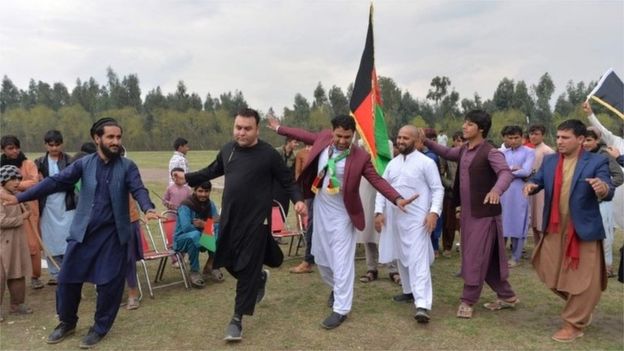
Afghans celebrating the US-Taliban agreement of 29th February 2020, Jalalabad, Nangarhar province, Afghanistan
By M. K. BHADRAKUMAR | Indian Punchline | March 24, 2020
In an extraordinary statement titled On the Political Impasse in Afghanistan, Washington has admitted the failure of Secretary of State Mike Pompeo’s mission to Kabul on Monday to heal the political rift among Afghan politicians and to urge them to form an inclusive government so as to implement the Doha pact of February 29.
In exceptionally strong words, Washington flagged its disappointment over the political rift between the factions led by Ashraf Ghani and Abdullah Abdullah respectively, which has “harmed U.S.-Afghan relations and, sadly, dishonours those Afghan, Americans, and Coalition partners who have sacrificed their lives and treasure” in the 18-year old war.
No sooner than the failure of Pompeo’s mission became clear, the state department disclosed that the Trump administration is cutting back its aid to the Afghan government — “a responsible adjustment to our spending in Afghanistan” by $1 billion immediately and another $1 billion next year — and will also “initiate a review of all of our programs and projects to identify additional reductions, and reconsider our pledges to future donor conferences for Afghanistan.” A calibrated Plan B with President Trump’s approval is unfolding, for sure.
Importantly, the state department statement added ominously, “We have made clear to the (Kabul) leadership that we will not back security operations that are politically motivated, nor support political leaders who order such operations those who advocate for or support parallel government.”
The reference is unmistakably to the the troika of hardliners surrounding Ghani, comprising “Vice-President” Amrullah Saleh, NSA Hamdullah Mohib and Defence Minister Asadullah Khalid.
However, the state department statement leaves the door open to “revisit the reviews initiated”, provided the Afghan leaders “choose to form an inclusive government that can provide security and participate in the peace process.”
The alacrity with which this statement has come implies that President Trump directed Pompeo to convey to the Kabul elite that his patience has run out and to reiterate that no matter the shenanigans of Afghan politicians, “We are proceeding with the conditions-based withdrawal of our forces in accordance with the U.S.-Taliban agreement.”
This is the nearest Trump has come to threatening that if push comes to shove, he may unilaterally end the war and wash his hands of it.
Evidently, Washington is calling Ghani’s bluff who bragged recently that Kabul has the necessary resources to carry on for at least two years even without any US assistance, signalling his grit to dissociate from the US’ peace talks with the Taliban.
On its part, Washington has put Ghani on notice that if the game plan of the hardliners in his circle is to precipitate security situations with a view to drag the US military into violent confrontations with the Taliban and thereby destroy the understanding forged painstakingly through the negotiations in Doha during the past year and more, that won’t happen.
Equally, Washington has distanced itself from the political rift between Ghani and Abdullah by making it clear that it has no favourites.
The startling development has three dimensions to it. First and foremost, will the Trump administration’s shock therapy have a sobering effect on the rival Afghan factions locked in a struggle for power?
The answer is, unfortunately, that such a probability is unlikely to happen as per current indications — given the vaulting ambitions of the protagonists. Both Ghani and Abdullah also have associates who would have their own agenda.
Having said that, Afghans also have a great tradition of reaching compromises and consensus at the last minute before an irrevocable break-up. Such a fortuitous turn of events can happen in the present circumstances only if Ghani accepts a coalition government with power-sharing of key security portfolios.
Arguably, the struggle may even take an ugly form and become “physical” unless great self-restraint is exercised. There are ominous reports that the warlords have come out of the woodwork and are marshalling their militia.
The government also commands shadowy militia groups beyond the pale of law who have been trained by the US to function as a state within the state. Indeed, Afghanistan has a violent history and its democratic temper is only skin-deep. Peaceful transfer of power is a recent phenomenon under the US diktat.
Second, what will be the impact on the security situation? The critical factor here is that, undeniably, there are ethnic undertones to the Ghani-Abdullah political rift and how they might impact the cohesion of the Afghan army and security forces is anybody’s guess. Of course, the US has been bankrolling the Afghan army.
To jog memory, it was Najib’s inability to pay the salaries of the Uzbek militia guarding Kabul city in the critical period since the Soviets withdrew aid that ultimately became a clincher for Rashid Dostum’s treacherous defection to the Mujahideen camp of Ahmed Shah Massoud that in turn resulted in the roof coming down on the communist regime.
Third, how will the Taliban react to these big shifts in the politico-military alignment? Clearly, the Taliban are already at peace with the US forces. Strict orders have been given to the commanders not to engage the US military.
Thus, the state department’s assurance that the US military will not be a party to any conspiracies by the hardliners in Kabul to precipitate confrontations with the Taliban becomes important. In good measure, Pompeo also flew to Doha to meet the Taliban leaders to discuss the current impasse. The Taliban will make careful note of Washington’s eagerness to stick to the Doha pact — and it will reciprocate.
Now, if Ghani resorts to delaying tactics much longer in releasing the Taliban, it may provoke the Taliban into ending the current (tacit) ceasefire and step up its operations against the Afghan security forces with a view to demoralise them.
There are also indications of the Taliban having infiltrated the Afghan army and police and security agencies.
Suffice to say, it will come as a surprise if the Taliban does not take advantage of a most conducive situation arising in Afghanistan — a rump administration ruling the roost in Kabul, lacking in political legitimacy (and the US distancing from it); the grim political struggle for supremacy amongst the Afghan factions that may take a violent form; the chain of command of Afghan forces coming under stress due to the ethnic fissures; and, the strong possibility of Trump unilaterally extricating the US out of the war at some point in a near future.
The big question is whether the Taliban will be savvy enough to wait for Kabul to fall like a rotten apple or will they hastily pluck it as a low-hanging fruit.
The bottom line is that the Taliban (and Pakistan which mentors it) would see that the political ascendance of the Taliban in Kabul, whenever it is due, happens with international legitimacy. The Trump administration’s stated preference still is to reach a negotiated peace settlement as envisaged under the Doha pact through intra-Afghan dialogue. And the Taliban too adheres to the Doha pact.
It is unlikely that the Taliban will opt for a decision to grab power through force. The preference at this stage will be to pitch for an interim government that is inclusive so as to carry as many Afghan factions as possible.
Make no mistake that time works in the Taliban’s favour. Unlike in the past, the Taliban has networked extensively with the international community in the recent years — especially with the major regional states — and its interest lies in securing world recognition for any future government under its leadership.
Yemen’s Ansarullah welcomes UN call for global ceasefire to tackle coronavirus pandemic
Press TV – March 24, 2020
Yemen’s Houthi Ansarullah movement has welcomed a call by United Nations Secretary General Antonio Guterres for a ceasefire in all conflicts worldwide amid a global fight against the coronavirus pandemic.
Mohammed Ali al-Houthi, the chairman of the Supreme Revolutionary Committee of Yemen, said in a tweet on Monday that Sana’a welcomes the UN chief’s call and supports a halt in attacks by the US, Britain, Saudi Arabia, the United Arab Emirates and their allies against Yemen.
The movement, he said, also seeks the lifting of an aerial and maritime blockade imposed on Yemen by the Saudi regime and its coalition allies since early 2015, to facilitate the adoption of preventive measures against the coronavirus outbreak.
The United States and Britain are not part of the Saudi-led alliance but have been providing all sorts of support to the bloody war.
Speaking to reporters from the UN headquarters in New York on Monday, Guterres called for “an immediate global ceasefire in all corners of the world,” adding, “It is time to put armed conflict on lockdown and focus together on true fight of our lives, pull back from hostilities and put aside mistrust & animosities.”
The United Nations has been trying to mediate an end to conflicts in countries including Syria, Yemen and Libya, while also providing humanitarian assistance to millions of civilians.
Guterres warned that in war-torn countries health systems have collapsed and the small number of health professionals left were often targeted in the fighting.
While Yemen has not recorded any COVID-19 cases to date, the possibility of an outbreak threatens the war-ravaged country’s already fragile healthcare system.
Last week, Houthi warned that the Saudi-led coalition of aggressors will be responsible for a possible spread of the virus to Yemen, citing the negative impacts of the siege.
Houthi’s comments come as Yemen is preparing to mark, on March 26, the fifth anniversary of the military campaign, which the Saudi regime and a number of its vassal states launched to reinstall a Riyadh-backed former regime in Yemen.
The Western-backed offensive, coupled with a naval blockade, has destroyed the country’s infrastructure.
The aggression has also led to the world’s worst humanitarian crisis in Yemen, where over 1,000 people, including many kids, were killed and hundreds of thousands afflicted by cholera, diphtheria, measles and dengue fever in 2019, according to the World Health Organization.
The War in Vietnam: John Wayne Was Wrong
By Marko | The Voluntaryist Reader | 12/10/2012
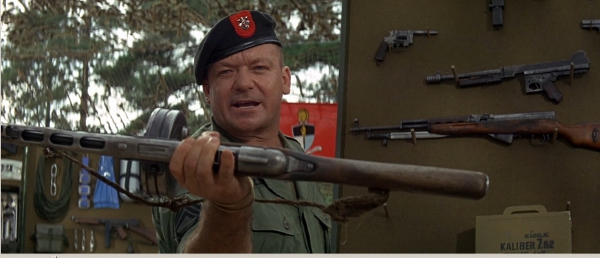
John Wayne’s Vietnam-era pro-war classic, The Green Berets opens with a scene of a press conference. It starts off with a group of Green Berets introducing themselves to the press, which is followed by a Q&A session with two Green Berets sergeants who have been assigned to answer questions. The scene reaches a crescendo when a reporter asks one of the sergeants if the war in Vietnam does not seem like a war between the Vietnamese and if the Americans should therefore stay out of it. Hearing this, the visibly irritated sergeant proceeds to pick up captured Vietnamese firearms from a display board nearby, and drops them in front of the reporter one by one, all the while explaining in a voice laden with hostile emotion that the weapons are Chinese-made, Soviet-made and Czechoslovakian-made respectively.
The implication is clear. The war in Vietnam is not merely an internal Vietnamese affair, because quite aside from the American factor in the war there is also the Soviet, the Chinese, even the Czechoslovakian factor. It is therefore on the account of this involvement of foreign Communist powers in Vietnam that the United States has to involve itself on the other side.
Now it is easy to see the inadequacy of that argument. Providing war material, even on a vast scale, is in no way comparable to a direct military intervention carried out with an occupation force of half a million soldiers, which is how many the United States had in Vietnam at the time The Green Berets aired in 1968.* Clearly the American involvement in Vietnam went far beyond what was necessary to balance out the involvement of the Soviets, the Chinese, or the Czechoslovaks, on the side of Hanoi.
But is it even true the American involvement was a reaction, perhaps an exaggerated reaction, to the Soviet, etc involvement? What were the actual cause and effect, in life rather than on film? Were the Americans in Vietnam because Soviet shipments of weaponry were going there, or were the Soviets shipping weaponry to Vietnam because the Americans had come there? How does this and other claims of war propagandists of the time stack up against what we know from the works of historians today?
In fact, where the Soviets are concerned their relationship with the Vietnamese before the American intervention in Vietnam was at its nadir precisely because the Soviet Union would not support DRV (North Vietnam) in reunifying Vietnam by military means. Soviet aid to DRV in this period, that is when the North was facilitating the struggle of the NLF (“Viet Cong”) in the South and before direct American involvement on a great scale, was relatively small and almost exclusively economic, not military.
When the unifying elections called for by the Geneva Accords of 1954 that had ended the French War in Vietnam did not come about, Hanoi gradually resolved to wage a military campaign to oust the American-backed government in the South. In this, however, it did not have the support of Moscow.
The Soviets feared American intervention which would have to result in an American-Soviet confrontation that would interfere with their policy line of “peaceful coexistence” with the Capitalist bloc. They made it clear to Hanoi they supported its struggle to reunify Vietnam only in as much as it was pursued by diplomatic means and encouraged Hanoi to pursue a peaceful strategy.
Vietnamese Communists shared many of the concerns being voiced by Moscow, but ultimately pressed on regardless. Both the Vietnamese and the Soviets were acutely aware that waging a violent struggle for reunification could result in an American invasion in Vietnam. They were both uneasy about this prospect and regarded it as highly undesirable, even disastrous. The difference was that the Vietnamese were ultimately willing to accept a confrontation with the Americans if they stood in the way of the reunification of their country, but the Soviets were not.
It was not until the time of the Gulf of Tonkin Resolution which marked the official entry of the United States into the war in Vietnam that the USSR begun to provide DRV with military assistance. The Soviets had held back on providing Vietnamese Communists with war material because this would encourage them to wage war in the South, which could in turn result in an American intervention. Now that Americans had intervened regardless, the Soviets no longer had a reason to continue to hold back. Whatever they did, the Americans were already in Vietnam. Now they would provide the Vietnamese with aid, because that was the only way these could hope to prevail against the Americans.
An additional reason for the Soviet reversal on the question of military assistance was to regain the influence they had lost with North Vietnam to China. In 1954 Moscow and Beijing had pressured the Vietnamese Communists into signing the Geneva Accords, which ended the French War in Indochina, but also split Vietnam in half.** Since then both China and the Soviet Union acted as a moderating force on Hanoi. They encouraged the Vietnamese to pursue the goal of reunification by peaceful means only, even after these had clearly shown themselves to be ineffectual when unifying elections called for by the Accords failed to materialize.
Following the Sino-Soviet split, however, Beijing gradually moved away from this position and came to see a military struggle could complement diplomatic and propaganda efforts. In time, the Chinese position would become further radicalized and they would reject the notion that negotiations could be of any use at all. It is important to understand, however, that Beijing came to approve of the armed struggle of the Vietnamese only in 1961, fully two years after the Vietnamese had gone ahead with it.
The change in the position of the PRC and the resultant increase in assistance to Vietnam enabled the Chinese-Vietnamese relationship to thrive. In the context of the Sino-Soviet confrontation within the Communist camp North Vietnam was now aligning ever more closely to China. That is, until the American intervention in the war caused the Soviets to launch a giant, Lend Lease-like program of military assistance to the DRV and regain their lost influence with Hanoi.
The key thing to take from here is that it was not the case that the Vietnamese fell under China’s influence which directed them to pursue the goal of unification of their country with military means. The Vietnamese were orienting themselves to that of the two Communist powers which would support them in their own policy line on South Vietnam. Chinese-Vietnamese relations could thrive precisely because China had come to adopt Hanoi’s view of peaceful means to reunify Vietnam as inadequate. The Soviet Union in turn could regain its influence over DRV and pull it back from the Chinese camp only when it had dropped its opposition to the military struggle of the Vietnamese.
The presence of Soviet and Chinese-made firearms in Vietnamese hands did not in fact point to the latter being simply the agents of monolithic Communism with designs over the entire globe as John Wayne wanted Americans to believe in 1968. In actuality, by going to war the Vietnamese Communists had defied the Kremlin and had frustrated its plans. It was precisely by opting for a military struggle that the DRV leadership had demonstrated its freedom of action. It was also the case that the USSR did everything it could to spare the US its calamitous war in Vietnam.
The Soviets attempted to dissuade the Vietnamese leadership from waging a military struggle even at the cost of losing nearly all its influence in Hanoi and seeing North Vietnam slide into the Chinese camp. If the mistake the Soviets committed was failing to appreciate just how important it was to the Vietnamese to reunify their country, it was a mistake the Americans tragically made as well. In part, due to propagandists like John Wayne who put out the idiotic drivel of the Vietnamese struggle for reunification as a matter of “world Communist domination”.
~ Marko
Source: Mari Olsen, Soviet–Vietnam Relations and the Role of China, 1949–64: Changing Alliances (New York: Routledge, 2006)
*Albeit by the time The Green Berets aired this was no longer the case, the Chinese also stationed troops in Vietnam, specifically in the Communist-run Democratic Republic of Vietnam (North Vietnam), but on a far smaller scale. In all 320,000 Chinese anti-aircraft and engineer troops served in Vietnam in comparison to 2.7 million Americans. The Chinese deployed in North Vietnam in mid 1965, in response to the Americans landing in the South. They evacuated in early 1968, having suffered about 1100 dead, mainly in the American bombing of the North.
**The two powers went as far as to signal the Viet Minh that rejecting the Accords may result in their ending their material assistance to the movement’s struggle.
These sickening videos of Australian SAS troops murdering unarmed Afghan civilians are a disgrace to my country
By Damian Wilson | RT | March 18, 2020
The graphic footage, filmed by body cameras worn by the elite troops and broadcast on national television, must lead to the soldiers being tried for murder.
Australians always look forward to celebrating Anzac Day, but this year it will be different because a pall of shame has fallen over our armed forces thanks to a jaw-dropping TV expose aired this week that showed elite Aussie soldiers murdering Afghan civilians in cold blood when they were supposed to be protecting them from the Taliban.
While a four-year inquiry into the behavior of its soldiers in Afghanistan, by the Inspector General of the Australian Defence Force, is still to deliver on its investigation, the chances of alleged war crimes being swept under the rug thanks to lying soldiers misguidedly protecting their comrades, misinformation from witnesses, or from a political cover-up, have just been blown out of the water.
Thanks to whistleblower Braden Chapman, a former army intelligence officer who witnessed the atrocities first hand in 2012, no one can ignore the reality of what happened as the Aussie Special Air Services Regiment (SAS) stormed the dusty villages of Afghanistan in search of those it considered legitimate targets.
Among the alleged crimes, Chapman says he witnessed an army dog handler allowing his charge to chew on the head of a newly-murdered man, another where an elite troop punched a child in the face and a third showing a soldier seemingly in the grip of ‘blood lust’ firing indiscriminately and throwing thermal grenades from close range into a mud hut occupied by several Afghan combatants.
Then there is the execution of a young, apparently unarmed Afghan man in a quiet wheat field. Shot from a distance of around two meters, his killer seems indifferent to the fact that his act was being filmed.
Somehow, those involved in several of the incidents explored in the documentary had already faced investigation over their actions but were found to have acted lawfully. Looks like they might have some further questions to answer now.
The culprits will regret that alongside their modern-tech weapons and armor they wore high definition body cameras that caught some of the inhumanity, and equally grim audio commentary, during their operations to flush out enemy combatants.
Several of the worst offenders, caught clearly on camera apparently murdering Afghans with thermal grenades, guns and through severe beatings, are still serving in the ADF. Though probably not for much longer thanks to their grinning murderous faces being caught for posterity on 4K video.
As an Australian, I am deeply ashamed by these disgraceful, impossible to deny scenes.
Our armed forces, and particularly their courageous, selfless behavior abroad while on active duty have always been a source of immense pride to Aussies.
Anzac Day (April 25) is a national holiday in our country, initially instituted to celebrate the contribution of Australian and New Zealand soldiers toward the ultimately futile Gallipoli campaign in the First World War that cost the lives of nearly 12,000 soldiers from the two nations among an Allied total of 56,000. The day of remembrance later widened its scope to include the sacrifices by soldiers from Down Under in all wars.
Nowadays, far from being a relic of the past, Anzac Day is celebrated by an increasing number of young Australians, many of whom attend ceremonies swathed in Aussie flags, wearing green and gold T-shirts and beanies and with national flag temporary tattoos on their cheeks.
Across the country, dawn ceremonies are held in memory of the time of the original landing on the Gallipoli peninsula, after which many take a traditional ‘gunfire breakfast’ – coffee with added rum – in memory of the sustenance taken by Aussie soldiers before battle.
It’s all highly symbolic and reflective stuff. Not taken lightly nor ever mocked even by the usually irreverent Aussies.
So to have the reputation of Australian fighting men and women representing the nation abroad dragged through the mud by rogue murderers in disgraceful scenes, all caught on camera and broadcast on the national broadcaster’s foremost investigative affairs programme on a Monday evening, is a devastating blow to national pride.
To realise that some of these animals are still serving in the ADF takes your breath away. It’s as simple as Braden Chapman says: “You can’t shoot unarmed people and not call that murder.”
Damian Wilson is a UK journalist, ex-Fleet Street editor, financial industry consultant and political communications special advisor in the UK and EU.
U.S. Forces Withdraw From Key Base Near Syrian Border. More Rocket Attacks On U.S. Targets In Iraq
South Front | March 18, 2020
Late on March 17, at least three rockets struck the area near the US embassy in Baghdad’s fortified Green Zone. This was the fourth such attack in the span of a week. A day earlier, a pair of rockets struck the Besmaya base south of Baghdad. This military facility is the second largest military base operated by the US-led coalition in Iraq after Camp Taji.
The threat of rocket attacks already forced the US military to announce that it is evacuating some of its bases in the country. The al-Qaim base, near the Syrian-Iraqi border, is among them. The al-Qaim facility has been an important logistical and operational hub employed by US forces for operations in western Iraq and eastern Syria. Its presence there, as well as in Syria’s al-Tanf, has allowed the US to project its power along the Syrian-Iraqi border more effectively and to support Israeli military actions against Iranian-backed forces in the area.
Al-Qaim is located on the highway between the Iraqi capital of Baghdad and the Syrian city of Deir Ezzor. The town of al-Bukamal, which Israeli and US media often label as a stronghold of Iranian-backed forces, is located on the Syrian side of the border.
The withdrawal from al-Qaim is a signal that the US has been forced to admit that its attempts to cut off the land link between Syria, Iraq and Iran have failed. Washington was seeking to prevent a free movement of troops, weapons and other supplies from one country to another.
Meanwhile in Syria, the Idlib zone remains the main focus of tensions. Idlib armed groups and their supporters continue blocking efforts to create a security zone along the M4 highway in southern Idlib, as had been agreed by Turkey and Russia. These actions are accompanied by a fierce war propaganda campaign against the Damascus government, Iran and Russia. If the situation develops in this direction and further, the only remaining option to implement the new de-escalation deal and neutralize the terrorist threat will be a new military operation.
Democratic Front for the Liberation of Palestine delegation meets with Russian foreign minister
MEMO | March 18, 2020
On Tuesday a delegation from the Democratic Front for the Liberation of Palestine (DFLP) met with Russian foreign minister, Sergey Lavrov, and special presidential representative for the Middle East and Africa and deputy foreign minister, Mikhail Bogdanov, in the Russian capital of Moscow.
According to a statement issued by the DFLP, the two sides discussed the general situation in the Middle East, specifically the Palestinian issue and the Palestinian people’s national rights. This came in light of the repercussions of US President Donald Trump’s endeavour to liquidate the cause of the Palestinians and confine the Palestinian state to a series of isolated patches of land ghettos, under the hegemony of the occupation state and its apartheid laws.
The DFLP stated that the two parties agreed that Trump’s vision violates international standards to solve the Palestinian issue, and constitutes a complete disregard for international legitimacy resolutions, as well as a threat to the stability of the region, in addition to paving the way for the emergence of more conflicts.
The two sides described the Israeli policies in the occupied areas as violations of international legitimacy resolutions, rising to the level of war crimes.
The two parties agreed that the United Nations, the International Council for Human Rights Policy (ICHRP) and the International Criminal Court (ICC) are required to assume their political, legal and moral responsibilities towards the Palestinian people.
The two sides stressed the necessity to end the division among Palestinian political actors, and reunite the Palestinian front in the face of the occupation and settlement, as well as Trump’s plan.
The two parties reaffirmed the Palestinian people’s right to fight for a fully sovereign independent state with Jerusalem as its capital, and to resolve the refugee issue in accordance with Resolution 194, which grants them the right of return.
Forced displacement and the US-Israel special relationship
By Ramona Wadi | MEMO | March 18, 2020
Democrats in the US House of Representatives have sent a letter to Secretary of State Mike Pompeo, asking the government to ensure that Israel is not using military equipment supplied or financed by America to perpetuate the forced displacement of Palestinian civilians.
“As supporters of the US-Israel special relationship and in light of the longstanding use of US-origin and supplied equipment by Israeli security forces,” they wrote, “we specifically request an examination of Israeli compliance with the requirements.” This was a reference to the US Arms Export Control Act which does not permit recipient countries to use such equipment unless for “legitimate self-defence” purposes.
The US said the Representatives, “should work to prevent unlawful home demolitions and the forcible transfer of civilians everywhere in the world and prevent the use of US-origin equipment in this destructive practice.”
Politically, though, the US-Israel relationship will take precedence over any human rights concerns. A letter by supporters of this relationship is already compromised in terms of upholding the colonial narrative and separating the recent statistics regarding home demolitions from the historical ethnic cleansing of Palestine which paved the way for colonial Israel’s establishment.
In light of the US “deal of the century” and the impending annexation of more Palestinian land, there is an inherent futility in this exercise of demanding answers from the government. It might satisfy some uneasy consciences but it will not contribute anything to the Palestinian people in terms of safeguarding their legitimate rights.
The deal of the century has demonstrated that what Israel has been doing all along — imposing unilateral measures to expand its colonial project — has given the Zionist state perpetual impunity. Israel, now aided by the US overtly, is ahead of the international community and its stagnant practices when it comes to human rights violations and international law. The US, like other countries, should be working towards eradicating forced displacement. Instead, it has chosen to support Israel’s expansion and penned a deal which will increase the number of people displaced.
Asking for clarification as a means to preserve US support for Israel defeats the purpose of trying to ensure that the end use of US aid is lawful. This contradictory approach must not be construed as a step forward in protecting Palestinians’ rights. It is a perfunctory exercise that detracts from the international law violation at hand, which is America’s political support for Israel’s annexation plans.
The letter shows how human rights concerns are being subjected to political allegiances. It does not call for a suspension of the “special relationship” between the US and Israel, but rather selectively targets a sliver of cooperation which facilitates Israel’s colonial expansion. It is well known that Israel manipulates its self-declared “exceptionalism” to prolong its violations against the Palestinian people and that the US is happy to play along with this.
“My hope is that Israel will stop the home demolitions and will see that there are many supporters of the US-Israel relationship on this letter,” explained US Representative Rohit Khanna. Such emphasis clarifies the underlying intent; the signatories may oppose forced displacement, but the political relationship will continue to take precedence, rather than make Israel reflect upon the consequences of what the International Criminal Court has clearly defined as war crimes.
US-Led Coalition Closing Several Bases in Iraq Following Rocket Attacks – Reports
Sputnik – March 16, 2020
The US-led coalition against Daesh is departing from several of its smaller bases in Iraq after several recent rocket attacks against them, CNN reported on Monday citing a statement it obtained from the coalition.
“As a result of the success of Iraqi Security Forces in their fight against Daesh, the Coalition is re-positioning troops from a few smaller bases,” the coalition said as quoted by CNN. “These bases remain under Iraqi control and we will continue our advising partnership for the permanent defeat of Daesh from other Iraqi military bases.”
Earlier this month, two rocket attacks hit coalition troops near Baghdad, killing two American soldiers and a British servicewoman. It prompted massive strikes against the local Shia militants by the US-led coalition.
The attacks against the coalition forces came after the US had announced that it would move air and missile defence systems into Iraq to defend against ballistic missile and drone threats. Washington blamed the attacks on Iranian-backed militants but Tehran has rejected the accusations.
Iraq has warned the US and other foreign forces against using attacks on the coalition troops as a pretext for unauthorised military action in the country. The US command claimed they had consulted with Iraqi authorities about the “defensive” strikes but it was not clear if Baghdad had approved it.
Israel settlers attack Palestinian farmers in Jordan Valley
MEMO | March 16, 2020
While Palestinians are busy fighting the outbreak of the coronavirus, Israeli occupation settlers have increased their attacks in the occupied Jordan Valley, Al Mugtama Magazine reported yesterday.
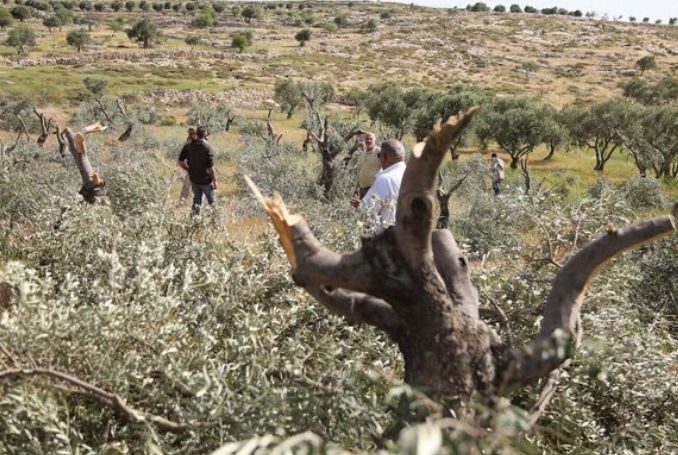
The armed settlers carried out a wide-scale campaign of attacks on the Palestinian herders and farmers. They stole scores of animals and damaged wide swathes of farmlands.
“The situation in the Jordan Valley is very difficult,” Mahmoud Bsharat, who has received an expropriation order for his farm, told the magazine.
He said that the “gangs of settlers” cut trees and steal cattle, as well as opening fire at the Palestinian shepherds. They also steal tractors from Palestinian farmers and damage their farms.
Activist Aref Daraghmeh told the magazine that Jewish settlers carried out 45 attacks over the past few days in the Jordan Valley, noting that they stole farming equipment in addition to damaging farms and homes.
He also said that the occupation imposed high fines on Palestinians and has been carrying out military drills that damage their crops.
This, Daraghmeh explained, was part of the settlers’ efforts to force Palestinians out of the area in preparation for its annexation by Israel.
The Palestinian Authority warned that Israel may use the state of emergency brought on by the COVID-19 to carry out its “colonial” plans in the occupied West Bank based on what was announced in the US ‘deal of the century’.
Iraq military demands foreign forces swiftly withdraw following US air raids
Press TV – March 14, 2020
The Iraqi military has called for an immediate withdrawal of all American and foreign troops from the country in accordance with a parliamentary resolution passed earlier this year, and in light of a string of airstrikes carried out by the United States against multiple locations of the Popular Mobilization Units (PMU), better known by the Arabic name Hashd al-Sha’abi.
On Saturday, the military asked all US-led forces to act within the resolution and pull out of Iraq.
Iraqi lawmakers unanimously approved a bill on January 5, demanding the withdrawal of all foreign military forces led by the United States from the country following the assassination of Lieutenant General Qassem Soleimani, the commander of the Quds Force of the Islamic Revolution Guards Corps, along with the deputy head of the PMU, Abu Mahdi al-Muhandis, and their companions in US airstrike authorized by President Donald Trump near Baghdad International Airport two days earlier.
Later on January 9, former Iraqi prime minister Adel Abdul-Mahdi called on the United States to dispatch a delegation to Baghdad tasked with formulating a mechanism for the move.
According to a statement released by his office at the time, Abdul-Mahdi “requested that delegates be sent to Iraq to set the mechanisms to implement the parliament’s decision for the secure withdrawal of (foreign) forces from Iraq” in a phone call with US Secretary of State Mike Pompeo.
The 78-year-old politician said that Iraq rejects violation of its sovereignty, particularly the US military’s violation of Iraqi airspace in the airstrike that assassinated General Soleimani, Muhandis and their companions.
Iraqi MP: We demand immediate withdrawal of US forces
Meanwhile, an Iraqi lawmaker from the Fatah (Conquest) alliance has called for the “immediate” pullout of American-led forces from the country through diplomatic means.
“Our fellow countrymen and women have become fully convinced that whatever has happened or happens in our country over the past 16 years is due to foreign interference in general, and the American interventions in particular in Iraq’s domestic affairs,” Ahmed al-Kinani said in a press release.
He added, “I would like to refer to repeated attacks on the sovereignty of Iraq by the occupying US forces, including the bombing of the headquarters of our security forces, army and the PMU, which led to their martyrdom and injury besides destruction of civilian facilities.”
“Such repeated attacks do not show that US forces have good intentions, and that they must leave our land as demanded by the government, the parliamentary resolution and the Iraqi nation, who took part in a million-march demonstration and called for their immediate departure,” Kinani pointed out.
‘Next Iraqi PM must be someone who can stop US recklessness’
Another Iraqi legislator lambasted US airstrikes as blatant violation of the Arab country’s sovereignty.
Nada Shaker Jawdat said that the country’s next prime minister must be someone who can firmly act against the US recklessness and its utter disdain for Iraq’s national sovereignty.
Attack on Camp Taji cannot serve as pretext for foreign ops: Baghdad
The Iraqi military also cautioned the US and other foreign forces on Saturday against taking any military action in Iraq without the government’s approval, emphasizing that recent missile strikes against the Camp Taji can’t serve as a pretext for unauthorized actions.
The military noted in a statement that 33 Katyusha rockets had been launched on the military base, which is located approximately 27 kilometers (17 miles) north of the capital Baghdad and houses US-led troops, and that the attack critically injured several Iraqi air defense servicemen.
The statement added that the military found seven rocket launchers and 24 unused rockets in the nearby Abu Izam area.
The Iraqi Interior Ministry’s Security Media Cell announced in a statement that “at 01:15 local time on Thursday (2215 Wednesday) an American aerial bombardment struck headquarters of Hashd al-Sha’abi, emergency regiments as well as commandos from the 19th Division of the army.”
The statement added that the airstrikes targeted positions in Jurf al-Nasr town, located about 60 kilometers southwest of the capital Baghdad, Musayyib town in the central province of Babil, the holy shrine city of Najaf as well as the ancient central city of Alexandria.
The US military did not estimate how many people in Iraq may have been killed in the strikes, which officials said were carried out by piloted aircraft.
US Defense Secretary Mark Esper, in a Pentagon statement detailing the strikes, cautioned that the United States was prepared to respond again, if needed.
“We will take any action necessary to protect our forces in Iraq and the region,” Esper said.
Separately, an Iraqi official said an airstrike had hit an airport under construction in Karbala, located about 100 kilometers (62 miles) southwest of Baghdad.
The official, speaking on condition of anonymity, told Arabic-language al-Sumaria television network on Friday that US military aircraft fired three missiles at the airport building, which is located in al-Haidariya district and near the border with neighboring Najaf province.
He added that the air raid killed a worker, and left great material damage at the site.
Meanwhile, CNN, quoting a US military official, reported that the airstrikes were carried out against five weapons storage facilities.
The early Friday US airstrikes were carried out about 24 hours after at least 18 PMU fighters were killed in air raids targeting an area southeast of the city of al-Bukamal in eastern Syria and near the border with Iraq.
That deadly attack was conducted hours after the US-led military coalition purportedly fighting the Daesh Takfiri terrorist group announced that three of its personnel – two Americans and one Briton – had been killed in a rocket attack on Iraq’s Taji military camp, located some 30 kilometers (18.6 miles) north of Baghdad.
More American Blunders in the Middle East: U.S. Envoys Embrace Terrorists Yet Again
By Philip Giraldi | American Herald Tribune | March 14, 2020
The spread of the coronavirus has meant that much of the other news about developments around the world has disappeared from the normal news cycle. The situation in Syria, which involves not only the government in Damascus but also Turkey, Russia, Iran and a remaining American force in part of the country has been proving increasingly unstable. Russian President Vladimir Putin has met face-to-face with Turkish President Recep Tayyip Erdogan to come up with a de-escalation plan that would avoid any head-to-head confrontation. An agreement was reached that included a cease fire, which most observers are describing as a surrender by Erdogan that accepted all Russian-Syrian army gains in the Idlib Province, but it remains to be seen what exactly will be sustainable. There have been subsequent reports that have included claims of the downing of two Syrian aircraft and several helicopters.
The United States for its part has been sending mixed messages to appeals from the Turks for support. Donald Trump has had an on and off again relationship with Erdogan and he has more-or-less approved the Turkish presence in the border areas and continues to endorse something like regime change in Damascus. Though it seems that at least for the moment the danger of a major armed conflict between Russia and Turkey has faded, many believe that more incidents are likely and could easily escalate.
And there is a truly dangerous connection in that Turkey and the United States are, of course, members of NATO. Under Article 5 of the NATO treaty, an attack on any one member is considered to be the same as an attack on all members and all members must respond by coming to the defense of the victim of the attack. Turkey has asked the United States for Patriot missiles to defend its troops on the ground in Syria. It has also called for NATO to enforce a no-fly zone in Idlib Province, air space that is currently controlled by Russia. Omer Celik, speaking for Erdogan’s Justice and Development Party, said that in his government’s view “The attack against Turkey is an attack against NATO. NATO should have been with Turkey, not starting today but from before these events.” Washington, for its part, has reportedly offered to provide Patriot batteries if the Turks do not deploy their recently purchased Russian built S-400 missiles. Trump has otherwise deferred to the Europeans for any direct assistance and NATO has not entertained seriously any no-fly commitment.
Under normal circumstances and in a normal world, the very idea that a member of a defensive alliance should be able to attack another country, as Turkey has done in Syria, and then demand assistance from other members of the alliance when the attacked country fights back would be a non-starter. But the problem with that kind of rational thinking is that NATO has long since ceased to be a defensive alliance. Both as an alliance and also acting through several of its member states, it has been actively involved in wars that have nothing to do with defense of Europe or of the Atlantic relationship with Washington. NATO troops are currently in Afghanistan and have also been in Iraq, Syria and Libya. Alliance members including the U.S. fought in Bosnia and Kosovo.
And there are the usual head cases on the American side also demanding action against Russia and Syria. Senator Marco Rubio of Florida tweeted that “The prospects of a direct military confrontation between Turkey & Russia in Syria are very high & increasing by the hour… [Erdogan] is on the right side here. Putin & Assad are responsible for this horrific humanitarian catastrophe.”
The American ambassador to NATO Kay Bailey Hutchison told reporters “This is a big development, and our alliance is with Turkey, it is not with Russia. We want Turkey to understand that we are the ones that they’ve been allied with.”
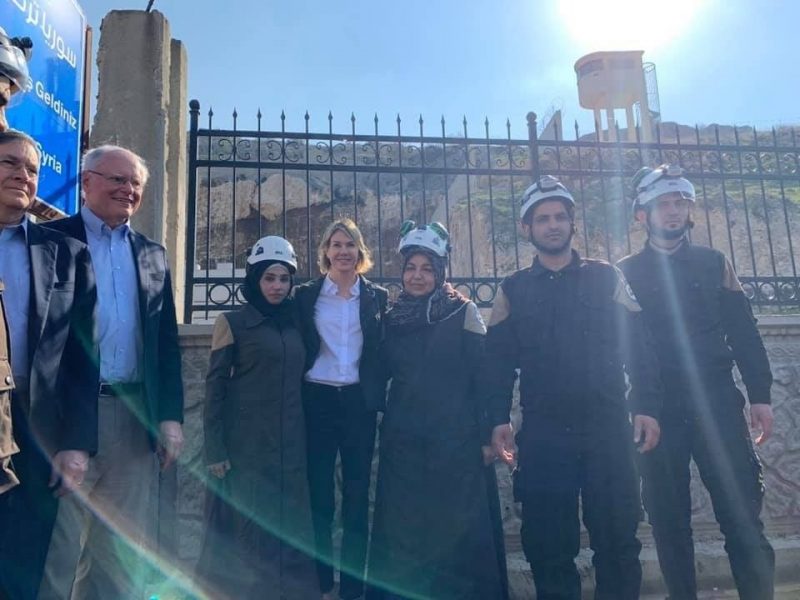
The United States has further complicated the game through a recent visit made by the entourages of two senior U.S. officials who visited Syria’s Idlib on March 3rd and pledged $108 million aid for Syrian civilians, hours after Turkey downed its second Syrian warplane in the province. Who exactly would receive the money and how it would be distributed was, inevitably, not immediately clear.
The two diplomats slipped over the border from Turkey with the connivance of Ankara and several Syrian “resistance” groups. They conspicuously met with the so-called White Helmets, a group that claims to be involved in nonpartisan humanitarian rescue missions but which really is affiliated with terrorists, most notably the Hayat Tahrir al-Sham (HTS), which is affiliated with al-Qaeda. HTS is the principal terrorist group operating in Idlib.
The group of American diplomats was headed by U.S. representative to the United Nations Kelly Craft, along with U.S. Special Envoy for Syria James Jeffrey. It was the first visit by American diplomats to Idlib. Craft announced that the aid package was for “the people of Syria in response to the ongoing crisis caused by Assad regime, Russian, and Iranian forces”. Jeffrey struck a more directly belligerent pose, saying that Washington would be providing ammunition in addition to the humanitarian assistance. “Turkey is a NATO ally. Much of the military uses American equipment. We will make sure that equipment is ready and usable.”
U.S. policy in Syria serves no American interest, but both Craft and Jeffrey are well known to be in the pocket of Israel. Craft, a big time GOP donor, who, in her fifteen months spent as Ambassador to Canada was remarkable for flying back to the U.S. from Ottawa 128 times, 70 of which were to her home in Kentucky. All on the government dime even though she is an extremely wealthy woman.
Craft left Canada when she replaced the arch Zionist Nikki Haley at the U.N. She emphasized in her confirmation hearing before the Senate Foreign Relations Committee that she would “fight against anti-Israel resolutions and actions by the U.N. and its affiliated agencies.” She also “made a case for America returning to a leading role at Turtle Bay [the U.N.] as a way of protecting Israel… Without U.S. leadership, our partners and allies would be vulnerable to bad actors at the U.N. This is particularly true in the case of Israel, which is the subject of unrelenting bias and hostility in U.N. venues. The United States will never accept such bias, and if confirmed I commit to seizing every opportunity to shine a light on this conduct, call it what it is, and demand that these outrageous practices finally come to an end.”
Jeffrey is even more the zealot. His full title is as United States Special Representative for Syria Engagement and the Special Envoy for the Global Coalition to Defeat ISIL. He is, generally speaking, a hardliner politically, closely aligned with Israel and regarding Iran as a hostile destabilizing force in the Middle East region. He was between 2013 and 2018 Philip Solondz distinguished fellow at the Washington Institute for Near East Policy (WINEP), a think tank that is a spin-off of the American Israel Public Affairs Committee (AIPAC). He is currently a WINEP “Outside Author” and go-to “expert.”
Professor John Mearsheimer of the University of Chicago and Stephen Walt, academic dean at Harvard University ‘s Kennedy School of Government, describe WINEP as “part of the core” of the Israel Lobby in the U.S. They examined the group on pages 175-6 in their groundbreaking book The Israel Lobby and US Foreign Policy and concluded as follows:
“Although WINEP plays down its links to Israel and claims that it provides a ‘balanced and realistic’ perspective on Middle East issues, this is not the case. In fact, WINEP is funded and run by individuals who are deeply committed to advancing Israel’s agenda … Many of its personnel are genuine scholars or experienced former officials, but they are hardly neutral observers on most Middle East issues and there is little diversity of views within WINEP’s ranks.”
Jeffrey set the tone for his term of office shortly after being appointed by President Trump back in August 2018 when he argued that the Syrian terrorists were “. . . not terrorists, but people fighting a civil war against a brutal dictator.” Jeffrey, who must have somehow missed a lot of the head chopping and rape going on, subsequently traveled to the Middle East and stopped off in Israel to meet Prime Minister Benjamin Netanyahu. It has been suggested that Jeffrey received his marching orders during the visit.
So, Trump bleats incessantly about how he wants to withdraw the U.S. from the senseless wars that it has been drawn into but at the same time his State Department sends two Zionist hardliners to Syria on a semi-secret mission to support a policy of regime change in Damascus while also providing aid that will inevitably fall into the pockets of an al-Qaeda linked terrorist group. And ammunition will also be forthcoming for the invading Turks to shoot Syrians, Russians and Iranians. If anyone is seriously interested in what is wrong with U.S. foreign policy, the activity of Craft and Jeffrey might serve as a decent case study on how not to do it. Unless, of course, the actual objective is to screw things up and involve the United States in quarrels that it could easily avoid.
Philip M. Giraldi is a former CIA counter-terrorism specialist and military intelligence officer who served nineteen years overseas in Turkey, Italy, Germany, and Spain. He was the CIA Chief of Base for the Barcelona Olympics in 1992 and was one of the first Americans to enter Afghanistan in December 2001. Phil is Executive Director of the Council for the National Interest, a Washington-based advocacy group that seeks to encourage and promote a U.S. foreign policy in the Middle East that is consistent with American values and interests.
Iraqi military confirms attack on Taji base, says it shouldn’t be pretext for foreign ops on its soil
RT | March 14, 2020
A military base in Iraq housing US troops has been targeted in a rocket attack that severely injured Iraqi soldiers, the nation’s military confirmed. It also warned that the strike does not warrant a retaliation by foreign powers.
As many as 33 Katyusha rockets have been launched at the Taji base north of the Iraqi capital, Baghdad. The strike left several Iraqi air defense soldiers “critically injured,” according to the military statement. It is unclear if any US personnel have been affected.
The military urged all foreign forces to implement the national parliament’s resolution, passed after the US killing of Iranian top general Qasem Soleimani, and withdraw troops from Iraq.
The incident comes two days after the US launched its own airstrikes against an Iranian-backed Shia militia in Iraq, which it blames for the previous assault on a base where Western forces are stationed. The attack claimed the lives of three soldiers, two American and one British.
The move sparked angry reaction in Baghdad, which said it would file a complaint to the UN Security Council over the issue while the targeted militia called it a violation of Iraq’s sovereignty.
Featured Video
Iran’s Mass Protests /Patrick Henningsen & Lt Col Daniel Davis
or go to
Aletho News Archives – Video-Images
From the Archives
Does Kevin Barrett Seek to “Absolve Islam of a Terrible Crime”?
The Kevin Barrett-Chomsky Dispute in Historical Perspective – Last part of the series titled “9/11 and the Zionist Question”
By Prof. Tony Hall | American Herald Tribune | August 28, 2016
Amidst his litany of condemnations, Jonathan Kay reserves some of his most vicious and vitriolic attacks for Kevin Barrett. For instance Kay harshly criticizes Dr. Barrett’s published E-Mail exchange in 2008 with Prof. Chomsky. In that exchange Barrett castigates Chomsky for not going to the roots of the event that “doubled the military budget overnight, stripped Americans of their liberties and destroyed their Constitution.” The original misrepresentations of 9/11, argues Barrett, led to further “false flag attacks to trigger wars, authoritarianism and genocide.”
In Among The Truthers Kay tries to defend Chomsky against Barrett’s alleged “personal obsession” with “vilifying” the MIT academic. Kay objects particularly to Barrett’s “final salvo” in the published exchange where the Wisconsin public intellectual accuses Prof. Chomsky of having “done more to keep the 9/11 blood libel alive, and cause the murder of more than a million Muslims than any other single person.” … continue
Blog Roll
Recent Comments
loongtip on Eilat port faces worst crisis… loongtip on British minister dreams of kid… loongtip on Kiev awards major mining proje… loongtip on UK believes it can seize any t… loongtip on Pirates of the Caribbean loongtip on Australian festival boycotted… loongtip on Kiev seeks to ban Russian musi… seversonebcfb985d9 on Somaliland and the ‘Grea… John Edward Kendrick on Kidnapped By the Washington… aletho on Somaliland and the ‘Grea… John Edward Kendrick on Somaliland and the ‘Grea… aletho on Donald Trump, and Most America…


 Aletho News
- Knesset advances bill mandating death by hanging for Palestinian prisoners
- Eilat port faces worst crisis as Red Sea shipping collapses
- Iran protest-riots can only achieve US-Israeli intervention, ‘shadow CIA’ concludes
- The Coming War on Iran: What Has Really Been Happening?
- US Cargo Planes Have Flooded the Persian Gulf Since the First of December
- Deep-state forces from abroad instigated violence in Nepal – former foreign minister
- Rare Earths—or Arctic Control? Greenland’s Riches May Just Be Excuse
- Kiev awards major mining project to Trump-linked investors
- US makes money from weapons, not from Ukrainian minerals
- Drone hits Kazakh tanker en route to Russian port
- If Americans Knew
- The New Neoconservatives
- As more Gaza children freeze to death, Trump eyes Gaza as starting point for world domination – Not a ceasefire Day 95
- More death: in Gaza, West Bank, Israeli prison – Not a ceasefire Day 94
- The Israeli Influence Operation Aiming to Install Reza Pahlavi as Shah of Iran
- Avoidable tragedy: another infant dies from cold – Not a ceasefire Day 93
- Israel is quietly erasing Palestinian refugee camps from existence in the West Bank
- The “Zionist tint” to the Maduro abduction, if not operational, then normative
- Press association condemns Israel’s continued ban on media access to Gaza
- Israeli Indifference to Palestinian Suffering Is Fertile Ground for the Growth of Sadism
- Surge in premature births, congenital defects, cancer deaths in Gaza – Not a ceasefire Day 92
- No Tricks Zone
- Denmark Places Climate Protection Above Animal Welfare, Poisoning And Culling Cows
- New Study: Greenland Was 3-7°C Warmer And Far Less Glaciated Than Today 6000-8000 Years Ago
- German Media Report That Current Frigid Weather Can Be Explained By Arctic Warming!
- Berlin Blackout Shows Germany’s $5 Trillion Green Scheme Is “Left-Green Ideological Pipe Dream”
- Modeling Error In Estimating How Clouds Affect Climate Is 8700% Larger Than Alleged CO2 Forcing
- Berlin’s Terror-Blackout Enters 4th Day As Tens Of Thousands Suffer In Cold Without Heat!
- Expect Soon Another PIK Paper Claiming Warming Leads To Cold Snaps Over Europe
- New Study: Human CO2 Emissions Responsible For 1.57% Of Global Temperature Change Since 1750
- Welcome To 2026: Europe Laying Groundwork For Climate Science Censorship!
- New Study Finds A Higher Rate Of Global Warming From 1899-1940 Than From 1983-2024
 Aletho News