A Few Historical Frauds
Einstein, Bell & Edison, Coca-Cola and the Wright Brothers

By Larry Romanoff • Moon of Shanghai • July 11, 2020
There are only two nations in the world whose existence seems to be founded primarily on historical myths. In the US, false historical mythology permeates every nook and cranny of the American psyche, the result of more than 100 years of astonishing and unconscionable programming and propaganda, a massive crime against an entire population. This condition pertains not only to past events we think of as history, but to the extent that most items permitting Americans to “feel good by being an American” are fabricated Disney fairytales. This essay is a brief introduction to only a minor aspect of this subject.
In the introduction to my series of books (soon to be published) I wrote that “Perhaps 90%, or even 95%, of everything we know, or think that we know, or that we believe to be true about history, is wrong. To express this another way, if we were to take the history of the entire world for the past 500 years and compress it into a book of 100 pages, a full 50 of those pages would be blank. That is the extent to which our true history has been suppressed, entirely deleted from the record and from our consciousness. Of the remaining 50 pages, 45 are false in whole or in part, photoshopped, sanitised, twisted, and with critical details omitted to deliberately lead the public to the wrong conclusions.”[1]
Einstein, the Mythical Genius
One of the greatest mythical frauds in history is that of Albert Einstein, the famous physicist who invented the Theory of Relativity, E=mc² and so many other esoteric things. But this is all fabrication. The claims about Einstein inventing any theory of relativity, or light and photons, or time, are false. Almost every claim – almost everything – attributed to Einstein is simply a lie. Einstein was an inept who contributed nothing original to the field of quantum mechanics, nor any other science. Far from being a competent physicist, he once even flatly denied that the atom could be split and, much later, admitted that the idea of a chain reaction in fissile material “had never occurred to me”.[2][3]
Einstein was a third-class clerk at the government patent office in Bern, and never progressed beyond this level even with years of experience. By all contemporary reports, Einstein wasn’t even an accomplished mathematician. It has been well documented that much of the mathematical content of Einstein’s so-called theories were well beyond his ability. Walter Isaacson, president of the Aspen Institute, stated that Einstein’s first wife Mileva Marić was a “Serbian physicist who had helped him with (his) math . . .”[4] Other prominent scientists have made the claim that his wife did most of his math for him.
Henri Poincaré was the foremost expert on relativity in the late 19th century and the first person to formally present the theories, having published more than 30 books and over 500 papers on the topics. Extensive documentation exists that Einstein and his associates had studied Poincaré’s theories and mathematics for years, yet when Einstein published his almost wholly-plagiarised versions he made no reference whatever to these other works.
In the accepted historical account, Einstein is credited with having written the correct field equations for general relativity, an enormous falsehood. It is an undisputed fact that David Hilbert sent Einstein a draft of his work (which had already been submitted for publication), containing precisely these equations, evidenced by the existence of a letter from Einstein to Hilbert thanking him for doing so. Yet a few weeks later, Einstein delivered a public speech of Hilbert’s work, claiming full credit for the derivation of Hilbert’s equations. Similarly, E=mc², the famous equation relating mass, energy, and the speed of light, had been published several times by Italian physicist Olinto De Pretto, long before Einstein was suddenly given credit for it. In multiple thorough reviews of scientific literature, prominent scientists have unanimously stated that there is “absolutely nothing to connect Einstein to the derivation of this formula.”[5]
Einstein’s papers, theories, mathematics, documentation, were almost 100% plagiarised from others. He combined the prior published works of several people into one paper and claimed ownership of all of it. His so-called theories were nothing more than a composition encompassing the prior work of men like James Maxwell, Hendrik Lorentz, Joseph Larmor, Olinto De Pretto, Robert Brown, Ludwig Boltzmann, Friedrich Hasenöhrl, and many more.
In a paper he wrote in 1907, in part responding to (already-virulent) accusations of plagiarism, Einstein declared that plagiarism was perfectly acceptable as a form of ethical research, stating “… the nature [of physics is] that what follows has already been partly solved by other authors. I am [therefore] entitled to leave out a thoroughly pedantic survey of the literature…”[6][7][8] In other words, scientists all build on each others’ work, so Einstein could freely compile the work of everyone before him and re-present it as his own, with no obligation to even mention them or their work. His view of ethical science was like building a tower where each person adds one stone and, if I add the last stone, I not only take credit for the entire design and construction of the tower, but I own the building.
Perhaps the most damning evidence was when in 1953 Sir Edmund Whittaker published a very detailed account of the origin and development of all these theories and equations of physics, with extensive reference to the primary sources, documenting beyond doubt that Einstein had no priority in any of it, and clearly stating so. Einstein was alive and well when Whittaker published his book, yet he offered no dispute to the conclusions, no refutation of Whittaker’s claim that he (Einstein) had been irrelevant to the entire process. Einstein made no attempts in his own defense but simply hid in the bushes and refused to make any public comment whatever.[9]
Einstein was almost certainly the greatest fraud and plagiarist in modern science, an unashamed intellectual thief but, according to sources like Wikipedia, this is all just a minor “priority dispute” about who said what first in the realm of relativity physics. These sources misleadingly imply that several people made a discovery independently and more or less simultaneously, and we are simply debating who went public first. Nothing could be farther from the truth. Wikipedia is renowned as being virtually useless as an information source due to widespread ideological bias and censorship.
Einstein was Jewish and had the support of the Jewish-controlled media who conspired to create yet another historical myth. His fame and popularity today, his status as a hero of the scientific world, are due only to decades of a well-planned force-feeding of the Einstein myth to the masses by the media. The propaganda machine simply airbrushed out of the history books all the physicists who formulated these theories, and credited everything to Einstein. Without the extravagant generations-long PR and propaganda campaign, Einstein would have remained in the dustbin of obscurity where he belongs.
There are many Einstein apologists who produce reams of heavily-documented irrelevancies masquerading as proof, items such as a schoolmate who claimed “the flight of his mathematical genius was so high that I could no longer follow.” Many scientists and scientific historians know the truth of all this, and the accurate historical record is readily available, but many appear afraid to speak out for fear of damaging their careers. I have put the question to several prominent physicists in different countries, eliciting similar responses, namely that “it will not further one’s career to open a debate which will inevitably produce a tsunami of invective and slander, to say nothing of accusations of anti-Semitism.”
Time Magazine published more than a dozen issues on Einstein, including a special Collector’s Edition, and even ran an issue naming Einstein the “Person of the Century”. As with all other American heroes, the PR machine has worked for decades to embellish the myth with a collection of possibly hundreds of wise sayings attributed to this man where there is absolutely no historical evidence he ever said any of those things. The NYT published an article on a small cleverly-selected scientific dispute, in which it claimed “Findings Back Einstein in a Plagiarism Dispute”.[10] And thus is history spun by those who control the microphone. This is why so many pages in our history book consist of misrepresentations and omitted facts, painting a picture so considerably at odds with the truth. As with Thomas Edison, Alexander Graham Bell, the Wright Brothers and so many others, the false historical myths have been so deeply entwined in American and world history that they cannot be unraveled.
Einstein, the “Man of Peace”
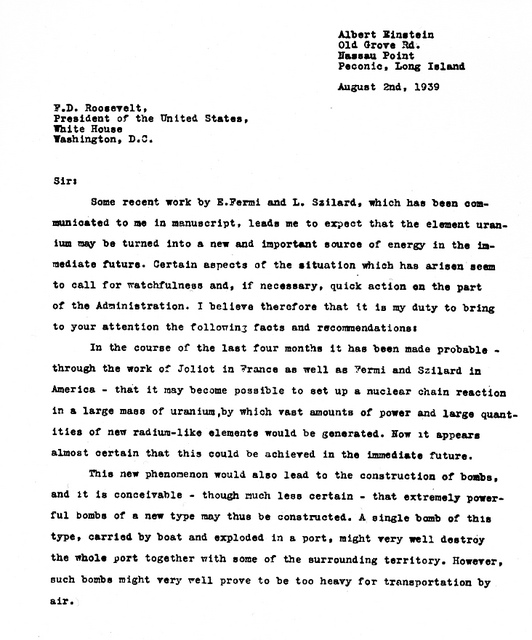
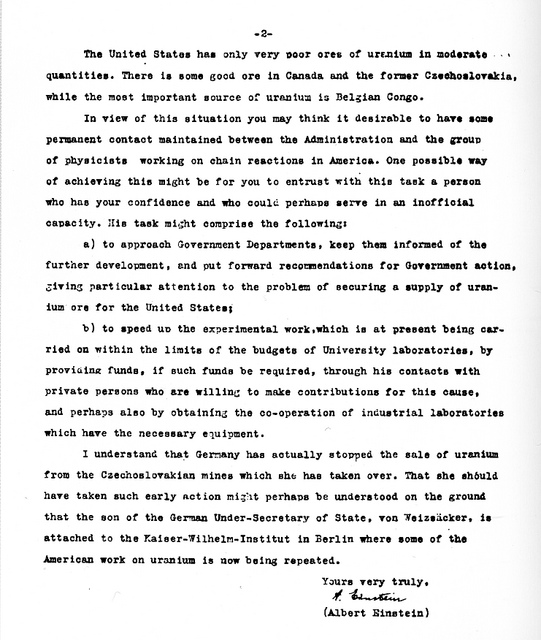
Similarly, there has been a great campaign by Einstein’s revisionist apologists to disavow his strong support for the development of the atomic bomb, claiming him to be “a man of peace”. I have copies of correspondence from Einstein where he stated his conviction that the United States should “demonstrate” the atomic bomb to disfavored foreign countries. In one letter to then-US President Roosevelt, he wrote, “… extremely powerful bombs of a new type may thus be constructed. A single bomb of this type, carried by boat and exploded in a port, might very well destroy the whole port together with some of the surrounding territory. I am convinced as to the wisdom and the urgency of creating the conditions under which that and related work can be carried out with greater speed and on a larger scale than hitherto”.[11]
That statement is part of one of Einstein’s letter to Roosevelt, suggesting he (Einstein) be “entrusted with the task” of managing the project. Roosevelt refused Einstein’s fervent requests to manage, or even to participate in, the project, because it was an open secret that nobody trusted him and the FBI had conducted extensive investigations against him. One FBI file labeled “Secret”, stated that Einstein was affiliated with 33 organisations which had been cited by the Attorney-General and/or Congress, as being politically suspect.
It is interesting that the respected National Geographic is one of the world’s worst publications for spinning historical fact and truth. In 2017, this magazine ran an article on Einstein claiming that Hoover and the FBI despised Einstein and built a 1,400-page file on him because “the world-famous physicist was outspoken against nuclear bombs”.[12][13]
The second portion of the same letter is rather more disturbing, and has to my knowledge never been publicly referenced anywhere. It clearly reveals that Einstein had had detailed discussions with some wealthy acquaintances in Europe who were eager to personally finance the US development of atomic bombs from their own pockets. Einstein was informing the President he had access to these individuals with whom he had already confirmed available funding, baiting Roosevelt with an offer that, should he be ‘entrusted’ with management of the bomb project, he could bring the necessary financing with him. He states that, as project manager, one of his tasks would be: “providing funds … through his contacts with private persons who are willing to make contributions for this cause.”
It would be appropriate for us to ask who were these “private persons” who had the money to finance the development of the world’s first atomic bombs, and why they would want to personally fund such a project. Einstein does not mention these individuals by name, but they would surely have been Jewish and who in Europe (in the 1930s) had the kind of money to offer open-ended funding for a scientific project the cost of which was unknown and unknowable, but clearly massive.[15] This offer was not spurred by patriotism but by the prospect of financial gain and control of both the technology and the application of this ‘science’. We can therefore further question who would have taken ownership of the technology, and who would have been the intended victims of this large personal investment.
One plausible theory; I would add here that many of Einstein’s propagandists and apologists have made repeated efforts to pass the blame for the development of the atomic bomb onto Enrico Fermi, another monstrous falsehood. The US government offered Fermi a cash payment of US$100,000[16] to lead the research and development of the atom bomb, but Fermi refused. I have seen a copy of a letter from Fermi to the US President claiming that something so evil had “no right to exist”. In fact, it was Oppenheimer and Szilard who led the development of what was almost in totality a Jewish project, so much so that for many years in scientific circles the atomic bomb was widely known as “The Jewish hell-bomb”.[17] I believe it was Eustace Mullins who first coined the phrase, and I believe it was he who first suggested there was “circumstantial but compelling evidence” that the Jewish motivation for offering to finance the A-bomb’s development was to take control of the technology and use it for Germany’s total destruction.”[18] The theory is more than plausible if you are familiar with the heavily-evidenced proposition that the underlying purpose of both world wars was the total destruction of Germany). You can understand why items like this are restricted to the blank pages in our history book.
Alexander Graham Bell – The Man Who Didn’t Invent the Telephone
History books tell us the famous American, Alexander Graham Bell, invented the telephone. This claim has only two flaws; Bell was Canadian, not American, and he did not invent the telephone.
An Italian named Antonio Meucci patented a working telephone many years before Bell did anything.[19] Bell had obtained copies of Meuci’s drawings and patents and had attempted to obtain US patents on Meuci’s phone. Meucci discovered Bell’s attempted patent of his invention and filed a lawsuit against Bell, in support of which he brought from Italy all his documents, working models, original sketches and his patent, to present to the court as evidence of his prior invention. The delivery company – Western Union – was charged with the responsibility as trustee to hold this evidence for delivery to the court, but all of it “amazingly disappeared without a trace immediately prior to the court hearing, leaving Meucci with no proof of anything and thus losing his lawsuit against Bell.” It is worth noting that at the time Bell was employed at the Western Union lab where Meucci’s evidence was being stored.
The Italians are still angry about this. The Italian Historical Association informed us that their investigation produced evidence of illegal relationships between employees of the patent office and Bell’s company. And later, during a lawsuit between Bell and Western Union, it was revealed Bell had agreed to pay Western Union 20% of all profits from ‘his’ telephone, for 17 years, representing millions of dollars, sufficient temptation for Western Union to justify “losing” Meucci’s invention. US media have fabricated at least dozens of tales excusing Bell, a common one that “due to hardships, Meucci could not renew his patent” and therefore Bell could take it, but in fact the US government filed charges against Bell for fraud because of his telephone patent, but powerful friends had the lawsuit delayed year after year until Meucci died.[20] American history books and sources like Wikipedia omit these critical facts and twist the remaining information, and thus Americans grow up believing yet one more false myth about their country and their innovative ability.
I would make a note here that when doing historical research we sometimes discover that the landscape has been so badly polluted by countless individuals amending details to conform to opinion or ideology (or patriotism) that it becomes nearly impossible to ferret out the actual facts without an extraordinary amount of work. In this case, some have claimed (without evidence) that Meucci lost his patent because he hadn’t the funds to renew it. Others ignore Meucci’s lawsuit against Bell and claim Bell delivered his phone patent and samples to Western Union for evaluation and who later claimed to have lost all of it. And so on. Here are several articles purporting to tell “the real truth”[21][22][23][24]
Thomas Edison – The Man Who Didn’t Invent Anything
Every American child is taught in school that the famous American Thomas Edison invented the light bulb, Wikipedia claiming that Edison was “the fourth most prolific inventor in history, holding 1,093 US patents in his name, as well as many patents in the UK, France, and Germany”. Edison is given full credit for inventing the light bulb, electricity transmission, electric power utilities, sound recording and motion pictures. All these claims are completely false.[25] Not only was Edison not one of the most prolific inventors in history, he never invented anything. Edison himself made the statement: “patents 1047 – inventions 0”, in recognition of his situation.
The inventions for which Edison is credited by the Americans were all achieved by others, and his “1,093 US patents” were all either stolen, bullied, extorted or purchased from those same inventors. As another author pointed out, “a man who kidnaps or adopts 1,000 children can hardly be deemed the world’s most prolific father, and a man who steals 1,000 inventions and patents can hardly be deemed the world’s most prolific inventor”. Thomas Edison was unquestionably one of the world’s most prolific thieves, and widely known as a con-man and common thug who often resorted to threats and extortion, but he was no inventor. Edison was mostly just a thieving opportunist who extorted or stole everything that is listed to his credit, but in US history books Edison is revered in totally fabricated myths as the father of the light bulb and America’s most prolific inventor.
The light bulb had been invented by several people in Europe, one of whom, Heinrich Goebel, unsuccessfully tried selling it to Edison who claimed to see no value in it though he was more than happy to purchase the patent from Goebel’s estate when the man died, cheating his widow out of a substantial sum of money. In any case, another man, Joseph Wilson Swan developed and patented a working incandescent light bulb using a carbon filament 20 years before Edison made any such claim.[26][27] Edison first tried to steal Swan’s invention and, when that proved legally dangerous, he made Swan a minor partner in the Ediswan United Company, buying both Swan and his patented light bulb and claiming the invention for himself. Swan also invented sound recording and other items which are today credited to Edison.[28]
Every American is taught from birth that Edison labored for years, trying at least 1,000 different substances (some say 2,000) before he discovered that twisted carbon would function acceptably as the filament in a light bulb. The story is entirely false, a myth fabricated after the fact, a little religious morality play to support faith in the American Dream – that persistence and hard work will lead to unlimited fame and riches in the end. Edison did indeed try – and repeatedly failed – to create a light bulb, and he may well have attempted some of those filament trials. But all that is irrelevant because Swan had already proven the effectiveness of a carbon filament when Edison took ownership of his invention and patent.
Edison is given credit for the device which made x-rays possible, but the actual inventor was German scientist Wilhelm Roentgen who publicly displayed x-rays of his wife’s hand years prior to Edison’s fluoroscope. Similarly, Edison is given credit for inventing electrical transmission in various forms, but Nicola Tesla brought this invention to the US and offered it to Edison who took ownership of the process and patents under a promise of $50,000, then refused to pay Tesla and spent years in attempts to destroy his name and reputation.
The US-based Science website dismisses the entire truth about Edison in one cute sentence: “Even though many of his “inventions” were not unique – and he engaged in some well-publicized court battles with other inventors whose ideas he “borrowed” – Edison’s skill at marketing and using his [political] influence often got him the credit.”[29] And that means Edison patented items that already existed, created by others, and that had sometimes already been patented. Plus, he had a habit of stealing and patenting any ideas brought to him by other inventors. Hence, the lawsuits. But his marketing ability and some powerful political and judicial contacts kept him out of jail. Nevertheless, the myth has been so thoroughly weaved into American history, it could never be recalled.
The US government even issued a special silver dollar coin to commemorate Edison’s non-achievements. And we have an Edison museum complete with the requisite US flag, providing Americans with the unique opportunity to experience delusion and patriotism simultaneously. But the man did invent one thing the history books seem to have quietly deleted. Edison was a believer in spirits and regularly attended séances where mediums would receive and transmit messages from the dead. To more easily conduct these affairs, Edison invented a telephone that he claimed could talk to people in the spirit world, though he didn’t specify what numbers to dial. In a conversation with B.C. Forbes, the founder of Forbes magazine, Edison claimed, “I have been at work for some time building an apparatus … for personalities which have left this earth to communicate with us”. No idea what the spirits said to him, and no idea why his promoters deleted this important item from the history of the world’s greatest inventor.[30]
Coca-Cola
Coca-Cola, originally called Kola Coca, was invented more than 140 years ago in a small town in Spain, the creators of the formula for the world’s best-selling soft drink having been cheated of its ownership and billions of dollars. The process was a well-kept secret at the time and quickly became a world-famous product, winning dozens of international gold medals and other awards. Unfortunately, Bautista Aparici, one of the company’s founders, attended a trade fair in Philadelphia and made the mistake of giving a sample and a brief description of the process to an American he happened to meet, and a short time later US pharmacist John Pemberton changed the name to Coca-Cola and patented the product and process, the US government refusing to recognise the original Spanish patent.[31][32][33]
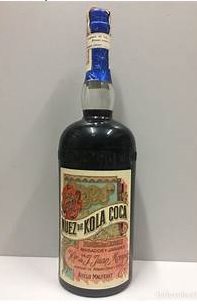 The official story is that this drink was “invented by Dr. John Smith Pemberton on May 8, 1886, at Atlanta, Georgia”, in the USA, and was named Coca-Cola because at that time it contained extracts of Coca leaves and Kola nuts, and that the company’s book-keeper renamed the drink because he thought the two ‘C’s’ would look better in advertising. None of that is true. The drink was indeed made from kola nuts and coca leaves, but the new name was a cheap attempt to differentiate itself after Pemberton stole and patented the original formula. All the stories about Pemberton inventing Coke’s secret formula in his laboratory are fabricated nonsense, with the company’s website cleverly designed to airbrush out the drink’s early history and avoid the truth becoming known. Beverage World magazine produced a special issue to commemorate the one-hundredth (American) anniversary of Coca-Cola, claiming Coke was:
“A totally American product born of a solid idea, nurtured throughout the past century with creative thinking and bold decision-making, and always plenty of good old-fashioned hard work. That is as it should be; it is the American way”.
Not by a long shot. Coca-Cola is just one of hundreds of products the Americans have stolen and patented with the full protection of their courts operating under the peculiarly American definition of ‘rule of law’. It isn’t widely-known, though well-documented, that for decades surrounding the turn of the last century, the US government offered between $20,000 and $50,000 to anyone who could steal a foreign patent or product, that amount representing a lifetime’s earnings for an average person.
To add insult to injury, Coca-Cola moved into Spain in 1953, sued the original Spanish owners, then bullied, extorted and bought the rights for a pittance, permitting the firm to continue producing only a single alcoholic beverage under their name. USA Today reported on this without even a hint of regret or shame about the rule of law or fair play or the evils of IP theft. Their only comment: “The Spanish factory has just four employees left and probably won’t last another generation.” Even more insultingly, ABC News dismisses this story as “The Spanish firm that inspired Coke”, although they do state correctly the claim: “Locals believe that the Spanish town of Aielo de Malferit is where Coca-Cola originated — and that the factory which developed the formula that inspired the world’s best-selling soda has been cheated of its rightful place in history. Not to mention profits.”[34]
The Wright Brothers
For more than 100 years, the Smithsonian Institution in Washington has had on display an aircraft that was piloted by Orville and Wilbur Wright in 1903 in Kitty Hawk, North Carolina in man’s first powered, manned aircraft flight, Americans therefore having created “The Age of Flight”.
But that was never true, and the Smithsonian was in on the fraud from the very beginning. In an agreement with the Wright family to donate the aircraft to the Institution, its officials signed a pledge to perpetuate the story that the Wrights had made the first flight, when all present were fully aware the claim was false. And for more than 100 years the Smithsonian Institution of Historical Mythology, with the full support of the US government and the media, has done everything in its power to dismiss, contradict, and just ignore, extensive documentation of other prior flights in an effort to prevent the dethroning of America in the public mind.[35][36]
Several people have thoroughly researched the matter and have written authoritative books on other prior flights but these have been “denounced by leading aeronautic agencies” (like the Smithsonian Institution), with the authors dismissed as “unqualified” and their books “unreliable”. In fact, there were many prior flights, some in Europe, Canada, South America, and others in the US itself, and the Smithsonian was fully aware of this. Recently, the editors of the authoritative Jane’s Aircraft firmly declared that Gustave Whitehead had flown years before the Wright Brothers. Alberto Santos-Dumont had done the same in Paris, as had another group in Alberta, Canada.
Moreover, there exists sufficient evidence the Wrights had access to all that prior knowledge in building their own aircraft, then claimed it as their own. In addition to other design features, the Wright brothers claimed ownership of the curved airfoil – without which no aircraft would ever have gotten off the ground anywhere, but, as one historian noted, “the Wrights stole both the concept and the actual design from an Australian who had recorded it years before, and who had himself deduced the concept from the boomerang of the Australian aboriginals.” The Wright Brothers stole the idea to build their aircraft, then patented it and sued others for using it.
Rumors had been circulating for decades that the Smithsonian had signed what was essentially a contract of fraud with the Wright family, agreeing to perpetuate the myth of the first manned flight, in exchange for having the aircraft on permanent display. But the Directors of the Smithsonian repeatedly denied the existence of such an agreement, stating that would be “tampering with history” and that they “would never agree to such a thing.” But then one day a US Senator collected a few lawyers and descended on the Smithsonian in a kind of political raid. And they did indeed locate the document, which reads in part: “Neither the Smithsonian Institution nor its successors nor any museum or other agency, bureau or facilities administered by the United States of America, shall publish or permit to be displayed a statement … in respect of any aircraft model … of earlier date than the Wright Aeroplane of 1903, claiming … that such aircraft was capable of carrying a man under its own power in controlled flight …”[37]
And now you know how the Wright Brothers became famous as the first men to fly. One historian wrote that the Smithsonian had no authority “to engage in political engineering of this sort”, noting that this “compromises history”. But compromising history is an American specialty. And this children’s tale will never end. Scientific American wrote a long, biased, and foolish article, claiming the other stories as myths and their myth as the truth.[38] Other eminent publications have done the same. This is how history is spun.
To give you an idea of the enormous influence of the US media and book publishers in maintaining these myths, in 2015 David McCullough ignored the judgment by Janes (and the world outside the US), and wrote a new book for Americans that not only perpetuates the myth but enhances it, with the major US media immediately writing glowing book reviews to help push sales and get the propaganda back into the public mind. The Washington Post modestly tells us how “two [American] boys taught the world to fly.” The publishers, Simon and Schuster, tell us the Wright brothers had “exceptional courage and determination”, and “ceaseless curiosity”.[39]
Daniel Okrent, in a review of McCullough’s book in the NYT,[40] adds that their progress was achieved through “excruciating patience and obsessive attention to detail” and with “an elegant demonstration of the creativity of their thinking”. They were “possessed by genius”. Their discovery of the necessity of a curved airfoil was not copied from Australia, but was the result of “endless calculation, application and recalculation”, every concoction being “a dazzling piece of reasoning” pursued with a “grandness of vision”, with the end result being “the most astonishing feat mankind has ever accomplished”. Yes. Except that it wasn’t.
Notes
[1] Jim Quinn: A Nation Built On Lies; https://www.zerohedge.com/news/2018-07-10/jim-quinn-nation-built-lies-part-2
[2] Einstein’s Plagiarism of the General Theory of Relativity 1st Edition; by Christopher Jon Bjerknes; https://www.amazon.com/Einsteins-Plagiarism-General-Theory-Relativity/dp/1544900872
[3] Einstein A Plagiarist Special Relativity; https://educheer.com/term-paper/einstein-a-plagiarist-special-relativity
[4] Time magazine, July 2006; http://www.time.com/time/magazine/article/0,9171,1211594,00.htm
[5] The Guardian, November 11, 1999; “Einstein’s E=mc² was Italian’s idea”; Clark, R. W. [1984], Einstein: The Life and Times, Avon Books, New York. De Pretto, O. [1904], ‘Ipo tesi dell ” et ere nell a vita dell ” universe’, Reale Istituto Veneto di Scienze, Lettere ed Arti, Feb.
[6] http://www.cartesio-episteme.net/episteme/epi6/ep6-bjerk-rec.htm
[7] https://www.bibliotecapleyades.net/esp_einstein.htm
[8] https://www.veteranstoday.com/2020/01/02/was-einstein-a-wife-beater-womanizer-plagiarizer-and-eugenicist/
[9] A history of the theories of aether and electricity: https://archive.org/details/historyoftheorie00whitrich
[10] Findings Back Einstein In a Plagiarism Dispute; https://www.nytimes.com/1997/11/18/science/findings-back-einstein-in-a-plagiarism-dispute.html
[11] Photo included:
[12] https://www.nationalgeographic.com/news/2017/04/science-march-einstein-fbi-genius-science/
[13] https://www.wsws.org/en/articles/2002/09/eins-s03.html
[14] Photo included:
[15] In the end, the Manhattan Project cost the US military between US$2 and US$3 billion, in dollars of the day.
[16] The average annual income in the US in 1935 was about $1,500, thus this represents about 65 years of average income.
[17] The Secret History Of The Atomic Bomb by Eustace C. Mullins; http://whale.to/b/mullins8.html
[18] http://www.vanguardnewsnetwork.com/2013/08/the-jewish-bomb-that-ended-world-war-ii/
[19] Antonio Meucci – Biography, Facts and Pictures; https://www.famousscientists.org/antonio-meucci
[20] The United States Government vs. Alexander Graham Bell; www.chezbasilio.org/us_bell.htm
[21] https://www.theguardian.com/world/2002/jun/17/humanities.internationaleducationnews
[22] https://www.theguardian.com/technology/2007/aug/06/bellvwestern
[23] http://wondermark.com/true-stuff-western-union-bell/
[24] https://sciencetechworld.com/10-famous-stolen-inventions/
[25] http://newsreeling.com/about-thomas-edisons-lies-and-19-stolen-inventions
[26] Joseph Swan – Wikipedia; https://en.wikipedia.org/wiki/Joseph_Swan
[27] Joseph Swan | Biography, Lightbulb, & Facts; https://www.britannica.com/biography/Joseph-Wilson-Swan
[28] Edison & Swan United Electric Light Company is Established; https://worldhistoryproject.org/1883/edison-swan-united-electric-light-company-is-established
[29] Thomas A. Edison and the Founding of Science: science.sciencemag.org/content/105/2719/142
[30] Thomas Edison, B.C. Forbes And The Mystery Of The Spirit Phone; https://www.forbes.com/…/2019/10/25/thomas-edison-bc-forbes-mystery-spirit-phone
[31] Spanish town claims origins of Coca-Cola; https://www.usatoday.com/story/news/world/2013/08/10/newser-spanish-town-coca-cola/2638515/
[32] https://www.spiegel.de/thema/coca_cola/
[33] https://www.spiegel.de/international/zeitgeist/locals-say-coca-cola-originated-in-aielo-de-malferit-in-spain-a-915371.html
[34] Fizzing Out: The Spanish Firm that Inspired Coke – ABC News; https://abcnews.go.com/International/fizzing-spanish-firm-inspired-coke/story?id=19918738
[35] https://www.foxnews.com/science/smithsonian-releases-wright-brothers-contract-detailing-first-in-flight-claims
[36] https://www.nationalgeographic.com/news/2013/5/130503-wright-brothers-first-flight-gustave-whitehead-aviation-smithsonian-institution-adventure-world/
[37] http://historybycontract.org/?tag=smithsonian-wright-agreement-1948
[38] https://www.scientificamerican.com/article/myths-about-the-wright-br/
[39] https://www.simonandschuster.com/books/The-Wright-Brothers/David-McCullough/9781476728759
[40] https://www.nytimes.com/2015/05/10/books/review/the-wright-brothers-by-david-mccullough.html
Iran slams ‘flurry of disinformation’ about potential China deal
Press TV – July 11, 2020
A senior Iranian foreign ministry official has slammed a “disinformation” campaign that seeks to stoke fears about the impacts of a potential agreement between Iran and China.
In remarks published on Saturday, Reza Zabib, a foreign minister aide for South Asia, dismissed “the hypothetical figures” reported in the media about Iran-China Comprehensive Strategic Partnership, saying nothing has yet been finalized about the deal.
“The objective of those who spread this disinformation is to destroy the (bilateral) relations, to prevent the signing of the deal and to pile accusations on the (Iranian) government and system,” said Zabib in an interview with Persian daily Shargh.
The seasoned Iranian diplomat also said that scaremongering about the deal is an attempt by certain political elements inside Iran to extract information about the deal and to force the Iranian government to disclose more information about the ongoing talks with China.
He said that Iran and China are now in agreement about at least 75 percent of the terms of a draft deal that was proposed by Iran during a visit to Beijing last year by Iranian Foreign Minister Mohammad Javad Zarif.
Zabib said that the Iran-China Comprehensive Strategic Partnership will allow the two countries to expand ties in three main fields of politics, military and economy.
He said that the economic part of the agreement would cover a wide range of areas, including energy, technology and infrastructure.
Zabib’s comments come against the backdrop of criticism suggesting that Iran has offered major discounts on its future sales of oil to China in return for Beijing’s long-term and sizable investment in the country.
Iranian authorities have dismissed the claims while also insisting that the potential deal with China would not be an attempt to offset the failure of a 2015 nuclear agreement involving major Western powers.
Zabib said China has always been a major economic partner for Iran, even at the times of normal relations between Tehran and some Western countries.
Blindness on Iraq War “Patriotism”
By Jacob G. Hornberger | FFF |July 10, 2020
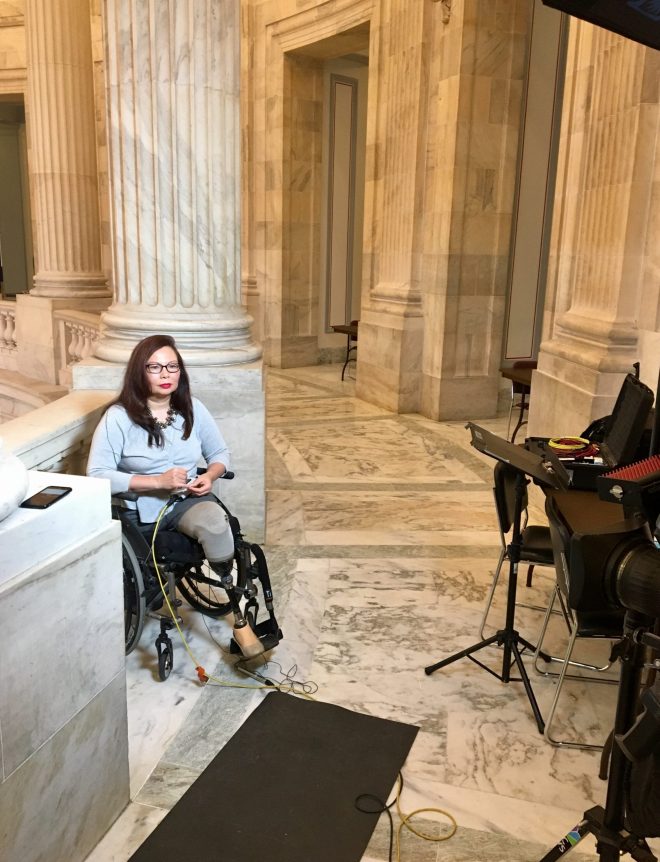
An op-ed in yesterday’s New York Times by Democrat Tammy Ducksworth demonstrates that when it comes to “patriotism,” liberals are as morally blind as conservatives.
Duckworth’s op-ed goes after conservative Fox News commentator Tucker Carlson, who recently questioned Duckworth’s patriotism by suggesting that she didn’t love her country. Naturally, Duckworth, who lost her legs while serving as a soldier in the U.S. military in Iraq, took umbrage over Carlson’s attack and responded quite vociferously in her op-ed.
Much of the controversy involves meaningless exchanges that regularly take place between Democrats and Republicans, liberals and conservatives. That’s mostly because both leftists and rights believe in the welfare-warfare state way of life.
But there is one aspect of Duckworth’s op-ed that deserves addressing because it so clearly shows that when it comes to war, the left-wing is as morally obtuse as the right wing.
Duckworth writes:
Even knowing how my tour in Iraq would turn out, even knowing that I’d lose both my legs in a battlefield just north of Baghdad in late 2004, I would do it all over again. Because if there’s anything that my ancestors’ service taught me, it’s the importance of protecting our founding values, including every American’s right to speak out.
So while I would put on my old uniform and go to war all over again to protect the right of Tucker Carlson and Donald Trump to say offensive things on TV and Twitter….
What Duckworth obviously still hasn’t come to the terms with is that her military service in Iraq had absolute nothing to do with protecting the right of freedom of speech of the American people. That’s because neither the Iraqi regime nor the Iraqi people were threatening the freedom of speech of the American people.
What Duckworth obviously still doesn’t recognize is that it was the U.S. government that was the aggressor in the Iraq War. She was part of a military force — the most powerful in history — that attacked and then occupied an impoverished Third World country that had never attacked and then occupied the United States or even threatened to do so.
Yes, I know, U.S. officials called the operation “Operation Iraqi Freedom.” But that was just propaganda. The operation had nothing to do with bringing freedom to Iraq, any more than it did with protecting the right to Americans to exercise freedom of speech. The purpose of the operation was to replace Iraqi dictator (and former U.S. partner and ally) Saddam Hussein with another U.S. stooge.”
Moreover, let’s not forget that every U.S. soldier who served in Iraq, including Duckworth, was serving in an illegal war. It was illegal given that there was no congressional declaration of war against Iraq, as the Constitution requires. It was also illegal under international law because it violated the principle against wars of aggression established by the Nuremberg War Crimes Tribunal.
Let’s also not forget about the countless Iraqis who were killed in the process. By being deprived of their lives, they were also deprived of their right of freedom of speech.
Leftists and rightists can engage in their meaningless debates on “patriotism” all they want. Just leave out the part that holds that invading and occupying a country that has never attacked the United States protects the right of Americans to exercise freedom of speech because that just isn’t true.
OPCW Gives Syria 90 Days to Declare Chemical Weapons
Sputnik – 09.07.2020
Syria has until October to declare to the UN chemical weapons watchdog its stockpile of illegal toxins or face “appropriate action,” the OPCW executive council agreed Thursday.
An investigative team of the Organisation for the Prohibition of Chemical Weapons concluded in April that the Syrian government used sarin and chlorine in aerial attacks on the town of Ltamenah in March 2017, hurting dozens of people.
The OPCW’s 41-member executive council requested in its decision that Syria “declare to the Secretariat all of the chemical weapons it currently possesses… as well as chemical weapons production facilities and other related facilities.”
It is also expected to declare facilities where the chemical weapons used in the attacks on March 24, 25, and 30 in 2017 were developed, produced, stockpiled and stored for delivery.
If Syria fails to “redress the situation,” the council warned it will recommend action against it at the next annual conference of all 193 member states, scheduled from November 30 to December 4.
Syria has repeatedly denied using chemical weapons after having them destroyed as part of a Russia-brokered agreement with OPCW in 2013. The government accuses militants of staging chemical attacks, used by Western powers to justify strikes on its territory in 2018.
How the Pentagon failed to sell Afghan government’s bunk ‘Bountygate’ story to US intelligence agencies
By Gareth Porter | The Grayzone | July 7, 2020
The New York Times dropped another Russiagate bombshell on June 26 with a sensational front-page story headlined, “Russia Secretly Offered Afghan Militants Bounties to Kill U.S. Troops, Intelligence Says.” A predictable media and political frenzy followed, reviving the anti-Russian hysteria that has excited the Beltway establishment for the past four years.
But a closer look at the reporting by the Times and other mainstream outlets vying to confirm its coverage reveals another scandal not unlike Russiagate itself: the core elements of the story appear to have been fabricated by Afghan government intelligence to derail a potential US troop withdrawal from the country. And they were leaked to the Times and other outlets by US national security state officials who shared an agenda with their Afghan allies.
In the days following the story’s publication, the maneuvers of the Afghan regime and US national security bureaucracy encountered an unexpected political obstacle: US intelligence agencies began offering a series of low confidence assessments in the Afghan government’s self-interested intelligence claims, judging them to be highly suspect at best, and altogether bogus at worst.
In light of this dramatic development, the Times’ initial report appears to have been the product of a sensationalistic disinformation dump aimed at prolonging the failed Afghan war in the face of President Donald Trump’s plans to withdraw US troops from it.
The Times quietly reveals its own sources’ falsehoods
The Times not only broke the Bountygate story but commissioned squads of reporters comprising nine different correspondents to write eight articles hyping the supposed scandal in the course of eight days. Its coverage displayed the paper’s usual habit of regurgitating bits of dubious information furnished to its correspondents by faceless national security sources. In the days after the Times’ dramatic publication, its correspondent squads were forced to revise the story line to correct an account that ultimately turned out to be false on practically every important point.
The Bountygate saga began on June 26, with a Times report declaring, “The United States concluded months ago” that the Russians “had covertly offered rewards for successful attacks last year.” The report suggested that US intelligence analysts had reached a firm conclusion on Russian bounties as early as January. A follow-up Times report portrayed the shocking discovery of the lurid Russian plot thanks to the recovery of a large amount of U.S. cash from a “raid on a Taliban outpost.” That article sourced its claim to the interrogations of “captured Afghan militants and criminals.”
However, subsequent reporting revealed that the “US intelligence reports” about a Russian plot to distribute bounties through Afghan middlemen were not generated by US intelligence at all.
The Times reported first on June 28, then again on June 30, that a large amount of cash found at a “Taliban outpost” or a “Taliban site” had led U.S. intelligence to suspect the Russian plot. But the Times had to walk that claim back, revealing on July 1 that the raid that turned up $500,000 in cash had in fact targeted the Kabul home of Rahmatullah Azizi, an Afghan businessmen said to have been involved in both drug trafficking and contracting for part of the billions of dollars the United States spent on construction projects.
The Times also disclosed that the information provided by “captured militants and criminals” under “interrogation” had been the main source of suspicion of a Russian bounty scheme in Afghanistan. But those “militants and criminals” turned out to be thirteen relatives and business associates of the businessman whose house was raided.
The Times reported that those detainees were arrested and interrogated following the January 2020 raids based on suspicions by Afghan intelligence that they belonged to a “ring of middlemen” operating between the Russian GRU and so-called “Taliban-linked militants,” as Afghan sources made clear.
Furthermore, contrary to the initial report by the Times, those raids had actually been carried out exclusively by the Afghan intelligence service known as the National Directorate of Security (NDS). The Times disclosed this on July 1. Indeed, the interrogation of those detained in the raids was carried out by the NDS, which explains why the Times reporting referred repeatedly to “interrogations” without ever explaining who actually did the questioning.
Given the notorious record of the NDS, it must be assumed that its interrogators used torture or at least the threat of it to obtain accounts from the detainees that would support the Afghan government’s narrative. Both the Toronto Globe and Mail and the United Nations Assistance Mission in Afghanistan (UNAMA) have documented as recently as 2019 the frequent use of torture by the NDS to obtain information from detainees. The primary objective of the NDS was to establish an air of plausibility around the claim that the fugitive businessman Azizi was the main “middleman” for a purported GRU scheme to offer bounties for killing Americans.
NDS clearly fashioned its story to suit the sensibilities of the U.S. national security state. The narrative echoed previous intelligence reports about Russian bounties in Afghanistan that circulated in early 2019, and which were even discussed at NSC meetings. Nothing was done about these reports, however, because nothing had been confirmed.
The idea that hardcore Taliban fighters needed or wanted foreign money to kill American invaders could have been dismissed on its face. So Afghan officials spun out claims that Russian bounties were paid to incentivize violence by “militants and criminals” supposedly “linked” to the Taliban.
These elements zeroed in on the April 2019 IED attack on a vehicle near the U.S. military base at Bagram in Parwan province that killed three US Marines, insisting that the Taliban had paid local criminal networks in the region to carry out attacks.
As former Parwan police chief Gen. Zaman Mamozai told the Times, Taliban commanders were based in only two of the province’s ten districts, forcing them to depend on a wider network of non-Taliban killers-for-hire to carry out attacks elsewhere in the province. These areas included the region around Bagram, according to the Afghan government’s argument.
But Dr. Thomas H. Johnson of the Naval Postgraduate School, a leading expert on insurgency and counter-insurgency in Afghanistan who has been researching war in the country for three decades, dismissed the idea that the Taliban would need a criminal network to operate effectively in Parwan.
“The Taliban are all over Parwan,” Johnson stated in an interview with The Grayzone, observing that its fighters had repeatedly carried out attacks on or near the Bagram base throughout the war.
With withdrawal looming, the national security state plays its Bountygate card
Senior U.S. national security officials had clear ulterior motives for embracing the dubious NDS narrative. More than anything, those officials were determined to scuttle Trump’s push for a complete withdrawal from Afghanistan. For Pentagon brass and civilian leadership, the fear of withdrawal became more acute in early 2020 as Trump began to demand an even more rapid timetable for a complete pullout than the 12-14 months being negotiated with the Taliban.
It was little surprise then that this element leapt at the opportunity to exploit the self-interested claims by the Afghan NDS to serve its own agenda, especially as the November election loomed. The Times even cited one “senior [US] official” musing that “the evidence about Russia could have threatened that [Afghanistan] deal, because it suggested that after eighteen year of war, Mr. Trump was letting Russia chase the last American troops out of the country.”
In fact, the intelligence reporting from the CIA Station in Kabul on the NDS Russia bounty claims was included in the Presidential Daily Brief (PDB) on or about February 27 — just as the negotiation of the U.S. peace agreement with the Taliban was about to be signed. That was too late to prevent the signing but timed well enough to ratchet up pressure on Trump to back away from his threat to pull all US troops out of Afghanistan.
Trump may have been briefed orally on the issue at the time, but even if he had not been, the presence of a summary description of the intelligence in the PDB could obviously have been used to embarrass him on Afghanistan by leaking it to the media.
According to Ray McGovern, a former CIA official who was responsible for preparing the PDB for Presidents Ronald Reagan and George H.W. Bush, the insertion of raw, unconfirmed intelligence from a self-interested Afghan intelligence agency into the PDB was a departure from normal practice.
Unless it was a two or three-sentence summary of a current intelligence report, McGovern explained, an item in the PDB normally involved only important intelligence that had been confirmed. Furthermore, according to McGovern, PDB items are normally shorter versions of items prepared the same day as part of the CIA’s “World Intelligence Review” or “WIRe.”
Information about the purported Russian bounty scheme, however, was not part of the WIRe until May 4, well over two months later, according to the Times. That discrepancy added weight to the suggestion that the CIA had political motivations for planting the raw NDS reporting in the PDB before it could be evaluated.
This June, Trump’s National Security Council (NSC) convened a meeting to discuss the intelligence report, officials told the Times. NSC members drew up a range of options in response to the alleged Russian plot, from a diplomatic protest to more forceful responses. Any public indication that US troops in Afghanistan had been targeted by Russian spies would have inevitably threatened Trump’s plan for withdrawal from Afghanistan.
At some point in the weeks that followed, the CIA, Defense Intelligence Agency and National Security Agency each undertook evaluations of the Afghan intelligence claims. Once the Times began publishing stories about the issue, Director of National Intelligence John Ratcliffe directed the National Intelligence Council, which is responsible for managing all common intelligence community assessments, to write a memorandum summarizing the intelligence organizations’ conclusions.
The memorandum revealed that the intelligence agencies were not impressed with what they’d seen. The CIA and National Counter-Terrorism Center (NCTC) each gave the NDS intelligence an assessment of “moderate confidence,” according to memorandum.
An official guide to intelligence community terminology used by policymakers to determine how much they should rely on assessments indicates that “moderate confidence” generally indicates that “the information being used in the analysis may be interpreted in various ways….” It was hardly a ringing endorsement of the NDS intelligence when the CIA and NCTC arrived at this finding.
The assessment by the National Security Agency was even more important, given that it had obtained intercepts of electronic data on financial transfers “from a bank account controlled by Russia’s military intelligence agency to a Taliban-linked account,” according to the Times’ sources. But the NSA evidently had no idea what the transfers related to, and essentially disavowed the information from the Afghan intelligence agency.
The NIC memorandum reported that NSA gave the information from Afghan intelligence “low confidence” — the lowest of the three possible levels of confidence used in the intelligence community. According to the official guide to intelligence community terminology, that meant that “information used in the analysis is scant, questionable, fragmented, or that solid analytical conclusions cannot be inferred from the information.”
Other intelligence agencies reportedly assigned “low confidence” to the information as well, according to the memorandum. Even the Defense Intelligence Agency, known for its tendency to issue alarmist warnings about activities by US adversaries, found no evidence in the material linking the Kremlin to any bounty offers.
Less than two weeks after the Times rolled out its supposed bombshell on Russian bounties, relying entirely on national security officials pushing their own bureaucratic interests on Afghanistan, the story was effectively discredited by the intelligence community itself. In a healthy political climate, this would have produced a major setback for the elements determined to keep US troops entrenched in Afghanistan.
But the political hysteria generated by the Times and the hyper-partisan elements triggered by the appearance of another sordid Trump-Putin connection easily overwhelmed the countervailing facts. It was all the Pentagon and its bureaucratic allies needed to push back on plans for a speedy withdrawal from a long and costly war.
Gareth Porter is an independent investigative journalist who has covered national security policy since 2005 and was the recipient of Gellhorn Prize for Journalism in 2012. His most recent book is The CIA Insider’s Guide to the Iran Crisis co-authored with John Kiriakou, just published in February.
Russian Foreign Ministry Sees UK’s ‘Magnitsky’ Sanctions as Another Unfriendly Step
Sputnik – July 9, 2020
MOSCOW – The UK’s new sanctions against Russian nationals under the Magnitsky Act are another unfriendly step, as well as an attempt to put pressure on justice and interfere in Russia’s domestic affairs, Russian Foreign Ministry spokeswoman Maria Zakharova said on Thursday.
“The UK imposed personal sanctions against Russian citizens. We consider the decision announced on July 6 by the government of this country to introduce sanctions against a number of officials in our country within the framework of the so-called Magnitsky case to be another unfriendly step by the UK authorities,” Zakharova said at a briefing.
The spokeswoman recalled that Moscow had repeatedly provided comprehensive explanations on all issues related to the death of Russian tax accountant Sergei Magnitsky.
“Apparently, London prefers not to notice them [the explanations], it is not clear on what basis they designate those guilty and determine so-called punishments for them. The UK’s acts are nothing but an attempt to intervene in the domestic affairs of another state and exert pressure on the Russian justice system,” Zakharova said, adding that the decision will affect bilateral relations.
In addition, the spokeswoman noted that Moscow reserved the right to retaliate to UK’s sanctions.
“The principle of reciprocity is one of the fundamentals in international relations, therefore, we reserve the right to retaliate and urge London to abandon the practice of groundless accusations, choosing the path of a civilized dialogue about existing problems and concerns,” Zakharova said.
The UK Foreign Office said on Monday that it has created a new sanctions list to include Russian and Saudi citizens who will face sanctions for being involved in alleged human rights violations. The list is comprised of 25 Russians, including Investigative Committee chief Alexander Bastrykin, 20 Saudi citizens, two Myanmar military generals involved in violence against ethnic minorities, and two North Korean special services.
Not Fact Checkers
By Iain | In This Together | February 28, 2020
Fact Checkers claim they check facts for you, so you don’t have to. The dictionary definition of a fact is:
“Something that is known to have happened or to exist, especially something for which proof exists, or about which there is information”
The legal definition of a fact is:
“An actual and absolute reality, as distinguished from mere supposition or opinion; a truth, as distinguished from fiction or error.”
Like reality and truth, a fact is absolute. It never changes, it is immutable and eternal. Our understanding of the facts may differ because we only have the available evidence to inform our knowledge of the facts. The availability of evidence is vital if we are to have any hope of knowing the facts. Our access to evidence doesn’t change the facts, it merely limits or expands our knowledge of them.
The definition of knowledge is:
“[Noun]… awareness, understanding, or information that has been obtained by experience or study, and that is either in a person’s mind or possessed by people generally.”
Access to information is the key component for developing knowledge of the facts. Knowledge doesn’t mean we always get the facts right, but we have no chance if information is limited or deliberately restricted.
Some facts are relatively easy to understand. The boiling point of water is a fact we can physically measure with consistent results. Others are more difficult to know and therefore less certain from our perspective. For example, history comprises of nothing other than facts but for us to know what they are we need to sift through the evidence, some reliable some not, to build our knowledge of the historical facts.
The same is true with current affairs and public issues. The facts are fixed but our knowledge of them is determined by our access to information. Information is subject to many competing forces. Censorship, propaganda, commercial interest, fabrication, omission and basic human error all combine to distort, obfuscate or over emphasise information (evidence). This makes knowing the facts about contemporary public issues just as tricky as knowing the historical facts, often more so.
Fortunately, we can all employ critical thinking skills, cross reference the evidence from various sources and decide the facts for ourselves. Thanks to the current iteration of the internet, the logical pursuit of information, forming our own balanced judgments of the facts, has never been more accessible for ordinary folk. The process called thinking is the service the fact checkers are selling.
Fact checkers claim their knowledge of the information (evidence), which identifies fact, is both complete and indisputable. They are certain about what happened, thoroughly understand all the relevant circumstances, have a complete grasp of reality, knowledge of all the relevant information and are accurately able to determine what is fact.
In short, they say they possess the truth. If you disagree with them, you don’t know the truth and are therefore wrong, regardless of the evidence you cite.
If you rely upon the fact checkers for your facts you must accept this. You no longer need to think critically or examine the evidence yourself. The fact checkers will do the hard work for you. They will tell you what the information is, give you your knowledge and cement the facts in your mind. All you need do is “Google it.”
What Do Fact Checkers Do?
The State has decided people are incapable of critical thinking and can’t tell the difference between facts and disinformation. Further, they propose legislation that will fundamentally change the nature of the internet. It is in this political environment that fact checkers have been commissioned to discern the facts and present the truth to the confused public.
In 2014 there were just 44 Fact checkers worldwide. As of June 2019 there were 188. While the whole of Africa, Asia, Australasia and South America have 67 fact checkers between them, the much smaller geographical and less populated regions of Europe and North America have 121. So there must be more incorrect information in the U.S. and Europe than anywhere else in the world.
Fact Checking is a rapidly changing startup industry. In 2014 nearly 90% of Fact Checkers were directly funded by mainstream media corporations. Today that figure has dropped to just 56% with many more claiming they are independent. We are going to look at how independent they are.
Some independent fact checkers, such as the UK’s Full Fact, have been given charity status. The UK Charity commission accepted Full Fact’s charitable purpose:
“To provide free tools, advice, and information so that anyone can check the claims we hear about public issues.”
Fact Checkers make money by fact checking for multinational corporations, non-governmental organisations (NGO’s), wealthy charitable foundations and the mainstream media. Global corporations, notably the tech giants, are under considerable political pressure to employ fact checkers and devise ways of stopping the spread of so called disinformation. Disinformation being anything that questions official narratives.
Recently Facebook announced that its subsidiary Instagram was working with fact checkers to deploy a rating system. They will apply a rating “label” to all information as either true, partly false or false. Information rated as partly false or false will then be removed from search results and associated hashtags denied. Once the label is activated Facebook and Instagram bots seek out all “matching” content and label it accordingly. Thus effectively removing the offending information from the public domain.
The public will then be redirected to the correct information:
“… If something is rated false or partly false on Facebook, starting today we’ll automatically label identical content if it is posted on Instagram (and vice versa). The label will link out to the rating from the fact-checker and provide links to articles from credible sources that debunk the claim(s) made in the post.”
“Credible sources”, as far as most International Fact Checking Network (IFCN) fact checkers are concerned, often means the mainstream media (MSM) who they cite while seemingly oblivious to the MSM’s never ending stream of fake news.
Independent Fact Checkers?
For fact checkers to have any credibility they need to be scrupulously unbiased, thoroughly independent and as objective as possible. Any evidence that they are not means they are not fact checkers at all but rather political organizations that offer an opinion. If they are paid by people or groups with clear agendas then they have no credibility and everything they say needs to be treated with caution. We would still need to exercise due diligence and examine the evidence ourselves to establish if the fact checkers opinions are indeed facts.
When the UK Government Foreign and Commonwealth Office established the Open Information Partnership (the Expose Network) they suggested their network of actors use approved fact checking services, such as Full Fact in the UK, who are members of Poynter’s International Fact Checking Network (IFCN). Poynter’s major funders include the Charles Koch Foundation, the National Endowment for Democracy (NED), the Omidyar Network (Luminate), Google and the Open Society Foundation.
Therefore it is a fact that the IFCN, the “official” trade organisation for “approved” fact checkers, is funded by, among others, the multinational corporation Koch Industries, the C.I.A (NED), globalist venture capitalists (Omidyar), aggressive internet monopolists (Google) and globalist currency speculator & social change agent George Soros (Open Society). Nearly all of the fact checking signatories to the IFCN code have similar agenda driven backers. Members include Politifact, Full Fact, StopFake and AP Fact Check, to name but a few.
Full Fact, for example, list their corporate members to include the City of London Corporation (the UK financial sector and a global center for international finance), the global corporate law firm King & Wood Malleson, St Jame’s Place Wealth Management (a huge global capital investment firm), and the defence contractor Rolls Royce. Their funding partners include Google, The Omidyar Network and the Open Society foundation. They even wrote a policy proposal paper called “Tackling Misinformation In an Open Society.”
Full Fact’s trustees include former BBC Director of News and Current Affairs James Harding. James was responsible for one of the most egregious pieces of fake news war propaganda in modern history when he oversaw production of the BBC’s fake documentary Saving Syria’s Children.
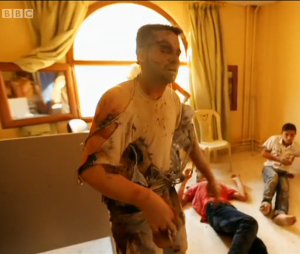
BBC Fake Documentary To Promote War
Chair of the board of trustees is Conservative Party donor Michael Samuel and he is joined by fellow Conservative Lord Inglewood and Labour Peer Baroness Royal. The political establishment is well represented when it comes to making sure we have the right facts.
Another Full Fact trustee is Lord Sharkey Liberal Democrat Peer and former strategic adviser to once UK Deputy Prime Minister Nick Clegg. Clegg joined Facebook in October 2018 to become Facebook Head of Global Affairs. In January 2019 Full Fact became approved third party fact checkers for Facebook and in September 2019 Nick announced that Facebook won’t “fact check” politicians in the same way that it fact checks the general public. Speaking of Facebook’s approach to the political class Clegg said:
“From now on we will treat speech from politicians as newsworthy content that should, as a general rule, be seen and heard.”
Obviously this carte blanche doesn’t extend to the general public. Presumably because we are all disinformation agents.
Another Full Fact trustee Tim Gordon was also an advisor to Nick Clegg. He co founded Best Practice AI which was the first UK AI firm invited to join the World Economic Forum’s Global AI Council (GAIC). The GAIC bring together representatives from tech giants including Microsoft , IBM and Google’s Chinese division with British government ministers, such as former Secretary of State for Digital, Culture, Media and Sport Jeremy Wright, who attending their council meeting in 2019.
GAIC is one of six WEF global councils focused upon technology and the fourth industrial revolution. Their stated purpose is:
“… to provide policy guidance and address governance gaps.”
So as Full Fact rolls out automated AI fact checking, fully funded by regular WEF attendees Pierre Omidyar and George Soros, with the full support of GAIC members Google, it is good to know these projects are rooted firmly in Full Fact’s independence. As they only report the facts they state on their website:
“Full Fact fights bad information. We’re a team of independent fact checkers and campaigners who find, expose and counter the harm it does.”
“Bad information” is information that questions government policy agendas and harms globalist interests. These interests are defined for government by global institutions like the World Economic forum, where government ministers attend to get their orders. Independent, in Full Fact speak, must mean “employed by global corporations and oligarchs.”
The extensive political, intelligence, non governmental and globalist network steering Full Fact is by no means unique to them. A cursory glance at the supporters of the other fact checking signatories to the IFCN reveal a similar web of globalist and corporate interests in practically every case. The IFCN, and its members, are paid by people with overt political, financial and social agendas. Independence is non existent and consequently the fact checkers claims of objectivity need to be treated accordingly. They have no credibility at all.
Not Fact Checking
If fact checkers check facts then you would at least expect them to report the evidence accurately. However, all too often, they don’t. For example, AP Fact Check are IFCN members who report that World Trade Center Building 7 (WTC7) collapsed on September 11th 2001 as a result of fires. This “fact” was first reported by AP Fact Check on 13/06/2017 and remains as their statement of fact today (28/02/2020.)
The engineering department of the University of Alaska Fairbanks (UAF) undertook a 4 year long study into the collapse of WTC7. The UAF report is currently open to peer review and cites the evidence it is based upon. It was published in draft form in mid September 2019 and the findings were officially announced at the same time. It categorically states:
“… fire did not cause the collapse of WTC 7 on 9/11, contrary to the conclusions of NIST and private engineering firms that studied the collapse.”
The UAF study represents the most thorough, up to date, scientific analysis of the collapse of WTC7. Incomplete peer review of the UAF report is no reason for AP Fact Check to ignore it. The NIST report, the sole source for the fire collapse theory, has never been peer reviewed. Anyone using AP Fact Check to check the facts about the collapse of WTC7 would be wrong if they believed AP Fact Check. AP Fact Check haven’t got their facts straight.
This is a common problem with so called fact checkers. Due to the political nature of their role, all too often they stray into opinion rather than fact. There’s nothing wrong with that except the fact checkers falsely claim their opinions are facts not opinions. What’s worse is that the Internet is being policed and information censored on the basis that the fact checkers opinions are facts.
In January this year the HighWire released a video which contrasted clips of Dr. Soumya Swaminathan, chief scientist for the World Health Organisation (W.H.O). The Video was titled “W.H.O. Chief Scientist Caught Lying To The Public.” There was no commentary in the Highwire video, viewers were simply presented with the two clips of Dr. Swaminathan. It was left to the viewers discretion to decide if they believed Dr. Swaminathan was, in fact, lying.
In the first clip, from an official W.H.O. vaccine promotional video, Dr. Swaminathan states:
“We have vaccine safety systems. Robust vaccine safety systems … [The] WHO works closely with countries to make sure that vaccines can do what they do best: prevent disease without risks.”
The second clip records Dr. Swaminathan’s address to the U.N. Global Vaccine Safety Summit in 2019. She informs the summit:
“… We really don’t have very good safety monitoring systems in many countries…..we’re not able to give clear-cut answers when people ask questions about the deaths that have occurred due to a particular vaccine… One should be able to give a very factual account of what exactly has happened and what the cause of deaths are, but in most cases, there is some obfuscation at that level.”
These two mutually exclusive statements cannot both be true. If one is, the other is a lie. Vaccines cannot both “prevent disease without risks” while “deaths… have occurred due to a particular vaccine.” The intention to deceive is an evident fact. Yet Facebook’s automated fact checking labeling system flagged the video as ‘PARTLY FALSE‘ and directed users to two articles from two credible sources which both presented specious, illogical arguments to discredit the factually accurate HighWire video.
In September 2019 climatologists and environmental experts protested to Facebook after its fact checkers labelled the article “The Great Failure of the Climate Models” as ‘FALSE.’ The article was blocked and users could not share it. The information in the article was censored. The article was based upon the work of scientists and statisticians and was factually accurate. Facebook not only labelled the article FALSE they directed readers to a dubious, poorly evidenced source, calling that “credible.”
Facebook removed the FALSE label shortly after receiving the protest letter, without explanation or apology. They clearly accepted their fact checking wasn’t checking any facts at all, simply censoring factually accurate information. However, in the fast paced modern information environment, the damage was done, and the political objective achieved.
This is not fact checking. This is political opinion masquerading as fact checking, deceiving the public into believing something is factually accurate (or inaccurate) when, in fact, it isn’t.
Poynter and the IFCN also confuse their opinion with fact. In May 2019 Poynter were forced to issue an apology, of sorts, to a number of media organisations after they issued an index of ‘unreliable’ media sources. When some of the listed organisations inquired about the basis for Poynter’s unfounded accusations, requesting Poynter and the IFCN provide some evidence to back up their claims, Poynter quickly removed the suggested “blacklist.”
Poynter’s IFCN make a great deal out of their fact checking principles so it’s a shame they didn’t apply any when they issued their blacklist. Poynter’s managing editor, Barbara Allen, said the purpose of the blacklist was as follows:
“… to provide a useful tool for readers to gauge the legitimacy of the information they were consuming… We began an audit to test the accuracy and veracity of the list, and while we feel that many of the sites did have a track record of publishing unreliable information, our review found weaknesses in the methodology. We detected inconsistencies between the findings of the original databases that were the sources for the list and our own rendering of the final report.”
This was tantamount to the IFCN admitting they chose who to put on their blacklist based upon their feelings. When we look at who funds the IFCN it’s pretty clear who those feelings lean towards.
When requested to evidence their decision the IFCN, guardians of the fact checking industry, couldn’t provide any. They had no relevant information, had no evidence to back up their opinion and were simply stating something as a fact when it was nothing of the sort.
Just because an organisation claims they are a fact checker it doesn’t mean they check facts. They are essentially establishment stooges whose role it is to police information and make sure the wider public doesn’t have access to any evidence that challenges official narratives and policy decisions. These fallible groups of people, no better informed than anyone else, are being used by the internet giants, at the behest of government, to censor what we can say online.
Let’s ignore the establishment’s fact checkers and hang on to our critical thinking skills for a while. It looks like we are going to need them more than ever.
Russia-Baiting Is the Only Game in Town
Washington again becomes hysterical
By Philip Giraldi • Unz Review • July 7, 2020
There is particular danger at the moment that powerful political alignments in the United States are pushing strongly to exacerbate the developing crisis with Russia. The New York Times, which broke the story that the Kremlin had been paying the Afghan Taliban bounties to kill American soldiers, has been particularly assiduous in promoting the tale of perfidious Moscow. Initial Times coverage, which claimed that the activity had been confirmed by both intelligence sources and money tracking, was supplemented by delusional nonsense from former Obama National Security Advisor Susan Rice, who asks “Why does Trump put Russia first?” before calling for a “swift and significant U.S. response.” Rice, who is being mentioned as a possible Biden choice for Vice President, certainly knows about swift and significant as she was one of the architects of the destruction of Libya and the escalation of U.S. military and intelligence operations directed against a non-threatening Syria.
The Times is also titillating with the tale of a low level drug smuggling Pashto businessman who seemed to have a lot of cash in dollars lying around, ignoring the fact that Afghanistan is awash with dollars and has been for years. Many of the dollars come from drug deals, as Afghanistan is now the world’s number one producer of opium and its byproducts.
The cash must be Russian sourced, per the NYT, because a couple of low level Taliban types, who were likely tortured by the Afghan police, have said that it is so. The Times also cites anonymous sources which allege that there were money transfers from an account managed by the Kremlin’s GRU military intelligence to an account opened by the Taliban. Note the “alleged” and consider for a minute that it would be stupid for any intelligence agency to make bank-to-bank transfers, which could be identified and tracked by the clever lads at the U.S. Treasury and NSA. Also try to recall how not so long ago we heard fabricated tales about threatening WMDs to justify war. Perhaps the story would be more convincing if a chain of custody could be established that included checks drawn on the Moscow-Narodny Bank and there just might be a crafty neocon hidden somewhere in the U.S. intelligence community who is right now faking up that sort of evidence.
Other reliably Democratic Party leaning news outlets, to include CNN, MSNBC and The Washington Post all jumped on the bounty story, adding details from their presumably inexhaustible supply of anonymous sources. As Scott Horton observed the media was reporting a “fact” that there was a rumor.
Inevitably the Democratic Party leadership abandoned its Ghanaian kente cloth scarves, got up off their knees, and hopped immediately on to their favorite horse, which is to claim loudly and in unison that when in doubt Russia did it. Joe Biden in particular is “disgusted” by a “betrayal” of American troops due to Trump’s insistence on maintaining “an embarrassing campaign of deferring and debasing himself before Putin.”
The Dems were joined in their outrage by some Republican lawmakers who were equally incensed but are advocating delaying punishing Russia until all the facts are known. Meanwhile, the “circumstantial details” are being invented to make the original tale more credible, including crediting the Afghan operation to a secret Russian GRU Army intelligence unit that allegedly was also behind the poisoning of Sergei and Yulia Skripal in Salisbury England in 2018.
Reportedly the Pentagon is looking into the circumstances around the deaths of three American soldiers by roadside bomb on April 8, 2019 to determine a possible connection to the NYT report. There are also concerns relating to several deaths in training where Afghan Army recruits turned on their instructors. As the Taliban would hardly need an incentive to kill Americans and as only seventeen U.S. soldiers died in Afghanistan in 2019 as a result of hostile action, the year that the intelligence allegedly relates to, one might well describe any joint Taliban-Russian initiative as a bit of a failure since nearly all of those deaths have been attributed to kinetic activity initiated by U.S. forces.
The actual game that is in play is, of course, all about Donald Trump and the November election. It is being claimed that the president was briefed on the intelligence but did nothing. Trump denied being verbally briefed due to the fact that the information had not been verified. For once America’s Chief Executive spoke the truth, confirmed by the “intelligence community,” but that did not stop the media from implying that the disconnect had been caused by Trump himself. He reportedly does not read the Presidential Daily Brief (PDB), where such a speculative piece might indeed appear on a back page, and is uninterested in intelligence assessments that contradict what he chooses to believe. The Democrats are suggesting that Trump is too stupid and even too disinterested to be president of the United States so they are seeking to replace him with a corrupt 78-year-old man who may be suffering from dementia.
The Democratic Party cannot let Russia go because they see it as their key to future success and also as an explanation for their dramatic failure in 2016 which in no way holds them responsible for their ineptness. One does not expect the House Intelligence Committee, currently headed by the wily Adam Schiff, to actually know anything about intelligence and how it is collected and analyzed, but the politicization of the product is certainly something that Schiff and his colleagues know full well how to manipulate. One only has to recall the Russiagate Mueller Commission investigation and Schiff’s later role in cooking the witnesses that were produced in the subsequent Trump impeachment hearings.
Schiff predictably opened up on Trump in the wake of the NYT report, saying “I find it inexplicable in light of these very public allegations that the president hasn’t come before the country and assured the American people that he will get to the bottom of whether Russia is putting bounties on American troops and that he will do everything in his power to make sure that we protect American troops.”
Schiff and company should know, but clearly do not, that at the ground floor level there is a lot of lying, cheating and stealing around intelligence collection. Most foreign agents do it for the money and quickly learn that embroidering the information that is being provided to their case officer might ultimately produce more cash. Every day the U.S. intelligence community produces thousands of intelligence reports from those presumed “sources with access,” which then have to be assessed by analysts. Much of the information reported is either completely false or cleverly fabricated to mix actual verified intelligence with speculation and out and out lies to make the package more attractive. The tale of the Russian payment of bribes to the Taliban for killing Americans is precisely the kind of information that stinks to high heaven because it doesn’t even make any political or tactical sense, except to Nancy Pelosi, Chuck Schumer, Adam Schiff and the New York Times. For what it’s worth, a number of former genuine intelligence officers including Paul Pillar, John Kiriakou, Scott Ritter, and Ray McGovern have looked at the evidence so far presented and have walked away unimpressed. The National Security Agency (NSA) has also declined to confirm the story, meaning that there is no electronic trail to validate it.
Finally, there is more than a bit of the old hypocrisy at work in the damnation of the Russians even if they have actually been involved in an improbable operation with the Taliban. One recalls that in the 1970s and 1980s the United States supported the mujahideen rebels fighting against the Soviet presence in Afghanistan. The assistance consisted of weapons, training, political support and intelligence used to locate, target and kill Soviet soldiers. Stinger missiles were provided to bring down helicopters carrying the Russian troops. The support was pretty much provided openly and was even boasted about, unlike what is currently being alleged about the Russian assistance. The Soviets were fighting to maintain a secular regime that was closely allied to Moscow while the mujahideen later morphed into al-Qaeda and the Islamist militant Taliban subsequently took over the country, meaning that the U.S. effort was delusional from the start.
So, what is a leaked almost certainly faux story about the Russian bounties on American soldiers intended to accomplish? It is probably intended to keep a “defensive” U.S. presence in Afghanistan, much desired by the neocons, a majority in Congress and the Military Industrial Complex (MIC), and it will further be played and replayed to emphasize the demonstrated incompetence of Donald Trump. The end result could be to secure the election of a pliable Establishment flunky Joe Biden as president of the United States. How that will turn out is unpredictable, but America’s experience of its presidents since 9/11 has not been very encouraging.
Philip M. Giraldi, Ph.D., is Executive Director of the Council for the National Interest, a 501(c)3 tax deductible educational foundation (Federal ID Number #52-1739023) that seeks a more interests-based U.S. foreign policy in the Middle East. Website is https://councilforthenationalinterest.org, address is P.O. Box 2157, Purcellville VA 20134 and its email is inform@cnionline.org.
Key U.S. Ally Indicted for Organ Trade Murder Scheme
By Nicolas J.S. Davies | Dissident Voice | July 6, 2020
When President Clinton dropped 23,000 bombs on what was left of Yugoslavia in 1999 and NATO invaded and occupied the Yugoslav province of Kosovo, U.S. officials presented the war to the American public as a “humanitarian intervention” to protect Kosovo’s majority ethnic Albanian population from genocide at the hands of Yugoslav president Slobodan Milosevic. That narrative has been unraveling piece by piece ever since.
In 2008 an international prosecutor, Carla Del Ponte, accused U.S.-backed Prime Minister Hashim Thaci of Kosovo of using the U.S. bombing campaign as cover to murder hundreds of people to sell their internal organs on the international transplant market. Del Ponte’s charges seemed almost too ghoulish to be true. But on June 24th, Thaci, now President of Kosovo, and nine other former leaders of the CIA-backed Kosovo Liberation Army (KLA,) were finally indicted for these 20-year-old crimes by a special war crimes court at The Hague.
From 1996 on, the CIA and other Western intelligence agencies covertly worked with the Kosovo Liberation Army (KLA) to instigate and fuel violence and chaos in Kosovo. The CIA spurned mainstream Kosovar nationalist leaders in favor of gangsters and heroin smugglers like Thaci and his cronies, recruiting them as terrorists and death squads to assassinate Yugoslav police and anyone who opposed them, ethnic Serbs and Albanians alike.
As it has done in country after country since the 1950s, the CIA unleashed a dirty civil war that Western politicians and media dutifully blamed on Yugoslav authorities. But by early 1998, even U.S. envoy Robert Gelbard called the KLA a “terrorist group” and the UN Security Council condemned “acts of terrorism” by the KLA and “all external support for terrorist activity in Kosovo, including finance, arms and training.” Once the war was over and Kosovo was successfully occupied by U.S. and NATO forces, CIA sources openly touted the agency’s role in manufacturing the civil war to set the stage for NATO intervention.
By September 1998, the UN reported that 230,000 civilians had fled the civil war, mostly across the border to Albania, and the UN Security Council passed resolution 1199, calling for a ceasefire, an international monitoring mission, the return of refugees and a political resolution. A new U.S. envoy, Richard Holbrooke, convinced Yugoslav President Milosevic to agree to a unilateral ceasefire and the introduction of a 2,000 member “verification” mission from the Organization for Security and Cooperation in Europe (OSCE). But the U.S. and NATO immediately started drawing up plans for a bombing campaign to “enforce” the UN resolution and Yugoslavia’s unilateral ceasefire.
Holbrooke persuaded the chair of the OSCE, Polish foreign minister Bronislaw Geremek, to appoint William Walker, the former U.S. Ambassador to El Salvador during its civil war, to lead the Kosovo Verification Mission (KVM). The U.S. quickly hired 150 Dyncorp mercenaries to form the nucleus of Walker’s team, whose 1,380 members used GPS equipment to map Yugoslav military and civilian infrastructure for the planned NATO bombing campaign. Walker’s deputy, Gabriel Keller, France’s former Ambassador to Yugoslavia, accused Walker of sabotaging the KVM, and CIA sources later admitted that the KVM was a “CIA front” to coordinate with the KLA and spy on Yugoslavia.
The climactic incident of CIA-provoked violence that set the political stage for the NATO bombing and invasion was a firefight at a village called Racak, which the KLA had fortified as a base from which to ambush police patrols and dispatch death squads to kill local “collaborators.” In January 1999, Yugoslav police attacked the KLA base in Racak, leaving 43 men, a woman and a teenage boy dead.
After the firefight, Yugoslav police withdrew from the village, and the KLA reoccupied it and staged the scene to make the firefight look like a massacre of civilians. When William Walker and a KVM team visited Racak the next day, they accepted the KLA’s massacre story and broadcast it to the world, and it became a standard part of the narrative to justify the bombing of Yugoslavia and military occupation of Kosovo.
Autopsies by an international team of medical examiners found traces of gunpowder on the hands of nearly all the bodies, showing that they had fired weapons. They were nearly all killed by multiple gunshots as in a firefight, not by precise shots as in a summary execution, and only one victim was shot at close range. But the full autopsy results were only published much later, and the Finnish chief medical examiner accused Walker of pressuring her to alter them.
Two experienced French journalists and an AP camera crew at the scene challenged the KLA and Walker’s version of what happened in Racak. Christophe Chatelet’s article in Le Monde was headlined, “Were the dead in Racak really massacred in cold blood?” and veteran Yugoslavia correspondent Renaud Girard concluded his story in Le Figaro with another critical question, “Did the KLA seek to transform a military defeat into a political victory?”
NATO immediately threatened to bomb Yugoslavia, and France agreed to host high-level talks. But instead of inviting Kosovo’s mainstream nationalist leaders to the talks in Rambouillet, Secretary Albright flew in a delegation led by KLA commander Hashim Thaci, until then known to Yugoslav authorities only as a gangster and a terrorist.
Albright presented both sides with a draft agreement in two parts, civilian and military. The civilian part granted Kosovo unprecedented autonomy from Yugoslavia, and the Yugoslav delegation accepted that. But the military agreement would have forced Yugoslavia to accept a NATO military occupation, not just of Kosovo but with no geographical limits, in effect placing all of Yugoslavia under NATO occupation.
When Milosevich refused Albright’s terms for unconditional surrender, the U.S. and NATO claimed he had rejected peace, and war was the only answer, the “last resort“. They did not return to the UN Security Council to try to legitimize their plan, knowing full well that Russia, China and other countries would reject it. When UK Foreign Secretary Robin Cook told Albright the British government was “having trouble with our lawyers” over NATO’s plan for an illegal war of aggression against Yugoslavia, she told him to “get new lawyers“.
In March 1999, the KVM teams were withdrawn and the bombing began. Pascal Neuffer, a Swiss KVM observer reported, “The situation on the ground on the eve of the bombing did not justify a military intervention. We could certainly have continued our work. And the explanations given in the press, saying the mission was compromised by Serb threats, did not correspond to what I saw. Let’s say rather that we were evacuated because NATO had decided to bomb.”
NATO killed thousands of civilians in Kosovo and the rest of Yugoslavia, as it bombed 19 hospitals, 20 health centers, 69 schools, 25,000 homes, power stations, a national TV station, the Chinese Embassy in Belgrade and other diplomatic missions. After it invaded Kosovo, the U.S. military set up the 955-acre Camp Bondsteel, one of its largest bases in Europe, on its newest occupied territory. Europe’s Human Rights Commissioner, Alvaro Gil-Robles, visited Camp Bondsteel in 2002 and called it “a smaller version of Guantanamo,” exposing it as a secret CIA black site for illegal, unaccountable detention and torture.
But for the people of Kosovo, the ordeal was not over when the bombing stopped. Far more people had fled the bombing than the so-called “ethnic cleansing” the CIA had provoked to set the stage for it. A reported 900,000 refugees, nearly half the population, returned to a shattered, occupied province, now ruled by gangsters and foreign overlords.
Serbs and other minorities became second-class citizens, clinging precariously to homes and communities where many of their families had lived for centuries. More than 200,000 Serbs, Roma and other minorities fled, as the NATO occupation and KLA rule replaced the CIA’s manufactured illusion of ethnic cleansing with the real thing. Camp Bondsteel was the province’s largest employer, and U.S. military contractors also sent Kosovars to work in occupied Afghanistan and Iraq. In 2019, Kosovo’s per capita GDP was only $4,458, less than any country in Europe except Moldova and war-torn, post-coup Ukraine.
In 2007, a German military intelligence report described Kosovo as a “Mafia society” based on the “capture of the state” by criminals. The report named Hashim Thaci, then the leader of the Democratic Party, as an example of “the closest ties between leading political decision makers and the dominant criminal class.” In 2000, 80% of the heroin trade in Europe was controlled by Kosovar gangs, and the presence of thousands of U.S. and NATO troops fueled an explosion of prostitution and sex trafficking, also controlled by Kosovo’s new criminal ruling class.
In 2008, Thaci was elected Prime Minister, and Kosovo unilaterally declared independence from Serbia. (The final dissolution of Yugoslavia in 2006 had left Serbia and Montenegro as separate countries.) The U.S. and 14 allies immediately recognized Kosovo’s independence, and ninety-seven countries, about half the countries in the world, have now done so. But neither Serbia nor the UN have recognized it, leaving Kosovo in long-term diplomatic limbo.
When the court in the Hague unveiled the charges against Thaci on June 24th, he was on his way to Washington for a White House meeting with Trump and President Vucic of Serbia to try to resolve Kosovo’s diplomatic impasse. But when the charges were announced, Thaci’s plane made a U-turn over the Atlantic, he returned to Kosovo and the meeting was canceled.
The accusation of murder and organ trafficking against Thaci was first made in 2008 by Carla Del Ponte, the Chief Prosecutor of the International Criminal Tribunal for the Former Yugoslavia (ICTFY), in a book she wrote after stepping down from that position. Del Ponte later explained that the ICTFY was prevented from charging Thaci and his co-defendants by the non-cooperation of NATO and the UN Mission in Kosovo. In an interview for the 2014 documentary, The Weight of Chains 2, she explained, “NATO and the KLA, as allies in the war, couldn’t act against each other.”
Human Rights Watch and the BBC followed up on Del Ponte’s allegations, and found evidence that Thaci and his cronies murdered up to 400 mostly Sebian prisoners during the NATO bombing in 1999. Survivors described prison camps in Albania where prisoners were tortured and killed, a yellow house where people’s organs were removed and an unmarked mass grave nearby.
Council of Europe investigator Dick Marty interviewed witnesses, gathered evidence and published a report, which the Council of Europe endorsed in January 2011, but the Kosovo parliament did not approve the plan for a special court in the Hague until 2015. The Kosovo Specialist Chambers and independent prosecutor’s office finally began work in 2017. Now the judges have six months to review the prosecutor’s charges and decide whether the trial should proceed.
A central part of the Western narrative on Yugoslavia was the demonization of President Milosevich of Yugoslavia, who resisted his country’s Western-backed dismemberment throughout the 1990s. Western leaders smeared Milosevich as a “New Hitler” and the “Butcher of the Balkans,” but he was still arguing his innocence when he died in a cell at The Hague in 2006.
Ten years later, at the trial of the Bosnian Serb leader Radovan Karadzic, the judges accepted the prosecution’s evidence that Milosevich strongly opposed Karadzic’s plan to carve out a Serb Republic in Bosnia. They convicted Karadzic of being fully responsible for the resulting civil war, in effect posthumously exonerating Milosevich of responsibility for the actions of the Bosnian Serbs, the most serious of the charges against him.
But the U.S.’s endless campaign to paint all its enemies as “violent dictators” and “New Hitlers” rolls on like a demonization machine on autopilot, against Putin, Xi, Maduro, Khamenei, the late Fidel Castro and any foreign leader who stands up to the imperial dictates of the U.S. government. These smear campaigns serve as pretexts for brutal sanctions and catastrophic wars against our international neighbors, but also as political weapons to attack and diminish any U.S. politician who stands up for peace, diplomacy and disarmament.
As the web of lies spun by Clinton and Albright has unraveled, and the truth behind their lies has spilled out piece by bloody piece, the war on Yugoslavia has emerged as a case study in how U.S. leaders mislead us into war. In many ways, Kosovo established the template that U.S. leaders have used to plunge our country and the world into endless war ever since. What U.S. leaders took away from their “success” in Kosovo was that legality, humanity and truth are no match for CIA-manufactured chaos and lies, and they doubled down on that strategy to plunge the U.S. and the world into endless war.
As it did in Kosovo, the CIA is still running wild, fabricating pretexts for new wars and unlimited military spending, based on sourceless accusations, covert operations and flawed, politicized intelligence. We have allowed American politicians to pat themselves on the back for being tough on “dictators” and “thugs,” letting them settle for the cheap shot instead of tackling the much harder job of reining in the real instigators of war and chaos: the U.S. military and the CIA.
But if the people of Kosovo can hold the CIA-backed gangsters who murdered their people, sold their body parts and hijacked their country accountable for their crimes, is it too much to hope that Americans can do the same and hold our leaders accountable for their far more widespread and systematic war crimes?
Iran recently indicted Donald Trump for the assassination of General Qassem Soleimani, and asked Interpol to issue an international arrest warrant for him. Trump is probably not losing sleep over that, but the indictment of such a key U.S. ally as Thaci is a sign that the U.S. ”accountability-free zone” of impunity for war crimes is finally starting to shrink, at least in the protection it provides to U.S. allies. Should Netanyahu, Bin Salman and Tony Blair be starting to look over their shoulders?
Nicolas J.S.Davies is the author of Blood On Our Hands: the American Invasion and Destruction of Iraq.
US ‘Made-Up’ Claims of Russia-Taliban Collusion Aim to Derail Peace Process, Group Says
Sputnik – 06.07.2020
Late last month, The New York Times, citing anonymous US intelligence sources, published an article claiming that Russian military intelligence offered bounties to Taliban-linked militants for attacks on American soldiers in Afghanistan and that US President Donald Trump had been informed about this.
The Taliban believes that claims of its collusion with Russia were made up by intelligence services in Kabul and are aimed at derailing the Afghan peace process, Suhail Shaheen, an official representative of the movement’s political bureau in Qatar, said on Monday.
“We continue our own investigation based on the information in the media. these accusations are false, they are groundless and were launched by an intelligence agency in Kabul to derail and postpone the peace process as well as the formation of a new government,” Shaheen said.
The New York Times reported in June that some units of Russian military intelligence allegedly incentivised the Taliban to attack international coalition troops in Afghanistan.
Russian presidential Spokesman Dmitry Peskov and the Foreign Ministry said the reports were a lie. The White House and the Pentagon said that there did not appear to be any proof for the claims made in the article .
BOUNTYGATE: Scapegoating Systemic Military Failure in Afghanistan
By Scott Ritter | Consortium News | July 5, 2020
On the morning of Feb. 27, Beth Sanner, the deputy director of national intelligence for mission integration, arrived at the White House carrying a copy of the Presidential Daily Brief (PDB), a document which, in one form or another, has been made available to every president of the United States since Harry Truman first received what was then known as the “Daily Summary” in February 1946.
The sensitivity of the PDB is without dispute; former White House Press Secretary Ari Fleischer once called the PBD “the most highly sensitized classified document in the government,”while former Vice President Dick Cheney referred to it as “the family jewels.”
The contents of the PDB are rarely shared with the public, not only because of the highly classified nature of the information it contains, but also because of the intimacy it reveals about the relationship between the nation’s chief executive and the intelligence community.
“It’s important for the writers of the presidential daily brief to feel comfortable that the documents will never be politicized and/or unnecessarily exposed for public purview,” former President George W. Bush observed after he left office, giving voice to a more blunt assessment put forward by his vice president who warned that any public release of a PDB would make its authors “spend more time worried about how the report’s going to look on the front page of The Washington Post.”
Beth Sanner
Sanner’s job was the same for those who had carried out this task under previous presidents: find a way to engage a politician whose natural instincts might not incline toward the tedious, and often contradictory details contained in many intelligence products. This was especially true for Donald J. Trump, who reportedly disdains detailed written reports, preferring instead oral briefings backed up by graphics.
The end result was a two-phased briefing process, where Sanner would seek to distill critical material to the president orally, leaving the task of picking through the details spelled out in the written product to his senior advisors. This approach was approved beforehand by the director of national intelligence, the director of the CIA and the president’s national security advisor.
Sanner, a veteran CIA analyst who previously headed up the office responsible for preparing the PDB, served as the DNI’s principal advisor “on all aspects of intelligence,” responsible for creating “a consistent and holistic view of intelligence from collection to analysis” and ensures “the delivery of timely, objective, accurate, and relevant intelligence.”
If there was anyone in the intelligence community capable of sorting out the wheat from the chaff when it came to what information was suited for verbal presentation to the president, it was Sanner.
No copy of the PDB for Feb. 27 has been made available to the public to scrutinize, nor will one likely ever be.
However, based upon information gleaned from media reporting derived from anonymous leaks, a picture emerges of at least one of the items contained in the briefing document, the proverbial “ground zero” for the current crisis surrounding allegations that Russia has paid cash bounties to persons affiliated with the Taliban for the purpose of killing American and coalition military personnel in Afghanistan.
Links Between Accounts
Sometime in early January 2020 a combined force of U.S. special operators and Afghan National Intelligence Service (NDS) commandos raided the offices of several businessmen in the northern Afghan city of Konduz and the capital city of Kabul, according to a report in The New York Times. The businessmen were involved in the ancient practice of “Hawala.” It is a traditional system for transferring money in Islamic cultures, involving money paid to an agent who then instructs a remote associate to pay the final recipient.
Afghan security officials claim that the raid had nothing to do with “Russians smuggling money,” but rather was a response to pressure from the Financial Action Task Force (FATF), an international body established in 1989 whose mission is, among other things, to set standards and promote effective implementation of legal, regulatory and operational measures for combating money laundering and terrorist financing.
This explanation, however, seems more of a cover story than fact, if for no other reason than that the FATF, in June 2017, formally recognized that Afghanistan had established “the legal and regulatory framework to meet its commitments in its action plan,” noting that Afghanistan was “therefore no longer subject to the FATF’s monitoring process.”
The joint U.S.-Afghan raid, according to the Times, was not a takedown of the Halawa system in Afghanistan—a virtually impossible task—but rather a particular Halawa network run by Rahmatullah Azizi, a one-time low-level Afghan drug smuggler-turned-high profile businessman, along with a colleague named Habib Muradi.
Azizi’s portfolio is alleged by the Times, quoting a “friend,” to include serving as a contractor for U.S. reconstruction programs, managing undefined business dealings in Russia, which supposedly, according to unnamed U.S. intelligence sources quoted by the Times, included face-to-face meetings with officers from Russian Military Intelligence (GRU), and serving as a bagman for a covert money laundering scheme between the Taliban and Russia.
Some thirteen persons, including members of Azizi’s extended family and close associates, were rounded up in the raids. Both Azizi and Muradi, however, eluded capture, believed by Afghan security officials to have fled to Russia.
Based in large part on information derived from the interrogation of the detainees that followed, U.S. intelligence analysts pieced together a picture of Azizi’s Halawa enterprise—described as “layered and complex”, with money transfers “often sliced into smaller amounts that routed through several regional countries before arriving in Afghanistan.”
What made these transactions even more interesting from an intelligence perspective, were the links made by U.S. analysts between Azizi’s Halawa system, an electronic wire transfer, a Taliban-linked account, and a Russian account that some believed was tied to Unit 29155 (a covert GRU activity believed to be involved with, among other activities, assassinations). The transactions had been picked up by the National Security Agency (NSA), the U.S. intelligence agency responsible for monitoring communications and electronic data worldwide.
The discovery of some $500,000 in cash by U.S. special operators at Azizi’s luxury villa in Kabul was the icing on the cake—the final “dot” in a complex and convoluted game of “connect the dots” that comprised the U.S. intelligence community’s assessment of the alleged Russian (GRU)-Taliban-Azizi connection.
The next task for U.S. intelligence analysts was to see where the Russian (GRU)-Taliban-Azizi connection took them. Using information gathered through detainee debriefings, the analysts broke down money Azizi received through his Halawa pipeline into “packets,” some comprising hundreds of thousands of dollars, which were doled out to entities affiliated with, or sympathetic to, the Taliban.
According to Afghan security officials quoted by the Times, at least some of these payments were specifically for the purpose of killing American troops, amounting to a price tag of around $100,000 per dead American.
The game of “connect the dots” continued as the U.S. intelligence analysts linked this “bounty” money to criminal networks in Parwan Province, where Bagram Air Base—the largest U.S. military installation in Afghanistan—is located. According to Afghan security officials, local criminal networks had carried out attacks on behalf of the Taliban in the past in exchange for money. This linkage prompted U.S. intelligence analysts to take a new look at an April 9, 2019 car bomb attack outside of Bagram Air Base which killed three U.S. Marines.
This information was contained in the PDB that was given to Trump on Feb. 27. According to standard procedure, it would have been vetted by at least three intelligence agencies—the CIA, the National Counterterrorism Center (NCC), and the NSA. Both the CIA and NCC had assessed the finding that the GRU had offered bounties to the Taliban with “moderate confidence,” which in the lexicon used by the intelligence community means that the information is interpreted in various ways, that there are alternative views, or that the information is credible and plausible but not corroborated sufficiently to warrant a higher level of confidence.
The NSA, however, assessed the information with “low confidence,” meaning that they viewed the information as scant, questionable, or very fragmented, that it was difficult to make solid analytic inferences, and that there were significant concerns or problems with the sources of information used.
Floating in the Bowl
All of this information was contained in the PDB carried into the White House by Sanner. The problem for Sanner was the context and relevance of the information she carried. Just five days prior, on Feb. 22, the U.S. and the Taliban had agreed to a seven-day partial ceasefire as prelude to the conclusion of a peace agreement scheduled to be signed in two days’ time, on Feb. 29.
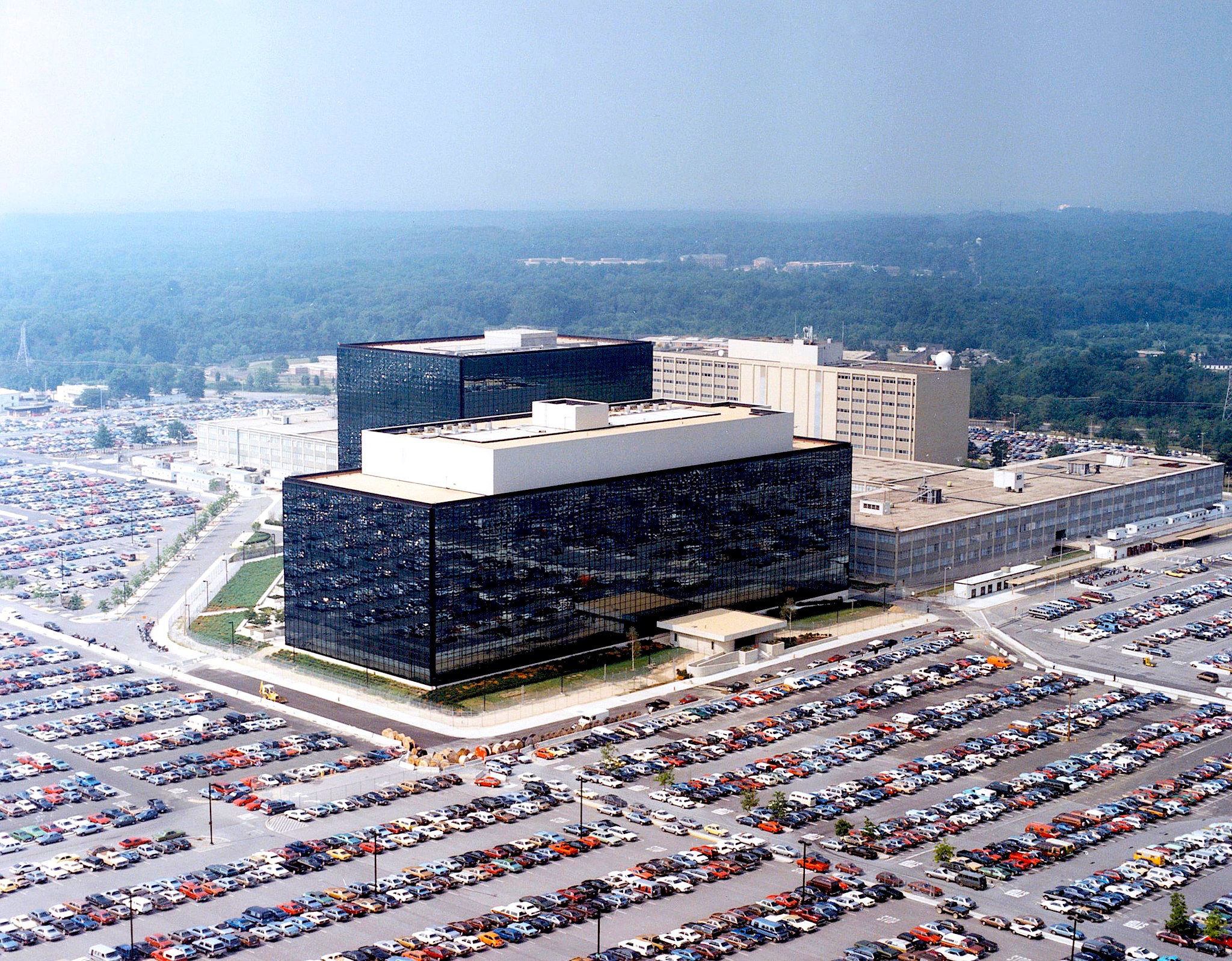
NSA HQ, Fort Meade, Maryland. (Wikimedia Commons)
The U.S. Representative for Afghanistan Zalmay Khalilzad, was in Doha, Qatar, where he was hammering out the final touches to the agreement with his Taliban counterparts. Secretary of State Mike Pompeo was preparing to depart the U.S. for Doha, where he would witness the signing ceremony. The information Sanner carried in the PDB was the proverbial turd in the punchbowl.
The problem was that the intelligence assessment on alleged Russian GRU “bounties” contained zero corroborated information. It was all raw intelligence (characterized by one informed official as an “intelligence collection report”), and there were serious disagreements among the differing analytical communities—in particular the NSA—which took umbrage over what it deemed a misreading of its intercepts and an over reliance on uncorroborated information derived from detainee debriefs.
Moreover, none of the intelligence linking the GRU to the Taliban provided any indication of how far up the Russian chain of command knowledge of the “bounties” went, and whether or not anyone at the Kremlin-let alone President Vladimir Putin-were aware of it.
None of the information contained in the PDB was “actionable.” The president couldn’t very well pick up the phone to complain to Putin based on a case drawn solely from unverified, and in some cases unverifiable, information.
To brief the president about an assessment which, if taken at face value, could unravel a peace agreement that represented a core commitment of the president to his domestic political base—to bring U.S. troops home from endless overseas wars—was the epitome of the politicization of intelligence, especially when there was no consensus among the U.S. intelligence community that the assessment was even correct to begin with.
This was a matter which could, and would, be handled by the president’s national security advisors. Sanner would not be briefing the president in person on this report, a decision that Trump National Security Adviser Robert O’Brien agreed with.
Blaming Russia
Ending America’s nearly 19-year misadventure in Afghanistan had always been an objective of President Trump. Like both presidents before him whose tenure witnessed the deaths of American service members in that hard, distant and inhospitable land, Trump found himself confronting a military and national security establishment convinced that “victory” could be achieved, if only sufficient resources, backed by decisive leadership, were thrown at the problem.
His choice for secretary of defense, James “Mad Dog” Mattis, a retired Marine general who commanded Central Command (the geographical combatant command responsible for, among other regions, Afghanistan) pushed Trump for more troops, more equipment, and a freer hand in taking on the enemy.
By the Fall of 2017, Trump eventually agreed to the dispatch of some 3,000 additional troops to Afghanistan, along with new rules of engagement, which would allow greater flexibility and quicker response times for the employment of U.S. air strikes against hostile forces in Afghanistan.
Mattis: Got what he wanted
It took little more than a year for the president to come to grips with a reality that would be reflected in the findings of Special Inspector General for Afghanistan Reconstruction John Sopko, that there had been “explicit and sustained efforts by the U.S. government to deliberately mislead the public…to distort statistics to make it appear the United States was winning the war when that was not the case.”
In November 2018, Trump turned on “Mad Dog”, telling the former Marine General “I gave you what you asked for. Unlimited authority, no holds barred. You’re losing. You’re getting your ass kicked. You failed.”
It was probably the most honest assessment of the War in Afghanistan any American president delivered to his serving secretary of defense. By December 2018 Mattis was out, having resigned in the face of Trump’s decision to cut American losses not only in Afghanistan, but also Syria and Iraq.
That same month, U.S. diplomat Khalilizad began the process of direct peace talks with the Taliban that led to the Feb. 29 peace agreement. It was a dispute over Afghan peace talks that led to the firing of National Security Advisor John Bolton. In September 2019—Trump wanted to invite the Taliban leadership to Camp David for a signing ceremony, something Bolton helped quash. Trump cancelled the “summit”, citing a Taliban attack that took the life of an American service member, but Bolton was gone.
Taking on Failure
One doesn’t take on two decades of systemic investment in military failure that had become ingrained in both the psyche and structure of the U.S. military establishment, fire a popular secretary of defense, and then follow that act up with the dismissal of one of the most vindictive bureaucratic infighters in the business without accumulating enemies.
Washington DC has always been a political Peyton Place where no deed goes unpunished. All president’s are confronted by this reality, but Trump’s was a far different case—at no time in America’s history had such a divisive figure won the White House. Trump’s anti-establishment agenda alienated people across all political spectrums, often for cause. But he also came into office bearing a Scarlet Letter which none of his predecessors had to confront—the stigma of a “stolen election” won only through the help of Russian intelligence.
The “Russian interference” mantra was all-pervasive, cited by legions of anti-Trumpers suddenly imbued with a Cold War-era appreciation of global geopolitics, seeing the Russian Bear behind every roadblock encountered, never once pausing to consider that the problem might actually reside closer to home, in the very military establishment Trump sought to challenge.
Afghanistan was no different. Prior to stepping down as the commander of U.S. forces in Afghanistan in September 2018, Army General John Nicholson sought to deflect responsibility for the reality that, despite receiving the reinforcements and freedom of action requested, his forces were losing the fight for Afghanistan.
Unable or unwilling to shoulder responsibility, Nicholson instead took the safe way out—he blamed Russia.
Scapegoating
“We know that Russia is attempting to undercut our military gains and years of military progress in Afghanistan, and make partners question Afghanistan’s stability,” Nicholson wrote in an email to reporters, seemingly oblivious to the history of failure and lies being documented at that moment by Sopko.
In March 2018 Nicholson had accused the Russians of “acting to undermine” U.S. interests in Afghanistan, accusing the Russians of arming the Taliban. But the most telling example of Russian-baiting on the part of the general occurred in February 2017, shortly after President Trump was inaugurated. In an appearance before the Senate Armed Services Committee, Nicholson was confronted by Sen. Bill Nelson, a Florida Democrat and ardent supporter of the U.S. intervention in Afghanistan.
“If Russia is cozying up to the Taliban—and that’s a kind word—if they are giving equipment that we have some evidence that the Taliban is getting…and other things that we can’t mention in this unclassified setting? And the Taliban is also associated with al-Qaida? Therefore Russia is indirectly helping al-Qaeda in Afghanistan?” Nelson asked.
“Your logic is absolutely sound, sir,” was Nicholson’s response.
Except it wasn’t.
Russia has a long and complicated history with Afghanistan. The Soviet Union invaded Afghanistan in 1979, and over the course of the next decade fought a long and costly war with Afghan tribes, backed by American money and arms and a legion of Arab jihadis who would later morph into the very al-Qaeda Sen. Nelson alluded to in his question to General Nicholson.
By 1989 the Soviet Empire was winding down, and with it its disastrous Afghan War. In the decade that followed, Russia was at odds with the Taliban government that arose from the ashes of the Afghan civil war that followed in the wake of the withdrawal of Soviet forces.
Moscow threw its support behind the more moderate forces of the so-called Northern Alliance and, after the al-Qaeda terror attacks on the U.S. on Sept. 11, 2001, was supportive of the U.S.-led intervention to defeat the Taliban and bring stability to a nation that bordered the Central Asian Republics of the former Soviet Union, which Russia viewed as especially sensitive to its own national security.
Realized US Was Losing the War
Fourteen years later, in September 2015, Russia was confronted by the reality that the U.S. had no strategy for victory in Afghanistan and, left to its own devices, Afghanistan was doomed to collapse into an ungovernable morass of tribal, ethnic and religious interests that would spawn extremism capable of migrating over the border, into the former Soviet Central Asian Republics, and into Russia itself.
Russia’s concerns were shared by regional countries such as Pakistan and China, both of which faced serious threats in the form of domestic Islamist extremism.
The capture of the northern Afghan city of Konduz, followed by the rise of an even more militant Islamist group in Afghanistan known as the Islamic State-Khorassan (IS-K), both of which occurred in September 2015, led the Russians to conclude that the U.S. was losing its war in Afghanistan, and Russia’s best hope was to work with the prevailing side—the Taliban—in order to defeat the threat from IS-K, and create the conditions for a negotiated peace settlement in Afghanistan.
None of this history was mentioned by either Gen. Nicholson or Sen. Nelson. Instead, Nicholson sought to cast Russia’s involvement in Afghanistan as “malign”, declaring in a Dec. 16, 2016 briefing that:
“Russia has overtly lent legitimacy to the Taliban. And their narrative goes something like this: that the Taliban are the ones fighting Islamic State, not the Afghan government. And of course … the Afghan government and the U.S. counterterrorism effort are the ones achieving the greatest effect against Islamic State. So, this public legitimacy that Russia lends to the Taliban is not based on fact, but it is used as a way to essentially undermine the Afghan government and the NATO effort and bolster the belligerents.”
Absent from Nicholson’s comments is any appreciation surrounding the creation of IS-K, and the impact it had on the Taliban as a whole.
The formation of IS-K can be causally linked to the disarray that occurred within the internal ranks of the Taliban in the aftermath of the death of Mullah Omar, the founder and moral inspiration of the organization. The struggle to pick a successor to Omar exposed a Taliban fractured into three factions.
One, representing the mainstream faction of the Taliban most closely linked to Mullah Omar, wanted to continue and expand upon the existing struggle against the Government of Afghanistan and the U.S.-led coalition, which supported and sustained it in an effort to re-establish the Emirate that ruled prior to being evicted from power in the months after the terror attacks of 9/11.
Another, grounded in the ranks of Pakistani Taliban, wanted a more radical approach which sought a regional Emirate beyond the borders of Afghanistan.
A third faction had grown tired of years of fighting and viewed the passing of Mullah Omar as an opportunity for a negotiated peace settlement with the Afghan government. IS-K emerged from the ranks of the second group, and posed a real threat to the viability of the Taliban if it could motivate large numbers of the Taliban’s most fanatic fighters to defect from the ranks of the mainstream Taliban.

Mujahideen who fought Soviets, Aug. 1985 (Wikimedia Commons)
For the Russians, who witnessed the growing potency of the Taliban as manifested in its short-lived capture of Konduz, the biggest danger it faced wasn’t a Taliban victory over the U.S.-dominated Afghan government, but rather the emergence of a regionally-minded Islamist extremist movement that could serve as a model and inspiration for Muslim men of combat age to rally around, allowing the violent instability to fester locally and spread regionally for decades to come. The mainstream Taliban were no longer viewed as a force to be confronted, but rather contained through co-option.
In a statement before U.S. troops in December 2016, then-President Barack Obama openly admitted that “the U.S. cannot eliminate the Taliban or end violence in that country [Afghanistan].” Russia had reached that conclusion more than a year prior, following the Taliban capture of Konduz.
A year before Obama made this announcement, Zamir Kabulov, Russia’s special representative to Afghanistan, noted that “Taliban interests objectively coincide with ours” when it came to limiting the spread of the Islamic State in Afghanistan, and he acknowledged that Russia had “opened communication channels with the Taliban to exchange information.”
For its part, the Taliban was at first cold to the thought of cooperating with the Russians. A spokesperson declared that they “do not see a need for receiving aid from anyone concerning so-called Daesh [Islamic State] and neither have we contacted nor talked with anyone about this issue.”
Many of the Taliban leadership had a history of fighting against the Soviets in the 1980s and were loath to be seen as working with their old enemies. The rise of IS-K in Afghanistan, however, created a common threat that helped salve old wounds, and while the Taliban balked at any overt relationship, the Russians began a backchannel process of discreet diplomatic engagement. (Kabulov had a history of negotiations with the Taliban dating back to the mid-1990’s).
By November 2018 this effort had matured into what was called the “Moscow Format”, a process of diplomatic engagement between Russia and Afghanistan’s neighbors which resulted in the first-ever dispatch of a Taliban delegation to Moscow for the purpose of discussing the conditions necessary for peace talks to be held about ending the conflict in Afghanistan.
When President Trump terminated the U.S.-Taliban peace negotiations in September 2019, it was the “Moscow Format” that kept the peace process alive, with Russia hosting a delegation from the Taliban to discuss the future of the peace process.
The Russian involvement helped keep the window of negotiations with the Taliban open, helping to facilitate the eventual return of the U.S. to the negotiating table this February, and played no small part in the eventual successful conclusion of the Feb. 27, 2020 peace agreement—a fact which no one in the U.S. was willing to publicly acknowledge.
Bad Intelligence
The Intelligence Collection Report that found its way into the Feb. 27 PDB did not appear in a vacuum. The singling out of the Hawala network operated by Rahmatullah Azizi was the manifestation of a larger anti-Russian animus that had existed in the intelligence collection priorities of the U.S. military, the CIA and the Afghan NDS since 2015.
This animus can be traced to internal bias that existed in both U.S. Central Command and the CIA against anything Russian, and the impact this bias had on the intelligence cycle as it applied to Afghanistan.
The existence of this kind of bias is the death knell of any professional intelligence effort, as it destroys the objectivity needed to produce effective analysis.
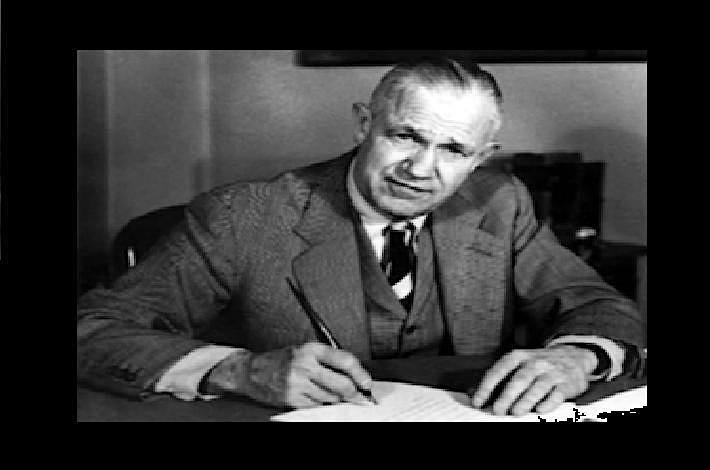
Sherman Kent
Sherman Kent, the dean of U.S. intelligence analysis (the CIA’s Center for Intelligence Analysis is named after him), warned of this danger, noting that while there was no excuse for policy or political bias, the existence of analytic or cognitive bias was ingrained in human condition, requiring a continuous effort by those responsible for overseeing analytical tasks to minimize.
Kent urged analysts “to resist the tendency to see what they expect to see in the information,” and “urged special caution when a whole team of analysts immediately agrees on an interpretation of yesterday’s development or a prediction about tomorrow’s.”
Part of a Litany of Intel Failures
The nexus of theory and reality was rarely, if ever, achieved within the U.S. intelligence community. From exaggerated Cold War estimates of Soviet military capability (the “bomber” and “missile” gaps), the underestimation of Viet Cong and North Vietnamese military capability, a failure to accurately predict the need for, and impact of, Gorbachev’s policies of reform in the Soviet Union, the debacle that was Iraqi WMD, a similar misreading of Iran’s nuclear capability and intent, and the two decade failure that was (and is) the Afghanistan experience, the U.S. intelligence community has a track record of imbuing its analysis with both political and cognitive bias—and getting it very, very wrong about so many things.
The Russian bounty story is no exception. It represents the nexus of two separate analytical streams, both of which were amply imbued with policy bias; one, representing America’s anger at not being able to control the fate of Russia in the aftermath of the collapse of the Soviet Union, and the second, America’s total misread of the reality of Afghanistan (and the Taliban) as it related to the Global War on Terror (GWOT).
For the first decade or so, these streams lived separate but equal lives, populated by analytical teams whose work rarely intersected (indeed, if truth be told, the Russian/Eurasian “house” was frequently robbed of its best talent to feed the insatiable appetite for more and better “analysis” driven by the GWOT enterprise.)
The election of Barack Obama, however, changed the intelligence landscape and, in doing so, initiated processes which allow these two heretofore disparate intelligence streams to drift together.
Under President Obama, the U.S. “surged” some 17,000 additional combat troops into Afghanistan in an effort to turn the tide of battle. By September 2012, these troops had been withdrawn; the “surge” was over, with little to show for it besides an additional 1,300 U.S. troops killed and tens of thousands more wounded. The “surge” had failed, but like any failure rooted in Presidential policy, it was instead sold as a success.
That same year the Obama administration suffered another policy failure of similar magnitude. In 2008, Russian President Vladimir Putin swapped places with Prime Minister Dmitri Medvedev, and when Obama took office, his team of Russian experts, led by a Stanford professor named Michael McFaul, sold him on the concept of a “reset” of U.S.-Russian relations, which had soured under eight years of the Bush Presidency.
But the “reset” was decidedly one-sided—it placed all of the blame for the bad blood between the two nations on Putin, and none on two successive eight-year presidential administrations, led by Bill Clinton and George W. Bush, which saw the U.S. expand the NATO alliance up to Russia’s borders, abandon foundational arms control agreements, and basically behave like Russia was a defeated foe whose only acceptable posture was one of acquiescence and subservience.
This was a game Russia’s first President, Boris Yeltsin, only seemed too happy to play. His hand-picked successor, Vladimir Putin, however, would not.
With Medvedev installed as president, McFaul sought to empower Medvedev politically—in effect, to give him the “Yeltsin” treatment—in hopes that an empowered Medvedev might be able to muscle Putin out of the picture.
For any number of reasons (perhaps most important being Putin had no intention of allowing himself to be so squeezed, and Medvedev was never inclined to do any squeezing), the Russian “reset” failed. Putin was reelected as president in March 2012. McFaul’s gambit had failed, and from that moment forward, U.S.-Russian relations became a “zero sum game” for the U.S.—any Russian success was seen as a U.S. failure, and vice versa.
In 2014, after watching a duly elected, pro-Russian Ukrainian president, Viktor Yanukovych, removed from office by a popular uprising which, if not U.S. sponsored, was U.S. supported, Putin responded by annexing the Russian-majority Crimean peninsula and supporting pro-Russian secessionists in the breakaway Donbas region of Ukraine.
This action created a schism between Russia and the U.S. and Europe, resulting in the implementation of economic sanctions against Russia by both entities, and the emergence of a new Cold War-like relationship between Russia and NATO.
In 2015 Russia followed up its Ukraine action by dispatching its military into Syria where, at the invitation of the Syria government, it helped turn the tide on the battlefield in favor of Syria’s embattled president, Bashar al-Assad, against an assortment of jihadist groups.
Overnight, the intelligence backwater that had been Russian/European affairs was suddenly thrust front and center on the world stage and, with it, into the heart of American politics. The McFaul school of Putin-phobia suddenly became dogma, and any academic who had published a book or article critical of the Russian president was elevated in status and stature, up to and including a seat at the table in the senior-most decision-making circles of the U.S. intelligence community.
The Russians were suddenly imbued with near super-human capability, up to and including the ability to steal an American presidential election.
After the failure of the Obama surge in Afghanistan, and the withdrawal from Iraq at the end of 2011 of all U.S. combat troops, the mindset throughout the Central Command area of operations was “stability.” This was the command guidance and pity the intelligence analyst who tried to raise a red flag or inject a modicum of reality into the intelligence enterprise whose mission it was to sustain this sense of stability.
Indeed, when the Islamic State roared out of the western deserts of Iraq to establish itself in eastern Syria, dozens of CENTCOM intelligence analysts officially complained that their senior management was purposefully manipulating the analytical product produced by CENTCOM to paint a deliberately misleading “rosy” picture of truth on the ground out of fear of angering the Commanding General and his senior staff.
For anyone who has spent any time in the military, the importance of command guidance, whether written or verbal, when it comes to establishing both priorities and approach, cannot be overstated. In short, what the general wants, the general gets; woe be the junior officer or analyst who didn’t get the memo.
By 2016, the commander of U.S. forces in Afghanistan, Gen. Nicholson, wanted to see Russians undermining U.S. policy objectives in Afghanistan. The poisonous culture that existed inside CENTCOM’s intelligence enterprise was only too happy to comply.
The corruption of intelligence at “ground zero” ended up corrupting the entire U.S. intelligence community, especially when there was a systemic desire to transfer blame for the failure of U.S. policy in Afghanistan anywhere other than where it belonged—squarely on the shoulders of U.S. policy makers and the military that did their bidding.
And there was a beefed-up Russia/Eurasia intelligence apparatus looking for opportunities to foist blame on Russia. Blaming Russia for U.S. policy failure in Afghanistan became the law of the land.
The consequences of this political and cognitive bias is subtle, but apparent to those who know what to look for, and are willing to take the time to look.
Following the leak to The New York Times about the Russian “bounty” intelligence, members of Congress demanded answers about the White House’s claim that the information published by the Times (and mimicked by other mainstream media outlets) was “unverified.”
Rep. Jim Banks, who sits on the Armed Services Committee as one of eight Republican lawmakers briefed by the White House on the substance of the intelligence regarding the alleged Russian “bounties”, tweeted shortly after the meeting ended that, “Having served in Afghanistan during the time the alleged bounties were placed, no one is angrier about this than me.”
Bank’s biography notes that, “In 2014 and 2015, he took a leave of absence from the Indiana State Senate to deploy to Afghanistan during Operations Enduring Freedom and Freedom’s Sentinel.”
Banks’ timeline mirrors that offered by a former senior Taliban leader, Mullah Manan Niazi, who told U.S. reporters who interviewed him after the Russian “bounty” story broke that “the Taliban have been paid by Russian intelligence for attacks on U.S. forces—and on ISIS forces—in Afghanistan from 2014 up to the present.”
Niazi: shady character (ToloNews/YouTube)
Niazi has emerged a key figure behind the crafting of the “bounty” narrative, and yet his voice is absent from The New York Times reporting, for good reason—Niazi is a shady character whose acknowledged ties to both the Afghan Intelligence Service (NDS) and the CIA undermine his credibility as a viable source of information.
Officials, speaking anonymously to the media, have stated that “the bounty hunting story was ‘well-known’ among the intelligence community in Afghanistan, including the CIA’s chief of station and other top officials there, like the military commandos hunting the Taliban. The information was distributed in intelligence reports and highlighted in some of them.”
If this is true, and some of this information found its way into the intelligence report referred to by Rep. Banks, then the U.S. intelligence community has been selling the notion of a Russian bounty on U.S. troops since at least 2015—coincidentally, the same time Russia started siding with the Taliban against IS-K.
Seen in this light, claims that Bolton briefed President Trump on the “bounty” story in March of 2019–nearly a full year before the PDB on it was delivered to the White House—don’t seem too far-fetched, except for one small detail: what was the basis of Bolton’s briefing? What intelligence product had been generated at that time which rose to a level sufficient enough to warrant being briefed to the president of the United States by his national security advisor?
The answer is, of cours–none. There was nothing; if there was, we would be reading about it with enough corroboration to warrant a White House denial. All we have is a story, a rumor, speculation, a “legend” promoted by CIA-funded Taliban turncoats that had seeped itself into the folklore of Afghanistan enough to be assimilated by other Afghans who, once detained and interrogated by the NDS and CIA, repeated the “legend” with sufficient ardor to be included, without question, in the intelligence collection report that actually did make into a PD–on Feb. 27, 2020.
There is another aspect of this narrative that fails completely, namely the basic comprehension of what exactly constitutes a “bounty.”
“Afghan officials said prizes of as much as $100,000 per killed soldier were offered for American and coalition targets,” the Times reported. And yet, when Rukmini Callimachi, a member of the reporting team breaking the story, appeared on MSNBC to elaborate further, she noted that “the funds were being sent from Russia regardless of whether the Taliban followed through with killing soldiers or not. There was no report back to the GRU about casualties. The money continued to flow.”
There is just one problem—that’s not how bounties work. Bounties are the quintessential quid pro quo arrangement—a reward for a service tendered. Do the job, collect the reward. Fail to deliver—there is no reward. The idea that the Russian GRU set up a cash pipeline to the Taliban that was not, in fact, contingent on the killing of U.S. and coalition troops, is the antithesis of a bounty system. It sounds more like financial aid, which it was—and is. Any assessment that lacked this observation is simply a product of bad intelligence.
The Timing
Whoever leaked the Russian “bounty” story to The New York Times knew that, over time, the basics of the story would not be able to stand up under close scrutiny—there were simply too many holes in the underlying logic, and once the totality of the intelligence leaked out (which, by Friday seemed to be the case), the White House would take control of the narrative.
The timing of the leak hints at its true objective. The main thrust of the story was that the president had been briefed on a threat to U.S. forces in the form of a Russian “bounty,” payable to the Taliban, and yet opted to do nothing. On its own, this story would eventually die out of its own volition.
On June 18, the U.S. fulfilled its obligation under the peace agreement to reduce the number of troops in Afghanistan to 8,600 by July 2020. By June 26, the Trump administration was close to finalizing a decision to withdraw more than 4,000 troops from Afghanistan by the fall, a move which would reduce the number of troops from 8,600 to 4,500 and thus pave the way for the complete withdrawal from U.S. forces from Afghanistan by mid-2021.
Both of these measures were unpopular with a military establishment that had been deluding itself for two decades that it could prevail in the Afghan conflict. Moreover, once the troop level had dropped to 4,500, there was no turning back—the total withdrawal of all forces was inevitable, because at that level the U.S. would be unable to defend itself, let alone conduct any sort of meaningful combat operations in support of the Afghan government.
It was at this time that the leaker chose to release his or her information to The New York Times, perfectly timed to create a political furor intended not only to embarrass the president, but more critically, to mobilize Congressional pushback against the Afghan withdrawal.
On Thursday, the House Armed Services Committee voted on an amendment to the National Defense Authorization Act which required the Trump administration to issue several certifications before U.S. forces could be further reduced in Afghanistan, including an assessment of whether any “state actors have provided any incentives to the Taliban, their affiliates, or other foreign terrorist organizations for attacks against United States, coalition, or Afghan security forces or civilians in Afghanistan in the last two years, including the details of any attacks believed to have been connected with such incentives”—a direct reference to the Russian “bounty” leak.
The amendment passed 45-11.
This, more than anything else, seems to have been the objective of the leak. The irony of Congress passing legislation designed to prolong the American war in Afghanistan in the name of protecting American troops deployed to Afghanistan should be apparent to all.
The fact that it is not speaks volumes to just how far down the road of political insanity this country has travelled. On a weekend where America is collectively celebrating the birth of the nation, that celebration will be marred by the knowledge that elected representatives voted to sustain a war everyone knows has already been lost. That they did so on the backs of bad intelligence leaked for the purpose of triggering such a vote only makes matters worse.
Scott Ritter is a former Marine Corps intelligence officer who served in the former Soviet Union implementing arms control treaties, in the Persian Gulf during Operation Desert Storm, and in Iraq overseeing the disarmament of WMD.
Featured Video
The Search for Truth: Charlie Kirk’s Assassination One Year Later
or go to
Aletho News Archives – Video-Images
From the Archives
The 9/11 “Double-Cross” Conspiracy Theory
BY LAURENT GUYÉNOT • UNZ REVIEW • SEPTEMBER 6, 2022
Is it true that “9/11 was an inside job”? Yes, insofar as Israel is “inside” the U.S. But for the 9/11 truthers who have identified Israel as the main perpetrators, “9/11 was an inside job” is at best a half-truth, and at worst an integral part of the Zionist operation, like a secondary flag sewn as a lining under the false flag of Islamism. Victor Thorn (1963-2017) wrote in his book 9/11 made in Israel: The Plot Against America (2011): “In essence, the ‘9-11 truth movement’ was created prior to Sept. 11, 2001 as a means of suppressing news relating to Israeli complicity. . . . The slogan ‘9-11 was an inside job’ was quite possibly the greatest example of Israeli propaganda ever devised.” In milder terms, it is “controlled opposition”.
A genuine truth movement would have pointed to Israel as the prime suspect from the start. From day one, it was obvious who would benefit. … continue
Blog Roll
 Aletho News
- Hormuz and the Looming Economic Catastrophe
- Dhubab offensive, media blitz and the rapid unraveling of Saudi-backed coalition’s new gambit
- Putin Conveys to Trump Iran’s Vision on Possible Conflict Resolution – Kremlin
- The Search for Truth: Charlie Kirk’s Assassination One Year Later
- ‘Harsh reality’: Iran says France seeks monopoly on power and intimidation, not peace for all
- When Will This White House Madness End?
- Huckabee aide goes to ‘unusual lengths’ to portray ‘Israel’ positively
- Trump Announces Diesel Supply Deal With Putin Following Phone Call
- MEP blasts ‘Euro-Gestapo’ for lecturing Russia on democracy
- Syria May Send Troops to Saudi Arabia Amid War with Ansar Allah
- If Americans Knew
- Israeli forces kill another child in Gaza – Daily Update
- Gaza ceasefire exists in name only, say more than 100 organizations
- Nearly 2 Million in Gaza Need Urgent Shelter Assistance as Winter Looms: IOM Chief Warns
- Suppressing Palestinian resistance: US charity under fire for AI monitoring of Gaza classrooms
- Thousands Are Held in Israeli Torture Camps. This Is What Happens Inside
- Israel puts Gaza’s sick, injured, newborn in peril – Daily Update
- Report claimed Mark Levin used by Israeli government to influence Trump
- Over 2,000 Gazans have died awaiting medical evacuation amid Israel’s continued siege
- How a U.S. Diplomat Suppressed and Altered Reports Critical of Israel
- 5 Palestinians Die from Israeli Strikes in Gaza as Relentless Attacks Continue
- No Tricks Zone
- New Study: 50 Years Of The Most Aggressive ‘Net Zero’ Policies Can Only Affect The Global Climate By 0.03°C
- US September “Heat” Was No Record…Many Records Set Decades Ago
- Latest European Green Energy Debacle; Portugal’s Largest Flagship Solar Park Insolvent!
- Green Energy Debacle: German Expert Professor Fritz Vahrenholt Warns Of Severe Economic And Social Consequences
- Two More Paleo Reconstructions Affirm Meters-Higher Sea Levels Across Ireland, Brazil 7000-6000 Years Ago
- New Study: Earth And Venus Surface Warmth Largely Explained By Convection And Lapse Rate, Not CO2 Or Radiation
- 2025 Nature Paper Claiming Worsening Global Drought Gets RETRACTED …Heavily Flawed
- New Study: ‘Global Drought Shows No Detectable Recent Acceleration Under Climate Warming’
- Economic Masterminds: German Socialists Suggest Taxing Productivity Gains Stemming From Using AI
- The South China Sea Has Not Been Cooperating With The Climate Change Narrative


.jpg)