The Washington Post’s “Cartel of the Suns” Theory is the Latest Desperate Excuse for Why the Coup Attempt in Venezuela has Failed
By Peter Bolton | CounterPunch | May 17, 2019
With the attempted coup in Venezuela now nearing its four-month mark, commentators in the corporate-owned Western press are scratching their heads as to why Washington’s plan for its proxy, Juan Guaido, to topple the government of Nicolas Maduro has so far failed to materialize. Of course, all of the real reasons elude them because they have never so much as crossed their minds. It is beyond their mental world to consider the lasting popularity of the late Hugo Chavez’s policies and lasting suspicion toward the right-wing opposition amongst large swathes of the population – or the deep revulsion at the thought of US (and especially US military) intervention into their country held by the vast majority of Venezuelans (and, indeed, Latin Americans generally). Rather, both the coup attempt’s puppeteers in Washington and their ventriloquist dummies in the mainstream media have been coming up with ever-more desperate excuses for why Guaido’s attempt to take power has not been a swift and decisive success. The so-called “propping up” of the Maduro “regime” by the traditional the US boogeymen of Russia, China and Cuba seems to have been the most frequently touted explanation. This has manifested itself in increasingly bizarre ways, such as the recent claim by Mike Pompeo that Maduro was at the point of fleeing the country before being convinced otherwise by Russia.
Now, the Washington Post’s notorious warhawk and deranged conspiracy peddler Jackson Diehl has come up with the latest labored rationalization for the failure of the coup attempt: the so-called “Cartel of the Suns.” According to Diehl, this shadowy organization is made up of “some of the most senior officials in the Maduro regime.” He claims that it “flies hundreds of tons of Colombian cocaine from Venezuelan airfields to Central America and the Caribbean for eventual distribution in the United States and Europe.” He furthermore claims that the Maduro government’s crimes also include skimming accounts used for importing food and medicine and “corrupt currency trading.” Describing the Maduro government as “less a government — much less a socialist one — than a criminal gang,” he claims that “the money it is reaping from criminal activity is serving as a prop that allows it to survive U.S. sanctions.” The only sources he provides to support these assertions are: an Associated Press article from September 2018 that reported on an unproven allegation made by a minor US Treasury Department figure, a January 2019 Wall Street Journal article that reports on another unproven allegation made by the US Treasury Department, and a link to one of his own Washington Post articles published in 2015. Leaving aside the self-citation, allegations made by the Treasury Department can hardly be considered credible evidence. It is, after all, a branch of the US government, which has been attempting to destabilize Chavista administrations since their earliest days in office. The Trump administration that it currently answers to, meanwhile, has been the major driving force behind the attempted coup and makes no secret of basing the effort on the advancement of US corporate economic interests.
Larissa Costas has gone so far as to posit that the very idea of such a government-operated cartel might be a whole-cloth fabrication. She stated in February 2017 article:
Although information abounds in the mediums of communication, the “Cartel of the Suns” has not been caught with a single gram of drugs, nor has there been any insignia of the organization identified in any seizure, nor has a single death been attributed to it. There are just two explanations: either it is the most inoffensive of cartels or it simply does not exist. [translated from the original in Spanish]
This latter possibility seems to be confirmed by the consistent failure of repeated Washington-led investigations into members of the Maduro government to result in actual convictions or even clear conclusions. For instance, in January 2015 the US Justice Department (DoJ) and Drug Enforcement Administration (DEA) launched a joint probe into then-President of the National Assembly Diosdado Cabello and other senior figures of the Venezuelan government. News reports soon followed repeating the allegations, including the claim that Cabello is the “capo” of the “Cartel of the Suns.” (Note here the loaded use of mafia-tinged language that’s seemingly borrowed straight from The Godfather movies.) But now, over four years since the launch of this probe, the DEA and DoJ have yet to even charge, let alone convict, any of the people implicated in it. Yet still the mainstream media reports repeat the allegations as if they were beyond question. In May 2018, for example, InSight Crime published an article titled “Drug Trafficking Within the Venezuelan Regime: The ‘Cartel of the Suns’,” in which the publication claims to have built “files on senior [Venezuelan] officials, current or past, that have been involved in the trafficking of cocaine.” But rather than providing the reader with this purported mountain of evidence that they have amassed, the authors instead cite an anonymous Justice Department official as their source. Just as with the US Treasury Department, the Justice Department can hardly be trusted when successive administrations in Washington have been consistently trying to undermine Chavista governments ever since Hugo Chavez was first elected in 1998. From CIA and Bush administration involvement in the 2002 coup attempt and also in the 2002-2003 PDVSA management lock-out through to the present coup attempt and oil sanctions, Washington has gone from covert to brazenly overt regime change methods.
But things go deeper than this. It seems that these dubious accusations of drug trafficking, in fact, form a significant part of the regime change effort itself. For one thing, they are used as justification for sanctions that Washington enacts in order to weaken the regime by sending thinly veiled signals to international capital to avoid Venezuela. Second of all, these sanctions and allegations are in turn used as a form of leverage to weaken the regime and encourage defection to the US’s and US-backed opposition’s side. There is no better case to illustrate this reality than that of the retired Venezuelan General Hugo Carvajal. In July 2014, as Carvajal was being released from custody in Aruba, Reuters reported that he categorically denied US charges of involvement in the illegal drug trade and provision of aid to Colombian leftist armed groups. But in February 2019, with the coup attempt about a month in, Carvajal did an about-face and accused Maduro and his inner circle of involvement in drug trafficking. This was right after Trump made an open threat that military officials who remain loyal to Maduro have “everything to lose” while Guaido simultaneously offered amnesty to those willing to defect to his side. It seems that Carvajal was responding to this “carrot and stick” threat/incentive combination that the US had, in his case successfully, employed as part of its regime change arsenal. The questionable validity of his claims is demonstrated by his repetition of Washington’s oft-repeated mantra that Maduro officials are courting the Lebanese “militant” group Hezbollah. These claims have been decisively debunked by Richard Vaz, who points out that mainstream media outlets such as CNN that report these allegations again use solely the Treasury Department as their source, or worse still figures such as Marco Rubio. Vaz also points to the absurdity of holding up Tarek el Aissami as the facilitator of some kind of cross-Atlantic Iranian-led Shi’ite alliance when el Aissami himself is not even Muslim, but rather the son of Lebanese Druze immigrants who was born and has spent all his life in Venezuela.
In any normal situation this is all that would have to be said to dismiss Diehl’s claims. But Latin America is no normal place and US relations with the region constitute no normal situation. In addition to the scarcity of evidence for the claims he makes, there is a question of double standards that lies beneath the surface. Diehl undoubtedly wishes to imply that the Maduro government’s alleged involvement in criminal activity justifies the interventionist actions from Washington and its proxies on the ground. But when one looks across the region and into both its past and present, one sees a whole cornucopia of flagrant narco-states that Washington has not only ignored but bank-rolled and armed to the teeth. Not coincidentally, two of them are staunch allies and the other was so until very recently. I am talking, of course, of Colombia, Honduras and Mexico.
Colombia’s status as a narco-state during the first decade of this century is hardly a secret. Even some of the US’s own declassified intelligence documents contain allegations of former president Alvaro Uribe’s close ties to narcotrafficking. A 1991 declassified Defense Intelligence Agency (DIA) report, for example, describes Uribe as a “close personal friend of Pablo Escobar” and “dedicated to collaboration with the Medellín cartel at high government levels.” Another intelligence report from 1993, and declassified in 2018, says that Colombian Senator told officials at the US Embassy in Bogota that Escobar’s cartel had financed Uribe’s election campaign for the Colombian Senate. In spite of having such information available, Washington nonetheless generously funded the Uribe government through Plan Colombia to engage in so-called “counter-narcotics” campaigns, which served as a cover for brutal offensives against labor and indigenous rights activists and displacement of rural campesinos. The extent of state capture by drug cartels in Colombia was furthermore exposed by the Parapolitics scandal, which led to the conviction of 32 members of the Colombian congress along with five state governors for collusion with right-wing paramilitaries. These groups, incidentally, have been the biggest players in the Colombian drug trade, dwarfing the involvement of leftist guerrilla groups such as the FARC and ELN.
Revelations from the recently concluded trial of Joaquín ‘El Chapo’ Guzmán have shone a light onto a similar story in Mexico. State witness Alex Cifuentes made a credible accusation during his testimony against Guzman that former Mexican president Enrique Peña Nieto received a bribe from Guzman worth $100 million dollars. Mexican investigative journalist Anabel Hernandez has long claimed that collusion between the Mexican state and narco-trafficking groups stretches all the way to the top, including the presidency, which Cifuentes’ testimony seemingly confirms. As has been the case with Colombia, the US has not only turned a blind eye to this situation, but has been generous funding the Mexican government to conduct “counter-narcotics” campaigns through the Merida Initiative. And again, these campaigns provided cover for brutal human rights violations on the part of Mexico’s state security forces.
Finally, we should turn to Honduras, the most contemporary and, in many ways, most flagrant example of a narco-state that the US cozies up to. Ever since the State Department orchestrated a coup against the democratically-elected government of Manuel Zelaya in 2009 there have been growing signs that Honduras has degenerated into a fully-fledged narco-state. In January of last year, for example, it emerged that a national police chief personally facilitated a cocaine delivery worth $20 million in 2013. In November 2018, President Juan Orlando Hernandez’s brother, Tony Hernandez, was arrested on drug trafficking charges in Miami. Just as this article went to press, testimony that he gave to US Drug Enforcement Administration (DEA) was unsealed in which he reportedly admits to interacting with several known drug traffickers as well as taking bribes. Even according to the aforementioned InSight Crime : “Tony Hernández’s detailed knowledge of the activities of some of Honduras’ most prominent drug traffickers makes it increasingly difficult for President Juan Orlando Hernández to deny being aware of these acts.” The president himself has previously faced allegations of involvement in drug trafficking via ex-army captain Santos Rodriguez Orellana. And as with Colombia and Mexico, not only has Washington never issued any punitive measure whatsoever against Honduras for any of this, it has rather been generously funding its state security forces in spite of its brutal record of human rights violations.
Note that all three of the above countries have been close US allies for the last few decades, with Colombia and Honduras remaining so while Mexico begins to break from Washington following the election of progressive president Andres Manuel Lopez Obrador. This is no coincidence. So long as a country is serving the US’s geostrategic and economic interests, it will not just overlook its status as a narco-state but will aid and abet its committing of human rights violations. You won’t hear about any of this from Jackson Diehl, however. Because as an obedient cheerleader for the Monroe Doctrine he must faithfully promulgate the selective indignation that underpins its entire edifice of justification propaganda. Given Washington’s record in the wider region, whether or not Venezuela is indeed a narco-state ceases to be the point. Rather, the question becomes one of credibility. And when it comes to evenhandedness in its treatment of Latin American states, Washington has exactly none.
Pretexts for an Attack on Iran
By Ray McGovern – Consortium News – May 15, 2019
An Iraq-War redux is now in full play, with leading roles played by some of the same protagonists — President Donald Trump’s national security adviser, John Bolton, for example, who says he still thinks attacking Iraq was a good idea. Co-starring is Secretary of State Mike Pompeo.
The New York Times on Tuesday played its accustomed role in stoking the fires, front-paging a report that, at Bolton’s request, Acting Defense Secretary Patrick Shanahan has come up with an updated plan to send as many as 120,000 troops to the Middle East, should Iran attack American forces or accelerate work on nuclear weapons. The Times headline writer, at least, thought it appropriate to point to echoes from the past: “White House Reviews Military Plans Against Iran, in Echoes of Iraq War.”
By midday, Trump had denied the Times report, branding it “fake news.” Keep them guessing, seems to be the name of the game.
Following the Iraq playbook, Bolton and Pompeo are conjuring up dubious intelligence from Israel to “justify” attacking — this time — Iran. (For belligerent Bolton, this was entirely predictable.) All this is clear.
What is not clear, to Americans and foreigners alike, is why Trump would allow Bolton and Pompeo to use the same specious charges — terrorism and nuclear weapons — to provoke war with a country that poses just as much strategic threat to the U.S. as Iraq did — that is to say, none. The corporate media, with a two-decade memory-loss and a distinct pro-Israel bias, offers little help toward understanding.
Before discussing the main, but unspoken-in-polite-circles, impulse behind the present step-up in threats to Iran, let’s clear some underbrush by addressing the two limping-but-still-preferred, ostensible rationales, neither of which can bear close scrutiny:
No. 1: It isn’t because Iran is the world’s leading sponsor of terrorism. We of Veteran Intelligence Professionals for Sanity shot down that canard a year and a half ago. In a Memorandum for President Trump, we said:
“The depiction of Iran as ‘the world’s leading state sponsor of terrorism’ is not supported by the facts. While Iran is guilty of having used terrorism as a national policy tool in the past, the Iran of 2017 is not the Iran of 1981. In the early days of the Islamic Republic, Iranian operatives routinely carried out car bombings, kidnappings and assassinations of dissidents and of American citizens. That has not been the case for many years.”
No. 2. It isn’t because Iran is building a nuclear weapon. A November 2007 U.S. National Intelligence Estimate concluded unanimously that Iran had stopped working on a nuclear weapon in 2003 and had not resumed any such work. That judgment has been re-affirmed by the Intelligence Community annually since then.
The Joint Comprehensive Plan of Action, commonly known as the Iran nuclear deal, imposed strict, new, verifiable restrictions on Iranian nuclear-related activities and was agreed to in July 2015 by Iran, the U.S., Russia, China, France, the U.K., Germany and the European Union.
Even the Trump administration has acknowledged that Iran has been abiding by the agreement’s provisions. Nevertheless, President Trump withdrew the U.S. from the Iran nuclear deal on May 8, 2018, four weeks after John Bolton became his national security adviser.
‘We Prefer No Outcome’
Fair Warning: What follows may come as a shock to those malnourished on the drivel in mainstream media: The “WHY,” quite simply, is Israel. It is impossible to understand U.S. Middle East policy without realizing the overwhelming influence of Israel on it and on opinion makers. (A personal experience drove home how strong the public appetite is for the straight story, after I gave a half-hour video interview to independent videographer Regis Tremblay three years ago. He titled it “The Inside Scoop on the Middle East & Israel,” put it on YouTube and it got an unusually high number of views.)
Syria is an illustrative case in point, since Israel has always sought to secure its position in the Middle East by enlisting U.S. support to curb and dominate its neighbors. An episode I recounted in that interview speaks volumes about Israeli objectives in the region as a whole, not only in Syria. And it includes an uncommonly frank admission/exposition of Israeli objectives straight from the mouths of senior Israeli officials. It is the kind of case-study, empirical approach much to be preferred to indulging in ponderous pronouncements or, worse still, so-called “intelligence assessments.”
It has long been clear that Israeli leaders have powerful incentives to get Washington more deeply engaged in yet another war in the area. This Israeli priority has become crystal clear in many ways. Reporter Jodi Rudoren, writing from Jerusalem, had an important article in TheNew York Times on Sept. 6, 2013, in which she addressed Israel’s motivation in a particularly candid way. Her article, titled “Israel Backs Limited Strike against Syria,” noted that the Israelis have argued, quietly, that the best outcome for Syria’s civil war, at least for the moment, is no outcome.
Rudoren wrote:
Jodi Rudoren. (Twitter)
“For Jerusalem, the status quo, horrific as it may be from a humanitarian perspective, seems preferable to either a victory by Mr. Assad’s government and his Iranian backers or a strengthening of rebel groups, increasingly dominated by Sunni jihadis.
“‘This is a playoff situation in which you need both teams to lose, but at least you don’t want one to win — we’ll settle for a tie,’ said Alon Pinkas, a former Israeli consul general in New York. ‘Let them both bleed, hemorrhage to death: that’s the strategic thinking here. As long as this lingers, there’s no real threat from Syria.’”

If this is the way Israel’s current leaders look at the carnage in Syria, they seem to believe that deeper U.S. involvement, including military action, is likely to ensure that there is no early resolution of the conflict especially when Syrian government forces seem to be getting the upper hand. The longer Sunni and Shia are at each other’s throats in Syria and in the wider region, the safer Israel calculates it will be.
The fact that Syria’s main ally is Iran, with whom it has a mutual defense treaty, also plays a role in Israeli calculations. And since Iranian military support has not been enough to destroy those challenging Bashar al-Assad, Israel can highlight that in an attempt to humiliate Iran as an ally.
Today the geography has shifted from Syria to Iran: What’s playing out in the Persian Gulf area is a function of the politically-dictated obsequiousness of American presidents to the policies and actions of Israel’s leaders. This bipartisan phenomenon was obvious enough under recent presidents like Clinton and Obama; but under Bush II and Trump, it went on steroids, including a born-again, fundamentalist religious aspect.
One need hardly mention the political power of the Israel lobby and the lucrative campaign donations from the likes of Sheldon Adelson. Israeli Prime Minister Benjamin Netanyahu is riding high, at least for the now, Israeli influence is particularly strong in the lead-up to U.S. elections, and Trump has been acquitted of colluding with Russia.
The stars seem aligned for very strong “retaliatory strikes” for terrorist acts blamed on Iran.
Tonkin — er, I Mean Persian Gulf
Over the weekend, four vessels, including two Saudi oil tankers, were sabotaged near the Strait of Hormuz. Last evening The Wall Street Journal was the first to report an “initial U.S. assessment” that Iran likely was behind the attacks, and quoted a “U.S. official” to the effect that if confirmed, this would inflame military tensions in the Persian Gulf.The attacks came as the U.S. deploys an aircraft carrier, bombers and an antimissile battery to the Gulf — supposedly to deter what the Trump administration said is the possibility of Iranian aggression.
On Tuesday, Yemen’s Houthi rebels, with whom Saudi Arabia has been fighting a bloody war for the past four years, launched a drone attack on a Saudi east-west pipeline that carries crude to the Red Sea. This is not the first such attack; a Houthi spokesman said the attack was a response to Saudi “aggression” and “genocide” in Yemen. The Saudis shut down the pipeline for repair.
Thus the dangers in and around the Strait of Hormuz increase apace with U.S.-Iran recriminations. This, too, is not new.
Tension in the Strait was very much on Joint Chiefs of Staff Chairman Adm. Mike Mullen’s mind as he prepared to retire on Sept. 30, 2011. Ten days before, he told the Armed Force Press Service of his deep concern over the fact that the U.S. and Iran have had no formal communications since 1979:
“Even in the darkest days of the Cold War, we had links to the Soviet Union. We are not talking to Iran. So we don’t understand each other. If something happens, it’s virtually assured that we won’t get it right, that there will be miscalculations.”
Now the potential for an incident has increased markedly. Adm. Mullen was primarily concerned about the various sides — Iran, the U.S., Israel — making hurried decisions with, you guessed it, “unintended consequences.”
With Pompeo and Bolton on the loose, the world may be well advised to worry even more about “intended consequences” from a false flag attack. The Israelis are masters at this. The tactic has been in the U.S. clandestine toolkit for a long time, as well. In recent days, the Pentagon has reported tracking “anomalous naval activity” in the Persian Gulf, including loading small sailing vessels with missiles and other military hardware.
Cheney: Down to the Sea in Boats
In July 2008, Pulitzer Prize-winning investigative journalist Seymour Hersh reported that Bush administration officials had held a meeting in the vice president’s office in the wake of a January 2008 incident between Iranian patrol boats and U.S. warships in the Strait of Hormuz. The reported purpose of the meeting was to discuss ways to provoke war with Iran.
Hersh wrote:
“There were a dozen ideas proffered about how to trigger a war. The one that interested me the most was why don’t we build in our shipyard four or five boats that look like Iranian PT boats. Put Navy seals on them with a lot of arms. And next time one of our boats goes to the Straits of Hormuz, start a shoot-up. Might cost some lives.
“And it was rejected because you can’t have Americans killing Americans. That’s the kind of, that’s the level of stuff we’re talking about. Provocation.
“Silly? Maybe. But potentially very lethal. Because one of the things they learned in the [January 2008] incident was the American public, if you get the right incident, the American public will support bang-bang-kiss-kiss. Youknow, we’re into it.”
Preparing the (Propaganda) Battlefield
One of Washington’s favorite ways to blacken Iran and its leaders is to blame it for killing U.S. troops in Iraq. Iran was accused, inter alia, of supplying the most lethal improvised explosive devices, but sycophants like Gen. David Petraeus wanted to score points by blaming the Iranians for still more actions.
On April 25, 2008, Joint Chiefs of Staff Chairman, Adm. Mike Mullen, told reporters that Gen. David Petraeus would be giving a briefing “in the next couple of weeks” that would provide detailed evidence of “just how far Iran is reaching into Iraq to foment instability.”
Petraeus’s staff alerted U.S. media to a major news event in which captured Iranian arms in Karbala, Iraq, would be displayed and then destroyed. But there was a small problem. When American munitions experts went to Karbala to inspect the alleged cache of Iranian weapons, they found nothing that could be credibly linked to Iran.
This embarrassing episode went virtually unreported in Western media – like the proverbial tree falling in the forest with no corporate media to hear it crash. A fiasco is only a fiasco if folks find out about it. The Iraqis did announce that Iraqi Prime Minister Nouri al-Maliki had formed his own Cabinet committee to investigate U.S. claims and attempt to “find tangible information and not information based on speculation.”
With his windsock full of neoconservative anti-Iran rhetoric, Petreaus, as CIA director, nevertheless persisted — and came up with even more imaginative allegations of Iranian perfidy. Think back, for example, to October 2011 and the outlandish White House spy feature at the time: the Iranian-American-used-car-salesman-Mexican-drug-cartel plot to assassinate the Saudi ambassador to the U.S. And hold your nose.
More recently, the Pentagon announced it has upped its estimate of how many U.S. troops Iran killed in Iraq between 2003 and 2011. The revised death tally would mean that Iran is responsible for 17 percent of all U.S. troops killed in Iraq.
Who Will Restrain the ‘Crazies’?
Pompeo stopped off in Brussels on Monday to discuss Iran with EU leaders, skipping what would have been the first day of a two-day trip to Russia. Pompeo did not speak to the news media in Brussels, but European foreign ministers said that they had urged “restraint.”
British Foreign Minister Jeremy Hunt told reporters: “We are very worried about the risk of a conflict happening by accident, with an escalation that is unintended, really on either side.” British Army Major General Christopher Ghika was rebuked by U.S. Central Command for saying Tuesday: “There has been no increased threat from Iranian backed forces in Iraq and Syria.” Central Command spokesperson Captain Bill Urban said Ghika’s remarks “run counter to the identified credible threats available to intelligence from U.S. and allies regarding Iranian backed forces in the region.”
Although there is growing resentment at the many serious problems tied to Trump’s pulling the U.S. out of the Iran deal, and there is the EU’s growing pique at heavyweights like Pompeo crashing their gatherings uninvited, I agree with Pepe Escobar’s bottom line, that “it’s politically naïve to believe the Europeans will suddenly grow a backbone.”
There remains a fleeting hope that cooler heads in the U.S. military might summon the courage to talk some sense into Trump, in the process making it clear that they will take orders from neither Pompeo nor from National Security Advisor John Bolton. But the generals and admirals of today are far more likely in the end to salute and “follow orders.”
There is a somewhat less forlorn hope that Russia will give Pompeo a strong warning in Sochi — a shot across the bow, so to speak. The last thing Russia, China, Turkey and other countries want is an attack on Iran. Strategic realities have greatly changed since the two wars on Iraq.
In 1992, still in the afterglow of Desert Storm (the first Gulf War), former Gen. Wesley Clark asked then Undersecretary of Defense for Policy Paul Wolfowitz about major lessons to be drawn from the Desert Storm attack on Iraq in 1991. Without hesitation, Wolfowitz answered, “We can do these things and the Russians won’t stop us.” That was still true for the second attack on Iraq in 2003.
But much has changed since then: In 2014, the Russians stopped NATO expansion to include Ukraine, after the Western-sponsored coup in Kiev; and in the years that followed, Moscow thwarted attempts by the U.S., Israel, and others to oust Syrian President Bashar al-Assad.
No doubt Russian President Vladimir Putin would like to “stop us” before the Bolton/Pompeo team finds an “Iranian” casus belli. Initial reporting from Sochi, where Pompeo met with Russian Foreign Minister Sergey Lavrov and President Vladimir Putin on Tuesday indicates there was no meeting of the minds on Iran. Both Pompeo and Lavrov described their talks as “frank” — diplomat-speak for acrimonious.
Pompeo was probably treated to much stronger warnings in private during the Sochi talks with Lavrov and Putin. Either or both may even have put into play the potent China card, now that Russia and China have a relationship just short of a military alliance — a momentous alteration of what the Soviets used to call the “correlation of forces.”
In my mind’s eye, I can even see Putin warning, “If you attack Iran, you may wish to be prepared for trouble elsewhere, including in the South China Sea. Besides, the strategic balance is quite different from conditions existing each time you attacked Iraq. We strongly advise you not to start hostilities with Iran — under any pretext. If you do, we are ready this time.”
And, of course, Putin could also pick up the phone and simply call Trump.
There is no guarantee, however, that tough talk from Russia could stick an iron rod into the wheels of the juggernaut now rolling downhill to war on Iran. But, failing that kind of strong intervention and disincentive, an attack on Iran seems all but assured. Were we to be advising President Trump today, we VIPS would not alter a word in the recommendation at the very end of the Memorandum for President George W. Bush we sent him on the afternoon of Feb. 5, 2003, after Colin Powell addressed the UN Security Council earlier that day:
“No one has a corner on the truth; nor do we harbor illusions that our analysis is irrefutable or undeniable [as Powell had claimed his was]. But after watching Secretary Powell today, we are convinced that you would be well served if you widened the discussion … beyond the circle of those advisers clearly bent on a war for which we see no compelling reason and from which we believe the unintended consequences are likely to be catastrophic.”
Ray McGovern works with Tell the Word, a publishing arm of the ecumenical Church of the Saviour in inner city Washington. He was a CIA analyst for 27 years and presidential briefer and is co-founder of Veteran Intelligence Professionals for Sanity.
Islamic Republic No Threat to Anybody in Iraq or Elsewhere: Iran UN Mission
Al-Manar | May 16, 2019
Iran has rejected the United States’ claims that ‘Iranian activities’ endanger American sites and troops in Iraq, saying the Islamic Republic is no threat to anybody in Iraq or elsewhere.
“’Iran is no threat to anybody in Iraq or elsewhere, and Iran is not preparing for any attacks anywhere,” Alireza Miryousefi, the spokesman for Iran mission to the United Nations made the statement on Wednesday.
“Iran, as is evidenced by our history, only acts in self-defense, and has no offensive strategy against any nation,” he added, according to Mehr news agency.
The official censured the US for sticking to fake reports for spreading propaganda against the Islamic Republic, saying, “Iranians will never capitulate to this new psychological war.”
The US has recently built up its military presence in the region over what it calls an Iranian threat to American troops and interests.
Last week, US Secretary of State Mike Pompeo claimed that the US administration had received intelligence related to “Iranian activity” that put American facilities and service personnel at “substantial risk.”
Other senior officials within the US administration itself as well as other countries have however dismissed that claim.
Following Pompeo’s claims, the US on Wednesday ordered the partial evacuation of its embassy in Baghdad and a consulate in Erbil.
Why is the US always ‘stumbling’ or ‘sliding’ into war? How the media misleads with language

By Danielle Ryan | RT | May 15, 2019
The way the mainstream media tells it, the United States never, ever ends up embroiled in wars and military conflicts on purpose — only ever by mistake, or as a result of things like ‘bad planning’ or ‘strategic missteps’.
Very often when media coverage of war is analysed, there is a focus on how hawkish pundits cheerlead for conflict and journalists parrot official narratives while dissenting voices are drowned out. Mainstream networks, for example, have been heavily criticized by media watchdogs for almost exclusively inviting pro-war guests and ex-military hawks onto their news shows to convince Americans that war is the only reasonable course of action, while refusing to let anti-war commentators get a look in.
But there is another more subtle and unnoticeable way that the media deceives us. Even when they are not outright cheerleading for military action (as was the case in the lead up to the Iraq War), the language they use to describe events is designed to absolve Washington of blame.
Next time you read the news, notice how the US is always “stumbling into” war, or “drifting into” war or “sliding into” war — or even “sleepwalking into” war. To “stumble into” war seems to be a firm favorite among headline writers. The US has “stumbled” into war in Iraq and Syria and has been, at one time or another, at risk of “stumbling” into war with Russia, North Korea and most recently Iran.
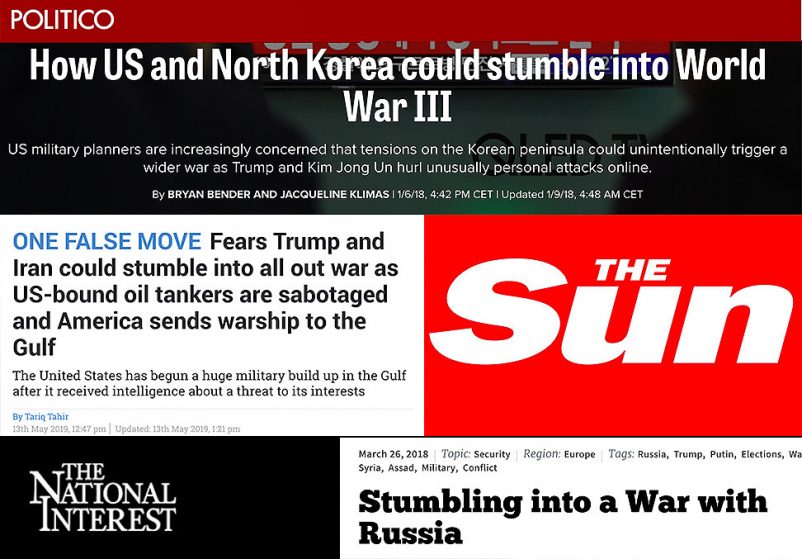
According to these headlines, the US has also been “dragged into” (CNN) and “sucked into” (NI ) war in Syria and Afghanistan, twice (NI, The Times ). In recent weeks, the Trump administration has been “sliding into” (AP ) a potential “accidental” war with Iran — and back in 2017, it was “dragged into” (FP ) the disastrous Yemen conflict.
The examples of the US stumbling, blundering and bumbling its way into wars are endless — and it does raise a question that no one ever seems to ask: If it’s so easy to trip and fall into massive never-ending wars, why isn’t it happening to everyone else? Is Washington just especially clumsy?
With this narrative of the bumbling superpower, agency is always removed from the architects of war. Instead of enthusiastically banging the drums for war, we’re told the White House is always ‘reluctant’ to deploy its military, but is ‘forced’ into it . Then, once the war is in full-swing, when things are not panning out exactly as planned, the US can become the sacrificial hero, propelled into a deadly conflict not of its own making.
A recent headline in the Miami Herald framed recent US actions on Venezuela as the US being “pushed to act.” Pushed by who? The Trump administration voluntarily helped organize and instigate the attempted coups that worsened the country’s political crisis and proudly imposed the economic sanctions which have led directly to thousands of premature deaths. There was no “pushing” involved.
In April, Foreign Policy magazine even had Venezuela’s self-declared interim president Juan Guaido “stumbling toward a coup.” How do you stumble into a military coup? Surely that’s the kind of thing that requires careful, deliberate planning and execution? The Washington Post had Trump “fumbling” an uprising in Caracas, too.
It’s not just media pundits and journalists who employ this kind of misleading language, either. British Foreign Secretary Jeremy Hunt said this week that a US war with Iran could happen “by accident.” Did Hunt take a vacation from reality and miss US Secretary of State Mike Pompeo and National Security Advisor John Bolton ramping up war rhetoric against Iran for months? Maybe Trump abandoned the 2015 Iran nuclear deal by accident and sent an aircraft carrier and bomber task force into the Persian Gulf last week to “send a message” to Iran by mistake.
Such framing obscures basic facts about Washington’s motives and predilection toward military conflict over diplomacy. Washington doesn’t get into wars by mistake. Unless a country is directly attacked, threatened or occupied, wars are quite easy to avoid getting into if you really don’t want to be in them — but the hawks in Washington, no matter how much they pretend to not want war, are always itching for more and they will stop at nothing to get what they want, even if that means fabricating evidence (as in Iraq) or pulling off false flag attacks to use as convenient pretexts for the US to ‘respond’ to.
US military actions are designed specifically to provoke the conflicts that they believe will be of benefit to their overall geopolitical strategy. Talk of freedom, democracy and human rights are just a convenient cover. Washington is never at risk, for example, of stumbling into war with Saudi Arabia, despite Riyadh’s laundry list of crimes against humanity.
Whether this propagandistic language is always employed in a totally conscious way or not, it’s difficult to tell. Either way, it’s a psychological trick which frames the most powerful, military-minded and trigger-happy country in the world as some kind of innocent victim of events beyond its control.
Also on rt.com:
US media’s love affair with war: Major outlets showed zero opposition to Syria strikes
Who Really Gains from the Gulf Ship ‘Sabotage’
By Finian Cunningham | Strategic Culture Foundation | May 15, 2019
After dramatic and patently scripted warnings of “Iranian aggression” by bellicose US officials, there then follows – conveniently enough – an alleged sabotage incident in the Persian Gulf region implicating Iran.
Meanwhile, US Secretary of State Mike Pompeo poses with a straight face that his country doesn’t want war with Iran. His comments warp credulity given that American forces have suddenly escalated firepower in the Persian Gulf for the purpose of “responding” to alleged Iranian infractions.
Typically, Western news media are “reporting” (or rather, “echoing”) the purported sabotage incident as if it were fact, basing their source of information on Saudi and Emirati officials, sources which have a vested interest in creating a war pretext against Iran.
Given the grotesque, barefaced lies that have emanated from the Saudi regime over the past year with regard to the murder of journalist Jamal Khashoggi and also its barbaric, mass executions of political dissidents, it is nauseating how Western media can affect to be so credulous in citing Saudi claims as reliable over the latest alleged shipping incident.
“Two Saudi oil tankers have been sabotaged off the coast of the United Arab Emirates posing a potentially serious threat to world oil supplies,” reports [sic] Britain’s Guardian, attributing the source of this information to the “Saudi government”. What the Guardian omitted was the key word “alleged” before “sabotage”. Notice how the impression given is one of a factual incident of malicious intent. Most other Western news media adopted the same reliance on the official Saudi and Emirati claims.
Tellingly, however, Saudi and Emirati officials gave no details about the “significant damage” allegedly caused to a total of four tankers.
What we seem to know is that the four vessels were somehow disabled off the UAE port of Fujairah early on Sunday. The location at sea is in the Gulf of Oman, which lies outside the Persian Gulf, about 140 kilometers south from the Strait of Hormuz. The latter is the narrow passage from the Gulf of Oman into the Persian Gulf, through which up to 30 per cent of all globally shipped crude oil passes each day.
Last week, Iran once again threatened it would blockade its territorial waters in the Strait of Hormuz “if” the US carried out a military attack on it. Such a move by Iran would throw the global economy into chaos from the anticipated crisis in oil markets. It would also doubtless trigger an all-out war between the US and Iran, with American regional client regimes like Saudi Arabia and Israel piling in to facilitate attacks against Tehran.
So far, there have been no official accusations explicitly made against Iran over the latest shipping incident. But the implications are pointedly skewed to frame-up the Islamic Republic.
Saudi energy minister Khalid al Falih, whom Western media have quoted uncritically, claimed that one of the vessels allegedly attacked was on its way to load up on crude oil from the Saudi port of Ras Tanura, destined for the US market. The Saudi official did not give any substantiating details on the alleged sabotage, but emphasized that it was aimed “to undermine the freedom of navigation”. He called on international action to “protect security of oil tankers”. Wording that the American self-appointed global “policeman” (more accurately, “thug”) invokes all the time to cover for its imperialist missions anywhere on the planet.
When the US warned last week that it was sending a naval carrier strike armada to the Persian Gulf along with nuclear-capable B-52 bombers, it assumed the right to hit “Iran or its proxies” for any alleged attack on “American interests”. The wording out of Washington is so vague and subjective that it lends itself to any kind of perceived provocation.
An oil tanker on its way to collect crude from Saudi Arabia for the US market? That certainly could qualify as perceived Iranian aggression against American vital interests.
Last week, Washington issued hammed-up warnings that “Iran or its proxies” was set to “target commercial sea traffic”. Days later, as if on cue, the alleged sabotage of four ships appears to fit the theatrical bill.
Iran, for its part, has said it would not start a war with the US; that it will only act to defend itself from any American offensive. The foreign ministry in Tehran called the latest sabotage claims “highly alarming” and demanded more clarity from the Saudi and Emirati authorities as to what happened exactly. We can be sure that neither will come clean on that score, given their past record of calumny.
The clarifying question is, of course, who gains from the latest twist in tensions? Certainly, it fulfills American, Saudi and Israeli desires to intensify aggression towards Iran.
Another important question is the location of the alleged sabotage. If Iran wanted to carry out such an operation, it would be much more feasible to do it near the Iranian territorial waters in the Strait of Hormuz. Seriously: how feasible is it for several Iranian commando teams to strike four oil tankers in waters some 140 kms away? Waters that are forensically surveilled by the US Fifth Fleet based in the Persian Gulf.
Suspiciously, as already noted, there is no verifiable information about the alleged sabotage. All we’ve got are claims from Saudi and Emirati officials, the same kind of people who claim journalists disappear into thin air while in consular buildings, or that children in Yemen are slaughtered in air strikes by “mistake”, or that peaceful women protesters from Saudi’s oppressed Shia minority are “terrorists” to be executed by beheading with a sword.
And, shamefully, the Western media tamely go along doe-eyed and gullibly with this risible charade.
Sequencing, timing, sources, agenda and motives plus the dutiful Western media servility. The bets are this is a false-flag operation to incriminate Iran.
If it doesn’t result in a pretext for American military attack, at the very least Washington and its Saudi and Israeli clients are trying to make sure the European lackeys are bounced into toeing the line for increasing economic warfare on Iran over the floundering nuclear accord. An international treaty, by the way, which has been torpedoed – verifiably – by American political sabotage.
What’s really going on here is another brazen case of reality-inversion. Compare with contemporaneous US mendacity towards Venezuela, Syria, Cuba, Russia, China, North Korea, and so on. American criminal aggression is, incredibly, again being laundered with a moral license by lying corporate mass media which have the gall to call their blatant war propaganda a “news service”.
Indeed, the world is being lied into a potentially catastrophic war by a congenitally criminal US regime.
“Saving Syria’s Children”: Response to the HuffPo
Corrections and clarifications to “Keith Allen Thinks The BBC May Have Faked ‘Apocalyptic’ Attack In Syria”
Saving Syria’s Children: Did The BBC Lie? from Robert Stuart on Vimeo.
By Robert Stuart | OffGuardian | May 13, 2019
News and opinion website The Huffington Post has written about my campaign to crowdfund a documentary about the 2013 BBC Panorama programme Saving Syria’s Children.
Keith Allen Thinks The BBC May Have Faked ‘Apocalyptic’ Attack In Syria was published on May 4th 2019. Some notes in response follow.
Stuart says he has spent nearly six years compiling “a mountain of evidence” that shows the BBC’s footage was “faked”. He claims the national broadcaster worked “cheek by jowl with Isis” to produce the Panorama documentary, which was broadcast in September 2013.
Evidence that sequences in Saving Syria’s Children were fabricated is set out on my blog. Readers are free to make their own topographical analogies.
During the programme’s making BBC Panorama reporter Ian Pannell and cameraman Darren Conway were embedded with then ISIS partner group Ahrar al-Sham – a group described elsewhere by the BBC as “hard-line Islamist”. Less than three weeks earlier Ahrar al-Sham, ISIS and other groups together killed over 190 civilians, including women, children and elderly men, and kidnapped over 200 mostly women and children.
In the programme’s climactic scenes of the aftermath of an alleged incendiary attack the BBC crew filmed at close quarters an ambulance prominently bearing the ISIS emblem and its militarily attired occupants, at least one of whom was armed.
In an interview with TalkRadio on Friday, Stuart claimed “the only source of [this attack] is the BBC”. However, the strike was also reported by NBC News who interviewed doctors who described the “apocalyptic” attack in detail, documented in painstaking detail by the Violations Documentation Centre in Syria (VDCS), and confirmed by Human Rights Watch.
The NBC News article cited features an interview with a single volunteer doctor named “Roula”. This is clearly Dr Rola Hallam. Dr Hallam and Dr Saleyha Ahsan were being followed by the BBC Panorama team of reporter Ian Pannell and cameraman Darren Conway as they visited hospitals run by the UK charity Hand in Hand for Syria. As such Hallam was central to the BBC reports in question and cannot be considered an independent commentator. [1] [2] [3] [4]
The Violations Documentation Centre in Syria report cited gives the time of the alleged attack as follows:
On 26 Aug 2013, at 02:00 pm, the Syrian air forces shelled ‘Iqraa’ Institution in Orm Al Kubra in Aleppo, which had been under the Free Army’s control for several months then.
The VDCS report also quotes Mustapha Haid, “Head of ‘Doulati Organization/My State Organization’”:
At 3 in the afternoon, On 26 Aug 2013, I was in Al Atareb City and I heard rumours about a ‘chemical attack’ on Orm Al Kubra and that tens of casualties were brought to Al Atareb Hospital.
However the BBC has categorically stated in complaints correspondence that:
The attack happened on the 26th of August at around 5.30pm at the end of the school day.[5]
The VDCS report quotes a second witness, Issa Obeid, “Head of Nursing Department in Al Atareb Hospital”, who provides a first-hand account of his actions at Atareb Hospital:
We washed the casualties with water and serums after taking off their clothes. We used ‘Florasline’ liniment on the burnt areas and provided the casualties with fluids and some of them were given tranquilizers like Morphine.
However on 26 August 2013 Issa (or Iessa) Obied would appear not to have been present at Atareb but to have been attending a battle first aid training course in Antakia, Turkey. [6]
Iessa Obied has been photographed posing with an arsenal of weaponry including assault rifles, an anti-aircraft gun and a shoulder-launched surface-to-air missile. [7] [8]

The Huffington Post reports that the strike was “confirmed by Human Rights Watch”. However Mary Wareham, Advocacy Director of HRW’s Arms Division, stated in a contemporary (August 2013) article that Human Rights Watch has “not investigated this incident“. [9]
HuffPost UK asked a team of ex-military and medical professionals who teach hostile environment training to view the full Panorama footage to comment on its authenticity.
Questions about Hostile Environment Awareness Training, the company cited by the Huffington Post, are raised by journalist Kit Klarenberg. “With the predictability of Chinese water torture, York’s once again written a propagandistic ad hominem hatchet job on an independent researcher, in this case @cerumol. Leaving aside his puerile insults, the ‘experts’ he apparently consulted are worthy of close investigation…”
They described it as “legitimate” and “consistent with chemical exposure”, adding the select footage in Stuart and Allen’s promotional video had been “cleverly” edited in a way to manipulate the viewer.
The BBC has been at pains to assert “that this was an attack using an incendiary device, rather than a chemical weapon.”
As noted on my blog a GMC registered doctor with burns experience has concluded that the scenes of alleged incendiary bomb victims arriving at Atareb Hospital in Saving Syria’s Children were “an act”. Further sceptical comment by medical professionals, including former UK and US military personnel, plus observations by lay people with experience of burns victims, is collated here. [10]
None of the BBC footage used in the crowdfunding video has been altered in any way, save for basic editing techniques such as freeze frame and fade.
Stuart also takes issue with the fact the documentary makers – reporter Ian Pannell and cameraman Darren Conway – worked alongside the armed Islamist groups that controlled the Aleppo region where Atarib is situated.
When required, all major media organisations negotiate access with whoever controls the area in question. Numerous journalists have risked their lives to report on what is happening inside Taliban-controlled Afghanistan, Hamas-controlled Gaza or Boko Haram-controlled Nigeria, for example.
It is clearly in the public interest for BBC audiences to be made aware that a portion of their license fee revenue has apparently been paid to a jihadist group co-founded by “one of Osama bin Laden’s most trusted couriers”.
The BBC rebutted the claims made by Stuart and Allen in a statement to HuffPost UK, saying there is “absolutely no evidence that any part of the programme was fabricated”.
It added: “Any such suggestion is offensive to the victims, medics and reporters.”
This statement was published on Facebook by BBC Panorama editor Rachel Jupp over two years ago in response to challenges made by film, television and radio producer Victor Lewis-Smith.
An RT report based on Stuart’s work was found to be in breach of Ofcom broadcasting rules and described as “materially misleading”.
Some important caveats in Ofcom’s finding against the RT programme in question have been noted by OffGuardian :
To be clear, according to OfCom’s own description of its remit, in the dispute between RT and the BBC, OfCom did not look into the BBC’s accuracy or credibility. Nor did OfCom investigate whether RT’s allegations of fakery were true or false. In fact the Broadcast Bulletin makes it clear OfCom ruled in favour of the BBC based solely on two things:
A) a finding that RT had broken “Rule 7 of the Code”, which requires a broadcaster to allow sufficient right of reply to anyone accused.
B) a finding that RT had infringed “Rule 2.2 of the Code” which requires a broadcaster not to present facts in a way likely to “mislead the viewer” – based on the fact RT had referred to Robert Stuart’s ongoing investigation into the BBC’s Panorama program as a “massive public investigation”, when OfCom thought the size of his investigation did not merit such an epithet.
Anyone can visit Robert Stuart’s website and decide for themselves if his investigation can fairly be described as “massive”, but the extent to which OfCom’s findings are themselves factual inaccuracies I’ll leave for others to explore. The most significant point here is that OfCom has specifically not cleared the BBC of suspicion of wrongdoing, and is not claiming to have done so.


The Russians are coming for European elections! Just don’t ask for proof
Graham Dockery | RT | May, 2019
Those dastardly Russian hackers are alive and well and meddling in the upcoming European Parliament elections, warned the New York Times. Just don’t expect to see any proof, because the paper offers none.
Fresh from interfering in seemingly everything wrong in America, unidentified Russian hackers have shifted their attention to Europe, deploying information warfare tactics to give a boost to populist and right-wing parties ahead of next month’s European Parliament elections. At least according to a New York Times article, given the front-page treatment on Sunday.
The story is heavy with accusation. The Russians, it states, are busy “spreading disinformation, encouraging discord and amplifying distrust in the centrist parties that have governed for decades.” Among their tools are news websites that “bear the same electronic signatures as pro-Kremlin websites,” Twitter accounts, Facebook profiles, and WhatsApp groups.
Although the Times article claimed that “intelligence officials,” and “security experts” back up its theories, it quotes only one: Former FBI analyst Daniel Jones, who now runs a nonprofit entitled Advance Democracy.
“They’re working to destroy everything that was built post-World War II,” Jones said, an explanation rivaling George W. Bush’s “they hate our freedom” for its nonsensical reductionism.
Is it possible that Jones might have an agenda? Most definitely. The former intelligence analyst runs a second nonprofit, The Democracy Integrity Project, from his home in Virginia. TDIP spent much of the last two years emailing a daily “collusion”newsletter to journalists, including those at the New York Times.
Jones’ ties to the Democratic party machine are also extensive. A former staffer for California Senator Dianne Feinstein (D), Jones reportedly worked with opposition research firm Fusion GPS to continue to search for evidence of collusion between the Trump campaign and Russia even after Trump’s election. The uncorroborated claims made in the so-called ‘Steele Dossier’ often featured prominently in TDIP’s daily memos to reporters, and leaked text messages to Democrat Senate Intelligence Committee member Mark Warner revealed Jones to be an associate of Christopher Steele, the former British spy who compiled the dossier.
With the Steele Dossier deemed unfit to print by every single mainstream media outlet (except, of course, Buzzfeed ), and with the “collusion” narrative completely dismantled by Special Counsel Robert Mueller’s final report, who else can the New York Times bring in to back up their Russian meddling expose?
Enter Ben Nimmo, who claims at the end of the article that Europe is a “test bed” for Russian interference efforts. Again, Nimmo offers no proof, but a glimpse at his resume gives an idea of what his motivations might be. A senior fellow at NATO-sponsored think tank the Atlantic Council, Nimmo has emerged in recent years as a reliable Russia-basher, always ready to give a juicy soundbite to the media. He’s also identified thousands of ‘Russian-linked’ Twitter accounts, based on some thoroughly dodgy methodology.
With two ‘experts’ down, what has the Times got left? Not much. The article notes that “a definitive attribution would require the kind of tools that the American government used to reveal the 2016 interference.” Of course, none is provided.
Even if the Russians aren’t involved, the article claims that populist and right-wing groups in Europe are “adopting many of the Kremlin’s tactics.” In practice, this means that the nasties on the right side of the political spectrum make funny memes and videos to support their candidates of choice.
Running through the article is a palpable fear that the centrism that has dominated European politics for more than half a century is now under threat. “False and divisive stories about the European Union, NATO, immigrants and more,” amplify the threat, driving voters into the embrace of populist parties, “many of them sympathetic to Russia.”
However, never once does it occur to the authors that perhaps Europeans are simply tiring of the consensus. Perhaps they disagree with mass immigration, especially at a time of slow economic recovery from the Great Recession. Perhaps they disagree with the often unaccountable bureaucracy of Brussels, and their membership in a military alliance that they have personally never felt a connection with. After all, populism is called populism because its positions are popular ones.
But nope, it’s all a sinister Russian plot to undermine democracy. Let’s go with that one.
Bolton Is Spinning Israeli ‘Intelligence’ to Push for War Against Iran
By Gareth Porter | TruthDig | May 11, 2019
John Bolton has gotten away with a dangerous deception. The national security adviser’s announcement Sunday that the Pentagon has deployed air and naval forces to the Middle East, which he combined with a threat to Iran, points to a new maneuver to prepare the ground for an incident that could justify a retaliatory attack against Iran.
Bolton presented his threat and the deployments as a response to alleged intelligence about a possible Iranian attack on U.S. targets in the Middle East. But what has emerged indicates that the alleged intelligence does not actually reflect any dramatic new information or analysis from the U.S. intelligence community. Instead, it has all the hallmarks of a highly political case concocted by Bolton.
Further underscoring the deceptive character of Bolton’s maneuver is evidence that senior Israeli national security officials played a key role in creating the alleged intelligence rationale for the case.
The new initiative follows an audacious ruse carried out last fall by Bolton and Secretary of State Mike Pompeo, detailed in Truthdig in February, to cast the firing of a few mortar rounds in the vicinity of the U.S. embassy and a consulate in Iraq as evidence of an effort by Tehran to harm U.S. diplomats. Bolton exploited that opportunity to press Pentagon officials to provide retaliatory military options, which they did, reluctantly.
Bolton and Pompeo thus established a policy that the Trump administration would hold Iran responsible for any incident involving forces supported by Iran that could be portrayed as an attack on either U.S. personnel or “interests.”
Bolton’s one-paragraph statement on Sunday considerably broadened that policy. It repeated the previously stated principle that the United States will respond to any alleged attack, whether by Iranian forces or by what the administration calls “proxy” forces. But it added yet another major point to Trump administration policy: “a clear and unmistakable message to the Iranian regime that any attack on United States interests or on those of our allies will be met with unrelenting force [emphasis added].”
That language represents an obvious move by Bolton to create potential options for U.S. retaliation against Iran for a real or alleged attack by “proxy forces” on Israeli or Saudi forces or “interests.” Such a commitment to go to war with Iran over incidents related to Israeli or Saudi conflicts should be the subject of a major debate in the press and in Congress. Thus far, it has somehow escaped notice.
Significantly, on a flight to Finland on Sunday, Pompeo repeated the threat he made last September to respond to any attack by “proxy forces” on U.S. “interests.” He made no reference to possible attacks against “allies.”
Bolton and his staff claimed to the news media that what he characterizes as “troubling and escalatory indications and warnings” are based on “intelligence.” Media reports about Bolton’s claim suggest, however, that his dramatic warning is not based on either U.S. intelligence reporting or analysis.
Citing “U.S. officials,” The Wall Street Journal reported Monday that the alleged intelligence “showed that Iran drew up plans to target U.S. forces in Iraq and possibly Syria, to orchestrate attacks in the Bab el-Mandeb strait near Yemen through proxies and in the Personal [sic] Gulf with its own armed drones.”
But in the very next paragraph, the report quotes an official saying it is “unclear whether the new intelligence indicated operations Tehran planned to carry out imminently or contingency preparations in the case U.S.-Iran tensions erupted into hostilities.”
A Defense Department source said the intelligence showed “a change in behavior that could be interpreted to foreshadow an attack on American forces or interests,” according to the New York Times’ story on the matter. But the source didn’t actually say that any emerging intelligence had led to such a conclusion or even that any U.S. intelligence official has come to that conclusion.
The timing of the alleged new intelligence also suggests that Bolton’s claim is false. “As recently as last week there were no obvious sign of a new threat,” the Wall Street Journal reported. The New York Times similarly reported that “several Defense officials” said “as recently as last Friday they have had [sic] not seen reason to change the American military’s posture in the region.”
Normally, it would require intelligence from either a highly credible source within the Iranian government or an intercept of a sensitive communication from Iran to justify this kind of accusation. But no news outlet has brought word that any such spectacular new intelligence has found its way to the White House or the Pentagon.
The Journal’s report revealed, moreover, that Bolton has only a “fresh intelligence assessment” rather than any new intelligence report. That “assessment” is clearly not a product of the intelligence community, which would have taken at least several days to arrive at such a fundamental reinterpretation of Iranian intentions. The mysterious new “assessment” was evidently unknown outside Bolton’s office before Bolton swung into action last weekend.
We now know, in fact, that the sources behind Bolton’s claim were Israel’s national security adviser and intelligence agency. Axios published a report Monday by leading Israeli journalist Barak Ravid, who covers national security for Israel’s Channel 13, revealing that a delegation of senior Israeli officials had given Bolton “information” about “possible Iranian plots against the U.S. or its allies in the Gulf” two weeks earlier.
The Israeli delegation, led by national security adviser Meir Ben Shabbat, met with Bolton and other unnamed officials in the White House, according to Ravid, to discuss possible Iranian plans. Bolton himself tweeted on April 15 about his meeting with Shabbat.
Israeli officials told Ravid that they understood that “intelligence, gathered by the Mossad intelligence agency, was part of the reason for Bolton’s announcement.” What Ravid’s official sources told him reveals, however, that what the Israelis provided to Bolton was not really new intelligence at all; it consisted of several scenarios for what the Iranians might be planning, according to one Israeli official.
“It is still unclear to us what the Iranians are trying to do and how they are planning to do it,” the Israeli official told Ravid, “but it is clear to us that the Iranian temperature is on the rise as a result of the growing U.S. pressure campaign against them, and that they are considering retaliating against U.S. interests in the Gulf.”
That revelation explains the lack of evidence of either genuine U.S. intelligence reporting or proper assessment to support Bolton’s statement.
Bolton is an old hand at using allegedly damning intelligence on Iran to advance a plan of aggressive U.S. war. In 2003-04, he leaked satellite photographs of specific sites in Iran’s Parchin military complex to the press, claiming those images provided evidence of covert Iranian nuclear weapons-related experiments—even though they showed nothing of the sort. He then tried to pressure International Atomic Energy Agency Director General Mohamed ElBaradei to insist on an inspection of the sites. When ElBaradei finally relented, he found nothing in that inspection to support Bolton’s claim.
Bolton’s deceptive maneuver has the effect of increasing the range of contingencies that would trigger a U.S. strike on Iran and represent a major advance toward his long-declared intention to attack it. More alarmingly, however, some media outlets have reported his claims without any serious questioning.
Given the violent struggles in Iraq, Yemen, Syria and Israel itself, Bolton and the Netanyahu government will be able to portray an incident as an attack by Shiite militias, the Houthis or Hamas on Israeli, Saudi or U.S. “interests,” just as Bolton and Pompeo did last fall. That, in turn, would offer an opportunity for urging Trump to approve a strike against one or more Iranian military targets.
Even more alarming is that both acting Defense Secretary Patrick Shanahan and new CENTCOM commander Gen. Kenneth McKenzie have signed up for the Bolton initiative. That means that the Pentagon and military leaders can no longer be counted on to oppose such a war, as they did in 2007, when Vice President Dick Cheney pushed unsuccessfully for a plan to retaliate against a future Iraqi militia attack on U.S. troops in Iraq.
The United States is in danger of falling for yet another war ruse as malignant as those that led Congress and the mainstream media to accept the invasion of Iraq or the Gulf of Tonkin resolution.
Misled again by the arbiters of anti-semitism
By Jonathon Cook | May 11, 2019
British comedian David Schneider has become one of the more influential public figures on social media seeking to arbitrate what constitutes anti-semitism. Compared to TV show host Rachel Riley, or even Guardian columnist Jonathan Freedland, Schneider is an exemplar of moderation and rationality. But, to be honest, the bar has been set pretty low in recent years.
Schneider has now published a guide in the Independent newspaper on “how to talk about Israel without sliding into antisemitism”. Although there are elements to his guide I can agree with, most of his advice is – to put it charitably – simplistic, misleading or downright unhelpful.
Given how polarised public discourse has grown on the issue of anti-semitism, and the degree to which it has been weaponised by those – Jews and non-Jews alike – opposed to a new kind of insurgency politics in the UK and US demanding the right to speak out unequivocally in support of Palestinian rights, Schneider’s blind spots need highlighting.
He rightly notes that the phrase “legitimate criticism of Israel” has become clichéd. But it is more than just a cliché; it has come to serve as a ringfence, ensuring that “legitimate” criticism relates only to Netanyahu and the Israeli right.
Many of us, however, want to point out that there would still be major problems with Israel even if Netanyahu had been replaced at last month’s election by the rival party of generals led by Benny Gantz or if the Israeli Labour party ever managed to revive itself from terminal decline. We want to talk about why Israel was a very problematic kind of state long before anyone had heard of Netanyahu, during a time when a supposed Israeli left ruled the country.
So here I offer an addendum meant to clarify and counter the arguments made in Schneider’s seven-point guide.
The relevant text of his guide is in bold, with my comments below in ordinary type:
1. Avoid saying “Zionist” or “Zionism” when discussing contemporary Israel/Palestine. The terms are too loaded now, too coarse and broad in their application, and too often used by hardcore antisemites to mean simply Jews.
Benjamin Netanyahu is a Zionist, but so are Israeli lawyers and peace activists fighting to achieve justice for Palestinians. You cannot lump them all together. Fair enough when talking historically, as long as you’re informed and precise, but for the present day, I recommend using specific terms instead, such as “the Israeli government” or “Netanyahu”.
Schneider has lost no time in revealing the nub of the problem with his guide. He is a liberal Zionist, and understandably he feels uncomfortable being lumped in with Netanyahu. But the primary goal of Palestinians and their supporters isn’t to make Schneider or other liberal Zionists feel comfortable with their political views or to comply with their demand that “legitimate” criticism of Israel be restricted to Netanyahu.
Yes, some anti-semites may use “Zionist” as code for “Jew”. But Schneider is demanding his cake and eating it in insisting that the core ideology driving Israeli policy towards the Palestinians for more than seven decades be declared largely unmentionable.
Zionism wasn’t just a historical prelude to Israel’s creation, some anachronism to be deposited in a museum. All the major political parties in Israel still firmly define themselves as Zionist. It is at the core of their political programmes, meaning that they share much common ground. The parties are often divided chiefly about how to achieve their political goals, not what those goals are.
Political disagreements in Israel revolve around two camps: Labour Zionists, who founded Israel, and Revisionist Zionists, now represented chiefly by Netanyahu’s Likud party, that have largely ousted Labour Zionists from power since the late 1970s.
The movement Schneider probably identifies most with are the Labour Zionists (now often described as liberal Zionists) whose founders drove 80 per cent of the native Palestinian population off their lands in 1948 in what would today be called an ethnic cleansing operation.
It didn’t end there, though. The Labour Zionists then created a land and residential segregation system inside the new state of Israel that very much persists to this day. In fact, almost all of Israel’s land is reserved exclusively for Jews, with many hundreds of communities using admissions committees to bar the fifth of the population who are Palestinian citizens. The Palestinian minority have been herded into deprived and overcrowded ghettoes on a tiny fraction of the remaining land. All of this is entirely separate from what happens to Palestinians in the occupied territories.
Inside Israel, the state’s control and allocation of land and resources on an ethnic basis is know as Judaisation, and it has been at the heart of state policy for 71 years.
Labour Zionists also established and maintained a rigid system of segregated state education, separating Jewish and Palestinian children – all of them Israeli citizens – in much the same way as occurred in the Jim Crow South in the US.
Outside Israel, the Labour Zionists founded the first settlements in the occupied West Bank and East Jerusalem, which were built in violation of international law and with intent to destroy any hope of a Palestinian state emerging.
Today the Labour Zionists still advocate policies to keep Israel’s Jewish and Palestinian citizens apart, and support the larger settlements, even at the cost of denying the Palestinians any viable right to self-determination. In any other context, we would call them ethnic nationalists, or racists.
In fact, one could reasonably argue that Judaisation and political Zionism – the kind that probably finds favour with 99 per cent of Israeli Jews – are as good as synonyms. Many of the Israeli Jewish lawyers and human rights activists Schneider refers to who are trying to help Palestinians in the occupied territories are still quite ready to back a political system inside Israel that keeps Palestinian citizens separate from Jewish citizens.
These extreme liberal Zionists – small in number though they are – are plagued by concerns about the rights of Palestinians in the occupied territories, but all too often because they want Israel out of those territories so it can concentrate on privileging Jews inside Israel, even though a fifth of Israel’s population are not Jewish.
Those who do not feel that way are usually described as anti-Zionists – one reason why the term “Zionist” is such a helpful ideological signpost about where Israel Jews and their supporters stand on core issues like equality inside the state of Israel itself.
The other camp, the Likud Zionists, have not opposed this system of segregation, which closely echoes apartheid South Africa. In fact, they have sought to entrench and expand it. Today, the main difference between Labour and Likud Zionists is the latter’s indifference to how such policies are perceived by the international community.
So, in other words, there is no way to understand or critique Israel’s political system, or the nature of its abuses of Palestinians, or the ideology espoused by its supporters abroad, without analysing Zionism and its aims.
Schneider’s formula makes as much sense as demanding back in the 1980s that “legitimate criticism” of South Africa not address the country’s overarching apartheid ideology but be reserved specifically for P W Botha and his government. Following Schneider’s advice would make useful, reasoned criticism of Israel impossible.
2. Do not slide from anger at the actions of the Israeli state into asserting that Israel is controlling everything or paying money to MPs, celebrities or the media to act as they do. To do so simply echoes far-right antisemitism and centuries-old conspiracy theories about Jews, now rebadged to apply to Israel.
And yes, I know about the documentary The Lobby, where a Labour MP was filmed discussing money with an Israeli embassy official. But unless you have other examples of this, I suggest you avoid it.
Few critics of Israel are actually claiming anything of this sort. Schneider has offered a strawman formulation here. But I suspect he wishes to catch in his trawl net far more than these claims.
It is interesting to consider why it is so contentious to claim that Israel wields power through its lobbies to promote its interests in the US and UK when our political elites are so ready to claim that Russia has been supposedly interfering in superhuman ways in the US and UK to pursue its interests.
It is telling that Schneider, like the British media, wishes to hurry past Al-Jazeera’s documentary The Lobby. The undercover film did not just show a Labour MP discussing money with an embassy official – as Schneider would presumably know if he had watched the documentary. It showed much, much more.
Not least, it showed an Israeli government agent, Shai Masot, who was probably working for the strategic affairs ministry at the time, plotting from within the UK to unseat a British government minister who was seen by Israel as a little too sympathetic to the Palestinians. And it showed pro-Israel activists within the Labour party, led by the Jewish Labour Movement, colluding with the Israeli embassy to damage and oust Labour leader Jeremy Corbyn because he too is seen as overly sympathetic to Palestinian rights. That is the necessary context for understanding the endless claims of a supposed “anti-semitism crisis” in the Labour party, much of it advanced by this same Jewish Labour Movement.
The Lobby – both the UK series and the censored, but leaked, US follow-up – were groundbreaking television. They put flesh on the bare bones of what we already knew about the lobby’s activities in interfering in British and American politics. To dismiss its revelations so casually and quickly is to bury one’s head in the sand – because its findings are too unpalatable for those who wish to place Israel at the core of their identity.
3. Don’t conflate Israel and Jews. It may anger you that the likes of Netanyahu try to do this, so don’t make the same mistake yourself. If you see someone talking about Jews, antisemitism or the Holocaust and find yourself leaping straight to Israel-Palestine, think again.
This would make good sense only if we had not just spent the last three years witnessing the term “anti-semitism” being publicly redefined so as to refer chiefly to criticism of Israel. It wasn’t, after all, Israel’s critics that insisted public bodies and political parties, including the British Labour party, adopt the International Holocaust Remembrance Association’s 11 examples of anti-semitism, seven of which refer to Israel.
Here’s a promise. If the accusation of anti-semitism is restricted to examples of hatred, suspicion or fear of Jews, I happily promise to avoid raising the issue of Israel during debates about anti-semitism. But when the term is being weaponised, when its meaning is being altered to defend a state, and one that has been abusing Palestinians for decades without serious censure, then I and others are under a moral responsibility to talk about Israel and remind others that criticism of Israel is not usually anti-semitic.
4. Avoid the terms “Israel lobby” and especially “Jewish lobby” unless you also say “Saudi lobby”, “Russian lobby”, “Hindu lobby” and so on. “Supporters of Israel” is safer language.
As for “Jewish lobby”, they say “two Jews, three opinions”. The idea of us agreeing enough to form a single lobby is as likely as Theresa May fighting the next election as Tory leader.
It is rather surprising that Schneider claims Jews are so disputatious with each other that they could never form a single lobby. Surprising because so many prominent Jews, including Jonathan Freeland of the Guardian, and Schneider himself, I believe, have regularly insisted that Jews are almost entirely of a single mind on at least one issue: that Israel is crucial to their identity as Jews. (This, of course, usually serves as a prelude to warning that any criticism of Israel – apart from the “legitimate” kind they approve of – is evidence of anti-semitism because it undermines Jewish identity.)
Not only is there a very obvious “Israel lobby”, but it is quite unlike the other lobbies Schneider mentions. In the UK, for example, there is no visible public lobby for Saudi Arabia or Russia, and if Hindus are actively and vocally campaigning to prevent criticism of India, or labelling such criticism as anti-Hindu, I must have missed it.
And in one obvious sense, Schneider sabotages his own argument. We have just seen American society waste more than two years hyperventilating about non-existent Russian “collusion” with Donald Trump – a US president supposedly acting as a sort of Trojan horse or Manchurian candidate for the Russia lobby.
Unlike the many conspiracy theories about Russia, the Israel lobby is talked about so much by Israel’s critics because it is so in our faces, and so obviously trying to hijack or manipulate public debate in ways that harm free speech and Palestinian rights.
Right now, more than half of state legislatures in the US have passed legislation to limit their citizens’ fundamental right to free speech – but only in relation to criticism of Israel. Similar legislation is well advanced in Congress too.
This spate of legislation has occurred not because US politicians love Israel more than their own country (which Americans are still free to criticise), but because of the ferocious tactics of an extremely well organised Israel lobby in the US. That lobby is dominated by both rightwing Jewish leadership organisations and rightwing Christian evangelical groups.
None of this is to say that the Israel lobby is supremely powerful, or even unusually powerful, even if it sometimes looks that way. There are lots of other powerful lobbies, from the health and gun lobbies to the arms and financial industries lobbies. And, we could add, the Saudi-oil lobby too.
In fact, one could plausibly argue that many of these lobbies are even more powerful than the Israel lobby because their power is typically wielded far from public view. They are less visible, and therefore their presence less felt by the public. They operate almost entirely in the shadows.
But that is hardly grounds for condemning critics of Israel who are able to identify the Israel lobby’s activities and influence, and its efforts to manipulate public debate, whether it be by misusing the anti-semitism accusation or working actively to violate Americans’ First Amendment rights.
Many of us can see very clearly what the Israel lobby is up to.
It has, for example, also begun actively interfering in British politics. One only needs to see the arch-conservative body the Board of Deputies of British Jews or the Murdoch-owned Times newspaper regularly sticking the knife into Jeremy Corbyn using anti-semitism as their weapon of choice. It is his socialism, not any presumed anti-semitism, that is really driving the agenda of these bodies.
The lobby is seeking to damage our democracies in plain sight, but it is almost impossible to say so without being accused of anti-semitism, as Schneider himself implies here. That’s a wonderful self-rationalising system if you love Israel, but it is simply terrifying if you think the Palestinians should be entitled to rights in their homeland, or that we should at least have the right to discuss whether they are entitled to such rights.
That is why it is so important to keep identifying and exposing the Israel lobby – because, unlike those other lobbies, we don’t need special access to the hidden corridors of power to see it in operation. Even as ordinary citizens we can identify its role and call it out for what it is.
5) Don’t accuse Jews of dual loyalty to Israel and the UK (or whichever country), and certainly not of just being loyal to Israel. It’s another age-old antisemitic standard, as featured in Stalinist show trials and the Dreyfus affair.
And yet, many prominent Jews in the UK and US – as previously mentioned – tell us that Israel is central to their identity, and in the US have been willing to promote a unique violation of First Amendment rights to prevent criticism of Israel.
In fact, some make no secret of their dual loyalty. Here is what I wrote recently in a piece on the lobby:
That pro-Israel lobbyists – as opposed to Jews generally – do have dual loyalty seems a peculiar thing to deny, given that the purpose of groups like AIPAC is to rally support for Israel in Congress.
Casino billionaire Sheldon Adelson, a key backer of Republican candidates for the presidency, has never hidden his passion not only for Israel but specifically for the ultra-nationalist governments of Benjamin Netanyahu.
In fact, he is so committed to Netanyahu’s survival that he spent nearly $200 million propping up an Israeli newspaper over its first seven years – all so he could assist the prime minister of a foreign country.
Similarly, Haim Saban, one of the main donors to Democratic presidential candidates like Hillary Clinton, has made no secret of his commitment to Israel. He has said: “I’m a one-issue guy and my issue is Israel.”
6) Don’t compare Israeli actions to the Nazis unless it’s incredibly specific and historically justified (such as a settler calling for Arabs to be gassed). And even then, use extreme caution.
Finally we can agree.
7) Don’t ask every Jew to condemn Israel in every tweet or comment they make. Would you ask every Muslim to condemn Saudi Arabia? I hope, and presume, not.
Well, fair enough – if anyone beyond a few unhinged people trying to get themselves noticed on social media are actually doing this unbidden.
But it’s a little more complex than Schneider cares to make out. Aren’t Schnneider and other prominent Jewish figures who publicly support Israel or Zionism not creating this problem for themselves by specifically tying their Jewishness to an identification with Israel?
If Jonathan Freedland keeps telling us that to criticise Israel too vehemently is to undermine his Jewish identity – and that this is itself a new form of anti-semitism – he can hardly complain when Israel’s critics hone in on his support for Israel and try to assess what exactly he means by it.
Does his Israel-tied Jewish identity allow him to excuse, rationalise or minimise the murder of unarmed Palestinian demonstrators in Gaza by Israeli snipers? Does he reject Israel’s claim to sovereignty over the Old City of Jerusalem, which violates international law and was based on the ethnic cleansing of many Palestinian residents living there? Does he accept that all of the West Bank must be handed over to the Palestinians as part of a future agreement? Does he accept that Palestinian refugees, ethnically cleansed from their homeland in 1948 and 1967 by Israel, have a right to return? And is he prepared to condemn unequivocally the apartheid system Israel has created inside its recognised borders that separates the rights of Jewish citizens from Palestinian citizens of Israel?
His and Schneider’s answers to those questions and many others not only help us understand what they mean when they speak of “legitimate” criticism of Israel, but what their view of their Jewish identity really entails – for their approach to human rights generally and their approach to Palestinian rights specifically.
Where’s Tulsi? The Hill forgets Gabbard when listing candidates who qualify for primary debates
RT | May 10, 2019
A report by The Hill on Democratic candidates qualifying for the party’s debates has one glaring omission – Hawaii Congresswoman Tulsi Gabbard.
The Hill cited a New York Times report detailing all the Democratic candidates who have made the cut to appear on the debate stage during the primaries. Gabbard is among 10 candidates who have qualified by surpassing both the donation and polling thresholds, and yet she was the only one of those candidate who was missing from the Hill’s report on Thursday.
The NYT article even included a Venn diagram of all the candidates, which featured Gabbard smack bang in the middle of it. The article was from April 30 and shows San Antonio Mayor Julián Castro as having qualified only on polling, but he has since reached the donor threshold.
The Democratic National Committee rules require candidates to have raised donations from at least 65,000 unique donors with at least 200 donors in 20 different states, or hit at least one percent in at least three approved polls, to appear at the primary debates.
Gabbard’s supporters have accused elements of the mainstream media of failing to give her adequate coverage.
The first primary debates take place in Miami in June and will be split into two parts to account for the large number of candidates.
Featured Video
The Failed Air War Over Vietnam
or go to
Aletho News Archives – Video-Images
From the Archives
USS Liberty Massacre: A Pivotal Moment in the Hostile Takeover of America
By Kevin Barrett | Crescent | Dhu al-Qa’dah 24, 1445
In corporate America, hostile takeovers are commonplace. They occur when an aggressor—a larger corporation or rich individuals—seizes control of a smaller corporation without asking permission.
What few recognize is that the United States itself has been subjected to a hostile takeover. Since the aggressor, the illegitimate settler colony known as “Israel,” is much smaller than the US, the takeover has necessarily been surreptitious.
As of June, 2024, Israel’s gradual takeover of the US has become obvious and undeniable—a proverbial “elephant in the living room.” … continue
Blog Roll
 Aletho News
- Leaders Condemn Ansarallah Attack on Saudi Arabia While Ignoring Illegal War Against Yemen
- Leaked: Britain’s Covert Iraqi Psyops Network
- Yemeni Armed Forces Warn Airlines Against Using Saudi Airports, Exempt Mecca and Medina
- Iran security chief says powers greater than US tried to conquer Iran but ended in ‘dustbin of history’
- Europe’s mounting social chaos… chickens coming home to roost for proxy war against Russia
- US-Russia Diesel Deal Becomes Massive Defeat for Ukraine
- Hormuz and the Looming Economic Catastrophe
- Dhubab offensive, media blitz and the rapid unraveling of Saudi-backed coalition’s new gambit
- Putin Conveys to Trump Iran’s Vision on Possible Conflict Resolution – Kremlin
- The Search for Truth: Charlie Kirk’s Assassination One Year Later
- If Americans Knew
- The American Conservative: Mike Huckabee Should Resign
- A C-Section in Shackles: A Palestinian Woman’s Harrowing Birth in Israeli Detention
- ‘He’s Desperate’: AIPAC Begins Spending Against Abdul El-Sayed to Boost Mike Rogers:
- Trump, Hormuz, and the Looming Economic Catastrophe
- For three years, Israel has killed a child in Gaza every 71 minutes – Daily Update
- Israeli forces kill another child in Gaza – Daily Update
- Gaza ceasefire exists in name only, say more than 100 organizations
- Nearly 2 Million in Gaza Need Urgent Shelter Assistance as Winter Looms: IOM Chief Warns
- Suppressing Palestinian resistance: US charity under fire for AI monitoring of Gaza classrooms
- Thousands Are Held in Israeli Torture Camps. This Is What Happens Inside
- No Tricks Zone
- Germany’s Green Energy Debacle: High Energy Costs Force Kahla Porzellan to Close After 182 Years!
- New Study: 50 Years Of The Most Aggressive ‘Net Zero’ Policies Can Only Affect The Global Climate By 0.03°C
- US September “Heat” Was No Record…Many Records Set Decades Ago
- Latest European Green Energy Debacle; Portugal’s Largest Flagship Solar Park Insolvent!
- Green Energy Debacle: German Expert Professor Fritz Vahrenholt Warns Of Severe Economic And Social Consequences
- Two More Paleo Reconstructions Affirm Meters-Higher Sea Levels Across Ireland, Brazil 7000-6000 Years Ago
- New Study: Earth And Venus Surface Warmth Largely Explained By Convection And Lapse Rate, Not CO2 Or Radiation
- 2025 Nature Paper Claiming Worsening Global Drought Gets RETRACTED …Heavily Flawed
- New Study: ‘Global Drought Shows No Detectable Recent Acceleration Under Climate Warming’
- Economic Masterminds: German Socialists Suggest Taxing Productivity Gains Stemming From Using AI

