Mainstream Media: the Indispensable Pre-War Preparations
By Greg Simons | Sputnik | April 9, 2017
The recent bombing of a Syrian airbase by American Tomahawk missiles was preceded by several days of heavy media coverage centered on the presumed “chemical attack” against the Khan Sheikhun community.
In fact, this press coverage was the only justification for the bombing, since the Organization for the Prohibition of Chemical Weapons (OPCW) and other international bodies simply had no time to properly investigate the circumstances.
This situation imposes additional responsibility on journalists, but were they up to the task? Unfortunately, just like in many previous cases, there were many immediate assumptions and immediate categorical statements that have been made concerning the presumed guilty party. The current situation is a vivid demonstration of the dilapidated state of the so-called fourth estate that is mixing, without any distinction, information and opinion in the news of this event.
If the hype and opinion are removed from the equation, what are the solid facts that are known about this really cruel act? The attack occurred on April 4, 2017 in the Khan Shaykhun area in the south of the Idlib province of Syria. This fact was recorded by OPCW and reflected in its press release.
For the Western mainstream media (MSM), at this point, the facts ended and allegations started. What is worse, these allegations bore all the hallmarks of propaganda. The MSM quickly assigned guilt and in many cases suggested a military course of action. In retrospective, the press coverage looks like a hasty justification for the US government’s position on the matter, which resulted in the bombing.
Here is the press statement of the US secretary of state, Rex Tillerson, issued immediately after the attack in Khan Shaykhun: “While we continue to monitor the terrible situation, it is clear that this is how Bashar al-Assad operates: with brutal unabashed barbarism. Those who defend or support him, including Russia and Iran, should have no illusions… Anyone who uses chemical weapons to attack his own people shows a fundamental disregard for human decency and must be held accountable.”
The first and the most frequently used technique of propaganda is assertion. It consists of presenting a disputed sequence of events or a debatable idea as a fact, with no further explanation. It reflects the public’s longing for a quick and easy explanation of events. Even Tillerson’s statement contains a lot of categorical and emotionally laden assertions, but offers very little in terms of hard evidence to back those claims. The guilt is also personalized (another typical element of propaganda), with Assad proclaimed guilty without any sort of trial or investigation.
Unfortunately, the MSM follow this tactic of distributing guilt by assertion. The MSM also adds to its guilt by association — a propaganda technique, in which previous misdeeds of some (possibly very different) actors are somehow associated with the demonized person. The scale of the blame is deliberately exaggerated or left unclear.

Syrian President Bashar al-Assad and his wife Asma al-Assad meeting in Damascus with families of Syrians who have lost relatives while fighting with terrorists in the country’s ongoing unrest.
The MSM did not busy itself with any sort of balanced contextual understanding, what was being projected and promoted was the notion of a massive scale crime immediately associated with Assad. A New York Times headline read “Worst Chemical Attack in Years in Syria; US Blames Assad“.
This headline is deceptive and misleading as it can be deduced that this is the worst single act in six years of the Syrian civil war, even though a bigger attack took place just recently — in 2013, near Damascus. Many other attacks, some of them possibly coming from the opposition groups fighting Mr. Assad, were also recorded since then. The authors have not seen the scene of the attack, but they rush to dramatize what they have not seen: “One of the worst chemical bombings in Syria turned a northern rebel-held area into a toxic kill zone on Tuesday, inciting international outrage over the ever-increasing government impunity shown in the country’s six-year war.” This one sentence contains a number of different elements of propaganda. One of them is bandwagoning — in this case the entire international community’s reaction is represented as aligning itself with the US’ position, without the authors specifying the positions of individual countries. In addition, the implication is that the Syrian government must abide by the NYT’s representation of what the international opinion and reaction is. Assertion propaganda also appears, where there is little to no evidence provided to support the assertion (in this case concerning the ever-increasing impunity and the assigned guilt of Mr. Assad in person). The headline and the very end of the article also differ in terms of the strength of the assigned guilt. The headline contained “US blames Assad” (certainty is projected), but the last paragraph notes that “a chemical weapons attack, if carried out by the government…” denotes much less certainty of the guilty party.
Fox News, while representing a different, “illiberal” wing of the American MSM, is involved in the same kind of propaganda as the New York Times. The simplest technique is exaggeration. Here is the headline: “At Least 100 Dead in a Suspected Chemical Attack in Syria, Hospital Reportedly Hit“.
Very soon we shall read that even by the most pessimistic accounts there were less than 90 victims, and not “at least 100” offered to us by Fox News. But Fox News never apologized or corrected itself. In the article they present a slideshow with “heartbreaking images of gas attack victims.” This particular statement contradicts the headline that points to “a suspected chemical attack” and not a definite one. As to the “hospital reportedly hit”, once again there is no certainty or due diligence concerning the verification of information, which should be a standard journalistic good practice. Fox’s sources of information include the MSM standard source, the Syrian Observatory for Human Rights, which is a shadowy organization that has been actively campaigning for regime change in Syria. In addition to this source, they use the White Helmets, which are in fact a Western-funded organization that is called by some as “al-Qaeda’s civil defense.”
The last, but certainly not the least effective means of propaganda is an emotional attack on the audience. The reader (or the viewer) is put face to face with such unbearable cruelty, that it spurs him to justify any military action (in this case — from the US government) that would remove the terrible descriptions from a newspaper page or the unbearable images from the screen before his eyes. A headline appearing in Vox certainly is among the most emotionally-based ones — “Bashar al-Assad Just Gassed His Own People, Then Bombed the Clinic Treating Victims”
This article also uses a personalized form of character assassination against Assad, lacking any proof to back up the claims, and hypes the level and scale of the alleged atrocities committed. The information that is published in the article is not even verified, as it is admitted on the first page. Once more a great deal of stress is placed on the deaths of children. As with Reuters, some quotes by Syrian government and Russian sources are published, but hidden in the middle of the article. The end of the article confirms the conspiracy theory of the Syrian government’s guilt in this matter, using selective historical accounts to try and create the picture of a pattern (as opposed to an isolated incident) of atrocities by the ‘bad’ character of this story.
All in all, these practices of the MSM media should be remembered and in due time used against it. Not only politicians justifying war should be held to account, if we are allowed to use MSM’s favorite formula. Journalism once more found itself in the situation of not only supporting war, but enabling it, war journalism at its very worst and supporting a narrow set of destructive political interests that are very far from the public interest of starting yet another war of choice.
See also:
What US Officials Fail to Mention When Blaming Assad for Idlib Chemical Attack
US State Senator Says ‘Zero Probability’ Assad Government Launched Gas Attack
Luring Trump into Mideast Wars
By Daniel Lazare | Consortium News | April 8, 2017
Donald Trump entered military terra incognita on Thursday by launching an illegal Tomahawk missile strike on an air base in eastern Syria. Beyond the clear violation of international law, the practical results are likely to be disastrous, drawing the U.S. deeper into the Syrian quagmire.
But it would be a mistake to focus all the criticism on Trump. Not only are Democrats also at fault, but a good argument could be made that they bear even greater responsibility.
For years, near-total unanimity has reigned on Capitol Hill concerning America’s latest villains du jour, Russia’s Vladimir Putin and Syria’s Bashar al-Assad. Congressmen, senators, think-tank strategists, and op-ed analysts all have agreed that Putin and Assad are the prime enemies of “peace,” by which is meant global American hegemony, and that therefore the U.S. must stop at nothing to weaken or neutralize them or force them to exit the world stage.
Until recently, in fact, just about the only politically significant dissenter was Trump. Accusing reporters of twisting the news at a tumultuous press conference in late February, he told them, “Now tomorrow, you’ll say, ‘Donald Trump wants to get along with Russia, this is terrible.’ It’s not terrible. It’s good.”
But since getting along with Russia was terrible for America’s perpetually bellicose foreign-policy establishment, Official Washington declared war on Trump, building on Hillary Clinton’s charge during the last presidential debate that he was Putin’s “puppet.” It became the conventional wisdom that Trump was a “Siberian candidate” being inserted in the White House by a satanic Kremlin determined to bend freedom-loving Americans to its will.
As Inauguration Day approached, President Obama’s intelligence chiefs pulled out all stops to persuade the public that (a) Russian intelligence had engineered Clinton’s defeat by hacking the Democratic National Committee’s computers and placing thousands of embarrassing emails in the hands of WikiLeaks and that (b) Trump was somehow complicit in the effort.
The campaign was highly effective. The alleged Putin-Trump relationship was a major feature at the anti-Trump protests surrounding his inauguration and the major U.S. news media pounded on the Russia “scandal” daily.
On Feb. 13, barely four weeks after taking office, Trump crumbled under a mounting barrage of political abuse and gave National Security Adviser Michael Flynn the boot after it was revealed that he had talked with Russian Ambassador Sergey Kislyak during the transition, supposedly in violation of the 1799 Logan Act, an absurd piece of ancient legislation that even The New York Times referred to as “a dusty, old law” that should have been repealed generations ago.
Under Media Pressure
A day later, the administration reeled again when the Times charged in a front-page exposé that “members of Donald J. Trump’s 2016 presidential campaign and other Trump associates had repeated contacts with senior Russian intelligence officials in the year before the election.”
The article provided no evidence and no names and said nothing about whether such contacts were knowing or unknowing, i.e., whether they involved a John le Carré-style midnight rendezvous or merely an exchange of pleasantries with someone who may or may not have been connected to the FSB, as Russia’s version of the CIA is known.
In a March 6 article entitled “Pause This Presidency,” Times columnist Charles M. Blow called for little less than a coup d’état: “The American people must immediately demand a cessation of all consequential actions by this ‘president’ until we can be assured that Russian efforts to hack our election … did not also include collusion with or cover-up by anyone involved in the Trump campaign and now administration.”
How “the American people” would demand such a cessation or who would provide such assurances was not specified.
On March 31, CNN quoted an unnamed senior administration official saying that Trump’s hopes of a rapprochement with Russia were fading because he “believes in the current atmosphere – with so much media scrutiny and ongoing probes into Trump-Russia ties and election meddling – that it won’t be possible to ‘make a deal.’”
Thus, Trump found himself increasingly boxed in by hostile forces. But he still tried to fulfill his promise to concentrate on defeating terrorists in Syria and Iraq. On March 30, U.S. Ambassador to the United Nations Nikki Haley announced that the U.S. administration “priority is no longer to sit there and focus on getting Assad out,” but to concentrate on defeating Al Qaeda and ISIS instead.
But the more Trump contemplated his predicament in the following days, the more he realized how untenable it had come. Tuesday’s poison-gas incident in Idlib thus offered a way out regardless of who was actually responsible. The only way for Trump to make peace with the “deep state” in Washington was by waging war on Syria.
Finally, on Thursday, hours before Trump sent a volley of cruise missiles wafting towards Syria, Hillary Clinton taunted him by declaring that America “should take out his [Assad’s] airfields and prevent him from being able to use them to bomb innocent people.” The effect was to all but force Trump to show that he was every bit as macho as the former First Lady.
Frog-Marching Trump
Trump is certainly a fool for going ahead with such an attack in clear contravention of international law and entangling the United States more deeply into the complicated Syrian conflict. But the blame also should go to the people who frog-marched him to the precipice and then all but commanded him to step over the edge.
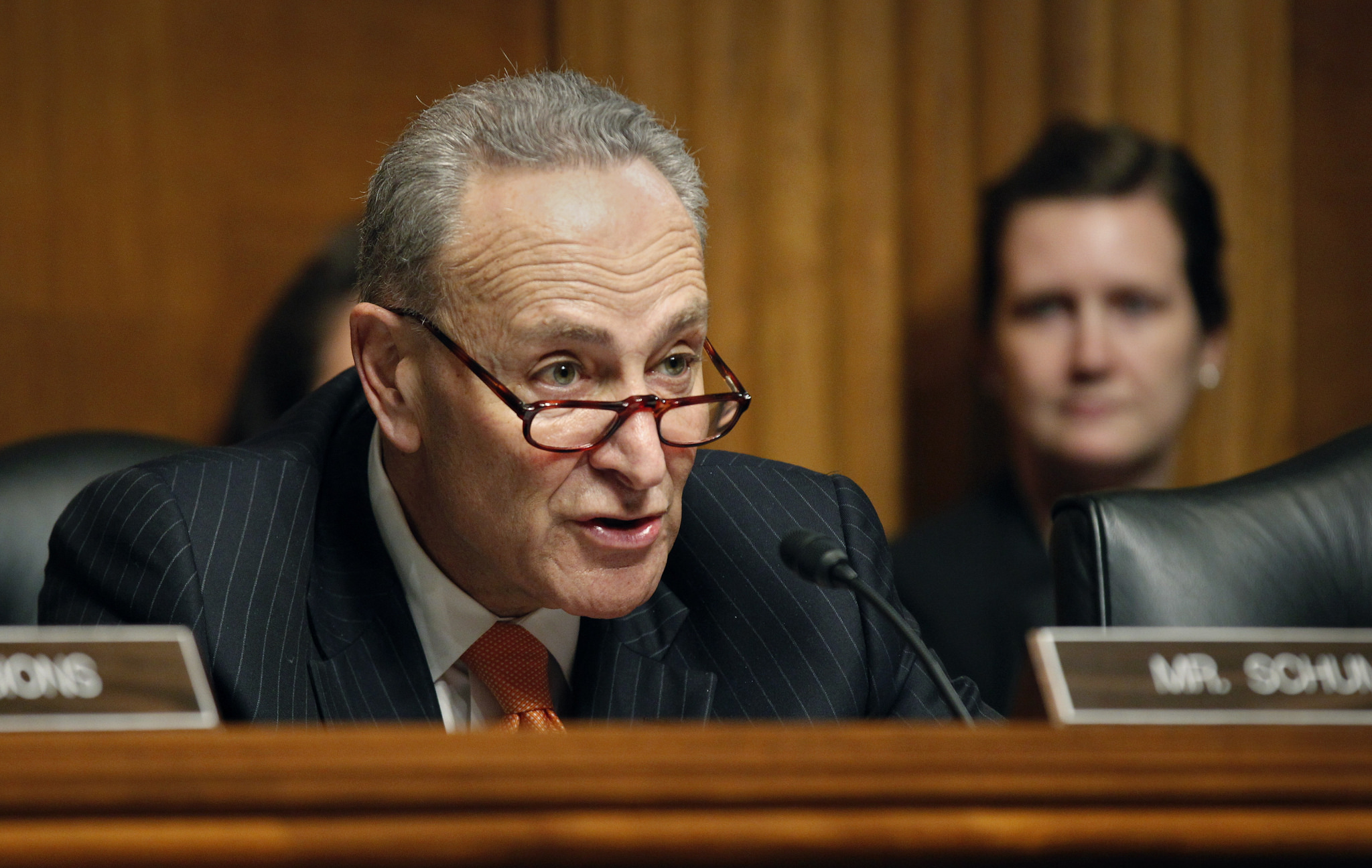
Sen. Charles Schumer, D-New York
Within hours, all the usual suspects were congratulating one of the most scorned U.S. presidents in history for taking the leap.
Senate Minority Leader Chuck Schumer said: “Making sure Assad knows that when he commits such despicable atrocities he will pay a price is the right thing to do.” House Minority Leader Nancy Pelosi described Trump’s missile barrage as “a proportional response to the regime’s use of chemical weapons.”
Republican super-hawks Senators John McCain and Lindsey Graham, previously as anti-administration as any Democrat, issued a joint statement declaring that Trump “deserves the support of the American people,” while liberal heart-throb Sen. Elizabeth Warren also agreed that “the Syrian regime must be held accountable for this horrific act.”
The Guardian, as fiercely anti-Trump as it is anti-Putin and anti-Assad, conceded that “Donald Trump has made his point” and that the next step would be up to Russia. All in all, Trump had never gotten such good press. It’s clear that Official Washington was pleased with Trump’s handiwork and was eager to encourage him to do more.
But the missile barrage was not just an assault on Syria but on reason and good sense, too. Although the Washington Post’s Adam Taylor tried to make it seem that the only critics of the missile barrage are members of the alt-right “known for espousing racist, anti-Semitic and sexist points of view,” the fact is that criticism flowed in from other quarters.
At Alternet, Vijay Prashad pointed out that there were few independent observers in Khan Shaykhun, the farming town where the April 4 incident occurred, to provide an accurate account. Eyewitnesses “with the densest relationship to the armed opposition,” he wrote, “are the first to claim that this attack was done by the government.”
Consortiumnews’ Robert Parry pointed out that rather than dropping the gas themselves, Syrian or Russian warplanes could well have triggered an outbreak by bombing a facility containing “chemicals that the rebels were planning to use in some future attack.” Parry also noted that Al Qaeda, which controls Idlib province, could have “staged the incident to elicit precisely the international outrage directed at Assad as has occurred.”
[Previously, United Nations investigators have received eyewitness testimony from Syrians about rebels staging an alleged chlorine-bomb attack so it would be pinned on the Assad regime.]
Something similar may well have occurred in August 2013, a sarin-gas missile attack on the outskirts of Damascus that killed hundreds and that appears to have been launched from a rebel-controlled area two kilometers away. The two incidents are curiously parallel.
The August 2013 incident, which horrified the world and brought the Obama administration to the brink of its own attack on the Syrian government, occurred just days after a U.N. team had arrived in Damascus to investigate an alleged chemical attack by rebels against Syrian government troops some four months earlier.
It made little sense for the Assad regime to have invited U.N. investigators in and then launch a more horrific chemical-weapons attack just miles from the investigators’ hotel. It would be a bit like someone inviting a police inspector to dinner and then committing a murder in full view.
Not Making Sense
As one independent analysis noted in 2013, the Assad regime would have to have decided to carry out a large-scale attack “despite (a) making steady gains against rebel positions, (b) receiving a direct threat from the US that the use of chemical weapons would trigger intervention, (c) having constantly assured their Russian allies that they will not use such weapons, (d) prior to the attack, only using non-lethal chemicals and only against military targets.”
The Assad government would also have had to decide “to (a) send forces into rebel-held area, where they are exposed to sniper fire from multiple directions, (b) use locally manufactured short-range rockets, instead of any of the long-range high quality chemical weapons in their arsenal, and (c) use low quality sarin.”
All of which seems supremely unlikely, but much of the mainstream U.S. media still treats the 2013 sarin-gas attack as the undeniable case of Assad crossing Obama’s “red line” against using chemical weapons. And the highly dubious 2013 incident is cited as a key reason to believe that Assad has done it again. [Recently, The New York Times has quietly backed off the 2013 claims although not explicitly retracting its earlier reporting blaming the attack on the Assad regime.]
Assad would have possibly even stronger reasons not to deploy sarin gas on April 4, 2017. He would have to make a conscious decision to court world opprobrium at a time when the tide of the war was finally turning in his favor with the liberation of Aleppo last December and with most world leaders having concluded that the Assad regime was here to stay.
To have produced and deployed a sarin bomb would have meant deliberately risking military intervention more than three years after Syria reached an agreement with the United Nations to destroy its entire chemical-weapons stockpile so as to avoid … military intervention.
All of which seems supremely unlikely as well. It would be an act of suicide – and after holding off a combined U.S., Saudi, Qatari, and Turkish assault for half a decade or more, one thing that Assad does not appear to be is suicidal.
Although Secretary of State Rex Tillerson said, “there is no doubt in our mind that the Syrian regime under the leadership of Bashar al-Assad is responsible for this horrific attack,” in reality there is plenty of doubt.
Nevertheless, Trump decided to fire away before the facts were in because the enemy he is most worried about is not the one half a world away in Syria, but the Democratic-neocon alliance in his own backyard. The political warfare in Washington is now generating more agony from real wars in the Middle East.
Guardian’s new low of journalistic abdication
OffGuardian | April 8, 2017
The world stands on the brink of global conflict. Nuclear war is currently a serious possibility. The US launched an attack on a Russian ally state based on completely unproven claims that it had used chemical weapons on its own people. No investigation to verify these claims has yet been undertaken. Responsible journalism needs to play an urgent part in pulling the situation back from the brink. It needs to point out the lack of data and the requirement for cool heads and rational thinking. But today, of all days, this is the Guardian’s headline.

Guardian headline April 8 2017
“Again.” Could there be a more complete abdication of journalistic responsibility to question and inform? Do the Guardian editorial staff who sanctioned this offence realise they are not simply advertising their own lack of moral fibre but may also be propagandising for the end of the world, themselves and their loved ones? Or does some innate hubris make them feel immortal and invulnerable? If so, by the time they realise they were wrong it will be very much too late for all of us.
Russian ambassador to UN asks US counterpart to avoid insulting Russia
TASS – April 7, 2017
UNITED NATIONS – Russian Deputy Ambassador to the UN, Vladimir Safronkov, on Friday urged U.S. Ambassador Nikki Haley to refrain from insulting Russia and to put collective work at the Security Council on a healthy basis.
“I’d like to ask the speakers here – the U.S. representative and members of other delegations – to refrain from insulting my country,” Safronkov said at an emergency meeting of the Security Council. “No one has the moral right to do it. We never allow ourselves to do such things.”
As the U.S. Ambassador and current President of the UN Security Council, Haley “has a real chance to put collective work at the Council on a healthy footing but this will never happen if the viewpoint of just one nation is passed off for absolute truth.”
Nikki Haley alleged in her speech at the meeting Russia, which “(…) is supposed to be a guarantor of the removal of chemicals weapons from Syria”, had failed to do so, “(…) as innocent Syrians continue to be murdered in chemical attacks.”
“It could be that Russia is knowingly allowing chemical weapons to remain in Syria,” she claimed. “It could be that Russia has been incompetent in its efforts to remove the chemical weapons. Or, it could be that the Assad regime is playing the Russians for fools, telling them that there are no chemical weapons, all the while stockpiling them on their bases.”
“The world is waiting for Russia to reconsider its misplaced alliance with Bashar Assad,” Haley said.
Is Noam Chomsky Manufacturing Consent for Regime Change in Syria?
By Kim Petersen | American Herald Tribune | April 7, 2017
One might well expect the corporate/state media to twice be complicit for the gas attack perpetrated by the Syrian regime scenario. One would hope, however, that media independent of the state and corporate sponsors would apply a higher journalistic standard. Yet Democracy Now! has been pushing the imperialist agenda for regime change in Syria. Tendentious recent reports from DN make this abundantly clear. The so-called independent [1] DN has also lured octogenarian professor Noam Chomsky to criticize the “Assad regime.”
DN begins with the leading statement of “worldwide outrage mounts over an alleged chemical weapons attack in Idlib province, which was reportedly carried out by the Assad government…” No evidence is presented to support the accusation, and the accusers also are unnamed. What kind of journalism is this?
It would be completely nonsensical and insane for Syria to use chemical weapons while the war is turning in its favor. And, of course, there is evidence that refutes the allegation. For the record, when a Zionist and war criminal Barack Obama was bent on attacking Syria in 2013 following false accusations that the Assad government used sarin gas in Ghouta, Syria – to preempt the threatened invasion Assad agreed (UN Resolution 2118) to give up Syria’s stockpile of chemical weapons (a deterrence against Israel’s nuclear weapons). Now the Syrian government stands accused of using a chemical that was disposed of under international supervision. Is the Syrian government that stupid to risk another threat of invasion by using a non-conventional attack? And why is this new gas attack in Idlib taking place just after Rex Tillerson declared that it is the Syrian people who should decide the fate of their current president?
The professor tells DN: “Syria is a horrible catastrophe. The Assad regime is a moral disgrace. They’re carrying out horrendous acts, the Russians with them.”
How about a dose of skepticism? After all, Chomsky speculated recently of a Donald Trump-orchestrated false flag. Chomsky’s opening omissions speak loudly. He goes straight at the Syrian government; he does not mention involvement by the US, Israel, and other western states. He does not mention the western, Saudi, and Qatari-backed terrorist mercenaries that seek to topple a foreign government through violence.
Indeed Chomsky, the linguist, has dipped into the imperialist lexicon. He criticizes the Assad “regime.” I am unaware of Chomsky ever referring to a Trump, Obama or other US “regime” or of an Israeli “regime.” To be sure, Chomsky has been a critic of US terrorism and imperialism and of Zionist crimes against Palestinians, but I am unaware of Chomsky referring to US, Israeli, or other western regimes as a “moral disgrace.” It might be implicit but not explicit.
Moreover, to criticize “the Assad regime” seems starkly at odds with a fundamental tenet of Chomsky’s philosophy: that his concern is primarily the terror and violence carried out by his own state, the USA.[2]
Chomsky is even on record as denying American-Israeli intent at regime change in Syria. If Chomsky is correct, then that would signal a profound change in American imperialist direction. In 2007, former US general Wesley Clark, told of a classified memo describing the US “tak[ing] out seven countries in five years, starting with Iraq, then Syria, Lebanon, Libya, Somalia, Sudan and Iran.”
DN asks Chomsky: “Why the Russians with them [the ‘Assad regime’]?”
Replied Chomsky: “Well, pretty simple reason: Syria is their one ally in the whole region. Not a close ally, but they do have—their one Mediterranean base is in Syria. It’s the one country that’s more or less cooperated with them. And they don’t want to lose their one ally. It’s very ugly, but that’s what’s happening.”
That is Chomsky’s assessment, but it is factually inaccurate. Iran and Hezbollah are helping fight the terrorists in Syria. Also Chomsky does not discuss an important point: that Russia was invited to aid the Syrian government, as were Iran and Hezbollah.[3] The US is uninvited and Syrian president Assad calls US forces in Syria “invaders.” Chomsky is well versed as to what happens when uninvited US forces show up in foreign lands – among them Korea, Viet Nam, Panama, Grenada, Somalia, Haiti, Afghanistan, Iraq, Libya, Yemen, etc: genocide, millions killed, millions displaced, economic infrastructure destroyed, and vassalage.
Later in the interview, Chomsky almost exculpates the Russians when he mentions “an initiative from the Russians … for a negotiated settlement, in which Assad would be phased out, not immediately…. The West would not accept it, not just the United States. France, England, the United States simply refused to even consider it. At the time, they believed they could overthrow Assad, so they didn’t want to do this, so the war went on.”
Is the West’s refusal of a negotiated settlement not a “moral disgrace”?
Says Chomsky, “Qatar and Saudi Arabia are supporting jihadi groups, [Italics added. Again Chomsky borrows from the imperialist lexicon. Why not characterize, then, western groups as “crusaders”?] which are not all that different from ISIS. So you have a horror story on all sides. The Syrian people are being decimated…. the country is simply being destroyed. It’s descending to suicide.”
Suicide? When US invaders are in Syria, when western governments and operatives are arrayed against the Syrian government, when Saudi and Qatari governments are supporting terrorists, and when Syrian people are being killed and made into refugees, then why describe this as a “suicide”? Does Chomsky want to imply that the Syrian people bear responsibility for the horror and decimation imposed upon them from outside? It sounds absurd.
Moral Imperatives
As a first imperative, all uninvited outsiders should vacate Syria immediately. As a second imperative, all parties responsible for aggression against Syria and its peoples must be charged and prosecuted. Third, any crimes committed by the Assad government in allegedly putting down peaceful protests must be investigated and where such charges are valid, then prosecution must be carried out.
Noam Chomsky has garnered enormous respect for his opposition to US crimes, support for social justice, and anarchist leanings. Yet, Chomsky also stakes out positions that appear flawed (his statement that the truth doesn’t matter as to 9-11), even morally questionable (his opposition to the Palestinian-led Boycott, Divestment, and Sanctions movement).
It is imperative is that people become informed. We should all listen to the words of intellectuals and persons who have demonstrated great integrity, but we must also pay heed to our internal dissonance to seemingly incongruous information; we must question and apply rigorous challenge to that information; and based on our assessment of the factual accuracy, logic, and morality of the information we must reach our own conclusions. Avoid the allure of unquestioningly accepting the words of authority! Regardless of personage, open-minded skepticism is the key to developing our own ability to cut through disinformation and thwart the insidious acts propaganda is intended to disguise.
Critical and moral thinking is crucial to the revolution for a free and socially just world.
ENDNOTES
- As the whistleblowing former FBI contractor Sibel Edmonds, among others, has pointed out DN receives large foundation grants:Serious questions have arisen about how Democracy Now!, begun and developed with the resources of Pacifica Radio and grants from the Carnegie Corporation, the Ford Foundation, the J.M. Kaplan Fund and others, suddenly became independent and the effective property of Amy Goodman without recompense to Pacifica. This transferapparently included valuable assets such as trademarks, ownership of years of archived programs, affiliate station access, and more. In a contract that remains secret, Amy Goodman is also receiving $1 million per year for a five-year period that began in 2002, according to Pacifica Treasurer Jabari Zakiya, to continue doing what has become Pacifica’s flagship morning news program. This is more than double Goodman’s officially stated stipend of $440,000 per year from Pacifica Radio. Democracy Now! receives indirect funding from George Soros, and direct funding from the Ford Foundation, the Glaser Foundation, Soros’ Open Society Institute… [Emphasis in original]
- See Noam Chomsky, On Power and Ideology: The Managua Lectures (South End Press, 1987.)
- Colleague BJ Sabri and I concluded in part 6 — “A Russian White Knight or an Interventionist Power?” — of our 7-part series on “The Imperialist Violence in Syria”:
“Russia, although it entered the war on the side of the legitimate government, Russia has never declared any strategy or long-term objective in Syria except the one supporting a legitimate U.N. member from not being overrun by American/Saudi-supported terrorists and mercenaries.”
BBC redacts article on Idlib to hide unwelcome facts
OffGuardian | April 7, 2017
The push for “action” following the alleged chemical attack in Idlib, Syria is reaching fever pitch. Indeed, it may already have had disastrous consequences. The spokespeople for power that are the Western press consider the case against the Assad regime air-tight. Absent any forensic, or even circumstantial, evidence the mainstream media have resorted to simple arguments from authority looks of bewilderment.
The trouble is “authority” doesn’t seem have any cohesion in this matter – so the press have carefully chosen who they will listen to… and who they will remove from their websites.
Col. Hamish de Bretton-Gordon is the favored voice of “reason” on these matters, he has dismissed any idea other than a deliberate attack by the Syrian government as “fanciful”. And has been cited everywhere from Channel 4, to the Daily Mail to the Guardian, to the BBC. He is universally credited as a “chemical weapons expert” who works as the director of “Medics Under Fire”…. but that’s not his only job, just his most recent.
He was originally in the British army, filling an important role at NATO:
Previously Commanding Officer of the UK CBRN Regiment and NATO’s Rapid Reaction CBRN Battalion, Hamish is one of the most operationally experienced CBRN practitioners in the World and is regarded as one of the leading experts in Chemical and Biological Counter Terrorism and warfare.
With other hints from his biography suggesting some work in espionage or military intelligence:
He has also worked with US networks and British newspapers to smuggle chemical samples out of Syria for verification in UK and France.
… so he’s hardly an objective source.
Of course, “Medics Under Fire” is nothing like what it appears to be, either. Its name conjures up imagery of global charities, along the lines of Medecins sans Frontieres. It is nothing like that, in truth it is a Western-backed NGO working out of Syria, very much like the White Helmets. In fact, their websites are almost completely identical.
On the other side of this narrow divide is Jerry Smith, a chemical weapons expert who took part in the removal of Syria’s chemical weapons stocks in 2013. He is hardly a frothing pro-Assad alternative voice, but he takes a measured approach. He wrote in the Guardian :
Russia’s claim that the latest poisoning is a result of a conventional attack on an opposition arms storage facility should not be dismissed out of hand. While it is true that nerve agent can be destroyed by explosion, it is perfectly possible that some agent could survive and be ejected out as a result of an explosion.
… but obviously nobody there was listening, because “dismissing it out of hand” is exactly what they have done.
Mr Smith was also interviewed on Channel 4 news (curiously absent from their online archive), and ABC news in Australia, both times saying very similar things.
The BBC referenced and quoted his Channel 4 interview in their article on the attack, this quote was included in an article headlined Syria chemical ‘attack’: Trump condemns ‘affront to humanity’:
… the official who led the UN-backed operation to remove Syria’s chemical weapons told the UK’s Channel 4 News that the Russian version of events could not be discounted.
“If it is Sarin that was stored there and conventional munitions were used, there is every possibility that some of those [chemical] munitions were not consumed and that the Sarin liquid was ejected and could well have affected the population,” Jerry Smith said.
This paragraph was completely removed just 35 minutes later. The current version of this article makes no mention of Mr Smith at all. No reason is given, and there is no note referencing that the article had been amended.
A reminder that these are standards deemed acceptable by the “news service” for which we are all forced, by law, to pay.
Our thanks to the media lens twitter for bringing this issue to our attention, and to newssniffer for the very important work they do.
British journalist destroys MSM lies on Syria
Syriana Analysis | April 6, 2017
Exclusive interview with British Journalist Tom Duggan in Damascus at the French Hospital tells us about the chemical attacks accusations.
Interview conducted by Hanin Elias
***Follow Syriana Analysis***
YouTube: https://www.youtube.com/c/syrianaanal…
Facebook: https://www.facebook.com/SyrianaAnalysis
Twitter: https://twitter.com/SyrianaAnalysis
‘Take Out His Airfields’: Hillary Clinton Comes Out of Woods to Warmonger
Sputnik – 07.04.2017
Defeated Democratic presidential candidate Hillary Clinton made a rare public appearance on Thursday evening — to come out and push for the US to bomb Syria.
The former secretary of state called for more US international intervention while speaking at the Women of the World Summit in New York, saying that the US should target Syrian airfields.
“That air force is the cause of most of the civilian deaths, as we have seen over the years and as we saw again in the last few days,” Clinton said.
“I really believe that we should have — and still should — take out his airfields and prevent him from being able to use them to bomb innocent people and drop sarin gas on them,” she added, referring to Syrian President Bashar al-Assad, and aligning herself with the likes of Iraq War architect Bill Kristol and neoconservatives such as Republican Senator John McCain.
The chemical attack has raised many eyebrows, however, as it came just days after the Trump administration stated that Syrians should decide who is running their country.
“It makes no sense, even if you were totally separate from this and take no sides of this and you were just an analyst, it doesn’t make sense for Assad under these conditions to all of the sudden use poison gasses. I think it’s zero chance that he would have done this deliberately,” former Texas congressman Ron Paul said on Wednesday.
Kentucky Representative Thomas Massie has also been outspoken about how the attack would not serve Assad’s interests.
“Let me ask you this: Who benefits? Who benefits, if chemical weapons were used and America weighs in on the side of the rebels, or wades into a war against Assad?” Massie said in an interview on CNN. “How does Assad benefit from that?”
Many of Trump’s most prominent supporters on social media have also been urging the president to ignore calls for intervention.
US rep shocks CNN anchor by questioning Syria gas attack narrative
RT | April 6, 2017
CNN anchor Kate Bolduan was flabbergasted after Representative Thomas Massie (R-Kentucky) questioned a recent chemical gas attack in Syria, then said it wouldn’t be in President Bashar Assad’s interest to conduct such a strike on his own people.
Bolduan interviewed Massie, a tea party darling and member of the House Freedom Caucus, about the US response to the reported chlorine gas attack on civilians in Syria that killed more than 80 people, including children. Massie voted against an American intervention in Syria in 2014.
“You see the images coming out of Syria and you think the best policy for the United States right now is to do nothing?” Bolduan asks towards the end of the 7.5-minute interview.
Massie cautions that American intervention might make the situation on the ground worse, then notes that “the first casualty of war is the truth.”
“It’s hard to know exactly what’s happening in Syria right now,” he continued. “I’d like to know specifically how that release of chemical gas, if it did occur ‒ and it looks like it did ‒ how that occurred. Because frankly I don’t think Assad would have done that. It does not serve his interest, it would tend to draw us into that civil war even further.”
Bolduan can’t contain herself from interrupting, her expression shocked, to haltingly ask who Massie thinks is behind the attack.
“Supposedly the airstrike was on an ammo dump, and so I don’t know if it was released because there was gas stored in the ammo dump or not,” he replied. “That’s plausible; I’m not saying that’s what I think happened…”
Baffled, Bolduan interrupts again to tie Massie to Assad and the Syrian president’s Russian backers.
“You’re more inclined to believe the position of what Bashar Al-Assad is saying and what the Russians are saying right now than more inclined to agree with, believe what your even your colleagues here in the United States believe is true, that this is Assad and what human rights observers over there say is Assad?” she asks incredulously.
“I don’t think it would have served Assad’s purposes to do a chemical attack on his people. So, you know, it’s hard for me to understand why he would do that if he did,” Massie replied.
Still stunned, Bolduan ends the interview.
Massie is most known for his repeated attempts to abolish the US Department of Education, as well as his pronouncement in mid-March that he would change his vote on the much-maligned American Health Care Act from “no” to “hell no.”
Why the Syrian Gas Attack Is Probably Fake
By Colin Liddell | Occidental Observer | April 5, 2017
Dirty tricks are like favourite records: play them too much and they get jaded. We haven’t heard about gas attacks in Syria for some time, but now, once again, the media — and, sadly, the Trump administration — is in overdrive about what is claimed to be a gas attack on the Syrian town of Khan Sheikoun by the Assad government.
First of all, the use of gas should not be regarded as particularly “evil” in a war that has also seen bombing and shelling of civilian areas as a matter of course, not to mention all the refinements to cruelty that ISIS and their like have introduced. But it is. We get it. Gas is “evil,” and you’re very, very bad if you use it. OK? So, stop!
But this means that gas attacks are also an extremely useful means of propaganda — but only if your opponents are seen to do them. In fact, this negative propaganda effect totally outweighs gas’s military benefits. And, yes, using gas may have military benefits, although in this case it’s hard to see how any possible benefits could outweigh the costs in terms of increasing the level of Western hostility.
An important precedent is the major gas attack, apparently by sarin rockets, that took place in the Damascus suburb of Ghouta in 2013 in which from between 350 and 1,400 people died.
Now, horrific as the attack was, there was a certain logic in it that made blaming the Syrian government plausible. The Syrian army was fighting street-to-street, house-to-house, trying to recapture urban territory, which any professional soldier can tell you is a nightmare for soldiers and civilian population alike. A way round this would be to use gas to clear out nests of entrenched opposition to make advances and pacification possible. Not ideal, obviously, but a way to break the deadlock and get a result. So, when the Ghouta attacks happened they at least made sense in a basic military tactical sense.
But any gains in this respect — and there weren’t many, as four years later Ghouta is still held by anti-Assad rebels — were soon outweighed by the negative international and diplomatic backlash, with the Obama and Cameron governments using the “propaganda” value of the attacks to push for military intervention.
Only strong countermeasures by the Russians, who claimed the attacks were false flag attacks designed to prepare the way for Western intervention, and a strong Russian commitment to support Assad, prevented this gas attack — false flag or not — becoming the death knell of the Assad government. Indeed, it is at least highly doubtful (see also here) that the attack was carried out by the Assad government.
Obviously gas attacks are an extremely risky and inefficient option for anyone, but especially the Assad government, so it simply doesn’t make sense that they would do this on purpose now. In fact there are a whole list of reasons why this couldn’t be a willful use of poison gas by the Assad government.
First, there’s the fact that Nikki Haley, the U.S. Ambassador to the United Nations, told reporters on March 30 that removing Assad was no longer a priority for the US:
You pick and choose your battles and when we’re looking at this, it’s about changing up priorities and our priority is no longer to sit there and focus on getting Assad out…
Do we think he’s a hindrance? Yes. Are we going to sit there and focus on getting him out? No. What we are going to focus on is putting the pressure in there so that we can start to make a change in Syria…
We can’t necessarily focus on Assad the way that the previous administration did…Our priority is to really look at how do we get things done, who do we need to work with to really make a difference for the people in Syria.
Given this, why would Assad risk the displeasure of the United States by doing something that reinforces the image presented by much of the media that he is a prime candidate for regime change? Why give fuel to Trump’s many critics by putting him in a difficult situation when he has just given you a free pass? On the other hand, if you really want renewed US effort to topple Assad, a false flag gas attack is just the ticket. Trump, under pressure from the media and many Republicans, may decide to change his mind and opt for a military confrontation.
So it’s no surprise that the neocon media immediately concluded that Assad was responsible. Michael Warren, writing in The Weekly Standard, hopes that the attack will change Trump’s policy toward Syria. For Neocon Jonathan Tobin, writing in National Review, it’s certain that Assad did it, and he wants to use this event to go after the neocons’ bête noire, Russia:
The Syrian government dropped a poison-gas bomb on a hospital, taking the lives of dozens, including eleven children. … This is a moment for the president, who is not generally shy about sounding off on his views of the world, to say something that puts the onus on Putin for Assad’s atrocities and makes clear that the U.S. won’t continue to turn a blind eye to the horror there.
Like 9-11, the gas attack is exactly the sort of thing the neocons want in order to panic the US into military intervention by providing a powerful moral rationale. Remember the moral opprobrium attached to Saddam Hussein that was so important in selling the disastrous Iraq war to the American people? Assad’s supposed gas attack on children in a hospital paints him as the epitome of evil.
And of course neocon favorites Senators John McCain and Lindsay Graham condemned the move. McCain‘s reasoning was that Trump, by de-prioritizing toppling the Assad regime, had encouraged Assad.
I’m sure they are encouraged to know the United States is withdrawing and seeking a new arrangement with the Russians. It is another disgraceful chapter in American history and it was predictable.
Sorry, but it seems ridiculous to try to launch a gas attack that kills a few dozen people in a civil war that has already killed between 321,000-400,000 people when it will be condemned by virtually everyone and has been used in the past as a pretext for US involvement. How could such a small-scale attack yield a strategic advantage? How can attacking a hospital and killing children have any military benefit at all?
There’s also the location. Khan Sheikoun is not on the front line. It is well in the rear, at least 10 miles from where the fighting is taking place, and ten miles is an enormous distance in this war where front lines have been moving slowly for years. This is clearly not Assad’s army clearing out an area of entrenched opposition so that they can advance.
So, there is absolutely no clear military rationale behind such an attack. In fact quite the reverse. In terms of negative propaganda for the Syrian government, the location is ideal: an isolated gas attack that harms civilians, but does not significantly endanger or inhibit journalists, allowing the latter to film and highlight the suffering of the former. We are now being inundated with images of dead babies and children writhing in pain—the emotional currency of Fourth Generation Warfare.
So, absolutely zero military benefit and a massive negative propaganda effect for the Syrian government. They would have to be insane to do it.
There are other possibilities. The worst one for the Syrian government would be an unwitting use of a bomb, shell, or rocket containing gas. This is not impossible, as there is always a chance that some gas weapons slipped through the net when the Assad government agreed to clear out its stockpiles of chemical weapons.
Another possibility is that a normal bomb, shell, rocket hit an opposition chemical weapons depot. Again there is no reason why this is impossible. Chemical weapons have been in the hands of various sides in this chaotic war.
Then there is the possibility of a false flag. In its favour is the fact that Syria and gas attacks haven’t been at the top of the news agenda for some time, so the shock effect on the uninformed public will be fresh and strong. If it worked in the 2013 attack in getting the US involved, maybe it will work again. Also arguing in favour of a false flag is the fact that the Assad government has been making gains and has been growing stronger for months. In short, they have been on a roll. The last thing they need is to be blamed for gassing civilians, while this clearly favors their opponents who need all the help from the West that they can get. Indeed, Zerohedge notes:
What was lost in all of today’s conflicting narratives is that it was an almost identical alleged chemical attack by Assad in 2013 that got the Obama administration involved in the Syria proxy war in the first place; the motive behind today’s attack is hardly any different.
It is clear then that the most likely explanation for this tragic event is either an accident or a false flag, and certainly not an intentional action by the Assad government.
Featured Video
Matt Bracken: US Plans Massive MOAB Strike on Iran?
or go to
Aletho News Archives – Video-Images
From the Archives
Confronting the Threat of Ethnic Bioweapons
By Tony Cartalucci – New Eastern Outlook – 29.11.2017
The United States Air Force’s 59th Medical Wing’s molecular biology branch recently was revealed to have been collecting specifically Russian RNA and synovial (connective) tissue samples, prompting fears in Russia of a possible US directed ethnic-specific bioweapons program. … continue
Blog Roll
 Aletho News
- The Downfall of a Manufactured Icon
- Matt Bracken: US Plans Massive MOAB Strike on Iran?
- Russia accuses France of ‘piracy’ over tanker seizure
- Why Yemen Is Bombing Saudi Arabia’s Airports: The War Behind the Headlines
- Sally Rooney’s books pulled from UK over support for Palestine Action
- Bombs for Tel Aviv, Promises for Riyadh
- Israeli ad agency conducted vast global espionage campaign using online ads: Report
- Oct. 7 Forever Marks The Big Reveal: ‘We See You, Israel, We Revile You, We Reject You!’
- Meet the US generals and admirals advancing Israeli policy
- Israel’s Straw Widow Protocol: The Kill Zones Where Civilians Were Labelled ‘Terrorists’
- If Americans Knew
- Israeli firm used online ads to run vast spy operation, researchers say
- No, the world zionist movement is not an antisemitic conspiracy theory
- Hundreds of IDF investigations into killings still have no public outcome, BBC Verify finds
- After Ashley Moody Epstein Probe, Donors Linked to Him Poured Money Into her Senate Campaign
- Worried about Russian meddling in UK politics? Wait till you see what Israel is up to
- Israeli settlers attack West Bank center for disabled children, church leader calls for int’l action
- Pulling Out Teeth Just to Live: How Israel Has Devastated Dental Care in Gaza
- Gaza’s “ceasefire” death toll passes 1,500 – Daily Update
- Activists Abused By Israel Return to New Freedom Flotilla Mission
- 60 Minutes won’t tell the full truth about Israeli settler violence
- No Tricks Zone
- New Study Suggests Large Regions Of The Pacific Ocean Have Been Cooling For The Last 80 Years
- Germany’s Green Energy Debacle: High Energy Costs Force Kahla Porzellan to Close After 182 Years!
- New Study: 50 Years Of The Most Aggressive ‘Net Zero’ Policies Can Only Affect The Global Climate By 0.03°C
- US September “Heat” Was No Record…Many Records Set Decades Ago
- Latest European Green Energy Debacle; Portugal’s Largest Flagship Solar Park Insolvent!
- Green Energy Debacle: German Expert Professor Fritz Vahrenholt Warns Of Severe Economic And Social Consequences
- Two More Paleo Reconstructions Affirm Meters-Higher Sea Levels Across Ireland, Brazil 7000-6000 Years Ago
- New Study: Earth And Venus Surface Warmth Largely Explained By Convection And Lapse Rate, Not CO2 Or Radiation
- 2025 Nature Paper Claiming Worsening Global Drought Gets RETRACTED …Heavily Flawed
- New Study: ‘Global Drought Shows No Detectable Recent Acceleration Under Climate Warming’

