Russian President Vladimir Putin told Israeli Prime Minister Benjamin Netanyahu in a telephone conversation that it was unacceptable to make “groundless” accusations concerning the alleged chemical weapons incident that took place in Syria earlier this week.
During the phone call initiated by the Israeli side on Thursday, Putin and Netanyahu stressed the importance of boosting international efforts to tackle terrorism, the Kremlin said in a statement.
Both sides “expressed readiness to expand [cooperation] in the interest of assuring stability and security in the Middle East and, first of all, in Syria,” it said.
In particular, Putin “pointed out that it was unacceptable to make groundless accusations against anyone without conducting a detailed and unbiased investigation.”
At least 70 people, including 11 children, were reportedly killed in a suspected chemical incident in the town of Khan Sheikhoun in Iblib province, Syria, on Tuesday. The US and its allies have put the blame on the Syrian government.
Earlier on Thursday, Israeli Defense Minister Avigdor Lieberman told the Yedioth Ahronoth newspaper that he was sure Syrian government forces were behind the “chemical weapons attack” in Idlib.
“The two murderous chemical weapons attacks on civilians in the Idlib region in Syria and on the local hospital were carried out by direct and premeditated order of Syrian President Bashar Assad, with Syrian planes. I say this with 100 percent certainty,” Lieberman said.
The defense minister criticized the ‘international community’ for having “zero” reaction to the incident, stressing that “the world needs to take responsibility and, instead of just talking, needs to do something.”
When asked if Russia was somehow involved in the chemical weapons attack, Liberman replied “we don’t know.”
The Russian Defense Ministry said the Syrian military carried out airstrikes in Khan Sheikhoun on April 4, hitting production facilities where terrorists stored chemicals, which were previously used in Iraq and the Syrian city of Aleppo.
Syrian Foreign Minister Walid Muallem has dismissed any accusations that the Syrian Army deployed chemical weapons in Idlib.
It’s impossible that the army – which has been making significant gains in almost all theaters of the Syrian war – would use banned chemical weapons against its “own people” and even terrorists, the minister said.
April 6, 2017
Posted by aletho |
Ethnic Cleansing, Racism, Zionism, Mainstream Media, Warmongering, Wars for Israel | Benjamin Netanyahu, Israel, Russia, Syria, Zionism |
Leave a comment
Things were looking good for days. President Donald Trump had reportedly sent US senator Tulsi Gabbard on a fact-finding mission in Syria and wanted to know if President Assad would cooperate with the US in defeating ISIS. Assad was willing to cooperate with the new American president. US Secretary of State Rex Tillerson’s recent statement in Ankara that the US had renounced its desire to remove Assad seemed to mark a major policy shift in the right direction.
French presidential favourite Marine Le Pen was unequivocal in her desire to work with the Syrian government to defeat Takfiri terrorism. France’s Popular Republican Union party (UPR) recently invited journalist Vanessa Beeley to address their election campaign where she delivered an inspiring speech on Syria. Francois Asselineau, the party’s leader, is the most progressive and anti-imperialist candidate in the French election.
For a few days, it seemed as though the tide was turning in favour of peace and good sense. Then, as peace negotiations with the Syrian government were progressing, the Syrian gas saga returned with a vengeance.
If you are new to the topic of Syria, there are a few matters which need to be cleared up here. The country’s leader, Bashar Al-Assad, is democratically elected. He is neither dictatorial nor brutal. All of the “sources” which the mainstream Western media use to write their stories on Syria come from organisations such as the ubiquitously cited Syrian Observatory for Human Rights (SOHR). SOHR is neither Syrian nor a human rights organisation. It is a one-man show run by Rami Abdel Rahman, an anti-government exile based in Coventry England. He hasn’t been in Syria for more than two decades. Almost all Western media sources come from this man!
So, the intrepid and indefatigable purveyors of “serious” journalism in France’s Le Monde were busy yesterday doing what they do best: war propaganda. Having implanted the belief in the uncritical reader’s brain through headlines accusing the Syrian government of gassing its own people – this time in Khan Cheikoun in the outskirts of Idlib – according to “the sources”, the real story emerges from the rubble of the aforementioned “sources”: the Syrian Army have intensified operations against “rebels” in the area contiguous to Idlib and Hama in recent weeks.
“The Operation” writes Le Monde’s Benjamin Barthes “which enabled the insurgents to come to at least within 10 kilometres of their aim, was led by the Jihadists of the Fatah Al Sham Front, an emanation of Al Qaida”. So there you have it! Le Monde has just told you once again that the “rebels” and “insurgents” are in fact led by an “emanation of Al-Qaida.
Our governments are supposed to be fighting Al-Qaida, supposed to be protecting us from them. The Syrian government – which NATO admitted in 2013 has the support of the majority of the Syrian people – claims to have bombed a chemical weapons depot in Khan Cheikoun. The information has been confirmed by the Russian military.
Even if you believe Bashar Al-Assad is secretly a devil “killing his own people”, surely the man is intelligent? If he wants to stay in power, getting the United States off his back would be a major help, would it not? So, just days after the United States looked like it was going to work with Assad against ISIS, he just couldn’t resist spraying that gas on innocent children and all the war-weary generals of the Syrian Arab Army are cowering in the barracks, abjectly carrying out every whim of the Damascene butcher and now facing a carpet bombing campaign by NATO! How did such a crazy fool manage to stay in power so long!?
Yesterday morning on France Inter radio station, academic dullards were pontificating about “post-truth”, “fake news” and of course, “conspiracy theories”. Russian media in France is increasingly coming under the spotlight. Some pundits have accused Moscow of destabilising European opinion. But critical minds always seek clarity and the French are a most critically-minded people. The war lobby is howling in Washington and Brussels and a silence of cruel complicity was observed in Western capitals following the terrorist attacks in St Petersburg on Monday. We have been taught to hate Russia.
In the French presidential debates on the 4th of April there were only two candidates the establishment fear: François Asselineau and Marine Le Pen. Of the two, Asselineau is unquestionably superior. Unlike Le Pen, Asselineau wants to leave NATO and not just the Military Command Structures. He wants leave the EU and not just have a time-wasting referendum on it. Asselineau wants to reform the Conseil de Resistance Nationale (the National Council of the Resistance) – the post war council formed by patriots and communists to reconstruct France.
Asselineau’s UPR could be the surprise in this election. No genuine communist could vote for that perfidious caitiff, that execrable little Trotskyite trashbag Jean-Luc Mélenchon! The pseudo-leftist defends wars of aggression as long as they have their UN mandates and ‘humanitarian’ cover. Mélenchon is the incarnation of everything that is putrid and pathetic on the “Left.” In fact, he is not left-wing at all. He is a right-wing demagogue who pipes the far-left tune – another Alexis Tsipras, another Sorosite, fake social-democratic class traitor!
Yesterday morning the republican presidential candidate was drilled by France Inter’s war-monger-in-chief Patrick Cohen concerning the French government’s response to the alleged gassing in Syria. Fillon, who has faced an avalanche of dubious allegations due to his connections with pro-Assad Lebanese businessmen and his desire for peace with Russia, said tellingly that the Syrian leader makes “incredible mistakes”. Fillon seemed to suggest that Assad couldn’t be that stupid and demanded “proof”- to the chagrin of Patrick Cohen!
Trump has now excluded Chief Strategist Steve Bannon from the National Security Council. The CIA and Joint-chiefs of Staff are also back in the council. The US Deep State is triumphant and the White House is pushing UN war resolutions against Syria. In France we need a patriotic leader capable of challenging the Empire; we need the National Council of the Resistance. In the aftermath of American populist failure, now is the time to build the European popular front!
April 6, 2017
Posted by aletho |
Mainstream Media, Warmongering | al-Qaida, European Union, France, Francois Asselineau, NATO, SOHR, Syria, United States |
Leave a comment
Syria’s foreign minister has dismissed allegations that the Syrian Army had deployed chemical weapons in the city of Idlib, saying the military will never use such weapons against its own people or even terrorists.
Syrian Foreign Minister Walid Muallem denied claims that the military used chemical weapons in the western city of Idlib. Speaking at a news conference on Thursday, Muallem said an airstrike by Syrian military had targeted an arms depot where chemical weapons stockpiles were stored by Islamic State (IS, formerly ISIS/ISIL) and Al-Nusra Front militants.
He said it’s impossible that the army – which has been making significant gains in almost all theaters of the Syrian war – would use banned chemical weapons against its “own people” and even terrorists.
Asked if Damascus would allow a fact-finding mission into the Idlib incident, Muallem said past experience of similar investigations was “not encouraging.” He also said that he could not predict “the reality of US intentions” in Syria.
Muallem added that such a mission must not be politicized and must start its operations “from Damascus, not Turkey,” apparently referring to the latest statements by Ankara condemning the incident, as well as the fact that some victims were taken to Turkey for autopsy.
‘Monstrous crime’
Meanwhile, Dmitry Peskov, spokesman for the Russian president, said the Kremlin believes the Syrian military will do its utmost to prevent chemical agents from falling into the hands of terrorists.
“This was indeed a dangerous and monstrous crime, but in our opinion, it would be wrong to point fingers,” Peskov told reporters on Thursday. The Kremlin spokesman said Moscow does not agree with assessments provided by certain Western countries.
“Immediately after the tragedy no one had access to this area, so no one could have hard verifiable data. Consequently, any information which the US side or our colleagues from other countries might have had access to, could not be based on objective facts,” Peskov told reporters.
Though Peskov rejected “hasty assessments” of the alleged use of chemical weapons, he emphasized that there are always disagreements between Moscow and Washington, but mutual discords over the Idlib incident are unlikely to affect “the spirit of our cooperation.”
Earlier in the day, the Russian Foreign Ministry dismissed as “unsubstantiated” statements by US Vice-President Mike Pence that Moscow and Damascus had failed to fulfill their obligations under a landmark 2013 deal to eliminate Syria’s chemical weapons arsenals.
“I wouldn’t use profane language, especially when it comes to the second-most powerful man in the US administration, but I do believe that this is ignorance rather than irresponsibility,” Mikhail Ulyanov, head of the ministry’s Arms Control Department, said.
“The new administration has only recently begun reviewing its policy. Once that’s done, American officials’ statements, I hope, will become more accurate. There is no reason to say the US-Russia agreements [on eliminations Syria’s chemical weapons stockpiles] did not work,” Ulyanov stated.
April 6, 2017
Posted by aletho |
Mainstream Media, Warmongering | Russia, Syria, United States |
Leave a comment
With the latest hasty judgment about Tuesday’s poison-gas deaths in a rebel-held area of northern Syria, the mainstream U.S. news media once more reveals itself to be a threat to responsible journalism and to the future of humanity. Again, we see the troubling pattern of verdict first, investigation later, even when that behavior can lead to a dangerous war escalation and many more deaths.
Before a careful evaluation of the evidence about Tuesday’s tragedy was possible, The New York Times and other major U.S. news outlets had pinned the blame for the scores of dead on the Syrian government of Bashar al-Assad. That revived demands that the U.S. and other nations establish a “no-fly zone” over Syria, which would amount to launching another “regime change” war and would put America into a likely hot war with nuclear-armed Russia.
Even as basic facts were still being assembled about Tuesday’s incident, we, the public, were prepped to disbelieve the Syrian government’s response that the poison gas may have come from rebel stockpiles that could have been released either accidentally or intentionally causing the civilian deaths in a town in Idlib Province.
One possible scenario was that Syrian warplanes bombed a rebel weapons depot where the poison gas was stored, causing the containers to rupture. Another possibility was a staged event by increasingly desperate Al Qaeda jihadists who are known for their disregard for innocent human life.
While it’s hard to know at this early stage what’s true and what’s not, these alternative explanations, I’m told, are being seriously examined by U.S. intelligence. One source cited the possibility that Turkey had supplied the rebels with the poison gas (the exact type still not determined) for potential use against Kurdish forces operating in northern Syria near the Turkish border or for a terror attack in a government-controlled city like the capital of Damascus.
Reporting by investigative journalist Seymour Hersh and statements by some Turkish police and opposition politicians linked Turkish intelligence and Al Qaeda-affiliated jihadists to the Aug. 21, 2013 sarin gas attack outside Damascus that killed hundreds, although the Times and other major U.S. news outlets continue to blame that incident on Assad’s regime.
Seasoned Propagandists
On Tuesday, the Times assigned two of its most committed anti-Syrian-government propagandists to cover the Syrian poison-gas story, Michael B. Gordon and Anne Barnard.
Gordon has been at the front lines of the neocon “regime change” strategies for years. He co-authored the Times’ infamous aluminum tube story of Sept. 8, 2002, which relied on U.S. government sources and Iraqi defectors to frighten Americans with images of “mushroom clouds” if they didn’t support President George W. Bush’s upcoming invasion of Iraq. The timing played perfectly into the administration’s advertising “rollout” for the Iraq War.
Of course, the story turned out to be false and to have unfairly downplayed skeptics of the claim that the aluminum tubes were for nuclear centrifuges, when the aluminum tubes actually were meant for artillery. But the article provided a great impetus toward the Iraq War, which ended up killing nearly 4,500 U.S. soldiers and hundreds of thousands of Iraqis.
Gordon’s co-author, Judith Miller, became the only U.S. journalist known to have lost a job over the reckless and shoddy reporting that contributed to the Iraq disaster. For his part, Gordon continued serving as a respected Pentagon correspondent.
Gordon’s name also showed up in a supporting role on the Times’ botched “vector analysis,” which supposedly proved that the Syrian military was responsible for the Aug. 21, 2013 sarin-gas attack. The “vector analysis” story of Sept. 17, 2013, traced the flight paths of two rockets, recovered in suburbs of Damascus back to a Syrian military base 9.5 kilometers away.
The article became the “slam-dunk” evidence that the Syrian government was lying when it denied launching the sarin attack. However, like the aluminum tube story, the Times’ ”vector analysis” ignored contrary evidence, such as the unreliability of one azimuth from a rocket that landed in Moadamiya because it had struck a building in its descent. That rocket also was found to contain no sarin, so it’s inclusion in the vectoring of two sarin-laden rockets made no sense.
But the Times’ story ultimately fell apart when rocket scientists analyzed the one sarin-laden rocket that had landed in the Zamalka area and determined that it had a maximum range of about two kilometers, meaning that it could not have originated from the Syrian military base. C.J. Chivers, one of the co-authors of the article, waited until Dec. 28, 2013, to publish a halfhearted semi-retraction. [See Consortiumnews.com’s “NYT Backs Off Its Syria-Sarin Analysis.”]
Gordon was a co-author of another bogus Times’ front-page story on April 21, 2014, when the State Department and the Ukrainian government fed the Times two photographs that supposedly proved that a group of Russian soldiers – first photographed in Russia – had entered Ukraine, where they were photographed again.
However, two days later, Gordon was forced to pen a retraction because it turned out that both photos had been shot inside Ukraine, destroying the story’s premise. [See Consortiumnews.com’s “NYT Retracts Russian-Photo Scoop.”]
Gordon perhaps personifies better than anyone how mainstream journalism works. If you publish false stories that fit with the Establishment’s narratives, your job is safe even if the stories blow up in your face. However, if you go against the grain – and if someone important raises a question about your story – you can easily find yourself out on the street even if your story is correct.
No Skepticism Allowed
Anne Barnard, Gordon’s co-author on Tuesday’s Syrian poison-gas story, has consistently reported on the Syrian conflict as if she were a press agent for the rebels, playing up their anti-government claims even when there’s no evidence.
For instance, on June 2, 2015, Barnard, who is based in Beirut, Lebanon, authored a front-page story that pushed the rebels’ propaganda theme that the Syrian government was somehow in cahoots with the Islamic State though even the U.S. State Department acknowledged that it had no confirmation of the rebels’ claims.
When Gordon and Barnard teamed up to report on the latest Syrian tragedy, they again showed no skepticism about early U.S. government and Syrian rebel claims that the Syrian military was responsible for intentionally deploying poison gas.
Perhaps for the first time, The New York Times cited President Trump as a reliable source because he and his press secretary were saying what the Times wanted to hear – that Assad must be guilty.
Gordon and Barnard also cited the controversial White Helmets, the rebels’ Western-financed civil defense group that has worked in close proximity with Al Qaeda’s Nusra Front and has come under suspicion of staging heroic “rescues” but is nevertheless treated as a fount of truth-telling by the mainstream U.S. news media.
In early online versions of the Times’ story, a reaction from the Syrian military was buried deep in the article around the 27th paragraph, noting: “The government denies that it has used chemical weapons, arguing that insurgents and Islamic State fighters use toxins to frame the government or that the attacks are staged.”
The following paragraph mentioned the possibility that a Syrian bombing raid had struck a rebel warehouse where poison-gas was stored, thus releasing it unintentionally.
But the placement of the response was a clear message that the Times disbelieved whatever the Assad government said. At least in the version of the story that appeared in the morning newspaper, a government statement was moved up to the sixth paragraph although still surrounded by comments meant to signal the Times’ acceptance of the rebel version.
After noting the Assad government’s denial, Gordon and Barnard added, “But only the Syrian military had the ability and the motive to carry out an aerial attack like the one that struck the rebel-held town of Khan Sheikhoun.”
But they again ignored the alternative possibilities. One was that a bombing raid ruptured containers for chemicals that the rebels were planning to use in some future attack, and the other was that Al Qaeda’s jihadists staged the incident to elicit precisely the international outrage directed at Assad as has occurred.
Gordon and Barnard also could be wrong about Assad being the only one with a motive to deploy poison gas. Since Assad’s forces have gained a decisive upper-hand over the rebels, why would he risk stirring up international outrage at this juncture? On the other hand, the desperate rebels might view the horrific scenes from the chemical-weapons deployment as a last-minute game-changer.
Pressure to Prejudge
None of this means that Assad’s forces are innocent, but a serious investigation ascertains the facts and then reaches a conclusion, not the other way around.
However, to suggest these other possibilities will, I suppose, draw the usual accusations about “Assad apologist,” but refusing to prejudge an investigation is what journalism is supposed to be about.
The Times, however, apparently has no concern anymore for letting the facts be assembled and then letting them speak for themselves. The Times weighed in on Wednesday with an editorial entitled “A New Level of Depravity From Mr. Assad.”
Another problem with the behavior of the Times and the mainstream media is that by jumping to a conclusion they pressure other important people to join in the condemnations and that, in turn, can prejudice the investigation while also generating a dangerous momentum toward war.
Once the political leadership pronounces judgment, it becomes career-threatening for lower-level officials to disagree with those conclusions. We’ve seen that already with how United Nations investigators accepted rebel claims about the Syrian government’s use of chlorine gas, a set of accusations that the Times and other media now report simply as flat-fact.
Yet, the claims about the Syrian military mixing in canisters of chlorine in supposed “barrel bombs” make little sense because chlorine deployed in that fashion is ineffective as a lethal weapon but it has become an important element of the rebels’ propaganda campaign.
U.N. investigators, who were under intense pressure from the United States and Western nations to give them something to use against Assad, did support rebel claims about the government using chlorine in a couple of cases, but the investigators also received testimony from residents in one area who described the staging of a chlorine attack for propaganda purposes.
One might have thought that the evidence of one staged attack would have increased skepticism about the other incidents, but the U.N. investigators apparently understood what was good for their careers, so they endorsed a couple of other alleged cases despite their inability to conduct a field investigation. [See Consortiumnews.com’s “UN Team Heard Claims of Staged Chemical Attacks.”]
Now, that dubious U.N. report is being leveraged into this new incident, one opportunistic finding used to justify another. But the pressing question now is: Have the American people come to understand enough about “psychological operations” and “strategic communications” that they will finally show the skepticism that no longer exists in the major U.S. news media?
Investigative reporter Robert Parry broke many of the Iran-Contra stories for The Associated Press and Newsweek in the 1980s.
April 5, 2017
Posted by aletho |
Deception, Fake News, Mainstream Media, Warmongering, Timeless or most popular | Anne Barnard, C.J. Chivers, Michael B. Gordon, New York Times, Syria, United States |
Leave a comment
The alleged chemical attack, reported yesterday, is the latest in a series of atrocities notionally carried out by the Syrian government (“The Regime”, in the partisan parlance of the press). There has not been time, as yet, to fully examine and analyse all the evidence – the claims and counter claims, the photographs and videos – but it would be a massive mistake to view it in a vacuum.
First, the situation on the ground needs to be considered. The Syrian government – with assistance from Iran and the Russian Air Force, have been making steady progress for months. Aleppo has fallen. Palmyra was retaken. The rebels are losing. So cui bono? What good does dropping chemical weapons on children do Assad, at this point? It is both strategically pointless, and a crushing blow to his international image. It would serve no purpose, unless he’s a comic-book style villain intent on being cruel for cruelty’s sake – and they don’t exist outside of cinema or the American press. Conversely, it would make all the sense in the world for cornered zealots and mercs to try to disrupt the upcoming talks (from which they are excluded).
Second, the timing. Much like a previous “chemical attack” (and subsequent BBC Panorama documentary) came on the eve of a commons vote on military intervention in Syria, this attack comes at a key moment. In two days there is a meeting in Brussels on the Syria peace process, and the future of the country. This attack will allow Western leaders – especially the European voices, increasingly separate from the US on this issue – to ride an artificial high-horse into those proceedings. Deals can be scuppered and progress refused in the wake of such “atrocities”.
Third, we have seen this all before. There was the chemical attack in Ghouta, initially pinned on the government (and still unquestioningly attributed to them in the MSM), that was revealed to be carried out by rebels. there was also the aforementioned napalm/chemical attack on a school – thoroughly debunked by Robert Stuart. We have seen the same girl rescued three different times by the White Helmets, and seen people in Egypt arrested for faking footage of bombings. The “last hospital in Aleppo” was knocked down everyday for a month, and the last doctors slaughtered bi-weekly. There is no reason, as yet, to think this is not just more of the same.
This is in fine tradition of media manipulation – from filming people on the outside of a fence and pretending they’re inside, to moving bodies for a better photograph, to deliberately removing an image’s context, and lying about it. Events are ignored, twisted, exaggerated and outright fabricated in order to push an agenda. Accordance with reality is immaterial to the process, and coincidental when it occurs.
Real or not, false flag or not – No one can deny convenience of the timing. Given the conflict the UK/EU find themselves in with the new US administration re: Syria. During the campaign Trump, unlike Clinton, totally refused to countenance the idea of no-fly zones or any kind of American/NATO backed military action against Syria and their Russian/Iranian allies. The last few weeks have seen even a softening of America’s “Assad must go” mantra. Rex Tillerson, speaking in Turkey last week, said:
I think the… longer term status of president Assad will be decided by the Syrian people,”
And the American ambassador to the UN added:
You pick and choose your battles and when we’re looking at this, it’s about changing up priorities and our priority is no longer to sit there and focus on getting Assad out.”
Though she did later clarify these remarks, after being named-and-shamed in the media.
John McCain called Tillerson’s words “one of the more unusual statements I have ever heard”, stating it would be ridiculous to let Syrians decide the fate of Syrian government (probably because they would choose wrong).
The press, of course, have not referenced any of this. They continue to cite the partisan White Helmets and completely discredited “Syrian observatory for Human Rights” as if they are reliable sources. They continue to assert gossip and rumor as if it were fact. They continue to lie, but give themselves just enough room to manoeuvre should their lies be exposed.
The Guardian view on…, one of the Guardian’s anonymous editorials (that definitely don’t come straight from GCHQ, you cynics), is a classic example. The headline reads:
The Guardian view on Syria: Assad knows he acts with impunity
A sharp, hard-edged, statement of absolute certitude… and the only sentence of conviction in the whole piece. The rest is littered with uncertain, selective language. Weasel-words and guesses. I have added the emphasis:
Tuesday’s attack in rebel-held Idlib province has forced a reaction: it is one of the worst suspected chemical attacks in the six-year war
the symptoms suggest the use of a nerve agent, probably sarin
ascertaining the agents used, by whom, is always difficult – particularly given the problems experts will face in accessing the site.
The suspicion is that Tuesday’s strike, like another suspected sarin attack which killed 93 people in eastern Hama in December,
Some have already drawn a link between what seems to be the use of a more deadly agent and the US shift on Syria
That’s an awful lot of “seems” and “suspecteds” to cram into 700 words. It’s a suspected attack, that seems like it might be similar to other suspected attacks, which might have happened. As of right now, it appears, we don’t who attacked, how they attacked, what they attacked with or – indeed – if anyone attacked anything at all.
Nevertheless, the nameless and completely non-partisan and objective author reassures us that:
Nonetheless, the evidence so far points in one direction,
… he just neglects to mention exactly what that evidence is, or tell us where we can find it.
Just hours later we are treated to a longer variation on the exact-same theme, this time the author doesn’t feel ashamed to put his name to it… he probably should be. But years of writing about the Guardian teaches you that Jonathan Freedland is never ashamed of putting his name to anything.
Let’s not even condemn these attacks any more – because our condemnations ring so hollow.
… he says, before condemning the attacks – at interminable length and in trite manipulative language. That these condemnations “ring hollow” might be the only honest words in the article. The level of selective blindness, historical dishonesty, and flat-out hypocrisy is astounding. Even for him,
Assad has himself broken international law, indeed broken a set of precious, century-old conventions and agreements that ban chemical weapons.
… he says, as if a) It was a proven fact and b) It was the only example. No mention of American use of depleted Uranium, Agent Orange or napalm is made. No mention of Israeli White Phosphorus or of the cluster bombs we used in Iraq, and sold to Saudi Arabia to be used on Yemeni civilians. The use of any and all of those substances is illegal under International law. America and Israel cannot be charged with a breach of The Geneva Convention, of course, because they have never ratified protocols I and II, outlawing the targeting of civilians and infrastructure and banning certain weapons.
We are all too aware of the costs of action. But the dead of Khan Sheikhoun force us to make another calculation. They force us to see that inaction too can exact a terrible price.
This could be a straight copy-and-paste job from his many articles on Libya. He made the same arguments back then, and must take partial responsibility for post-apocalyptic wasteland that he (and his colleagues in the media) helped to create. Libya is destroyed, he knows this, and if he could excuse or downplay his role in that destruction… he would do so. To ignore it, and employ the same reasoning to encourage the same fate to yet another Middle-Eastern country, displays a callousness and vanity that belies is saccharine concern for “values”.
However, no amount of faux-moral agonising and dishonesty will ever trump this:
For more than a decade, we have rightly weighed the grave consequences of the 2003 invasion of Iraq, counting the toll in human suffering.
The tone mirrors the same tone ever-taken by members of the Western press when it comes to Iraq. “Our consciences are agony”, they scream at us. As if Iraq was all a tragic accident, fuelled by the fervor of our best intentions and naivety of our governments. They will never address the truth of it – that it was a cynical and brutal war of conquest, cheered on a by braying, controlled media, with more regard for their appearance of virtue, and their bank balances, than any idea of objective truth.
Now, the lame self-flagellation is one thing, but that it should appear alongside this:
Assad’s impunity is, at this very moment, being noted and filed away by the world’s most brutal regimes: the precedent is being set. This is what you can get away with.
… is quite another. The world is VERY aware “what you can get away with” in international law…and it’s not 70 dead in what “seems” like a gas attack. What you can “get away with” is walling up millions of people in a giant ghetto, and cutting off their water and power supply. It’s dropping carcinogens on villages, that give babies tumors 50 years later. It’s illegal sanctions that kill 500,000 children but are “worth it”.
“what you can get away with”, as the author so po-facedly admits, is the invasion of Iraq. An illegal war, a million dead, an ancient seat of civilisation reduced to a glass crater. Was anyone fired? Did anyone resign in disgrace? Has anyone faced charges in the Hague. No, the perpetrators walk free. They collect paychecks from the boards of the most powerful companies in the world, and are given column inches in the Guardian when ever they want them.
In terms of making an actual argument, he hits the exact same talking points as The Guardian view, uses the exact same phrases… and produces the exact same amount of evidence:
… we almost certainly know who did it. Every sign points to the regime of Bashar al-Assad.
He doesn’t say what these “signs” are. Or link to where we can see them.
We know that the poison spread after warplanes dropped bombs
We “know” no such thing. That’s just what the White Helmets said. The White Helmets are paid by the governments of several countries… including the US and UK. They are completely discredited as a source. But this article isn’t about making an evidence-based case, it is about harnessing created public outrage in order to further a specific political agenda.
So, what is the agenda? Well, it won’t be full-blown war in Syria. Number 10 was very quick to – shall we say – shoot-down that idea. It won’t be any kind of overt NATO or American backed intervention… if the PTB had wanted that, they would have pushed harder for a Clinton victory. And Freedland’s reference to Anne-Marie Slaughter’s suggestion is laughable:
Anne-Marie Slaughter, formerly of the Obama administration, suggests a single strike that would crater, say, a runway used by Assad’s warplanes – not an invasion, not a full-scale military operation, but some way of punishing Syria for what it has done.
No, the agenda being pushed here is two-fold, firstly an attack on the UN and its apparent impotence, and secondly a pre-emptive defense of the status quo.
To deal with the first point, the article launches a sidelong attack on the UN Security Council, most specifically the veto power:
In February, the UN security council considered imposing sanctions over the use of chemical weapons. Russia vetoed it, of course: it would never want to stay the hand of its murderous chum. But China vetoed it too.
This is not new material for the Guardian, they have been attacking the UN veto for years now – as have other liberal papers and news outlets. You don’t need to be a genius to understand the drive to undermine the only regulatory body that can put a hold on neo-liberal imperialism. But for the UNSC, Iraq would have been so much easier and Syria would have been levelled by now.
The second point is more subtle. For years the CIA et al have been seeking to remove Assad from government, most openly through supplying arms and money to the “moderate opposition” in order to wage a proxy war. Trump’s election, and his public undermining of the intelligence agencies, poses a threat to this on-going plan.
Now that this chemical attack has happened, of course, Trump’s administration can be condemned for being “soft”. Now, we can call on Trump and his cabinet to “act”… and when they refuse to change their policy, rightfully fearful of a conflict with Russia, they will be further derided and undermined in the press as “Russian agents” who are “easy on tyrants”.
All the while, the covert operations carried out by American and European alphabet agencies all over Syria will continue.
When the State Dept., the CIA and all their co-members of America’s (totally imaginary) “deep state” completely disregard the orders of their Commander-in-Chief, and continue to pursue their own agenda – continue to supply arms and funding to their mercenaries and proxies – they will be applauded in the press for their “bravery” and “resolution”.
We will be encouraged to be “thankful” that the mechanics of democracy and freedom cannot be impeded by the election of an autocratic buffoon. We will be told, with a bright smile, that our choice of leadership means literally nothing as it pertains to foreign policy.
It will be thrown in our faces that our elected officials have no real power, and we will be told to applaud the death of democracy… in the name of freedom.
April 5, 2017
Posted by aletho |
Fake News, Mainstream Media, Warmongering | CIA, Gaza, Iraq, Jonathan Freedland, Syria, The Guardian, UK, United Nations |
Leave a comment
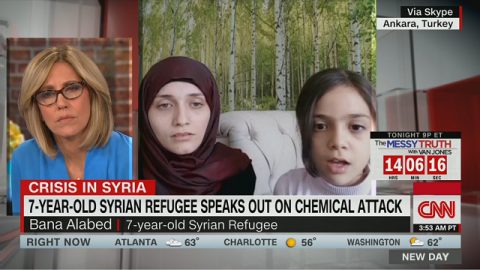
CNN is calling it a “7-year-old Syrian girl’s heartbreaking plea” to stop the war in Syria, in reality it’s a fake news hoax to get the Trump administration to overthrow Assad and turn on Russia.
The top story on CNN’s front page today is a disgusting Iraq-has-WMDs-style fake news story to con America into another war.
Under the title, “7-year-old Syrian girl’s heartbreaking plea: ‘Why can’t you stop the war?’,” CNN anchor Alisyn Camerota is seen interviewing a 7-year-old Syrian girl named Bana Alabed.
Camerota asks her: “Bana, do you [a 7-year-old girl] blame President Assad for this [chemical attack]?”
Bana responds, “Yes.”
“What is your message to President Assad?” Camerota asks the 7-year-old.
“I am very sad,” Bana says, looking down and blatantly reading off a script. “A lot of died,” she says, clearly struggling to read and skipping over the word “people” or “Syrians.”
“And, oh,” she stutters, “no one help them.”
“The world is watching,” she stammers, “the world doesn’t do anything.”
It goes on for another minute with Bana struggling to read her clearly pre-written propaganda lines. Eventually she asks, “why you, why can’t you, stop the war?”
“I don’t know Bana, I don’t know why the world can’t stop the war in Syria someday,” a torn Camerota responds, ignoring how incredibly fake and staged the whole shameless stunt she just took part in is.
This is the epitome of fake news and it’s a thousand times more dangerous to our country than some schmuck in Macedonia writing about fake endorsements from the Pope.
April 5, 2017
Posted by aletho |
Fake News, Mainstream Media, Warmongering | Alisyn Camerota, CNN, Syria, United States |
Leave a comment
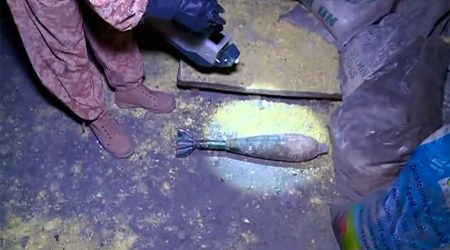
ARCHIVE: Russian military inspect suspected chemical weapons workshop in Aleppo © Ruptly
The Syrian Air Force has destroyed a warehouse in Idlib province, where ammunition dump containing chemical weapons was being produced by militants before being delivered to Iraq, the Russian Defense Ministry spokesman has said.
The strike, which was launched midday Tuesday, targeted a major rebel ammunition depot east of the town of Khan Sheikhoun, Russian Defense Ministry spokesman Major-General Igor Konashenkov said in a statement.
The warehouse was used to both produce and store shells containing toxic gas, Konashenkov said. The shells were delivered to Iraq and repeatedly used there, he added, pointing out that both Iraq and international organizations have confirmed the use of such weapons by militants.
The same chemical munitions were used by militants in Aleppo, where Russian military experts took samples in late 2016, Konashenkov said.
The Defense Ministry has confirmed this information as “fully objective and verified,” Konashenkov added.
According to the statement, Khan Sheikhoun civilians, who recently suffered a chemical attack, displayed identical symptoms to those of Aleppo chemical attack victims.
Hasan Haj Ali, commander of the Free Idlib Army rebel group, rejected Russia’s version of the incident, saying the rebels had no military positions in the area.
“Everyone saw the plane while it was bombing with gas,” he told Reuters.
“Likewise, all the civilians in the area know that there are no military positions there, or places for the manufacture [of weapons]. The various factions of the opposition are not capable of producing these substances,” he added.
At least 58 people, including 11 children, reportedly died and scores were injured after a hospital in Khan Sheikhoun was targeted in a suspected gas attack on Tuesday morning, Reuters reported, citing medics and rebel activists. Soon after a missile allegedly hit the facility, people started showing symptoms of chemical poisoning, such as choking and fainting.
The victims were reportedly also seen with foam coming out of their mouths. While the major Syrian opposition group, the Syrian National Coalition, and other pro-rebel groups put the blame on the attack onto President Bashar Assad’s government, the Syrian military dismissed all allegations as propaganda by the rebels.
“We deny completely the use of any chemical or toxic material in Khan Sheikhoun town today and the army has not used nor will use in any place or time, neither in past or in future,” the Syrian army said in a statement.
The Russian military stated it did not carry out any airstrike in the area either.
However, EU foreign affairs chief Federica Mogherini, commenting on the incident, was quick to point to the Syrian government as a culprit, saying that it bears responsibility for the “awful” attack.
US Secretary of State Rex Tillerson echoed Mogherini, accusing the Syrian government of perpetrating the attack calling it “brutal, unabashed barbarism.” He argued, that besides the Syrian authorities, Iran and Russia should also bear “moral responsibility” for it.
The suspected nerve agent attack on a rebel-held area on Tuesday has underlined the regime’s confidence – bolstered by the Trump administration
The Guardian | April 4, 2017
Heartbreaking images of desperate patients and dead children in Syria are, sadly, too familiar. But Tuesday’s attack in rebel-held Idlib province has forced a reaction: it is one of the worst suspected chemical attacks in the six-year war. It claimed at least 67 lives, and the symptoms suggest the use of a nerve agent, probably sarin. It hit an area where thousands had taken shelter from fighting nearby. It was followed by attacks on medical facilities treating victims. It had “all the hallmarks of a regime attack”, said Britain’s ambassador to the United Nations. The White House accused the Syrian government of a “heinous” attack. […]
Some have already drawn a link between what seems to be the use of a more deadly agent and the US shift on Syria. The secretary of state said last week that Mr Assad’s future was a matter for the Syrian people, while the ambassador to the UN said removing him was no longer the priority (though she later tempered that remark).
Those comments dangerously reinforced, rather than created, the regime’s certainty that it can carry out war crimes with impunity. As a candidate, Donald Trump said Mr Assad’s future was “secondary” to defeating Isis. In February, Russia and China vetoed a security council resolution imposing sanctions over chemical weapons use; Wednesday’s meeting on the issue is unlikely to change much. … Full editorial
April 4, 2017
Posted by aletho |
Mainstream Media, Warmongering | Syria, The Guardian |
Leave a comment
The mainstream U.S. media is never more unctuous and unprofessional as when it asserts that it alone must be the arbiter of what is true and what is not, regardless of what the evidence shows or doesn’t show.
For instance, New York Times columnist Charles W. Blow declared on Monday that the public can no longer debate whether Russia leaked to WikiLeaks the emails from the Democratic National Committee and Hillary Clinton’s campaign chairman John Podesta despite the failure of the U.S. government or private researchers to present evidence that establishes that claim as fact.
Blow acknowledged that “We are still not conclusively able to connect the dots on the question of whether there was any coordination or collusion between members of Donald Trump’s campaign and the Russians … but those dots do continue to multiply at an alarming rate.”
But Blow also asserted that “It is absolutely clear that the Russians did interfere in our election. This is not a debatable issue. This is not fake news. This is not a witch hunt. This happened.”
Blow chastised people who still wanted evidence of this now non-debatable issue, seeing them at fault “because this fact [of the Russian meddling] keeps getting obscured in the subterfuge of deflection, misdirection and ideological finger-pointing about what has yet to be proven.”
So, if you insist on asking for proof of the core allegation in Russia-gate, you are guilty of “subterfuge…, misdirection and ideological finger-pointing.”
And if that indictment doesn’t quiet you up, there’s the column by The Washington Post’s E.J. Dionne Jr. who explains that the real victims in Russia-gate are the accusers who have promoted this guilt-by-association scandal that has impugned the integrity of a growing number of Americans who either talked to Russians or who expressed doubts about the investigation.
While the Russia-gate accusers have essentially deemed these Americans “traitors” or the Kremlin’s “useful idiots” or some other derogatory phrase, Dionne sees the much greater offense coming from the people so accused who have complained about what they see as McCarthyism. Dionne writes:
“These days, any liberal who raises alarms about Trump’s relationship with Russia confronts charges of McCarthyism, hysteria and hypocrisy. The inclination of many on the left to assail [Russian President Vladimir] Putin is often ascribed to partisan anger over his success in undermining Clinton’s candidacy.
“There’s no doubt that liberals are angry, but ask yourself: Shouldn’t everyone, left, right and center, be furious over Russia’s efforts to inject calumny and falsehood into the American political bloodstream?”
So, Dionne suggests that people who question the credibility of the Russia-gate allegations are somehow un-American by favoring the injection of “calumny and falsehood into the American political bloodstream.” But that mainstream hostility toward skepticism has been at the heart of the Russia-bashing campaign that we have witnessed for the past several years.
Blacklisting Journalists
And, that campaign indeed has been replete with McCarthyism. You even have The Washington Post promoting a blacklist of 200 Internet news sites (including Consortiumnews.com and other prominent independent-minded outlets) as guilty of “Russian propaganda” for reporting skeptically on some State Department claims about the New Cold War.
But Dionne also is dishonest in claiming that the alleged leaks blamed on Russia are “falsehoods”. The central allegation in Russia-gate is that the Russians obtained two batches of Democratic emails and released them to the American public via WikiLeaks. Even if that is the case, nothing in those emails was fabricated.
The emails represented real news including evidence that the DNC displayed improper bias against Sen. Bernie Sanders’s insurgent campaign; excerpts of Hillary Clinton’s paid speeches to Wall Street that she was trying to hide from the voters; and revelations about pay-to-play aspects of the Clinton Foundation’s dealing with foreign entities.
So, even if the Russians did give the emails to WikiLeaks – although WikiLeaks denies that the Russians were the source – the core reality is that the emails provided real information that the American people had a genuine right to know. But Dionne and the mainstream U.S. media have conflated this truth-telling with cases of “fake news,” i.e., made-up stories that investigations have shown had no connection to Russia, simply to sleazy entrepreneurs seeking to make some money via lots of clicks. In other words, Dionne is lying or engaging in “fake news” himself.
Such phony journalism is reminiscent of other shameful chapters of the mainstream media’s history of serving as propaganda conduits and marginalizing independent reporters who displayed professional skepticism toward the dangerous groupthinks of Official Washington.
A pivotal moment in the chaos that is now consuming the planet came on Feb. 6, 2003, when The Washington Post’s editorial and op-ed pages presented a solid phalanx of misguided consensus that ruled out any further dissent about the existence of Iraq’s WMD after Secretary of State Colin Powell presented his slam-dunk case before the United Nations the day before.
The Post’s editorial board – led by editorial page editor Fred Hiatt – judged Powell’s WMD case “irrefutable,” an opinion echoed across the Post’s op-ed page.
“The evidence he [Powell] presented to the United Nations – some of it circumstantial, some of it absolutely bone-chilling in its detail – had to prove to anyone that Iraq not only hasn’t accounted for its weapons of mass destruction but without a doubt still retains them,” wrote Post columnist Richard Cohen. “Only a fool – or possibly a Frenchman – could conclude otherwise.”
The Post’s senior foreign policy columnist Jim Hoagland then demanded the surrender of any WMD-doubting holdouts: “To continue to say that the Bush administration has not made its case, you must now believe that Colin Powell lied in the most serious statement he will ever make, or was taken in by manufactured evidence. I don’t believe that. Today, neither should you.”
This enforced WMD consensus contributed to arguably the most disastrous U.S. foreign policy decision in history as President George W. Bush launched an illegal invasion of Iraq that got nearly 4,500 U.S. soldiers killed along with hundreds of thousands of Iraqis and spread bloody chaos across the Middle East and now into Europe. There was also the problem that no hidden caches of WMD were discovered.
So, you might assume that editorial-page editor Fred Hiatt and other prominent mainstream journalists who pushed the bogus WMD claims and pushed the few dissenters to the fringes of the public debate, received some appropriate punishments – at least being unceremoniously fired in disgrace. Of course, if you thought that, you don’t understand how the U.S. mainstream media works. To this day, Fred Hiatt is still the editorial-page editor of The Washington Post.
Slandering Dr. King
One might note, however, that historically the mainstream U.S. media has performed no better than it has in recent years.
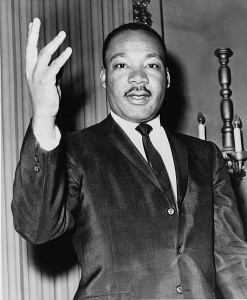
Fifty years ago, on April 4, 1967, at Riverside Church in New York City, Dr. Martin Luther King Jr. gave one of the most important speeches in U.S. history, taking to task American militarism and the Vietnam War. Famously and courageously, King denounced his own government as “the greatest purveyor of violence in the world today.”
King, whose life was increasingly at risk, was then put at even greater risk by being denounced by The New York Times and The Washington Post. The Post blasted King for spreading what today we might call “fake news,” accusing him of “sheer inventions of unsupported fantasy.” The Times chimed in that King’s words were “facile” and “slander” while urging him to focus instead on “the intractability of slum mores and habits,” i.e. those lazy and immoral black folks. (Exactly a year later, King was shot dead.)
But you might ask, don’t the Post and Times at least get the big investigative stories right and thus warn the American people about abuses to their democratic process? Well, not exactly.
Take, for example, the case of Richard Nixon conspiring with South Vietnamese leaders to sabotage President Lyndon Johnson’s Paris peace talks in fall 1968 so Nixon could eke out a victory over Vice President Hubert Humphrey. Nixon’s manipulation of that election – while half a million American soldiers were in the war zone – was treated by the Post and Times as a conspiracy theory for nearly half a century, even as honest journalists chipped away at Nixon’s denials by uncovering evidence of the deal that continued the war for another four years.
Some reporters, such as the Christian Science Monitor’s Beverly Deepe, were onto the story in real time. Others, including Seymour Hersh, advanced knowledge about these events over the decades. Five years ago, I uncovered a top secret file that Johnson’s National Security Adviser Walt Rostow dubbed “The X-Envelope” which contained wiretap proof of what Johnson called Nixon’s “treason.” Besides writing up the details, I posted the documents on the Internet so anyone could see for themselves.
Yet, as recently as last October, The New York Times ignored all this evidence when referencing the supposed “October Surprise” of 1968, citing — instead of Nixon’s peace-talk sabotage — the fact that Johnson had ordered a bombing halt of North Vietnam. In other words, the Times was still promoting Nixon’s version of the story nearly a half century later.
Only early this year, when a scholar uncovered some cryptic notes by Nixon’s chief of staff H.R. Haldeman that seemed to reference Nixon’s instructions regarding the sabotage did the Times finally deign to acknowledge the reality (because the Times published the finding on its op-ed page, which I guess makes it true). But the Times did so without acknowledging all the hard work that journalists had done over the years so the cryptic notes would fit into a complex puzzle that made sense.
Nor did the Times acknowledge its own role in obscuring this history for so long.
Rumor-Mongers
To add insult to the historical injury, the Times pretended that it was right to have ignored the earlier work. Times columnist Nicholas Kristof dismissively treated those decades of investigative journalism by writing: “Nixon’s initiative, long rumored but confirmed only a few months ago, was meant to improve his election chances that year.”
“Long rumored”? The reality was that Nixon’s perfidy had long ago been proven by independent-minded journalists but their work was ignored by The New York Times and pretty much everyone else in the mainstream media until the self-proclaimed truth monitors decided that the discovery of one new piece of the mosaic was the appropriate time to proclaim that the reality could now be accepted as a reality.
To explain the near half-century gap in the Times’ failure to investigate this historic act of treason, the Times then smeared the journalists who had done the investigating as rumor-mongers.
So, in light of the mainstream media’s dismal performance over the decades, what is one to make of the dictate now that we must accept that the Russians did leak the emails to WikiLeaks even if no one is showing us the evidence? It also appears that we are supposed to dismiss the contents of the emails as “fake news” (even though they are genuine) so that will buttress the narrative that Russia is undermining our democracy by disseminating “fake news.”
Perhaps getting people to accept this false narrative is crucial to giving credibility to the Times’ full-page ads professing the newspaper’s undying love of the truth and to The Washington Post’s new melodramatic slogan, “Democracy Dies in Darkness.”
While there’s no doubt that truth is important to an informed electorate, there is something scary when the mainstream media, which has such a checkered history of misreporting the truth, asserts that it is the one that gets to decide what the truth is.
Investigative reporter Robert Parry broke many of the Iran-Contra stories for The Associated Press and Newsweek in the 1980s.
April 4, 2017
Posted by aletho |
Deception, Fake News, Mainstream Media, Warmongering, Timeless or most popular | Charles W. Blow, DNC, E.J. Dionne Jr., New York Times, Nicholas Kristof, United States, Washington Post |
Leave a comment
DAMASCUS – The command of the Syrian Armed Forces decisively rejected accusations of using chemical weapons in Idlib province and placed responsibility for that on militants and their patrons.
“The army command and the Armed Forces categorically deny the use of any chemical weapons in the town of Khan Shaykhun in the suburb of Idlib today,” according to a Syrian Armed Forces command statement copy obtained by Sputnik.
The document also said the responsibility for the chemical attack in Idlib lies with militants and their patrons.
Earlier in the day, the Syrian National Coalition of Revolution and Opposition Forces claimed that nearly 80 people were killed and some 200 injured in an attack by the use of chemical weapons in Idlib, placing the blame for the reported attack on the Syrian army. However, a source in the Syrian army told Sputnik that the army did not have chemical weapons and the allegations could be part of anti-Damascus propaganda.
“The armed terrorist groups regularly blame the Syrian Army of using chemical weapons against members of this group, as well as against civilians, every time they fail to reach their objectives. And they do everything to justify their defeats on the ground to their financial patrons,” the statement added.
A UN Security Council meeting has been called by the United States to discuss the issue, while the United Nations said it could not verify if the attack took place. The Organisation for the Prohibition of Chemical Weapons (OPCW) has set up a Fact Finding Mission (FFM) to gather information about the alleged incident.
In 2013, Damascus agreed to place its chemical weapons under international control for its destruction. The move was made in order to prevent the weapons from being captured by militants in the course of the civil war in the Middle Eastern state.
So far, there has been a number of reports on use of chemical weapons in Syria, putting responsibility for attacks both on Syrian authorities and Daesh terrorist group.
In October 2016, the UN Joint Investigative Mechanism (JIM) on the chemical weapons use in Syria said that the Syrian authorities used chemical weapons at least three times throughout 2014-2015, while an earlier report said the IS was also responsible for several attacks.
Despite lack of conclusive evidence, a number of countries, in particular the United Kingdom, France, and the United States, blamed the Syrian government for the chemical attacks. Syrian President Bashar Assad though denied all accusations, claiming the reports failed to provide conclusive evidence of its culpability and putting blame on the terrorist groups. The Russian authorities have repeatedly called on necessity to double-check such kind of reports, stressing that conclusions cannot be simply made on interviews of several local residents.
In late October-early November 2016, a number of chemical attacks were conducted in Syria’s city of Aleppo by militants, killing dozens of Syrian servicemen and civilians. The Syrian government urged the Organization for the Prohibition of Chemical Weapons (OPCW) to conduct the investigation, while the Russian Defense Ministry handed the results of the chemical use probe to Syria’s national regulator in charge of implementing the OPCW convention.
Earlier on February, Russia’s Foreign Ministry said it expected more effective work from the OPCW, adding that the organization’s act-finding mission in Syria had conducted its activity over the past years remotely by interviewing witnesses, which raised questions over information’s credibility.
Since 2011, Syria has been engulfed in a civil war, with government forces fighting against numerous opposition and terrorist groups, including al-Nusra Front and Daesh, banned in a range of countries, including Russia.
READ MORE:
Assad: West ‘Demonizes’ Damascus Through Chemical Weapons Use Allegations
Oscar for White Helmets: Hollywood Gave Credibility to ‘Terror-Affiliated’ Group
April 4, 2017
Posted by aletho |
Deception, Fake News, False Flag Terrorism, Mainstream Media, Warmongering, Timeless or most popular | Syria |
Leave a comment
More chickenhawks on parade for war with Russia
The latest Democratic Party shill to demonize Russia is, I am ashamed to say, my state of Virginia’s Senator Mark Warner, who, on Thursday said “Russian President Vladimir Putin ordered a deliberate campaign carefully constructed to undermine our election.” Last Thursday, Warner was the top Democrat on a Senate Intelligence Committee panel investigating Moscow’s alleged interference in last year’s presidential election. The panel inevitably included carefully selected expert witnesses who would agree with the proposition that Russia is and was guilty as charged. There was no one who provided an alternative view even though a little Googling would have surfaced some genuine experts who dispute the prevailing narrative.
Warner joined many of his esteemed colleagues in Congress who have completely accepted the allegations that Russia meddled in the election in spite of the failure of the Obama Administration to provide any indisputable evidence to that effect. Senator Ben Cardin of Maryland has called Moscow’s claimed interference an “attack” and labeled it a “political Pearl Harbor.” A number of other congressmen, to include Bonnie Watson Coleman of New Jersey and Eric Swalwell of California have called it an act of war. And then there are echo chambers Senators John McCain and Mark Rubio on the Republican side of the aisle while former Vice President Dick Cheney was speaking at a business conference in New Delhi saying the same thing. Yes, that Dick Cheney. Why anyone in India would pay to hear him speak on any subject escapes me.
Democrat Adam Schiff of California is leading the charge for his party as he is the ranking Democrat on the House Intelligence Committee. He outlined his case against Russia two weeks ago, providing a heap of minimally factual “information”, relying heavily instead on supposition and featuring mostly innuendo. And again, it was largely evidence-free. One assertion is almost comical: “In July 2016, Carter Page, one of Trump’s former national security advisers, traveled to Moscow after being approved to do so by the Trump campaign. While there, Page gave a speech in which he was critical of the U.S. and its efforts to fight corruption and promote democracy.”
Almost everyone I know who follows such matters is also critical of U.S. (hypocritical) efforts to promote democracy, a formulation wildly popular among Hillary Clinton style Democrats to enable attacking Muslim countries that have somehow offended either Israel or the Washington Establishment. But what is particularly disturbing about the constant denigration of Russia and Vladimir Putin in the media and among the political class is the regular invocation of war doctrine, that hacking a server by a foreign power, if it took place, is in the same category as the attack on Pearl Harbor. That World War 3 would be a nuclear holocaust does not seem to have occurred to politicians seeking a punchy line so they can get cited in The Washington Post. It leads one to the inevitable conclusion that war is far too serious a business to be left to politicians.
But what particularly offends me personally about those eager to go toe to toe with the Russians is their complete venality and fundamental cowardice. As a Vietnam era vet, I understand full well how it feels to have your life disrupted to go off and possibly die to fight a war that was totally meaningless. Our crowd of politicians is fond of talking about war as if it were some kind of diversion being featured on a monopoly board and that is precisely because they have no skin in the game. They somehow fancy that a shooting war will somehow not happen, that Russia will back down in a confrontation with force majeur, and they deep down feel completely immune to the consequences that might result from their ill-advised actions. And they are unfortunately in large part correct to feel so, as no one was ever held accountable for Iraq. Consequences that apply to the “little people” in the U.S. do not apply to them.
Under the rule of our bipartisan war-loving elites the United States has evolved from a bumbling giant into something far more threatening. The completely useless wars since 9/11 have killed nearly 10,000 American soldiers and contractors as well as hundreds of thousands, if not millions, of the inhabitants of the countries that we have attacked. I would hold Congress, the White House and the mainstream media as directly responsible for those deaths. As former Ambassador Chas Freeman puts it, “America has now chosen publicly to redefine itself internationally as the foreign relations equivalent of a sociopath – a country indifferent to the rules, the consequences for others of its ignoring them, and the reliability of its word. No nation can now comfortably entrust its prosperity or security to Washington, no matter how militarily powerful it perceives America to be.”
Which inevitably leads to the subject of Dick Cheney. When it comes to hypocrisy over war as a constant state for the American Republic with absolutely no consequences for those who lead, no one takes a back seat to good old Dick. Dick had five deferments during Vietnam and he has explained that he had had “other priorities.” He and his consigliere Scooter Libby, together with Paul Wolfowitz at the Pentagon, might have had more to do with America’s march to war in Iraq than any other individuals in the Bush Administration. And none of them paid any price except Libby who was convicted of having committed perjury connected to his apparent outing of CIA officer Valerie Plame as revenge for her husband’s refutation of claims about Iraq buying uranium from Niger. Libby was sentenced to 30 months in prison but had his jail time commuted by President George W. Bush.
One might even suggest that the architects of devastating policies were actually rewarded, most particularly Wolfowitz, who was named president of the World Bank before having to resign over a sex scandal that he initiated. Today Wolfowitz is a Visiting Scholar at the American Enterprise Institute and Libby is a Senior Vice President at the neocon Hudson Institute. Cheney is retired comfortably on the somewhere between $19 and $86 million he made, mostly while working for five years at defense contractor Halliburton. His truly frightening daughter Liz is in congress representing Wyoming, continuing the family legacy of bone headed knee jerk reactionaryism combined with egregious self-aggrandizement that Dick is best known for.
Note that neither Cheney, nor Wolfowitz nor Libby ever served in the U.S. military, exhibiting thereby their willingness to let other American die for the dreadful policies that they initiated. That pattern also holds true for the Democrats who seem to have found Russia as a useful scapegoat for their failure to elect Hillary Clinton president. If the Kremlin did it then the Democratic National Committee and Clinton campaign are off the hook, aren’t they? And even better if one can simultaneously discredit Donald Trump by implying that he or his associates might be subjected to blackmail by Moscow, making them little more than agents of Vladimir Putin and therefore traitors to the United States.
Senator Mark Warner, a lawyer by training, founded a venture capital firm called Columbia Capital before being elected Governor of Virginia and then Senator in 2008. He is reported to be the wealthiest U.S. Senator, worth $200 million. He has a 15 acre farm in Rappahannock County Virginia where he produces wine as a hobby.
Warner has three daughters who will never serve in the U.S. military, which is precisely the problem. The more our “ruling class” in Washington has little or nothing to do with the average American or, to be more precise, the class of Americans called upon to fight and die in the wars that are constantly being promoted, the more we will engage in senseless wars and sabre rattling. As Warner appears willing to use the threat of war to pillory Trump, he perhaps should step back, take a deep breath, and try to think of the consequences of the politically loaded claims that he is promoting.
Ben Cardin and Adam Schiff are a lot like Warner in that they are reliable partisan Democrats who are seeking to milk as much benefit out of beating on Russia as they can. Both are unimpeachable liberals who wrap their arguments in the good old American flag by claiming that Moscow is seeking to threaten our democracy while completely ignoring the fact that the U.S. intelligence agencies have been regularly overthrowing governments and corrupting elections since the Second World War. They both have children who will never serve in uniform or see the inside of a barracks. War for them is an abstraction which serves as a useful tool, in this case, for bringing down Donald Trump. And they are bringing down with Trump any hope of rapprochement with Russia, a readjustment in policy that is desperately needed.
I am reminded frequently of the ancient Greek way of war. Armor was expensive and only the wealthy and powerful could afford it. And those with the armor stood in the front line as they were most able to engage in the cutting and thrusting and still survive. Armor was also heavy and they could not run away, so wars were only fought when vital interests were at stake and they were fought to the death for most of those on the battlefield. I fancy a phalanx of hoplites with Warner, Cardin, Schiff, Wolfowitz, Cheney and Libby arrayed on the front line in their fine armor manufactured by Halliburton. That way they could have all the war they want and experience it first-hand. I doubt they would last very long as they are both moral and physical cowards, but given that reality, they just might think a bit harder about promoting the type of fearmongering that will only end by sending the children of other Americans off to war.
April 4, 2017
Posted by aletho |
Mainstream Media, Warmongering, Militarism, Timeless or most popular | Ben Cardin, Dick Cheney, Mark Warner, Russia, United States |
Leave a comment
Polish prosecutors say they have evidence proving that Russia “deliberately provoked” the 2010 plane crash over Smolensk which resulted in the death of President Lech Kaczynski. Commenting on the claims, journalist Andrei Veselov lamented that Polish politics seems to have degenerated into paranoia over a mysterious ‘hand of Moscow’ at every turn.
Almost seven years ago, on April 10, 2010, the Polish Presidential Tu-154M airplane carrying President Kaczynski, his wife, and a number of high-ranking Polish civilian and military officials crashed outside Smolensk, western Russia, killing all 96 passengers and crew on board. Official investigations by both the Russian and Polish sides concluded that pilot error was to blame. The pilots, according to investigators, lacked adequate training for operations in adverse weather conditions, and did not approach the landing field in a safe manner amid foggy weather in the area on the day of the crash.
In the years since, conspiracy theories have circulated in Poland, particularly among the country’s conservative anti-Russian forces, claiming that the crash was a deliberate plot by Moscow to assassinate Polish leaders. Until recently, these conspiracy theories were generally ignored by the country’s leaders, who said that there was absolutely no evidence to support this claim in the official findings.
However, following presidential and parliamentary elections in 2015, which resulted in the Law and Justice Party, led by Kaczynski’s twin brother Jaroslaw coming to power, the ‘Russian trace’ conspiracy quickly transformed into official dogma. Jaroslaw Kaczynski has long maintained that the Kremlin deliberately ‘assassinated’ his brother. Defense Minister Antoni Macierewicz has gone even further, claiming that Poland and Russia have actually been ‘in a state of war’ since the 2010 catastrophe.
On Monday, Poland’s Public Prosecutor’s Office gave ammunition to the conspiracy theorists, announcing that prosecutors had amassed evidence against Russian air traffic controllers which showed that Russia had “deliberately provoked” the disaster. The Prosecutor’s Office claimed the presence of a mysterious “third person” in the air traffic control tower on the day of the crash, but did not elaborate.
Moscow responded in an extremely calm manner to the offensive claims. Foreign Ministry spokeswoman Maria Zakharova recalled that Russia had carried out its own, very detailed investigation, which concluded that the air traffic controllers had nothing to do with the crash. “Warsaw knows this very well,” she noted. Presidential spokesman Dmitri Peskov added that as far as the Kremlin is concerned, the causes of the catastrophe had been determined, “and of course it is not seen as possible to agree with [the] conclusions” reached by prosecutors.
Polish authorities, Zakharova noted, were actively trying to “use the tragedy to settle political scores in their country. We consider this tactic futile [and] damaging to Russian-Polish relations, which are already not in the best condition,” she added.
What are these political scores? Well, for one thing, they include Warsaw’s longstanding conflict with European Council President Donald Tusk. Authorities have accused the politician of everything from shady contacts with Russian intelligence, to illegal dealings with Russian companies on the repair of the presidential plane shortly before it crashed, to bending to Russian interests following the disaster to prevent an objective investigation from taking place. “Prime Minister Tusk and Vladimir Putin made an illegal deal to the detriment of Poland, and he must answer for this before a court,” Defense Minister Macierewicz has said.
In reality, anyone familiar with Tusk’s record on Russia, both as prime minister and as the head of the EU, has a pretty good understanding that the politician is anything but pro-Russian. As European Council president, Tusk has been at the forefront of EU politicians accusing Russia of ‘aggression’, and has repeatedly said that sanctions must be extended. Meanwhile, during his time as prime minister, Tusk balanced a policy of ‘rapprochement’ with Moscow with an active effort by his foreign minister, Radoslaw Sikorski, to rip Russia’s western partners out of Moscow’s orbit via the so-called ‘Eastern Partnership’ program. That effort ultimately culminated in the 2014 Maidan Coup in Kiev.
Furthermore, as RIA Novosti contributor Andrei Veselov points out, Warsaw has yet to present any hard evidence to back up its conspiratorial accusations, even against Tusk, much less about Russia’s alleged role in the Smolensk tragedy.Lawmakers from the Civic Platform Party, Poland’s main opposition group, have sent a letter to Prime Minister Beata Szydlo, demanding an explanation for why the full version of the official Polish government report on the plane crash, published in July 2011, is being taken down from public sources online. The party complained that the subcommission convened by Macierewicz is not working with the official report, and noted that its removal from official internet resources makes the Russian side’s report the only official document on the investigation that’s publically available.
However, as Veselov pointed out, Civic Platform lawmakers too are not being entirely honest: “The Russian report is not the only one. In 2011, the Interstate Aviation Committee (IAC) released its final report on the technical investigation into the disaster. According to its experts, the crash was caused by the crew’s decision not to go to the alternative aerodrome. Furthermore, it said, there were shortcomings in flight support and the crew’s training.”
In other words, Warsaw’s decision to dig up the investigation, and to ignore the findings of a diverse collection of aviation experts, all of whom have reached nearly identical conclusions, indicates that spokeswoman Zakharova is right: Warsaw is out to settle old political scores, not find any hidden ‘truth’. And given the stakes involved (including the alleged murder of a statesman in peacetime by another state), the campaign is not only distasteful, but simply detestable.
April 4, 2017
Posted by aletho |
Mainstream Media, Warmongering | Poland |
Leave a comment