MSM promotes dodgy docs as well as child-exploitation in drive for war

By Catte | OffGuardian | August 20, 2016
Overshadowed by the recent attempts to create a faux media storm out of an unverified video produced by the pro-terrorist “Aleppo Media Center”, a recent article in the Guardian by Patrick Wintour reminds us that, when it comes to war-propaganda, the media doesn’t just do child-exploitation to order – it also promotes dodgy documents without question or analysis.
Wintour’s piece focuses on the – as usual – uncorroborated open letter to President Obama allegedly written by a group of doctors in terrorist-controlled eastern Aleppo, calling for US “intervention” to “stop the bombardment of hospitals in the besieged city by the Russian-backed Syrian air force”, and is another shining example of spineless obedience to an intellectually bankrupt narrative.
The article doesn’t give the text of the letter in full, but here it is:
Dear President Obama,
We are 15 of the last doctors serving the remaining 300,000 citizens of eastern Aleppo. Regime troops have sought to surround and blockade the entire east of the city. Their losses have meant that a trickle of food has made its way into
eastern Aleppo for the first time in weeks. Whether we live or die seems to be dependent on the ebbs and flows of the battlefield.We have seen no effort on behalf of the United States to lift the siege or even use its influence to push the parties to protect civilians.
For five years, we have faced death from above on a daily basis. But we now face death from all around. For five years, we have borne witness as countless patients, friends and colleagues suffered violent, tormented deaths. For five years, the world has stood by and remarked how ‘complicated’ Syria is, while doing little to protect us. Recent offers of evacuation from the regime and Russia have sounded like thinly-veiled threats to residents – flee now or face annihilation ?
Last month, there were 42 attacks on medical facilities in Syria, 15 of which were hospitals in which we work. Right now, there is an attack on a medical facility every 17 hours. At this rate, our medical services in Aleppo could be completely destroyed in a month, leaving 300,000 people to die.
What pains us most, as doctors, is choosing who will live and who will die. Young children are sometimes brought into our emergency rooms so badly injured that we have to prioritize those with better chances, or simply don’t have the equipment to help them. Two weeks ago, four newborn babies gasping for air suffocated to death after a blast cut the oxygen supply to their incubators. Gasping for air, their lives ended before they had really begun.
Despite the horror, we choose to be here. We took a pledge to help those in
need.Our dedication to this pledge is absolute. Some of us were visiting our families when we heard the city was being besieged. So we rushed back – some on foot because the roads were too dangerous. Because without us even more of our friends and neighbors will die. We have a duty to remain and help.
Continued US inaction to protect the civilians of Syria means that our plight is being wilfully tolerated by those in the international corridors of power. The burden of responsibility for the crimes of the Syrian government and its Russian ally must therefore be shared by those, including the United States, who allow them to continue.
Unless a permanent lifeline to Aleppo is opened it will be only a matter of time until we are again surrounded by regime troops, hunger takes hold and hospitals’ supplies run completely dry. Death has seemed increasingly inescapable. We do not need to tell you that the systematic targeting of hospitals by Syrian regime and Russian warplanes is a war crime. We do not need to tell you that they are committing atrocities in Aleppo.
We do not need tears or sympathy or even prayers, we need your action. Prove that you are the friend of Syrians.
Yours,
1 Dr. Abu Al Baraa, Pediatrician
2 Dr. Abu Tiem, Pediatrician
3 Dr. Hamza, Manager
4 Dr. Yahya, Pediatrician and head of Nutrition Program
5 Dr. Munther, Orthopedics
6 Dr. Abu Mohammad, General Surgeon
7 Dr. Abu Abdo, General Surgeon
8 Dr. Abd Al Rahman, Urologic Resident
9 Dr. Abu Tareq, ER Doctor
10 Dr. Farida, OBGYN
11 Dr Hatem, Hospital Director
12 Dr. Usama, Pediatrician
13 Dr. Abu Zubeir, Pediatrician
Even while admitting that “it has not been possible to verify the names of all the doctors listed in the letter,” Wintour doesn’t investigate or even interrogate its authenticity. His only comment on the subject is an airy claim that “[the] account tallies with evidence given by US doctors to the UN after a working visit to Aleppo’s hospitals in the past fortnight.”
He doesn’t quite dare say this offers any kind of validation (because of course it doesn’t), he simply hopes his readers will take it that way while he turns to his real task, which is sanctifying the West’s strategic fears for the loss of a corridor to eastern Aleppo as a sudden rush of humanitarian concern for the fate of the civilians living there. His casual assumption that only Western-led forces and Western-led humanitarians will have the decency to treat civilians with respect is almost Victorian in its colonial appropriation of moral ascendancy.
Wintour doesn’t ask why a group of disinterested doctors on the ground in Aleppo would write a letter that exactly mirrors the dishonest and incomplete western narrative, and repeats discredited or unsubstantiated claims such as the “systematic targeting of hospitals by Syrian regime and Russian warplanes.” He doesn’t ask why they would dismiss the recent offer from Russia and the Syrian government for safe conduct out of the war zone as “a thinly-veiled threat” rather than welcome it as a way of saving valuable lives. He doesn’t ask why a group of humanitarians would condemn Russia and the Syrian government for “crimes” because they have been bombing Aleppo, while saying nothing about the fact the US is also bombing Aleppo.
Neither does he mention that the supposed medics’ primary demand – for a “permanent lifeline” to Aleppo – is exactly what the “rebels” (ie Al Nusra terrorists) have been fightng for in recent weeks, in order to break the “siege” of eastern Aleppo by government forces and put pressure on government-held western Aleppo. Keeping this corridor “permanently” open would make the difference between success or failure for the rebels/terrorists in this key strategic area.
So, naturally these fifteen concerned medical professional have that item at the top of their list, over and above a ceasefire, or indeed an evil Russian evacuation of civilians, or evil Russian aid drops.Wouldn’t anyone rather die than accept help from America’s ‘enemies”? Wouldn’t anyone welcome slaughter when it’s wrapped in a US flag?
Wintour doesn’t state the obvious – that this letter is pushing an agenda that has nothing to do with alleviating human suffering. He doesn’t point out that it reads like a Washington fantasy version of reality. On the contrary he’s more than happy to exist in that fantasy where US intervention is a humanitarian response to the imploring of care-ravaged doctors, and for the purposes of saving people from evil Putin and his sidekick Assad. The letter must be endorsed because it in turn endorses the delusional dreamworld of moral righteousness where most western journalists spend most of their time these days. The only place their consciences don’t trouble them.
Meanwhile, the Twitter account known as @TheLemniscat took a look at the names of the letter’s signatories and made these annotations…
https://twitter.com/theLemniscat/status/764052010404503552?ref_src=twsrc%5Etfw
The fact six of these alleged doctors have signed with only their last name is maybe slightly odd, as is the fact six others are namesakes of prominent members of ISIS and al Qaeda, and one has the same name as a well-known shop. But until the signatories can be positively identified that’s about all we can say. Then again identifying them should not be too difficult, given that several of them identify as paediatricians and, as Moon of Alabama points out, the “last pediatrician” in rebel-held Aleppo was supposed to have been killed weeks ago. If these guys are the real deal they must have turned up in the rebel-held part of Aleppo since April, and they are likely the only paediatricians working there. How hard could it be to track them down? Has anyone tried?
Regardless of the deeper realities of the letter it’s the absolute abdication of scepticism by the Western media coverage that continues to be the real issue.
Imagine if an open letter appeared calling for the Russian government to “stop US bombardment of hospitals”, signed by fifteen alleged but unverified “doctors”, six of whom refused to give a first name, another six of whom were the namesakes of prominent terrorists and one who signed himself with the Syrian equivalent of “T K Maxx”.
What would the Guardian say about that? How many column inches of scorn would Walker, Harding et al rightly pour on a document with such clear potential for being a clumsy fraud? How would Wintour’s article have read then? How many veiled or direct suggestions of Kremlin fakery would he have made? How much Twitter mileage would the MSM and its obedient pundits have gotten out of those coincidental names?
Yet about the shortcomings of this letter they have been entirely and unforgivably silent.
Jennifer Rubin: Hillary Must Stop Peace With Iran at All Costs!

By Daniel McAdams | Ron Paul Institute | August 18, 2016
After anxiously and incessantly angling for a hardcore neoconservative to take the Republican presidential nomination, the Washington Post’s online blogger Jennifer Rubin has made the long journey home. Rebuffed by Republican voters who selected Donald Trump as their candidate, Rubin’s gunpowder breath is now desperately seeking Democratic nominee Hillary Clinton’s ear.
Her message? This damned Iran deal is improving US/Iran relations and that is completely intolerable. “Hillary: Please bomb something over there,” Rubin screeches, in her latest installment of the neocon chronicles.
Why is Rubin so hot and bothered? Well, Secretary of State John Kerry has dared to encourage some business investment in Iran after the nuclear deal has begun paying dividends in more stable relations. Doing business is always preferable to sanctions and blockades because it makes war less likely. Each side has too much to lose when there are economic interests at stake so each side will act with more caution. As when a Chinese incident with a US spy plane led the damaged US plane to land in China, yet both sides realized that economic relations were sufficiently important that the potentially volatile situation needed to be carefully walked back from the brink of conflict.
War kills economic opportunities for the average people on both sides, but it also produces unique financial opportunities for the specially connected. Like the people around Jennifer Rubin.
Rubin is given a little corner of Washington’s “paper of record,” but she is either so ill-formed when it comes to the basic situation in Syria that one wonders why she has such a platform when surely there are plenty of better-informed high school students who could fill the slot… or she is purposely obfuscating from her little perch in which case the Washington Post is a witting party to her deception.
For example she writes this:
This week we have also learned that as many as 100,000 Iranian-backed militia members are fighting in Iraq…
But she does not inform her readers that these Iranian militia members are in fact fighting ISIS in Iraq. In other words, they are helping us defeat our sworn enemy. While Washington is pained to admit it, even John Kerry said not long ago that having so many additional fighters taking on ISIS in Iraq is “helpful” to America’s efforts to defeat ISIS.
Rubin would clearly prefer an ISIS victory to accepting the assistance of an Iran that also views the establishment of an anti-Iranian jihadist Caliphate in its backyard an existential threat.
Again Rubin plays fast and loose with the truth when she writes:
Russia is expanding its alliance with Iran and influence in Syria in unprecedented ways. Russian planes are now taking off directly from Iran to bomb Syrian targets…
What she does not tell us once again is that those Russian planes are bombing ISIS and al-Qaeda (those guys who attacked us on 9/11). Does anyone else wonder why she objects to the Russians bombing ISIS and al-Qaeda? Particularly as the US seems to be letting them get away at every possible opportunity.
What is to be done, in the mind of Rubin?
[R]ather than pleading with Russia, we can make clear that we will be establishing a new policy of direct action against the Assad regime, including establishment of safe havens. Vladimir Putin has had a risk-free policy of aggression up to now; that should change.
So, Rubin would have the US attack a Syrian government that has fought for five years against a foreign, radical jihadist insurgency and directly confront a Russia that has the same enemy in the process.
Who’s side is she on? Ours or the terrorists’?
Evidently we can partner with Stalin to defeat Hitler but we dare not partner with Putin to defeat ISIS and al-Qaeda. The neocons are clearly high on their own vapors. Rubin is first in line for neocon bong hits.
Alarm over the public loss of trust in science
By Judith Curry | Climate Etc. | August 18, 2016
A blast of fresh air from the new Editor-in-Chief of Science. “Science editor-in-chief sounds alarm over falling public trust. Jeremy Berg warns scientists are straying into policy commentator roles.”
You may recall my previous article that bemoaned what was going on with the journal Science — Editor-in-Chief Marcia McNutt’s op-ed that was published in Science : Beyond the two-degree inferno. If you read my post on this (at the link), I can’t recall much that has disturbed me more than McNutt’s overt alarmisn and advocacy in the context of her role as Editor-in-Chief of Science.
A summary of my concerns:
… my main concern is this – the editorial was published in Science and written by McNutt who is the CHIEF EDITOR for Science. Science, along with Nature, has far and away the highest impact factor of any scientific journals on the planet – Science matters. Like Nature, Science sends out for review only a small fraction of the submitted papers. Apart from the role the Chief Editor may have in selecting which papers go out for review or eventually get published, this essay sends a message to the other editors and reviewers that papers challenging the consensus are not to be published in Science. Not to mention giving favored status to papers by activist authors that sound the ‘alarm’ – pal review and all that. After all, ‘the time for debate has ended.’
Well, Marcia McNutt has moved on, she is now President of the National Academy of Sciences. I have a separate set of concerns about that one, but at least she is no longer involved in the arbitration of published scientific research in the U.S.’s premier science journal.
There is a new Editor-in-Chief at Science: Jeremy Berg. See the press release from Science [link]. Excerpts:
Jeremy Berg, a biochemist and administrator at the University of Pittsburgh (Pitt) in Pennsylvania, will become the next editor-in-chief of Science magazine on 1 July. A former director of the National Institute of General Medical Sciences (NIGMS) who has a longstanding interest in science policy.
Times Higher Education has a new article on this: Science Editor-in-Chief Sounds Alarm Over Falling Public Trust.
Well the title certainly caught my attention. Lets take a look at what Jeremy Berg has to say about his new position. Excerpts from the Times article:
As the new editor-in-chief of Science, a highly selective journal that still has the controversial power to make scientific careers, the biochemist and former University of Pittsburgh senior manager is worried about an apparent rejection of science by some parts of the public – and thinks that academics should look closely at how their own behaviour may have contributed.
“One of the things that drew me to this position… is there’s a crisis in public trust in science. I don’t pretend to have answers to that question but it is something that I care deeply about.”
Berg acknowledges that society’s confidence in science does “wax and wane” over time but thinks that, this time, things are different.
In the US, “scientists have been labelled as another special interest group”, he says.
Part of this is down to the polarisation of American politics and the rise of an anti-intellectual spirit, Berg thinks. His fears echo Atul Gawande, an American health writer, who earlier this year told graduating students at the California Institute of Technology that “we are experiencing a significant decline in trust in scientific authorities”.
But researchers are not entirely blameless for this rising hostility, thinks Berg. Too often they have gone beyond explaining the scientific situation and ventured into policy prescriptions, notably in the case of climate change, he thinks. “The policy issues should be informed by science, but they are separate questions,” he says. “Scientists to some degree, intentionally or otherwise, have been mashing the two together,” he adds, and urges scientists to be more “transparent” about “where the firmness of your conclusions end”.
But some in the scientific community argue that high-profile journals such as Science are partly to blame for the very overhyping of results that Berg decries.
A paper published in 2011 made waves after it found that there was a correlation between journal impact factors (JIFs) – which measure average paper citation rates over the past two years and are highest for prestigious journals such as Science, Nature and Cell – and the rate of retractions. Science had the second highest rate of retractions among the journals studied, below only the New England Journal of Medicine.
JC reflections
Wow. I haven’t been so heartened by statements from ‘establishment’ science in a long time. What is really astonishing is that Science chose Berg, who represents a marked change from the advocacy/activism of McNutt.
Berg gives me some optimism that ‘establishment’ science may move in the direction to address some of the issues raised in my recent post The Troubled Institution of Science.
I look forward to reading Jeremy Berg’s future op-eds in Science.
NYT Touts Honduras as Ad for ‘American Power’–Leaving Out Support for Murderous Coup Regime
By Jim Naureckas | FAIR | August 17, 2016
“How the Most Dangerous Place on Earth Got Safer” was the headline over the lead article in the New York Times‘ “Week in Review” (8/11/16), with the teaser reading, “Programs funded by the United States are helping transform Honduras. Who says American power is dead?”

The New York Times‘ “faith in American power.”
The piece never really got around to explaining, though, how Honduras became the most dangerous place on Earth. That’s American power, too.
Reporter Sonia Nazario returned to Honduras after a three-year absence to find
a remarkable reduction in violence, much of it thanks to programs funded by the United States that have helped community leaders tackle crime…. The United States has not only helped to make these places safer, but has also reduced the strain on our own country.
Nazario described US-funded anti-violence programs in a high-crime neighborhood in the Honduran city San Pedro Sula:
The United States has provided local leaders with audio speakers for events, tools to clear 10 abandoned soccer fields that had become dumping grounds for bodies, notebooks and school uniforms, and funding to install streetlights and trash cans.
She offered the results of this and similar programs as evidence that “smart investments in Honduras are succeeding” and “a striking rebuke to the rising isolationists in American politics,” who “seem to have lost their faith in American power.”
But Nazario failed to explain how American power paved the way for the shocking rise in violence in Honduras. In the early 2000s, the murder rate in Honduras fluctuated between 44.3 and 61.4 per 100,000—very high by global standards, but similar to rates in neighboring El Salvador and Guatemala. (It’s not coincidental that all three countries were dominated by violent, US-backed right-wing governments in the 1980s—historical context that the op-ed entirely omitted.) Then, in June 2009, Honduras’ left-leaning President Manuel Zelaya was overthrown in a military coup, kidnapped and flown out of the country via the joint US/Honduran military base at Palmerola.
The US is supposed to cut off aid to a country that has a military coup—and “there is no doubt” that Zelaya’s ouster “constituted an illegal and unconstitutional coup,” according to a secret report sent by the US ambassador to Honduras on July 24, 2009, and later exposed by WikiLeaks. But the US continued most aid to Honduras, carefully avoiding the magic words “military coup” that would have necessitated withdrawing support from the coup regime.
Internal emails reveal that the State Department pressured the OAS not to support the country’s constitutional government. In her memoir Hard Choices, Hillary Clinton recalled how as secretary of State she worked behind the scenes to legitimate the new regime:
In the subsequent days [following the coup] I spoke with my counterparts around the hemisphere, including Secretary Espinosa in Mexico. We strategized on a plan to restore order in Honduras, and ensure that free and fair elections could be held quickly and legitimately, which would render the question of Zelaya moot.
With a corrupt, drug-linked regime in place, thanks in large part to US intervention, murder in Honduras soared, rising to 70.7 per 100,000 in 2009, 81.8 in 2010 and 91.4 in 2011—fully 50 percent above the pre-coup level. While many of the murders involved criminal gangs, much of the post-coup violence was political, with resuscitated death squads targeting journalists, opposition figures, labor activists and environmentalists—of whom indigenous leader Berta Cáceres was only the most famous.
At one point, it seemed like Nazario was going to acknowledge the US role in creating the problems she gives “American power” credit for ameliorating. “We are also repairing harms the United States inflicted,” she wrote—but the explanation she gives for that was strangely circumscribed:
first by deporting tens of thousands of gangsters to Honduras over the past two decades, a decision that fueled much of the recent mayhem, and second by our continuing demand for drugs, which are shipped from Colombia and Venezuela through Honduras.
No mention of the US supporting Honduras’ coup, or the political murders of the US-backed regime.
At one point, three-quarters of the way through the lengthy piece, Nazario did acknowledge in passing the sinister role the US plays in Latin America:
It will take much more than this project to change the reputation of the United States in this part of the world, where we are famous for exploiting workers and resources and helping to keep despots in power.
Surely it’s relevant that some of the despots the US helped keep in power were in the country she’s reporting from, and that this led directly to the problem she’s writing about? But she dropped the idea there, moving on immediately to talk about the US’s interest in reducing the flow of child refugees.
The most troubling part of the op-ed is that it didn’t feel the need to acknowledge or even dispute the relationship between US support for the coup and Honduras’ shocking murder rate. The New York Times covered much of this ground, after all, in an op-ed by Dana Frank four years ago (1/26/12). Now, however, that information is down the memory hole—leaving the Times free to tout donations of trashcans and school uniforms as an advertisement for American power.
Open Letter Of Aleppo Doctors Is Easily Torn Apart – Bottom Of The Barrel Propaganda
By Brandon Turbeville | Activist Post | August 16, 2016
In 2016, we have become accustomed to relatively childish and easily deconstructed propaganda narratives that are circulated by the U.S. State Department and its mainstream media mouthpieces in order to discredit the Syrian government and drum up support for a NATO-led war on the secular government of Bashar al-Assad.
From scares related to chemical weapons (later demonstrated to be the work of NATO’s terrorists), unproven and largely discredited claims that Assad is “killing his own people” or even that Assad is “supporting ISIS” has become the order of the day in American media. Recently, however, the State Department, office of origin of the “Ghaddafi is handing out Viagra to rapists” propaganda line, has issued yet another pathetic propaganda ploy against the Syrian government – an alleged letter written by alleged doctors alleging that the Syrian military is encircling Aleppo in order to allegedly kill civilians.
Are you sick of the word allegedly yet? Imagine how Syrians must feel. The only truth in the propaganda narrative of the West is that the Syrian military is encircling Aleppo. Beyond that, it has been demonstrated over and over again that Assad’s forces are not targeting innocent civilians. Neither have the doctors in question been confirmed as actually being doctors or even that the letter was written by whoever these individuals might turn out to be. In other words, the whole story of the letter is merely a . . . well, allegation.
Still, the letter has been reported by the Guardian and a host of other Western mainstream media outlets as fact that conveniently tugs at the heartstrings. The letter is being referred to as the Open Letter Of Aleppo Doctors.
In reality, the letter is a semi-carefully crafted act of pro-war propaganda which calls on the United States and the West to “do something” and includes accusations against the Russian and Syrian governments as well as claims of Assad’s (and Russia’s) alleged targeting of hospitals. The letter even has incubator babies for extra effect!
The letter reads:
Dear President Obama,
We are 15 of the last doctors serving the remaining 300,000 citizens of eastern Aleppo. Regime troops have sought to surround and blockade the entire east of the city. Their losses have meant that a trickle of food has made its way into eastern Aleppo for the first time in weeks. Whether we live or die seems to be dependent on the ebbs and flows of the battlefield.
We have seen no effort on behalf of the United States to lift the siege or even use its influence to push the parties to protect civilians. For five years, we have faced death from above on a daily basis. But we now face death from all around. For five years, we have borne witness as countless patients, friends and colleagues suffered violent, tormented deaths. For five years, the world has stood by and remarked how ‘complicated’ Syria is, while doing little to protect us. Recent offers of evacuation from the regime and Russia have sounded like thinly-veiled threats to residents – flee now or face annihilation ?
Last month, there were 42 attacks on medical facilities in Syria, 15 of which were hospitals in which we work. Right now, there is an attack on a medical facility every 17 hours. At this rate, our medical services in Aleppo could be completely destroyed in a month, leaving 300,000 people to die.
What pains us most, as doctors, is choosing who will live and who will die. Young children are sometimes brought into our emergency rooms so badly injured that we have to prioritize those with better chances, or simply don’t have the equipment to help them. Two weeks ago, four newborn babies gasping for air suffocated to death after a blast cut the oxygen supply to their incubators. Gasping for air, their lives ended before they had really begun. Despite the horror, we choose to be here. We took a pledge to help those in need.
Our dedication to this pledge is absolute. Some of us were visiting our families when we heard the city was being besieged. So we rushed back – some on foot because the roads were too dangerous. Because without us even more of our friends and neighbors will die. We have a duty to remain and help. Continued US inaction to protect the civilians of Syria means that our plight is being wilfully tolerated by those in the international corridors of power. The burden of responsibility for the crimes of the Syrian government and its Russian ally must therefore be shared by those, including the United States, who allow them to continue.
Unless a permanent lifeline to Aleppo is opened it will be only a matter of time until we are again surrounded by regime troops, hunger takes hold and hospitals’ supplies run completely dry. Death has seemed increasingly inescapable. We do not need to tell you that the systematic targeting of hospitals by Syrian regime and Russian warplanes is a war crime. We do not need to tell you that they are committing atrocities in Aleppo.
We do not need tears or sympathy or even prayers, we need your action. Prove that you are the friend of Syrians.
The letter was signed by the following names:
Dr. Abu Al Baraa, Pediatrician
Dr. Abu Tiem, Pediatrician
Dr. Hamza, Manager
Dr. Yahya, Pediatrician and head of Nutrition Program
Dr. Munther, Orthopedics
Dr. Abu Mohammad, General Surgeon
Dr. Abu Abdo, General Surgeon
Dr. Abd Al Rahman, Urologic Resident
Dr. Abu Tareq, ER Doctor
Dr. Farida, OBGYN
Dr Hatem, Hospital Director
Dr. Usama, Pediatrician
Dr. Abu Zubeir, Pediatrician
Dr. Abu Maryam, Pediatric Surgeon
Dr. Abo Bakr, Neurologist
Of course, the doctors are calling for war and, in this, there is no question. They want the U.S. to intervene directly in Syria and no doubt “liberate” Syria and spread the “democracy” that has left every other “liberated” country the burning heaps of rubble and savagery that they are today. They are calling for the forces of Bashar al-Assad to be defeated so that “rebels,” aka al-Qaeda, al-Nusra (excuse me, Jobhat Fatah al-Sham), Ahrar al-Sham, ISIS, etc. can take over take over the city and impose their pre-historic Sharia rule over civilized people, all with the requisite amount of rape, murder, torture, and pedophilia to go along with “rebel” liberation. Nice work, docs.
But, perhaps I should sarcastically congratulate the State Department instead? After all, there is little evidence these doctors actually exist. Even the Guardian itself was quick to point out that “It has not been possible to verify the names of all the doctors listed in the letter.”
Proving the names of the letter writers is no doubt a difficult task. After all, most of these doctors are pediatricians and, the Telegraph as well as a number of other mainstream outlets told us that the last pediatrician in Aleppo was killed on April 28 (by Assad’s forces of course – rebel bullets are incapable of harming doctors even if they wanted to). Thus, they will truly be difficult to track down.
Not only that, but the names of the doctors who signed on to the letter appear to also be names of well-known terrorists. One name is not even that of a person, but a well-known parlor in Aleppo. What significance this has remains to be seen but, needless to say, we must getting very close to the bottom of the barrel of propaganda narratives.
As Ali Ornek writes for Moon Of Alabama :
We are used to quite a lot of warmongering propaganda against Syria. The “last hospital in Aleppo gets destroyed” – week after week after week, reports by Physicians For Human Rights on Syria turn out to be scams, videos and pictures of “children rescued” by the U.S./UK payed media group “White Helmets” are staged.
. . . . .
Our “western” and Gulf governments pay a lot of our taxpayer money for such anti-Syrian warmongering. The “White Helmets” alone receive $60 million. We should at least demand better fakes and more plausible lies for such large expenditures of our money.
There are three options to consider after analyzing the latest FAIL! of the U.S. propaganda machine. Either the State Department is running out of money, Americans are so dumbed down that cheap narratives such as this one actually work, or the war machine is simply throwing everything against the wall in its march toward Syria and its Path To Persia.
Hollywood’s Revenge on Dissident Historian David Irving
By Michael Hoffman | RevisionistHistory | August 15, 2016
In late September the Zionists will once again advance their cartoon version of history by means of Hollywood, their “court” of first resort. Tinseltown is the ideal venue for projecting fantasies disguised as historical truth and trying and convicting heretics and dissidents. The target in question is English historian David Irving, author of more than 20 best-selling history books and the leading military historian of National Socialist Germany.
In the year 2000 he brought to trial a libel suit in London against Deborah Lipstadt, a dreary thought cop from Emory University in Georgia who has made it her life’s work to dream up a new category of heretic (“Holocaust denier”), reflective of the hysteria and megalomania of the religion of Holocaustianity, of which she is high priestess. The hobby horse of one obscure professor soon became a marching order for the media of the entire western world. The story behind that chilling Orwellian perversity is itself deserving of a book-length study.
Thanks to Deborah, many writers and historians now bear the career-withering “ holocaust denier” stigmata, branded both by new media (Google search engine, Wikipedia) and the senile print media. Imagine if every atheist who was a chemist, astronomer, geographer, novelist or sculptor, who did not believe that Jesus Christ rose from the dead, would have to endure going through life perpetually branded by the media as a “Resurrection-denier”?
Of course in our modern world one may deny the central tenet of Christendom all one likes. Hollywood director James Cameron lavishly funds the Resurrection denial of Israeli activist Simcha Jacobvici. In the Israeli state there is a tourist trade based on selling maps and taking tours of what the Israelis describe as the tomb where the bones of Jesus rot, but Cameron and co. bear no contumely for it.
Acting as his own attorney, Irving went it alone against Lipstadt and her team of lawyers and researchers in the masonic courts of injustice, for which Britian is notorious. In spite of a few failings (chiefly in deciding not to call German-American chemist/historian Germar Rudolf as a witness), Irving mounted a magnificent defense against a legal team consisting of lawyers for England’s aristocracy, funded by the bottomless pockets of movie mogul Steven Spielberg, and with the Israeli ambassador seated in the courtoom with his retinue of gun-toting bodyguards — in case the presiding judge didn’t get the message about which way the verdict should go.
Unfortunately, there is no revisionist book about the Irving trial as there is for the show trial of Ernst Zündel in Canada. In the breach, on September 30 Hollywood will tender “Denial,” its mendacious spin on the ignominious Lipstadt, who was so cowardly she hid behind her high-priced lawyers and refused to take the stand and endure Mr. Irving’s cross-examination (it will be interesting to see how the film will handle this embarrassing, self-indicting fact).
The part of the slim and good-looking Irving of that era is played by Timothy Spall, a chubby thespian with a flaccid jaw who typically portrays villains. The role of the plain-looking Prof. Lipstadt is undertaken by the glamorous Rachel Weisz, who is usually cast as a heroine.
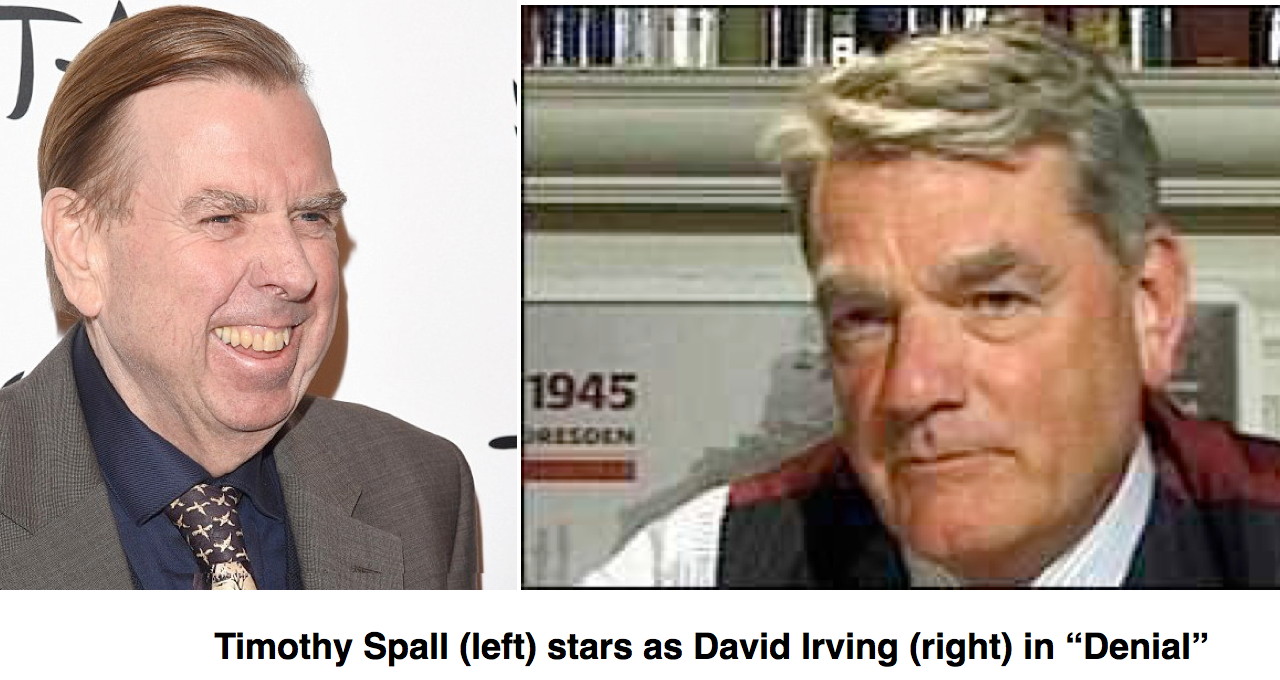
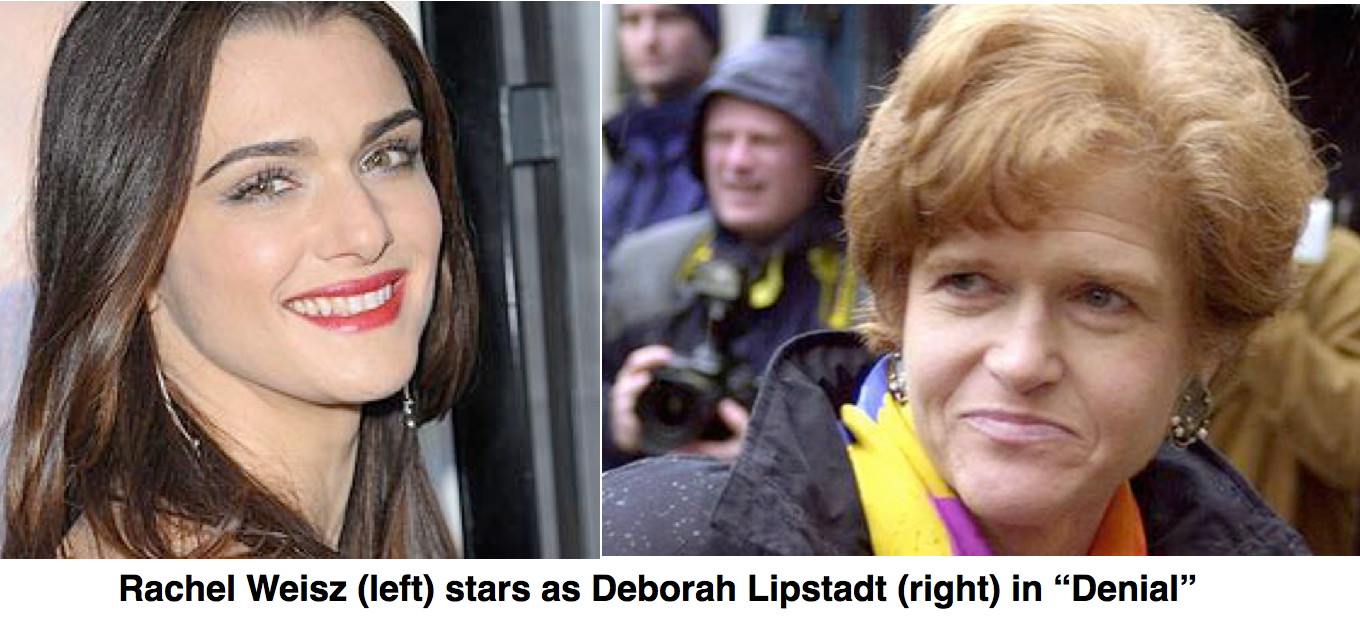
This is a morality play in a shades-of-gray world. When Christians endeavor to slay a dragon we are told to lighten up, don’t be a fanatic, embrace diverse viewpoints. When the Zionists prepare to slay a revisionist reptile, existential factors are banished and a pure struggle between cosmic good and evil takes center stage.
We will soon place online a video of a speech this writer delivered at Mr. Irving’s “Real History” Cincinnati conference more than a decade ago, concerning Lipstadt’s use of the theological term “Amalek” to denigrate him.
In 2006, when that speech was first placed on Google’s fledgling online video channel, friends of Lipstadt had it removed. She stated afterward: “The video, which was a virulent attack on me by Hoffman, was introduced by David Irving. I am sorry the video is gone. It was such a blatant example of the venomous hatred these folks feel towards Jews. It also was a prime illustration of their delusional conspiracy theories. I had used it in a number of speeches to illustrate their thinking.”
Needless to say, there was absolutely “no hatred toward Jews” in the video. Deb can’t seem to refrain from recklessly spouting this “Jew hater” trope. It’s a Pavlovian response to any informed criticism of a Judaic academic that is accurate — and wounding because it is accurate. By ominously terming Irving “Amalek,” Prof. Lipstadt rendered him, in terms of rabbinic theology, a target for extermination (how ironic). Pointing this out is only “Jew hate” in a Wonderland world where any defiance of the impostures of the Holy People is automatically suspect; again we observe the relentless megalomania.
The trailer for the movie “Denial”
Hoffman’s extensive archive on the libel trial, dating from January 11, 2000 to April 21, 2000
The Committee for Open Debate on the Holocaust (CODOH) maintains its own archive on Lipstadt/Irving
Lipstadt’s book, Denying the Holocaust is demolished by Carlo Mattogno
Israeli MKs, NGO Monitor Invent False Anti-Semitic Claims Against BDS
By Richard Silverstein | Tikun Olam | August 16, 2016
Israeli and American Jewish media have become willing facilitators of yet another fraud perpetrated by right-wing MKs and their NGO counterparts. The Knesset foreign affairs committee began the fraud by titling the hearing, “Singling Out Jewish Students by BDS on U.S. Campuses.” MK Anat Berko, who touts herself as a former IDF colonel and “expert” on Islamist terror, made flagrantly false claims that the BDS movement compiled lists of Jewish students along with their addresses. Berko is the solon who claimed Palestine doesn’t exist because there is no “P” in Arabic. Not to be outdone, MKs from Yesh Atid and Labor also chimed in supporting this hash of a hearing. The charges were formulated as if this were BDS’ first step toward a Final Solution of the Israel Problem. For those pro-Israelists without a sense of humor, the above sentence was meant entirely ironically.
Arutz 7, a settler website, ran this headline: Jews Persecuted Around the World. A video of some of the proceedings (in Hebrew) is here. NGO Monitor, a group whose leader was sued successfully for libel by an Israeli Palestinian non-profit group, even claimed that BDS’ anti-Semitic activism could be criminal in nature. Another NGO, Reservists to the Front, which was founded to combat Breaking the Silence, joined in claiming (without any evidence) that there were 941 anti-Semitic incidents in the U.S. in 2015. 90 were committed on campuses. He added, for good measure:
Jewish students are the most persecuted minorities on U.S. campuses, bar none.
Former Shin Bet chief and current Likud MK testified not just to his histrionic view of BDS, but his abject racism:
“BDS is an anti-Semitic wave against Jews. To my sorrow, it exists in nations considered enlightened and campuses considered intellectual [sic]. The style of BDS activists bring an Olympic judo medal, but nothing respectable. A great portion of BDS activism springs from the frustration of recent years when the subject of Palestine has sunk from the international agenda.”
Dichter continued his delusional rant thanking the Reservists group for the fake claims they offered: “The things done against Jewish students are carried out with the intent of harming Israel.”
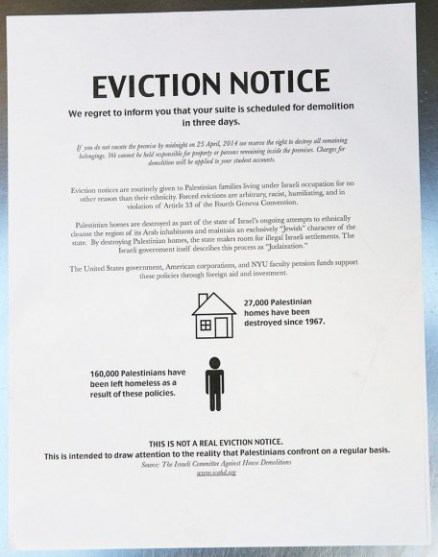 The former domestic security agency chief was alluding to a bit of guerilla theater in which Students for Justice for Palestine (SJP) placed “eviction notices” under the dormitory room doors of students at NYU. Jewish students who received the notices filed complaints with the administration that they were targeted because they were Jews. In reality, two dormitories received the flyers. One of them contained a Shabbat elevator for observant Jewish students. Both buildings contained both Jewish and non-Jewish students and there is no evidence that Jewish students were the only ones targeted for the notices.
NGO Monitor claimed that SJP deliberately distributed eviction notices to non-Jewish students so it could not be prosecuted for a hate crime. Again, an evidence-free claim. This action did not involve, as the media reports allege, any lists of Jewish students, their mail or e-mail addresses. None of the reports substantiate this claim with any evidence whatsoever. There is no evidence. Even the ADL, not known for its fondness for BDS acknowledged this in the Forward :
“According to our research, there is no evidence pointing to Students for Justice in Palestine compiling specific lists of Jewish students.”
Even more virulent pro-Israel groups stepped back from Berko’s hoax:
… Officials from the Zionist Organization of America and Stand With Us…. told the Forward they had no knowledge of this sort of activity taking place.
But that didn’t stop other members of the pro-Israel media. The Times of Israel (which Jeffrey Goldberg calls a “highly credible” publication):
Students for Justice in Palestine (SJP), a pro-Palestinian student advocacy group, has been compiling lists of Jewish students on college campuses in North America and detailing their dorm address information, raising fears for the students’ safety, Israel Radio reports.
The report came as the Knesset’s Foreign Affairs and Defense Committee met earlier Tuesday to discuss Israel boycott efforts at US colleges.
Israel HaYom also went to town on the report. It’s come to smell like a bunch of flies buzzing around a corpse of a story. That’s what all the lies amount to. Defending the indefensible. You get tired of having to defend Israel’s oppression and so you turn the tables and blame the accusers, the victims. They’re not the real victims, you are. They hate you. Want you dead. You? You did nothing wrong. It’s all their fault. Focus it all on them. Then they won’t be able to shine the light back at you and what you’ve done.
Guardian: “yes media is weighted against Trump” because he’s “rubbish”

By Catte | OffGuardian | August 17, 2016
As a female writer I often cringe at the embarrassing collection of beaming, smooth-faced young women the Guardian fields to wrap dangerous political extremisms in lipsticky identity-politics. There’s a touch of exploitation in it, intended or not. Here’s the latest example, by Lucia Graves:

The article sets out the case that Trump does not deserve unbiased press coverage. The media would love to be fair to him, of course, because fairness is their watchword – but they just can’t do it, because they have to protect their audience from his lies. Censorship is actually a sort of duty, Lucia tells us in her elementary-school prose, because Trump is “rubbish”.
His campaign is indeed a place where journalistic objectivity meets its limits, but it’s not because we’re deliberately gunning for him. There simply is no fairness in presenting both sides of a story when one side is consistently rubbish, to put it kindly, or a dumpster fire, in this cycle’s parlance. Trump changes his mind like it’s the weather and tells a lie every five minutes, going by Politico’s best count.
If we get past the awkward syntax (how often does Lucia think Trump changes the weather?), we have to admit “a lie every five minutes” is quite a lot of lies. True the article doesn’t tell us what any of those lies actually are, but Politico does (well, actually it doesn’t do that, but it does run a list of alleged “lies” Trump told over a single week, some of which may seem a bit relevant). But just in case you’re still not feeling convinced of the need for wholesale suppression of open political debate based on the fact that (shock) politicians lie, here’s a little more of Lucia’s A-grade analysis:
CNN and MSNBC have taken to putting parentheticals in their chyrons to correct erroneous claims in real time. The New York Times has started including the sweep of history in even the most straightforward news stories to demonstrate breaks from longstanding political norms.
The fact-checkers, in particular, are working overtime.
Trump’s also been keeping Politifact busy. As of late June, 95% of the site’s 158 fact-checks of Trump were rated “false” or “pants on fire”, while the same could be said for just 16% of Hillary Clinton’s 120 rated statements.
Ok, who is going to argue with a collection of data like this? Trump is 95% liar and Clinton is only 16% liar! Politifact says so! If that’s not a done deal, cast-iron, knock down argument for total censorship of Donald Trump and all he stands for I’d like to know what is.
Wait, what? Do I hear you say you want to know how they arrive at these statistics? You want to see the actual claims being made so you can evaluate them for yourself? You have heard that Politifact is not an entirely objective or neutral outfit?
No, I’m sorry, you need to get with the program. Media-bias is no longer a thing to be ashamed of, because the media is only biased against bad people. Today’s censorship is just about helping us understand things – weeding out the lies and leaving only the lovely truth for us to enjoy in nice pre-packed, easily-digested soundbites. Lucia is here to tell us our lovely cuddly Big Brother is only “fact-checking” so we don’t need to.
More revelations at ‘snipers’ massacre trial in Kyiv
New Cold War | August 10, 2016
Unbeknownst to consumers of mainstream Western media, trials in Ukraine are ongoing against officers of the former ‘Berkut’ police force who were on duty in Maidan Square, Kyiv at the height of the violent protest movement that overthrew the elected President Victor Yanukovych on February 22, 2014.
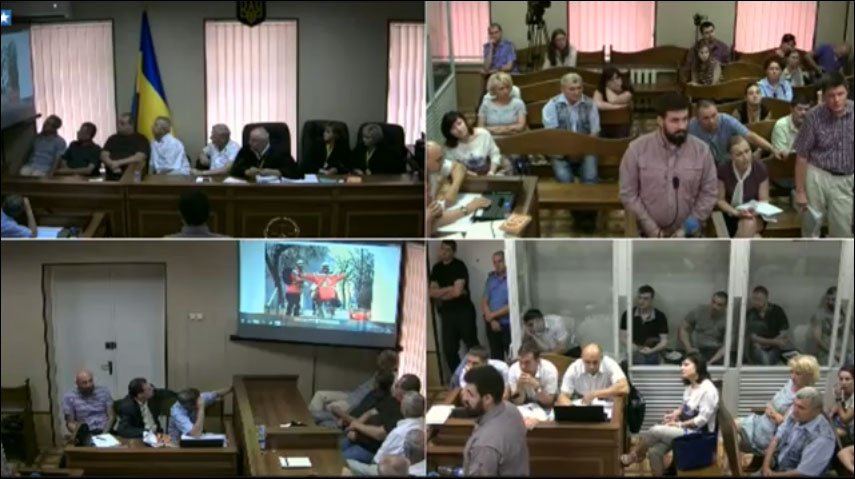
‘Maidan Massacre’ trial in Kyiv – Aug 4, 2016
Trial proceedings are filmed and broadcast (in Ukrainian language), but Western media is loathe to cover and report on proceedings. That’s because trial testimony is countering the centrepiece of the Western propaganda construct of the overthrow of Ukrainian President Victor Yanukovych in February 2014, namely the killings by sniper fire of dozens of protesters on Maidan Square on February 20, 2014.
Western governments and media have claimed all along that the killings were the work of the Berkut special police under orders of the Yanukovych government to suppress the protests. But as revealed at the trial and brought to light in the English language by the ongoing writing of Ottawa researcher Ivan Katchanovski, it turns out that most if not all of the sniper killings were perpetrated by paramilitaries of the extreme, right-wing forces on Maidan Square.
Katchanovski is reporting the revelations at the ‘Maidan Massacre’ trials on his Facebook page and in occasional academic papers analyzing the whole snipers episode. Enclosed is his report of August 5, 2016 on Facebook, reporting on trial revelations the day before.
By Ivan Katchanovski, August 5, 2016
An on-site, forensic ballistic investigation which was conducted by a ballistics expert on a GPU [Prosecutor General of Ukraine] request and made public during the Maidan massacre trial on August 4, 2016 confirmed my APSA paper [research paper presented to American Political Science Association in September 2015] finding that a Maidan medic was wounded from a Maidan-controlled location on February 20, 2014 and not from the Berkut positions. The moment of his wounding was filmed by CNN from the Hotel Ukraina and used by the media in the West and in Ukraine as evidence that the government forces deliberately targeted even medics. My analysis found that the medics were shot by Maidan “snipers” as a part of a false flag operation.
The on-site forensic ballistic investigation concluded that Roman Kotliarevsky was shot from a sector ranging from the Hotel Ukraina to the Bank Arkada. The ballistic expert did this based on the reconstruction of the position of Kotliarevsky and his wound location that were shown by this wounded medic but the expert amazingly did not see the CNN video to make a more precise determination about the shooting location. [Lengthy trial video footage streaming of Aug 4, 2016 here.]
A forensic medical report made public during the trial confirmed that Kotliarevsky was shot in the top back part of his right thigh at a steep angle from a top to bottom direction. This wounded medic stated during this investigation experiment that he was most likely shot from the Bank Arkada based on the steep direction of his wound channel. The GPU investigation continues to deny that any “snipers” were at these locations and charges the Berkut police with wounding Kotliarevsky.
A forensic ballistic report, made recently public during the trial concluded that this medic was shot from the same 7.62×39 caliber AKM-type weapon, or its hunting version, which was used to kill Mykola-Oleh Pankiv. The forensic medical reports, made public during the Maidan massacre trial last year, also found that Pankiv was killed from a steep vertical angle. These forensic findings confirm my APSA paper finding that Pankiv was killed from the same Maidan controlled-sector, specifically the Bank Arkada and Horodetskoho Street buildings (pp. 39-40 of APSA research paper):
“Mykola-Oleh Pankiv was fatally wounded 10:07am when he was filmed in the Zelenyi Front video sitting behind a tree protecting from the Berkut side and facing Horodetskoho Street and Bank Arkada. The prosecution charges confirmed that he was shot in his chest. This indicates either of these two buildings in the Maidan-controlled area but the prosecution charged the Berkut policemen with his murder. Within several seconds of his killing, Oleksander Labetsky, who was next to Pankiv behind the same tree facing Arkada, was wounded. He said that he was shot in his inner thigh and saw the bullet on the ground nearby. His position shortly before he was shot and the wound location and its very steep direction indicate that he was most likely shot by a sniper on the roof of Bank Arkada.
At 10:17am, CNN filmed from the Hotel Ukraina a Maidan medic being shot in his right leg, but did not report in its Emmy-nominated coverage of the Maidan massacre that this direction pointed to a shooter in one of the Maidan-controlled buildings. Roman Kotliarevsky, the wounded Maidan medic, said that his position at the moment of his shooting and a steep wound in the side back area of his right thigh indicated that he was shot from the Bank Arkada or a roof of one of the buildings there, i.e. on Horodetskoho Street. He also stated that he was wounded with 7.62mm bullet and that the investigation in his shooting was dragged out and that no specific suspects were identified.”
Background:
‘Maidan protesters were killed by snipers in Maidan-controlled Hotel Ukraina’: Interview with Ivan Katchanovski, Feb 20, 2016
Revelations in the Maidan Massacre trial in Ukraine go unreported in the West, interview with Ivan Katchanovski, published in Aletho News, July 22, 2015
The Snipers’ Massacre on Maidan Square in Ukraine (updated Sept. 2015), research paper by Ivan Katchanovski presented to the annual meeting of the American Political Science Association, San Francisco, Sept 3-6, 2015
Top 10 ‘acceptable’ Western Establishment conspiracy theories
By Neil Clark | RT | August 14, 2016
The label ‘conspiracy theorist’ is used by Western Establishment gatekeepers as a means of shutting down debate and smearing those who have the temerity to challenge elite-friendly narratives.
As I argued in an Op-Edge last year, there’s a great irony here. Over the last twenty years or so, the biggest pushers of conspiracy theories (CTs) have been Western Establishment gatekeepers themselves.
In fact, the most outlandish, fact-free and downright dangerous ‘CTs’ have been promoted by those who are the quickest to yell “conspiracy theorist!” at others.
So here are the top ten ‘acceptable’ Western establishment conspiracy theories. If you peddle them you won’t be labelled a ‘crank’ or nut-job’, but be hailed as an ‘expert’ who may even be deserving of a column in a ‘serious newspaper’ like the Washington Post, or the London Times. And who knows, you might even get a lucrative offer from a top publishing house to write a book about conspiracy theories.
1.Iraq has WMDs which threaten the world!
The most deadly conspiracy theory of them all – one which led to an illegal invasion and the destruction of a sovereign state and the deaths of up to 1m people. But the people who promoted it paid no professional penalty. Thirteen years on, the ‘punditocracy’ in the US and UK is still dominated by those who assured us Saddam had WMDs (and also that the secular, cigar-smoking Sound of Music lover had links to al-Qaeda). Remember that the next time you see a smug, self-regarding member of the neocon elite journos club loftily accuse someone they regard as their social and intellectual inferior of being a ‘conspiracy theorist’.
2.Iran’s developing nukes!
Since the early 90s we’ve been told the Islamic Republic is on the verge of developing nuclear weapons, or has already got them. The claims made repeatedly over the past 25 years by Israeli PM Netanyahu have been echoed by the same bunch of uber-hawks who pushed conspiracy theory 1. If you assert, without any evidence that say, Zambia is on the brink of developing nukes, you’ll be called a nutcase. But if you assert, without any evidence, that Iran is doing the same, then you’ll greatly increase your chances of being invited as an ‘expert’ into the studios of Fox News or Newsnight.
3. Jeremy Corbyn deliberately sabotaged the ‘Remain campaign’ in Britain’s EU referendum.
This has been a popular conspiracy theory peddled in elite Blairite circles in the UK this summer. The same anti-Corbyn crowd who tell us that the left-wing Labour Party leader is a massive turn-off with voters, blame said Labour Party leader for not doing more to persuade Britons to vote to stay in the EU!
In fact, Corbyn’s qualified support for the EU was much more in tune with public opinion than the Blairites’ EU fanaticism. Labour under Corbyn did deliver a majority vote for Remain among its supporters. Meanwhile, Islington, where Corbyn has his own seat, registered the sixth best result for Remain (75.2 percent) in the country. Some ‘sabotage’, eh, folks?
4. Assad is helping/working with ISIS and wants them to expand.
This one has been pushed by and large by the same people who pushed CTs 1 and 2 above. The theory says that the wicked Syrian tyrant wanted ISIS to gain territory in order for him to present himself as the ‘good guy’ in the conflict.
However, we’ve learned from declassified secret US intelligence documents from 2012 that the prospect of a ‘Salafist principality’ being established in eastern Syria was “exactly what the supporting powers to the opposition want” as it would “isolate the Syrian regime”. But let’s not mention evidence that it was Assad’s opponents – and not Assad – who welcomed the rise and expansion of ISIS.
That will only be dismissed as a conspiracy theory’!
And let’s ignore the Syrian Army’s liberation of Palymra from ISIS as well, shall we? It just doesn’t fit the ‘Why Assad won’t fight ISIS narrative!
5. Russia is providing ISIS with an air force
In October 2015, after Russia had started air strikes on terrorist targets in Syria, a new variation of Conspiracy Theory 4 started to circulate. Russia, we were told, was also helping ISIS and giving the Islamic State an air force!
Yet when a Russian passenger airliner was taken down by an ISIS/ISIL bomb later that month, we were told that it was a ‘warning shot’ for Moscow. If Russia was helping Islamic State/Daesh and providing it with an air force in Syria, why on earth would the group target a Russian plane?
As I wrote at the time: “You can’t say on one day that Russia is helping ISIS and that ISIS is gaining ground because of Russian actions and the next day claim that ISIS is bombing a Russian airline because they are, er.. angry with Russia”.
Or rather you can, if you’re a neocon who peddles outlandish anti-Russian conspiracy theories.
6. Trotskyists are taking over the Labour Party!
Record numbers of people are joining the Labour party to support leader Jeremy Corbyn, an anti-war democratic socialist whose policies represent a clean break with Blairism. And guess what?- these new members are disciples of a Russian revolutionary who died over 75 years ago!
Labour’s membership surged by 100,000 this summer – whoever would have thought there were so many Trotskyists in Britain! It’s all the more surprising given that the main Trotskyist party, the SWP, only has around 6,000 members.
According to Labour’s Deputy Leader Tom Watson, who opposes Corbyn, Trotskyist entrists’ are “twisting the arms” of young members. Perhaps they’re also threatening these young members with a spell in the Red Army…?
‘Trots under the bed’ is the 2016 variation of ‘Reds under the Bed’ for McCarthyite conspiracy theorists in the Labour Party, who are desperate to restrict party democracy and return to elite-friendly Tory-lite, pro-war policies.
7. Russia was behind the DNC email leak
No evidence has yet been produced that the Kremlin was responsible for the leaked emails from the Democratic National Committee, so let’s just push this conspiracy theory 24-7 shall we? It concerns Russia, an ‘official enemy’, so no need to wait for little things like facts, right? As Glenn Greenwald noted: “Democrats not only treated this evidence free conspiracy theory as Truth, but following the Clinton campaign, proceeded to smear Wikileaks as a Kremlin operation”.
8. Putin orchestrated football hooliganism in the European Football Championships to get Britain out of the EU
This has to be a strong contender for the nuttiest CT of 2016. Russia is very keen for Western sanctions to be lifted. So what does the Russian Prez do? He gets Russian football hooligans to attack England supporters in Marseille. And this apparently will make it more likely that Britain will vote to leave the EU.
I’m sure there were millions of people in the UK who read about English and Russian fans fighting each other in France, who turned to their partners and said ‘That does it. I’m voting for Brexit on Thursday’!
What a load of (foot)balls.
9. Donald Trump is a Russian agent
The argument in the West against Donald Trump goes: Since the Republican presidential contender does not seem keen on starting WW3 with Russia over Ukraine or Syria, he must therefore be a Russian agent! Either a ‘witting’ one or an ‘unwitting’ one!
We’ve even had claims that The Donald is a ‘Manchurian Candidate’ who is secretly working either for Russia, or for Hillary Clinton.
Again, peddle these evidence-free CTs in the US or UK and you won’t lose your credibility as a ‘respected commentator’. Far from it. But if you argue that Tony Blair or David Cameron were agents of the US – either ‘witting’ or ‘unwitting’ on account of their ‘pro-US policies’ you’d face ridicule and career death. Proving once again, that some conspiracy theories are more equal than others.
10. Dr Jill Stein is a Kremlin shill!
The Green Party candidate in the US Presidential Election is attracting plenty of support from progressives who can’t see what’s progressive about Wall Street-funded and neocon supported Hillary Rodham Clinton. So guess what? As her popularity rises, Dr Stein’s been smeared as a Kremin shill and is accused having ties to Vladimir Putin.
The ‘evidence’? Well, like Trump (see CT No 9), she doesn’t seem keen to start WW3, and wait for it, she attended, along with a lot of other public figures, the RT 15th Anniversary conference in 2015.
Going to Moscow and not wanting war with Russia – or indeed with anyone else – is apparently unacceptable, and enough to get another ‘acceptable’ Establishment conspiracy theory going, folks!
Follow Neil Clark on Twitter @NeilClark66
Featured Video

Trump asks Iran not to retaliate after he strikes Pickaxe Mountain
or go to
Aletho News Archives – Video-Images
Book Review
‘Why Fauci Must Rot in Prison’: A Tale of Two Diaries
By Jill Erzen | The Defender | October 13, 2026
Dr. Anthony Fauci’s private diary reveals a “mind-numbing” contradiction between what the former top U.S. infectious disease official knew about COVID-19 and what he told the public, senior White House adviser Peter Navarro, Ph.D., said last week on “American Thought Leaders.”
In his new book, “Why Fauci Must Rot in Prison,” due out Oct. 20, Navarro compares Fauci’s private entries to his own pandemic-era diary, and uses what he calls “a tale of two diaries” to argue that Fauci should face criminal prosecution.
“I show, actually, how a prosecution can and should happen … at the state level, most likely,” Navarro said. “He should wind up in prison, and we’ve got the receipts in this book to put him there.”
Navarro said Fauci repeatedly acknowledged important facts in private, then publicly pursued policies that contradicted those facts — with devastating consequences.
“What he says many times privately in his diary is so at odds with both his public behavior and public statements that it’s mind-numbing,” Navarro said.
Navarro examines the lasting damage caused by lockdowns and other pandemic policies, and the ongoing toll of long COVID.
His book also addresses questions about vaccine safety, including why healthy young people faced COVID-19 vaccination mandates despite concerns about myocarditis, and why women were not warned about miscarriage risks linked to the shots. … continue
Blog Roll
 Aletho News
- Yemen denounces international community’s silence on Saudi aggression, siege
- UAE and Saudi Arabia move toward renewed coordination against Sanaa
- How Iran’s two-week retaliatory strikes exposed cracks in US military architecture in Persian Gulf
- The mother of all propaganda: Why the hype over US MOAB strike against Iran is nothing but theater
- Iran says it possesses technology behind US 14-ton GBU bunker-buster
- Trump asks Iran not to retaliate after he strikes Pickaxe Mountain – w/ Prof. Marandi
- Vice President J.D. Vance’s Deceptive ‘Antiwar’ Campaign Speech
- Iran: Palestinians’ rights must not be compromised in Gaza’s future; US, Israel to blame for Hormuz situation
- Ongoing tales of Syrian chemical weapons
- Moscow blasts UN for ignoring torture of Russian POWs
- If Americans Knew
- Netanyahu’s spin on latest settler attack is laughable – Daily Update
- Israeli soldiers debunk Israel’s talking points
- In West Bank, Israeli settlers are totally out of control – Daily Update
- NPR investigation finds evidence of widespread fraud at mall kiosks tied to Israeli skincare brand
- Tucker Carlson exposes Israeli Lies about the Oct 7th attack, Charlie Kirk, and the U.S.
- Israel has detained thousands of Palestinian children since Oct 7th – over half spent time in solitary, many uncharged
- Israeli Analysis: Is Netanyahu Planning an ‘October Surprise’ Attack Before Israel’s Election?
- Israeli settlers brutally attack Palestinians and Washington Post female photographer, 65
- Words Have Changed, Occupation Continues: The Reality of the Gaza Ceasefire
- Gaza’s child amputees are growing faster than their prosthetics allow
- No Tricks Zone
- Predictions Made By Renowned Climate Proifessor Over Past Decades Have Been Proven To Be Poor
- New Study Suggests Large Regions Of The Pacific Ocean Have Been Cooling For The Last 80 Years
- Germany’s Green Energy Debacle: High Energy Costs Force Kahla Porzellan to Close After 182 Years!
- New Study: 50 Years Of The Most Aggressive ‘Net Zero’ Policies Can Only Affect The Global Climate By 0.03°C
- US September “Heat” Was No Record…Many Records Set Decades Ago
- Latest European Green Energy Debacle; Portugal’s Largest Flagship Solar Park Insolvent!
- Green Energy Debacle: German Expert Professor Fritz Vahrenholt Warns Of Severe Economic And Social Consequences
- Two More Paleo Reconstructions Affirm Meters-Higher Sea Levels Across Ireland, Brazil 7000-6000 Years Ago
- New Study: Earth And Venus Surface Warmth Largely Explained By Convection And Lapse Rate, Not CO2 Or Radiation
- 2025 Nature Paper Claiming Worsening Global Drought Gets RETRACTED …Heavily Flawed

