CNN Strikes Again: Blames NYT Hack on Russians, Provides Zero Evidence
Sputnik – August 24, 2015
The major American news network claims that the FBI is looking toward Russia for hacking into the New York Times and other news organizations. Where CNN got this information is unknown.
Citing only anonymous sources, CNN released a report on Tuesday claiming that the FBI and other US security agencies are investigating a series of cyber breaches at various US media outlets, including the New York Times.
“Investigators so far believe that Russian intelligence is likely behind the attacks and that Russian hackers are targeting news organizations as part of a broader series of hacks that also have focused on Democratic Party organizations,” the report reads, citing, “US officials briefed on the matter.”
The identity of these officials remains unknown, as CNN notes that none of the principals involved have commented. While the FBI declined to comment, the New York Times released a vaguely-worded statement.
“Like most news organizations we are vigilant about guarding against attempts to hack into our systems,” said New York Times Co. spokeswoman Eileen Murphy.
“There are a variety of approaches we take, up to and including working with outside investigators and law enforcement. We won’t comment on any specific attempt to gain unauthorized access to The Times.”
The Russian government has become the scapegoat for a series of cyberattacks in recent months, including hacks into the computer networks of both major US political parties. Most recently, Moscow has been blamed for hacking into the US National Security Agency and stealing cyberweapons.
The accusations are never backed by evidence, and are often contradicted by shreds of inference. In the recent NSA hack, US government hacking tools acquired through the breach were put up for auction, suggesting that the perpetrators were not sponsored by a foreign government.
“A more logical explanation could also be insider theft,” James Bamford writes for Reuters, adding that it appeared the culprits were “more like hacktivists than Russian high command.”
“Rather than the NSA hacking tools being snatched as a result of a sophisticated cyber operation by Russia or some other nation, it seems more likely that an employee stole them.”
There is little evidence that Russia is responsible for the DNC hack that led to the release of internal emails by Wikileaks.
“Intelligence agencies have again pointed the finger at Russia for hacking into these emails,” Bamford says.
“Yet there has been no explanation as to how [Wikileaks founder Julian] Assange obtained them. He told NBC News, ‘There is no proof whatsoever’ that he obtained the emails from Russian intelligence. Moscow has also denied involvement.”
Russian, Chinese, Iranian or other foreign hackers are constantly blamed for online breaches of major US government or private corporation servers. However, despite making bold headlines, these accusations are rarely confirmed by facts and often are later quietly dismissed by intelligence officials and cyberexperts. Which doesn’t stop mainstream media from running with stories attributed to anonymous sources again and again.
The network has a history of jumping to conclusions on hacking stories. In the wake of the hack into Sony Pictures, CNN was quick to pin the blame on the North Korean government, but subsequent investigations have cast doubt on Pyongyang’s role. Similarly, CNN was one of the first to blame Russia for the breach of systems at the White House without any evidence.
“The Awful Clarity” of Israeli Oppression Becomes Murky Spin in the NYT

By Barbara Erickson | TimesWarp | August 22, 2016
When writer Michael Chabon visited the West Bank city of Hebron earlier this year, the brutal reality of the Israeli occupation hit him with force. During an interview with the Forward, he appeared “visibly jarred,” and he pulled no punches in describing his reaction.
“Once you see for yourself,” he said, “it is pretty obvious, I think, to any human being with a heart and a mind, it is pretty clear what to feel about it. It is the most grievous injustice I have ever seen in my life.”
His reaction echoes in the words of another author, Ben Ehrenreich, who recently published a book about the occupation, “The Way to the Spring: Life and Death in Palestine.” In his introduction Ehrenreich refers to “the awful clarity of the injustice,” and his book portrays Palestinian resistance under Israel’s state-sponsored system of oppression.
Both these American writers are saying that the suffering of Palestinians under Israeli rule is clear to see, an obvious truth to anyone who witnesses the situation firsthand.
Now, as Peter Baker, the latest New York Times Jerusalem bureau chief, takes up his post, we can ask whether the newspaper will begin to convey this reality to its readers. Will Baker, a fresh new witness with full access to the sites under occupation, give voice to the oppression seen with such clarity by Ehrenreich and Chabon?
Baker’s predecessor, Jodi Rudoren, who left Jerusalem late last year, filed hundreds of stories over nearly four years at the post and managed not to clarify but to obscure the reality of occupation and dispossession. Her stories promoted a narrative of Israeli victimhood and Palestinian violence and deflected Israeli culpability. (See TimesWarp 12-22-15.)
Many voices vied for attention during her stint, but Rudoren turned a deaf ear to some of the most respected sources of information, not only the United Nations and human rights organizations such as Amnesty International and Human Rights Watch but also Israeli monitoring groups and courageous Israeli journalists. These groups and individuals were constantly documenting and reporting abuses by the Israeli forces, but the news they bore rarely found even brief mention in the Times.
When a series of stabbing and vehicular attacks on Israelis began last fall, several monitoring groups issued alerts, charging that Israeli forces were using the situation to conduct “street executions” of Palestinians who actually posed no threat.
These accusations were bolstered by video and eyewitness evidence and came from groups such as the Israeli human rights organization B’Tselem, Amnesty International and Euro-Med Monitor. To give even more weight to their claims, a group of nine Israeli organizations, including Physicians for Human Rights and the Public Committee Against Torture, issued a joint statement saying Israeli officials were responsible for the climate that fostered these executions.
The Times took little notice. The newspaper’s headlines remained focused on Palestinian attacks, and any quotes about extrajudicial executions were attributed to Palestinian officials, as if these charges were nothing more than the opinions of partisans taking one side in a bitter exchange.
Anticipating Baker’s arrival in Jerusalem, the Times produced a video featuring him in conversation with Rudoren and another former Jerusalem bureau chief, James Bennet. The trio made many references to “the conflict” (with only a single mention of the occupation), and they insisted that Times reporting strives to be balanced and neutral.
If reporters were sincerely looking for balance, however, it would seem that truly neutral parties, such as the United Nations and human rights organizations, would provide an essential antidote to the partisan claims of two adversaries. Yet the Times turns a deaf ear to these sources, no matter how fully documented their findings are, and relies heavily on Israeli officials.
Thus, Times readers are left in ignorance, hearing almost nothing about urgent and repeated appeals from these non-partisan groups. Beyond the latest accusations of extrajudicial killings, for instance, rights organizations have consistently highlighted the mistreatment of Palestinian children held in Israeli custody and the demolition of Palestinian structures, including everything from homes and workshops to cisterns and animal shelters.
Organizations such as UNICEF, Defence for Children International, Save the Children, B’Tselem, Human Rights Watch, the UN Committee for the Rights of the Child and the Committee Against Torture in Israel have tried over several years to publicize the abuse of Palestinian children (See TW 1-13-14.), but the Times has rarely mentioned these reports and then only in stories aimed to spin the information in favor of Israel.
Throughout 2015 some of these groups continued to issue frequent reports and news releases with headlines such as “Rising physical violence against Palestinian child detainees,” “UNICEF report confirms ill-treatment of Palestinian child detainees remains systematic,” and “New U.S. government report highlights violations against Palestinian kids,” but the Times showed no interest in exploring the problem.
Likewise, Israel’s rampage of demolitions in the West Bank is never brought to the attention of Times readers although the United Nations, B’Tselem, Human Rights Watch and other groups have issued frequent statements and demands, urging Israel to end its policy of destruction.
While the Times has remained silent, Gideon Levy and Amira Hass, columnists for the Israeli newspaper Haaretz, have often written about the terrible toll demolitions have exacted from some of the most vulnerable Palestinian communities.
Rudoren wrote occasionally about punitive demolitions, the Israeli policy of destroying the family homes of attackers, but her stories omitted any mention of the much more common demolition of structures because they lack building permits, which are rarely issued.
The policy is a constant threat to Palestinians in a large part of the West Bank, and over the decades of occupation, the state has demolished more than 48,000 Palestinian homes and other structures.
According to the UN Office for the Coordination of Humanitarian Affairs, Israel has destroyed 726 Palestinian structures so far this year, displacing 1,020 people. In a recent report, OCHA noted that during one week this month, 42 structures were demolished or confiscated. The report stated, “Twelve of the targeted structures had been previously provided as humanitarian assistance, including emergency shelters, animal sheds, latrines, a community centre, and a water connection; the confiscation of the latter means that nearly 1,000 Palestinians in five herding communities in the Jordan Valley will continue to suffer water scarcity.”
The OCHA report continued, “This brings the number of assistance items destroyed or confiscated since the start of 2016 to 200, almost double the figure for the entire 2015 (108).” In other words, donors such as the European Union and International Committee of the Red Cross have stepped in to provide tents and other items when Israel has destroyed Palestinian homes, schools, playgrounds, water wells and other structures, but the Israeli authorities have demolished even this humanitarian aid.
In this brief report from OCHA “the awful clarity of the injustice” is evident, as it has been evident in hundreds of other reports issued over the years. The rising tide of demolitions, with all its human-interest value, is most certainly newsworthy, but will the Jerusalem bureau of The New York Times report it?
So far the Times seems determined to muddy the waters, avoiding a clear exposition of Israeli brutality, but with a new bureau chief now on board, some readers may hold out a faint hope for change, for an honest and full accounting at last.
Unfortunately, here at TimesWarp, the expectation is for more of the same. It seems unlikely that the Times would allow any straightforward reporting on Israeli oppression to appear in its pages. This would destroy its carefully fostered narrative of Israeli victimhood, “ancient hatreds” and the need to place Israeli security needs above all.
The alternate reality of Anders Fogh Rasmussen
By Danielle Ryan | RT | August 23, 2016
Reading through a recent interview with former NATO secretary general Anders Fogh Rasmussen, it becomes clear that his world is one in which US foreign policy has only ever made us all safer and the biggest risk we now face is diminished US power.
The entire premise of his argument throughout the interview is that if the US steps back from playing global policeman, the “bad guys” will win. Simple as that.
Tempting Putin
The interview, which focuses on Donald Trump, opens with a question about Trump’s views regarding the NATO alliance and how the candidate sees the US’s role in the world. Rasmussen immediately declares he is “not taking sides” in the US election, but his attempt at neutrality goes swiftly out the window moments later when he complains that Trump is undermining “the credibility of the United States” and putting at stake America’s “role as the global superpower”. If Trump were to be elected, he laments, that could usher in “the end of the American-led world order”.
This would be very bad, he says, because if NATO is undermined by a Trump victory, then Vladimir Putin would “open a bottle of champagne” and be “tempted to test” the alliance. This assumes that Putin has simply been waiting in the wings for the 16 years that he has held positions of power for Donald Trump to come along so that he can invade Estonia for no reason. Because Rasmussen doesn’t give us a reason and we’re not supposed to ask. We’re just supposed to assume invading the Baltics is on Putin’s to-do list.
So, keeping with his policy of “not taking sides” Rasmussen then argues that Hillary Clinton would be “more determined to defend” the country’s NATO allies than Trump would. When asked whether eastern European nations are worried about Trump’s take-it-or-leave-it approach to NATO’s Article 5 (principle of collective defense) Rasmussen says they are indeed very concerned, particularly following “Russian aggression” against Ukraine. So concerned in fact, that only five of the 28 alliance members have reached the 2 percent of GDP benchmark that NATO requires. Now, this is either because they aren’t really as terrified of Russia as they claim, or that they’re simply taking the US for a ride — in which case, Trump might actually have a point about getting them to cough up before putting American lives in harm’s way to defend them.
It’s hybrid warfare, stupid!
Next up, Rasmussen is asked whether the threat environment for NATO has changed and how the alliance is dealing with the changes. Rasmussen here employs one of my favorite terms: “hybrid warfare”. It’s not just conventional warfare (tanks rolling across borders etc.) that eastern European nations need to be aware of, he says. It’s a whole load of other stuff, too. Like what? Well, sophisticated “disinformation campaigns” for one thing.
But the great thing about “hybrid warfare” is that when you use the term, you don’t really need to explain what you mean. Even NATO itself published an article about the fact that it can mean everything and nothing at the same time. Pretty nifty, right?
Moving on to Crimea, another victim of hybrid warfare. Trump isn’t too bothered by the fact that Crimea was annexed by/invaded by/reunited with Russia in 2014. That’s Europe’s business, he has said — and it shouldn’t prevent Washington and Moscow from getting along and working together on common threats like international terrorism. You don’t have to be a Trump fan to see the common sense in this, but it’s another no-no for Rasmussen.
Trump also hasn’t been so gung-ho about sending weapons to Ukraine. This is very scary and “disturbing” Rasmussen says, because if the US doesn’t support the government in Kiev, the West “risks losing a democratic Ukraine”.
Democracy and world peace
So, how is “democratic Ukraine” doing, then? Well, a few months ago The Guardian published an op-ed arguing that Ukraine was at risk of becoming not a democracy, but a “failed state”. Since the country’s democratic “revolution” in 2013, living standards have plummeted, as has the value of the country’s currency — and the government, ideologically driven to sever all ties with Russia, has pursued economic policies that “can only be termed suicidal”. But the solution is obviously to send them some new weapons. Regardless of whether you believe Russia has acted aggressively in Ukraine or not, this kind of thinking is simply delusional.
Next Rasmussen is asked about Trump’s “America first” campaign slogan, which he also doesn’t happen to like (surprise!). Using the term “America first” for an American presidential election is “out of touch” he says. How so? Well, of course it comes back to America’s role in the world again. You can’t use the term “America first” when you’re supposed to be “the world’s leader”. I swear, I’m not making this up.
After World War 2, Rasmussen tells us, the US established a “rules-based world order” and it has “served us very well” because “freedom has flourished” and we’ve seen “world peace”. All of this freedom and world peace (really?!) is now at stake… because of Donald Trump (are you sensing the “not taking sides” thing?). Anyway, I could list all of the occasions on which the US decided to flout its own “rules-based” order, but that would take too long.
If the US “retreats and retrenches” now, it will create a power vacuum that will be filled by “the bad guy,” Rasmussen warns. He doesn’t tell us who the bad guy is this time; he’s just there, malevolently waiting for Trump’s election. Trump needs to understand that the US has “special obligations” to “maintain world order” and “promote peace”. Not only this, but it’s the “only power on earth” with such a “destiny”.
Barack Obama has also been a disappointment to Rasmussen. He has been “too reluctant” to use American force around the world. Obama and Trump are proponents of a “less interventionist” movement in the world and this simply won’t do.
By the end, Rasmussen had lavished so much praise on the United States and its role and “destiny” in the world that I had forgotten he was not an American himself, but a Dane. The real kicker was when he dramatically pleaded with the next president: “We need a global policeman, and that policeman should be the United States. We don’t have any other.”
Could he really be so profoundly in awe of Washington and its power, or is this waxing lyrical about American destiny simply, as one writer put it, “the practiced gambit of a con man, who knows flattery is the surest means to success” ?
Decide for yourself.
Donald Trump’s Neocon Foreign Policy Advisor

By Kurt Nimmo | Another Day In The Empire | August 13, 2016
Donald Trump has appointed at least two neocons to his foreign policy group.
First, let’s consider Joseph E. Schmitz. He is a former Inspector General of the Department of Defense and a former executive with Blackwater Worldwide. He fled the Pentagon after he was accused of protecting top Bush officials accused of wrongdoing.
Blackwater, now Academi, the military contractor founded by Eric Prince, played a substantial role during the Iraq War. It is infamous for killing seventeen Iraqi citizens in 2007, the same year the corporation was accused of illegally smuggling weapons into the country. Blackwater did not like being investigated for its misdeeds. In 2007, Blackwater Manager Daniel Carroll threatened to kill Jean Richter, a State Department Investigator.
Schmitz is connected to the Center for Security Policy (CSP), a think tank formed by Frank Gaffney, a neocon so radical he was rejected by the Pentagon when he was Deputy Assistant Secretary of Defense for Nuclear Forces and Arms Control Policy in the Reagan Administration. He is associated with other neocons, including Richard Perle, who rose to prominence as aides of the late Democrat Senator Henry “Scoop” Jackson.
The Center for Security Policy, described by William Arkin as the “Domino’s Pizza of the policy business,” claims there is a “stealth jihad” underway in America and Muslims plan to install sharia law. Former CIA director and staunch neocon James Woolsey coauthored a report for the center claiming sharia law is a major threat to the United States.
After CSP sent a letter to the State Department Inspector General accusing Hillary Clinton aide Huma Abedin of working undercover for the Muslim Brotherhood, a number of Republicans, including John McCain, John Boehner, and Marco Rubio, denounced the group.
Trump and former Republican member of the House, Michele Bachmann, often cited CSP propaganda.
Trump’s call for a “total and complete shutdown of Muslims entering the United States” was in part inspired by the results of a CSP poll. The poll said 25% of Muslims queried supported violent jihad and more than half favored sharia law. The methodology and accuracy of the poll is suspect. Philip Bump of The Washington Post said the poll’s structure encouraged Muslims to select the options endorsing violence.
On Friday The Canary reported Schmitz worked with a Saudi prince to illegally provide arms to the jihadists in Syria. “Schmitz was in direct contact with then Free Syrian Army (FSA) commander Gen. Salim Idris. Schmitz hoped his deal with Gen. Idris would be a first step toward potential future assistance from Blackwater founder Erik Prince himself,” writes Brad Hoff.
Idris, a former Syrian Army commander, was appointed to lead a Salafist dominated military command in 2012. “The unified command includes many with ties to the Muslim Brotherhood and to Salafists, who follow a puritanical interpretation of Islam. It excludes the most senior officers who had defected from Assad’s military,” Reuters reported.
Its composition, estimated to be two-thirds from the Muslim Brotherhood and its allies, reflects the growing strength of Islamist fighters on the ground and resembles that of the civilian opposition leadership coalition created under Western and Arab auspices in Qatar…
“Idris and [Col. Abdul Jabbar al-Okaidi] were the very men that Joseph Schmitz stood ready to arm through a mysterious Saudi middle man before the whole private venture was reportedly shut down by a CIA official who intervened in Amman, Jordan,” writes Hoff.
Trump has a second fringe neocon in his circle of confidants—Walid Phares.
Phares is associated with the Foundation for Defense of Democracies, a neocon organization that teamed up with the American Enterprise Institute and the Hudson Institute to propagandize (and lie) America into invading Iraq.
In 2011, Phares became one of several neocon advisors to the Mitt Romney presidential campaign. Other advisers included Eliot Cohen, Robert Kagan, Michael Chertoff, Eric Edelman, John Lehman, Dan Senor, Vin Weber, and Paula Dobriansky.
Phares, a Christian Maronite of Lebanese origin, was associated with the Lebanese Forces in the 1980s.
In the 1970s the Lebanese Forces were part the Kataeb Party, also known as the Lebanese Phalanges Party. Its militia killed 3,500 Palestinians at the Shatila refugee camp in Beirut in 1982 during the Israeli invasion of Lebanon. Elie Hobeika, a prominent figure in the Phalanges, served as the Lebanese Forces intelligence chief and liaison officer with Mossad, the Israeli intelligence agency.
Many of Donald Trump’s foreign policy pronouncements are contradictory. Hillary Clinton, on the other hand, has demonstrated her willingness to do the bidding of the neocons in Libya and Syria. She has not vacillated in her commitment to total war. More than a few neocons, most notably Max Boot, have said they will vote her.
The danger for America “is not Trump, but Hillary Clinton,” writes John Pilger. “She is no maverick. She embodies the resilience and violence of a system whose vaunted ‘exceptionalism’ is totalitarian with an occasional liberal face.”
Trump may indeed rollback the aggressive military posture of the United States, as promised, then again, considering his coterie of foreign policy advisers and his penchant for flip-flopping, he may continue to engage in foreign interventionism, albeit with his signature flair.
Sir Richard Shirreff Preparing Poles for War with Russia
By Vladislav GULEVICH | Strategic Culture Foundation | 22.08.2016
In July 2016, while swearing in 105 Polish soldiers being promoted to the rank of podporucznik (roughly equivalent to the rank of second lieutenant and a junior officer rank of the Polish Army), the Minister of National Defence for Poland, Antoni Macierewicz, announced Warsaw’s military plans for the near future:
– to increase the number of Polish troops from 100,000 to 150,000 by 2017;
– to set up 17 brigades, one in each of Poland’s 16 provinces and two in Mazovia Province (where Warsaw is situated);
– to urgently deploy new brigades in the provinces of Podlaskie, Podkarpackie and Lubelskie and four battalions in Białystok (on the border with Belarus), Lublin and Rzeszów (both on the border with Ukraine), and Siedlce (90 kilometres from Warsaw); and
– to set up territorial defence forces consisting of 35,000 volunteers, or 164 units, to assist the army.
The territorial defence forces will be the fifth branch of the Polish Armed Forces (after the Land Forces, the Navy, the Air Force, and the Special Forces).
Antoni Macierewicz said that an army of 150,000 is the minimum required for cooperation between Poland and its allies «in the event of a real threat to our independence». And in order to justify this militaristic itch to the Polish people, the defence minister added: «This threat is real and it is coming from the Russian government».
It is impossible to deny the achievements of the Polish authorities in whipping up war hysteria in the country, of course, but their role is ultimately secondary. The root cause should be sought in the work of leading Western think tanks.
The authors of a report published in July (2016) by the European Council on Foreign Relations entitled «An unpredictable Russia: the impact on Poland» are trying to make the Polish people believe that the risk posed by Russia is comparable with the threat of terrorism to Europe (!), that «Central and eastern Europe represents the testing ground for Vladimir Putin’s project to create a new world order». And this statement is presented as an axiom.
On 11 August, an article was published on the BBC’s website under the headline «The Polish paramilitaries preparing for war» which states that nearly 100,000 people have now joined paramilitary organisations in Poland and others are learning how to survive a possible invasion. US National Guard units will serve as the prototype for the territorial defence forces, which are to be an integral part of the Polish Armed Forces, and US instructors are involved in their training and indoctrination.
On 19 July 2016, the Atlantic Council presented a 25-page report entitled «Arming for deterrence. How Poland and NATO should counter a resurgent Russia», which is a kind of postscript to the alliance’s summit in July. Calling for a large-scale military build-up in NATO’s zone of responsibility, the report suggests that Poland should be regarded as a front-line bastion in a war with Russia.
Half of the report deals with recommendations to the Polish government regarding the militarisation of the country, with the clear aim of creating war hysteria among the population.
Thus, the Atlantic Council recommends that Warsaw should:
– issue a statement declaring that Poland will come to the aid of the Baltic States and Romania should they be attacked by Russia;
– publish a list of potential targets for Polish strikes in Russia, primarily in the Kaliningrad Oblast;
– enable Polish F-16s to be carriers of tactical nuclear ordnance;
– declare that, if attacked, Poland reserves the right to dispatch Special Operations Forces deep into Russian territory to carry out acts of sabotage;
– be prepared to destroy Russian infrastructure facilities using missiles; and
– announce that, if attacked by Russia, Poland reserves the right to deploy offensive cyber operations against such targets as the Moscow metro, the St. Petersburg power network, and the TV news channel RT.
Generally speaking, the list of recommendations in the report can reasonably be considered the ravings of a madman. This feeling is intensified by the name of the report’s author – retired British General Sir Richard Shirreff, who served as NATO’s deputy supreme allied commander in Europe between 2011 and 2014 and who has recently gained renown as a novelist.
In May this year, Sir Shirreff presented his book «2017: War with Russia» in London, in which the author states that war between Russia and the West is inevitable. The book opens with a colourful description of the beginning of the war, and this heart-rending scene was written with the firm belief that it would capture anyone’s imagination: Russian troops attack a school in Donetsk and kill around a hundred innocent children in order to blame it on the Ukrainian military and thus create a pretext for large-scale aggression against Ukraine and Europe, which has dropped its guard. Sir Shirreff himself called his work a «prophesy novel».
The politicians currently in power in Poland can boast about their supposed independence in international affairs as much as they like, but in reality, immersed in an atmosphere of hatred with their Russian neighbour, they can only dance obediently to the tune of gentlemen like the retired British General and aspiring novelist Richard Shirreff. And dances like that will never end well.
Syrian boy’s image shamelessly exploited for West’s war agenda
By Finian Cunningham | RT | August 21, 2016
How many times have we seen this before? Western media selectively focusing on, or distorting, human suffering in order to fulfill a base political agenda – war – for powerful interests.
It is no coincidence Western media fevered with images of a five-year-old boy, pulled from rubble in Aleppo after an alleged air strike by Syrian government or Russian forces – and the very next day US warplanes were scrambled over northern Syria reportedly to ward off Syrian Su-24 fighter bombers.
American political analyst Randy Martin at crookedbough.com told this author: “This is a prelude to an all-out war in Syria – one that would inevitably bring American and Russian forces into direct confrontation.”
Martin says a warmongering cabal in Washington wants an “existential showdown” with Russia. This “war party” comprises hawkish think-tanks, military corporations, the Pentagon and CIA whose world view is predicated on American total domination. “They are counting on Hillary Clinton for president,” says the analyst. “And a war with Russia in Syria is an opportunity for this cabal which Clinton seems more than willing to accommodate.”
Perversely, the image of a suffering child is being exploited to solicit an outcome entailing many, many more children suffering.
It is no coincidence either that last week saw Western media reports alleging that thousands of detainees have died during incarceration in Syrian prisons.
https://www.rt.com/news/356600-aleppo-children-hospital-situation/video/
There were also reports claiming that since President Vladimir Putin ordered Russian military intervention in Syria last September his forces have “killed more civilians than terrorists” belonging to the Islamic State and other extremists. The latter claim was based on figures from the so-called Syrian Network for Human Rights, which, according to reliable sources, is a political front for Western governments. Tellingly, the UK-registered network refers to Russia as the “Russian regime”.
The unmistakable context is to further discredit and demonize the elected government of Syria and its foreign allies, which then gives pretext for further Western intervention in the country – intervention that under any normal, rational perspective would be viewed as illegal aggression.
Several alternative media observers have questioned the validity of the now-iconic image of the five-year-old boy, named as Omran Daqneesh. Commentators at the OffGuardian site, for example, have pointed to anomalies in the video footage suggesting that it was staged for propaganda effect. The so-called Aleppo Media Center that fed the images to Western outlets is evidently embedded with the proscribed terror group, Fatah al Sham (previously Jabhat al Nusra).
Other observers noted that the self-declared “photojournalist” Mahmoud Raslan has also been spotted in selfies posted on social media in which he cheerfully enjoys the company of militants belonging to the Nour al Din al Zinki – the very same individuals who last month posted a video of themselves decapitating a 12-year-old boy near Aleppo.
The Russian Ministry of Defense refuted claims that its aircraft were involved in the Aleppo blast. Major General Igor Konashenkov said Russian forces were not operating in the eastern district of Qaterji on the day of the alleged strike. He also said that footage of the blast site indicated it most likely was caused by a mortar shell, which could have been fired by anti-government militants. This is consistent with claims that such militants are holding civilians in eastern Aleppo as hostages and human shields.
The politicization of an image purporting to show a little boy with bloodied head, covered in dust becomes obvious when we step back from this emotive singular focus. Why do Western media outlets not give the same prominence to thousands of children who have been killed or maimed by the anti-government militants or US warplanes?
Why, we should ask, is this particular image made “iconic”? What about the countless children suffering in Afghanistan, Iraq, Libya, Mali and elsewhere where Washington and its Western allies have waged dubious wars and invasions?
In the same week that the image of five-year-old Omran was plastered all over Western channels, in Yemen US-backed Saudi warplanes bombed a school killing 10 children. Where were their images on Western media?
Almost invariably, Western media focus on human suffering is hardly as simple as relaying the story that meets the eye. Russia was right this week to denounce the “cynical manipulation” of images as an attempt to score political points and orchestrate public sentiments.
Notorious incidents recall how Western media have actually engaged in not just “selective focus” and “omission” but fabrication. Recall the image of the emaciated girl whom Western media claimed was from an enclave in Syria besieged by “regime forces” in a policy of starving rebel-held populations. Turns out the little girl is Lebanese, unrelated to the Syrian conflict.
Or remember the Houla massacre that occurred in May 2012? Over 100 villagers were butchered in that attack and Western media rushed to assign blame on militia supporting the Assad government. Turned out that it was Western-backed mercenaries who perpetrated the atrocity, with the aim of incriminating the Syrian government.
Perhaps the most notorious “false flag” massacre was that of the chemical weapon attack on the Damascus suburb of East Ghouta in August 2014. Images of children suffocating were broadcast across the Western media. Again, it later emerged that it was US-backed Jaish al Islam militants who likely carried out the massacre in a deliberate attempt to prompt Obama’s “red line” for American air strikes on Syria.
Shameless Western media manipulation over Syria’s conflict – as with so many others, for example, Gaddafi’s “imminent butchering of Benghazi” which served as a pretext for NATO bombing of Libya and overthrow of its government in 2011 – is always correlated with a desired policy shift.
The Houla massacre back in 2012 happened only days before the UN security council was to meet on ramping up sanctions on the Assad government. The East Ghouta atrocity was around the time Washington was looking for a red line excuse to impose its military directly in Syria.
The image of the boy from Aleppo falls into the same pattern of expediting political objective.
The battle for Aleppo marks a last stand by the Western-backed militants. Their likely defeat by Syrian, Russian, Iranian and Hezbollah forces portends the end of a six-year war that Washington and its allies covertly embarked on for the illegal purpose of regime change. As many as 400,000 Syrians have died in this Western-fomented war.
Washington desperately wants to thwart the Russian-backed offensive, which is putting paid to its regime-change scheme.
Western outcry for ceasefires and No-Fly Zones are animated by emotive images of children suffering. But the real, underlying concern is to afford respite to the West’s proxies in Aleppo and to stave off terminal defeat.
Much more than this, however, is the perplexing sign that Washington wants to go to war in Syria, as US analyst Randy Martin and others point out.
Presidential candidate Hillary Clinton has already stated that she will escalate American involvement in Syria. Her backers in the CIA and Pentagon are also advocating “killing Russians” and supplying anti-aircraft missiles to their jihadist proxies.
In this prelude to war, we can therefore expect many more such images of children shamelessly exploited to condition the public to accept Washington’s despicable agenda.
Read more:
‘Aleppo child survivor image will be used as propaganda for more war – not less’
Footage Of Boy In Aleppo Is Opportunistic, Vile Propaganda From Western Media
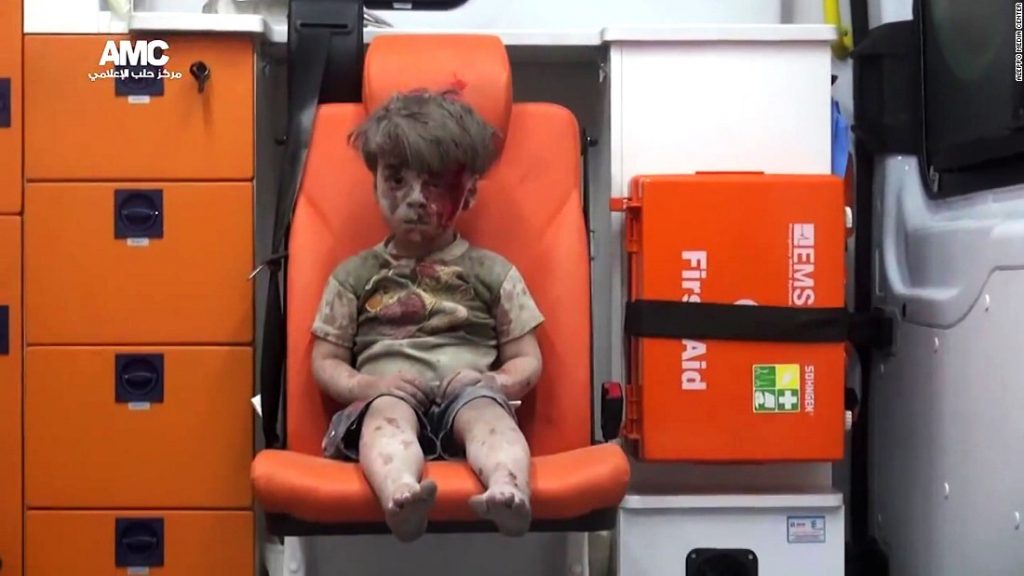
By Brandon Turbeville – Activist Post – August 19, 2016
It’s August, 2016 and the Western mainstream press is parading yet another injured child in front of a population of normally uncompassionate audiences in order to drum up support for some type of NATO military action against the secular government of Bashar al-Assad.
The picture of a little boy, seemingly injured in some type of bombing incident, sitting alone in an orange chair in the back of an ambulance, blood stains on his face and covered in dust from cracked concrete also comes in video form, footage that lasts for about two minutes, showing the boy being carried to a well-equipped ambulance (with English writing on some of the equipment). The boy’s story is also accompanied by “heart wrenching” stories from “activists” in east Aleppo alleging the crimes of the Syrian government and the horrific situation in the area.
The story as presented in the Western press goes as follows:
The video shows a child after he was pulled from rubble in Aleppo, a Syrian city that has been devastated by constant bombardment. A man carried the boy away from the rubble after a suspected Russian or Syrian regime airstrike in the neighborhood of rebel-held Qaterji. He placed him in an orange seat, and the boy brushed his eye and face after the man walked away.
Looking dazed, he then wiped the blood and debris on the seat. After the airstrike, which reportedly shook the northern Syrian city Wednesday night during a call to prayer, the boy was rescued from the rubble that was once his home. Mahmoud Raslan, a photojournalist who captured the image, told the Associated Press that emergency workers and journalists tried to help the child, identified as 5-year-old Omran Daqneesh, along with his parents and his three siblings, who are 1, 6 and 11 years old. “We were passing them from one balcony to the other,” Raslan said, adding: “We sent the younger children immediately to the ambulance, but the 11-year-old girl waited for her mother to be rescued. Her ankle was pinned beneath the rubble.”
Omran was taken to a hospital for a wound on his head.
. . . . .
“This picture of a wounded Syrian boy captures just a fragment of the horrors of Aleppo,” read a Telegraph headline about the picture. The International Business Times said: “Heartbreaking video of little boy dragged from Aleppo rubble shows Syrian children’s suffering.”
. . . . .
The haunting image was also shared by David Miliband, former British foreign secretary and now president and chief executive of the International Rescue Committee. At least 400,000 people have died and millions have been displaced as the Syrian conflict has stretched on for years.
It is rather clear that the child is being used as a stage prop. After being passed to the medical “attendants,” little Omran is placed in an orange chair facing the camera and immediately left alone. He is not treated, no one else is being lifted into the ambulance, and no one is even in the vehicle with him. Instead, he is left to face the “activists” outside the vehicle and their cameras for what seems like too long a time to be anything other than a photo op for the “activists” videotaping him.
While some more discerning alternative media outlets are questioning the credibility of the footage – suggesting that the entire affair was simply staged by “activists” (meaning terrorists and terrorist supporters like the White Helmets) for propaganda purposes – one need not go so far in order to destroy the narrative being pushed by Western outlets. It is, of course, quite possible that the footage was simply created from beginning to end by propagandists but there is also no shortage of injured and dying children in Syria. Thus, the possibility that this footage is completely real and merely seized upon by the propagandists is incredibly real as well. It is even possible that the child was injured as a result of errant bombs dropped by Syrian or Russian planes. Generally, however, when children are killed or injured by American bombs or by bearded freaks receiving a paycheck from the U.S. government, those children are simply labeled “collateral damage” or “unfortunate realities of war.” Even if the bombing targets were intentionally civilian areas, the results are excused. When children are unintentionally injured by a Syrian or Russian plane – despite have taken all the appropriate measures to avoid these types of incidents – the Western press refers to the results as “crimes against humanity,” “intentional targeting of civilians,” and Assad “killing his own people.”
It should also be noted that, while all of the above may be the source of the child’s injuries, it is just as likely that his injuries came as a result of the men seen handling him. After all, America’s “rebels” have long killed children in the most grotesque manner, even beheading a young boy on camera in recent weeks.
But regardless of the nature of the child’s injuries, the photo and the footage is clearly a propaganda stunt. At best, it was seized by propagandists in the West and their foot soldiers in “rebel held” areas of Syria, ) i.e. terrorist support operations such as the White Helmets). One need only examine the “photographer” and this push by mainstream outlets to see that little Omran is being used as the latest bit of war porn propaganda, designed to create sympathy and moral outrage in an audience devoid of both until they are told to have one or the other by mass media outlets.
Mahmoud Raslan, “Activist,” “Journalist,” Terrorist
Raslan describes himself to be a “Syrian media activist,” which, in and of itself, is a red flag to anyone who has studied the Syrian crisis. In the world of Western media, anyone defining themselves as an “activist” in Syria should immediately be translated to mean “terrorist.” Calling “terrorists” “activists” has been an important mode of operation by the Western media since day one in Syria since “activists” can be quoted while actual terrorists are not seen as credible enough in the minds of the general public. In other words, “activist” is merely a moniker assumed by terrorists when propaganda outfits need “on the ground” confirmation of what they are already peddling.
Raslan, the “Syrian media activist” certainly fits the bill. Despite being hailed a true journalist or selfless “activist,” Raslan’s terror-supporting history is easily revealed via social media. Raslan has repeatedly made public statements praising terrorists and suicide bombers. In a post on Raslan’s facebook page (translated by The Canary) reads:
With the suicide fighters, from the land of battles and butchery, from Aleppo of the martyrs, we bring you tidings of impending joy, with God’s permission
Another post reads:
Thousands of suicide fighters and tens of booby-traps are being prepared for the great battle in Aleppo, the first battle where I see men weeping because they can’t participate on account of the number of attackers.
Raslan’s Twitter page is full of pictures and footage of him standing next to captured Syrian tanks, marching with terrorists flying the French mandate flag (white, black, and green), taking selfies with terrorists, and celebrating terrorist victories. His Twitter page alone carries a cover photo that says “Stop Russia.” Why would anyone want to stop Russia from bombing terrorists unless they themselves were terrorists? This is a question more and more Americans should be asking themselves.
Videos on Raslan’s social media also show celebrations with other terrorists, praising suicide bombers on camera.
As Miri Wood writes in her article, “Oscar Nominations For War Porn With Child Has New Nomination,” “That one woman with a Twitter account can immediately expose this heinous relationship, while paid msm reporters cheer this scum, if further indictment of the criminal intentions of western media against the Syrian Arab Republic.”
Wood and Afraa Dagher continue by writing,
True, Gray Boy might not be the best competition for Aylan, but how many drowned babies’ bodies that have been desecrated by repositioning for maximum emotional impact are we to expect?
Besides,
Aylan’s defiled corpse was needed to propagate the myth of the external Syrian refugee — part of the plan to strategically depopulate the country (which is why msm neglected to mention Aylan’s father was the human trafficking boat ‘captain’) — while Gray Boy is to be used for an increased bombing campaign against Syria, by the same NATO forces which have funded terrorism in the SAR, and which obliterated Libya in 2011.
As Mnar A. Muhawesh of Mint Press News stated,
Since when does the corporate or mainstream media care about the people of Syria let alone the children of Syria? The answer is never. Watching CNN anchors cry crocodile tears over the Aleppo boy lifted from rubble serves one purpose only: to play with our emotions to justify more US intervention. MEDIA and their pundits are now calling for the US to help these people, as if our actions haven’t done enough damage. And by help, they mean bomb. But, I have been poking around to find the original source of this video of the heart-wrenching Syrian boy. It brought me to tears and I’m seeing everyone post about it. CNN cited the original source as coming from the Aleppo Media Center. The website is in Arabic but I read it, and it’s a pro rebel website referring to Al-qaeda rebels that behead civilians as “revolutionaries”. I doubt many people looked up the original source, but I did and it wasn’t hard to find. What the media is not telling us is that many parts of Aleppo is currently occupied by Al-qaeda rebels including al-Nusra Front and Noor alzinki — including the area this boy is from.
. . . . .
Consider this: CNN and other media and NGO’s that are funded by NATO county’s like the US and the UK have embedded reporters, rescue workers and doctors in al-Qaeda held areas like we see with the White Helmets. These are the sources the media is using for interviews and sources for information to control the narrative. But the Assad government is bombing the Al-qaeda held areas. Three years ago the media referred to these areas as al-qaeda held. Today, they’re referring to these same terrorists as “opposition” . These groups are starving the areas they occupy and hog up all aid sent into the areas set to them for civilians. This gives these institutions an opportunity to show the West how the Assad government and the Syrian army are airstriking “opposition” held areas without the context that these are al- qaeda held or that many times the Al-qaeda rebels are starving the population. Doesn’t the US want to get rid of Al-qaeda and ISIS? You’d think that but instead, they are defending them to the world and legitimizing them. These “sources” are simply controlling the narrative Indeed, the award-winning performance of CNN news anchor Kate Bolduan crying, hyperventilating, and indignantly insinuating that someone should “do something” to stop these airstrikes against terrorist forces has caught the attention of many people who couldn’t find Syria on a map before or after her report. But we haven’t see Bolduan crying for any other Syrian children over the course of the last five years. Did she cry over the young boy beheaded by America’s “moderate” rebels? Did she cry at any other child’s death at the hands of the “rebels?” There is no shortage of dead children in Syria and certainly no shortage of them killed in the most horrific and sadistic ways by the “activists” and “rebels” her employer has been pimping to the American people since day one. So why the tears for this child?
Bolduan’s carefully scripted performance and excellent follow-through should earn her a serious acting job one day. But we would kindly ask she leave journalism to someone else.
Little Omran is unfortunately the rehash of baby Aylan, a child for whom Western audiences wept and wailed for days, becoming more and more willing to allow the West to increase its intervention in Syria and allow hordes of non-Syrian immigrants into their country but who, only a year later, would scarcely warrant a head scratch at the familiarity of the name. But it would be virtually impossible to ask any American to recount the name of the little girl killed by Obama’s rebels in Lattakia, car bombed to death by “moderates” and democracy-loving Sharia fanatics, around the same time as baby Aylan. Why? Because not one mainstream media outlet reported her death.
Indeed, some children are more equal than others and children killed by America’s terrorists aren’t worthy of even a mention by the mainstream press. Forgive me if I am unconvinced and unmoved by CNN’s crying anchors or America’s temporary fickle and hypocritical moral outrage.
What Should We Do About Crimea?

By Ron Paul | August 21, 2016
Is Crimea about to explode? The mainstream media reports that Russia has amassed troops on the border with Ukraine and may be spoiling for a fight. The Russians claim to have stopped a Ukrainian sabotage team that snuck into Crimea to attack key infrastructure. The Russian military is holding exercises in Crimea and Russian President Vladimir Putin made a visit to the peninsula at the end of the week.
The Ukrainians have complained to their western supporters that a full-scale Russian invasion is coming, and Ukrainian President Petro Poroshenko said he may have to rule by martial law due to the Russian threat.
Though the US media pins the blame exclusively on Russia for these tensions, in reality there is plenty of blame to go around. We do know that the US government has been involved with “regime change” in Ukraine repeatedly since the break up of the Soviet Union. The US was deeply involved with the “Orange Revolution” that overthrew elected president Viktor Yanukovych in 2005. And we know that the US government was heavily involved in another coup that overthrew the same elected Yanukovych again in 2014.
How do we know that the US was behind the 2014 coup? For one, we have the intercepted telephone call between US Assistant Secretary of State Victoria Nuland and US Ambassador to Ukraine, Geoffrey Pyatt. In the recording, the two US officials are plotting to remove the elected government and discussing which US puppet they will put in place.
You would think such undiplomatic behavior could get diplomats fired, but sadly in today’s State Department it can actually get you promoted! Nuland is widely expected to get a big promotion – perhaps to even Secretary of State – in a Hillary Clinton administration, and Geoffrey Pyatt has just moved up to an Ambassadorship in Athens.
Ambassador Pyatt can’t seem to control himself: Just as tensions were peaking between Russia and Ukraine over Crimea this month, he published a series of Tweets urging Ukraine to take back Crimea. Is this how our diplomats overseas should be acting? Should they be promoting actions they know will lead to war?
When the mainstream media discusses Crimea they are all lock-step: that’s the peninsula Putin annexed. Never do they mention that there was a referendum in which the vast majority of the population (who are mostly ethnic Russians) voted to join Russia. The US media never reports on this referendum because it produced results that Washington doesn’t like. How arrogant it must sound to the rest of the world that Washington reserves the right to approve or disapprove elections thousands of miles away – meanwhile we find out from the DNC hacked files that we don’t have a lot of room to criticize elections overseas.
What should we do about Ukraine and Russia? We should stop egging Ukraine on, we should stop subsidizing the government in Kiev, we should stop NATO exercises on the Russian border, we should end sanctions, we should return to diplomacy, we should send the policy of “regime change” to the dustbin of history. The idea that we would be facing the prospect of World War III over which flag flies above a tiny finger of land that most US politicians couldn’t find on a map is utterly ridiculous. When are we going to come to our senses?
Casuistry
By Thomas S. Harrington | CounterPunch | August 19, 2016
Casuistry, which one dictionary defines as “specious, deceptive, or oversubtle reasoning, especially in questions of morality” is, rightly or wrongly, inextricably linked to the history of Jesuit order of the Catholic Church. And the rise of the Jesuit order is deeply enmeshed with the Counter-Reformation, a set of measures designed to roll back the spread of Protestantism in Europe during the late 16th and early 17th centuries. The control center of the movement was Spain, the world-striding superpower of that historical moment.
Rightfully fearful that Protestantism’s rejection of long-standing modes of clerical privilege and the Church’s “right” to collect vast sums of money from parishioners would undermine their ability to bully and bribe Italian, French, Dutch and German potentates into compliance with their political demands, the Spanish Monarchy undertook an endless series of military adventures against “heretics” across the Continent in the years between 1530 and 1648. This military thrust was accompanied by a well-organized propaganda campaign in which the highly educated Jesuits priests played a crucial role.
Appearing morally and intellectually reasonable while serving as a convinced advocate for the systematic subjugation of other people and their animating ideals is not a simple task. In the long run it is, in fact, an impossible one. No amount of argument can convince a person or group of persons who see them selves as suffering under the boot of another that their bondage is a good and necessary thing. What such a rhetorical posture can do, for a time at least, is convince the subjects of the hegemonic country of, if not the inherent nobility of their bloody mission, its generally benign nature.
A key, if generally unstated, goal of the 16th and 17th century Jesuits was to insure that the highly problematic matter of Rome’s corruption, and the brutal Imperial designs of the Spanish monarchy that lay behind it, never be allowed to occupy the center zone of what then passed for “public” discourse.
When confronted by the emergent Protestant movements about the clear violations of Christian morality practiced by the Church of Rome, they responded with complex disquisitions on the largely circumstantial nature of all moral reasoning. By constantly parsing the intricacies of how overarching moral rules should, or should not, be applied in each particular circumstance (and teaching others to do the same), they very effectively prevented the emergence within the Church, and by extension in the leadership class of the Spanish Empire, of a frank discussion of the quite real and deeply-felt grievances of their many enemies.
I am reminded of all this when I read or watch the news after every so-called “terrorist” attack against a US or European target. Within minutes of the violence, mainstream journalists, begin intense speculation about what particular ethnic group the assailant came from, how he or she became “radicalized” (as if the desire to kill was akin to some sort of contagious moral flu) and whether the “West’s” latest stand-in for PURE EVIL™ (e.g. Al-Qaeda, ISIS, ISIL) was behind the act.
What will almost never be talked about are the many very good reasons a person from the vast region stretching from Morrocco in the west, to Pakistan in the east, have to be very angry at, and to feel highly vengeful toward, the US, its strategic puppeteer Israel, and their slavishly loyal European compadres like France, Germany and Great Britain.
There is never any talk of that group of august “democracies” long-standing penchant for implanting, then staunchly supporting, ruthless and deeply corrupt regimes in that region.
No talk of the very long Algerian experience of French colonialism, nor the US and French- backed coup of that country’s government in 1992 which led to a civil war that left 200,000 people dead.
No talk of the coup against the legally elected president of Egypt in 2013, nor the cold-blooded massacres carried out by his US-backed successor upon hundreds of that same president’s followers.
No talk of the decision of the US to back elements of ISIS in order to cynically extend a Syrian Civil War that was on its way to peace—albeit an imperfect one—by means of a Syrian government victory by late 2013.
No talk of the planned destruction of Libya in 2011 and its enormous effects on the stability of life in that once wealthy country as well as all of northern Africa.
No talk of the US-Israeli nullification of the results of the Palestinian elections of 2006, Israel’s coldly planned siege of Gaza nor the “shoot-fish-in-a barrel” assaults on that benighted enclave by Israel in 2006, 2008, 2012 and 2014.
No talk of the ongoing Saudi—and therefore US-approved—war on Yemen, nor the ruthless Saudi march on Bahrain in 2011 in which several dozen people died and thousands of democracy activists were tortured and/or carted off to prison.
No talk of the 18-year Israeli—and therefore, US-backed—occupation of Southern Lebanon nor Israel’s 1993, 1996 and 2006 assaults upon that same country.
Oops, I almost forgot. There is no talk of the small matter the calculated US destruction of Iraq, pre-invasion Libya’s rival as the Arab world’s most wealthy and socially progressive state.
But hey, why talk about all that off-putting stuff when you can boil it all down to neat tales of personal ideological contamination, Svengali-like recruiters lurking in mosques, and that old standby, the development of an urgent need to bang virgins in the hereafter.
It seems the media believes that the delicate imperial mind must be left free from understanding the effects of the actions for which it regularly cheers and prays.
The best way to insure this? Casuistry, as the old saying goes, “Pure casuistry”.
Thomas S. Harrington is a professor of Iberian Studies at Trinity College in Hartford, Connecticut and the author of the recently released Livin’ la Vida Barroca: American Culture in a Time of Imperial Orthodoxies.
Featured Video

Trump asks Iran not to retaliate after he strikes Pickaxe Mountain
or go to
Aletho News Archives – Video-Images
Book Review
‘Why Fauci Must Rot in Prison’: A Tale of Two Diaries
By Jill Erzen | The Defender | October 13, 2026
Dr. Anthony Fauci’s private diary reveals a “mind-numbing” contradiction between what the former top U.S. infectious disease official knew about COVID-19 and what he told the public, senior White House adviser Peter Navarro, Ph.D., said last week on “American Thought Leaders.”
In his new book, “Why Fauci Must Rot in Prison,” due out Oct. 20, Navarro compares Fauci’s private entries to his own pandemic-era diary, and uses what he calls “a tale of two diaries” to argue that Fauci should face criminal prosecution.
“I show, actually, how a prosecution can and should happen … at the state level, most likely,” Navarro said. “He should wind up in prison, and we’ve got the receipts in this book to put him there.”
Navarro said Fauci repeatedly acknowledged important facts in private, then publicly pursued policies that contradicted those facts — with devastating consequences.
“What he says many times privately in his diary is so at odds with both his public behavior and public statements that it’s mind-numbing,” Navarro said.
Navarro examines the lasting damage caused by lockdowns and other pandemic policies, and the ongoing toll of long COVID.
His book also addresses questions about vaccine safety, including why healthy young people faced COVID-19 vaccination mandates despite concerns about myocarditis, and why women were not warned about miscarriage risks linked to the shots. … continue
Blog Roll
 Aletho News
- How Iran’s two-week retaliatory strikes exposed cracks in US military architecture in Persian Gulf
- The mother of all propaganda: Why the hype over US MOAB strike against Iran is nothing but theater
- Iran says it possesses technology behind US 14-ton GBU bunker-buster
- Trump asks Iran not to retaliate after he strikes Pickaxe Mountain – w/ Prof. Marandi
- Vice President J.D. Vance’s Deceptive ‘Antiwar’ Campaign Speech
- Iran: Palestinians’ rights must not be compromised in Gaza’s future; US, Israel to blame for Hormuz situation
- Ongoing tales of Syrian chemical weapons
- Moscow blasts UN for ignoring torture of Russian POWs
- Millions of Books Could Have Been Destroyed in Lebanon During Israeli Bombings
- Moscow warns of ‘hunt for Russians’
- If Americans Knew
- Netanyahu’s spin on latest settler attack is laughable – Daily Update
- Israeli soldiers debunk Israel’s talking points
- In West Bank, Israeli settlers are totally out of control – Daily Update
- NPR investigation finds evidence of widespread fraud at mall kiosks tied to Israeli skincare brand
- Tucker Carlson exposes Israeli Lies about the Oct 7th attack, Charlie Kirk, and the U.S.
- Israel has detained thousands of Palestinian children since Oct 7th – over half spent time in solitary, many uncharged
- Israeli Analysis: Is Netanyahu Planning an ‘October Surprise’ Attack Before Israel’s Election?
- Israeli settlers brutally attack Palestinians and Washington Post female photographer, 65
- Words Have Changed, Occupation Continues: The Reality of the Gaza Ceasefire
- Gaza’s child amputees are growing faster than their prosthetics allow
- No Tricks Zone
- Predictions Made By Renowned Climate Proifessor Over Past Decades Have Been Proven To Be Poor
- New Study Suggests Large Regions Of The Pacific Ocean Have Been Cooling For The Last 80 Years
- Germany’s Green Energy Debacle: High Energy Costs Force Kahla Porzellan to Close After 182 Years!
- New Study: 50 Years Of The Most Aggressive ‘Net Zero’ Policies Can Only Affect The Global Climate By 0.03°C
- US September “Heat” Was No Record…Many Records Set Decades Ago
- Latest European Green Energy Debacle; Portugal’s Largest Flagship Solar Park Insolvent!
- Green Energy Debacle: German Expert Professor Fritz Vahrenholt Warns Of Severe Economic And Social Consequences
- Two More Paleo Reconstructions Affirm Meters-Higher Sea Levels Across Ireland, Brazil 7000-6000 Years Ago
- New Study: Earth And Venus Surface Warmth Largely Explained By Convection And Lapse Rate, Not CO2 Or Radiation
- 2025 Nature Paper Claiming Worsening Global Drought Gets RETRACTED …Heavily Flawed

