US Propaganda Budget Reaches All-Time High
Sputnik – 13.02.2016
Western governments routinely sound the alarm over Russian “propaganda.” But President Obama’s new budget calls for a drastic increase in spending to America’s own foreign media arm, the Broadcasting Board of Governors, which already spends millions more than its Russian counterpart.
Last year, the Broadcasting Board of Governors (BBG), the US federal agency responsible for Voice of America and Radio Liberty/Radio Free Europe, among others, requested a substantial budget increase. Seeking a boost of $30 million, the BBG’s budget soared to $751.5 million.
That was, evidently, not enough money. President Obama’s newly proposed budget for fiscal year 2017 proposes another massive increase in spending for the BBG. If granted, the agency will receive nearly $778 million, a roughly $27 million increase.
That sum is even more surprising given that the US repeatedly accuses Russia of spending vast sums on a “propaganda war” against the West through news outlets like RT and Sputnik. Yet the BBG’s budget is approximately twice that of Russia’s foreign media budget.
MIA Rossiya Segodnya, the parent company of Sputnik News, operates on a budget of $75 million, including both domestic and foreign media — 10 times less than the BBG.
RT, a publicly-funded, autonomous non-profit organization whose popularity is incomparable to VOA and Radio Free Europe, has an annual budget of slightly more than $300 million. That money — also significantly less than the sum allocated to the BBG — is used operate a number of satellite TV channels in multiple languages, a much costlier endeavor than the radio programs produced by the BBG’s outlets.
Taken together, both RT and Rossiya Segodnya’s budgets are a far cry from the BBG’s coffers, and while the agency claims to pursue objective journalism, this is hardly the case.
“[The BBG wants] to promote points of view that conform to American foreign and domestic policy,” political cartoonist Ted Rall told Sputnik.
“Objectivity does not exist in journalism. It’s impossible,” he added. “The best that a viewer, listener or reader can hope for when she or he consumes journalism is to understand the bias or biases of the relevant news outlet so that she or he can consider that point of view while consuming the news.”
The BBG, it seems, is especially unconcerned with objectivity. Last March, US Assistant Secretary of European Affairs Victoria Nuland told Congress that the BBG was specifically committing $23.2 million to “Russian-language programming,” adding that “the Kremlin’s pervasive propaganda campaign is poisoning minds across Russia, Russia’s periphery, and across Europe.”
The real reason for the budget increase has less to do with concerns of objectivity, and is actually about Washington’s concern that channels like RT are actually doing their job effectively, presenting audiences with a viewpoint that challenges those presented by the mainstream press.
Despite its relatively meager budget, RT has an international audience of millions. In the US alone, 2.8 million people in major cities watch RT weekly, according to 2014 Neilsen ratings. In the United Kingdom, RT viewership tops American behemoth Fox News. Across the Middle East, RT Arabic is watched by 6.7 million people every day.
With that kind of reach, it should come as no surprise that the US government is concerned enough to beef up its foreign media arm. Last April, Helle Dale, Senior Fellow for Public Diplomacy at the Heritage Foundation, pointed out that Voice of America ranks 3,828 in Russia, while RT ranks 61.
“[Radio Free Europe/Radio Liberty]’s presence and reputation in Russia, it must be added, took a beating in 2012,” Dale admitted, citing poor management and the lack of qualified journalists. She also noted that RT is “flourishing.”
This lack of popularity could be directly proportional to its credibility.
“If the topic is something embarrassing to the United States, such as Julian Assange or Edward Snowden,” Rall told Sputnik, “I would trust Russian media more.”
Making sense of the BBC’s World War Three: Inside the War Room
Preparing the British public for collective suicide? Or a voice of reason in a world gone mad under US-Russian confrontation?
By Gilbert Doctorow | Une Parole Franche | February 10, 2016
The Russians and all of ‘progressive humanity’ have been jumping up and down about this pseudo-documentary film. The sound bite from one War Room participant that “I wouldn’t mind killing tens of thousands of Russians” has been trumpeted as a major provocation. Baltics politicians on both sides of the issue are furious. However, seeing the film through to its unexpected ending, one is left with big questions about the intentions of its producers and of its high level participants that so far no one has addressed.
The pseudo-documentary film “World War Three: Inside the War Room” was described in advance by the BBC as a “war game” detailing the minute-by-minute deliberations of the country’s highest former defense and security officials facing an evolving crisis involving Russia.
What gave unusual realism and relevance to their participation is that they were speaking their own thoughts, producing their own argumentation, not reading out lines handed to them by television script writers.
The mock crisis to which they were reacting occurs in Latvia as the Kremlin’s intervention on behalf of Russian speakers in the south of this Baltic country develops along lines of events in the Donbas as from summer 2014. When the provincial capital of Daugavpils and more than 20 towns in the surrounding region bordering Russia are taken by pro-Russian separatists, the United States calls upon its NATO allies to deliver an ultimatum to the Russians to pull back their troops within 72 hours or be pushed out by force.
This coalition of the willing only attracts the British. After the deadline passes, the Russians “accidentally” launch a tactical nuclear strike against British and American vessels in the Baltic Sea, destroying two ships with the loss of 1,200 Marines and crew on the British side. Washington then calls for like-for-like nuclear attack on a military installation in Russia, which, as we understand, leads to full nuclear war.
The show was aired on Feb. 3 by BBC Two, meaning it was directed at a domestic audience, not the wider world. However, in the days since its broadcast, it has attracted a great deal of attention outside the United Kingdom, more in fact than within Britain. The Russians, in particular, adopted a posture of indignation, calling the film a provocation.
In his widely watched weekend wrap-up of world news, Russia’s senior television journalist Dimitri Kiselev devoted close to ten minutes denouncing the BBC production. He cited one participant (former UK Ambassador to Russia Sir Tony Brenton) expressing pleasure at the idea of “killing tens of thousands of Russians.” This segment was later repeated on Vesti hourly news programs during the past week. Kiselev asked rhetorically how the British would react if Moscow produced a mirror image show from its War Room.
For its part, the world broadcaster Russia Today issued a harsh review which castigates the British broadcaster for presenting Russia as “Dr. Evil Incarnate, the villain that regularly plays opposite peace-loving NATO nations.” It saw the motivation of the producers as related to “the military-industrial shopping season.”
RT alleges the BBC was trying to drum up popular support for the modernization of Britain’s nuclear Trident submarines at a cost to taxpayers of some 100 billion pounds ($144.7 billion).
Meanwhile, President Vladimir Putin’s spokesman, Dmitry Peskov, said it was low grade, translated by some as trash, and that he didn’t bother to watch it. If so, that is a pity for the reasons I will set out below.
The program also generated a great deal of emotion in Latvia, on both sides of the fundamental issue. The country’s Foreign Minister Edgars Rinkevics tweeted that he found parts of the program to be ‘’rubbish’’ while other parts had lessons to be studied. Public Broadcasting of Latvia was concerned over the scant support the country appears to enjoy in Britain and other NATO member states, judging by the deliberations in the War Room.
For their part, members of the Russian speaking community were deeply upset by the way the program provides grist to the mill of those who view them as a fifth column ready to be used by the Kremlin for its aggressive purposes.
Examination of the British print media’s reaction to World War Three results in a very different impression of the film. Reviews in the British press mostly directed attention to the program’s entertainment value. The Telegraph called the film “gripping and terrifying.”
The Independent reviewer tells us: “It started out as quite a dull discussion but as the hypothetical situation escalated – and boy did it escalate quickly – it fast became compelling, if not terrifying, viewing. … It was a little clichéd – the Russians were the bad guys, the UK set lots of deadlines but ultimately wouldn’t commit to any action and the US went in all guns (or nuclear weapons) blazing – but then clichés are always clichés for a reason.”
In a reversal of roles, the tabloid Daily Mail ended up doing the heavy lifting for the British press with thoughtful in-depth reporting.
The Daily Mail expressed deep surprise at the way World War Three ends, with the War Room team voting overwhelmingly to order Trident submarine commanders not to fire even as Russian nuclear ICBMs have been launched and are on their way to targets in the West, including England. The paper noted, correctly I might add, that this puts in question the value of the Trident deterrent, which the Cameron government is planning to renew. The newspaper sent out its reporters to follow up on this stunning aspect of the BBC film.
The Daily Mail especially wanted elucidation of two remarks at the very end of the film, just prior to the final vote. One was by Sir Tony Brenton, UK Ambassador to Russia, 2004-2008, who says in the film: “Do we pointlessly kill millions of Russians or not? To me it’s a no-brainer – we do not.”
This quote deserves special attention because it was made by Brenton right after his widely cited and seemingly scandalous statement which has been taken out of context, namely that he wouldn’t mind killing tens of thousands of Russians in response to the destruction of the British vessel in the Baltic by Russia at the cost of 1,200 British lives.
The second remark from the end of the film cited by The Daily Mail which they in fact follow-up was more surprising still, coming as it did from a top military official, General Sir Richard Shirreff, who served as Deputy Supreme Allied Commander Europe, 2011-2014. Shirreff declared on camera: “I say do not fire.”
When asked about it, Shirreff gave the newspaper a still better sound bite that bears repeating in full: “At this point it was clear deterrence had failed. My feeling was it had become a moral issue – that the use of force can only be justified to prevent a greater evil … if the UK is going to be obliterated, what is going to be achieved if we obliterate half of Russia as well? It was going to create an even worse evil.”
It is a great pity that the Kremlin has chosen to vilify the BBC’s producers and overlook these extraordinary open text signals from the very top of the British political and defense elites.
If nothing else, The Daily Mail reporting knocks out the easy answers and compels us to ask anew what did the British broadcaster have in mind when it produced the pseudo-documentary World War Three. Moreover, why did top former British diplomats, military officials and politicians agree to participate in this film?
In one sense, this film is a collective selfie. It might be just another expression of our contemporary narcissism, when former top government officials publish their memoirs soon after leaving office and tell all. But several of the participants are not even former office holders. They continue to be active and visible.
One can name the Liberal Democrat Baroness Falkner, spokesperson for foreign policy. Also, Dr. Ian Kearns who remains very much in the news as the director of the European Leadership Network, partner to the leadership of the Munich Security Conference and a member of teams that are invited to Moscow from time to time to talk international security issues with the Russians. Surely these VIP participants in the film had no intension of cutting off contacts by antagonizing the Kremlin. So there is something else going on.
What that something else might be can be teased out if we pay close attention to their deliberations on screen. I believe they earnestly sought to share with the British public the burden of moral and security decision-making, to present themselves as reasonable people operating to the best of their knowledge and with all due respect for contrary opinions to reach the best possible recommendations for action in the national interest.
In the War Room, we are presented with two very confident hardliners, General Richard Shirreff, mentioned above, and Admiral Lord West, former Chief of Naval Staff; and with two very confident soft-liners, Baronness Falkner, the Liberal Democrat Foreign Affairs Spokesman, and Sir Tony Brenton. The others seated at the table do not have firm views and are open to persuasion.
It is noteworthy that argumentation is concise and apart from the occasional facial expression showing exasperation with opponents, there is a high level of purely intellectual debate throughout. Though one of the reviewers in the British press calls Falkner a “peacenik” in what is not meant as a compliment, no such compartmentalizing of thinking appears in the video. And the counter arguments are set out in some detail.
The voting at turning points in the developing scenario of confrontation with Russia is open. When the participants consider Britain joining the United States-led coalition of the willing ready to use force to eject the Russians from Latvia, they insist they will not be passive in the relationship, will not be Washington’s “poodle.” This is in clear reference to criticism of the Blair government’s joining the American invasion of Iraq in 2003.
Baroness Falkner is allowed to question the very logic of NATO. She calls the early decisions taken by the majority of her colleagues “sleepwalking,” an allusion to the group think that brought all of Europe into the suicidal First World War. With further reference to WWI, she says that the British government must look after the security of its people and not blindly submit to the wishes of an Alliance when that spells doom, such as happened in 1914.
At each turn of the voting on what to do next until the very last, the hardliners win out. But positions can and ultimately do flip-flop. In the end the overwhelming majority around the table decides not to press the button.
However, if the participants want to show themselves as open-minded and sincere, does that mean that the facts they work from are objective and equally well vetted. Here we come to a crucial problem of the video: Narration of the pre-history to the crisis over the Baltics, namely the archival footage on the Russian-Georgian War of 2008, the Russian “annexation” of Crimea and the Russian “intervention” in Donbass, is an unqualified presentation of the narrative from Washington and London, with Russia as “aggressor.” The narration of the crisis events as they unfold is also the unqualified, unchallenged view from the Foreign Office.
The pseudo-reporting on the ground in Daugavpils which is the epicenter of the crisis gives viewers part of the reason for the fictional Russian intervention, but only a small part. One Russian speaker tells the reporter that she is there in the demonstration because Russian-speakers have been deprived of citizenship since the independence of Latvia and this cannot continue.
But we are not told what the former diplomats in the War Room surely know: that Britain was complicit in this situation. In fact, the British knew perfectly well from before the vote on accession of the Baltic states to the European Union in 2004 that Latvia and Estonia were in violation of the rules on minorities of European conventions.
However, in the back-room negotiations which led to the final determination of the list of new Member States, the British chose to ignore the Latvian violations, which should have held up admission, for the sake of getting support from other Member States for extending E.U. membership to Cyprus.
The unfolding scenario of Russian actions and Western reactions does not attempt to penetrate Russian thinking in any depth. We are given the usual generalizations about the personality of Vladimir Putin. The most profound observation we are offered is that Russian elites only understand strength and would not allow Putin to back down, so he must be offered face-saving gestures even as his aggression is foiled.
The objectives of Russian moves on the geopolitical chessboard are not debated. The question of how the Baltics and Ukraine are similar or different for Russian national interest is hardly explored. Simply put, as the British press reviews understood, the Russians are “bad guys.”
Moreover, the authors of this war game assume that the past is a good guide to the future, which in warfare of all kinds is very often a fallacious and dangerous assumption. There is no reason to believe that the Russian “hybrid warfare” used in the Crimea and Donbass would be applied to the Baltics, or that escalation would be gradual.
Given the much smaller scale of the Baltic states, each with two million or fewer inhabitants, and the short logistical lines, it might be more reasonable to consider the Russians moving in and occupying the capitals in one fell swoop if they had reason to do so.
At present, they do not. But if the build-up of NATO troops and materiel along the Western frontiers of Russia and in the Baltic Sea continues as projected in President Obama’s latest appropriations for that purpose, reason for Russian action might well appear.
In this case, the confrontation might proceed straight to red alert on strategic nuclear forces without any intermediary pinpricks that this film details, much as happened back in the 1962 Cuban Missile Crisis. The British, as well as other NATO countries would then be totally sidelined as talks went on directly between Moscow and Washington.
The tragedy in our times of “information warfare” is that well-educated and sincere citizens are blind-sighted. We have an old maxim that when you cannot persuade, confuse. The fatal flaw comes when you start to believe your own propaganda.
If nothing else, the BBC documentary demonstrates that for Western elites this is what has happened. The reaction to the film from the Kremlin, suggests the same has happened to Eastern elites.
Gilbert Doctorow is the European Coordinator, American Committee for East West Accord, Ltd. His latest book Does Russia Have a Future? (August 2015) is available in paperback and e-book from Amazon.com and affiliated websites.
What Medvedev never said: Reuters misquotes Russian PM on ‘new world war’
RT | February 12, 2016

Russian Prime Minister Dmitry Medvedev © Ekaterina Shtukina/
A Reuters article quoted Russian Prime Minister Dmitry Medvedev as “raising the specter of a world war” in an interview to a German newspaper. The problem is – he didn’t say any such words.
The leading world news agency reported on an interview that Medvedev gave Germany’s Handelsblatt newspaper on the eve of talks on Syria in Munich.
“All sides must be compelled to sit at the negotiating table, instead of unleashing a new world war,” the agency quoted the head of the Russian government as saying.
The report referred to a German translation of his words, which is incorrect and implies that Russia is warning that a full-scale war between leading world powers may be ignited from the Syrian conflict.
The quote comes from the portion of the interview in which Medvedev argued against starting a foreign ground intervention against Syria, saying it would only prolong the armed conflict for years or decades to come.
Medvedev’s actual words, according to the Russian transcript on PM’s website were:
“What is necessary is to use strong measures, including those taken by Russia, by the Americans and even under certain provisions those that the Turks are trying to take, to sit at the negotiating table, instead of unleashing yet another war on Earth. We know all too well the scenarios leading to that.”
The misquotation incident is the second in February involving a senior world official and the Syrian conflict. Earlier, The Financial Times claimed that UN Secretary General Ban Ki-moon blamed Russia for the collapse of the Syrian peace talks.
In a letter to the FT viewed by RT, Ban’s office said that the quotes of the secretary general used in the article were “technically correct” but taken out of context and “framed in a way that attributes to him direct language that is incorrect.” In particular, author Sam Jones made it appear that Ban Ki-moon had singled out Russia and the Syrian government in describing the difficulties that the peace process is facing, which he didn’t do.
The office requested that a correction be published to accurately reflect what the Secretary-General actually said.


Netanyahu’s Zoomorphic Bigotry: A Retrospective
By Nima Shirazi | Wide Asleep in America | February 10, 2016

Benjamin Netanyahu pets his dog Kaia, a biter, at the Prime Minster’s residence in Jerusalem. (Credit: Facebook)
“Anyone who approaches the Zionist problem in a moral aspect is not a Zionist.” – Moshe Dayan, quoting David Ben-Gurion
Ha’aretz correspondent Barak Ravid reported yesterday:
Prime Minister Benjamin Netanyahu said during a tour to the construction site of a barrier on the eastern border on Tuesday that he wishes to surround the country with fences and barriers “to defend ourselves against wild beasts” that surround Israel.
Dehumanization of one’s real or perceived adversaries, often in the form of animalization, has long been a hallmark of propaganda. As Netanyahu reinforces Israel’s garrison mentality, he continues building a literal fortress by extending the apartheid wall further around the Zionist state, promising more division, segregation, discrimination, and violence.
“For most human beings, it takes an awful lot to allow them to kill another human being,” Anthony Pratkanis, a psychology professor at the University of California, Santa Cruz, told ABC News back in 2003, as the United States was gearing up to invade Iraq. “The only way to do it is to justify the killing, to make the enemy look as evil as possible.”
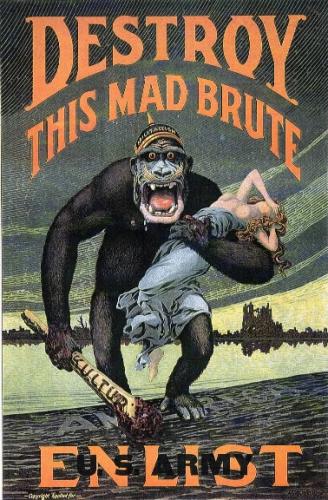 The report also quoted Hayward communications professor James Forsher, an expert on propaganda films. “The secret in propaganda is that when you demonize, you dehumanize,” Forsher explained. “When you dehumanize, it allows you to kill your enemy and no longer feel guilty about it. That is why during World War II, a lot of caricatures became animals… You can kill a monkey a lot more easily than you can kill a neighbor.”
 Nazi dehumanization of Jews as “vermin” to be exterminated and American anti-Japanese caricatures of rats and snakes from the 1940s are especially grotesque, but the phenomenon was around long before that. Anti-Tsarist and, subsequently, anti-Soviet propaganda often employed the image of an octopus, spreading its imperial tentacles across the globe. During World War I, Germany was depicted a crazed, club-wielding gorilla in a U.S. Army poster encouraging enlistment.
In their 1994 book, Unthinking Eurocentrism: Multiculturalism and the Media, Ella Shohat and Robert Stam note that the common colonial/racist trope of “animalization” was “rooted in a religious and philosophical tradition which drew sharp boundaries between the animal and the human” and “renders the colonized as wild beasts… projected as body rather than mind.”
Zionist colonists and Israeli officials have for years employed this type of rhetoric to dehumanize those they seek to forcibly displace, dispossess, disenfranchise, oppress, occupy and subjugate. The Zionist project is always presented as a bulwark of civilization against the savagery and barbarism of the brutish Eastern, Arab, and/or Muslim hordes; the settlement on the hill; the light amidst the darkness; the “villa in the jungle,” as Ehud Barak once said.
“At the end, in the State of Israel, as I see it, there will be a fence that spans it all,” Netanyahu fantasized yesterday. “I’ll be told, ‘this is what you want, to protect the villa?’ The answer is yes. Will we surround all of the State of Israel with fences and barriers? The answer is yes. In the area that we live in, we must defend ourselves against the wild beasts.”
The animalization of Palestinians, and other perceived enemies, in Israeli rhetoric goes back decades.
Dogs, Animals, Roaches, Grasshoppers and Worms
Shortly after Israel seized military control over the West Bank and Gaza in 1967, Israeli Chief of Staff Moshe Dayan told officials in his center-left political party, Rafi, that unless Palestinians in the newly-occupied territories make “peace” with Israel, they “shall continue to live like dogs, and whoever wishes may leave, and we will see where this process leads.”
On June 8, 1982, two days after the Israel invaded Lebanon, Prime Minister Menachem Begin delivered remarks before the Knesset justifying the military assault as a defense of Jewish lives worldwide. Begin insisted that the widespread rallying cry of terrorists around the globe was that “there is no innocent Jew. Every Jew is doomed – he must be killed.” In response, he declared, “This terror must be eradicated.” Setting Jewish people apart from the rest of humanity, Begin said:
The fate of a million and half a million Jewish children has been different from all the children of the world throughout the generations. No more. We will defend our children. If the hand of any two-footed animal is raised against them, that hand will be cut off, and our children will grow up in joy in the homes of their parents.
In April 1983, outgoing Israeli Chief of Staff Rafael Eitan (who was losing his post due to his responsibility for the 1982 Sabra-Shatila Massacre) reportedly told the Knesset’s Foreign Affairs and Defense Committee, “The Arabs will never win over us by throwing stones. Our response must be a nationalist Zionist response. For every stone that’’s thrown, we will build ten settlements. If 100 settlements will exist, and they will, between Nablus and Jerusalem, stones will not be thrown. If this will be the situation, then the Arabs will only be able to scurry around like drugged roaches in a bottle.”
During the First Intifada, on March 31, 1988, Israeli Prime Minister Yitzhak Shamir told reporters at the ruins of an ancient Herodian fortress in the occupied West Bank, “Anybody who wants to damage this fortress and other fortresses we are establishing will have his head smashed against the boulders and walls,” adding that Palestinians who resist the Israeli occupation “are like grasshoppers compared to us.”
In late 2004, Yehiel Hazan, a Likud minister and leader of the biggest settler lobbying group, declared on the floor of the Knesset, “The Arabs are worms. You find them everywhere like worms, underground as well as above,” adding, “Until we understand that we’re doing business with a nation of assassins and terrorists who don’t want us here, there will be no let up. These worms have not stopped attacking Jews for a century.”
On June 30, 2012, Israeli lawmaker Ayelet Shaked of the religious nationalist Jewish Home party posted a Facebook message that identified “the entire Palestinian people is the enemy” and calling for the total elimination of Palestine, “including its elderly and its women, its cities and its villages, its property and its infrastructure.” The post, alleged written years ago by now-deceased settler leader Uri Elitzur, added that Palestinian mothers should be executed for giving birth to “little snakes,” that is, Palestinian children. Less than a year later, Netanyahu appointed Shaked to be Israel’s Minister of Justice.
Netanyahu, too, has a penchant for animal allusions when speaking about those he despises most, be they Palestinians, Iranians, or Muslims, in general.
Insatiable Crocodile
While a possibly apocryphal quote has then-Israel Prime Minister Ehud Barak saying in August 2000, “The Palestinians are like crocodiles, the more you give them meat, they want more,” Netanyahu brought the reptilian analogy up to date when, during a typically verbose and combative speech before the UN General Assembly in September 2011, he said:
[Israel’s] critics continue to press Israel to make far-reaching concessions without first assuring Israel’s security. They praise those who unwittingly feed the insatiable crocodile of militant Islam as bold statesmen. They cast as enemies of peace those of us who insist that we must first erect a sturdy barrier to keep the crocodile out, or at the very least jam an iron bar between its gaping jaws.
Netanyahu probably didn’t realize he was channeling his fellow apartheid champion, P.W. Botha, who led South Africa from 1978 to 1989, and is credited with complaining that “the free world wants to feed South Africa to the red crocodile [Communism], to appease its hunger.” Botha, incidentally, was widely known by the Afrikaans nickname Die Groot Krokodil, or “The Big Crocodile.”
Nuclear Duck
The following March, in one of his most tedious diatribes about the non-existent threat of a nuclear-armed Iran, Netanyahu told attendees at AIPAC’s annual conference that Iran’s fully safeguarded uranium enrichment facilities and medical research reactor were actually a cover for a clandestine nuclear weapons program.
Ladies and Gentlemen, if it looks like a duck, walks like a duck, and quacks like a duck, then what is it? That’s right, it’s a duck – but this duck is a nuclear duck. And it’s time the world started calling a duck a duck.
Quack.
Wolf in Sheep’s Clothing
Appearing on Face The Nation on July 14, 2013, Netanyahu decried Iranian president-elect Hassan Rouhani as a “wolf in sheep’s clothing,” whose devious Persian strategy is to “smile and build a bomb.” He repeated this description to a group of U.S. lawmakers the following month.
On October 1, 2013, Netanyahu returned to the UN General Assembly and accused Rouhani of being a “wolf in sheep’s clothing.”
“Rouhani doesn’t sound like Ahmadinejad,” Netanyahu wailed. “But when it comes to Iran’s nuclear weapons program, the only difference between them is this: Ahmadinejad was a wolf in wolf’s clothing. Rouhani is a wolf in sheep’s clothing, a wolf who thinks he can pull the eyes — the wool over the eyes of the international community.”
Fittingly, Netanyahu’s faithful lapdog, Yuval Steinitz, also took to the media in July and September that year to describe Rouhani the same way.
Wicked Games: US ‘Uses Terrorism as Main Mechanism of Its Foreign Policy’
Sputnik – February 10, 2016
In an interview with RT, Russian military analyst Alexander Zhilin said that US media allegations that Russia is pursuing its own interests in Syria are “absolute nonsense”, given that Moscow “cooperates there with the legitimately elected president.”
He also pointed to Washington’s hypocritical statements about the necessity of fighting terrorism, saying they came as the White House continued to use terrorism as a major mechanism of its foreign policy.
“Just think about it: if a country with a military budget exceeding the consolidated budget of all the countries in the world uses terrorism as the main instrument of its foreign policy, fighting terrorism is almost impossible”, Zhilin said.
He also lashed out at US President Barack Obama and US Secretary of State John Kerry repeatedly calling for the ouster of Syrian President Bashar Assad.
“My question is: who are you to make such calls? It means Obama who bombed out half the world’s territory must not step down, while Assad must step down, right? It is the wrong approach,” he said.
According to him, Washington currently wages so-called network-centric warfare against Moscow, a military doctrine pioneered by the US Department of Defense in the 1990s. The goal is to translate an information advantage, enabled in part by information technology, into a competitive advantage through the robust computer networking of a well-informed, geographically decentralized force.
“The United States has started a propaganda [war] against Russia, which is why it is creating an anti-Russian coalition with the participation of Saudi Arabia, Turkey and the US private military companies,” he pointed out.
Zhilin expressed regret about foreign media outlets, including CNN and the BBC, being involved in this war and misinforming their readers about Russia’s air campaign in Syria. He recalled that Russia’s “participation in Syria suggests the support of the legitimately elected president,” and that “it was Washington which started the invasion without getting the UN’s go-ahead.”
“You know, I’m very sorry that the BBC and CNN, once respected media outlets, have turned into primitive propaganda and disinformation news agencies,” he said.
Zhilin’s remarks came shortly after CNN reported that the Russian air support had allowed the Syrian Army to begin liberating the strategic city of Aleppo, which was seized by militants several years ago. At the same time, CNN alleged that in Syria, Russia does not only struggle with Daesh militants but also pursues its own interests.
JEREMY SALT ON ANTI SYRIA PROPAGANDA ESCALATION
thewallwillfall | February 9, 2016
“I have looked through the report, it has all the characteristics of previous UN Human Rights reports on Syria. The timing is extremely suspect – released just as the Syrian army closes in on Aleppo.We have seen a great spike in propaganda in the past few days, against Russian air strikes and over the number of civilians building up on the Syrian border, said to be 35,000, but 70,000 are said to be coming and yesterday the Turkish deputy PM spoke of 600,000 on the way. All this can be seen as the possible prelude to establishing a buffer zone – we can’t look after any more in Turkey, so the only answer is to look after them inside Syria ….The UN Human Rights Council speaks of 500 interviews. There is no mention of who these people are, how the UN HRC got their names and where they were interviewed. The HRC’s answer is that names cannot be released but at the same time we cannot accept as credible any report that does not/will not provide such information.There is absolutely no means of verifying it and given the HRC’s previous record, its word cannot be trusted. You might remember Navi Pillai’s hysterical statements about Syria when she was head of this council . I had a run-in with one of the committee members when i criticised a report on Syria for the same reasons I am giving here. It made many lurid accusations without providing a skerrick of reliable information. In a very heated discussion she admitted what was not in the report, that most of the people interviewed were in Turkey or Jordan, and, I would imagine, in the refugee camps.I have no doubt that being in a Syrian prison is very unpleasant experience, perhaps as unpleasant as being in prison at Abu Ghraib, but extermination is an extremely powerful word and to make an accusation of a policy of extermination without providing the evidence anyone would need to know to back it up, exposes, I think, the true agenda of this group of people.Watch how its now going to be used by governments and groups like HRW. ” ~ Jeremy Salt
French Media Uses Russian Footage to Show ‘Success’ of US Strikes in Syria
Sputnik – February 9, 2016
TV Channel France 2 showed footage of Russian airstrikes in Syria as the work of the US-led international coalition in a fight against Daesh (Islamic State).
While covering news from Syria and reporting about airstrikes against Daesh militants, France 2 showed footage first released by the Russian Defense Ministry.
According to Russian blogger Timofei Vasiliev, the news story said that Russian airstrikes hit civilian targets, as the Russians allegedly don’t use precision bombs, instead indiscriminately bombing everything in the area. Unlike the Russians, the French Air Force, which works as part of the US-led coalition, “successfully” bombed Daesh targets, France 2 said.
The French TV channel, however, couldn’t find any footage to prove their point, so it just used footage of Russian airstrikes to demonstrate the precision of Western missiles. No big deal, right?
First, the channel claimed the Russians were off target, while the Western coalition bombed the terrorists; then France 2 showed footage filmed by the Russian Air Force as the work of the US-led coalition. Awkward.
The use of the Russian Defense Ministry’s videos wasn’t a mistake as one might think, but a deliberate lie — the Russian text underneath the footage was deleted, while the video itself is identical to that of Russian airstrikes. Below are original footage provided by the Russian Defense Ministry:
A similar thing happened on November 19, 2015, when PBS NewsHour, a daily US-television news program, used the footage of Russian airstrikes in Syria, passing them off as US airstrikes.
Unlike the US-led airstrikes campaign, which doesn’t provide footage from their operations, the Russian Defense Ministry is always prompt to release video evidence showing what exactly happened to terrorists and how their operations unfolded. Instead of accusing the Russian Air Force of not being “precise” enough and not bombing Daesh, the Western-coalition should simply shoot its own videos. It can’t be that hard.
See also: US Media Shows Footage of Russian Airstrikes Passed Off as American
The Occupation Goes Missing from The NY Times
By Barbara Erickson | TimesWarp | February 8, 2016
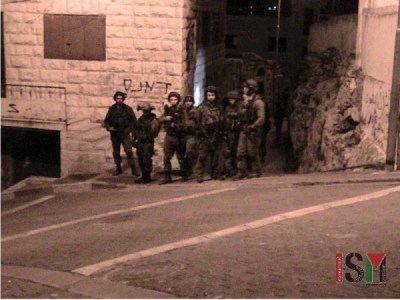 The occupation went missing from The New York Times this past week. Palestinians were there, as victims and attackers, but the brutal military regime that controls their lives made no appearance.
The newspaper had plenty to say about Israeli Jewish life, however: two lengthy stories about prayer space at the Western Wall and one discussing Zionism. Each of these stories ran over a thousand words.
Two shorter news articles reported that the murderers of a Palestinian teen had been sentenced to prison and that a knife attack left one Israeli police officer dead, but nothing in either of these provided the context crucial to understanding events in the occupied territories.
Meanwhile, as the Times obsesses over Israeli identity and attitudes, the occupation grinds on, producing news that appears elsewhere. At the top of the list were two major stories: A Palestinian prisoner was near death after passing his 75th day on hunger strike, and Israeli forces carried out a massive demolition of over 20 homes, rendering more than 100 Palestinians homeless in the dead of winter.
The ordeal of Mohammed al-Qeeq, a journalist held without trial since Nov. 21 of last year, drew the attention of Israeli and international media outlets, which recounted his legal appeals, protests on his behalf and an Israeli Supreme Court decision which “froze” his detention but confined him to a hospital. (Al-Qeeq refused the offer and continued his fast.)
Al-Qeeq’s hunger strike was deemed unfit to print in the Times, perhaps because it would touch on Israel’s use of administrative detention, which holds prisoners without trial. Readers are not to know that as of last December 660 Palestinians were held in this limbo, nor were they to be informed that a number of human rights groups have protested Israel’s unsavory use of the practice.
And then there is the matter of two impoverished villages in the South Hebron Hills of the West Bank, Khirbet Jenbah and Khirbet Al-Halawah, which were made even more destitute after Israeli army crews arrived last Tuesday and demolished 22 structures, displacing 110 people, including dozens of minors. The army also confiscated solar panels, which, like many of the homes, had been donated by aid organizations.
The military claimed that it destroyed Jenbah and Al-Halawah because they were located in a declared firing zone. The Israeli publication 972 Magazine, however, noted that “Jewish settlements within [the zone] have not been served with eviction orders.”
This was the largest mass demolition in a decade, and the plan to destroy villages within the firing zone has drawn international attention and a petition from world-renowned authors to spare the communities. None of this, however, was enough to draw the interest of the Times.
Instead, the Times considered it more urgent to examine the effects of a new prayer space at the Western Wall—not once, but twice—and to take a look at Zionism today. Villagers thrown out in the cold of winter and a prisoner on the brink of death took a back seat to these concerns.
The Times claims that it gives readers “the complete, unvarnished truth as best as we can learn it,” and it insists that the newspaper’s overriding goal is to “cover the news as impartially as possible.” Readers who never stray to other sources of information may actually believe this.
BBC whips up anti-Russia hysteria to apocalyptic levels
By Robert Bridge | RT | February 7, 2016
Once again, Russia is being featured as Dr. Evil Incarnate, the villain that regularly plays opposite peace-loving NATO nations, in a BBC program that has Moscow initiating an invasion on Latvia followed up with a nuclear strike on Britain.
And just in time for the military-industrial shopping season.
Since the collapse of the Soviet Union, Russia has failed Western analysts and political pundits in spectacular fashion. Despite a full-court effort to portray Russia as a barbaric, land-grabbing nation obsessed with the idea of restoring imperial real estate, Russia has stubbornly refused to play along.
Why, even dangling the fat bait of Ukraine before Russia’s nose could not get Moscow to react the way NATO had hoped it would.
In fact, while NATO has been hot on the warpath against a number of shell-shocked nations across the Middle East, Central Asia and North Africa, Russia has gone to war on just one (1) occasion, and that was against Georgia, and only after the egomaniacal leader of that tiny Caucasian country tempted fate by stupidly poking the Russian bear first.
Thus, the BBC has apparently found it necessary to contrive an altered state of reality, a veritable twilight zone, to convince its audience of Russia’s ‘real’ intentions: The result is a military contractor’s wet dream, an apocalyptic bunker buster, unsubtly entitled ‘World War Three: Inside the War Room,’ that depicts a sweat-inducing showdown between Russia and NATO and the beginning of WWIII.
It’s probably safe to say I would not be playing plot spoiler by revealing here that Russia has been typecast as the aggressor.
To briefly summarize: After the Russian military rolls over little Latvia for no good strategic reason whatsoever, British military commanders and graying bureaucrats with furrowed brows huddle themselves in a bunker, deciding whether to launch Trident missiles at Russia in response.
The Daily Mail breathlessly described the tax-payer paid performance as “an utterly realistic ‘war game’” which presents “deeply troubling questions, not least with the current political row over Government plans to spend £100 billion replacing our fleet of Trident submarines.”
Eureka! At the very same time UK military contractors are salivating over the prospect of winning billion-dollar contracts to replace the Queen’s collection of Trident nuclear-armed submarines, along comes a state-funded scaremongering film, starring arch-villain Russia to lend some credence to the initiative.
Russian lawmaker Frants Klintsevich told the Russian News Service radio station the film will give NATO an opportunity to remind member states that they should crack open their tattered purses and boost their military spending.
“They [West] have always demonized Russia trying to show that it is uncontrolled and non-European. As for what happens recently… we qualified this a long time ago as an information war, a very serious and a profound one,” said Klintsevich, the first deputy chairman of Federation Council’s committee on defense and security.
“Today the US has a very serious problem of rearmament, the military and industrial sector needs to get financing. A mechanism of the corrupt American elite has been launched. This was in Iraq, is in Syria and around Europe,” the senator said.
Meanwhile, the Kremlin has provided a tongue-in-cheek critique of the BBC film.
“Unfortunately, our colleagues from the BBC have lately resorted to making public products, of quite low-quality. Therefore, we haven’t always been in a hurry to familiarize ourselves with them,” Russian presidential press secretary Dmitry Peskov told reporters when asked whether the Kremlin has stayed up late to catch the film.
“It’s simply not worth the time it takes to watch,” Peskov said.
On the same day the BBC thriller was released, a report by the totally unbiased Rand Corporation – invoking sexed-up memories of Saddam Hussein’s alleged ability to strike the UK in 45 minutes – said that it would take just 60 hours for Russia to occupy Estonia and Latvia, and that’s not taking into account Riga’s rush-hour traffic.
“Across multiple games using a wide range of expert participants in and out of uniform playing both sides, the longest it has taken Russian forces to reach the outskirts of the Estonian and/or Latvian capitals of Tallinn and Riga, respectively, is 60 hours,” Rand said in its report.
“Such a rapid defeat would leave NATO with a limited number of options, all bad.”
It might be worth noting in closing that former RAND chief strategist, Herman Kahn, once forwarded the insane idea of a “winnable” nuclear exchange in his 1960 book ‘On Thermonuclear War.’
This led to Kahn being the inspiration for the title character of Stanley Kubrick’s black comedy satire Dr. Strangelove.
As far as the BBC’s latest anti-Russia production goes, well, it’s just plain strange.
Robert Bridge is the author of the book on corporate power, “Midnight in the American Empire”, which was released in 2013. @Robert_Bridge
Featured Video

Why the U.S. Should Pull Back From the First Island Chain
or go to
Aletho News Archives – Video-Images
Book Review
‘Why Fauci Must Rot in Prison’: A Tale of Two Diaries
By Jill Erzen | The Defender | October 13, 2026
Dr. Anthony Fauci’s private diary reveals a “mind-numbing” contradiction between what the former top U.S. infectious disease official knew about COVID-19 and what he told the public, senior White House adviser Peter Navarro, Ph.D., said last week on “American Thought Leaders.”
In his new book, “Why Fauci Must Rot in Prison,” due out Oct. 20, Navarro compares Fauci’s private entries to his own pandemic-era diary, and uses what he calls “a tale of two diaries” to argue that Fauci should face criminal prosecution.
“I show, actually, how a prosecution can and should happen … at the state level, most likely,” Navarro said. “He should wind up in prison, and we’ve got the receipts in this book to put him there.”
Navarro said Fauci repeatedly acknowledged important facts in private, then publicly pursued policies that contradicted those facts — with devastating consequences.
“What he says many times privately in his diary is so at odds with both his public behavior and public statements that it’s mind-numbing,” Navarro said.
Navarro examines the lasting damage caused by lockdowns and other pandemic policies, and the ongoing toll of long COVID.
His book also addresses questions about vaccine safety, including why healthy young people faced COVID-19 vaccination mandates despite concerns about myocarditis, and why women were not warned about miscarriage risks linked to the shots. … continue
Blog Roll
 Aletho News
- Jennifer Kavanagh: Why the U.S. Should Pull Back From the First Island Chain
- Yemen denounces international community’s silence on Saudi aggression, siege
- UAE and Saudi Arabia move toward renewed coordination against Sanaa
- How Iran’s two-week retaliatory strikes exposed cracks in US military architecture in Persian Gulf
- The mother of all propaganda: Why the hype over US MOAB strike against Iran is nothing but theater
- Iran says it possesses technology behind US 14-ton GBU bunker-buster
- Trump asks Iran not to retaliate after he strikes Pickaxe Mountain – w/ Prof. Marandi
- Vice President J.D. Vance’s Deceptive ‘Antiwar’ Campaign Speech
- Iran: Palestinians’ rights must not be compromised in Gaza’s future; US, Israel to blame for Hormuz situation
- Ongoing tales of Syrian chemical weapons
- If Americans Knew
- Israeli rabbi permits occupiers to steal Palestinian olive harvest in West Bank
- Netanyahu’s spin on latest settler attack is laughable – Daily Update
- Israeli soldiers debunk Israel’s talking points
- In West Bank, Israeli settlers are totally out of control – Daily Update
- NPR investigation finds evidence of widespread fraud at mall kiosks tied to Israeli skincare brand
- Tucker Carlson exposes Israeli Lies about the Oct 7th attack, Charlie Kirk, and the U.S.
- Israel has detained thousands of Palestinian children since Oct 7th – over half spent time in solitary, many uncharged
- Israeli Analysis: Is Netanyahu Planning an ‘October Surprise’ Attack Before Israel’s Election?
- Israeli settlers brutally attack Palestinians and Washington Post female photographer, 65
- Words Have Changed, Occupation Continues: The Reality of the Gaza Ceasefire
- No Tricks Zone
- Predictions Made By Renowned Climate Proifessor Over Past Decades Have Been Proven To Be Poor
- New Study Suggests Large Regions Of The Pacific Ocean Have Been Cooling For The Last 80 Years
- Germany’s Green Energy Debacle: High Energy Costs Force Kahla Porzellan to Close After 182 Years!
- New Study: 50 Years Of The Most Aggressive ‘Net Zero’ Policies Can Only Affect The Global Climate By 0.03°C
- US September “Heat” Was No Record…Many Records Set Decades Ago
- Latest European Green Energy Debacle; Portugal’s Largest Flagship Solar Park Insolvent!
- Green Energy Debacle: German Expert Professor Fritz Vahrenholt Warns Of Severe Economic And Social Consequences
- Two More Paleo Reconstructions Affirm Meters-Higher Sea Levels Across Ireland, Brazil 7000-6000 Years Ago
- New Study: Earth And Venus Surface Warmth Largely Explained By Convection And Lapse Rate, Not CO2 Or Radiation
- 2025 Nature Paper Claiming Worsening Global Drought Gets RETRACTED …Heavily Flawed

