Here media hysteria goes again. This is BBC.
It is very difficult to know what has happened. The media and many governments around the world immediately condemn this test. The EU says it is against UN Security Council resolutions – a council consisting exclusively of much stronger, nuclear powers.
Before we get carried away, it should be pointed out that North Korea’s military expenditures (US$ 7-10 bn and very complicated to calculate, but anyhow) is around 1% of those of the U.S., about 20% of South Korea’s and about 15% of Japan’s.
North Korea’s entire military costs a bit less than the newest single nuclear bomb the U.S. tested last year.
Nuclear weapons remain a huge problem to the world. However, countries that have nuclear weapons themselves focus on proliferation. Humanity focuses on the existence of nuclear weapons. Simply put, as long as there are some who have nuclear weapons, others will try to acquire them.
Mass media that blow this inferior nuclear power’s test of whatever it was up on the front pages but forget to tell their audiences much much more serious nuclear stories are – knowingly or not – part of a militarist propaganda machine. Thereby they promote what I have called MIMAC – the Military-Industrial-Media-Academic Complex.
That should not be the role of any media. It would be to highlight all nuclear activities by any government, get some proportions, highlight how these weapons violate international law and inform the world about both the huge risks and what would happen if they are used and, finally, inform us about the activities for nuclear disarmament and abolition.
Just contributing to “fearology” about a nuclear dwarf and keeping us uninformed about the giants militates against objectivity, pluralism and freedom of the press. And it contributes indirectly to militarism.
What are the much more serious nuclear stories I mentioned above?
Well, it has just been revealed that 33,000 U.S. atomic factory workers have died over the last 70 years because of the dangerous environment.
Fact is that nuclear weapons cause many problems even without being used directly – such as the war on Iraq [depleted uranium munitions?], such as polluting the environment and making larges areas – like in Khazakstan – uninhabitable. There are constant nuclear accidents and the world could be more or less totally destroyed from a single technical or human failure.
And what does the U.S. do with a president who wanted to work for a nuclear-free world and received the Nobel Peace Prize?
It has decided to spend US$ 1 trillion – i.e. 1000 billion – the next 30 years on new nuclear weapons. Read more about this perverse ‘peace’ policy here.
January 7, 2016
Posted by aletho |
Deception, Mainstream Media, Warmongering, Militarism | France, North Korea, UK, United States |
Leave a comment
Public opinion is increasingly influenced by mixing politics, business and entertainment with good causes. When Mark Zuckerberg announced he was giving away most of his money, people got excited. But charity and good causes are rarely what they seem.
Politics – as the adage goes – is show business for ugly people.
If by ‘show business’ we mean the implementation of a script worked out in advance by people the public never hears about and dressed up to resemble a spontaneous and passable substitute for reality, then I would agree.
What I see, though, is just as all other norms are being redefined and merged with their polar opposites to form a new mush designed to confuse and debilitate, so the beautiful people are being blended with the ugly ones to form a new compound agent.
The first feet over the line appeared in the 1960s. They belonged to JFK who was the first TV president star, and Muhammad Ali, the first major sports star activist.
Since then, the trickle has turned into a deluge, with a lot of the traffic coming from Hollywood and big business.
Just to be clear: I’m not bemoaning the injection of a lack of purity into the political discourse. I have no time for any politician in power of any stripe who does not actively and openly work to wrest power away from international bankers. Outside of Iceland, I’m still waiting.
But today, it is commonplace – almost expected – for a star or an industrial magnate to get behind a cause.
Charities, philanthropies and foundations
Charities and philanthropies have two attractive qualities if you’re in the business of pushing through an agenda quietly. Firstly, they are tax-exempt. Secondly, they are beyond criticism.
People’s naiveté is staggering. They believe that industrial magnates and investors – men who have spent their lives screwing people over – suddenly and for no reason fall under the influence of benevolent fairy dust.
They want to believe that the Warren Buffetts and George Soroses – men whose careers are characterized by reflex ruthlessness – are suddenly compelled to go out and do random acts of kindness.
What, in fact, is happening is that these men are creating foundations: corporations that will never pay any tax and which will continue to advance an agenda none of us voted for – in perpetuity.
A foundation will hire and retire generations of directors and workers, all of whom will be suborned to the Articles governing that foundation at the time it was created. The DNA of the founder is enshrined in a legal entity, given boundless amounts of money, and then allowed to follow an agenda invariably directed towards ‘change’ – change no one ever heard about, never mind voted for.
What foundations (and charities or so-called philanthropies) do not do is give away money. What they, in fact, do is allow money to be released to persons or organizations, which must then do very specific things with it. In short, they subcontract out the implementation of their guiding Articles to the recipients of their ‘charity’.
If it is still hard for you to embrace the notion that what is termed ‘charity’ or ‘philanthropy’ could be anything but benign, I recommend watching Norman Dodd interviewed by the excellent G. Edward Griffin. Norman Dodd was, in 1954, the Staff Director of the Congressional Special Committee to Investigate Tax-Exempt Foundations. He knew how they really work.
Agenda 21
Mainstream media works hard, generally speaking, to defuse criticism of Agenda 21. Similar to philanthropy, it uses warm, fuzzy terminology. It talks, for example, about ‘sustainable development’ – and who could be against that?
Glenn Beck nailed it when he said: “Sustainable development is just a really nice way of saying centralized control over all of human life on planet earth.”
Bill Gates has gone from knowing how to make computer software (which defies any intelligent attempt to use it and now spies on you), to being an expert on the environment (i.e. how all of us should live), which is at the core of Agenda 21.
He couldn’t make an operating system that didn’t crash and turn blue every time you wanted to do something, but he’s got the solution to the problem which was identified by his buddy Al Gore, who went from almost inventing the internet and almost being president of the United States to almost winning the Nobel Peace Prize (he shared it with the Intergovernmental Panel on Climate Change) and who – like Bill – is an expert on how we all should live.
Bill explains with nerd-like zeal the need to reduce carbon emissions to “almost zero” (which, since humans are carbon-based life forms, would require our virtual extinction), and among his toolkit for achieving this aim is “a really great job on new vaccines.”
Bill Gates also has a tax-free foundation. Knowing how – and, in fact, if – the rest of us should have children is something of a family business for Gates. His father, W. H. Gates, was a director of Planned Parenthood, and also a ‘philanthropist’.
Eye candy
Actors and pop stars get adoration and money – at least the successful ones do. And if you live in a grim area and work in a boring job that can seem like the zenith of all possible joy.
However, the appeal wears off after a while. You don’t just want to speak other people’s words. You want to say something significant yourself. You’ve spent your life scrambling up a greasy pole to get respect, only to find yourself secretly afraid that people don’t take you seriously.
Such people, then, are nothing if not vain. That’s partly why they went into the business in the first place.
So it’s not difficult to utilize both their vanity and their proven skills in delivering dialogue they didn’t write and don’t understand, in order to push forward agendas they could never grasp.
Such people are Bill Gates and Warren Buffett writ small. Very small. Because while they might seem like gods to you, they have no real power. They are only ever one misjudged comment away from never working again, and they are all terrified of having to go back and live with the unwashed masses.
People such as Gates and Buffett and Gore are pretty dull to most people. Joe Public is not accustomed to listening to suits. But he has thousands of hours invested in giving his rapt attention to Hollywood stars and musicians.
This makes them useful to those who really do understand power; who can make where the rubber meets the road – where vanity meets inanity – serve to push forward the agenda the grown-ups came up with.
Pop people are basically used by the system to sell a new weaponized culture to the target audience. It is an obvious move to use those tried-and-tested puppets to sell more of that same agenda.
So Angelina Jolie was gushed over by the Telegraph, in part for her intrepid journey to Darfur and then for lecturing the Council on Foreign Relations (a place where real power resides) on the need to do the things in Darfur – stuff the CFR was planning on doing anyway, but was unable to express in a way that did not send people to sleep.
Bono, for his part, has gone from anthems against the establishment to eulogies in its praise. He is big friends with Bill Gates, for example, and likes to chew the cud with him on the ‘charity’ they are both involved in.
You name the star, they’ll have a cause. From Emma Watson (who at the age of 25 is already an ‘activist’) to George Clooney to Scarlett Johansson – they are all out there treading the boards of seemingly worthy narratives, looking authentic and concerned, and investing dullness with magic.
The fact that few if any of them could write an undergraduate paper unaided on the subject they are supposedly experts in doesn’t matter. People follow the stars. And the people who control the stars know that.
Very occasionally, someone goes off-script; someone claws his way to a position of prominence by sheer grit and talent and then just says what he thinks. Tyson Fury comes to mind.
Then the media is less interested in causes and more interested in damage limitation, wringing its hands at the incongruity of someone capable of Wrongthink being fantastically good at something.
Something tells me Mr Fury isn’t going to be invited to share his thoughts with the Council on Foreign Relations or to hug trees with Bill Gates.
I also wonder how long we’ll have to wait to find a star using the Oscars to speak out in favor of no sex before marriage or tipping buckets of cold water over themselves to highlight the evils of usury.
I’m thinking Hell will freeze over first.
Read more:Gates Foundation focuses $3bn agro-fund on rich countries, ‘pushes GMO agenda in Africa’
January 7, 2016
Posted by aletho |
Corruption, Deception, Mainstream Media, Warmongering, Science and Pseudo-Science, Timeless or most popular | Africa, Bill Gates, George Clooney, George Soros, Human rights, Mark Zuckerberg, Scarlett Johansson, United States |
Leave a comment
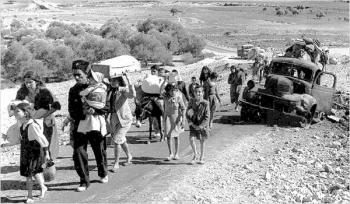
The better part of a decade ago, I described the Toronto Star‘s Mitch Potter as “a canary in the mineshaft of liberal Canadian racism.” A piece on 1948 Palestine published in a recent edition of The Star shows the canary very close to asphyxiating.
Since Potter insists he was within his rights to describe Palestinian fighters in Gaza as “lemming-like,” he’ll surely forgive the metaphor.
The article, entitled “The Toronto man who saved Nazareth,” celebrates the heritage of Ben Dunkelman, the most prominent Canadian to travel to 1948 Palestine to support the Zionist war effort. In more than 2500 words spread across The Star‘s “Insight” section, Potter and his editors transform this Canadian’s role in occupying Palestinian communities into fodder for patriotism. “What he did was bring his hard-earned Canadian military professionalism to help organize a chaotic fighting force and help set down the rules of engagement,” the Star quotes one of a number of friendly sources as explaining. “And that included saying, ‘No, we will not expel civilians.'”
The record of this “gentle giant of a man,” as Potter introduces Dunkelman, is well documented. The son of the founder of Ontario retail giant Tip Top Tailors and a veteran of the Queen’s Own Rifles of Canada, Dunkelman was not an obscure figure. In Canada, he was an eminent member of the country’s community of patriotic respectables. In Palestine, he was a participant in the mass expulsion of Palestinians from the Galilee, commanding troops who repeatedly massacred civilians.
Dunkelman’s record of Canadian patriotism and Zionist colonization has long made for a popular sell. He has been happily remembered as “a Canadian and Israeli war hero,” as The Globe and Mail once described him. His basic character should be apparent to anyone who picks up his autobiography, Dual Allegiance.
Potter’s article for The Star pines over lost pages of this book without conveying to readers its utterly thuggish tone. The first five pages, to give you a sense, move from a description of a fight Dunkelman picked with a Palestinian (“Kneeling astride him, I began hitting him again and again, until his body went limp”) to boyhood reminiscences that feature a young Dunkelman in Toronto, soon to enroll in Upper Canada College, “waving a little Union Jack.” A lovely patriotic tale.
In Palestine, Dunkelman did not stop at beating Palestinians with his fists. In the summer and autumn of 1948, he served as commander of the Seventh (Armoured) Brigade of the newly established Israel Defence Forces (IDF). This is a representative sample of how Potter now presents this history to The Star‘s readership: “Named to lead Israel’s 7th Brigade in the final phase of the 1948 war, Dunkelman pushed methodically — and almost bloodlessly — through the Galilee with a series of nighttime flanking movements, eventually ending at the Litani River in Lebanon. He quite literally shaped borders, delivering territory Israel might not otherwise hold today.”
“Bloodlessly”?
One of the Seventh Brigade’s “nighttime flanking movements,” on October 29-30, 1948, brought the Palestinian village of Safsaf under Dunkelman’s command. A Palestinian woman from Safsaf, Umm Shahadah al-Salih, described what happened the next morning. Villagers were ordered to assemble in file around two houses to the north of the village.
“As we lined up, a few Jewish soldiers ordered four girls to accompany them to carry water for the soldiers. Instead, they took them to our empty houses and raped them. About 70 of our men were blindfolded and shot to death, one after the other, in front of us. The soldiers took their bodies and threw them on the cement covering of the village’s spring and dumped sand on them.”
If Potter’s editors can cough up subway fare to Yonge and Bloor, he can read this and other accounts for free at the local library, in Nafez Nazzal’s The Palestinian Exodus from Galilee, 1948. The Seventh Brigade’s trail of death, destruction and mass displacement of Palestinians from the Galilee into Lebanon is detailed authoritatively by Nazzal.
But right, this is a Canadian discussion of Palestine. Surely, Palestinians can’t be trusted! Unfortunately for Potter and The Star, more than mistrust of Palestinian testimony would be needed to make their whitewashing of these massacres halfway credible. In 1978, the year that Nazzal’s study was published, Israel began declassifying documents on these events. The Israeli record tells much the same story.
Israel Galili had been chief of staff of the Haganah, the main precursor to the IDF. In a declassified November 11, 1948 briefing cited by Israeli historian Benny Morris, Galili described the conduct of Dunkelman’s men in Safsaf. He spoke of the fate of “52 men tied with a rope and dropped into a well and shot,” and of three cases of rape, including of a 14-year-old girl. He also described large-scale killing of civilians by the Seventh Brigade in the villages of Saliha, Jish, and Sa’sa’. In Sa’sa’, Galili said, Dunkelman’s troops committed “mass murder” and then forced all remaining survivors out: “The whole village was expelled.”
Palestinian witnesses recount the most horrifying details. One survivor of the occupation of Safsaf recalled the stabbing of a pregnant woman with a bayonet. The witness lived out his life in the Ayn Al-Hilweh refugee camp in Lebanon; his testimony was kept alive by his nephew and cited in Ilan Pappé’s The Ethnic Cleansing of Palestine. In his memoirs, Dunkelman admits to authorizing looting by his forces, but predictably does not discuss most abuses. He does, however, proudly relate how one of his units set a landmark in the summer of 1948 with “the first bayonet charge ever mounted by the Israeli Army.” Facing an Arab position in the central Galilee, the company commander “ordered his men to fix bayonets; then, yelling like banshees, they rushed the Arab positions. When the astonished Arabs saw what was coming up the hill at them, they kicked off their boots and fled in terror.”
We don’t know much about specific atrocities with bayonets. We do know that Operation Hiram, during which Dunkelman’s troops carried out severe atrocities, helped push Palestinians out of the Upper Galilee en masse. On October 31, Dunkelman received an order from the IDF’s northern command spelling out this objective: “The inhabitants should be assisted to leave the conquered areas,” Dunkelman was instructed.
Here massacres by Dunkelman’s troops played their part. “What happened at Safsaf and Jish no doubt reached the villagers of Ras al Ahmar, ‘Alma, Deishum and al Malikiya hours before the Seventh Brigade’s columns,” writes Morris. “These villages, apart from ‘Alma, seem to have been completely or largely empty when the IDF arrived.” A week and a half into November 1948, an IDF intelligence report observed that “more than 50,000 new refugees” had crossed the border into Lebanon as a result of Operation Hiram.
Dunkelman — cue Potter’s praise — did not order expulsions in every Palestinian community that his forces occupied. He specifically opposed the (widespread) expulsion of Palestinian Christians by Israeli forces. When in July 1948 his troops occupied one of the main Christian centres in Palestine, the city of Nazareth, he spared it the harsher treatment he accorded to predominantly Muslim villages in its vicinity.
Potter is effusive with praise! He laments to The Star‘s readership that Dunkelman “won no medals for refusing to molest civilians” in Nazareth, but takes the opportunity to trumpet Canadian civility: “Transpose that morality to the modern era and imagine how the U.S. military interrogations at Abu Ghraib might have played out with a Dunkelman in command.” If those held at gunpoint were Muslims? Should we really follow this thread? “In many of the Palestinian oral histories that have now come to the fore,” observes Ilan Pappé, “few brigade names appear. However, Brigade Seven is mentioned again and again, together with such adjectives as ‘terrorist’ and ‘barbarous.'”
Israel has not declassified enough documentation for us to know for certain whether Dunkelman ordered his troops to massacre Palestinian civilians in line with instructions from higher-level IDF officers, took the initiative himself, or left the details to lower levels of command. But there is no record of him taking any action to discipline the culprits. By all accepted standards, he is therefore among them. Only the best liberal patriots want to award war criminals prizes for each possible war crime they didn’t commit.
Introducing a co-edited volume entitled Nakba: Palestine, 1948, and the Claims of Memory, Lila Abu-Lughod and Ahmad Sa’di explore the challenges of asserting Palestinian memory “under the conditions of its silencing by the thundering story of Zionism.” Engaging with 1948 as a landmark of enduring trauma, both individual and collective, may not be simple. But one can imagine an alternate universe in which Canadian journalists made a respectable effort. In which some attempt was made to look to the kind of work assembled by Abu-Lughod and Sa’di, to consider the recorded memories of those who lives were uprooted by Dunkelman’s troops, to bring their experiences into this history.
Instead, The Star basks in patriotic self-satisfaction and ignores the evidence.
This is not just a question of professional standards, or of historical accuracy. As Abu-Lughod and Sa’di argue, “the Nakba is not over yet.” It was Israel’s current defence minister, Moshe Ya’alon, who described Israel’s twenty-first-century assaults on Palestinians as “the second half of 1948.” How this war is represented abroad can affect its continuation into the present. I haven’t paid much attention to Potter’s work since his distortions of Israel’s 2006 assaults on Gaza and Lebanon. But it seems he’s decided to whitewash past and present attacks on the Palestinians in much the same spirit.
People in Canada need to demand better. In the coming period, we will have to face the fact that the end of the Harper years did not spell an end to Canadian support for Israel’s perpetual warfare against the Palestinian people. The liberal patriotic impulse is to bury this problem in comforting myths: to pretend that even in its support for Israel, Canadian liberalism shines. This requires nothing less than falsification of the record. An open discussion of the realities of Palestine will raise troubling questions about local burdens of responsibility. If this is what drives so many opinion-makers to avoid it, it is also what makes it urgent.
Dan Freeman-Maloy is an activist and writer based in Montreal. For a more detailed review of the record of Western recruits in 1948 Palestine, see this article of his from the Journal of Palestine Studies.
January 6, 2016
Posted by aletho |
Ethnic Cleansing, Racism, Zionism, Mainstream Media, Warmongering, Timeless or most popular, War Crimes | Canada, Human rights, Israel, Palestine, Zionism |
Leave a comment
As scores of Palestinians have died at the hands of Israeli forces over the past three months, The New York Times has endeavored to hide the full story of this bloodbath, emphasizing Israeli losses, ignoring the majority of Palestinian deaths, and promoting a narrative that shields trigger-happy troops and obscures facts to the point of deceit.
Thus, a recent story about deadly attacks in Tel Aviv tells us that “at least 20” Israelis have been killed since Oct. 1 and about 130 Palestinians, “up to two-thirds of them while carrying out attacks, or attempting to attack Israelis, according to the police. Others have been killed in clashes with the Israeli security forces in the West Bank and East Jerusalem and along Israel’s border with Gaza.”
In other words, the Times is saying that Israeli troops were justified in these killings because they were trying to repel deadly attacks or responding to “clashes” with the army or police. This is the message we are to hear, and readers are unlikely to notice that its source is none other than those responsible for a significant number of Palestinian deaths—the Israeli police.
The Times betrays its claim of neutrality by ignoring other sources. Nothing is said of reports by alternative media and human rights groups that accuse Israeli forces of carrying out extrajudicial executions and killing Palestinians who pose no possible threat to security forces or civilians. Likewise, nothing is said of those victims who were taking no part in demonstrations but were merely bystanders or passers-by when they were killed.
The Times, omitting contrary evidence, thus leaves readers with the impression that all of the Palestinian dead were killed as they participated in acts of violence.
At the same time the Times has been quick to name Israeli casualties but has provided identities for only a fraction of the Palestinians. Virtually every Israeli victim has been identified in stories by Times reporters, while only some 34 Palestinians out of more than 130 were mentioned by name. (Some, however, may have been identified in wire services reports that appear briefly online.)
This tally was based on a search of Times stories out of its Jerusalem bureau, using a published list of those killed since Oct. 1. It shows a grossly lopsided preference for Israeli victims over Palestinians, with the names of more than 100 victims omitted from news reports.
Moreover, in the single instance when an Israeli victim was unnamed, the Times apologized, saying the man “was not immediately identified” but was said to be 45 years old and the father of seven.
By contrast, the Times often failed to report Palestinian deaths or it mentioned them almost as afterthoughts, as in this paragraph tucked into a story about dampened Christmas celebrations in the West Bank: “On Thursday, Israeli forces killed three young Palestinian men who they said were trying to carry out attacks. In one episode, a Palestinian tried to ram his vehicle into soldiers near a Jewish settlement in the West Bank, lightly wounding a man before he was shot dead.”
The man who was said to have “tried to ram his vehicle into soldiers” had a name. It was Wisam Abu Ghweila; he was from Qalandiya refugee camp, and according to the International Middle East Media Center, there is much more to his story than appeared in the Times.
Abu Ghweila drove his car “too close to a roadblock,” IMEMC reported, and lightly struck a soldier in the process. “Instead of addressing the situation as if it were an accident,” the story continues, “Israeli troops immediately began to empty their guns at the suspect, wounding him severely.”
Eyewitnesses told IMEMC that soldiers shot more than 30 rounds at Abu Ghweila’s car and allowed the injured soldier to receive medical care but left Abu Ghweila unattended as he lay dying in his car.
B’Tselem, an Israeli monitoring group, has reported on other cases in which troops have denied medical care to wounded Palestinians, and alternative media often give accounts of ambulances and medics being denied access to injured victims. The Times, however, makes no mention of these charges, even though some are backed by video evidence.
Israeli media have also reported killings that never appear in the Times. One of these involved a teenage girl who was shot as she sat in the back seat of her family car. The story in Haaretz was titled “The Face of Collateral Damage” and carried this subhead: “Samah Abdallah, 18, from a little-known Palestinian village in the West Bank, was shot dead, either on purpose or by accident—but most assuredly without legitimate reason.”
The Times made no mention of this incident, which took place near Nablus, nor did it report on the death of a mother of four, an inexperienced driver, who was killed in a hail of bullets when she drove slowly through a checkpoint and failed to stop in time. Haaretz, however, told her story under this headline: “A Palestinian Mother of Four, Shot 17 Times for Being a Bad Driver.”
This unfortunate woman, Mahdia Hammad, appears in the Times merely as one of the “about 130” Palestinian killed in the past three months. As in dozens of other cases, the fact of her death at the hands of Israeli security forces received no notice at all, not even a brief paragraph citing officials’ claims that they had “neutralized” a would-be attacker.
These incidents expose the deception inherent in the Times’ claim that Palestinian casualties have occurred only during attacks on Israelis or during “clashes” with security forces.
This self-serving narrative, however, is what Israeli officials want us to believe, and the Times is a willing co-conspirator, showing an appalling indifference to the mounting death toll among Palestinians. It gives credence only to the official reports of police and army spokespersons, the groups most responsible for the bloodshed, turning its back on respected sources and betraying its readers and its own stated values of journalistic ethics.
Follow @TimesWarp on Twitter
January 5, 2016
Posted by aletho |
Deception, Ethnic Cleansing, Racism, Zionism, Mainstream Media, Warmongering | Gaza, Human rights, Israel, New York Times, Palestine, West Bank, Zionism |
Leave a comment
As the New Year dawns, the neocons and their liberal interventionist sidekicks remain firmly in control of Official Washington’s storylines – on Syria, Russia and elsewhere – even as their policies continue to wreak havoc across the Mideast and threaten the stability of Europe and indeed the future of civilization.
The latest proof of this dangerous reality came when Saudi Arabia’s repressive Sunni monarchy executed prominent Shiite political leader Sheikh Nimr al-Nimr for criticizing the nation’s kings and princes. Before the killing, the Obama administration held its tongue in public so as not to antagonize the Saudi royals. (Nimr’s nephew awaits Saudi “crucifixion” for his role as a teenager in Arab Spring protests.)
After the Nimr execution, the State Department issued a mild protest toward the Saudis while blurring the guilt by twinning it with criticism of Iran where outraged protesters damaged the Saudi embassy, which led to Saudi Arabia’s retaliatory breaking of relations with Iran.
“We believe that diplomatic engagement and direct conversations remain essential in working through differences,” State Department spokesman John Kirby said meekly on Sunday, while some senior U.S. officials reportedly seethed in private over the latest Saudi provocation.
“This is a dangerous game they are playing,” one official told The Washington Post’s Karen DeYoung while insisting on anonymity to discuss U.S.-Saudi relations.
But the fact that the Obama administration could not voice its revulsion over the Saudi mass head-chopping (along with some firing squads) for 47 men, including Nimr, over the weekend speaks volumes. President Barack Obama and other insiders continue to tip-toe around the unsavory U.S. “alliances” in the Mideast.
Over the past several years, Saudi Arabia sealed its impervious protection from U.S. government criticism by forming an undeclared alliance with Israel around their mutual hatred of Shiite-ruled Iran and its Shiite allies, a cause picked up by American neocons and shared by the career-oriented liberal interventionists.
Some more “realist-oriented” U.S. officials, reportedly including Obama and some national security aides, recognize the havoc that neocon/liberal-hawk strategies continue to wreak across the region and now spreading into Europe, but they act powerless to do anything bold to stop it.
With Israel’s lobby siding with the Sunni states in their bloody rivalry with Shiite states, most U.S. politicians and pundits have scrambled to defend each recurring outrage by the Saudis, Qataris and Turks by trying to flip the script and somehow put the blame on Iran, Syria and Russia.
Getting a Pass
Thus, the Saudis, Qataris and Turks get mostly a pass for arming and enabling radical jihadists, including Al Qaeda and the Islamic State. Israel also provides assistance to Al Qaeda’s Nusra Front along the Golan Heights and bombs allies of the Syrian government and, of course, faces no official U.S. criticism.
In 2014, when Vice President Joe Biden blurted out the truth about Saudi support for Islamic terrorism inside Syria, he was the one who had to apologize. [Quote at 53:20 of clip.] In 2015, when Saudi Arabia invaded and bombed Yemen after hyping Iran’s support for Houthi rebels, the Obama administration sided with the Saudis even as their wanton attacks on poverty-stricken Yemen killed thousands of civilians and created a humanitarian crisis.
For more than a year after President Obama announced his air war against the Islamic State in summer 2014, Turkey continued to let the terror group run an industrial-style oil smuggling operation from Syria and Iraq through Turkey. Only when Russia entered the conflict last fall was the U.S. government shamed into joining in bombing raids to destroy the truck convoys. Yet, Obama still defended Turkey and bought its promises about finally trying to seal a 100-kilometer gap in its border.
Then, when Turkey retaliated against the Russian anti-terrorist bombing raids inside Syria by willfully shooting down a Russian Su-24 plane whose pilot was murdered after bailing out, Obama again sided with the Turks even though their claim that the Russian plane had violated Turkish air space was dubious at best. By their account, the plane had intruded over a sliver of Turkish territory for 17 seconds.
In other words, whatever these U.S. “allies” do – no matter how brutal and reckless – the Obama administration at least publicly rushes to their defense. Otherwise, the neocon/liberal-hawk “group think” would be offended – and many angry editorials and columns would follow.
While this strange reality may make sense inside Official Washington – where careerism is intense and offending the Israel Lobby is a sure career killer – this pusillanimous approach to these grave problems is endangering U.S. national interests as well as the world’s future.
Not only has the neocon/liberal-interventionist obsession with “regime change” turned the Middle East into a vast killing field but it has now spread instability into Europe, where the fabric of the European Union is being shredded by dissension over how to handle millions of Syrian refugees.
The United Kingdom may vote to leave the E.U., removing one of the original anchors of the European project which — for all its faults — has deservedly gotten credit for replacing a history of European blood-soaked conflicts with peaceful cooperation.
The spreading disorder has had political repercussions in the United States, too, where panic over terrorism is reshaping the presidential race.
Yet, instead of practical solutions such as pressuring all rational sides in the Syrian conflict to engage in peace talks and hold free elections that give the Syrian people the power to decide who their future leaders will be, Official Washington instead generates “talking points,” such as calling Syrian President Bashar al-Assad a “magnet for terrorism” who “must go” – although his forces have done the most to stop an outright victory by Al Qaeda and Islamic State.
If one buys this “magnet” theory, then you’d also have to seek “regime change” in every country that’s been attacked by terrorists, including the United States, France, United Kingdom, Spain, etc. In the case of Syria, what’s remarkable is that the sponsorship of terrorism by U.S. “allies” and indeed by the U.S. government itself has been so blatant. [See Consortiumnews.com’s “Climbing into Bed with Al Qaeda.”]
However, as far as Official Washington is concerned, it doesn’t really matter what Assad has or hasn’t done. What’s important is that “regime change” in Syria has been on the neocons’ to-do list since at least the mid-1990s – along with the brilliant idea of “regime change” in Iraq. [See Consortiumnews.com’s “How Israel Out-Foxed US Presidents.”].
The Infallible Neocons
And since the neocons are infallible – as far as they’re concerned – the goal can’t be changed. The only option is to escalate the “regime change” planning to include other countries that get in the way, including Iran and now nuclear-armed Russia.
Yes, that’s the ultimate neocon idea – make the Russian economy scream, overthrow the calculating Vladimir Putin and risk having him replaced by some extreme and unstable nationalist with his or her hand on the nuclear button. That may be how life on the planet ends – but there will be evermore “group thinks” and “talking points” right up to the moment of Armageddon. The neocons can never stop generating false narratives.
Meanwhile, the “liberal interventionists” can boast of their own “regime change” – in Libya, a policy promoted by then-Secretary of State Hillary Clinton who delighted at the gruesome torture-murder of Muammar Gaddafi – “we came, we saw, he died,” she laughed – after having ignored his warnings that the overthrow of his secular government would open the oil-rich country to chaos from radical jihadists, a prediction that has been fulfilled.
Yet, despite this record of spreading chaos and death around the world, the grip that the neocons and liberal hawks have on Official Washington remains almost absolute. They control most of the think tanks – from the Brookings Institution to the American Enterprise Institute – as well as the editorial pages of The Washington Post and The New York Times and pretty much the rest of the mainstream media.
In case you haven’t noticed, the Times’ “news” coverage of the Middle East and Russia has been consistently slanted to favor neocon/liberal-hawk positions. Just as the Times eagerly joined President George W. Bush’s bogus case for invading Iraq in 2003, “the newspaper of record” has peddled false and misleading articles about the crises in Syria and Ukraine as well as promoting anti-Russian propaganda.
In this climate of manufactured “reality,” any old-fashioned foreign policy “realist” – especially one who has criticized Israel – cannot expect to win Senate confirmation to any senior position, establishing what amounts to a blacklist against “realists,” such as happened to ex-U.S. Ambassador Chas Freeman whose intelligence appointment was dropped by Obama in his early days out of fear of offending the Israel Lobby and its many neocon backers.
As the rise of those neocons has played out since their emergence during the Reagan administration, the “realists” who were known for cold-hearted foreign policy calculations to protect American interests have aged, died out or otherwise disappeared. They have been largely replaced by ideologues, either neocons with their intense devotion to right-wing Israeli interests or liberal interventionists who almost invariably side with the neocons but cite “humanitarian” concerns to justify “regime change” wars.
Blocking Obama
No matter how foolhardy and deadly these policy prescriptions have been, there is almost no way to dislodge the neocons and liberal hawks inside Official Washington, since they monopolize almost all levers of political and media power.
Even when President Obama tried to collaborate under the table with President Putin to reduce tensions in Syria and Iran in 2013, Obama was quickly outmaneuvered by neocons and liberal hawks inside the State Department who pushed for the putsch in Ukraine in 2014 that effectively destroyed the Obama-Putin cooperation. [See Consortiumnews.com’s “What Neocons Want from Ukraine Crisis.”]
I have long argued that the only way to begin to challenge the neocon/liberal-hawk “group thinks” is to release facts about pivotal events, such as the 2013 Syria-sarin case, the 2014 sniper attacks at Kiev’s Maidan square, and the 2014 shoot-down of Malaysia Airlines Flight 17 over Ukraine. The neocons/liberal hawks currently control all those narratives, using them as clubs to advance ideological agendas just as they did with the false claims about Iraq’s WMD. [See Consortiumnews.com’s “The Power of False Narrative.”]
But other evidence suggests very different scenarios. Obama and his national security team could either release evidence to confirm the accuracy of the “group thinks” or puncture that self-certainty. Instead Obama has chosen to withhold what the U.S. intelligence community knows about these events, all the better to protect the dominant propaganda narratives.
So, the Obama administration continues down a road of tolerating or condoning outrages by its Mideast “allies” as the President and his timid intelligence bureaucrats do nothing to empower the American people with the truth. It is a recipe for worldwide catastrophe.
Investigative reporter Robert Parry broke many of the Iran-Contra stories for The Associated Press and Newsweek in the 1980s. You can buy his latest book, America’s Stolen Narrative, either in print here or as an e-book (from Amazon and barnesandnoble.com).
January 5, 2016
Posted by aletho |
Mainstream Media, Warmongering, Progressive Hypocrite, Timeless or most popular, Wars for Israel | al-Qaeda, Iran, Israel, Middle East, New York Times, Obama, Qatar, Saudi Arabia, Syria, Turkiye, Washington Post, Yemen, Zionism |
Leave a comment
Granted it would be quite a competition, but is Washington Post columnist Richard Cohen the dumbest columnist ever?
For instance, in his June 19, 2007 op-ed, Cohen joined the neoconservative media riot over the 30-month jail sentence facing former White House aide I. Lewis “Scooter” Libby.
From reading the column, it does appear that Cohen has the skills at least to master and recite the litany of talking points that the neocons have compiled to make their case about the injustice of Libby going into the slammer for committing perjury and obstruction of justice.
Cohen accuses special prosecutor Patrick Fitzgerald of violating longstanding Justice Department guidelines on when to bring a case; he denounces the trial – over Libby’s lying about his role in unmasking covert CIA officer Valerie Plame – as “a mountain out of a molehill”; he asserts that there was no “underlying crime”; he even pokes fun at Americans who thought the invasion of Iraq might have been a bad idea.
“They thought – if ‘thought’ can be used in this context – that if the thread was pulled on who had leaked the identity of Valerie Plame to Robert D. Novak, the effort to snooker an entire nation into war would unravel and this would show . . . who knows? Something,” Cohen wrote.
Yet, beyond a talent for reprising the conventional wisdom from Washington dinner parties, it is hard to tell what justifies Cohen’s long career as a political columnist. On nearly every major development over the past couple of decades, Cohen has missed the point or gotten it dead wrong.
For example, during the Florida recount battle in 2000, Cohen cared less about whom the voters wanted in the White House than the Washington insiders’ certainty that George W. Bush would be a uniter, not a divider.
“The nation will be in dire need of a conciliator, a likable guy who will make things better and not worse,” Cohen wrote. “That man is not Al Gore. That man is George W. Bush.”
Cohen also joined the Washington herd in the disastrous stampede for invading Iraq. After Secretary of State Colin Powell’s deceptive Iraq War speech to the United Nations on Feb. 5, 2003, Cohen mocked anyone who still dared doubt that Saddam Hussein possessed hidden WMD stockpiles.
“The evidence he [Powell] presented to the United Nations – some of it circumstantial, some of it absolutely bone-chilling in its detail – had to prove to anyone that Iraq not only hasn’t accounted for its weapons of mass destruction but without a doubt still retains them,” Cohen wrote. “Only a fool – or possibly a Frenchman – could conclude otherwise.”
Misplaced Enthusiasm
It took Cohen another three years before he recognized that his enthusiasm for the war had been misplaced.
On April 4, 2006, as the U.S. death toll reached into the thousands and the Iraqi death toll soared into the tens of thousands, Cohen wrote, “those of us who once advocated this war are humbled. It’s not just that we grossly underestimated the enemy. We vastly overestimated the Bush administration.”
In normal work settings, incompetence – especially when it is chronic and has devastating consequences – justifies dismissal or at least demotion, maybe a desk in Storage Room B where Cohen could sit with his red stapler, but without access to a word processor.
Yet, in the strange world of Washington punditry, success is measured not in being right but in keeping one’s opinion within the parameters of the capital’s respectable opinions, even if those judgments are atrociously wrong.
As for the Plame case, Cohen seems to be living in the propaganda dreamscape of the still-influential neocons, not in the real world where the disclosure of Plame’s identity caused actual damage, destroying her undercover career as a CIA officer and putting in jeopardy the lives of foreigners who worked with her investigating weapons proliferation.
Plus, the motive behind the leaking of Plame’s identity was not “gossip,” as Cohen asserts, but a White House-orchestrated campaign to punish her husband, former Ambassador Joseph Wilson, for telling the truth about his 2002 fact-finding mission to Africa. Wilson’s findings helped the U.S. intelligence community debunk false claims about Iraq attempting to buy yellowcake uranium from Africa.
Despite warnings from the CIA, however, President George W. Bush cited Iraq’s supposed uranium shopping during his 2003 State of the Union Address, making it a key part of the case to invade Iraq.
When Wilson went public with his story in July 2003, the Bush administration sought to discredit him by suggesting that his Africa trip was just a junket arranged by his CIA wife. One White House official told a reporter from the Washington Post that the administration had informed at least six reporters about Plame.
The official said the disclosure was “purely and simply out of revenge.” That was a revelation that special prosecutor Fitzgerald corroborated in his investigation.
Libby’s Role
Also, contrary to Cohen’s column, Libby, as Vice President Dick Cheney’s chief of staff, was a central figure in this anti-Wilson smear campaign. Libby briefed two reporters – Judith Miller and Matthew Cooper – about Plame’s identity and brought press secretary Ari Fleischer into the leak operation.
Though it turned out that other senior administration officials, Deputy Secretary of State Richard Armitage and his friend, White House political adviser Karl Rove, were the successful ones in getting a journalist, Robert Novak, to publish Plame’s identity, it wasn’t for the lack of Libby trying to get Plame’s identity into the press.
Nor is it accurate to say that there was no underlying crime. It is illegal to willfully disclose the identity of a covert CIA officer – and the administration officials involved were well aware that her identity was classified. Leaking classified material also can be – and often is – treated as a crime. …
Rather than a wild-eyed prosecutor on a rampage, Fitzgerald actually appears to have been a very cautious prosecutor who chose not to pursue what would have been a deserving but politically disruptive case against Bush, Cheney and other government conspirators implicated in both leaking classified material and participating in a cover-up.
But all this is missed by Cohen. In his June 19, 2007 column, he does reiterate his current position that the Iraq War was a mistake. He also acknowledges that lying under oath is a bad thing to do. But – blinded by the pervasive neocon talking points – he refuses to see the larger scandal.
“I have come to hate the war and I cannot approve of lying under oath – not by Scooter, not by Bill Clinton, not by anybody,” Cohen wrote. “But the underlying crime is absent, the sentence is excessive and the investigation should not have been conducted in the first place. This is a mess. Should Libby be pardoned? Maybe. Should his sentence be commuted? Definitely.” [As it turned out, President Bush did commute Libby’s sentence so he avoided jail time.]
Cohen took a similarly tolerant view of lies told by Reagan administration officials in the Iran-Contra scandal of the 1980s and its successful cover-up by President George H.W. Bush in the early 1990s when special prosecutor Lawrence Walsh was pressing for long-withheld answers.
When Bush sabotaged Walsh’s probe by issuing six Iran-Contra pardons on Christmas Eve 1992, prominent U.S. journalists, including Cohen, praised Bush’s actions and brushed aside Walsh’s complaint that the move was the final act in a long-running cover-up that protected a secret history of criminal behavior and Bush’s personal role.
Cohen spoke for many of his colleagues when he defended Bush’s fatal blow against the Iran-Contra investigation. Cohen especially liked Bush’s pardon of former Defense Secretary Caspar Weinberger, who had been indicted for obstruction of justice but was popular around Washington.
In a Dec. 30, 1992 column, Cohen said his view was colored by how impressed he was when he would see Weinberger in the Georgetown Safeway store, pushing his own shopping cart.
“Based on my Safeway encounters, I came to think of Weinberger as a basic sort of guy, candid and no nonsense – which is the way much of official Washington saw him,” Cohen wrote. “Cap, my Safeway buddy, walks, and that’s all right with me.”
There was a time when The Washington Post aggressively pursued cover-ups of government wrongdoing, such as Richard Nixon’s Watergate scandal. Even during the Clinton administration, a favorite pearl of Washington wisdom was: “It’s not the crime, it’s the cover-up.”
But that was then and this is now. Today, the Post editorial page and its prized columnists, like Cohen, eagerly join in cover-ups and happily bash anyone who won’t go with the Washington flow.
So, the question remains, is Cohen just a clueless incompetent when he berates Fitzgerald for the “train wreck” of the Libby conviction or is this columnist really a clever guy who is very skilled at knowing how to stay on the gravy train of modern Washington journalism?
Investigative reporter Robert Parry broke many of the Iran-Contra stories for The Associated Press and Newsweek in the 1980s. You can buy his latest book, America’s Stolen Narrative, either in print here or as an e-book (from Amazon and barnesandnoble.com).
January 1, 2016
Posted by aletho |
Mainstream Media, Warmongering, Timeless or most popular, Wars for Israel | Iran-Contra, Iraq, Judith Miller, United States, Washington Post, Zionism |
Leave a comment
Tehran has officially denied that its Revolutionary Guards’ patrol vessel launched rockets in imminent proximity to the USS Harry S. Truman and its convoy entering the Persian Gulf, calling the allegation an act of “psychological warfare.”
On Tuesday, reports emerged that last Saturday the US aircraft carrier was intimidated after missiles were launched by an Iranian patrol vessel on a parallel course with the American naval convoy.
“The naval forces of the Guards have not had any exercises in the Strait of Hormuz during the past week and the period claimed by the Americans, for them to have launched missiles and rockets,” Reuters quoted Revolutionary Guards spokesman Ramezan Sharif as saying.
The alleged dangerous missile launch was reported by NBC News, which cited two unnamed US military officials as saying that the USS Harry S. Truman was about 1,400 meters away from the Iranian vessels, which launched two missiles as part of naval exercises.
“The publication of such false news under the present circumstances is akin to psychological warfare,” Sharif said.
December 31, 2015
Posted by aletho |
Deception, Mainstream Media, Warmongering | Iran, Sanctions against Iran, United States |
Leave a comment
No other country, with the exception of maybe China, gets as much of a look in as Russia does from the Washington Post’s editorial board.
It’s hardly strange that the newspaper would focus some of its attention on Russia, an increasingly influential global player, but it does seem to have a bit of a bee in its bonnet about the old enemy.
Reading the Post’s editorials on matters of global affairs is like an exercise in understanding the very worst imaginable interpretation of American exceptionalism — and the latest dispatch on Syria is a perfect example. The headline reads: “A UN resolution on Syria is shattered – and Russia is to blame.”
The UN resolution referred to by the Post stated that all parties must “immediately cease any attacks against civilians and civilian objects” as well as “any indiscriminate use of weapons, including through shelling and aerial bombardment.” Leaving aside the laughable notion that the US itself would adhere to such a resolution and “immediately cease” anything whatsoever, let’s take a look at what concerned the Post.
Two days after the resolution was passed, the editorial says, Russia carried out strikes in the northern Syrian provincial capital of Idlib “killing scores of civilians”. It is not for this writer to judge the authenticity of that claim or to question the word of the Post’s reporter in Beirut — and it would be ludicrous to claim Russia’s strikes have killed not one civilian, but it is at least worth noting that one of the newspaper’s original sources for the story was The Syrian Observatory for Human Rights, an ‘organization’ run out of a home in Coventry by one man who hasn’t visited Syria in 15 years, has received “small subsidies” from the European Union, and whose reports are at best, unreliable. Nevertheless, SOHR has become one of the single-most important “sources” of information on Syria in the Western press.
Irony lost
The Post continues on, unabashed. Secretary of State John Kerry, they chide, should be embarrassed by “this outrage” which “shattered” the UN resolution. They say this without so much of a hint of irony as the US continues to wage its illegal bombing campaign in the country they purport to care so very deeply about. They always care, you see. The more they care, the more bombs they want to drop.
And in the Post’s world, the UN is important and should be respected. Unless you’re the United States, in which case, go ahead and do whatever you want. Ever the pen-wielding champions for the spreading of good old freedom and democracy, they are always there, on the frontlines, cheering on America’s wars. It’s awfully easy to be in favor of ‘humanitarian’ military interventions when you comfort yourself with the knowledge that it’s okay, because you’re the good guys — always. But still, the board likes to be outraged (!) — and it needs to get its outrage fix from somewhere.
At least they’re consistent
Enter Russia. You have to at least hand it to the Post for its consistency. Russia and Putin continue to be the scapegoats for all seasons. There is nothing Moscow can’t be blamed for and nothing it can do right. If the Kremlin produced a cure for cancer tomorrow, the Post would re-imagine it as a sinister plot devised by Putin to put Western oncologists out of jobs.
In early October, the board warned Obama: Don’t green light Mr. Putin’s Syria project. That piece argued that the “moderate” opposition to Assad — which in the real world includes Al-Qaeda’s Syria affiliate Al Nusra, should be given more US anti-tank missiles and that Putin should be given “red lines”.
In November, after the Paris attacks, sensing that things were moving in Putin’s favor, and that an international anti-ISIS coalition might be in the making, they jumped in to ensure no one thought that was a good idea with a piece headlined: Teaming up with Russia in Syria could be a dangerous.
And of course, when Turkey shot down a Russian jet near the Syrian border after claiming that it had violated Turkish airspace, the Post did its bit to make sure no one was left with the wrong impression about who exactly was responsible for the incident: Russian “provocations” and “dangerous behavior of Vladimir Putin’s regime.” Reading that, you’d be forgiven for thinking that it was Russia recklessly shooting planes out of the sky. One wonders would the Post’s reaction have been the same if an American warplane had been shot down in Syria? It’s certainly unlikely (to say the least) that the Post would be calling the US’s illegal flights over the war-torn country “provocations” and demanding accountability.
Occasionally, the newspaper likes to dabble in wishful thinking. Not the editorial board, but an opinion piece published by the Post in late November asked: Is Syria the beginning of the end of Putinism?
It’s our world. Everyone else just lives in it.
The Post’s penchant for US exceptionalism extends far beyond Syria. Here, they lament, Obama just “doesn’t understand” Putin’s “Eurasian ambitions”. Apparently it’s not worth noting that Russia is in fact a massive Eurasian country, unlike say, the US.
And God forbid any other countries might think they could act independently of Washington in any arena. Obama was “right to order a sail-by” in the South China Sea because “failure to respond” to the “aggression” of other countries is always the greatest sin. Meanwhile, Iran “steps up its aggression” in the Middle East. The list goes on and the Washington Post’s editorial board fails, time and again, to see the irony.
That’s the kind of world the Post’s editors live in: Black and white. Good and evil. We’re always right, you’re always wrong. Do what we say, not as we do. The destruction this kind of thinking leaves in its wake is always someone else’s problem to solve.
Danielle Ryan is an Irish freelance journalist and media analyst. She has lived in the US and Germany and is currently based in Moscow. She previously worked as a digital desk reporter for the Sunday Business Post in Dublin. She studied political reporting at the Washington Center for Politics & Journalism in Washington, DC and also has a degree in business and German. She focuses on US foreign policy, US-Russia relations and media bias.
December 29, 2015
Posted by aletho |
Deception, Mainstream Media, Warmongering | John Kerry, Russia, Syria, United States, Washington Post |
Leave a comment
Like children’s fairy tales, foreign policy myths are created, told and retold for a purpose.
The Boy Who Cried Wolf imparts a life lesson while entertaining your five year-old niece. Unfortunately foreign policy myths are seldom so benign.
The tale told about Romeo Dallaire illustrates the problem. While the former Canadian General rose to prominence after participating in a failed (assuming the purpose was as stated) international military mission, he’s widely considered a great humanitarian. But, the former Senator’s public persona is based on an extremely one-sided media account of his role in the complex tragedy that engulfed Rwanda and Burundi two decades ago.
In a particularly egregious example of media bias, criticism of Dallaire’s actions in Rwanda have been almost entirely ignored even though his commander published a book criticizing the Canadian general’s bias. According to numerous accounts, including his civilian commander on the UN mission, Dallaire aided the Rwandan Patriotic Front (RPF), which invaded Rwanda with decisive Ugandan support and quiet US backing. Gilbert Ngijo, political assistant to the civilian commander of United Nations Assistance Mission for Rwanda (UNAMIR), summarizes the criticism: “He [Dallaire] let the RPF get arms. He allowed UNAMIR troops to train RPF soldiers. United Nations troops provided the logistics for the RPF. They even fed them.”
In his 2005 book Le Patron de Dallaire Parle (The Boss of Dallaire Speaks), Jacques-Roger Booh Booh, a former Cameroon foreign minister and overall head of UNAMIR, claims Dallaire had little interest in the violence unleashed by the RPF despite reports of summary executions in areas controlled by them. RPF soldiers were regularly seen in Dallaire’s office, with the Canadian commander describing the Rwandan army’s position in Kigali. This prompted Booh Booh to wonder if Dallaire “also shared UNAMIR military secrets with the RPF when he invited them to work in his offices.” Finally, Booh Booh says Dallaire turned a blind eye to RPF weapons coming across the border from Uganda and he believes the UN forces may have even transported weapons directly to the RPF. Dallaire, Booh Booh concludes, “abandoned his role as head of the military to play a political role. He violated the neutrality principle of UNAMIR by becoming an objective ally of one of the parties in the conflict.”
Dallaire doesn’t deny his admiration for RPF leader Paul Kagame who was likely responsible for shooting down the plane carrying both Rwandan Hutu President Juvénal Habyarimana and Burundian President Cyprien Ntaryamira on April 6, 1994. (That event triggered mass killing and an environment of deep instability that facilitated the RPF’s rise to power in Kigali.) In Shake Hands with the Devil, published several years after Kagame unleashed terror in the Congo that’s left millions dead, Dallaire wrote: “My guys and the RPF soldiers had a good time together” at a small cantina. Dallaire then explained: “It had been amazing to see Kagame with his guard down for a couple of hours, to glimpse the passion that drove this extraordinary man.”
Dallaire’s interaction with the RPF was certainly not in the spirit of UN guidelines that called on staff to avoid close ties to individuals, organizations, parties or factions of a conflict.
A witness at the International Criminal Tribunal for Rwanda (ICTR) actually accused Dallaire of complicity in a massacre. A Rwandan national testifying under the pseudonym T04, reported Tanzania’s Arusha Times, “alleged that in April 1994, Gen. Dallaire allowed members of the rebel Rwandese Patriotic Front (RPF, now in power in Kigali), to enter the national stadium and organize massacres of Hutus. Several people, including the witness, took refuge there following the assassination of Rwandan President Juvenal Habyarimana.”
But, criticisms of Dallaire’s actions in Rwanda have been almost entirely ignored by the Canadian media. Le Patron de Dallaire Parle went largely unnoticed, or at least not commented upon. A Canadian newswire search found three mentions of the book (a National Post review headlined “Allegations called ‘ridiculous’: UN boss attacks general,” an Ottawa Citizen piece headlined “There are many sides to the Rwanda saga” and a letter by an associate of Dallaire). Other critical assessments of Dallaire’s actions in Rwanda have fared no better including Rwanda and the New Scramble for Africa and Enduring Lies: The Rwandan Genocide in the Propaganda System, 20 Years Later in which Edward Herman and David Peterson “suggest that Dallaire should be regarded as a war criminal for positively facilitating the actual mass killings of April-July, rather than taken as a hero for giving allegedly disregarded warnings that might have stopped them.”
On the other hand, a Canadian newswire search of “Romeo Dallaire Rwanda” elicited over 6,000 articles that generally provide a positive portrayal of Dallaire. Similarly, a search for mention of Dallaire’s 2003 book Shake Hands with the Devil elicited 1,700 articles.
The complex interplay of ethnic, class and regional politics, as well as international pressures, which spurred the “Rwandan Genocide” has been decontextualized. Instead of discussing Uganda’s aggression against its much smaller neighbour, the flight of Hutus into Rwanda after the violent 1993 Tutsi coup in Burundi and economic reforms imposed on the country from abroad, the media focuses on a simplistic narrative of vengeful Hutus killing Tutsis. In this media fairy tale, Dallaire plays the great Canadian who attempted to save Africans.
While two decades old, the distortion of the Rwandan tragedy continues to have political impacts today. It has given ideological cover to dictator Paul Kagame’s repeated invasions of the Congo and domestic repression. In addition, this foreign policy myth has been used to justify foreign military intervention as is the case with the current political crisis in Burundi. The myth of Dallaire in Rwanda is also cited to rationalize the Responsibility to Protect doctrine, when, in fact the true story illustrates the inevitable duplicitousness of foreign interventions.
Unlike in bedtime stories, in foreign policy making things up is usually harmful.
December 28, 2015
Posted by aletho |
Deception, Mainstream Media, Warmongering | Africa, Burundi, RPF, Rwanda |
Leave a comment
JunkScience.com got NOAA scientist e-mails via FOIA? Why can’t Congress?
Last October, the New York Times published this dire op-ed on ocean acidification, supposedly authored by NOAA chief Richard Spinrad and his UK counterpart Ian Boyd.
 Curious, I submitted a Freedom of Information Act request to NOAA for the e-mail related to the development and publication of the op-ed. I received 443 pages of e-mail in return.
First, the op-ed was actually written by NOAA staff Madelyn Applebaum, not Spinrad or Boyd. The purpose was to tout NOAA not inform the public about ocean acidification.
 Second, the New York Times initially rejected the op-ed for its U.S. print edition and web site, the e-mails show. NOAA staff then submitted the op-ed to the International NYTimes staff in London (because Madelyn knew the INYT staff) where it was placed in the International NYTimes print edition and NYTimes.com.
 Next, NOAA staff was appalled at the New York Times-selected title, which was a lot different than the NOAA-picked titled:

 But the most notable e-mails stand in stark contrast to the information presented in the NYTimes op-ed.
Specifically, NOAA’s Dr. Shallin Busch insists the op-ed exaggerates the ocean acidification problem:
 Below are clips of Busch doing so:


 JunkScience has maintained for years now that there is no evidence that ocean “acidification” is causing harm. Glad to see that a top NOAA scientist sees it the same way.
BTW, we were about to FOIA scientist e-mail from NOAA. Not sure why Congress can’t get it and Judicial Watch has to sue for it.
December 27, 2015
Posted by aletho |
Deception, Environmentalism, Mainstream Media, Warmongering, Science and Pseudo-Science | New York Times, United States |
Leave a comment
“Ukraine is trying to discredit DPR media by creating false sites of the republic”
Novorossiya – Ukrainian media, feeling powerless in the information war, is resorting to new tricks. This time false websites allegedly belonging to the republics have been created which are spreading false information. This was reported by the technical service team of Donetsk News Agency.
“They [these fake sites] are registered in the Ukrainian domain zone and their names sometimes refer to the DPR or to a city controlled by the republic’s forces. ‘Donetsk People’s Republic’ is written without quotation marks, thus attracting the attention of gullible supporters of the DPR. However, the content of the publications is false and sometimes of an absurd character. A number of extremely ‘yellow’ Ukrainian media outlets are using new data resources referring to ‘separatist’ publications,” the information agency noted.
The deputy director of state information policies of the Ministry of Information of the DPR, Natalya Pershina, commented on this move by Ukraine in the information war:
“Those who are associated with this project are mired in their own lies and are harming Ukraine’s media, not the republic’s,” she said.
The authorities of the DPR have repeatedly urged a cautious approach to Ukrainian media, especially information which is posted about Donbass. There are no Ukrainian journalists in the DPR and they do not have access to documents of the republic. In addition, Ukrainian media and journalism have little in common.
December 25, 2015
Posted by aletho |
Deception, Mainstream Media, Warmongering | Donbass, Ukraine |
Leave a comment
Report makes wild allegations of war crimes without substantiating evidence
Amnesty International has just released a report accusing the Russian authorities of “shamefully concealing” large numbers of civilian deaths caused by Russian air strikes in Syria.
The report also says the Russians might be committing war crimes in Syria.
The Russians have responded to the report by saying it is littered with cliches.
Having read the report, I can say it provides no evidence a court could use.
As Amnesty says, its report was researched “remotely”.
That means there was no field work. No investigators visited the six places where Amnesty says the attacks by the Russians discussed in the report took place.
The report is based entirely on reports of alleged eye witnesses and video evidence provided to Amnesty by third parties.
This in itself is worrying. Given that Syria is in a state of civil war with a long history of evidence being manipulated by both sides – especially by the rebels – in pursuit of their objectives, this is a fragile reed upon which to build a report like this.
As it happens, detailed examination of the six incidents shows there is no conclusive evidence linking the Russians to any of them.
An attack on Talbisseh on 30th September 2015 is said to have been the result of “suspected Russian air strikes on Karama Street”. Use of certain munitions is attributed to the Russians because “Syrian government forces are not considered capable of delivering them” (“considered” by whom and what if that assumption is wrong?). An attack on Darat Izzah is attributed to a “suspected Russian sea-launched cruise missile”. Civilian deaths on Nuqeyr “purportedly involved cluster munitions”. An attack on Al-Ghantu involved “suspected Russian air strikes”. Two missiles that attacked Sermin were “fired by suspected Russian warplanes”.
Lastly, the report discusses an attack on Ariha without mentioning the Russians or providing any evidence they were involved at all.
Given the myriad number of air forces now operating in Syria, it is impossible to see how Amnesty can be sure that any of these incidents – if they even happened – involved the Russians.
Amnesty tries to get round this by saying the volume of noise of some of the attacks, and comparisons with post-attack reports provided by the Russians, indirectly confirms their involvement.
To say this is unconvincing would be an understatement.
As any investigator knows, relying on what a witness claims to have seen is problematic enough. Drawing deductions from the volume of sound a witness claims to have heard is hopeless.
As for the coincidence of some of the incidents to the post-attack reports the Russians have provided, that is interesting but hardly conclusive. It would after all be an obvious step for someone trying to fabricate evidence of atrocities by the Russians to try to match incidents to attacks the Russians have admitted being involved in.
In a particularly farfetched piece of reasoning, Amnesty tries to use a Russian denial of the destruction of the Omar Bin Al-Khattab mosque in Jisr Al-Sughour in order to “prove” its claim the Russians did actually destroy the Omar Bin Al-Khattab mosque.
The argument is that because the Russians denied they destroyed the mosque, but supported their denial by showing a picture of a different mosque, that somehow “proves” they destroyed the mosque.
That is a classic example of a non sequitur (“it does not follow”).
To see how bad this reasoning is, just consider what Philip Luther, Director of Amnesty’s Middle East and North Africa programme, has said about this incident:
“By presenting satellite imagery of an intact mosque and claiming it showed another that had been destroyed, the Russian authorities appear to have used sleight of hand to try to avoid reproach and avert scrutiny of their actions in Syria. Such conduct does not cultivate confidence in their willingness to investigate reported violations in good faith. Russia’s Ministry of Defence must be more transparent and disclose targets of their attacks in order to facilitate assessment of whether they are complying with their obligations under international humanitarian law.”
If there is a “sleight of hand” it is in this argument.
Firstly, it is a huge – and unwarranted – leap to say it proves bad faith because the Russians provided a photograph of the wrong mosque.
It is equally possible there was simply a mistake. That would be very likely if the Russians were confused about which mosque they were supposed to have destroyed – because they didn’t in fact destroy any mosque.
More fundamentally, what this argument does is try to prove a positive – that the Russians destroyed the Omar Bin Al-Khattab mosque – out of a negative – that the Russians showed a satellite image of the wrong mosque.
This is flawed reasoning by any measure, and it proves nothing. It does not prove that the mosque – if it was destroyed – was destroyed by the Russians. It could equally well have been destroyed by someone else. In a conflict like the one in Syria there is no shortage of others who might have done it.
The entire report is in fact riddled with this sort of bad reasoning. Besides its repeated use of the word “suspected” (“suspected” by whom?) exposes it for what it actually is – a tissue of guesses and suppositions.
The real concern must however be about the provenance of the information – such as it is – upon which the report is based.
When discussing the attack on Maasran the report says it arrived at its conclusions based on “images and reports sent to it by Syrian human rights activists and also documented by military and security organisations”.
Though Amnesty claims to have spoken to some of the alleged witnesses, it is likely most of the information in the report – and all the video evidence which Amnesty claims to have seen – comes from these sources.
This begs the obvious question of who these “Syrian human rights activists” and “military and security organisations” are, and how much reliance can be placed on them?
What criteria does Amnesty use to determine whether someone reporting out of Syria is a “human rights activist”?
The expression “human rights activist” implies someone whose primary concern is for human rights and who is therefore in some way detached from the political struggle.
Anyone who has followed the Syrian conflict with any care knows that no such people exist. Individuals and organisations who report about Syria claiming to be “human rights activists” – such as the Syrian Observatory of Human Rights – turn out invariably to be anti-Assad activists and members of the Syrian opposition. As such they cannot be assumed to be unbiased or impartial reporters of what is going on.
A reporter does not have to be impartial to be objective and accurate. Gleb Bazov and Colonel Cassad who report about the Ukrainian war from a militia perspective are neither unbiased nor impartial and make no pretence to be. However experience has shown them to be extremely reliable and accurate.
The same unfortunately is not true of the Syrian conflict. This has been proved countless times (see for example here my discussion about the Ghouta chemical attack of August 2013) whilst the fact that the people Amnesty is in contact with claim to be “human rights activists” as opposed to “opposition supporters” – which is what they really are – is in itself good reason to doubt what they say.
Far more disturbing than this reliance on “Syrian human rights activists” is however the reference to “military and security organisations”.
Who are these “military and security organisations”? Are they perhaps the intelligence agencies of the Western powers? If so, should Amnesty be getting its information from such a source?
It is comments like this that explain the concern of many people like me, who have strong historic links to Amnesty, and who are left wondering whether it bears any resemblance to the organisation they once knew?
I have dissected Amnesty’s report on the Russian campaign in Syria to expose its obvious flaws.
Doing so in a sense is however hardly necessary. There is no need to get lost in the detail.
The reality – as everyone knows – is that it is hardly conceivable Amnesty would ever publish a report about the Russian military campaign in Syria that gave it a clean bill of health.
The report in fact brings together two of Amnesty’s perennial villains – the Russian government and the Syrian government – and given what Amnesty routinely says about each of them, nothing different from the report Amnesty has just published could have been expected.
Ever since the start of the Syrian conflict Amnesty has campaigned against the Syrian government, calling for Western military intervention in Syria to “protect civilians”, for the establishment of “safe havens” and “no-fly zones” (as to what all that means see my discussion here) and has tried to orchestrate public campaigns against Russia’s support or perceived support for the Syrian government.
To expect Amnesty not to find fault with a Russian military intervention in Syria that is defeating all those objectives would be naive.
This is quite apart from the fact that Amnesty has a long history of hostility to the Russian government.
It has backed groups like Pussy Riot. It named people like the oligarch Mikhail Khodorkovsky – an individual the European Court of Human Rights says is guilty of massive tax evasion – “prisoners of conscience”.
Amnesty’s reporting of the Ukrainian conflict has also leaned heavily in favour of the Ukrainian government and against the east Ukrainian militia and Russia.
It has for example laid heavy stress on individual human rights violations it claims were committed by the militia whilst all but ignoring the Ukrainian army’s indiscriminate shelling of cities and its attempts to besiege them.
Amnesty has also vigorously supported the claims of Western governments that the Russian army is intervening on the militia’s side in the Ukrainian war – to the point of publishing actually inconclusive satellite pictures to prove it – as if it was itself an intelligence agency.
The report on the Russian campaign in Syria has to be read in this context.
It is not an impartial fact-based study carried out after careful field work on the ground. Rather it is simply part of the ongoing campaign in the West to turn Western public opinion against Russia’s military campaign in Syria.
That this is so is shown by the claim in the report that the Russians are deliberately targeting civilians and are therefore committing war crimes – an incendiary allegation Amnesty has also made against President Assad.
In the case of the Russians it makes no sense. Why would the Russians deliberately target civilians – something that can only provoke them to join the rebels – at the same time as they have been working hard to get a political process started to end the Syrian war? Surely the one contradicts – and completely undermines – the other?
None of this is to say that no civilians have died in Syria as a result of Russian air strikes. Some have certainly died and it would be absurd to pretend otherwise. However to claim there is a deliberate policy of targeting civilians defies logic, and finds no support in anything the Russians have said or done, or which appears in the report whose flaws I have dissected.
As it happens the report does give an account of one incident which might – if true – show how civilians might have been killed during a Russian air strike without the Russians intending it.
This is the attack on Al-Ghantu, in which several members of a single extended family sheltering in the basement of what the report calls a civilian building are alleged to have been killed as a result of a Russian air strike.
The report says the family “were related to a commander of a local armed group who was away at the time of the attack”.
Amnesty does not identify the man in question or the group he leads. One wonders why?
Regardless, this account sounds very like an attempt to kill a rebel commander which missed him but which killed instead members of his family.
The Russians have claimed on several occasions that they have killed rebel commanders in air strikes. It is entirely plausible that they target rebel commanders intentionally, and that this was an attempt to kill one.
If so then it obviously was not intended to kill civilians since the intended target was not the civilians but the rebel commander.
The Russians might have been guilty of recklessness about whether civilians were in the basement when they attacked it in the belief the rebel commander was there. Or they might have mistaken the basement for a bunker or command post. Or they might have thought only the commander and his guards were there.
In any of these cases the killing of the civilians would not have been deliberate. It would have been – in the horrible language of modern war – not intentional but “collateral”.
Some might argue – as I do – that trying to assassinate someone far from the battlefield in this way is wrong. However the point is that it is precisely what the Western powers do all the time – with barely any complaint from Amnesty.
To take one example amongst legions: during the 2011 Libyan campaign the Western military made what were obvious attempts to kill Gaddafi. The fact Gaddafi was being intentionally targeted was not even denied, though the Russian government complained about it.
One such attempt involved an air strike on a residential villa. It missed Gaddafi – who was not there – but killed one of his infant children and three of his grandchildren. Here is what I wrote about it.
At the time I called this an “ongoing descent into barbarism”.
If Amnesty condemned it I never heard about it, and I have found no record of it. If Amnesty did condemn it, they certainly don’t draw attention to it. Certainly they have not accused the Danish government – whose aircraft carried out the strike – of committing war crimes.
Why then does Amnesty find the attack on Al-Ghantu so much more objectionable?
The short answer – there is no other – is that it is because the attack on Gaddafi’s villa – like scores of other attacks on civilian facilities in any number of countries before and since – were carried out by the Western powers, whilst the attack on Al-Ghantu was – allegedly though not definitely – carried out by the Russians.
It is impossible to avoid the feeling that for the authors of the Amnesty report it is that – not the deaths of civilians – that is in the end what matters.
Amnesty International was once a universally respected organisation, greatly admired for its courage and integrity. Its founding purpose was to campaign for political prisoners – people imprisoned not for their crimes but for their beliefs – regardless of their political views or of the political views of those who had imprisoned them.
As someone who has supported Amnesty’s campaigns in the past, it pains me to see it departing so far from its founding purpose by taking sides in conflicts so openly and in such a brazenly political way.
I hope and believe there are still people in Amnesty who realise the folly of this, and who will fight back against it before it is too late.
As for the report about Russia’s military campaign in Syria that Amnesty has just published, it falls so far below its old standards that it has to be treated more as a piece of anti-Russian propaganda than as a serious critique of the Russian military campaign.
December 25, 2015
Posted by aletho |
Deception, Mainstream Media, Warmongering, Timeless or most popular | Amnesty International, Human rights, Russia, Syria |
Leave a comment

 Aletho News
