Leaked emails reveal Hollywood execs at work for Israel
By Alastair Sloan | MEMO | April 20, 2015
Top Hollywood bosses enjoy a strong relationship with the Israeli government and various pro-Israel lobbying groups across the United States, according to a cache of Sony internal emails leaked to Wikileaks and published for the first time last week.
The emails reveal a dinner between Sony executives and Prime Minister Benjamin Netanyahu; the presenter of American X-Factor chiding actress Natalie Portman aggressively for her views on Israel; meetings between top entertainment chiefs and the Israeli consulate-general; close ties between Sony’s Co-Chairperson and various pro-Israel lobbying groups; and film chiefs planning, in detail, a new documentary about the rise of anti-Semitism in Europe, about which the emails also reflect rising concern.
Amy Pascal, Co-Chairperson of Sony Pictures Entertainment from 2006 until 2015, was signed up to regular email updates on the security situation in Israel, from a right-wing pressure group called The Israel Project. The group was described by Jewish Daily Forward in 2010 as a Zionist group which, “Stokes Fear of Islam for Political Profit.” The Israel Project has been admonished by the more liberal pro-Israel lobby group J-Street for taking a pro-settler stance. The daily emails sent to Pascal by The Israel Project had subject lines like “Protect Israel from a Nuclear Iran”, “Fighting Anti-Israel Hate” and “Hamas Agrees to Ceasefire then Breaks It, Again”. Most of the emails, which were being sent as often as once a day, contained requests for financial donations.
Pascal also received an email from the Anti-Defamation League, an anti-Semitism watchdog with close links to the Israeli government, thanking her personally for being amongst eighteen entertainment executives whose names were displayed prominently in an ADL advert in Variety, The Jewish Journal, and The Hollywood Reporter. The advert quoted Golda Meir from 1957: “We can forgive them [the Palestinians] for killing our children. We cannot forgive them for forcing us to kill their children. We will only have peace with them when they love their children more than they hate us.” The quote was prefaced with additional commentary from ADL: “As talk turns to the future of Gaza, these haunting words of Golda Meir are as current as today’s headlines. She could have been talking about Hamas.”
Another leaked email exchange shows Pascal, who has since left Sony, being invited to “an intimate salon style discussion” at a J-Street supporter’s home, in August 2014. The email emphasised that a special guest would be in attendance, J-Street President Jeremy Ben-Ami. Pascal declined the invitation as she was on holiday in Vietnam, but responded, “I’m in for next steps and want to know how to get myself educated [sic].” J-Street bills itself as a “Pro-Israel, Pro-Peace” organisation and is regarded as the liberal element of the US pro-Israel lobby.
Another email that Pascal received and responded to shows an organisation called Creative Community for Peace, “a group of influential music execs… which battles the BDS movement… which tries to stop artists performing in Israel” reminding Pascal that they had taken her and her husband on a trip to Israel back in 2007.
“At that time,” wrote David Lonner, a top Hollywood executive and Advisory Board Member for CCP, “the war with Hezbollah had just ended and our community had exhibited a great deal of apathy and some ignorance on what Israel was up against.” Lonner added: “My hope in the end, was that if there was another crisis, we would not be silent. 7 years have passed since our trip and tragically we are in another crisis with Hamas.”
Lonner than claimed that CCP worked with Rihanna, Paul McCartney and Alicia Keys when international pressure nearly prevented them from playing concerts in Israel. The email asked for Pascal’s and her husband’s signatures on another appeal, this time to “support Israel” during the Toronto Film Festival. Pascal replied to the email, “Count on both us.” [sic]
Pascal and her husband Bernard Weintraub also received a personal invitation to attend a private event in September last year with the Israeli Consul-General, according to another email in the leaked archive. Held at the home of media lawyer and marketing tycoon Michael Kassan, the event was billed as “A Special Briefing on the Situation in Israel by David Siegel, Consul General of Israel in Los Angeles, and Jay Sanderson, President and CEO of The Jewish Federation of Greater Los Angeles.” The evening included “cocktails and hors d’oeuvres,” and guests were advised to wear “Business Casual Attire.”
Another top Sony executive, Michael Lynton, was also emailed by Israeli intelligence operative and veteran film producer Arnon Milchan, arranging for him to have an “intimate dinner” with Prime Minister Benjamin Netanyahu. The dinner was later held at Milchan’s private home in Malibu.
One of the most extraordinary exchanges in the leaked emails came as Hollywood executives discussed Ken Loach’s call for “a complete cultural boycott of Israel”. “Enough with this pathetic limousine liberals ignorant bs,” responded Ben Silverman, Executive Producer of hit shows like The Office, Ugly Betty and The Tudors.
Silverman then claimed that Gazans watching Loach’s films will “be lined up and shot in the street for doing so.” He asserted that anyone
“with a wife, daughter, mother or sister knows the evil anti woman rhetoric of the sharia Islamists and it is time to draw attention to the fact that you can have a voice and a choice in our democracies and you can have nothing but hate in their monarchies and dictatorships who thrive on censorship that would never allow their works to be shown. Let’s go gents. We can’t lie down. We must stand up.”
Hollywood star Natalie Portman is copied on the email. She complained that she doesn’t want her personal email address shared with a group of people she doesn’t know. Ryan Kavanaugh, a well-known producer, reported billionaire and Variety magazine’s 2011 “Showman of the Year,” then reproached her sarcastically.
“Sorry. You are right jews being slaughtered for their beliefs and cannes members calling for the boycott of anything Israel or Jewish is much much less important than your email address being shared with 20 of our peers who are trying to make a difference. my deepest apologies.
I know that you don’t care so I’ll leave it alone, but I had lunch yesterday with Israel consulate general who brought J street up to me. He was so perplexed confused and concerned when he heard you supported them that he begged me to connect you two. I told him how you felt, you didn’t want to hear from or speak to anyone who disagrees with your position. Three times he said “buts she’s Jewish and smart.”
Just thought you should know”
In another round-robin email, Hollywood executives discussed making a documentary about the recent resurgence in anti-Semitism. The well-respected independent film producer and agent Cassian Elwes suggested,
“How about we all club together and make a documentary about the rise of new anti-Semitism in Europe I would be willing to contribute and put time into it if others here would do the same. Between all of us I’m sure we could figure out a way to distribute it and get it into places like Cannes so we could have a response to guys like Loach. Perhaps we try to use it to rally support from film communities in Europe to help us distribute it there.”
Copied in on the email are dozens of Hollywood names, including Natalie Portman and fellow actress Scarlett Johansson, executives at Lionsgate Productions, MGM and Fox, X-Factor presenter and producer of “Keeping up with the Kardashians” Ryan Seacrest, and several high profile actors’ agents. One unidentified executive called the proposed documentary “A brilliant idea.” Also copied is Amy Pascal of Sony, who writes “Me too,” in response.
Jason Binn, the owner of luxury shopping website Gilt, then offered to promote the film to its nine million members and the three million readers of his luxury magazine DuJour.
Glenn Feig, owner of the entertainment law firm Reder and Feig, offered pro bono legal services for the planned documentary, before copying in his client Ram Bergman, producer of the upcoming Star Wars Episode VIII and Star Wars Episode IX, and the thriller Looper, which starred A-Listers Bruce Willis, Emily Blunt and Joseph Gordon-Levitt.
Also copied in on the email discussion about the upcoming film is Elliot Brandt, who was named in September 2014 as National Managing Director for the America Israel Public Affairs Committee (AIPAC), a pro-Israel lobbying and political financing organisation. The emails reveal anxiety amongst the predominantly Jewish film executives regarding the rise of anti-Semitism.
One round-robin email, sent out by Bart Rosenblatt of Code Entertainment, is entitled “Too close to home.” It details a hate crime at Emory University in October 2014 in which swastikas were scrawled onto a Jewish fraternity house. Executives also emailed each other articles from The Guardian newspaper saying that anti-Semitism “was at its worse since the Nazis”, and an article claiming that Germany is now a no-go area for Jews.
Producer Ryan Kavanaugh wrote
“We can continue to be silent and pretend this isn’t happening because it is not in our country yet. We can ignore the anti-Semitism akin to pre ww2 Germany… now lining the streets of London, France, Germany and around the world. We all may think we’re protected here in the free US. We are not. It had now hit our doorstep and yet we remain silent?”
Another producer, Ron Rotholz, argued that
“many lines are being crossed … it’s a new reality for us. The tacit and subtle recognition of Hamas as a legitimate government with legitimate policies and a legitimate charter, by Western governments is a hate crime on a global scale”
Rotholz also called out the UK’s National Union of Students:
“In the UK as you well know there has been a shocking rise in anti-Israel and anti-Semitism on university campuses here, both in terms of faculty and students and student orgs such as the potent and powerful NUS ( Natl Union of Students which holds great weight within the natl. Labour Party ).
The NUS has a long history of anti-Israel leadership and policy and their rhetoric and policies have become much more aggressive in the last year or so … The intimidation of Jewish students, and those who support Israel in UK universities both by administrators, faculty and students is widespread, commonplace and alarming … it’s a dire situation and quite shocking in a nation which prides itself on tolerance and civility.”
Those working on the anti-Semitism documentary also discussed who should present the film. One producer said that the project would need “a really good director who on the face of it doesn’t seem completely biased, so that we can show something that gets the message across without making it seem like propaganda.”
Organisers also planned to lean heavily on European institutions to make the film, anticipating good support. One executive wrote,
“I think we will get full cooperation from the impt media in europe, the eu, the current conservative govt. in the uk, the current govt in france, angela merkel in germany, many academics ( def at Oxford, Cambridge, LSE ) and of course, major jewish orgs in the uk france germany and in most eu countries … This documentary is an essential tool for spreading our message.”
Hollywood has often been accused being the propaganda arm of the Israeli government. These leaked emails appear to confirm that this is indeed the case.
Please follow on Twitter @AlastairSloan for more updates.
The giant spider climate story which simply won’t die
By Eric Worrall | Watts Up With That? | April 18, 2015
The giant spider climate story is making the rounds again. The story is, if we don’t mend our wicked ways, we’re going to end living a real life version of the blockbuster movie Arachnophobia.
According to The Telegraph :
Forget floods, droughts, sea-level rise and even the melting polar ice caps. Here’s a really compelling reason to worry about global warming. Spiders.
Research has already suggested that there will be more of them – and they will grow bigger – as temperatures rise. Now a new study, published in the journal Experimental Biology, has concluded that they are likely to be able to run faster and therefore, be harder to catch. …
The study on which all this nonsense is based, didn’t actually say we will all be overrun by giant super spiders. The researchers just wanted to know what happens, if you put a tarantula on a hot plate. The answer – surprise – is they run around really fast, but they fall over a lot.
So what is it really like to live in a place which is infested with giant tropical spiders? As someone who lives on the edge of a tropical swamp (described by real estate agents as a “delightful tropical lagoon”), I feel qualified to answer this question. I love the spiders. The spiders don’t bother me. What I find annoying is the horse flies, like the huge half inch monster which just bit my ankle. The mosquitoes can be annoying as well. At dusk, the mosquitoes stop pretending they care about insect repellent.
Don’t get me wrong, I love living here. There is no such thing as winter, and the sea is as warm as bathwater, for almost half the year. But with my ankle stinging from that horse fly bite, times like this, I really wish there were a lot more spiders.
Saudi claim of Iran arms flow to Yemen ridiculous: Official
Press TV – April 18, 2015
A senior Iranian military official has denounced as “ridiculous” Saudi Arabia’s allegation that Tehran is sending weapons to Yemen.
“This claim is ridiculous because everyone knows that it is Saudi Arabia which has procured different weapons through the US and is using them against the oppressed Yemeni nation today,” Chief of Staff of the Iranian Armed Forces Major General Hassan Firouzabadi told reporters on Saturday.
He added that Iran supports the Yemeni people because they have stood up for their civil rights, national sovereignty and independence.
He said Tehran supports an independent Yemen and a democratic Yemeni nation, saying the Yemenis are fighting against the enemies in a united way.
Firouzabadi emphasized that if the US and Saudi Arabia make an allegation against Iran, it is a “blame game.”
Iran has in numerous occasions denied as baseless reports that Tehran is sending weaponry for the the revolutionaries in Yemen.
Saudi Arabia started its military aggression against Yemen on March 26, without a UN mandate, in a bid to restore power to the former fugitive president, Abd Rabbuh Mansur Hadi, a close ally of Riyadh.
More than 2,600 people have been killed during the Saudi aggression so far.
In a letter to UN Secretary General Ban Ki-moon on Friday, Iran’s Foreign Minister Mohammad Javad Zarif submitted a four-point peace plan on Yemen in an attempt to end the bloodshed in the impoverished Arab country.
The plan calls on the international community to get more effectively involved in ending the senseless aerial attacks on the Yemeni people and establishing a ceasefire in the country.
GOP presidential hopeful ratchets up anti-Iran rhetoric, seeks military action
Press TV – April 18, 2015
US Republican presidential hopefuls have ratcheted up their rhetoric against Tehran and denounced the Obama administration’s efforts to reach an agreement with Iran over its nuclear energy program, with Senator Marco Rubio calling on Washington to bomb Iran’s nuclear infrastructure.
Rubio, the first-term senator from Florida a candidate for the 2016 presidential elections, told participants at a Republican Party reception in New Hampshire on Friday that the world, particularly the Middle East, is in chaos because of President Barack Obama’s policies.
The Cuban American politician, known as an ultimate opportunist within the party, warned of a coming terrorist attack on US soil and even raised the specter of Iranian missiles striking the United States.
“We may have to decide at some point what is worse: a military strike against Iran or a nuclear-armed Iran,” the 43-year-old said during a question-and-answer session.
“I am not cheerleading for war. I don’t want there to be the need to use military force, but a nuclear Iran is an unacceptable risk for the region and the world,” he added.
He went on to say that “Iran is developing long-range rockets that will at some point, in less than a decade, be capable of reaching the East Coast of the United States.”
Iran and P5+1 group of countries – the US, Britain, France, China, Russia and Germany – reached a mutual understanding on Tehran’s nuclear program on April 2 in Switzerland. The two sides are expected to start drafting a final deal which they seek to sign by the end of June.
If a final deal is reached, it would lift all international sanctions imposed against the Islamic Republic in exchange for certain steps Tehran will take with regard to its nuclear program.
Rightwing elements in the Republican Party along with Israeli Prime Minister Benjamin Netanyahu and some of their allies accuse Iran of pursuing military objectives in its civilian nuclear program.
Iran rejects the allegation, arguing that as a committed signatory to the nuclear Non-Proliferation Treaty (NPT) and a member of the International Atomic Energy Agency (IAEA), it has the right to use nuclear technology for peaceful purposes.
Rubio, who has recently emerged as one the strong supporters of Israel in the Senate, said earlier this week that the United States must abandon the Obama administration’s drive to reach a comprehensive agreement with Iran, and renew its commitment to Israel and strengthen the military.
“If America accepts the mantle of global leadership… then our nation will be safer, the world more stable, and our people more prosperous,” Rubio said.
For the Conference on the Israel Lobby: Press Blackout at the Press Club
By Ralph Nader | Dissident Voice | April 17, 2015
Following the heavy coverage of AIPAC’s (the virulently pro-Israeli government lobby) multi-day annual Washington convention in March, the mainstream media might have been interested for once in covering alternative viewpoints like those discussed at the April 10th conference “The Israel Lobby: Is it Good for the US? Is it Good for Israel?” Fairness and balance in reporting should produce at least some coverage of such an event.
Organized by the Washington Report on Middle East Affairs, which was launched about thirty years ago by a British Army Officer who served in World War II and two retired U.S. Ambassadors to countries in the Middle East, the day-long program at the prestigious National Press Club should have been intriguing to reporters. After all, are they not interested in important, taboo-challenging presentations on a critical dimension of U.S. foreign and military policy?
The presenters were much more newsworthy than most of the speakers at the AIPAC convention who redundantly restated the predictable AIPAC line. “The Israel Lobby: Is it Good for the US? Is it Good for Israel?” had presenters ranging from the courageous, principled columnist, Gideon Levy of Israel’s best and most serious newspaper, Haaretz; Princeton Professor emeritus of international law and the former UN Special Rapporteur for Palestinian territories, Richard Falk; former members of Congress, Paul Findley (R-IL) and Nick Rahall (D-WV); author and an Israeli general’s son, Miko Peled; Dr. Jack Shaheen, the award-winning author documenting stereotypes of Arabs and Arab-Americans in Hollywood and the U.S. media; and even a former AIPAC supporter M. J. Rosenberg who witnessed the power of AIPAC money as both a congressional staffer and later an AIPAC senior staffer in the nineteen eighties.
Gideon Levy, the dean of Israeli Journalists, who knows first-hand the situation on the ground in Israel and occupied Palestine, referred to Israel’s intensely intrusive pressure on the U.S. during Iranian nuclear negotiations. He offered the phrase: “United States of Israel,” and said, “many times when someone looks at the relations between Israel and the United States, one might ask, who is really the superpower between the two?”
Mr. Levy described Israel as a society that “lives in denial, totally disconnected from reality” that “lost connection with the reality in its backyard, it totally lost connection with the international environment.”
The veteran journalist stunned the packed audience when he said that “the two state solution is dead.” With the Israeli occupation going “deeper and deeper,” he pointed to the “systematic dehumanization of the Palestinians,” Israelis presenting themselves as occupying victims and the belief by many Israelis that they “are the chosen people” and “have the right to do what we want,” as the basis for the occupation.
The serious, continuing breaches over decades of international law by Israel and its backer, the U.S. government, were described by Richard Falk who felt the brunt of these powers during his six-year term as the UN Rapporteur just for connecting the facts to the laws, and noting widely acknowledged continuing violations of UN resolutions and the Geneva Conventions.
Former Congressman Paul Findley spoke of politicians cowering before AIPAC because of the “anxiety over being accused of anti-Semitism.” AIPAC is a leading anti-Semitic organization against the Arab peoples and the thousands of innocent civilian Palestinians and Lebanese children and adults slaughtered by the U.S.-armed Israeli armed forces. (See Doctor James Zogby’s remarks about ‘The Other Anti-Semitism’, delivered Hebrew University in Israel in 1994.)
AIPAC, knowing that the Israeli military was engaged daily as brutalizing occupiers, has never openly disavowed its support for such destruction of innocent humans and human rights even when the videotaped devastation horrified the civilized world. AIPAC was conspicuously silent during the illegal U.S. invasion and violent sociocide of Iraq—a nation that did not threaten the U.S.
A surprise speaker was the just defeated 38-year veteran of the House of Representatives, former Congressman Nick Joe Rahall. Apparently, now extricated from AIPAC’s Congressional clutches, he is now free to stand tall for human rights and speak freely and describe the congressional obeisance to the Israel lobby from the inside.
Unfortunately, there was no panel representing either U.S. taxpayers, who foot the bill for the billions of dollars spent yearly, nor the U.S. soldiers who have been sent to kill or be killed in military invasions and other attacks backed by this self-defeating Israeli-U.S. government alliance that just worsens the insecurities in the Middle East, spreads into savage sectarian struggles and portends more boomerangs against peace and justice in the world.
So, where were the reporters of the mainstream media? Where was C-SPAN during a week when Congress was on a holiday and their cameras were not preoccupied by Capitol Hill activities—its foremost priority? Apparently, the American people were only to see and hear the extreme views of AIPAC that do not even command the support of a majority of American Jews who do favor a two-state solution, along with a majority of Arab-Americans.
It is true that a few members of the mainstream media RSVP’d to attend this conference, but they did not show up or write anything about it before or after.
Nonetheless, thanks to the Internet, you can see the entire one-day conference online.
In the meantime, how about a little retrospective evaluation, by those so authorized, in the New York Times, Washington Post, Wall Street Journal, Associated Press, and Reuters to make better judgements about providing balanced news the next time around. As for the absentee “fair and balanced” Fox News—well, what do you expect?
US-NATO Antics in the Nuclear Playground
By BRIAN CLOUGHLEY | CounterPunch | April 17, 2015
The commander of US-NATO forces, the vigorously vocal General Breedlove, stated on April 7 that the military alliance’s planners “have been working tirelessly to enhance NATO’s Response Force and implement the Very High Readiness Joint Task Force, and today our progress is manifested in the rapid deployments we see happening in locations across the Alliance.”
Breedlove is the man who declared on March 5 that Russia had sent combat troops and massive quantities of military equipment into Ukraine. He said that President Putin had “upped the ante” in eastern Ukraine by deploying “well over a thousand combat vehicles, Russian combat forces, some of their most sophisticated air defense, battalions of artillery.” His military opinion was that “What is clear is that right now, it is not getting better. It is getting worse every day.”
He spoke absolute drivel, because the ceasefire between Ukrainian forces and separatists in the east of the country was working, albeit shakily, and things were quietening down. The last thing that was needed was provocation. Silence and, or at the most, calm, reasoned comments were essential if both sides were to be encouraged to cool it.
But this man, the Supreme Allied Commander Europe, the man who has the trust of the American president, the prime nuclear button-shover, told a deliberate lie intended to increase tension.
The manufactured tension built up and on April 7 Breedlove’s HQ announced that the militaries of “11 Allied nations, Germany, Poland, Norway, Denmark, Hungary, Lithuania, Croatia, Portugal, and Slovenia tested their Headquarters’ response to alert procedures,” while “in the afternoon of 7 April, the 11th Air Mobile Brigade in The Netherlands and the 4th Rapid Reaction Brigade in the Czech Republic were given orders to rapidly prepare to deploy their troops and equipment” in a maneuver called “Noble Jump” which conjured up an image of a missile-wielding April bunny leaping into the fray against a coyly unnamed enemy who could be no other than Russia. (Although perhaps Russia need not be too troubled about some of NATO’s war preparations. My sources told me that the practice mobilization of the Dutch brigade was a shambles.)
While the ground-based martial bunny-hops were going on there was an aerial provocation in progress, this time involving a US Combat Sent RC-135U spyplane which was on a mission against Russia and flew along its Baltic Sea coastline. To prevent identification its transponder had been switched off — just like those of the aircraft in the 9/11 hijackings and Malaysia Airlines Flight 370 which disappeared mysteriously a year ago.
All aircraft have transponders which report their speed, height, heading and identification to air traffic controllers and other aircraft in order to avoid aerial confusion, so when Russian radar detected a large aircraft without such a signal but obviously using transmission devices to collect their radar and other electronic emissions, including civilian commercial communications, they sent up a fighter plane to have a look. Washington threw up its hands in mock horror and issued statements about how dangerous this was. Then the western media went into overdrive with a cavalier disregard for balanced reporting.
The Daily Mail of Britain is a garbage newspaper which maintains enormous readership because it specializes in glamorizing Britain’s sad, tacky and pathetic Celeb culture while concurrently condemning it, sometimes in the most portentous terms. The paper’s masses of online readers try to rationalize their attraction to vulgarity by glancing at items on international affairs and were told breathlessly that “In a maneuver with ominous echoes of the Cold War, a Russian fighter jet ‘aggressively’ intercepted an American plane over Poland, the Pentagon claims. Filing an official complaint to Russia, the State Department alleges a U.S. RC-135U reconnaissance aircraft was flying near the Baltic Sea in international airspace when a Russian SU-27 Flanker cut into its path.”
The average Daily Mail reader might not be able to question the absurdly conflicting phrases “near the Baltic Sea,” “over Poland,” and “in international airspace,” but that doesn’t matter. The message was being spread around by the US-NATO propaganda apparatus that the dreaded Russkies were menacing the Free World. The media lapped it up.
Little attention was paid in the West to the Russian announcement that “an Su-27 fighter on duty was scrambled, approached the unidentified aircraft, flew around it several times, identified it as an RC-135U reconnaissance aircraft belonging to the U.S. Air Force and read its side number, and reported it to the command. After having been intercepted by the Russian fighter, the U.S. Air Force aircraft changed its course and moved away from the Russian border.”
What the Russians didn’t say was that the aircraft’s “side number” was 4849 and that it had been photographed the previous day in Eastern England at the Royal Air Force base at Mildenhall which houses a USAF tanker squadron, about 200 US special forces soldiers with Osprey aircraft and operatives from such elements as 97 Intelligence Squadron.
No doubt the Russians know that last October it was noticed that US RC-135U spy plane number 4849 carries on its side some eye-catching decals. A photograph taken by Gary Chadwick at Mildenhall shows the “mission markings applied above the crew entry hatch, on the left hand side of the RC-135U Combat Sent 64-14849 ‘OF’ with the 45th Reconnaissance Squadron/55th Wing of the U.S. Air Force : five hammer and sickle symbols.”
These symbols may be stickers or stencils, but whatever they are they cost money and take time and effort to apply on the side of an airplane to which they add neither beauty or distinction. So why are they placed there?
It might be thought strange that a US military aircraft in 2015 should have Soviet-era hammer and sickle decals on its side in order to publicly indicate a military exploit involving achievement of an objective of some sort. And it is interesting that one of the images has been added recently, because when a photograph of 4849 was taken last year there were only four such symbols. What enterprising and gallant mission merited the fifth hammer and sickle? Another addition was a fourth depiction of an aircraft carrier, signifying, no doubt, a successful electronic spying mission involving one of these ships that was not of the United States Navy. What nationality could it have been?
The anti-Russian spy-antics of the US are fully in line with the war-talk of Breedlove and his NATO colleagues who are beavering away in their brand-new billion dollar combat palace in Brussels to justify existence and expansion of their war machine. Russia’s actions have been propagandized accordingly, and the US spy flights are intended to provoke Moscow into taking action which can be used to escalate tension yet further. It would all be childishly funny were it not for the fact that Breedlove and his people are playing with the future of Europe and indeed the world. They are leading us to the nuclear threshold, and must be reined in before they stumble into ultimate confrontation.
Brian Cloughley writes about foreign policy and military affairs. He lives in Voutenay sur Cure, France.
Syrian Rebels Caught in ‘False-Flag’ Kidnapping
By Robert Parry | Consortium News | April 16, 2015
In December 2012, Syria’s U.S.-backed “moderate” rebels pulled off a false-flag kidnapping and “rescue” of NBC’s chief foreign correspondent Richard Engel and his crew, getting the crime blamed on a militia tied to Syrian President Bashar al-Assad, a propaganda scam that NBC played along with despite having evidence of the truth.
On Wednesday, Engel, who had blamed an Assad-linked Shiite militia in reports both for NBC and Vanity Fair, acknowledged that a new examination of the case persuaded him that “the group that kidnapped us was Sunni, not Shia.” He added that the kidnappers “put on an elaborate ruse to convince us they were Shiite shabiha militiamen.”
According to an account published by the New York Times on Thursday – in its “Business Day” section – NBC executives had evidence from the beginning that the actual kidnappers were part of “a Sunni criminal element affiliated with the Free Syrian Army, the loose alliance of rebels opposed to Mr. Assad.”
The Free Syrian Army has been the principal rebel force supported by the U.S. government which, in April 2013, several months after Engel’s high-profile ordeal, earmarked $123 million in aid to the group to carry out its war against Assad’s government.
The other significance of the Syrian rebels’ successful false-flag kidnapping/rescue of Engel is that it may have encouraged them to sponsor other events that would be blamed on the Syrian government and excite the U.S. government and media to intervene militarily against Assad.
On Aug. 21, 2013, a mysterious Sarin gas attack outside Damascus killed several hundred people, causing U.S. officials, journalists and human rights activists to immediately leap to the conclusion that Assad was responsible and that he had crossed President Barack Obama’s “red line” against the use of chemical weapons and thus deserved U.S. military retaliation.
Within days, this political-media hysteria brought the United States to the verge of a sustained bombing campaign against the Syrian military before contrary evidence began emerging suggesting that extremist elements of the Syrian rebel force may have deployed the Sarin as a false-flag event. Obama pulled back at the last moment, infuriating America’s influential neoconservatives who had long put “regime change” in Syria near the top of their to-do list.
In retrospect, the aborted U.S. bombing campaign, if carried out, might well have so devastated the Syrian military that the gates of Damascus would have fallen open to the two most powerful rebel armies, Al-Qaeda’s Nusra Front and the hyper-brutal Islamic State, meaning that the black flag of Islamic terrorism might have been raised over one of the Mideast’s most important capitals.
Dangers of Bad Journalism
The revelations about Engel’s staged kidnapping/rescue also illuminate the dangers of biased mainstream U.S. journalism in which the big news organizations take sides in a conflict overseas and shed even the pretense of professional objectivity.
In the case of Syria, the major U.S. media put on blinders for many months to pretend that Assad was opposed by “moderate” rebels until it became impossible to deny that the dominant rebel forces were Al-Qaeda’s Nusra Front and the Islamic State. In late September 2013, many of the U.S.-backed, supposedly “moderate” rebels realigned themselves with Al-Qaeda’s affiliate.
In the case of Ukraine, U.S. journalists have put on their blinders again so as not to notice that the U.S.-backed coup regime in Kiev has relied on neo-Nazis and other right-wing extremists to wage an “anti-terrorist operation” against ethnic Russians in the east who have resisted the overthrow of their elected President Viktor Yanukovych. When it comes to Ukraine, the more than 5,000 deaths – mostly ethnic Russians in the east – are all blamed on Russian President Vladimir Putin. [See Consortiumnews.com’s “Seeing No Neo-Nazi Militias in Ukraine.”]
These biased storylines – with the “U.S. side” wearing white hats and the other side wearing black hats – are not only bad journalism but invite atrocities because the “U.S. side” knows that the U.S. mainstream media will reflexively blame any horrors on the black-hatted “bad guys.”
In the case of Engel’s staged kidnapping/rescue, the New York Times belatedly reexamined the case not in the context of a disinformation campaign designed to excite war against Syria’s Assad but as a follow-up to disclosures that NBC’s longtime anchor Brian Williams had exaggerated the danger he was in while covering the Iraq War in 2003 – explaining the story’s placement in the business section where such media articles often go.
The most serious journalistic offense by NBC in this case appeared to be that it was aware of the behind-the-scenes reality – that individuals associated with the U.S.-backed rebels were likely responsible – but still let Engel go on the air to point the finger of blame in Assad’s direction.
The Times reported that the kidnapping “group, known as the North Idlib Falcons Brigade, was led by two men, Azzo Qassab and Shukri Ajouj, who had a history of smuggling and other crimes. … NBC executives were informed of Mr. Ajouj and Mr. Qassab’s possible involvement during and after Mr. Engels’s captivity, according to current and former NBC employees and others who helped search for Mr. Engel, including political activists and security professionals.
“Still, the network moved quickly to put Mr. Engel on the air with an account blaming Shiite captors and did not present the other possible version of events. … NBC’s own assessment during the kidnapping had focused on Mr. Qassab and Mr. Ajouj, according to a half-dozen people involved in the recovery effort.
“NBC had received GPS data from the team’s emergency beacon that showed it had been held early in the abduction at a chicken farm widely known by local residents and other rebels to be controlled by the Sunni criminal group.
“NBC had sent an Arab envoy into Syria to drive past the farm, according to three people involved in the efforts to locate Mr. Engel, and engaged in outreach to local commanders for help in obtaining the team’s release. These three people declined to be identified, citing safety considerations.
“Ali Bakran, a rebel commander who assisted in the search, said in an interview that when he confronted Mr. Qassab and Mr. Ajouj with the GPS map, ‘Azzo and Shukri both acknowledged having the NBC reporters.’ Several rebels and others with detailed knowledge of the episode said that the safe release of NBC’s team was staged after consultation with rebel leaders when it became clear that holding them might imperil the rebel efforts to court Western support.
“Abu Hassan, a local medic who is close to the rebel movement, and who was involved in seeking the team’s release, said that when the kidnappers realized that all the other rebels in the area were working to get the captives out, they decided to create a ruse to free them and blame the kidnapping on the Assad regime. ‘It was there that the play was completed,’ he said, speaking of the section of road Mr. Engel and the team were freed on.
“Thaer al-Sheib, another local man connected with the rebel movement who sought the NBC team, said that on the day of the release ‘we heard some random shots for less than a minute coming from the direction of the farm.’ He said that Abu Ayman, the rebel commander credited with freeing the team, is related by marriage to Mr. Ajouj, and that he staged the rescue.”
The Sarin Mystery
While it’s impossible to determine whether the successful scam about Engel’s kidnapping/rescue influenced the thinking of other Syrian rebels to sponsor a false-flag attack using Sarin, some of the same propaganda factors applied – with the U.S. news media jumping to conclusions about Assad’s responsibility for the Sarin deaths and then ridiculing any doubters.
Yet, like the Engel kidnapping affair, there were immediate reasons to doubt the “group think” on the Sarin attack, especially since Assad had just invited United Nations inspectors to Syria to investigate what he claimed was an earlier use of chemical weapons by the rebels. As the inspectors were unpacking their bags in Damascus, the Sarin attack occurred in a Damascus suburb, a provocation that quickly forced the inspectors to address the new incident instead.
The inspectors were under extraordinary U.S. pressure to implicate Assad — especially after Secretary of State John Kerry described a massive Sarin attack using multiple rockets that he said could only have come from a Syrian military base. But the inspectors only found one crudely made Sarin-laden rocket – and when rocket experts examined it, they estimated that it could only travel a couple of kilometers, meaning it was likely fired from rebel-controlled territory. [See Consortiumnews.com’s “The Collapsing Syria-Sarin Case.”]
Even as the evidence implicating the Syrian government evaporated, the mainstream U.S. news media and many wannabe important bloggers continued to defend the earlier “group think” on the Sarin attack and reject the possibility that the sainted rebels had done it. But the false-flag Engel kidnapping/rescue shows that such propaganda stunts were in the rebels’ bag of tricks.
~
Investigative reporter Robert Parry broke many of the Iran-Contra stories for The Associated Press and Newsweek in the 1980s. You can buy his latest book, America’s Stolen Narrative, either in print here or as an e-book (from Amazon and barnesandnoble.com).
A Shifting Narrative on Iran
Iran will always be the enemy
By Philip Giraldi • Unz Review • April 14, 2015
For more than twenty years the world has been hearing from Israeli Prime Minister Benjamin Netanyahu and his friends in the United States that Iran is a global threat because it is developing nuclear weapons. Netanyahu’s warning has been framed around his repeated prediction that if nothing were done to intercede in the process the Mullahs would have a weapon of mass destruction in their hands within six months or a year. Since that time numerous time spans of six months or a year have passed and no weapon has appeared, even though Israel did its best to provide forged intelligence to muddy the waters about what was actually occurring. In a notable scam, a lap top prepared by Mossad and delivered by an Iranian dissident group half convinced the International Atomic Energy Agency that Iran was up to something. Israel has also been adept at floating false “intelligence based” allegations that the Iranians were carrying out uranium enrichment in hidden, secret facilities.
But alas, the accepted narrative proved to be a bit creaky. In 2007 the United States intelligence community issued a joint assessment based on reliable information indicating that Iran did not have a nuclear weapons program, so the threat that was being described as imminent suddenly became purely speculative and speculative threats are a dime a dozen, paling before the reality of actual North Korean nuclear weapons and fifty or more nukes in the hands of an unstable Pakistan.
When the threat of Iran actually building a bomb in the near term became less credible, the narrative perforce shifted its focus. It became no longer a question of Iran actually constructing a nuclear weapon. The central bone of contention became their having the capability to do so at some future point. This became known as “breakout capability,” which was defined as the ability to use stockpiled low enriched uranium, enrich it to weapons grade, and engineer it into a weapon. Inevitably, the breakout time for Iran was again often described as six months to a year, demonstrating that no good phony narrative detail element should ever go to waste.
Netanyahu and a number of American congressmen then continued to tinker with their warning, still complaining about breakout but emphasizing that it was actually the capability part that was most troubling. Iran, though a signatory to the Nuclear Non-Proliferation Treaty, which nuclear armed Israel is not, should have no right to enrich any uranium at all and ought to be forced to get rid of any uranium in its stockpile. It would also have to dispose of the centrifuges and other equipment used for enrichment and shut down the Fordo facility which, it was alleged, might be able to secretly produce weapons grade enriched uranium.
Ironically, the demands of both Israel and Congress made no sense as Iran and at least fifty other countries already possessed “capability” to make a nuclear weapon as there are many trained engineers able to understand the technical information that is already publicly available to those who know where to look. And the narrative became even more suspect when, in 2010, U.S. intelligence reexamined its previous finding and stated again that Tehran was not developing a weapon at all, an assertion that was actually confirmed by Israel’s Mossad, making it even more difficult to maintain the fiction that Iran was a danger to world peace.
Other intelligence assessments suggested that even if Tehran were able to obtain one or two crude nuclear weapons the threat could easily be contained, all of which produced yet another reset among the anti-Iran claque. The new focus was on delivery systems. Reports that Iran was developing or possibly buying from North Korea a new longer range missile for its arsenal became a key issue and the Obama administration wasted considerable time and energy in first correctly asserting that the missiles were not part of the discussion before folding and including mentioning them in talks as a sop to Israel. The new missiles, per Netanyahu, could allegedly hit parts of Europe and might be improved to the point where they could become intercontinental. And if Iran could acquire a bomb from somebody or develop its own through breakout it would threaten the entire world. The fact that Iran had neither the missile nor the weapon was seemingly irrelevant.
So now we arrive at 2015 and a former Israeli intelligence chief has openly said what most of the rest of the world has long known: Netanyahu is a liar when he talks about Iran. Concurrently, the P5+1 group of negotiators have concluded a marathon 18 months negotiation by achieving a framework agreement with Iran which will substantially diminish its ability to enrich uranium at all, will greatly reduce its stockpile and will also subject all of its research facilities to intrusive inspections. In return sanctions on Iran will slowly be lifted, but it should be observed that most of the major concessions were made by the Islamic Republic, where there is considerable pressure from the public to make Iran again a normal member of the international community.
It is a good agreement for all parties, guaranteeing that Iran will not go nuclear in a bad way and offering a substantive reward for cooperation to the country’s people and government. Unfortunately, details of how an agreement will actually be implemented have yet to be worked out, meaning that a final document is not anticipated until the end of June. That means the troublemakers still have time to create mischief.
Of course Netanyahu and a large number of American Congressmen might be singled out as the aforementioned troublemakers and it has to be reported that they are clearly not happy with the Obama framework. As an agreement will basically eliminate the short term threat of an Iranian nuclear weapon, the initial kibitzing from the usual critics focused on what might happen after the ten years covered by the agreement. Netanyahu has averred that it would virtually guarantee an Iranian bomb after that point, but as his prescience is questionable and he has been wrong about everything else that argument did not obtain much traction, not even in the Washington Post or Wall Street Journal.
Sensing defeat, Netanyahu and his tame congressmen clearly decided a sharp change in direction would be necessary and, presumably guided by the warm and friendly hand of AIPAC, a new approach was concocted combining two essential elements. First, it was claimed that Iran cannot be trusted to abide by any agreement because, as Chief U.S. negotiator Wendy Sherman put it “deception” is in the Iranian leadership DNA. That would mean that Iran might appear to be going along with the agreement but it would secretly be manufacturing a weapon. Just exactly how that would take place under an intrusive inspections regime is not clear, but the idea is to plant the seed that Iranians are intrinsically deceitful and dangerous.
The second argument, which began to evolve before the framework agreement was announced and which not surprisingly has nothing to do with nuclear weapons, is that Iran is threatening and dangerous by virtue of its behavior beyond its nuclear program. Congressmen and pundits have begun to bleat that Iran “now dominates four Arab capitals” and it also “supports terrorism.” One op-ed writer who should know better has described the development of a new Persian Empire.
The first argument is sheer fantasy and racist to boot but the second argument, intended to shift the narrative in a new direction, is actually the more ridiculous. Iran has a struggling economy, a relatively weak military, and much of its outreach to Shi’a communities in neighboring states is in response to the hostility surrounding it engineered by the U.S., Israel and the Sunni ruled regimes in the Persian Gulf. Creating and exploiting a limited sphere of influence as a defensive measure is far from uniquely Iranian.
And the assertion that Iran is controlling four Arab capitals – Baghdad, Beirut, Damascus and Sanaa – is breathtaking in its audacity. Iran has friends and allies in all four states but it does not determine what the government does or does not do in any one of them. The close relationship of Iran with Syria and Iraq is largely defensive and can indeed be described as derived from the instability in the region that came about because of reckless American intervention against Saddam Hussein followed by Washington’s support of a roadmap to remove Bashir al-Assad.
As for the terrorism issue, one might reasonably argue that Iran has been on the receiving end more often than not. It has been subjected to bombing and shooting attacks carried out by armed separatists supported by Tel Aviv and Washington, its scientists and technicians have been assassinated by Israel and its computer systems have been attacked with Stuxnet, Duqu and Flame viruses. According to the annual State Department Countries Report on Terrorism, Tehran’s actual support of what the U.S. and Israel claim are terrorists consists of continuing “… support for Palestinian terrorist groups in Gaza, and for Hizballah. It has also increased its presence in Africa and attempted to smuggle arms to Houthi separatists in Yemen and Shia oppositionists in Bahrain. Iran used the Islamic Revolutionary Guard Corps-Qods Force (IRGC-QF) and its regional proxy groups to implement foreign policy goals, provide cover for intelligence operations, and create instability in the Middle East. The IRGC-QF is the regime’s primary mechanism for cultivating and supporting terrorists abroad. Iran views Syria as a crucial causeway in its weapons supply route to Hizballah, its primary beneficiary.”
The meddling by the Revolutionary Guards would appear to be small potatoes, largely defensive in nature and focused on specific regional interests and concerns, relatively minor in comparison with what the United States does globally. The two Palestinian groups cited by name later in the report, the Palestine Islamic Jihad (PIJ) and the Popular Front for the Liberation of Palestine-General Command (PFLP-GC), plus Hizballah in Lebanon, would be considered resistance organizations against Israeli occupation and aggression by many. None of them threatens the United States.
The sad reality is that the pro-Israel crowd wants a war with Iran to be fought exclusively by the United States no matter what Iran does to avoid an armed conflict and they will twist the narrative so that Tehran always represents a serious threat. Remember the lies that were concocted to justify invading Iraq? Iraq allegedly had weapons of mass destruction, it threatened the entire region, it supported terrorism… does that sound familiar? Even complete surrender by Tehran might not be enough to satisfy the hawks in Congress and in Israel because the fact that Iran is in terms of geography, resources and population a regional power is what disturbs psychopaths like Benjamin Netanyahu and his Foreign Minister Avigdor Lieberman. Hopefully the American public has finally developed enough savvy to see through the barrage of war talk and lies that it will be subjected to over the next two months. Hopefully Israel and its Lobby and its friends will go down in defeat one more time, perhaps a defeat decisive enough to convince them that their narrative shifting is not any longer working. Hopefully.
Were US Arms to Egypt Ever Really Frozen?
By PAUL GOTTINGER | CounterPunch | April 12, 2015
On February 31, Obama announced the lifting of what the New York Times called “an arms freeze on Egypt”.
The US arms export restrictions the Times is referring to had been put in place following a 2013 coup, which removed Egypt’s democratically elected president Mohamed Morsi.
This Times piece titled, “Obama Removes Weapons Freeze Against Egypt” states:
“President Obama on Tuesday lifted an arms freeze against Egypt that he had first imposed after the military overthrow of the country’s democratically elected government nearly two years ago.”
The piece states that the “freeze” was imposed after the coup. Given this, readers will naturally assume the Obama administration enacted a significant policy shift towards the Egyptian government as a result of this affront to democracy.
But the Times quickly qualifies the extent of this arms freeze by listing the very small number of “big ticket” items which had been restricted.
The piece states:
“Mr. Obama cleared the way for the delivery of F-16 aircraft, Harpoon missiles and M1A1 Abrams tanks, weapons prized by Egyptian leaders, who have smoldered at the suspension.”
NPR handled this same issue in a more confused way. An NPR story called “US Ends Freeze on Military Aid to Egypt” stated:
“Certain types of training and military equipment never stopped flowing. But in 2013, the flow of weapons deliveries was halted after Egypt’s military takeover.”
These seemingly contradictory sentences seem to both admit US arms deliveries never really ended, but then also imply that they in fact had stopped.
Both the Times and NPR do correctly point out that F-16s, Harpoons, and M1A1 Tanks were held up by the Obama administration, and that now these items—along with the full allotment of the $1.3 billion in this year’s military assistance—will again flow to Egypt.
However, what the Times and NPR didn’t mention is that in essence US military aid to Egypt was never really frozen. The ‘freeze”, it turns out, was little more than a light frost.
Export data from the US Census Department shows that in 2014 alone the US shipped Egypt almost $44 million in parts for military aircraft, over $36 million in parts for armored fighting vehicles, and over $68 million in guided missiles.
In addition, both the NPR and Times piece fail to mention the 10 Apache helicopters, which the US delievered to Egypt in October of 2014 (worth $171 million), and which were previously included in the so called “arms freeze”.
What both the Times and NPR do mention is that these weapons are going to an Egyptian government which may be a titch less than perfect. However, they both completely fail to explain the depth of the abuses.
The Times piece mentions that Egyptian authorities have arrested over 40,000 people since the coup, and the NPR story states there are at least 20,000 political prisoners.
Both reports brush over how Abdel Fattah el-Sisi, the now president of Egypt, seized control of Egypt following the coup and immediately instituted a serious crackdown on human rights, which continues to this day.
Neither NPR nor the Times mention the 1,300 protesters killed, the mass death sentences, that a major political party has been deemed a terrorist organization, that media outlets have been closed, that activists and journalists remain detained, that protest is essentially outlawed, and that there have been no serious steps towards democracy taken.
Despite these very serious human rights abuses, the US continued shipping, not only parts for advanced weapons systems like jets, helicopters, and tanks, but also smaller arms, which could be used against the Egyptian population.
In 2014, the US shipped a small number of military machine guns, military rifles, as well as over $600,000 worth of parts for military rifles.
These exports are especially troubling given that in August of 2013 the Egyptian security forces opened fire on a protest camp killing at least 1,000 people and injuring almost 4,000. This is a massacre similar in scale to the one in Tiananmen Square in 1989.
Perhaps it’s not surprising that the Times and NPR faithfully played their servile role by peddling the myth that the US froze arms to Egypt. But surely human rights groups got the story right? Well, no.
Human Rights Watch have documented rights abuses perpetrated by the Egyptian government, however they haven’t documented much on the US responsibility for these abuses. This is especially true when it comes to US military support and US arms exports.
Egypt receives the second largest amount of US military aid, and the US and Egypt have a decades long history of military cooperation. Given this, the US could exert a significant amount of influence in Egypt. However, this context is absent in both the Times and NPR articles.
The Times, NPR, and HRW also all fail to mention that the end of US arms restrictions to Egypt means that the last remaining aid and weapons to Egypt, which had been held-up, have now been released.
This means that after a military coup, a massacre, systematic human rights abuses, and even continued detention of Americans, Egypt didn’t lose a single dollar of US taxpayer funded aid, or a single weapons shipment.
Shamefully, NPR, the Times, and HRW all lead readers to falsely believe that the US significantly changed its policy towards Egypt to respond to concerns for democracy and human rights. Unfortunately, the data says otherwise.
Paul Gottinger is a journalist based in Madison, WI whose work focuses on the Middle East. He can be reached via Twitter @paulgottinger or email: paul.gottinger@gmail.com
Seven Steps of Highly Effective Manipulators
White Helmets, Avaaz, Nicholas Kristof and Syria No Fly Zone
By Rick Sterling | Dissident Voice | April 9, 2015
You might think that after seeing the consequences of their campaign for “freedom and democracy” in Libya, journalists like Nicholas Kristof and “humanitarian campaigners” like Avaaz would have some qualms.
Unfortunately they have learned nothing. They have generally not been held to account, with a few nice exceptions such as this Greenwald/Hussain article. And now they are at it again. Many well-intentioned but naive members of the U.S. and international public are again being duped into signing an Avaaz petition based on fraud and misinformation. If the campaign succeeds in leading to a No Fly Zone in Syria, it will result in vastly increased war, mayhem and bloodshed.
The following illustration shows the sequence and trail of deceit leading to Avaaz’s call for a No Fly Zone in Syria.
 Following is a brief description documenting the flow of misinformation and deceit, beginning at the Source and ending with Avaaz’s campaign for NATO/US attack on Syria.
Source
The “Source” is unknown at this time. It might be some US agency with or without the approval of the Obama administration. Or it might be another foreign government which seeks, in plain violation of international law, the overthrow the Syrian government. In addition to the U.S., Turkey, Saudi Arabia, France, Britain and Qatar have each spent hundreds of millions and even billions in heavy weaponry plus 3,000 tons of weapons via Croatia plus arming, training, supplying and paying the salaries of thousands of domestic and international mercenaries sowing mayhem and destruction in Syria.
At this point we do not know but there is a REWARD: $100 finders fee to the first person who can provide credible evidence identifying the SOURCE.
PURPOSE Inc.
This is an international PR firm. CEO is Jeremy Heimans, a co-founder of Avaaz.
President is Kevin Steinberg, previous CEO of World Economic Forum USA (antithesis of World Social Forum). Their website describes their goal:
“Purpose builds and accelerates movements to tackle the world’s biggest problems.”
In this case the “problem” is reluctance to take over Syrian skies and land.
For a hefty fee, “Purpose” will dupe the public and break down that reluctance.
Toward that end, Purpose created “The Syria Campaign”.
The Syria Campaign
The Syria Campaign began in spring 2014. One of their first efforts was to work to prevent publicity and information about the Syrian Presidential Election of June 2014. Accordingly, “The Syria Campaign” pressured Facebook to remove advertisements or publicity about the Syrian election. Since then Syria Campaign has engineered huge media exposure and mythology about their baby, the “White Helmets” using all sorts of social and traditional media. The campaigns are largely fact free. For example, the Syrian election was dismissed out of hand by them and John Kerry but taken seriously by many millions of Syrians.
The Syria Campaign is managed by Anna Nolan, who grew up in northern Ireland and has very likely never been to Syria. In addition to promoting the White Helmets, Syria Campaign promotes a new social media campaign called “Planet Syria”. It features emotional pleas for the world to take notice of Syria in another thinly veiled effort pushing for foreign intervention and war.
According to their website, The Syria Campaign received start-up funding from the foundation of Ayman Asfari, a billionaire who made his money in the oil and gas services industry.
White Helmets
White Helmets is the newly minted name for “Syrian Civil Defence”. Despite the name, Syria Civil Defence was not created by Syrians nor does it serve Syria. Rather it was created by the UK and USA in 2013. Civilians from rebel controlled territory were paid to go to Turkey to receive some training in rescue operations. The program was managed by James Le Mesurier, a former British soldier and private contractor whose company is based in Dubai.
The trainees are said to be ‘nonpartisan’ but only work in rebel-controlled areas of Idlib (now controlled by Nusra/Al Queda) and Aleppo. There are widely divergent claims regarding the number of people trained by the White Helmets and the number of people rescued. The numbers are probably highly exaggerated especially since rebel-controlled territories have few civilians. A doctor who recently served in a rebel-controlled area of Aleppo described it as a ghost town. The White Helmets work primarily with the rebel group Jabat al Nusra (Al Queda in Syria). Video of the recent alleged chlorine gas attacks starts with the White Helmet logo and continues with the logo of Nusra. In reality, White Helmets is a small rescue team for Nusra/Al Queda.
But White Helmets primary function is propaganda. White Helmets demonizes the Assad government and encourages direct foreign intervention. A White Helmet leader wrote a recent Washington Post editorial. White Helmets are also very active on social media with presence on Twitter, Facebook etc. According to their website, to contact White Helmets email The Syria Campaign which underscores the relationship.
Nicholas Kristof/New York Times
The “White Helmets” campaign has been highly successful because of uncritical media promotion. Nicholas Kristof of the New York Times was an advocate of the NATO/US attack on Libya. According to him, villagers who had been shot, injured and their homes destroyed were not bitter, they were thankful! “Hugs from Libyans” is how he viewed it. It was, of course, nonsense, helping to pave the way in the invasion and destruction of the country.
Now Kristof is uncritically promoting the White Helmets, aiding and abetting their political and propaganda message seeking foreign intervention in Syria.
Avaaz
Avaaz is an online lobby organization founded in 2007 by Jeremy Heimans (now CEO of Purpose) and others. Start-up funding was provided by George Soros’ foundation. While Avaaz has promoted some worthy causes, they have been prominent in promoting neoliberal foreign policies in keeping with the U.S. State Department. Accordingly, they had a major disinformation campaign against Venezuela last year.
Avaaz very actively promoted a No Fly Zone in Libya. They are now very actively promoting the same for Syria.
In-depth research and exposure of Avaaz can be found here. The titles give some indication: “Faking It: Charity Communications in the Firing Line”, “Syria: Avaaz, Purpose & the Art of Selling Hate for Empire”, “Avaaz: Imperialist Pimps for Militarism”.
Avaaz justifies its call for No Fly Zone in part on White Helmets. Given the close interconnections between Avaaz and Purpose, they are surely aware that White Helmets is a media creation. This calls into question their sincerity.
Conclusion
The manipulators rely on emotional images and messages, not facts. They depend on willing partners in the mainstream media who amplify the easy and glib characterizations of who and what is good and bad. The manipulators depend on their audience not asking questions or investigating on their own. In these times of rapid spread of visual and text information via social media, the potential for deceit is huge.
Snapshots
 Avaaz Petition for Libya No Fly Zone — 2011
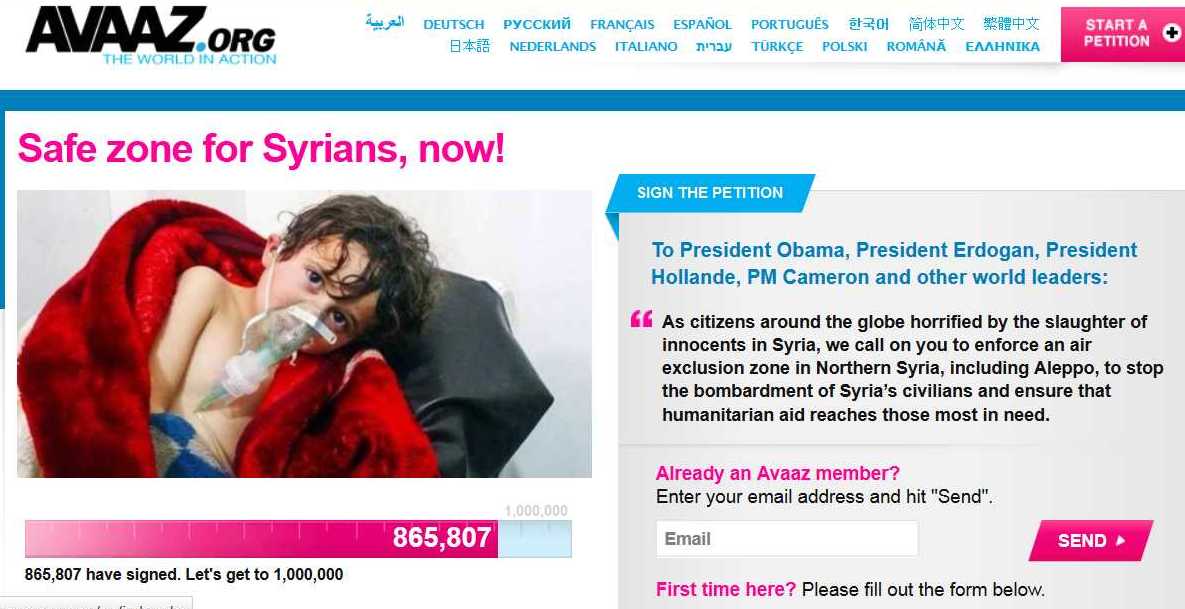 Avaaz Petition for Syria No Fly Zone — 2015 (Syria Campaign Posting)
 Kristoff/New York Times/2011
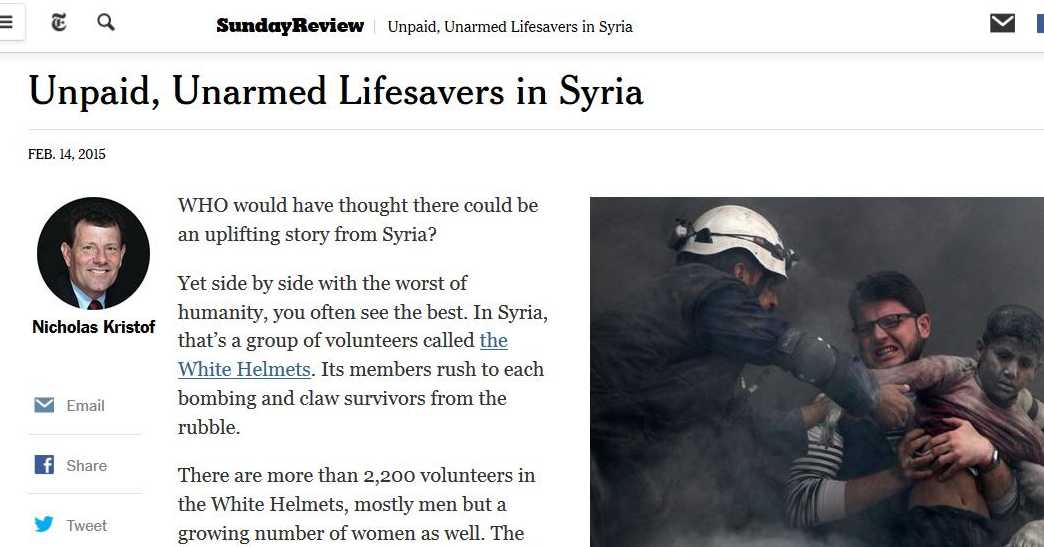 Kristoff/New York Times/2015

 The Real White Helmet Purpose: Propaganda
Who’s Protesting in Brazil and Why?
By Bryan Pitts – NACLA – 04/09/2015
Reading the English-language press these days, one could be forgiven for thinking that Brazil is in the throes of a democratic uprising against a singularly corrupt government, a politically incompetent president, and a floundering economy. Since late last year, the center-left Worker’s Party (PT) government headed by President Dilma Rousseff has been rocked by an ever-widening scandal involving over-inflated contracts and kickbacks to government-allied politicians at the state-owned oil giant Petrobrás. Indignant PT militants—rather than lamenting corruption in a party that once ran on its anti-corruption credentials—have tended to attack the media for highlighting PT corruption after ignoring abuses during the 1995-2002 administration of Fernando Henrique Cardoso, as well as similar scandals in state governments controlled by the opposition Party of Brazilian Social Democracy (PSDB).
In part due to the collapse of Petrobrás’s stock, down 67% since the start of September, the Brazilian currency has plunged nearly 40% against the dollar since then. Inflation over the last year has reached nearly 8%, the highest since 2005, inviting Brazilians to nervously recall the hyperinflation of the 1980s and early 1990s. On March 15, nationwide demonstrations organized on social media gathered anywhere from 300,000 to two million protesters in dozens of cities. They brandished signs saying, “Out with the PT!” and demanded Rousseff’s impeachment, although the one-time head of Petrobrás has not been implicated in the kickback scheme and can constitutionally only be impeached for crimes committed during her presidency. In the wake of the demonstrations, the percentage of Brazilians rating her government as “excellent” or “good” dropped to an abysmal 12%, while 64% rated it “poor” or “terrible.” This disapproval rating is the highest for any president since Fernando Collor de Mello’s 68% on the eve of his own impeachment for corruption in 1992. (Incidentally, Collor, now an opposition senator, is one of 47 politicians currently under investigation for their role in the Petrobrás scandal.)
Foreign media outlets have seized on Rousseff’s supposedly lackluster response to the Petrobrás scandal and Brazil’s gloomy macroeconomic outlook to speculate whether the collapse of the PT’s economic and political model, which has relied on cautiously redistributive policies and moderately increased government involvement in the economy, is imminent. Their sense of hope is palpable: “Brazil’s poor turn their back on Rousseff,” one headline gleefully reported on March 16. Another article insisted that the protests’ “cheerfully democratic multitudes” sought contrition from Rousseff for her party’s graft and economic mismanagement, but that the President had so far ignored their indignation. An opinion piece in a British daily expressed hope that “popular dissatisfaction” would persuade Rousseff to take the steps needed to solve Brazil’s economic problems – a reduced role for state credit agencies, increased independence for Petrobrás and monetary authorities, tax reform, brakes on special interests, and increased openness to foreign trade. The New York Times added an editorial on March 20 blasting Rousseff’s foreign policy, which, it suggested, should draw closer to the United States – despite Eric Snowden’s revelations of NSA spying on Rousseff’s communications.
It’s no secret that most foreign correspondents are neither politically well connected nor fluent in Portuguese. Part of the explanation for their bias, then, comes from their dependence upon Brazil’s notoriously one-sided media, owned by a few elite families and corporate groups. The major newspapers are all staunchly anti-government, their reporting on Rousseff’s administration universally negative. The Globo television network dedicated much of its March 15 programming to recruiting attendees for what it called, “peaceful demonstrations against corruption, with women, the elderly, and children asking for democracy and out with Dilma.” Indeed, the Brazilian and foreign press are engaged in an endless echo chamber of self-validation: foreign journalists get their information from anti-government media outlets, which then breathlessly report the foreign “analysis” in order to invalidate their own bias. For example, a March 21 story in the Folha de S. Paulo and Veja reported favorably on the New York Times’ foreign policy editorial. If foreigners say it, it must be true.
Perhaps the most notorious recent example of press bias occurred when Brian Winter, Reuters’ chief Brazil correspondent, interviewed Fernando Henrique Cardoso. Published in Portuguese by Reuters Brasil, the story contained a paragraph admitting that one of the Petrobrás officials involved in the corruption scheme claims that it dated to Cardoso’s administration. The paragraph was followed by a parenthetical note, apparently penned by one of the Brazilian editors, that accidentally remained undeleted: “We can take this part out if you want.” To his credit, Winter didn’t remove the paragraph, but the gaffe shows the inner-workings of the Brazilian branch of an American media outlet, where protecting the opposition and attacking the PT trumps even a casual relationship with the truth. Although the article was hastily corrected (without any indication that it had been modified), it was too late: attentive readers had already posted the gaffe to Twitter, under the hashtag #PodemosTirarSeAcharMelhor.
Amidst predictions of Rousseff’s demise, the mainstream media has consistently downplayed, and occasionally outright ignored, one fact: the social backgrounds of protesters. It is not “the Brazilian people” who are in the streets, but rather a very specific segment of the population whose economic interests are historically opposed to those of the majority. They are largely middle and upper class and, consequently, mainly white. In the 2014 elections they sensed that their time had come to get rid of the PT, only to see their favored candidate, former Minas Gerais PSDB governor Aécio Neves, lose in Brazil’s closest-ever presidential contest. Despite the very real and serious flaws of the current government, this discontent with the PT finds its true source in centuries of elite fear of popular mobilization and a deep resentment of the gains working class people have made since Lula took office in 2003.
Of course, if one asks the demonstrators in the streets why they are protesting, no one will say that it’s because the poor aren’t as poor anymore. Indeed, 44% of demonstrators in Porto Alegre told pollsters that they were attending to speak out against corruption. And, responding to a question that permitted multiple answers, 58% indicated that their greatest disappointment lies with the political class overall, as compared to 44% that identified the PT and 29% Rousseff. A further 78% argued that political parties, including the opposition, should have no role in their movement. Could it be the case that the demonstrations were, in fact, overwhelmingly democratic and targeted primarily at corruption? Several clues indicate that this is not the case.
Although they represented a small minority of demonstrators, a vocal contingent was not satisfied with calls for impeachment. In a chilling scene for those who remember the repression unleashed during Brazil’s 1964-1985 military dictatorship, protesters carried signs emblazoned with slogans like “Military intervention now” and “SOS Armed Forces.” A banner in Rio de Janeiro featured a swastika and read, “Armed Forces, liberate Brazil.” Another read (in English), “Army, Navy, and Air Force. Please save us once again of [sic] communism.” “The best communist is a dead communist. Dilma, Maduro, Hugo, Fidel, Cristina, Lula: the world’s garbage.” Their signs were eerily reminiscent of the media’s enthusiastic response to Brazil’s 1964 coup, when the country’s press overwhelmingly cheered the military’s ouster of João Goulart—another mildly-leftist, so-called “communist” president—as a victory for democracy.
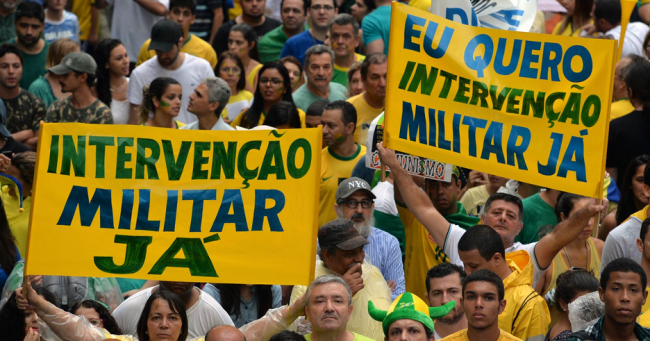
Protesters in São Paulo Plead for a Military Coup, March 15, 2015 (Source: Nelson Almeida / AFP)
In response to the pleas for military intervention, a spokesman for Revoltados ON LINE, a grassroots group that helped organize the protests and has 750,000 Facebook likes, commented, “The people asking for [military] intervention want to remove the PT from power. That is the sole focus. The participation of a variety of groups strengthens the group as a whole.” Though a military coup still looks unlikely, it is widely known that many in the military are incensed with the Rousseff administration over the final report of the National Truth Commission, which blasted the armed forces for torture and disappearances during its rule.
If those waxing nostalgic for dictatorships of yore were in the minority, what of the rest of the protesters? Despite attempts to highlight the supposed multi-class composition of the crowds on March 15, they represented, above all, Brazil’s white, university-educated economic elite. As Gianpaolo Baiocchi and Marcelo K. Silva recently pointed out, in Porto Alegre, nearly 70% of protesters were college-educated, in contrast with 11% of the general population, while over 40% belonged to the top income brackets, which make up but 3% of the population. Photographs confirm this; in a country with a high correlation between skin color and economic class, where over half of the population identifies as black or brown, the crowds had a decidedly lighter hue. A viral Tumblr account poked fun at the similarities with the upper-class, yellow-and-green-clad crowds that attended pricey World Cup matches last year by challenging visitors to determine if the photographs posted came from a March 15 demonstration or the World Cup.
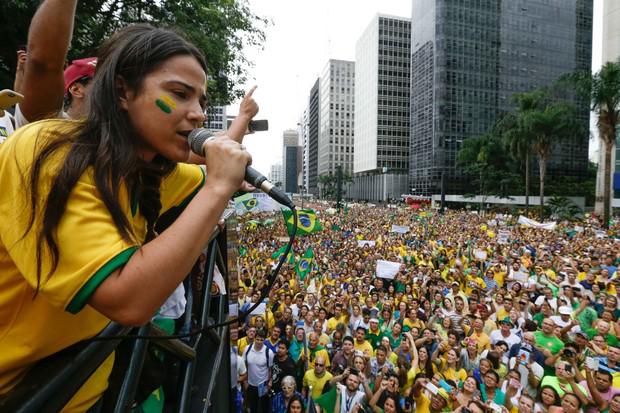
Singer Wanessa Camargo performs the National Anthem for a largely white crowd in São Paulo, March 15, 2015 (Source: Vanessa Carvalho / BPP / AGNEWS)
Of course, the fact that the demonstrations largely consisted of white middle- and upper-class Brazilians does not automatically mean that they were anti-democratic. At the same time, it would be a grave mistake to interpret the class composition of the crowds outside the context of Brazil’s historic inequalities of class, race, and region. What does it mean if the majority of demonstrators demanding the ouster of a moderately redistributive center-left party come from the social classes and regions that have least benefited from its policies? What problems do they see with corruption, the PT, or Rousseff that are insufficient to motivate the working classes or people from the impoverished Northeast of the country to take to the streets?
Since the colonial period, political and economic power has been wielded by a tiny European-descended elite, and since the collapse of the Northeastern plantation sugar economy in the nineteenth century, economic power has been concentrated in the Southeast and South, especially in the coffee and industrial powerhouse of São Paulo—today the epicenter of the opposition. An influx of European immigration in the late nineteenth and early twentieth centuries only heightened the disdain light-skinned, prosperous Southeasterners felt for their mixed-race Northeastern and Northern countrymen and women, and after the 1950s, that prejudice was turned against Northeastern migrants who came to work in the region’s expanding industries. Brazil’s middle class of government bureaucrats, small business owners, and professionals, tied to the landowning and industrial elite by socialization and patronage, has in turn largely identified with elite interests. Whenever Brazilian leaders, be they the populist dictator and later elected president Getúlio Vargas (1930-1945, 1950-1954), or the left-leaning would-be reformer João Goulart (1961-1964), have proposed reforms that would decrease inequality and broaden political representation, they have been ousted by an indignant elite and middle class – at precisely the moments when the minimum wage was growing the fastest.
The leveling results of the last 12 years are striking, if still far short of what Brazil needs to comprehensively address income inequality. In January 2003, the Inter-union Department of Socioeconomic Statistics and Studies (DIEESE) calculated that in order to provide a living wage, the minimum wage should be 6.93 times what it actually was; by February 2015, the ratio had fallen to 4.03. The unemployment rate when Lula took office was 11.2%; today, it is 5.9% (though it has risen from 4.4% in November 2014). At the same time, the gains were not evenly spread out; between 2001 and 2013, the income of the poorest 10% of the population grew at nearly three times the rate of that of the richest 10%. The result was a Gini coefficient that, while still among the highest in the world at 0.527 in 2012, reached its lowest level since 1960. In sum, then, though economic growth between 2003 and 2014 benefited the whole population, it benefited the poor and working class the most, largely as a result of real increases in the minimum wage. As economist Luiz Carlos Bresser Pereira, a cabinet minister under Cardoso, put it, “This hatred [against the PT] is a result of the fact that the government revealed a strong and clear preference for workers and the poor.”
The persistence of prejudice against the poor and Northeasterners manifested itself most clearly on social media in the wake of the 2014 elections—when the Northeast voted overwhelmingly for Rousseff. “These Northeastern sons of bitches need to die in a drought; good-for-nothings, sucking on the government’s teat, ignorant sons of bitches,” read one tweet. “Northeasterners don’t have a brain, they have no culture; it’s the slum of Brazil,” read another. Even former president Cardoso, a one-time leftist sociologist and champion of the struggle against the military dictatorship, grumbled, “The PT relies on the least informed, who happen to be the poorest.” Much like in the United States, in the wake of government efforts to reduce inequality, the wealthy and middle class have reacted with racially inflected charges of laziness, dependency, and ignorance. And so far it has largely been the same social groups who voted for Neves and blasted Northeasterners who have been participating in the demonstrations against Rousseff.
If the March 15 demonstrations expressed the concerns of the middle class and elite, what are the implications for Rousseff’s government? First, despite Rousseff’s dismal approval ratings, the PT’s base of support in the working class and poor is not ready to abandon it. The PT has retained their support through policies like the wildly popular conditional cash transfer program Bolsa Família, the expansion of the federal university system, and race and class-based quotas in college admissions that have yielded tangible improvements in their daily lives. Unless the economy deteriorates to the point where the working class and poor join the demonstrations – and even Brazil’s small leftist press admits that this is not impossible – it’s hard to imagine the protests gaining further traction. Second, despite the common class interests of the demonstrators, a message decrying working class gains is not politically feasible. In the absence of this message, which in fact is the real motivator of the protests, the demonstrators are left in the tenuous position of calling for the ouster of the PT through a legally invalid impeachment, with no agreement at all about, or what should, happen afterwards.
The same groups that organized the March 15 demonstrations are planning another round for April 12. Will they attract working class support? What developments in the Petrobrás scandal might affect their success? Will calls for military intervention become more prominent or fade into the background? One thing remains certain: In the absence of a mass working-class defection from the PT, proof of crimes justifying impeachment, or military interest in a coup, the prospects for a change in government are remote. Yet this is unlikely to dampen the hopes of wealthy and highly educated protesters, who will continue to use corruption as an excuse to protest against the socioeconomic ascension of those they see as their inferiors. As sociologist Jesse de Souza pointedly explains, “What distinguishes Brazil from the United States, Germany, and France, who we admire so much,” isn’t the level of corruption, “but the fact that we accept maintaining a third of the population in subhuman conditions.” The PT governments of the last 12 years made progress toward improving those conditions, but in the process they threatened the Brazilian elite’s deeply ingrained sense of superiority. Whether conscious or not, class and regional prejudice—not corruption—is the driving force behind the demonstrations.
Bryan Pitts is visiting assistant professor of History at Duke University and a Fulbright Scholars postdoctoral fellow at the Instituto de Ciência Política of the Universidade de Brasília (UnB).
Featured Video

Iran’s Next Strike May Not Explode. It Could Shut You Down
or go to
Aletho News Archives – Video-Images
Book Review
New paperback: Butchered by “Healthcare”
Lies are Unbekoming | October 20, 2026
 Butchered by “Healthcare” is Robert Yoho’s plain-spoken account of how American medicine stopped being a profession and became an industry. 341 pages. Over a thousand references. Thirty-eight chapters.
“Screening Tests Are Useless”, on tests that find diseases that would never have hurt you. “The FDA Protects the Big Drug Companies”, on an agency funded by the companies it regulates. “The Journals’ Sins Are the Editors’ Sins”, on ghostwritten studies and captured peer review. “Opioids and ‘Pain Management’”, on how a generation was prescribed its way into addiction. “Prozac and Relatives” and “Antipsychotics Are Disastrous”, on what psychiatry does to adults and children. “Surgery: Money Before Patients”. “Failed Cancer Treatments”. “Futile CPR and Overprescribing”. “Billing Scams & Specialty Warfare”. “Hospitals Are Sharks”. Each with a Patient Tips section at the end on how to survive it.
If you have ever walked out of a doctor’s office with a prescription you didn’t ask for, or watched a parent put through a treatment that made them worse, this is the book you want on your shelf before the next appointment. … Full review
Butchered by “Healthcare” is available on Lulu now.
Blog Roll
 Aletho News
- Iran’s Next Strike May Not Explode. It Could Shut You Down /Col Doug Macgregor
- Iran: US political targets legitimate if assassinations return
- Iraq shuts key border crossing with Iran under US pressure: Report
- Undersea Internet cables could be targeted in retaliation for attacks on Iran: IRGC deputy chief
- EU sending ‘biased’ observers to interfere in Serbian election – president
- White House envoy declares kinetic action against Yemen ‘fruitless’
- Ukraine deployed thousands of microdrones in Iraqi Kurdistan: Tasnim
- Iran calls for emergency UNSC meeting over Trump’s ‘brazen’ bomb talk, Israeli threats
- Iranian sources reveal details of Russia-China Hormuz proposal
- Plan for more US-Israel integration puts our military tech at risk
- If Americans Knew
- Americans at National Conservatism Conference held in Israel this year criticize Israel
- Christiane Amanpour exits CNN with a legacy shaped by the debate over Israel
- Israel’s war on Iran is the final move in a decades-old strategy
- Israel Denies Entry to French Journalist, U.S. Researcher Amid Rise in Entry Denials
- Gaza’s hospitals are running out of life-saving fuel – Daily Update
- Mysterious bot accounts reportedly spread fake ‘man on the street’ videos for Michigan Senate candidate
- Israeli Defense Minister Katz Says Over 60 Lebanon Villages Have Been Destroyed
- Why Is Israel Running TV Ads in Iowa Ahead of the Midterms?
- Hind Rajab’s Alleged Killer Is in the United States. HRF Demands His Arrest.
- US Officials Face Fresh Pressure After Another American ‘Brutalized’ by Israeli Settlers in West Bank
- No Tricks Zone
- E-Cars Reduce CO2 Emissions By Only 41% Compared To Internal Combustion Engine Vehicles
- Predictions Made By Renowned Climate Professor Over Past Decades Have Been Proven To Be Poor
- New Study Suggests Large Regions Of The Pacific Ocean Have Been Cooling For The Last 80 Years
- Germany’s Green Energy Debacle: High Energy Costs Force Kahla Porzellan to Close After 182 Years!
- New Study: 50 Years Of The Most Aggressive ‘Net Zero’ Policies Can Only Affect The Global Climate By 0.03°C
- US September “Heat” Was No Record…Many Records Set Decades Ago
- Latest European Green Energy Debacle; Portugal’s Largest Flagship Solar Park Insolvent!
- Green Energy Debacle: German Expert Professor Fritz Vahrenholt Warns Of Severe Economic And Social Consequences
- Two More Paleo Reconstructions Affirm Meters-Higher Sea Levels Across Ireland, Brazil 7000-6000 Years Ago
- New Study: Earth And Venus Surface Warmth Largely Explained By Convection And Lapse Rate, Not CO2 Or Radiation

