Nuland’s Mastery of Ukraine Propaganda
By Robert Parry | Consortium News | March 11, 2015
An early skill learned by Official Washington’s neoconservatives, when they were cutting their teeth inside the U.S. government in the 1980s, was how to frame their arguments in the most propagandistic way, so anyone who dared to disagree with any aspect of the presentation seemed unpatriotic or crazy.
During my years at The Associated Press and Newsweek, I dealt with a number of now prominent neocons who were just starting out and mastering these techniques at the knee of top CIA psychological warfare specialist Walter Raymond Jr., who had been transferred to President Ronald Reagan’s National Security Council staff where Raymond oversaw inter-agency task forces that pushed Reagan’s hard-line agenda in Central America and elsewhere. [See Consortiumnews.com’s “The Victory of ‘Perception Management.’”]
One of those quick learners was Robert Kagan, who was then a protégé of Assistant Secretary of State Elliott Abrams. Kagan got his first big chance when he became director of the State Department’s public diplomacy office for Latin America, a key outlet for Raymond’s propaganda schemes.
Though always personable in his dealings with me, Kagan grew frustrated when I wouldn’t swallow the propaganda that I was being fed. At one point, Kagan warned me that I might have to be “controversialized,” i.e. targeted for public attack by Reagan’s right-wing media allies and anti-journalism attack groups, like Accuracy in Media, a process that did indeed occur.
Years later, Kagan emerged as one of America’s top neocons, a co-founder of the Project for the New American Century, which opened in 1998 to advocate for the U.S. invasion of Iraq, ultimately gaining the backing of a large swath of the U.S. national security establishment in support of that bloody endeavor.
Despite the Iraq disaster, Kagan continued to rise in influence, now a senior fellow at the Brookings Institution, a columnist at the Washington Post, and someone whose published criticism so alarmed President Barack Obama last year that he invited Kagan to a White House lunch. [See Consortiumnews.com’s “Obama’s True Foreign Policy Weakness.”]
Kagan’s Wife’s Coup
But Kagan is perhaps best known these days as the husband of neocon Assistant Secretary of State for European Affairs Victoria Nuland, one of Vice President Dick Cheney’s former advisers and a key architect of last year’s coup in Ukraine, a “regime change” that toppled an elected president and touched off a civil war, which now has become a proxy fight involving nuclear-armed United States and Russia.
In an interview last year with the New York Times, Nuland indicated that she shared her husband’s criticism of President Obama for his hesitancy to use American power more assertively. Referring to Kagan’s public attacks on Obama’s more restrained “realist” foreign policy, Nuland said, “suffice to say … that nothing goes out of the house that I don’t think is worthy of his talents. Let’s put it that way.”
But Nuland also seems to have mastered her husband’s skill with propaganda, presenting an extreme version of the situation in Ukraine, such that no one would dare quibble with the details. In prepared testimony to the House Foreign Affairs Committee last week, Nuland even slipped in an accusation blaming Russia for the July 17 shoot-down of Malaysia Airlines Flight 17 though the U.S. government has not presented any proof.
Nuland testified, “In eastern Ukraine, Russia and its separatist puppets unleashed unspeakable violence and pillage; MH-17 was shot down.”
Now, it’s true that if one parses Nuland’s testimony, she’s not exactly saying the Russians or the ethnic Russian rebels in eastern Ukraine shot down the plane. There is a semi-colon between the “unspeakable violence and pillage” and the passive verb structure “MH-17 was shot down.” But anyone seeing her testimony would have understood that the Russians and their “puppets” shot down the plane, killing all 298 people onboard.
When I submitted a formal query to the State Department asking if Nuland’s testimony meant that the U.S. government had developed new evidence that the rebels shot down the plane and that the Russians shared complicity, I received no answer.
Perhaps significantly or perhaps not, Nuland presented similarly phrased testimony to the Senate Foreign Relations Committee on Tuesday but made no reference to MH-17. So, I submitted a new inquiry asking whether the omission reflected second thoughts by Nuland about making the claim before the House. Again, I have not received a reply.
However, both of Nuland’s appearances place all the blame for the chaos in Ukraine on Russia, including the 6,000 or more deaths. Nuland offered not a single word of self-criticism about how she contributed to these violent events by encouraging last year’s coup, nor did she express the slightest concern about the actions of the coup regime in Kiev, including its dispatch of neo-Nazi militias to carry out “anti-terrorist” and “death squad” operations against ethnic Russians in eastern Ukraine. [See Consortiumnews.com’s “Nuclear War and Clashing Ukraine Narratives.”]
Russia’s Fault
Everything was Russia’s fault – or as Nuland phrased it: “This manufactured conflict — controlled by the Kremlin; fueled by Russian tanks and heavy weapons; financed at Russian taxpayers’ expense — has cost the lives of more than 6,000 Ukrainians, but also of hundreds of young Russians sent to fight and die there by the Kremlin, in a war their government denies.”
Nuland was doing her husband proud. As every good propagandist knows, you don’t present events with any gray areas; your side is always perfect and the other side is the epitome of evil. And, today, Nuland faces almost no risk that some mainstream journalist will dare contradict this black-and-white storyline; they simply parrot it.
Besides heaping all the blame on the Russians, Nuland cited – in her Senate testimony – some of the new “reforms” that the Kiev authorities have just implemented as they build a “free-market state.” She said, “They made tough choices to reduce and cap pension benefits, increase work requirements and phase in a higher retirement age; … they passed laws cutting wasteful gas subsidies.”
In other words, many of the “free-market reforms” are aimed at making the hard lives of average Ukrainians even harder – by cutting pensions, removing work protections, forcing people to work into their old age and making them pay more for heat during the winter.
Nuland also hailed some of the regime’s stated commitments to fighting corruption. But Kiev seems to have simply installed a new cast of bureaucrats looking to enrich themselves. For instance, Ukraine’s Finance Minister Natalie Jaresko is an expatriate American who – before becoming an instant Ukrainian citizen last December – ran a U.S. taxpayer-financed investment fund for Ukraine that was drained of money as she engaged in lucrative insider deals, which she has fought to keep secret. [See Consortiumnews.com’s “Ukraine’s Finance Minister’s American ‘Values.’”]
Yet, none of these concerns were mentioned in Nuland’s propagandistic testimony to the House and Senate – not that any of the committee members or the mainstream press corps seemed to care that they were being spun and even misled. The hearings were mostly opportunities for members of Congress to engage in chest-beating as they demanded that President Obama send U.S. arms to Ukraine for a hot war with Russia.
Regarding the MH-17 disaster, one reason that I was inquisitive about Nuland’s insinuation in her House testimony that the Russians and the ethnic Russian rebels were responsible was that some U.S. intelligence analysts have reached a contrary conclusion, according to a source briefed on their findings. According to that information, the analysts found no proof that the Russians had delivered a BUK anti-aircraft system to the rebels and concluded that the attack was apparently carried out by a rogue element of the Ukrainian military.
After I published that account last summer, the Obama administration went silent about the MH-17 shoot-down, letting stand some initial speculation that had blamed the Russians and the rebels. In the nearly eight months since the tragedy, the U.S. government has failed to make public any intelligence information on the crash. [See Consortiumnews.com’s “The Danger of an MH-17 ‘Cold Case.’”]
So, Nuland may have been a bit duplicitous when she phrased her testimony so that anyone hearing it would jump to the conclusion that the Russians and the rebels were to blame. It’s true she didn’t exactly say so but she surely knew what impression she was leaving.
In that, Nuland appears to have taken a page from the playbook of her husband’s old mentor, Elliott Abrams, who provided misleading testimony to Congress on the Iran-Contra Affair in the 1980s – and even though he was convicted of that offense, Abrams was pardoned by President George H.W. Bush and thus was able to return to government last decade to oversee the selling of the Iraq War.
~
Investigative reporter Robert Parry broke many of the Iran-Contra stories for The Associated Press and Newsweek in the 1980s. You can buy his latest book, America’s Stolen Narrative, either in print here or as an e-book (from Amazon and barnesandnoble.com).
Israeli op-ed writer calls on Israel to nuke Germany, Iran
Non-Aligned Media | March 11, 2015
The Times of Israel reports that an Israeli op-ed writer has advocated the nuclear annihilation of both Iran and Germany.
In an article written in Hebrew for Israel National News, Chen Ben-Eliyahu advocates the use of 20 or 30 nuclear bombs against Germany in revenge for the holocaust and also against Iran which the author suggests is an existential threat to Israel.
“Twenty, thirty atomic bombs on Berlin, Munich, Hamburg, Nuremberg, Cologne, Frankfurt, Stuttgart, Dresden, Dortmund and so on to assure the job gets done. And the land will be quiet for a thousand years,” he wrote.
“To an existential threat we must respond with an existential threat,” he wrote, “not with speeches in Congress. We must make it clear to the Iranians that Israel will wipe out their nuclear program and Tehran and Isfahan as well.”
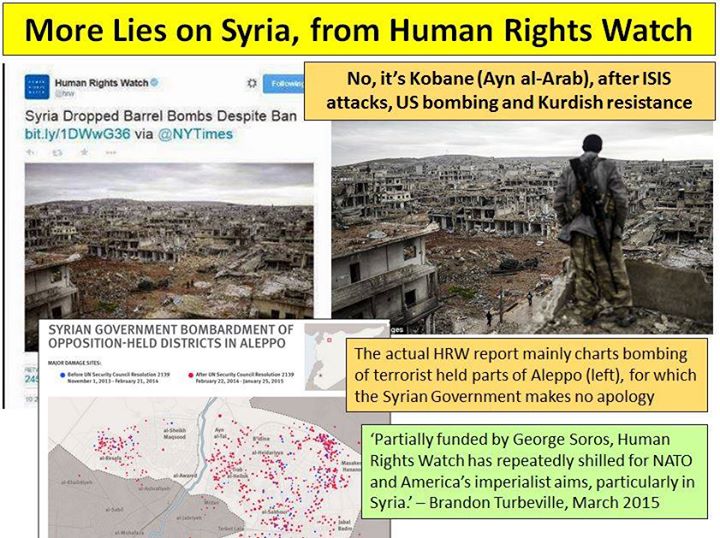
Human Rights Watch FAIL: Uses Photo of American Bombing Destruction To Condemn Assad
Activist Post | March 9, 2015
Putting its hypocritical and biased nature on full display once again, the alleged human rights organization, Human Rights Watch, was recently caught in an attempt to fabricate “evidence” of Assad’s use of barrel bombs in civilian areas for the purposes of further demonizing the secular Syrian government.
On February 25, HRW posted a photo of a devastated civilian area in Syria with the tagline “Syria dropped barrel bombs despite ban.” The “ban” HRW is referring to is the ban on bombing civilian areas that applies to both sides in Aleppo after the United Nations stepped in to save the Western-backed terrorists from annihilation. Assad’s forces had surrounded the city and had cut off a major supply route for the death squads from Turkey thus making the ultimate elimination of the jihadist forces a virtual inevitability.
As Somini Sengupta wrote for the New York Times on February 24,
Human Rights Watch said Tuesday that the Syrian government had dropped so-called barrel bombs on hundreds of sites in rebel-held towns and cities in the past year, flouting a United Nations Security Council measure.
In a report released Tuesday, the group said it relied on satellite images, photos, videos and witness statements to conclude that the Syrian government had bombarded at least 450 sites in and around the southern town of Daraa and at least 1,000 sites in Aleppo in the north.
The report focused on the period since Feb. 22, 2014, when the Security Council specifically condemned the use of barrel bombs, which are large containers filled with explosives and projectiles that can indiscriminately hurt civilians and are prohibited under international law.
There was only one problem with HRW’s tweet – the photograph the organization provided was not Aleppo.
In fact, the damage that had been wrought upon the civilian area in the photograph was not committed by the Syrian military but by the United States.
The photo was actually a picture of Kobane (Ayn al-Arab), the city which has been the site of heavy US aerial bombardment over the last several months as the US engages in its program of death squad herding and geographical reformation of sovereign Syrian and Iraqi territory.
But, while HRW was content to use the destruction of the city as a reason to condemn the Assad government and continue to promote the cause for US military action in Syria, the “human rights organization” was apparently much less interested in the exact same destruction wrought by US forces.
In other words, if Assad’s forces bomb a civilian area into the stone age, it is an atrocity, a war crime, and justification for international military involvement. If the United States bombs a civilian area into the stone age, it’s no biggie.
Partially funded by George Soros, Human Rights Watch has repeatedly shilled for NATO and America’s imperialist aims, particularly in Syria.
For instance, when Western media propaganda had reached a crescendo regarding the outright lie that Assad had used chemical weapons against his own people, HRW stood right beside Barack Obama and John Kerry in their effort to prove Assad’s guilt. HRW even went so far as to repeat the lie that the UN report suggested that Assad was the offending party, driving the final nail into the coffin of any credibility HRW may have had.
When a last-minute chemical weapons deal was secured by Russia in an effort to avoid yet another US/NATO invasion of Syria, HRW did not rejoice for the opportunity of peaceful destruction of chemical weapons and a chance to avoid war, it attacked the deal by claiming that it “failed to ensure justice.” Of course, the deal did fail to ensure justice. There were no provisions demanding punishment of the death squads who actually used the weapons or the US/NATO apparatus that initiated and controlled the jihadist invasion to begin with.
Regardless, when Mother Agnes Mariam of the Cross released her report that refuted what the US/NATO was asserting in regards to chemical weapons in Syria, HRW embarked upon a campaign of attack against her and her work.
Even as far back as 2009, however, HRW was showing its true colors when it apparently signed off on and supported renditions – the process of kidnapping individuals off the street without any due process and “rendering” them to jails and prisons in other countries where they are often tortured – in secret talks with the Obama administration.
If HRW ever had any credibility in terms of the question of actual human rights, then all of that credibility has assuredly been lost. HRW is nothing more than a pro-US, pro-NATO NGO that acts as a smokescreen for the continuation of the violation of human rights across the world – that is, unless those violations are committed by America’s enemies.
Washington and ISIS: The Evidence

By Tim Anderson | teleSUR | March 8, 2015
Reports that US and British aircraft carrying arms to the Islamic State group – better known as ISIS – have been shot down by Iraqi forces have been met with shock and denial in western countries. Few in the Middle East doubt that Washington is playing a ‘double game’ with its proxy armies in Syria, but some key myths remain important amongst the significantly more ignorant Western audiences.
A central myth is that Washington now arms ‘moderate Syrian rebels’, to both overthrow the Syrian Government and supposedly defeat the ‘extremist rebels’. This claim became more important in 2014, when the rationale of US aggression against Syria shifted from ‘humanitarian intervention’ to a renewal of Bush’s ‘war on terror’.
A distinct controversy is whether the al-Qaida-styled groups (especially Jabhat al-Nusra and ISIS) have been generated as a sort of organic reaction to the repeated US interventions, or whether they are actually paid agents of Washington.
Certainly, prominent ISIS leaders were held in US prisons. ISIS leader, Ibrahim al-Badri (aka Abu Bakr al-Baghdadi) is said to have been held for between one and two years at Camp Bucca in Iraq. In 2006, as al-Baghdadi and others were released, the Bush administration announced its plan for a ‘New Middle East’, a plan which would employ sectarian violence as part of a process of ‘creative destruction’ in the region.
According to Seymour Hersh’s 2007 article, ‘The Redirection’, the US would make use of ‘moderate Sunni states’, not least the Saudis, to ‘contain’ the Shia gains in Iraq brought about by the 2003 US invasion. These ‘moderate Sunni’ forces would carry out clandestine operations to weaken Iran and Hezbollah, key enemies of Israel. This brought the Saudis and Israel closer, as both fear Iran.
While there have been claims that the ISIS ‘caliph’ al-Baghdadi is a CIA or Mossad trained agent, these have not yet been well backed up. There are certainly grounds for suspicion, but independent evidence is important, in the context of a supposed US ‘war’ against ISIS. So what is the broader evidence on Washington’s covert links with ISIS?
Not least are the admissions by senior US officials that key allies support the extremist group. In September 2014 General Martin Dempsey, head of the US military, told a Congressional hearing ‘I know major Arab allies who fund [ISIS]’. Senator Lindsey Graham, of Armed Services Committee, responded with a justification, ‘They fund them because the Free Syrian Army couldn’t fight [Syrian President] Assad, they were trying to beat Assad’.
The next month, US Vice President Joe Biden went a step further, explaining that Turkey, Qatar, the UAE and Saudi Arabia ‘were so determined to take down Assad … they poured hundreds of millions of dollars and tens, thousands of tons of weapons into anyone who would fight against Assad … [including] al-Nusra and al- Qaida and extremist elements of jihadis coming from other parts of the world … [and then] this outfit called ISIL’. Biden’s admissions sought to exempt the US from this operation, as though Washington were innocent of sustained operations carried out by its key allies. That is simply not credible.
Washington’s relationship with the Saudis, as a divisive sectarian force in the region, in particular against Arab nationalism, goes back to the 1950s, when Winston Churchill introduced the Saudi King to President Eisenhower. At that time Washington wanted to set up the Saudi King as a rival to President Nasser of Egypt. More recently, British General Jonathan Shaw has acknowledged the contribution of Saudi Arabia’s extremist ideology: ‘This is a time bomb that, under the guise of education. Wahhabi Salafism is igniting under the world really. And it is funded by Saudi and Qatari money’, Shaw said.
Other evidence undermines western attempts to maintain a distinction between the ‘moderate rebels’, now openly armed and trained by the US, and the extremist groups Jabhat al-Nusra and ISIS. While there has indeed been some rivalry (emphasised by the London-based, Muslim Brotherhood-aligned, Syrian Observatory of Human Rights), the absence of real ideological difference is best shown by the cooperation and mergers of groups.
As ISIS came from Iraq in 2013, its Syrian bases have generally remained in the far eastern part of Syria. However Jabhat al-Nusra (the official al-Qaida branch in Syria, from which ISIS split) has collaborated with Syrian Islamist groups in western Syria for several years. The genocidal slogan of the Syrian Islamists, ‘Christians to Beirut and Alawis to the Grave’, reported many times in 2011 from the Farouk Brigade, sat well with the al-Qaida groups. Farouk (once the largest ‘Free Syrian Army’ group) indeed killed and ethnically cleansed many Christians and Alawis.
Long term cooperation between these ‘moderate rebels’ and the foreign-led Jabhat al-Nusra has been seen around Daraa in the south, in Homs-Idlib, along the Turkish border and in and around Aleppo. The words Jabhat al-Nusra actually mean ‘support front’, that is, support for the Syrian Islamists. Back in December 2012, as Jabhat al-Nusra was banned in various countries, 29 of these groups reciprocated the solidarity in their declaration: ‘We are all Jabhat al-Nusra’.
After the collapse of the ‘Free Syrian Army’ groups, cooperation between al-Nusra and the newer US and Saudi backed groups (Dawud, the Islamic Front, the Syrian Revolutionary Front and Harakat Hazm) helped draw attention to Israel’s support for al-Nusra, around the occupied Golan Heights. Since 2013 there have been many reports of ‘rebel’ fighters, including those from al-Nusra, being treated in Israeli hospitals. Prime Minister Netanyahu even publicised his visit to wounded ‘rebels’ in early 2014. That led to a public ‘thank you’ from a Turkey-based ‘rebel’ leader, Mohammed Badie (February 2014).
The UN peacekeeping force based in the occupied Golan has reported its observations of Israel’s Defence Forces ‘interacting with’ al-Nusra fighters at the border. At the same time, Israeli arms have been found with the extremist groups, in both Syria and Iraq. In November 2014 members of the Druze minority in the Golan protested against Israel’s hospital support for al-Nusra and ISIS fighters. This in turn led to questions by the Israeli media, as to whether ‘Israel does, in fact, hospitalize members of al-Nusra and Daesh [ISIS]’. A military spokesman’s reply was hardly a denial: ‘In the past two years the Israel Defence Forces have been engaged in humanitarian, life-saving aid to wounded Syrians, irrespective of their identity.’
The artificial distinction between ‘rebel’ and ‘extremist’ groups is mocked by multiple reports of large scale defections and transfer of weapons. In July 2014 one thousand armed men in the Dawud Brigade defected to ISIS in Raqqa. In November defections to Jabhat al-Nusra from the Syrian Revolutionary Front were reported. In December, Adib Al-Shishakli, representative at the Gulf Cooperation Council of the exile ‘ Syrian National Coalition’, said ‘opposition fighters’ were ‘increasingly joining’ ISIS ‘for financial reasons’. In that same month, ‘rebels’ in the Israel-backed Golan area were reported as defecting to ISIS, which had by this time began to establish a presence in Syria’s far south. Then, in early 2015, three thousand ‘moderate rebels’ from the US-backed ‘Harakat Hazzm’ collapsed into Jabhat al-Nusra, taking a large stock of US arms including anti-tank weapons with them.
ISIS already had US weapons by other means, in both Iraq and Syria, as reported in July, September and October 2014. At that time a ‘non aggression pact’ was reported in the southern area of Hajar al-Aswad between ‘moderate rebels’ and ISIS, as both recognised a common enemy in Syria: ‘the Nussayri regime’, a sectarian way of referring to supposedly apostate Muslims. Some reported ISIS had bought weapons from the ‘rebels’.
In December 2014, there were western media reports of the US covert supply of heavy weapons to ‘Syrian rebels’ from Libya, and of Jabhat al-Nusra getting anti-tank weapons which had been supplied to Harakat Hazm. Video posted by al-Nusra showed these weapons being used to take over the Syrian military bases, Wadi Deif and Hamidiyeh, in Idlib province.
With ‘major Arab allies’ backing ISIS and substantial collaboration between US-armed ‘moderate rebels’ and ISIS, it is not such a logical stretch to suppose that the US and ‘coalition’ flights to ISIS areas (supposedly to ‘degrade’ the extremists) might have become covert supply lines. That is precisely what senior Iraqi sources began saying, in late 2014 and early 2015.
For example, as reported by both Iraqi and Iranian media, Iraqi MP Majid al-Ghraoui said in January that ‘an American aircraft dropped a load of weapons and equipment to the ISIS group militants at the area of al-Dour in the province of Salahuddin’. Photos were published of ISIS retrieving the weapons. The US admitted the seizure but said this was a ‘mistake’. In February Iraqi MP Hakem al-Zameli said the Iraqi army had shot down two British planes which were carrying weapons to ISIS in al-Anbar province. Again, photos were published of the wrecked planes. ‘We have discovered weapons made in the US, European countries and Israel from the areas liberated from ISIL’s control in Al-Baqdadi region’, al-Zameli said.
The Al-Ahad news website quoted Head of Al-Anbar Provincial Council Khalaf Tarmouz saying that a US plane supplied the ISIL terrorist organization with arms and ammunition in Salahuddin province. Also in February an Iraqi militia called Al-Hashad Al-Shabi said they had shot down a US Army helicopter carrying weapons for the ISIL in the western parts of Al-Baqdadi region in Al-Anbar province. Again, photos were published. After that, Iraqi counter-terrorism forces were reported as having arrested ‘four foreigners who were employed as military advisers to the ISIL fighters’, three of whom were American and Israeli. So far the western media has avoided these stories altogether; they are very damaging to the broader western narrative.
In Libya, a key US collaborator in the overthrow of the Gaddafi government has announced himself the newly declared head of the ‘Islamic State’ in North Africa. Abdel Hakim Belhaj was held in US prisons for several years, then ‘rendered’ to Gaddafi’s Libya, where he was wanted for terrorist acts. As former head of the al-Qaida-linked Libyan Islamic Fighting Group, then the Tripoli-based ‘Libyan Dawn’ group, Belhaj has been defended by Washington and praised by US Congressmen John McCain and Lindsey Graham.
Some image softening of the al-Qaida groups is underway. Jabhat al-Nusra is reported to be considering cutting ties to al-Qaida, to help sponsor Qatar boost their funding. Washington’s Foreign Affairs magazine even published a survey claiming that ISIS fighters were ‘surprisingly supportive of democracy’. After all the well published massacres that lacks credibility.
The Syrian Army is gradually reclaiming Aleppo, despite the hostile supply lines from Turkey, and southern Syria, in face of support for the sectarian groups from Jordan and Israel. The border with Lebanon is largely under Syrian Army and Hezbollah control. In the east, the Syrian Army and its local allies control most of Hasaka and Deir e-Zour, with a final campaign against Raqqa yet to come. The NATO-GCC attempt to overthrow the Syrian Government has failed.
Yet violent destabilization persists. Evidence of the covert relationship between Washington and ISIS is substantial and helps explain what Syria’s Deputy Foreign Minister Fayssal Mikdad calls Washington’s ‘cosmetic war’ on ISIS. The extremist group is a foothold Washington keeps in the region, weakening both Syria and Iraq. Their ‘war’ on ISIS is ineffective. Studies by Jane’s Terrorism and Insurgent database show that ISIS attacks and killings in Iraq increased strongly after US air attacks began. The main on the ground fighting has been carried out by the Syrian Army and, more recently, the Iraqi armed forces with Iranian backing.
All this has been reported perversely in the western media. The same channels that celebrate the ISIS killing of Syrian soldiers also claim the Syrian Army is ‘not fighting ISIS’. This alleged ‘unwillingness’ was part of the justification for US bombing inside Syria. While it is certainly the case that Syrian priorities have remained in the heavily populated west, local media reports make it clear that, since at least the beginning of 2014, the Syrian Arab Army has been the major force engaged with ISIS in Hasaka, Raqqa and Deir eZour. A March 2015 Reuters report does concede that the Syrian Army recently killed two ISIS commanders (including Deeb Hedjian al-Otaibi) along with 24 fighters, at Hamadi Omar.
Closer cooperation between Iran, Iraq, Syria and Lebanon’s Hezbollah is anathema to Israel, the Saudis and Washington, yet it is happening. This is not a sectarian divide but rather based on some clear mutual interests, not least putting an end to sectarian (takfiri) terrorism.
It was only logical that, in the Iraqi military’s recent offensive on ISIS-held Tikrit, the Iranian military emerged as Iraq’s main partner. Washington has been sidelined, causing consternation in the US media. General Qasem Suleimani, head of Iran’s Quds Force is a leading player in the Tikrit operation. A decade after Washington’s ‘creative destruction’ plans, designed to reduce Iranian influence in Iraq, an article in Foreign Policy magazine complains that Iran’s influence is ‘at its highest point in almost four centuries’.
Select references
Mahdi Darius Nazemroaya (2006) Plans for Redrawing the Middle East: The Project for a ‘New Middle East’
Seymour Hersh (2007) The Redirection
http://www.newyorker.com/magazine/2007/03/05/the-redirection
Al Akhbar (2011) Syria: What Kind of Revolution?
http://english.al-akhbar.com/node/540
The New Yorker (2013) Syrian Opposition Groups Stop Pretending
http://www.newyorker.com/news/news-desk/syrian-opposition-groups-stop-pretending
RT (2014) Anyone but US! Biden blames allies for ISIS rise
Iraqi News (2015) American aircraft dropped weapons to ISIS, says MP
Washington Post (2015) Syrian rebel group that got U.S. aid dissolves
David Kenner (2015) For God and Country, and Iran, Foreign Policy
Reuters (2015) Syrian air strike kills two Islamic State commanders
http://www.reuters.com/article/2015/03/07/us-mideast-crisis-syria-islamicstate-idUSKBN0M30F720150307
The Guardian’s Homan Square story was huge on the internet—but not in Chicago media
By Jackie Spinner | Columbia Journalism Review | March 4, 2015
CHICAGO, IL — On Election Day just over a week ago, as this city’s reporters and editors focused on whether the incumbent mayor with ties to the White House would win big or be forced into a historic run-off, an out-of-town newspaper produced a startling account of alleged abuse at a police facility called Homan Square.
The blockbuster story, published in The Guardian and written by Brooklyn-based journalist Spencer Ackerman, described the warehouse as the “domestic equivalent of a CIA black site,” where secretive police units operate and detainees are “disappeared,” with no access to lawyers or relatives and no immediate record of their whereabouts.
With its comparisons to war-on-terror practices and allegations of police brutality, the story landed big on the internet, with well more than 100,000 social shares and write-ups across the Web. The one place it didn’t get much traction: Chicago media.
The city’s two main dailies, the Chicago Tribune and Chicago Sun-Times, quickly reported that city police denied any wrongdoing in pieces that offered little original reporting. The CBS affiliate in Chicago also reported the police denial. The local papers and TV stations have since covered protests from groups demanding that the facility be shuttered.
But more than a week after the initial story, local enterprise reporting remains scant. The most notable examples are a few oddly framed stories, from the Tribune and public radio station WBEZ, suggesting that the focus on Homan Square is misplaced and that, according to local defense attorneys, abusive detentions and interrogations may actually be routine and widespread. If true, that would seem to be worth digging into—but the local coverage, especially in the Tribune, put as much emphasis on possible overreach by The Guardian as it did on police abuse. … Full article
Once upon a TIME
By Margarita Simonyan, RT Editor-in-Chief | March 9, 2015
Once upon a time – last October, to be precise – I gave an interview to a TIME magazine correspondent for the publication’s in-depth profile on RT. Late last week that piece finally appeared on America’s newsstands.
The opus is an object lesson in writing about RT, which over the last year or so has blossomed into its own cottage industry: full of half-truths, half-quotes and full-on commitment to fitting your subject into an existing narrative box, rather than an attempt to understand or discover anything new.
In an effort to give the article a sense of timeliness, the author uses the backdrop of Boris Nemtsov’s murder to frame the RT story. How did RT treat this tragic, headline-grabbing event that reverberated around the world, and the tens of thousands-strong Moscow march that followed it? According to TIME : “On March 1, when a massive march began in Moscow to protest Nemtsov’s murder – with many carrying signs that read propaganda kills – RT was showing a documentary about American racism and xenophobia.”
Would you like to know what TIME was writing about on March 1? It was comparing the merits of two new models of the Samsung smartphone. A poignant story indeed!
If this example seems like an attempt to purposefully mislead the audience about the quality of TIME’s journalism, it’s because it is. But it’s the same as TIME’s deliberate avoidance of the fact that the Nemtsov mourning rally was the lead story on RT’s March 1 hourly news bulletins from 8am till midnight, with live updates published across our websites and social media platforms throughout the day.
If the introductory presentation of RT is based on brazen omissions, then the next part is a classic example of misdirection, and concerns every mainstream media hound’s favorite bone – RT’s financing. Now, I can empathize with the challenge of trying to write an honest-to-goodness sad-sack story about the outspent (and new favorite epithet, ‘outgunned’) Western media at a time when RT is broadcasting multiple 24/7 TV channels around the world for the mind-blowing sum of $225 million, while the UK’s BBC World Service and the US’ Broadcasting Board of Governors (BBG, which includes Voice of America and Radio Free Europe) – both running predominantly online and radio services with small and sporadic television presences in a handful of regions – receive $375 million and $721 million respectively.
But TIME certainly gets an A for effort. First, this stateside magazine with a largely US audience pretends that American government-funded BBG doesn’t exist. Then, it compares the financing of RT to the BBC World Service (with the BBC correctly coming out as more generously subsidized, even though TIME uses RT’s obsolete budget figure to narrow the gap), but pivots to a qualifier: “The BBC’s International Service is the biggest broadcast newsgathering operation in the world.”
To achieve this kind of status on such a relatively conservative budget would be remarkable indeed – if only it were true. The problem is that BBC’s “International Service” isn’t a thing in and of itself. It is the newsgathering department of BBC News (budget – $530 million), which is part of the British Broadcasting Corporation (budget – over $7 billion), funded through the license fee that is charged to every UK household with a TV.
This department feeds a substantial part of the content of BBC World News, the UK’s global news channel and RT’s closest counterpart. Formally, BBC World News is set up as a private entity (it is owned by BBC Global News Ltd, the commercial arm of the BBC) and its budget is unknown. BBC News also lends its resources (from newsgathering to the newsroom space) to the BBC World Service (that’s the mostly radio and online service with a $375-million budget that TIME talks about – also funded through the UK TV license). If by now all those structural and budgetary cross-overs seem a little murky, it’s because they are. TIME is obviously counting on its readers to gloss over the details.
So TIME laments: “What is the West to do in the face of a form of richly endowed propaganda?” Yes, what IS the West – with its BBG, BBC News/World News/World Service, CNN International (that has never contradicted a State Department position), Deutsche Welle, France 24, Euronews, and countless newspapers and magazines (including TIME ) read around the world – to do in the face of RT and its $225 million? Poor dears!
But the pièce de résistance of the article is my actual interview. Back in October, the TIME correspondent and I spoke in my offices for an hour-and-a-half. This discussion is reduced to some 60 words (in an essay of 2,800) spread across five quotes, plus there is one more quote from our London correspondent. So much for the “inside” look at RT, touted in the headline.
One of the quotes is from our discussion of what makes up the Russian point of view, the presentation of which is one of RT’s stated goals. I said that this worldview is “defined by certain principles expressed by the state: by representatives of the Russian state, if you talk to people on the street, if you look at different polls with Russian people as a whole – you will see that one of the important things that we do not like in the existing world order is the desire of Western countries to make unilateral judgments about what is good, what is bad in the countries far removed from them, about which they know very little, and take military actions based on those unilateral judgments.”
This is what is left of this quote in print: the worldview is “defined by certain principles expressed by the state, by representatives of the Russian state.” Notice a difference? Of the constituencies that are part of the Russian state and define its views, goals and grievances only state representatives make the cut. The opinion of the Russian people is irrelevant. A decade ago I might have been surprised.
By the way, sometimes those representatives call me on my “old yellow telephone” – in plain sight in my office where I give most of the interviews – “to discuss secret things.” What kinds of secret things? Mostly budgets (seeing as RT is publicly funded) and the president’s travel details to coordinate the work of our pool reporters. I said as much to the TIME reporter. Of course, only the conspiratorial-sounding “secret things” comment made the cut. Again, in the good old days I expected higher standards from the Western press…
There are also smaller, funnier fact- and bias-fails that have crept into the piece, like the detail that I gave my interview in the office just across the river from the Kremlin (did we move and I hadn’t noticed? At least someone remembered to pack the phone).
Or that in 2002 I “got a job as a reporter for state TV in Moscow, assigned to the Kremlin pool” – never mind that I’ve already been with the same employer for years, heading up the channel’s regional bureau and continuing my work as a war reporter, which started in 1999 in Chechnya, then took me to Abkhazia in 2001 and Beslan, North Ossetia in 2004.
(Side note: does TIME have a quota for how often Kremlin must be mentioned in an article about RT?)
Or that the “propaganda war” that the West is ostensibly losing is desperately “one-sided” (except for the headlines screaming about Russia’s “Uncontrolled Violence,” “Putin’s Missile”, “The Fascist in the Kremlin,” or how “Russia Wants to Restore Soviet Union”).
But if I had to nit-pick every piece of nonsense said or written about RT, I’d have no time left to run “Putin’s on-air machine.”
~

Margarita Simonyan is RT’s Editor-in-Chief.
Libya, ISIS and the Unaffordable Luxury of Hindsight
By AHMAD BARQAWI | CounterPunch | March 9, 2015
Who are you?” the late Muammar Gaddafi once rhetorically asked in a famous speech of his towards the end of his reign; (rightly) questioning the legitimacy of those seeking to over-throw his government at the time, calling them extremists, foreign agents, rats and drug-addicts. He was laughed at, unfairly caricatured, ridiculed and incessantly demonized; a distasteful parody video poking fun at the late Libyan leader even went viral on social media; evidently the maker of the video, an Israeli, thought the Libyan colloquial Arabic word “Zenga” (which means an Alleyway) sounded funny enough that he extracted it from one of Gaddafi’s speeches, looped it on top of a hip-hop backing track and voila… he got himself a hit video which was widely (and shamefully) circulated with a “revolutionary” zeal in the Arab world. We shared, we laughed, he died.
But the bloody joke is on all of us; Gaddafi knew what he was talking about; right from the get-go, he accused the so-called Libyan rebels of being influenced by Al-Qaeda ideology and Ben Laden’s school of thought; no one had taken his word for it of course, not even a little bit. I mean why should we have? After all, wasn’t he a vile, sex-centric dictator hell-bent on massacring half of the Libyan population while subjecting the other half to manic raping sprees with the aid of his trusted army of Viagra-gobbling, sub-Saharan mercenaries? At least that’s what we got from the visual cancer that is Al Jazeera channel and its even more acrid Saudi counterpart Al-Arabiya in their heavily skewed coverage of NATO’s vicious conquest of Libya. Plus Gaddafi did dress funny; why would anyone trust a haggard, weird-looking despot dressed in colorful rags when you have well-groomed Zionists like Bernard Henry Levy, John McCain and Hillary Clinton at your side, smiling and flashing the victory sign in group photo-ops, right?
Gaddafi called them drug-addicted, Islamic fundamentalists; we know them as ISIS… it doesn’t seem much of a joke now, does it? And ISIS is what had been in store for us all along; the “revolutionary” lynching and sodomization of Muammar Gaddafi amid manic chants of “Allahu Akbar”, lauded by many at the time as some sort of a warped triumph of the good of popular will (read: NATO-sponsored mob rule) over the evil of dictatorship (sovereign state), was nothing but a gory precursor for the future of the country and the region; mass lynching of entire populations in Libya, Syria and Iraq and the breakup of key Arab states into feuding mini-statelets. The gruesome video of Colonel Gaddafi’s murder, which puts to shame the majority of ISIS videos in terms of unhinged brutality and gore, did not invoke the merest of condemnations back then, on the contrary; everyone seemed perfectly fine with the grotesque end of the Libyan “tyrant”… except that it was only the beginning of a new and unprecedented reign of terror courtesy of NATO’s foot-soldiers and GCC-backed Islamic insurgents.
The rapid proliferation of trigger-happy terrorist groups and Jihadi factions drenched in petrodollars in Libya was not some sort of an intelligence failure on the part of western governments or a mere by-product of the power vacuum left by a slain Gaddafi; it was a deliberate, calculated policy sought after and implemented by NATO and its allies in the Gulf under the cringe-inducing moniker “Friends of Libya” (currently known as the International Coalition against ISIS) to turn the north-African country into the world’s largest ungovernable dumpster of weapons, al-Qaida militants and illegal oil trading.
So it is safe to say that UNSC resolution 1973, which practically gave free rein for NATO to bomb Libya into smithereens, has finally borne fruit… and it’s rotten to its nucleus, you can call the latest gruesome murder of 21 Egyptian fishermen and workers by the Libyan branch of the Islamic State exhibit “A”, not to mention of course the myriad of daily killings, bombings and mini-civil wars that are now dotting the entire country which, ever since the West engineered its coup-d’etat against the Gaddafi government, have become synonymous with the bleak landscape of lawlessness and death that is “Libya” today. And the gift of NATO liberation is sure to keep on giving for years of instability and chaos to come.
In an interview with the western media misinformation collective that is the BBC, ABC and the Sunday Times in February 2011; the late Muammar Gaddafi told his condescending interviewers; “have you seen the Al Qaeda operatives? Have you heard all these Jihadi broadcasts? It is Al Qaeda that is controlling the cities of Al Baida and Darnah, former Guantanamo inmates and extremists unleashed by America to terrorize the Libyan people…”. Darnah is now the main stronghold for ISIS in Libya.
In a bizarre coincidence (or some sort of cosmic irony); the date on which ISIS chose to release its video of the beheading of Egyptian captives, thereby officially declaring its presence in the war-torn country with three oil fields under its control, (appropriately) marked the 4th anniversary of the start of the so-called Libyan revolution on February 15th, 2011; a more apt “tribute” to commemorate the Western instigated regime-change debacle in Libya could not have been made.
But even long before ISIS became the buzzword, the acrid nature of a “revolutionary” Libya showed in full, sickening splendor almost instantly right after the old regime fell, everything the late Gaddafi was falsely accused of doing was literally perfected to a chilling degree by the so-called rebels; massacres, indiscriminate shelling of residential areas, car-bombings, mass arrests, torture, theft of oil and national resources… the whole lot. In 2013; two British pro-Palestine activists, on their way to Gaza with an aid convoy, got to experience first-hand the rotten fruits of the Libyan chapter of the so-called Arab Spring when they were abducted by a motely crew of Libyan revolutionaries-turned-warlords in the city of Benghazi and gang raped in front of their father.
Proponents of Humanitarian Interventions must be patting themselves on the back these days; now that Libya has completed its democratic makeover from a country with the highest standard of living in Africa under Gaddafi’s rule into a textbook definition of a failed state; a godless wasteland of religious fanaticism, internal bloodletting and wholesale head-chopping, in fact Libya became so “democratic” that there are now two parliaments and two (warring) governments; each with its own (criminal) army and supported with money and caches of weapons from competing foreign powers, not to mention the myriad of secessionist movements and militias which the illegal coup against Gaddafi has spawned all over the country while free health care, education and electricity, which the Libyans took for granted under Gaddafi’s regime, are all now but relics of the past; that’s the “Odyssey Dawn” the Libyans were promised; a sanitized version of Iraq sans the public outrage, neatly re-packaged in a “responsibility to protect” caveat and delivered via aerial bombing campaigns where even the West’s overzealous Gulf Co-conspirators Club (GCC), driven by nothing beyond petty personal vendettas against Gaddafi, got to test the lethality of its rusted, American-made military aircrafts alongside NATO on the people of Tripoli and Sirte.
This is what Gaddafi had predicted right from the get-go and then some; the ephemeral euphoria of the Tunisian and Egyptian revolutions was just too potent and too exhilarating for us to read the fine print; was it a conspiracy or a true revolutionary spirit gone awry? It doesn’t really matter now that ISIS has become the true legacy of Tahrir Square; “they will turn Libya into another Afghanistan, another Somalia, another Iraq… your women won’t be allowed out, they will transform Libya into an Islamic Emirate and America will bomb the country under the pretext of fighting terrorism”, the late Libyan leader had said in a televised speech on February 22nd, 2011, and more prophetic words were never spoken.
America’s “clean war” Libyan prototype proved to be such a success that it was replicated with a wanton abandon in Syria; Paul Bremer’s “Blackwater” death squads of old, which reigned terror all over Iraq, are back… with an Islamic twist; bearded, clad in black and explosives from head to toe and mounting convoys of Toyota Land Cruiser trucks with an ever-expanding, seemingly borderless Islamic Caliphate (that somehow leaves the Zionist regime unencumbered in its occupation of Palestine) set in their sights.
Everyday the Arab World is awakened to a new-videotaped atrocity; steeped in gore and maniacal terror courtesy of ISIS (or IS or ISIL), and countless of other “youtubeless”, albeit more heinous crimes courtesy of America’s very own ever-grinding, one-sided drone warfare; the entire region seesaws between machete beheadings and hellfire missile incinerations. Death from above… as well as below; the War on Terror rears its ugly head once again; to bring in line those nasty terrorists that the West itself funded and sponsored in the name of democracy to destabilize “unsavory” regimes; an unrelenting Groundhog Day that starts with the Responsibility to Protect and ends with the War on Terror, with thousands of innocent lives, typically chalked up to collateral damage, crushed in the process.
This is exactly what Gaddafi foresaw; a Libya mired in utter chaos, civil conflict and western diktats; a breeding ground for Jihadi fundamentalism and extremists… too bad we just laughed his warnings off to an Israeli-made parody tune.
Ahmad Barqawi, freelance columnist and writer.
Know the Enemy
By Jon Taylor | Dissident Voice | March 8, 2015
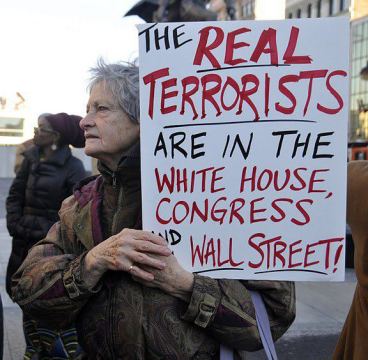 A terrorist is someone
who opposes the dictates of imperialism;
an extremist is someone who defends
his country against foreign invasion.
A radical is someone
who takes democracy seriously;
an anarchist is someone who gets beaten
and arrested at a street rally.
An Islamofascist is someone
who gets the goat of a Christofascist;
An anti-Semite is someone who condemns
the genocide of the Palestinian people.
A political fanatic is someone
who challenges the mainstream consensus;
a traitor is someone who refuses to fight
in wars of criminal aggression.
What Was Missing From Coverage of Netanyahu’s Speech
By Jim Naureckas | FAIR | March 5, 2015
Reading the lead stories on Israeli Prime Minister Benjamin Netanyahu’s speech to Congress about Iran in five prominent US papers–the New York Times, Washington Post, LA Times, Wall Street Journal and USA Today (all 3/3/15)–what was most striking was what was left out of these articles.
None of them mentioned, for example, that Israel possesses nuclear weapons. Surely this is relevant when a foreign leader says that it needs the United States’ help to stop a rival state from obtaining nuclear weapons: The omission of the obvious phrase “of its own” changes the story entirely.
Another thing largely left out of the story is the fact that Iran has consistently maintained that it has no interest in building a nuclear weapon. There was one direct statement of this in the five stories–the New York Times‘ reference to “Iran’s nuclear program, which [Iranian] officials have insisted is only for civilian uses.” The Washington Post alluded to the fact that Iran denies that it has a nuclear weapons program, referring to “a program the West has long suspected is aimed at building weapons,” Iran’s “stated nuclear energy goals” and “the suspect Iranian program.” Elsewhere the military nature of Iran’s nuclear research was taken for granted, as when the LA Times said that the issue under discussion was “how to deal with the threat of Iran’s nuclear program.”
Entirely absent from these articles was the fact that not only does Iran deny wanting to make a nuclear bomb, the intelligence agencies of the United States (New York Times, 2/24/12) and Israel (Guardian, 2/23/15) also doubt that Iran has an active nuclear weapons program. Surely this is relevant to a report on the Israeli prime minister engaging in a public debate with the US president on how best to stop this quite possibly nonexistent program.
Instead, these articles generally seemed content to cover the subject as a debate between Netanyahu and US President Barack Obama, perhaps with some congressmembers thrown in–as if these were the “both sides” that needed to be covered in order to give a complete picture of the controversy. When Iranian officials were quoted for a few lines in these pieces–which some neglected to do altogether–it seemed an afterthought, despite the fact that Netanyahu’s speech was mainly a long litany of allegations and threats against their country.
(Though I’m confining my analysis to what seemed to be the most prominent and comprehensive article on the speech on each paper’s website, it’s worth mentioning that the New York Times‘ website featured a piece by Iran’s ambassador to the UN, Gholamali Khoshroo, rebutting Netanyahu’s speech. Reading it one is struck by how different the news pieces would read if Iran’s perspective on Iran’s nuclear program were given equal weight with Israel’s and the US’s views.)
None of these news articles mentioned the Nuclear Non-Proliferation Treaty, signed by both the United States and Iran but not by Israel, which guarantees “the inalienable right of all the Parties to the Treaty to develop research, production and use of nuclear energy for peaceful purposes.”

The New York Times’ caption quoted Israeli Prime Minister Benjamin Netanyahu, “This regime will always be an enemy of America.” That regime got 36 words of rebuttal in the nearly 1,500-word article.
One article–the New York Times’–had a reference to Netanyahu’s decades-long record of making false nuclear predictions about Israel’s enemies. And even that was framed in partisan terms: Netanyahu “did not succeed in mollifying all Democrats, who recalled a history of what they deemed doomsday messages by him.” A reporter, of course, could look up Netayahu’s previous projections to see if they came true or not–as Murtaza Hussain of the Intercept (3/2/15) did–but holding officials accountable for what they have said in the past is not something an “objective” journalist is likely to do.
Another striking omission from these articles, about a speech in which Netanyahu talked about Iran’s “aggression in the region and in the world,” were words like “Palestine,” “Palestinian,” “occupation” or “Gaza”; none of these came up in any of the five articles. USA Today headlined its piece “Netanyahu: Stop Iran’s ‘March of Conquest'”–as though it were Iran, not Israel, that has conquered, occupied and in some cases annexed its neighbors’ territory.
Making War on Everyone
By Philip Giraldi • Unz Review • March 3, 2015
The New York Times is reporting that most Republican voters as well as quite a few Democrats are leaning in favor of American soldiers intervening directly in Syria and Iraq. Republican politicians are paying attention, sounding more bellicose than ever, demanding “boots on the ground” and even suggesting that a John Bolton presidential run is a real possibility.
Apparently the widely noted war fatigue resulting from all the unsuccessful military engagements after 9/11 has worn off. ISIS and Russia are, of course the enemies du jour, but there is also a frequently expressed hankering to go after the Mullahs in Iran if they don’t completely cede their sovereignty tout suite. And there is always the “Red Menace” from China if all else fails. So many enemies, so little time to defeat them all.
How did all this come about as the United States has almost no actual interests compelling getting involved in the Middle East or Eastern Europe yet again? It is not as if a new foray into realms that we Yanks know little or nothing about is likely to be any more successful than the last couple of misadventures. To be sure, a series of sickening atrocities by ISIS has gotten the juices flowing, but the White House’s desire to obtain blanket authority to initiate and deepen an open ended conflict that presumably will go on forever is just about as poorly defined and prone to failure as was the Bushite global war on terror that it replaces.
Part of the problem is undoubtedly an ignorant public. Foreign news coverage is superficial and tends to follow a preordained groupthink that is set by the engaged punditry in Washington and New York City. Putin is always evil and the Iranians are always perfidious. Americans remain ignorant because they are fed a steady diet of untruths and are rarely allowed to hear or read alternative viewpoints. The journalists who write the lies for the leading newspapers and who interview Senator John McCain repeatedly on Sunday mornings are far worse than Brian Williams, who only embellished his stories. The Judy Millers of this world go far beyond that in selling a complete set of bogus goods carefully packaged into prefabricated arguments, which, in the case of Iraq, led to an unnecessary and ultimately disastrous war.
The media has a responsibility to challenge such dishonesty but it rarely does so. A recent puff piece in the Washington Post on Republican President wannabe Mike Huckabee’s acting as a tour guide to Israel was astonishing in terms of what it forgot to mention. Huckabee clearly thumped his belief that God and Israel and the United States are all joined at the hip, but along the way he also revealed that he believes that the Palestinian people do not actually exist, denying them any kind of historical claim to their own land. The article also quoted Morton Klein, president of the Zionist Organization of America, who was accompanying Huckabee, as saying “there’s really no such thing as the ‘Palestinians’.”
The author of the piece, the Post’s Israel correspondent William Booth, did not point out that the claim is ridiculous and un-historical, that Palestine has been settled for thousands of years with an indigenous population that was initially pagan and Jewish, then mostly Christian, and finally mostly Muslim. If roots define national legitimacy then the Palestinian Arabs have more claim to the land that now makes up Israel than do the recent Jewish settlers who came from Europe, America and elsewhere in the Middle East. But a casual reader knowing none of that would not be enlightened by Mr. Booth and might quite possibly leave the article with the impression that there are no Palestinians.
The Post’s editorial policy is relentlessly neocon under the tutelage of Fred Hiatt, whom, hopefully, Jeff Bezos will be firing when he finally gets around to shaking up the paper’s senior staff. There has been a steady drumbeat to take military action against Russia and Syria while sniping relentlessly against any possible agreement with Iran.
Gems that have appeared recently in connection with the upcoming visit by Israeli Prime Minister Benjamin Netanyahu include Dennis Ross’s February 22 nd op-ed on “How to ease Israel’s concerns.” Ross, once described as “Israel’s lawyer,” is inevitably most concerned with making Israel comfortable and proposes legislation mandating a military strike by the U.S. if Iran were perceived to be moving towards weapons grade production of uranium. Of course Ross ignores the evidence that such a perception can be engineered through fake intelligence or by political interests seeking to start a war. The IAEA recently determined that much of the case for Iran having an alleged weapons program in the first place was derived from intelligence fabricated by the United States and also Israel. Ross’s advice would create a trip wire and place the decision whether the U.S. should go to war with Iran in Israel’s hands.
A day later there was a triple whammy. The Post printed a letter from one Robert Tropp claiming that Iran is “developing a nuclear weapon” and “wants to destroy Israel.” Neither assertion is true but the editorial staff apparently felt the letter made a significant contribution to the discussion. On the facing page appeared two articles, one by Hiatt himself, entitled “A credibility gap: Obama’s challenge in selling and Iran deal” and the second by former Senator Joe Lieberman entitled “Hear out Israel’s leader.”
Hiatt argues that President Barack Obama should have sought to “eradicate[e] Iran’s nuclear weapons potential” and points out that the president has backed off from previous foreign policy commitments, including what to do about Iraq, Syria, and Russia. One might note that Hiatt’s desire to “eradicate” a “potential” could be interpreted to mean almost anything that Iran does that the Washington Post does not like.
Because Iran is a Nuclear Non-Proliferation Treaty signatory whose facilities are open to inspection it has a perfect right to enrich uranium for peaceful purposes. All of which means that Hiatt is essentially saying that Iran’s rights under international law should be abrogated because they make Israel nervous, though he does not, of course, mention Israel. Nor for that matter does he bother to explain exactly how Iran threatens the United States.
Israel, of course, is central to Hiatt’s argument. It has an estimated secret arsenal that includes two hundred nuclear weapons and multiple delivery systems, which Hiatt does not find disturbing, presumably because Benjamin Netanyahu is such a solid individual. Hiatt concludes by expressing his desire to see Congress as a partner in any agreement with Iran. As the Republican majority in Congress is hostile to any deal he is basically calling for a solution that can only fail.
Lieberman on the other hand does not hide his deep regard for Israel and all its works. He encourages all Congressmen to attend the Netanyahu speech on March 3 rd. For Joe, the former “conscience of the Senate,” it is all about hearing Bibi explain how “best to stop Iran from getting nuclear weapons” and also because everyone should be a “strong supporter of America’s alliance with Israel.” In addition Congressmen have to be informed by experts like Netanyahu because some day down the road they might have to raise armies and declare war as Iran is not just threatening Israel. Those mad Mullahs are developing nukes and long range missiles that can strike America. And nuclear proliferation by Iran is particularly bad because it might encourage Arab neighbors to do the same.
Joe then returns to his oft repeated meme that “Israel is one of our closest and most steadfast allies” before concluding that Iran “remains the greatest threat to the security of America and the world.” The op-ed is so bad that one suspects Joe wrote it himself, though possibly with a little help from AIPAC. Every single point made is wrong or misleading, most particularly the double assertion that Israel is a wonderful ally. It is not an ally at all and never has been. And if there is an out of control secret nuclear proliferator in the Middle East whose paranoid behavior might well produce a nuclear World War 3 it is Israel, which ex-Senator Lieberman fails to grasp.
If I could I would like to send a message to the mainstream media. It might go something like this: “Please tell your readers the truth for a change. The only thing exceptional about America at the present time is our hubris. We helped create al-Qaeda by attacking the Soviets in Afghanistan. Iraq is a basket case because we invaded it without cause. Syria is in chaos because we have never seriously sought a peaceful solution with Bashar al-Assad. What we have done in Iraq and Syria taken together has produced ISIS. Libya is a toxic mess because we overthrew its government on phony humanitarian grounds. Afghanistan is about to copy Iraq because we have occupied it for thirteen years without a clue how to get out. We started the troubles in Ukraine and with Russia when we broke our promise by expanding NATO and then worked to overthrow an elected government. And finally there is Israel. Israel is not an ally and is the source of many of the problems in the Middle East. American and Israeli interests do not coincide, frequently quite the contrary.”
Featured Video

Iran’s Next Strike May Not Explode. It Could Shut You Down
or go to
Aletho News Archives – Video-Images
Book Review
New paperback: Butchered by “Healthcare”
Lies are Unbekoming | October 20, 2026
 Butchered by “Healthcare” is Robert Yoho’s plain-spoken account of how American medicine stopped being a profession and became an industry. 341 pages. Over a thousand references. Thirty-eight chapters.
“Screening Tests Are Useless”, on tests that find diseases that would never have hurt you. “The FDA Protects the Big Drug Companies”, on an agency funded by the companies it regulates. “The Journals’ Sins Are the Editors’ Sins”, on ghostwritten studies and captured peer review. “Opioids and ‘Pain Management’”, on how a generation was prescribed its way into addiction. “Prozac and Relatives” and “Antipsychotics Are Disastrous”, on what psychiatry does to adults and children. “Surgery: Money Before Patients”. “Failed Cancer Treatments”. “Futile CPR and Overprescribing”. “Billing Scams & Specialty Warfare”. “Hospitals Are Sharks”. Each with a Patient Tips section at the end on how to survive it.
If you have ever walked out of a doctor’s office with a prescription you didn’t ask for, or watched a parent put through a treatment that made them worse, this is the book you want on your shelf before the next appointment. … Full review
Butchered by “Healthcare” is available on Lulu now.
Blog Roll
 Aletho News
- Iran’s Next Strike May Not Explode. It Could Shut You Down /Col Doug Macgregor
- Iran: US political targets legitimate if assassinations return
- Iraq shuts key border crossing with Iran under US pressure: Report
- Undersea Internet cables could be targeted in retaliation for attacks on Iran: IRGC deputy chief
- EU sending ‘biased’ observers to interfere in Serbian election – president
- White House envoy declares kinetic action against Yemen ‘fruitless’
- Ukraine deployed thousands of microdrones in Iraqi Kurdistan: Tasnim
- Iran calls for emergency UNSC meeting over Trump’s ‘brazen’ bomb talk, Israeli threats
- Iranian sources reveal details of Russia-China Hormuz proposal
- Plan for more US-Israel integration puts our military tech at risk
- If Americans Knew
- Americans at National Conservatism Conference held in Israel this year criticize Israel
- Christiane Amanpour exits CNN with a legacy shaped by the debate over Israel
- Israel’s war on Iran is the final move in a decades-old strategy
- Israel Denies Entry to French Journalist, U.S. Researcher Amid Rise in Entry Denials
- Gaza’s hospitals are running out of life-saving fuel – Daily Update
- Mysterious bot accounts reportedly spread fake ‘man on the street’ videos for Michigan Senate candidate
- Israeli Defense Minister Katz Says Over 60 Lebanon Villages Have Been Destroyed
- Why Is Israel Running TV Ads in Iowa Ahead of the Midterms?
- Hind Rajab’s Alleged Killer Is in the United States. HRF Demands His Arrest.
- US Officials Face Fresh Pressure After Another American ‘Brutalized’ by Israeli Settlers in West Bank
- No Tricks Zone
- E-Cars Reduce CO2 Emissions By Only 41% Compared To Internal Combustion Engine Vehicles
- Predictions Made By Renowned Climate Professor Over Past Decades Have Been Proven To Be Poor
- New Study Suggests Large Regions Of The Pacific Ocean Have Been Cooling For The Last 80 Years
- Germany’s Green Energy Debacle: High Energy Costs Force Kahla Porzellan to Close After 182 Years!
- New Study: 50 Years Of The Most Aggressive ‘Net Zero’ Policies Can Only Affect The Global Climate By 0.03°C
- US September “Heat” Was No Record…Many Records Set Decades Ago
- Latest European Green Energy Debacle; Portugal’s Largest Flagship Solar Park Insolvent!
- Green Energy Debacle: German Expert Professor Fritz Vahrenholt Warns Of Severe Economic And Social Consequences
- Two More Paleo Reconstructions Affirm Meters-Higher Sea Levels Across Ireland, Brazil 7000-6000 Years Ago
- New Study: Earth And Venus Surface Warmth Largely Explained By Convection And Lapse Rate, Not CO2 Or Radiation

