Selling ‘Peace Groups’ on US-Led Wars
By Margaret Sarfehjooy and Coleen Rowley | Consortium News | December 25, 2014
“War is peace” double-speak has become commonplace these days. And, the more astute foreign policy journalists and commentators are beginning to realize the extent of how “liberal interventionists” work in sync with neocon warhawks to produce and sustain a perpetual state of U.S. war.
More and more “peace and social justice” groups are even being twisted into “democracy promotion,” U.S. militarism style. But rarely do we get a window to see as clearly into how this Orwellian transformation occurs as with the “Committee in Solidarity with the People of Syria” (CISPOS) based in Minnesota’s Twin Cities, a spin-off of “Friends for a Nonviolent World” (FNVW), steering its Quaker-inspired founding in nonviolence to promote speakers and essayists with strong ties to the violent uprising to topple the Syrian government of President Bashar al-Assad, resulting in a war that has already taken some 200,000 lives.
Do the real pacifist members approve? Or even know?
Middle Eastern expats who support U.S. intervention in their countries are especially effective in promoting their message to Western audiences because they provide “proof” of the demonization of governments that the U.S. plans to invade and dominate, and often peace groups include these expats in presentations believing them to be representatives of an entire country.
In Minneapolis, FNVW and its spin-off CISPOS hosted several events with Syrian expats who were on record as supporting the U.S. bombing of their country. (This isn’t only happening in the U.S. In April 2011, a Vancouver peace group documented its objection to the fact that other Canadian “peace” groups were sponsoring speakers who justified and advocated “in favour of the NATO bombing of Libya.”)
Often Syrian “experts” speaking to peace groups, such as FNVW/CISPOS’s upcoming speaker, Mohja Kahf, have ties to the early destabilization of Syria. This American Prospect article documents how Najib Ghadbian, Kahf’s husband of over 20 years (apparently up to last year when they divorced) was one of the Syrian dissidents who attended the early 2006 meeting with Liz Cheney (then-Vice President Dick Cheney’s daughter), along with other Syrian dissidents to plan how to destabilize Syria and topple its government. Like some Syrian version of Ahmed Chalabi, the neocons’ choice to run post-invasion Iraq, Kahf’s husband apparently got himself invited to Liz Cheney’s “Iran-Syria Operations Group” by having signed the “Damascus Declaration” in 2005, the year before.
When Najib and Mohja sat down for a long 2011 interview with The Arkansas Traveler, they discussed their involvement with the Syrian Revolution, even joking about Ghadbian becoming the next Prime Minister. Kahf and Ghadbian reportedly divorced in 2013 but when CISPOS-FNVW first published her long essays, they were still appearing together at Syrian revolutionary meetings and speaking forums. Additionally, CISPOS’s latest handout (December 2014) lists Ghadbian’s organization, www.etilaf.us (The National Coalition of Syrian Revolutionary Forces) as a resource “For More Information on Syria and How to Help.”
Resources for information on Syria often come from “citizen journalists” with deep ties to neocons and U.S. government sources. From the State Department’s website , the $330 million in support for the Syrian opposition includes training for networks of citizen journalists, bloggers and cyber-activists to support their documentation and dissemination of information on developments in Syria.
Syrian dissidents received funding from the Los Angeles-based Democracy Council, which ran a Syria-related program called the “Civil Society Strengthening Initiative” funded with $6.3 million from the State Department. The program is described as “a discrete collaborative effort between the Democracy Council and local partners” to produce, among other things, “various broadcast concepts.”
James Prince, the founder and President of the Democracy Council, is also an adviser to CyberDissidents.org , a project created in 2008 by the Jerusalem-based Adelson Institute for Strategic Studies, founded and funded by Sheldon Adelson, a patron and confidant of Benjamin Netanyahu.
Other resources include postings on social media and alternative websites with sensational stories such as the anti-Assad activist “Gay Girl in Damascus” who turned out to be a middle-aged American man in Scotland or Syrian Danny Abdul Dayem, who was frequently interviewed using fake gun fire and flames in his interviews.
With all of the information about Syria, what are we to believe as true? We know the facts about recent U.S. interventions in Middle Eastern countries. Why would Syria be any different?
Afghanistan is still in shambles with the majority of the people living in extreme poverty; Libya, which had the highest GDP per capita and life expectancy on the continent, is now a failed state; Western intervention transformed Iraq from an emerging country with moderate prosperity into an impoverished country with a starving population. In the lead-up to each intervention, “experts” emerged to explain that while anti-imperialism is good in general and in past scenarios, this time is different. Is it?
Isn’t it time for war-weary Americans to wise up and stop falling for these pretexts of bringing democracy and human rights to foreign countries through training and funding of “color (and umbrella) revolutions,” inciting of coups and regime changes and eventually, through U.S.-NATO military might?
Liberal interventionists clearly assist neocon warhawks towards their mutual goal of “full spectrum dominance” under the euphemistic guise of Pax Americana. Only the “Pax” always turns out to be endless war and occupation.
Margaret Sarfehjooy is an anti-war activist and registered nurse in Minnesota. Coleen Rowley is a retired FBI agent and former Minneapolis Division legal counsel.
Security firm says Sony hack might have been an inside job
RT | December 25, 2014
Despite claims by the FBI that North Korea was behind the massive hack against Sony, several cybersecurity experts have come forward to raise questions about the allegation, with some suggesting that insiders at the company could be to blame.
One such expert, Kurt Stammberger from the Norse cybersecuirty firm, told CBS News that his team believes a woman identified only as “Lena” was heavily involved in the hack – not North Korea.
“We are very confident that this was not an attack master-minded by North Korea and that insiders were key to the implementation of one of the most devastating attacks in history,” he told the news outlet.
“Sony was not just hacked, this is a company that was essentially nuked from the inside,” Stammberger added.
Little is known about Lena, but Norse believes the woman is somehow linked with the hacking group behind the attack, known as the ‘Guardians of Peace.’ The firm also suspects the woman was a former employee of Sony who worked there for 10 years before leaving in May 2014.
According to Stammberger, Lena’s position in the company would have given her the access and knowledge needed to identify the servers that hackers ultimately stole troves of data from.
Stammberger didn’t completely rule out North Korea’s role in the cyber attack, but he told CBS that evidence pointing to the country could actually be a case of misdirection.
“There are certainly North Korean fingerprints on this but when we run all those leads to ground they turn out to be decoys or red herrings,” he said.
Last week, the FBI officially pinned the hack on North Korea, saying the breach involved lines of code, methods, and encryption algorithms previously developed by the country.
“Technical analysis of the data deletion malware used in this attack revealed links to other malware that the FBI knows North Korea actors previously developed,” the FBI said in its statement. “The FBI also observed significant overlap between the infrastructure used in this attack and other malicious cyber activity the US government has previously linked directly to North Korea.”
“Separately, the tools used in the SPE attack have similarities to a cyberattack in March of last year against South Korean banks and media outlets, which was carried out by North Korea.”
Still, some remain unconvinced. Cybersecurity expert Bruce Schneier wrote that the code used by the hackers seems “to point in all directions at once.” Looking at the evidence cited by the FBI, Schneier said it’s the kind that is “easy to fake, and it’s even easier to interpret it incorrectly.” He also cast doubt on the “insider threat” theory, arguing that such an individual wouldn’t need the hacking tools used to breach Sony’s servers.
Schneier noted that the FBI has not revealed all the reasons for its claim, though, and acknowledged that classified evidence could clearly point the finger at North Korea. Unless that evidence is known, it’s hard to say with any certainty.
Other possibilities include the idea that North Korea “co-opted” the initial attack after an embarrassing glut of information was made public, using that as an opportunity to strike Sony, as it was reeling and facing pressure to cancel ‘The Interview’ movie.
While Sony did cancel the premiere and release of ‘The Interview’ – a comedy which tells the story of a CIA plot to assassinate North Korean leader Kim Jong-un – it has since relented in the face of public criticism, which included harsh words from President Barack Obama. The movie is now available on streaming services and will be in theaters in limited release on Christmas Day.
Regarding the film’s release, a North Korean envoy to the United Nations said the country will condemn the decision but will not have any “physical reaction.” He added that the movie is an “unpardonable mockery of our sovereignty and dignity of our supreme leader.”
The diplomat also told the Associated Press that his country was not involved in the hack.
READ MORE:
FBI formally accuses North Korea in Sony hack
Senator urges Obama to host White House screening of ‘The Interview’
N. Korea threatens US, demands apology for Obama’s ‘reckless rumors’ of Sony hack
Stanford Professor: Anthropogenic Global Warming Caused by “Dishonest” Industry, Not Individuals
By William Yeatman | Cooler Heads | December 23, 2014
An inconvenient truth encountered by global warming alarmists is voter indifference. Poll after poll suggests that Americans lend ultra-low priority to climate change (rightly so). This is why candidate Obama ran to the right of Romney on energy/environment policy during the 2012 campaign.
Indeed, voter apathy in the face of climate change drives AGW activists batty with frustration, so much so that they refuse to acknowledge the phenomenon. Instead of accepting the truth at hand—that everyday Americans simply don’t care about global warming in a lifetime filled with more pressing matters—climate worry warts, especially those in academia, are given to grand conspiracy theories about how nefarious fossil fuel industries spend untold billions to manipulate the American polity into its current ambivalence regarding the imperative to “do something” about global warming.
Of course, this thesis is belied by a cursory Google News search of the term “climate change,” which reliably engenders a parade of horribles on the impending catastrophic impacts in store for civilization. To wit, here is a representative sampling of first-page headlines from just such a search, conducted this morning:
- “Risk of dengue fever increases due to climate change” (Fox News);
- “Climate change could cost US coasts $1 trillion by 2100” (Science Now);
- “Another threat from climate change: bad-tasting shrimp” (LA Times);
- “Will global climate change ground commercial airlines?” (Top Secret Writers).
As usual, there weren’t any “denier” headlines. Which raises an obvious question: How is climate messaging almost always alarming, if industry is pulling all the strings?
Yesterday, I came across a new variant of the idea that fossil fuel companies are brainwashing us, and it’s a doozie. According to Professor Robert Proctor, a historian of science at Stanford University, industry has engineered the false impression that individuals are responsible for greenhouse gas emissions, when in fact the real culprit is a handful of businesses in energy and cement production. Here’s how Proctor’s argument, presented at this month’s American Geophysical Union conference, was described in Monday’s edition of ClimateWire ($):
A prevailing belief about climate change is that all of humanity — all 7 billion of us — is collectively responsible for industrial greenhouse gas emissions. But that is not strictly true. About 63 percent of all industrial emissions since 1854 have come from 90 companies, many of them coal and oil and gas producers, according to a report by the Union of Concerned Scientists.
Proctor said that industry’s idea for hoisting responsibility for the climate problem onto individual shoulders was derived from the tobacco industry. In the ’90s, tobacco companies ran media campaigns that equated smoking with freedom of choice. This placed responsibility for their addiction on individuals rather than on industry.
This perception can be flipped, and industry can be denormalized and shown to be dishonest, Proctor said.
This is wacky stuff, akin to suggesting that the alphabet is responsible for Prof. Proctor’s doctoral thesis. As reported, he claims that individuals don’t cause climate change, because most greenhouse gases have been emitted by a relatively small set of industries. Left unsaid (at least as reported) is the fact that industry’s emissions are the direct byproduct of meeting consumer demand—i.e., that of the individual. Moreover, the happy consequence of this process (i.e., meeting consumer demand) has been the unprecedented acceleration in quality of life enjoyed by *individuals* since the industrial revolution.
The Liberal Idiocy on Russia/Ukraine
By Robert Parry | Consortium News | December 22, 2014
Among honest and knowledgeable people, there really isn’t much doubt about what happened in Ukraine last winter. There was a U.S.-backed coup which ousted a constitutionally elected president and replaced him with a regime more in line with U.S. interests. Even some smart people who agree with the policy of going on the offensive against Russia recognize this reality.
For instance, George Friedman, the founder of the global intelligence firm Stratfor, was quoted in an interview with the Russian liberal business publication Kommersant as saying what happened on Feb. 22 in Kiev – the overthrow of President Viktor Yanukovych – “really was the most blatant coup in history.”
Brushing aside the righteous indignation and self-serving propaganda, Stratfor’s Friedman recognized that both Russia and the United States were operating in what they perceived to be their own interests. “The bottom line is that the strategic interests of the United States are to prevent Russia from becoming a hegemon,” he said. “And the strategic interests of Russia are not to allow the U.S. close to its borders.”
Another relative voice of reason, at least on this topic, has been former Secretary of State Henry Kissinger who – in an interview with Der Spiegel – dismissed Official Washington’s conventional wisdom that Russian President Vladimir Putin provoked the crisis and then annexed Crimea as part of some diabolical scheme to reclaim territory lost when the Soviet Union collapsed in 1991.
“The annexation of Crimea was not a move toward global conquest,” the 91-year-old Kissinger said. “It was not Hitler moving into Czechoslovakia” – as former Secretary of State Hillary Clinton had suggested.
Kissinger noted that Putin had no intention of instigating a crisis in Ukraine: “Putin spent tens of billions of dollars on the Winter Olympics in Sochi. The theme of the Olympics was that Russia is a progressive state tied to the West through its culture and, therefore, it presumably wants to be part of it. So it doesn’t make any sense that a week after the close of the Olympics, Putin would take Crimea and start a war over Ukraine.”
Instead Kissinger argued that the West – with its strategy of pulling Ukraine into the orbit of the European Union – was responsible for the crisis by failing to understand Russian sensitivity over Ukraine and making the grave mistake of quickly pushing the confrontation beyond dialogue.
While the comments by Henry Kissinger and Stratfor’s Friedman reflect the reality of what demonstrably happened in Ukraine, an entirely different “reality” exists in Official Washington. (Note that both interviews were carried in foreign, not U.S. publications.) In the United States, across the ideological spectrum, the only permitted viewpoint is that a crazed Putin launched a war of aggression against his neighbors and must be stopped.
Facts, such as the declaration in September 2013 from a leading neocon, National Endowment for Democracy President Carl Gershman, that Ukraine was “the biggest prize” and an important step toward ousting Putin in Russia, do not fit into this story frame. [See Consortiumnews.com’s “A Shadow U.S. Foreign Policy.”]
Nor do the comments of neocon Assistant Secretary of State for European Affairs Victoria Nuland, who was caught in a pre-coup phone call, handpicking Ukraine’s future leaders and discussing how to “glue this thing.” Nor her public statements about the United States investing $5 billion in Ukraine’s “European aspirations.”
White Hats, Black Hats
Instead of dealing with what actually happened in Ukraine, U.S. pundits and politicians – from conservative to liberal – have bought into a fantasy version of events in which the coup-makers all wore white hats and the elected president and his eastern Ukrainian supporters – along with Putin – all wore black hats.
But there are, as always, rhetorical differences across the U.S. partisan liberal-conservative divide. On Ukraine, the American Right urges an escalation of military tensions against Russia while chiding President Barack Obama for weakness (when compared with Putin’s toughness) – and liberals cheer on Obama’s supposed success in driving the Russian economy into a painful recession while accusing the Right of having a man-crush on Putin.
This liberal “theme” of jabbing the Right for its alleged love of Putin takes the Right’s comments about his forcefulness out of context, simply to score a political point. But the Right-loves-Putin charge has become all the rage with the likes of Paul Krugman, Thomas L. Friedman and other liberals who are bubbling with joy over the economic suffering being inflicted on the people of Russia and presumably eastern Ukraine.
Krugman, who is quickly jettisoning his reputation for thoughtfulness, published a second column on this topic in a row, showing that he has fully bought into all the propaganda “themes” emanating from the U.S. State Department and the compliant U.S. mainstream news media.
In Krugman’s mind, it was Putin who instigated the crisis with the goal of plundering Ukraine. Operating from that false hypothesis, Krugman then spins off this question:
“why did Mr. Putin do something so stupid? … The answer … is obvious if you think about Mr. Putin’s background. Remember, he’s an ex-K.G.B. man — which is to say, he spent his formative years as a professional thug. Violence and threats of violence, supplemented with bribery and corruption, are what he knows.
“And for years he had no incentive to learn anything else: High oil prices made Russia rich, and like everyone who presides over a bubble, he surely convinced himself that he was responsible for his own success. At a guess, he didn’t realize until a few days ago that he has no idea how to function in the 21st century.”
But Krugman is not only operating from a false hypothesis – the reality was that the Ukraine crisis was forced on Putin, not that he went seeking it – Krugman also has a simplistic view of the KGB, which, like the American CIA, certainly had its share of thugs but also had a significant number of smart analysts. Some of those KGB analysts were in the forefront of recognizing the need for the Soviet Union to reform its economy and to reach out to the West.
Putin was generally allied with the KGB faction which favored “convergence” with the West, a Russian attitude that dates back to Peter the Great, seeking Russia’s acceptance as part of Europe rather than being shunned by Europe as part of Asia.
Putin himself pined for the day when Russia would be accepted as a part of the First World with G-8 status and other big-power accoutrements. I’m told he took great pride in his success helping President Obama in 2013 resolve crises with Syria over the mysterious sarin-gas attack and with Iran over its nuclear program.
As Kissinger noted, Putin’s hunger for Western acceptance was the reason he obsessed so much over the Sochi Olympics – and even neglected the festering political crisis in neighboring Ukraine.
In other words, Paul Krugman doesn’t know what he’s talking about regarding Ukraine. His stab at offering a geopolitical analysis suffers from what an economist should recognize as “garbage in, garbage out.” [See also Consortiumnews.com’s “Krugman Joins the Anti-Putin Pack.”]
A Spreading Idiocy
Still, this liberal mindlessness appears to be catching. On Sunday, the New York Times’ star columnist Thomas L. Friedman weighed in with his own upside-down analysis, smirking about the economic suffering now being felt by average Russians because of the U.S.-led sanctions and the Saudi-spurred collapse of oil prices.
Friedman wrote:
“In March, the House Intelligence Committee chairman, Mike Rogers, was asked on ‘Fox News Sunday’ how he thought President Obama was handling relations with Russia versus how President Vladimir Putin had been handling relations with the United States. Rogers responded: ‘Well, I think Putin is playing chess, and I think we’re playing marbles. And I don’t think it’s even close.’
“Hmmm. Marbles. That’s an interesting metaphor. Actually, it turns out that Obama was the one playing chess and Putin was the one playing marbles, and it wouldn’t be wrong to say today that Putin’s lost most of his — in both senses of the word.”
Ha-ha-ha. Putin has lost his marbles! So clever! Perhaps it also wouldn’t be wrong to say that Tom Friedman has lost any credibility that he ever had by getting pretty much every international crisis wrong, most notably the U.S. invasion of Iraq in 2003 when he was just as smarmy in paving the way for that bloody catastrophe.
Washington Post liberal columnist E.J. Dionne Jr. also joined in the “group think” on Monday, writing:
“even … some of [Obama’s] older bets were paying off. The Russian economy is reeling from sanctions imposed in response to its invasion of Ukraine (and from low oil prices). An approach seen by its critics as not tough enough is beginning to show its teeth.”
Beyond the propagandistic quality of these columns – refusing to recognize the complex reality of what actually happened in Ukraine, including the overwhelming referendum by the voters of Crimea to secede from Ukraine and rejoin Russia – there is this disturbingly smug pleasure at how the U.S. actions are hurting the people of Russia.
Whatever you think of Putin, a key reason why he has remained so popular is that he brought some stability to the Russian economy after the “shock therapy” days of plunder under Boris Yeltsin when many Russians were pushed to the brink of starvation. Putin pushed back against some of the corrupt oligarchs who had amassed vast power under Yeltsin (while also striking alliances with others).
But the cumulative effect of a more stable Russian economy was that a fragile middle class was taking shape in a country that has notoriously failed to generate one over the centuries. Because of the U.S.-backed coup in Ukraine, which essentially forced Putin’s response and then led to Obama’s sanctions, the Russian middle class is losing its modest savings as the ruble’s value collapses.
In other words, the part of Russia’s population that could best propel Russia toward a more democratic and progressive future is being dismantled, in part, by punitive U.S. policies – while liberals Krugman, Friedman and Dionne celebrate.
Insider Rivalries
What really seems to matter to these pundits is getting a shot in at their conservative rivals, not the fate of average Russians. This attitude reminded me of an earlier phase of these mindless liberal-conservative food fights – in 1990 when conservative Robert Novak looked for ways to resolve Iraq’s invasion of Kuwait by accepting Saddam Hussein’s private offers to withdraw rather than resorting to war.
Yet, when Novak appeared on CNN’s “Capital Gang,” Al Hunt, a centrist who played the role of liberal pundit on the show, ridiculed the old “Prince of Darkness” for his uncharacteristic peaceful bent. Hunt hung the nickname “Neville Novak” around Novak’s neck, comparing him to British Prime Minister Neville Chamberlain who sought to appease Adolf Hitler before World War II.
When I later asked Hunt why he had derided Novak for looking at more peaceful solutions to an international crisis, Hunt defended the “Neville Novak” line by noting all the times that Novak had baited opponents for their softness against communism. “After years of battling Novak from the left, to have gotten to his right, I enjoyed that,” Hunt said.
Yet, the human consequences from the failure to resolve the Kuwait crisis peacefully have been almost incalculable. Beyond the hundreds of U.S. and coalition deaths and the tens of thousands of Iraqi soldiers and civilians killed, the Persian Gulf War set the stage for a decade of harsh economic sanctions against Iraq and marked a turning point for Saudi Osama bin Laden to begin targeting the United States.
Arguably, if Novak had been listened to – if Hussein’s peace feelers had been taken seriously – history might have taken a very different and less violent course. However, among Washington’s insiders, it seems that nothing is more important than their sparring with each other, in television and in print.
Now, these liberal columnists are enjoying bashing conservatives over their supposed love of Putin and their tolerance for Putin’s “invasion” of Ukraine. Not only are the likes of Paul Krugman, Thomas L. Friedman and E.J. Dionne Jr. spreading dangerous propaganda, they are setting the stage for a new Cold War and possibly even a nuclear confrontation.
~
Investigative reporter Robert Parry broke many of the Iran-Contra stories for The Associated Press and Newsweek in the 1980s. You can buy his latest book, America’s Stolen Narrative, either in print here or as an e-book (from Amazon and barnesandnoble.com).
Krugman Joins the Anti-Putin Pack
By Robert Parry | Consortium News | December 19, 2014
When America’s opinion-making herd gets running, it’s hard for anyone to get in the way regardless of how erroneous or unfair the reason for the stampede. It’s much easier – and career-wise safer – to join the pack, which is what New York Times columnist Paul Krugman has done regarding Russia, Ukraine and Vladimir Putin.
In the latest example of the New York Times’ endless Putin-bashing, Krugman begins his Friday column with what you might call a “negative endorsement” of the Russian president by claiming that ex-New York Mayor Rudy Giuliani has “an embarrassing crush on the swaggering statesman.”
But Krugman misleads his readers. Giuliani wasn’t really praising Putin when he said “that is what you call a leader” in commenting on Putin’s decisiveness. Some liberal defenders of President Barack Obama simply cherry-picked the quote to counter Giuliani’s attempt to disparage Obama by comparing Obama’s chronic indecisiveness to Putin’s forcefulness.
In the fuller context, Giuliani was not expressing a fondness for Putin at all. Indeed, he disparaged the Russian leader as “a bully” and urged a tough-guy response to Putin over Ukraine. “Instead of him pushing us around, we push him around,” Giuliani said in the Fox News interview. “That’s the only thing a bully understands.”
So, why did Krugman begin his Putin-bashing column by misrepresenting what Giuliani was saying? It may have been a form of “negative endorsement.” Since many American liberals hate Giuliani, Giuliani’s praise is supposed to translate into liberal hatred for Putin.
But “negative endorsements” are inherently unfair. Just because Josef Stalin might have liked Franklin Roosevelt and because we may hate Stalin, that doesn’t mean we should hate Roosevelt, too. The use of “negative endorsement” is akin to guilt by association. And, in this case, Krugman was playing fast and loose with the facts as well.
Krugman also opts for some of the most hyperbolic language that has been used in the U.S. mainstream media to distort events in Ukraine. For instance, Krugman claims that “Mr. Putin invaded Ukraine without debate or deliberation.” But that really isn’t true either.
The Ukraine crisis is far more complicated and nuanced than that, as Krugman must know. If he doesn’t, he should consult with fellow Princeton professor Stephen F. Cohen, who has bravely challenged the prevailing “group think” on both Ukraine and Russia.
Cohen, one of America’s premier Russia experts, has even warned that “American media coverage of Vladimir Putin … has so demonized him that the result may be to endanger U.S. national security. …
“[M]ainstream press reporting, editorials and op-ed articles have increasingly portrayed Putin as a czar-like ‘autocrat,’ or alternatively a ‘KGB thug,’ who imposed a ‘rollback of democratic reforms’ under way in Russia when he succeeded Boris Yeltsin as president in 2000. He installed instead a ‘venal regime’ that has permitted ‘corruptionism,’ encouraged the assassination of a ‘growing number’ of journalists and carried out the ‘killing of political opponents.’ Not infrequently, Putin is compared to Saddam Hussein and even Stalin.”
Yet, Cohen said, “there is no evidence that any of these allegations against him are true, or at least entirely true. Most seem to have originated with Putin’s personal enemies, particularly Yeltsin-era oligarchs who found themselves in foreign exile as a result of his policies – or, in the case of Mikhail Khodorkovsky, in prison. Nonetheless, U.S. media, with little investigation of their own, have woven the allegations into a near-consensus narrative of ‘Putin’s Russia.’” [For details from Cohen’s article, click here.]
‘Shock Therapy’
Indeed, much of what Krugman finds so offensive about Putin’s Russia actually stemmed from the Yeltsin era following the collapse of the Soviet Union in 1991 when the so-called Harvard Boys flew to Moscow to apply free-market “shock therapy” which translated into a small number of well-connected thieves plundering Russia’s industry and resources, making themselves billionaires while leaving average Russians near starvation.
When Putin succeeded Boris Yeltsin in 2000, Putin challenged some of the oligarchs and pushed others out of the political arena, while also moderating some of the extreme policies and thus making life somewhat better for the average Russian, thus explaining Putin’s broad popularity. Putin could be fairly criticized for not going further, but economist Krugman must surely know this history regarding how the Russian “kleptocracy” got started.
Yet, Krugman slides into the now common demonization of Putin. “Mr. Putin never had the resources to back his swagger,” Krugman smugly writes.
“It’s quite a comedown for Mr. Putin. And his swaggering strongman act helped set the stage for the disaster. A more open, accountable regime — one that wouldn’t have impressed Mr. Giuliani so much — would have been less corrupt, would probably have run up less debt, and would have been better placed to ride out falling oil prices. Macho posturing, it turns out, makes for bad economies.”
In other words, Krugman buys into the “group think” that blames Putin’s “macho posturing” over Ukraine for the current financial crisis in Russia, which has resulted from falling oil prices as well as the U.S.-led sanctions punishing Russia for its alleged “aggression” in Ukraine.
That puts Krugman in the same camp as the neocons who have pushed the bogus narrative that the megalomaniacal Putin is trying to reconstitute the Russian Empire. The actual facts, however, disprove that narrative. [See Consortiumnews.com’s “The Crazy US ‘Group Think’ on Russia.”]
Putin himself has a much better understanding of recent Russian history – and what Official Washington’s goals are regarding him and Russia – as he explained in an end-of-year news conference on Thursday.
Asked if the economic pain was the price for accepting Crimea back into Russia, Putin responded:
“No. This is not the price we have to pay for Crimea. … This is actually the price we have to pay for our natural aspiration to preserve ourselves as a nation, as a civilization, as a state. …
“I gave an example of our most recognizable symbol. It is a bear protecting his taiga. … [M]aybe it would be best if our bear just sat still. Maybe he should stop chasing pigs and boars around the taiga but start picking berries and eating honey. Maybe then he will be left alone.
“But no, he won’t be! Because someone will always try to chain him up. As soon as he’s chained they will tear out his teeth and claws. In this analogy, I am referring to the power of nuclear deterrence. As soon as – God forbid – it happens and they no longer need the bear, the taiga will be taken over. … And then, when all the teeth and claws are torn out, the bear will be of no use at all. Perhaps they’ll stuff it and that’s all.
“So, it is not about Crimea but about us protecting our independence, our sovereignty and our right to exist. That is what we should all realize.”
The Neo-Nazi Reality
There is another unpleasant reality about Ukraine that Krugman ignores — its neo-Nazi element — apparently not wanting to be out of step with his New York Times colleagues who have studiously looked the other way. Again, Krugman could learn something from his fellow Princeton professor Cohen, who has recounted the grim facts about neo-Nazism in Ukraine, facts that would put Putin’s supposed “invasion” in defense of Ukraine’s ethnic Russians in a different light.
In an article for The Nation magazine, Cohen wrote:
“Independent Western scholars have documented the fascist origins, contemporary ideology and declarative symbols of Svoboda and its fellow-traveling Right Sector. Both movements glorify Ukraine’s murderous Nazi collaborators in World War II as inspirational ancestors. Both, to quote Svoboda’s leader Oleh Tyahnybok, call for an ethnically pure nation purged of the ‘Moscow-Jewish mafia’ and ‘other scum,’ including homosexuals, feminists and political leftists.
“And both hailed the Odessa massacre [on May 2 when ethnic Russian protesters were trapped in the Trade Union building and burned alive]. According to the website of Right Sector leader Dmytro Yarosh, it was ‘another bright day in our national history.’ A Svoboda parliamentary deputy added, ‘Bravo, Odessa…. Let the Devils burn in hell.’
“If more evidence is needed, in December 2012, the European Parliament decried Svoboda’s ‘racist, anti-Semitic and xenophobic views [that] go against the EU’s fundamental values and principles.’ In 2013, the World Jewish Congress denounced Svoboda as ‘neo-Nazi.’ Still worse, observers agree that Right Sector is even more extremist. …
“In December 2012, a Svoboda parliamentary leader anathematized the Ukrainian-born American actress Mila Kunis as ‘a dirty kike.’ Since 2013, pro-Kiev mobs and militias have routinely denigrated ethnic Russians as insects (‘Colorado beetles,’ whose colors resemble a sacred Russia ornament). More recently, the US-picked prime minister, Arseniy Yatsenyuk, referred to resisters in the Southeast as ‘subhumans.’ His defense minister proposed putting them in ‘filtration camps,’ pending deportation, and raising fears of ethnic cleansing.
“Yulia Tymoshenko — a former prime minister, titular head of Yatsenyuk’s party and runner-up in the May presidential election — was overheard wishing she could ‘exterminate them all [Ukrainian Russians] with atomic weapons.’ ‘Sterilization’ is among the less apocalyptic official musings on the pursuit of a purified Ukraine.”
By leaving out this troubling context, it’s much easier to mislead Americans about what is actually happening in Ukraine. Instead of understanding Russia’s interest in protecting ethnic Russians in eastern Ukraine from these brutal neo-Nazis, the crisis can simply be presented as Putin’s “aggression” or – as Krugman says – how “Mr. Putin invaded Ukraine.” [For an earlier case of Krugman’s distortions on Ukraine, click here.]
More fitting Krugman’s expertise about the dangers of free-market extremism, he might do better looking at the consequences of those strategies on both Russia and Ukraine, where corrupt oligarchs also took power and have now moved to the center of Ukraine’s U.S.-backed regime.
And, if Krugman wants some current example of cronyism, he might look at the curious case of Natalie Jaresko, a former U.S. diplomat who parlayed $150 million in U.S. AID funds designed to help Ukraine develop an investment-based economy into a personal fortune and now into the post of Ukraine’s new Finance Minister.
According to corporate records, the U.S. government-funded investment project for Ukraine involved substantial insider dealings by Jaresko, including $1 million-plus fees to a management company that she also controlled. Meanwhile, the $150 million stake provided by the U.S. taxpayers appears to have dwindled to less than $100 million. [See Consortiumnews.com’s “Ukraine’s Made-in-the-USA Finance Minister.”]
But critical reporting about the U.S.-backed Ukrainian regime would violate Official Washington’s narrative that prefers the Kiev authorities to be dressed in white hats while Vladimir Putin wears the black hat.
~
Investigative reporter Robert Parry broke many of the Iran-Contra stories for The Associated Press and Newsweek in the 1980s. You can buy his latest book, America’s Stolen Narrative, either in print here or as an e-book (from Amazon and barnesandnoble.com).
Bad Reporting and Nuclear Alarmism Return to The Guardian
By Nima Shirazi | Wide Asleep in America | December 22, 2014

Tehran Bureau/Digarban/The Guardian article from December 17, 2014
Last week, the Iran-focused blog, Tehran Bureau, housed online by The Guardian, posted an alarming headline: “Senior cleric: Iran has knowledge to build a nuclear bomb.” The accompanying article, co-authored by Tehran Bureau‘s new partner Digarban, was posted below a guaranteed-to-scare image simultaneously containing three beardy clerics, two Supreme Leaders, and an angry looking partridge in a pear tree.
The report announced:
An official site belonging to the Islamic Revolutionary Guard Corps (IRGC) has quoted a senior conservative cleric as saying that Iran has attained the knowledge to build a nuclear bomb but doesn’t want to use it.
The IRGC site of Kurdistan province today quoted Ayatollah Ahmad Khatami, a leading cleric who often leads Friday prayers in Tehran, as telling a group of IRGC commanders in Iran’s Kurdistan province that Iran had the expertise to enrich uranium not just to the 5% and 20% levels required for civilian uses but to higher levels required for a bomb. “[We] can enrich uranium at 5% or 20%, as well as 40% to 50%, and even 90%,” he was quoted as saying. But he said the Islamic republic believed that the building of a bomb is religiously forbidden.
Furthermore, Tehran Bureau boasts, “Khatami’s speech was widely covered by the Iranian press, but the remarks about Iran’s nuclear bomb-making capabilities were not reported.”
What an exclusive! What breaking news!
Except not really.
Before addressing the details of the disingenuous reportage, a larger point looms. Tehran Bureau‘s headline and lede claiming that, according to a senior cleric, Iran now has “the knowledge to build a nuclear bomb” are not only irresponsible and misleading, they are genuinely incorrect.
The reporting wholly conflates uranium enrichment with nuclear bomb-making; this is absurd. Obtaining enriched uranium at weapons-grade levels (90% or more) is but one component of manufacturing a nuclear weapon, but one that pales in relative comparison to mastering the detonation process, requisite missile technology, and making a bomb deliverable. It’s like standing next to a pile of steel, plastic and glass, and claiming an ability to make a Ferrari.
Iran has the technical ability to enrich uranium up to roughly 19.75%; it began enriching to this level in February 2010, under strict IAEA monitoring. By early 2013, Iran had already begun voluntarily converting its stockpile of 19.75% LEU to reactor fuel, a process rendering such material incapable of weaponization. Conversion of all remaining 19.75% stocks was agreed to under the multilateral interim nuclear deal struck between Iran and six world powers in November 2013. Earlier this year, the IAEA confirmed that Iran had completed the conversion process, leaving no 19.75% LEU in the country.
As is often pointed out, the technical capacity to enrich uranium to nearly 20%, “accomplishes much of the technical leap towards 90% – or weapons-grade – uranium.”
Last year, Rob Wile explained in Business Insider:
Uranium enrichment has a kind of momentum curve, where it takes much more effort to go from 0% enriched to 20% enriched than it does 20% enriched to 90% enriched. Here’s the chart: The vertical axis represents “effort” as measured in things called Separate Work Units, which is basically the given quantity of uranium measured in kilograms needed to reach a given level of enrichment. The horizontal axis is enrichment percentage.
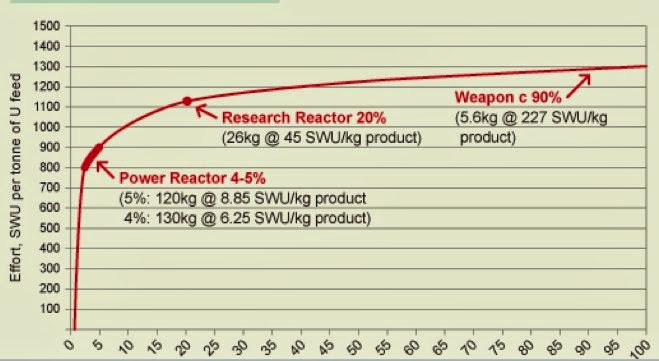
By virtue of having functional uranium enrichment facilities and technical expertise to spin centrifuges, Iran – like any other nation with that technology – can create weapons-grade material if it decided to. But this doesn’t mean it can already “build a nuclear bomb.”
Moreover, Tehran Bureau‘s paraphrased quote from Khatami is itself misleading. The source of the quote can be found here, although Tehran Bureau does not provide a link over to it, a highly unprofessional reporting practice.
Mohammad Ali Shabani, a doctoral researcher at the University of London’s School of Oriental and African Studies (SOAS), notes that the focus of Khatami’s speech before the IRGC gathering was not the nuclear issue, but rather Iran’s Kurdistan province and Syria. While Khatami is by no means an expert on nuclear technology, when he did touch briefly on the subject, this is what he said, according to Shabani’s translation:
[But] even if we could build a bomb, we would not do such a thing as our Guardian Jurist [Ayatollah Khamenei] deems use [of such weapons] impermissible (haraam). The West’s concerns are not about a bomb, but Iran’s capabilities; just as our nuclear scientists enriched uranium from 5% to 20%, undoubtedly they can [do so] to 40%, 50% and finally 90%, which is needed in order to build a bomb, and they [Iran’s scientists] posses this knowledge. Our role model is our Dear Prophet, who even forbade the poisoning of an enemy city, and this is our evidence [basis] for not building a bomb.
This is a political statement, not a technical declaration. Nowhere does Khatami state that Iran can build a nuclear weapon. Tehran Bureau‘s reporting also omits the fact that such statements about such scientific capabilities and the nation’s official, absolute prohibition on nuclear weapons are nothing new for Iranian officials.
For instance, in February 2010, then-Iranian president Mahmoud Ahmadinejad announced that “right now in Natanz, we have the capacity to enrich uranium at high levels.” He added, “We have the capability to enrich uranium more than 20 percent or 80 percent but we don’t enrich (to this level) because we don’t need it.”
A couple years later, in April 2012, The Guardian itself reported on a nearly identical statement made by Gholamreza Mesbahi Moghadam, a minister of the Iranian parliament. The framing in both that piece and the latest report are very similar:
Iran has the technological capability to produce nuclear weapons but will never do so, a prominent politician in the Islamic republic has said.
The statement by Gholamreza Mesbahi Moghadam is the first time an Iranian politician has publicly stated that the country has the knowledge and skills to produce a nuclear weapon.
Moghadam, whose views do not represent the government’s policy, said Iran could easily create the highly enriched uranium that is used to build atomic bombs, but it was not Tehran’s policy to go down that route.
Moghadam told the parliament’s news website, icana.ir: “Iran has the scientific and technological capability to produce [a] nuclear weapon, but will never choose this path.”
The 2012 Guardian report sparked false conclusions and predictable reactions from Israeli officials, who eagerly exploited the non-news for political posturing. The following year, a number of different reports published by The Guardian contained bad analysis, dubious allegations and sloppy journalism.
Unfortunately, The Guardian, now in partnership with Tehran Bureau, is at it again.
Climate Policy Risk: Who’s In Denial?
By Marlo Lewis | Cooler Heads | December 19, 2014
Earlier this week, economist Roger Bezdek gave a presentation at the Ronald Reagan Building titled “Carbon Dioxide: Social Cost or Social Benefit?” Washington Post columnist Dana Milbank covered the event and published a short review titled “The new climate denialism: More carbon dioxide is a good thing.”
Granted, it’s hard to develop an argument about a complex, technical subject in a 760-word column, but Milbank doesn’t even try. He takes cheap shots and spouts off without knowing whereof he speaks.
Milbank starts with a snarky putdown, asserting that “though Bezdek is an economist, not a scientist, he played one on Monday.” How so? Some of Bezdek’s slides show the fertilization effects of carbon dioxide (CO2) emissions on crop yields and plant growth. For example:

That is not playing scientist, it is citing scientific research.
Another slide shows that, over the past 250 years, CO2 emissions closely correlate with population growth, life expectancy, and per capita GDP.

Milbank retorts that “correlation is not the same as causation.” Deep! But does he really think unprecedented improvements in the human condition — a greater than doubling of average human life expectancy, an eight-fold increase in the sheer abundance of human life, and an eleven-fold increase in global per capita GDP — would have occurred without fossil fuels?
Milbank repeatedly misfires, as the excerpts below (indented in blue) and my comments (standard width in black) show.
For years, the fossil-fuel industries have been telling us that global warming is a hoax based on junk science.
Name a single CEO of any major energy company or trade association who says that! If there are any, they are outliers. Skeptics argue that predictions of catastrophic global warming are based on speculative interpretations of selective evidence and models projections that increasingly diverge from observations. That’s a different thesis — and much harder to refute. Milbank inveighs against a straw man.
But now these industries are floating an intriguing new argument: They’re admitting that human use of coal, oil and gas is causing carbon dioxide in the atmosphere to rise — but they’re saying this is a good thing.
New argument? The Center for the Study of Carbon Dioxide and Global Change has emphasized the ecological and health benefits of atmospheric CO2 enrichment since its inception in 1998. Founder Sherwood Idso’s first peer-reviewed paper on the subject was published in 1991.
I pointed out to Bezdek that increasing energy use fueled the economic growth, and CO2 was just a byproduct. So wouldn’t it make more sense to use cleaner energy?
CO2 does not dirty the air, so reducing/capturing CO2 emissions does not make energy cleaner. CO2 is not “just” a byproduct; it is the inescapable byproduct. Thus, UN emission reduction targets endanger both existing economic, health, and welfare benefits and progress towards a wealthier, healthier world.
He [Bezdek] went on to point out that “35,000 people every year in the United States die in automobile accidents, but the solution is not to ban automobiles. You try to make them safer.” And the solution to climate change is not to ban energy but to make it cleaner.
Making energy “cleaner” in the present context means banning (rapidly phasing out) the carbon-based fuels that currently supply 82% of U.S. and world energy consumption, and are projected — absent additional market-rigging interventions — to supply 80% of U.S. energy in 2040.
The presentation began as a standard recitation of the climate-change denial position, that “there’s been no global warming for almost two decades” and that forecasts are “based on flawed science.”
Milbank provides no evidence that the “standard recitation” is incorrect – very likely because he can’t.

So instead, he resorts to name calling and labels Bezdek a ‘denialist.’
Enough back and forth. What matters is the big picture. Some 1.3 billion people in developing countries have no access to electricity and 2.3 billion people face chronic electricity shortages.

Source: International Institute for Applied Systems Analysis
Even in Europe and the United States, millions of low-income households struggle with high energy costs. Many must choose between heating and eating.

Source: EU Fuel Poverty Network

Source: Bezdek (2014)
Forcing an energy-starved planet to abandon fossil fuels before cheaper substitutes are available is bound to have profound social costs. That is Bezdek’s thesis, and it is spot on. Milbank is in denial.
Regime-Change Makeover: Blaming Syria for the Rise of ISIS
By Finian CUNNINGHAM | Strategic Culture Foundation | 16.12.2014
If a recent report in the British Guardian is to be believed, then the West is angling for a new pretext to step up its covert war of regime in Syria. The new pretext, it would seem, is that the Damascus government of Bashar al Assad was the main driving force in the creation of the so-called Islamic State (IS) terror network.
The report by Guardian Middle East correspondent Martin Chulov, published on December 11, is riven with contradictions and anomalies. It raises more questions than answers that the author seems strangely indisposed to delve into.
But the upshot is the apparent conclusion that the Syrian government of President Assad is to blame for the rise of IS, or ISIS (Islamic State in Iraq and Syria). That the Syrian army has emerged as the main fighting force on the ground to defeat IS in the latter’s campaign to overthrow the Assad government is right away a troubling question mark over the credibility of the Guardian report.
Nevertheless, if we follow the dubious logic of this narrative, then it would seem to be aimed at providing a «just cause» for Western hostility towards Assad and for the objective of regime change.
IS, an offshoot of the Al Qaeda network, is portrayed in the Western media as «the world’s most menacing terrorist group». It has gained notoriety for its videos purporting to show the execution of Western hostages. The US government has appointed itself as the leader of an international coalition to «wipe out» IS with air strikes on its bases in remote areas of Iraq and Syria.
The efficacy and legality of these US-led air strikes are questionable, and as already noted, it is the Syrian state forces carrying out ground operations that are actually inflicting the heaviest losses on the IS network – the latest being in the eastern city of Deir al Zour.
So, it is at odds, to say the least, that the Guardian should now be casting the Syrian authorities as the originating sponsors of the very network that they are locked in mortal combat with.
The report, headlined ‘ISIS: the inside story’, informs readers that around early 2009 the Syrian government gave the group crucial help in ramping up its insurgency in Iraq. That insurgency, according to the Guardian, then «spilled over» into Syria in 2011, as if by accident. And so we can condemn the «dastardly Syrians» for their own maladroit blowback.
The main source of the story, we are told, is «one of the Islamic State’s senior commanders» who goes by the nom de guerre of Abu Ahmed.
The Guardian correspondent writes: «Syria’s links to the Sunni insurgency in Iraq had been regularly raised by US officials in Baghdad and by the Iraqi government. Both were convinced that the Syrian president, Bashar al-Assad, allowed jihadists to fly into Damascus airport, where military officials would escort them to the border with Iraq».
That «assessment» is largely based on «interrogations» of captured jihadists. In other words, by torture techniques that even the US Senate Intelligence Committee report last week described as «unreliable».
According to the Guardian, the Syrian plot to destabilise Iraq with Sunni extremists was hatched during two top-secret meetings near Damascus during early 2009. The meetings were between Syrian military intelligence, senior members of the Baathist party of President Assad and the jihadists of Al Qaeda in Iraq – the latter being the precursor to the IS network.
The Syrian objective was allegedly to «unsettle the Americans and their plans for Iraq». This was nearly three years before the Americans ended their military occupation of the country at the end of 2011.
Apparently, the Iraqis knew of Syria’s alleged covert involvement and that led to a «poisoning of relations» between the then Iraqi Prime Minister Nouri al Maliki and Assad.
However, this is where the story does not add up. Why would the Alawite-Shia-led government of Bashar al Assad get into bed with Sunni extremists to fuel a sectarian war against co-religionists in Iraq? Why would the Assad regime cause mayhem in a neighbouring Shia country and to provoke enmity with regional allies in Baghdad and Tehran? Not only that but to fan an insurgency by Sunni extremists who avowedly harbour a death wish against Alawites, Shia and other Sunnis who have for centuries formed a stable social order in Syria? Such a gambit by the Syrians would be suicidal. It is completely counter-intuitive.
These are just some of the questions that throw serious doubt on the narrative put forward by the Guardian, which seeks to pin the blame on Syria for the rise of IS – «the world’s most menacing terrorist group».
Tellingly in this «in-depth exposé» on the origins of IS in Iraq, there is not a single mention of the well-documented role that Western ally Saudi Arabia played, and continues to play, in fuelling the network and its Wahhabi fundamentalist ideology.
Moreover, the report appears to go into great detail about how IS and its Al Qaeda forerunner came into being at the giant US prison in southern Iraq known as Camp Bucca. The detention centre opened in 2004 and brought together some 24,000 suspected members of various Sunni militia. According to several sources, the inmates were permitted by the Americans to freely associate.
Even the Guardian’s IS source, Abu Ahmed, noted the lax prison conditions under US command. «We could never have all got together like this in Baghdad, or anywhere else. It would have been impossibly dangerous. Here, we were not only safe, but we were only a few hundred metres away from the entire al-Qaida [sic] leadership».
One of the inmates to be given special attention by the US jailers was Abu Bakr al Baghdadi, who is now leader of IS and self-proclaimed caliph of the Middle East. Al Baghdadi was seen by the Americans as a «fixer» and a figure who could sort out fractious disputes and «resolve conflicts among the inmates». It is obvious that the «emir» was being groomed by the Americans as a future leader. Al Baghdadi, who several sources believe is a US intelligence asset, was released from Camp Bucca at the end of 2004, less than a year after being first imprisoned and despite the fact of his past terrorist activities.
Incredibly, the Guardian affects a doe-eyed naivety in this account and spins a narrative that the IS terror group was formed under «the noses of the American jailers». That is, without US knowledge or intent.
The newspaper’s IS «source» is quoted as saying: «When [the civil war in] Syria became serious it wasn’t difficult to transfer all that expertise to a different battle zone. The Iraqis are the most important people on the military and Shura councils in Isis now, and that is because of all of those years preparing for such an event. I underestimated Baghdadi. And America underestimated the role it played in making him what he is».
Contrary to the spin, the American handlers didn’t underestimate anything. Baghdadi and his future IS role went to plan.
Camp Bucca has been rightly referred to by several other observers as a «terror academy» from which IS graduated. Some 70 per cent of the IS current senior commanders are believed to have passed through Camp Bucca and other American detention centres before they were shut down at the end of the US occupation of Iraq. That the IS group was inculcated and mentored by American intelligence seems without question – except to Western media like the Guardian.
But that Western media whitewash of the real American origins of IS is now overlaid with a new veneer of misinformation that purports to lay the blame for the rise of IS terrorism on the Syrian government. A classic case of the terrorists and their terror-master blaming the victim.
Why the Americans are now leading a bombing campaign against their own creation is a good question. But the answer has got nothing to do with defeating terrorism, as the ineffectual bombing campaign so far would suggest. As the Western media narrative evolves, it seems rather more to do with extending the mission of IS – regime change in Syria.
MTV Glorifies Venezuela’s Barricade Protests in New Reality TV Show
By Z.C. Dutka | Venezuelanalysis | December 18, 2014
Santa Elena de Uairen – US entertainment channel MTV has signed a contract with a Venezuelan media group to purchase extensive footage of the violent anti-government protests that wracked the South American nation earlier this year, to be featured in the new reality series Rebel Music.
The footage, captured by citizen reporters with GoPro cameras, show masked and shirtless men throwing handmade grenades and wreaking general havoc in a coordinated effort to force president Nicolas Maduro’s resignation that lasted from February to May this year.
43 people were killed during that time, the majority while trying to clear rubbish from or cross the barricades set up by demonstrators. Numerous public institutions including hospitals, universities, and transportation agencies were also burnt down in protest.
Reporte Confidencial became known for editing the GroPro material nightly, adding in a pumping dubstep track befitting a London club scene, and posting the finished videos to YouTube, where they received thousands of views from around the world.
It is this material MTV now seeks to own.
The reality show Rebel Music claims to be inspired by young people who “are raising their voices to demand change for a better future…. often putting their lives on the line,” according to the show’s website.
With this premise, many Venezuelans fear the show’s narrative will grant hero status to those hardcore protestors – whose tactics were so violent they effectively drove away a majority of opposition supporters, according to polls.
Furthermore, as the White House approves sanctions against Venezuelan government officials, others accuse the MTV program of dovetailing too neatly with US foreign policy. […]
The series, which first aired last month, will also feature voices of dissent in Myanmar, Iran, Senegal, Turkey and US Native American communities.
The US media has made no effort to hide its contempt of Venezuela’s socialist government since the Hugo Chavez’s election in 1999, while Chavez, in turn, repeatedly accused Washington of funding subversive movements to remove him from office.
Shepard Fairey and USAID
Venezuelan political analyst Luigino Bracci pointed out the paradoxical use of red stars and other archetypal communist symbols in an op-ed for Caracas newspaper Alba Ciudad last week, which he attributes to the show’s executive producer, Shepard Fairey.
Fairey is the pop art empresario behind the OBEY campaign and the red and blue stencil portrait of Barack Obama, which featured the word HOPE and was used universally throughout the US president’s initial campaign.
Though he calls himself apolitical, Fairey has been criticized for reproducing communist Cuban and Korean poster art with slight twists and selling them as his own. In a 2008 interview with the magazine Mother Jones, reporter Liam O’Donoghue also called the artist out on appropriating images from social movements, usually created by artists of color, and stripping them of their political messages.
In a promotional video, Rebel Music features Venezuelan reggae artist OneChot whose 2010 video for the English-language single “Rotten Town” generated controversy for its depiction of Caracas as an Inferno of crime and murder, replete with images of dead and dying children.
Though the reggae singer also claims to abstain from politics, his music is more popular with Venezuela’s privileged class, the same sector that widely supports the opposition.
“You are not free of violence anywhere. That is why I fight for change in Venezuela,” OneChot says to the MTV cameras.
While many Caracas artists would be eager for such international exposure, some mistrust the pre-determined script many reality shows are known to possess, believing it may spell out further US defamation of Venezuela’s socialist leaders.
After being approached by MTV correspondents to represent the pro-Chavez version of events, underground hip hop artist Arena La Rosa announced her refusal on her Facebook page.
“My dignity and my ideas are worth more than a million [page] views, so I have wisely decided not to participate,” the chavista rapper said.
On the same day La Rosa posted her response, the Associated Press released documents detailing the US government’s failed attempt at infiltrating the Cuban hip hop scene, by way of the developmental organization USAID.
According to the AP, Washington had sought to build a network of young people seeking “social change” to spark a resistance movement against the government of Cuban president Raul Castro.
Incidentally, Maduro has accused numerous opposition leaders of attempting the same kind of subterfuge during February’s unrest. A committee of victims and their families has even assembled to seek justice from those public figures who they believe encouraged such extreme tactics.
Meanwhile, Venezuela will have to wait for the MTV segment to be released to understand how their high-stakes reality will be adapted to meet the lofty demands of broadcast entertainment.
Featured Video

Iran’s Next Strike May Not Explode. It Could Shut You Down
or go to
Aletho News Archives – Video-Images
Book Review
New paperback: Butchered by “Healthcare”
Lies are Unbekoming | October 20, 2026
 Butchered by “Healthcare” is Robert Yoho’s plain-spoken account of how American medicine stopped being a profession and became an industry. 341 pages. Over a thousand references. Thirty-eight chapters.
“Screening Tests Are Useless”, on tests that find diseases that would never have hurt you. “The FDA Protects the Big Drug Companies”, on an agency funded by the companies it regulates. “The Journals’ Sins Are the Editors’ Sins”, on ghostwritten studies and captured peer review. “Opioids and ‘Pain Management’”, on how a generation was prescribed its way into addiction. “Prozac and Relatives” and “Antipsychotics Are Disastrous”, on what psychiatry does to adults and children. “Surgery: Money Before Patients”. “Failed Cancer Treatments”. “Futile CPR and Overprescribing”. “Billing Scams & Specialty Warfare”. “Hospitals Are Sharks”. Each with a Patient Tips section at the end on how to survive it.
If you have ever walked out of a doctor’s office with a prescription you didn’t ask for, or watched a parent put through a treatment that made them worse, this is the book you want on your shelf before the next appointment. … Full review
Butchered by “Healthcare” is available on Lulu now.
Blog Roll
 Aletho News
- Iran’s Next Strike May Not Explode. It Could Shut You Down /Col Doug Macgregor
- Iran: US political targets legitimate if assassinations return
- Iraq shuts key border crossing with Iran under US pressure: Report
- Undersea Internet cables could be targeted in retaliation for attacks on Iran: IRGC deputy chief
- EU sending ‘biased’ observers to interfere in Serbian election – president
- White House envoy declares kinetic action against Yemen ‘fruitless’
- Ukraine deployed thousands of microdrones in Iraqi Kurdistan: Tasnim
- Iran calls for emergency UNSC meeting over Trump’s ‘brazen’ bomb talk, Israeli threats
- Iranian sources reveal details of Russia-China Hormuz proposal
- Plan for more US-Israel integration puts our military tech at risk
- If Americans Knew
- Americans at National Conservatism Conference held in Israel this year criticize Israel
- Christiane Amanpour exits CNN with a legacy shaped by the debate over Israel
- Israel’s war on Iran is the final move in a decades-old strategy
- Israel Denies Entry to French Journalist, U.S. Researcher Amid Rise in Entry Denials
- Gaza’s hospitals are running out of life-saving fuel – Daily Update
- Mysterious bot accounts reportedly spread fake ‘man on the street’ videos for Michigan Senate candidate
- Israeli Defense Minister Katz Says Over 60 Lebanon Villages Have Been Destroyed
- Why Is Israel Running TV Ads in Iowa Ahead of the Midterms?
- Hind Rajab’s Alleged Killer Is in the United States. HRF Demands His Arrest.
- US Officials Face Fresh Pressure After Another American ‘Brutalized’ by Israeli Settlers in West Bank
- No Tricks Zone
- E-Cars Reduce CO2 Emissions By Only 41% Compared To Internal Combustion Engine Vehicles
- Predictions Made By Renowned Climate Professor Over Past Decades Have Been Proven To Be Poor
- New Study Suggests Large Regions Of The Pacific Ocean Have Been Cooling For The Last 80 Years
- Germany’s Green Energy Debacle: High Energy Costs Force Kahla Porzellan to Close After 182 Years!
- New Study: 50 Years Of The Most Aggressive ‘Net Zero’ Policies Can Only Affect The Global Climate By 0.03°C
- US September “Heat” Was No Record…Many Records Set Decades Ago
- Latest European Green Energy Debacle; Portugal’s Largest Flagship Solar Park Insolvent!
- Green Energy Debacle: German Expert Professor Fritz Vahrenholt Warns Of Severe Economic And Social Consequences
- Two More Paleo Reconstructions Affirm Meters-Higher Sea Levels Across Ireland, Brazil 7000-6000 Years Ago
- New Study: Earth And Venus Surface Warmth Largely Explained By Convection And Lapse Rate, Not CO2 Or Radiation

