The Problem with the Venezuela Sanctions Debate
By Peter Hayakawa | Center for Economic and Policy research | July 18, 2014
As murmurs of U.S. sanctions against Venezuela continue in the aftermath of the protest violence there, researcher Michael McCarthy recently published an article in World Politics Review making some good arguments for why they would be a bad idea. He points out that unilateral sanctions lack regional support, and argues that they would discourage dialogue within Venezuela, would likely be ineffective, and may even harm U.S. interests by scuttling efforts to improve and maintain ties in the region.
McCarthy claims that the push for sanctions represents a “symbolic action” on the part of U.S. officials to communicate “universal support for human rights.” This assumption is pervasive in the mainstream debate about Venezuela sanctions; most commentators assume that the moral basis of imposing sanctions is sound and that the only real debate is on whether they will have the desired practical effect. In this context, some of the most obvious questions are missing from the discussion—in particular: a) what right does the U.S. have to enact coercive, unilateral economic measures against democratically-elected governments (measures that in this case, happen to be nearly universally opposed in the rest of the region and, as a study by pollster Luis Vicente Leon recently presented at the Washington Office on Latin America shows, are overwhelmingly opposed domestically in Venezuela)? And b) what integrity does the U.S. have when it comes to promoting human rights?
Last year, over a thousand unarmed protestors were killed by the U.S.-backed military government of Egypt after an illegal coup overthrew the country’s first democratically-elected president. Among those killed was a young journalist, Ahmed Assem el-Senousy, who had the misfortune to film his own murder at the hands of a government soldier who had spotted his camera. It was a grim echo of an event from another era—in June, 1973, Swedish journalist Leonardo Henrichsen similarly filmed his own death in Chile at the hands of a soldier in an unsuccessful military coup attempt that presaged Augusto Pinochet’s U.S. supported takeover three months later. The State Department claims that U.S. interests always align with democracy and human rights, but it is hard to miss the glaring gap between U.S. rhetoric on these issues and its actions.
While officials and Congress members throw unfounded accusations at the Venezuelan government and continue to discuss punitive measures, there are no comparable discussions about removing tax-payer funded military aid to U.S. allies with abysmal human rights records – let alone imposing sanctions — including states like Israel, Egypt, Saudi Arabia, and many others. The U.S. ended its partial freeze of military aid to Egypt this January and has quietly defended Israel during its latest assault on Gaza, even as Palestinian casualties rise at an alarming rate. In this hemisphere, in places like Honduras and Colombia, countries ruled by rightwing allies of the Obama administration, the laws that condition U.S. military and security aid on human rights standards are nearly systematically ignored, just as they are in the Middle East.
Over the past dozen years, the U.S. government has made no secret of its hostility toward the government of Venezuela – even supporting and getting involved in a 2002 military coup against Chávez – despite the fact that, over and over again, it has been elected democratically. In her recent book, “Hard Choices,” former Secretary of State Hillary Clinton even refers to Chávez as a “self-aggrandizing dictator.” She is much more sympathetic toward Egypt’s former president, Hosni Mubarak, whom she doesn’t label a dictator, though she does qualify her praise of his commitment to Middle East peace by mentioning that he is an “autocrat at home.” Clinton is not shy in explaining how she urged President Obama not to call for Mubarak to step down during the height of the 2011 Egyptian protests, citing her concerns about U.S. interests, just as she is not shy about detailing how she intervened to ensure that democratically-elected President Manuel Zelaya was not reinstalled after an illegal military coup in Honduras. Most importantly, while Mubarak was in office and while she was Secretary of State (i.e. when it mattered), Clinton, like virtually every other U.S. official, consistently defended the U.S. relationship with Egypt. Instead of referring to him as an autocrat while she headed the State Department, she famously referred to Hosni Mubarak and his wife as “friends of the family.”
Last November, the current Secretary of State, John Kerry, visited Latin America and announced the “end of the Monroe Doctrine,” stating that the U.S. would no longer work to undermine the sovereignty of its hemispheric neighbors in order to promote its own interests. The open secret is that U.S. officials still actively reserve the right to define human rights and democracy in ways that serve U.S. objectives. Over the decades and right up to the present, the U.S. has spent hundreds of billions of taxpayer dollars to arm some of the world’s least democratic actors, often with some of the worst human rights records, from Suharto to Sisi. Even if one disagrees that the U.S.’s historic disdain for left governments in Latin America is not a factor in the push for sanctions against Venezuela, considering the role that the U.S. continues to play in supporting human right abuses around the world, why accept the U.S. government’s own terms in the debate?
CNN boots reporter from Israel-Gaza conflict after ‘scum’ tweet
RT | July 18, 2014

CNN has pulled correspondent Diana Magnay out of her post covering the Israeli-Palestinian conflict after the reporter tweeted that Israelis cheering bombs hitting Gaza, and who had allegedly threatened her, were “scum.”
Magnay was “threatened and harassed” before and during her report, a CNN spokeswoman told The Huffington Post, leading to the reporter’s reaction on Twitter.
“She deeply regrets the language used, which was aimed directly at those who had been targeting our crew,” the spokeswoman added. “She certainly meant no offense to anyone beyond that group, and she and CNN apologize for any offense that may have been taken.”
Israelis could be heard cheering missiles heading for Gaza on Thursday during a live Magnay report from a hill overlooking the Israel-Gaza border.
“I think you can probably see there are lots of Israelis gathered around who are cheering when they see these kinds of Israeli strikes,” Magnay said during the report.
Following the shot, Magnay tweeted, “Israelis on hill above Sderot cheer as bombs land on #gaza; threaten to ‘destroy our car if I say a word wrong’. Scum.”
The reporter eventually deleted the tweet, but not before it had been retweeted more than 200 times.
The CNN spokeswoman said Magnay has been assigned to Moscow.
Magnay’s removal comes a day after NBC News sent its reporter on the conflict, Ayman Mohyeldin, out of Gaza.
The network has not explained why Mohyeldin, a much-praised veteran reporter of the Israeli-Palestinian conflict, was removed. Sources have told media outlets that security concerns compelled NBC executives to pull Mohyeldin, yet the network quickly replaced him in Gaza with chief foreign correspondent Richard Engel.
TV Newser reported Wednesday that NBC staffers were unhappy that Engel was ordered to front an “NBC Nightly News” segment on the killing of four Palestinian children on a Gaza beach even though Mohyeldin was a witness to that very strike and had reported from the site in its aftermath.
Thursday marked the beginning of a ground offensive into Gaza by Israeli forces. Palestinian health officials said 27 Palestinians were killed in the latest ground operation, Reuters reported. One Israeli soldier perished in the fighting.
Well over 200 Palestinians and two Israelis have been killed since fighting ramped up along the border nearly two weeks ago.
NYT headline on Gaza killings hits new low
By Jonathon Cook | The Blog from Nazareth | July 17, 2014
Remember the appalling New York Times headline of July 10 over a story about a family of nine Palestinians killed by an Israeli strike as they watched the World Cup on the beach: “Missile at beachside Gaza cafe finds patrons poised for World Cup.” Could you imagine a more obfuscatory and misleading headline? Like the missile made the decision about where to strike on its own. I thought that was about as low as the NYT would sink.
But I was wrong. They have come up with an even more dissembling headline, one clearly crafted to avoid highlighting the embarrassing fact that Israel slaughtered four boys yesterday who were playing football in clear view on the beach.
The first subeditor does a reasonable job: “Four young boys killed playing on a Gaza beach”. It’s not exactly clear who did the killing, but at least it gives an idea of the story.
But then, it seems, the senior editors stepped in and demanded the headline be rewritten. Not to make the headline better or clearer, mind you. Simply to strip it of any relevance to the story; in fact, to strip it of any obvious meaning at all. Here it is: “Boys Drawn to Gaza Beach, and Into Center of Mideast Strife.”
No missile strike, no blast, no deaths and injuries, no Israeli responsibility to be found in the headline. All of it whitewashed by that weasel word “strife”.
And look at the enormous burden being placed on the verb “drawn”. It leaves the reader wondering not why Israel targeted four children but why they were “drawn” to the beach in the first place. And further, why they were drawn – rather than thrust by Israel – into the “center of strife”. The clear implication is that they were pawns, lured to the beach and exploited for some nefarious end. Who could have done such luring and to what purpose?
The NYT editors are world-class wordsmiths. They understand the power of words and they are experts at using them to achieve the desired effect. There is nothing accidental about this headline. It is as precisely targeted as the Israeli missile that ended those four young boys’ lives.
www.fair.org/blog/2014/07/17/nyt-rewrites-gaza-headline-was-it-too-accurate/
Ex-NYT editor Jill Abramson on how flak and ‘anti-terrorism’ help discipline corporate media
Interventions Watch | July 16, 2014
She didn’t quite put it in those words, but it’s essentially what she’s saying: that the U.S. government would contact the New York Times and tell them that publishing this, that or the other story would ‘help the terrorists’. And that the New York Times would take those threats seriously and bring the story to a halt (even if they did eventually work out that the U.S. government’s intentions may not always have been entirely honourable).
Here’s a quote from an interview Abramson recently gave to Cosmopolitan :
‘Sometimes the CIA or the director of national intelligence or the NSA or the White House will call about a story . . . You hit the brakes, you hear the arguments, and it’s always a balancing act: the importance of the information to the public versus the claim of harming national security . . . Over time, the government too reflexively said to the Times, ‘you’re going to have blood on your hands if you publish X’ and because of the frequency of that, the government lost a little credibility . . . But you do listen and seriously worry . . . Editors are Americans too . . . We don’t want to help terrorists’.
Interesting, as well, that Abramson seems to be suggesting that being ‘against terrorists’ – or at least, people who the U.S. government claim are terrorists – is somehow an inherent part of being an American, like it’s a national religion or something.
Which for the political and media classes, I suppose it is – except when it comes to the terrorism of the U.S. government and its allies, in which case being ‘against terrorism’ is blasphemous.
WaPo’s Gaza dispatch: ugly and dishonest
By Jonathon Cook | July 17, 2014
There’s something deeply ugly, verging on mendacious, about this eye-witness account of the strike against children on Gaza’s beach, which killed four of them, by William Booth in the Washington Post. It begins with what appears to be context but is, in fact, simply an effort to deflect criticism from Israel and blame the victims.
He starts with this: “It is not unusual for militants to launch rockets from sites near my hotel.”
So had rockets been launched from the spot where the children were killed? Here’s the account of veteran Guardian / Observer correspondent Peter Beaumont:
The building that was hit was just a shipping container next to where one of the kids’ father keeps his boat and stores fishing nets. The kids were just playing hide and seek there. They shoot missiles (against Israel) from this neighborhood but none from that location.
So how is Booth’s introduction relevant in any way to the story? Yes, militants have fired rockets from the neighbourhood (after all, from where else but “neighbourhoods” are they likely to fire rockets in one of the most densely populated places on earth). But, as Beaumont points out, they were not being fired from the area that was attacked by Israel.
Israel is supposedly using precision missiles. So this was deliberate targeting of that area, an open area from which no rockets had been fired and where children regularly play. If Booth believes that rockets fired from the general area somehow justify Israel’s missile strikes on the children (and if not, why mention it?), then why the hell is he staying in the al-Deira hotel, which is presumably as likely to be hit as the harbour where the children play?
There is also something unpleasant in his style of writing here. Note this line as the injured children are brought to his hotel.
Two young terrified kids were bleeding and injured, and they were quickly bandaged on the floor of the terrace, where guests usually eat skewers of grilled chicken, suck on water pipes and watch the sun go down.
That incidental reference to the chicken and water pipes is added for colour. It’s a journalistic technique we use when there’s not much happening and you want to set a scene to draw the reader into the story. But here it’s entirely unnecessary. The action – the bleeding children and the dead bodies nearby – are what will draw the reader in, as any rookie journalist would know. So when I see Booth pausing from his description to talk about how the guests entertain themselves in the evenings, I sense – both as a journalist and a reader – that his attention is not fully on the events at hand.
I’d like to believe this is his way of responding to the shock of the events he’s just witnessed. But I suspect something else is at work here, something revealing about the business of journalism.
Most of the time, we write not for ourselves or our readers but for our editors – in short to keep our jobs. Here Booth was called on to stop being the careerist and connect with his humanity. That, rare though it is in journalism, was what the moment required: to see, really see the desperate, terrified little boys in front of him. Instead, all he could think about was technique and what his editors might want.
CNN’s Jake Tapper was taught to recognize the “essential importance” of Israel

By Alison Weir | July 14, 2014
There are some videos posted on Youtube with titles such as “CNN’s Jake Tapper Demolishes PLO Spokeswoman.” Tapper’s questioning is extremely aggressive and reflects a pro-Israel approach to the current violence. (Israel is again massacring Gazans like shooting fish in a goldfish bowl. Instead of discussing this, Tapper focuses on the rockets from Gaza, but seems to know/care little about the real facts about these and about the conflict in general.)
I wondered where Tapper’s bias came from, and learned some information about his upbringing that I suspect influences his journalism:
Tapper attended Akiba Hebrew Academy, since re-named Jack M. Barrack Hebrew Academy, which is proud of inculcating its students with loyalty to Israel.
The school website states that it “offers a unique study abroad program in Israel during the fall trimester of a student’s junior year. In this program, learning comes to life as students supplement their formal academic studies with trips to historical sites that parallel their study of the history of the Jewish people and Israel…”
The site notes that many of their students report that their experiences in Israel “are life-changing; they return to Barrack with greater maturity as well as a stronger personal connection to Israel and their Jewish roots.”
Tapper’s alma mater emphasizes: “…we are committed to the centrality of Israel and the State of Israel.”

Jake Tapper’s alma mater
There is, of course, always the hope that Tapper will transcend this early conditioning, shared by so many US journalists. However, so far there is little indication that he has done so. Especially, of course, when pro-Israel elements are so strong in today’s media, it’s not a good career move to report too fully and honestly on the conditions of Palestinians.
RELATED STORIES:
Myra Noveck & the New York Times: Another journalist with children in the Israeli military, “US Media and Israeli Military: All in the Family,” “Jodi Rudoren, Another Member of the Family: Meet the New York Times‘ New Israel-Palestine News Chief,” “Ethan Bronner’s Conflict With Impartiality,” and “AP’s Matti Friedman: Israeli citizen and former Israeli soldier.”
An Open Letter to Wall Street Journal from a Palestinian Woman
Amani Al-Khatahtbeh · Muslim Girl · 7.09.14
Bret Stephens penned a column last week in the Wall Street Journal titled, “Where are the Palestinian Mothers?” in which he makes the racist assertion, based on conversations he’s had with three individual women, that all Palestinian mothers raise their children to become “martyrs.”
The thing that Stephens must understand about Palestinians’ concept of “martyrdom” is that it’s a coping mechanism for the senseless loss of life they must endure. Their “martyrdom” is not an aspiration. It’s forced upon them.
My mother is a Palestinian. At the moment, she’s probably enjoying the peace of her suburban home. Unlike her counterparts in the West Bank and Gaza, she’s free from having to worry about her children being killed by occupational forces in the middle of the night, or even broad daylight. For a Palestinian mother, this is a freedom that can never be appreciated enough.
My grandmother was a Palestinian. She passed away last summer after decades of being a flag bearer of the strength of Palestinian mothers. She was a survivor of the Deir Yassin massacre in 1948, which was one of the first Palestinian villages to be ethnically cleansed by Zionist militias to create the state of Israel. She was seven years old at the time and witnessed the murder of her neighbors and relatives, including her own Palestinian grandmother and infant brother. Yet, she survived and, in her refugee exile, created a fruitful and happy life for her family that allows me to write this letter today.
Over that time, those militias came together to become the Israeli Defense Force. One of their leaders, Yitzhak Rabin, rose to become the prime minister of Israel.
In his column, Stephens claims that he has “yet to meet the Israeli mother who wants to raise her boys to become kidnappers and murderers.” Actually, every Israeli mother is legally obligated by the Israeli government to enter her sons and daughters into an institution that systematically kidnaps and murders. It’s the Israeli Defense Force.

Since 1948, the IDF has been creating mourning mothers for the longest occupation in modern human history, riddled with war crimes and human rights atrocities. Its illegal and immoral actions have been denounced in more United Nations resolutions than any other country in the world. The most recent were a series of four resolutions in the UNHCR denouncing Israel’s international law violations. All four of them passed 46 to 1 — with the lone dissenter being the United States.
Stephens refers to West Germany’s “moral rehabilitation” and ironically suggests it for the Palestinian people. Yet, in an iconic visit last month, Pope Francis stood before Israel’s apartheid wall and placed his hand on Palestinian graffiti that, in desperate broken English, said in spray paint: “Bethlehem looks like Warsaw ghetto.”
Extremist Israeli settlers have been engaging in some of the worst hate crimes in the conflict, notoriously known for pillaging mosques and churches, attacking and even running over Palestinians, and vandalizing Palestinian property with calls for the death of all Arabs. One of the three kidnapped Israelis was old enough to have already served in the IDF, and all three of them were on an illegal settlement on Palestinian territory. While no mother should endure the abduction or death of a child — neither Israeli nor Palestinian — the situation must be placed in the context of the conflict as a whole.
Since the disappearance of the three Israelis on June 12, 2014, at least 50 Palestinian civilians have been killed in retribution — including a 7-year-old child and a 15-year-old child — and hundreds more injured or imprisoned with no charges. But, you don’t know any of their names, despite having the three Israelis’ names memorized by heart.
Last Tuesday night, Palestinian teenager Muhammad Abu Khdeir was kidnapped and burned alive by an Israeli mob. His mother — like the mothers of the eight other murdered Palestinians or the hundreds of newly detained prisoners — will never be given the media attention to express her grief. Nor does she or any of the other Palestinian mothers have the power to demand that Israel brings back their boys.
Among many Israelis, Mohammad’s death was celebrated. All facets of Israeli society, even up to the government, called for this sort of retribution, with Netanyahu demanding “revenge” and Ben-Ari calling for “death to the enemy.” While the call for justice is expected of any democratic country, what Israel is calling for is indiscriminate revenge.
Netanyahu called the killers of the three Israelis “human animals.” But, in Israel’s collective punishment of the Palestinian people, his accusations and references of a faceless Palestinian enemy, and his sheer condoning and even encouragement of anti-Arab racism, he is implicating the Palestinian people as a whole.
Indeed, Israel treats Palestinians as nothing more than animals. In this case, Israel has placed its “animal” in a cage and keeps prodding it with a stick — or, more accurately, with rubber bullets, tear gas, and even white phosphorous. Then, when the animal bites back, Israel feigns selective memory and moral outrage and punishes it in ways that are unprecedented in our modern history.
Stephens makes the racist suggestion that Palestinian culture is filled with hate, but what, then, can we say of a society that views another people as collectively subhuman?
If you want to know where the Palestinian mothers are, they are living under a military occupation, among an unarmed civilian population, quietly reciting their boys’ names in their hearts as American columnists try to write them away.
Photography by Robert Croma.
A condensed variation of this column was originally published as a letter to the editor in the Wall Street Journal.
ABC misrepresents Israelis as victims, the real picture is quite different
In the real world, Israelis don’t appear too afraid of attack. In fact they rather enjoy watching their trapped and defenseless victims burn:
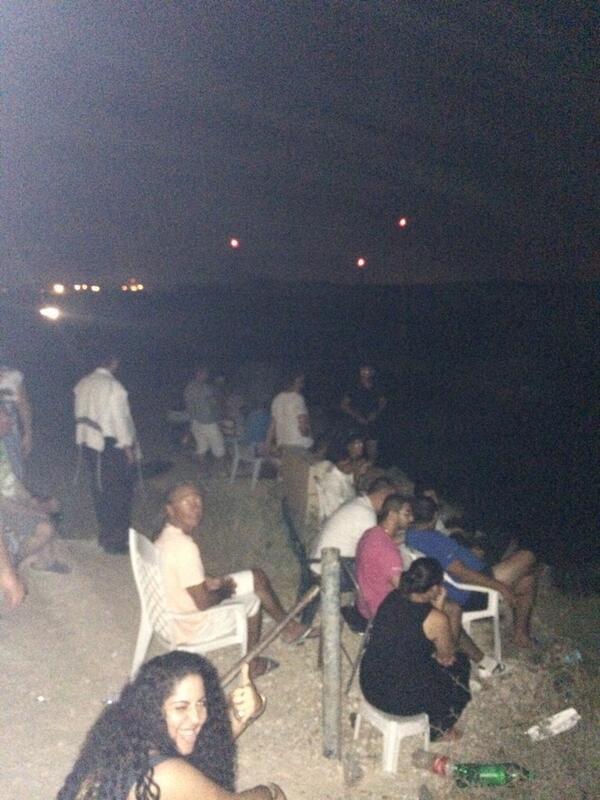
NYT Protects the Fogh Machine
By Robert Parry | Consortium News | July 9, 2014
A principal way that the New York Times and other leading U.S. news outlets engage in propaganda is by selecting which facts to include in a story and which ones to exclude, a process exemplified by a Times article on an interview in which the head of NATO excoriates Russia over Ukraine.
NATO Secretary General Anders Fogh Rasmussen accused Russia of playing a “double game,” warned the West not to be fooled by the peaceful overtures of Russian President Vladimir Putin, and declared, “There’s no doubt that Russia is heavily engaged in destabilizing eastern Ukraine, and they continue their activities.”
However, since Rasmussen provided no evidence, his credibility would seem to be central to this story. And, on Wednesday, correspondents Mark Landler and Michael R. Gordon provided some background about Rasmussen, noting that he served as prime minister of Denmark before getting the NATO gig in 2009.
But what is excluded from the Times’ story is what the readers would need to evaluate Rasmussen’s honesty as well as his own ability to weigh evidence. Not mentioned by Landler and Gordon was the fact that this is the same Anders Fogh Rasmussen who swallowed President George W. Bush’s bogus case for invading Iraq hook, line and sinker.
Before the U.S. invasion in 2003, Rasmussen famously declared that “Iraq has WMDs. It is not something we think; it is something we know. Iraq has itself admitted that it has had mustard gas, nerve gas, anthrax, but Saddam won’t disclose. He won’t tell us where and how these weapons have been destroyed. We know this from the UN inspectors, so there is no doubt in my mind.”
Of course, pretty much everything that Rasmussen declared was wrong, but it succeeded in tricking the Danish parliament into voting to join Bush’s “coalition of the willing” to invade Iraq. Yet, while Rasmussen was rewarded for his cooperation and his duplicity with the NATO job, a Danish intelligence analyst Frank S. Grevil was imprisoned for four months for disclosing documents that exposed Rasmussen’s deception.
While such an arrangement might now seem normal for Americans who have gotten use to prosecutions of truth-tellers who expose war crimes and immunity for liars who start unnecessary wars, Rasmussen’s falsehoods on Iraq – and his role in that criminal invasion – are facts that should have been provided to the Times’ readers as they judge whether to believe his current allegations about Russia and Ukraine.
But Landler and Gordon saw fit to protect the Fogh machine by leaving out his unpleasant history, all the better to sell the preferred narrative blaming the entire Ukraine crisis on Russia and Putin. [For more on the New York Times’ journalistic malfeasance, see Consortiumnews.com’s “Will Ukraine Be NYT’s Waterloo?”]
Checkered Journalistic Careers
Michael Gordon’s bias in favor of U.S./NATO propaganda also has a long history. He co-wrote, with Judith Miller, the infamous aluminum tube story of Sept. 8, 2002, relying on U.S. intelligence sources and Iraqi defectors to frighten Americans with images of “mushroom clouds” if they didn’t support Bush’s invasion of Iraq. The timing played perfectly into the administration’s advertising “rollout” for the Iraq War.
The story turned out to be false and to have unfairly downplayed skeptics of the nuclear-centrifuge scenario. The aluminum tubes actually were meant for artillery. But the article provided a great impetus toward the Iraq War, which ended up killing nearly 4,500 U.S. soldiers and hundreds of thousands of Iraqis.
Gordon’s co-author, Judith Miller, became the only U.S. journalist known to have lost a job over the reckless and shoddy reporting that contributed to the Iraq disaster. For his part, Gordon continued serving as a respected Pentagon correspondent.
Gordon’s name also showed up in a supporting role on the Times’ botched “vector analysis” story of Sept. 17, 2013, which nearly helped get the United States into another Mideast war, with Syria. That story traced the flight paths of two rockets, recovered in suburbs of Damascus after the Aug. 21 sarin gas attack, back to a Syrian military base 9.5 kilometers away.
The article became the “slam-dunk” evidence that the Syrian government was lying when it denied launching the sarin attack that killed several hundred people. However, like the aluminum tube story, the Times’ ”vector analysis” ignored contrary evidence, such as the unreliability of one azimuth from a rocket that landed in Moadamiya because it had struck a building in its descent. That rocket also was found to contain no sarin, so it’s inclusion in the vectoring of two sarin-laden rockets made no sense.
But the Times’ story ultimately fell apart when rocket scientists analyzed the one sarin-laden rocket that had landed in the Zamalka area and determined that it had a maximum range of about two kilometers, meaning that it could not have originated from the Syrian military base 9.5 kilometers away. C.J. Chivers, one of the co-authors of the article, waited until Dec. 28, 2013, to publish a halfhearted semi-retraction. [See Consortiumnews.com’s “NYT Backs Off Its Syria-Sarin Analysis.”]
Last April, Gordon was involved in another journalistic fiasco when he and two other correspondents fell for some grainy photographs peddled by the U.S. State Department to supposedly prove that Russian military personnel — who had been “clearly” photographed in Russia — turned up fighting in Ukraine.
However, two days later, the Times was forced to retract the story when it was discovered that a key photo that was supposedly taken in Russia was actually snapped in Ukraine, destroying the premise of the article. [See Consortiumnews.com’s “NYT Retracts Russian Photo Scoop.”]
Taking the Israeli Line
Landler, the Times’ White House correspondent, has been another propaganda specialist when it comes to framing foreign confrontations in ways favorable to the U.S. government and its allies. For instance, on March 5, 2012, he appeared on MSNBC and offered this account of Israeli-Iranian tensions:
“The Israelis feel the window for that [denying Iran the capability to build nuclear weapons] is closing and it’s closing really fast, and if they allow it to close without taking military action, they would find themselves in a position where the Iranians suddenly are in possession of nuclear weapons, which they’ve threatened already to use against Israel. As the Israelis always say, that’s an existential threat to Israel, which is something we don’t necessarily feel here in the United States.”
Landler’s account was hair-raising, claiming that Iranians have “threatened already to use [nuclear weapons] against Israel” which the Israelis understandably would perceive as an “existential threat.” But Landler’s statement simply wasn’t true. Iranian leaders continue to deny that they even want nuclear weapons, so it makes no sense that they would threaten to use them against Israel.
For instance, in February 2012, Iran’s Supreme Leader Ali Khamenei, who controls the armed forces, called “the possession of nuclear weapons a grave sin” and said “the proliferation of such weapons is senseless, destructive and dangerous.” He insisted that “the Iranian nation has never pursued and will never pursue nuclear weapons.”
Further, the U.S. intelligence community reported in 2007 that Iran stopped research work on a nuclear weapon in 2003 and has not resumed that effort. That assessment has been reaffirmed periodically and remains the position of the CIA and other intelligence agencies.
Beyond that, for Iran to threaten to “annihilate” Israel with its hypothetical nuclear weapons would represent one of the strangest threats in world history. Here is a nation without nuclear weapons – and whose top leader disavows any intent to get nuclear weapons – supposedly threatening to use those non-existent weapons against a nation which has a large stockpile of nuclear weapons.
So, perhaps it’s no surprise that the Times would spare its readers the relevant background on NATO chief Anders Fogh Rasmussen’s credibility because otherwise the supposed “newspaper of record” might also be expected to explain why it continues to entrust sensitive stories to journalists who have a history of slanting information in ways that may advance their careers but misleads the public.
~
Investigative reporter Robert Parry broke many of the Iran-Contra stories for The Associated Press and Newsweek in the 1980s. You can buy his new book, America’s Stolen Narrative, either in print here or as an e-book (from Amazon and barnesandnoble.com).
David Cameron spoke to Benyamin Netanyahu today. Here’s what was said.
Interventions Watch | July 9, 2014
From the Gov.uk website:
‘The Prime Minister spoke to Prime Minister Netanyahu earlier this evening about the situation in Israel. The Prime Minister strongly condemned the appalling attacks being carried out by Hamas against Israeli civilians. The Prime Minister reiterated the UK’s staunch support for Israel in the face of such attacks, and underlined Israel’s right to defend itself from them’.
So then, Israel simply defending itself from Hamas’ attacks on Israeli civilians.
The actual facts, of course, speak of a somewhat different reality. According to medical sources in the Gaza strip:
-
Number of Israelis killed since the launch of ‘Operation Protective Edge’: 0
-
Number of Palestinians killed since the launch of ‘Operation Protective Edge’: ‘at least 47′, of which 41 were civilians, and 12 children.
Nevermind that the very idea of ‘defending yourself’ against a people you have spent decades occupying, dispossessing, racially oppressing, collectively punishing and generally brutalising is a complete nonsense.
It doesn’t need me to point out that David Cameron’s supposed ‘humanitarianism’ and commitment to ‘freedom’ – which we are told was behind his decision to bomb Libya, and to almost bomb Syria – is a complete sham. He is simply the latest mouthpiece for a British Establishment that has long both committed and supported the perpetration of war crimes and atrocities in the service of colonial domination, while talking the language of human rights and freedom.
But statements like that one help to drive the point home.
And they illuminate where the BBC have been taking their lead from, perhaps:

(BBC News Online front page, circa 01:00 A.M., July 9th 2014)
Israel deploys dehumanizing rhetoric to justify mass assault on Palestinians
By Chloé Benoist | Al-Akhbar | July 9, 2014
As Israeli forces began their assault on the Gaza Strip, Israel’s leaders and media ramped up a rhetoric offensive, using dehumanizing discourse to garner support for deadly military action in the besieged Palestinian territory.
Operation “Protective Edge” – Israel’s latest military offensive to be given a name with nurturing undertones after “My Brother’s Keeper” and “Pillar of Defense” – has already killed at least 43 Palestinians and bombarded more than 400 locations in the Gaza Strip in less than 48 hours.
An estimated 200 rockets have been fired from Gaza since Tuesday, but there have been no recorded Israeli casualties.
Despite the intensity of the Israeli assault on Gaza, Israel’s politicians are framing the military operation as one they entered against their will.
“We are not eager for battle, but the security of our citizens and children takes precedence over all else,” Israeli Prime Minister Benjamin Netanyahu said on Tuesday.
An Israeli official quoted by The Jerusalem Post lamented that Palestinian Authority President Mahmoud Abbas could not “influence his Hamas partners to exercise restraint and stop kidnapping and murdering Israeli teenagers and sending rocket barrages into Israel.”
“That sort of restraint would have prevented the current crisis,” he added.
The implication of these statements are that Hamas has forced Israel into launching a full-scale military operation against them, conveniently ignoring the recent crackdown on the West Bank after the disappearance of three Israeli youths, which Israel blamed on Hamas without providing evidence to back its claims.
In an op-ed titled ‘Send Gaza to the Stone Age’ published on Wednesday, Israel Hayom’s Editor-in-Chief Amos Regev praised the Israeli government for “the levelheadedness, restraint and sound judgment it exhibited before ordering the Israel Defense Forces [sic] to launch Operation Protective Edge,” calling for a ground operation in Gaza to be “carried out with determination and clenched lips, with the knowledge that this is a war of no choice.”
Israel, its leaders would have you believe, is reluctantly entering an open conflict out of a sense of duty, once again indulging in the self-victimizing rhetoric that all Israeli military actions are defensive or retaliatory.
Israel’s enemy, once again, is Hamas, and Zionist political figures have stepped up their eliminationist discourse.
Israeli Defense Minister Moshe Yaalon called for the destruction of Hamas.
“We are continuing to carry out attacks that are exacting a heavy price from Hamas,” Yaalon said. “We are destroying its arms, terrorist infrastructure, command and control systems, institutions, government buildings, terrorists’ homes, and we are killing terrorists in the organizational high command.”
Other politicians echoed the sentiment.
“A sovereign state cannot allow for a bunch of terrorists to run its life; we must cut off the head of the snake and for every Hamas man to know that his blood is upon his head,” Shas party leader Aryeh Deri tweeted on Wednesday.
Deputy Defense Minister Danny Danon took it one step further, calling on Israel Wednesday to cut off fuel and electricity supplies to the Gaza Strip.
“It is inconceivable that on the one hand we fight Hamas and on the other we provide fuel and electricity that are used to transport missiles that are fired at us,” Danon said. “We are in a campaign against Hamas, which is firing missiles at Israel’s citizens.”
Neither Yaalon, Deri or Danon have acknowledged the human cost of such actions on Gaza, an enclave already suffering because of the crushing Israeli siege and already struggling with fuel and electricity shortages. Nor did they mention the loss of civilian life which is the inevitable consequence of wide military actions in such a densely populated territory.
Israeli leadership, however, has repeatedly emphasized the plight of Israeli civilians. Israeli news outlets have dutifully reported every siren sounded in Israeli towns since the beginning of Operation “Protective Edge” and lamented the closure of some Israeli summer camps.
Cara Lebenzon, a blogger for The Times of Israel penned a post berating those who have spoken out against Israel’s attacks, saying “I would actually argue we are TOO nice to Hamas and the people of Gaza. I’ve never heard of a single country on earth that supplies their mortal enemies with water, goods and electricity on a daily basis, have you?” For these folk, Palestinians are not people entitled to basic human rights, and an assault on Gaza is not only warranted, but long overdue.
Meanwhile, the Israeli Occupation Forces (IOF) have bombarded Twitter with stylized graphics trying to garner sympathy for the fearful Israeli population who must run to bomb shelters — conveniently ignoring Palestinians’ lack of shelters during its deadly air raids.
The IOF has also shared an image which it claims is representative of Hamas’ own visual campaign to convince civilians stand in as human shields. The graphic, available only on IOF social media platforms, could have been created by the IOF’s own design team, purportedly standing as “proof” of Hamas’ treachery instead of showing actual existing Hamas posters.
The argument about Hamas forcing people to stand as human shields is one Israel regularly trots out, despite the fact that such claims have been dismantled in the past, and that the IOF is itself guilty of using such tactics repeatedly.
But the “human shield” argument is a convenient excuse for Israeli forces to continue with tactics that they know full well will lead to many civilian casualties while rejecting any responsibility for these deaths. Palestinians living in Gaza are not granted the luxury of being considered innocent civilians in Israeli rhetoric; dead Palestinian men, women and children are all guilty of standing in the way of Israeli weapons, despite the fact that there is nowhere to run in the open-air prison that is Gaza.
Dehumanization of Palestinians and demonization of the Palestinian struggle are essential tools of the Israeli military machine in order to continue justifying expansive military action while maintaining its discourse of victimization.
Follow all the latest updates on Israel’s assault on the Gaza Strip.
Featured Video

Iran’s Next Strike May Not Explode. It Could Shut You Down
or go to
Aletho News Archives – Video-Images
From the Archive
Zionism’s Violent Legacy
By Donald Neff | Washington Report On Middle East Affairs | January 1996
On January 4, 1948, Jewish terrorists drove a truck loaded with explosives into the center of the all Arab city of Jaffa and detonated it, killing 26 and wounding around 100 Palestinian men, women and children.[1] The attack was the work of the Irgun Zvai Leumi – the “National Military Organization,” also known by the Hebrew letters Etzel – the largest Jewish terrorist group in Palestine. The Irgun was headed by Revisionist Zionist Menachem Begin and had been killing and maiming Arabs, Britons and even Jews for the previous ten years in its efforts to establish a Jewish state.
This terror campaign meant that at the core of Revisionist Zionism there existed a philosophical embrace of violence. … continue
Blog Roll
 Aletho News
- Riyadh Says Its Oil System Is Intact. The Numbers Say Otherwise.
- Trump and Netanyahu Want to “Finish the Job” on Iran
- US ‘one-sided dictation’ not Iran’s beliefs makes rational talks impossible: Baghaei
- Iran’s Next Strike May Not Explode. It Could Shut You Down /Col Doug Macgregor
- Iran: US political targets legitimate if assassinations return
- Iraq shuts key border crossing with Iran under US pressure: Report
- Undersea Internet cables could be targeted in retaliation for attacks on Iran: IRGC deputy chief
- EU sending ‘biased’ observers to interfere in Serbian election – president
- White House envoy declares kinetic action against Yemen ‘fruitless’
- Ukraine deployed thousands of microdrones in Iraqi Kurdistan: Tasnim
- If Americans Knew
- Americans at National Conservatism Conference held in Israel this year criticize Israel
- Christiane Amanpour exits CNN with a legacy shaped by the debate over Israel
- Israel’s war on Iran is the final move in a decades-old strategy
- Israel Denies Entry to French Journalist, U.S. Researcher Amid Rise in Entry Denials
- Gaza’s hospitals are running out of life-saving fuel – Daily Update
- Mysterious bot accounts reportedly spread fake ‘man on the street’ videos for Michigan Senate candidate
- Israeli Defense Minister Katz Says Over 60 Lebanon Villages Have Been Destroyed
- Why Is Israel Running TV Ads in Iowa Ahead of the Midterms?
- Hind Rajab’s Alleged Killer Is in the United States. HRF Demands His Arrest.
- US Officials Face Fresh Pressure After Another American ‘Brutalized’ by Israeli Settlers in West Bank
- No Tricks Zone
- E-Cars Reduce CO2 Emissions By Only 41% Compared To Internal Combustion Engine Vehicles
- Predictions Made By Renowned Climate Professor Over Past Decades Have Been Proven To Be Poor
- New Study Suggests Large Regions Of The Pacific Ocean Have Been Cooling For The Last 80 Years
- Germany’s Green Energy Debacle: High Energy Costs Force Kahla Porzellan to Close After 182 Years!
- New Study: 50 Years Of The Most Aggressive ‘Net Zero’ Policies Can Only Affect The Global Climate By 0.03°C
- US September “Heat” Was No Record…Many Records Set Decades Ago
- Latest European Green Energy Debacle; Portugal’s Largest Flagship Solar Park Insolvent!
- Green Energy Debacle: German Expert Professor Fritz Vahrenholt Warns Of Severe Economic And Social Consequences
- Two More Paleo Reconstructions Affirm Meters-Higher Sea Levels Across Ireland, Brazil 7000-6000 Years Ago
- New Study: Earth And Venus Surface Warmth Largely Explained By Convection And Lapse Rate, Not CO2 Or Radiation

