A few questions for the New York Times
By Alison Weir | July 26, 2014
Following are a few short questions for the New York Times in regard to a recent news report:
1. When are you going to cover the killing of Palestinians the same way you cover the killing of Israelis?
Israel’s killing of at least 8 civilians in one day was relegated to the second half of the story and not mentioned in the headline.
The murder of a father of three children, a staff member for Defense for Children International, got two sentences in the 17th paragraph. Israeli forces’ killing of a 17-year-old got one sentence in the 25th paragraph. The killing of a 12-year-old and a 15-year-old got a half sentence – between them – in the 27th paragraph.
2. When are you going to stop calling Palestinians who are fighting to protect their homeland “militants” and start calling them resistance fighters?
3. When are you going to stop framing this as “Israel against Hamas” rather than Israel against Gazans? Or Israel against Palestinians?
The vast majority of the over 800 people Israeli forces have killed in the last 19 days are civilians, many of them children. The vast majority of the over 5,000 injured are civilians, many of them children. Israel is, once again, destroying large amounts of civilian infrastructure: hospitals, schools, roads, family homes, etc.
4. When are you going to include crucial context on the American connection – that hard-pressed American taxpayers give Israel $8.5 million per day?
When are you going to mention that we have given tiny Israel far more of our tax money than to any other country – In total, over $233.7 billion (corrected for inflation). Currently, on average, 7,000 times more per capita than to others around the world.
5. When are you going to tell your readers that senior “objective” reporter Isabel Kershner was a British citizen who went to Israel to become an Israeli citizen? When are you going to divulge her family ties to the Israeli military?
6. When are you going to include the true context of the violence:
- Gaza is basically an open-air prison that Israel has been starving for over seven years (an Israeli official called it putting Palestinians “on a diet“),
- Rockets from Gaza began in April 2001 AFTER Israeli invasions and shelling of Gaza, that the vast majority of these rockets are small, home-made projects that cause no damage (and that this was the case long before the Iron Dome system was deployed),
- During the entire time the rockets have been used they have killed a total of approximately 30 Israelis, while during this same period Israeli forces have killed over 4,700 Gazans?
- The Jewish state was created through a war of ethnic cleansing, and that the allegedly “only democracy in the Middle East” has no constitution and has never declared its borders,
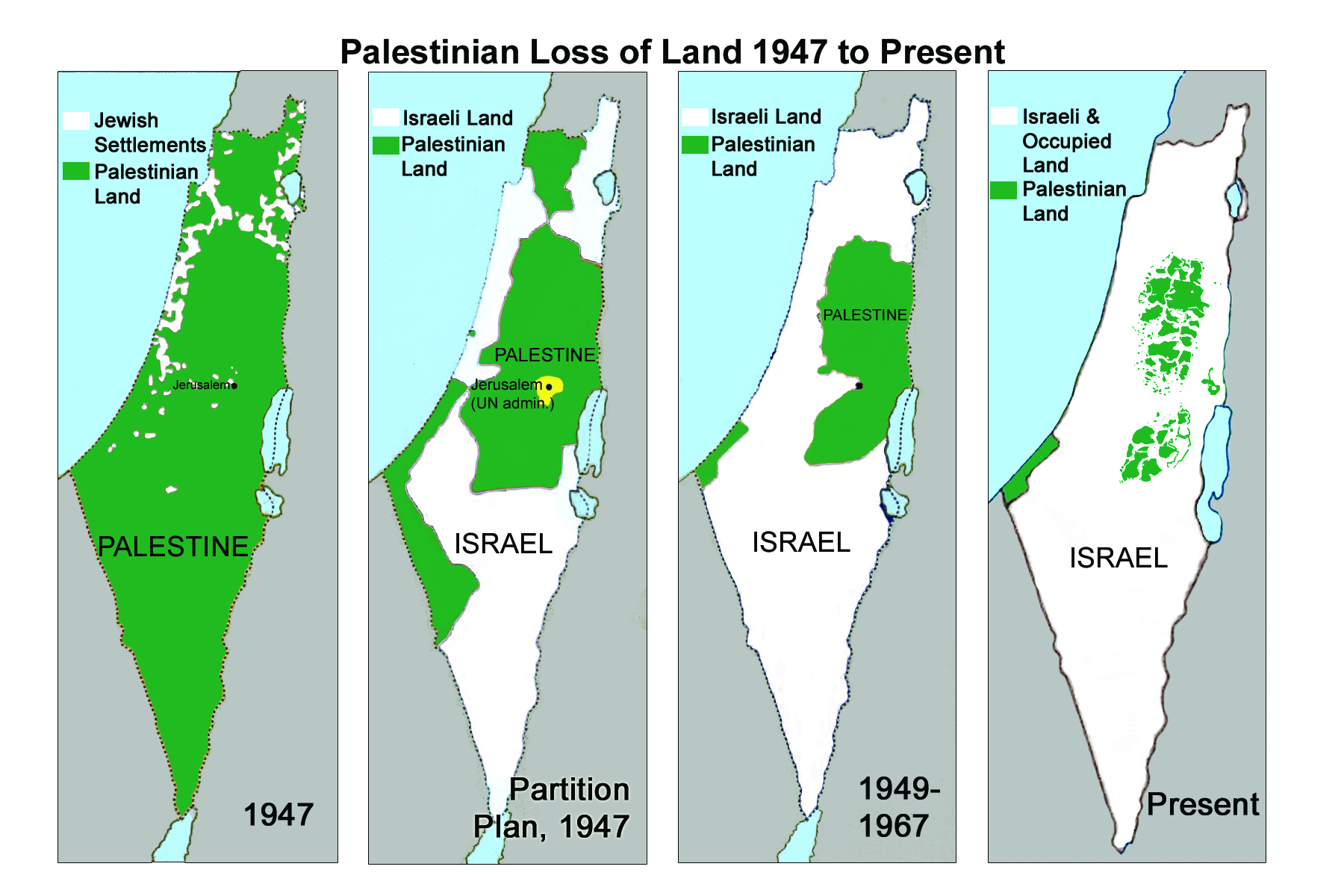
- Palestinians in the Occupied Territories are living on approximately 15 percent of their original land.
7. When are you going to give readers the facts without Israeli spin?
Alison Weir is president of the Council for the National Interest, executive director of If Americans Knew, and author of Against Our Better Judgment: How the US was used to create Israel.
ADDITIONAL RESOURCES
Statistical Report on New York Times coverage of Israel-Palestine
Where’s BBC scoop on Netanyahu’s big lie?
By Jonathon Cook | The Blog from Nazareth | July 26, 2014
Here’s a hugely significant story that I suspect will get almost no play outside Palestinian solidarity sites. Mickey Rosenfeld, the Israeli police spokesman, has told BBC reporter Jon Donnison that there are no grounds for believing Hamas ordered the abduction of three Israeli teens on June 12. Rather, the police say, it was carried out by a rogue cell from Hebron with a loose political affiliation to Hamas.
 It was those abductions, and Israel’s response in blaming Hamas and rounding up and jailing hundreds of its activists in the West Bank, that triggered Hamas rocket fire that in turn was used by Israel to justify its attack on Gaza, which is currently killing hundreds of civilians.
Israel’s prime minister, Benjamin Netanyahu, stated at the time that he had cast-iron evidence that Hamas was behind the abductions and the movement would pay a “heavy price”. He never produced that evidence. But now Israel’s police force itself concedes that Hamas was not involved.
Many of us, of course, suspected that Netanyahu was using the abductions as a pretext to destroy the unity government Hamas and Fatah had recently set up after years of conflict. Now we have official confirmation.
I wonder why, given the great scoop he has, Donnison appears only to have tweeted about this. It’s now more than 24 hours since he went public with the information. Is he waiting for another news outlets to beat him to the story? Or is he tweeting it because he knows the BBC isn’t interested in running a story so embarrassing to Israel?
Anyway, kudos to him for getting the scoop, even if no one seems interested in it. Another one down the memory hole.
The New York Times amplifies Israeli propaganda
Interventions Watch | July 24, 2014
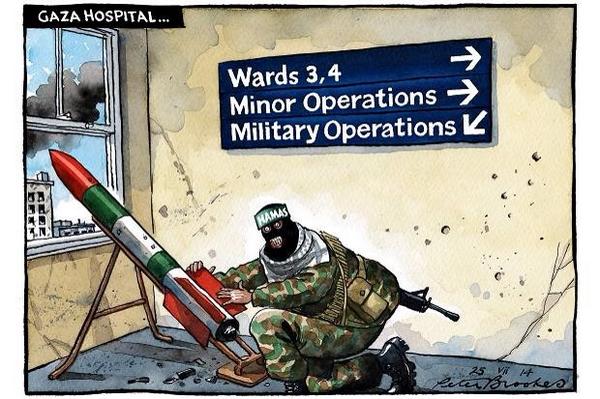
And what The Goldstone Report found the last time Israel fired on hospitals in Gaza, and then accused Hamas of using them as military bases:
‘The Mission did not find any evidence to support the allegations that hospital facilities were used by the Gaza authorities or by Palestinian armed groups to shield military activities and that ambulances were used to transport combatants or for other military purposes. On the basis of its own investigations and the statements by UN officials, the Mission excludes that Palestinian armed groups engaged in combat activities from UN facilities that were used as shelters during the military operations’.
The Israeli government are proven liars in this regard, and no-one should be surprised if they are lying this time around as well.
That they are proven liars in this regard apparently isn’t enough to stop The Times taking the Israeli government at their word, and then publishing cartoons which can only have the effect of helping to justify war crimes.
Zionist censors enabling war crimes
By Kevin Barrett | Press TV | July 25, 2014
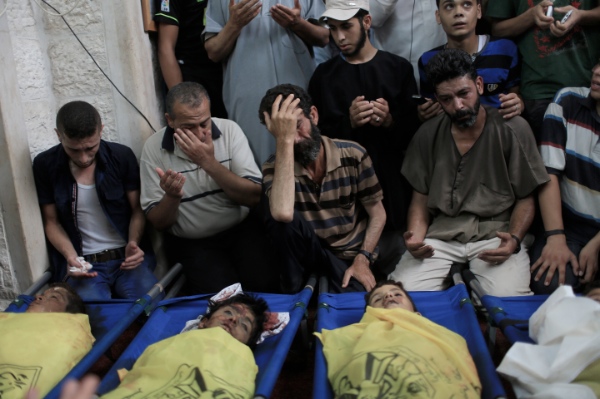
During the past two weeks, a horrified world has witnessed accelerating Israeli war crimes in Gaza. Those crimes are enabled by the United States, Israel’s biggest backer on the world stage.
Why does the US support Israel? Because Americans have been robbed of the freedom to think and speak freely about Zionism.
The United States of America is supposed to be a bastion of free expression. The courts have ruled that even the most lurid and depraved words and pictures are entitled to Constitutional protection.
Yet in the self-styled Land of the Free, an “apartheid wall of censorship” blocks the free expression of anti-Zionist arguments.
This censorship is not directly imposed by the government. The real enemy of free speech is the Zionist Power Configuration (ZPC).
In his book The Power of Israel in the United States, professor James Petras identified the ZPC as the source of that power. The ZPC is led by AIPAC, the most powerful lobby in America. It includes the 51 Major American Jewish Organizations, which are backed by only about one half million of America’s six million Jews. That is less than 10% of the total. But as Petras says, “what a half million!” He adds that “the 51′s hundreds of thousands of activists are strategically placed in institutions, as well as geographically, with a centralized command capable of mobilizing money, media attention and political leverage in any priority, political, cultural or social arena.”
This extremely well-financed mob of 500,000 pro-Israel fanatics can be counted on to make life miserable for anyone guilty of expressing an anti-Zionist opinion, or allowing one to be expressed. I know this from repeated personal experience.
For example, I recently gave an interview on WWUH, a radio station based at the University of Hartford, Connecticut. (You can listen by conducting an internet search for “WWUH 9/11 Wake-Up Call.”)
During the interview, I expressed the same views, and cited the same facts, that are featured in my opinion columns at Press TV. I presented empirical evidence that Israel and its American supporters orchestrated 9/11 in order to trick the USA into destroying or destabilizing “seven countries in five years” – as General Wesley Clark revealed. Those seven countries were the ones blocking Israel’s quest for regional domination.
I also explained why Zionism is morally indefensible and ultimately doomed, but persists by controlling the USA’s Middle East policy.
Predictably, a backlash from the ZPC ensued. A complaint was lodged against WWUH and copied to the University. According to the complaint, I had delivered “an anti-Zionist sermon” and my words were “biased.”
The implication: Americans must never hear anything but the pro-Zionist sermons the mainstream media continually inflicts on them. Alternative views are forbidden.
The University of Connecticut knows that the ZPC is tightly organized and financed by hundreds of millionaires and a considerable number of billionaires. Zionist complaints like the one targeting my interview come with an implied threat to withhold funding from the University if it continues to allow the free expression of anti-Zionist views.
Such Zionist censorship is a pervasive feature of American university life. While teaching at the University of Wisconsin-Madison I was twice attacked by the legions of the ZPC. The second time, in 2006, after I appeared on Fox News arguing that 9/11 was an inside job, the University lost more than $500,000 in canceled contributions in less than 24 hours. I am currently unemployable in the American academy because any university that hired me would face this kind of financial attack from the Zionists.
It isn’t just the universities that are terrorized by Zionist censorship. The American media, too, is punished on the rare occasions that it diverges even slightly from the pro-Israel party line. A newspaper, magazine, or broadcast outlet that allows an anti-Zionist voice to be heard will be slammed with a barrage of complaints, and perhaps be hit in the pocketbook with an advertising boycott, from the ZPC.
Politicians are censored even more tightly. Whenever an American statesman stands up for the US rather than Israel – as in the cases of William Fulbright, Paul Findley, James Abourezk, Cynthia McKinney, James Trafficant, and many others – they are hounded out of office by the ZPC.
Even presidents are vulnerable. Many analysts believe that Jimmy Carter was made a one-term president by the ZPC due to his attempts to force peace on Israel. Some even argue that John F. Kennedy was removed from office in part because he had staked his life on an attempt to prevent Israel from obtaining nuclear weapons.
Even gatherings of American Muslims are subject to Zionist censorship. Last week when Obama hosted a White House Ramadan iftar (fast-breaking dinner) for Muslims he also invited Israeli Ambassador Ron Dermer, a notorious racist who recently said the child-killing Israeli military should get the Nobel Peace Prize. Obama stubbornly intoned the Orwellian mantra “Israel has the right to defend itself” and clearly was not prepared to listen to the views of his Muslim guests.
Shortly after the Ron Dermer fiasco at the White House, I myself was viciously attacked by a Zionist Jew at a Ramadan iftar in Madison, Wisconsin. The Zionist started a conversation about “Israel’s right to defend itself” and proclaimed that Hamas was a terrorist group. When I responded by gently explaining some of the facts about the conflict, the Zionist iftar-infiltrator had a fit and repeatedly called me a Nazi. Then he lodged a complaint with the organizer of the iftar.
Apparently the Muslim-majority perspective cannot be voiced anywhere in America – not even at a Muslim celebration! It seems that every group in America – every civic group, church group, NGO, nonprofit, and even the Muslim groups – are infiltrated by the Zionist thought police, who are dedicated to preventing the American people from hearing any version of events except their own.
Why are the Zionists so desperate to suppress free thought and free debate about the Middle East? The answer is obvious: The Zionist position is indefensible. If Americans knew the horrors that the Zionists have inflicted not only on Palestine, but also on the United States – including the cold-blooded murder of almost 3,000 Americans on September 11th, 2001 – the bloody Zionist experiment would face its final reckoning.
Why Did Bernie Sanders Get Gaza So Wrong?
Senators Sanders & Leahy Join in Deeply Flawed Resolution Supporting Israel
By James Marc Leas | CounterPunch | July 24, 2014
All 100 Senators, including Vermont’s Bernie Sanders and Patrick Leahy, joined in passing a Senate resolution on July 17, 2014 supporting “the State of Israel as it defends itself against unprovoked rocket attacks from the Hamas terrorist organization.”
However, the facts differ.
A report issued by the authoritative “Meir Amit Intelligence and Terrorism Information Center” (ITIC), a private Israeli think tank that “has close ties with the country’s military leadership,” unintentionally debunked the Senate resolution more than a week before its unanimous consent vote in the Senate. The weekly ITIC reports regarding rocket fire are frequently quoted on the Israeli government’s own web site.
The ITIC July 8, 2014 report,“News of Terrorism and the Israeli-Palestinian Conflict (July 2 – 8, 2014),” states: “For the first time since Operation Pillar of Defense [November 2012], Hamas participated in and claimed responsibility for rocket fire [on July 7, 2014].”
Thus, Hamas rocket fire only re-started on July 7 after a 19 month cease-fire. As we will see, this was nearly a month after Israeli forces launched massive military operations in the West Bank and Gaza starting on June 12. But those Israeli military operations were not the only provocation.
First, about the cease fire that was in place: Operation Pillar of Defense was an 8 day aerial assault on Gaza in November 2012 that ended with a ceasefire agreement brokered by Egypt. Graphs presented on the ITIC website show that the cease-fire was effective. In the weeks and months following that agreement, the ITIC consistently reported the absence of Hamas rocket fire. In addition, a May 2013 article in the Jerusalem Post, “IDF source: Hamas working to stop Gaza rockets,” reported that Hamas was policing other groups to prevent rocket fire.
The July 8 ITIC report also divulged why Hamas launched its first rocket fire at Israel in more than 19 months on July 7: On that night Israeli forces had bombed and killed 6 Hamas members in Gaza. The ITIC report includes a picture of the six Hamas members. Thus, a report from an authoritative Israeli source described the provocation for the resumption of rocket fire: Hamas rocket fire began only after Israeli forces had engaged in nearly a month of military operations in violation of the ceasefire agreement and had killed 6 Hamas members in Gaza.
The Palestine Center for Human Rights (PCHR) also issues weekly reports, these reports focus on Israeli human rights violations in the occupied territories, including the West Bank and Gaza. In its July 10 weekly report, PCHR gave further details of the events that immediately preceded the July 7 Hamas rocket launchings: PCHR reports:
Between 01:00 and 16:00, the bodies of 5 members of the ‘Izziddin al-Qassam Brigades (the armed wing of Hamas) were recovered from a tunnel dug near Gaza International Airport in the southeast of the southern Gaza Strip town of Rafah. They were identified as: Ibrahim Dawod al-Bal’awi, 24; ‘Abdul Rahman Kamal al-Zamli, 22; Jum’a ‘Atiya Shallouf, 26; and Khaled ‘Abdul Hadi Abu Mur, 21, and his twin brother, Mustafa. Another three members were recovered alive, but one was in a serious condition. It should be noted that the tunnel was repeatedly bombarded by Israeli warplanes and tanks. According to medical sources, the deceased inhaled toxic gases. The ‘Izziddin al-Qassam Brigades declared in an online statement that 5 of its members were killed as a result of airstrikes that targeted places of resistance activities.
The facts show that Israeli forces had to work quite hard to get Hamas to end its cease-fire. The killing of the six Hamas members was not an isolated event. Israeli forces and settlers had gone wild on the West Bank starting on June 12 after the kidnapping of three Israeli teens. Israeli forces had also attacked 60 targets in Gaza during those three weeks of June. Then, on the night of July 7, 2014, the Israeli Air Force had attacked approximately 50 more “terrorist targets” in the Gaza Strip, as described in the ITIC report.
Human Rights Watch (HRW) reported on July 3:
Israel’s military operations in the West Bank following the abduction and killing of three Israeli teenagers have amounted to collective punishment. The military operations included unlawful use of force, arbitrary arrests, and illegal home demolitions.
The HRW report also states that:
Israeli forces have arrested about 700 Palestinians since June 12, 2014, and are currently detaining at least 450, some during the large-scale military incursions and others who are known supporters or leaders of the Hamas Reform and Change Party, which won Palestinian elections in 2006, according to Addameer, a Palestinian prisoner’s rights group.
Giving more details, several of the weekly reports from the Palestine Center for Human Rights (PCHR) indicate that Israeli forces and settlers killed 11 Palestinians and wounded 51 during 369 incursions into the West Bank between June 12 and July 2 and that Israeli forces raided hundreds of houses on the West Bank each week. Israeli forces also launched the 60 bombing attacks on Gaza and one ground incursion, wounding 27 people in Gaza during those three weeks.
While all these attacks in the West Bank and Gaza did produce rocket fire from other groups in Gaza during June–which the ITIC reports had been almost zero during the previous month–the attacks did not provoke Hamas itself to fire rockets. To predictably accomplish that feat, Israeli forces had to go further and kill the 6 Hamas members on July 7.
The Senate resolution names Hamas in nearly every one of its deeply flawed paragraphs. Yet it fails to mention any of the facts about Israel’s military operations in the West Bank and Gaza.
Let’s turn this around for a moment: Had the Israeli public been subjected to a massive military crackdown including 369 military incursions into Israel and 110 bombing attacks on Israel during which 11 Israelis had been killed, 78 wounded, and 700 arrested, and then had six Israeli soldiers been killed in a single air and ground military operation, would the Senate have omitted mention of all such facts and voted by unanimous consent that responding Israeli forces were “unprovoked?” Would the Senate have voted that the one attacking Israel was defending itself and that Israeli forces were the ones engaging in “belligerent actions?”
Why did the Senate get this so wrong? Why did Bernie Sanders and Patrick Leahy allow their names to be used for pro-war propaganda so at variance with the facts?
James Marc Leas is a Vermont attorney and is a past co-chair of the National Lawyers Guild Free Palestine Subcommittee. He collected evidence in the Gaza Strip from November 27 to December 3, 2012 as part of a 20 member delegation from the US and Europe and co-authored several articles describing findings. He also participated in the National Lawyers Guild delegation to Gaza after Operation Cast Lead in February 2009 and contributed to its report, Onslaught: Israel’s Attack on Gaza and the Rule of Law.
Journalist Speaks Truth to Employer, Demoted from “Contributor” to “Palestinian”

By Nima Shirazi | Wide Asleep in America | July 23, 2014
A day after journalist, writer, and frequent MSNBC contributor Rula Jebreal harshly criticized that very cable news network during a broadcast of “Ronan Farrow Daily” for its biased and deferential pro-Israel coverage of the current military assault on Gaza, she appeared on “All In with Chris Hayes” to further discuss the matter.
The evidence of anti-Palestinian bias in the mainstream media – including cable news networks – is beyond question, as numerous studies and analyses have shown. A common refrain – heard again last night in Hayes’ attempt to defend his employer’s coverage of the ongoing Israeli massacre of Palestinians – is that Israeli government officials are more accessible than officials from Palestinian groups. But this claim rests on the assumption that allowing politicians and their spokespeople to repeat honed talking points is the same thing as journalism.
In January 2014, for example, an internal study of the past 11 years of NPR’s Israel-Palestine coverage found that its reports and dispatches suffered from significant “imbalance” between Israeli and Palestinian voices. Ombudsman Edward Schumacher-Matos summarized the report, noting that such skewed representation “is to be expected.” Why? Here’s what he writes:
Israel generates more news in part because its officials are more open and the country is more democratic than in the Palestinian territories. Israel stages more newsworthy “official” events, such as elections, and its economy is far more dynamic. Israel also is an ally of the U.S., and its officials frequently visit. The Gaza Strip in particular is miniscule. NPR’s sole correspondent is based in Jerusalem.
Naturally, no mention is ever made in this litany to Israel’s crushing occupation and siege of Gaza, the deliberate destruction of its economy and infrastructure, or the fact that Israel is “more democratic” than an isolated and imprisoned enclave much in the same way Apartheid South Africa was ostensibly “more democratic” than the Bantustans created for its inconvenient and unwanted inhabitants.
“I had [Israeli government spokesman] Mark Regev on this program for 16 minutes, alright? That’s a very long interview but there was a lot to talk to him about,” Hayes told Jebreal last night, after noting that Hamas officials are hard to book for on-air interviews.
While much has been made of Jebreal’s truth-telling and Hayes’ weak pushback, the chyrons used during Jebreal’s interviews have told an even more troubling story.
In all of her appearances on the network over the past two years as MSNBC contributor, Jebreal has routinely been introduced, described, and referred to on-air as either a “journalist” or an “MSNBC contributor,” and usually both.
During her appearance on “All In with Chris Hayes,” however, which followed her widely-reported condemnation of Israel/Palestine coverage, the chyron describing Jebreal read: “Palestinian Journalist.” That kind of description serves to paint her comments automatically as themselves biased and emotional, rather than factual and impartial. It would be as inappropriate as frequent contributor Jonathan Alter being referred to as a “Jewish Journalist.”
Kerry’s Poor Record for Veracity
Secretary of State Kerry has earned an unenviable reputation for bombastic exaggeration at times when diplomatic caution is needed, a pattern that he has demonstrated again in rushing to judgment over the shoot-down of Malaysia Airlines Flight 17.
By Ray McGovern | Consortium News | July 22, 2014
The last time a major war loomed on the near horizon, Secretary of State John Kerry played fast and loose with the facts. In a speech on Aug. 30, 2013, he solemnly claimed, no fewer than 35 times, “we know” that the Syrian government of Bashar al-Assad was responsible for chemical attacks outside Damascus on Aug. 21.
Just a few days later it became abundantly clear that Kerry did not know. There was instead a great deal of uncertainty within the U.S. intelligence community. And, to their credit, my former colleagues in CIA and in the Defense Intelligence Agency stood their ground by refusing to say “we know.”
Indeed, the dog-not-barking moment in the Syria-sarin case was the absence of U.S. intelligence officials sitting behind Kerry when he testified about his supposed knowledge to the U.S. Congress. Unlike the tableau in 2003 when CIA Director George Tenet positioned himself behind Secretary of State Colin Powell to give silent endorsement to Powell’s false allegations about Iraqi WMD to the United Nations Security Council, Kerry had no such support when he made his case against Syria’s government, although the clueless U.S. mainstream news media failed to notice this significant absence.
We Veteran Intelligence Professionals for Sanity (VIPS) tried to alert President Barack Obama to this lack of consensus among our former colleagues in a Memorandum for the President on Sept. 6. Determined to avoid a redux of the fraudulent intelligence performance on Iraqi WMD, our former colleagues refused to “fix the intelligence around the policy” – again. The opposition was so strong that not even the malleable CIA Director John Brennan could give Kerry the usual “Intelligence Assessment” he wanted. So the best the Obama administration could cook up was something called a “Government Assessment” bereft of verifiable evidence and shorn of the normal dissents that intelligence analysts file with traditional estimates.
The reason for this internal intelligence community resistance was that, from the start, it made little sense that Assad would have launched a sarin attack right outside Damascus just as UN inspectors were unpacking at their Damascus hotel, having arrived in Syria to examine another chemical incident that Assad was blaming on the rebels. Further, the evidence quickly began to accumulate that the Syrian rebels had sarin and that they may well have been the ones who released it on Aug. 21 in a scheme to push Obama across his “red line” against the use of chemical weapons and induce the U.S. military to join the civil war on the rebel side.
At the time, the rebels were increasingly desperate. They had suffered a string of setbacks earlier last summer. The Turks, who had been aiding the rebels, also were growing convinced that only open U.S. military involvement could avert a looming defeat. So they set out, with apparent support of hawks in the U.S. State Department, to mousetrap President Obama into “retaliating” against Syria for crossing the “red line.”
Kerry’s performance on Aug. 30 – with all his “we knows” – was a clarion call for attacking Syria and might have prevailed, were it not for the fact that Joint Chiefs of Staff Chairman Martin Dempsey intervened and talked sense to the President. Less than 24 hours after Kerry spoke, Obama surprised virtually everyone in Official Washington by announcing that he had decided not to attack Syria immediately as expected, but rather would go to Congress for authorization.
How close the world came to another U.S. war was underscored by the fact that after Obama’s decision, France, which had been eager to attack, had to be told to decrease the alert status of the fighter-bombers it had on the tarmac. Israel had to be told it could relax the highest-alert posture of its defenses.
On Sept. 1, Senators John McCain and Lindsey Graham angrily confirmed that Dempsey’s intervention had put the kibosh on their clearly expressed desire to attack Syria post-haste.
Kerry: Giving It the College Try
But an attack on Syria was still in play and Kerry gave a bravura performance in his Sept. 3 testimony to a Senate Foreign Affairs Committee whose leaders showed by their own remarks the degree to which they, too, were lusting for an attack on Syria. Kerry’s testimony on Syria included a transparent attempt to play down the effectiveness of al-Qaeda affiliates in gaining control of the armed opposition to Assad.
Kerry’s testimony drew a highly unusual personal criticism from Russian President Vladimir Putin. In a televised meeting of the Russian Presidential Human Rights Council on Sept. 4, Putin said, “He [Kerry] is lying, and he knows he is lying. It is sad.”
But Kerry continued to dissemble. Still arguing for war on Syria, Kerry was asked at the end of a Sept. 9 press conference in London whether there was anything Assad could do to prevent a U.S. attack. Kerry answered (quite dismissively, in view of subsequent events) that Assad could give up every one of his chemical weapons, but “he isn’t about to do that; it can’t be done.”
However, such a plan was already afoot, being pushed by Putin’s diplomats. Later that same day, Russian Foreign Minister Sergei Lavrov and his Syrian counterpart announced that Syria had agreed to allow all its chemical weapons to be removed and destroyed. Cutting out Kerry, Obama had cut a deal directly with Putin. All Syria’s chemical weapons have now been destroyed.
So this is the backdrop against which to give credence, or not, to Kerry’s stacking up the evidence against Russia for the shoot-down of the Malaysian airliner on Thursday over Ukraine.
If You Believed the US Secretary of State’s Poison Gas Lie, You’ll Love His Latest One
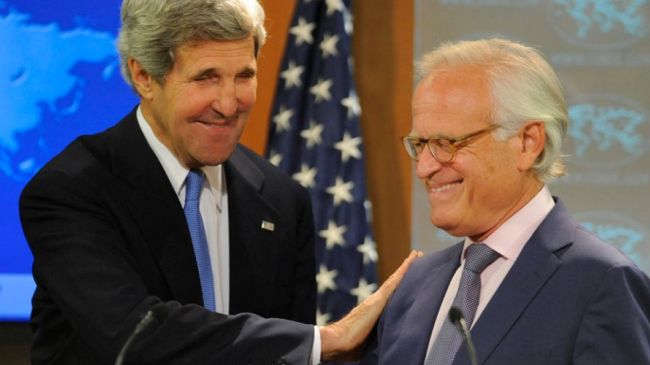
By Dave Lindorff | This Can’t Be Happening! | July 20, 2014
If the best the US can do to pin the blame for the Malaysia Flight 17 downing on Russia is to have Secretary of State John Kerry say that “circumstantial evidence” points to Moscow being behind it, we can be pretty certain it was not Russia at all.
Kerry’s credibility on such matters has been in the toilet since last August when he claimed during last year’s furor and push for war against Syria’s Basher al Assad that he had seen “clear and compelling evidence” that the Syrian government had used poison gas against its own people. That “evidence” turned out (clearly with Kerry’s knowledge) to have been ginned up, falsified and staged, and in the end it was evident that Syria had not been the guilty party. Had Kerry and the White House succeeded in duping the world and the American people the way President George W. Bush and VP Dick Cheney succeeded in duping them about Iraq’s “WMDs,” an armada of US planes and ships already in position around Syria would have begun a massive aerial bombardment of Syria sparking a whole new war in the Middle East, even as Iraq was already in the throes of a civil war.
Fortunately, John Kerry’s and the accommodating US corporate media’s lies that time were exposed, and that bloody catastrophe was averted.
Now, undeterred by that first attempt at a full-blown campaign of lies, Kerry and the Obama White House are at it again, trying to falsify a casus belli against Russia by blaming Moscow for the downing of a civilian airliner that killed 298 people.
The problem for Kerry and Washington’s warmongers is that the story they’re selling is ludicrous.
Ukraine’s military has a hundred or so Buk anti-aircraft missiles and dozens of mobile launchers which have been seen in a Kiev parade
Why on earth would the Russians (who have been scrupulously avoiding getting involved in the Ukraine fighting), have provided the separatist rebels in eastern Ukraine with Buk missiles capable of downing high-altitude planes? Such aircraft pose no threat to the rebels. What they fear is the Ukraine military’s ground attack aircraft and bombers, and their helicopter gunships and troop transport planes. And they already have demonstrated that they’ve got the weapons to deal with those, in the form of shoulder-fired, wire-guided missiles — weapons that don’t have the capability to down aircraft flying at anywhere near 33,000 feet.
The answer to that question is that Russia would gain nothing, and would stand to lose a lot by contributing to the downing of a civilian aircraft. In fact, we can see, in the desperate effort by Kerry to pin the blame on Russia, exactly whey they would never have wanted to do such a thing.
That goes for the separatist rebels, too. The last thing they would want would be to give reluctant NATO allies of the US in Europe a reason to join the war-mongering campaign of the US in backing the Ukrainian government’s “anti-terrorist” campaign against them. After all, the separatists have actually been doing pretty well at stymieing the Ukrainian military as it is. In addition, increasing numbers of Ukrainians in western Ukraine are growing frustrated with the corruption, incompetence and war-making of their government. How do the rebels then gain by angering Western European nations and the Ukrainian people? Answer: They don’t.
Indeed the only parties who could conceivably gain by the downing of a civilian airliner would be the US and Ukraine, if they thought they could manage to pin the blame on the Russians and/or the separatist rebels. (For those who find it hard to swallow the idea that the US would deliberately shoot down a plane carrying 298 civilians in order to get a war going, there is another theory out there: that the Ukrainians — or some rogue element of the Ukraine military — thought the plane was Russian President Vladimir Putin’s own “Air Force One” carrying him back from the Brazil World Cup. In fact the flight paths of the two plans actually intersected within a fairly short time frame according to some reports.)
Meanwhile, it has already been demonstrated that the “evidence” that the US and Ukraine are citing — an electronic communication allegedly between a rebel and a Russian general referring to the downing of Malaysian Flight 17, was made a day before the downing happened (a point not mentioned in the breathless corporate media reports). That sounds like something the CIA would have had a hand in, as many believe it did in the also bogus “notice” earlier this year allegedly calling on Jews in eastern Ukraine to register with rebel authorities. As for the claim that the rebels had in their possession a Buk missile launcher, and that it came from Russia, this is highly dubious. First of all, as mentioned, there was no reason for Russia to provide such a weapon to the rebels. Second, if the rebels, often described as a rag-tag group, ever got such sophisticated weapons, they would not have had the training to use it. Kerry is also saying that the US “has the trajectory” of a missile fired by a Buk launcher in rebel-held territory “near the scene of the crash,” but of course, he also said the US “had the trajectories” of the poison gas rockets and that they came from a Syrian military installation–a claim that later proved false.
On the other hand, Ukraine’s military is known to possess several dozen mobile Buk missile launchers in its arsenal, and some of these were known to have been moved into eastern Ukraine. Why Ukraine’s military would have done this, when the rebels have no air force, is a good question — one which the Russians are asking (but which the US corporate media have not bothered to speculate about).
So we have Kerry’s lies and the lies of other US government officials, backed by the same complicit and propagandistic US media that ran with their lies so unquestioningly in the Syria poison gas incident, with little but the alternative media and some of the foreign media to rely on for more honest and forthright investigation into this case. And we have the Ukrainian government, which has been charging all along, against all logic, that the pro-Russian rebels in eastern Ukraine are all “terrorists,” also claiming that it’s the Russians and the rebels who did the deed.
No doubt it will be a while before the truth comes out about this story. In the meantime, the best evidence that it was not the Russians and the rebels in Ukraine who shot down the plane is that Secretary of State Kerry is trying to convince us all that they did it.
Meanwhile everyone would do well to calm down and heed the warning of former CIA analyst Ray McGovern, a 27-year Agency veteran, now retired, who points to the campaign of lies orchestrated during the early Reagan administration concerning the Russian shoot-down of a Korean 747 back in 1983. While the Reagan White House and the Pentagon knew from captured radio transmissions between the Russian fighter pilot and his base that he made efforts to warn the Korean plane to land, including the firing of tracer bullets in the dark sky, and knew that he had become convinced he was dealing with a US military spy plane flying over a highly secret part of Russia’s western defenses, before he fired a missile to shoot it down, McGovern says they doctored those tapes to make it look like he had done the opposite, heartlessly shooting down a civilian plane on orders from Moscow. The goal of this official Washington lie, McGovern says, was to incite American hatred against the Soviet Union, which had been waning since the end of the Vietnam War.
McGovern also suggests that the US government covered up the true cause of the downing of TWA Flight 800 off Long Island in 1996, which he says may well have been caused by an errant US missile, and not, as claimed, by a spark in a fuel tank.
McGovern’s advice in this current campaign of deceit: “There is, sadly,…reason to kick the tires of any fancy truck carrying ‘intelligence’ offered by the U.S. with respect to the Malaysian Airline shoot-down.”
Amnesty International and the War in Ukraine
By VLADISLAV GULEVICH | CounterPunch | July 21, 2014
Amnesty International recently released a report on “stomach-turning” violence in Eastern Ukraine (“Abduction and Tortures in Eastern Ukraine,” – see for example BBC coverage here). According to the report, the acts of violence are perpetrated chiefly by pro-Russian separatist groups.
The Amnesty International report and its conclusion about rebel responsibility for the majority of violence does’t hold water and has little in common with reality. The violence in Ukraine in general is not properly analyzed, and the report is quite biased. Rather than the rebels, it is the Ukrainian army and the pro-EuroMaidan forces that are responsible for the abductions and abuses.
Firstly, rebels in Eastern Ukraine enjoy almost 100% support of the local population. There is no need for them to commit any kind of violence targeting the locals. The Ukrainian army, on the contrary, is viewed as a cruel enemy and Ukrainian soldiers feel the animosity of the locals. Simple logic would argue that it is the army that has felt the need to repress its local adversaries through violence. Moreover, it suffices to speak with any of the thousands of refugees from Eastern Ukraine and listen to their stories about the barbaric methods used by the army to break the resistance, to be persuaded that the Ukrainian army bears the responsibility for the majority of kidnappings and tortures.
Secondly, it’s well known that EuroMaidan was supported by Ukrainian neo-Nazi organizations. After the success of EuroMaidan its leaders enrolled their neo-Nazi supporters into newly formed police and National Guard battalions (“Azov”, “Donbas” and so on). From time to time foreign media speak of the neo-Nazi background of such Ukrainian military units, but most of the time this fact is hidden. It’s hard to expect any respect for human rights or any other kind of law observance from these soldiers.
The facts show that EuroMaidan authorities started the terror campaign promptly after toppling the former government, that is to say long before the start of the war. The spiral of violence raging now in Eastern Ukraine is the sequel of the geopolitical drama called EuroMaidan.
In addition, to see the whole scale of violence in Ukraine one should gather information about abductions, tortures and other ill-treatment throughout the country and not only in Eastern Ukraine. And the time period should be enlarged: it’s necessary to take into consideration all of the violence perpetrated since the victory of EuroMaidan and not only since the beginning of the hostilities.
When the new post-EuroMaidan government was formed it unleashed unprecedented repressive measures, which became more and more stringent and violent. Policemen and their families were the first targets. They were threatened anonymously, their apartments burnt and some policemen killed.
Not only were policemen tracked down, but any conspicuous person loyal to the previous government. Unacceptable newspapers were forcibly closed, independent journalists arrested. The most radical pro-European movement, “Right Sector,” put forward the idea that “the revolution continues and we will hunt down the enemies of the revolution”. After that civic activists were subjected to brutal attacks and the most active of them were arrested. Now Kiev goes even further. Following the example of the US in Iraq, the Ukrainian authorities are producing playing cards with faces of the rebel commanders as well as faces of “wrong” journalists, for the soldiers in Eastern Ukraine. The army must either arrest or kill them.
After EuroMaidan, Ukraine is a country full of political prisoners. The number of well-known journalists and writers who have had to escape from the country is rather high: Alexander Chalenko, Rostislav Ishchenko, Vladimir Rogov, myself, and many others. Even high-ranking Congressmen of the Ukrainian parliament, such as the anti-EuroMaidan politician Oleg Tsarov, have had to leave Ukraine under the threat of arrest. Before fleeing Tsarov was attacked by a crowd of EuroMaidan activists and savagely beaten. The video of the attack as well as Tsarov with torn clothes and bruises was shown on TV. His house in Dnepropetrovsk was burnt by Molotov cocktails thrown by well-known “unknown” perpetrators.
Now Tsarov gives juridical assistance to police officers and civil activists persecuted by the new authorities. According to Tsarov, many people are being arrested throughout Ukraine and prisons are filled with political prisoners. The latest case has been the arrest of Alexander Samoylov, the vice-rector of International Slavonic University in Charkov. The picture of Samoylov beaten, with black bruises around his eyes, is circulating on the internet.
The violence against ideological rivals has turned into political advertising for the Ukrainian politicians supporting EuroMaidan, aimed toward dissuasion. Congressmen from the well-known xenophobic nationalistic party Svoboda forcibly entered the office of the Ukrainian National TV Channel director, beat him and forced him to resign. They disliked how the TV channel covered the Crimean conflict between Moscow and Kiev.
Notorious congressman and leader of the Radical party Oleg Liashko is famous for his PR actions in the zone of hostilities. He often shows up there accompanied by a large number of bodyguards and demonstrates his attitude towards the population of Eastern Ukraine. There are many videos showing Liashko humiliating his opponents and threatening to kill them — like in this video where Liashko and his bodyguards rudely force a local deputy in Slawiansk to resign and threaten to lynch him in a town square – or threatening to throw them into prison, like in this video where Liashko interrogates a 68-year old man with a sack on his head and threatens to keep him in prison until death.
It’s worth mentioning that in March 2014, a month before the beginning of hostilities between Kiev and the rebel provinces, and when dialogue was still possible, Liashko ordered one of the Eastern Ukrainian leaders, Arsen Klinchaev, to be arrested. This was carried out in a rude and humiliating manner and Liashko himself took part in the action. Klinchaev was arrested in his office and not with arms in hand, but was treated like a dangerous terrorist.
Instead of dialogue, Kiev has chosen violence.
Vladislav Gulevich is a Ukrainian journalist and political analyst who has recently fled to Russia. He can be reached at kwonltd@rambler.ru.
Airline Horror Spurs New Rush to Judgment
By Robert Parry | Consortium News | July 19, 2014
Despite doubts within the U.S. intelligence community, the Obama administration and the mainstream U.S. news media are charging off toward another rush to judgment blaming Ukrainian rebels and the Russian government for the shoot-down of a Malaysia Airlines plane, much as occurred last summer regarding a still-mysterious sarin gas attack in Syria.
In both cases, rather than let independent investigators sort out the facts, President Barack Obama’s ever-aggressive State Department and the major U.S. media simply accepted that the designated villains of those two crises – Bashar al-Assad in Syria and Russian President Vladimir Putin on Ukraine – were the guilty parties. Yet, some U.S. intelligence analysts dissented from both snap conventional wisdoms.
Regarding the shoot-down of the Malaysian jetliner on Thursday, I’m told that some CIA analysts cite U.S. satellite reconnaissance photos suggesting that the anti-aircraft missile that brought down Flight 17 was fired by Ukrainian troops from a government battery, not by ethnic Russian rebels who have been resisting the regime in Kiev since elected President Viktor Yanukovych was overthrown on Feb. 22.
According to a source briefed on the tentative findings, the soldiers manning the battery appeared to be wearing Ukrainian uniforms and may have been drinking, since what looked like beer bottles were scattered around the site. But the source added that the information was still incomplete and the analysts did not rule out the possibility of rebel responsibility.
A contrary emphasis has been given to the Washington Post and other mainstream U.S. outlets. On Saturday, the Post reported that “on Friday, U.S. officials said a preliminary intelligence assessment indicated the airliner was blown up by an SA-11 surface-to-air missile fired by the separatists.” But the objectivity of the Obama administration, which has staunchly supported the coup regime, is in question as are the precise reasons for its judgments.
Even before the Feb. 22 coup, senior administration officials, including Assistant Secretary of State Victoria Nuland and U.S. Ambassador to Ukraine Geoffrey Pyatt, were openly encouraging protesters seeking the overthrow of Yanukovych. Nuland went so far as to pass out cookies to the demonstrators and discuss with Pyatt who should be appointed once Yanukovych was removed.
After Yanukovych and his officials were forced to flee in the face of mass protests and violent attacks by neo-Nazi militias, the State Department was quick to declare the new government “legitimate” and welcomed Nuland’s favorite, Arseniy Yatsenyuk, as the new prime minister.
As events have unfolded since then, including Crimea’s secession to join Russia and bloody attacks directed at ethnic Russians in Odessa and elsewhere, the Obama administration has consistently taken the side of the Kiev regime and bashed Moscow.
And, since Thursday, when the Malaysian plane was shot down killing 298 people, the Ukrainian government and the Obama administration have pointed the finger of blame at the rebels and the Russian government, albeit without the benefit of a serious investigation that is only now beginning.
One of the administration’s points has been that the Buk anti-aircraft missile system, which was apparently used to shoot down the plane, was “Russian made.” But the point is rather silly since nearly all Ukrainian military weaponry is “Russian made.” Ukraine, after all, was part of the Soviet Union until 1991 and has continued to use mostly Russian military equipment.
It’s also not clear how the U.S. government ascertained that the missile was an SA-11 as opposed to other versions of the Buk missile system.
Slanting the Case
Virtually everything that U.S. officials have said appears designed to tilt suspicions toward the Russians and the rebels – and away from government forces. Referring ominously to the sophistication of the SA-11, U.S. Ambassador to the United Nations Samantha Power declared, “We cannot rule out Russian technical assistance.” But that phrasing supposedly means that the administration can’t rule it in either.
Still, in reading between the lines of the mainstream U.S. press accounts, it’s possible to see where some of the gaps are regarding the supposed Russian hand in Thursday’s tragedy. For instance, the Post’s Craig Whitlock reported that Air Force Gen. Philip M. Breedlove, U.S. commander of NATO forces in Europe, said last month that “We have not seen any of the [Russian] air-defense vehicles across the border yet.”
Since these Buk missile systems are large and must be transported on trucks, it would be difficult to conceal their presence from U.S. aerial surveillance which has been concentrating intensely on the Ukraine-Russia border in recent months.
The Post also reported that “Rear Adm. John Kirby, the Pentagon press secretary, said defense officials could not point to specific evidence that an SA-11 surface-to-air missile system had been transported from Russia into eastern Ukraine.”
In other words, the mystery is still not solved. It may be that the rebels – facing heavy bombardment from the Ukrainian air force – convinced the Russians to provide more advanced anti-aircraft weapons than the shoulder-fired missiles that the rebels have used to bring down some Ukrainian military planes.
It’s possible, too, that a rebel detachment mistook the civilian airliner for a military plane or even that someone in the Russian military launched the fateful rocket at the plane heading toward Russian airspace.
But both the Russian government and the rebels dispute those scenarios. The rebels say they don’t have missiles that can reach the 33,000-foot altitude of the Malaysian airliner. Besides denying a hand in the tragedy, the Russians claim that the Ukrainian military did have Buk anti-aircraft systems in eastern Ukraine and that the radar of one battery was active on the day of the crash.
The Russian Defense Ministry stated that “The Russian equipment detected throughout July 17 the activity of a Kupol radar, deployed as part of a Buk-M1 battery near Styla [a village some 30 kilometers south of Donetsk],” according to an RT report.
So, the other alternative remains in play, that a Ukrainian military unit – possibly a poorly supervised bunch – fired the missile intentionally or by accident. Why the Ukrainian military would intentionally have aimed at a plane flying eastward toward Russia is hard to comprehend, however.
A Propaganda Replay?
But perhaps the larger point is that both the Obama administration and the U.S. press corps should stop this pattern of rushing to judgments. It’s as if they’re obsessed with waging “information warfare” – i.e., justifying hostilities toward some adversarial nation – rather than responsibly informing the American people.
We saw this phenomenon in 2002-03 as nearly the entire Washington press corps clambered onboard President George W. Bush’s propaganda bandwagon into an aggressive war against Iraq. That pattern almost repeated itself last summer when a similar rush to judgment occurred around a sarin gas attack outside Damascus, Syria, on Aug. 21.
Though the evidence was murky, there was a stampede to assume that the Assad government was behind the attack. While blaming the Syrian army, the U.S. press ignored the possibility that the attack was a provocation committed by radical jihadist rebels who were hoping that U.S. air power could turn the tide of the war in their favor.
Rather than carefully weigh the complex evidence, the State Department and Secretary of State John Kerry tried to spur President Obama into a quick decision to bomb Syrian government targets. Kerry delivered a belligerent speech on Aug. 30 and the administration released what it called a “Government Assessment” supposedly proving the case.
But this four-page white paper contained no verifiable evidence supporting its accusations and it soon became clear that the report had excluded dissents that some U.S. intelligence analysts would have attached to a more formal paper prepared by the intelligence community.
Despite the war hysteria then gripping Official Washington, President Obama rejected war at the last moment and – with the help of Russian President Putin – was able to negotiate a resolution of the crisis in which Assad surrendered Syria’s chemical weapons while still denying a hand in the sarin gas attack.
The mainstream U.S. press, especially the New York Times, and some non-governmental organizations, such as Human Rights Watch, continued pushing the theme of the Syrian government’s guilt. HRW and the Times teamed up for a major story that purported to show the flight paths of two sarin-laden missiles vectoring back to a Syrian military base 9.5 kilometers away.
For a time, this report was treated as the slam-dunk evidence proving the case against Assad, until it turned out that only one of the rockets carried sarin and the maximum range of the one that did have sarin was only about two kilometers.
Despite knowing these weaknesses in the case, President Obama stood by his State Department hawks by reading a speech to the UN General Assembly on Sept. 24 in which he declared: “It’s an insult to human reason and to the legitimacy of this institution to suggest that anyone other than the regime carried out this attack.”
In watching Obama’s address, I was struck by how casually he lied. He knew better than almost anyone that some of his senior intelligence analysts were among those doubting the Syrian government’s guilt. Yet, he suggested that anyone who wasn’t onboard the propaganda train was crazy.
Since then, investigative journalist Seymour Hersh has revealed other evidence indicating that the sarin attack may indeed have been a rebel provocation meant to push Obama over the “red line” that he had drawn about not tolerating chemical weapons use.
Now, we are seeing a repeat performance in which Obama understands the doubts about the identity of who fired the missile that brought down the Malaysian airliner but is pushing the suspicions in a way designed to whip up animosity toward Russia and President Putin.
Obama may think this is a smart play because he can posture as tough when many of his political enemies portray him as weak. He also buys himself some P.R. protection in case it turns out that the ethnic Russian rebels and/or the Russian military do share the blame for the tragedy. He can claim to have been out front in making the accusations.
But there is a dangerous downside to creating a public hysteria about nuclear-armed Russia. As we have seen already in Ukraine, events can spiral out of control in unpredictable ways.
Assistant Secretary Nuland and other State Department hawks probably thought they were building their careers when they encouraged the Feb. 22 coup – and they may well be right about advancing their status in Official Washington at least. But they also thawed out long-frozen animosities between the “ethnically pure” Ukrainians in the west and the ethnic Russians in the east.
Those tensions – many dating back to World War II and before – have now become searing hatreds with hundreds of dead on both sides. The nasty, little Ukrainian civil war also made Thursday’s horror possible.
But even greater calamities could lie ahead if the State Department’s “anti-diplomats” succeed in reigniting the Cold War. The crash of Malaysian Airlines Flight 17 should be a warning about the dangers of international brinkmanship.
~
Investigative reporter Robert Parry broke many of the Iran-Contra stories for The Associated Press and Newsweek in the 1980s. You can buy his new book, America’s Stolen Narrative, either in print here or as an e-book (from Amazon and barnesandnoble.com).
NBC reinstates Mohyeldin to salvage image
By Jonathon Cook | The Blog from Nazareth | July 19, 2014
Some good overnight news, to which readers have alerted me: Ayman Mohyeldin has been reinstated by NBC as their Gaza correspondent. This is an interesting sign of changing times: NBC, it seems, is waging a rearguard action, feeling the need to restore its credentials for editorial independence. Once it would have been taken for granted that a large media organisation was free and fearless; now increasingly it is not.
What was so revealing about NBC’s original move was that no serious reason was given by the TV executives for Mohyeldin’s removal from Gaza; and their grounds for reinstating him are equally opaque. That is because their decision can only be explained in cynical, political terms, as a response to, or pre-emption of, the Israel lobby and its chums in Washington’s corridors of power.
It is true that there are cynical journalists, but most genuinely believe they are independent and free to say what they like – even when the evidence screams at them that the opposite is true. But media executives, who should really be called what they are – money men and women – are the ones who make the key decisions. And they are entirely cynical about editorial policies. They are interested solely in revenues, access and remaining credible with and useful to powerful interest groups, including the massive corporations that run the media.
Journalists have a bad habit of ignoring the reality that these corporate titans run their news organisations, and they manage it by not examining their bosses’ motives, or their own, too deeply.
But Mohyeldin’s removal will have caused them problems. There were no possible editorial grounds for pulling him from Gaza. The executives offered a vague pretext – “security” – but then exposed the deceitfulness of their reasoning by bringing in another reporter to replace him.
This was doubtless too much for the journalists at NBC, who were threatened by the thought that their outlet might not be quite the bastion of free speech they need to believe it is. And that doubt will only have been reinforced by the popular campaign to bring Mohyeldin back.
In these circumstances, NBC’s original decision threatened to expose to many of its journalists and viewers the hoax of a free western press. That, I suspect, is why Mohyeldin was hurriedly reinstated. NBC’s executives understood that the illusion needed to be restored.
But, as I say, this is a sign of progress. These media corporations can no longer take for granted that we will continue believing they are committed to the truth or acting honourably.
Featured Video

Iran’s Next Strike May Not Explode. It Could Shut You Down
or go to
Aletho News Archives – Video-Images
From the Archive
Zionism’s Violent Legacy
By Donald Neff | Washington Report On Middle East Affairs | January 1996
On January 4, 1948, Jewish terrorists drove a truck loaded with explosives into the center of the all Arab city of Jaffa and detonated it, killing 26 and wounding around 100 Palestinian men, women and children.[1] The attack was the work of the Irgun Zvai Leumi – the “National Military Organization,” also known by the Hebrew letters Etzel – the largest Jewish terrorist group in Palestine. The Irgun was headed by Revisionist Zionist Menachem Begin and had been killing and maiming Arabs, Britons and even Jews for the previous ten years in its efforts to establish a Jewish state.
This terror campaign meant that at the core of Revisionist Zionism there existed a philosophical embrace of violence. … continue
Blog Roll
 Aletho News
- Trump and Netanyahu Want to “Finish the Job” on Iran
- US ‘one-sided dictation’ not Iran’s beliefs makes rational talks impossible: Baghaei
- Iran’s Next Strike May Not Explode. It Could Shut You Down /Col Doug Macgregor
- Iran: US political targets legitimate if assassinations return
- Iraq shuts key border crossing with Iran under US pressure: Report
- Undersea Internet cables could be targeted in retaliation for attacks on Iran: IRGC deputy chief
- EU sending ‘biased’ observers to interfere in Serbian election – president
- White House envoy declares kinetic action against Yemen ‘fruitless’
- Ukraine deployed thousands of microdrones in Iraqi Kurdistan: Tasnim
- Iran calls for emergency UNSC meeting over Trump’s ‘brazen’ bomb talk, Israeli threats
- If Americans Knew
- Americans at National Conservatism Conference held in Israel this year criticize Israel
- Christiane Amanpour exits CNN with a legacy shaped by the debate over Israel
- Israel’s war on Iran is the final move in a decades-old strategy
- Israel Denies Entry to French Journalist, U.S. Researcher Amid Rise in Entry Denials
- Gaza’s hospitals are running out of life-saving fuel – Daily Update
- Mysterious bot accounts reportedly spread fake ‘man on the street’ videos for Michigan Senate candidate
- Israeli Defense Minister Katz Says Over 60 Lebanon Villages Have Been Destroyed
- Why Is Israel Running TV Ads in Iowa Ahead of the Midterms?
- Hind Rajab’s Alleged Killer Is in the United States. HRF Demands His Arrest.
- US Officials Face Fresh Pressure After Another American ‘Brutalized’ by Israeli Settlers in West Bank
- No Tricks Zone
- E-Cars Reduce CO2 Emissions By Only 41% Compared To Internal Combustion Engine Vehicles
- Predictions Made By Renowned Climate Professor Over Past Decades Have Been Proven To Be Poor
- New Study Suggests Large Regions Of The Pacific Ocean Have Been Cooling For The Last 80 Years
- Germany’s Green Energy Debacle: High Energy Costs Force Kahla Porzellan to Close After 182 Years!
- New Study: 50 Years Of The Most Aggressive ‘Net Zero’ Policies Can Only Affect The Global Climate By 0.03°C
- US September “Heat” Was No Record…Many Records Set Decades Ago
- Latest European Green Energy Debacle; Portugal’s Largest Flagship Solar Park Insolvent!
- Green Energy Debacle: German Expert Professor Fritz Vahrenholt Warns Of Severe Economic And Social Consequences
- Two More Paleo Reconstructions Affirm Meters-Higher Sea Levels Across Ireland, Brazil 7000-6000 Years Ago
- New Study: Earth And Venus Surface Warmth Largely Explained By Convection And Lapse Rate, Not CO2 Or Radiation