NEOCON PROPAGANDA: ‘ISRAELIS TAKE PRISONERS BUT HAMAS KIDNAPS ISRAELI SOLDIERS’
By Damian Lataan | August 2, 2014
Writing in Commentary today, Israeli apologist and neocon propagandist Jonathan Tobin said: “…the Netanyahu government decided to accede to the [ceasefire] proposal put forward by the United States and the United Nations. But that decision has been rendered moot by the decision of Hamas to use the cover of the cease-fire to launch a suicide attack on Israeli forces that led to the possible kidnapping of a soldier.”
Not mentioned by Tobin was the ‘kidnapping’ of almost 300 Palestinians who had been taken by the Israelis during the first days of their invasion of the Strip, nor did Tobin mention that many of them had been ‘interrogated’ by Shin Bet, the Israeli security service who are notorious for their use of ‘enhanced interrogation techniques’, a Western euphemism for torture.
Tobin forgets that it is the Israelis that have invaded the Gaza Strip and that the Gaza people have a right at all times to defend themselves against any aggression and also have the right, as do the Israelis, to take prisoners of war.
Tobin argues that, rather than a truce, Israel should go all out to destroy Hamas and demilitarise the Gaza Strip. To ‘demilitarise’ the Gaza Strip will involve a prolonged occupation and who knows what horrors Tobin has in mind when he says ‘Hamas should be destroyed’.
HRW: Human Rights Watch or Hypocrites Representing Washington
By Eric Draitser | New Eastern Outlook | August 1, 2014
Ulike previous centuries and epochs, modern warfare is not restricted solely to the battlefield. Rather, it extends into the information sphere where the dissemination of propaganda and the construction of narratives are of equal importance to weapons and soldiers. For today, the legitimacy of a war in the eyes of public opinion in many ways determines victory or defeat. It is here, in the realm of public opinion, that an organization such as Human Rights Watch (HRW) becomes indispensible to the Empire, not so much for the facts that it presents, but the narrative that it shapes.
Put another way, HRW serves as intermediary between the facts on the ground and the western public who rely on the organization (and similar NGOs such as Amnesty International) to accurately tell the story of a given conflict. It is precisely this position as an “information middleman” that makes HRW both relevant and dangerous for the simple fact that the manner in which it presents information, along with the critical facts it chooses to omit or otherwise distort, can have a tremendous impact on how the world views a conflict and, consequently, how the world responds.
By examining the way in which HRW documented, investigated, and presented findings from the conflicts in Israel/Palestine, Ukraine, Libya, Syria, and Venezuela, it becomes clear that the organization, though theoretically objective and “disinterested,” is in fact an integral part of the western imperial system. Though HRW has done some good work, and likely will in the future, this cannot be taken as evidence that the organization is somehow not a part of the Empire. On the contrary, without HRW and similar organizations, Washington and its allies would not be able to champion themselves as “defenders of human rights,” “beacons of democracy,” and “humanitarian powers.”
HRW on Israel/Palestine
In analyzing HRW’s findings and, perhaps most importantly, the way in which they are presented, one conclusion becomes inescapable: when the facts are damaging to the western powers, HRW dilutes the impact of its own conclusions, and when its findings advance the western agenda, HRW exaggerates them. What can one call such obvious service to power under the guise of truth-telling? Words like cynical, insidious, and treacherous certainly come to mind.
On the subject of Israel/Palestine, HRW has consistently placed itself in the “condemn both sides” camp. That is to say, it makes an equivalence between the violence and barbarism of Israel’s colonial-style occupation of Gaza and the West Bank on the one hand, and Palestinian armed resistance on the other. The cynicism is painfully obvious. By making such equivalence, HRW effectively reduces the scope and scale of Israeli crimes which are, objectively speaking, far more widespread, systematic, and devastating.
As renowned Palestinian journalist and Middle East analyst Mouin Rabbani wrote in 2009:
In the years since 2000, HRW pursued a consistent — and consistently effective — formula: criticize Israel, but condemn the Palestinians. Challenge the legality of an Israeli aerial bombardment, preferably in polite, technical terms, and vociferously denounce the Palestinian suicide bomber in unambiguous language — especially when raising questions about the latest Israeli atrocity. In HRW publications, explicit condemnations and accusations of war crimes were almost wholly monopolized by Palestinians. With Israeli citizenship a seeming precondition for the right to self-defense, the right to resist was for all intents and purposes non-existent.
Rabbani here correctly points out not only the false equivalence between the violence perpetrated by Israel and the armed resistance of the Palestinians, but also the question of legitimacy and legality in regard to the latter. HRW portrays Palestinian resistance, in whatever form it takes, as illegitimate and a violation of international law, often referring to the rockets and, when it was still applicable the “suicide bombers,” as war crimes. In contrast, HRW very rarely, if ever, expressly uses the term “war crimes” to refer to any of the atrocities committed by Israel that undoubtedly are such.
Perhaps here it would be relevant to point out that, according to international law and UN precedent, all Israeli so-called “self-defense” (bombing civilian targets, laying siege to Gaza, etc.) constitutes war crimes. By contrast, the Palestinians have a legal right to resist their occupation by a foreign power by any means necessary. Indeed, this point has been reiterated countless times by the United Nations. One particularly relevant example comes from the 43rd resolution of the 37th UN General Assembly held in 1982 against the backdrop of Israel’s vicious war on Lebanon which, “Reaffirms the legitimacy of the struggle of peoples for independence, territorial integrity, national unity and liberation from colonial and foreign domination and foreign occupation by all available means, including armed struggle.”
Though certainly not the only example of international law and UN precedent legitimizing the armed resistance of the Palestinian people, the above resolution makes it quite plain that the argument that “Hamas rockets constitute a war crime” is little more than a rhetorical flourish from those who attempt to make an equivalence between Israeli and Palestinian violence in order to justify the former by discrediting the latter. It goes almost without saying that such faulty reasoning must be rejected entirely.
But this issue of rhetoric and language is also crucial to understanding how HRW is able to criticize Israel without actually condemning its atrocities or exposing it to charges of war crimes and crimes against humanity. In response to the most recent round of Israeli crimes, renowned scholar and activist Norman Finkelstein wrote:
In its first press release on 9 July 2014, Indiscriminate Palestinian Rocket Attacks; Israeli Airstrikes on Homes Appear to be Collective Punishment, HRW stated that “Israeli attacks targeting homes may amount to prohibited collective punishment.” In its second press release on 16 July, Unlawful Israeli Airstrikes Kill Civilians; Bombings of Civilian Structures Suggest Illegal Policy, HRW states that “Israeli air attacks in Gaza… have been targeting apparent civilian structures and killing civilians in violation of the laws of war. Israel should end the unlawful attacks that do not target military objectives and may be intended as collective punishment or broadly to destroy civilian property.” It then proceeded to legally define the meaning of war crimes, but artfully avoided accusing Israel of committing them… In these statements HRW doubly distanced itself from alleging Israeli war crimes: first, it qualified the weight of the incriminating evidence – “appear,” “may,” “apparent,” “may be,”; second, it recoiled from explicitly charging Israel with war crimes and instead settled for lesser or vaguer charges – “collective punishment,” “violation of the laws of war,” “unlawful attacks.”
As Finkelstein correctly notes, the language that HRW employs is, at least superficially, supposed to provide a veneer of objectivity by using qualifier words such as “may” and “apparent.” However the reality is that such language is deliberately designed to allow HRW to avoid correctly ascribing terms like “war crimes” and “crimes against humanity” to Israeli actions. In this way, HRW dilutes its own findings, pleasing the powerful corporate and political interests in the US that fund it.
Indeed, here it is important to reiterate how HRW creates a false equivalence between Israeli war crimes and Palestinian “war crimes.” HRW has gone on record saying that “Hamas rocket attacks targeting Israeli civilians are unlawful and unjustifiable, and amount to war crimes… As the governing authority in Gaza, Hamas should publicly renounce rocket attacks on Israeli civilian centers and punish those responsible, including members of its own armed wing.”
So, let’s just be clear here. Israeli bombings of Palestinian civilian targets through systematic campaigns “may” constitute “collective punishment” (not war crimes according to HRW’s language), while Hamas rocket attacks “amount to war crimes.” The transparently hypocritical use of double-standards in terms of language exposes a deeply rooted bias in HRW against the justness of Palestinian resistance. Whether one agrees or disagrees with Hamas’s military (and political) tactics, the legal and moral righteousness of their resistance cannot be disputed by anyone objectively evaluating the conflict.
More to the point, HRW accusing Palestinians of war crimes implies yet another distortion perpetrated by the Empire and its media and NGO toadies: that the conflict in Gaza is a “war.” This is no war, it is a one-sided slaughter. One could point to the casualty figures, the absence of an army, navy, or air force on the Palestinian side, the complete lack of indigenous economic activity to support a “war economy” in Gaza, or any of the other myriad material reasons why this is not a war.
If one is being honest, then it is clear that it is the western media (which includes of course Israeli media) which distorts the reality of the situation, calling it a “war” so as to justify the horrific crimes being committed. Because, as is self-evident, only under conditions of war can Israeli actions be justified in the minds of westerners. This is willful self-deception of the highest order. Indeed, self-deception is one of the most potent weapons that Israel’s supporters, along with HRW, have at their disposal.
HRW on Ukraine
 The armed conflict between the US-sponsored regime in Kiev and the anti-Kiev rebels in the East of the country has devolved into a bona fide civil war. However, it should be noted that, though the term “civil war” is used to describe the fighting, it should not be taken to mean that there is equivalent force on both sides. Rather, the Kiev regime has the full force of an organized military with air power, heavy weapons, tanks, artillery, and a host of other military materiel. In contrast, the anti-Kiev forces possess very few of these same weapons, with no air power whatsoever, despite the continued allegations of Russian support. And so, as with the so called “war” between Israel and Hamas, the conflict is far more one-sided than most media is willing to admit.
This point about unequal force is critical to understanding just how HRW, though seemingly condemning the use of rockets by the US-backed Ukrainian military, in fact provides an important service to the western narrative on Ukraine. Specifically, HRW presents a “condemn everyone equally” perspective which unjustifiably condemns the rebel forces with as much fervor as it does Kiev’s military. In so doing, HRW once again makes false equivalence, thereby distorting the true nature of the conflict in the eyes of western observers.
In its report Ukraine: Unguided Rockets Killing Civilians, HRW documents the use of “Grad” (Russian for “hail”) rockets by both sides in Ukraine. The report noted that “Unguided Grad rockets launched apparently by Ukrainian government forces and pro-government militias have killed at least 16 civilians and wounded many more in insurgent-controlled areas of Donetsk and its suburbs in at least four attacks between July 12 and 21, 2014.” In this initial assessment at the opening of the report, HRW is correct in pointing out that both sides of the conflict have been using such weapons, at least according to a number of independent reports from the region. However, again one must return to the question of equivalence between the two sides. In other words, are both sides equally accountable for the death and destruction wrought on the civilian population?
According to HRW and the language of the report, the answer is yes. Ole Solvang, senior emergencies researcher at HRW noted that, “Grad rockets are notoriously imprecise weapons that shouldn’t be used in populated areas. If insurgent and Ukrainian government forces are serious about limiting harm to civilians, they should both immediately stop using these weapons in populated areas.” Though of course one would agree that the use of such weapons by either side harms civilians, it presupposes that each side is equally responsible. Naturally, one should note that it is the Kiev regime’s military which is launching these rockets against a civilian population, while the rebels are using such rockets against military positions held by the Ukrainian army. This simple fact, conveniently left out of HRW’s report, should significantly alter how the issue is perceived. Rather than a war between two equally criminally responsible parties, there is undoubtedly an asymmetry in the violations of the rules of war.
To be fair, there are portions of the HRW report which do intimate, though perhaps stop short of explicitly stating, the fact that Kiev bears the majority of the blame. The report states, “Human Rights Watch called on all parties to the conflict in eastern Ukraine, particularly Ukrainian government forces, to stop using Grad rockets in or near populated areas because of the likelihood of killing and wounding civilians.” Indeed, the use of the phrase “particularly Ukrainian government forces” does suggest that Kiev is more culpable than the rebels. However, HRW quickly negates whatever value can be drawn from the above statement by following it with “Insurgent forces should minimize the risk to civilians under their control by avoiding deploying forces and weapons in densely populated areas.” Such a statement is patently absurd considering that the war is undeniably being fought in densely populated areas (Donetsk alone has about a million residents).
How can HRW genuinely tell rebels who are protecting their homes, their families, and their communities, not to fight in densely populated areas? The Ukrainian air force and military have been shelling civilian areas with far more than just the Grad rockets (artillery, aerial bombardment, and possibly white phosphorous bombs), and HRW expects the rebels to simply allow this? Again, the report presents an equivalence between the force employed by both sides, an utterly disingenuous argument. The report notes, “Human Rights Watch said that insurgent forces have failed to take all feasible precautions to avoid deploying in densely populated areas, thereby endangering civilians in violation of the laws of war.” In other words, though HRW condemned the use of the rockets by Kiev’s military forces, ultimate responsibility lies with the rebels who are “endangering civilians.”
This is backwards thinking. It is the equivalent of Israeli military spokesmen who argue that Hamas is responsible for Palestinian deaths because of where they place their rockets. The sort of mental gymnastics required to evaluate the situation in this way perhaps best illustrates what HRW is doing. Rather than assigning blame to Kiev where it is deserved, HRW condemns fervently the rebels for the actions of Kiev. In this way, HRW bolsters the western narrative that the “pro-Russian separatists” (as the western media is fond of calling them) are the ultimate cause of the conflict and the civilian deaths. This is not the first time that HRW has blamed the victims of aggression for the crimes of the aggressors.
Israel Right or Wrong
But What’s In It For Americans?
By Philip Giraldi • Unz Review • July 29, 2014

It is a familiar scenario. Israeli is killing hundreds of civilians, mostly women and children, and the Zionist propaganda machine is working overtime. The President of the United States reaffirms America’s solemn pledge to protect Israel at all costs and justifies the carnage by stating that Israel has a right to defend itself. Secretary of State John Kerry repeats the message and the US House and Senate pass unanimously American Israel Public Affairs Committee (AIPAC) drafted resolutions affirming the same.
Israeli Prime Minister Benjamin Netanyahu lies repeatedly and the US media gives him a bully pulpit to spread his disinformation about what is occurring, including the propaganda cartoon depicted above explaining why he had to use artillery and bombs to level a residential district, killing nearly 100 civilians in what was described as a “heinous massacre.”
The mainstream media obligingly toes the line, depicting something like a battle between equals pitting the Israeli Army (IDF) against Hamas militants, obfuscating the essential asymmetry of a conflict that has killed more than 1,000 Palestinians civilians. A very large percentage of the commentators on television and radio as well the authors of mainstream print media opinion are American and Israeli Jews, to include a piece by Michael Oren, former Israeli Ambassador to the US and current CNN “expert,” entitled “Israel Must be Permitted to Crush Hamas” as well as the featured appearances by Prime Minister Netanyahu on national television.
Oren’s call to crush Hamas is particularly ironic as it runs directly contrary to American interests. The US intelligence community believes that the group would likely be succeeded by something far more radical. The media, Congress, and Netanyahu all also connive to ignore the deliberate targeting of civilians to include hospitals, schools and private homes by the IDF, producing massive infrastructure damage and increasing the numbers of dead and wounded. The US media did not report how Israelis watching the bombing from their lawn chairs on a hill near Sderot were photographed cheering and applauding each time a target in Gaza exploded. They were also sharing popcorn and one described the event as “just good fun.”
Also missing in the discussion is the damage that the conflict does to the United States, which is seen throughout the world as Israel’s puppet, manifested most recently when Washington alone opposed and will presumably veto any United Nations inquiry into possible war crimes connected to the Gaza conflict.
America diplomats are supposed to support American interests while the Founding Fathers created an army and navy to defend the United States, not Israel, a fact that seems to have escaped the notice of many in the White House, Congress and in the media. In reality, Washington has no obligation to protect the Netanyahu government in international fora nor is there any treaty obligation to defend Israel or anyone else outside the NATO alliance. Israel is neither an ally nor is its self-defined security a compelling US national interest if one excludes the drumbeat of the domestic lobby that protects it no matter how badly it behaves.
The sequence of events leading up to the current slaughter is clear, though Israel’s friends pretend that it all started when the first homemade rocket landed inside Israel, justifying any subsequent steps necessary for “defense.” But the Israel-Palestine problem truly began in 1948, when armed Jews deliberately terrorized and then drove more than 700,000 Palestinians from their homes. It was exacerbated when in 1967 the military occupation of the West Bank and Gaza began, leading to the creation and expansion of illegal settlements on Arab land.
The current cycle of violence, rooted in the denial of viable statehood for the Palestinian people, began in April when Israel deliberately torpedoed US brokered peace talks by accelerating settlement building and failing to comply with an agreement to release prisoners. On May 15 th Israeli soldiers shot dead two Palestinian teenagers, an event that was videoed. They were among the 26 Palestinians killed by Israelis since January, with no one being held accountable. Four weeks later three Israeli teenagers from Hebron were kidnapped and later discovered dead. Netanyahu, who knew that the three young men were already dead and that the abduction had not been carried out by Hamas cynically used the kidnapping as a pretext to attack Hamas in the West Bank, blaming the group for the crime without producing one shred of evidence. An Arab teenager was subsequently burned to death by Jewish extremists and the boy’s American citizen cousin was badly beaten by police when he joined a demonstration.
Netanyahu may or may not have cared who was killing or kidnapping whom on a micro level, but he knew a good opportunity when he saw one. He took advantage of the situation to launch a plan to destroy Hamas and pari passu the Palestinian unity government. Hundreds of arrests were made, again without any evidence linking those detained with the kidnapping, and homes of suspects were demolished. When Hamas in Gaza eventually struck back with its homemade rockets, killing or injuring no one, Israel unleashed its modern army and air force on the largely unarmed and defenseless Palestinians.
Israel also has found allies in the usual places in the US media and political circles to help explain the ensuing massacre. Ayman Mohyeldin, the NBC News correspondent who personally witnessed and reported the killing by Israel of four Palestinian boys on a Gazan beach was ordered by NBC executives to leave Gaza immediately, presumably because he had strayed from the acceptable message, which is that the deaths of Palestinians is somehow their own fault. CNN also “reassigned” reporter Diana Magnay who tweeted regarding an Israeli mob that threatened her when she filmed their celebration of missile strikes in Gaza. She called her attackers “scum” and was quickly removed.
The far fewer deaths of Israelis in the conflict are, however, rather more celebrated than the mass high tech execution of Palestinians. American volunteers in the IDF are depicted as somehow doing their patriotic duty, albeit in a foreign army. The Washington Post described how the “Death of two Americans in Israel brings conflict home.” Both men identified in the article though born in the US had chosen to live in Israel, producing some pushback in the blog comments. One noted that bearing arms for a foreign country that is not in NATO is illegal (and used to lead to automatic loss of citizenship) while another comment observed that if you are by choice fighting in a foreign army you are no longer really American. I might add that directly supporting Israel’s militarized colonization of Palestinian lands is against stated US government policy and does actual damage to American interests.
The Gazans are, to be sure, an easy target, crowded into a narrow strip of land with no place to go as they are controlled on all sides by Egypt and Israel. Fleeing inhabitants cannot even turn to the sea which is controlled by the Israeli navy. A comprehensive ten year truce offer by Hamas has been rebuffed by Israel and the slaughter will presumably continue until Netanyahu decides to stop. The United Nations has suggested that what Israel is doing might fit the definition of a war crime, just as was the case back in 2009 for Operation Cast Lead, when more than 1,400 Gazans were killed and schools run by the UN were deliberately targeted, as has been the case also currently.
That the US is so tied to a rogue nation like Israel would be incomprehensible but for the action of what has been described as the Israel Lobby. As Harvard Professor Stephen Walt puts it, “AIPAC is the only explanation for America’s morally bankrupt Israel policy.” Israel is in reality a place that most Americans would find unsympathetic. It is a corrupt theocracy that denies equal rights to Christians and Muslims, a fact that is conveniently overlooked by Congress and the media. There is also a strong dose of racism and ethnocentrism in its political matrix, with broad popular support for either disenfranchising or expelling all non-Jews. Or even killing them, with crowds in Tel Aviv routinely chanting “Death to Arabs.”
An Israeli member of parliament Ayelet Shaked of the ultra-nationalist Jewish Home party has called all Palestinians terrorists, saying women should be especially targeted for killing during the ongoing Israeli assault on the besieged Gaza Strip because they give birth to “little snakes.” She explained “They have to die and their houses should be demolished so that they cannot bear any more terrorists,” adding “They are all our enemies and their blood should be on our hands. This also applies to the mothers of the dead terrorists.” A prominent Rabbi has also endorsed complete destruction of Gaza and genocide, as a “deterrent measure to exterminate the enemy.”
Perhaps most discouraging is the visceral hatred directed at American critics of Israeli policies that surfaces occasionally among that nation’s most zealous supporters. Rabbi Shmuley Boteach, former Michael Jackson spiritual adviser and self-designated “America’s Rabbi,” has penned a piece entitled, “By Condemning Israel, Presbyterians Condemn Themselves.” He writes regarding the Presbyterian decision to divest from companies supporting the Israeli occupation of the West Bank, stating that “The rotting corpse of the Presbyterian Church suffered another nail in the coffin with its general convention vote on Friday to divest from companies doing business with Israel.”
Boteach, who has also become close to a number of prominent politicians, received no mainstream censure for this comments attacking a major Christian denomination in the vilest terms. His article also plays fast and loose with the facts. He observes “In the wake of the Oslo Accords, in which Israel granted the PLO political autonomy in the West Bank, about 60,000 Americans were murdered in Israel.” Since Oslo in 1993 the actual figure for dead Americans, many of whom were Israeli dual nationals, is 53.
That the United States has provided political support for a monster like Benjamin Netanyahu is criminal but it is a tribute to the grip that Israel’s lobby has on America’s political class and media. For starters, one might reasonably suggest that people like Boteach and the American volunteers including Chicago mayor Rahm Emanuel who go to fight for Israel while eschewing any service in the US Army should perhaps move permanently to the country that they love most. The charge of dual loyalty which surfaces regularly regarding Israel’s most passionate Jewish supporters misses the point. Boteach and his friends, most certainly to include the likes of multi billionaire casino magnate Sheldon Adelson of Las Vegas, have no dual loyalty at all. Their only concern is for Israel and they stay in the United States to cash in and to make sure that the rest of the American people are coerced and propagandized sufficiently so as to guarantee that the US will remain Israel’s patsy. But more and more Americans are waking up to the fraud and the ongoing slaughter of another thousand or so Palestinians in Gaza virtually guarantees that there will be more questions about the relationship with Israel than answers. Eventually the truth will out.
Wow, Hillary Clinton as moral philosopher
Responsibility for wars and killing
By Jan Olberg | TFF PressInfo | August 1, 2014
A number of Western/NATO politicians – Hillary Clinton foremost among them – and media people have recently introduced a new ethical principle in international affairs:
When A delivers weapons to B, A is responsible for what B does with these weapons. The former Secretary of State and perhaps future U.S. President presents this new ethical principle here on CNN.
This makes a lot of sense to me. Look at it this way:
Here is a young confused boy who has little to look forward to – and less to lose – because his country is falling apart in nasty civil war.
He’s been told by some commander, or by his President, that he must hate the enemy; he gets paid for killing off as many as he can. And so he does.
He believes also in what he’s been promised: Fame as a hero upon return – that is, if he returns – and a comfortable life.
So he kills people, children and woman among them. He’s paid for it, not much but it’s better than earning nothing at all. And then that hope of a good life when it’s all over.
If these tragic figures survive, they return home – but not to fame but to traumas, nightmares, divorce, guilt feelings, isolation from family and friends, then alcohol and often suicide – or perhaps make a career as part of the mafia.
I’ve met quite a few such young men, for instance in the various parts of what was once Yugoslavia.
Roll back the war movie
Tell you what, I’ve never been able to understand why this type of war criminal is the only one who is prosecuted and punished.
Roll back the film: OK, he held the gun and of course he has responsibility for what he does. He could choose not to pull the trigger.
But he was part of an organisation – army or rebel group, whatever – with commanders who gave orders; his country’s political leaders had lied to him and constructed an ideology of hate. The media promoted all kinds of war propaganda, lies and myths – and made him believe that what he did was right.
And how did that gun get into his hand? Well, there were researchers and engineers who developed it – actually the largest single group of researchers on earth.
There were industries who manufactured it and there were governments or middlemen or private arms traders who sold the weapon and ammunition – and there were transport companies which transported it to the war zone. There were people far away from the danger who made huge profits from somebody else’s killing.
That’s how!
Are all these other actors in this movie innocent?
Why on earth is this poor fellow the only one to be punished – while the multi-billionaire arms manufacturers, traders and transporters are at large and living the life he dreamt about?
OK, the world isn’t fair – and ethics is not in high demand in the field of politics. But somehow it should be pretty obvious that the soldier is far from the only culprit and that his finger on the trigger is only the end of a long movie.
Hillary Clinton’s ethics is a step forward
So Madam Clinton is saying something interesting, pointing in the direction of a new ethics which I actually find reasonable:
Putin is responsible – at least ”indirectly” as she says – for the shooting down of MH17 because he – or Russia or whatever else over there we don’t like – gave the Eastern Ukrainian rebels the missile with which they made the MH17 fall down from the sky. (Leave aside that we don’t have all the facts; it’s just an example, isn’t it?)
Conclusion: Arms developers, researchers, manufacturers, traders, profiteers, commanders, politicians, prime ministers and presidents – all those who caused our young fellow – and the millions like him – to pull the trigger should be brought to justice.
Off you go to the International Criminal Court – not because you killed but because you facilitated killing. Sometimes mass killing, genocide, crimes against humanity!
Bravo! But!
There is only one little problem: It applies only to Putin – as you may have guessed. Because look here: US supplies Israel with bombs amid Gaza blitz.
And the U.S. doesn’t do only that in the midst of mass murder of civilians – no it gives military ”aid” to Israel so Israel can more effectively destroy itself as state and the Palestinians as people: Some US $ 3 bn per year, year after year and provides the political support for the killing of innocent people, sleeping children in UN schools included.
So, dear Hillary Clinton…
May I humbly suggest that you please shut up with your selective ethics or stand up and admit your country’s responsibility for wars around the world, the one in Gaza included.
The U.S. is the world’s largest arms producer, it’s largest arms exporter and arms consumer.
And could the free media – here CNN’s Fareed Zakaria – please begin to speak up and do what journalists are supposed to do: Ask questions to power?
~
Jon Snow’s strange interview with Hamas
By Jonathon Cook | The Blog from Nazareth | July 31, 2014
Two observations about Jon Snow’s interview last night with Hamas spokesman Osama Hamdan, for which Snow has received a lot of criticism from those supportive of the Palestinian case.
First, we should notice how Snow chooses to frame the interview. This is his first question: “Israel has demonstrated that it is prepared to go on killing Gaza’s woman and children, civilians generally. Why are you encouraging them by continuing to fire your ineffective rockets?”
That is quite some opener. In using the phrase “prepared to go on”, Snow implies that Israel’s killing of civilians is to a degree deliberate. In fact, that becomes the essential frame of the whole interview – and is the source of his irritating, even puerile line of questioning. Why antagonise Israel, when it’s clear it’s going to vent its fury on women and children? Why not hand over your weapons and let Israel blow up your tunnels? Why not abandon resistance?
Snow’s framing does a great disservice to Hamas but it damages Israel even more. Hamas are stupid, according to this approach, but Israel is actually malevolent. We should not discount the significance of the assumption about Israel Snow is making on behalf of his viewers. This may be some sort of tiny victory for the Palestinians in the media war.
Second, Snow keeps telling Hamdan: “There’s no time to go into the history”. In other words, we must ignore the context. But this is precisely the criticism of media coverage of Israel-Palestine made by academics like Greg Philo. Their surveys show the media fail to provide the historical context of the conflict, and this failure puts the Palestinians at an immediate disadvantage, because their case is essentially historical – a demand for redress for the injustices of 1948 and 1967. After all, Hamas represents an enormous group of refugees from those wars, forced out of their homes in Israel and now imprisoned in Gaza. Without that context, we cannot understand what drives Hamas or Gaza’s will to resist.
The Israelis, on the other hand, would much rather we ignored the history, or only concentrated on marginal aspects of it, because the injustice – the dispossession of Palestinians – is precisely historical. So, in refusing to consider history, Snow is taking a side – Israel’s.
http://www.channel4.com/news/hamas-israel-started-this-conflict-in-1948-video
US-Russia Intermediate-Range Nuclear Forces Treaty lapsing: Cui bono?
RT | July 30, 2014
The US has accused Moscow of violating a 1987 INF Treaty banning short and medium range ballistic and cruise missiles. Experts speculate whether Washington is nudging Moscow to pull out of a treaty to create a new ‘nuke bogey’ and offer aegis to the EU.
Washington says Russia has tested a prohibited ground-launched cruise missile thus breaching the Intermediate Range Nuclear Forces Treaty signed by the US and the Soviet Union nearly 30 years ago, banning all ground-based nuclear-capable missiles with range from 500 to 5,500 kilometers, the New York Times cited.
READ MORE: US claims on nuclear missiles treaty unfounded, Russia has questions too
Though no Western media outlet has mentioned the name of the missile, there are probably only two candidates for the role of the “peace breaker.”
The first is Russia’s RS-26 Rubezh (Frontier) ICBN “ABM-killer” complex. According to a top military official, it was tested several times at distances ranging from 2,000 km to 5,700 km, RBC Daily reports.
However, Rubezh is technically out of suspicion, according to member of the Academy of Sciences, Aleksey Arbatov, as under the treaty the ballistic missile’s range is estimated as the maximum range it was tested at.
The second candidate for the role is the R-500, a cruise missile which can be used with ground-based 9K720 Iskander launcher. Its range is a delicate issue, said Arbatov as cited by RBC Daily. Though it has an officially announced range below 500 kilometers, its exact characteristics remain top-secret and could be argued.
According to military experts, the R-500 is a modification of the old Soviet 3M10 Granat with an estimated range of 2,600 km that was initially designed for submarine launch. All land-based Granat missiles were destroyed under the INP Treaty. However, the treaty did not apply to naval missiles.
Earlier the US already complained about suspected Russian treaty violations, presumably about the R-500 and its land-based tests that reportedly had to be conducted due to lack of funding. Moscow’s explanations did not satisfy Washington, noted Arbatov adding that such decisions and arguments are usually discussed during the meeting of working groups – while now the issue has reached the presidential level.
At the same time Russian Air Force possesses a unique X-101 cruise missile – that could be adopted for surface launch – with some reports indicating its maximum range to be over 5,500 kilometers, in which case this missile would not fall under conditions of the INF Treaty either.
Timing is everything?
The situation in the world has greatly changed over the years and today Moscow and Washington remain the world’s only capitals that imposed restrictions on themselves in this regard. In the meantime Russia has several nuclear states in proximity to its borders that already have such medium-range missiles (China, India, Pakistan and probably Iran and North Korea) that can potentially strike Russian territory, whereas the US has no such neighbors.
The New York Times broke to the world on Monday that President Barack Obama sent a letter to Vladimir Putin, in which Russia is accused of testing a surface-to-surface cruise missile with an excessive range.
The first tests of those missiles were conducted back in 2008, the report suggests, and it took the Obama administration 3 years to conclude that they were a compliance concern. But the question of possible treaty violation was raised by the State Department’s arms control officials only in 2013.
When reports of Russia’s ground-based tests re-emerged in January 2014, the US administration wasn’t ready to comment on the issue or draw any conclusions and media attention to the issue at that particular time.
The US is obviously trying to force Russia out of the INF Treaty to have a pretext for further augmentation of its military presence in Europe, expert of the Institute of International Security Problems, Valery Fenenko shared with RIA news agency.
“A lukewarm conflict between Russia and the US has been drawing on since 2007. In my opinion, Americans are pushing Russia to step out of the treaty,” Fenenko opined.
He believes that the accusations of the INF Treaty violation is a part of American strategy of spreading anti-ballistic missile defense shield in Europe.
“Some American and Russian analysts expected Russia to respond to the imposed sanctions with threatening rhetoric towards the EU, and an obvious and harsh step of quitting the INF Treaty but that never happened,” explained Fenenko, adding that now Washington wants to fulfill the aim in a different manner.
“If Russia re-deploys medium and short range missiles that would be a direct threat to EU member states, both Eastern and Western European countries,” the expert concluded.
Fenenko specifically stressed that both Russia and the US never stopped development of such missiles because the INF Treaty does not prohibit this.
“Americans are in a much easier situation in this regard. They have allies France and the UK that haven’t signed the INF Treaty. These countries have cruise missile projects of their own that could be easily be transformed into surface-to-surface missiles,” Fenenko said.
Russia could try to impose a moratorium on the Treaty until France and UK sign the document, “but there is no chance they would sign, so that would be the end of the treaty,” Fenenko concluded.
Washington uses the alleged INF Treaty violation to boost global tensions in the background of the Ukrainian crisis and sanctions imposed on Russia, Andrey Koshkin told RT, military political analyst at Plekhanov Academy in Moscow.
“This is interconnected with the crisis situation being created by the Americans themselves,” estimated Koshkin, adding that Washington is launching a political assault on Moscow from every direction “to hype up the tensions.”
“They try to blame Russia every morning, every evening, every night – this is a salvo of accusations. They try to get western public accustomed to blaming Russia,” Willy Wimmer, the former State Secretary of the German Ministry of Defense, told RT.
Zionism’s Prior Condition: Propaganda
By Nima Shirazi | Wide Asleep in America | July 29, 2014
“Propaganda by its very nature is an enterprise for perverting the significance of events and of insinuating false intentions…The propagandist will not accuse the enemy of just any misdeed; he will accuse him of the very intention that he himself has and of trying to commit the very crime that he himself is about to commit. He who wants to provoke a war not only proclaims his own peaceful intentions but also accuses the other party of provocation.” – Jacques Ellul, Propaganda: The Formation of Men’s Attitudes, 1965
As Israeli war crimes continue unabated – at the time of this writing, nearly 1100 human beings in the besieged Gaza Strip, the vast majority of whom are civilians, have already been slaughtered by their occupiers; over 6,200 have been wounded – Israeli lies too keep piling up.
Despite what Israeli spokespeople and their dutiful, compliant, and prostrate puppets in the media continue to claim, Hamas was not responsible for the abduction and murder of three Israeli teenagers last month. Hamas did not break the 2012 ceasefire, Israel did. Hamas is not forcing Palestinians to act as “human shields.” Israel is not acting in self-defense when it bombs hospitals, schools, ambulances, mosques, homes, refugee camps, parks, or a zoo. The “terror tunnels” which Israel apparently needs to murder hundreds and hundreds of men, women, and children in order to destroy pose essentially no threat whatsoever to Israeli civilians. The list goes on and on.
Israel’s ongoing massacre cannot continue without a steady barrage of hasbara – what Zionists, in their Orwellian glory, refer to as “public diplomacy,” but which is merely propaganda to justify the indefensible, inexcusable, and unspeakable. That is, the promotion of a 19th century, colonial European ideology of ethnic, religious, and racial superiority, imposed upon an indigenous population through military conquest and a campaign of ethnic cleansing, displacement, dispossession, disenfranchisement, and discrimination.
And yet, though mainstream media outlets are suffused with pro-Israel bias and Israel has legions of willing propagandists trolling the internet to spread Netanyahu’s latest talking points, we have heard – especially as the Palestinian death toll keeps rising – that Israel and its advocates are “losing the media war.” Politico, Mashable, New York Magazine, analyst Juan Cole, and Britain’s Channel 4 have all noted this.
Even the Telegraph‘s detestable, neoconservative “Defence Editor” Con Coughlin is worried for Israel’s image, writing that, “with so much focus on the Palestinian victims of this dreadful conflict, it is hard to see how Israel can turn the propaganda war around in its favour.” Coughlin laments, “I fear the answer is that it cannot.”
Similarly, in a conversation via Twitter with a spokesman at the Israeli Embassy, Washington Post White House correspondent Scott Wilson was fretful that the Israeli slaughter in Gaza might not be “good for Israel – strategically.” For Wilson, as for so many others, Israeli war crimes and crimes against humanity are simply image problems, a matter of PR.
Without its propaganda, Israel cannot sustain the support of its benefactors, whether in the war chests of Congress or the war cries of brainwashed and bloodthirsty communities. Without its lies, Israel can’t survive. This fact is known not only to professional hasbarists like Michael Oren, Dore Gold, and Mark Regev, but – more importantly – is a vital feature of Zionism, inseparable from the ideology itself.

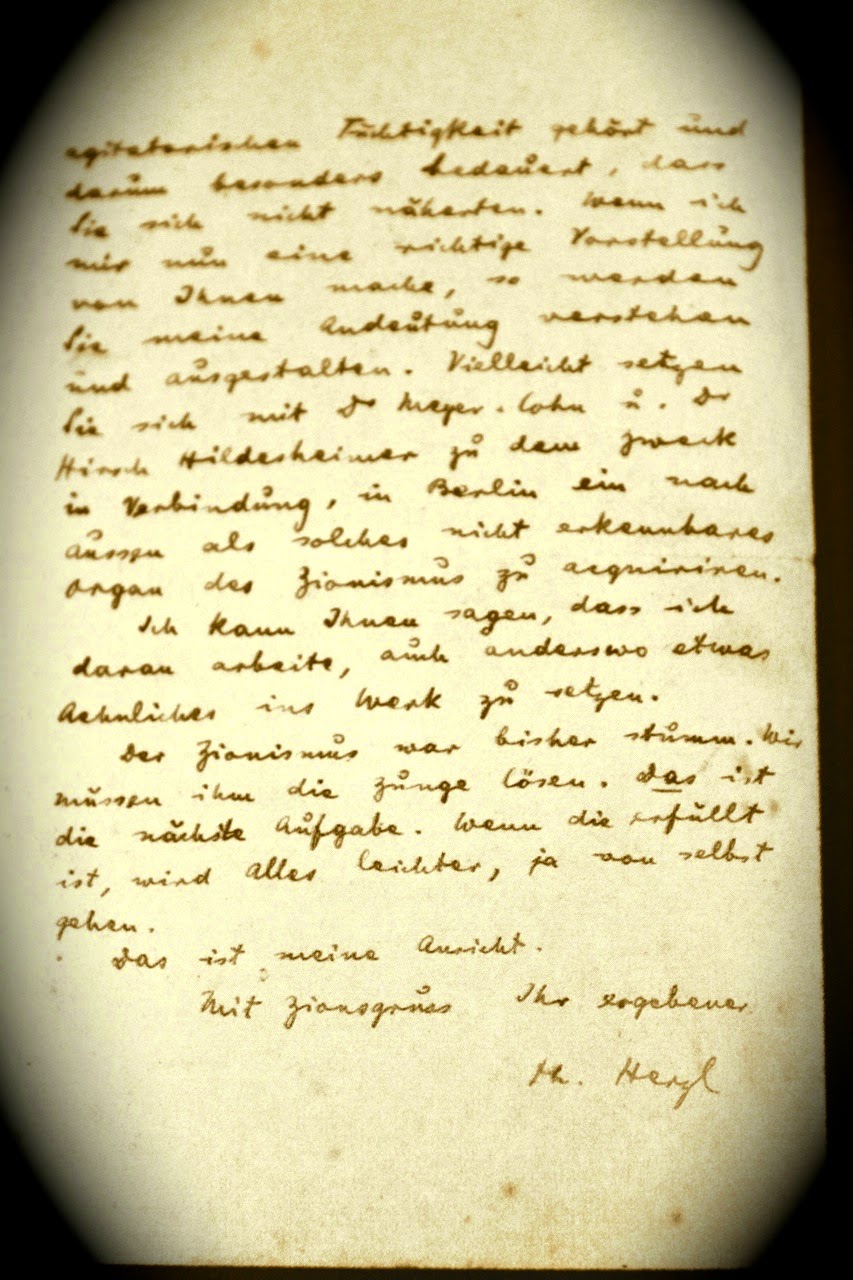
In a little known and rarely-referenced letter written in early 1897, Theodor Herzl, the ostensible founder of political Zionism, made this perfectly clear. During the planning stages of the First Zionist Congress – initially to take place in Munich but eventually held in Basel, Switzerland in late August 1897 – Herzl contacted Willy Bambus, leader of the Berlin Hovevei Zion society (an early Zionist organization committed to Jewish immigration and agricultural settlement in Palestine), for support.
“I want to reach an understanding with the Berlin Zionists,” Herzl wrote from Vienna on January 26, 1897. “[I]n the general Zionist conference that I am planning for next summer, we will grow closer to each other.” The letter is written in German, Herzl’s first language.
Herzl’s dream was big and he knew what he needed to achieve it:
But a project of this sort… has one prior condition: propaganda. First we must have propaganda and afterward establish economic projects… [T]ry to win influence at a Berlin daily newspaper… There is no necessity to immediately give the newspaper a Zionist imprint. On the contrary, because of the cowardly suspicions (to my sorrow, of most of the Jews) of Zionism, it would be wiser to keep things innocent… Perhaps you can… purchase a Zionist paper in Berlin, that will not be outwardly noticed as such.
Friendly media coverage? Feigned innocence and impartiality? Sounds familiar.
“Until now Zionism has been silent,” Herzl wrote Bambus. “We must free its tongue. This is the first order of business.”
Those tongues of Zionism have since wrought over a century of pain and suffering, in name the entitlement and privilege, to the people of Palestine. It is time to drown out the propaganda with truth.
The Consistency of Official Iranian Commentary, Part III: On Khamenei’s Referendum Rhetoric, Reuters is Wrong
By Nima Shirazi | Wide Asleep in America | July 27, 2014
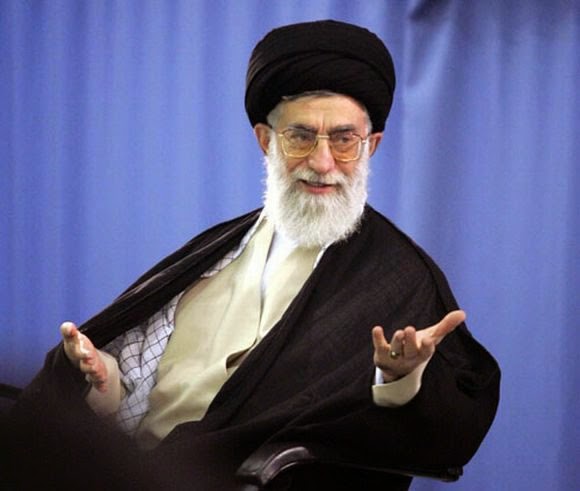 Last week, Iranian leader Ayatollah Ali Khamenei addressed a meeting of Iranian university students and, in his first public comments on the ongoing assault on Gaza, spoke of his belief in the necessity of continued Palestinian resistance to Israel aggression, oppression, and occupation.
“Don’t the Palestinians have the right to defend their lives and security?” he asked rhetorically, and condemned Western nations like the United States and Great Britain for openly supporting Israel’s assault and justifying “crimes that no ordinary person would.”
In the right-wing Daily Caller, notorious neocon darling Reza Kahlili noted that Khamenei reiterated the call by his predecessor, Ayatollah Rouhollah Khomeini, that “Israel must be destroyed,” adding that “until that time with the help of God for this cruel and murderous regime to be destroyed, strong confrontation with steadfast armed resistance is the only solution against this destructive regime.”
Yet the Caller omitted a crucial aspect of Khamenei’s speech – deliberately replaced by an ellipsis linking the the paraphrased Khomeini quote with Khamenei’s endorsement of Palestinian armed struggle – in which the Iranian leader stated that the ideal solution to the current impasse was a democratic vote.
The missing piece, however, was reported by other outlets. “There are logical and practical means to this end, which is for people who live and belong there to pick the government of their choice through a referendum. That would be the end of a usurping fake regime,” Khamenei said, according to a translation by Reuters. Until that time, he continued, “while waiting for an end to this cold-blooded murderous regime, mighty armed resistance is the only way to deal with it.”
Only through a vote by the indigenous population, Khamenei said, will “the usurper and forged regime” of Israel “be practically annihilated.”
Kahlili’s report predictably expunged all mention of a referendum, focusing instead on Iranian military capabilities and nuclear negotiations. More troubling, perhaps, is that “The Young Turks,” a liberal (some might even say, progressive) news and commentary outlet led by host Cenk Uygur, promoted the Daily Caller line in their own round table discussion of the matter. After hearing a portion of the Kahlili article read aloud verbatim, co-host Ana Kasparian described Khamenei’s comments as “extremely violent” and “crazy,” while John Iadarola called such statements “depressing.”
Reuters also quoted Khamenei as saying, “Israel’s annihilation is the only real cure, but that doesn’t mean destroying Jews in this region,” a statement also ignored by the Daily Caller. With this comment, Reuters editorialized, “Khamenei made clear for the first time that he was talking about the dismantling of the state of Israel, not the death of Jews.”
While such clarification is important, the characterization of that distinction as being a new addition to Khamenei’s rhetoric is curious. In fact, this is a distinction made often by Iranian officials when discussing this very topic – and Iran’s official position toward Israel/Palestine. Cursory research into past statements quickly reveals the consistency of such statements and proves the Reuters claim to be, not only sloppy, but ludicrous.
A similar presumption was made last year in the wake of then-newly-inaugurated Iranian President Hassan Rouhani’s insistence that, “when it comes to the settlement and resolution of regional issues,” including the colonization and occupation of Palestine, “we believe that the only path is through the ballot box, through democracy.” International news media declared this to be a breakthrough moment, despite the clear fact that Rouhani’s immediate predecessor, the much-maligned Mahmoud Ahmadinejad, had made identical statements throughout his eight-year tenure as president.
“We are opposed to the idea that the people who live there should be thrown into the sea or be burnt,” Ahmadinejad said in comments reported by the New York Times in September 2008. “We believe that all the people who live there, the Jews, Muslims and Christians, should take part in a free referendum and choose their government.”
More to the point, however, Khamenei himself has remained remarkably consistent on this issue, and Iran’s official prescription, for over two decades. In an extensive analysis of Khamenei’s speeches since 1990, published in the Boston Review in November 2013, well-known Iranian dissident Akbar Ganji – no fan of the Iran’s theocratic leadership – revealed the truth: Khamenei has long called for a new, inclusive Palestinian government to supersede the current Zionist one, thereby dismantling what is currently known as “Israel” politically, not violently.
For instance, Ganji notes, on April 17, 1991, Khamenei discussed “his solution for the Palestinian problem and said, ‘The Islamic Republic’s solution is to disband the usurping Zionist regime, forming a government of the Palestinians, and [guaranteeing] peaceful co-existence of Jews, Christians, and Muslims in all of Palestine.'” Four months later, on August 19, 1991, Ganji adds, Khamenei stated, “Solving the Palestinian problem entails destroying and eliminating the illegitimate government there, so that the true owners [of the land] can form a new government; Muslims, Christians, and Jews can live side by side… Our view regarding the Palestine issue is clear. We believe the solution is destroying the Israeli regime.”
Nearly a decade later, Khamenei’s position had not shifted. In a speech to the Basij militia on October 21, 2000, Ganji tells us that Khamenei again laid out his vision for the indigenous people of Palestine to choose their own political path forward. “The solution is for the millions of the Palestinians to return to Palestine, the several millions that live away from home to return to Palestine. The indigenous people of Palestine—Jews, Christians, and Muslims—should hold a referendum to decide what kind of a regime they want. The vast majority are Muslims. There are also Jews and Christians that belong there, as their parents also lived there. They can decide the political system that they favor,” he opined.
In March 2002, Khamenei again stated, “Holding a referendum in Palestine among the Palestinians, and all those that became refugees—if, of course, they want to return to Palestine—is a rational solution.” In June 2002, he repeated, “The only solution for the Palestine problem is that the true Palestinians, not the usurping and occupying immigrants, those who live in Palestine and those who became refugees, decide the type of government that they want. If asking for the vote of the people of a nation is a solution for those who claim to be democracy advocates, [then] Palestine is also a nation and must decide [its fate].”
The Palestinian problem has only one solution, and that is what we proposed several years ago. Hold a referendum among the indigenous Palestinians, those who live there, or are in refugee camps, or live elsewhere, regardless of whether they are Muslim, Christian, or Jew, and ask them to decide the government that they want. Regardless of whether that government is run by the Muslims, Jews, or Christians, as long as it is the result of people’s direct votes, is acceptable, and will solve the problem. Without it [the referendum] the problem will never be solved.
That Reuters would now claim Khamenei’s recent comments about Gaza mark a stark break from the past is absurd. In his Friday prayer sermon on June 20, 2008, Khamenei declared, “No, we have no problems with Jews. We have no problems with Christians, and with adherents of other religions in the world. The usurper is just the Zionist regime. This is the position of our state, and that of our revolution and our people.”
Similarly, on September 30, 2011, Khamenei spoke at a conference in support of the Palestinian struggle for freedom, justice, and self-determination, and said, “We neither advocate a classic war between Israel and the Islamic countries, nor throwing the Jewish people into the sea, and neither do we accept mediation by the United Nations or any other international organization. We propose a referendum among the Palestinian people. Similar to any other nation, the Palestinians also have the right to decide their fate and pick the type of government they want.”
Addressing the opening assembly of the Non-Aligned Movement on August 30, 2012 in Tehran, Khamenei once again reiterated Iran’s “just and entirely democratic solution” to the conflict:
All the Palestinians – both the current citizens of Palestine and those who have been forced to immigrate to other countries but have preserved their Palestinian identity, including Muslims, Christians and Jews – should take part in a carefully supervised and confidence-building referendum and chose the political system of their country, and all the Palestinians who have suffered from years of exile should return to their country and take part in this referendum and then help draft a Constitution and hold elections. Peace will then be established.
Regardless of whether Khamenei’s proposals are realistic, idealistic, inevitable or impossible, is irrelevant. That he has consistently called for a referendum to alter the exclusivist and discriminatory political system that controls Palestinian lives and has routinely made distinctions between the Zionist government in Israel specifically and Jewish people in general, is indisputable.
Reuters should get their facts straight.
Detained Diplomat Hugo Carvajal Arrives in Venezuela
TeleSUR | July 28, 2014
General Hugo Carvajal arrived Sunday evening in Venezuela after being released from a jail in Aruba, where he had been arbitrarily detained since July 24, and immediately headed to Caracas to be received by President Nicolas Maduro at the Third Congress of the United Socialist Party of Venezuela (PSUV).
Venezuelan Foreign Relations Minister Elias Jaua received Carvajal and the deputy Minister of Foreign Relations to Europe, Calixto Ortega, at the Maiquetia International Airport, some 18 miles from the capital’s city of Caracas.
Ortega told teleSUR that, “The government of the Netherlands — which recognized that the arrest of the official had been illegal and in violation of international treaties on diplomats — accepted the criteria of the Venezuelan Foreign Ministry in regards to the fact that the Major General is a diplomatic official.”
Venezuelan President Nicolas Maduro said he was satisfied with the release of the general consul Hugo Carvajal, who he said was falsely accused of drug trafficking by the United States.
“Hugo Carvajal broke world records by arresting over 75 heads of drug trafficking organizations,” said Maduro during the second day of the Third National Congress of the PSUV. Carvajal was standing next to Maduro in the presence of the 985 delegates of the ruling party participating in the political event.
Maduro said Carvajal was an innocent victim of “lies fabricated” against him by Western media.
Carvajal was released this Sunday evening by the Dutch autorities in Aruba, after they admitted they had illlegaly arrested him on July 24.
Special Correspondent for teleSUR, Madelein Garcia, reported that Carvajal exited the prison in Aruba, accompanied by deputy Minister of Foreign Relations to Europe, Calixto Ortega, and his lawyers.
The government of Netherlands said on Sunday that General Hugo Carvajal would be released. The Venezuelan official was arrested by Aruban authorities in violation of international law, in particular the 1961 Vienna Convention on Diplomatic Relations.
The announcement of Carvajal´s release was made on Sunday by Jaua, in the framework of the III National Congress.
Jaua read a statement sent by the Netherlands to the Venezuelan government, in which it recognized that the arrest occurred “outside international treaties for diplomatic personnel.”
“Comrade Hugo Carvajal at this time is in a prison and probably still does not know this news,” Jaua said. He stressed that the Netherlands rectified and complied with international law.
The Venezuelan Foreign Ministry issued a statement on Thursday rejecting the arrest and said the Venezuelan government will provide all support to Carvajal.
The Shame of David Gregory
By Greg Mitchell | Pressing Issues | July 28, 2014
It’s been a tough week for NBC’s David Gregory.
First were reports that his “Meet the Press” was sinking under even weaker ratings and that he would soon be replaced. Then as we noted here yesterday: Gregory, after a weak interview with Prime Minister Netanyahu, committed one of the worst journalistic ethical lapses of recent vintage. After letting Netanyahu claim, again, that Israel may be blameless in the school massacre, despite all the evidence and logic to the contrary, he brought on UNWRA spokesman Chris Gunness–and blindsided him by showing a 10-second, hazy, tape just released within the hour by Israel allegedly showing a Hamas rocket being fired from the grounds of a UN school. Yet Gregory said NBC had not “verified” that it’s accurate–and admitted that Gunness could not view it and had never seen it before. Yet then asked Gunness to respond! Gunness naturally protested the unfairness–and then the segment quickly ended.
Gregory has now issued this statement: “An end note in a discussion about Gaza we asked a spokesman about this video which Israel claims showed rockets being fired by Hamas from a U.N. school in Gaza,” Gregory said. “This is shot by the Israeli government, and that’s their claim. The U.N. has reviewed it, tells us they have confirmed, in their view, the video does not show rockets being fired from U.N. administrative school in Gaza. So this is a back and forth we are not able to settle at this point.” No apology or recognition of his severe ethical lapse. Shameful. And leaves it at the usual “he said/she said”–rather than NBC attempting to verify tape or prove Israeli propaganda. Which it should have done before airing it.
Meanwhile, the NYT has not updated its report last night, that focused on a different Israeli video, to add the UN statement–which Gregory cited 17 hours ago–debunking the one that allegedly shows rockets fired from the school grounds. Surely it’s worth noting that Israel’s videos may be nothing but propaganda. This is what I wrote about it last night:
Will surprise no one that when the NYT tonight reports on Israel’s claim it killed no one at the school–it’s the same old refusal to take on the absurd IDF claims head-on. You’d never know that Israel lied to them for three days [claiming] that none of their bombs even hit the school. It’s as if the reporters say, “More propaganda, please.” As from the beginning, they ultimately rely on “different versions can’t be reconciled now”–even though all evidence and testimony point to Israel being guilty of this slaughter. It’s a false “balance.”
They give their point of view away by not even referring to Israel completely changing its story after three days. That’s more revealing than the totally unverified 10-second video. Most of those who have gone to the site, such as Peter Beaumont of The Guardian, have all pointed their finger at Israel as no doubt the guilty party. Another one here. Not the Times.
And see the IDF spokesman’s “scenario” (below) that maybe the hundreds of wounded and dead were not hit there but brought to the site from elsewhere. The Times now dutifully uses the phrase that 16 were “reportedly killed” at the site. This is the same Israeli official the NYT reporters give the benefit of the doubt to re: the grainy video with no time stamp. See my earlier report on the shameful NYT coverage on this (as with much else on the conflict).
Blaming Russia as ‘Flat Fact’
By Robert Parry | Consortium News | July 27, 2014
As nuclear-armed America hurtles into a completely avoidable crash with nuclear-armed Russia over Ukraine, you can now see the dangers of “information warfare” when facts give way to propaganda and the press fails to act as an impartial arbiter.
In this sorry affair, one of the worst offenders of journalistic principles has been the New York Times, generally regarded as America’s premier newspaper. During the Ukraine crisis, the Times has been little more than a propaganda conveyor belt delivering what the U.S. government wants out via shoddy and biased reporting from the likes of Michael R. Gordon and David Herszenhorn.
The Times reached what was arguably a new low on Sunday when it accepted as flat fact the still unproven point of how Malaysia Airlines Flight 17 was shot down. The Times dropped all attribution despite what appear to be growing – rather than diminishing – doubts about Official Washington’s narrative that Ukrainian rebels shot down the plane by using a powerful Russian-supplied Buk missile battery.
U.S. and Ukrainian government officials began pushing this narrative immediately after the plane went down on July 17 killing 298 people onboard. But the only evidence has been citations of “social media” and the snippet of an intercepted phone call containing possibly confused comments by Ukrainian rebels after the crash, suggesting that some rebels initially believed they had shot the plane down but later reversed that judgment.
A major problem with this evidence is that it assumes the rebels – or for that matter the Ukrainian armed forces – operate with precise command and control when the reality is that the soldiers on both sides are not very professional and function in even a deeper fog of war than might exist in other circumstances.
Missing Images
But an even bigger core problem for the U.S. narrative is that it is virtually inconceivable that American intelligence did not have satellite and other surveillance on eastern Ukraine at the time of the shoot-down. Yet the U.S. government has been unable (or unwilling) to supply a single piece of imagery showing the Russians supplying a Buk anti-aircraft missile battery to the rebels; the rebels transporting the missiles around eastern Ukraine; the rebels firing the fateful missile that allegedly brought down the Malaysian airliner; or the rebels then returning the missiles to Russia.
To accept Official Washington’s certainty about what it “knows” happened, you would have to believe that American spy satellites – considered the best in the world – could not detect 16-feet-tall missiles during their odyssey around Russia and eastern Ukraine. If that is indeed the case, the U.S. taxpayers should demand their billions upon billions of dollars back.
However, the failure of U.S. intelligence to release its satellite images of Buk missile batteries in eastern Ukraine is the “dog-not-barking” evidence that this crucial evidence to support the U.S. government’s allegations doesn’t exist. Can anyone believe that if U.S. satellite images showed the missiles crossing the border, being deployed by the rebels and then returning to Russia, that those images would not have been immediately declassified and shown to the world? In this case, the absence of evidence is evidence of absence – absence of U.S. evidence.
The U.S. government’s case also must overcome public remarks by senior U.S. military personnel at variance with the Obama administration’s claims of certainty. For instance, the Washington Post’s Craig Whitlock reported last Saturday that Air Force Gen. Philip M. Breedlove, U.S. commander of NATO forces in Europe, said last month that “We have not seen any of the [Russian] air-defense vehicles across the border yet.”
Whitlock also reported that “Rear Adm. John Kirby, the Pentagon press secretary, said defense officials could not point to specific evidence that an SA-11 [Buk] surface-to-air missile system had been transported from Russia into eastern Ukraine.”
There’s also the possibility that a Ukrainian government missile – either from its own Buk missile batteries fired from the ground or from a warplane in the sky – brought down the Malaysian plane. I was told by one source who had been briefed by U.S. intelligence analysts that some satellite images suggest that the missile battery was under the control of Ukrainian government troops but that the conclusion was not definitive.
Plus, there were reports from eyewitnesses in the area of the crash that at least one Ukrainian jet fighter closed on the civilian plane shortly before it went down. The Russian government also has cited radar data supposedly showing Ukrainian fighters in the vicinity.
Need for a Real Inquiry
What all this means is that a serious and impartial investigation is needed to determine who was at fault and to apportion accountability. But that inquiry is still underway with no formal conclusions.
So, in terms of journalistic professionalism, a news organization should treat the mystery of who shot down Flight 17 with doubt. Surely, no serious journalist would jump to the conclusion based on the dubious claims made by one side in a dispute while the other side is adamant in its denials, especially with the stakes so high in a tense confrontation between two nuclear powers.
But that is exactly what the Times did in describing new U.S. plans to escalate the confrontation by possibly supplying tactical intelligence to the Ukrainian army so it can more effectively wage war against eastern Ukrainian rebels.
On Sunday, the Times wrote: “At the core of the debate, said several [U.S.] officials — who, like others interviewed, spoke on the condition of anonymity because the policy deliberations are still in progress — is whether the American goal should be simply to shore up a Ukrainian government reeling from the separatist attacks, or to send a stern message to [Russian President Vladimir] Putin by aggressively helping Ukraine target the missiles Russia has provided. Those missiles have taken down at least five aircraft in the past 10 days, including Malaysia Airlines Flight 17.” [Emphasis added.]
The link provided by the Times’ online version of the story connects to an earlier Times’ story that attributed the accusations blaming Russia to U.S. “officials.” But this new story drops that attribution and simply accepts the claims as flat fact.
The danger of American “information warfare” that treats every development in the Ukraine crisis as an opportunity to blame Putin and ratchet up tensions with Russia has been apparent since the beginning of the Ukraine crisis – as has been the clear anti-Russian bias of the Times and virtually every other outlet of the mainstream U.S. news media. [See Consortiumnews.com’s “Will Ukraine Be NYT’s Waterloo?”]
Since the start of the crisis last year, U.S. officials and American-funded non-governmental organizations have not only pushed a one-sided story but have been pushing a dangerous agenda, seeking to create a collision between the United States and Russia and, more personally, between President Barack Obama and President Putin.
The vehicle for this head-on collision between Russia and the United States was the internal political disagreement in Ukraine over whether elected President Viktor Yanukovych should have accepted harsh International Monetary Fund austerity demands as the price for associating with the European Union or agree to a more generous offer from Russia.
Angered last September when Putin helped Obama avert a planned U.S. bombing campaign against Syria, American neocons were at the forefront of this strategy. Their principal need was to destroy the Putin-Obama collaboration, which also was instrumental in achieving a breakthrough on the Iran nuclear dispute (while the neocons were hoping that the U.S. military might bomb Iran, too).
So, on Sept. 26, 2013, Carl Gershman, a leading neocon and longtime president of the U.S.-funded National Endowment for Democracy, took to the op-ed page of the neocon-flagship Washington Post to urge the U.S. government to push European “free trade” agreements on Ukraine and other former Soviet states and thus counter Moscow’s efforts to maintain close relations with those countries.
The ultimate goal, according to Gershman, was isolating and possibly toppling Putin in Russia with Ukraine the key piece on this global chessboard. “Ukraine is the biggest prize,” Gershman wrote. “Russians, too, face a choice, and Putin may find himself on the losing end not just in the near abroad but within Russia itself.”
To give the United States more leverage inside Ukraine, Gershman’s NED paid for scores of projects, including training “activists” and supporting “journalists.” Rather than let the Ukrainian political process sort out this disagreement, U.S. officials, such as neocon Assistant Secretary of State Victoria Nuland and neocon Sen. John McCain, also intervened to encourage increasingly disruptive demonstrations seeking to overthrow Yanukovych when he opted for the Russian deal over the EU-IMF offer.
Though much of the ensuing violence was instigated by neo-Nazi militias that had moved to the front of the anti-Yanukovych protests, the U.S. government and its complicit news media blamed every act of violence on Yanukovych and the police, including a still mysterious sniper attack that left both protesters and police dead.
On Feb. 21, Yanukovych denied ordering any shootings and tried to stem the violence by signing an agreement brokered by three European nations to reduce his powers and hold early elections so he could be voted out of office. He also complied with a demand from Vice President Joe Biden to pull back Ukrainian police. Then, the trap sprang shut.
Neo-Nazi militias overran government buildings and forced Yanukovych and his officials to flee for their lives. The State Department quickly endorsed the coup regime – hastily formed by the remnants of the parliament – as “legitimate.” Besides passing bills offensive to ethnic Russians in the east, one of the parliament’s top priorities was to enact the IMF austerity plan.
White Hats/Black Hats
Though the major U.S. news media was aware of these facts – and indeed you could sometimes detect the reality by reading between the lines of dispatches from the field – the overriding U.S. narrative was that the coup-makers were the “white hats” and Yanukovych along with Putin were the “black hats.” Across the U.S. media, Putin was mocked for riding on a horse shirtless and other indiscretions. For the U.S. media, it was all lots of fun, as was the idea of reprising the Cold War with Moscow.
When the people of Crimea – many of whom were ethnic Russians – voted overwhelmingly to secede from Ukraine and rejoin Russia, the U.S. media declared the move a Russian “invasion” although the Russian troops were already in Ukraine as part of an agreement with previous Ukrainian governments.
Every development that could be hyped was hyped. There was virtually no nuance in the news reporting, a lack of professionalism led by the New York Times. Yet, the solution to the crisis was always relatively obvious: a federalized system that would allow the ethnic Russians in the east a measure of self-governance and permit Ukraine to have cordial economic relations with both the EU and Russia.
But replacement President Petro Poroshenko – elected when a secession fight was already underway in the east – refused to negotiate with the ethnic Russian rebels who had rejected the ouster of Yanukovych. Sensing enough political support inside the U.S. government, Poroshenko opted for a military solution.
It was in that context of a massive Ukrainian government assault on the east that Russia stepped up its military assistance to the beleaguered rebels, including the apparent provision of shoulder-fired anti-aircraft missiles to fend off Kiev’s air superiority. The rebels did succeed in shooting down some Ukrainian warplanes flying at altitudes far below the 33,000 feet of the Malaysia Airlines plane.
For a plane at that height to be shot down required a more powerful system, like the Buk anti-aircraft batteries or an air-to-air missile fired by a fighter jet. Which brings us to the mystery of what happened on the afternoon of July 17 and why it is so important to let a serious investigation evaluate all the available evidence and not to have a rush to judgment.
But the idea of doing an investigation first and drawing conclusions second is a concept that, apparently, neither the U.S. government nor the New York Times accepts. They would prefer to start with the conclusion and then make a serious investigation irrelevant, one more casualty of information warfare.
~
Investigative reporter Robert Parry broke many of the Iran-Contra stories for The Associated Press and Newsweek in the 1980s. You can buy his new book, America’s Stolen Narrative, either in print here or as an e-book (from Amazon and barnesandnoble.com).
Featured Video

Iran’s Next Strike May Not Explode. It Could Shut You Down
or go to
Aletho News Archives – Video-Images
From the Archive
Zionism’s Violent Legacy
By Donald Neff | Washington Report On Middle East Affairs | January 1996
On January 4, 1948, Jewish terrorists drove a truck loaded with explosives into the center of the all Arab city of Jaffa and detonated it, killing 26 and wounding around 100 Palestinian men, women and children.[1] The attack was the work of the Irgun Zvai Leumi – the “National Military Organization,” also known by the Hebrew letters Etzel – the largest Jewish terrorist group in Palestine. The Irgun was headed by Revisionist Zionist Menachem Begin and had been killing and maiming Arabs, Britons and even Jews for the previous ten years in its efforts to establish a Jewish state.
This terror campaign meant that at the core of Revisionist Zionism there existed a philosophical embrace of violence. … continue
Blog Roll
 Aletho News
- Trump and Netanyahu Want to “Finish the Job” on Iran
- US ‘one-sided dictation’ not Iran’s beliefs makes rational talks impossible: Baghaei
- Iran’s Next Strike May Not Explode. It Could Shut You Down /Col Doug Macgregor
- Iran: US political targets legitimate if assassinations return
- Iraq shuts key border crossing with Iran under US pressure: Report
- Undersea Internet cables could be targeted in retaliation for attacks on Iran: IRGC deputy chief
- EU sending ‘biased’ observers to interfere in Serbian election – president
- White House envoy declares kinetic action against Yemen ‘fruitless’
- Ukraine deployed thousands of microdrones in Iraqi Kurdistan: Tasnim
- Iran calls for emergency UNSC meeting over Trump’s ‘brazen’ bomb talk, Israeli threats
- If Americans Knew
- Americans at National Conservatism Conference held in Israel this year criticize Israel
- Christiane Amanpour exits CNN with a legacy shaped by the debate over Israel
- Israel’s war on Iran is the final move in a decades-old strategy
- Israel Denies Entry to French Journalist, U.S. Researcher Amid Rise in Entry Denials
- Gaza’s hospitals are running out of life-saving fuel – Daily Update
- Mysterious bot accounts reportedly spread fake ‘man on the street’ videos for Michigan Senate candidate
- Israeli Defense Minister Katz Says Over 60 Lebanon Villages Have Been Destroyed
- Why Is Israel Running TV Ads in Iowa Ahead of the Midterms?
- Hind Rajab’s Alleged Killer Is in the United States. HRF Demands His Arrest.
- US Officials Face Fresh Pressure After Another American ‘Brutalized’ by Israeli Settlers in West Bank
- No Tricks Zone
- E-Cars Reduce CO2 Emissions By Only 41% Compared To Internal Combustion Engine Vehicles
- Predictions Made By Renowned Climate Professor Over Past Decades Have Been Proven To Be Poor
- New Study Suggests Large Regions Of The Pacific Ocean Have Been Cooling For The Last 80 Years
- Germany’s Green Energy Debacle: High Energy Costs Force Kahla Porzellan to Close After 182 Years!
- New Study: 50 Years Of The Most Aggressive ‘Net Zero’ Policies Can Only Affect The Global Climate By 0.03°C
- US September “Heat” Was No Record…Many Records Set Decades Ago
- Latest European Green Energy Debacle; Portugal’s Largest Flagship Solar Park Insolvent!
- Green Energy Debacle: German Expert Professor Fritz Vahrenholt Warns Of Severe Economic And Social Consequences
- Two More Paleo Reconstructions Affirm Meters-Higher Sea Levels Across Ireland, Brazil 7000-6000 Years Ago
- New Study: Earth And Venus Surface Warmth Largely Explained By Convection And Lapse Rate, Not CO2 Or Radiation

