The idea that the Great Depression was finally brought to an end by the onset of WWII has been a staple of history textbooks, documentaries and various war propaganda for decades. This myth continues to be perpetuated to the present day.
The idea that war is good for the economy is, needless to say, a fallacious argument which itself is based on incorrect economic data.
The idea that the economic activity surrounding militarization represents a net economic gain is called the “broken window fallacy.” This fallacy was named and identified by French economist Frédéric Bastiat in his 1850 essay, “That Which is Seen, and That Which is Not Seen,” in which he imagines the case of a shopkeeper whose careless son breaks a pane of glass in his shop window. In Bastiat’s example, ‘that which is seen’ is that the glazier comes, performs the task of fixing the window, and receives six francs for his effort. Onlookers to the scene believe that the economy has actually been bolstered by this act of destruction, since six francs have been spent into it that otherwise would not have been.
But Bastiat notes that what is important is not what is seen, but what is not seen: “It is not seen that as our shopkeeper has spent six francs upon one thing, he cannot spend them upon another. It is not seen that if he had not had a window to replace, he would, perhaps, have replaced his old shoes, or added another book to his library. In short, he would have employed his six francs in some way, which this accident has prevented.”
Similarly, production for war is the broken window fallacy writ large. Economic “gains” produced by government spending on munitions and vehicle manufacture and supplying and equipping the troops are not gains at all; money has merely been diverted to the pockets of the defense contractors via the political cronies in their back pocket.
So why is this important? Because sadly, this myth is being played on by the warmongering class to once again push the idea that war is good and even necessary for economic progress. This time it is not just manufacture of supplies or munitions that are being touted, but war’s ability to justify government spending on investment. No matter how unlikely the threat, or whether it is indeed completely made up, this warped thinking holds that such lies and exaggerations are the answer to our current economic problems.
Sadly, it is not just intellectual deficients like making this case. In a new op-ed in the New York Times, Tyler Cowen of George Mason University argues that technological advances from nuclear research to rocketry to internet and robotics have all been spurred by defense spending, and thus war or threats of war are necessary to continue the advance of civilization.
Why these technologies are ends in themselves, or more valuable than the tens of millions of lives lost in the previous “great wars” is a question left unexamined. Perhaps more to the point, Cowen never addresses why such advances could not take place in the absence of war or without the motivation of advancing the methods of killing as their impetus.
What is most fundamentally upsetting about the mindset that justifies carnage in the name of “economic gain” is that economic gain is usually measured in abstract concepts like GDP growth or increasing equities markets that have no or even negative correlation with the livelihood of the poorest members of society. Income actually shrank by 0.7% for 99% of Americans during the supposed “recovery” of 2009-2011. For the top 1%, income grew 11.5%. This is the type of “help” that massive government spending on bank bailouts and other stimulus measures invariably creates. In times of war, the situation is even more perverse: money is created as debt owed to the banks, backed up by the average working taxpayer, to pay politically-connected defense contractors to create bombs to kill poor brown people on the other side of the planet. This is called economic progress.
Taken to its logical conclusion, there is only one more effective way of solving the problem of poverty. After all, if we are willing to believe the lie that sacrificing lives is good for the economy, why not go that one step further…
A new survey shows the American people’s confidence in TV news is at a record low.
Of all the Americans surveyed, only 18 percent expressed either a “great deal” or “quite a lot” of confidence in US television news, a Gallup poll found.
“Now I am going to read you a list of institutions in American society. Please tell me how much confidence you, yourself, have in each one–a great deal, quite a lot, some or very little?” the Gallup survey asked the participants. One of the institutions listed is “television news.”
Gallup has been asking the same question every year since 1993.
The latest poll was conducted June 5-8. Only 10 percent said they had “a great deal” of confidence in TV news and 8 percent said they had “quite a lot” of confidence.
The second lowest results were in 2012, when 21 percent said they had a great deal or quite a lot of confidence in television news. In 2013, the percentage of people who trusted US TV news was a bit higher — 23 percent.
Some 46 percent of Americans said they had confidence in TV news in 1993, the first year Gallup started asking Americans’ opinion on this topic.
Gallup interviewed a random sample of 1,027 adults in all 50 states and the District of Columbia for the survey. The poll has a margin of error of +/- 4 percentage points.
Iran’s nuclear talks with the P5+1[1] are taking place in Vienna. A “solid commitment” from Iran is needed, ensuring that its stated peaceful atomic energy programme is not a clandestine attempt to build nuclear weapons. The Iranians have found themselves needing to make a leap towards lifting the crushing international sanctions, notably those imposed by the US. It is the basis of these sanctions that MEMO has re-examined with a group of senior researchers in the field.
When Ellie Geranmayeh, Iran expert at the European Council on Foreign Relations (ECFR) spoke with MEMO, she insisted, “In the same way that any potential military dimensions of Iran’s nuclear programme needs to be explained to the United Nations, the West also needs to explain the basis of its accusations and suspicions.”
Ever since the International Atomic Energy Agency (IAEA) reported “sensitive enrichment and reprocessing activity” in Iran in 2003, the country has been under close supervision. The UN Security Council decided to impose economic sanctions for Iran’s non-compliance with its previous request to suspend enrichment activities before extending them in 2007, 2008 and 2010. According to Reuters, Washington was recently pushing for an even more severe attack on the Iranian economy, but this was rejected by the Security Council. Iran’s former president, Mahmoud Ahmadinejad, argued that the sanctions are “illegal” and imposed by “arrogant leaders”. The sanctions are devastating the Iranian economy and have been imposed despite the fact that Iran’s uranium enrichment is being held below 5 per cent, consistent with developing fuel for a civilian nuclear power plant. US pressure has led several nuclear contracts between Iran and foreign governments to fall through.
The United States Enrichment Corporation (USEC)[2], meanwhile, has used its official website to “call for action” to change the course of its declining share of the global enrichment market, underscoring the need to “limit the spread of enrichment technologies to rogue states”. This controversial Western centric use of the phrase “rogue states” demands a thorough investigation, according to many experts.
Furthermore, the West’s foundation for these claims against Iran has too many fault lines “to begin to even list them,” claims historian and Iran nuclear expert Dr Gareth Porter. The single biggest factor pushing “the elite’s obsession over Iran as a threat and as an enemy,” he says, “is that the basic premise was laid down early at the end of the Cold War.” His ground-breaking work recently received the annual Martha Gellhorn Prize for Journalism from the London-based journalists’ Frontline Club. MEMO spoke to Porter about the trajectory of the “imminent Iranian nuclear threat” and its construct by a handful of powerful actors with a particular political agenda and documents “with little reliability” that the media over the last decade have had no qualms about accepting and sharing as (unauthenticated) “evidence”.
1) “The laptop documents”
One of the main anomalies in America’s porous trajectory on Iran is the pseudo-crucial “laptop documents”. Presented by the US to the Security Council, these 1,000 pages are alleged to contain research on nuclear weapons-related activities, stolen from the computer of an Iranian scientist or engineer who was, it is claimed, involved in the programme. “This was a trick to cover the truth,” said Porter. He recapped how the documents were passed to Germany’s intelligence agency by a member of the Mujahideen-E-Khalq (MEK) an Iranian terrorist organisation in exile, which has been a client of Israel’s Mossad spy agency for several years. German intelligence and many other government officials, including ex-US Secretary of State Colin Powell, warned that the US and EU should not make the mistake of basing policy on this information.
2) Redesigned Iranian missile
Another central anomaly is the “discovery” that the Iranian missile re-entry vehicle is depicted in the documents as being redesigned to accommodate a nuclear payload. “This was one that had been discarded by Iran at least two years before the drawings were said to have been made,” Porter argues, “not according to Iranian sources, but an authoritative Western source: the London-based International Institute for Strategic Studies (IISS).”
3) Technical errors
“The discovery that the same drawings of an alleged effort to redesign the re-entry vehicle of the Shahab-3 missile contained numerous technical errors,” Gareth Porter contends, “indicated again that they had not been done by those involved in Iran’s missile programme.”
4) Codename (5.15)
This was given to one of the sub-projects in the alleged nuclear weapons research programme that was, in truth, the number assigned to a contract with the civilian atomic energy organisation of Iran or an ore processing facility and was signed two years before the supposed covert research programme was even said to have begun.
Israel’s position
Last week, at the Herzliya Conference, Israel’s platform for the articulation of national policy, Global Jewish News Source reported major Israeli politicians with strong beliefs in this propaganda. “What is at stake is not merely Israel’s position in the Middle East,” argued Likud’s Yuval Steinitz, “what is at stake is the fate of the entire world… Iran is a nuclear threshold state. It just hasn’t created the weapons yet.”
Lina Khatib of the Carnegie Endowment for International Peace think-tank explained to MEMO how Israel has been trying to push the US to take military action against Iran to stop its nuclear enrichment programme. Further, the government in Tel Aviv has also been engaging in “clandestine intelligence operations to halt Iran’s nuclear developments, for example through cyber-attacks,” she warned. In response, America pushed back against Israel’s request for military strikes against Iran, and is not likely to include Israel as a formal partner in the Vienna negotiations over the nuclear file, “though the US will ensure that Israeli interests are represented during the talks”.
“Overwhelming” evidence exists, according to Dr Gareth Porter, that it was Israel’s Mossad that produced the falsified documents that have propelled the “manufactured crisis” forward, “not just once, but twice”. First came the “laptop documents” that surfaced in 2004 followed in 2008-2009, two years into his research, when a series of intelligence reports and allegedly Iranian documents were given to the IAEA directly by the Israelis, “resulting in more accusations following the November 2011 IAEA report”.
According to Porter, Israeli’s pressure on the Obama administration to make demands of Iran will ensure that the talks fail. “Thus far that Israeli strategy has succeeded, because the Obama administration has demanded a cut in Iranian centrifuges that makes it difficult to envision a final compromise.” Basing any military action on false dossiers would be as irresponsible as the invasion of Iraq in 2003; the world witnessed what consequences that had, when soldiers on the ground had no clue about what was going on.
Current talks
Iran has been talking separately with most of the members of the P5+1 group in advance of the formal meetings week. Although reports have been modestly positive about the potential outcome, the final accord date set as July 20 is already predicted to be given a six-month extension by government officials from most of the countries involved.
Porter remains “very worried” that the talks will fail because of America’s “hard-line” refusal to tolerate any Iranian enrichment of uranium to support even its present nuclear reactor, “much less future reactors”. He recently interviewed Iranian Foreign Minister Javad Zarif, who has not given up hope of renewed and extended diplomatic flexibility on behalf of the US. Even so, he indicated that statements had been made in the talks, as well as to the media, that were “posturing”. He implied that this was politically dangerous because it would make later adjustment in the US negotiation stance very difficult.
According to Lina Khatib, we will see the lifting of some sanctions, but a comprehensive deal will take time to be made and implemented. However, as Iran’s nuclear programme is primarily, she says, “aimed at giving Iran political weight in the Middle East and international recognition as a major regional player, rather than at preparing to conduct a nuclear attack,” there might be more “muscle-flexing” involved than seen so far.
The threat of an ISIS take-over of major Iraqi cities near the border with Iran has collided with the current negotiations on the country’s nuclear programme and arguably paved the way for an indirect willingness to reach an agreement with America. The pace of events means that Iran, which in the 1980s fought former Iraqi dictator Saddam Hussein for eight years, may be willing to cooperate with Washington to bolster Iraq’s Shi’ite Prime Minister Nouri al-Maliki. Iranian President Hassan Rouhani has said that he will consider such cooperation, if the US takes action in Iraq.
However, a US official cautioned against reading too much into the latest talks: “No one should expect that all of a sudden, overnight, even if we resolve the nuclear agreement, that everything will change. It will not. The fundamentals remain exactly as they are. Until we resolve the nuclear issue there cannot be any kind of fundamental change in this relationship.”
Footnotes
[1] Iran has had meetings with China, France, Germany, Russia, the United Kingdom and the United States. These six are known as the P5+1 (the permanent five members of the UN Security Council plus Germany) or alternatively as the E3+3, used by European countries. These meetings are intended to resolve concerns about Iran’s nuclear programme.
[2] USEC: the American corporation that contracts with the United States Department of Energy to produce enriched uranium for use in nuclear power plants.
Although the legal debates about Iran are not taking place in an international court – at least not yet – the veracity of the scientific evidence espoused by all sides to support their legal arguments is nevertheless an extremely important matter, particularly in light of the debacle of the 2003 Iraq war having been based, at least in part, on bad technical and scientific analysis of intelligence information on similar questions. – Dan Joyner
This week the P5+1 and Iranian officials meet again to try to narrow differences over a comprehensive nuclear deal, which is to last for an as-yet unknown duration. Reaching an agreement will be a challenging task because Iran and P5+1 seem to disagree – among other things – about the enrichment capacity Iran should be allowed during the (unknown) term of the comprehensive deal.
According to the Institute for Science and International Security (ISIS) limits on Iran’s enrichment capacity are important because they would lengthen the time needed for Iran to “breakout” and quickly enrich uranium to weapons-grade in any hypothetical race to a uranium-based device.
But Jeffrey Lewis of the Monterey Institute has suggested that such limits are meaningless, saying, “This is completely wrong. Breakout is precisely the wrong measure of whether a deal is successful,” because the Iranians – goes the argument – could use a covert facility to breakout if they wanted to do that.
Instead, intensive verification and intrusive inspections above and beyond what is codified in international law by the so-called “Additional Protocol” have been suggested to try to address this fear.
In a separate report last week, Mr. Porter assesses that David Albright, the founder and executive director of the Institute for Science and International Security (ISIS) in Washington, DC, a prominent commentator on nonproliferation and Iran’s nuclear program has embraced an alarmist line on the Iran issue – despite his knowledge that there were serious problems with the evidence on which it was based.
My intention here isn’t to evaluate the specific items of evidence presented in Mr. Porter’s reports but to weigh in with my own expert analysis – some of it done in collaboration with Dr. Ferenc Dalnoki-Veress of the Monterey Institute – of the quality of the evidence against Iran.
By way of context, Iran has never been formally accused of manufacturing nuclear weapons. The IAEA did determine that Iran was in “non-compliance” with its safeguards agreement in 2005. But this had to do with technical nuclear material accountancy matters — “non-compliance” does not mean Iran was making nuclear weapons. For example, South Korea and Egypt both violated their safeguards agreements in 2004 and 2005. But these U.S. allies were never even referred to the UN Security Council — let alone targeted for sanctions. Pierre Goldschmidt, a former deputy director of safeguards at the IAEA, has noted the “danger of setting bad precedents based on arbitrary criteria or judgments informed by political considerations” at the IAEA.
It is not always easy to obtain access to the actual evidence being used against Iran, but occasionally some is leaked to the press and is amenable to scientific scrutiny. Below, I list some of this evidence being used against Iran, as well some historical record of the group(s) making the allegations:
[1]. An indication into the quality – or, rather, lack thereof – of the evidence against Iran comes from my analysis (done with another physicist, Ferenc Dalnoki-Veress of the Monterey Institute) of the graphs published by the Associated Press purporting to show an Iranian interest in modeling a nuclear explosion. Aside from the fact that there is nothing illegal with doing such theoretical modeling, our analysis showed that there was a large numerical error in the graph and that the time-scale of the explosion was wrong.
[2]. In February 2013, the Washington Post published a story that “purchase orders obtained by nuclear researchers show an attempt by Iranian agents to buy 100,000 … ring-shaped magnets” and that such “highly specialized magnets used in centrifuge machines … [are] a sign that the country may be planning a major expansion of its nuclear program.” As evidence, the Post’s Joby Warrick cited a report authored by David Albright of the Institute for Science and International Security (ISIS).
The Washington Post’s ombudsman eventually got involved and his report is appended below (the cc field has been x’ed out as it mentions the emails of editors & others):
I’ve read everything that Mr. Butt referred me to, and Joby’s story.
A couple of things trouble me. Language like “place the order” doesn’t seem borne out by the nature of those notes that ISIS included copies of in the PDF. It certainly looks like that Iranian company is looking to buy magnets, but I’m not sure I would say “place the order” or “new orders” based on that evidence. And that there is no evidence that a purchase actually went through, as Joby wrote, correct? And there is no date, other than mentioned in the story “about a year ago.” That’s pretty vague, and Iran since then has made some moves, as Joby reported, such as converting some enriched uranium into metal, that suggest it might be listening to international concerns.
Is Joby persuaded that these magnets could only be used for centrifuges? Could Mr. Butt be correct that they could be used for other things and Iran would have the industrial and economic demand for them as speaker magnets or what have you? And how would these magnets, if they were intended for use in centrifuges, play in to the damage caused by stuxnet, in which many of the first generation Iranian centrifuges were damaged?
Just before nuclear talks get underway I am always suspicious of stories that suddenly surface that seem to reinforce the narrative that Iran is building nuclear weapons.
Last July, Joby had the story on the potential increasing threat of the Iranian Navy against the U.S. Navy. Nowhere in that story was there anything about the economic sanctions that many defense experts say are hurting the Iranian military deeply.
I’ve been on some 60 U.S. Navy ships, including five or six carrier battle groups underway. The planes and helicopters that circle in the air above battle groups have considerable surveillance- and fire power. So do U.S. attack submarines who patrol with the battle groups. The new littoral combat ships have plenty of ability to attack shoreline installations in minutes. That is a formidable array of offensive capability.
Of course we should always be vigilant and pay attention to information that comes to us, and report it out. But neither do we want to overstate any threat from any enemy, real or potential.
Kelley is a true authority on such matters, being a nuclear engineer and a veteran of over 35 years in the US nuclear weapons complex, most recently at Los Alamos. He managed the centrifuge and plutonium metallurgy programs at Lawrence Livermore National Laboratory, and was seconded by the US DOE to the IAEA where he served twice as a Director in the nuclear inspections in Iraq, in 1992-1993 and 2002-2003. He is currently an Associate Senior Research Fellow at the Stockholm International Peace Research Institute (SIPRI).
Most importantly, the SIPRI report says that the paving work at Parchin would not completely hide any alleged contamination because there is an area west of the building of interest that remains untouched. And, in any case, the important samples in such a test would come from within buildings not outside on the ground.
Let’s also recall that the IAEA has already visited Parchin twice in 2005 and found nothing – although they did not go to the specific area they are now interested in. However, the IAEA could have gone to that area even in 2005 – they simply chose to go to other sites on the military base. As the IAEA report at the time summarized:
“The Agency was given free access to those buildings and their surroundings and was allowed to take environmental samples, the results of which did not indicate the presence of nuclear material, nor did the Agency see any relevant dual use equipment or materials in the locations visited.”
When the IAEA last went to Parchin, Olli Heinonen was head of IAEA safeguards and led the inspections – the methodology for choosing which buildings to inspect is described in an excellentChristian Science Monitorarticle which is worth reading in its entirety, but I quote the relevant bits:
“At the time, it[Parchin] was divided into four geographical sectors by the Iranians. Using satellite and other data, inspectors were allowed by the Iranians to choose any sector, and then to visit any building inside that sector. Those 2005 inspections included more than five buildings each, and soil and environmental sampling. They yielded nothing suspicious, but did not include the building now of interest to the IAEA.
“The selection [of target buildings] did not take place in advance, it took place just when we arrived, so all of Parchin was available,” recalls Heinonen, who led those past inspections. “When we drove there and arrived, we told them which building.”
“Also unusual is how open and specific the IAEA has been about what exactly it wants to see, which could yield doubts about the credibility of any eventual inspection.
“I’m puzzled that the IAEA wants to in this case specify the building in advance, because you end up with this awkward situation,” says Olli Heinonen, the IAEA’s head of safeguards until mid-2010.
“First of all, if it gets delayed it can be sanitized. And it’s not very good for Iran. Let’s assume [inspectors] finally get there and they find nothing. People will say, ‘Oh, it’s because Iran has sanitized it,’” says Mr. Heinonen, who is now at Harvard University in Cambridge, Mass. “But in reality it may have not been sanitized. Iran is also a loser in that case. I don’t know why [the IAEA] approach it this way, which was not a standard practice…”
Hans Blix, former chief of the IAEA and later of UN weapons inspectors in Iraq, has also expressed surprise at the focus on Parchin, as a military base that inspectors had been to before.
“Any country, I think, would be rather reluctant to let international inspectors to go anywhere in a military site,” Mr. Blix told Al Jazeera English… “In a way, the Iranians have been more open than most other countries would be.”
One of the reasons that Mr. Blix says that is because normally the IAEA does not have the legal authority to inspect undeclared non-nuclear-materials related facilities, in a nation – like Iran — that has not ratified the Additional Protocol.
The IAEA can call for “special inspections” but they have not done so. They can also choose arbitration, as specified in the Comprehensive Safeguards Agreement, but again they have not done that.
So Iran has been more cooperative than they have needed to be in already allowing inspections of Parchin.
“Iran has engaged in large-scale bulldozing operations on about 25 hectares near the Parchin building. This includes the bulldozing of old dirt piles to level a field 500 metres north of the building of interest. However, there has been no such activity in the area west of the building, except for removing some parking pads within about 10 m of it. The fact that the building’s immediate vicinity has been largely untouched on the west side strongly suggests that the purpose of the earth-moving operations was for construction and renovation work and not for ‘sanitizing’ the site by covering up contamination.”
“Some of the experiments described by the IAEA do not and cannot use uranium. The results would be inconclusive if they did. So the basis for the IAEA’s requests continues to be opaque. The timeline for the alleged experiments is also highly suspect, with claims that massive experimental facilities had been fabricated even before they had been designed, according to the available information. The IAEA work to date, including the mischaracterization of satellite images of Parchin, is more consistent with an IAEA agenda to target Iran than of technical analysis.” [Emphasis added]
[4]. The biased analysis of Parchin is, unfortunately, part of a longstanding pattern at ISIS. David Albright co-authored a Sept. 10, 2002, article – entitled “Is the Activity at Al Qaim Related to Nuclear Efforts?” – which declared:
“High-resolution commercial satellite imagery shows an apparently operational facility at the site of Iraq’s al Qaim phosphate plant and uranium extraction facility (Unit-340), located in northwest Iraq near the Syrian border. This site was where Iraq extracted uranium for its nuclear weapons program in the 1980s. …
“This image raises questions about whether Iraq has rebuilt a uranium extraction facility at the site, possibly even underground. … Unless inspectors go to the site and investigate all activities, the international community cannot exclude the possibility that Iraq is secretly producing a stockpile of uranium in violation of its commitments under Security Council resolutions. The uranium could be used in a clandestine nuclear weapons effort.”
Of course the passage is evasive and does not make any definitive claim. But its suggestive and misleading rhetoric implying a possible nuclear weapon program in Iraq turned out to be wrong.
However, ISIS has written almost identical slippery rhetorical statements about various facilities in Iran. There is no end to such “possible facilities” in any country. The point to take home from the erroneous (suggestive) interpretation of the satellite images of facilities in Iraq is that it is very difficult to be sure of what one is seeing in satellite imagery.
[5]. The Exploding Bridgewire Detonators (EBWs) issue is among other pieces of circumstantial evidence publicized by Albright’s ISIS group as possibly implicating Iran. But there are many non-nuclear weapons uses for EBWs, especially for an oil-rich nation like Iran. One manufacturer of EBWs explains that these have “… applications in explosive welding of piping and tubing, seismic studies, oil well perforating & hard rock mining.”
The manufacturer is explicit that EBWs “… have found a wide range of applications within the mining, explosive metal welding and energy exploration field. Many of these uses could not be accomplished using conventional blasting equipment without a compromise of safety.”
Furthermore, Iran was not secretive about its work on EBWs. As the November 2011 IAEA report states: Iran “provided the Agency with a copy of a paper relating to EBW development work presented by two Iranian researchers at a conference held in Iran in 2005. A similar paper was published by the two researchers at an international conference later in 2005.”
The Agency, however, noted, “Iran’s development of such detonators and equipment is a matter of concern…” It really is not given its other civilian (and conventional military) uses, and Iran’s relative openness in pursuing the technology.
The expert Atomic Reporters have weighed in: “While the IAEA reported in 2011 that there are ‘limited civilian and conventional military applications’ for exploding bridge wire detonators, the open source literature shows the technology is widely used in the mining, aerospace and defense industries.”
Again, as long ago as 2011 Robert Kelley, a former IAEA inspector, stated: “The Agency is wrong. There are lots of applications for EBWs… To be wrong on this point, and then to try to misdirect opinion shows a bias towards their desired outcome… That is unprofessional.”
[6]. Other technical experts have also weighed in on Albright’s and ISIS’ track-record. For instance, in a long-running argument with the Federation of American Scientists (FAS) over the capability of Iran’s centrifuges at the Fordow facility, ISIS consistently exaggerated their capability. Ivanka Barzashka and Dr. Ivan Oelrich explained how ISIS generated the wrong numbers:
“When given the choice between a higher value attributed to unnamed sources and values he calculates himself, Albright consistently chooses the higher values.This is especially misleading when dealing with weapon production scenarios, which evaluate what Iran can currently achieve.” [emphasis added]
[7]. In a separate long-running argument with a scientist, Dr. Thomas Cochran, at the Natural Resources Defense Council (NRDC) over the plutonium production capability of the Khushab II reactor in Pakistan it took David Albright years to admit that he and Paul Brannan over-estimated the capability of the reactor by a factor of 10 to 25. This is not a minor error.
Thus, the pattern that emerges of the “evidence” against Iran (and other nations) is of consistent bias, exaggeration and unprofessionalism by some independent nonproliferation security analysts, as well as by the IAEA itself.
“What about the three indications that the arms project may have been reactivated?
Two of the three are attributed only to two member states, so the sourcing is impossible to evaluate. In addition, their validity is called into question by the agency’s handling of the third piece of evidence.
That evidence, according to the IAEA, tells us Iran embarked on a four-year program, starting around 2006, to validate the design of a device to produce a burst of neutrons that could initiate a fission chain reaction. Though I cannot say for sure what source the agency is relying on, I can say for certain that this project was earlier at the center of what appeared to be a misinformation campaign.
In 2009, the IAEA received a two-page document, purporting to come from Iran, describing this same alleged work. Mohamed ElBaradei, who was then the agency’s director general, rejected the information because there was no chain of custody for the paper, no clear source, document markings, date of issue or anything else that could establish its authenticity. What’s more, the document contained style errors, suggesting the author was not a native Farsi speaker. It appeared to have been typed using an Arabic, rather than a Farsi, word-processing program. When ElBaradei put the document in the trash heap, the U.K.’s Times newspaper published it.
This episode had suspicious similarities to a previous case that proved definitively to be a hoax. In 1995, the IAEA received several documents from the Sunday Times, a sister paper to the Times, purporting to show that Iraq had resumed its nuclear-weapons program in spite of all evidence to the contrary. The IAEA quickly determined that the documents were elaborate forgeries. There were mistakes in formatting the documents’ markings, classification and dates, and many errors in language and style indicated the author’s first language was something other than Arabic or Farsi. Inspections in Iraq later in 1995 confirmed incontrovertibly that there had been no reconstitution of the Iraqi nuclear program.”
The words of well-connected and informed senior ex-IAEA officials are worth heeding: Dr. Hans Blix, former head of the IAEA, has stated: “So far, Iran has not violated the NPT,” adding, “and there is no evidence right now that suggests that Iran is producing nuclear weapons.” And Mohamed ElBaradei, the Nobel Peace Prize laureate who spent more than a decade as the director of the IAEA,said that he had not “seen a shred of evidence” that Iran was pursuing the bomb. “All I see is the hype about the threat posed by Iran,” he concluded.
The maximalist approach to non-proliferation advocated by ISIS and other groups may be seen as useful but it is inconsistent with existing international law, as codified in the safeguards agreements. In fact, IAEA records show that all substantial safeguards issues raised in 2005 had been resolved in Iran’s favor by 2008. So Iran was again in compliance with its safeguards agreement at that date. All UN Security Council sanctions ought to have been dropped at that point. Yet Iran’s nuclear file still remains tied up at the Security Council due mainly to the IAEA and Security Council’s flawed handling of the case.
Out of all the countries it inspects, the IAEA spends the second-highest amount on Iran’s nuclear inspections— only Japan, with a vastly greater nuclear infrastructure, accounts for a bigger chunk.About 12 percent of the IAEA’s $164 million inspections budget is spent just on Iran. This is now increased to about 17% during the period of the interim deal because of the even more intrusive—and thus expensive—inspections being carried out now.
On a “per nuclear facility” basis the IAEA spends – by far – the largest amount of its inspections budget on Iran. Comprehensive deal or not, the IAEA will continue to conduct in Iran one of the most thorough and intrusive inspections it carries out anywhere.
However, achieving a deal is in everyone’s favor. It will be made easier by rejecting any flawed (or exaggerated) evidence or analysis being used against Iran – especially by individuals or groups who have a track-record of bias, exaggeration or erroneous scientific analysis.
Dr. Yousaf Butt, a nuclear physicist, is director of the Emerging Technologies Program at the Cultural Intelligence Institute, a non-profit dedicated to promoting fact-based cultural awareness among individuals, institutions, and governments. The views expressed here are his own.
A senior Iranian diplomat has rejected reports about negotiations between Iran and the US over the ongoing crisis in Iraq.
“The Islamic Republic of Iran has had no negotiations with the Americans over mutual cooperation in Iraq,” Iran’s Deputy Foreign Minister for Arab and African Affairs Hossein Amir-Abdollahian said on Monday.
We believe that the Iraqi people and armed forces are capable of handling the crisis in their country on their own, he added.
The Iranian diplomat also dismissed the likelihood of the spillover of the crisis into Iran, saying, “There is no threat against the geographical borders of the Islamic Republic of Iran, but necessary precautions have been taken in this regard.”
Commenting on the quality of Iran’s cooperation with Iraq in fighting terrorism, Amir-Abdollahian rejected any direct military intervention, but noted that the Islamic Republic will assist Iraq through consultations or any other measures which can enable the Iraqi army in its counter-terrorism campaign.
On Sunday, a senior US official said the administration of President Barack Obama is considering the situation to hold talks with Iran over the Iraqi crisis.
Takfiri militants from the so-called Islamic State of Iraq and the Levant (ISIL) have recently been carrying out acts of terror in Iraq, taking over a number of cities and committing atrocities against the people.
Nearly 95 per cent of terrorist arrests have been the result of FBI foiling its own entrapment plots as a part of the so-called post-9/11 War on Terror, a new study revealed.
According to thereportentitled ‘Inventing Terrorists: The Lawfare of Preemptive Prosecution’, the majority of arrests involved the unjust prosecution of targeted Muslim Americans.
The 175-page study by Muslim advocacy group SALAM analyzes 399 individuals in cases included on the list of the US Department of Justice from 2001 to 2010.
“According to this study’s classification, the number of preemptive prosecution cases is 289 out of 399, or 72.4 percent. The number of elements of preemptive prosecution cases is 87 out of 399, or 21.8 percent. Combining preemptive prosecution cases and elements of preemptive prosecution cases, the total number of such cases on the DOJ list is 376, or 94.2 percent,” the report concluded.
The authors define ‘preemptive prosecution’ as “a law enforcement strategy adopted after 9/11, to target and prosecute individuals or organizations whose beliefs, ideology, or religious affiliations raise security concerns for the government.”
Nearly 25 percent of cases (99 of 399) contained material support charges. Another almost 30 per cent of cases consisted of conspiracy charges. More than 17 per cent of the analyzed cases (71 of 399 cases) involved sting operations. Over 16 percent of cases (65 of 399 cases) included false statement or perjury charges, and around six percent of cases involved immigration-related charges.
According to the report, since 9/11 only 11 cases posed “potentially significant” threat to the United States.
“Only three were successful (the [Tamerlan and Dzhokhar] Tsarnaev brothers and Major Nidal Hasan), accounting for 17 deaths and several hundred injuries,” the paper says.
One of the FBI’s strategies involved “using agents provocateur to actively entrap targets in criminal plots manufactured and controlled by the government.”
“The government uses agents provocateur to target individuals who express dissident ideologies and then provides those provocateurs 25 with fake (harmless) missiles, bombs, guns, money, encouragement, friendship, and the technical and strategic planning necessary to see if the targeted individual can be manipulated into planning violent or criminal action,” the report concluded.
The government could also choose to use “minor ‘technical’ crimes,” such as errors on immigration forms, an alleged false statement to a government official, gun possession, tax or financial issues, etc., to go after someone for their “ideology.”
“What they were trying to do is to convince the American public that there is this large army of potential terrorists that they should all be very-very scared about. They are very much engaged in world-wide surveillance and this surveillance is very valuable to them. They can learn a lot about all sorts of things and in a sense control issues to their advantage,” Steven Downs, an attorney for Project SALAM, which issued the report, told RT. “And the entire legal justification for that depends on there being a war on terror. Without a war on terror they have no right to do this. So they have to keep this war on terror going, they have to keep finding people and arresting them and locking them up and scarring everybody.”
In the conclusion, authors of the report offered the US government several recommendations that the DOJ “should employ” to change the present unfair terrorism laws. A total of seven recommendations call on the US government to accurately identify people who offer material support for terrorism, strengthen the “entrapment” defense in the courts; abolish “terror-enhanced sentencing” that triples or quadruples jail time in cases linked to terrorist acts; disallow secret court proceedings, and to immediately notify defendants if any evidence in their case is derived from secret surveillance.
Iran’s nuclear program has been a subject of obsession for Western governments and media agencies for decades, as far back as the final years of Western-backed Shah Mohammed Reza Pahlavi’s reign. But over the course of the last decade, the subject has reached new hysterical heights, propelled by mainstream media coverage mired with distortion and misinformation. Enter: Gareth Porter.
Porter, 71 years old, is a man of many trades. He is a historian, an author, a policy analyst, and of late, has made a name for himself as a successful investigative journalist.
He began his career in journalism during the US war on Vietnam, serving as the Saigon Bureau Chief for the Dispatch News Service International from 1970-71. He then decided to leave journalism for decades, working in a variety of jobs as an anti-war activist, a university teacher, and sustainable development environment work.
It was after another American war at the dawn of the 21st century, this time against Afghanistan and Iraq, that Porter found himself back into the journalistic fold, mainly writing for the InterPress Service.
“It was only from the year 2000 I started writing this book on Vietnam, how the Americans went to war there. It was such an eye-opener. I realized that the problem of America’s wanton wars was not the problem of a president gone wrong or starting from the wrong values or ideas. It was a systemic problem that the war state was the real problem. That has shaped my political consciousness and my scholarship in journalism ever since then,” Porter told Al-Akhbar.
While working on the book, titled “Perils of Dominance: Imbalance of Power and the Road to War in Vietnam”, which was eventually published in 2005, Porter started to write investigative journalistic articles, the first of which was on how Iraqi Kurdish groups were stealing and forging parliamentary elections at the time.
“That’s what started me on the road of becoming an investigative journalist. I never imagined it would happen but it just developed really quickly,” he said with a light laugh.
Porter started covering the Iranian nuclear issue in 2006; at first, he said, he had believed the overall narrative produced by various agencies.
One key evidence used in the allegations by the West of Iran’s attempts to militarize its nuclear program is the more than one thousand pages of documents that were supposedly acquired from the laptop of an Iranian nuclear scientist by intelligence agencies. They are known informally as the “Laptop Documents.”
But when Porter decided to examine the evidence presented against Iran, he began to discover certain anomalies.
“I went back to look at the recent history of the Iran nuclear issue, and that is when I came across a Wall Street Journal article quoting a German foreign office official, Karsten Voigt, saying this very intriguing thing: ‘Don’t rely on these documents because they came from an Iranian dissident group’ – meaning Mujihedin-E-Khalq (MEK).”
“It pushed me in the direction of questioning the narrative. As time went by I saw more and more of the pieces that didn’t fit the puzzle, particularly about these Laptop Documents,” he added.
In late 2007, Porter met with a German source in Washington DC, and asked him about the Wall Street Journal article. The German source confirmed Voigt’s statement, and thus cemented Porter’s belief that there was more to the story. He began working full-time examining the various evidence and raging debates over Iran’s nuclear program.
Many of his articles, however, have never garnered the attention of the mainstream press and traditional policy institutions within the US.
“The feedback was very weak. The biggest problem, of course, is that the news media and political elite in the US are very powerful, don’t need to respond to information and analysis that contradicts their narratives,” Porter said in regards to the reasons behind this general disinterest in his reports.
Nevertheless, his work in uncovering propaganda and unveiling uncomfortable truths about the problematic narratives regarding Iran’s nuclear program earned him the Martha Gellhorn Prize for Journalism, an annual award given by the London-based Frontline Club that celebrates courageous and ground-breaking journalism.
“The single biggest factor driving the elite’s obsession over Iran as a threat and as an enemy is that the basic premise was laid down early at the end of the Cold War,” Porter explained in terms of the reasons behind the American and European honing in on the Islamic republic.
“That the US must take a hand in constraining and preventing Iran from extending its power. It became a fundamental premise of post-Cold War US policy. It fit the interests of the national security state and the Israeli lobby together. Once that happened, and pretty quickly during the Clinton Administration, successive governments naturally followed the general lines set down.”
“Even Obama, just in the early days of office, had the NSA and Israelis come in and tell him about their plans for a cyberwar against Iran. Here he is, a guy who is allegedly planning to enter serious diplomatic engagement with Iran, was essentially conspiring with the Israelis to carry out cyberwarfare. He was going to be the first president to wage cyberwar against another country. That’s very serious,” Porter further remarked.
Overall, Porter mused, the biggest obstacles to any attempt to work out a deal with Iran and end a consideration of military action comes down to Israel.
“Even if there was a settlement of the issue that led to détente between the US and Iran, both of which I’m skeptical about, that would not change the Israeli point of view – which is they have to possess nuclear weapons to maintain superiority over every other country in the Middle East,” he said.
Porter has authored a new book entitled “Manufactured Crisis: The Secret History of the Iranian Nuclear Scare,” which recounts his journalistic work on the allegations about Iran’s nuclear program by the Americans and Israelis since 2006, and discusses in greater detail the numerous evidences and counter-evidences at play.
He recently presented a round table discussion on the topic and his book at the Issam Fares Institute (IFI) building within the American University of Beirut campus on June 9.
Below is the video of the entire talk, and subsequent discussion between Porter and the audience, posted on YouTube by IFI:
In national-security matters, the news media couldn’t do a better job misinforming the public if they tried. The latest example is their portrayal of the five Taliban officials traded for Bowe Bergdahl.
The media of course have an incentive to accentuate controversy. In the Bergdahl deal, this includes portraying the five Taliban prisoners as, in Sen. John McCain’s words, “hard-core jihadis responsible for 9/11.” McCain is wrong, but the major news outlets don’t care. Over and over, the five are identified as terrorists. Facts take a back seat to drama and conflict.
In terms of potential threats, the release of the Taliban who were being held in Guantánamo was conditioned on the Qataris keeping eyes on them and creating a structure in which we can monitor their activities. We will be keeping eyes on them. Is there a possibility of some of them trying to return to activities that are detrimental to us? Absolutely.
The media simply take the government’s word that the five Taliban figures are international terrorists. But the Taliban are not al-Qaeda. They were the theocratic government overthrown by U.S. forces. So when Taliban insurgents attack American forces, it is not terrorism but war, which the U.S government started.
There have been a few hints that the prisoners are not accurately described. A rare example is from the government’s former chief prosecutor at the American prison at Guantánamo Bay, retired Air Force Colonel Morris Davis. Davis punctured the “hardest of the hard-core” narrative when he said:
We had screened all of the detainees and we had focused on about 75 that had the potential to be charged with a crime. When I saw the names [of those traded] … [I] wasn’t familiar with any of these names.… If we could have proven that they had done something wrong that we could prosecute them for I’m confident we would have done it, and we didn’t.
In fact, the story behind the five Taliban prisoners reflects poorly on the U.S. government’s conduct of its supposedly good war. Maybe that’s why this story gets so little attention.
all five of the swapped prisoners were initially captured while trying to cut deals, and … three had been attempting to join, or had already joined, the Afghan government at the time of their arrest.
This history shows that the categories we take as rigid and unchanging, such as “terrorist,” are in fact remarkably fluid in the context of Afghan politics. Uncovering the stories of these men tells us much about Guantanamo, the Taliban, and the possibility of a negotiated end to the conflict.
How did these men end up in U.S. custody? The U.S. government offered attractive bounties to Afghans who turned alleged Taliban and al-Qaeda members over to American authorities. This created a strong incentive to rat out personal enemies, rival warlords, and others, many of whom had nothing to do with the Afghan insurgency or international terrorism. Many were sent to Guantánamo.
For example, Gopal writes, Mohammad Nabi Omari, who was part of the Bergdahl exchange,
was a small-time commander linked to pro-Taliban strongman Jalaluddin Haqqani in the 1990s. After 2001, he was among the many Haqqani followers who switched allegiances to the Karzai government.… [Omari] and other former Haqqani commanders began working for the CIA.… Some Afghan officials in Khost allege that Omari reaped profits from falsely accusing others of al Qaeda membership. If so, he certainly accrued enemies, and in September 2002, he, too, was accused of insurgent membership by rival warlords and politicians, despite being publicly aligned with the Karzai government.
His next stop was Guantánamo.
“Instead of being recalcitrant terrorists bent on fighting America,” Gopal concludes, “this history indicates that all five can make pragmatic deals if the conditions are right.”
The U.S. invasion-occupation of Afghanistan was a war of choice not necessity. American forces made it worse by indiscriminately placing a price on the head of any Afghan whom someone else was willing to destroy.
An official British probe this week into alleged “Islamic extremism” in schools is replete with rumor, hearsay and sensationalist accusations.
But, as it turns out, the government report is based on scant factual evidence.
What this amounts to is a “witch-hunt” against British Muslims fuelled at the highest level of government.
This exercise in fear mongering not only denigrates Muslim communities; it recklessly adds to an already hostile climate of Islamophobia in British society, where ordinary citizens are being targeting by racism and hate crimes.
This week the British government’s regulatory body, Ofsted, released a report into more than 20 schools in the midlands city of Birmingham, where it has been alleged that there is a secret plot to infiltrate the education system with “Islamic extremism.”
Six of the schools investigated have been accused of promoting “intimidation” and “intolerance” of non-Muslims. The British government has now placed the schools on a watch-list, which will involve future no-warning snap inspections.
British Prime Minister David Cameron has vowed “a robust response to protect children” with “an extremism taskforce” that will from now on promote “British values” in schools.
The Birmingham establishments in question may now see their governors and staff sacked, and replaced by government-vetted personnel.
The local education trust that runs the facilities in Birmingham has flatly rejected the Ofsted report and the “baseless allegations.”
A senior member of Parkview Trust, which governs three of the schools investigated, said the government probe has found no evidence to support its claims. Trust chairman David Hughes said:
“This report has been conducted in a climate of suspicion… Ofsted inspectors came to our schools looking for extremism, looking for segregation, looking for proof that our children have religion forced upon them as part of an Islamic plot. The Ofsted reports find absolutely no evidence of this because this is categorically not what is happening at our schools.”
So, what is going on here? The whole affair into alleged extremism in the Birmingham schools, both secondary and primary, began some four years ago when an anonymous teacher supposedly wrote a letter to the British government claiming that there was a “Trojan Horse” plot operating in schools in majority Muslim communities across Birmingham.
That plot was said to involve the takeover of teaching staff at the schools and the infiltration of students with extremist ideology.
The letter has since been widely seen as a hoax. Even right-wing British newspapers, such as The Daily Mail, have acknowledged that the document and its accusations therein are fabrications.
Nevertheless, the allegations have taken on a life of their own and have gained credibility, largely due to incessant media vilification of the schools and Muslim communities in general.
Reprehensibly, senior British government ministers have heightened this climate of fear and the ensuing Islamophobia by giving these groundless claims of extremism credence.
Last week, the interior minister Theresa May and education minister Michael Gove engaged in a bizarre public row, accusing each other of “being soft on Islamic fundamentalism.” Then Conservative party leader David Cameron stepped in to the war of words – not to dismiss the damaging allegations against Muslim majority schools, but to merely discipline his ministers for their public bickering.
There is more than a suspicion that the Conservative ministers, May and Gove, are each exploiting the issue as a way of garnering personal publicity and to further their ambitions for taking over the party leadership from the hapless Cameron. For his part, Cameron seems to be reacting in a heavy-handed way to shore up his image as a “tough leader” instead of being seen as the lame duck premier that he is increasingly appearing to be.
With the release of the Ofsted report this week, Cameron has not challenged the dubious premise of the probe, but has instead promised a “robust response,” thus giving its claims a veneer of veracity.
Teachers, parents and community leaders in Birmingham have roundly condemned the “political agenda” of the government’s so-called probe into Islamic extremism.
Lee Donaghey, a principal at the now black-listed Parkview Academy, said the accusations were “absolutely untrue,” adding: “This is a normal state school, like thousands of others across Britain – 98 percent of our pupils just happen to be Muslims. British Muslims.”
As several local people also pointed out, the schools being targeted by the British government report have staff of different religious faiths, including Muslim and Christian. Some are agnostic.
One parent, Arshad Malik, said the conclusions of the Ofsted report claiming the existence of extremism were “completely alien” to him.
“The only thing extreme about our school is the excellence of student achievement in exams,” he added, saying that Park View had been turned around from an academically failed school into an award-winning one in recent years, thanks to the resilient efforts of the teaching staff.
What forms the basis of the British government probe is nothing but a litany of hearsay and unfounded rumor, which has been pursued with prejudice among the government school-regulators. That is a symptom of the worrying trend of increasing Islamophobia in British society at large, not the existence of “hard-line Islamic” influence in schools.
This very real and unconscionable Islamophobia is now being further whipped up at senior government level for self-serving political reasons that bear no relation to alleged problems.
Furthermore, what is even more deplorable is that the government fuelled anti-Muslim attitude in Britain is placing the lives of ordinary Muslims, including young students, at grave risk. Already, there is disturbing evidence of a soaring number of physical attacks, some of them lethal, on Muslim citizens across Britain. In the mindset of racist street thugs, all Muslims are dehumanized as “terrorists.”
What the British government is doing with its scaremongering reports of “extremist plots” at schools in Muslim communities is setting the stage for even more hate crimes.
Ironically, the one entity that can be most associated with so-called Islamic extremism is the British government itself, with its covert support for terrorists in Syria and Libya, as well as its long-held cozy relationship with the Wahhabi rulers of Saudi Arabia.
Tragically, Muslim communities across Britain are at risk of paying an even bigger price of human suffering for the reckless policies of the British government and its so-called “British values.”
I toured the recently opened 9/11 Museum last night. There is quite a bit to report. The size and scale of the building and many sections are actually impressive. One can see how the general public will be very taken by the entire presentation, and therefore, take what they see as truth.
However, if the original intent of the museum was to pay homage to those who perished, the exhibits are far off the mark. Instead, the creators have co-opted the tragedy to substantiate the official narrative. The museum just solidifies the shock & awe of the events of 9/11, and gives the public a visual and auditory experience that will be firmly etched in their memory far into the future.
There are exhibits on each of the towers. There are photos of their original construction. There were sections of steel columns, elevator parts, and parts of the foundation. There were displays of personal items of those who perished. There were many audio recordings with slide shows being projected of pictures of victims, survivors, and onlookers in a state of terror. There are film clips, and transcripts of conversations from that day. There is an ambulance and a fire truck, which show the damage from the debris. There are videos of the towers on fire. There are even photos of people jumping. Then there are even large videos of the demolition of each tower. But by the time people view these, they’ve been thoroughly distracted and emotionally overcome by the magnitude of the horror people experienced that day, so they cannot recognize the implications of the disintegration and free-fall of 110 stories of steel-framed structures.
There is a section on Osama Bin Laden, the alleged hijackers, Kaleed Sheikh Mohammed, and Al Qaeda. There were two film clips of hijackers passing through the airports. However, the one from Dulles has no time stamp and I think the only other one is actually taken from Portland, ME, not Logan Airport. Nevertheless, people viewing this display were shown exactly who the official narrative wants the blame to be attributed to.
To my surprise, there was even a small section on the public’s questioning of the events. This included photos of people calling for investigations, protestors claiming 9/11 was an inside job, and the cover of Popular Mechanics which supposedly debunked all those “conspiracy theories”. At least the museum planners can attempt to say they were thorough in addressing all of the “focus groups”. But this small section did nothing to go into the broad scope of alternative research based on science and journalistic analysis. If only they had a copy of “The New Pearl Harbor” by David Ray Griffin next to a copy of “Rebuilding America’s Defenses“.
Then, of course, there were quilts, photos, and artifacts that good hearted Americans created in tribute to those who suffered and died. There were photos and statements about how we all came together and rose above the tragedy because we’re resilient and won’t be defeated. After all, we have to keep up our “American exceptionalism”. The framers of the official account took an unspeakable tragedy and turned it into a cause for patriotism.
There was a digital presentation showing the flight paths. There where photos of Shanksville and the Pentagon. But by now you may be noticing there’s a glaring omission to this report. There is nothing on WTC7!I still can’t believe it when the museum covers so much of everything else.
To add further weight to this proposition, just think how the truth about WTC7 actually changes the meaning of everything in the museum! Just think how the entire official narrative caves in on itself. It boggles the mind…
The alternative flyer by Architects & Engineers for 9/11 Truth is an essential educational tool. The cover looks similar to the official pamphlet, except it says “9/11 Reality: Welcome to the other story about 9/11.” This is the Visitor Guide For Truth Seekers. With the thousands of people visiting the 9/11 Memorial and 9/11 Museum daily, distributing these flyers is a huge opportunity to open the eyes of the public. This is our chance to counter the deliberate distortion of history. I urge us all to meet the challenge.
(sf911truth editor’s note: The headline above was in response to a June 5, 2014 article in Newsweek called “The 9/11 Museum’s Biggest Oversight: The World Trade Center’s Neighborhood“, written by Alexander Nazaryan, which laments the museum’s oversight of including any mention of the historical arabic roots of the part of New York City where the museum now resides. However, we think the oversight of mentioning WTC Building 7, a 47-story tall building that suddenly collapses at free fall speed on 9/11, even though it wasn’t hit by a plane, is the more egregious example of the museum omitting evidence, especially evidence that could lead to people questioning the official narrative.)
The corporate media silence on Fukushima has been deafening even though the melted-down nuclear power plant’s seaborne radiation is now washing up on American beaches.
Ever more radioactive water continues to pour into the Pacific.
At least three extremely volatile fuel assemblies are stuck high in the air at Unit 4. Three years after the March 11, 2011, disaster, nobody knows exactly where the melted cores from Units 1, 2 and 3 might be.
Amid a dicey cleanup infiltrated by organized crime, still more massive radiation releases are a real possibility at any time.
Radioactive groundwater washing through the complex is enough of a problem that Fukushima Daiichi owner Tepco has just won approval for a highly controversial ice wall to be constructed around the crippled reactor site. No wall of this scale and type has ever been built, and this one might not be ready for two years. Widespread skepticism has erupted surrounding its potential impact on the stability of the site and on the huge amounts of energy necessary to sustain it. Critics also doubt it would effectively guard the site from flooding and worry it could cause even more damage should power fail.
Meanwhile, children nearby are dying. The rate of thyroid cancers among some 250,000 area young people is more than 40 times normal. According to health expert Joe Mangano, more than 46 percent have precancerous nodules and cysts on their thyroids. This is “just the beginning” of a tragic epidemic, he warns.
There is, however, some good news—exactly the kind the nuclear power industry does not want broadcast.
When the earthquake and consequent tsunami struck Fukushima, there were 54 commercial reactors licensed to operate in Japan, more than 12 percent of the global total.
As of today, not one has reopened. The six at Fukushima Daiichi will never operate again. Some 30 older reactors around Japan can’t meet current safety standards (a reality that could apply to 60 or more reactors that continue to operate here in the U.S.).
As part of his desperate push to reopen these reactors, Prime Minister Shinzo Abe has shuffled the country’s regulatory agencies, and removed at least one major industry critic, replacing him with a key industry supporter.
But last month a Japanese court denied a corporate demand to restart two newer reactors at the Ooi power plant in Fukui prefecture. The judges decided that uncertainty about when, where and how hard the inevitable next earthquake will hit makes it impossible to guarantee the safety of any reactor in Japan.
In other words, no reactor can reopen in Japan without endangering the nation, which the court could not condone.
Such legal defeats are extremely rare for Japan’s nuclear industry, and this one is likely to be overturned. But it dealt a stunning blow to Abe’s pro-nuke agenda.
In Fukushima’s wake, the Japanese public has become far more anti-nuclear. Deep-seated anger has spread over shoddy treatment and small compensation packages given downwind victims. In particular, concern has spread about small children being forced to move back into heavily contaminated areas around the plant.
Under Japanese law, local governments must approve any restart. Anti-nuclear candidates have been dividing the vote in recent elections, but the movement may be unifying and could eventually overwhelm the Abe administration.
A new comic book satirizing the Fukushima cleanup has become a nationwide best-seller. The country has also been rocked by revelations that some 700 workers fled the Fukushima Daiichi site at the peak of the accident. Just a handful of personnel were left to deal with the crisis, including the plant manager, who soon thereafter died of cancer.
In the meantime, Abe’s infamous, intensely repressive state secrets act has seriously constrained the flow of technical information. At least one nuclear opponent is being prosecuted for sending a critical tweet to an industry supporter. A professor jailed for criticizing the government’s handling of nuclear waste has come to the U.S. to speak.
The American corporate media have been dead silent or, alternatively, dismissive about the radiation now washing up on our shores, and about the extremely dangerous job of bringing intensely radioactive fuel rods down from their damaged pools.
Fukushima’s General Electric reactors feature spent fuel pools perched roughly 100 feet in the air. When the tsunami hit, thousands of rods were suspended over Units 1, 2, 3 and 4.
According to nuclear engineer Arnie Gundersen, the bring-down of the assemblies in Unit 4 may have hit a serious snag. Gundersen says that beginning in November 2013, Tokyo Electric Power removed about half of the suspended rods there. But at least three assemblies may be stuck. The more difficult half of the pile remains. And the pools at three other units remain problematic. An accident at any one of them could result in significant radiation releases, which have already far exceeded those from Chernobyl and from the bombings of Hiroshima and Nagasaki.
At least 300 tons of heavily contaminated Fukushima water still pour daily into the Pacific. Hundreds more tons are backed up on site, with Tepco apologists advocating they be dumped directly into the ocean without decontamination.
Despite billions of dollars in public aid, Tepco is still the principal owner of Fukushima. The “cleanup” has become a major profit center. Tepco boasted a strong return in 2013. Its fellow utilities are desperate to reopen other reactors that netted them huge annual cash flow.
Little of this has made its way into the American corporate media.
New studies from the Nuclear Regulatory Commission have underscored significant seismic threats to American commercial nuclear sites. Among those of particular concern are two reactors at Indian Point just north of New York City, which sit near the highly volatile Ramapo Fault, and two at Diablo Canyon, between Los Angeles and San Francisco, directly upwind of California’s Central Valley.
The U.S. industry has also suffered a huge blow at New Mexico’s Waste Isolation Pilot Project. Primarily a military dump, this showcase radioactive waste facility was meant to prove that the industry could handle its trash. No expense was spared in setting it up in the salt caverns of the desert southwest, officially deemed the perfect spot to dump the 70,000 tons of high-level fuel rods now backed up at American reactor sites.
But an explosion and highly significant radiation release at the pilot project last month has contaminated local residents and cast a deep cloud over any future plans to dispose of American reactor waste. The constant industry complaint that the barriers are “political” is absurd.
While the American reactor industry continues to suck billions of dollars from the public treasury, its allies in the corporate media seem increasingly hesitant to cover the news of post-Fukushima Japan.
In reality, those gutted reactors are still extremely dangerous. An angry public, whose children are suffering, has thus far managed to keep all other nukes shut in Japan. If they keep them down permanently, it will be a huge blow to the global nuke industry—one you almost certainly won’t see reported in the American corporate media.
Defying threats of violence, tens of thousands of ordinary Syrians went to the polls to cast a vote that was more about Syrian dignity and self-determination than any of the candidates on the ballot. After three years of unimaginable atrocities fomented by a demented and dying U.S. empire, with the assistance of the royalist monarchies of the Middle East and the gangster states of NATO, the Syrian people demonstrated, by their participation, that they had not surrendered their national sovereignty to the geo-strategic interests of the U.S. and its colonial allies in Europe and Israel.
The dominant narrative on Syria, carefully cultivated by Western state propagandists and dutifully disseminated by their auxiliaries in the corporate media, is that the conflict in Syria is a courageous fight on the part of the majority of the Syrian people against the brutal dictatorship of Bashar al-Assad. As the story goes, the al-Assad “regime,” (it is never referred to as a government), can only maintain its power through the use of force. By attacking “its own citizens,” the regime, representing the minority Alawite community, can only maintain its dominance over the rest of the country through sheer terror.
However, events in Syria, with the election being a dramatic example, continue to reveal fissures in that story.
First, it became clear that substantial numbers of non-Alawite people and communities support the government. And even those elements of Syrian society that were not enthusiastic supporters of the government grew to understand that the legitimate indigenous opposition had been displaced by powerful non-Syrian forces from the U.S. and the Gulf States who provided material, political and diplomatic support to an opposition that not only had tenuous ties to the country but seemed only committed to waging war. This convinced many that the only politically consistent option was to support the government, as an expression of support for Syria’s sovereignty and its’ national project.
As a result, not only did popular support for the government hold over the last three years of carnage, it expanded to include those in the opposition who were against the destruction of the country and the slimy Syrian ex-pats who traveled from one European capital to another begging for the U.S. and NATO to do what it did in Libya – destroy the infrastructure of the country through the use of NATO air power and flood the country with weapons.
But the most graphic undermining of the dominant Western narrative has been the participation of tens of thousands of ordinary Syrians who have braved threats and violence to participate in the election process.
Western corporate news outlets, especially in the U.S., were unable to explain the huge turnout of Syrian refugees voting in Lebanon preceding the election on Tuesday, so they just decided not to cover it. Images of Syrians displaced by war yet backing al Assad for president did not support the carefully crafted story that the only people fleeting war were those who had been terrorized to do so by the government.
Instead, the U.S. press raised the question of the “legitimacy” of elections taking place in a country involved in a “civil war,” a position consistent with their narrative of the war being one between the Syrian people and the government as opposed to what it has turned out to be – a war largely being fought by foreign forces, with the indigenous opposition forces allied with the feckless Syrian National Coalition; isolated, out-gunned and militarily irrelevant.
And while the U.S. press uncritically propagated the position of the U.S. state, which wrote off the election as illegitimate and a farce, the media seemed not to notice the contradictory position of the U.S. writing off the election in Syria because of conflict but giving enthusiastic support to the election in Ukraine in the midst of a conflict and contested legitimacy. The Western media could explore a few obvious questions if it was really independent, such as: what makes the election in Ukraine legitimate when half of the country boycotts the vote and the national army violently attacks its own citizens in Eastern Ukraine who refused to recognize the legitimacy of the coup-makers in Kiev?
Other questions might be: if they deem it appropriate to support an election in Ukraine, why would the Obama Administration violently oppose elections in Syria, especially if, as it claims, the majority of the people oppose the current government? Wouldn’t the illegitimacy of the government in Syria be confirmed by the low turnout, even in areas where there was a modicum of security? If Syrian authorities organized opportunities for displaced Syrians in various countries around the world to vote and very few participated, wouldn’t that verify the Administration’s position that the al Assad government lacks popular support?
Yet in various European capitals and other countries like Turkey, United Arab Emirates, Jordan and Egypt, efforts were made to block the opportunity for displaced Syrians to vote in their election – why? Were the authorities afraid that the narrative of non-support for al Assad might be challenged if there was a proliferation of images like the ones that came out of Lebanon showing thousands of Syrians marching to the polls holding signs of Bashar al Assad?
It will be interesting to see how the authorities and their spokespeople in the corporate media spin the voting process in Syria.
The U.S. position is a position of continued war in Syria
Secretary of State John Kerry declared that Syria’s presidential election was a “farce,” and that the U.S. and its partners are prepared to quickly redouble efforts to support opposition forces in the county. The meaning of this position is that it does not matter what kind of public display of support is given to al Assad or anyone who might emerge as the head of state in Syria, the U.S. objective is more death, more war and more chaos.
This is the essence of the “new” global strategy unveiled by President Obama during his foreign policy speech at West Point last week. The U.S. declaration that it will “change the dynamics on the ground in Syria” came out of a meeting of the so-called “Friends of Syria,” a motley collection of 11 Western colonial nations and their Arab creations. The Obama Administration intends to work through these kinds of regional formations and alliances to advance its strategic objectives with as minimal a cost to the U.S. as possible. Of course, the interests and desires of the states or peoples involved are of secondary concern. The desire on the part of the majority of the people to end the conflict in Syria is not even considered. As part of the effort to secure public support in the U.S. for destabilizing and then attacking Syria it was posited that by deposing the al Assad government a real democracy can be introduced. That is why policymakers pretended to back so-called moderate elements that support democracy. But over the last year or so, even that proposal has been eliminated. Democracy in Syria is as much a threat to U.S. imperialist interests as it is in Ukraine – and increasingly even in the U.S.
Policymakers in Washington and London have already made the shift to supporting what are being called “moderate” Islamists forces grouped around the Islamic Front (IF) with al Nusrah, al Qaeda’s official Syrian affiliate, operating in the background. The problem for the Syrian people is that these moderates the west is supporting are Salafi-Wahhabi fundamentalists who reject representative democracy and support the imposition of sharia law in Syria. So while the U.S. and their allies characterize the election in Syria a farce, their solution is to back forces who would eliminate even the pretext of democratic participation. This is the progress that is being imposed on the secular, pluralist society of Syria by the Western “liberators.”
It is not about al Assad, it is about the people of Syria and imperialism:
Questions of democratic legitimacy have never determined U.S. relationships with any state where the U.S. had strategic and economic interests. If a commitment to democracy and democratic governance was the determining factor for U.S. support, the Obama Administration would not be in alliance with the dictatorship of the royalists in the Gulf states, it would have condemned the coups in Honduras and Egypt, not given diplomatic or economic support to the coup in Ukraine, and would not be supporting right-wing elements in Venezuela attempting to destabilize the democratically-elected government in that country.
There was a time when this position would have been clear to the peace and anti-war, anti-imperialist progressive and left movements in the U.S. and the West. But over the last two decades, with the ideological infiltration of the left by liberalism, social democracy and the rightist tendencies of “anti-authoritarian” anarchism, the resulting political confusion has seen a consistent alignment of the left with the imperial project of the U.S. – from the attacks on the Federal Republic of Yugoslavia through to attacks on nationalist projects throughout the global South, from Libya to Syria. Since the last gasp of anti-imperialism solidarity represented by the massive marches in opposition to the illegal attack on Iraq in 2003, the peace, anti-war and anti-imperialist movements have been in relative disarray.
This disarray and ineffectiveness is taking place right at the historical moment when in order to maintain its global hegemony, the colonial/capitalist West has decided to revert to what it does best – spread death and destruction. For those of us who understand our responsibility situated, as we are, at the center of this monstrosity called the U.S., we have to strip away the veneer of humanitarianism that hides the ugly inner logic of domination and we have to “struggle” – a term now passé for the hip post-modern nihilist left.
When a people, like the people of Syria, demonstrate their commitment to the integrity of their own national experience in opposition to the efforts of the imperialist states that we reside in, the only principled position we can take is to stand in solidarity with those people, no matter how we see the internal contradictions of that nation/state. The people of Syria have said no to foreign intervention. Those of us in the imperialist West, can we do anything less?
Ajamu Baraka, a long-time human rights activist and organizer, is an editor and contributing columnist for Black Agenda Report. Baraka can be reached at info.abaraka@gmail.com and http://www.AjamuBaraka.com
By Donald Neff | Washington Report On Middle East Affairs | January 1996
On January 4, 1948, Jewish terrorists drove a truck loaded with explosives into the center of the all Arab city of Jaffa and detonated it, killing 26 and wounding around 100 Palestinian men, women and children.[1] The attack was the work of the Irgun Zvai Leumi – the “National Military Organization,” also known by the Hebrew letters Etzel – the largest Jewish terrorist group in Palestine. The Irgun was headed by Revisionist Zionist Menachem Begin and had been killing and maiming Arabs, Britons and even Jews for the previous ten years in its efforts to establish a Jewish state.
This terror campaign meant that at the core of Revisionist Zionism there existed a philosophical embrace of violence. … continue
This site is provided as a research and reference tool. Although we make every reasonable effort to ensure that the information and data provided at this site are useful, accurate, and current, we cannot guarantee that the information and data provided here will be error-free. By using this site, you assume all responsibility for and risk arising from your use of and reliance upon the contents of this site.
This site and the information available through it do not, and are not intended to constitute legal advice. Should you require legal advice, you should consult your own attorney.
Nothing within this site or linked to by this site constitutes investment advice or medical advice.
Materials accessible from or added to this site by third parties, such as comments posted, are strictly the responsibility of the third party who added such materials or made them accessible and we neither endorse nor undertake to control, monitor, edit or assume responsibility for any such third-party material.
The posting of stories, commentaries, reports, documents and links (embedded or otherwise) on this site does not in any way, shape or form, implied or otherwise, necessarily express or suggest endorsement or support of any of such posted material or parts therein.
The word “alleged” is deemed to occur before the word “fraud.” Since the rule of law still applies. To peasants, at least.
Fair Use
This site contains copyrighted material the use of which has not always been specifically authorized by the copyright owner. We are making such material available in our efforts to advance understanding of environmental, political, human rights, economic, democracy, scientific, and social justice issues, etc. We believe this constitutes a ‘fair use’ of any such copyrighted material as provided for in section 107 of the US Copyright Law. In accordance with Title 17 U.S.C. Section 107, the material on this site is distributed without profit to those who have expressed a prior interest in receiving the included information for research and educational purposes. For more info go to: http://www.law.cornell.edu/uscode/17/107.shtml. If you wish to use copyrighted material from this site for purposes of your own that go beyond ‘fair use’, you must obtain permission from the copyright owner.
DMCA Contact
This is information for anyone that wishes to challenge our “fair use” of copyrighted material.
If you are a legal copyright holder or a designated agent for such and you believe that content residing on or accessible through our website infringes a copyright and falls outside the boundaries of “Fair Use”, please send a notice of infringement by contacting atheonews@gmail.com.
We will respond and take necessary action immediately.
If notice is given of an alleged copyright violation we will act expeditiously to remove or disable access to the material(s) in question.
All 3rd party material posted on this website is copyright the respective owners / authors. Aletho News makes no claim of copyright on such material.
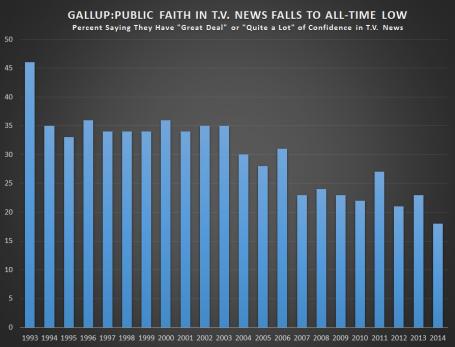 A new survey shows the American people’s confidence in TV news is at a record low.
 I toured the recently opened 9/11 Museum last night. There is quite a bit to report. The size and scale of the building and many sections are actually impressive. One can see how the general public will be very taken by the entire presentation, and therefore, take what they see as truth.


 Defying threats of violence, tens of thousands of ordinary Syrians went to the polls to cast a vote that was more about Syrian dignity and self-determination than any of the candidates on the ballot. After three years of unimaginable atrocities fomented by a demented and dying U.S. empire, with the assistance of the royalist monarchies of the Middle East and the gangster states of NATO, the Syrian people demonstrated, by their participation, that they had not surrendered their national sovereignty to the geo-strategic interests of the U.S. and its colonial allies in Europe and Israel.

 Aletho News

