Media Distortions on the Syrian Elections
By Rick Sterling | CounterPunch | June 3, 2014
US Secretary of State Kerry has pronounced the Syrian election to be a “farce”. As if on cue, National Public Radio, Associated Press, ABC and other western media have presented stories which support that claim. A closer look reveals the media has been exaggerating, distorting and lying about the Syrian elections.
Following are a few examples from the past few days.
Example 1. “Thousands Flee before Syrian Elections” by Bassem Mroue, AP
On Saturday May 31 Associated Press distributed a story claiming that thousands of Syrian civilians have “fled government-held Syrian cities”. In my local newspaper there is an accompanying photo showing youth on a truck, photographed from behind. The impression to the casual viewer will be that these are some of the people fleeing. But the reality is the opposite: the photo shows youth enthusiastically encouraging voting in the election and flashing peace signs. Far from “fleeing”, they are driving around town expressing their enthusiasm for the election.
Where is the evidence to back up the AP claim? It’s all “according to opposition activists”. That’s it, no other evidence.
Contrary to the claim of this AP story, many people are flooding INTO Syria to vote in the election. There are Syrians flying from all over the globe to return home to vote. There are dozens of Syrian Americans from southern California flying there to vote.
Example 2. “How Fair can a Vote be in a War Zone?” , Frederick Pleitgen, CNN
This CNN story reports that opposition and Western countries “say it’s impossible to hold a vote when rebels are holding much of the north and east of the country. And they say the election won’t be free or fair, that it will be rigged and Assad declared the winner.” The CNN story fails to include such relevant information as:
a) Elections have recently been held in Afghanistan, Iraq and Ukraine where there are also conflicts and areas beyond the government control. The response of the US was not to dismiss the election but to congratulate the government and people!
b) The US held its 1864 election in the midst of the US Civil War.
As to the final claim about election rigging, that is simple propaganda without evidence. Perhaps CNN does not refer to polling or surveys because credible polls , including those contracted by Doha Qatar and NATO, have consistently shown Assad having wide support.
Example 3. ”Syria Election: Experts Weigh In” Voice of America , Cecily Hilleary, June 2, 2014
In this VOA report the “experts” have clearly been selected with bias. Only one of the eight is not vehemently anti-Assad. The “experts” proceed to voice all sorts of nonsense. For example Zaher Sahloul says the Syrian government is “targeting the healthcare system”. For a reality check interested readers can view the video of rebels blowing up of the Kindi Hospital in Aleppo. To the cries of Alahu Akhbar we see the truck slowly drive up the road and then blow up the new hospital which was to be a model for Syria. Sahloul continues as follows: “Syrians who are lucky enough to stay alive or be spared from displacement will have no choice but to vote and vote frequently for the ’exceptional’ leader”. This is untrue. There is no requirement to vote, nor is there any way to determine how a person votes if they do. It’s a secret ballot. Sahloul’s claim is part of the stream of false rumors and claims, assertions without evidence.
Example 4. “Five Things to Know about Tuesday’s Election in Syria“, ABC News, by Zeina Karam AP
According to this article “The election is an indication the civil war is likely to last a long time.” On the contrary, if the election confirms that the Syrian government has significant popular support, it will further undermine the credibility of the armed opposition and lead to ENDING the armed conflict. That, of course, is what they are worried about.
Another claim in this article is that “The so-called internal Syrian opposition groups … are also boycotting.” This is not true. The non-violent opposition parties and groups are actively participating in the election.
The article further claims that “About 2.5 million Syrian refugees are scattered across neighboring countries. Most of them have been either excluded or are boycotting the balloting.” This is not true. Those refugees who crossed the border into Lebanon or Jordan with passports stamped had their voting day last Wednesday May 28. The turnout of Syrians in exile was huge, greatly exceeding the expectations.
Those refugees who fled across the border over the past few years and only have their national ID card, were expected to vote at polling stations on the Syrian side of the border on election day June 3.
However in the wake of the massive turnout last Wednesday, the US allied Lebanese “Future Movement” has in the last 48 hours enacted a new law which will PREVENT Syrian refugees from voting on Tuesday! The law will not allow the refugees to return to their camp if they cross over into Syria to vote. It’s the Lebanese government, not the Syrian government, which is excluding the vote of Syrian refugees.
In summary, Syrian citizens abroad are not being allowed to vote in countries like USA and Canada where the Syrian Embassies have been shut down. They are not being allowed to vote in European countries such as Germany, Belgium and France where the host countries have prohibited voting. And now the refugees in Lebanon are not being allowed to cross into Syria to vote. The claims of the article are untrue. It’s the western powers and their allies who are preventing Syrians from voting.
WHAT IS AT STAKE
John Kerry and those seeking regime change in Damascus know the significance of the Syrian elections. That’s why Kerry has been so crude and forceful in his denunciation. The media, as in the past, has fallen into line and failed to report objectively.
The Syrian people, both those in the country and those abroad, also know the meaning of the election. That’s why they went in massive numbers in Beirut. That’s why Syrians have traveled from many countries around the globe, going to vote in their homeland. And that’s why it will be interesting to see how many boycott the election in Syria vs. how many vote. One thing is clear: We won’t find out from the mainstream media or their followers.
Rick Sterling is a founding member of Syria Solidarity Movement. He was in Damascus, Latakia and Homs in April with the International Peace Pilgrimage. He can be emailed at rsterling1@gmail.com
Left Forum Conference Ignores US-NATO Genocide
By Jay Janson | Dissident Voice | June 3, 2014
The Left Forum’s tenth annual conference was held this year at John Jay College of Criminal Justice, part of the City University of New York. Left Forum describes itself as “convening “the largest annual conference of a broad spectrum of left and progressive intellectuals, activists, academics, organizations and the interested public.”
The rather enigmatic theme for Left Forum 2014 was “Reform and/or Revolution: Imagining a World of Transformative Justice,” but one heard no mention of justice for the victims of sixty-nine years of US-NATO genocide presently ongoing in a dozen Muslim nations in the Middle-East and Africa as being a reason for either “reform” or “revolution.” The entire focus of the three day event, save in a a very small number of the three-hundred-and-eighty panel/workshops, was on “reform and/or revolution” to benefit Americans in America.
For this writer, the actual theme of Left Forum 2014 seems to have been: Martin Luther King was Wrong!: Americans CAN make a better America WHILE still continuing to kill the poor overseas in spite of the cost in human and financial resources that SHALL NOT stop Americans from making progress on social and justice issues at home.
Martin Luther King Jr. said:
I knew that America would never invest the necessary funds or energies in rehabilitation of its poor so long as adventures like Vietnam continued to draw men and skills and money like some demonic destructive suction tube. So, I was increasingly compelled to see the war as an enemy of the poor and to attack it as such. “I knew that I could never again raise my voice against the violence of the oppressed in the ghettos without having first spoken clearly … for the sake of the hundreds of thousands trembling under our violence. … Somehow this madness must cease. We must stop now. … I speak for those whose land is being laid waste, whose homes are being destroyed, whose culture is being subverted. I speak … for the poor of America who are paying the double price of smashed hopes at home, and … in sending their sons and their brothers and their husbands to fight and to die in extraordinarily high proportion relative to the rest of the population.
A few years ago there was a shining moment in that struggle. It seemed as if there was a real promise of hope for the poor — both black and white — through the poverty program. There were experiments, hopes, new beginnings. Then … I watched this program broken and eviscerated, as if it were some idle political plaything of a society gone mad on war.
Martin Luther King cried out, “For the sake of the hundreds of thousands trembling under our violence I cannot be silent!”
But Cornel West, now of New York Theological Seminary, the keynote speaker at Left Forum 2014’s Opening Plenary, and Harry Belafonte and Angela Davis, who spoke at its Feature Event, were silent on the sixty-seven years of US-NATO genocide overseas, the ongoing US-NATO slaughter of Muslims in a dozen nations in the Middle East and Africa and the covert violence around the world for “unjust predatory investments” that Rev. King condemned. Amazingly, their cries and exhortations were to fight for justice for Americans at home. Left Forum 2014 was a truly an ‘America First’ proposition.
All three most beloved African American celebrities of the Left railed against the injustices suffered by African Americans, Native Turtle Islanders, Latin Americans, and non-heterosexuals (including one supposes those returning from military duty in one or the more of the nations under military occupation or attack, and from US military bases in more than a hundred and fifty nations.)
The shouting was mainly about getting a better deal for Americans in America, Americans who King had held responsible for atrocity wars and covert genocide on three continents since 1945. Yours truly was uncomfortably aware that he sat in a college gymnasium filled with knowledgeable people, who, by virtue of their anti-government stance and protests, felt themselves innocent of the massive atrocities that King held himself responsible for, along with his fellow Americans.
Perhaps the most galling pill to swallow was the presence on stage of progressive media Democracy Now director Amy Goodman, long committed to false reporting to destroy the government and the population that supports it in Syria, having had a dedication to the destruction of beautiful, democratic and prosperous Libya and third world hero Muammar Gaddafi, and to dutiful backing of the Orange, Green and now Ukrainian “revolutions” sponsored by CNN and arranged by CIA and its many foreign branches.
I was gratified to find that quite a few panel facilitators and speakers at the three day conference were very knowledgeable and outspoken about the perfidy and treachery of Amy Goodman — and just as angry about her role in contributing to the death and maiming of so many innocent citizens by disseminating false propaganda in support of US-NATO bombings and funding of terror.
In fact, the panels I sought out were run and attended by dedicated scholars well aware of the traitorous nature of so many of those who pride themselves in being leftists and progressives critical, or even damning, of their government without realizing that not working firstly to stop the carnage of US-NATO deadly military operations and CIA’s equally deadly covert activities makes Leftists and Progressives more responsible for the genocide continuing than anyone else. For as the segment of society most informed about the horror of American actions overseas, yet refraining from referring to them as prosecutable crimes against humanity, not calling for their prosecution, and not seeking justice for America’s victims, makes such intellectuals, professors, historians and journalists accessories after the fact, even in some cases before the fact, for backhandedly protecting criminals in hindering the arrest and bringing to justice of all fellow Americans responsible. … Full article
Seymour Hersh: liar and pro-fascist propagandist?
Interventions Watch | June 3, 2014
On 19th December 2013, the London Review of Books published an article by Seymour Hersh, entitled ‘The Red Line and the Rat Line’, which challenged the Obama administration’s claims that only the Assad regime could have been responsible for the chemical weapon attacks in Ghouta on August 21st 2013.
The article attracted a lot of criticism and attempted ‘debunkings’, some of which I blogged about here.
The latest attempted ‘debunking’ comes from Muhammad Idrees Ahmad, an author and journalist, and has been published in the L.A. Review of Books.
It’s being widely circulated among those who have long been critical of Hersh’s claims in regards to Ghouta, with – for example – Peter Bouckaert of Human Rights Watch tweeting:
Thank u @im_PULSE 4 revealing Sy Hersh’s lies re Ghouta CW attack–we stand by @hrw findings of Assad resp. http://www.hrw.org/reports/2013/09/10/attacks-ghouta …
I agree: Sy Hersh’s @LRB writing on Ghouta chemical weapons attack = distortions of a propagandist, not journalism. http://lareviewofbooks.org/essay/dangerous-method-syria-sy-hersh-art-mass-crime-revisionism# …
Not only is Hersh being accused of being wrong, then, but he’s being accused of being both a liar and a propagandist – a couple of very serious, and potentially libellous, accusations.
For Bouckaert to justify making such serious allegations against Hersh, Ahmad’s article would have to demonstrate conclusively that Hersh is both a liar and a propagandist. And in my opinion, it fails to do so.
Let’s just deal with some of the claims made against Hersh:
1. Claims of Responsibility
Ahmad writes that:
Hersh claims that the Assad regime was innocent of the August 21 massacre, that indeed the attack was carried out by the Islamist rebel group Jabhat al-Nusra, as part of what Hersh’s source describes as “a covert action planned by [Turkish Prime Minister Recep] Erdoğan’s people to push Obama over the red line.”
This is Ahmad’s first error, and one that is commonly made among those seeking to ‘debunk’ Hersh.
Hersh is not in fact saying that the regime was innocent, and that the rebels were to blame, and has clarified this on a number of occasions.
In an interview with Mint Press News in April 2014, he said that:
No one is saying they know what happened . . . We don’t know.
In an interview with Democracy Now! in December 2013, he said that:
I certainly don’t know who did what, but there’s no question my government does not.
And in an interview with Almayadeen in April 2014, he said that (starts at 21:54):
I am not saying I know that one particular unit . . . we know nothing about who did what. Was there an Al Nusrah wing that did it? Was it done by a rogue unit of the Syrian army? Maybe, who knows? I’m not ruling out . . . I’m just saying what the President was told by the Joint Chiefs: the Sarin that we found was not military grade.
So Ahmad starts off by attributing an opinion to Hersh that he’s never actually held, and that he has openly denied holding on at least three separate occasions. Ahmad continues to repeat the error throughout the rest of the article.
Hersh is instead saying that there are people within the U.S. Intelligence community who suspect rebel culpability; who believe certain rebel groups have the capability to manufacture Sarin; and that this therefore directly contradicts the Obama administration’s initial claims that only Assad and Assad alone could have been responsible.
2. U.N Reports
In his article, Hersh relays claims that Sarin samples collected on the ground in Ghouta by a Russian agent were later tested by British defence scientists at Porton Down. These scientists apparently concluded that ‘the gas used didn’t match the batches known to exist in the Syrian army’s chemical weapons arsenal’, and so a message was relayed to the U.S. Joint Chiefs of Staff ‘that the case against Syria wouldn’t hold up’.
In response, Ahmad quotes a U.N. report from February 2014. Here is what Ahmad says exactly:
Samples were also recovered from the site by the UN. Hersh makes no mention of these. Whatever discoveries Porton Down might have made, they were superseded by what the UN inspectors extracted and studied first hand. The UN’s remit did not include assigning responsibility, but its judgment leaves little room for doubt. The perpetrators, it concludes, “had access to the chemical weapons stockpile of the Syrian military, as well as the expertise and equipment necessary to manipulate safely large amount of chemical agents.”
And here is what that U.N. report says in full:
The evidence available concerning the nature, quality and quantity of the agents used on 21 August indicated that the perpetrators likely had access to the chemical weapons stockpile of the Syrian military, as well as the expertise and equipment necessary to manipulate safely large amount of chemical agents.
http://www.globalr2p.org/media/files/a-hrc-25-65_en.pdf – p.19 (emphasis mine)
As you can see, Ahmad leaves the words ‘indicated’ and ‘likely’ out of the quote, perhaps because they’re qualifiers and do in fact suggest a degree of doubt.
That reading is strengthened by what the report says three paragraphs later. Namely, and in regards to allegations of chemical weapon usage in Syria in general, that:
In no incident was the commission’s evidentiary threshold met with regard to the perpetrator.
Again, if the U.N. are themselves saying that the evidentiary threshold has not been met in regards to the perpetrator, then quite a significant degree of doubt *is* suggested.
Ahmad then moves onto the alleged chemical weapon attack in Khan al-Assal in March 2013. Hersh quotes an anonymous source from the U.N. as saying that:
Investigators interviewed the people who were there, including the doctors who treated the victims. It was clear that the rebels used the gas. It did not come out in public because no one wanted to know
Ahmad again responds by quoting the U.N. report from February, which says:
Concerning the incident in Khan Al-Assal on 19 March, the chemical agents used in that attack bore the same unique hallmarks as those used in Al-Ghouta.
He then accuses Hersh of not having read the report.
But the report doesn’t pin the blame on the regime, does it? It just says the chemical agents allegedly used had the same hallmarks as those used in Ghouta – an attack for which, like all the others, no ‘evidentiary threshold was met with regard to the perpetrator’.
Further to this, a previous and more indepth U.N. report, released in December 2013, had said of the Khan al-Assal attacks that there is:
credible information that corroborates the allegations that chemical weapons were used in Khan Al Asal on 19 March 2013 against soldiers and civilians
https://unoda-web.s3.amazonaws.com/wp-content/uploads/2013/12/report.pdf – p.19 (emphasis mine)
A reasonable question to ask here might be ‘Why would the Syrian regime gas its own soldiers?’.
And for what it’s worth, Hersh’s anonymous U.N. source is not the only person from that organisation who has pointed the finger of suspicion at rebel groups, in regards to chemical weapon attacks carried out in the early part of 2013.
Carla Del Ponte, one of the overseers of the U.N. Commission of Inquiry on Syria, was reported as saying in May 2013 that:
According to their report of last week, which I have seen, there are strong, concrete suspicions but not yet incontrovertible proof of the use of sarin gas, from the way the victims were treated . . . I was a little bit stupefied by the first indications we got . . . they were about the use of nerve gas by the opposition.
http://www.bbc.co.uk/news/world-middle-east-22424188
Ahmad is entitled to his interpretation of the February 2014 report, and I would agree that it does, to an extent, look damning for the regime.
But he has clearly stripped all of the qualifiers out of the report he is quoting, which do indeed leave room for doubt. He then – at least in regards to the Khan al-Assal attack – ignores previous U.N. reports, and quotes from named and senior U.N. officials, which, in turn, look damning for the rebels.
Ahmad then quotes Hersh as saying, in regards to the U.N. team who investigated the Ghouta attack, that:
[Their] access to the attack sites, which came five days after the gassing, had been controlled by rebel forces
This quote actually comes from Hersh’s first LRB article on the chemical weapon attacks in Ghouta, ‘Whose Sarin?’, which was published in December 2013.
In Ahmad’s reading, this is Hersh ‘suggesting that the UN may have been constrained by the presence of the rebels’, while neglecting to mention that, in Ahmad’s words, ‘the visit “came five days after the gassing” because the regime refused access to the sites and instead subjected them to unrelenting artillery fire‘.
Ahmad, on the basis of this, accuses Hersh of employing ‘the distortion of a propagandist’.
Another way of looking at Hersh’s sentence is that it is simply true.
The U.N. investigative teams access to the affected areas had indeed been controlled by rebel forces, as the report itself says. Here is the relevant passage:
A leader of the local opposition forces who was deemed prominent in the area to be visited by the Mission, was identified and requested to take ‘custody’ of the Mission. The point of contact within the opposition was used to ensure the security and movement of the Mission, to facilitate the access to the most critical cases/witnesses to be interviewed and sampled by the Mission and to control patients and crowd in order for the Mission to focus on its main activities’.
Hersh’s article also quoted the part of the U.N. report which says that:
‘During the time spent at these locations, individuals arrived carrying other suspected munitions indicating that such potential evidence is being moved and possibly manipulated’.
The report, then, is clear: the teams access to the affected areas was controlled by the opposition, and the team also had concerns about the potential moving and/or manipulation of evidence.
Hersh doesn’t misrepresent or distort the report in any way.
The most Ahmad can pin on Hersh is that he didn’t outline why there was a five day delay in getting to the affected areas, but frankly, it’s weak tea indeed, and in no way justifies the description of ‘distortion’ and ‘propaganda’.
3. Technical claims
Ahmad takes issue with Hersh’s use, in an interview with Democracy Now!, of the phrase ‘kitchen sarin’, writing that:
one would also have to accept Hersh’s related claim that sarin can be produced in a kitchen. Bashar al-Assad shares this view, but chemical weapons experts understandably disagree. Sarin is a deadly substance; its production is a substantial technical, financial, and logistical undertaking. It is not the kind of thing one can conceal in a house; nor is it something one can load into homemade rockets using kitchen gloves.
But it’s clear from the full quote that Hersh is not saying that he thinks sarin can be ‘produced in a kitchen’. Here is the full quote:
And so, the Brits came to us with samples of sarin, and they were very clear there was a real problem with these samples, because they did not reflect what the Brits know and we know, the Russians knew, everybody knew, is inside the Syrian arsenal. They have—professionals armies have additives to sarin that make it more persistent, easier to use. The amateur stuff, they call it kitchen sarin, sort of a cold phrase.
The phrase ‘kitchen sarin’, then, is being used as a slang term to distinguish professionally manufactured sarin from ‘the amateur stuff’. I very much doubt it was intended to be taken literally, or that Hersh seriously believes sarin can be knocked up on a stove with a few pots and pans.
There is then an overview of the debate regarding the launch points of the rockets used in the Ghouta attacks, and about who is in possession of such rockets.
This basically pits Ted Postol, a well regarded defence technology expert at MIT, and Richard Lloyd, a former UN weapons inspector, against Eliot Higgins, a British blogger renowned as an expert on the munitions used in the Syrian conflict.
Postol and Lloyd are the main sources for Hersh’s technical claims, and Ahmad himself concedes that ‘They have produced valuable analyses on the payloads and ranges of the rockets used on August 21′, and that ‘There is little reason to doubt their expertise in this area’.
I’m not going to attempt to analyse the competing claims and counter-claims in this regard, because i’m not qualified to do so.
But Hersh relying on the expertise of Postol and Lloyd in making some of his claims in regards to the technical aspects of the attack doesn’t strike me as being particularly outrageous. They may be right, they may be wrong, but they are competent and credible sources.
However, Ahmad then accuses Ted Postol of a ‘determination to validate’ Seymour Hersh’s work, and in doing this, ignoring ‘all evidence that undermines them’. He quotes Emile Durkheim as calling this the ‘ideological method’, defined as ‘the use of “notions to govern the collation of facts, rather than deriving notions from them”.
But Postol himself has said that when he first started investigating the attacks, he was sure that no-one but the regime could have been responsible. To quote Postel himself:
My view when I started this process was that it couldn’t be anything but the Syrian government behind the attack. But now I’m not sure of anything.
http://www.mcclatchydc.com/2014/01/15/214656/new-analysis-of-rocket-used-in.html
If anything then, Postol’s trajectory has been the exact opposite of the one Ahmad attributes to him. When he started his investigations, he was sure that the regime was culpable, and that Hersh was wrong. But the facts he uncovered in the course of that investigation lead him to doubt and then discard his initial hunches.
That doesn’t stop Ahmad essentially dismissing some of his work as ideologically motivated.
Ahmad then accuses Hersh of a similar ideological motivation, saying that:
He ignores or obfuscates established facts that contradict his theory: the fact that the delivery system used in the attacks is peculiar to the regime, or that the UN has established that the sarin could only have come from government stockpiles
But you could argue that it is Ahmad who is obfuscating here.
The UN has never categorically reported ‘that the sarin could only have come from government stockpiles’, saying only that the perpetrators ‘likely’ had access to government stockpiles, but that the evidentiary threshold in regards to the perpetrators hasn’t been met.
Postol and Lloyd are both of the opinion that the ‘delivery system used’ could have been manufactured by a rebel group, and needn’t be peculiar to the regime.
Ahmad himself also ignores other evidence – such as Carla Del Ponte’s claims, or that regime soldiers appear to have been targeted in some cases – that points to rebel culpability for at least some of the chemical weapon attacks in Syria.
Ahmad finishes by wondering whether Hersh is just ‘credulous’, or whether ‘something less benign is at play’.
He basically accuses Hersh of wanting to see Assad retain his chemical arsenal, based on this paragraph from ‘Whose Sarin?’:
While the Syrian regime continues the process of eliminating its chemical arsenal, the irony is that, after Assad’s stockpile of precursor agents is destroyed, al-Nusra and its Islamist allies could end up as the only faction inside Syria with access to the ingredients that can create sarin, a strategic weapon that would be unlike any other in the war zone’.
Ahmad calls this ‘a dog-whistle case for Assad keeping his arsenal’, and expresses astonishment that LRB would publish it.
But I don’t see it as anything of the sort. Ahmad’s reading of Hersh here is, at best, tenuous and uncharitable, and at worst an outright smear that is the polar opposite of Hersh’s stated beliefs.
In his December 2013 interview with Democracy Now!, for example, Hersh said in regards to Obama’s acceptance of the Russian brokered disarmament deal:
He (Obama) decides overnight to go to Congress, and then he accepts a very rational deal—and I’m glad he did—that the Russians put forward, with the Syrians, to dispose of the chemical arsenal or the chemicals that are in Syria.
http://www.democracynow.org/2013/12/9/seymour_hersh_obama_cherry_picked_intelligence
So Hersh thinks the deal was ‘very rational’, and he is ‘glad’ Obama accepted it. Some ‘dog whistle’.
In summary, then, these are the most obvious and immediate errors and misrepresentations I found in Ahmad’s article:
1. That Hersh thinks the rebels were to blame for the attacks in Ghouta. This is flatly false, as Hersh’s own words show, and is not the point he’s making at all. Ahmad gets the basic premise of Hersh’s argument – which is that doubt over culpability exists where the Obama administration insists there is none – completely wrong.
2. That Hersh misrepresents, obfuscates or ignores U.N. reports to make his case. Again, this isn’t true, and if anything it’s Ahmad who has selectively quoted some U.N. reports, while totally ignoring others/senior U.N. officials, to make it look like they’re categorically blaming the regime.
3. That Hersh is wrong in regards to the technical claims, and that his sources are ideologically motivated.
All I can say is that it’s clear the technical debate is still raging, and that Hersh has some very credible sources on his side – one of whom, despite Ahmad’s insinuations, actually started his investigations convinced that the regime was to blame, and that Hersh was wrong.
It should also be noted that Ahmad’s own main source, Brown Moses, is far from infallible, and is less qualified and less experienced than both Postol and Lloyd.
4. That Hersh might not just be well meaning if wrong, and instead has another agenda, such as wanting Assad to keep his chemical weapon stockpile. This is based on the most uncharitable reading of Hersh’s work possible, is extremely tenuous, and is directly contradicted by Hersh’s own words.
Ahmad finishes by saying:
By now even the most dogmatic among Hersh’s publishers must have realized that they were hoaxed. Their ideological proclivities and eagerness for clicks made the deception easier. They got played — they relayed what is in effect pro-fascist propaganda.
And while this may ultimately turn out to be true, he doesn’t come anywhere near close to demonstrating it to be the case.
Nor is there any convincing evidence presented of Hersh being a liar or a propagandist, as opposed to just conveying claims from his sources that are potentially dishonest or mistaken.
But for those who are desperate to see Hersh discredited if not destroyed, I suppose it’ll have to do until the next attempt.
“They want to start a religious war; we want to extinguish it” – Mufti of Syria
By Eva Bartlett | Crescent International | June 1, 2014
Leading figures in Syria such as the Mufti of Syria who lost his own son to a terrorist attack, want to extinguish the fires of hatred. The overwhelming majority of Syrians agree, isolating the foreign-backed mercenaries inside and outside Syria.
Most news accounts of Syria paint a desolate, sectarian picture of the country where people in areas secured by the Syrian army are miserable and where people, above all, want to see President Bashar al-Asad gone. During my visit, I found the exact opposite. In particular, I found widespread, and usually ardent, support for the president.
I entered Syria as part of an international Peace Delegation, comprising more than 40 people who believe in a political, Syrian-led solution for Syria. In the course of one week, we visited Latakia, Homs, and areas of Damascus, sat with the top religious leaders and numerous grassroots leaders. We heard testimonies from survivors of massacres — Haram, Kasab, Maaloula — and met with various internally-displaced from Yarmouk.
After the week had passed, I stayed on independently, moving freely on my own throughout Damascus, engaging with various strata of Damascene life.
The streets of the three cities I saw were far busier and more alive than I had expected possible and, aside from the mortars fired daily by armed insurgents on Damascus and environs, I felt safe and welcomed. All over, I saw groups of mixed faiths comfortably chatting, sharing meals and shisha, and proudly answering “I am Syrian” to my taboo question, “Are you Muslim, Druze, Christian…?”
Damascus, unsurprisingly, has upscale shops and historic markets, but also newsstands with papers found in any North American city, including those which have propagandized so heavily against Syria’s government and for the need for Western intervention.
Yarmouk has now, strangely, all but disappeared from mainstream reporting. Is it because the story is old, or because the actions of these armed insurgents controlling vast areas of Yarmouk have been so documented that it is difficult to any longer purvey the standard line: that the government is assaulting its own people? Still suffering under the presence of largely foreign militants, with a heavy presence of Jabhat al-Nusrah, Islamic State in Iraq and Sham (ISIS), and other al-Qaeda affiliated groups there since December 2012, numerous attempts at cease-fire have been foiled. The Palestinians and Syrians (yes, there are Syrians in Yarmouk) continue to need food, medicine, hospitals, and the exit of the armed groups.
At the edge of the camp, where Yarmouk and Palestine streets converge, I could see some of the massive damage: shells of cars, houses and a hospital with walls studded with machine gun bullets and mortars. But venturing beyond the concrete barriers would have been inviting sniper bullets to the head. “For two kilometres in that direction, it’s completely open. If you walk another five meters, you’ll be in the snipers’ scope,” security told me, himself not going any farther.
Abu Kifah Ghazzi, a PFLP spokesman, outlined events of the past two years relating to Yarmouk, noting that there are Palestinians from Yarmouk alongside the Syrian army fighting against the militias and for Yarmouk. I ask about food aid and starving residents. “The civilians are suffering terribly, but the armed gangs have ample food,” he said, adding, “Food aid has entered Yarmouk, but the militias often took it.”
In the most recent attack on aid distribution, on May 13, one person was killed and another injured when a centre for humanitarian aid distribution was targeted, the Daily Star reported. We also visited two different schools now housing displaced Palestinians and Syrians from Yarmouk. Their words were the same. “The terrorists took over the camp, took over our houses, and stole our food. We want the camp back. Tell your governments to tell those terrorists to leave Yarmouk.”
The growing trend of Syrian fighters laying down their arms in exchange for amnesty from the government was most notable in Homs, now secured by the Syrian army. This “Musalahah” (Reconciliation) movement, dubbed the “third way,” looks toward a political solution for Syria.
Amnesty and the laying down of arms doesn’t apply to the over 5,000 foreign fighters, nor have they shown any intention to stop shelling, kidnappings, beheadings and the countless other atrocities largely void from many Western reports on Syria.
As of April 2014, “1416 fighters have laid down their weapons. At first, the fighters were afraid that they would go to jail, but now, every day people are asking for reconciliation. Yesterday 10, the day before 29, I feel that peace is close,” said a priest in Homs. The highest numbers of those laying down weapons are from Homs, a city which was often dubbed in the media as the “heart of the revolution.” It seems these “rebels” realize that the ideology they thought they were fighting for is not shared by their armed takfiri brothers.
The mortars being fired at Damascus by militants in the Jobar district east of Damascus (and until recently the Mliha, now secured by the Syrian army) are not guided, yet they are designed to create maximum damage. One day I got a lesson on mortars from two men in the National Defense Forces (NDF). Most mortars the armed groups are using are homemade. Some have just enough explosives to make them fly, with as many pieces of metal, nails, sharp bits stuffed inside, to cause wider injury when exploded.
Online videos document the insurgents making these crude but deadly shells, and the firing of them toward Damascus. While the Old City has been particularly hard-hit, the mortars also reach central and western areas of Damascus. On April 15, insurgents in Jobar shelled the Manar elementary school, killing one child and injuring at least 60 more. They shelled a kindergarten the same day, injuring three more children. On April 29, four mortars hit Shaghour district, killing 12 students and wounding at least 50.
Deputy-Foreign Minister Faisal al-Miqdad had said earlier this year (January 2014), “In the past 4 months, terrorists fired 12,000 shells,” not including the mortars in other areas of Syria. A friend, a member of Syria’s rugby team, was one day at a match in Beirut, another day in the hospital, injured by shrapnel from these mortar attacks. At the time of his injury, he had been assisting civilians injured in a prior attack in the area.
Staying in Bab Sharqi, the East Gate area of the Old City, I got a more personal lesson on mortars, some as close as 50 metres from where I stayed, a residential area. On another occasion, outside the walls of the Old City, from the direction of insurgent-held Jobar, sniper bullets flew within a few feet of me. So while the city has a secure and strangely normal feel to it, the attacks of these militants are constant.
Driving to Homs, the roads were secured by military checkpoints, cars were searched for explosives and weapons. Evidence of the past three years of fighting is everywhere. In Homs City, I saw the site of a double car bombing just the week prior, which killed 25 civilians. Houses and businesses torn apart, families of martyrs told of the bombings, mid-afternoon, timed one after another, to ensure hitting any rescuers. These people were some of the most ardent supporters of President al-Asad and the Syrian army, again saying al-Asad is the only means of unifying Syria, and the army is protecting them. Having endured years of car-bombings and mercenary snipings, they would know best.
In Latakia, northwest of Damascus and closer to the Turkish border, to some of the current hot spots like Aleppo, I was surprised by the sense of normalcy: people picnicking, busy seaside streets as the Sun set. Lilly Martin, an American 22 years in Syria, mentioned that yes, Latakia is in general safe, but that they are assaulted from afar, from the Turkish border, by long-range missiles.
As Latakia is largely unscathed, it is host to refugees from areas being assaulted by militant groups, including the displaced from the village of Kasab, attacked March 21 by mercenaries originating from, and with the support of Turkey. The mercenaries continue to hold Kasab, and reports cite the desecration of churches there.
In Latakia, Homs, Damascus, and on the roadside, posters of President al-Asad are everywhere… the President in a suit, to the President in army fatigues and sunglasses. The support voiced by the various civilians I met in all three cities is not exclusive to minorities or ‘Alawites or Ba‘th party members. In fact, within Syria, there are a number of registered opposition parties who, while seeking change in the country, support President al-Asad.
At a joint meeting with the peace delegation, I met members of six different leftist opposition parties who do not support foreign intervention, but instead support the reconciliation movement. They resoundingly agreed that this “conflict” was a Syrian issue, to be dealt with by Syrians in Syria, that the foreign mercenaries had to go, and that elections were imperative. Despite their differing sentiments three years ago, they said they would now vote for Bashar al-Asad this June.
“In Syria we have real opposition parties, demanding reforms for the Syrian people. We are the real opposition, rooted in the streets of Syria,” said Shaykh Nawaf ‘Abd al-‘Aziz Trad al-Milhim, head of the People’s Party. Berwin Ibrahim, chair of the National Youth Party for Justice and Development said, “We don’t agree with the regime on many things, but we insist that our homeland comes first. We have corruption in the government. But that is like any government. The conspiracy, terrorism, and interference from Western countries have united supporters of the government and the opposition,” she said.
One of the opposition who had formally called for al-Asad to step down, Mohammad Abu Qasem, Secretary General of the Solidarity Party, said, “What’s happening in Syria is international terrorism, with many countries interfering in Syria. Since the elections were announced, the insurgents started working harder in Kasab and in Aleppo.”
Feminist activist, Suheir Sarmini, Deputy Secretary General of the Syrian National Youth Party, said, “President Obama and Congress have armed these gangs to kill our children, our people. Tell Obama and Congress to stop killing the Syrian people and not to interfere in Syrian sovereignty.”
In contrast to accusations that no “real” opposition could exist within Syria, Mazen al-Akhrass, a member of Syria’s NDF and a political analyst, pointed out that two very vocal (and far more critical than those I met) opposition members remain in Syria, unscathed. “Louay Hussein and Hassan ‘Abd al-‘Azeem are very well known and extremely against the regime, and they ask for more than ‘reforms.’ Yet they have been living in Damascus — the ‘stronghold of the regime’ — during the events, and their lives weren’t threatened. They are not in jail, and at this point they seem to have settled for partial reforms as a step toward full regime change.”
We met with Syria’s Grand Mufti, Dr. Ahmad Badr al-Din Hassoun. He spoke of the need for reconciliation and forgiveness amongst Syrians. He is notable for walking the talk: Shaykh Hassoun’s 21-year-old son Sarya was assassinated in October 2011, on the same day that it was announced he’d be engaged. During the funeral, while sobbing, the Mufti called for forgiveness and reconciliation, even for those who murdered his son. “All of the churches and masjids that have been destroyed, we can rebuild. But who will bring back our children? Who will bring back my son Sarya? When we have violation against any child, it is a violation against God.”
He mentioned that in March he had been granted a prestigious Italian peace prize, by The Ducci Foundation, for his non-sectarian preaching of interfaith peace. But the Mufti never got to Rome. “I was granted a visa for only ten days. They were afraid I’d stay longer. But Europeans are among those killing our people. … I reject this [kind of] ‘democracy.’ We in Syria are not Sunni or Shi‘i or ‘Alawi nor Muslim nor Christian. We are human beings and must be respected. They want to start a religious war. We are going to extinguish this fire.”
On a personal note, I would echo the Mufti’s call, and those of so many others I met in Syria. Come to Syria, see for yourselves. Very quickly you can get a taste of the senseless mortars, and the horrific testimonies of those assaulted by foreign mercenaries and takfiri ideologists. But also of the strength and resistance that is the Syrian people, who don’t intend any time soon to fall to occupation, and who will vote for President al-Asad in June.
Why are They Afraid of the Syrian Elections?
By Rick Sterling | CounterPunch | May 30, 2014
The Presidential Election in Syria takes place next Tuesday, June 3. With a revised 2012 Constitution, Syria is no longer a one party state and there are multiple candidates for office. Running against Bashar al Asad are former communist and legislator Maher al Hajjar and business person Hassan al Nouri.
The election has been vehemently opposed by the so called “Friends of Syria” (NATO members Turkey, Germany, France, UK, Italy, USA, plus the Gulf monarchies UAE, Qatar, Saudi Arabia plus Jordan and Egypt). Since 2011 the “Friends” have met periodically to coordinate funding, arming and training the rebels plus trying to promote and consolidate a credible outside political leadership. According to the pro opposition Syrian Observatory for Human Rights the result of this externally supported uprising has been over 62,000 dead Syrian soldiers and militia, plus another 80,836 dead civilians. Many of the civilians were killed by rebels. Just looking at the number of dead Syrian soldiers and security forces, can you imagine what would happen if 10% of that number (6,000 soldiers and security) were killed in the USA?
Given the extent of the violence, the well publicized fanaticism of the most active rebels and evident difficulty to manage the political operatives who were supposed to be anointed “leaders”, one might wonder why the USA and others persist in trying to force regime change in Syria.
But instead of viewing the multi-candidate election in Syria as a step forward, they are viewing it as a mortal threat. “Assad’s staged elections are a farce,” Kerry said after the so-called Friends of Syria meeting in London on Thursday May 15. “They’re an insult. They are a fraud on democracy, on the Syrian people and on the world,” he added.
France, Germany, Belgium and the Gulf States have all prohibited voting in the Syrian election. Syrian Embassies in the US and Canada have been forced to close, removing the chance for Syrians living in these countries to vote.
Why are Kerry and the “Friends” so upset and fearful of Syrian elections? If they are such a farce, then much of the public will not participate in them. If the vote is seen by the public as meaningless, then voter turnout will be very low such as in Egypt this week.
As to the issue of holding an election during a time of conflict, this was done right here in the USA. The 1864 election which re-elected Abraham Lincoln was held during the midst of the extremely bloody US civil war.
Another group afraid of the Syrian elections is the Syrian American Council (SAC). This well funded lobby group claims to represent Syrian Americans. They have launched a twitter and Facebook campaign decrying the ‘Blood Election’. They have professional marketing and public relations, paid staff and support from neo-con and Zionist interventionists in Congress. Still, their real support across the country seems thin. Last August and September 2013, they were promoting a US attack on Syria. They were not concerned with the massive bloodshed that would have resulted from that. Ironically they are decrying blood now when Syria holds a peaceful election.
In sharp contrast with SAC, alternative organizations such as Arab Americans for Syria (AA4Syria) and Syrian American Forum (SAF) are speaking with growing strength against our US tax dollars being used to destroy their homeland. As a measure of the depth of feelings, over 25 members of AA4Syria are flying to Beirut then traveling by land to Syria to vote in next Tuesday’s election. The same thing is happening in other countries which have prevented Syrians from casting a vote. Syrians who live in the Gulf are traveling all the way to Syria to vote as a sign of their commitment.
The reason is that many Syrians, both inside and outside the country, see voting in this election as a sign of support for their homeland at this difficult time.
Voting by Syrians living abroad has already begun, with voting yesterday, May 28, in Lebanon, Jordan and a few other countries. The turnout in Beirut was massive, with tens of thousands of people marching, chanting and singing through the avenue and along the highway to the Syrian Embassy compound east of the city center. Look at the video and judge for yourself whether these people are being “forced” to vote or cheer for Bashar al Asad.
The voting in Beirut has been extended due to the huge turnout. This is in ironic contrast with Egypt where the government is desperately extending the voting hours and days, trying to boost the voting turnout.
If recent history is a guide, there may be some kind of spectacular media event or atrocity in the coming days. The Syrian opposition and their handlers have executed PR stunts at critical times. If it happens here, the purpose will be to distract from the strong Syrian participation in the election and to attempt to renew the branding of Assad as “brutal dictator”.
But the branding is wearing thin, those who are most affected by the crisis know the truth and even those who have been influenced by the immense propaganda may be starting to wonder: Was it ever a genuine “Syrian revolution”? What kind of “revolution” is financed by corrupt monarchies and former colonial powers? Is the “brutal dictator” really as bad as they say? The scenes of thousands of Syrians waving his poster, chanting his name and youth expressing love for him are not what they wish us to see.
Next week we can look at the videos, photos and stories from Syria. Hopefully there will be some reasonably unbiased reports. John Kerry and other “Friends of Syria” did not want it to happen, and there may still be violence and bumps on the journey, but the election in Syria is going ahead. Let’s see what Kerry and company are afraid of.
Rick Sterling is a founding member of Syrian Solidarity Movement. In April he was in Damascus, Latakia and Homs with the International Peace Pilgrimage.
Historic Syrian Election Brings Multitudes of Voters
By Brenda Heard | Friends of Lebanon | May 29, 2014
On the 28th May 2014, expatriated Syrian nationals in numerous countries flocked to Syrian embassies to begin the voting process in a presidential election. With all its potential flaws, perhaps even inherent flaws, this quintessential element of democracy is still the most effective means of finding consensus. As the saying goes, you can’t please all the people all the time. Thus elections provide an opportunity for peaceful compromise. But to work, democracy requires participation.
President Bashar al Assad is being challenged by Maher Hajjar and Hassan Nouri, even if sneered at by those who label them as merely symbolic candidates. Yet instead of offering strong opponents to al Assad, those aligned with the opposition parties of the Syrian War have boycotted the election, calling it a mockery, a parody, a joke. Likewise, many expats have been unable to vote because their host countries have either closed their Syrian Embassies or have banned the election process. Notable examples are Australia, Belgium, Britain, Egypt, France, Germany, Italy, Jordan, Qatar, Switzerland, Turkey, the United Arab Emirates, and the United States.
As thousands upon thousands of Syrians made their way to embassies around the world to vote, US President Obama addressed the West Point Military Academy and proclaimed that the US would “ramp up support for those in the Syrian opposition” and that the US would “coordinate with our friends and allies in Europe and the Arab World to push for a political resolution of this crisis.” Such a stance is nonsensical. Isn’t an election the essence of a political resolution? Instead, the US has led the Western world in denouncing the election as a farce, and in fomenting division.
The context of Syria’s war is long and complex. The bottom line, however, is that far too many people have suffered. Many Syrians oppose the al Assad government. Many Syrians support the al Assad government. Unless an agreement is reached between the two camps, they will both suffer a dismal war of attrition. This election could have been an opportunity to take a path of compromise and cooperation. Instead, it has been refused and ridiculed.
Typical of Western media coverage, the Washington Post reduces the election to a “forceful affirmation of [al Assad’s] tightening grip on power.” The Post bemoans that “Assad is expected to win easily because there are no serious challengers,” saying that the “constitution has been carefully crafted to exclude political opponents.” Has it? The constitution is here, with the relevant section beginning with Article 83. Perhaps the Post is reading between the lines of what appear to be standard criteria for candidacy, but even the alleged stumbling block of a candidate’s needing approval from 35 of the 250 members of a citizen-elected parliament is surmountable. The National Progressive Front (aligned with al Assad) gained 168 seats in the May 2012 election, which if assuming absolute party-alliance, still leaves 82 non-aligned potential votes for the would-be candidate. That pool might have been more, but the opposition boycotted that election as well, thus forfeiting the chance to gain authority.
Again typical of Western media coverage, the Post attempts to explain away the vast numbers of expat voters in Lebanon by saying:
“The large turnout here was spurred in part by a widespread rumor that those who do not vote will not be allowed to return home, a question of growing concern for those among the 1 million Syrian refugees living in Lebanon who support the opposition but are losing hope that the rebels will prevail. Syrian authorities did not say this would be the case, but with all voters having to submit their identity papers to the embassy for registration, it is feasible that the government will know who voted and who did not.”
Well, yes, that is not only feasible, but quite normal. All governments check off the names of those voting in some fashion against a voter registration. Such an occurrence hardly validates this rumour. Even if a voter did cast his ballot for al Assad simply to ensure his future ability to return home, it would mean he felt that return preferable than the status quo. And even if this were the case with some expats, it does not explain away the obvious enthusiasm that is seen in the faces, statements and actions reported across the ideological spectrum. As the Huffington Post’s World Post reports, support for President al-Assad “was splashed across everything from T-shirts to enormous signs that men carried” as “tens of thousands of Syrians living here [in Lebanon] cast their ballots.”
Of course there are ordinary Syrian citizens—“farmers or dentists,” as President Obama imagined the “ordinary Syrians”—who oppose the al Assad government. But as you can see and hear for yourself in the numerous reports of this election process, there are also many people who genuinely support his leadership, even after three years of bitter conflict. While the election is surely a lost opportunity for working toward a common good, perhaps the passions exhibited act as a much needed reminder: Isn’t it time for compromise?


Reports for additional reading:
Al Jazeera: In Pictures: Syrians in Lebanon head to polls
Al Jazeera: Massive turnout for Syrian vote in Lebanon: Of the tens of thousands of expatriates flocking to their embassy to vote, a majority voiced support for Assad’s rule. (with video)
Guardian/Associated Press: Syrians in Lebanon battle crowds to vote for Bashar al-Assad: Massive turnout for ‘expatriate’ voting in embassies before Syria’s June election though many refugees boycott polls
BBC: Syria election: Refugees vote in Lebanon and Jordan
Washington Post: This is what the Syrian election looks like in Lebanon
International Business Times: Syria: Refugees Go to Polls in Lebanon to Vote for Bashar al-Assad
Huffington Post’s World Post: Syrians Flood Embassy In Lebanon To Cast Ballots In Presidential Election
Reuters: Tens of thousands of Syrians abroad vote in early poll
Lebanon Daily Star: Beirut roads paralyzed by Syrian voters headed to polls
Lebanon Al Akhbar: Syrian Expatriates Head to the Polls in Presidential Vote
Iran dismisses WSJ nuclear report as unfounded
Press TV – May 28, 2014
Iran has rejected as unfounded a report by The Wall Street Journal on its nuclear energy program.
On Tuesday, the US newspaper cited a report by the terrorist Mujahedin-e Khalq Organization (MKO) as saying that Iran “has kept active and intact its core team of weaponization researchers.”
In a statement on Wednesday, Iran’s diplomatic mission at the United Nations condemned the report as a fabrication.
It said The Wall Street Journal is repeating the claims of a terrorist group whose previous allegations proved untrue.
The MKO is listed as a terrorist organization by much of the international community and is notorious for committing numerous terrorist acts against Iranians and Iraqis.
The statement also said that Tehran has lived up to its obligations under the nuclear Non-Proliferation Treaty.
It added that Tehran expects the five permanent members of the UN Security Council — the United States, China, Russia, France and Britain — plus Germany to abide by their commitments concerning Iran’s nuclear rights, regardless of the “uproar” by anti-Iran lobby groups.
Iran and the six world powers have been discussing ways to iron out differences and start drafting a final nuclear deal that would end the West’s dispute with Iran over the country’s nuclear energy program.
Iran and the world powers reached an interim accord in the Swiss city of Geneva on November 24 last year that took effect on January 20 this year.
Under the deal, the six countries undertook to provide Iran with some sanctions relief in exchange for Iran agreeing to limit certain aspects of its nuclear activities during a six-month period. It was also agreed that no nuclear-related sanctions will be imposed on Iran within the same time-frame.
What Brought the West to the Table
By Kaveh L. Afrasiabi | Iran Review | May 20, 2014
There is a widespread Western fallacy that “sanctions brought Iran to the table,” which serves to legitimize the unjust regime of sanctions imposed by the Western governments, who rationalize their action by claiming to be the “injured parties” under international law, with respect to Iran’s alleged “non-compliance” with its international obligations.
The problem with this perspective that has acquired the status of a self-evident truth in the Western media is that it adopts the rhetoric of Western governments at face value, without the slightest inquiry on what caused the US and other Western governments involved in the nuclear negotiations with Iran to also ‘come to the table,’ that is, make reciprocal concessions?
The answer to the above question is three-fold. First, the idea that the Iran sanctions have caused little or no pressure on the Western countries is, of course, suspect and can be easily debunked. On the contrary, it can be shown that the whole edifice of sanctions regime was experiencing growing pressures and the Geneva agreement reflected a break not only for Iran but also the very sanctioning regimes, above all the US and European Union (EU).
To elaborate, given the fact that Iran’s nuclear progress had continued unabated despite the escalation of sanctions since 2006, the US was poised to pass new sanction laws targeting Iran’s oil sector, which if passed would have adversely affected US’s relations with some of its own trade partners such as India and China. In the absence of a deal in Geneva last November, the US lawmakers would have for sure enacted the new legislation, which would have instantly introduced new distortions in global trade, further violating the WTO norms on free trade. In other words, the Geneva agreement was a timely rescuer for the Western sanctioning states, avoiding a deterioration of their relations with Iran’s energy partners.
Second, by the time of Geneva agreement the unilateral European sanctions had come under increasing scrutiny by various courts in Europe, which had struck down a growing number of banks, trading companies, and individuals from the sanctions list. The significance of these adverse rulings, dreaded by the US officials who lobbied unsuccessfully to prevent them, was that it questioned the legality of some aspects of the EU sanctions that went far beyond the scope of UN sanctions on Iran, thus reflecting the irrefutable legal gap between UN and unilateral sanctions.
Third, in addition to the pressure of ‘market-distorting’ Western sanctions on the sanctioning powers, who deprived their own corporations from conducting profitable business with Iran, much to the delight of their Asian competitors, another important factor that ‘brought the West to the table’ was indeed the impressive pace of Iran’s nuclear progress. As a result of this steady progress, reflected in Iran’s ability to manufacture fuel rods for its medical reactor by enriching uranium up to 19.75%, i.e., the upper limit of low-enrichment, the West was suddenly jolted into the realization that Iran had reached a new nuclear milestone warranting serious negotiation.
Connected to this at the same time was the lessening value of the “military card” in West’s hands, in light of Iran’s construction of the underground facility known as Fordo, which is relatively immune from aerial bombardment, compared to the above-ground Natanz facility. This instantly jettisoned the “Osirak option,” that is the Israeli scenario of knocking down Iran’s facilities the way they did with ease against Iraq in 1981, thus adding to the futility of military threats against Iran. Needless to say, Iran’s counter-threat of closing the Hormuz and retaliating against any attacks throughout the region and beyond, i.e., the doctrine of extended deterrence, was an effective response that raised the potential cost of any military adventures against Iran. A good deal of this successful Iranian counter-strategy hinged on Iran’s extensive preparations for “asymmetrical warfare” and reliance on missile defense, given the impressive Iranian advances in missile technology.
Notwithstanding the above-said, it is hardly surprising that faced with Iran’s steady nuclear progress despite the sanctions that had harmful effects on the Western economy and entailed exorbitant monitoring costs, the West agreed to climb down its maximalist demands on “zero centrifuges” and to tacitly recognize Iran’s right to a civilian fuel cycle.
Of course, this explanation does not preclude the argument that the escalation of sanctions adversely affected Iran’s economy and spurred the new government of Hassan Rouhani to prioritize the lifting of sanctions through good-faith and principled negotiations. As an “injured party” whose inalienable nuclear rights have been abridged by Western discrimination and punitive actions, Iran’s anti-sanctions quest is in line with the nation’s national interests. But, while so much attention has been paid to Iran’s motivation to ‘make a deal’ unfortunately so far little attention has been paid to the underlying reasons for the West to reciprocate Iran’s action and thus explore the feasibility of a “win-win” scenario.
In terms of the regional and global geostrategic context, there are undeniably a host of relevant factors such as the withdrawal of US and NATO forces from the region after a decade of costly intervention and the related concerns for stability ‘the day after’ their planned departure, i.e., issues of direct link to Iran’s role in regional stability. Altogether, the net of Western interest to deal with Iran and search for ‘common grounds’ has been expanding and, naturally, one must probe the various economic, political, and geostrategic interests and concerns of the Western governments led by the US in determining why these powers consented to an interim deal with Iran, which has triggered the current negotiations for a long-term agreement? Suffice to say that the Western media’s failure to pay attention to this side of equation fuels a Western misperception that focuses on Iran’s purported weaknesses due to the sanctions, without bothering to present a comprehensive picture that, as outlined above, presents a vastly different, and more complex, picture before us, with clear policy connotations.
U.S. Senate Committee Approves Sanctions, Venezuela to Appeal to United Nations
By Z.C. Dutka | Venezuelanalysis | May 20th 2014
Earlier this afternoon in Washington, the Foreign Relations Committee of the U.S. Senate approved 13 to 2 the “Venezuelan Human Rights and Democracy Protection Act.” The bill includes sanctions on key individuals of the Venezuelan government and at least $15 million to “defend human rights… and strengthen the rule of law.”
The Menendez Bill
Committee chair, Democrat Robert Menendez, who played a lead role in the writing of the proposed legislation, plans to present the bill before the whole Senate within the coming weeks.
The legal measures proposed are in regards to recent anti-government protests that have reached levels of extreme violence in certain Venezuelan cities, resulting in 42 dead, 800 injured, and millions of dollars of public property damaged, including the burning of multiple universities.
Menendez said the US can’t “play the role of bystander” while Venezuelan president is going to “dangerous extremes to silence political dissent.”
“The U.S. should always be on the side of human rights around the world,” said another lead supporter, Florida Republican senator Marco Rubio.
Rubio has prepared list of Venezuelan military and government officials who would be targeted for sanctions if the bill were to pass. Among those listed are attorney general Luisa Ortega Diaz and the head of operations for the National Guard, Manuel Quevedo.
Earlier this month another piece of similar legislation, the Venezuelan Liberty and Democratic Solidarity Act, promoted by Florida congresswoman Ileana Ros-Lehtinen, passed the corresponding foreign committee of the U.S. Congress. It has yet to be addressed by Congress as a whole.
Roberta Jacobson, Assistant Secretary of State for Western Hemisphere Affairs, has attended the senate hearings and expressed concern on behalf of the White House.
“This is not a U.S.-Venezuela issue,” she said. “We have strongly resisted attempts to be used as a distraction from Venezuela’s real problems.”
She has displayed equal unease that the bill might distract from the important dialogue that is taking place between the Venezuelan government and the opposition.
Appeal to the UN
Even before the bill passed today’s Senate committee, Venezuelan foreign minister Elias Jaua expressed outrage at what he considers repeated US “interference” in Venezuelan affairs.
On Thursday Jaua announced his plan to present a formal claim to the United Nations, the Organization of American States (OAS), the Union of South American Nations (UNASUR), and the Community of Latin American and Caribbean States (CELAC).
“We’ve had enough of the United States assuming a role that belongs to multilateral bodies, Jaua said Thursday. “We must remember that as a free and independent nation we do not recognize the United States parliament… as a legislative [force] over Venezuela. There are basic principles of the United Nations Charter that must be respected.”
The minister has called a meeting with the UNASUR, to be held next week in Ecuador. He plans to bring with him a “dossier of all the declarations of interference posed by representatives of the United States, starting with president Obama, Secretary [of State John] Kerry, and others…”
The Holocaust Religion’s New Offshoot
By Richard Edmondson | Fig Trees and Vineyards | May 18, 2014
To considerable media fanfare, the National September 11 Memorial Museum held a dedication ceremony on Thursday, May 15 and plans to open its doors to the general public this coming Wednesday, May 21.
The new museum pledges itself to “demonstrating the consequences of terrorism on individual lives and its impact on communities at the local, national, and international levels”—and if 9/11 hasn’t already been elevated to the status of a full-blown religion in America, this should do it once and for all.
The new 9/11 religion will be devoted to endlessly remembering the events of 9/11 (“Never forget!”), and its main center of worship will be—where else?—“Ground Zero.” Ah, but the vast majority of the museum is not above ground, but rather below it. This was done so that visitors may “be in the very space where the Twin Towers once stood,” and also “because federal preservation law mandated that those remnants be publicly accessible.”
In some respects you could think of the new religion as an offshoot of the holocaust religion, and should you doubt the analogy, consider that the museum houses a 2,500 square foot repository in which are now stored the unidentified human remains—mostly bags of pulverized bone—of more than a thousand 9/11 victims…or…that no less than the president of the United States, along with the mayor of New York, have pronounced the ground upon which the museum sits to be “sacred.”
“A lot of family members have agreed that this is the right approach,” said Mayor Bill de Blasio, referring to the decision to store human remains on the site. “I’m confident this is being done respectfully after a lot of consultation with family members, and in a way that really dignifies this moment and the sacred ground we’re discussing.”
Consider also that, according to the museum’s website, “The National September 11 Memorial & Museum has partnered with the New York City Department of Education and the New Jersey Commission on Holocaust Education to develop a robust set of 9/11 lessons for K-12 classrooms.” It sounds almost like they’re planning to teach the kids the holocaust and 9/11 in the same lesson.
Built at a cost of $700 million, the museum features two “core” exhibition areas, both underground and located at the “archaeological heart of the World Trade Center site.” The exhibition halls are in proximity to what are known as the “Survivors’ Stairs,” and are packed with exhibits, including “artifacts, photographs, audio and video tapes” and much, much more.
But the possibility that Israel may have been one of the principle perpetrators behind the 9/11 attack doesn’t seem to be in the mix anywhere. At least there’s no mention of it on the official website, so if you do plan to visit the museum (admission $24), I wouldn’t count on seeing any exhibits on the luck of Larry Silverstein, the five dancing Israelis, Urban Moving Systems or its activities as a Mossad front operation, or a vast body of other evidence pointing to Israeli involvement in the attacks.
You will, however, should you show up on May 25—that’s four days after the main opening—get to attend a program entitled “9/11 Conspiracy Theories: Why They Exist and What Role They Play in Society,” featuring talks by Kathryn Olmstead and Michael Barkun. Both are noted academics, and both have authored books on the subject of conspiracy theories.
In fact, the 9/11 religion, as a main tenet of its faith, seems very much devoted to espousing the grandest conspiracy theory of them all—i.e. the official government narrative as determined by the 9/11 Commission, whose executive director, Philip Zelikow, is reportedly an Israeli/US dual citizen.
In that narrative, of course, we have 19 hijackers outwitting the intelligence agencies of the West, winging past NORAD defenses, ramming planes into the Twin Towers and the Pentagon, and accomplishing all this with relatively little flight training. And in case you should happen to forget, the 9/11 Museum seems quite intent on reminding you—these people were Muslims. One of the museum exhibits is to be a film entitled “The Rise of Al Qaeda,” which has set off a controversy (more about which below).
The 9/11 Memorial Museum consists of both the museum itself, as well as the 9/11 Memorial. The latter is located on the grounds above and around the museum, and its prominent features are two cascading reflection pools, each nearly an acre in size, bordering which the names of 9/11 victims are set in bronze.
The director of the museum is Alice Greenwald, while the CEO of the nonprofit overseeing both the museum and the memorial is Joseph Daniels. And then there is Clifford Chanin, who serves as the museum’s education director. Together the trio seems to be heavily involved in the day-to-day administration of the enterprise, and further they seem to be the three officials most often mentioned or quoted by the media.
In addition, all three—Chanin, Greenwald, and Daniels—are listed as having helped host a conference of the Council of American Jewish Museums that took place in March of 2013, while Chanin himself participated in one of the event’s panel discussions—entitled “Handle With Care: Sensitive Issues Surrounding Cultural Property”—along with Gabriel Goldstein, of Yeshiva University Museum, and Richard Freund, of the University of Hartford.
Chanin, by the way has also served as curator of the Legacy of Absence collection for the Illinois Holocaust Museum and Education Center, and reportedly also founded the Legacy Project, described as a nonprofit group “dedicated to documenting contemporary responses—in visual art, literature, film and public debates about memory—to historical traumas around the world.”
As you may imagine, obsessing over the holocaust— “in visual art, literature, film…” etc.—is a central preoccupation of the Legacy Project, but it seems Chanin has carried the same template into his work with the 9/11 Museum. On the official museum website, you can find an artists registry featuring a variety of artwork—from music and poetry to visual arts—with a 9/11 theme, plus information about the artists who created them.
One artist so featured is Lana Sokolov, an Israeli vocalist, choir conductor, and composer, who has a CD out entitled “Jewish Love Songs.” Ms. Sokolov is described as having been “active on the music scenes of Israel, Russia, and the US for the last 17 years,” and you can click here to watch a music video of her 9/11 song, “On That Day.”
Is there a continuum through all this? If Israelis were behind, or had a hand in, the destruction of the Twin Towers, then would it perhaps stand to reason that Israelis would also be behind (and profit from) the construction of the memorial built upon the same spot in their place?
The architect who designed the 9/11 Memorial, including its two pools, is Michael Arad, an Israeli/US dual national who previously served in the Israeli military. Reportedly Arad was chosen on the basis of having entered a competition, held back in 2003, in which contestants were invited to submit their designs for a 9/11 memorial. His design was selected out of a total of 5,201 entries, it was divulged.
“When I was in the Army, the unit I served in, you could never stop,” said Arad, speaking of his time served in the Israeli Army, which was during the first Intifada. “It was a volunteer unit, and there was a fairly high rate of attrition. The people stayed through are the people who were either great at it or the people who just didn’t know how to stop. And I fell into that second category.”
By all counts, Arad has an explosive temper, and he frequently clashed not only with other architects on the project, but also with the Lower Manhattan Development Corporation, the government agency overseeing the task. Especially rocky, it seems, was his relationship with architect Daniel Libeskind, who is also Jewish.
Libeskind drew up what has been referred to as the “ground zero master plan,” and it seems an habitual source of friction between the two men was Arad’s “significant departures,” in his own design for the memorial, from Libeskind’s overall master plan for the entire 16-acre site. (Two other architectural firms also involved in the project were Davis Brody Bond and Snøhetta, and reportedly there was considerable bickering between Arad and the rest).
“I will fight this!” Libeskind reportedly railed at one point. “I am the people’s architect!”
Perhaps the old adage about “two Jews and three opinions” is applicable here. But whatever the case, it seems the national memorial to the events of September 11 has been “hijacked,” in a manner of speaking, apparently in an effort to shape national perceptions—not only as they pertain to the substance and meaning of the tragic episode (tragic for the entire world), but also as to the character and distinctive traits of those purportedly behind the attacks.
As mentioned above, one of the museum exhibits is a film entitled “The Rise of Al Qaeda,” a short documentary—less than seven minutes long—but one over which there has been considerable controversy.
While it has not yet been made available to the general public, the video, narrated by NBC anchor Brian Willams, was screened before an interfaith advisory group, whose members have criticized it as inflammatory toward Muslims.
Their reactions are reported in an April 23, 2014 New York Times article, while two members of the group also registered their concerns in a letter to Greenwald, a letter which can be accessed in PDF form here.
As you know, many members of the Interfaith Advisory Group have expressed reservations about the narrative script for the documentary. Following our group’s request for a second viewing of the documentary and for a meeting with you, we expressed our concerns that, given the content of the video, museum visitors who do not have a very sophisticated understanding of the issues could easily come away equating al-Qaeda with Islam generally. We continue to posit that the video may very well leave viewers with the impression that all Muslims bear some collective guilt or responsibility for the actions of al-Qaeda, or even misinterpret its content to justify bigotry or even violence toward Muslims or those perceived to be Muslim (e.g., Sikhs). Equally troubling is Brian William’s narrative juxtaposed to the English translations. All American sources, news quotations and narrative are recorded in “Media English”, whereas translations from Middle Eastern sources were recorded in English or broken English with a heavy Middle Eastern accent.
The writers of the above are Peter Gudaitis, of New York Disaster Interfaith Services, and the Rev. Chloe Breyer, of the Interfaith Center of New York. According to the Times, they and other members of the group had been invited to take a pre-opening tour of the museum, to walk through and view its exhibits, and for the most part, says the Times, their impressions were favorable—that is, until they saw the film.
“As soon as it was over, everyone was just like, wow, you guys have got to be kidding me,” Gudaitis said.
Objections centered around the film’s use of such words as “Islamist” and “jihadist” without sufficient elaboration, possibly leaving the impression that Muslims in general condone terrorism. It was at this point that Gudaitis and Breyer wrote their letter to Greenwald—and yes, they did receive a reply from museum officials, but according to the Times, it was an unintentional one:
The response from the museum was immediate, though accidental: Clifford Chanin, the education director, inadvertently sent the group an email intended solely for the museum’s senior directors, indicating he was not overly concerned.
“I don’t see this as difficult to respond to, if any response is even needed,” he wrote.
A Muslim member of the interfaith group was so incensed over the matter he resigned from the panel.
“The screening of this film in its present state would greatly offend our local Muslim believers as well as any foreign Muslim visitor to the museum,” said Shiekh Mostafa Elazabawy, imam of Masjid Manhattan. “Unsophisticated visitors who do not understand the difference between Al Qaeda and Muslims may come away with a prejudiced view of Islam, leading to antagonism and even confrontation toward Muslim believers near the site.”
But the film has also been defended by Bernard Haykel, a professor of Near Eastern studies at Princeton University, who supposedly “vetted” the script.
“The critics who are going to say, ‘Let’s not talk about it as an Islamic or Islamist movement,’ could end up not telling the story at all, or diluting it so much that you wonder where Al Qaeda comes from,” said Haykel, whose father is a Lebanese Christian and whose mother is Jewish.
Gudaitis and Breyer, in their letter, suggested some re-editing prior to the museum’s opening, or, should that not be possible, a disclaimer, placed either at the front of the film or in the room where it is shown, reading:
“This video in no way intends to imply that the vast majority of Muslims agree with or support the attacks perpetrated by the members of al-Qaeda. Most Muslim leaders and Muslim organizations worldwide have disavowed the ideology and actions of Al Qaeda. The Museum’s documentation of Al-Qaeda-inspired terrorism should not be mistaken for any implicit or explicit justification for racial, religious or ethnic profiling.”
But their suggestion was rejected. You can go here to watch a video of Chanin interviewed by Megyn Kelly on Fox News and insisting that, “The film will be shown as we’ve developed it.”
The issue of the storage of human remains at the museum has also stirred up a controversy. Museum officials assert that the decision was made in conjunction with the family members of 9/11 victims, and that it was handled respectfully… but not all the families are in agreement on that matter.
On Saturday, May 10, in a ceremony that had all the flavor of a religious rite, the remains were transported from the medical examiner’s office, where they were stored in the past, to the museum, to be housed in the special, 2,500 foot repository. Accompanied by blinking red lights, the procession was a solemn one, with more than 7,900 bags of bones and other remnants of the deceased victims being carried in three large, flag-draped containers.
According to one report, officials have stressed that “the remains will not be part of the museum’s exhibit and that their lost relatives’ bones will not be subjected to ghoulish gawking by strangers.” Nonetheless, the procession was met with a protest by a group of family members, many of them wearing black ribbons tied around their mouths. One of the protesters, Jim Riches, is quoted at length in a report at Voice of Russia.
“He was the hero before 9/11 and he was the hero after 9/11,” said Riches, speaking of his son, a 29-year-old firefighter who died in the attack and whose remains are among those that have yet to be positively identified by DNA sample.
Riches said the families were never polled to find out what they thought about the placement of the remains. He said many families wanted the remains above ground in a place that could be visited at any time, not one that closes at night like the museum will. “People have to pay 24-dollars to go pay their respects; it’s ridiculous”, he said.
Riches called the museum “a cash cow”. He said the nonprofit that runs the museum has paid their top executive and director close to half-a-million dollars a year. He said he thinks it’s “double what people from the National Park Service would bring in to do the same job at other national memorials like Pearl Harbor, Gettysburg and Shankesville.
“These guys are thinking of this as a revenue generating tourist attraction rather than being a memorial to our loved ones that would tell the story of what happened that day. We’re outraged,” he said.
You can also go here to access a website put up by the family members.
The dedication ceremony, held last Thursday, was attended in the main by dignitaries, family members (though presumably not the same ones protesting), and the media. On hand to deliver a speech was Obama, who at one point referred to the museum as a “sacred place of healing and of hope.”
But is it really? What are we to make of this museum, its architectural finesses, and its $700 million aggrandizement of a national tragedy? How do we interpret the stubborn refusal to change the “Rise of Al Qaeda” video or to at least put up the altogether reasonable disclaimer requested by the interfaith group? The museum seems very much to have been built, at least in part, with the intention of buttressing the official 9/11 narrative.
“In the battle for the American mind, reinforcements are often needed to stem the tide of truth,” writes Kenny, of the blog Kenney’s Sideshow, in a post on the museum put up on the day of the dedication ceremony.
And that may be an apt way of looking at it. The official 9/11 narrative is unraveling. Increasing numbers of people all over the world, including here in the US, have come to realize that it simply does not hold water. Perhaps, then, “reinforcements” were put in place, $700 million worth, in an effort to keep the whole artifice from falling apart at the seams.
The events of 9/11 gave birth to something truly monstrous. Nearly 3,000 people lost their lives that day in New York, but it is a number relatively miniscule compared to the millions who perished in the wars which were fought afterward and which still go on to this day. At this point perhaps all one might do is ask the perennial question: Who benefited? The official mission of the 9/11 Memorial Museum, as defined on its website, is to “bear solemn witness” to the attacks, and also to “honor” the victims. Yet I wonder if this man…
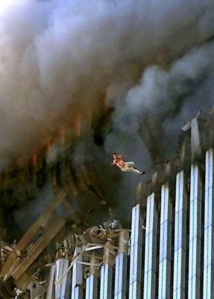
…would feel himself so honored had he known that one day, in his memory, rising up in place of the building from which he plummeted, would arrive what could perhaps be thought of as a festival of the victorious posing itself as a canto to the dead. They say that in such moments as this, captured in the frame above, your whole life passes in front of your eyes. And truly I can only believe that at some point on the way down, free-falling past the office windows one by one, there came over him a sense of heightened consciousness, a moment of consummate awareness, of celestial, perhaps even omniscient realization, when the question mark in his mind turned into… an exclamation point!
Sea level rise tipping points
By Rud Istvan | Climate Etc. | May 18, 2014
Sea level tipping points are a popular CAGW/media theory, easily suggested by images of calving icebergs and summer meltwater rushing down Greenland moulins. But they are alarmist precautionary mitigation fantasies rather than remotely possible future scenarios on multi-centennial time scales.
The core tenant of catastrophic anthropogenic global warming (CAGW) is that rising CO2 will raise temperatures and result in various catastrophes. IPCC, UNFCC and now the US NCA have argued this requires immediate drastic collective mitigation. Nature has not co-operated. Temperatures stopped rising (the pause), extreme weather did not increase (IPCC SREX), Australian drought turned to flood, Tuvalu has not disappeared, and polar bears thrive. So AR5 WG2 finally said adaptation might be a better response.
About the only urgent immediate mitigation rationale left is the precautionary principle: take expensive actions as just in case ‘insurance’. Precautions against some ‘tipping point’ beyond which the world is rapidly, disastrously, and irreversibly affected, which point at any cost we therefore dare not risk passing. No price is too high to pay to avoid a catastrophic tipping point according to this precautionary principle. Bad economics piled onto bad science.
One of the most marketed tipping points is sea level rise (SLR). The problem with ‘sudden’ SLR is that it did not happen in the Eemian interglacial. But that does not say it might not with CAGW added to this one, the Holocene.
There are only three ice bodies with enough water to cause a potentially rapid and large sea level rise. These are the Greenland, East Antarctic, and West Antarctic Ice Sheets. Since Antarctica as a whole may (inconveniently for CAGW) be accumulating ice [i], Greenland has been the ‘tipping point’ most frequently mentioned by official agencies [ii] and by the MSM. [iii]
There is no doubt that Greenland is losing ice mass, and at a recently increased rate. This has been measured in different ways (ice melt boundary, gravity (GRACE), iceberg calving… The ‘consensus’ is about 170- 200 Gt per year recently, but about 100Gtpy over satellite era Arctic cycles since the estimated loss was only about 7Gtpy in the 1990s.[iv] Winter snow accumulation is as important to net ice mass balance as the summer melt.
The observed mass loss should be put into perspective. According to the Byrd Polar Research Center the Greenland Ice Sheet comprises 2.62-2.93 E+6 km3. That is a total mass of about 2.67E+18Kg (uncertainty on volume, and uncertainty on density—firn, moulins, entrained air). A gigaton is E+12Kg. Greenland is estimated to be losing about E+14Kg per year averaged over two decades. At that rate, it would take about (2.67 E+18kg mass/E+14kg average annual mass loss) 27000 years to melt/sluff. Even the recent accelerated rate (if continued) would take over 14000 years.[v] That is longer than it took the great Laurentide Ice Sheet to disappear at the end of the last ice age. If Greenland ever did melt it would raise sea level by 6.7 meters. Even at the faster melt rate this would be (670 cm/140 centuries) 4.8 cm/century of sea– an additional 0.5mm/yr—more adaptation than mitigation.
It is unlikely that Greenland will melt. NEEM showed northwest Greenland was +5-8°C above the present for about 7 millennia during the Eemian. True, more ice melted there then than has up to now in the Holocene. The NEEM site cored ‘only’ 2537 meters of ice. At end of the Eemian the NEEM location ice was about 130 meters lower—‘only’ ≈2400 meters thick.
The only way a centennial or even millennial Greenland tipping point would be possible is if much of its ice ‘slid off’. It is true that the outer ice sheet edges are glaciers creeping seaward and sluffing—calving icebergs like the one that sank the Titanic in 1912 (before AGW). But it is not true that most of the Greenland ice sheet could ever creep off, since the underlying bedrock is bowl shaped. The most graphic 3D visualization is from Bamber, University of Bristol.

The thickest ice is over the deepest part of a bedrock bowl 1000-2500 meters deep, e.g. at the NEEM site. It is not going anywhere anytime soon. That ‘bowl’ interior is where the Greenland Sheet has been accumulating even as the edges sluff/melt. Creep decline becomes increasingly self-limited by underlying geology.

Greenland losing all its ice is geophysically impossible on millennial time scales, since it has to melt. Not something to worry about at all on centennial time scales, even as an implausible black swan or dragon king.
With Greenland geologically debunked as a possible SLR tipping point, attention turned to Antarctica. Whether Antarctica in total is gaining or losing ice is a matter of dispute between NASA and NOAA. Current NOAA ice loss is:

WAIS losing, EAIS gaining, the Peninsula about even. So any tipping point has to be sought in West Antarctica (WAIS). The general WAIS slope is from the Transarctic Mountain divide down to the sea, although some is anchored by the Executive Committee and Ellsworth mountain ranges.

Potential WAIS instability has been the subject of much scientific scrutiny. The original concerns were the large below sea level grounded portions of the Ronne (which is not part of WAIS but is still mostly in the Western half of Antarctica) and Ross ice shelves. (Floating shelf ice cannot further raise sea levels.) These have the largest volumes of ice creeping toward the sea. Like Greenland, much of the rest (and most of EAIS) is land anchored by underlying bedrock topology. On an annual basis fresh snow still replenishes most of the lost edge mass inland at higher WAIS elevations. It is the net mass balance along these seaward sloping WAIS ice sheet edges that might constitute sufficiently large tipping points.
 Ronne (1) is net gaining ice mass according to NASA. So it isn’t a plausible tipping point. Ross (19) might or might not be losing ice, but it is what ‘holds back’ almost half of WAIS. Ross also has more ice grounded deeper on the seabed, which if ungrounded (melted from below), would raise sea levels more. For years Ross was the main WAIS instability ‘tipping point’ concern.
 The ANDRILL program was designed to look at the underlying Ross seabed (both where the ice is grounded below sea level, and where it is floating shelf) to understand its behavior in previous interglacials. Andrill cores and creep rates suggest it has not before (well, for at least 3 million years and the entire Pleistocene Ice Age) and likely will not now collapse. The Ross shelf’s seaward creep has decelerated. [vi],[vii] Ross had bedrock islands ‘anchoring’ its grounded ice, retarding seaward creep. [viii] So Ross is not a plausible tipping point after all.
So 2014 attention turned to the only other possibility, the Amundsen Embayment, which is indisputably losing ice at an accelerating rate. Abetted by additional NASA PR and author interviews (Rignot of NASA JPL “Already gone into irreversible retreat, past the point of no return”), MSM alarmist headlines were, well, alarming. Reuters reported worldwide: “West Antarctic Glaciers in irreversible thaw: rising seas” CNN said: “Ice melt in part of Antarctica ‘appears unstoppable’, NASA says”
The MSM did not read these new papers carefully or in context (if at all). The first paper found Pine Island (22) plus Thwaites (21) plus the four lesser Amundsen Embayment glaciers are discharging ice more rapidly than all of Greenland (together ±330Gtyr). That is surprisingly 3-4x higher than any previous estimate, for example those also from NASA in 2011 shown above. The second paper used computer models of Thwaites (21) bottom melting to conclude it couldbecome unstable in 200 to 900 years. If so, the computer models suggested 1mm/yr of additional SLR thereafter. Not ‘in coming decades’ as Reuters said and NASA PR implied.
There is a deeper comprehension problem in this new NASA sponsored version of a SLR tipping point. The NASA NEWS about these papers says the Embayment region contains enough ice to raise global sea level by 4 feet (1.2 meters). That is true for the entire catchment basin of about 360,000 km2. [ix]For 1.2 meters of SLR, the entire catchment would have to become entirely ice free. That is highly unlikely. The interior portions are not flowing much toward the sea according to the first paper itself, and are also still accumulating ice. [x], [xi]

Sea level tipping points are a popular CAGW/media theory, easily suggested by images of calving icebergs and summer meltwater rushing down Greenland moulins. But they are alarmist precautionary mitigation fantasies rather than remotely possible future scenarios on multi-centennial time scales.
AR5 WG2 had it right that the best response to SLR is adaptation. Major coastal cities like New Orleans (3-10mm/yr), Jakarta (6-22mm/yr), and Bangkok (10-28mm/yr) are already subsiding at much faster rates than sea levels are or will foreseeably be rising.
Featured Video
Iran’s Next Strike May Not Explode. It Could Shut You Down
or go to
Aletho News Archives – Video-Images
From the Archive
Zionism’s Violent Legacy
By Donald Neff | Washington Report On Middle East Affairs | January 1996
On January 4, 1948, Jewish terrorists drove a truck loaded with explosives into the center of the all Arab city of Jaffa and detonated it, killing 26 and wounding around 100 Palestinian men, women and children.[1] The attack was the work of the Irgun Zvai Leumi – the “National Military Organization,” also known by the Hebrew letters Etzel – the largest Jewish terrorist group in Palestine. The Irgun was headed by Revisionist Zionist Menachem Begin and had been killing and maiming Arabs, Britons and even Jews for the previous ten years in its efforts to establish a Jewish state.
This terror campaign meant that at the core of Revisionist Zionism there existed a philosophical embrace of violence. … continue
Blog Roll
 Aletho News
- Riyadh Says Its Oil System Is Intact. The Numbers Say Otherwise.
- Trump and Netanyahu Want to “Finish the Job” on Iran
- US ‘one-sided dictation’ not Iran’s beliefs makes rational talks impossible: Baghaei
- Iran’s Next Strike May Not Explode. It Could Shut You Down /Col Doug Macgregor
- Iran: US political targets legitimate if assassinations return
- Iraq shuts key border crossing with Iran under US pressure: Report
- Undersea Internet cables could be targeted in retaliation for attacks on Iran: IRGC deputy chief
- EU sending ‘biased’ observers to interfere in Serbian election – president
- White House envoy declares kinetic action against Yemen ‘fruitless’
- Ukraine deployed thousands of microdrones in Iraqi Kurdistan: Tasnim
- If Americans Knew
- Americans at National Conservatism Conference held in Israel this year criticize Israel
- Christiane Amanpour exits CNN with a legacy shaped by the debate over Israel
- Israel’s war on Iran is the final move in a decades-old strategy
- Israel Denies Entry to French Journalist, U.S. Researcher Amid Rise in Entry Denials
- Gaza’s hospitals are running out of life-saving fuel – Daily Update
- Mysterious bot accounts reportedly spread fake ‘man on the street’ videos for Michigan Senate candidate
- Israeli Defense Minister Katz Says Over 60 Lebanon Villages Have Been Destroyed
- Why Is Israel Running TV Ads in Iowa Ahead of the Midterms?
- Hind Rajab’s Alleged Killer Is in the United States. HRF Demands His Arrest.
- US Officials Face Fresh Pressure After Another American ‘Brutalized’ by Israeli Settlers in West Bank
- No Tricks Zone
- E-Cars Reduce CO2 Emissions By Only 41% Compared To Internal Combustion Engine Vehicles
- Predictions Made By Renowned Climate Professor Over Past Decades Have Been Proven To Be Poor
- New Study Suggests Large Regions Of The Pacific Ocean Have Been Cooling For The Last 80 Years
- Germany’s Green Energy Debacle: High Energy Costs Force Kahla Porzellan to Close After 182 Years!
- New Study: 50 Years Of The Most Aggressive ‘Net Zero’ Policies Can Only Affect The Global Climate By 0.03°C
- US September “Heat” Was No Record…Many Records Set Decades Ago
- Latest European Green Energy Debacle; Portugal’s Largest Flagship Solar Park Insolvent!
- Green Energy Debacle: German Expert Professor Fritz Vahrenholt Warns Of Severe Economic And Social Consequences
- Two More Paleo Reconstructions Affirm Meters-Higher Sea Levels Across Ireland, Brazil 7000-6000 Years Ago
- New Study: Earth And Venus Surface Warmth Largely Explained By Convection And Lapse Rate, Not CO2 Or Radiation

